 Chat with
this content: Summary, Analysis, News...
Chat with
this content: Summary, Analysis, News...
 Subscribe on LinkedIn


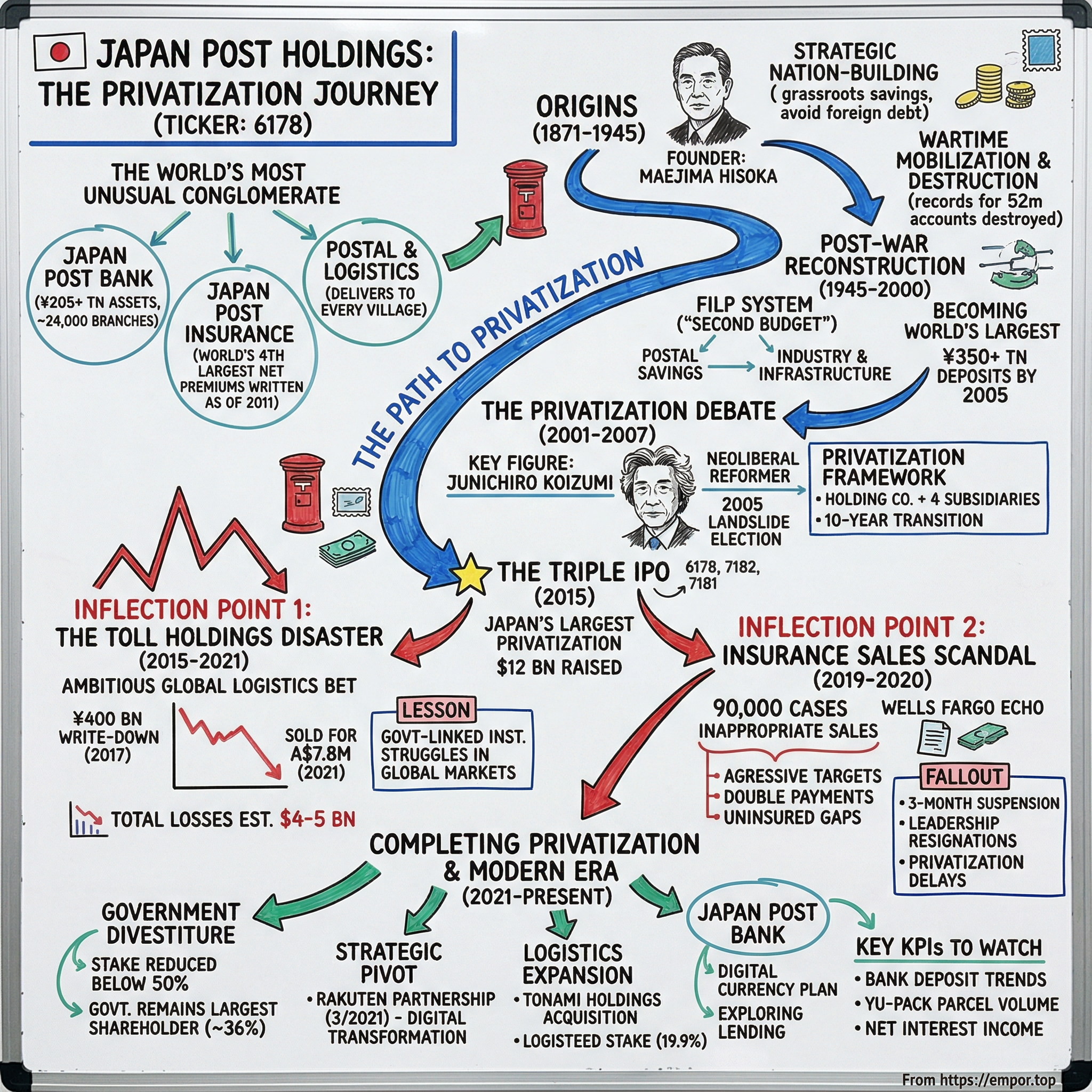
Japan Post Holdings: The Privatization of Japan's Financial Backbone
The World's Most Unusual Conglomerate
Picture a single institution that delivers letters to every village in a mountainous archipelago, holds enough deposits to rival the GDP of mid-sized nations, sells life insurance through local post office clerks, and at one point financed a significant portion of Japan's post-war industrial miracle. This is Japan Post Holdings—a 150-year-old institution that defies easy categorization.
Japan Post Bank manages over ¥205 trillion of assets and offers services in almost 24,000 branches across Japan. At times in its history, it was the largest financial institution in the world. Today, it remains one of the most consequential enterprises in the developed world, yet outside Japan, it barely registers in the investment consciousness.
How did a post office become a financial colossus? Why did it take two decades—and a constitutional crisis—to partially privatize it? And what does its tortured path to public markets reveal about the relationship between state institutions and free markets in the world's third-largest economy?
The answer touches on some of the most fascinating themes in business history: the role of savings in nation-building, the political economy of privatization, the challenges of managing sprawling conglomerates, and the tension between social obligation and shareholder value. Japan Post Holdings is a Japanese publicly traded conglomerate headquartered in Kasumigaseki, Chiyoda, Tokyo. It is mainly engaged in postal and logistics business, financial window business, banking business and life insurance business.
This is the story of Japan Post Holdings.
Origins: The Birth of Japan's Postal System (1871-1945)
A Young Reformer's Journey
In 1870, a 35-year-old Japanese bureaucrat named Maejima Hisoka stepped off a ship in London, commissioned by the Meiji government to study the workings of the British postal system. At 36, Hisoka Maejima (1835–1919) founded Japan's postal system. Yet, this was just one of his many pursuits that helped to realize a modern Japan.
What Maejima found in Britain was more than an efficient mail delivery network—he discovered a revolutionary concept that would reshape his nation's financial infrastructure. Maejima personally coined the Japanese word for postage stamp (kitte). To make the system self-supporting, and to extend the modern economic system into the Japanese countryside, Maejima also created a system of postal savings banks in 1874. This system expanded to include money orders in 1875.
Baron Maejima Hisoka (前島 密; January 24, 1835 – April 27, 1919), born Ueno Fusagorō, was a Japanese statesman, politician, and businessman in Meiji-period Japan. Maejima founded the Japanese postal service, and is known as Yūbin Seido no Chichi (郵便制度の父), or "Father of the Postal System".
Born in present-day Niigata Prefecture, Maejima was a true polymath of the Meiji era. He was sent to Edo to study rangaku, medical science and English. In the Bakumatsu period he was considered a radical reformer and proponent of westernization. In 1866, he submitted an unsolicited proposal to shōgun Tokugawa Yoshinobu that Japan abolish the use of kanji (Chinese characters) in its writing system. He would go on to help establish what became Waseda University, found railroads, and start a newspaper—but his postal system remains his defining legacy.
Upon his return to Japan in 1871, The Japanese post office began operation in April 1871 with a daily service linking Tokyo with Osaka, with 65 post offices in between. Maejima launched the Yūbin Yakusho (郵便役所) postal service on April 20, 1871, with a single daily route between Tokyo and Kyoto. That day, the country's first postboxes made their debut. They were simple wooden containers mounted on stands, known as shojō atsume bako (書状集め箱), or "letter collection boxes".
Strategic Role in Nation-Building
The postal savings system wasn't merely a convenience for Japanese citizens—it was a strategic weapon in Meiji Japan's race to modernize. The importance of the Japanese postal banking system lies not just in providing a savings vehicle and financial services to the people of Japan, but also in the use of the saved funds to promote economic development throughout modern Japan's history. Postal savings were first deposited at Dai-Ichi National Bank, a private bank of issue, but starting in 1878 deposits were made to Ministry of Finance, which became the exclusive destination for deposits in 1884. This was during the Meiji era, when the Japanese government was focused on encouraging economic and military modernization and avoid foreign debt to remain independent during a period of Western colonialism.
The context is crucial: Japan was surrounded by examples of Western colonial subjugation. A particular concern was foreign debt, as observers in Japan saw indebtedness in countries like China and Egypt leading to their subordination to their creditors.
By channeling the savings of ordinary citizens through the postal network into government coffers, Japan could finance railroads, telegraph systems, and industrial development without becoming dependent on foreign capital. This was financial sovereignty through grassroots savings—and it worked. However, this transformation required large amounts of capital to finance as railways, communications systems and industrial development in a country with a low savings rate because a large majority did not see money as something to be saved and invested. Postal banking became a success, and by 1885 it had 1.25 million depositors who could make financial transactions at around 4500 post office branches. At the beginning, deposits were lent exclusively to the government through the purchase of government bonds.
The genius of the system lay in its accessibility. Post offices existed in every corner of Japan, bringing formal banking to rural communities that private banks would never serve profitably. For farmers, shopkeepers, and workers, the local post office became their first and often only relationship with the formal financial system.
Wartime Mobilization and Destruction
The postal savings system reached its darkest chapter during World War II. The system that Maejima had designed to build Japan now became an instrument of war finance. The banking system was in complete disarray immediately after the war. The savings rate became negative as depositors withdrew money that had lost significant value during wartime inflation. Records for 52 million accounts were destroyed in war damage. Finally, ¥6 billion of investments by the postal savings system in overseas colonial territories vanished as the government struggled to control the domestic economy.
The destruction of records for 52 million accounts represents an almost incomprehensible administrative catastrophe. The postal savings system—Japan's primary vehicle for household savings—emerged from the war with both its infrastructure and its archives in ruins.
Yet this destruction would prove to be the foundation for an even more ambitious rebuilding.
Post-War Reconstruction & The Rise of a Financial Giant (1945-2000)
Rising from the Ashes
In the immediate aftermath of Japan's surrender in August 1945, the nation faced challenges that seemed insurmountable. Cities lay in ruins. Industrial capacity had been devastated. And the financial system that had channeled savings into war production now needed to do the opposite—rebuild a peaceful economy.
Under U.S.-led occupation reforms, including the 1946 currency redenomination and the 1949 Dodge Line austerity measures, the postal network was rehabilitated as a trusted conduit for rebuilding savings habits, with deposits rebounding to support reconstruction via government bonds and early precursors to the Fiscal Investment and Loan Program (FILP). By 1950, postal savings had stabilized, amassing funds that grew steadily to comprise a significant share of household deposits, enabling directed investments in infrastructure and industry during the 1950s recovery phase. This resurgence underscored the system's resilience, leveraging its nationwide branch network—relatively intact in rural areas—to foster high personal savings rates averaging 15–20% of disposable income by the mid-1950s.
The postal savings system played a unique role in this recovery. Unlike private banks, which could choose where to lend, postal deposits flowed to the Ministry of Finance and from there into directed investments in priority sectors.
The FILP System: Japan's "Second Budget"
During the Allied Occupation of Japan, deposits into the postal savings system were allowed to be invested only in government and municipal bonds and private financial institutions were mainly responsible for issuing capital. After a revision in public financing in 1951, due to the need for funds for both rebuilding and the Korean War, funds could once again be deposited at the Ministry of Finance and invested in industry through the Fiscal Investment and Loan Program (FILP). Financial corporations were established by the government to make loans to government and industrial bodies which contributed to rapid industrial development and economic growth. From the 1953, the funds distributed through FILP totaled one-half to one-third of the national budget.
The Fiscal Investment and Loan Program became known as Japan's "second budget"—a massive pool of capital, invisible to most citizens, that financed highways, railways, housing, and industrial development. Japan's Fiscal Investment Loan Programme (FILP), also known as the second budget, was a policy-based public finance system through which traditionally the national government transmitted the accumulated savings of small investors to dedicated governmental and quasi-governmental organizations for investment in projects and programmes designed to achieve prescribed national economic and social (and party political) objectives.
Historically, the postal savings system—predecessor to Japan Post Bank—served as the dominant funding source for the Fiscal Investment and Loan Program (FILP), channeling household savings into government-directed investments for infrastructure, housing, and public enterprises. Established in 1875, postal savings amassed enormous sums, reaching ¥213 trillion by March 1996, the largest financial institution globally at the time, with funds mandatorily deposited into the Ministry of Finance's Trust Fund Bureau for allocation via FILP loans and equity investments. From 1975 to 2000, postal savings provided the bulk of FILP's non-tax revenue, supporting Japan's post-war industrialization and economic expansion by financing policy objectives such as small business loans, energy security, and regional development, often at below-market rates to public corporations.
The scale of this system is difficult to comprehend. As of 1999, when its deposits peaked, the amount of outstanding deposits was 260 trillion yen (approximately $2.4 trillion), 37% of total household deposit holdings and more than a half of Japan's Gross Domestic Product).
Becoming the World's Largest
From the 1950s, postal savings experienced steady growth and increased its market share relative to private banks, thanks to the huge availability of postal offices, attractive financial products offering good returns and preferential tax treatment on deposits from the government.
By the 1990s, the postal savings system had grown into something without parallel in the developed world. It was simultaneously:
- The largest holder of household savings in Japan
- The primary funder of government debt
- A network of 24,000+ post offices serving as the banking backbone of rural Japan
- A major life insurer with policies held by millions of households
By the late 1990s, Japan Post had amassed vast financial assets through its postal savings and life insurance operations, with deposits totaling approximately 350 trillion yen (around $3 trillion USD) by 2005, representing over one-third of Japan's household savings. These funds, collected via a network of over 24,000 post offices offering government-guaranteed accounts, were primarily channeled into the Fiscal Investment and Loan Program (FILP), which financed public infrastructure and enterprises, often with low returns and political favoritism toward Liberal Democratic Party (LDP) constituencies. This structure distorted private capital markets by crowding out commercial banks and insurers, as Japan Post's risk-free appeal and state backing suppressed competition and innovation in financial services.
This extraordinary growth came with a cost. Private banks complained bitterly that they couldn't compete against a government-backed institution offering guaranteed deposits. Economists worried that the FILP system had become a vehicle for pork-barrel politics rather than efficient capital allocation. And the sheer size of the postal system—employing hundreds of thousands and operating in every community—made it a formidable political force resistant to change.
The stage was set for one of the most consequential political battles in modern Japanese history.
The Privatization Debate: Koizumi's Political Gamble (2001-2007)
Setting the Stage
Privatization of the postal system in Japan was first considered in the 1980s under Prime Minister Nakasone, who, amid concerns about the government deficit, oversaw the privatization of three major public corporations: the Japanese National Railways, Nippon Telegraph and Telephone (NTT), and Japan Tobacco. These discussions did not proceed, and in 1997 the issue of privatizing Japan Post Bank specifically was raised again under Prime Minister Hashimoto. This time, opposition from within the ruling and opposition parties resulted only in reforms aimed at improving financial discipline that fell short of actual privatization.
By the late 1990s, Japan was mired in what economists called the "Lost Decade"—a prolonged period of stagnation following the collapse of the asset bubble. The postal savings system had become a focal point for criticism: its deposits funded inefficient public corporations, its guaranteed rates distorted private markets, and its sprawling bureaucracy seemed emblematic of everything wrong with Japan's rigid economic structure.
Enter Koizumi
Junichiro Koizumi (/kɔɪˈzuːmi/ koy-ZOO-mee; 小泉 純一郎, Koizumi Jun'ichirō; born 8 January 1942) is a Japanese retired politician who served as Prime Minister of Japan and president of the Liberal Democratic Party (LDP) from 2001 to 2006. He retired from politics in 2009. He is the sixth-longest serving Prime Minister in Japanese history. Widely seen as a maverick leader of the LDP upon his election to the position in 2001, Koizumi became known as a neoliberal economic reformer, focusing on reducing Japan's government debt and the privatisation of its postal service.
Koizumi was an unlikely revolutionary. A third-generation politician from the Liberal Democratic Party—Japan's dominant conservative party since 1955—he nonetheless positioned himself as an outsider determined to destroy the very power structures that had nurtured his career. Postal privatization became his signature issue, a crusade he had championed since his days as Posts and Telecommunications Minister in 1992.
Upon taking office in April 2001, Koizumi targeted the postal system's integrated services—encompassing mail delivery, savings deposits exceeding ¥200 trillion, and life insurance policies totaling around ¥120 trillion by the early 2000s—for their role in distorting private financial markets and subsidizing politically connected public works projects through directed lending. These assets, managed under a government monopoly since 1871, were seen as perpetuating fiscal burdens and shielding rural post offices from market discipline, with Koizumi arguing that privatization would liberate funds for productive private investment and reduce the system's vulnerability to political patronage.
Koizumi framed the debate in stark terms: Japan Post had become "an enormous source of corruption and patronage." Its deposits funded bridges to nowhere and propped up failing public corporations. Only by exposing it to market discipline could Japan's economy be revitalized.
The Political Battle
The opposition Koizumi faced came not from rival parties but from within his own LDP. The postal lobby—consisting of the 400,000 postal employees, the postmasters who often doubled as local party organizers, and the construction interests that benefited from FILP-funded projects—formed a formidable coalition.
General elections were held in Japan on 11 September 2005 for all 480 seats of the House of Representatives, the lower house of the Diet. Prime Minister Junichiro Koizumi called the election almost two years before the end of the term taken from the previous elections in 2003, after bills to privatize Japan Post were voted down in the upper house (which cannot be dissolved), despite strong opposition from within his own Liberal Democratic Party (LDP). The elections resulted in a landslide victory for Koizumi's LDP, with the party winning 296 seats, the largest share since World War II, and marked the first time the LDP had won an overall majority in the House of Representatives since 1990.
The privatization bills narrowly passed the lower house but were rejected by the upper house in August 2005, with dozens of LDP members voting against their own prime minister. In August 2005, Koizumi dissolved the lower house parliament and called an early election after rebels in his own party in the upper house rejected his postal reform bills by a vote of 125 to 108, with 30 LDP members either voting against the bill or abstaining. The bill only passed through the lower house by five votes a month before. The move was unusual in that Koizumi dissolved the lower house over a vote in the upper house.
Koizumi immediately dissolved the lower house and scheduled a general election to be held on September 11, 2005. He declared the election to be a referendum on postal privatization.
The 2005 election was the crowning achievement in Koizumi's campaign to save the LDP by attacking it. Koizumi undercut the party machine directly by reducing public works spending and indirectly by promoting reform of the postal finance system and the special public corporations that channel much of this spending. When members of his own party voted against his postal privatization bill in the Lower House last year, he threatened to dissolve the Lower House if LDP members prevented passage in the Upper House. When the bill failed, he not only called the election but also ousted those LDP Lower House members who had voted against the bill from the party and sponsored "assassin" candidates to run against them.
In the 2005 election, Koizumi led the LDP to win one of the largest parliamentary majorities in modern Japanese history. The September 2005 elections were the LDP's largest victory since 1986, giving the party a large majority in the House of Representatives and nullifying opposing voices in the House of Councilors. In the following Diet session, the last to be held under Koizumi's government, the LDP passed 82 of its 91 proposed bills, including postal privatization.
The Privatization Framework
Japan Post Holdings was to start as a state-owned holding company for Japan Post Bank, Japan Post Insurance, Japan Post Network, and Japan Post Service and gradually sell off its shares through 2017. The original plan was for the government to retain about a one-third ownership share of Japan Post Holdings, and for Japan Post Holdings to sell all its shares in its banking and insurance subsidiaries. Proceeds from the sale were to be used to reduce government debt.
The final version of the bill to privatize Japan Post in 2007 was passed in October 2005. It officially abolished Japan Post, with its branches broken up into a shareholding company and four other companies for postal service, postal savings, postal life insurance, and post office service networks. The legislation provided a 10-year transition period wherein the savings and insurance companies would be fully privatized while the government would still continue to be involved with the three other companies.
The privatization formally took effect on October 1, 2007, creating Japan Post Holdings as a holding company overseeing four distinct subsidiaries. What seemed like a decisive conclusion was, in fact, merely the opening act.
The Triple IPO: Japan's Largest Privatization (2015)
Delays and Political Reversal
In 2009, the Democratic Party of Japan took power and halted the initial public offering for Japan Post companies. In 2012, the administration went further in blunting some aspects of privatization, allowing the government to maintain indefinite control over Japan Post Holdings by stipulating a minimum of one-third shares to be owned by the government.
The DPJ's rise to power represented a fundamental shift in Japanese politics—the first time since 1955 that a party other than the LDP controlled the government. The new administration viewed postal privatization skeptically, concerned about service cuts to rural areas and job losses among postal workers. Progress stalled.
Abenomics Revival
In late 2012, incoming Prime Minister Shinzo Abe reemphasized progress towards privatization as part of his Abenomics plan for economic reform and growth. It was also hoped that the sale of shares could raise funds for rebuilding after the Great East Japan Earthquake. One result was the expediting of the IPO process for Japan Post companies.
The devastating 2011 Tōhoku earthquake and tsunami had left Japan with enormous reconstruction costs. Selling shares in Japan Post offered a way to raise funds without increasing taxes. Under Prime Minister Abe, the IPO process was revived and accelerated.
The Historic Triple Listing
On November 4, 2015, Japan Post Holding (TYO: 6178) was listed on the Tokyo Stock Exchange as part of a "triple IPO" (initial public offering) with shares offered as well in Japan Post Bank (TYO: 7182) and Japan Post Insurance (TYO: 7181). About 10% of the shares in each company were offered.
The offering was met with strong demand from the Japanese public, to whom Japan Post Holdings and its subsidiaries were a trusted, recognized name. Raising JPY1.35 trillion (nearly US$12 billion), the IPO was the largest of the year and the biggest since Alibaba's 2014 debut.
By 2013, Japan Post Holdings' banking subsidiary was the largest retail bank in the country measured by savings and deposits, and they had diversified into insurance and other financial services, becoming a crucial arm of the Japanese state. 2015 marked the culmination of a plan nearly a decade in the making to privatize the massive, multi-pronged public institution. Initiated under the leadership of then-Prime Minister Junichiro Koizumi, the plan reached its fruition under Prime Minister Shinzo Abe.
The IPO was structured to appeal to Japanese retail investors—80% of shares were reserved for domestic buyers. The postal business, Japan Post Holding, eventually opened up 15.5 percent at 1,617 yen, against an IPO price of 1,400 yen per share. Japan Post Bank also jumped more than 15 percent to 1,652 yen, from an IPO price of 1,450. Shares in the parent company Japan Post Holdings closed around 26% higher than the initial public offering price of 1,630 yen at the close of trading in Tokyo Wednesday. Its other two listed units—Japan Post Bank and Japan Post Insurance—closed up 15% and 56%, respectively.
"Through privatisation, we can play a role in revitalising the Japanese economy," Japan Post president Taizo Nishimuro told reporters after ringing a bell at the Tokyo Stock Exchange to start trading. The IPO comes more than a decade after Japan began privatising its postal system and the postal banks that are the backbone of the country's massive household savings pool.
The triple IPO represented a triumphant moment—Japan had successfully brought to market its largest state-owned enterprise, raising funds for earthquake reconstruction while signaling commitment to economic reform. But within eighteen months, the celebration would turn to crisis.
Key Inflection Point #1: The Toll Holdings Disaster (2015-2021)
The Ambitious Acquisition
Even as it prepared for its public listing, Japan Post Holdings was making a bold bet on global logistics. It appears as a result of Japan Post's purchase was driven by a sense of urgency to diversify its own business, not least due to pressure from the Japanese government. Looking in envy at DP-DHL, Japan Post thought of Toll Group as a platform to enter global logistics and desperately grabbed at the Australian company without sufficient forethought or research.
The overall Toll business was bought by Japan Post in 2015 for A$6.5bn, but its value was later written down due to weak performance. It peaked at $13.4 billion in 2015, the year once state-owned Japan Post paid a surprisingly high $6.5 billion for Toll, an Australian-based global transport company. The purchase was part of an ambitious bid to turn a privatised post office bank into a global logistics business.
The strategic logic seemed compelling: mail volumes were declining globally due to digital communication, while e-commerce was driving explosive growth in parcel delivery. Companies like Deutsche Post DHL had successfully transformed from national postal operators into global logistics giants. Japan Post sought the same transformation through Toll, which offered a network spanning 150 countries.
The Catastrophic Losses
On April 25, 2017, Japan Post Holdings said it would have a ¥40bn ($360m) loss for its first full financial year as a listed company, due to losses from Toll Group, which it controversially acquired in 2015. It will be the company's first net loss since its privatization in October 2007.
Japan Post acquired Toll in 2015, which was seen at the time becoming the core of the company's international operations. Toll has instead turned out heavy losses since then, leading Japan Post Holdings to book a roughly 400 billion yen ($3.54 billion) impairment charge in the year ended March 2017.
A ¥400 billion write-down—approximately $3.5 billion—on an acquisition made less than two years earlier. For a company that had just completed its IPO, the timing was catastrophic.
The Root Causes
An article in the 'Australian Financial Review' magazine published yesterday, September 30, said to be based on interviews with former managers within Toll Group, describes a strategically incoherent company with chaotic operations bought by a Japanese institution with no idea how to control its purchase. Toll Group was created through a string of acquisitions by Paul Little and Peter Rowsthorn over several decades and the structure of the company reflected this. Composed of numerous different businesses whose relationship to each other was often tenuous, the company held together under the founder's energy and charisma. According to the Australian Financial Review report, with the final departure of Mr Little the company rapidly broke-down into semi-autonomous fiefs that were difficult for the central management to control.
The problems were multiple and compounding:
-
Due diligence failures: Japan Post seemed to have been unaware of these problems when it bought Toll Group in 2015. According the report, Toll Group was on the brink of insolvency when the Japanese giant offered to buy the company for AUS$6.5bn.
-
Cultural mismatch: A conservative Japanese postal bureaucracy attempting to manage an Australian transport company built through aggressive acquisitions proved an impossible combination.
-
Integration chaos: The institution made a decision of immense importance under pressure and without fully understanding the nature of its acquisition. Even after Japan Post had bought Toll it seems to have little control over its management.
Fire Sale and Lessons
In April 2021, Japan Post Holdings agreed to sell part of its unprofitable Australian logistics company Toll Holdings for only 7.8 million Australian dollars. The offer was accepted despite the fact that Toll Holdings had lost 67.4 billion yen, or roughly $624 million, for the fiscal year which ended in March 2021.
But Japan Post has already written off $4.9 billion of its original purchase price and the Financial Review articles raise the prospect of up to another $4–5 billion being lost in a break-up or liquidation of the remaining business. That means the total loss from this one disaster could be more than the $8 billion average net annual Japanese direct investment in recent years.
The Toll disaster stands as one of the most expensive cross-border acquisition failures in corporate history. For Japan Post shareholders—including the Japanese government and millions of retail investors who had bought shares in the 2015 IPO—it represented a painful lesson in the risks of overseas expansion.
The failure also highlighted a fundamental question: Could a government-linked institution, staffed largely by career bureaucrats, successfully operate in the cutthroat world of global logistics? The Toll debacle suggested the answer was no.
Key Inflection Point #2: The Insurance Sales Scandal (2019-2020)
The Revelation
Just as Japan Post was absorbing the losses from Toll, a new crisis emerged—this time striking at the heart of its relationship with Japanese customers.
The revelation that Japan Post Insurance Co., which is under the umbrella of the Japan Post Holdings, has engaged in more than 90,000 cases of inappropriate sales to their customers is the largest scandal to hit the group since the 2007 privatization of the nation's postal services.
In December 2019, Japan Post Holdings and Japan Post Insurance were revealed to be involved in a large-scale illegal insurance sales scam targeting elder customers.
The Scale of Misconduct
The problems in question include roughly 22,000 cases in which customers made double payments on insurance premiums when they switched to new contracts, 47,000 cases in which customers were rendered uninsured when months passed before they signed new contracts after terminating their old ones and 24,000 cases that resulted in other disadvantages for customers.
Reportedly behind the improper sales were demanding targets set on the sales of insurance products by Japan Post Insurance. In cases in which customers made double payments on their old and new contracts, the salespersons are suspected of getting customers to delay canceling their old contracts for six months after signing the new ones to avoid having the latter classified as a switch-over. This would allow the salespersons to receive more credit for their sales performances. Similarly, customers were left uninsured for months when they were made to delay the signing of new contracts after canceling their old ones because a new contract signed within three months after canceling the old one would also be deemed a switch-over.
The scandal echoed the Wells Fargo fake accounts scandal that had roiled American banking—aggressive sales targets driving frontline employees to engage in practices that harmed customers. In 2019, there was a huge sales scandal involving Japan Post, the second largest life insurance company in Japan, for questionable sales practices as agents were under enormous pressure from their superiors to fulfill their sales quotas.
For Japan Post, the scandal was particularly damaging because trust was its core asset. The postal network's value lay precisely in its reputation as a reliable, government-backed institution that elderly Japanese could trust with their savings and insurance needs. That trust had now been betrayed.
Regulatory Fallout
The resignations came hours after Japan's financial regulator ordered a three-month suspension of insurance sales by two Japan Post units, saying it found examples of customers being sold unduly expensive policies, without proper explanation of what they were buying. The penalty applies to the group's mail and insurance subsidiaries, the Financial Services Agency added in a statement.
In December 2019, the heads of Japan Post Holdings announced that they will resign over the improper sales of insurance policies, after the regulator announced administrative punishments against the companies. The company said that Hiroya Masuda, a former minister of Internal Affairs and Communications, has been appointed as successor to current CEO Masatsugu Nagato.
The leadership purge was comprehensive: the CEOs of Japan Post Holdings, Japan Post Insurance, and Japan Post Co. all resigned to take responsibility. Hiroya Masuda has led Japan Post Holdings since early 2020. The new CEO had previously served in the public sector, as governor of Japan's northern Iwate Prefecture and later as Japan's Minister for Internal Affairs and Communications.
Impact on Privatization
The scandal directly affected the government's privatization timeline. At the end of 2019, the government had a 57% ownership stake in Japan Post Holdings, which still owns 90% of Japan Post Bank and Japan Post Insurance. With share prices depressed by the scandal, planned share sales had to be delayed.
Completing Privatization & Modern Era (2021-Present)
Government Divestiture
On October 6, 2021, the final stage of a difficult privatisation process which had begun in 2005 was completed after with the sale of a $9 billion tranche of shares. In October 2021, the Japanese government abandoned its majority ownership of the company, while also still maintaining the most stock.
In September 2017, the Japanese government announced its sale of $12 billion worth of Japan Post Holdings Co. Ltd. stock. It was the first sale since the 2015 IPO of the postal company and its two units, Japan Post Bank Co. Ltd. and Japan Post Insurance Co. Ltd.. That sale also raised $12 billion, which was used for the repair and reconstruction of places that were destroyed by an earthquake and tsunami in 2011.
Through multiple share sales between 2015 and 2021, the government reduced its stake below 50%, though it remains the largest single shareholder. Japan Post Holdings Co., Ltd. is... post office infrastructure, with the government retaining a controlling stake of approximately 36% as of mid-2024 to ensure universal service obligations amid ongoing divestment efforts.
Strategic Initiatives: The Rakuten Partnership
In March 2021, Japan Post Holdings announced that it would invest 150 billion yen or US$1.38 billion and take a 8 percent stake in internet conglomerate Rakuten.
Tokyo, March 12, 2021 – Japan Post Holdings Co.,Ltd., Japan Post Co., Ltd. and Rakuten, Inc. today signed a business alliance agreement to strengthen their collaborations across a range of fields, including logistics, mobile, digital transformation and more. In addition, Japan Post Holdings and Rakuten announced today that the two companies have signed an agreement for the allotment of shares through an investment in Rakuten by Japan Post Holdings aimed at strengthening ties between the Japan Post Group and the Rakuten Group.
But Masuda's desire for a 'chemical reaction' stemmed from a realization that a physical network alone would not lead the company into the future. "We are a company with a very strong physical presence. But the age of the internet is here. Everything is connected now." It's here that Rakuten's digital expertise could prove vital: "The biggest factor in choosing to partner with Rakuten was the Rakuten Ecosystem," he said. "We felt there was a lot of potential in the strongly digital nature of Rakuten's many services."
The Rakuten partnership represented a strategic pivot—rather than attempting to build global logistics capabilities through acquisition (the failed Toll strategy), Japan Post would deepen its domestic position by combining physical infrastructure with digital capabilities.
Recent Acquisitions and Logistics Strategy
Japan Post Holdings said on Wednesday that a subsidiary offered to acquire Japanese logistics company Tonami Holdings for about 92.6 billion yen ($619 million). TOKYO (Reuters) - Japan Post Holdings said on Wednesday that a subsidiary offered to acquire Japanese logistics company Tonami Holdings for about 92.6 billion yen ($619 million). The unit JWT will offer 10,200 yen for each share in Tonami, Japan Post said in a statement, a 74% premium to the company's closing price on Wednesday.
Japan Post Holdings Co., Ltd. announced the completion of a tender offer for Tonami Holdings Co., Ltd., which will become a consolidated subsidiary on April 17, 2025. Japan Post Holdings Co., Ltd. announced the completion of a tender offer for Tonami Holdings Co., Ltd., which will become a consolidated subsidiary on April 17, 2025. This acquisition, conducted through its subsidiary JWT Co., Ltd., signifies a strategic expansion in Japan Post's logistics capabilities, potentially enhancing its market positioning and operational scale.
The company has aggressively expanded its logistics and financial services segments. For instance, its acquisition of Tonami Holdings-a logistics and warehousing firm-signals a pivot toward high-growth areas like e-commerce fulfillment.
On 6th October, Japan Post Holdings Co., Ltd. announced that its subsidiary, Japan Post Co., Ltd., has decided to acquire 19.9% of the shares of LOGISTEED Holdings, Ltd.
Digital Transformation
In 2025, Japan Post bank announced a plan to issue a digital currency to revitalise its 190 trillion yen (US$1.29 trillion) deposit, which made it one of the largest fund holders in the country.
Japan Post Bank's 120 million accounts, holding $1.29 trillion in deposits, will be able to use the token for easier tokenized securities settlement. Japan Post Bank plans to adopt a tokenized asset network in FY2026, giving holders of 120 million accounts the ability to exchange their savings for a token that can be used for easier securities transactions.
Current State
As of today, Japan Post Holdings market cap is 4.08T. Japan Post Holdings has 218718 employees.
FY2025/3 Total assets were ¥233.5 tn as of March 31, 2025. As of March 31, 2025, Deposits were ¥190.4 tn, Liquid deposits were ¥125.9 tn, Fixed-term deposits were ¥64.3 tn. FY2025/3 Included in investment assets as of March 31, 2025, JGBs were ¥40.3 tn and foreign securities, etc. were ¥87.4 tn.
Net income attributable to Japan Post Holdings was ¥370.5 billion, an increase of ¥101.8 billion year-on-year.
Net income attributable to owners of parent increased by ¥58.1 bn year on year to ¥414.3 bn, which was record high profits in our history as a listed company for the second consecutive fiscal year.
Business Model Deep Dive
The Five Segments
Japan Post Holdings Co Ltd is a Japan-based company mainly engaged in postal and logistics services, post office counter services, international logistics, banking, and life insurance. The Company has five business segments. The Postal and Logistics segment is engaged in the postal business, the logistics business and others. The Post Office Counter segment includes counter services related to postal and logistics services, bank counter services, insurance counter services, merchandise sales, real estate business, and affiliated financial services. The International Logistics segment is engaged in the express, forwarding and logistics business in the global markets centered on Australia. The Banking segment is engaged in the banking business such as fund management, financing and other business. The Life Insurance segment is mainly engaged in the life insurance business.
Banking Segment (Japan Post Bank): The crown jewel of the group. As of March 2024, deposits at Japan Post Bank Co., Ltd. amounted to 192.8 trillion Japanese yen. Japan Post Bank is part of the Japan Post Group and operates more than 20 thousand branches all over Japan. As of the fiscal year ended March 2024, it allocated nearly 50% of its ¥192 trillion in deposits to overseas fixed-income securities and 23% to Japanese government bonds.
Life Insurance Segment (Japan Post Insurance): As of 2011, it was the world's fourth largest insurance company as regards net premiums written behind three European insurers and the largest as regards non-banking assets.
Postal and Logistics Segment: The traditional mail delivery business, now expanding into parcel delivery driven by e-commerce growth.
Post Office Counter Segment: The retail network of approximately 24,000 post offices that serves as the distribution channel for banking and insurance products.
International Logistics Segment: The remaining Toll Group operations focused on Asia-Pacific forwarding and logistics.
Revenue and Profit Dynamics
The economics of Japan Post Holdings reveal a fundamental tension: the postal business generates minimal profits while the financial services arms generate the overwhelming majority of earnings. The postal network exists partly as a distribution channel for banking and insurance products.
Japan Post remains profitable, but only thanks to fees paid by its banking and insurance units for operating inside post offices.
The volume of items handled decreased by 5.4% year on year due to a decrease in mail and Yu-Mail, despite an increase in Yu-Pack and Yu-Packet. Traditional mail volumes continue to decline as communication shifts digital, but parcel volumes grow with e-commerce.
Japan Post Bank: A Unique Financial Institution
Japan Post Bank Co. Ltd. is expected to explore building a lending business after its parent, Japan Post Holdings Co. Ltd., relinquishes majority control of the deposit-taking institution, a move that will challenge the quasi-government entity's transition to a full-fledged bank. Japan Post Bank will be free to pursue growth through new businesses once its parent's equity stake falls below 50% from the current 60%. The reduction is expected by the end of May. But analysts anticipate challenges, including competition from well-established private-sector banks and Japan Post Bank's continued focus on rural areas. Although the bank will gain autonomy over major decisions that previously required government approval, it currently operates as a deposit-taking institution and primarily invests in domestic and foreign government securities.
Japan Post Bank occupies an unusual position in global banking. It takes deposits—enormous amounts of deposits—but historically has made almost no loans to businesses or consumers. Instead, it invests primarily in government bonds and foreign securities. Japan Post Bank applied to enter the mortgage loan business in 2012 but withdrew its application five years later after facing opposition from private-sector banks.
The bank faces a strategic inflection point. But Japan Post Bank posted a decline in outstanding deposits, which fell to ¥192.1 trillion in December 2024 from ¥194.9 trillion a year earlier. With deposits declining and the yield curve normalizing after years of negative rates, the bank must diversify its business model or face gradual erosion.
Bull Case vs. Bear Case
The Bull Case
Unmatched Physical Network: Japan Post operates approximately 24,000 post offices covering every corner of Japan. This network is essentially irreplaceable—no competitor could build such infrastructure today. As e-commerce grows and last-mile delivery becomes more valuable, this network gains strategic importance.
Deposit Franchise: Founded in 1875, it has become one of the largest financial systems in the world with around 120 million savings accounts―one for nearly every person in Japan. Japan Post Bank holds roughly equivalent to one account per Japanese citizen. The trust accumulated over 150 years cannot be replicated.
Interest Rate Environment: After decades of near-zero rates, Japan's interest rate environment is normalizing. FY2025/3 Net interest income for the fiscal year ended March 31, 2025 increased by ¥240.9 bn year on year, mainly due to increases in income related to foreign bonds investment trusts, interest on Japanese government bonds and interest on Bank of Japan deposits. Higher rates mechanically improve banking profitability.
Record Profitability: Net income attributable to owners of parent increased by ¥58.1 bn year on year to ¥414.3 bn, which was record high profits in our history as a listed company for the second consecutive fiscal year.
Logistics Expansion: Recent acquisitions of Tonami Holdings and the LOGISTEED stake demonstrate renewed focus on domestic logistics growth—a more controllable strategy than the ill-fated Toll expansion.
Shareholder Returns: Dividend per share for the fiscal year ended March 31, 2025 is ¥58, an increase of ¥2 from the revised-upward dividend forecast announced on November 14, 2024. Dividend per share for the fiscal year ending March 31, 2026, taking into consideration the earnings forecasts and the shareholder return policy during the Medium-term Management Plan (FY2022/3 through FY2026/3), is planned to be ¥66, an increase of ¥8 from the fiscal year ended March 31, 2025.
The Bear Case
Structural Mail Decline: Traditional mail volumes continue their inexorable decline. No amount of efficiency can reverse the fundamental shift from physical to digital communication.
Aging Population: Japan's demographic profile—with over 30% of the population over 65—presents both opportunity and risk. Elderly customers are loyal but eventually decline. Younger customers increasingly prefer digital-native banks.
Government Overhang: Despite privatization, the government remains the largest shareholder and can impose constraints on strategy. Universal service obligations may prevent closure of unprofitable rural post offices.
Competition in Banking: "We strongly hope Japan Post Bank will ensure fair competition with other banks," the Japanese Bankers Association said in a Feb. 28 statement. As a government-backed institution, Japan Post Bank "receives more confidence from depositors than private banks," a spokesperson for the association said. Entry into lending would face fierce resistance from established banks and regulatory scrutiny.
Deposit Outflows: But Japan Post Bank posted a decline in outstanding deposits, which fell to ¥192.1 trillion in December 2024 from ¥194.9 trillion a year earlier. If this trend accelerates, the bank's primary asset erodes.
Execution Risk: The Toll disaster demonstrated Japan Post's limitations in complex integration. Even domestic acquisitions carry risk.
Applying Strategic Frameworks
Porter's Five Forces Analysis: - Threat of new entrants: Low in postal services (requires massive infrastructure), moderate in banking (digital banks emerging) - Bargaining power of suppliers: Low (highly fragmented labor and logistics suppliers) - Bargaining power of buyers: Moderate (customers have alternatives for most services) - Threat of substitutes: High for mail (email, digital communication), low for banking (few institutions offer comparable convenience for elderly) - Competitive rivalry: Intensifying in parcel delivery (Yamato, Sagawa), moderate in banking
Hamilton Helmer's 7 Powers: - Scale Economies: Significant—24,000 post offices provide unmatched distribution efficiency for banking and insurance products - Network Economies: Moderate—delivery network benefits from density - Counter-Positioning: Historically yes (government backing prevented private competition); diminishing as privatization continues - Switching Costs: High for elderly customers with longstanding relationships - Branding: Strong—150 years of trust - Cornered Resource: The nationwide post office network itself - Process Power: Limited—bureaucratic culture inhibits innovation
Key Performance Indicators to Watch
For investors seeking to track Japan Post Holdings' evolution, three metrics warrant close attention:
1. Japan Post Bank Deposit Trends: The ¥190+ trillion deposit base is the foundation of the enterprise. Quarterly changes in deposit levels—particularly the mix between liquid and fixed-term deposits—signal customer loyalty and competitive positioning. Accelerating outflows would suggest erosion of the franchise.
2. Yu-Pack Parcel Volume Growth: With traditional mail declining, parcel delivery must offset the loss. Yu-Pack volume growth relative to competitors (Yamato, Sagawa) indicates whether Japan Post is capturing e-commerce growth or losing share.
3. Japan Post Bank Net Interest Income: As interest rates normalize, the bank's ability to improve margins on its massive asset base becomes crucial. This metric also reflects success in diversifying from purely government bond holdings into higher-yielding investments.
Conclusion
Japan Post Holdings embodies the contradictions of modern Japan. It is simultaneously a relic of 19th-century nation-building and a 21st-century conglomerate navigating digital disruption. It serves rural communities that private enterprise would abandon while generating returns that satisfy capital markets. It traces its origins to a visionary reformer's observations in Victorian London yet struggles to adapt to a world Maejima Hisoka could never have imagined.
The privatization journey that began with Koizumi's crusade in 2001 remains incomplete. The government retains significant ownership. The universal service mandate constrains cost-cutting. The cultural DNA of a government bureaucracy persists even as the company operates as a public corporation.
Yet the fundamentals are compelling: a deposit franchise of extraordinary scale, a physical network without peer, and a trusted brand that few institutions anywhere can match. The question is whether management can translate these advantages into sustainable shareholder value or whether they will gradually erode under competitive pressure and demographic decline.
For patient investors willing to understand its complexities, Japan Post Holdings offers exposure to one of the most consequential privatization stories in economic history—one that is still being written.


 RSS Feed
 Spotify
 Apple Podcasts
 Amazon Music
 Audible
 YouTube