 Chat with
this content: Summary, Analysis, News...
Chat with
this content: Summary, Analysis, News...
 Subscribe on LinkedIn


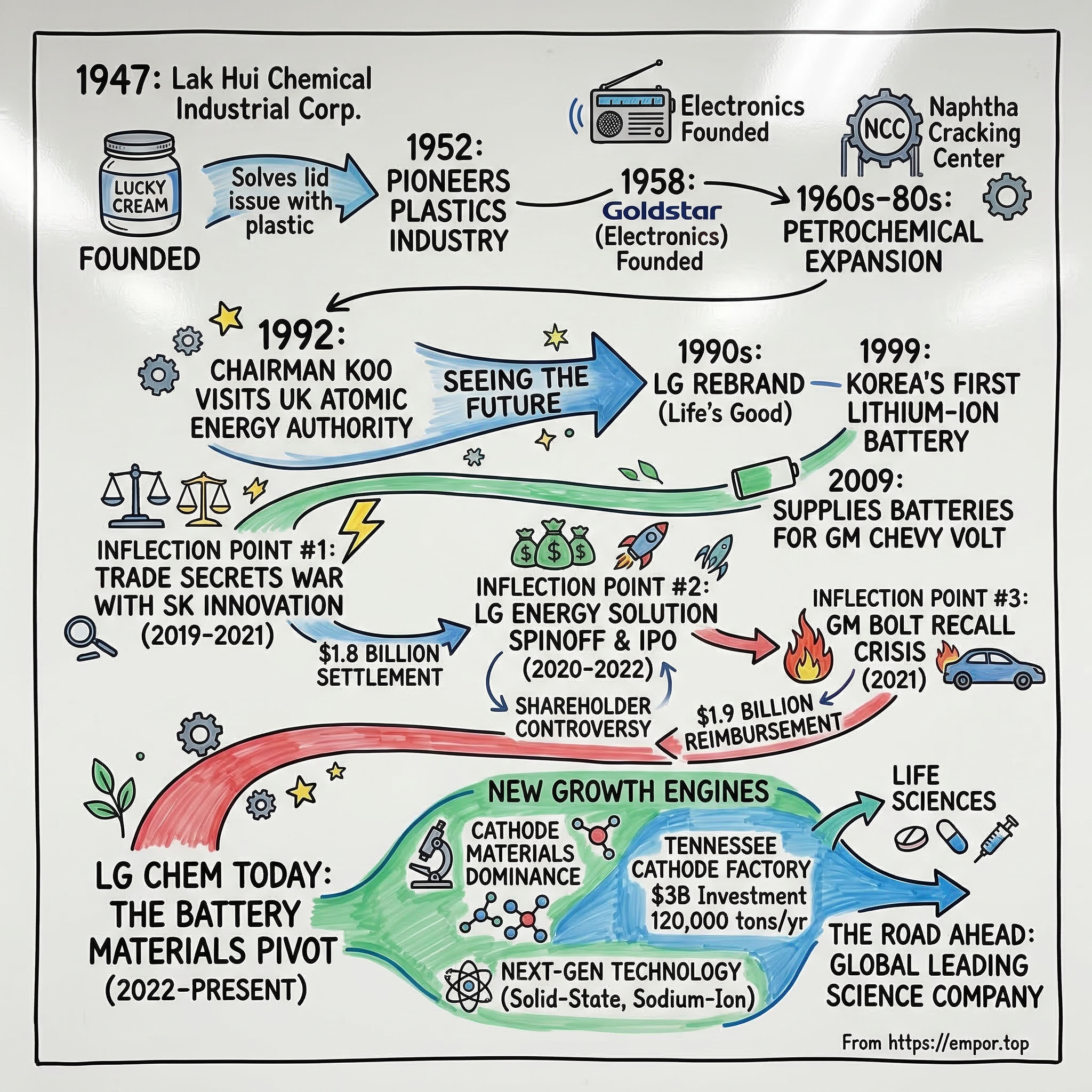
LG Chem: Korea's Chemical Pioneer and the Battery Revolution
I. Introduction: From Lucky Cream to Lithium-Ion
Picture Seoul in 2022. A line of retail investors snakes around the block, smartphones clutched in anxious hands, ready to place bids worth hundreds of billions of won on a company that, seventy-five years earlier, began by selling jars of face cream to post-war Koreans. The world's second-largest battery maker's IPO attracted bids worth $13 trillion, underscoring upbeat prospects for the electric vehicle industry. This wasn't some Silicon Valley unicorn—this was the battery spinoff of Korea's oldest chemical company, a business whose story mirrors the improbable rise of South Korea itself.
LG Chem Ltd., often referred to as LG Chemical, is the largest Korean chemical company and is headquartered in Seoul, South Korea. It was the 9th largest chemical company in the world by sales in 2021. But that ranking barely scratches the surface of what LG Chem actually represents. Today, the company specializes in three core business areas: petrochemicals, advanced materials including lithium-ion battery components, and life sciences focused on pharmaceuticals and innovative drugs.
The central question of this deep dive: How did a cosmetics cream company founded in post-war Korea become a linchpin of the global EV revolution? And now that it has spun off the very business that made it famous—the battery division that became LG Energy Solution—what exactly is LG Chem's identity, and why should investors care?
For 2024, LG Chem reported consolidated revenue of KRW 48.9161 trillion, with revenue decreasing by 11.46% and operating profit by 63.75% compared to the previous year. Those numbers include the now-publicly-traded LG Energy Solution. Strip that out, and you're looking at a company undergoing one of the most dramatic strategic pivots in Korean industrial history—from a petrochemical-centric portfolio toward battery materials, sustainability businesses, and innovative new drugs.
CEO Shin Hak-cheol announced at the BofA 2023 Korea & Global EV/EV Battery conference that LG Chem aims to grow its battery materials sales sixfold to KRW 30 trillion (USD 25.5 billion) by 2030, from KRW 4.7 trillion (USD 3.9 billion) in 2022. Sales from the three sectors which the company is counting on to power its growth—battery materials, sustainability business and innovative new drugs—is expected to make up 57% of the company's total sales in 2030.
This is a story of three generations of one family, three major corporate reinventions, and three existential crises—from Japanese occupation to the trade secrets war with SK Innovation, from GM Bolt battery fires to the controversial decision to spin off and IPO its crown jewel. Let's begin where all great Korean chaebol stories begin: in the chaos of post-war reconstruction.
II. Origins: Post-War Korea & The Lucky Story (1945-1960s)
The Founder: Koo In-hwoi
In the rubble of post-World War II Korea, with Japanese colonial rule barely a memory and the Korean War not yet begun, a businessman named Koo In-hwoi saw opportunity where others saw devastation. Koo In-hwoi (August 26, 1906 – December 31, 1969) was a South Korean businessman and the co-founder of LG Group, one of the largest chaebols in South Korea.
One of Yonam's classmates at Jisu Primary School was Lee Byung-chull, who later founded Korea's biggest conglomerate, Samsung Group. The two titans of Korean industry grew up in the same small town in South Gyeongsang Province, went to school together, and would later compete to reshape their nation. It was, in many ways, Korea's equivalent of Jobs and Gates emerging from the same garage.
In 1945, Korea gained independence from Imperial Japan's colonial rule. Yonam, who had been running a business in Jinju, renewed his mind for a new departure toward the new era and relocated his business to Busan, South Korea. In Busan, Yonam founded Chosun Heungup Company, which was the first trading company licensed by the US military government.
Considered the Father of Korea's electronics industry, Koo In-hwoi was a pioneering entrepreneur who explored the electronics, chemical and energy industries in the early years of Korea's industrialization. What distinguished him from countless other aspiring businessmen was a simple philosophy: make products that are essential in people's lives.
Lucky Cream and the Plastic Revolution
The company's origin myth centers on a mundane household item: a jar of face cream with a faulty lid. Lak Hui Chemical Industrial Corporation opened in 1947. It began selling a new face cream called Lucky, which quickly sold out despite its relatively high price thanks to its high-quality ingredients. But though sales were soaring, because of a big problem with the cream's lid, many people were returning the product.
LG Corporation was established as Lak Hui Chemical Industrial Corp. in 1947 by Koo In-hwoi. Its first product was "Lucky Cream", the first Korean make-up cream. In 1952, Lak Hui became the first South Korean company to enter the plastics industry.
The plastic lid solution wasn't just a fix for a manufacturing defect—it was a gateway into an entirely new industry. Yonam's solution was to use plastic for the lid, even though the material wasn't common in Korea. In September 1952, Yonam opened a plastics plant in Busan and started manufacturing plastic hairbrushes, which also became a huge hit. Within two months, Yonam had to add additional manufacturing machines to meet explosive demand.
Within two months, he had to add additional manufacturing machines to meet explosive demand, and also started making new products like toothbrushes and washbowls. In 1953 he succeeded in establishing Lak Hui Industrial Co. Ltd.
Goldstar and the Electronics Gambit
In 1958, Koo In-hwoi started Goldstar, which later became LG Electronics. Goldstar immediately began developing a radio, and in 1959, Korea's first homemade radio started rolling off the production line. He then started producing phones, fans, air conditioners, TVs, and refrigerators.
Founding Chairman Koo (1907-1969) laid the foundation for the modernization of Korea, which ultimately led to global leadership. At a time when Korea was still in the wilderness of technological civilization, every product he laid his hands on, such as plastics, toothpaste, radios, telephones, refrigerators and television sets, became the first of its kind in Korea.
This pattern—identifying a gap in Korea's industrial capabilities, making the capital investment to fill it, then riding the wave of national development—would define LG for decades. These choices underscored Koo's strategy of preempting industrial voids through calculated gambles, prioritizing long-term self-reliance over short-term stability.
Koo In-hwoi died at his home in Seoul, Korea, on December 31, 1969, the final day before the new year. He left behind a constellation of businesses that would soon coalesce into one of Korea's most powerful chaebols. But it was his successors who would transform Lucky Chemical from a domestic consumer goods company into a global petrochemical giant.
III. Building the Petrochemical Giant (1960s-1990s)
Scaling During Korea's Economic Miracle
The 1960s were a politically and socially turbulent era for Korea, but they were also the years when the foundation was established for what would become one of the most remarkable economic transformations in human history. As the Korean government launched its full-scale Economic Development Plans, Lucky Chemical positioned itself at the center of the country's industrialization.
In March 1966, the company established Korea's first synthetic detergent plant in Anyang. By October 1969, it was listed on the Korea Stock Exchange. These weren't just corporate milestones—they were markers of a nation's transformation from agricultural poverty to industrial power.
The company's progression followed a textbook chaebol pattern: start with consumer goods that build distribution networks and brand recognition, then integrate backward into the raw materials that feed those consumer products. Synthetic detergents led to the chemicals that make them. Plastics led to the petrochemicals that enable them.
The Naphtha Cracking Center: Engineering Excellence
At the heart of any petrochemical company lies its NCC—the Naphtha Cracking Center. Naphtha, a material obtained from the refining process of crude oil, is cracked in the 'Naphtha Cracking Center.' Cracking refers to the process of producing ethylene, propylene and other basic materials in the heating process, through pyrolysis at 750 to 850°C, and is the most crucial production process in the petrochemical industry. Due to the characteristics of the NCC that produces products at high temperature and requires high energy consumption, the ability to keep energy consumption to a minimum level is a core competitive edge.
Under such circumstances, LG Chem's Yeosu NCC was selected as the one that has the highest energy efficiency among the 115 NCCs throughout the world. The energy amount required to produce 1kg of ethylene is called "basic energy unit." Yeosu NCC achieved the basic energy units in the 3,000 Kcal/kg range for the first time in the world.
In a survey conducted by consulting firm Solomon Associates on 115 firms, the country's biggest chemicals maker was noted for using 40 percent less energy in ethylene production at its center in Yeosu than its competitors.
This achievement wasn't an accident—it was the result of decades of process engineering and capital investment. The company's Daesan and Yeosu steam crackers have ethylene production capacities of 1.27 million mt/year and 1.18 million mt/year, respectively. In the petrochemical business, cost competitiveness is survival, and energy efficiency is the primary lever.
The Lucky to LG Transformation
The company that had grown from Lucky Cream and Goldstar radios needed a new identity for the global stage. Koo In-hwoi led the corporation until his death in 1969, at which time his son Koo Cha-kyung took over. He then passed the leadership to his son, Koo Bon-moo, in 1995. Koo Bon-moo renamed the company to LG in that year. The company then trademarked the letters LG with the company's tagline "Life's Good".
The rebranding was more than cosmetic. "Lucky Goldstar" was a mouthful that didn't travel well internationally. "LG" was crisp, modern, and memorable. The timing—mid-1990s—coincided with Korea's emergence as a serious force in global manufacturing, from automobiles to semiconductors to consumer electronics.
But within LG Chem's R&D labs, something far more consequential than a rebrand was underway. A technology bet that would take nearly two decades to pay off, and when it did, would transform the company more dramatically than anything since Lucky Cream's plastic lid.
IV. The Battery Bet: A Company-Defining Decision (1992-2010)
The Visit That Changed Everything
LG Chem started a battery business after LG Group chairman Koo Bon-moo visited the United Kingdom Atomic Energy Authority office in 1992. After the visit, Koo brought rechargeable battery samples and began research into the emerging technology.
To appreciate how audacious this decision was, consider the context. In 1992, the commercial lithium-ion battery was barely a year old—Sony had launched the first consumer product in 1991. Electric vehicles were the stuff of science fiction. The dominant players in battery technology were all Japanese: Sony, Sanyo, Panasonic. Korea had no indigenous battery industry to speak of.
Since initiating lithium-ion battery research in 1992, LG Energy Solution has been leading the global battery industry.
In 2001, the (CEO) meeting of the top manager of LG Group was extremely difficult. Because of a controversial discussion about the future of the battery business. The problem for LG Chemical is that if it leaves the battery business, it could face a decade of continuous investment without a return. Opponents of the lithium-ion battery project say, "do you have to bear a large deficit and force the battery industry?" In their view, global electronics companies such as Sony and Sanyo have been engaged in battery development enthusiastically.
Proponents believe that the lithium-ion battery market has a bright future and will become an important source of LG chemical revenue in the future. The two sides quarreled. In the end, the second-generation head of LG said: "I think it is right to continue the battery business. Start over with the belief that you will succeed. Don't give up, look far away, and focus more on research and development." Since then, LG Chemical's battery business has been retained.
From R&D to Mass Production
LG Chem completed development and began mass production of Korea's first lithium-ion batteries back in 1999. At the end of 2011, LG Chem was the world's third-largest maker with an annual production capacity of 1 billion cells.
In 1999, the company commissioned its Cheongju plant—the first mass-production facility for secondary batteries in Korea and the second globally after Sony—enabling commercial output of prismatic lithium-ion cells primarily for mobile devices.
The early customers were consumer electronics makers—mobile phones, laptops, camcorders. The margins were thin, the competition fierce, and the path to profitability uncertain. But LG Chem kept investing.
The Automotive Breakthrough
2009: LG Chem supplies the world's first mass-produced Plug-In Hybrid EV batteries to GM (Chevy Volt).
This single contract vindicated seventeen years of patient investment. General Motors' decision to partner with LG Chem for the Chevrolet Volt—the first mass-market plug-in hybrid electric vehicle—transformed LG from a battery maker into an automotive supplier. LG Chem produced Korea's first lithium-ion battery in 1999 and began supplying automotive batteries for the Chevrolet Volt produced by General Motors in the late 2000s. Later, the company became a battery supplier to global car makers, including Ford, Chrysler, Audi, Renault, Volvo and SAIC Motor.
LG Chem Michigan is a wholly owned subsidiary of LG Chem based in Holland, Michigan which operates a plant to manufacture advanced battery cells for electric vehicles. The US$303 million Holland plant received 50% of its funding from U.S. Department of Energy matching stimulus funds, and started manufacturing battery systems in 2013. The plant can produce enough cells per year to build between 50,000 and 200,000 battery packs for electric cars and hybrids.
The decision to build in Michigan, with U.S. government support, established a template that LG Chem would repeat across the globe: secure anchor customers, then build local manufacturing capacity to serve them. The automotive industry's preference for just-in-time supply chains and local content made geographic proximity a competitive advantage.
V. Corporate Restructuring & The Spinoffs (2001-2020)
Streamlining for Focus
As LG Chem expanded into new sectors, it also recognized the need to simplify. It is now solely a business-to-business company (consumer products division was spun off into LG Household & Health Care).
The 2001 spinoff of LG Household & Health Care marked a philosophical shift. The consumer products that had built the Lucky brand—detergents, toothpaste, cosmetics—were profitable but capital-light and slow-growing. The future, management believed, lay in industrial applications: advanced materials, batteries, specialty chemicals. LG Hausys, the windows and doors business, followed in 2009.
LG Chem, which has continued to grow stable every year since its founding in 1947, is experiencing rapid growth in the 2010s. Under the vision of "a global company that grows with customers with differentiated high-tech materials and solutions," and with the merger of LG Life Sciences in 2017, it has built a portfolio of four businesses: petrochemical, battery, advanced materials, and life science.
The Global Manufacturing Footprint
LG Chem established a global production system of four internationally located plants: Ochang in South Korea, Holland in the United States, Nanjing in China, and Wrocław in Poland. LG Energy Solution Wrocław is the largest plant producing batteries for electric cars in Europe. An over 100-hectare, state-of-the-art technology park is located in Biskupice Podgórne near Wrocław, where several thousand people, representing over a dozen nationalities, work. The company produces 700,000 EV batteries per year.
This global footprint became crucial as automakers increasingly demanded regional manufacturing to comply with trade rules, manage logistics costs, and mitigate supply chain risks. LG Chem was uniquely positioned: it was the only company with production plants in the United States, China, and Europe—the three regions that together represented about 90% of the global pure EV market.
Leadership Transition
Koo Bon-moo died of a brain tumor on 20 May 2018. In July 2018, it was announced that Koo Kwang-mo, the nephew and adopted son of Koo Bon-moo, will be the new CEO of LG. Koo Bon-moo adopted his nephew in 2004, after losing his only son in 1994, citing "a family tradition of male-only succession".
His father is a brother of former LG Group chairman Koo Bon-moo; his great-grandfather is Koo In-hwoi, the founder of LG Group. In 2004, he was adopted by Koo Bon-moo. Koo Bon-moo had lost his own eldest son to an accident in 1994.
The leadership transition also brought in professional management to key operating roles. Shin Hak-cheol was born on August 18, 1957, in a farming family in Goesan, North Chungcheong Province. He graduated from Cheongju High School and studied mechanical engineering at Seoul National University. He is the first external professional manager in LG Chem's history.
After achieving a mechanical engineering degree in 1979, Mr. Shin worked for about 30 years all over the globe with 3M before becoming CEO of LG Chem in 2018. He came with an aggressive 10 year plan to grow it from the largest chemical company in Korea to the largest in the world.
In this interview, Mr. Shin will discuss his remarkable career starting out from 3M Korea and serving as the Vice Chair at 3M headquarter in the U.S. to his current role as the CEO of LG Chem. Since Mr. Shin took office in 2019, LG Chem's market capitalization in the Korean stock market has more than doubled.
VI. INFLECTION POINT #1: The Trade Secrets War with SK Innovation (2019-2021)
The Allegations
In April 2019, LG Chem filed what would become one of the most consequential intellectual property disputes in the electric vehicle industry. In April 2019, LG Chem sued rival SK Innovation for allegedly stealing trade secrets for manufacturing electric vehicle batteries.
The conflict stemmed from a pattern that has become all too familiar in technology industries: aggressive recruitment of competitors' key personnel. The dispute arose after 77 employees moved from LG to SK and allegedly misappropriated trade secrets, which coincided with a 14-fold increase in SK's battery supply contracts.
SKI lured away approximately 100 of LGES's employees and engineers to build its electric vehicle (EV) battery business using LGES's trade secrets that cover every aspect of EV battery design and manufacture.
The Evidence Destruction Scandal
What transformed this from a routine trade secrets case into an international incident was what happened next. When LG Chem filed its complaint with the U.S. International Trade Commission, SK Innovation allegedly engaged in systematic evidence destruction.
As Latham dug into the case, the team determined that SKI had engaged in a widespread effort to destroy or conceal unknown thousands of relevant documents, and moved for default judgment as a sanction. The ALJ granted Latham's motion in a 132-page decision, finding that its spoliation was intentional and had prevented LGES from having a fair chance to prove its case.
The judge highlighted that on the day after LG Chem filed its ITC complaint, an SK Innovation employee sent an urgent email directing recipients to delete every material related to the rival company from every PC, mail storage archive, and team room—and to delete the email itself after completing the directive.
The ITC Ruling & 10-Year Ban
The US Trade Commission ruled provisionally in 2020 and recently finally in favour of LG. The ruling was a tough one: SK Innovation was to be banned from importing certain batteries and their components into the US for a period of ten years.
SKI responded by threatening to halt construction of its $2.6 billion battery factory in the state of Georgia and to withdraw from the battery business in the US if President Joe Biden did not reverse the US Trade Commission's decision by 11 April.
The dispute became a political conundrum for Biden because it was said to jeopardize as many as 6,000 battery manufacturing jobs in Georgia, prompting the state's two Democratic senators and Republican governor to urge an intervention by the president. One of those senators faces re-election next year.
The $1.8 Billion Settlement
SK Innovation Co. agreed to pay 2 trillion won ($1.8 billion) to LG Energy Solution, a unit of LG Chem Ltd., according to a statement from the two companies. The payment is divided equally in cash and royalties, they said.
On 11 April, SKI and LG announced that they had reached an out-of-court settlement. A report by CNBC reads along the lines that the Biden administration has been pressuring both corporations to settle out of court before the deadline.
Biden said in a statement, "This settlement agreement is a win for American workers and the American auto industry."
"LG Energy Solution and SK Innovation have decided to settle to compete in an amicable way, all for the future of the U.S. and South Korean electric vehicle battery industries," the CEOs said in a joint statement.
Both companies agreed to stop all legal proceedings in the US and South Korea and to refrain from suing each other for the next ten years.
The settlement validated LG Chem's aggressive defense of its intellectual property while preserving competition in the battery market. It also demonstrated the geopolitical significance of battery manufacturing—this was no longer just a corporate dispute but a matter of national economic policy.
VII. INFLECTION POINT #2: The LG Energy Solution Spinoff & Record IPO (2020-2022)
The Strategic Rationale
In December 2020, LG Chem established the wholly-owned subsidiary - LG Energy Solution - assigning it to its battery business.
The IPO was considered necessary to raise capital for the new investments in battery gigafactories around the world, as well as research and development. $10.8 billion appears to be enough for 4-5 battery gigafactories.
The rationale was straightforward: the battery business was capital-hungry and needed funding to build gigafactories across three continents. Keeping it inside LG Chem meant competing for capital against the petrochemical division. Spinning it off created a pure-play battery company that could access capital markets directly and at higher valuations.
South Korea's Biggest IPO Ever
South Korea's LG Energy Solution's IPO attracted bids worth $13 trillion, underscoring upbeat prospects for the electric vehicle industry. LGES priced its 12.8 trillion won ($10.7 billion) IPO at the top of the range, becoming South Korea's third most-valuable company after Samsung Electronics and SK Hynix with a nearly $60 billion market valuation.
More than 4.4 million retail investors bid a record 114 trillion won ($95 billion) to subscribe to shares in the IPO, Asia's largest equity fund raising since Alibaba raised $12.9 billion in its Hong Kong secondary listing in 2019.
South Korea's LG Energy Solution soared in its first day of trading in Seoul, following the country's biggest initial public offering on record. The world's second-largest battery maker soared to close 68% above its IPO price of 300,000 won, even as the nation's benchmark Kospi tumbled into a bear market. Now worth over $98 billion, it's bigger than every other listed Korean company except Samsung Electronics.
The Shareholder Controversy
The battery maker listing has enraged shareholders of its parent company LG Chem, who accuse it of diluting the value of their shares. The process was carried out without swapping the shares between the parent and the subsidiary—which would have let LG Chem investors benefit from LG Energy Solution's listing. In South Korea, a listed company is not required to swap subsidiary shares for its parent company shares.
"Imagine Alphabet taking Google public. Alphabet wouldn't do it because shareholders would immediately strike back with a lawsuit for weakening the value of their shares," Lee, a professor of law, said.
This controversy highlights a structural issue in Korean corporate governance: the "parent-child listing" phenomenon where chaebols monetize subsidiaries while diluting minority shareholders in parent companies. The so-called parent-child listings are popular because they raise capital without sacrificing the ownership stake. The majority shareholders don't want a rights issue since new shares dilute theirs and they would need fresh capital to avoid that.
What LG Chem Retained
LG Chem, which wholly owns the battery maker, saw its controlling stake slide to 81 percent after the IPO. But even after raising fresh capital of 12.7 trillion won in the stock listing, it is still the battery maker's largest shareholder.
The IPO was about 2.5 times the size of Korea's previous record listing, Samsung Life Insurance Co. Parent LG Chem Ltd. will retain an 81.8% stake in the battery unit.
The spinoff created a paradox: LG Chem remained heavily exposed to the battery business through its majority stake in LG Energy Solution, but it no longer operated the battery business directly. The company's strategic identity became unclear—was it a petrochemical company? A holding company? A battery materials supplier?
VIII. INFLECTION POINT #3: The GM Bolt Recall Crisis (2021)
The Battery Fire Problem
Even as LG Chem celebrated the LG Energy Solution spinoff, a crisis was brewing. LG Electronics has agreed to reimburse General Motors up to $1.9 billion to recall and fix Chevrolet Bolt electric vehicles due to fire risks caused by faulty batteries provided by the South Korean supplier. Problems with the Bolt—the company's flagship mainstream EV—have led the automaker to recall every one of the electric cars since production began in 2016.
The "rare manufacturing defects" in the Bolt EVs are a torn anode tab and folded separator that when present in the same battery cell increase the risk of fire, according to GM.
The 2021 recall effort eventually spanned all of the roughly 140,000 Bolt EV and Bolt EUV vehicles in North America, after two specific manufacturing battery defects in cells supplied by GM partner LG led to many fires.
The faulty batteries have caused at least 13 vehicles to catch fire, according to GM.
The Financial & Reputational Impact
According to GM, the reimbursement offsets $1.9 billion of the $2.0 billion in charges associated with the recalls—effectively covering most of the cost of the recalls up until this point.
The recall effort ultimately cost GM nearly $2 billion.
The manufacturing problems occurred at LG Battery Solution's plants in South Korea and Michigan.
This wasn't LG's first battery recall issue. Earlier in 2021, Hyundai recalled 82,000 EVs due to a similar battery fire risk at an estimated cost of about $851.9 million. The pattern of quality issues raised fundamental questions about LG's manufacturing processes at precisely the moment when it was positioning itself as the world's leading EV battery supplier.
The Resolution
"LG is a valued and respected supplier to GM, and we are pleased to reach this agreement," said Shilpan Amin, GM vice president of global purchasing and supply chain.
The settlement comes as the companies are building two battery plants in the U.S.
The fact that GM and LG continued their joint venture relationship despite the recall crisis speaks to the lack of alternatives in the battery supply chain. Building battery manufacturing capacity takes years; switching suppliers is enormously disruptive. The automotive industry's dependence on a handful of Asian battery suppliers was laid bare.
LG eventually agreed to pay GM $1.9 billion for the issue—effectively covering the cost of the recall itself, but not other factors like reputation.
More recently, LG Chem Ltd. agreed to pay $150 million to settle consumer claims alleging a defect in more than 100,000 Chevy Bolt electric cars could cause their batteries to catch fire when they were nearly fully charged.
IX. LG Chem Today: The Battery Materials Pivot (2022-Present)
The New Strategic Vision
With the battery business spun off into LG Energy Solution, LG Chem faced an existential question: what is this company now? The answer management has settled on is ambitious: become the world's leading battery materials company.
Sales from battery materials, sustainability business and innovative new drugs accounted for 21% (with KRW 6.6 trillion, or USD 4.9 billion) of the company's sales in 2022. This will mark a turning point in LG Chem's business as it aims to become a "top global science company", shifting from a petrochemical-centric portfolio.
LG Chem will invest 6 trillion KRW (US$5.3 billion) in battery materials by 2025, including efforts in anode materials, separation membranes, cathode binders, radiant adhesives, carbon nanotubes, and more. The investment is part of a 10 trillion KRW (US$8.8 billion) investment in new growth engines, also including eco-friendly materials (3 trillion KRW) and new drugs (1 trillion KRW).
Cathode Materials Dominance
As the world's top NCM supplier, with 106,000 tons sold in 2024, the company is expanding its high-nickel cathode lineup for pouch and cylindrical batteries. High-nickel NCM, which contains about 80 percent nickel, offers higher energy density compared with standard NCM or lithium iron phosphate batteries, enabling longer driving ranges.
LG Chem remains one of the largest producers of lithium-ion battery cathode materials globally, with production exceeding 140 kilotons in 2023, representing nearly 11% of global supply. The company specializes in high-nickel NMC and NCA variants, which are widely used in electric vehicles and energy storage systems.
The Tennessee Cathode Factory
LG Chem is building a $3 billion battery cathode factory for EVs in Tennessee – and it just inked a multi-billion dollar deal with GM. LG Chem has secured a long-term cathode material supply contract with General Motors worth $19 billion. The contract will commence in 2026—when the factory is expected to come online—and run until 2035.
LG Chem's anticipated investment of approximately $3.2 billion represents the single largest announced foreign direct investment in Tennessee's history. The project is expected to create 860 new jobs in Montgomery County.
The new plant in Clarksville will sit on 420 acres and is expected to produce 120,000 tons of cathode material annually by 2027. That's enough to power batteries in 1.2 million EVs with a range of 310 miles per charge.
"With the Tennessee cathode material plant as the center, LG Chem will undoubtedly leap to become the top cathode material supplier in North America," CEO Shin Hak-cheol commented. "LG Chem will execute the vision to become the world's leading comprehensive battery material company, establishing a stable supply chain resilient to any environment."
Major Customer Contracts
LG Chem has secured a long-term cathode material supply contract with General Motors (GM), worth KRW 25 trillion. A long-term supply contract to commence from 2026 through 2035, LG Chem will supply GM more than 500,000 tons of cathode materials enough to power 5 million units of high-performance pure EVs with a range of 500km on a single charge.
LG Chem Ltd. has secured a 3.8 trillion won ($2.6 billion) contract to supply cathodes, a key material in lithium-ion batteries, to a US customer. Analysts estimate the order represents roughly 100,000 tons of cathodes, enough to power about 760,000 electric vehicles. Under the deal, LG Chem will ship cathodes produced in Korea from Nov. 15 through July 31, 2029.
LG Chem has an annual cathode capacity of about 150,000 tons, including 60,000 tons at its Cheongju plant and 40,000 tons in Gumi, both in Korea, as well as 50,000 tons from its site in Wuxi, China. The contract marks LG Chem's biggest win since February last year, when it struck an eight-year, 25 trillion won agreement with General Motors.
Next-Generation Technology
LG Chem has achieved a key breakthrough in boosting all-solid-state battery performance, advancing its efforts to commercialize the next-generation technology. According to the company, it has developed a technology that precisely controls the particle size of solid electrolytes. This key material for all-solid-state batteries enables higher energy density and lowers fire risk compared with conventional lithium-ion cells.
Tests have shown that the new process improves the base capacity of ASSBs by 15% and high-rate discharge capacity by 50%, compared with conventional electrolytes, providing a significant performance improvement in devices and systems that require rapid high-power delivery.
Building on the breakthrough, LG Chem said it will accelerate development of solid electrolyte materials and advance its roadmap for commercializing all-solid-state batteries. LG Chem and its battery affiliate, LG Energy Solution, aim to begin mass production of sulfide-based all-solid-state batteries by 2030.
South Korea's LG Chem Ltd. and China's Sinopec Group are partnering to develop materials for sodium-ion batteries, which have been touted as one of the most promising next-generation technologies for energy storage.
X. Life Sciences: The Other Growth Engine
While battery materials dominate the headlines, LG Chem's Life Sciences division represents a smaller but potentially high-margin growth opportunity.
LG Chem Life Sciences USA focuses on extending the global reach of LG Chem's medicines and therapeutics, engaging in open innovation, strategic investments, development, and commercialization in the key therapeutic areas of oncology, immunology, and metabolic diseases.
LG Chem's Zemiglo Tab. is the first new anti-diabetic drug developed in Korea for glucose control in patients with type 2 diabetes.
LG Chem's Eutropin S PEN Inj. is a growth hormone deficiency treatment that improves ease of use and product stability.
The pharmaceutical pipeline includes treatments for diabetes, growth hormone deficiency, autoimmune diseases, and vaccines. LG Chem won UNICEF's international bid to supply the five-in-one combination vaccine Eupenta—a contract that positions it in the global health supply chain.
XI. Bull Case, Bear Case, and Investment Considerations
The Bull Case
Battery Materials Leadership: LG Chem is positioning itself as the critical layer between raw materials and battery cells—a high-margin, technology-intensive position in the EV supply chain. The US supply chain incentives have made North American battery production increasingly central to global EV strategies. LG Chem's Korea-made cathodes will qualify US partners for IRA-linked tax credits, positioning the company as a key beneficiary of the policy shift.
Customer Lock-In: The multi-year contracts with GM ($19 billion), Toyota ($2.5 billion), and others create visibility and recurring revenue streams that extend through 2035.
Technology Moat: The company's LG Precursor Free (LGPF) process represents a genuine innovation. The highlight of LG Chem's showcase will be its LPF cathode materials, a revolutionary product developed through direct calcination of custom-designed metals, bypassing the traditional precursor stage. This innovative process yields significant advantages, including enhanced power performance at low temperatures and accelerated development timelines. Crucially, it eliminates the need for extensive precursor production facilities.
Diversification: Unlike pure-play battery companies, LG Chem has three legs—petrochemicals (cash cow), battery materials (growth driver), and life sciences (optionality). This reduces single-sector risk.
The Bear Case
Petrochemical Headwinds: The core petrochemical business faces structural challenges from Chinese overcapacity. LG Chem Ltd. has embarked on a process to sell its core naphtha cracking center (NCC) in South Korea, estimated at about 3 trillion won ($2.3 billion), as part of its business reshuffle to bolster new growth drivers and higher-value-added products to fend off the ascent of its Chinese rivals.
EV Demand Uncertainty: The entire battery materials thesis depends on continued EV adoption growth. Any slowdown—whether from consumer preferences, infrastructure limitations, or policy changes—directly impacts LG Chem.
Holding Company Discount: LG Chem trades at a significant discount to its net asset value. Activist fund Palliser Capital said that LG Chem Ltd. trades at a 74% discount to its net asset value, the widest among the units of all South Korean conglomerates.
Execution Risk: The Tennessee plant and other growth investments must ramp on schedule. Manufacturing cathode materials at scale with consistent quality is non-trivial—as the Bolt recall demonstrated for battery cells.
Porter's Five Forces Analysis
Supplier Power (Moderate): Raw material supply chains for nickel, cobalt, and lithium are concentrated. LG Chem's joint ventures—like the Korea Precursor Company with Korea Zinc—are designed to mitigate this risk.
Buyer Power (High): Automotive OEMs are consolidating battery supply relationships but remain powerful negotiators with alternative suppliers.
Threat of New Entrants (Low): The capital intensity, technical complexity, and customer qualification requirements create substantial barriers to entry.
Threat of Substitutes (Moderate): Alternative battery chemistries (LFP, sodium-ion, solid-state) could shift demand away from current cathode formulations.
Competitive Rivalry (High): Competition from Chinese players like CATL, Korean rivals like Samsung SDI, and global chemical giants like BASF and Umicore is intense.
Hamilton Helmer's 7 Powers Framework
Scale Economies: LG Chem's Cheongju plant operates with 10,000 tons per line—industry-leading productivity that creates cost advantages.
Network Effects: Limited direct network effects, but the company benefits from ecosystem effects with LG Energy Solution.
Counter-Positioning: The LG Precursor Free (LGPF) technology represents potential counter-positioning against traditional cathode manufacturers.
Switching Costs: Automotive qualification cycles create meaningful switching costs—changing cathode suppliers requires extensive testing and validation.
Branding: B2B business limits consumer branding power, but OEM relationships and track record matter.
Cornered Resource: Technology patents and manufacturing know-how constitute cornered resources.
Process Power: The Yeosu NCC's world-leading energy efficiency demonstrates process power in petrochemicals.
XII. Key Metrics to Watch
For investors tracking LG Chem's transformation, three KPIs matter most:
1. Battery Materials Revenue Mix: The percentage of total revenue (excluding LG Energy Solution) from cathode materials, CNT, and other battery components. Management targets 57% of company sales from new growth engines by 2030. Progress toward this target indicates strategic execution.
2. Cathode Shipment Volume: Tons of cathode material shipped annually. With 106,000 tons sold in 2024, annual volume growth indicates market share gains and capacity utilization. The Tennessee plant's ramp (60,000 tons initially, scaling to 120,000 tons) will be a key milestone.
3. Operating Margin by Segment: The spread between battery materials margins and petrochemical margins reveals whether the strategic pivot is creating value. Battery materials should command higher margins than commodity petrochemicals—if they don't, the entire thesis is questionable.
XIII. The Road Ahead
LG Chem stands at a crossroads. The company that began with Lucky Cream has transformed itself repeatedly—from cosmetics to plastics, from plastics to petrochemicals, from petrochemicals to batteries. Now it must execute another transformation: from battery maker to battery materials champion.
Looking ahead, CFO Dong Seok Cha stated, "Uncertainty in the global business environment is expected to intensify due to the deepening protectionist policies of key countries and increased volatility in environmental regulations. However, we will accelerate the restructuring of our business portfolio to focus on high-growth, high-profit sectors, enhance competitiveness by strengthening the foundation of our three new growth engines, and drive the commercialization of R&D initiatives through open innovation."
The Tennessee cathode plant represents a $3.2 billion bet on this vision. The GM and Toyota contracts provide customer validation. The LG Precursor Free technology offers potential differentiation. And the relationship with LG Energy Solution provides a captive customer and R&D partner.
Yet challenges abound. The petrochemical business faces structural headwinds from Chinese overcapacity. The EV market's growth trajectory remains uncertain amid economic volatility and policy shifts. The holding company discount suggests markets remain skeptical of the strategic narrative.
What's undeniable is that LG Chem's story—from post-war Korea to the electric vehicle revolution—encapsulates the arc of Korean industrialization itself: bold bets, patient capital, global ambition, and the willingness to reinvent. Whether the current reinvention succeeds will determine whether LG Chem remains a linchpin of the global energy transition or fades into the role of a holding company managing a declining petrochemical base and a minority stake in someone else's battery business.
CEO Shin Hak-cheol described the research breakthrough as "a major milestone in tackling one of the key hurdles of all-solid-state battery commercialization." "LG Chem will continue strengthening its next-generation battery technology capabilities to lead the global market," he added.
Seventy-eight years after Lucky Cream, the spirit of Koo In-hwoi—make products that are essential in people's lives—remains the animating principle. In 2025, that means cathode materials for electric vehicles. What it means in 2035 is anyone's guess. But if history is any guide, LG Chem will be there, reinventing itself once again.


 RSS Feed
 Spotify
 Apple Podcasts
 Amazon Music
 Audible
 YouTube