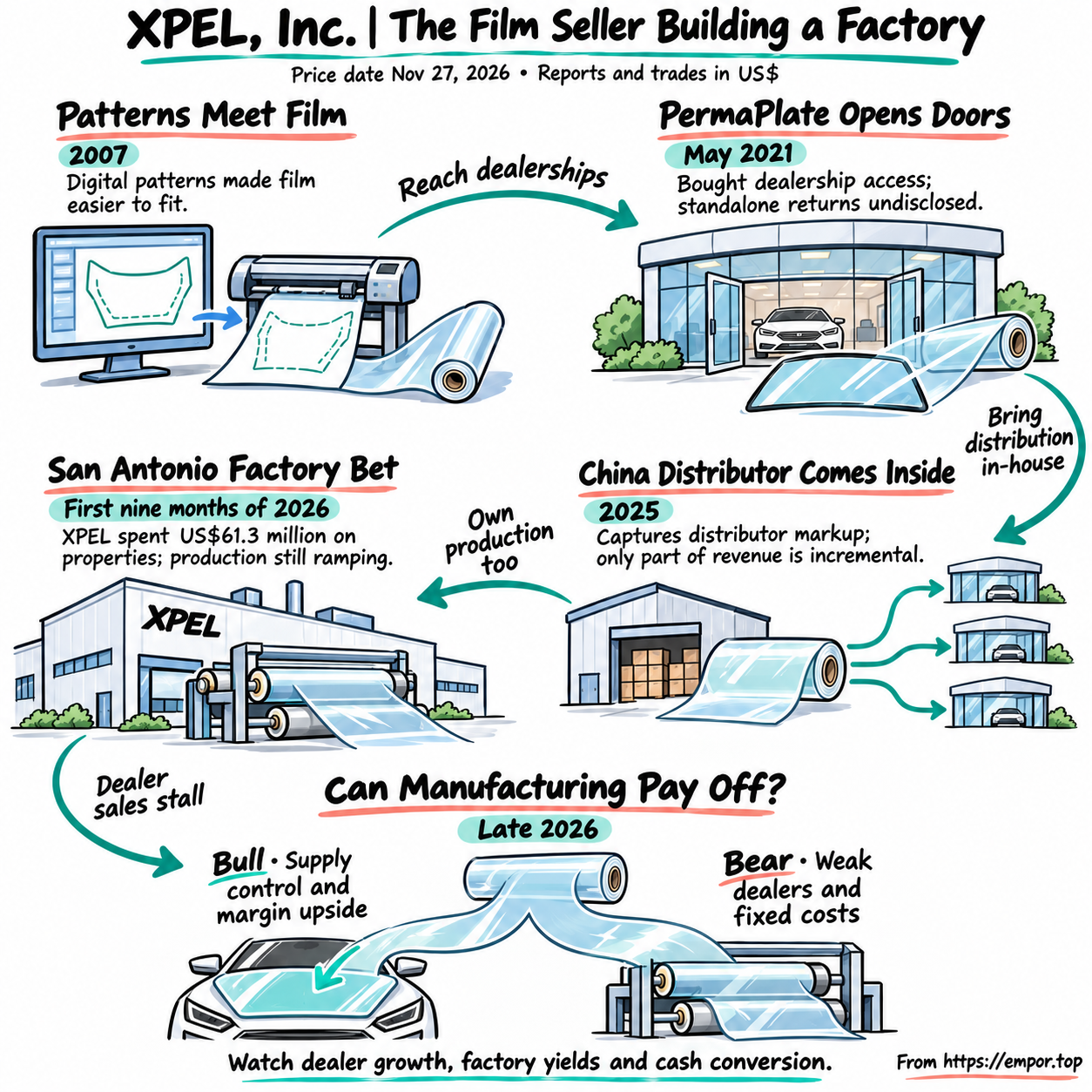
XPEL, Inc.: The Film Seller Building a Factory
I. The $110 Million Turn
On the morning of November 4, 2026, Ryan Pape got on the phone with Wall Street to explain two things that did not sit comfortably side by side.1 The first was a slowdown. XPEL's business with car dealerships, for years one of the easiest places to sell a roll of clear protective film, had gone roughly flat in the third quarter, and Pape told analysts that the fourth quarter could be a little worse before it got better.1 The second was a shopping spree. In the first nine months of the year, the company that had built its reputation on selling film made by other people had spent $76.7 million on property and equipment, and $61.3 million of that bought four properties in San Antonio, the Texas city XPEL calls home.2
That is the contrast at the heart of this story. A company famous for being light on its feet, with a brand and distribution network wrapped around a product it largely bought from outside suppliers, was pouring concrete. It was doing so at the precise moment its most reliable sales channel had stalled.
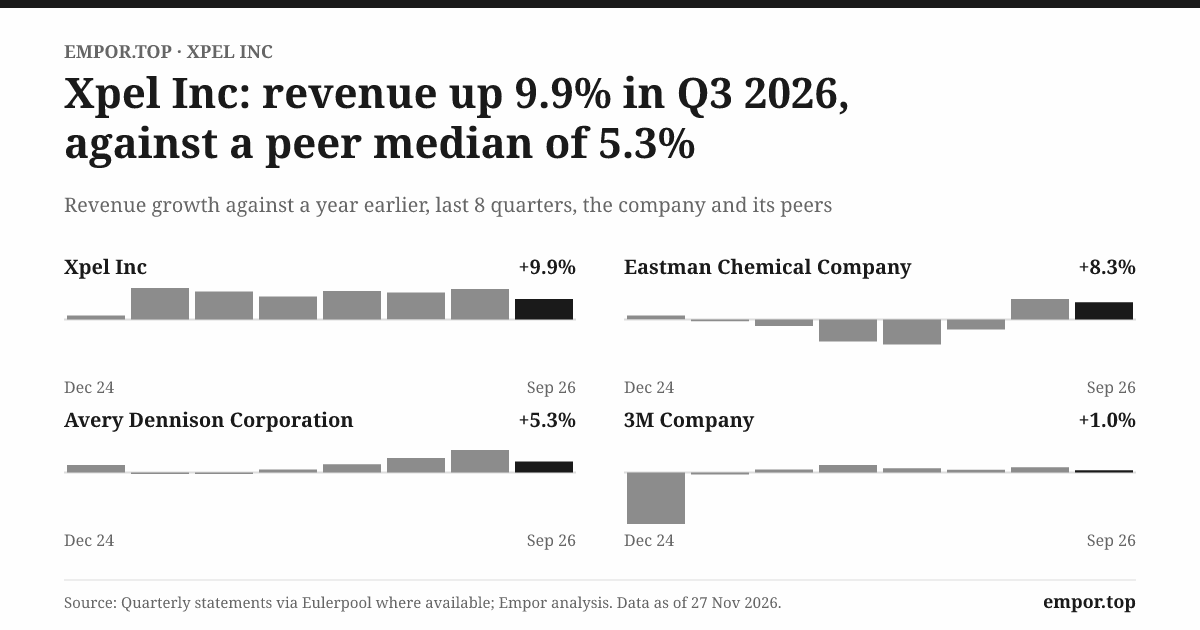
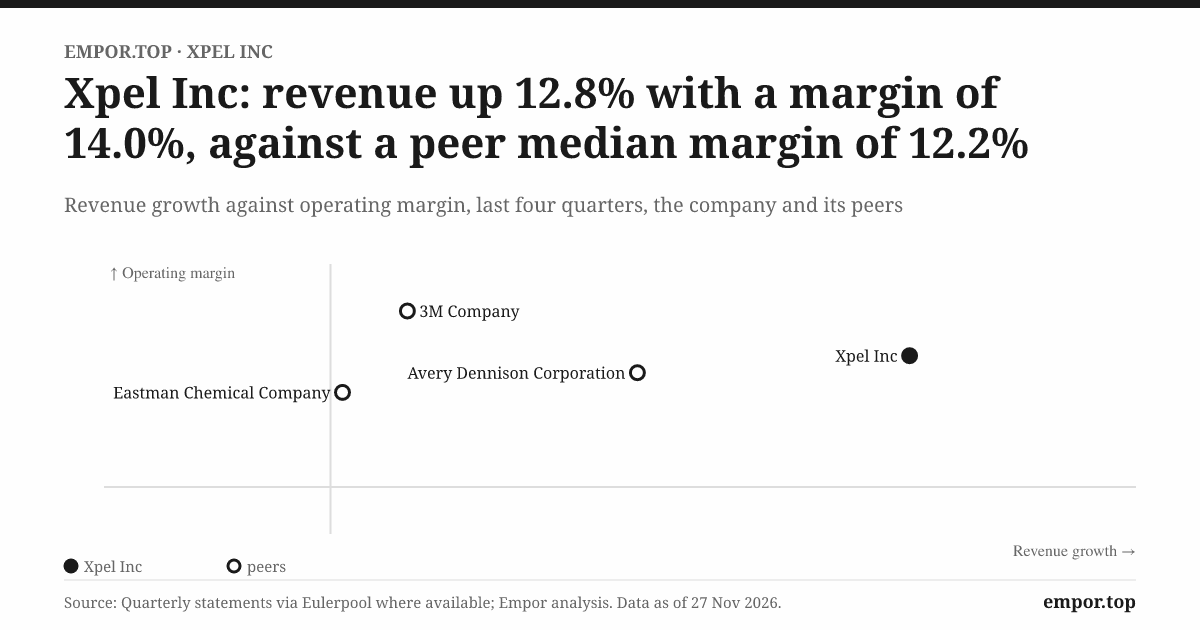
The quarter itself was not a disaster. Far from it. Revenue grew 9.9% from a year earlier, to about $138 million, and operating profit rose 25.8%, to about $21 million, which meant profit grew more than twice as fast as sales.3 Inside that total sat a split that told the real story of the moment. Revenue from independent installers in the United States, the aftermarket shops that customers visit after they have already driven a car home, grew a little over 9%. Revenue from dealerships, where protection is sold in the finance office alongside the car, was roughly flat.1
So XPEL is still growing, and its margins are rising. But the engine is changing under the hood while the car is still moving. The question worth two hours of anyone's attention is whether XPEL can turn a successful distribution and installation network into a stronger business by owning more of the manufacturing behind it.
There are really three questions tucked inside that one. Is XPEL's distribution advantage, the web of installers, dealers, software and brand it spent nearly two decades building, durable, or was it a beneficiary of an unusually generous period for car accessories? Will the factory earn its cost, or will it saddle an asset-light business with fixed expenses just as demand softens? And are the acquisitions and the reported cash flows supporting the growth story, or flattering it?
Before answering any of them, it helps to know what kind of company this is today. XPEL reported $476 million of revenue in 2025.4 Most of that came from selling protective film, the transparent urethane layer that shields a car's paint from stone chips, and the tinted film that goes on its windows. A meaningful slice came from installing that film. A small sliver came from software. The company sells across North America, Europe, Asia and beyond, has no controlling shareholder, pays no dividend, and until this year had owned remarkably little in the way of heavy physical assets: its property, plant and equipment stood at only about $37 million at the end of 2025, less than a tenth of total assets.4
That is the company that is now building a factory. It is a little like watching a successful restaurant group decide to buy the farm. The logic is easy to tell: control the ingredients, capture the supplier's margin, guarantee quality. The risk is just as easy to tell: farms have weather, debt, and fixed costs that do not care whether the dining room is full.
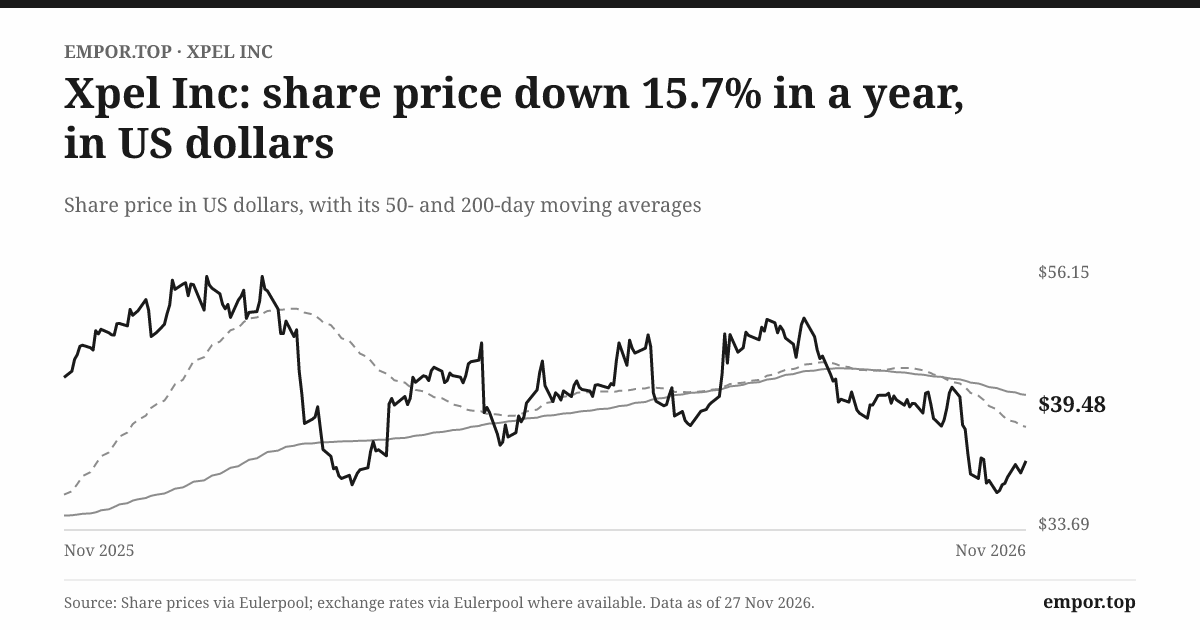
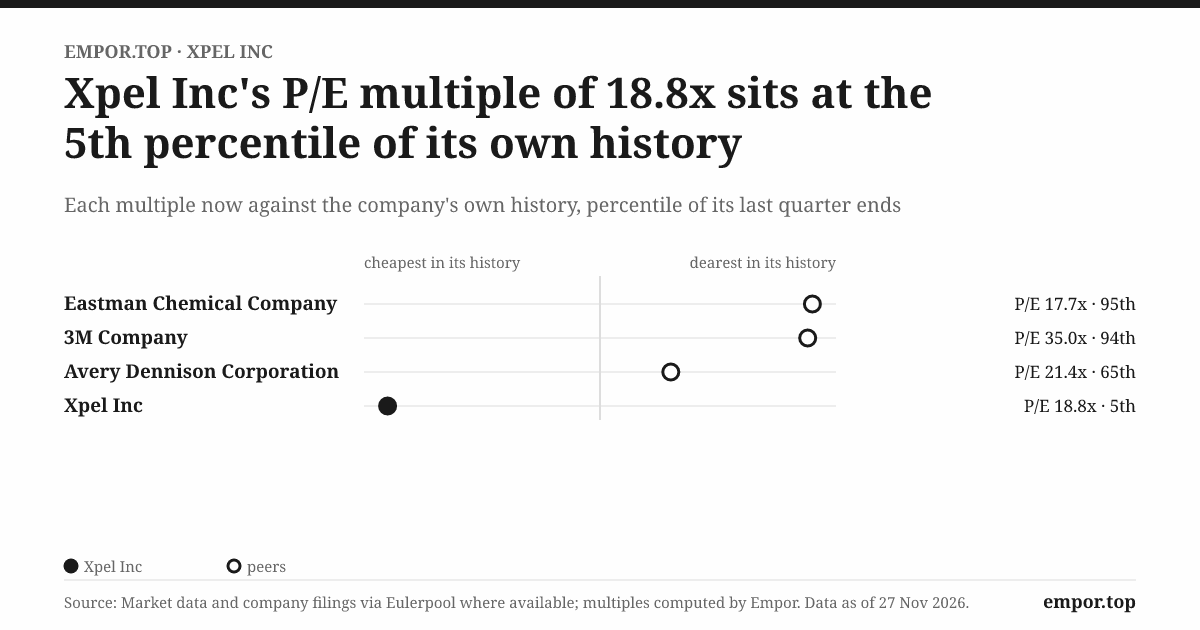
The market has been telling its own story. At $39.48 on November 27, 2026, XPEL's shares sat about 28% below their 52-week high and traded at 18.8 times trailing earnings, well below the stock's own five-year median of roughly 27.6 times. Investors who once paid a premium for a fast-growing, capital-light brand are now paying something closer to an ordinary multiple for a company in transition.
The case for XPEL from here turns on four things this story will keep returning to: the quality of its growth, the returns on its factories, the conversion of profit into cash, and how much of a good outcome the stock already assumes. To see why any of them matters, the story has to start somewhere much smaller, with a piece of software and a company looking for something to sell with it.
 Subscribe on LinkedIn
II. The Software That Needed a Product
Every car is a different shape. That simple fact is the seed of XPEL. To protect a hood, a bumper or a side mirror with a thin sheet of film, someone has to know exactly how to cut that sheet so it wraps the panel without wrinkles, gaps or bubbles. Do it by hand with a razor blade on the car, and you risk slicing the paint you are trying to protect. Do it with a precise digital template fed to a plotter, and the film arrives pre-shaped, like a tailored suit rather than a bolt of cloth.
XPEL's earliest business lived in that template problem. The company designed patterns, and the software to deliver them, before it was known as a film brand. Then, in 2007, it made the decision that defined everything after: it began selling automotive surface and paint-protection products to complement its software business.5 The software that had been useful on its own became far more useful once it was attached to a physical product that installers needed to buy anyway.
That is a subtle but important strategic move. A pattern library is valuable to an installer, but on its own it is a modest subscription business. Film, by contrast, is a recurring consumable: every car that rolls into a shop uses up a new piece. Tie the two together and the software becomes the reason an installer reaches for one brand's roll rather than another's. The product pays the bills, and the software helps make the sale.
Two years later, in 2009, Ryan Pape became the company's chief executive.4 He has held the job ever since, which makes him one of the longer-tenured chief executives of any growth company on the Nasdaq. The long history before him matters less than the commercial model he inherited and then expanded: a brand, a pattern library, a growing roster of independent installers, and a willingness to sell internationally through distributors long before the company was large.
Through the 2010s, that model spread. XPEL built its network country by country, sometimes through independent distributors and sometimes by taking those distributors in-house, and it added training, marketing and company-owned installation centers in select markets.6 The pitch to an installer was consistent: carry the XPEL brand, use its patterns, and the company would help bring customers through the door.
The company's path to the American stock market was unusual, and it is often misremembered. XPEL had traded on Canada's TSX Venture Exchange. In 2019 it registered its existing shares with the U.S. Securities and Exchange Commission using a Form 10, the route a company takes to become a U.S. reporting issuer without selling new stock.7 Its shares began trading on the Nasdaq that summer, and it voluntarily left the TSX Venture Exchange at the same time.8 There was no initial public offering and no cash raised. That detail matters, because it means XPEL's growth through the following years was financed by its own earnings and modest borrowing, not by a large pool of IPO money.
And grow it did. Revenue rose from about $29 million in 2014 to about $476 million in 2025.4 Over the decade from 2015, that worked out to annual growth of almost 28%, the kind of compounding that turned an obscure Texas company into a stock that growth investors fought over.
The most dramatic year was 2021. Revenue jumped about 64%, to roughly $259 million.5 It was the year when cooped-up consumers, flush with savings, spent heavily on their cars, when new vehicles were scarce and expensive enough that owners wanted to protect them, and when paint-protection film moved from a niche for supercar owners toward a mainstream add-on.
Then the curve bent. Revenue rose about 25% in 2022 and 23% in 2023, then just 6% in 2024 as the post-pandemic surge faded and China, then a large market for XPEL, weakened.4 Growth recovered to about 13% in 2025, and over the twelve months to September 2026 revenue rose by a similar amount, to about $520 million.2 Over the three years from 2022 to 2025, the annual growth rate was about 14%, half the decade's pace.
There is nothing shameful about 14% growth. Most companies would sign for it. But it is a different company from the one that compounded near 28%, and the way investors value it should change accordingly. The decade's growth rate is history, not a base case. Profit makes the point more sharply: net income grew only about 7.5% a year over the three years to 2025, well behind sales, as margins slipped from their 2023 peak.4
So the history leaves behind a question that the rest of this story has to answer. Did XPEL build a durable system for selling film, one that can keep winning installers and customers through ordinary years? Or did it ride a period of unusually strong demand for car accessories, and is now discovering what its business looks like when the tide is merely normal? To answer that, follow a single car from the showroom to the installer's bay.
III. A Film Business Built Around the Installer
Picture a new car, still smelling of the factory, rolling into an independent shop on the edge of town. The owner has just spent a great deal of money on it and wants the front end to stay perfect. A pattern guides the installer as a plotter cuts film from a roll. Over the next several hours, an installer sprays, squeegees and stretches each piece into place until the film all but disappears.
It is worth pausing on what that film actually is, because the physics explains the business. Paint-protection film is a thin, clear sheet of thermoplastic urethane, a tough, flexible plastic, with an adhesive on one side and a protective topcoat on the other. A stone flicked up by a truck on the highway hits the film instead of the paint, and the film absorbs the blow. Better films have topcoats that let light scratches fade with heat, so a swirl from a car wash disappears on a warm day. Window film is a different product, a tinted or ceramic-coated layer that blocks heat and glare. Both are commodities in the sense that several large companies can make them. Neither is a commodity in the sense that matters to a car owner, who cares a great deal whether the film yellows, peels or leaves a visible edge after three summers.
That gap, between a material anyone can make and a result only a skilled installer can deliver, is where XPEL built its business. The film is only as good as the hands that apply it, and the hands are only as fast as the pattern that guides them.
Three different businesses just met in that bay. A physical product was sold: the roll of film. A piece of software made it efficient: the pattern. And a local business did the labor, often under its own name rather than XPEL's. XPEL's strength, and its vulnerability, both live in the fact that it owns only some of those three steps.
Start with the product, because that is where the money is. In 2025, products made up about three-quarters of XPEL's revenue.4 Paint-protection film alone, which XPEL calls PPF, was about 52% of total revenue, a little over half of everything the company sold. Window film was about a fifth. Coatings and other products made up the rest of the product line.4
Services were the other quarter. The largest piece, installation labor, was about 18% of revenue, coming mostly from company-owned installation centers and from businesses XPEL has acquired that do the work themselves.4 Software was just 1.8% of revenue, or about $8.7 million, in 2025.4 Strategically, the software sits near the center of the story. Financially, it is a rounding error.
The accounting mirrors the physical flow. XPEL generally records product revenue when it ships the film, and installation revenue when the job is done.4 Customers do not sign long-term volume contracts. Payment terms typically range from due on receipt to 30 days, and the company says its contracts do not commit it to supply goods or services for more than a year.4 Every month, in other words, XPEL has to win its orders again.
That brings the route to market into focus. XPEL sells to independent installers, to car dealerships, to distributors in markets where it does not sell directly, and through its own installation locations.4 The dealership channel works differently from the shop on the edge of town. There, protection film or window tint is offered as an add-on during the purchase, often bundled into a package the buyer finances along with the car. That makes dealer volume sensitive to things XPEL cannot control: how many cars are sold, how confident consumers feel, and how the dealer's finance office runs its sales process.4
None of this is a necessity. A customer can always decide that the paint will be fine without a layer of plastic that can cost as much as a good vacation, and many do. That is the single most important force acting on the industry: the buyer's ultimate choice is not between XPEL and a rival, but between protection and nothing at all.
Why an installer reaches for one roll over another
When XPEL describes its competition, it names the established materials giants: Eastman Chemical's LLumar and SunTek brands, 3M, Avery Dennison, and STEK, a specialist brand.9 Eastman, 3M and Avery Dennison are vastly larger companies than XPEL overall, but their corporate revenues say little about who sells the most paint-protection film, because film is a small part of each. No one publishes a reliable market-share table for PPF, and XPEL does not claim one.
So why does an installer pick XPEL? The company's answer is a system. The brand pulls customers in; marketing support and training help the shop; the pattern library, delivered through XPEL's software, called DAP, makes the work faster and more consistent; and a global distribution network keeps rolls in stock.6 Each element on its own can be copied. The argument is that the bundle is harder to replicate than any single piece.
Think about it from the shop owner's side. An independent installer is usually a small business with a few bays, a handful of technicians and a reputation built one customer at a time. Its most precious resource is labor time, because every hour a technician spends trimming a badly fitting piece is an hour not spent on the next car. Its second most precious resource is the customer's trust, because a film that fails after a year comes back to the shop, not to the manufacturer. A brand that brings in customers who already ask for it by name, patterns that fit the first time, and a warranty that the manufacturer stands behind all reduce those two costs. That is the real product XPEL sells to installers: not a roll, but fewer wasted hours and fewer unhappy customers.
The same logic also shows the limits. If a rival offers a comparable film at a lower price, comparable patterns and a warranty of its own, a shop that cares mostly about its margin has every reason to switch or to carry both. Installers are not employees. They are independent businesses that choose a supplier every time they reorder, and with payment terms measured in days and no long-term contracts, nothing structural stops them from changing their mind.
Look at the industry through the forces that shape its profits and the picture sharpens. Installers and dealers hold real power, because they are the ones standing in front of the customer and many of them can carry several brands. Customers can defer a discretionary purchase. Suppliers matter, because XPEL has historically bought most of its film from third parties, and the company does not disclose how concentrated those suppliers are.9 And rivals backed by big chemicals companies bring their own brands and distribution. What the filings do not provide is the data that would let anyone measure these forces precisely: installer retention, the share of installers that carry only XPEL, the company's share of the market, or how prices have moved.
That gap matters, because the software argument is the one most often made for XPEL's moat. The appealing version goes like this: once a shop has built its workflow around XPEL's patterns, switching to a rival means retraining staff and accepting more waste, so the shop stays. It may be true. But software that earned $8.7 million in 2025 is not, by itself, proof of lock-in.4 Competitors offer pattern software too. Management reported growth in DAP subscribers in the first half of 2026, which is evidence of adoption, but adoption is not exclusivity.10 The honest conclusion is that the software helps XPEL sell film; whether it prevents installers from selling someone else's remains unproven.
The customer list that got safer
One piece of evidence has moved clearly in XPEL's favor. In 2023, its largest customer accounted for about 10.5% of sales. By 2025, the largest customer was down to 3.4%.4 A business where one account can swing a tenth of revenue has a buyer with leverage; a business where the biggest account is a few percent of sales has a much more diffuse customer base. The timing is worth noticing. The decline coincided first with a cooling Chinese market and then with XPEL's purchase of its Chinese distributor, which turned an outside reseller into part of the company. Concentration can fall for structural reasons like that, not only because the installer network broadened, so the improvement is real but should not be over-read. XPEL does not disclose its top-five or top-ten customer share, so the full shape of the base remains out of view.
The most encouraging operating evidence is in gross margin, the share of each sales dollar left after paying for the product and the direct cost of installing it. In the third quarter of 2026, XPEL kept about 44.6 cents of every dollar of revenue after those costs, up from about 41.8 cents a year earlier.3 Nearly three extra cents on each dollar is a meaningful improvement for a business of this kind, and management attributed it to better product costs, a richer mix and operating leverage.1
It would be tempting to read that rising margin as proof of pricing power, the ability to charge more without losing customers. It is not quite that. A margin can rise because a supplier cut its price, because the mix shifted toward higher-margin products, or because the company brought a distributor's margin in-house through acquisition, which XPEL did in China. All three appear to have played some part. The margin is good operating evidence. It is not yet a moat.
So the verdict on the installer system is a qualified one. XPEL has built something coherent: brand, distribution, software and installer relationships that reinforce one another and that took years to assemble. But the company does not publish the numbers, retention, exclusivity, market share, or price realization, that would prove customers and installers are captive. The moat is plausible rather than proven. And the next test of that margin is already coming, because XPEL is about to change where its film comes from. Before it built a factory, though, it went shopping for a sales channel.
IV. The $30 Million Deal That Bought a Dealer Channel
In May 2021, at the height of the car-accessory boom, XPEL agreed to buy a company most investors had never heard of. PermaPlate was a window-film distributor and installer that served U.S. car dealerships, and XPEL paid $30 million in cash for it.11 It was not a glamorous deal. It was a door.
The logic was simple to state. Window tint is a familiar product in the dealership finance office; dealers already offer it, and customers already understand it. PermaPlate had relationships with dealers that XPEL wanted, and through them XPEL hoped to sell not just tint but paint-protection film and coatings.12 Buy the company already sitting at the dealer's table, and you get a seat for your other products too.
The price looked reasonable on the numbers management offered. PermaPlate had about $25 million of annual revenue, and management said it expected roughly $6 million of EBITDA, a rough measure of cash operating profit, on a run-rate basis once integration and synergies were achieved.12 That implied XPEL paid about 1.2 times sales and about five times that forecast profit.
But note what kind of number the $6 million was. It was management's forecast after synergies, not an audited figure the acquired business had already earned. Five times a forecast is a very different thing from five times a track record. XPEL never subsequently reported PermaPlate's standalone results in a way that would let an outsider confirm whether that $6 million arrived. The deal's price was understandable. Its realized return is not disclosed.
What PermaPlate did reveal was a playbook. XPEL kept buying. It completed acquisitions for about $20.8 million in 2023 and about $12.5 million in 2024, mostly smaller installers and distributors that brought regional markets in-house.4 Then, in 2025, it spent about $50.3 million on five acquisitions, and one of them dwarfed the rest.4
The China distributor comes inside
On September 11, 2025, XPEL announced it was acquiring its exclusive distributor in China.13 China had been one of XPEL's most important and most volatile markets, a place where demand for paint-protection film among new car buyers had boomed and then cooled. XPEL had sold into China for years, but through this distributor, which bought XPEL's film at wholesale and resold it.
That structure explains why the headline numbers can mislead. XPEL said the acquired business was expected to generate $45 million to $50 million in annual revenue, but that only $13 million to $18 million would be incremental on a pro forma basis.13 The rest was revenue XPEL already counted, because it had already been selling film to the distributor. Buying it meant capturing the distributor's markup and taking direct control of the market, not adding $45 million of new customers.
That is why a simple acquisition multiple can mislead. Divide the price by the acquired revenue and the deal looks cheap; divide it by the incremental revenue and it looks expensive. Neither calculation captures what XPEL actually bought: a shift from wholesale economics to retail-like control of one market. XPEL has not disclosed enough standalone earnings history to establish the acquired business's normal profitability. Whether the price was cheap or expensive cannot be judged on the available evidence.
What can be judged is how the first months went. Across all five 2025 acquisitions, the businesses contributed about $18.1 million of revenue and about $2.0 million of operating income after their acquisition dates.4 That is a thin margin for the newly acquired operations, though a partial year of integration costs makes it an imperfect signal.
There was also a loose end. As part of the handover, the seller agreed to keep collecting money from Chinese customers on XPEL's behalf for a transition period. At the end of September 2026, about $5.5 million of receivables related to that arrangement.2 Management said on the third-quarter call that the seller was collecting on the company's behalf.1 That is an unusual receivable, owed not by a customer but by the former distributor, and it deserves to be tracked separately from XPEL's ordinary trade receivables until it is settled.
The shopping did not stop at distribution. In May 2026, XPEL bought a 75% interest in a Chinese manufacturing facility for about $21 million.10 This was a different kind of deal: not a sales channel but a source of film, the first step toward owning production. XPEL has not disclosed enough standalone revenue or profit for the facility to calculate a meaningful price multiple.
The acquisitions have left traces on the balance sheet. At the end of 2025, XPEL carried about $20 million of acquisition-related contingent liabilities, mainly contingent consideration and performance obligations owed to sellers if acquired businesses hit targets, up from about $1.8 million a year earlier.4 Its auditor, Deloitte, issued a clean opinion on the 2025 financial statements and internal controls but flagged the purchase-price allocation for the China acquisition as a critical audit matter, meaning it required especially complex judgment.4 That is not a warning about the accounts as a whole. It is a signal that the value XPEL assigned to customer relationships and other intangible assets in China rests on estimates that only time will validate.
There is a fair way to test the acquisition strategy against XPEL's own record. If buying distributors and installers reliably made the business more profitable, returns on capital should have held up as the deals piled on. They did not. Return on invested capital, which measures after-tax operating profit against the money tied up in the business, was around 52% in 2020, before PermaPlate, and fell to about 20% by 2025.4 Plenty of things drove that slide, including a post-pandemic hangover, heavy inventory and the weak Chinese market. But the record does not support the idea that acquisitions have been a returns engine. It supports a narrower claim: they extended XPEL's reach into channels and countries, while the business as a whole became more capital-hungry.
So the acquisition record leaves the listener with a test rather than a verdict. Acquired revenue has to translate into organic growth, into cash, and into returns after integration, not merely into a larger reported top line. PermaPlate opened a door; the China deal moved a market in-house. But buying the distributor was only half of the vertical integration story. The bigger move was the one that made the San Antonio properties necessary.
V. The Factory Bet
For most of its life, XPEL's economic model was elegant. Someone else made the film. XPEL designed the patterns, built the brand, trained the installers, and moved rolls around the world. It owned the relationship with the customer and let a supplier own the chemistry, the extrusion lines, the coating machines and their fixed costs. That is why, in good years, XPEL could post returns on equity above 30% while holding very little in the way of physical assets.4
Now picture a different scene. In 2026, XPEL bought four San Antonio properties and began preparing them for production.2 Elsewhere, it had already taken control of a Chinese film manufacturer. For the first time, XPEL was not merely selling film. It was setting out to make it.
The numbers show the size of the shift. In 2025, XPEL spent about $4 million on property and equipment for the whole year, less than 1% of revenue.4 In the first nine months of 2026, it spent $76.7 million.2 That is roughly nineteen times the prior year's annual spending, compressed into three quarters. A company that had treated capital spending as a minor line item had turned it into the dominant use of its cash.
The factory is also a striking departure from how XPEL has historically spent on innovation. Research and development cost about $2.9 million in each of 2023, 2024 and 2025, well under 1% of revenue.4 That is a tiny budget for a company about to make its own film, and it underlines how much of XPEL's product know-how has, until now, lived with its suppliers. Meanwhile headcount rose from 1,143 at the end of 2024 to 1,337 a year later, an increase of about 17%, faster than revenue grew.4 Some of those people came with acquisitions. But together the numbers describe a company spending more on people and property while its own technical investment remained modest, which places a heavy burden on the expertise acquired with the Chinese plant.
To pay for the properties, XPEL borrowed. At the end of September 2026 it had about $44.4 million of term debt outstanding, secured by the San Antonio properties and guaranteed by the company, carrying a floating interest rate of about 5.0% and maturing in 2036.2 It also had a $125 million revolving credit facility, extended to September 2028, on which nothing was drawn.2 The company reported that it was in compliance with its covenants, which cap leverage at 3.5 times and require interest coverage of at least 3 times.2 By the standards of most industrial companies, that is a conservative balance sheet. By the standards of XPEL's own history, it is a new kind of commitment.
The operational promise is clear enough to explain in a sentence. If XPEL makes its own film, it can control supply, keep the margin a supplier used to capture, and tune products to what its installers need. Think of a coffee chain that starts roasting its own beans: it saves the roaster's markup and controls quality, but it also has to buy roasting machines, fill them, and keep them running whether or not customers show up.
It helps to understand what making film involves. Paint-protection film is built in layers: a base sheet of urethane is produced, a clear topcoat is applied on one side and an adhesive on the other, and a release liner protects the adhesive until an installer peels it away. Each layer has to be uniform to within tiny tolerances across rolls that run for long distances, because a flaw invisible in the factory can become a visible ripple on a black car under showroom lights. This is precision chemistry and coating, closer to making optical film than to cutting plastic sheets, and the established suppliers have spent decades learning how to do it at scale.
That last part is the catch. Making film is a process business, where the cost of each square foot depends heavily on how full the factory runs and how much of the output meets quality standards, what manufacturers call yield. A half-empty factory spreads its fixed costs over too little output, and the unit cost of the film can end up higher than what XPEL used to pay suppliers. The savings only arrive if production ramps at competitive yields and sufficient utilization.
What the margin is already saying
The early evidence is encouraging, though not yet about the factory. Gross margin rose for a third consecutive quarter in the third quarter of 2026.1 Management attributed the improvement to product costs, mix and operating leverage, and excluded some manufacturing start-up costs from its adjusted figures.1 That exclusion is worth noticing. Adjusted figures that strip out start-up costs show what the business might look like once the factory is running; reported figures show what it actually earns while it is being built. Both matter, but only the reported figure is a fact.
Management has set a bold target. On its calls in 2026, it described a goal of mid-20% operating margins on a run-rate basis by the end of 2028.141 Set that beside the record. XPEL's operating margin was about 13.2% in 2025 and about 15.3% in the third quarter of 2026.43 Its best year, 2023, peaked just under 17%.4 Reaching the mid-20s would mean earning roughly ten more cents of operating profit on every dollar of sales than it does today, a step change the company has never achieved.
That does not make the target unreachable. Vertical integration has lifted margins at plenty of consumer brands. But a target is a management statement, not an achieved result, and this one will need several years of reported numbers to validate. The way to judge it is to track the factory itself: when San Antonio starts producing, how fully it runs, what yields it achieves, what share of XPEL's film it supplies, and what each square foot costs compared with purchased film. XPEL has not yet published those figures, and until it does, the margin target is a forecast.
The downside mechanism is equally clear. Fixed costs and debt magnify whatever happens to demand. If sales grow, a factory with high fixed costs turns each extra dollar of revenue into an outsized gain in profit. If sales slow, the same fixed costs eat into margins. And the term loan's floating rate means XPEL's interest bill moves with the market. None of this is dangerous at current debt levels, which are small relative to XPEL's earnings. But it does change the risk profile of a company that used to be able to simply order less film when demand fell.
It is worth testing the strategic logic against the alternative. A brand owner that buys from outside suppliers can, in principle, play suppliers against one another and switch when a better or cheaper film appears. A brand owner that makes its own film gives up some of that freedom: once the factory is built, the company has a strong incentive to fill it with its own product, even if a supplier's film becomes better. Vertical integration solves the problem of depending on suppliers. It creates the problem of depending on yourself. XPEL's management has judged that control and margin are worth the trade, and the improving gross margin offers early support. But it is a judgment, and the factory has not yet run long enough to test it.
The timing is the uncomfortable part. XPEL committed to its factory in a year when management was also telling investors that its most reliable channel was stalling. The factory was supposed to arrive into a growing business. It may instead arrive into a soft patch.
VI. The Dealer Slowdown Arrives Before the Factory
The analysts on the November 2026 call kept circling back to dealership softness.1
Pape said that in California, the CARS Act, a state law designed to curb deceptive practices in vehicle sales, along with scrutiny from the Federal Trade Commission on how dealers sell add-on products, had prompted dealers to rework their sales processes.1 The rules, he argued, do not prohibit dealers from selling protective film or window tint. But dealers were changing how they present and document add-ons, and some were delaying new programs while they did so.1 He described the fourth quarter as a likely trough.1
The distinction between the prepared remarks and the questions that followed matters. Management's opening case framed the slowdown as temporary and procedural: the products were still legal, still wanted, merely being sold under new paperwork. It was in the analyst questions that the timing came into sharper focus, with management acknowledging that dealer softness would continue into the fourth quarter and offering optimism about the dealer channel by the third quarter of 2027.1
That optimism is a claim to test, not a conclusion. It is plausible. Regulatory changes in auto retail often cause a period of disruption followed by adaptation, as dealers write new scripts and train staff. But it is also possible that dealers selling add-ons under tighter rules simply sell fewer of them, permanently. When a buyer has to sign an itemized, separately disclosed form for a protection package rather than see it folded into a monthly payment, some buyers will say no. The evidence that will settle this is dealer-channel growth and new program wins through 2027.
The aftermarket cushion
The counterweight is the installer channel, which kept growing a little over 9% in the third quarter.1 That is the business where a customer seeks out protection on purpose, rather than being offered it during a car purchase, and it is less exposed to dealer sales rules. XPEL does not separately break out installers who themselves serve dealership customers, so the line between the two channels is blurrier than the headline numbers suggest.
There was one more item on the call, a lead rather than a result. Management discussed a substantial contract with a carmaker that it said could contribute to revenue in India.1 It did not quantify the economics or the scale. Original-equipment contracts can be valuable, because they put film on cars at the factory rather than one installer at a time. They can also be low-margin, lumpy and slow to ramp. Until XPEL reports revenue from it, the India deal is a reason to revisit the story, not proof of a new growth engine.
The broader risks are tied to the business rather than to the general macro picture. Film purchases depend on discretionary spending and auto cycles, so a weaker consumer or lower new-car sales show up directly in volumes. Geopolitical conditions matter in a company that sells across many countries and now owns operations in China, where trade tensions and local demand both shape results. XPEL's supplier concentration remains undisclosed as it builds its own supply, which leaves investors unable to judge how dependent the company remains on outside film during the transition. As for artificial intelligence, XPEL reports no material AI revenue exposure, and software is too small a part of the business for AI disruption to be a central near-term issue; physical film still has to be stuck to physical cars.
There is a useful precedent in XPEL's own recent history for how quickly a soft patch can pass. In 2024, revenue growth slowed to about 6% and net income fell by about 14%, a sharp break from years of rapid growth, as China weakened and the post-pandemic surge faded.4 By 2025, growth had recovered to about 13% and profit had largely come back.4 That episode supports management's view that XPEL can absorb a slowdown in one market or channel and resume growing. It does not prove the dealer slowdown will follow the same path, because the 2024 setback was about demand in a single country, while the current one is about how products are allowed to be sold in the company's largest market.
The verdict on the slowdown is that management has given a specific explanation and a timing view, which is better than vague hand-waving. But a recovery forecast is still a forecast. The aftermarket cushions the slowdown, and the dealer channel's 2027 trend will show whether protection film remains easy to sell in a more tightly regulated showroom. That puts a great deal of weight on the judgment of the person who has led XPEL for almost two decades.
VII. Pape's Compounding Record Meets a New Test
Ryan Pape has run XPEL since 2009.4 He remains chairman, president and chief executive, and Barry Wood remains senior vice president and chief financial officer.15 In a company now changing its business model, that continuity is a genuine asset. The people asking investors to fund the factory are the same people who built the installer network that will have to fill it.
Pape's record is a strong one by the most basic measure. He took a company with revenue in the tens of millions and built it into one approaching half a billion dollars, mostly without raising equity, and while staying profitable.4 He also owns a real stake: about 3.9% of the shares, with directors and officers together holding about 9.4%.15 That is not control, but it is enough that management's wealth rises and falls with the stock.
The rest of the share register is concentrated among a few institutions. BlackRock held about 14.6%, Wasatch Advisors about 13.8%, Vanguard about 5.3%, and Alta Fox, a concentrated hedge fund, about 5.2% as of April 2026.15 Alta Fox had not been listed among holders above 5% a year earlier, so its arrival is a shift worth noting, though its intentions have not been disclosed in the filings.
Now the harder part. Executive pay at XPEL leans heavily on stock awards and incentive compensation.15 Pape's total reported compensation rose from about $2.04 million in 2023 to about $2.69 million in 2025.15 Over those same years, net income went from about $52.8 million to about $45.5 million and back to about $51.6 million.4 Pay rose; profit went sideways. Over a longer span, the gap is starker: the "compensation actually paid" to the CEO, a measure that includes changes in the value of stock awards, rose about 202% from 2021 to 2025, while net income rose about 62%.15
Some of that gap reflects how such measures work, since stock-based pay moves with the share price. But the plain reading is that executive compensation has grown faster than the earnings it is meant to reward. That raises the bar for the factory: the promises being made now are exactly the kind of measurable results that pay should track.
Shareholders mostly approved. At the June 2026 annual meeting, the advisory vote on executive pay passed with about 18.0 million votes for and roughly 235,000 against.16 Director Stacy Bogart, however, had about 6.47 million votes withheld, the highest dissent of any director.16 Those signals deserve context rather than drama. A large withheld vote against a single director often reflects a specific governance concern, such as committee responsibilities or attendance, rather than a revolt against the company's strategy. It is not evidence of a governance crisis. It is evidence that some shareholders want accountability.
The record of returns is the most direct test of management's capital allocation. Return on equity, the profit earned on each dollar of shareholders' money, was about 37% in 2021 and about 29% in 2023, before falling to about 18% in 2025.4 Some of that decline is simple arithmetic: XPEL has retained its earnings rather than paying them out, so equity has swelled faster than profit. But some of it reflects the acquisitions and a business that is now asking for more capital to produce each dollar of profit.
Management has stated a clear order for its cash: fund manufacturing first, pursue small tuck-in acquisitions second, and repurchase shares third.1 Buybacks totaled about $5.9 million in the first nine months of 2026, against $76.7 million of capital spending and new borrowing over the same period.2 The actions match the stated priorities. Whether those priorities are the right ones will be decided by the factory's returns.
The audit backdrop is clean. Deloitte gave unqualified opinions on both the 2025 financial statements and internal controls.4 The China purchase-price critical audit matter belongs with the acquisition story, as a reminder that the value of what XPEL bought rests on judgment, rather than as a general warning about the books.
There is one more way to judge a long-serving chief executive: how he explains bad news. When dealer revenue stalled, Pape did not blame the weather or the macro environment in general terms. He named the specific regulatory changes, described how dealers were responding, and gave a timing view that can be checked against the next two or three quarters of results.1 That is the kind of explanation that makes a management team accountable. Whether it proves correct is a separate question, and investors will be able to grade it within a year.
The verdict on management is that tenure, ownership and long-run growth support execution credibility, but compensation growth and the manufacturing promises raise the bar for measurable delivery. The most useful test of any management team is not what it says, but what it converts into cash.
VIII. The Cash Behind the Earnings
Here is a number that tells a long story in one line. From 2014 through 2025, XPEL reported about $266 million of net profit and generated about $220 million of cash from operations.4 For every dollar of profit on paper, about 83 cents arrived as operating cash.
That is respectable rather than perfect. For a growing product company, it is common for operating cash to lag profit, because growth requires more inventory and more money owed by customers. What matters is whether the gap is explained, and whether the cash ultimately arrives.
Over the same twelve years, after subtracting capital spending, XPEL generated about $176 million of free cash flow.4 It paid no dividends. Its cash and short-term investments rose from about $1.4 million at the end of 2013 to about $50.9 million at the end of 2025.4 The rest of the free cash went into acquisitions and, more recently, buybacks. That is the cash footprint of a company that funded its own growth.
The record is not seamless. In 2022, as XPEL built inventory during supply-chain disruption and expanded rapidly, operating cash flow fell to about $12 million, against net income of about $41 million, and free cash flow almost disappeared, at about $2.5 million.4 Inventory has remained a heavy weight since: by 2025, XPEL held enough inventory to cover about 163 days of cost of sales, roughly double its levels before 2021.4 A business that ties up five months of product in its warehouses is not as capital-light as its reputation suggests. There is a reason for it: XPEL has to stock film for many vehicle patterns, product lines and countries, and it built buffers after the supply shocks of the pandemic years. But the effect is that the cash conversion cycle, the number of days between paying for film and collecting cash from customers, stretched from under two months before 2021 to about five months in 2025.4 Every extra day in that cycle is cash the business needs to fund its own growth. Owning a factory may help, if local production lets XPEL hold less finished film, or it may hurt, if the factory adds raw materials and work-in-progress to the pile.
2025 was a much better year for cash, with operating cash flow of about $66.9 million.4 But the details matter. Receivables, money customers owed, used about $20.4 million of cash as XPEL sold more. Lower inventory purchases released about $11.5 million, and higher payables and accruals, money XPEL owed suppliers and others, supplied about $11.3 million.4 The China transition-services arrangement contributed about $5.5 million.4 In plain terms, 2025's strong cash came partly from buying less inventory and paying suppliers later, and partly from a one-time arrangement. Those are real cash flows, but they are not ones a company can repeat indefinitely.
Who pays late
The receivables deserve a closer look. Debtor days, the number of days of revenue sitting in receivables, rose to about 39 in 2025, up from about 26 in 2024.4 That means customers were, on average, taking almost two extra weeks to pay. Some of that rise reflects the China acquisition, which brought in a business with different terms, and some reflects the transition-services receivable.
Through 2026 the trend continued. Net trade receivables rose from about $49.8 million at the end of 2025 to about $59.1 million at the end of September 2026.2 The allowance XPEL sets aside for accounts it expects not to collect rose from about $0.1 million to about $1.0 million, and the company booked about $1.1 million of credit-loss provisions in the first nine months.2 That is still small against the total, but a tenfold jump in the allowance is a signal that XPEL has become less confident that every invoice will be paid.
Who pays late? XPEL's typical terms run from due on receipt to 30 days.4 The company does not disclose an ageing table showing how much is overdue and by how long. The China transition-services receivable remains the specifically identified item to watch until collection.2
The cash story has now changed shape. For most of its history, XPEL's free cash flow went into a growing cash pile, small acquisitions and nothing else. In 2026, property and equipment spending became the dominant use of capital. At November 27, 2026, the stock's free-cash-flow yield was about negative 1.4%, meaning the company was consuming rather than generating free cash over the trailing year. That is a snapshot of the factory build, not a sign that the core business has stopped producing cash. But it does mean investors are being asked to trust that the spending will come back as profit.
The long-run cash record is credible. The question is whether it will survive a period in which XPEL is spending heavily, carrying more receivables and running a factory. That brings the story to the market's own judgment.
IX. Analysis & Bear vs. Bull Case
On November 27, 2026, XPEL's share price was $39.48, valuing the company at about $1.1 billion.17 That price bought about 18.8 times trailing earnings. Over the previous five years, the stock's median multiple had been about 27.6 times.
The tempting conclusion is that the stock is cheap compared with its own history. That comparison is not enough to settle the question. The 27.6-times median was set in years when XPEL was growing far faster and earning far higher returns on capital. A company growing at 14% with returns on equity in the high teens is not the same company that grew at 28% with returns above 30%. The lower multiple may simply reflect a business that has changed.
What does the price assume? An earnings yield of about 5.3% (the inverse of the P/E) means investors are accepting a starting return roughly in line with what they could earn on safer assets, and are betting on growth to provide the rest. At about 12.5 times EBITDA and about 2.1 times sales, the market is pricing XPEL as a solid, moderately growing business, neither as a distressed one nor as the high-flying compounder it once was. A successful factory transition would justify more; a stalled dealer channel and disappointing manufacturing returns would justify less.
For context, Eastman Chemical, which owns the LLumar and SunTek brands that compete with XPEL, traded at about 11.5 times trailing earnings and about 7.9 times EBITDA on the same date.18 But Eastman is a diversified chemicals company, and its film business is a small part of the whole. The comparison is directional at best: it shows that a large materials company owning competing brands trades at a lower multiple, but says little about how the market values the film business itself.
The bull case
The bull case starts with what XPEL has demonstrably built. It has a growing brand, an installer network that spans the world, and a customer base that has become less concentrated, with the largest customer down to about 3% of sales.4 Aftermarket demand has stayed positive even as dealers stalled. Gross margins have improved for three consecutive quarters. And manufacturing could add cost control, supply security and margin upside that a pure distributor could never capture.
Through the lens of Hamilton Helmer's seven powers, the bull case leans on three. Branding: XPEL is one of the best-known names in paint-protection film among enthusiasts and installers. Switching costs: installers who have built their workflows around DAP patterns and XPEL training may find it costly to change. And potentially, in time, scale economies in manufacturing, if XPEL's volume lets it spread factory costs more thinly than smaller rivals. Process power, the ability to make film better or cheaper through accumulated know-how, would be the prize from owning production, but it is not yet earned.
The bear case
The bear case starts with what the business depends on. Much of XPEL's growth is discretionary and channel-dependent. Dealer demand is weak and may stay weak under new regulation. Supplier concentration is not disclosed. And the moat, however coherent the story, lacks published evidence of installer retention, market share or pricing power.
Porter's forces sharpen the bear view. Buyer power is meaningful: installers and dealers stand between XPEL and the end customer, and many can carry several brands. The threat of substitutes is real, because the most common alternative to film is no film at all. Rivals like 3M, Eastman and Avery Dennison have resources, brands and distribution far larger than XPEL's overall, even if their film businesses are smaller pieces of their empires. Supplier power has historically mattered, which is part of why XPEL is building its own factory. Barriers to entry are moderate: brand and installer networks take years to build, but film is not a secret technology.
The factory bear case is that heavy spending, debt and fixed costs arrive before utilization and unit-cost gains have been demonstrated. If the dealer slowdown lasts, XPEL could find itself running a half-full factory with costs that do not shrink with demand.
The acquisition bear case is that acquired growth can obscure organic performance. XPEL has bought distributors, installers and a manufacturer in quick succession, and the filings do not yet provide a robust basis to calculate returns on the China businesses. If acquired revenue is masking slower organic growth, the headline numbers flatter the underlying business.
The strongest test of the moat claim is how XPEL behaved when growth stalled. If installers and customers were truly captive, a demand slowdown would show up as lower volumes but stable pricing and margins. In 2024, as revenue growth fell to about 6%, operating margin fell from about 17% to about 14%.4 Margins then slipped further in 2025, to about 13%, even as revenue recovered, partly because of acquisition and personnel costs.4 That is not what a business with strong pricing power usually looks like in a downturn; it looks like a business whose costs had grown ahead of its sales. The recent gross-margin gains push the other way, but the history narrows the moat claim to this: XPEL has a strong brand and distribution system that keeps it growing, but not one that has historically protected its operating margin when demand softens.
An activist looking at XPEL would likely press on three points. First, why should a company that earned its best returns as an asset-light distributor now pour capital into factories, and what return is it promising? Second, how much of recent growth is organic, by channel, and will management disclose it consistently? Third, why has executive pay grown faster than earnings, and how will compensation be tied to the factory's actual results rather than adjusted figures?
Weighing it all, the evidence narrows the bull case rather than rejecting it. XPEL's distribution system is real and has survived a sharp slowdown in growth without losing money. But the claim that it is a wide moat is unproven, and the claim that manufacturing will lift margins to the mid-20s is a target, not a result.
Three numbers will decide which way it goes. The first is organic revenue growth by channel, especially dealer versus installer; the latest reading has installers up a little over 9% and dealers flat. The second is gross margin as manufacturing ramps; the latest reading is about 44.6%, up from about 41.8% a year earlier. The third is receivables and debtor days alongside operating cash conversion; debtor days rose to about 39 in 2025 and receivables kept rising through September 2026.
The multiple may recover if growth and returns improve. But a factory target and an installer network are not earnings until they show up in reported results.
X. Playbook: Business & Investing Lessons
Go back to the pattern-design screen in the installer's bay. That screen holds most of what XPEL has to teach.
The first lesson is about how niche products scale. XPEL's brand and installer workflow helped make its film easier to sell and fit. For founders, distribution and workflow can be worth as much as the product. For investors, the caveat stays visible: software that earns less than 2% of revenue is a sales tool, not a fortress, and XPEL has never shown that its installers are exclusive.
The second lesson is about vertical integration. XPEL's moves from distribution toward manufacturing brought it closer to the customer or the raw material, and each consumed more capital. The lesson for any growing company is that integration is not free: it trades the flexibility of buying from others for the obligations of owning assets.
The third lesson is about acquisitions. A good acquisition thesis is a forecast until the cash arrives. XPEL's acquisitions have yet to prove their returns, and the China transition-services receivable remains outstanding. Investors should ask, of any acquisitive company, how much of growth is bought and how much is earned, and whether the company discloses enough to tell the difference.
The fourth lesson is about valuation and time. A company's growth rate in its best decade is not its base case for the next one. XPEL's growth has slowed from its exceptional decade pace, and the market has repriced it accordingly. What looks like a cheap multiple against history may simply be the right multiple for a more mature business.
XI. Epilogue
Tonight, at the end of November 2026, XPEL stands in an in-between place. The factory properties were bought, but production is still ramping. The dealer channel has stalled, but management says the trough is near. The China businesses are inside the company, but their full economics are still being tested. Investors are being asked to believe in a future that has not yet shown up in the numbers.
The next chapter is measurable, and it will unfold in a sequence of moments. The first comes in early 2027, when XPEL reports its fourth quarter. If dealership revenue turns out to be only modestly weaker, as management expected, the trough thesis gains credibility. If it falls sharply, the regulatory changes may be doing more lasting damage than management believes.
The second is the San Antonio ramp. Watch for the start-up date, capacity utilization, realized unit costs, and the contribution of in-house film to gross margin. If XPEL begins disclosing those figures and they show film made more cheaply than it could be bought, the manufacturing case moves from promise toward proof. If the company keeps relying on adjusted figures that exclude start-up costs, investors should ask why.
The third is the China ledger. The transition-services receivable should be collected and settled. The acquired businesses should show organic growth and cash contribution, not just consolidated revenue. And the contingent payments owed to sellers will reveal whether those businesses hit their targets.
The fourth is capital discipline. Management has promised manufacturing first, small tuck-ins second and buybacks third. If acquisitions stay small, debt stays modest and capital spending normalizes after the build, the company will have done what it said. If spending keeps climbing while growth stays soft, the factory will start to look like the expensive experiment skeptics fear.
Against all of this, the target of mid-20% operating margins by the end of 2028 will be the scoreboard investors keep checking. It is the boldest promise XPEL has made. If it is met, the company will be a far more profitable business than the one that grew so fast in its first public years. If it is missed, the cost of building capacity ahead of demand will be written into the returns.
The tension that remains is simple. XPEL has proven it can sell film. It has not yet proven it can make film at a profit that justifies the factory.
XII. Outro
Return, one last time, to the installer's bay. A car rolls in. A pattern appears on a screen. A plotter cuts a sheet, and a technician stretches it into place until the film vanishes. What makes XPEL different from a company that simply sells rolls is the system around that sheet: its brand, software, distribution and installer network, with manufacturing now joining them.
XPEL's defining bet is that this system is worth more than the material alone. The next few years will show whether owning more of it makes the business more valuable, or just more expensive. Picture a roll of film leaving a new factory in San Antonio, crossing a continent, and ending up on the hood of a stranger's car. If the economics work, that journey will be XPEL's whole story. If they do not, the factory will be the most expensive pattern the company ever cut.
References
-
Q3 2026 Earnings Call Transcript — XPEL, 2026-11-04 ↩↩↩↩↩↩↩↩↩↩↩↩↩↩↩↩↩
-
2025 Form 10-K — SEC, 2026-02-27 ↩↩↩↩↩↩↩↩↩↩↩↩↩↩↩↩↩↩↩↩↩↩↩↩↩↩↩↩↩↩↩↩↩↩↩↩↩↩↩↩↩↩↩↩↩↩↩↩↩
-
Nasdaq Listing and TSXV Delisting Form 8-K — SEC, 2019-08-16 ↩
-
China Distributor Acquisition Announcement — XPEL, 2025-09-11 ↩↩
-
Q2 2026 Earnings Call Transcript — The Motley Fool, 2026-08-12 ↩
-
Eastman Chemical Valuation Statistics — Stock Analysis, 2026-11-27 ↩
 LinkedIn
 WhatsApp
 Reddit
 Hacker News
 Email
 Kindle
 RSS Feed
 Spotify
 Apple Podcasts
 Amazon Music
 Audible
 YouTube