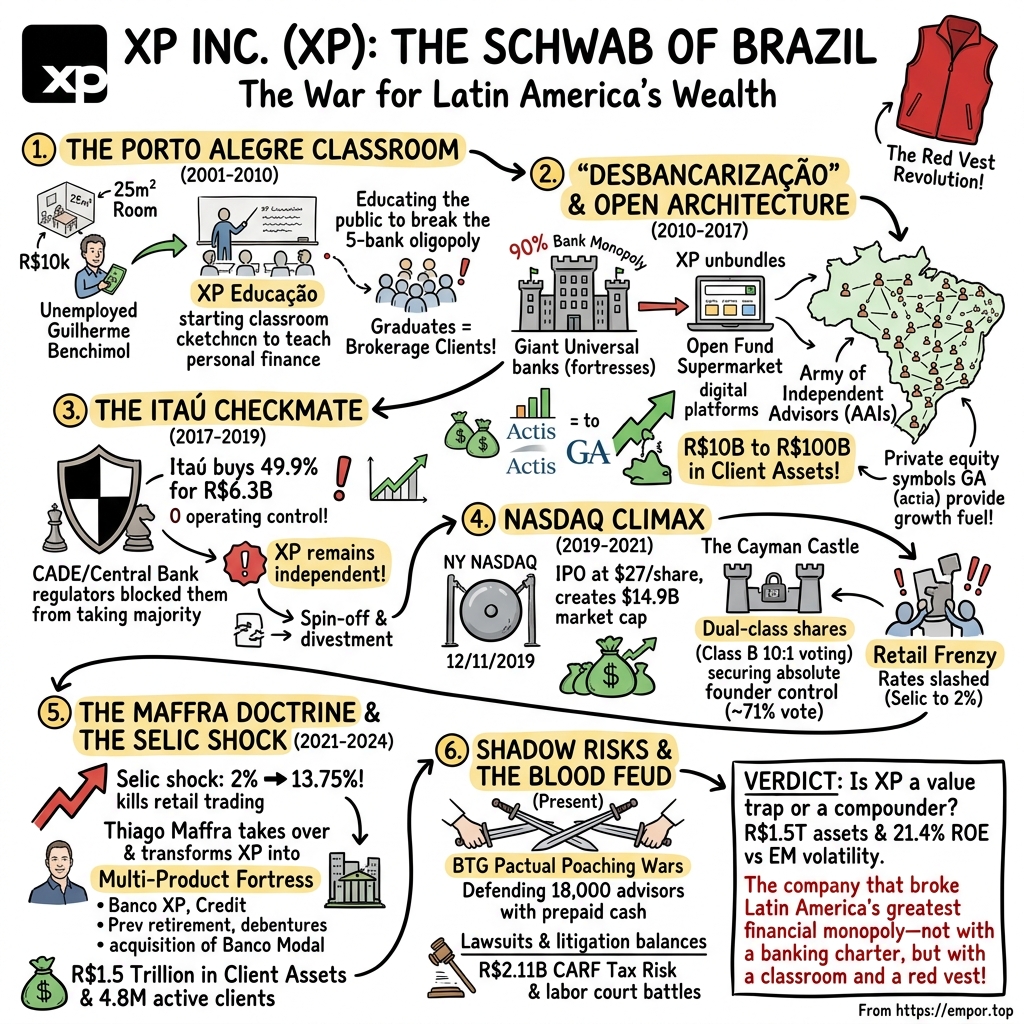
XP Inc.: The Schwab of Brazil and the War for Latin America's Wealth
I. The Red Vest Revolution
On December 11, 2019, XP Inc. priced its initial public offering in New York at $27 a share.1 The company sold 72.5 million Class A shares, roughly $2 billion of stock, and the market valued the whole group at around $15 billion on its debut.1 Guilherme Benchimol, the founder, wore the red fleece vest that XP's people had turned into a uniform, the kind of jacket a broker in Porto Alegre throws on when the air conditioning is too cold, not the kind of thing a banker in Faria Lima puts on for a listing ceremony. The costume was the message. XP was not a bank, and it wanted the five banks that had run Brazilian savings for a generation to know it.
Those banks had good reason to watch. For decades Brazilians kept their money where their parents had: in savings accounts and in-house mutual funds sold by Itaú Unibanco, Bradesco, Banco do Brasil, Caixa Econômica Federal and Santander Brasil. The branch manager decided what you owned, and the bank's own asset manager made it. XP's pitch was that you could buy anything from anyone, through an advisor who did not work for a bank, on a screen that showed you what everything cost. That pitch built one of the most valuable financial companies in Latin America.
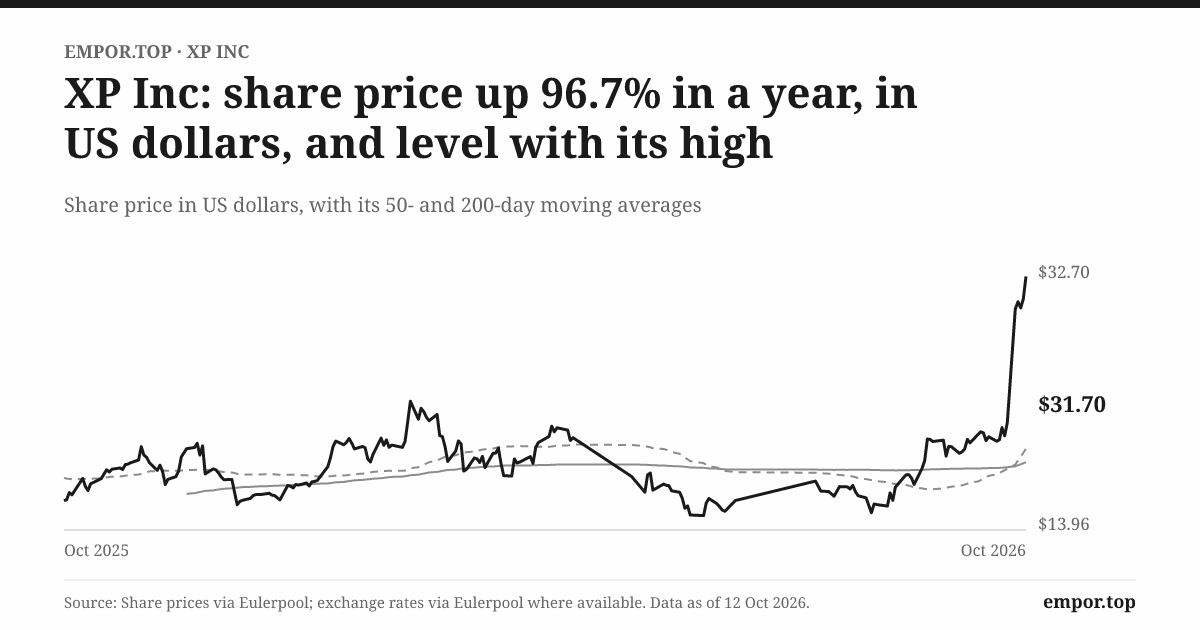
Seven years after the bell, the scale is hard to argue with. At the end of 2025 XP's clients held about R$1.5 trillion with the firm, spread across roughly 4.8 million active clients and served by about 18,000 independent advisors.2 Over the twelve months to June 2026 the group earned about $3.6 billion of revenue and just over $1 billion of net profit.24 On October 12, 2026, the shares closed at $31.73, a market value of about $17.4 billion and roughly 16 times trailing earnings.3 That price is barely above where the IPO priced, seven years and a lot of earnings later, which is itself a clue that the market has never been sure what kind of company this is.
There are two ways to tell the XP story, and both are partly true. The flattering version is that Benchimol built the Charles Schwab of Brazil: a disruptor that broke a banking oligopoly by teaching people to invest and then giving them a shelf full of products the banks would never sell. The skeptical version is that XP is a Brazilian capital-markets firm whose fortunes rise and fall with the country's interest rate, the Selic, which has swung between 2% and 13.75% in the space of a few years. When rates fall, Brazilians buy stocks and funds and XP prints money. When rates soar, they park everything in government bonds and bank deposits, and a broker becomes a much less exciting place to be.
This story tests three questions. The first is whether XP can keep charging about 1.25% a year on retail client assets, its take rate, when high rates push those clients toward low-margin fixed income.2 The second is whether the army of independent advisors stays loyal when Banco BTG Pactual, run by the dealmaker André Esteves, writes large checks to recruit them away, and when some of those advisors sue XP claiming they were really employees. The third is about control. XP is incorporated in the Cayman Islands with two classes of shares, and an entity called XP Control LLC, owned by Benchimol and his senior partners, holds about 71% of the votes while owning under 20% of the equity.2 Benchimol is now executive chairman; the chief executive is Thiago Maffra, an engineer who ran technology before he ran the company.2
To understand why a firm with those questions hanging over it ever got this big, start with a much smaller room, a broker with no job, and a country that was afraid of the stock market.
 Subscribe on LinkedIn
II. The Porto Alegre Classroom: How Education Became a Moat (2001–2010)
In 2001 Guilherme Benchimol was out of work. He had trained as an economist in Rio de Janeiro and had been working at a brokerage when the dot-com bust cleared the trading floors. He went south to Porto Alegre, the capital of Rio Grande do Sul, a long way from the money of São Paulo and Rio, and teamed up with Marcelo Maisonnave to open a small investment agency they called XP Investimentos.15 The founding legend features a cramped rented office, secondhand computers and a tiny pool of capital. The details have been polished by twenty years of retelling, but the shape of the problem was real: two young brokers, almost no money, and a product nobody wanted.
The product was Brazilian equities, and the reason nobody wanted it was history. Brazilians who were adults in 2001 remembered the hyperinflation of the late 1980s and early 1990s, when prices could rise by more than a thousand percent a year and the government froze bank accounts in a failed attempt to stop it. The lesson that generation learned was to keep money liquid, keep it with a big bank, and keep it away from anything that could fall. The stock exchange, then called Bovespa, was a place for foreigners, institutions and a few wealthy families. Cold-calling a doctor in Porto Alegre to suggest a few shares of Petrobras did not work, and XP's early attempts to do exactly that went nowhere.
So the partners changed what they sold. Instead of pitching stocks, they started selling courses on how stocks worked. People paid to attend sessions on personal finance, on reading a company, on how the exchange functioned. The insight sounds obvious only in hindsight: the barrier to Brazilian retail investing was not price but ignorance and fear, and someone who has paid to learn about the market is far more likely to open an account than someone who has been telephoned by a stranger. Graduates of the courses became clients, and the clients came pre-educated and pre-trusting. In the language of modern growth marketing, XP had found a customer acquisition channel that was not just cheap but actually made money.
That classroom habit became a cultural trait. XP grew up as a company that explained things, publishing research and content aimed at individuals rather than institutions, and that habit gave it a voice the banks lacked. A branch manager at a big bank was paid to sell the bank's products; XP was trying to persuade people to do something new, and persuasion requires teaching.
The second building block was distribution. XP could not afford branches, and it did not want them. Instead it borrowed a model that had worked in the United States, where independent broker-dealers such as LPL Financial and Raymond James let thousands of self-employed advisors run their own offices under a shared platform. In Brazil the equivalent was the agente autônomo de investimento, or AAI, a licensed independent agent who could serve clients on behalf of a broker. XP signed up these agents, many of them in provincial cities the big São Paulo firms ignored, and paid them a share of the revenue their clients generated.1 The agent got a business of their own; XP got a sales force it did not have to put on payroll or house in expensive real estate.
The combination was potent. Education created demand; the independent agents converted and serviced it; and because agents were paid on revenue, their incentive was to bring in clients and keep them active. The economics, though, carried a seed of future trouble. A sales force paid on commission is loyal to the economics, not the logo. As long as XP offered the best shelf and the best split, agents had every reason to stay. The moment someone else offered more, that loyalty would be tested, and XP would have to discover whether it had built a network or merely rented one. That test was still more than a decade away. First, XP had to turn a classroom and a few agent offices into a challenger the banks could not ignore.
III. Breaking the Oligopoly: Open Architecture and the "Desbancarização" Crusade (2010–2017)
Picture an affluent client in Curitiba or Belo Horizonte around 2012. They have savings at a big bank, and when they ask the branch what to buy, the answer is always one of the bank's own funds, charging a generous management fee for returns that look a lot like the market index. There are excellent independent hedge funds in Brazil, the fundos multimercado run by managers with names that meant something on Faria Lima, but the client cannot easily buy them, because the bank has no reason to put a competitor on its shelf.
XP's answer was open architecture, a phrase that means something simple: a store that sells everyone's products rather than its own. XP built a digital fund supermarket where independent managers could list their funds next to each other, and where the same client in Curitiba could buy a hedge fund, a corporate debenture or a bank deposit from a mid-sized lender, all from one account. Managers that had struggled to reach retail investors suddenly had a storefront with thousands of agents and an app attached. Clients got access to products that used to be reserved for the wealthy. XP took a cut of the fees.
This is the heart of what Brazilians started calling desbancarização, the de-banking of wealth. Universal banks had bundled two jobs, making investment products and distributing them. XP separated the jobs and kept the second one, which turned out to be where the power lived. Once a platform has the customers, the factories compete to get onto its shelf, and the platform gets paid by both sides: by the client through commissions and fees, and by the asset manager through a share of the fund's management fee. Economists call this a two-sided marketplace. In plain terms, every new manager made the shelf more attractive to clients, and every new client made the shelf more valuable to managers.
Growth capital helped. The British emerging-markets investor Actis invested in 2010, and General Atlantic followed in 2012.1 Both brought money and governance discipline at the moment XP needed to professionalize its back office, compliance and clearing. General Atlantic stayed on: it still owns about 5% of the Class A shares today.2 Private equity's presence also signalled to Brazilian institutions that the scrappy firm from Porto Alegre was becoming a serious financial company.
The numbers from the period show a business in a hurry. Revenue went from about $176 million in 2014 to about $622 million in 2017, and the growth rate in several of those years was 60% to 80%.12 Operating margins rose toward the mid-30s.1 Those figures are in dollars and therefore understate the real-terms growth in a period when the real was weakening, but even so they describe a company roughly tripling in three years while the banks it was attacking grew in single digits. The flywheel was turning: managers wanted the shelf, agents left bank jobs to open XP-affiliated offices, and client money flowed in.
Two cautions belong next to the triumph. The first is that XP's growth arrived when Brazilian interest rates were coming down from crisis levels, the very environment in which savers start looking past deposits for yield, so part of the momentum was the market and not only the model. The second is that open architecture is easy to copy once someone proves it works. XP's real advantage was timing and scale: it had the agents and the clients before the incumbents decided to fight.
And they did fight. Brazilian bankers, and the press that covered them, described an increasingly hostile relationship, with incumbents restricting the credit and services an upstart broker needs to operate. XP needed capital to become a full financial institution, with its own bank and its own balance sheet, and the cheapest source of capital in Brazil was the very industry it was attacking. Brazil's largest private bank noticed both XP's success and its need. What happened next was the strangest alliance in Latin American finance.
IV. "If You Can't Beat Them, Buy 49.9%": The Itaú Checkmate and the CADE Gauntlet (2017–2019)
In May 2017 XP was preparing to list in São Paulo. Instead, it announced a deal with Itaú Unibanco, the biggest private bank in the country and the symbol of everything XP had been campaigning against. Itaú agreed to pay about R$6.3 billion for 49.9% of XP's total capital, valuing the company at roughly R$12 billion.6 For a firm that had started as a classroom sixteen years earlier, it was an extraordinary price. For Itaú, it looked like the ultimate hedge: if you cannot beat the disruptor, own half of it.
The genius of the structure was in what Itaú did not get. It received just under half the economics but a much smaller share of the votes, about 30%, and Benchimol and the XP partners kept control of the company and its management.6 Itaú had options to increase its stake over time, but the partners held the operating keys. XP got a war chest from its enemy without handing over the steering wheel.
Regulators were not willing to take the arrangement on trust. Brazil's competition authority, CADE, and the Central Bank both reviewed the deal, and when the Central Bank approved it in August 2018 it did so with conditions.6 The practical effect of the conditions was to keep XP independent: Itaú could not take control of XP, and the arrangement had to preserve XP as a competitor rather than turn it into a captive channel.6 It is worth pausing on why that mattered. The whole reason XP was valuable was that it was not a bank. A version of XP that pushed Itaú's products would have destroyed the very thing Itaú paid for. The regulators, in effect, protected Itaú's investment from Itaú.
Benchimol had turned his biggest threat into his largest shareholder while legally fencing it off from his business. In terms of pure negotiating outcome, it is hard to think of a cleaner win for a founder in Latin American finance. It also left an uncomfortable relationship. Itaú owned half of a company whose sales pitch was that clients should leave banks like Itaú. As XP kept winning clients and advisors, the tension became public; Itaú's marketing in this period took aim at commission-driven advisors, and XP's leaders answered loudly in return. The partnership was financially rewarding for Itaú and strategically incoherent.
The resolution came in stages. In late 2020 Itaú's shareholders approved spinning off the XP stake into a separate company, later called XPart, so that Itaú's own investors held the XP shares directly rather than through the bank.7 Over the following years those holdings were sold into the market, and by 2024 the former Itaú and Itaúsa blocks had been entirely liquidated.2 The shareholders' agreement among XP Control, General Atlantic and the Itaú-linked holders was terminated before its scheduled 2026 expiry, and today XP pays no brand license, royalty or management fee to any outside parent.2 Related-party revenue with significant shareholders was under R$5 million in 2025, a rounding error against R$18 billion of revenue.2
So what did the Itaú chapter actually prove? It validated XP's model at a price that made the founders rich and the company well capitalized, and it ended with Itaú gone and XP still independent. The skeptical reading is that the episode also shows how much XP's independence depended on regulators and on careful contract drafting rather than on market power alone. That lesson would matter again, because the next contract XP needed to defend was not with a bank but with its own advisors. Before that, though, Benchimol had one more piece of financial engineering to perform, and it would shape who controls XP to this day.
V. The NASDAQ Climax and the Dual-Class Castle (2019–2021)
The obvious place for Brazil's most famous financial upstart to list was B3, the São Paulo exchange. B3's premium segment, the Novo Mercado, is built on a one-share-one-vote rule that was designed to clean up Brazilian corporate governance. XP went to New York instead. It created a holding company in the Cayman Islands and listed its Class A shares on the NASDAQ Global Select Market in December 2019.1
There were respectable reasons. NASDAQ offered a deeper pool of global growth investors, and it let XP present itself next to Charles Schwab and Interactive Brokers rather than next to Brazilian banks trading at bank multiples. Today the largest outside holders are global names, Capital World Investors, BlackRock and Dodge & Cox, each with roughly 8% to 10% of the Class A stock.2 But the less advertised reason was control. Cayman law allows the dual-class structure that Novo Mercado forbids.
The structure works like this. There are about 417 million Class A shares, each with one vote, held by the public. There are about 102 million Class B shares, each with ten votes, and all of them belong to XP Control LLC, the vehicle of Benchimol and the senior partners.2 Do the arithmetic and the Class B block is under 20% of the economic ownership but about 71% of the votes.2 Every board election and every shareholder resolution is decided before the meeting starts.
A fair critic would add two more points. XP reports as a foreign private issuer, which means it does not disclose individual executive pay the way a US company must; investors see only an aggregate, which was about R$53 million for executives and directors in 2025, up 55% on the year as variable profit-sharing rose.2 And the board's five independent directors are a minority of nine, serving at the pleasure of the controlling shareholder.2 A fair defender would answer that the partnership culture is the company, that owner-operators with real money at stake have run XP well, and that the structure kept XP out of the hands of a bank that had already tried to buy it. Both sides are right. The structure is a fortress, and public shareholders live outside the walls.
Then came the pandemic, and with it the best possible weather for XP. To fight the COVID recession, Brazil's Central Bank cut the Selic to an all-time low of 2% in 2020.5 With deposits paying almost nothing after inflation, millions of Brazilians opened brokerage accounts for the first time and poured money into stocks, funds and IPOs. XP's revenue rose from about $1.3 billion in 2019 to about $2.4 billion in 2021, and net margins climbed above 28%.2 In 2021 the stock traded above $50, valuing the company at more than $28 billion at the height of the global fintech boom.5
Here is the falsification that matters. If XP's growth in those years came mostly from its model, it should have continued when rates rose. If it came mostly from the cycle, it should have stalled. History ran exactly that experiment, and it began within months of the peak, while the company was changing who sat in the chief executive's chair.
VI. The Maffra Doctrine: Engineering the Multi-Product Fortress (2021–2024)
In 2021 Benchimol stepped back from day-to-day leadership and became executive chairman, handing the CEO job to Thiago Maffra.2 Maffra was not a salesman or a dealmaker. He was an engineer who had come up through XP's technology organisation and had been its chief technology officer. The choice said something about what Benchimol believed the next decade required: the company that had won by selling would now have to win by building.
The timing was brutal. To fight post-pandemic inflation, the Central Bank under Roberto Campos Neto raised the Selic from 2% in early 2021 to 13.75% by August 2022, one of the fastest tightening cycles in the world.10 For an equities-heavy broker, this was the macroeconomic version of an earthquake. With safe government bonds paying double digits, the appeal of stocks evaporated. Retail trading volumes on B3 fell, the IPO window closed, and investment-banking fees across Latin America dried up. Revenue growth fell from about 51% in 2021 to single digits in 2022 and 2023.2
What did not happen is as important. Earnings did not collapse. Net profit was broadly flat in 2022 and grew modestly in 2023, and margins stayed in the high 20s.2 The reason is the strategy Maffra pushed: turning XP from a broker that depended on stock trading into a financial supermarket that could make money whatever clients wanted to own.
The pieces of that supermarket were built mostly inside the company. Maffra reorganised XP around teams focused on client needs rather than product departments, the same squad model that technology companies use. Banco XP, the group's bank, grew from a licence into a real lender. It issued credit cards that paid rewards into investment funds rather than as cash, a feature XP marketed as "investback", and it lent against the investment portfolios clients already held at XP. That last product is the clever one: a loan backed by a client's own bonds and funds sitting in XP custody is about as safe as lending gets, and it deepens the relationship. By the end of 2025 the loan book was about R$35 billion, card spending had reached about R$53 billion a year, and retirement-plan assets, the Brazilian previdência, had grown to about R$95 billion.28
The biggest pivot, though, was in fixed income. When clients fled stocks for safety, XP followed them. It became a dominant distributor of the instruments Brazilian savers love in a high-rate world: tax-exempt bank deposits backed by real estate and agriculture, known as LCIs and LCAs, securitized credit bills known as CRIs and CRAs, and corporate debentures. The irony is that XP stayed relevant during the rate shock by doing the same thing it had always done, unbundling products from banks, only now the products were bonds rather than funds.
Maffra also bought. In 2023 XP completed the acquisition of Banco Modal, a digital bank and brokerage, paying in about 18.7 million Class A shares delivered as Brazilian depositary receipts.92 Modal was finally merged into Banco XP on September 1, 2025.2 More than two years from closing to full integration is a long time for a deal of that size, and the deal did not visibly change the group's growth curve; it was a consolidation of a smaller rival's accounts rather than a transformative move.
So did the doctrine work? The honest verdict is that it narrowed the damage rather than ending the cyclicality. Revenue in dollars grew strongly in 2024, then fell about 8% in 2025 before recovering to growth of about 14% in the June 2026 quarter.24 Profit kept rising in local currency throughout. That pattern is what a diversified platform looks like, and it is better than what a pure broker would have reported. But the claim that XP has outgrown the Selic is management's, not history's. The way to judge it is to look under the hood at how XP actually earns money.
VII. The Machine Under the Hood: Unit Economics, Capital Float, and the Take Rate Tightrope
Start with the single most important number in the company: the retail take rate. It answers a simple question. For every hundred reais a retail client keeps at XP, how much does XP earn in a year? In 2025 the answer was about R$1.25, or 1.25%.2 In 2023 and 2024 it was about 1.28% and 1.29%.2 That is the clue that matters most in this whole story, because it measures pricing power directly. If competitors were forcing XP to cut prices, or if clients were moving into products that pay XP almost nothing, the take rate is where it would show.
What is remarkable is how steady that number has been through the worst rate environment for a broker in a generation. The money moved from stocks into bonds, and XP still found a way to earn roughly the same share of it. The less remarkable part is the direction. A small but persistent slide from 1.29% to 1.25% is not a collapse, but it is not nothing either, and it is the first thing a careful investor watches each quarter.
Where does the money actually come from? Retail produced about R$14.6 billion of XP's roughly R$18.4 billion of revenue in 2025, three-quarters of the total.2 Inside retail, the main streams were placement fees for distributing new securities, at about R$2.5 billion; trading commissions on stocks and derivatives, at about R$2.0 billion; and management fees on funds and pensions, at about R$1.9 billion.2 Card interchange and the interest earned on the loan book fill in the rest. Outside retail, XP's corporate and issuer business, which helps companies raise debt and equity, contributed about R$2.7 billion; the institutional business serving professional investors about R$1.4 billion.2 Only the management fees and the interest margin are truly recurring; commissions and underwriting rise and fall with markets.
Now to the cost that defines the model. XP paid its independent advisors about R$3.5 billion in commissions and incentives in 2025, close to 44% of its revenue from services.2 That is the bill for owning distribution without owning the distributors. On top of the running commissions, XP carries about R$4.1 billion of prepaid incentives to advisors on its balance sheet, money paid upfront to sign or keep advisor offices and recognised as an expense over time.2 Hold that number in mind; it will return when the poaching wars begin.
Three of the headline figures about XP mislead anyone who reads them like an industrial company's. The first is cash flow. Operating cash flow was about R$12 billion in 2025, more than twice net profit.2 That is not a sign of extraordinary earnings quality. It is banking float: clients put about R$30 billion more into XP's deposits and bills during the year, and pension and insurance reserves rose by almost R$27 billion, while XP bought securities and made loans with much of that money.2 A bank's cash flow statement mostly describes its customers' money moving in and out.
The second is receivables. Data providers compute that XP takes 719 days to collect what it is owed, a number that would be alarming for a factory.2 It is an artefact. The calculation lumps the bank's R$34 billion loan book and billions in clearing and repo balances in with fees owed by fund managers.2 The genuine trade receivables were about R$1.4 billion at the end of 2025, mostly fees with a 30-day settlement cycle.2
The third is debt. XP shows around $15 billion of borrowings, which looks heavy against $4 billion of equity.2 Almost all of it is customer money: about R$123 billion of deposits, financial bills and structured notes issued by the bank.2 XP's own corporate borrowing, the debt its holding company owes, was about R$6.4 billion, or $1.15 billion, consisting mainly of dollar bonds due in 2026 and 2029, and it fell by more than R$3 billion during 2025 as XP repaid a credit line and maturing debentures.2 Against about R$19 billion of cash and equivalents, the corporate debt is modest.2
What remains, once the banking noise is stripped away, is a business with operating margins of about 32% and a return on equity of about 21%.2 Technology spending is real but contained: about R$1 billion of IT running costs, roughly 5.6% of revenue, plus about R$280 million of capitalised software.2 Those numbers say XP has scale economies; a platform this size spreads the cost of its systems across far more clients than any challenger can. But the advisor bill says something else. Nearly half the service revenue walks out the door to the people who own the client relationship day to day. Which raises the most important question in the company: who really owns the client, XP or the advisor?
VIII. The Advisor Blood Feud: BTG Pactual and the Poaching Wars
André Esteves does not do small. The founder-figure of Banco BTG Pactual rebuilt his bank after his arrest in 2015 and its near-collapse, and by 2020 BTG had decided that retail wealth was the next frontier. The fastest way into that business was not to build an advisor network. It was to buy one, office by office, from XP.
What followed, beginning around 2020 and accelerating in 2021, was the Brazilian financial industry's version of a talent war.11 BTG approached XP's largest affiliated advisor offices with upfront payments and economic participation. The marquee example was EQI Investimentos, a large advisor firm that left the XP ecosystem for BTG.11 The message to every other XP office was clear: your book of clients has a price, and there is now a buyer.
To understand why this was dangerous, recall how the advisor model works. An advisor office is a separate company. Its people know the clients, call them, and recommend products. XP provides the platform, the custody, the products and the brand. The contracts between XP and its offices contain exclusivity, non-compete, non-solicitation and confidentiality clauses designed to keep clients with XP if the office leaves.2 In theory, an office that walks away leaves its clients behind. In practice, clients trust the person who calls them, and many follow.
XP's response came on two fronts. Commercially, it paid to keep people; the R$4.1 billion of prepaid advisor incentives on the balance sheet is the cumulative price of loyalty.2 Legally, it went to court and to arbitration, claiming breach of exclusivity and misuse of client information. The cost of that legal war is visible in XP's contingencies: claims classified as possible but not provisioned in civil disputes rose about 47%, to about R$1.4 billion, in 2025.2 That figure covers more than advisor fights, but it tells you this is a litigious business.
A second front opened in the labour courts. Some former advisors sued XP arguing that, despite their contracts, the level of exclusivity and supervision made them employees under Brazilian labour law, a vínculo empregatício. At the end of 2025 XP had 365 labour cases and had provisioned about R$115 million for them as probable losses.2 The sums are small against XP's profits. The principle is not. If Brazilian courts ever broadly decided that exclusive advisors were employees, the economics of the whole model, with its variable payouts and off-payroll distribution, would have to be rebuilt.
The regulator changed the board too. In 2023 the securities commission, CVM, issued Resolution 178, a new framework for investment advisors.12 Among other changes it ended the old requirement that an advisor be tied exclusively to a single broker and let advisor firms organise as corporations with outside partners.12 For XP's competitors, that was an opening. For XP, it meant exclusivity would no longer be enforced by regulation; it would have to be enforced by contract and paid for in cash.
So far, the network has held in size. XP had about 17,200 advisors at the end of 2023, 18,200 in 2024 and 18,000 at the end of 2025, while client assets rose from about R$1.1 trillion to about R$1.5 trillion and net inflows ran at roughly R$94 billion in 2025.2 That is not the profile of a franchise being hollowed out. But it is a franchise whose defence has become a recurring expense. The question is no longer whether XP can keep its advisors. It is what it will cost, every year, forever, and whether that cost is a moat or a toll.
IX. Moat Assessment: Powers, Forces, and the Falsification Test
Imagine the question every bear eventually puts on an XP earnings call: if Itaú, Bradesco and BTG all now run open platforms, and if a client can move a portfolio to a competitor in a few days, what exactly is XP's moat? It is the right question, and it deserves a full answer once.
Start with Hamilton Helmer's seven powers, the framework that asks what lets a business earn more than its cost of capital for a long time. The strongest power XP has is a network effect of the two-sided kind. About 18,000 advisors and R$1.5 trillion of client assets make XP's shelf the most important distribution channel for Brazil's independent asset managers.2 A manager who wants to raise retail money cannot easily skip XP, and a client who wants access to the best managers finds them there. That cycle is real, and it explains why XP's take rate has held.
The second power is scale economies. Compliance, clearing, technology and product structuring are largely fixed costs, and XP spreads them across more client money than any independent rival. The 32% operating margin despite a 44% advisor payout is the proof.2
Switching costs are the third power, and they are moderate rather than strong. A client who keeps pensions, an offshore account, a card and a loan backed by their portfolio at XP faces paperwork and inertia if they leave; the transfer of custody between brokers in Brazil is a manual process. But Brazilian affluent clients commonly hold accounts at several institutions, and the advisor, not the app, is often the switching point. When an advisor office leaves, its clients may move together.
The power XP no longer has is counter-positioning, the advantage of a business model incumbents cannot copy without hurting themselves. In 2010 a bank could not open its shelf without cannibalising its own funds. Today Itaú runs its own digital investment platform, Íon, Bradesco owns the broker Ágora, and BTG matches XP product for product. That edge is spent.
Michael Porter's five forces round out the picture. Buyer power is fragmented; no client is more than 10% of revenue.2 Supplier power is where the trouble lives, because the scarcest input in Brazilian wealth management is not products, which are abundant, but trusted advisors, who now have multiple bidders. Substitutes are always present in the form of a bank deposit or a government bond bought directly through Tesouro Direto. Rivalry is intense and growing. Entry barriers for a new startup are high, because building R$1.5 trillion of trust takes decades, but entry barriers for an existing bank with a balance sheet are much lower.
Now test the moat claims against XP's own history. The claim that advisor exclusivity protects inflows does not survive in its strong form. BTG has recruited prominent XP offices, CVM's Resolution 178 removed regulatory exclusivity, and XP now carries R$4.1 billion of prepaid incentives to hold its network together.212 The record narrows the claim: XP's distribution is defensible, but only at a recurring price. What would confirm the narrowed claim is advisor headcount and net inflows holding while the prepaid balance stops growing faster than revenue; what would falsify it is a quarter of net outflows tied to advisor departures.
The claim that M&A expands scale is weaker still. Modal cost XP about 18.7 million shares and took more than two years to fold into Banco XP, without a visible step-up in growth.2 The record leaves the claim unproven, which matters only because XP has not leaned on acquisitions much; its growth has been organic.
The claim that XP's partnership incentives are clean has the most consequential counterevidence. The Federal Revenue Service has issued assessments totalling about R$2.1 billion, treated by XP as possible losses and not provisioned, challenging the way XP's profit-sharing payments were deducted from 2011 to 2021.2 The partnership culture is XP's identity, and the tax authority is arguing that part of its economic plumbing was improperly structured. That is not a moat issue in the classic sense, but it goes to the heart of how XP pays its people, and it deserves its own look.
The overall verdict is clear enough to state once. XP has a real moat built on network effects and scale, narrower than Charles Schwab's because the client relationship is partly owned by independent advisors who can be bought, and because Brazilian clients multi-bank easily. It is a good franchise defended at a cost, not an impregnable one.
X. The Shadow Risks: CARF Tax Assessments and Emerging Market Realities
In Brasília, an administrative tribunal called CARF hears tax disputes between companies and the Federal Revenue Service. It is not a glamorous place, but it is where several of Brazil's largest financial institutions have fought over the same question: when a firm pays its people a share of profits, is that a genuine profit-sharing plan under Law 10,101 of 2000, which is exempt from social security contributions and deductible for corporate tax, or is it a disguised bonus that should have been taxed?13
XP faces eight such assessments covering 2011 to 2021, adding up to about R$2.1 billion classified as possible losses.2 The tax authorities' argument, in essence, is that payments flowed disproportionately to partners and senior people rather than through a collective workforce plan. XP disputes this and has not provisioned for it, and the cases have moved up through administrative appeals toward the Superior Chamber of Tax Appeals, the CSRF.2 Add civil and other disputes and XP's total unprovisioned possible contingencies rose from about R$2.5 billion to about R$3.7 billion during 2025.2
How big is that? XP earned about R$5.2 billion of net profit in 2025.2 A complete loss on the profit-sharing cases would therefore cost roughly two-fifths of a year's earnings, more once interest and penalties accrue over long litigation, and it would be a cash cost rather than an accounting one. It would not threaten XP's survival; it would dent a year's buybacks and, more importantly, force a rethink of the partner compensation model that holds the firm together. The auditor, PwC, issued a clean opinion on the 2025 statements; its one critical audit matter concerned the valuation of about R$2.2 billion of hard-to-price financial instruments, not the tax cases.2
Currency is the second shadow. XP reports in reais and trades in dollars. Its US-dollar bonds, $435 million due in July 2026 and $503 million due in 2029, create accounting gains and losses as the real moves.2 In 2025 a stronger real produced a foreign-exchange gain of nearly R$1 billion; in 2024 a weaker one produced a loss of about R$1.2 billion.2 XP hedges much of this, but the swings run through reported profit, and an investor in New York also takes direct exposure to the real in every share.
The credit agencies see XP as solid within its country's limits. Fitch affirmed XP Inc. at BB, capped by Brazil's sovereign rating, and Banco XP at AAA on Brazil's national scale, in May 2026.14 Fitch credited the franchise, liquidity and largely collateralised lending, and flagged rising balance-sheet leverage and the sensitivity of capital-markets revenue to Brazilian rates.14 In other words, XP's balance sheet is not the risk. Brazil is.
And that brings the story back to the Selic. Every major chapter of XP's history lines up with the rate cycle: the boom of the falling-rate 2010s, the euphoria of the 2% pandemic rate, the slowdown of the 13.75% tightening. Brazil's fiscal politics decide that rate, and no amount of product engineering in São Paulo changes it. Which leaves the question investors argue about every quarter: at today's price, is the market paying for the cycle or for the franchise?
XI. The Bear vs. Bull Verdict and Valuation Stress Test
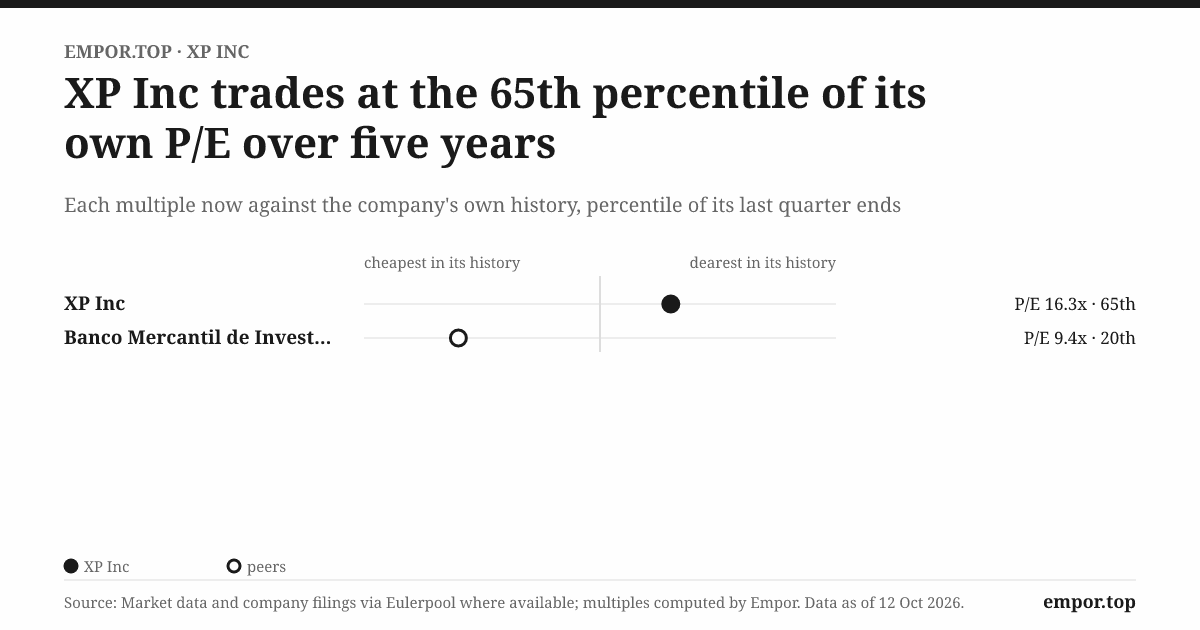
On equity research desks covering Latin American financials, XP is usually discussed in the same breath as two neighbours: Nubank and BTG Pactual. The comparison tells you what the market thinks of each. Nu Holdings, the mass-market digital bank expanding into Mexico and Colombia, trades at about 21 to 22 times trailing earnings, a premium for growth and for a lending franchise with returns on equity around 30%. BTG trades at roughly 16 to 19 times, with returns on equity in the mid-20s, a premium for its investment bank and trading franchise. XP sits at about 16 times trailing earnings and 3.3 times book value, at or slightly below BTG and well below Nubank.3
Against its own history, XP is not cheap. Its five-year median price-to-earnings multiple is about 12, and the shares have roughly doubled from their 52-week low to close at a 52-week high on October 12, 2026.3 At today's price, the market is paying about 33% more per real of earnings than it typically has since 2021. That suggests investors have started to believe in some version of the bull case, most plausibly a Brazilian rate-cutting cycle. An earnings yield of about 6% is what that belief buys.3
The bear argument begins with fees. If clients stay heavily in fixed income and competition intensifies, the take rate could drift from 1.25% toward 1%, which on R$1.5 trillion of assets would erase several billion reais of revenue. It continues with distribution costs: if BTG and the banks keep bidding for advisors, the 44% payout rises and margins slip below 30%. It adds the tax cases, where an adverse CSRF ruling would turn a contingent R$2.1 billion into cash out the door. And it ends with governance. With 71% of the votes in XP Control's hands, public investors cannot change capital allocation, the board or the pay structure. An activist would have nothing to work with, and a skeptic would say the dual-class discount is permanent by design.
The bull argument begins with the rate cycle, because XP has shown what it earns when rates fall. A sustained easing by the Central Bank would rotate clients back into funds and equities, reopen the IPO window and restore the high-margin streams. It adds the cross-sell: credit cards, pensions and portfolio-backed loans sold to 4.8 million existing clients cost little to acquire. It points to capital returns. XP increased stock buybacks from about R$900 million in 2023 to R$1.9 billion in 2025, and authorised another R$1 billion programme running to November 2026, alongside dividends.2 A company retiring shares at a 6% earnings yield compounds per-share value even without growth. And it ends with the franchise: no startup can rebuild R$1.5 trillion of trust and 18,000 advisors from scratch.
Weigh the two and a few things are clear. The bull case's strongest evidence is the take rate's resilience through the worst rate shock in a generation and the steady compounding of client assets. The bear case's strongest evidence is that the defence of distribution has become a permanent cost and that governance offers minority holders no lever. The market's 16-times multiple sits between the two stories. It is no longer pricing XP as a pure cyclical broker, and it is not pricing it as a growth platform.
For anyone following the company, two numbers matter more than all the rest. The first is the retail take rate, last at 1.25% for 2025 and drifting slowly down from 1.29%.2 The second is client assets and net inflows, last at about R$1.5 trillion and R$94 billion a year respectively, rising.2 If both hold, the franchise is intact. If the take rate falls while inflows slow, the bears are winning.
XII. Playbook: Business & Investing Lessons
The first lesson begins in that Porto Alegre classroom. XP did not win Brazil by charging lower commissions than the banks. It won by charging people to learn, at a time when nobody would buy stocks, and then letting the students become clients. In markets where the customer does not yet understand the product, the curriculum is the product, and the company that teaches owns the trust that follows. The fastest way to break a banking cartel is to teach its depositors what their savings are actually worth.
The second lesson is about where power sits in finance. Brazil's banks believed that owning the funds meant owning the customer. XP proved the opposite: once products become abundant, whoever controls the shelf and the relationship sets the terms, and the factories pay for placement. That is why Itaú paid R$6.3 billion for half of a broker, and why the regulators had to stop it from turning that broker into a captive channel. In wealth management, the entity that owns the client's trust dictates the split to the factory.
The third lesson is the one XP is still living. An army of independent advisors let XP grow across a continent-sized country without building branches or carrying a sales payroll. But the same independence that made the network cheap made it buyable, and when BTG arrived with checks, when CVM ended regulated exclusivity, and when former advisors went to labour court, XP discovered that loyalty in a commission model has a market price. Outsourced distribution is an asset on the way up and a recurring auction once rivals arrive with open checkbooks.
The fourth lesson belongs to Thiago Maffra. When the Selic went from 2% to 13.75%, a pure equity broker would have watched its profits sink. XP's earnings held because it had already started building a bank, a card business, a pension franchise and a fixed-income shelf. The insight for founders is to diversify the business against the cycle while the cycle is still kind, because no one funds a reinvention after the punchbowl is gone. When your business model depends on low interest rates, build the bank before the central bank takes the punchbowl away.
XIII. Epilogue
Tonight XP stands at a high-water mark. Over the past twelve months it earned about $3.6 billion of revenue and just over $1 billion of profit, client assets approach R$1.5 trillion, and the stock closed at $31.73, its highest level in a year.234 The June 2026 quarter showed revenue up about 14% from a year earlier and profit up about 12%, the strongest growth in two years.4
Three moments will decide which story about XP proves true. The first comes every quarter, when the company reports its retail take rate. If it holds above about 1.20% through 2026 and 2027, the evidence will say XP's pricing power survived the move to fixed income; if it falls below about 1.15%, the bears' story of fee compression will have its proof. The second is the advisor contest. The arbitrations and civil cases with departing offices, and any labour court ruling on whether exclusive advisors are employees, will set the terms of XP's relationship with its own sales force for a decade. A stable equilibrium would turn the prepaid incentives into a known cost of doing business; an accelerating exodus would turn them into a losing bid. The third is in Brasília. When the Superior Chamber of Tax Appeals rules on the profit-sharing assessments, XP will either close the book on a R$2.1 billion overhang or be forced to book provisions, pay cash, and redesign the partner compensation that defines the firm.
Behind all three sits the variable XP does not control: the Selic. Benchimol's red-vest army rebuilt the architecture of Brazilian wealth. The question it now faces is whether a mature, independent platform can compound through Latin America's perpetual roller coaster, or whether it will always be, at heart, a bet on the next rate cut.
XIV. Outro
Go back to Porto Alegre in 2001, to a small room and two brokers explaining to a handful of paying students how the stock market works. The students did not know they were the first customers of what would become the largest independent investment platform in Latin America. The banks down the road did not notice them at all.
Twenty-five years later, the banks notice. They copied the open shelf, bought half the company and sold it again, and now bid for its advisors one office at a time. XP's red vest has gone from a joke about cold air conditioning to a symbol of the most successful assault on a banking oligopoly in the Americas. It is the company that proved Latin America's tightest financial fortress could be broken, not with a banking charter, but with a classroom and a red vest.
References
-
SEC EDGAR Form 424B1 IPO Final Prospectus — U.S. Securities and Exchange Commission, 2019-12-11 ↩↩↩↩↩↩↩↩
-
SEC EDGAR Form 20-F Annual Report for the Fiscal Year Ended December 31, 2025 — U.S. Securities and Exchange Commission, 2026-04-29 ↩↩↩↩↩↩↩↩↩↩↩↩↩↩↩↩↩↩↩↩↩↩↩↩↩↩↩↩↩↩↩↩↩↩↩↩↩↩↩↩↩↩↩↩↩↩↩↩↩↩↩↩↩↩↩↩↩↩↩↩↩↩↩
-
XP Inc. Investor Relations Homepage — XP Inc., 2026-10-12 ↩↩↩↩↩
-
XP Inc. Reports Second Quarter 2026 Results — XP Inc. Investor Relations, 2026-08-11 ↩↩↩↩
-
How XP Inc. Transformed Brazilian Retail Finance — Financial Times, 2021-09-22 ↩↩↩
-
Brazil's Central Bank Approves Itaú's Acquisition of Minority Stake in XP Investimentos — Reuters, 2018-08-10 ↩↩↩↩
-
Itaú Approves Spin-off of 41% Stake in XP Investimentos to New Company — Reuters, 2020-11-26 ↩
-
XP Inc. Reports Fourth Quarter and Full Year 2025 Results — XP Inc. Investor Relations, 2026-02-24 ↩
-
XP Concludes Acquisition of Digital Brokerage Banco Modal — Reuters, 2023-07-03 ↩
-
SEC EDGAR Form 20-F Annual Report for the Fiscal Year Ended December 31, 2024 — U.S. Securities and Exchange Commission, 2025-04-24 ↩
-
XP and BTG Pactual Fight Over Financial Advisors in Brazil — Bloomberg, 2021-06-15 ↩↩
-
Brazil Securities Regulator CVM Approves New Rules for Autonomous Investment Agents (Resolution 178) — Comissão de Valores Mobiliários (CVM), 2023-02-14 ↩↩↩
-
Tribunal do CARF Analisa Autuações Fiscais sobre Planos de PLR no Setor Financeiro — Ministério da Fazenda / CARF, 2025-09-18 ↩
-
Fitch Affirms XP Inc.'s IDR at 'BB' and Banco XP at 'AAA(bra)'; Outlook Stable — Fitch Ratings, 2026-05-20 ↩↩
 LinkedIn
 WhatsApp
 Reddit
 Hacker News
 Email
Email Kindle
 RSS Feed
 Spotify
 Apple Podcasts
 Amazon Music
 Audible
 YouTube