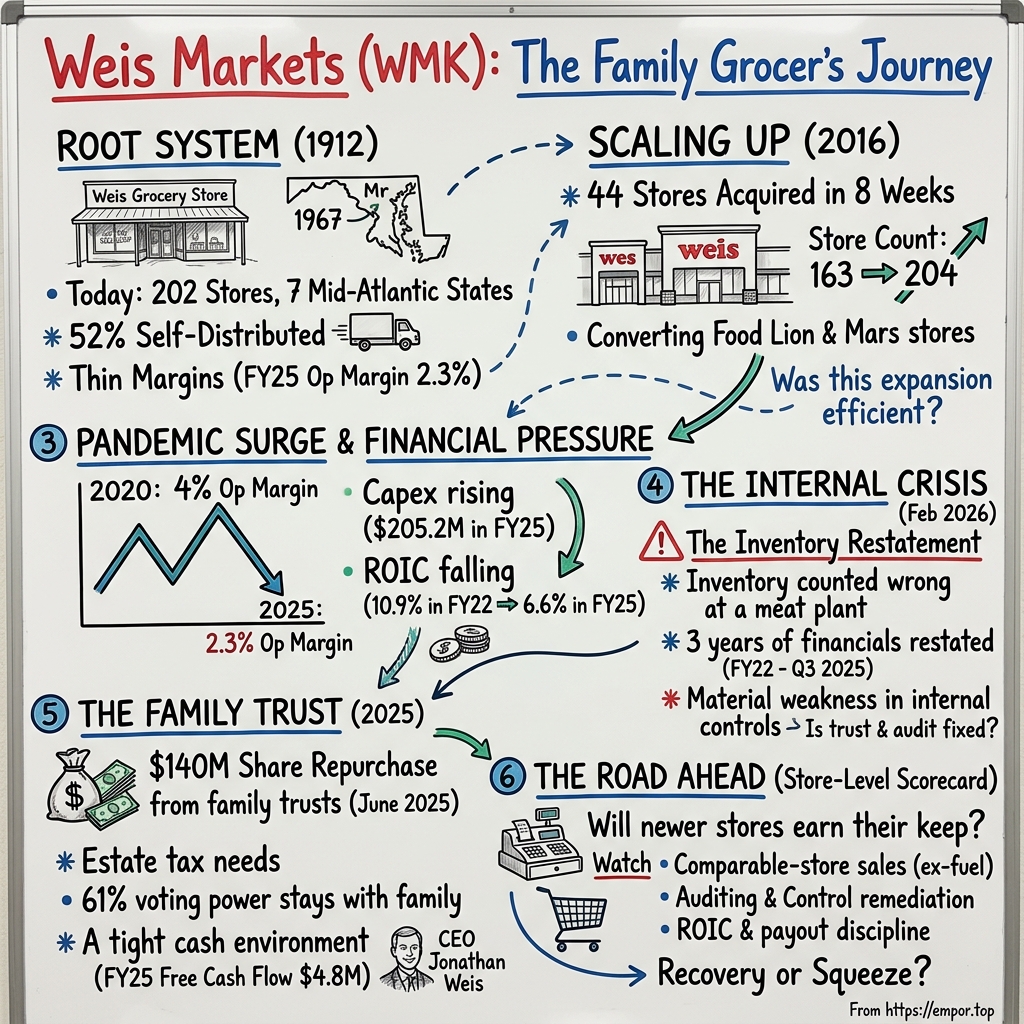
Weis Markets: The Family Grocer at the Checkout
I. The Grocery Bill That Doesn’t Tell the Whole Story
Somewhere in central Pennsylvania on an ordinary weekday, a shopper pushes a cart toward the front of a Weis Markets store. Milk, a dozen eggs, a pack of ground beef, a bag of salad, a prescription from the pharmacy counter in the back, maybe a tank of gas on the way out from the fuel center in the parking lot.
The scanner beeps, the receipt prints, and the bill comes to whatever a week of feeding a family costs now. Nothing about the moment is remarkable. That is the point of a supermarket. It is supposed to be the most unremarkable place in town.
A few dozen miles away, in Sunbury, the company that owns that store spent the start of 2026 dealing with something that was not ordinary at all. In February, the Audit Committee of Weis Markets' board concluded that the company's previously issued financial statements could no longer be relied upon.1
The cause was not a fraud ring or a collapsed customer. It was inventory, the boxes and cases and carcasses that sit between the loading dock and the shelf, which had been overstated at one of the company's meat operations.1 The correction reached back across fiscal 2022, 2023 and 2024 and into the first three quarters of 2025.2
Put those two scenes side by side and the whole Weis Markets story is visible. The shopper sees a grocery bill. An investor has to see what that bill is worth after the thinnest margins in retailing, after a decade of heavy store investment, and after the discovery that the company's own count of what was in the back room had been wrong for years.
The scale is real. Weis rang up about $5.0 billion of revenue in fiscal 2025 from 202 stores spread across Pennsylvania and six neighboring Mid-Atlantic states.2 It is, at its heart, a grocer: the distribution centers, the trucks, the dairy plant and the meat operation all exist to fill those stores.
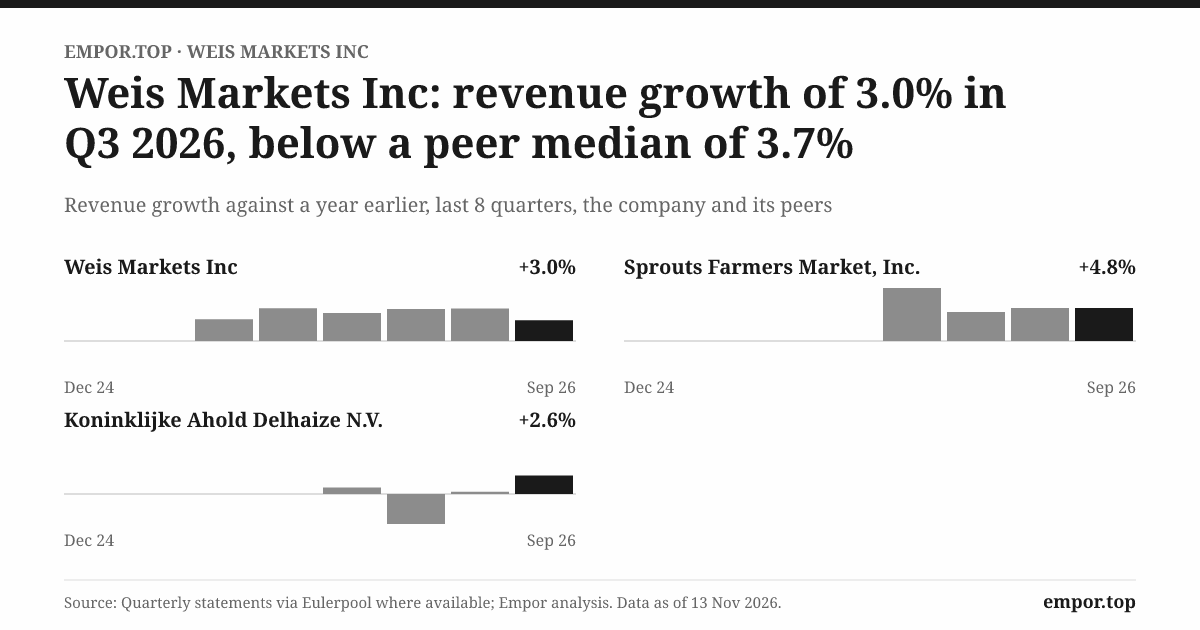
The most recent quarter looked, at first glance, like steady progress. Revenue in the third quarter of 2026 rose 3.0% to about $1.28 billion.3 But strip out gasoline and compare only stores that were open in both years, and sales fell 1.2%.3 The headline said growth. The core basket said something closer to retreat.
That gap between the top line and the basket is the first of three tests this story turns on. The second is whether the money Weis is now pouring into new stores, remodels and distribution can earn back more than it costs, at a time when the company's return on invested capital has fallen from about 11% in fiscal 2022 to under 7% in fiscal 2025.2 The third is whether the company has truly fixed the reporting failure that made investors' old numbers unreliable, or merely corrected them.
The long-run record makes the slowdown easy to see. Over the ten years to fiscal 2025, revenue compounded at roughly 5.6% a year. Over the latest three, it compounded at under 2%.2 Net profit tells a sharper story: it grew a little under 5% a year over the decade, but shrank more than 9% a year over the latest three.2
Something that worked for a long time has stopped working as well, and the explanation is part pandemic hangover, part competition, part cost, and part the plain arithmetic of a business that keeps about two cents of operating profit from each dollar it sells.
Running through all of it is a family. The Weis family founded the company in 1912 and still controls it.4 That control has bought continuity that most public grocers never had: no private-equity leveraged buyout, no hostile raider, no merger that dissolved the banner into someone else's. It has allowed the company to invest locally and patiently, through good years and bad.
The same control means that when the company makes a large capital decision, outside shareholders have little power to reverse it. In June 2025 the company spent $140 million buying stock from family-affiliated trusts.2 Whether that was patience or privilege is one of the questions this story has to answer.
One boundary keeps the analysis honest. Weis Markets is a standalone listed company, traded on the New York Stock Exchange since 1965, not a subsidiary of a larger group whose growth happens somewhere else.2 The trucking arm and the food-manufacturing subsidiary inside it are its own.2 Every dollar of sales, every store opening and every control failure belongs to the same entity whose shares trade under the ticker WMK.
So the question beneath the scanner's beep is simple to state and hard to answer. Can a family-controlled regional grocer turn rising sales and heavy reinvestment into durable earnings growth, and can investors trust the numbers that tell them whether it has? To answer it, the story has to begin where the company did, in a river town in Pennsylvania more than a century ago.
 Subscribe on LinkedIn
II. Sunbury, 1912: A Local Store Becomes a Regional System
Sunbury sits where the West Branch of the Susquehanna River meets the North Branch, a railroad and canal town in the coal and farm country of central Pennsylvania. In 1912 two brothers, Harry and Sigmund Weis, opened a grocery there.4 They incorporated the business in 1924.4
It was the era when the American grocery trade was being remade by chain stores, when the counter clerk who fetched goods from behind the counter was giving way to self-service aisles and to companies that bought in volume and sold for less. The Weis brothers did not invent that model. They built a local version of it, and then they kept extending it, one nearby town at a time.
The early history matters for only one reason: it explains the shape of the company today. Weis did not grow by leaping into distant metropolitan markets. It grew outward from the Susquehanna Valley into the small cities and suburbs of Pennsylvania, then south into Maryland and outward into New York, New Jersey, West Virginia, Virginia and Delaware.4
By the end of 2016, Pennsylvania still held about 121 of its stores and Maryland about 50, with the rest scattered across the five other states.4 It remained under family control after going public on the NYSE in 1965.2 What emerged was not a national brand but a regional system: a dense cluster of stores, close enough together that one network of warehouses and trucks could serve them all.
To understand that system, follow a single delivery. A Weis tractor-trailer leaves a company distribution center before dawn, loaded with cases of cereal, frozen vegetables and paper towels, perhaps a few pallets of store-brand milk from the company's own dairy, perhaps ground beef from its own meat operation. It backs into the loading dock of a store a couple of hours away.
The truck is driven by Weis Transportation, a subsidiary; the warehouse belongs to Weis; some of the products were made in one of the company's three manufacturing facilities.2 Roughly 52% of the product that reaches Weis shelves arrives through this self-distribution network, with the remainder delivered directly by vendors and wholesalers.2
That self-reliance is the closest thing Weis has to a signature. Many regional grocers buy most of their goods through large wholesalers such as C&S or UNFI and let those wholesalers handle the warehousing and the trucks. Weis does much of it itself. The appeal is control: the company decides what is in stock, when it arrives, and how fresh it is. The cost is capital: warehouses, fleets and plants have to be built, maintained and filled, and they only pay off if the stores they serve sell enough volume to keep them busy.
But it would be a mistake to treat these support operations as separate growth engines. Retail merchandise sales dominate the company's revenue; the manufacturing and distribution businesses exist to supply the shelves.2 When the company discloses its revenue, the categories are groceries, fresh food, pharmacy and fuel, not trucking or dairy contracts with outside customers.2 The plants and trucks are the plumbing. The stores are the house.
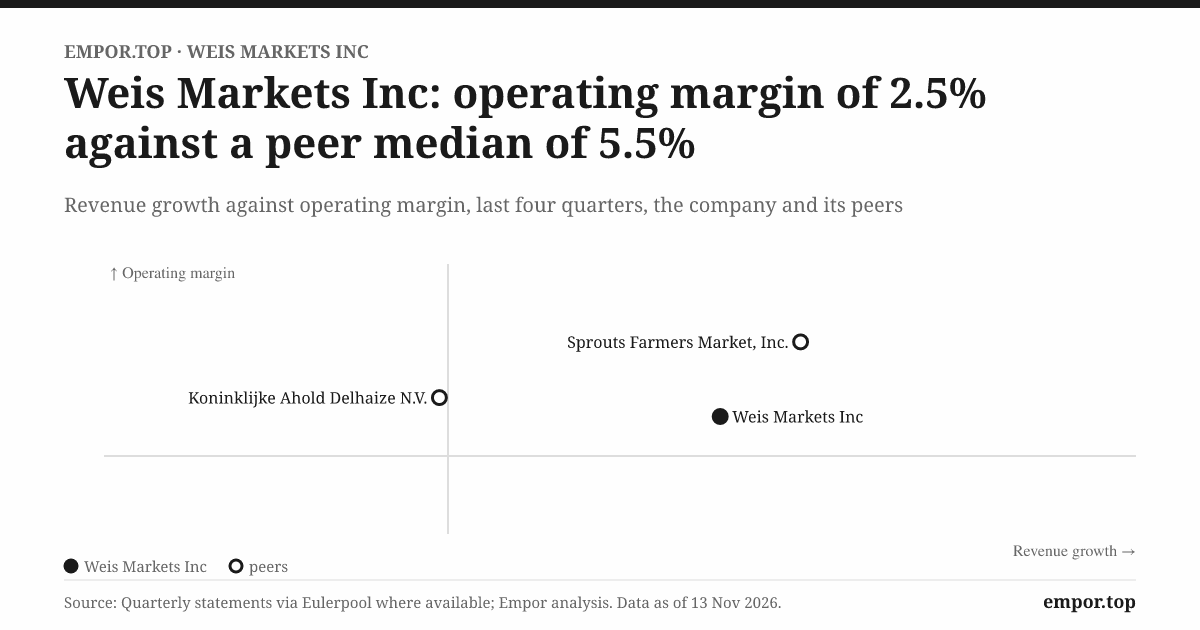
And the house runs on a very thin margin. In fiscal 2025, Weis kept about 2.3 cents of operating profit for every dollar of sales.2 That is normal for American grocery retail, where the cost of the goods themselves swallows roughly three-quarters of every sale and labor, rent, utilities and shrink consume nearly all the rest.
It also means that small changes matter enormously. Half a percentage point of margin, on $5 billion of sales, is $25 million of operating profit, which is about a fifth of what Weis earned from operations in 2025. A modest price war, a jump in wage costs or a bad year of spoiled produce can move the profit line far more than the revenue line.
Scale does not rescue a grocer from that arithmetic. Weis is large by the standards of a single family business and small by the standards of the industry it competes in. The shopper deciding where to buy groceries in a Weis town usually has several alternatives within a short drive. On price, Walmart supercenters and Aldi set the floor for what a basket should cost.
In overlapping Mid-Atlantic markets, Ahold Delhaize's Giant banners and the ShopRite stores operated by Wakefern's member cooperatives fight for the same households. Farther west, Giant Eagle has long been the dominant regional chain in the Pittsburgh area.5 Even in Weis's home region, the fight is close: a 2025 analysis of central Pennsylvania's grocery market, worth about $4.3 billion, framed the contest as a race among Giant, Weis and the smaller family-owned Karns.6
That is the honest frame for the company's distribution system. It is a real capability, and it may give Weis an edge in availability, freshness and cost compared with a regional rival that relies entirely on outside wholesalers. But Weis does not publish what self-distribution saves it relative to peers, nor store-level returns that would show the advantage turning into superior profits.2 It does not publish customer-retention figures or price comparisons against local competitors.2 What the record shows is a working system, not a proven moat.
A system like this creates a strategic choice that every regional grocer eventually faces. A company can grow organically, finding a site, building or leasing a store, hiring a staff, waiting years for the location to mature.
Or it can buy a cluster of existing stores and inherit a new geography almost overnight, with the trucks and warehouses absorbing the new volume. For most of its history Weis grew store by store. In 2016 it chose the second path, and it chose it at a speed that tested every part of the system it had built.
III. Forty-Four Stores in Eight Weeks
The supermarket business rarely produces a cliffhanger, but the late summer and fall of 2016 came close for Weis. The opportunity arrived courtesy of antitrust law. When Ahold and Delhaize, the parents of Giant and Food Lion, merged in 2016, regulators required them to sell stores in overlapping markets.
A batch of former Food Lion locations in Maryland, Virginia and Delaware came onto the market, and Weis bought 38 of them.4 In the same stretch it acquired five former Mars Super Market stores in Baltimore County, Maryland, from a family chain that was leaving the business, and one former Nell's Family Market in East Berlin, Pennsylvania.4 In the third and fourth quarters of 2016, the company took on 44 new locations.4
Picture what that meant on the ground. Each converted store had to be closed, re-signed, re-stocked and re-staffed. The point-of-sale systems had to be swapped, the loyalty program extended, the pharmacy records transferred, the shelves reset to Weis's assortment and private-label products.
New trucking routes had to be drawn into parts of Virginia and Delaware where Weis had barely operated before, without starving the existing chain of deliveries. Employees from the former owners had to learn new systems and a new culture in weeks. A grocer that had been adding a handful of stores a year was suddenly opening the equivalent of several years' worth of locations in a few months.
The result changed the company's shape. At the end of 2015 Weis operated 163 stores; at the end of 2016 it operated 204.4 The store base grew by roughly a quarter in a single year. Revenue followed: sales rose about 9% in fiscal 2016 and another 10.5% in fiscal 2017, the first full year with the acquired stores, after years of low single-digit growth.47
Weis's 2016 net sales rose "primarily" because of the 44 acquired locations.4 Weis had moved its center of gravity south, deeper into Maryland and into Virginia and Delaware, closer to the Washington and Baltimore suburbs where population growth was stronger than in its Pennsylvania heartland.
The map tells the story of the deal in a sentence. After the conversions, Weis operated 13 stores in Virginia and four in Delaware, states where it had been a marginal presence, and about 50 in Maryland, which had become its second home.4 For a company whose identity had been tied to the Susquehanna Valley for a century, that was a meaningful change in where its future customers would come from.
The obvious question is whether Weis got a good deal. The popular version of the story is that it did, that a patient family grocer swooped in on stores that regulators forced two giants to sell. The record supports a narrower claim. The company recorded a gain on bargain purchase of roughly $24 million in 2016, an accounting entry that means the fair value assigned to the net assets acquired exceeded the price paid.4
That gain is why profit before tax jumped to about $124 million in 2016, well above operating profit of about $98 million.4 It tells a listener that Weis paid less than the appraised value of the buildings, equipment and leases. It does not tell a listener that the stores went on to earn good returns.
Those are different questions, and the second one is harder to answer. Weis does not report the acquired stores' sales or profits separately, so it is impossible to calculate what multiple of earnings the company effectively paid or what return the stores have produced since.7 Food Lion stores that regulators required Ahold Delhaize to sell were not chosen for their profitability; some were in markets where a competitor's presence was the very reason for the divestiture.
The aggregate figures are not encouraging. Operating margin fell from about 3.1% in fiscal 2016 to about 2.3% in fiscal 2017, the year the company absorbed the new stores.7 Net income in 2017 was propped up by the one-time remeasurement of deferred taxes under the federal tax overhaul of that year, which made the company's reported tax rate negative.7 Strip that out and 2017 was a year in which a much larger company earned less from operations than the smaller one had the year before.
The fairest verdict is that the 2016 expansion succeeded as an operating feat and as a footprint decision. Weis integrated dozens of stores across three states without visible disruption to the rest of the chain, and it established itself in faster-growing markets. Whether it created value beyond that is unproven. The bargain-purchase gain suggests Weis did not overpay for the physical assets. The margin record suggests the stores did not, at least at first, raise the earning power of the business.
It also matters to separate growth by its source in the years that followed. Revenue has grown since 2016 for several reasons: new stores, yes, but also comparable-store sales at existing locations, food inflation, fuel prices and, for a while, a pandemic. The filings do not support treating all of that growth as share taken from competitors. When gas prices rise, Weis's revenue rises with them, and very little of the extra revenue reaches the bottom line. When egg prices double, dairy sales jump without any additional customers walking through the doors.
Set the 2016 wave against Weis's recent behavior and the contrast is stark. In 2025 the company opened four new stores and acquired one more, the Saylor's Market location, for about $7.5 million.2 In 2024 it made another small acquisition for about $16.2 million.2 Neither resembles a new acquisition strategy. Capital spending, meanwhile, climbed to $205.2 million in 2025, far above the cost of any recent deal.2 The company's growth now comes overwhelmingly from building and remodeling, not from buying.
That shift raises the question that follows every new store, whether acquired or built. Added square footage brings added sales; it also brings added rent, labor, utilities, inventory and delivery routes. Does the new space earn more than the capital and the people it consumes? For a few years after 2016, the answer seemed almost beside the point, because in 2020 a crisis arrived that made every grocery store in America look like a better business than it really was.
IV. The Pandemic Grocery Boom Fades
In March 2020, the most unremarkable place in town became the most important one. Restaurants closed, offices emptied, and Americans who had eaten a third of their meals away from home suddenly ate almost all of them in their kitchens. At Weis stores, as at every supermarket in the country, shoppers cleared the shelves of flour, toilet paper and canned soup, then kept coming back week after week with bigger baskets. Weis's stores were deemed essential, and its workers became front-line workers in a phrase that had not existed a few months earlier.8
The numbers from that year look like a different company. Net sales rose 16.1% to about $4.1 billion, and comparable-store sales rose 16.4%.8 Net income climbed about 75% to roughly $119 million.8 Operating margin reached about 4.0%, the highest in more than a decade.8
The company told investors that sales benefited from pandemic demand and from increased market share, and that the gross profit rate rose partly because fresh departments sold through faster, which meant less food spoiled before it could be sold.8 It paid front-line associates more than $32.5 million in pandemic-related rewards, including an extra $2 an hour for fifteen weeks, and still earned more than ever.8
That last detail explains the margin surge better than any other. A grocery store has large fixed costs: the building, the refrigeration, the base staffing, the trucks. When volume rises sharply through the same stores, those costs are spread over far more sales, and operating margin expands even if the company pays its workers more. Fresh food that sells within a day instead of four days stops being thrown away. The pandemic was a giant, temporary experiment in what happens to a grocer's economics when every store runs at full capacity.
The trouble with an experiment like that is that it ends. As restaurants reopened and households drifted back to their old habits, volumes normalized. Then inflation arrived. In 2022 Weis's revenue rose about 11%, but most of that reflected rising food and fuel prices rather than more groceries leaving the stores.2 Revenue was roughly flat in 2023, then rose to about 3.5% growth by 2025.2 Operating margin slid in steps, from 4.0% in 2020 to about 2.3% in 2025, back below where it had been before the pandemic.2
The long-run growth record was respectable,2 but the latest three years saw revenue growth slow and net profit shrink.2
The pandemic reset the earnings peak; it did not reset the company's margin structure. Weis today is a larger chain than it was in 2019, with more revenue and more stores, yet its operating margin is no higher than it was then.
The recovery since has been uneven. The first half of 2026 brought headline sales growth of about 4.6% in each quarter, and net income in the first quarter jumped by more than 40%.9 In August, management said customers had responded well to the company's promotions and to its newer stores.10
But fuel-excluded comparable sales, which rose just over 1% in the first quarter, fell nearly half a point in the second and 1.2% in the third.9 Net income dropped nearly 10% in the second quarter before rebounding by about 31% in the third, to $22.2 million.93 One trade publication summed up the pattern in its headline: a financial roller coaster.9
What was moving underneath? Here the company has been specific, and that specificity is worth more than a vague appeal to "the macro environment." Three headwinds hit at once in 2026. The first was pharmacy. Starting on January 1, 2026, the Inflation Reduction Act's Medicare provisions set maximum prices for certain widely used drugs, and because pharmacy revenue is largely the price of the drug passed through to the customer or insurer, lower drug prices meant lower sales.
Weis estimated the effect at about $14.6 million in the third quarter alone, shaving about 1.2 percentage points from revenue growth.3 The second was eggs. After avian flu sent egg prices soaring in 2025, they fell back sharply, and lower egg prices dragged down dairy sales.3 The third was produce. An outbreak of Cyclospora, a parasite linked to fresh vegetables, depressed demand for produce during the quarter.3
Two of those three headwinds are mostly accounting for revenue rather than lost customers. A cheaper drug or a cheaper carton of eggs does not mean a shopper defected to Walmart. The pharmacy hit alone is of the same order as the 1.2-point decline in fuel-excluded comparable sales, which suggests that the core grocery basket, excluding that drug-pricing change, was roughly flat rather than shrinking. That is a more generous reading than the headline comparable-sales number, and it is also a less exciting one. Flat is not growth.
Meanwhile, profits rose in the third quarter for reasons that had little to do with sales. Gross margin improved to about 25.5% from 24.8% a year earlier, which management attributed to better store inventory shrink and lower costs in its internal supply chain.3 Shrink is the grocery trade's word for inventory that disappears through spoilage, damage, theft or error.
Lower shrink is good news, and it is also a reminder of how sensitive Weis's earnings are to the accuracy of its inventory, a theme that becomes painfully important in a moment. Jonathan Weis, the chief executive, said customers remained cautious and continued to seek value, and that the company was supporting them with price investments and an expanded loyalty marketing program.3 In other words, the margin gains were being partially reinvested into prices to protect traffic.
For the first 39 weeks of 2026, sales rose 4.1% and net income rose about 18%, while fuel-excluded comparable sales slipped 0.1%.3 Read plainly, that is a company earning more from a basket that is not growing, largely by controlling costs and shrink. It can work for a while. It cannot work forever.
That is why the three measures that matter most for Weis are not the headline numbers. Fuel-excluded comparable-store sales show whether the existing stores are attracting more business. Operating margin shows whether that business is profitable. Return on invested capital shows whether the stores, warehouses and trucks the company keeps building earn their keep. Over the last three years, all three have pointed the wrong way, or at best sideways.
But the earnings slowdown was not the most serious problem Weis faced as 2025 turned into 2026. The more serious problem was that some of the earnings it had already reported had never existed. The pandemic made the business look stronger than it was for a while; a miscount in a meat operation had made it look stronger than it was for years.
V. The Inventory Count That Rewrote Three Years
Every grocer counts. Store teams and warehouse crews walk the aisles and the coolers with handheld scanners, tallying cases of cereal, pallets of bottled water, boxes of frozen chicken. The counts are compared against what the computer system says should be there, and the difference, the shrink, becomes a cost. In a business that sells food, the count is not a back-office ritual. It is where profit is measured.
Here is why. A grocer's gross profit is sales minus the cost of the goods it sold. But the company does not track the cost of every individual item as it crosses the scanner. Instead, it starts with what it had at the beginning of the period, adds what it bought, and subtracts what remains at the end. Whatever is missing must have been sold or lost, and that becomes the cost of sales.
If the ending inventory is overstated, if the books say there are more pounds of beef in the freezer than there really are, then the cost of sales is understated, gross profit is overstated, and net income is overstated. The balance sheet looks stronger too, because inventory is an asset. One bad count flatters both statements at once.
That is what happened at Weis. In February 2026, the Audit Committee concluded that inventory had been overstated at one of the company's meat facilities and that investors should no longer rely on previously issued financial statements.1 The restatement covered fiscal 2022, 2023 and 2024, along with the quarterly reports through September 2025.21 The error was not a single bad quarter that a year-end count caught and fixed. It persisted across multiple annual audits, which means the controls designed to catch it, the physical counts, the reconciliations, the reviews, had failed repeatedly.
The size of the error was modest relative to the company and serious relative to its profits. Fiscal 2022 net income, originally reported at about $125.2 million, was restated to about $119.7 million, a reduction of about $5.5 million.2 In a business with a 2% net margin, that is roughly 4% of a year's profit gone, created by inventory that was not there. The restatement of later years changed the trend line for 2023 and 2024 as well, which is why any multi-year comparison for Weis now carries an asterisk.2
There is a useful nuance hidden in the cash-flow statement. The restatement reduced 2022 net income, but it did not change that year's operating cash flow of about $218 million.2 That is exactly what one would expect from an inventory overstatement. Cash is cash: the company paid its suppliers and collected from its customers regardless of what the books said about the freezer.
The error lived entirely in the accrual accounting that sits between cash and profit. For investors, this is both a reassurance and a warning. The cash the business generated was real. The profit it reported on top of that cash was, for several years, partly fictional.
The company's auditor drew a careful distinction in its report on fiscal 2025. On the financial statements themselves, it issued an unqualified opinion, meaning the restated numbers presented the company's position fairly.2 On internal control over financial reporting, it reached the opposite conclusion: controls were not effective, because of a material weakness tied to inventory.2
The restatement itself was flagged as a critical audit matter, the auditor's way of telling readers which judgments required the most scrutiny.2 Put plainly, the auditor said the numbers had been fixed, and that the machinery that produces the numbers had not been reliable.
Meat is a particularly hard place to count. A side of beef arrives at a processing operation as one item and leaves as dozens: steaks, roasts, ground beef, trim and waste, each with its own weight and its own value. Inventory there is measured in pounds at various stages of cutting, often frozen, and its cost has to be allocated across products whose yields vary from one carcass to the next.
A small error in the assumed yield, the cost per pound or the count of cases in a freezer can repeat month after month, compounding quietly until someone reconciles the books against the physical reality. That is the kind of error that slips through when reviews rely on the system's numbers rather than on counts that are independently checked.
A material weakness is the most serious category of control deficiency a public company can disclose. It means there is a reasonable possibility that a material misstatement will not be prevented or detected on time. For a grocer, whose cost of sales is built on inventory, a weakness in inventory controls is not a peripheral flaw. It sits at the very center of how profit is calculated.
The consequences have spread beyond the accounts. The company's November 2026 earnings release warned that its future could be affected by further expenditures related to the restatement and by shareholder actions tied to it.3 It also disclosed a separate dispute: in November 2025 its former chief operating officer, Kurt Schertle, made a claim over benefit-plan amounts, which the company disputes.2 Neither is quantified as material. Together they show that the restatement has created legal and financial loose ends that are not yet tied off.
Then came the good news, and it deserves its proper weight. In its third-quarter 2026 filing, Weis reported that its disclosure controls and procedures were effective as of September 26, 2026, and that there had been no material change in internal control during the quarter.11 The company said management had worked through the remediation and that the system was functioning. Third-quarter results also showed improved store shrink, which suggests the company is paying closer attention to the gap between what its books say and what its shelves hold.3
That is evidence of progress. It is not yet proof. A quarterly management conclusion is not the same as an auditor's opinion on internal control, which comes only with the annual report. The meat-plant error survived several years of annual audits before it was discovered, so a single clean quarter cannot demonstrate that the problem is gone.
The real test is a complete cycle: a full year of physical counts, adjustments that stay small and explainable, quarterly reports that do not require revision, and then an auditor's report on fiscal 2026 that removes the material weakness. Until then, investors should treat the restatement as corrected but not yet settled.
There is a governance thread here as well. A material weakness that persisted for years raises the question of who was watching. Weis's board has five directors, three of them independent.12 The family that controls the company also controls the board's composition. When a reporting failure of this kind occurs at a widely held company, shareholders can vote out directors or press for change.
At Weis, the family whose decisions outside shareholders have limited power to reverse is also the family whose oversight failed to catch the problem. That made the next question unavoidable: when this family makes a capital decision that benefits itself, who protects everyone else?
VI. $140 Million for Shares from the Family Trusts
In June 2025, Weis Markets wrote one of the largest checks in its modern history, and it wrote it to its own founding family. The company bought 2,153,846 shares from family-affiliated trusts for $140 million, about $65 a share.2 The company said the trusts were selling principally to meet estate-tax obligations.2 A special committee of the board handled the transaction on the company's side.2 The company recorded about $1.2 million in legal and financial advisory costs and about $1.4 million in federal excise tax on the buyback.2
To understand why that deal matters, start with who owns Weis. The Weis family controlled about 61% of the company's voting power at the end of fiscal 2025, down from about 65% a decade earlier.213 As of March 2026, Jonathan Weis, the chairman, president and chief executive, beneficially owned about 21.5% of the stock; Ellen Wasserman held about 13.4%; and Kathryn Zox held about 5.4%.12
Outside the family, Dimensional Fund Advisors held about 7.8% and Vanguard about 6.7%.12 The family can elect a majority of the board and approve or block almost any shareholder matter.2 There is no takeover threat to discipline management, because no one can buy the company without the family's consent.
The relationship between the company and the family is otherwise surprisingly clean. Weis is the exclusive licensee of nearly 100 trademarks owned by WMK Holdings, Inc., a related entity, though the filing does not quantify the royalty terms.2 Beyond that, the company does not report material recurring related-party sales, purchases, management fees, loans or guarantees.2 There is no steady leakage of cash from the public company to family-owned businesses. That matters, because it means the June 2025 transaction stands as a single, very large event rather than one example of a pattern.
So judge it as a capital-allocation decision. Weis had cash and short-term investments of about $413 million at the end of fiscal 2024.2 By the end of fiscal 2025, the figure had fallen to about $214 million.2 The $140 million purchase was the largest single reason. Cash flow from financing, normally around $35 million a year in dividends, swelled to about $175 million.2
At the same time the company was spending more on stores than ever, so its operating cash flow of about $207 million in fiscal 2025 barely covered its $205 million in capital spending, leaving free cash flow of only a few million dollars.2 In effect, the share purchase and the dividend were paid for by drawing down the cash pile the company had accumulated during and after the pandemic.
The defense of the deal is straightforward. Estate taxes are a real problem for family-controlled companies. When a large shareholder dies, the estate may owe tax on the value of the shares, and if it cannot pay, it may have to dump stock on the open market, which can depress the price for everyone.
A negotiated repurchase solves that problem, and buying back stock at a price below today's trading price of nearly $79 has turned out to be accretive on paper for remaining shareholders.2 The special committee process is the standard corporate mechanism for ensuring that a related-party deal is evaluated by directors without a conflict.
The skeptic's case is equally straightforward. The company used corporate cash, money that belonged to all shareholders, to provide liquidity specifically to family members. Other shareholders were not offered the same opportunity to sell at the same price. The transaction reduced the company's financial cushion just as its capital spending was rising and its earnings were falling.
And because the family controls the board, the independence of a special committee depends on directors whom the family itself can elect or remove. Whether $65 a share was a fair price is a judgment outside shareholders had no power to challenge; they were never asked to vote on it.
Outside shareholders did express themselves where they could. At the April 2026 annual meeting, about 10% of votes cast opposed the company's executive pay.14 About 6.4 million votes were withheld from director Harold Graber, against about 14.8 million in favor, and about 2.7 million votes were withheld from Jonathan Weis, against 18.5 million in favor.14
Those figures need interpreting carefully. Because the family votes a majority of the shares, dissent among non-family holders is concentrated: a withholding of 6.4 million votes on Graber represents a far larger share of the shares not controlled by the family. In a company where the outcome is never in doubt, that is about as loud as minority shareholders can get.
Consider the chief executive himself. Jonathan Weis became CEO in 2014, a member of the founding family stepping into leadership of a company his relatives had run for a century.2 He presides as chairman, president and chief executive, a concentration of roles common in family-controlled companies and increasingly rare elsewhere.12 His roughly 21.5% beneficial stake gives him enormous exposure to the stock price, which is the best argument that his interests are aligned with other shareholders.12 His pay tells a more nuanced story.
Total compensation was about $6.8 million in 2025, down from about $9.3 million in 2024 and roughly $10 million in 2022.12 It consisted chiefly of salary and non-equity incentive pay, with no stock awards reported.12 That falling pay tracked falling profits, which is how incentive pay should work.
But a pay package that relies on cash bonuses tied to annual results, rather than long-term equity, rewards short-term profit rather than multi-year returns on capital. The proxy also described the recovery of incentive compensation previously paid on the basis of the misstated results, a necessary response to the restatement.12
What would a skeptical investor or activist ask? Not whether the family should control the company, which is not up for negotiation. They would ask whether the special committee received an independent fairness opinion, whether it considered a tender offer open to all holders, why the company drew down so much of its liquidity at a time of rising investment, and what policy now governs future transactions with family entities.
They would ask why incentive pay is not tied to return on invested capital or comparable-store sales. And they would ask how a board with family control and a minority of non-independent members oversaw an inventory process that failed for years.
The answer to the deeper question remains open. Concentrated ownership gives the CEO material exposure to the stock, and the company has not used its control to siphon off operating cash. But concentrated control and cash-based incentive pay do not by themselves demonstrate alignment. What would demonstrate it is future disclosure: a clear policy on related-party repurchases, independent oversight visibly constraining decisions, and capital that earns its keep. That last test is where the money is actually going now, into the stores.
VII. A New Store Costs More Than Its Sign
The ribbon-cutting at a new supermarket is a small-town event. A local official holds the scissors, the store manager thanks the staff, the first customers get a free reusable bag, and a photograph runs in the local paper. Weis held four of those ceremonies in 2025.2 What the photograph does not show is the bill behind it.
Before a single basket is rung up, a new store needs a building, owned or leased, refrigerated cases, checkout lanes, a pharmacy counter, often a fuel center, a few hundred employees hired and trained, and a full set of inventory on the shelves and in the back. It needs new delivery routes from the distribution center. Then it needs time, often several years, before its sales mature to the level that justifies the investment.
That is why the most important number in Weis's recent history may be one that never appears in a press release headline. Capital spending was about $104 million in fiscal 2023, or about 2.2% of sales.2 It rose to about $169 million in 2024 and to $205.2 million in 2025, about 4.2% of sales.2 In two years, Weis nearly doubled the share of every revenue dollar it plowed back into physical assets.
Where does that money go? Into new stores and fuel centers, into remodels of older stores, into distribution and manufacturing capacity, and into technology, from point-of-sale systems to the e-commerce platform that offers pickup at 195 stores and delivery at all of them.2
Weis does not report research and development spending, and for a supermarket chain that is not a meaningful omission; capital spending is the company's research budget, its marketing budget and its growth strategy rolled into one. The company also employs more than 22,000 full- and part-time workers, though it does not disclose a trend that would show whether productivity per employee is rising.2
The reinvestment case is plausible. Many Weis stores are old, and older stores lose customers to newer, brighter competitors with wider aisles, bigger prepared-food sections and convenient pickup. Supply-chain investment can lower the cost of getting goods to shelves, and the third quarter of 2026 offered a hint of that: management credited lower internal supply-chain costs and better shrink for an improvement in gross margin.3 In August, management said customers were responding to its promotions and to its newer stores.10
But the return case remains unproven, and the evidence against it is substantial. Return on invested capital, a measure of how much after-tax operating profit the business earns on the money tied up in it, had fallen to under 7% by fiscal 2025.2 Some of that decline reflects the fading pandemic boost.
Some of it reflects the fact that capital spent in 2024 and 2025 has not yet had time to produce mature returns. But some of it is the simplest explanation of all: the company is investing more and earning less. And because the third quarter of 2026 still showed fuel-excluded comparable sales falling, the newer stores management praised have not yet lifted the whole chain.3
The cash trail makes the tension concrete. Free cash flow, what is left of operating cash after capital spending, was close to $97 million in fiscal 2023.2 In fiscal 2025 it was only a few million dollars.2 Higher capital spending absorbed nearly all of the operating cash flow that year.2 In other words, Weis is spending almost every dollar its stores generate on building and refreshing more stores.
That is not necessarily bad. A company that can reinvest all of its cash at high returns should do exactly that. The question is the return. A company earning 6.6% on its invested capital, roughly in line with or below what many investors would expect as a cost of equity, is not obviously creating value with each additional dollar it invests. If the new stores mature into strong performers, the numbers will improve. If they do not, Weis will have spent heavily to stand still.
The acquisitions should be kept in proportion. Saylor's in 2025 and the small acquisition in 2024 were opportunistic additions.22 Together they amount to about a tenth of a single year's capital spending, and nothing in the company's disclosures suggests a new strategy of growth through acquisition. The defining scale step remains the 2016 wave; the defining capital story today is organic investment.
Step back to the twelve-year record and the business looks sturdier. From fiscal 2014 through fiscal 2025, Weis generated about $2.2 billion of operating cash flow against about $1.1 billion of reported net profit.2 That gap is normal for a retailer with large depreciation charges: depreciation is an expense on the income statement but not a cash outflow, so cash flow from operations exceeds profit.
It also reflects the working-capital engine of a grocer. Weis turns its inventory about every month and pays many suppliers on terms not far from that, so it does not need to tie up much cash in working capital as it grows.2
But operating cash is not free cash. After capital spending, cumulative free cash flow over those twelve years was about $720 million.2 Of that, about $404 million went to dividends, about 56%.2 The rest built up the cash and investment portfolio that peaked at more than $400 million in 2023 and 2024, and much of that pile then went to the family share purchase.2
The portfolio still matters: in fiscal 2025, investment income net of interest expense contributed about $14.7 million, roughly 12% of pretax income, a meaningful cushion in a business with margins this thin.2 A smaller portfolio means a smaller cushion.
Funded debt is minimal. The company paid only about $43,000 of interest on long-term debt in fiscal 2025.2 What appears as borrowing on some data screens is largely operating lease obligations, about $172 million at the end of fiscal 2025, which are a real fixed commitment for rent but not bank debt.2 Weis also has an unsecured revolving credit facility, amended in October 2026 to extend its maturity to October 2030, with $30 million of committed capacity, plus a further $70 million available at the lenders' discretion.1511
At the end of September 2026, about $23.9 million of the committed line was available after letters of credit.11 The balance sheet is conservative. It is also less flush than it was two years ago, with about $126 million of cash and about $101 million of marketable securities at the end of the third quarter of 2026.11
So the reinvestment story comes down to cohorts. The figure that would settle it is one Weis does not publish: the sales and profit of the stores opened or remodeled in the past few years, compared with the capital spent on them.
Without that, investors have to infer the answer from fuel-excluded comparable sales and from return on invested capital. Both, so far, are pointing the wrong way. The ribbon-cuttings are real. Whether they are worth it is not yet known, and the answer depends on how Weis fares in a fight that its stores wage every day.
VIII. What Weis Can Defend—and What It Cannot
Picture a shopper in suburban Maryland on a Saturday morning. Within a few miles of home there is a Weis store, a Walmart Supercenter, an Aldi and a Giant. The Walmart has the lowest prices on branded staples. The Aldi has the lowest prices on almost everything, with a narrow assortment of private-label goods and no frills.
The Giant has a larger store, a strong loyalty program and its own fuel rewards. The Weis store is familiar, clean, convenient, with a pharmacy and a deli counter where the staff know the regulars. What makes the shopper turn into the Weis parking lot rather than one of the others? And how much more, if anything, are they willing to pay for the privilege?
That is the real competitive question, and it can be tested with the frameworks investors use to judge whether any business has a durable advantage. Start with the five forces that shape an industry's profits.
Buyer power, in the grocery business, means the customer's ability to walk away, and it is enormous. Weis sells to individual shoppers, none of whom matters on their own, but all of whom can switch stores at no cost. There is no contract, no subscription, no switching fee.
A loyalty program creates a small habit, and a pharmacy creates a slightly stickier relationship, but neither is a lock. The threat of substitutes is also real and growing: a household can shift spending to warehouse clubs, dollar stores, meal kits, online delivery from Amazon, or simply eat out more.
Rivalry among existing competitors is intense and, crucially, national-scale. Kroger alone operates more than 2,600 stores across the United States, a reminder of how much purchasing and logistics scale Weis's largest competitors can bring to bear.16 That comparison is about scale rather than local share, because grocery competition is fought one trade area at a time, but scale drives purchasing costs, private-label economics and technology budgets.
Supplier power is more nuanced. Weis buys from thousands of vendors, and the largest consumer-goods companies, the makers of cereal, soda and snacks, are much bigger than Weis and negotiate across all their retail customers. At the same time, vendors pay Weis to sell their products: allowances for promotions, slotting fees for shelf space, cooperative advertising. Vendor allowances credited to cost of sales reached about $124.9 million in fiscal 2025, up from about $106.9 million in 2023.2
That figure is larger than Weis's entire operating profit for the year.2 In other words, supplier terms are not a footnote to Weis's economics. They are a pillar of its gross margin. The company does not disclose supplier concentration, so it is impossible to say whether any single vendor holds unusual power, but the dependence on vendor funding is clear.2 Barriers to entry, finally, are moderate. Building a store requires capital and a site, but Aldi, Lidl and Walmart have repeatedly shown they can enter new markets at will.
Now apply Hamilton Helmer's seven powers, the sources of durable advantage that allow a company to earn returns above its cost of capital. Scale economies favor Weis's larger rivals, not Weis. Network effects do not exist in grocery retail. Switching costs are negligible.
Weis's brand is familiar and locally trusted in its core markets, but familiarity is not the same as the power to charge more; there is no evidence that shoppers pay a premium to shop at Weis. Counter-positioning, a business model incumbents cannot copy without hurting themselves, does not apply. Weis has no cornered resource, no exclusive access to something competitors need.
That leaves process power, and this is where Weis's best case lives. Its regional supply-chain system might qualify.2 The company has not published peer comparisons that would prove the edge.2 Its operating margin of about 2.3% in fiscal 2025 is not obviously superior to the industry.2 Its return on invested capital has fallen.
If self-distribution produced a meaningful cost edge, one would expect it to show up as either higher margins or lower prices that drive superior comparable-store sales growth. Neither is clearly visible in the recent record. The more modest conclusion is that Weis has a defensible regional operating capability that allows it to compete, not a moat that allows it to win on its own terms.
Digital grocery deserves the same proportion. Weis offers online ordering, which is necessary to keep customers who expect convenience, but it is table stakes rather than an edge.2 The company does not report a separate digital business, a digital growth rate or a digital margin, so there is no evidence that e-commerce is a meaningful profit driver, and it introduces new technology and cybersecurity risks the company itself flags.2
The industry around Weis is also shifting. In July 2026, Kroger agreed to acquire Giant Eagle, the Pittsburgh-based chain that dominates western Pennsylvania grocery.165 If the deal closes, a national giant with Kroger's purchasing power and data capabilities would own the leading banner at the western edge of Weis's territory.
The effect on Weis depends on local overlap, which is limited, since Weis's strength is in central and eastern Pennsylvania and Maryland, and on how Kroger prices after the deal. A consolidating industry can be good for a regional player if competitors become more rational on price. It can be bad if a bigger rival uses its scale to cut prices. The headline deal size tells investors little; the local price checks after closing will tell them more.
So the war-game verdict is clear, and it is hedged once. Weis's stores, distribution system and familiar banner give it a defensible position in its home markets, enough to survive and compete. They do not, on the evidence available, give it the kind of durable advantage in customer loyalty, price realization or returns that would protect its margins from larger, lower-cost competitors. The test of whether local execution can offset that pressure is visible in a handful of numbers, and those numbers are where the investment case is actually decided.
IX. The Store-Level Scorecard
Inside a Weis store on a Tuesday afternoon, a store manager watches the front end. The weekly circular went out on Sunday with aggressive prices on chicken, cereal and soda, and the loyalty app pushed personalized coupons to shoppers' phones. Traffic is up a little. The baskets look about the same.
Back at headquarters, someone will eventually turn that afternoon into two separate lines in a quarterly release: total sales, which include the gasoline pumped outside and the higher price of a gallon, and comparable-store sales excluding fuel, which show whether the same stores sold more groceries to more people. The distance between those two lines is the distance between the story Weis can tell and the story it has earned.
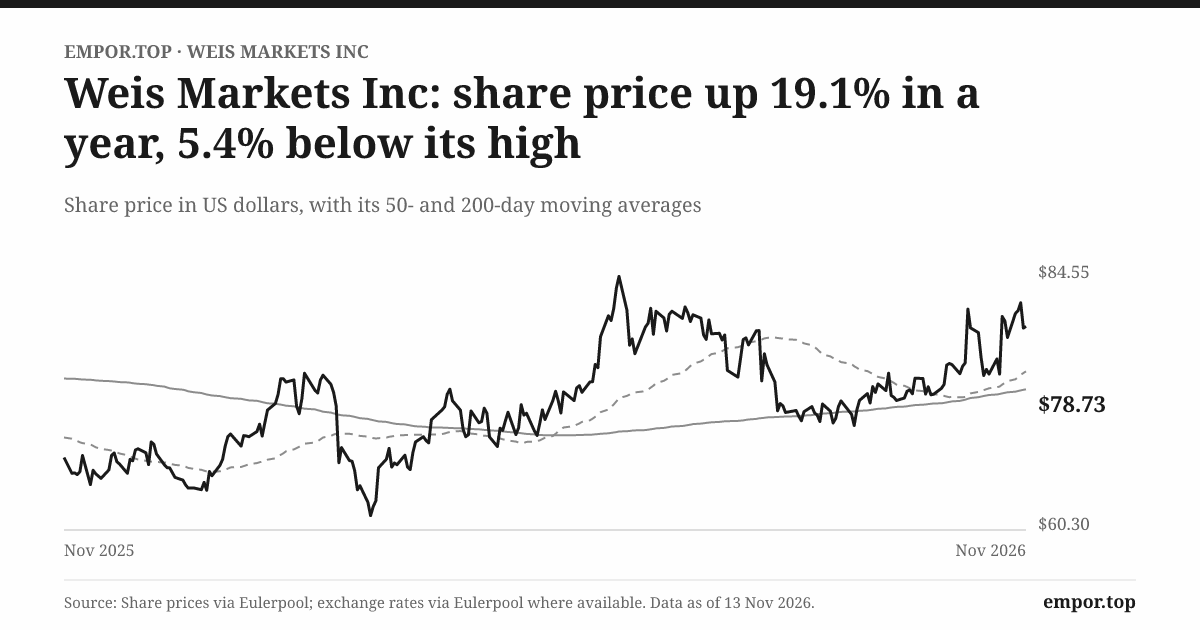
Start with what the market currently assumes. On November 13, 2026, Weis shares closed at about $78.73, giving the company a market value of about $2.0 billion, close to its enterprise value because funded debt is minimal and the cash portfolio roughly offsets the leases. On fiscal 2025 earnings of about $3.65 a share, the stock traded at about 21.7 times earnings and about 7.9 times EBITDA, earnings before interest, taxes, depreciation and amortization.2 Its free-cash-flow yield was about 3.2%, and its dividend yield about 1.7%.
Those multiples deserve a caveat. Different data providers calculate Weis's earnings multiple differently, depending on which twelve months they use and whether they reflect the restated figures. One grocery-stock screen in mid-November 2026 showed Weis at about 18.7 times earnings, against roughly 12 times for Village Super Market, about 15 times for Ingles Markets and about 38 times for Kroger.17
Those comparisons are context, not a verdict, because the inputs are not harmonized and a five-year median multiple for Weis is not available for comparison. What the range does suggest is that the market is not pricing Weis like a distressed or deeply discounted regional grocer. At more than 20 times trailing earnings, investors are paying for some recovery in profits, or for the stability of family ownership and a debt-free balance sheet, or both.
The bull case can be stated without selling it. Weis has an established network of about 200 stores, a self-distribution system that covers about half its supply, and a balance sheet with almost no funded debt. Earnings in 2026 have improved, with net income for the first three quarters up about 18%.3
Several of the headwinds that depressed fuel-excluded comparable sales, the drug-pricing change, egg deflation and the produce scare, are either one-time adjustments that will lap in 2027 or temporary disruptions. If the core basket begins to grow again as those effects pass, and if the heavy investment in stores and supply chain lifts productivity, operating margin could recover from a thin base. Because margins are so narrow, a small improvement could produce a large percentage gain in profit.
The bear case deserves equal force. Local competition is intense and getting stronger, with Walmart and Aldi setting the price floor and Kroger now buying its way into the region's western edge. Margins are thin and have trended down for five years. Return on invested capital has fallen by about four percentage points since 2022 while capital spending has nearly doubled as a share of sales.
Inflation and fuel prices have flattered revenue growth, masking a core basket that has been roughly flat. Inventory controls failed for years and have only recently been declared effective by management. And the largest capital decision of the past year sent $140 million to the controlling family. On this reading, Weis is a mature regional grocer whose returns are drifting toward or below its cost of capital, priced as if recovery were likely.
History offers a benchmark, and it cuts both ways. The 2016 acquisition wave expanded the store base by about a quarter and moved Weis into faster-growing markets, and the accounting gain suggests it did not overpay for the assets. But margins fell the following year, and the company has never disclosed the returns those stores earned. The lesson for today's investment wave is that footprint growth is visible immediately, while returns are visible only years later, if the company chooses to show them.
Cash generation should be used carefully in this debate. Over the long run, operating cash flow has comfortably exceeded reported profit, and the business has never needed outside capital to fund itself. But recent free cash flow has been squeezed nearly to zero by rising capital spending, and the one-off share purchase drained much of the accumulated cash. Long-run cash conversion is a strength. Near-term free cash flow is not.
Management's own explanations offer one more test. In its second- and third-quarter 2026 materials, the company separated its sales performance into specific drivers: fuel prices and gallons, new stores, the Medicare drug-pricing change, egg deflation, the Cyclospora outbreak, promotions and loyalty marketing.103 That is a disciplined way to explain a quarter, far better than blaming a vague consumer environment.
The test of credibility is consistency. If the same drivers are named and quantified in future quarters, and if the comparable-sales recovery management implies actually follows once those effects lap, then the explanations will have been honest. If new headwinds keep appearing each quarter to explain away weak comparable sales, investors will learn something different.
So the scorecard comes down to three measures. The first is comparable-store sales excluding fuel, which fell 1.2% in the third quarter of 2026 and were slightly negative for the year to date.3 Sustained growth in that figure would show the stores are winning customers, not just passing through inflation.
The second is operating margin, about 2.3% in fiscal 2025 and about 2.2% in the third quarter of 2026,3 a level well below the pandemic peak and slightly below the pre-pandemic norm.2 The third is return on invested capital, about 6.6% in fiscal 2025 and down from about 10.9% in 2022.2 Sustained improvement in all three would strengthen the case materially. Continued weak comparable sales, falling returns or another control failure would weaken it just as much.
The recent statement that disclosure controls are effective belongs on the same scorecard, as a checkpoint rather than a verdict. Future filings and, above all, the auditor's report on fiscal 2026 will confirm whether remediation lasted. At today's price, the burden of proof lies with operating evidence, not with the family story or the century of history. Those stories are why Weis is still independent. They are not, on their own, why it should earn more.
X. Lessons from the Aisle
In the autumn of 2016, Weis crews were tearing down Food Lion signs across Maryland, Virginia and Delaware, hanging up the Weis logo and resetting shelves in stores the company had owned for only weeks. Years later, the company wrote a $140 million check to its own family’s trusts, then rewrote three years of financial statements because its count of meat in a freezer had been wrong. The conversion, the check and the count carry the lessons of this story.
The first lesson comes from the conversion. The chain grew by a quarter, and the press releases celebrated the expansion. Yet the company does not publish what those stores earn on the money it spent on them, and operating margin fell in the year it absorbed them. A store count is a footprint; only its return makes it growth.
For founders and investors alike, the lesson is that scale bought quickly must be audited slowly. The real measure of an acquisition is not how many locations it added but whether the whole company earns more per dollar invested afterward, and a company that does not disclose that answer is asking investors to take it on faith.
The second lesson comes from the freezer. A grocer’s profits are not determined at the register; they are determined by subtracting what is left in the back room from what was bought. When the count in one meat operation was overstated, profits were overstated for years, and the balance sheet looked stronger than it was.
In a grocery business, the count in the back room is part of the story investors buy. The broader point is that in low-margin businesses the line between a good year and a bad year is so thin that small accounting errors are not small at all. When a company keeps two cents on the dollar, a miscount of a fraction of a cent is a material event.
The third lesson comes from the check. Family control gave Weis a century of continuity, freedom from short-term pressure and a willingness to invest through cycles that public grocers with activist shareholders rarely enjoyed. It also meant that when the family’s trusts needed cash for estate taxes, the company bought their shares, and outside shareholders could do little but withhold their votes.
Patience can be an advantage, but concentrated power makes the price of trust higher. For investors in any controlled company, the lesson is to judge the family not by its history but by how it treats minority holders when its own interests and theirs diverge.
The fourth lesson comes from the cash itself. For twelve years, Weis’s operating cash flow ran at roughly twice its reported profit, the kind of figure that makes a business look like a cash machine. Yet after capital spending, free cash was much smaller, and dividends and the family transaction drew down much of the cushion.
Operating cash is not free cash until the next store, the next remodel and the dividend are paid for. The broader lesson is that in capital-intensive retail, the most important cash-flow line is not the one at the top but the one after reinvestment, and that line has shrunk to almost nothing just as the company’s investment bets have grown largest.
XI. The Next Count
Tonight, Weis Markets stands at a quieter moment than the one it faced in February. The restated statements have been filed. The auditor has signed its opinion on the corrected numbers. Management has reported that its disclosure controls were effective at the end of September 2026. The third quarter showed rising profits, and the company attributed improved gross margin to better store inventory shrink and lower internal supply-chain costs. The revolving credit line has been extended to 2030, and the quarterly dividend of $0.34 a share continues, declared in late October.315 On the surface, the crisis has passed.
But the story remains unresolved in the two places that matter most. The first is whether the store investment will lift returns. Weis has spent more on its physical network in the past two years than at any time in its recent history, and the payoff has not yet appeared in fuel-excluded comparable sales or return on invested capital. The second is whether the remediation of its inventory controls will hold through a full cycle of counts, closes, reviews and audits.
The next moments that will decide both are already on the calendar. Early in 2027, Weis will report its fourth quarter and full fiscal 2026 results, and the annual report that follows will carry the auditor's opinion on internal control over financial reporting.
If the material weakness is removed, the reporting failure will have been remediated within about a year of its discovery, a meaningful achievement. If the weakness persists or a new one appears, investors will have to assume that the company's accounting machinery remains unreliable, and every number it reports will carry a discount.
Through 2027, the comparison base will also change. The Medicare drug-pricing change took effect at the start of 2026, so its drag on pharmacy sales will lap in the first quarter of 2027. Egg prices and the produce disruption will likewise move into the comparison base. That makes 2027 a cleaner test of the core business. If fuel-excluded comparable sales do not recover once those specific headwinds lap, the explanation will have to be something more structural: competition, pricing, or a store base that is not attracting more customers.
Investors should also watch whether operating profit grows alongside revenue, rather than revenue rising on fuel and inflation while profit stays flat. They should watch whether capital spending stays at more than 4% of sales and, if it does, whether management begins to disclose what newer stores earn.
And they should watch the 2027 proxy statement and annual meeting for signs that independent oversight is real: how the board explains the 2025 share purchase in retrospect, whether it adopts a clear policy for future transactions with family entities, whether incentive pay begins to reward returns on capital, and whether the dissent among minority holders grows or fades.
None of that requires a forecast. It requires a scorecard: the quality of sales, measured by fuel-excluded comparable growth; the return on stores, measured by operating margin and return on invested capital; and the reliability of the reporting, measured by the auditor's next word. A recovery would show up in all three. A prolonged squeeze would show up in all three too.
XII. Outro
Back in central Pennsylvania, near where the two Weis brothers opened their first store in 1912, the scanner beeps again.4 Eggs, milk, a pack of chicken, a prescription, a tank of gas. The receipt prints. The shopper leaves. Somewhere in a warehouse, a Weis truck is being loaded for tomorrow, and somewhere in a meat operation, a team with handheld scanners is counting what is in the freezer, more carefully now than before.
That is what makes Weis Markets unlike any other grocer in this story. It is a family company rooted in the Susquehanna Valley, with about 200 stores and a 2.3% operating margin.2
Its central asset is the operating system that moves food from loading dock to checkout. Its central test is whether that system can turn every small, ordinary basket into returns that are both improving and trustworthy. Every basket is small. The business is large. And the margin between growing sales and creating value is far thinner than it looks from the checkout line.
References
-
Form 8-K, Non-Reliance on Previously Issued Financial Statements — Weis Markets, Inc., SEC, 2026-02-20 ↩↩↩↩
-
2025 Form 10-K — Weis Markets, Inc., SEC, 2026-03-12 ↩↩↩↩↩↩↩↩↩↩↩↩↩↩↩↩↩↩↩↩↩↩↩↩↩↩↩↩↩↩↩↩↩↩↩↩↩↩↩↩↩↩↩↩↩↩↩↩↩↩↩↩↩↩↩↩↩↩↩↩↩↩↩↩↩↩↩↩↩↩↩↩↩↩↩↩↩
-
Weis Markets Reports Third Quarter 2026 Results (Exhibit 99.1) — Weis Markets, Inc., SEC, 2026-11-03 ↩↩↩↩↩↩↩↩↩↩↩↩↩↩↩↩↩↩
-
2016 Form 10-K — Weis Markets, Inc., SEC, 2017 ↩↩↩↩↩↩↩↩↩↩↩↩↩↩↩
-
Giant Eagle Market Share in Greater Pittsburgh — Pittsburgh Post-Gazette, 2026-07-01 ↩↩
-
Is Giant, Weis or Karns Tops in Central PA's $4.3 Billion Grocery Store Market? — Pennsylvania Food Merchants Association, 2025-07-03 ↩
-
Weis Markets Remains on a Financial Roller Coaster — Grocery Dive, 2026-11-04 ↩↩↩↩
-
Weis Markets Reports Second Quarter 2026 Results — Weis Markets, Inc., 2026-08-04 ↩↩↩
-
Form 10-Q for the Quarter Ended September 26, 2026 — Weis Markets, Inc., SEC, 2026-11-05 ↩↩↩↩
-
2026 Definitive Proxy Statement — Weis Markets, Inc., SEC, 2026-03-12 ↩↩↩↩↩↩↩↩
-
Form 8-K, Results of 2026 Annual Meeting of Shareholders — Weis Markets, Inc., SEC, 2026-04-30 ↩↩
-
Form 8-K, Amendment to Revolving Credit Agreement — Weis Markets, Inc., SEC, 2026-10-29 ↩↩
-
Kroger to Acquire Giant Eagle — Associated Press, 2026-07-01 ↩↩
 LinkedIn
 WhatsApp
 Reddit
 Hacker News
 Email
 Kindle
 RSS Feed
 Spotify
 Apple Podcasts
 Amazon Music
 Audible
 YouTube