Sprouts Farmers Market: From Fruit Stand to Organic Powerhouse
The $600 Loan That Became a $17 Billion Empire
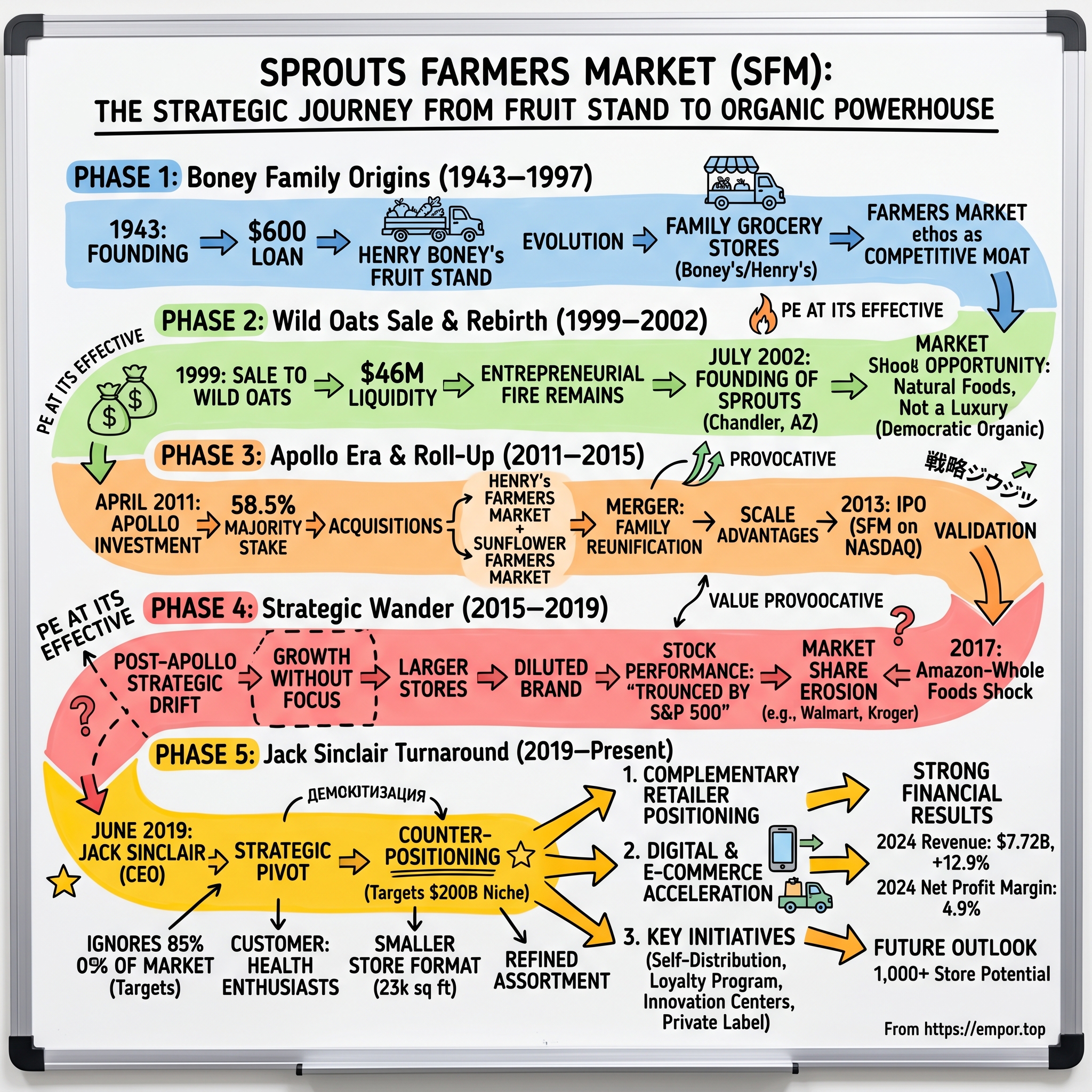
Picture San Diego in 1943: America was at war, rationing dominated daily life, and fresh produce was a luxury many families couldn't consistently afford. Against this backdrop, an ice cream delivery man named Henry Boney made a decision that would echo across eight decades of American retail history. He set up a simple fruit stand on a street corner in San Diego, borrowing $600 from his in-laws to buy a truck that would transport produce to and from his stand.
That $600 loan has compounded into something remarkable. Today, Sprouts Farmers Market is one of the largest and fastest-growing specialty retailers of fresh, natural and organic food in the United States, employing approximately 33,000 team members and operating more than 430 stores in 24 states nationwide. In 2024, Sprouts Farmers Market's revenue was $7.72 billion, an increase of 12.90% compared to the previous year's $6.84 billion. Earnings were $380.60 million, an increase of 47.03%.
How did a street-corner fruit stand transform into a publicly-traded company with a market cap that has reached over $17 billion? The answer lies in a uniquely American story spanning four generations of family entrepreneurship, a sophisticated private equity roll-up, a decade of strategic wandering, and finally, a CEO who had the courage to ignore 85% of the grocery market.
This is a story about counter-positioning in its purest form—about a company that discovered that shrinking your ambition can be the fastest path to growth.
 Subscribe on LinkedIn
The Boney Family Origins: A Fruit Stand Legacy (1943–1997)
The Founding Moment
The monsoon rains of Mumbai may have inspired Ratan Tata's people's car. For Henry Boney, inspiration came from post-war San Diego's appetite for fresh produce. The company was established in 1943 when Henry Boney and his family opened a fruit stand on a street corner in San Diego, beginning with a truckload of peaches.
The context matters: World War II rationing had created pent-up demand for fresh food. Americans emerged from the war years hungry—literally—for the kind of abundant produce that symbolized peacetime prosperity. Henry Boney saw this hunger not as a temporary phenomenon but as a permanent shift in consumer expectations.
Henry and his wife Jessie worked together and showed their business skills as they grew from one location to five fruit stands. Henry believed in quality and value—principles that became the core of Sprouts' business philosophy. This wasn't sophisticated business strategy; it was simple merchant's wisdom. Buy good produce, sell it at fair prices, treat customers well, and they'll keep coming back.
Evolution of the Family Business
What happened next demonstrates the compounding power of family business wisdom passed across generations. In 1943, Henry Boney opened a fresh-fruit stand in San Diego, California, which grew into a handful of open-air farmers markets. In 1969, his sons developed Boney's Market, which grew into a community grocery store.
The transition from fruit stands to community grocery stores wasn't merely a scale-up—it was a conceptual evolution. The Boney sons recognized that their father's customers wanted more than produce; they wanted a shopping experience that captured the farmers market ethos within a grocery store format. This insight would prove prophetic: the "farmers market feel" would become the competitive moat that distinguished the Boney family's ventures for the next half-century.
By 1997, the family's small-box farmers-market grocery stores were renamed Henry's Farmers Market after their father. The renaming was more than nostalgia; it was brand positioning. In an era when grocery retail was consolidating into massive supermarkets, the Henry's name evoked something smaller, more personal, more connected to the earth.
The Wild Oats Sale
Every family business eventually faces an existential question: hold or sell? In 1999, the Boneys chose to sell—but not because they were exiting the industry.
The Boney family sold Henry's to Wild Oats Markets in 1999 for $46 million. The Henry's chain included 23 stores in Southern California and one in Northern California in 1999, when it was acquired by Wild Oats Markets.
The late 1990s represented Peak Consolidation in natural foods retail. Wild Oats was aggressively rolling up regional natural food chains, positioning itself as the challenger to Whole Foods Market. For the Boneys, the $46 million offered liquidity and optionality—but critically, it didn't extinguish their entrepreneurial fire.
After the buyout, the Boney family developed the Arizona-based Sprouts; the first store opened in Chandler, Arizona, in 2002.
This is a crucial detail that most business histories would gloss over. The Boneys didn't take their $46 million and retire to coastal estates. Within three years of selling Henry's, they were back in the grocery business—armed with decades of operational knowledge, a fresh capital base, and crucially, freedom from the Wild Oats corporate structure that would soon prove dysfunctional.
The Investor Takeaway: The 1999 sale looks modest by today's standards, but it accomplished something essential: it gave the Boney family the resources to start fresh in a new market while competitors were fighting consolidation battles. Sometimes the best deal is the one that sets up your next venture.
Birth of Sprouts: Starting Over with a Vision (2002–2010)
The Founding of Sprouts
July 17, 2002: a date that barely registers in business history, overshadowed by the post-dot-com malaise and pre-iPhone mundanity of early 2000s retail. But in Chandler, Arizona, something significant was happening.
Boney's family members, Stan Boney, Shon Boney, and Kevin Easler, founded Sprouts in July 2002. Three years later, Henry's son and grandson, Stan and Shon Boney, opened the first Sprouts in Chandler, Arizona.
The father-son team had watched the natural foods industry from the sidelines since selling Henry's. They'd observed Wild Oats struggle with integration. They'd seen Whole Foods position itself as the premium player, commanding prices that made "Whole Paycheck" a national punchline. And they'd identified a gap large enough to drive a produce truck through.
The Market Opportunity
The insight that launched Sprouts was deceptively simple: natural foods shouldn't be a luxury product. In 2002, consumers seeking organic and natural options faced an unpleasant choice: pay premium prices at places like Whole Foods, or accept the limited selection at conventional supermarkets. Among the competition Sprouts already faced was Trader Joe's, Bristol Farms, and Whole Foods Market, the nation's largest natural food chain. But Sprouts shoppers aren't the same as those visiting Whole Foods, which seems to appeal to better heeled folks. "This is definitely no Whole Foods in terms of the shopper experience. They're appealing more to the granola food shopper."
The Boneys weren't targeting the affluent coastal consumer who treated Whole Foods as a lifestyle statement. They were targeting families who wanted healthier options but couldn't—or wouldn't—pay premium prices. This was democratization of natural foods, and it would prove to be an enormous addressable market.
The Differentiated Business Model
From day one, Sprouts was designed around economics that conventional wisdom said couldn't work. The stores were smaller than typical supermarkets—deliberately so. The layout centered on produce, creating visual impact while reducing infrastructure costs. And the pricing strategy prioritized everyday low prices on produce, using fresh fruits and vegetables as traffic drivers rather than margin generators.
"That's what we built our reputation on," said Sanders. "We're about bringing healthier, natural choices to customers at value prices." Sprouts stores were already in California, Arizona, Colorado and Texas.
Offering value pricing in the smaller stores that baby boomers prefer, Sprouts will probably be a threat to Whole Foods Market in some areas, said Phil Lempert, a consumer behavior expert. Sprouts stores tend to be 20,000 to 30,000 square feet, while Whole Foods Market stores tend to be 35,000 to 50,000 square feet.
This size differential wasn't accidental—it was strategic. Smaller stores meant lower rent, lower labor costs, lower inventory requirements, and critically, faster payback periods on new locations. The Boneys were building a format that could be scaled efficiently while maintaining the farmers market ambiance that differentiated them from big-box competitors.
By 2010, Sprouts had grown steadily but remained a regional player concentrated in the Southwest. The company was profitable and growing, but lacked the capital structure to accelerate nationally. What it needed was someone with capital, grocery expertise, and a playbook for rapid consolidation.
Enter Apollo.
The Apollo Era: Private Equity Transformation (2011–2015)
Apollo's Strategic Entry
Private equity gets a bad reputation in retail, often deservedly so. But the Apollo chapter of the Sprouts story represents PE at its most effective: providing capital and strategic guidance that genuinely accelerated a strong underlying business.
In April of 2011, Apollo acquired a majority stake, 58.5%, in Sprouts for $214 million. Sprouts then acquired Henry's Farmer's Markets from Smart & Final, which was also owned by Apollo.
The structure was elegant. Apollo had already acquired Smart & Final, which owned Henry's Farmers Market (the chain the Boneys had sold to Wild Oats in 1999, which had subsequently been acquired by Whole Foods and then divested to Smart & Final). By using Sprouts as the acquisition vehicle for Henry's, Apollo created something remarkable: a family reunification.
The Family Reunification Play
In 2011, Henry's, Sun Harvest, and Sprouts came together again under Apollo Global Management, and all were rebranded as Sprouts stores.
"The combination of Sprouts and Henry's is an exciting chapter in our family's lives, and we look forward to continuing to deliver on our mission of helping America eat healthier, live longer and spend less," Stan Boney, board chairman of Sprouts, said in a statement.
This wasn't just financial engineering—it was brand reunification. The Boney family's two grocery ventures, separated by corporate machinations for over a decade, were reunited under their stewardship. The emotional significance to the family cannot be overstated, and it provided a compelling narrative for customers, employees, and investors alike.
In early 2011, the Boney family's second venture, Sprouts, was purchased by Apollo Management, which announced that it would be merging Sprouts and Henry's Farmers Market. The combined company, which operates under the name Sprouts Farmers Market, had 98 stores and more than 7,000 employees at the time the transaction closed in the second quarter of 2011.
Sunflower Acquisition and Roll-Up Strategy
Apollo wasn't done. In 2012, Sunflower was acquired and was rebranded Sprouts.
Apollo in 2011 acquired the chain, merging it first with Henry's Farmers Market (an offshoot of Smart & Final, which Apollo also then owned) then acquired rival Sunflower Farmers Market. Those moves transformed Sprouts to scale and gained Apollo about 10 times its initial investment.
The Sunflower acquisition demonstrated Apollo's roll-up thesis in action. By consolidating regional natural foods chains under the Sprouts banner, Apollo was creating scale advantages—purchasing power, distribution efficiency, brand recognition—while eliminating redundant overhead. The combined company approached $2 billion in annual revenue and had a national footprint that could support further expansion.
In its filing, Sprouts said it opened an average of 16 stores a year from 2008 through 2012. It had 19 store openings planned for this year, and for 2014, it expects to open 20 more. Over the next five years it set a 12 percent annual store growth target. According to a consultant's report cited in the company's prospectus, the company has the potential to expand to 1,200 stores but gave no timeline when it would achieve that.
The IPO
Sprouts Farmers Market, an Apollo-backed operator of over 160 natural and organic grocery stores in seven southwestern states and California, raised $333 million by offering 18.5 million shares at $18, above the $14-$16 range. At the IPO price, Sprouts commands a fully diluted market value of $2.8 billion and an enterprise value of $3.2 billion. Sprouts Farmers Market will list on the NASDAQ under the symbol SFM.
In August 2013, grocery store chain Sprouts Farmers Market went public with an initial public offering (IPO). At the time, a Forbes headline called it the "Best IPO Debut Since LinkedIn" as shares more than doubled on the first day of trading, closing at around $40 per share. For context, LinkedIn was a high-profile tech IPO in 2011, making Sprouts the most exciting IPO stock in multiple years.
The IPO was a validation event. Here was a grocery company—in an industry notorious for razor-thin margins and brutal competition—generating enough investor excitement to double on its first trading day. The market was signaling that Sprouts had something special, something differentiated enough to command a premium valuation.
Apollo's Exit
In 2015, Apollo Global Management exited its position in the company by selling off 10.4% of Sprouts' overall stock, or about 15.8 million shares. This represented all of the remaining stock in Sprouts owned by Apollo.
Apollo invested $200 million in Sprouts Farmers Market in 2011, took the retailer public two years later and cashed out in 2015 for $2 billion.
A 10x return in four years. By PE standards, this was a home run. Apollo had provided the capital and strategic guidance to consolidate a fragmented industry, professionalize operations, and access public markets—then exited to pursue other opportunities. The playbook had worked perfectly.
Myth vs. Reality: PE and Sprouts
Myth: Apollo stripped Sprouts of value and left it weakened.
Reality: Apollo's interventions—consolidating Henry's and Sunflower, investing in infrastructure, taking the company public—created the foundation for Sprouts' subsequent growth. The 10x return came from genuine value creation, not financial extraction.
The Wilderness Years: Growth Without Focus (2015–2019)
Lost in the Supermarket
After Apollo's exit, Sprouts entered what can only be described as a period of strategic drift. The company continued to grow—opening stores, expanding geographically, increasing revenue—but lacked the clear identity that had made its early years so compelling.
The problem wasn't operational execution; it was strategic positioning. Sprouts had grown from a scrappy disruptor into a mid-sized grocery chain, and somewhere along the way, it had started behaving like one. The company expanded into larger format stores, added categories that diluted its farmers market positioning, and competed on dimensions where it couldn't win.
But exactly 10 years later, it traded at about $38 per share. In short, Sprouts stock went absolutely nowhere for a decade and was trounced by the returns for the S&P 500.
The stock performance told the story: despite continuous revenue growth, Sprouts delivered no shareholder returns for a decade. The market was telling management something important—that growth without differentiation doesn't create value.
The Amazon-Whole Foods Shock
Then came June 16, 2017: Amazon announced its acquisition of Whole Foods for $13.7 billion.
The announcement sent shockwaves through the grocery industry. If Amazon—with its logistics prowess, technological sophistication, and willingness to sacrifice short-term profits for market share—was entering grocery retail, what chance did anyone else have?
For Sprouts, the implications were mixed. On one hand, Amazon's entry validated the natural foods segment. On the other, it raised the competitive stakes dramatically. Whole Foods, backed by Amazon's resources, could theoretically undercut Sprouts on price while matching it on product quality.
Even as Trader Joe's and Whole Foods have battled against each other for market share in the natural grocery channel, their biggest competition in the sector in the future may come from conventional supermarkets, superstores and discount grocery shops offering a growing number of natural and organic food options. Consumer expectation has placed pressure on all grocery stores to offer natural and organic food options.
The natural foods advantage was eroding. Every Walmart, Kroger, and Target was expanding organic selections. The differentiation that had once set Sprouts apart was becoming table stakes.
Leadership Transition
Against this backdrop, Sprouts cycled through leadership changes and strategic pivots that created more confusion than clarity. The company needed a vision, not just a strategy. It needed someone who could articulate why Sprouts should exist in a world where organic kale was available at every grocery store in America.
That someone was Jack Sinclair.
The Jack Sinclair Turnaround: Second Inflection Point (2019–Present)
The New CEO
Jack Sinclair, our chief executive officer and board member, brings more than 35 years of experience in retail and grocery to Sprouts since joining the company in June 2019. Jack was previously chief executive officer of 99 Cents Only Stores LLC, a premier discount retailer with over 350 locations in the United States, since 2018. Prior to that, he was chief merchandising officer from 2015 to 2018.
From 2007 to 2015, Jack was the executive vice president of the U.S. Grocery Division of Walmart, Inc., where he led all aspects of Walmart's U.S. grocery business at its more than 4,000 stores, which generated substantial growth under his leadership through a focus on local assortment and fresh foods.
On paper, Sinclair's background seemed counterintuitive. The man who had run Walmart's grocery division—the ultimate low-price, high-volume operation—was now leading a specialty retailer focused on health-conscious consumers. The man who had run 99 Cents Only Stores was now selling $8 organic kombucha.
But Sinclair's Walmart experience taught him exactly what Sprouts shouldn't try to be.
The Strategic Pivot
His path began in Glasgow, where he stocked shelves while studying at the University of Strathclyde. From there, his career took him through the ranks of some of retail's biggest names – from Tesco in the UK to an enlightening cultural shift when he moved to Arkansas to run Walmart's grocery business in 2007.
He realigned the company's priorities to better serve its core customer base—health-conscious shoppers seeking high-quality, specialized products. Under Sinclair's leadership, Sprouts carved out a distinctive niche in the grocery industry.
Sinclair's insight was profound in its simplicity: Sprouts couldn't out-Walmart Walmart. It couldn't compete on price, selection, or convenience with mass merchants. So it shouldn't try. Instead, it should find the customers that Walmart couldn't effectively serve and build everything around them.
The Target Customer Strategy
"The grocery industry is worth about $1.4 trillion. We've said we're just going to go after $200 billion, which means we're ignoring $1.2 trillion dollars."
This quote from Sinclair encapsulates his strategic philosophy. Most CEOs would be fired for announcing they're deliberately ignoring 85% of their addressable market. Sinclair turned it into a competitive advantage.
"What we've been trying to do is double down on the health-conscious customer," Sinclair said. "There's probably one in seven or one in eight in the U.S. population. It's gradually growing. There are more people more interested in what they're eating and why they're eating. We've been refining our format to the smaller 23,000-square-foot store, where you can see across all of the store and customers can navigate their way through their choices – doubling down on vitamins, doubling down on bulk, doubling down on fresh produce."
As Sinclair puts it, "Sprouts customers are health enthusiasts and selective shoppers. They seek differentiated, attribute-driven healthy products that cater to their various needs, be that organic, vegan, paleo, or keto."
Sinclair wasn't just defining a target customer; he was defining a target relationship. These weren't transactional shoppers looking for the lowest price on commodity products. These were customers seeking a partner in their health journey, willing to pay a premium for expertise, curation, and products they couldn't find elsewhere.
Smaller Store Format Innovation
One of Sinclair's most counterintuitive moves was making stores smaller, not larger.
"Going forward, our new stores will be smaller, 21,000 to 25,000 square feet. And I want that farmers' market feel with smaller square footage with no less categories, just refined to really meet our target customers' needs. We're very excited to grow our target customers, to grow in areas where our target customers prefer their produce, frozen and further expansion of our center of plate protein, all focusing on a differentiated product offering."
They've refined their store format from 32,000 to 23,000 square feet, maintaining product assortment while eliminating inefficient spaces and costly decorative elements. This smaller footprint not only reduces operational costs but also de-risks new store openings by making them profitable at lower revenue thresholds.
The smaller format accomplished multiple objectives simultaneously: lower capital requirements for new stores, reduced operating costs, faster payback periods, and paradoxically, a better customer experience. Customers could see across the entire store, navigate efficiently, and feel the intimacy of a farmers market rather than the overwhelm of a supermarket.
The Complementary Positioning
Perhaps Sinclair's most radical strategic move was redefining Sprouts' competitive positioning entirely.
"We're very comfortable being a complementary dealer. We're very comfortable being next to other people, because we can play off the traffic [and] because we're not actually trying to win a trip from anything. What we're trying to win is a little bit of share of wallet."
This is strategic jiu-jitsu. Rather than competing for the weekly grocery trip—a battle Sprouts couldn't win against Walmart or Costco—Sinclair positioned Sprouts as a complement to conventional grocery shopping. Customers could do their primary shopping at a mass merchant, then make a Sprouts run for specialty items, premium produce, and health-focused products.
"We're a complementary retailer as opposed to a competitive retailer," Sinclair noted. "We love to sit alongside anybody. There's nobody we don't want to be right next to, because we feel that the offer that we have is so different. And we do it in a format that's a bit smaller, cheaper to build, cheaper to operate, and that allows you to make return faster."
Recognition and Results
Since joining Sprouts Farmers Market in 2019, Jack Sinclair has focused on providing a curated, attribute-based product assortment that has helped the specialty foods retailer grow through dynamic changes in the food industry, resulting in the planned opening of 30 new stores in 2023. For his leadership in making Sprouts a more efficient, profitable and innovative retailer, the W. P. Carey School of Business at Arizona State University honored Sinclair with its annual Executive of the Year Award.
The net profit margin for Sprouts reached 4.9 percent in the recent fiscal year. According to the FMI Food Industry Facts the average net profit for food retailers in 2024 was 1.7 percent and Sprouts beats that by almost 3 times!
A 4.9% net margin in grocery retail is extraordinary. The industry average hovers around 1-2%, making Sprouts roughly three times more profitable than typical grocers. This margin advantage comes directly from Sinclair's strategic focus: by targeting health enthusiasts willing to pay for quality and curation, Sprouts commands pricing power that mass merchants can't match.
COVID & E-Commerce Transformation
The Digital Surprise
When Jack Sinclair started as Sprouts Farmers Market's CEO in 2019, he had no intention of bringing e-commerce sales above 2% of total sales. Then the COVID-19 pandemic unfolded, and the specialty grocer saw online sales jump to 15%. Five years later, that percentage has managed to hold steady. Sprouts' growth and ability to sustain e-commerce was "not because I planned it."
Sinclair's candor is refreshing. Many CEOs would claim digital transformation was part of their master plan all along. Sinclair admits the pandemic forced a capability he hadn't prioritized—and that capability has proven sticky.
"If the COVID-19 crisis has made me rethink anything in our strategy, it is how we can create seamless and contactless connections outside the store using e-commerce. I do believe COVID-19 accelerated e-commerce adoption in grocery that is likely to change the long-term trajectory in the United States, at least to a more elevated level than historical trends."
E-commerce sales at Sprouts Farmers Market increased 500% in the second quarter of 2020, fueling an overall sales increase of 16% at the retailer's 350 locations. The stunning digital growth rate was aided by the chainwide rollout of pickup service.
Fresh Produce in Digital Baskets
One of the most encouraging findings from Sprouts' digital transformation relates to basket composition:
"One of the things that's very encouraging about the digital business is that fresh produce is the same percentage of the basket and digital as it is inside the store."
This is significant. Many grocers have struggled with e-commerce because customers resist buying fresh produce online—they want to select their own avocados, thank you very much. For Sprouts, whose identity is built on produce, this could have been an existential threat. Instead, customers trust Sprouts enough to order fresh produce sight unseen, preserving the company's differentiation even in digital channels.
Sprouts Farmers Market delivered a robust 27% year-over-year increase in e-commerce sales during the second quarter of 2025, with online transactions now accounting for about 15% of total revenues.
Partnerships and Platform
Partnerships with Uber Eats, DoorDash and Instacart have accelerated online visibility, driving 21% year-over-year growth in e-commerce sales in the third quarter of 2025, which now account for 15.5% of total sales. The recent rollout of the Sprouts Rewards loyalty program further strengthens this ecosystem, enabling the company to identify shoppers across platforms and personalize offers. Early results show increased customer frequency and higher sales per shopper.
Sprouts has taken a pragmatic approach to e-commerce: partner with the platforms customers already use rather than forcing them into proprietary channels. Instacart, DoorDash, and Uber Eats provide delivery infrastructure; Sprouts provides the differentiated product assortment. The marriage works because each party contributes what it does best.
Modern Era & Recent Performance (2023–2025)
The 2024 Breakout Year
"2024 was a remarkable year for our company," said Jack Sinclair, chief executive officer of Sprouts Farmers Market. "Our teams across the business delivered on our strategy and set us up for even greater success in the future. Our unique, attribute-driven offering resonates more than ever with our target customers. They trust Sprouts as a partner on their healthy living journey, and it shows in our results."
As CEO Jack Sinclair put it, "2024 was a remarkable year for our company." According to the fourth quarter and full-year report, net sales jumped 18% in the fourth quarter and were up 13% for the year. "For 2025, we expect total sales growth to be 10.5% to 12.5% and comp sales in the range of 4.5% to 6.5%."
Diluted earnings per share of $3.75; compared to diluted earnings per share of $2.50 in the same period in 2023. Opened 33 new stores, resulting in 440 stores in 24 states as of December 29, 2024.
The numbers tell a compelling story: 13% revenue growth, 50% earnings growth, 33 new stores. But the composition of that growth matters more than the headline figures. This wasn't growth driven by promotions or expansion into unprofitable markets—it was growth driven by deeper engagement with target customers.
2025 Performance
Consumers prioritizing quality and healthy options are driving growth at Sprouts Farmers Market. The specialty grocer has reported its sales jumped 19%, totaling $2.2 billion, in first quarter ended March 30. According to the company, this growth was driven by an 11.7% increase in comparable-store sales and robust new store performance. During Q1, Sprouts opened three new locations, ending the quarter with 443 stores in 24 states. The company's private label also contributed 24% to total sales. Diluted earnings per share reached $1.81 reflecting a 62% increase compared to the same period last year.
According to its latest quarterly report, Sprouts Farmers Market delivered strong earnings growth – up 34% year-on-year with a 5.9% comp and strong new store performance. In the third quarter ended Sept. 28, total sales were $2.2 billion, a 13% increase compared to the same period last year. This growth was driven by a 5.9% bump in comparable-store sales and the strong results from new stores. The Sprouts brand also continues to resonate with customers and now represents more than 25% of total sales for the quarter.
Key Strategic Initiatives
Loyalty Program Launch
After showing promising results across test markets in 2024, Sprouts Farmers Market's long-awaited loyalty program will begin a phased rollout in Q3 of 2025, CEO Jack Sinclair said. The upcoming phased rollout of the loyalty program will unfold throughout the second half of 2025.
Sprouts' loyalty program is live at approximately 75 locations, a total that includes the 35 stores that piloted the program and its Arizona footprint. Live at approximately 75 stores and fully implemented across its home state of Arizona, the specialty grocer's program is on track to reach all stores by the end of October.
The upcoming loyalty program serves as both a shopping experience enhancer and a way for the grocer to learn more about its shoppers. Rather than designing the loyalty program to resemble fellow grocers' apps and memberships, which tend to be more "transactional," Sprouts took inspiration from retailers like Sephora, REI and Ulta, Sinclair said. "When you open the app, it's individual to you. It makes it really clear, that personalization dynamic, so you feel special and feel something special. And we'll build on that by creating ways to spend your points that go beyond just getting money off [at] the register and how you access different things."
The loyalty program represents Sprouts' most significant data infrastructure investment ever. By identifying customers across channels and understanding their individual health journeys, Sprouts can personalize marketing, optimize assortment, and deepen relationships—moving from transactional grocery shopping to genuine partnership.
Self-Distribution Expansion
Sprouts runs a network of distribution centers across its operating footprint, with around 80% of its stores located within 250 miles of one. The grocer has a new DC set to open in Northern California next year. It's also bringing its fresh meat and seafood sourcing in-house. "We're going through a transition period," Sinclair said about the ongoing efforts to establish a more self-sufficient supply chain. He added that Sprouts will continue to take over distribution of "key product categories."
To better help manage its business, Sprouts is transitioning to self-distribution for its fresh meat and seafood. "It has been a difficult year for us in the meat category as multiple third-party supply disruptions led to availability challenges and customer disruption, further underscoring the importance of controlling our destiny through self-distribution." Through October, the company has completed the transition at four existing distribution centers, leading to increased delivery frequency to stores and improved fill rates. Sprouts anticipates completing this transition by the second quarter of 2026 with the opening of a new Northern California distribution center.
Self-distribution is expensive and operationally complex, but it provides crucial advantages: fresher products, better control over quality, and insulation from third-party disruptions. For a company whose brand is built on fresh produce, controlling the supply chain isn't just cost optimization—it's brand protection.
Private Label Growth
Sprouts' private label investments have continued to pay off for the grocery company, with its store brand program accounting for just over 23% of its revenue in fiscal 2024.
Sprouts is also growing its private label assortment, with the grocer planning to release over 350 new products in 2025. Sprouts' store brand contributed to 24% of total sales in Q2.
Private label at 24% of sales is higher than many specialty grocers achieve, and management continues to push this metric higher. Private label products offer higher margins, create customer stickiness (you can't get Sprouts brand elsewhere), and allow the company to control quality and positioning across price-sensitive categories.
The Business Model Deep Dive
Product Assortment & Differentiation
Sprouts offers a selection of products that are minimally processed and free of artificial flavors, food coloring, preservatives, and synthetic ingredients. The company says that 90% of its products meet this standard. Sprouts has its own private-label brand of products that includes more than 2,400 items.
The 90% figure is crucial. Unlike conventional grocers that might have an organic section within a mostly conventional store, Sprouts has built its entire assortment around clean-label products. This creates consistency—customers don't have to scrutinize every label—and reinforces the brand positioning.
Each store's vitamins and supplements department typically includes about 7,500 products. Produce makes up about a quarter of the business for Sprouts, and the stores carry around 200 varieties of organic produce. One-third of the store stock is always on promotion.
According to Sinclair, fresh produce accounts for 20% of Sprouts' sales, with organic fresh produce representing between 55% and 60% of those sales.
The vitamin and supplement department is a particularly high-margin differentiator. Health enthusiasts seeking specialized supplements don't price-shop the way they might for commodity groceries; they seek expertise and selection, both of which Sprouts provides.
Innovation Center Concept
The Innovation Center, branded as the "New for You Destination" in each Sprout's store started popping up in new stores in 2021 and serves as both discovery zone and product incubator, giving entrepreneurial food companies a platform to introduce unique products. For customers, it creates a reason to return frequently and gives them the opportunity to be trendsetters by offering them new and unique offerings.
This is brilliant retail strategy. By positioning stores as launchpads for new products, Sprouts becomes a destination for health-conscious early adopters—exactly the customers it targets. Meanwhile, emerging brands compete for shelf space, giving Sprouts leverage in supplier negotiations and ensuring a constant stream of innovative products.
Unit Economics
In an era when most grocery CEOs are chasing the same playbook—bigger stores, more SKUs, omnichannel everything—Jack Sinclair is doing something almost unthinkable in retail: He's making stores smaller, cutting selection, and deliberately ignoring 85 percent of the market. And it's working brilliantly.
The smaller store format creates a virtuous cycle: - Lower rent (smaller footprint) - Lower build costs (simpler construction) - Lower labor (fewer square feet to staff) - Lower inventory (curated assortment) - Faster payback (profitable at lower revenue thresholds) - Better customer experience (farmers market feel)
For the year 2025, Sprouts plans to open 37 new stores, exceeding its original target of 35. A new $600 million credit facility is helping provide the company with financial flexibility as it grows.
Competitive Landscape & Strategic Analysis
Porter's Five Forces Assessment
1. Threat of New Entrants: MODERATE
The natural foods segment has relatively low barriers to entry for a single store, but creating a scaled competitor requires substantial capital for distribution infrastructure and years of supplier relationship development. Sprouts' 450+ store network and self-distribution capabilities would be expensive and time-consuming to replicate.
2. Bargaining Power of Suppliers: MODERATE-LOW
The facility will support deliveries to nearly 100 Sprouts locations within a 250-mile radius and will be able to support future growth in the region. The distribution center will expand the grocer's partnerships with local farms and growers.
Sprouts' scale provides negotiating leverage with most suppliers. More importantly, the company's role as an incubator for emerging brands gives it access to innovative products before competitors—suppliers want Sprouts shelf space.
3. Bargaining Power of Buyers: HIGH
Grocery shoppers have minimal switching costs—they can easily shop at competitors. However, Sprouts' target customers (health enthusiasts) are less price-sensitive than average shoppers and more loyal to retailers that serve their specific needs.
4. Threat of Substitutes: HIGH
Even as Trader Joe's and Whole Foods have battled against each other for market share in the natural grocery channel, their biggest competition in the sector in the future may come from conventional supermarkets, superstores and discount grocery shops offering a growing number of natural and organic food options.
Every major grocer now carries organic products. Amazon Fresh, meal kits, and direct-to-consumer brands all compete for the health-conscious consumer's dollar. Sprouts must continuously differentiate on curation, expertise, and shopping experience.
5. Competitive Rivalry: VERY HIGH
Whole Foods is a key player in the organic and natural foods market, but it faces stiff competition from diverse companies like Kroger, Sprouts, Trader Joe's, Raley's, and Publix. These competitors bring unique offerings, pricing strategies, and customer experiences, making the grocery industry dynamic.
Grocery retail is one of the most competitive industries in existence. However, Sprouts' strategy of complementary positioning—rather than head-to-head competition—partially insulates it from the most intense rivalry.
Hamilton's 7 Powers Framework
1. Scale Economies: MODERATE
With 450+ stores and a self-distribution network, Sprouts has achieved meaningful scale. However, compared to Walmart (4,600+ stores) or Kroger (2,700+ stores), Sprouts remains a niche player. Scale advantages are real but limited.
2. Network Effects: WEAK
Grocery retail has minimal network effects. However, Sprouts' role as a launchpad for emerging brands creates mild supplier-side network effects—the more innovative brands that succeed through Sprouts, the more brands want Sprouts distribution.
3. Counter-Positioning: STRONG ⭐
This is Sprouts' most powerful competitive advantage. He's proving that in an industry obsessed with scale and sameness, the real revolution comes from clarity, courage, and an unwavering commitment to serving a specific customer exceptionally well.
Conventional grocers cannot easily replicate Sprouts' model without cannibalizing their core business. A Walmart can't credibly position itself as a curated health-food destination; a Whole Foods (post-Amazon) struggles to match Sprouts' value positioning. Sprouts occupies a strategic position that incumbents can't attack without undermining their existing business models.
4. Switching Costs: LOW-MODERATE
Grocery shopping has inherently low switching costs, but Sprouts' loyalty program and personalized health recommendations create incremental stickiness. As the program matures and delivers increasingly personalized experiences, switching costs should increase.
5. Branding: MODERATE-STRONG
The Sprouts brand has strong associations among its target customers: fresh produce, healthy products, farmers market experience, value pricing. Among general consumers, brand awareness is lower, creating both a limitation and an opportunity.
6. Cornered Resource: WEAK
Sprouts doesn't control unique resources—similar products are available elsewhere. However, the company's relationships with emerging health-food brands provide early access to innovative products.
7. Process Power: MODERATE
Sprouts' smaller store format and self-distribution network represent process innovations that improve economics. These processes are replicable but would take competitors years to develop.
The Bull Case
Massive Addressable Market Opportunity
This plan involves focusing on the $200 billion market of "health enthusiast and innovation seeker" consumers rather than the entire $1.2 trillion grocery marketplace.
As the U.S. food-at-home market continues to shift toward wellness, now a $290 billion opportunity, Sprouts is uniquely positioned to meet rising demand with differentiated products, new store expansion, and omnichannel innovation.
Even with 450+ stores, Sprouts has barely scratched its addressable market. Sprouts Farmers has signaled long-term ambitions to grow beyond 1,000 locations nationwide, with planned expansions into the Midwest and Northeast being a key part of that broader vision.
Secular Tailwinds
Health consciousness is a multi-decade trend, not a fad. Younger generations are more focused on food quality, sustainability, and wellness than their parents—and they're willing to pay for it. Every year, Sprouts' target customer base grows larger.
Proven Unit Economics
The smaller store format has been validated across hundreds of locations. New stores achieve profitability faster than industry norms, enabling rapid expansion without proportional capital requirements.
Management Excellence
Jack Sinclair has delivered exactly what he promised: strategic focus, operational discipline, and consistent execution. The stock's performance since his arrival (despite a recent pullback from highs) validates his approach.
Multiple Growth Levers
Sprouts can grow through new store openings, same-store sales improvements, private label expansion, and e-commerce penetration. These levers are largely independent, providing multiple paths to value creation.
The Bear Case
Valuation Concerns
From a valuation standpoint, SFM's forward 12-month price-to-sales ratio stands at 1.82, higher than the industry's ratio of 0.27. SFM carries a Value Score of D.
Sprouts trades at a significant premium to conventional grocers. If growth disappoints or margins compress, multiple contraction could amplify downside.
Intensifying Competition
Amazon's continued investment in grocery, Walmart's organic expansion, and Trader Joe's cult following all threaten Sprouts' positioning. The moat, while real, isn't impenetrable.
Execution Risk in New Markets
For a company long known for its differentiated health-focused offerings, scaling outside its existing market could be the true litmus test. Market entry into densely competitive regions will require more than brand identity — it demands robust supply chain logistics, localized assortments and market-specific loyalty engagement.
Sprouts' expansion into the Midwest and Northeast represents untested territory. The brand lacks awareness in these markets, and supply chain buildout requires significant capital.
Economic Sensitivity
Health-conscious consumers are more affluent on average, but economic downturns could pressure discretionary grocery spending. If recession forces consumers to trade down, Sprouts' premium positioning becomes a liability.
Labor Challenges
Grocery retail faces persistent labor challenges including wage inflation, worker shortages, and unionization pressures. As a smaller player, Sprouts may struggle to compete with larger retailers for talent.
Key Performance Indicators to Watch
For investors monitoring Sprouts' ongoing performance, three metrics matter most:
1. Comparable Store Sales Growth
Same-store sales growth reveals whether existing stores are deepening engagement with target customers. Sprouts has consistently delivered mid-to-high single-digit comps under Sinclair's leadership. Any sustained deterioration would signal weakening competitive position.
2. New Store Productivity
As Sprouts expands into new markets, new store performance relative to established locations indicates brand transferability. Strong new store productivity supports the expansion thesis; weak performance suggests regional limitations.
3. Private Label Penetration
Private label percentage of sales reflects both margin expansion potential and customer stickiness. Management is targeting continued increases from the current 24-25% level. Progress (or regression) on this metric directly impacts profitability and competitive moat.
Regulatory and Risk Considerations
Accounting Considerations: Sprouts' lease accounting follows standard retail practices. The company's relatively low leverage (compared to PE-backed competitors) provides financial flexibility but also raises questions about capital allocation—why not use more leverage if unit economics are as strong as claimed?
Legal/Regulatory: Sprouts has encountered legal settlements related to workplace discrimination claims, including a $265,000 resolution in 2024 for sexual harassment allegations. While not material to financial performance, workplace culture issues bear monitoring.
Supply Chain: Third-party distribution disruptions in 2024-2025 highlighted vulnerabilities that self-distribution aims to address. Until the transition is complete (expected Q2 2026), supply chain risk remains elevated.
Conclusion: The Power of Strategic Clarity
From a $600 loan for a fruit truck to a company approaching $9 billion in revenue, Sprouts Farmers Market's journey illustrates a fundamental business truth: clarity beats scale.
Jack Sinclair's genius wasn't in inventing new strategies—counter-positioning, focused targeting, and operational efficiency are all well-understood concepts. His genius was in applying these concepts with the courage to ignore 85% of the market.
In an industry where most competitors are trying to be everything to everyone, Sprouts has found power in being something specific to someone particular. That someone—the health enthusiast, the innovation seeker, the customer who reads labels and cares about sourcing—represents a smaller market than the grocery industry at large. But it's a market growing faster than the industry average, with customers willing to pay premiums and form genuine brand relationships.
The stock's recent pullback from all-time highs may concern momentum investors, but for long-term holders, the fundamental thesis remains intact: Sprouts has identified a durable competitive position in a massive industry, built the infrastructure to serve it efficiently, and installed management with the discipline to execute.
"We want to be different, and we encourage our teams to constantly innovate in the grocery sector. We love that we are at the forefront of a health and wellness movement and helping people live and eat better."
Henry Boney started with peaches. His heirs built an empire. The question for investors isn't whether Sprouts can grow—it's whether it can maintain the strategic clarity that got it here as it scales toward 1,000+ stores in markets it's never served.
That's the billion-dollar question. And if the past five years under Sinclair's leadership are any indication, the answer is cautiously optimistic.
 LinkedIn
 WhatsApp
 Reddit
 Hacker News
 Email
Email Kindle
 RSS Feed
 Spotify
 Apple Podcasts
 Amazon Music
 Audible
 YouTube