World Kinect Corporation: The Fuel Between Here and There
I. The $13 Billion Quarter With a 0.6% Margin
Somewhere over the Atlantic tonight, a widebody jet is burning fuel that World Kinect bought, financed and delivered. In a port in Asia, a container ship is taking on bunkers arranged by the same company. In a yard in California, a truck driver is swiping a card at a cardlock pump that belongs, through a chain of acquisitions, to the same Florida parent. None of these customers is likely to think about World Kinect at all. That invisibility is the business: when it works, the fuel is simply there.
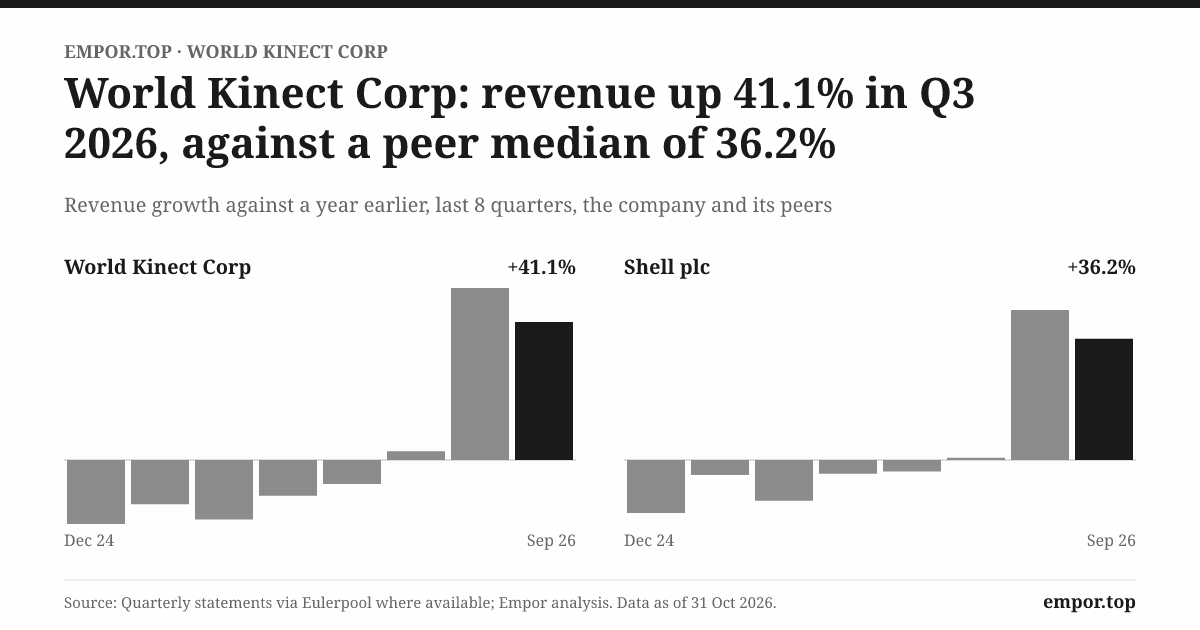
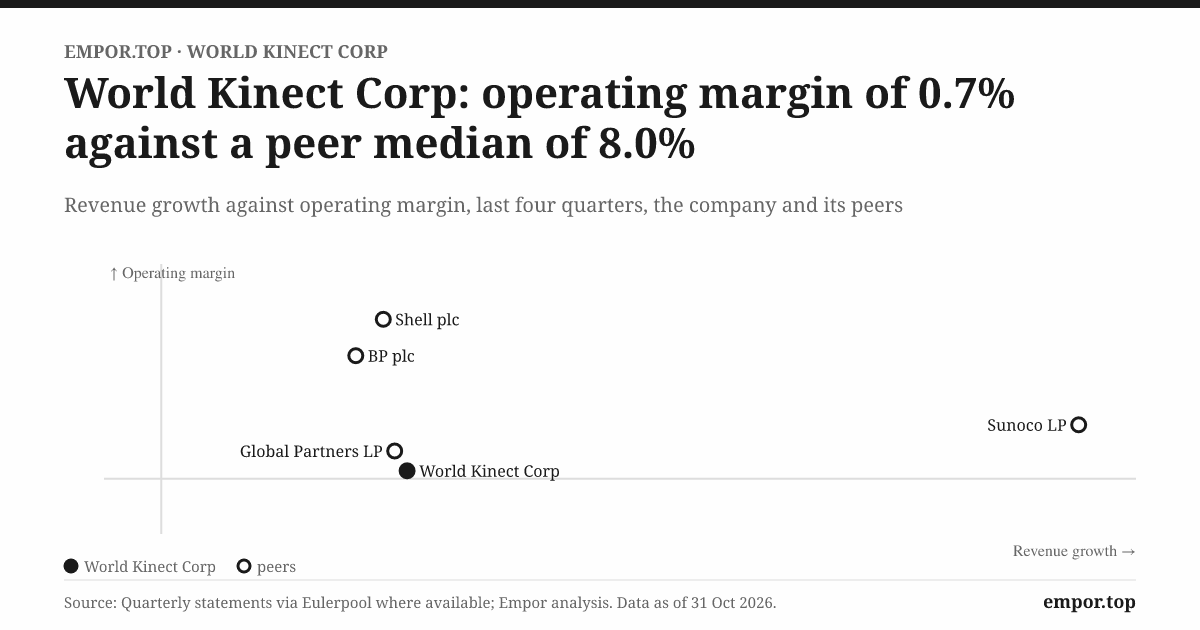
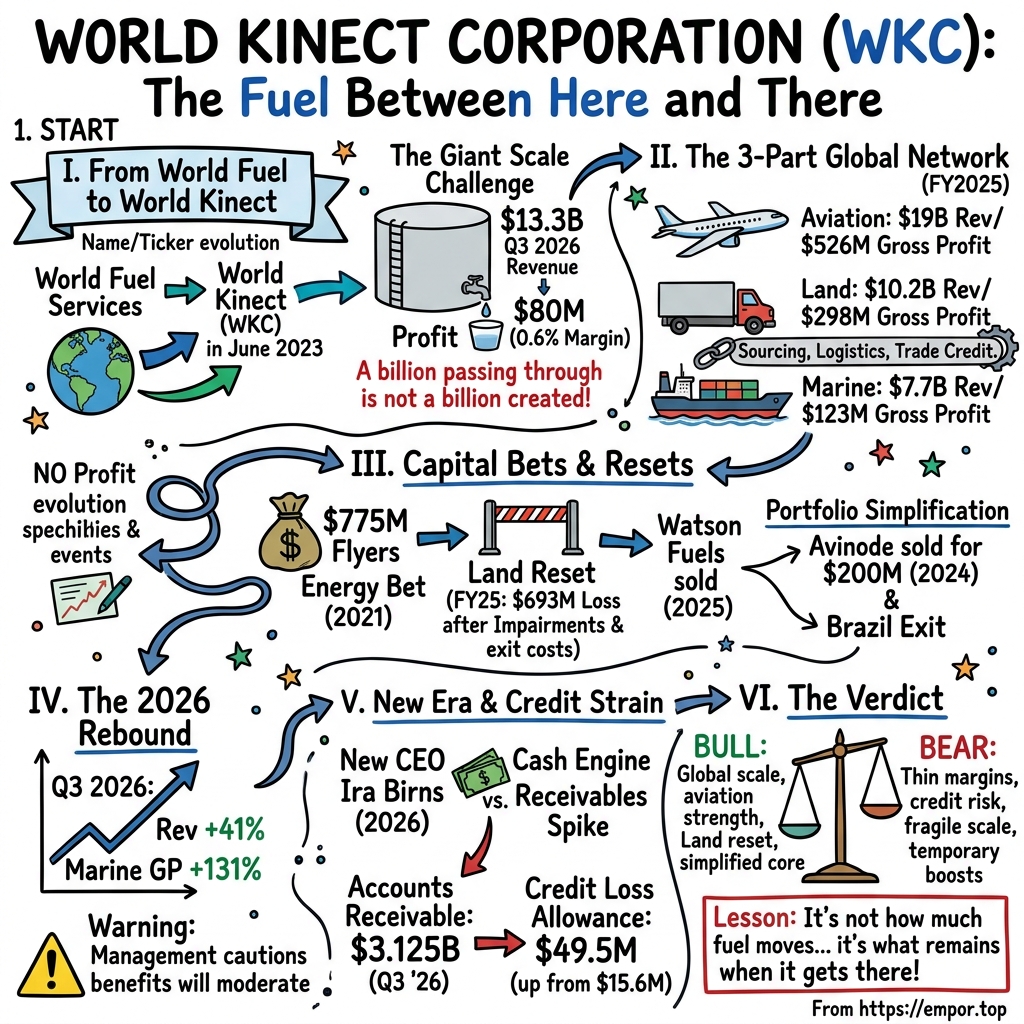
Now look at what that invisibility added up to in the third quarter of 2026. World Kinect reported $13.3 billion of revenue, up 41% from a year earlier.1 For a sense of scale, that is a quarterly sales figure larger than the annual revenue of most companies in the S&P 500. And yet the operating profit that fell out of that river of fuel was $80 million.1 Divide one by the other and the company kept about six-tenths of one cent of operating profit for every dollar that passed through its books.
Put another way: if World Kinect were a $100 grocery bill, the company's operating profit would be sixty cents. The rest belongs to refiners, airports, port suppliers, truckers, tax authorities and the costs of running a global logistics network. That gap, between the enormous fuel bill moving through the company and the tiny slice it keeps, is the first thing anyone needs to understand about it, and it is the thread that runs through every chapter of this story.
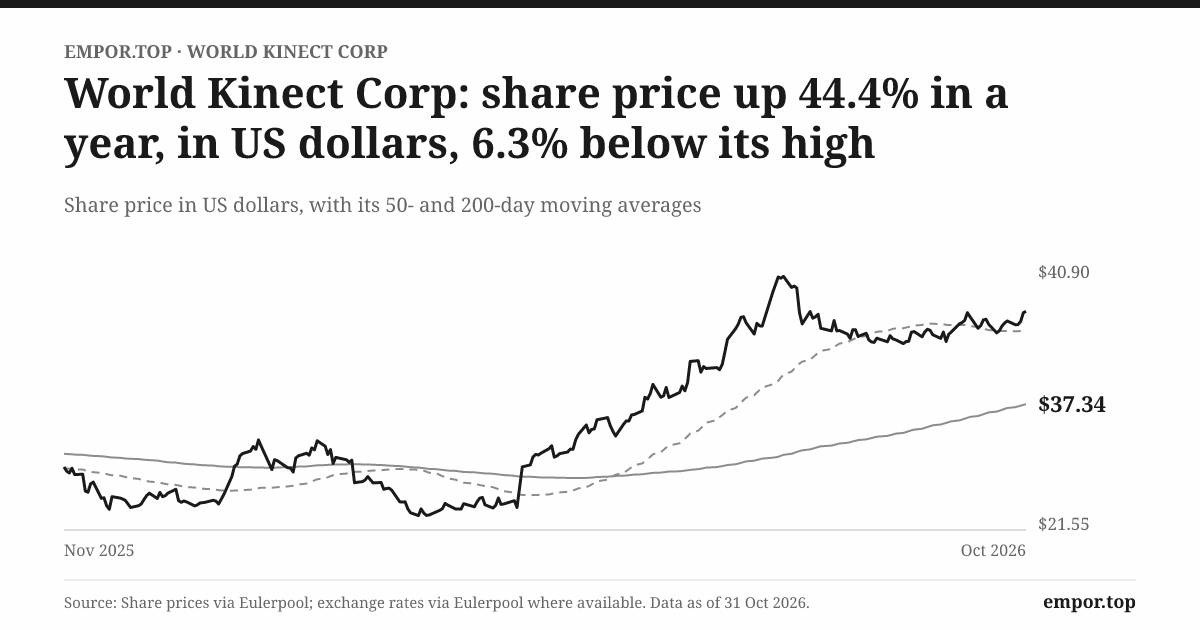
The stock market has been trying to make sense of the same gap. On October 31, 2026, shares closed at $37.34, near the top of a 52-week range that ran from about $23 to almost $40, and the company was worth roughly $2.1 billion.2 Over the previous twelve months, though, World Kinect had reported a loss of $2.93 per share, dragged down by a brutal 2025 in which it wrote off a large part of its land fuel business.23 So investors were paying close to a fifty-two-week high for a company whose trailing reported earnings were negative. That is not necessarily irrational. It simply means the price rests on what the company will earn from here, not on what it has recently reported.
Four questions sit under that bet. The first is whether 2026's growth lasts, or whether it is mostly the echo of higher fuel prices and conflict-driven volatility passing through a distributor. The second is whether the land business, after an expensive reset, can earn its way back to respectability. The third is whether customer credit stays contained, because a company that sells fuel on credit to airlines, shipping lines and fleets carries their troubles on its balance sheet. And the fourth is whether a new chief executive, Ira Birns, who took the job in January 2026, can turn a portfolio clean-up into better returns.4
Before chasing those questions, it helps to be precise about what World Kinect is. It is a Florida-incorporated, NYSE-listed parent company, and the financial statements are those of World Kinect and its own consolidated subsidiaries.2 There is no controlling shareholder, no parent group whose economics leak into the numbers, no sponsor waiting to sell.5 The company runs three businesses, aviation, land and marine, and every dollar of profit or loss in this story belongs to those three businesses and the corporate centre above them.
That clarity makes the central clue easier to see. In a business where the margin is measured in fractions of a cent, small things become very large. A one-cent swing in the profit earned on a gallon of jet fuel, multiplied across billions of gallons, moves earnings more than a billion dollars of extra revenue ever could. A single customer failing to pay can wipe out the profit on thousands of deliveries. The revenue line is loud, but it is mostly noise. The signal is in the unit margin, the operating costs, the credit losses and the cash. To see why the company looks the way it does, the story has to go back to the moment it decided it wanted to be something more than a fuel distributor.
 Subscribe on LinkedIn
II. From World Fuel to World Kinect—and Back to the Core
The company's founding story starts on the water, not in the air. In 1984, Michael Kasbar co-founded Trans Tec Services, a marine fuel brokerage; its acquisition, years later, laid the foundation for what became World Fuel Services.4 Over more than four decades, as chief executive and later executive chairman, Kasbar helped turn that brokerage into a company that, by its own description, became a Fortune 100 business.4 For decades it traded on the NYSE under the old ticker INT, a long-listed company that raised equity as an established business, including a follow-on offering of 4 million shares in 2005.67
The platform that grew out of those decades was easy to describe and hard to build. World Fuel sourced fuel from refiners and suppliers, arranged for it to be delivered where customers needed it, managed the price risk in between and often extended credit to the buyer. It did this for airlines, business jets, cargo carriers, ships and, increasingly, trucks and commercial fleets on land. The company was, in effect, the middleman that made a fragmented global fuel market workable for customers who did not want to negotiate with a hundred suppliers in a hundred places.
For most of its history, that was the identity. Then, in June 2023, shareholders approved a new name. World Fuel Services became World Kinect Corporation, and the following day its shares began trading under the ticker WKC.8 Kasbar, then chairman and chief executive, described the new name as representing the company's role as a bridge, a reference to an ongoing transformation alongside customers' own energy transitions.8 The rebrand came wrapped in an ambition: World Kinect would be a diversified energy and solutions provider, helping customers manage not just fuel but power, sustainability, and the transition to lower-carbon energy.
It is worth pausing on what had happened to revenue in the run-up to that announcement, because it shows how misleading the top line can be. In 2022, the year before the name change, revenue hit $59.0 billion, an 88% jump from the year before, as fuel prices spiked after Russia's invasion of Ukraine.9 Over the following three years, revenue fell every year, to $36.9 billion in 2025.2 Across the full decade from 2015 to 2025, revenue grew only about 2% a year.2 A company whose sales nearly doubled and then shrank by more than a third in four years is not a company whose revenue tells you much about its health. It tells you mostly about the price of oil.
What did change was the corporate footprint. The company had pushed further into land energy in North America and beyond, culminating in the Flyers acquisition that closed in 2022, and it had built or bought businesses in software, payments, trip support and energy advisory. The rebrand was the public recognition of that wider footprint. And yet the company's own filings, then and now, describe the business in terms Kasbar's younger self would have recognised. Most revenue comes from selling fuel and fuel-related products, and segment profit is generally driven by fuel volume and the unit margin earned on it.2 Services, including trip support, advisory and payment processing, are described as immaterial to consolidated revenue.2
That is the tension the name change created. "World Kinect" announced an aspiration. "World Fuel" described the economics. Fittingly, the company never really let the old name go. By 2026, its own press releases introduced it as World Kinect Corporation, operating as World Fuel.1 The listed parent wears the transition brand; the commercial business that customers deal with wears the fuel brand. That is not a scandal, but it is a tell. Three years after the rebrand, the company was leading with the name of its core.
The question the rebrand left behind is simple to state. Did diversification create a steadier, higher-return company, or did it add businesses whose returns proved hard to defend? The answer, as the next chapters show, is mostly the second, with an important caveat about the core. To see why, start with how the core makes money, a few cents at a time.
III. The Network That Has to Earn a Few Cents at a Time
Picture the problem from the customer's side. A commercial airline needs a specific grade of jet fuel at a specific airport at a specific hour, in volumes that change with its schedule. A ship's operator needs low-sulphur bunkers in a port it may visit twice a year, at a price agreed before the vessel arrives. A trucking fleet needs diesel at hundreds of locations, billed on one account, with controls on which drivers can fill up where. Each of those customers could, in principle, go directly to a refiner. Many do. But for many others, the problem is not the fuel. It is the sourcing, the logistics, the price risk, the paperwork and the credit.
World Kinect's pitch is that it solves all of those at once. In its annual report, the company says it competes on service, convenience, reliability, trade credit and price, and it describes a market in which major oil companies sell directly to many customers while smaller specialists compete locally.2 That combination, global reach, delivery reliability, price-risk management, credit and one supplier for many places, is the network proposition. It is real in the sense that customers pay for it. Whether it is defensible is a different question.
Why a $37 billion company keeps less than $1 billion
Start with the accounting, because it explains the strange shape of the income statement. World Kinect records most of its revenue gross, meaning it books the full price of the fuel as sales, because it takes control of the product before it is delivered to the customer.2 An agent that merely arranged a sale would book only its fee. World Kinect, as principal, books the whole thing. That is why revenue swings with crude oil prices and why the top line can rise 41% in a quarter without the business necessarily doing 41% more work.
So the better first measure of economics is gross profit, the revenue left after paying for the fuel and the direct costs of getting it to the customer. In 2025, World Kinect's $36.9 billion of revenue produced $947.8 million of gross profit, a gross margin of about 2.6%.2 Out of that gross profit come salaries, technology, offices, bad debts and every other operating cost. The earnings engine, in other words, is a simple formula: volume, times unit margin, minus operating expenses and credit losses. Everything the company does either moves one of those terms or it does not matter much.
Contracts shape that formula. Multi-year agreements may price fuel off market indices and include minimum-volume commitments, which gives the company some visibility on volume, while fixed-price contracts are generally shorter than a year, typically a month.2 The company also hedges, using derivatives to keep the price of fuel it has bought aligned with the price it has agreed to sell at. In theory, that leaves World Kinect earning a spread rather than betting on oil. In practice, sharp price moves still bleed into margins, as the aviation business found in the third quarter of 2026, when management said significant price movements hurt its physical inventory business.10
It helps to translate the spread into something tangible. In the third quarter of 2026, aviation sold about 1.85 billion gallons of fuel and earned about $148 million of gross profit.1 That is roughly eight cents a gallon before operating costs. Land earned roughly seven cents a gallon on about 1.2 billion gallon-equivalents.1 These are the few cents on which the whole enterprise rests, and they explain why a small shift in pricing discipline, a competitor's bid or a supplier's terms can matter so much.
Three businesses, unequal weights
The three segments are not equal partners. In 2025, aviation produced about $19.0 billion of revenue and $526 million of gross profit, more than half of the company's total, and it led on operating profit too.2 Land produced about $10.2 billion of revenue and $298 million of gross profit, but, as the next chapter shows, its operating line collapsed under impairments.2 Marine produced about $7.7 billion of revenue and $123 million of gross profit, the smallest slice, at a gross margin of well under 2%.2
Aviation is therefore the heart of the company. It sells fuel to commercial airlines, cargo carriers, business aviation and government customers, and it has layered on services such as trip support, which arranges the permits, handling and logistics that a business jet needs to land somewhere unfamiliar. The late-2025 acquisition of Universal Trip Support strengthened that service layer.10 Marine is the oldest business and the most volatile, because bunker prices and shipping disruptions can swing its margins violently. Land is the business that the company tried hardest to grow, through acquisitions, and the one that cost it most.
Now to the moat. The company describes a fragmented market and does not publish market shares or a ranked peer set.2 That matters, because "scale advantage" is the claim most often made about distributors like this, and here it cannot be quantified from the company's own disclosure. What can be said is that World Kinect is large enough to source fuel in many countries, manage complex logistics and carry a substantial receivables book, and that few competitors can match all of those at once across aviation, land and marine.
The harder test is through the mechanisms that would break an advantage. Customers in this market can and do multi-source fuel, using more than one supplier at a given airport or port. Suppliers compete for access to customers but also sell directly to the biggest of them. A buyer whose finance department gets a better credit line or price from a rival can move volume quickly, especially on short contracts. If the network advantage were strong, it would show up in high retention, rising bid-win rates, or an ability to raise unit margins over time. World Kinect does not publish retention, bid-win or price-realisation data, and it does not name a customer concentration or a top-ten customer share.2 So the claim is neither confirmed nor refuted by the record; it sits as plausible but unproven.
What about the newer pieces of the story, the technology and sustainability layer that the 2023 rebrand emphasised? Trip support, advisory and payment services are, by the company's own description, immaterial to consolidated revenue.2 Lower-carbon fuels such as sustainable aviation fuel fit naturally through the same logistics network, and World Kinect can technically source and deliver them. But technical availability is not commercial contribution, and the company does not disclose figures that would let anyone treat these offerings as a second earnings engine.
The honest picture of the core, then, is of a valuable but unforgiving business. A broad network can solve difficult logistics problems, and customers will pay for that, a few cents at a time. But with margins this thin there is very little room for error. A mispriced contract, a working-capital miscalculation or a customer who does not pay can erase months of careful work. That fragility was tested by the company's biggest bet on land.
IV. The $775 Million Flyers Bet Meets the Land Reset
On October 28, 2021, World Fuel Services announced that it had agreed to buy Flyers Energy Group, a family of fuel businesses headquartered in Auburn, California.7 Flyers was not a household name, but it was a substantial operation: fleet fueling, fuel supply and lubricants distribution to more than 12,000 customers across the United States, a leading national network of cardlock locations and about 475 employees.7 The price was approximately $775 million, with $675 million due at closing and the remaining $100 million payable in instalments over two years.7
Kasbar, then chairman and chief executive, said the deal would significantly expand the breadth of the company's land business in North America.7 The announcement promised significant margin, earnings-per-share and cash-flow accretion, though it gave no figures to measure that promise against.7 Birns, then chief financial officer, pointed to a cash position of $796 million at the end of the third quarter of 2021.7 The company had the money, and it had a thesis.
That thesis was strategic. Aviation and marine are global, volatile businesses, tied to the fortunes of airlines and shipping lines. Land, especially retail fuel, cardlock networks for commercial fleets, wholesale and branded fuel distribution, looked steadier. A cardlock network, for the uninitiated, is a set of unattended fueling sites where commercial drivers use a card tied to their company's account; the operator earns a margin on each gallon and keeps a sticky relationship with the fleet. Buying Flyers was meant to give World Fuel scale in that kind of business and make the whole company's earnings more ratable, the investor's word for predictable and recurring.
What did the company pay? Flyers' estimated 2021 revenue was $2.4 billion, so the headline price was roughly a third of a year's sales.7 In most industries, a deal at 0.3 times sales would look cheap. In fuel distribution, it means almost nothing on its own, because the sales are mostly the pass-through cost of fuel, and a business that keeps two or three cents of each revenue dollar can be expensive at a third of sales. The meaningful multiple would be price over earnings or cash flow, and the announcement did not disclose Flyers' EBITDA. Without that, and without a comparable transaction to benchmark against, nobody outside the company can say whether Flyers was cheap or expensive at signing. When the deal was accounted for, the total purchase consideration came to about $795 million.9
The early results looked encouraging. From the acquisition date through the end of 2022, Flyers contributed about $3.4 billion of revenue and about $71 million of income before taxes.9 Part of that revenue reflected 2022's extraordinary fuel prices, but $71 million of pretax income in less than a year was not a bad start on a roughly $800 million investment. On that evidence, the scale thesis was alive.
When the land business broke
Then the story turns, and not gently. By 2025, the land segment as a whole, of which Flyers was a large part but not all, had become the company's problem child. That year, it reported an operating loss of $692.6 million.2 The company recorded $689.6 million of goodwill and other asset impairments across the consolidated business, along with $103.1 million of restructuring and exit costs.2 Goodwill impairment is the accounting admission that a business acquired for a premium is no longer expected to earn back that premium. It is not cash leaving the building in 2025, because the cash left years earlier, when the acquisitions were made. It is the bill for past decisions arriving on the income statement.
The scale of the write-down is the falsifying evidence. The original thesis said land scale would make earnings steadier. Instead, the segment that was supposed to be the ballast produced the largest annual loss in more than a decade and drove a full-year net loss of $614 million.2 Fairness requires one caveat: the company does not attribute every impairment and exit charge specifically to Flyers, and some of the businesses written down or exited were other land operations. So the record does not prove that Flyers specifically was a failed acquisition. It does show that the broader bet on land scale, of which Flyers was the centrepiece, did not deliver what was promised.
Management's response was to shrink. In 2025, the company sold Watson Fuels, recording an $81.7 million pretax loss on the sale, and began exiting several land operations it described as unprofitable or outside its core strategy.2 Headcount across the company fell from about 5,300 at the end of 2023 to about 4,000 at the end of 2025, a cut of roughly a quarter.25 That is the signature of a portfolio reset rather than an expansion programme. Capital spending tells the same story from a different angle. The company spent about $88 million on capital projects in 2023 and about $66 million in 2025, against revenue in the tens of billions.2 For a business with this much product flowing through it, that is a very light physical footprint, because most of the tanks, trucks, pipelines and airport hydrant systems it uses belong to someone else. The asset-light model is a strength when things go well, since growth does not require heavy investment. It is also why the big money in this company goes into acquisitions and working capital rather than into equipment, and why the fate of those acquisitions decides so much of the return. The company was not reallocating capital to a new growth vector so much as cutting back to the parts of land it believed could earn a return: chiefly retail and cardlock.
Would it be fair to call Flyers "overpaid"? Not on the public evidence. There is no comparable price and no attributable stream of cash returns to judge it against. What can be said is narrower and still damning enough: the 2025 condition of the land business severely weakens the original scale-and-ratability thesis, and the deal's economic success remains unproven. The test now is whether the remaining land operations, after the exits, can produce consistent operating income and cash. The early 2026 evidence on that is more encouraging. First, though, the company had already been unwinding another part of its diversification, and in a way that told investors which pieces could earn a return.
V. The Energy Transition Story Loses Its Software Platform
Nine months after the company renamed itself around a broader energy and solutions role, it sold one of the clearest examples of that role. On March 12, 2024, World Kinect announced the sale of Avinode Group, together with its portfolio of aviation fixed-base-operator software products, to CAMP Systems International, a wholly owned subsidiary of Hearst, for approximately $200 million in cash.11 Avinode described itself as the world's leading air charter sourcing platform, a marketplace where charter brokers and operators find and book aircraft.11 It was the kind of asset that, in a transformation narrative, would be held up as proof that the company was more than a fuel middleman.
Kasbar framed the sale as another step in sharpening the portfolio while generating a solid return.11 Birns, still chief financial officer, said the proceeds would repay debt and cut the annual run-rate of interest expense by about $10 million.11 When the sale closed in 2024, World Kinect booked a pretax gain of about $96 million.2
On its face, that was a good trade. The company had owned Avinode for years, built it into a recognised platform and sold it to a strategic buyer at a gain. But the meaning of the sale runs in two directions. On one side, it showed that the company could build something valuable outside fuel. On the other, it showed that management, when it needed capital and focus, chose to sell the software asset rather than keep it as a growth engine. A company that believed software and data would carry its future earnings would not usually sell its best software platform for a one-off gain. The sale was a vote, by the people who knew the business best, about where the durable returns lay.
A gain is also not a return in the sense that matters to long-term owners. The $96 million was a one-time accounting result that will never recur, and it says nothing about whether the rest of the solutions strategy earns more than its cost of capital. It belongs in the "other income" bucket, not in any estimate of what the company earns in a normal year.
Set Avinode beside the other divestitures and the picture gets more mixed. In the same year, World Kinect sold its Brazil business and recorded a loss of about $111.2 million on that disposal.2 In 2025, the Watson Fuels sale produced the $81.7 million pretax loss.2 Add them up and three divestitures over two years produced one gain and two larger losses. Other income, which captures these items among others, was negative in each of 2023, 2024 and 2025, at about minus $74 million in the last of those years.2 The portfolio reset was real, and it simplified the company, but it was not a sequence of value-creating exits. It was, in large part, a sequence of corrections.
What, then, of the lower-carbon offerings, the part of the rebrand most closely tied to the energy transition? They may matter. Airlines face growing pressure to blend sustainable aviation fuel, and shipping lines face tightening emissions rules. A supplier that can deliver those alternatives through the same network may strengthen customer relationships and stay relevant as fuels change. But the company does not disclose material current earnings from these offerings, and a capability is not a profit pool until it shows up in gross profit.
The record here offers a useful prior. Over the last several years, World Kinect's adjacent bets, software, international land businesses, and a wider energy-management role, mostly ended in sale or exit rather than in a second earnings engine. That does not doom the next adjacent bet. It does mean that any claim about energy transition upside should be treated as an option with an uncertain strike price, not as part of the base case.
So by the end of 2025, the company had sold its software platform, exited Brazil, sold Watson, and begun pulling out of other land operations. What remained was essentially the core. The burden had shifted squarely to showing that this simpler company could produce better returns. And then, in 2026, the market handed it an unexpected tailwind.
VI. The 2026 Rebound—and the Management Warning Attached to It
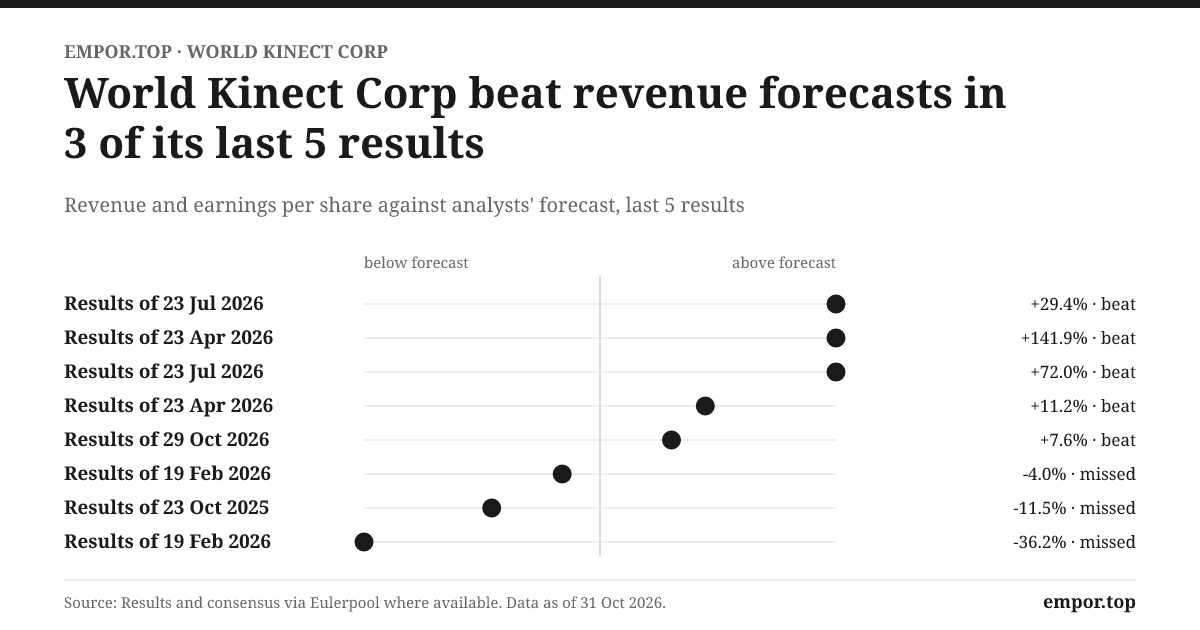
On October 29, 2026, World Kinect reported its third-quarter results under a headline announcing raised guidance.1 The figures looked like a company reborn. Revenue was up 41%. Gross profit rose 15%, to $288 million.1 Operating income rose from about $63 million a year earlier to about $80 million.1 Adjusted earnings per share, the company's preferred measure, rose 83% to $0.99, which management called a record third quarter.110 And the full-year adjusted EPS guide was lifted to between $3.52 and $3.62, from a prior range of $3.20 to $3.40.1
On the call that afternoon, chief financial officer Mike Tejada reminded listeners where the year had started: the original 2026 guide had been $2.20 to $2.40 a share.10 In other words, over the course of a single year, management's own expectation for adjusted earnings rose by roughly half. That is the rebound in one number. The question is what caused it, and the honest answer has two parts: some of it was the company, and a meaningful part was the world.
Start with what the revenue growth measures. Consolidated fuel volume in the quarter was actually down about 6% from a year earlier, at roughly 4.0 billion gallons.1 Revenue rose 41% while volume fell, which can only mean one thing: the price of the fuel being sold rose sharply. A distributor that books revenue gross will show booming sales whenever oil climbs, even if it moves fewer gallons. That is why revenue, once again, is the least interesting number in the release.
Below the gross profit line, the quarter also showed discipline on costs. Adjusted operating expenses fell about 3% from a year earlier, to roughly $176 million, a sign that the land exits were showing up in the cost base.10 Adjusted EBITDA rose to about $127 million in the quarter. Over nine months, it reached about $357 million, up from about $262 million in the same period of 2025.1 Against those gains, net interest expense nearly doubled and the adjusted tax rate rose to about 32% on unfavourable discrete items, so less of the operating improvement reached shareholders than the gross profit growth implied.10
Now separate the segments, because they tell three different stories.
Aviation, the largest business, grew gross profit by 4% to about $148 million, on volume up about 1%.1 Management credited commercial fuel resale and the Universal Trip Support acquisition, which closed in the fourth quarter of 2025, and said the gains were partly offset by a weaker physical inventory business, where significant price movements hurt margins.10 Operating income in aviation was essentially flat, at about $77.5 million against $77.1 million a year earlier.1 That is a steady quarter, not a breakout. Part of the gross profit growth came from an acquisition, so the organic improvement was smaller still.
Marine was the fireworks. Gross profit more than doubled, up 131% to about $59 million, even though volume fell about 8% to roughly 3.7 million metric tons.110 Operating income jumped from under $5 million to almost $37 million.1 Fewer tons and more than twice the gross profit means the margin per ton roughly tripled, from about $6 to about $16. That does not happen because a business got three times better at its job in twelve months. It happens when prices and volatility give a skilled middleman unusual opportunities. Management said as much. Birns said marine benefited in part from fuel prices and volatility that, for much of the quarter, were higher than the company had anticipated in late July, and Tejada noted that volume reflected continued conflict-related disruption to shipping patterns while margins had continued to moderate since the initial disruption.10
Land was the quieter surprise. Gross profit was flat at about $81 million, on volume down about 13%, which reflects the businesses the company had exited.1 But operating income more than doubled, to about $28 million from about $12 million, and adjusted operating income rose 102%.1 Fewer gallons, the same gross profit and more than double the operating income are what a successful clean-up looks like: the unprofitable volume is gone and the costs went with it. Nine-month adjusted land operating income was more than double the full-year 2025 figure, and management said it was making progress towards a full-year adjusted operating margin target of 30%, a measure of operating income as a share of gross profit.10
What the call revealed, and what it did not
The Q&A was short. Only one analyst, Justin Jenkins of Raymond James, appears on the record of the call, and his three questions went to the right places.10 He asked how the fourth-quarter guide treated commodity volatility. Tejada's answer was qualitative: management takes a measured approach and treats market upside as potential upside rather than baking it into the guide.10 He asked how far along the land self-help plan was. Tejada conceded that some third-quarter land strength came from market activity, particularly in cardlock, and that it was subsiding into the fourth quarter; Birns reached for a sports analogy, saying the company was barely halfway through the game and right around the hoop on the 30% margin target.10 And he asked about working capital. Tejada said the roughly $85 million built up in the first half had come back in the third quarter, called the quarter a high watermark that would not necessarily repeat, and pointed to cash conversion, higher hurdle rates and credit discipline as priorities.10
That exchange is revealing for what it quantified and what it did not. The 30% land target is a number investors can hold management to. The marine normalisation was described, not bridged: no one said what marine gross profit would look like once the conflict-driven benefit fades. The fourth-quarter outlook was given in words, with aviation roughly flat sequentially, marine down sequentially as incremental market benefits continue to moderate, and land down on seasonality.10 The implied fourth-quarter adjusted EPS, around $0.50 to $0.60 given about $3.02 already delivered through September, is itself a sharp step down from the third quarter's $0.99.110 And 2027 numbers were deferred to February.10
The sequence of guidance across 2026 tells the same story. The year began with a guide of $2.20 to $2.40, a figure set before the market benefits arrived. It was raised to $3.20 to $3.40 as conditions improved, and raised again to $3.52 to $3.62 in October.101 A rising guide is better than a falling one, but this pattern reflects external tailwinds being recognised quarter by quarter rather than a plan being executed to target. To his credit, Birns did not pretend otherwise. In closing remarks, he acknowledged that geopolitical events had benefited results, said management's objective is not to rely on volatility for growth, and called the year's work the foundation and certainly not the finish line.10
That candour is the strongest caveat to any structural reading of 2026. When management itself says the largest incremental profit source is moderating, nobody should call the marine rebound permanent. The settling evidence will be segment gross profit and operating income in 2027, after the conditions fade, with volume and unit-margin bridges. A few strong quarters cannot yet show through-cycle returns, repeatable margins or a durable lift in free cash flow. They can show that the core still works when the market is kind. The next question is whether the people now running it can prove it works when the market is not.
VII. The New CEO Inherits a Clean-Up and a Higher Bar
In January 2026, Ira Birns became chief executive of World Kinect after years as its chief financial officer.5 It was a natural succession in one sense, because Birns had been at the centre of the company's capital decisions, its debt financing and its investor communications for a long time. In another sense, it was a curious one. The man who had presented the Flyers deal's cash position to investors in 2021 and the Avinode proceeds in 2024 was now the man responsible for the clean-up that followed.711
His finance team was also homegrown. Mike Tejada became chief financial officer in October 2025, after serving as chief accounting officer.5 John Rau remained president.5 The continuity has obvious benefits: these executives know where the bodies are buried, figuratively speaking, and they do not need a year to learn the business. It also has an obvious cost: they were part of the leadership that made the decisions now being unwound.
The biggest governance change is still to come. On September 17, 2026, the company announced that Michael Kasbar, its co-founder, would step down as executive chairman effective December 31, 2026, and that Ken Bakshi, an independent director who has served on the board since 2002, would become chairman.4 Bakshi brings more than three decades of international business, private equity and advisory experience.4 Birns said it was hard to separate Kasbar from the history of World Fuel, which is both a compliment and a description of the challenge.4 From January, the company will be run by a chief executive with an independent chair, rather than the founder, above him.
Kasbar's presence was never a matter of control. He held about 1.8% of the shares as of April 2026, a meaningful personal stake but nowhere near a controlling one.5 The register is dominated by institutions: BlackRock held about 15.9%, Vanguard about 13.5%, and Dimensional, Brandes, State Street and Invesco each held between 5% and 8%.5 Between the 2025 and 2026 proxies, BlackRock's reported stake slipped from about 17.9% while Vanguard's rose from about 12.2%, shifts that look more like index and portfolio rebalancing than any concentrated activist build.125 The owners are diversified institutions, and they will judge Birns on results.
Incentives that actually bit
The compensation record offers a concrete accountability signal. For 2025, Birns' reported compensation was about $3.32 million, the same as Rau's, while Kasbar's was about $6.37 million.5 Annual incentives for all three paid out at 50% of target.5 More striking, the 2023–2025 performance share awards for Birns, Rau and Kasbar were forfeited entirely after adjusted EPS fell below the threshold.5 That is how incentive plans are supposed to work, and in many companies they do not: the targets get reset, the metrics get adjusted or discretionary awards fill the gap. Here, a three-year plan that missed simply paid nothing. Shareholders noticed, broadly approving the pay plan at the June 2026 annual meeting with about 41.3 million votes for and 3.26 million against.13 That is roughly 93% support among votes cast for and against, a comfortable margin with a real minority of dissent.
The scorecard and the footnote
Test management's capital-allocation record against outcomes, and the verdict is mixed. The Flyers expansion was followed by severe land impairment and exits. Avinode was sold at a gain; Brazil and Watson were sold at losses. A buyback programme reduced the share count, from about 56.7 million at the end of 2024 to about 54.1 million at the end of 2025, and further to about 51.2 million by September 2026.21 That is evidence of a management team that recognised its mistakes and corrected course, which is not nothing. It is not evidence of a long streak of disciplined capital allocation, and anyone describing it that way would be ignoring the largest write-down of the past decade.
Then there is a smaller item that matters out of proportion to its size. In the third-quarter 10-Q, the company disclosed that it had recognised a $9.1 million reduction to net income to correct errors primarily related to prior interim periods within 2026.3 The company said the errors were not material to any previously reported period, and the filing does not describe their nature in detail.3 Against a quarter with $38 million of GAAP net income, $9.1 million is not trivial, but more important than its size is its timing.1 The company's auditor, PwC, had reported effective internal control over financial reporting for 2025, with goodwill valuation as the critical audit matter.2 A correction of interim errors in the first year of a new chief executive and new chief financial officer is precisely the kind of thing a sceptical investor watches. One correction is a footnote. A second would be a pattern.
Birns' finance background may be an advantage for a turnaround that is largely about costs, hurdle rates, working capital and credit discipline. But the record is too short to call the new leadership proven. Credibility will rest on delivering the recovery without another impairment cycle, on clean and consistent reporting, and on explaining misses as plainly as the company explained the 2026 tailwinds. And the place where that credibility will be tested hardest is not the income statement. It is the balance sheet, where the receivables have been piling up.
VIII. The Cash Engine, the Receivables Spike and the Buyback
Every gallon World Kinect sells on credit creates a small IOU. A typical customer might pay in a few weeks, and the company typically pays its suppliers on a similar rhythm, so in a stable world the IOUs coming in roughly match the bills going out. The business turns over its assets more than six times a year, and in recent years the gap between when it pays suppliers and when customers pay it has shrunk to almost nothing.2 That is efficient. It also means that when fuel prices rise, or when a customer stops paying, the balance sheet feels it immediately.
In the first nine months of 2026, the balance sheet felt it. Net accounts receivable rose to about $3.13 billion at the end of September, from about $2.21 billion at the end of 2025, an increase of over 40%.3 Much of that reflected the same thing that inflated revenue: higher fuel prices mean bigger invoices. But the reserve against those invoices grew much faster. The allowance for credit losses netted against trade receivables on the balance sheet rose to $49.5 million from $15.6 million at year-end.3 The company's broader allowance for expected credit losses, which also covers other credit exposures, was higher still, at about $74 million.3 Either way, the reserve roughly tripled or more in nine months, while receivables grew by about 40%.
The cause was not abstract. The company reported deteriorating credit at certain aviation and marine customers, including a marine customer that filed for creditor protection during the second quarter of 2026 and is operating under court supervision.3 World Kinect does not name the customer. The provision for credit losses was about $61.1 million over the nine months, against about $5.7 million in the same period of 2025, with about $25.7 million in the third quarter alone.3 Actual write-offs remained small, around $3.5 million in the nine months, which means most of the provision is an estimate of losses still to be confirmed rather than money already lost.3
There is an important counterweight. As of September 30, 2026, 97% of the company's receivables were outstanding for less than 60 days.3 The book as a whole is young and turning over. The problem is concentrated in specific customers, not spread across the portfolio. That matters for how to read the risk. It suggests a few bad credits rather than a systemic loosening of standards.
There is also an accounting choice to watch. In its third-quarter reconciliation, the company excluded about $23.2 million of credit-loss provision from adjusted results, classifying it as an exit cost.1 There may be good reasons for that, if the exposures arose in businesses being exited. But it means the adjusted EPS figure investors were celebrating does not bear the full weight of the quarter's credit losses. In a credit business, bad debts are a cost of doing business, and the line between an exit-related provision and an ordinary one will need consistent treatment to be trusted.
Where the cash goes
Over the longer run, World Kinect's cash generation has looked better than its reported earnings. Across 2014 to 2025, the company produced about $2.3 billion of operating cash flow against about $469 million of cumulative net profit.2 Part of that gap is large non-cash charges such as the 2025 impairments, and part is working-capital movements that swing back and forth. The pattern can be erratic. In 2017 and 2018, operating cash flow was negative; in 2020, when fuel prices collapsed and receivables shrank, it surged to about $604 million.2 When prices fall, cash flows in as customers pay off larger old invoices with smaller new ones; when prices rise, cash flows out. That makes any single year hard to read.
2025 was a good cash year. Operating cash flow was about $293 million and free cash flow, after capital expenditure of about $66 million, was about $227 million.2 The company spent about $85 million on buybacks and $41 million on dividends that year, and it kept paying the dividend through a year with a $614 million GAAP loss.214 In 2026, the rhythm reversed. Through nine months, operating cash flow was about $108 million and free cash flow about $69 million, both well below the prior year, after a strong third quarter in which the working-capital build reversed.1 Buybacks continued, at about $89 million over the nine months, with none in the third quarter.1 On a trailing basis, free cash flow yield was slightly negative.2
That is the capital-allocation question in concrete form. Returning cash to shareholders is easy to defend when free cash flow covers it. In a year when receivables are growing, credit losses are rising and free cash flow is thinner, buybacks consume flexibility that a credit-heavy distributor might want to keep. Those are the right priorities. Their delivery will show up in the year-end balance sheet.
The debt structure gives the company room. In November 2025, World Kinect extended its $2.0 billion senior unsecured credit facility, including a $1.65 billion revolver and a $350 million term loan, to November 2030.2 It also has $350 million of 3.25% convertible notes due 2028.2 Total borrowings at the end of 2025 were about $700 million against equity of about $1.3 billion.2 The facility's leverage covenant limits total indebtedness to 4.75 times a defined leverage measure, and the company does not disclose how much headroom it has against that limit.2 Interest is not free either: net interest expense in the third quarter was about $31 million, up 90% from a year earlier, and management expects rates to remain elevated.10 Bigger receivables have to be financed, so higher fuel prices raise not only revenue but borrowing costs.
Two other exposures run quietly underneath. The first is currency. A company that buys fuel in dollars and sells it in dozens of countries collects receivables and owes taxes in many currencies, and World Kinect hedges those exposures with forwards and swaps that, it says, substantially offset the remeasurement of the underlying balances.2 By September 2026, it held foreign-currency contracts with notional values of roughly $870 million on one side and $810 million on the other.3 Those are large numbers relative to quarterly operating profit, which is why the hedges matter even when they work as intended.
The second is legal and tax. The company contests South Korean tax assessments of about $23.8 million relating to alleged VAT invoicing and reporting failures from 2011 to 2014, and it carried about $65.5 million of surety bonds at the end of 2025.2 Neither is large enough to threaten the company. Both are reminders that a business operating in many jurisdictions accumulates disputes the way a ship accumulates barnacles, and that a few of them can land on the income statement in a year when margins have no room to absorb them.
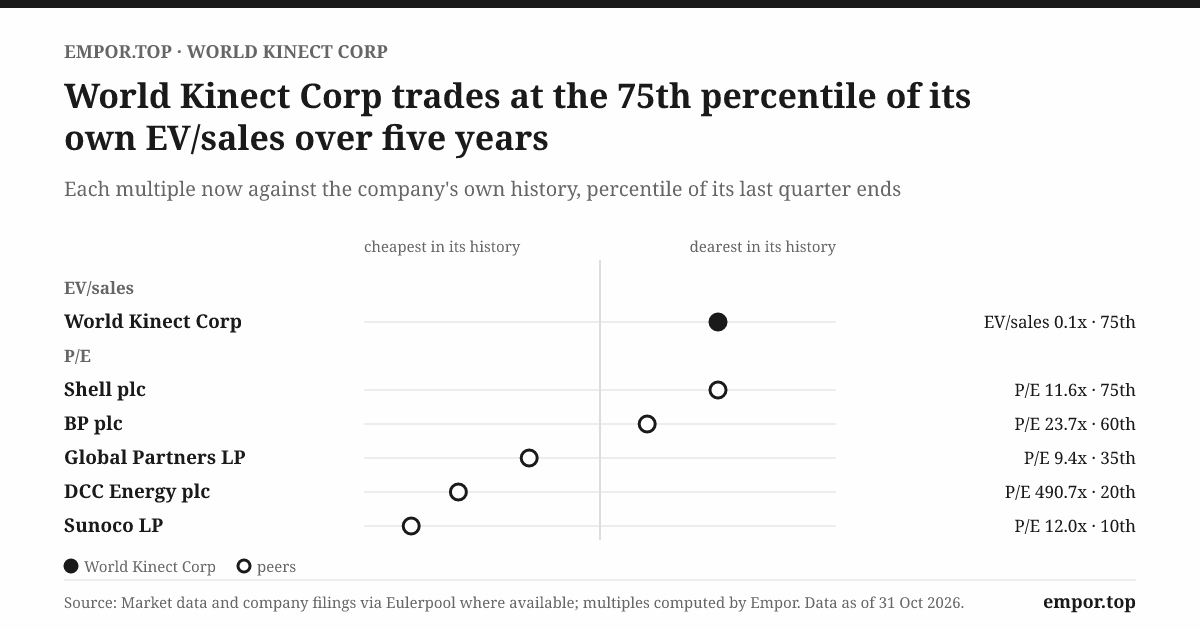
Valuation is where the receivables story and the earnings story meet. At $37.34, the shares traded at about 1.5 times book value and about 28 times trailing EBITDA, a high EBITDA multiple distorted by the 2025 impairments.2 The widely quoted price-to-earnings figure of 83.4 times is stale: its earnings denominator is the twelve months to March 2025, before the reported loss, and against a five-year median of about 13.5 times it describes nothing about current earnings.2 On management's adjusted 2026 guidance, the shares sit at roughly ten to eleven times adjusted earnings per share, but that is an adjusted number from a year with unusual tailwinds.1 The market, in short, is pricing World Kinect as if a large part of 2026's earnings power will persist. Whether it does is the subject of the bull and bear case.
IX. Analysis & Bear vs. Bull Case
Two facts from the same October afternoon sit side by side. Marine gross profit had just risen 131%.1 And the management team reporting it was telling investors, in plain words, that the incremental market benefits behind that jump would continue to moderate.10 Both facts are true. The investment case for World Kinect is a question of which one matters more over the next five years, and the answer depends less on any single quarter than on the structure of the industry the company competes in.
Start with that structure, viewed through Michael Porter's five forces. Rivalry is intense. The company itself describes a fragmented market in which major oil companies sell directly to many customers and smaller specialists compete locally on service, convenience, reliability, trade credit and price.2 There is no published market share data to suggest any player dominates, and in a fragmented market with a commodity product, price competition is the default. Buyer power is significant. Airlines, shipping lines and fleet operators are sophisticated purchasers who can tender, multi-source and switch, and the company discloses neither a customer concentration nor any retention measure that would show buyers are locked in.2 Supplier power matters most where fuel access is constrained, at a remote airport or a congested port, and where suppliers set credit terms that shape how much business a distributor can carry.
The threat of new entry is the force that most favours World Kinect. Building a global sourcing network, compliance infrastructure, hedging capability and a multi-billion-dollar receivables book is not something a start-up does in a year. That is a genuine barrier at the global level, though local competitors can and do enter individual airports, ports and regional land markets. Substitution is a slow-moving risk rather than an immediate one. Sustainable aviation fuel, LNG and methanol in shipping, and electrification of land fleets all change what gets moved, and electric trucks in particular could erode the land business over the long run. But none of these threatens to replace the current earnings base within a few years, and some, such as sustainable aviation fuel, may flow through the same network.
Now run the same company through Hamilton Helmer's seven powers, the sources of durable advantage that let a business earn persistently higher returns than its rivals. Scale economies are the most plausible: a global buyer with many locations can spread fixed costs across more gallons and may source more cheaply. But the company does not disclose market shares, and its gross margin of roughly 2.6% in 2025 is hardly the signature of a cost leader extracting outsized profit.2 Switching costs exist in places, such as integrated fleet card programmes, trip-support relationships and multi-location contracts, but short contract lengths and multi-sourcing limit them, and there is no disclosed retention data. Network economies, in the technical sense where each new user makes the product more valuable for others, applied most clearly to Avinode, the charter marketplace that the company sold.11 Counter-positioning, cornered resources and brand play little role; there is no evidence of a resource competitors cannot access, and fuel customers rarely pay a premium for a name. Process power, embedded operational know-how that competitors find hard to copy, is perhaps the most credible claim: decades of handling the messy logistics of fuel in many jurisdictions. But it is hard to prove from outside and impossible to quantify.
Put together, the frameworks describe a business with real barriers at the global scale but weak pricing power at the transaction level. That is consistent with what the margins show. A company with a strong moat would show steadily rising unit margins and returns; World Kinect's operating margin has hovered between about 0.4% and 1.1% across the last decade, with the occasional negative year.2 Return on capital employed reached about 10% in 2025 on the fact-sheet measure, but return on equity collapsed after the impairments.2
Why it may win, and why it may not
The bull case is not empty. World Kinect has broad sourcing and delivery capabilities across three transportation markets, operational knowledge built over four decades, trade credit and price-risk services that many customers value, a simpler land portfolio, an aviation business that grew gross profit in 2026 with the help of Universal Trip Support, and a management team whose incentives demonstrably bite when targets are missed.1105 Land's operating income more than doubled in the third quarter on less volume, which is exactly what a successful exit programme should produce.1 The facility runs to 2030, the share count is falling and cash dividends paid have roughly quadrupled since 2014.2 If the core earns adjusted EPS anywhere near the 2026 range in a normal year, the current price will look modest in hindsight.
The bear case is grounded in the company's own record. The advantages it claims lack public evidence on retention, bid wins, customer returns or price realisation. The acquisition-led land expansion ended in an impairment and exit cycle that wiped out roughly a third of shareholders' equity in a single year.2 Marine's best quarter in years came with an explicit market tailwind that management expects to fade.10 Receivables and credit provisions rose sharply, and a part of the credit provision was excluded from adjusted earnings.13 Free cash flow through nine months of 2026 was well below the prior year, even as buybacks continued.1 And the first year under the new leadership team included a correction of interim-period errors.3
An activist looking at the company would ask pointed questions. Why is a business with a sub-1% operating margin carrying a corporate cost centre that swung from about $31 million to about $62 million of unallocated expense in the third quarter, even if some of that reflects incentive accruals in a strong year?1 Why continue buybacks while receivables and credit reserves are rising and nine-month free cash flow is thin? How much of the 30% land margin target depends on cardlock market conditions that management itself said were subsiding?10 And how will the company separate exit-related credit losses from ordinary ones once the exits are finished?
The most useful stress test is to strip the 2026 numbers down to their components. Separate GAAP from adjusted: in the third quarter, adjusted net income was about $51 million against GAAP net income of about $38 million.1 Separate organic from acquired: some of aviation's growth came from Universal Trip Support.10 Separate volume from price: consolidated volume fell even as revenue soared.1 And separate recurring earnings from one-offs: the Avinode gain, the disposal losses and the impairments should all be set aside to see what the core earns. Seen that way, the rebound is real but narrower than the headlines suggest. Aviation is steady, land is genuinely improving from a very low base, and marine is enjoying an unusual year.
Three numbers will tell investors more than any others. The first is segment gross profit, read alongside volume and unit margin, because that is the earnings engine itself; its latest reading showed aviation up 4%, marine up 131% and land flat on sharply lower volume.1 The second is the credit-loss allowance and aging schedule, set against receivables growth; the latest reading showed a reserve that more than tripled while receivables grew by about 40%, with 97% of balances under 60 days.3 The third is operating and free cash flow after working-capital movements; nine-month free cash flow was about $69 million, down from about $215 million a year earlier.1 The first measures whether the network earns its keep, the second whether customers pay, the third whether earnings become money.
Valuation discipline follows from those KPIs. A consistent current-earnings multiple will only be meaningful after several quarters of positive GAAP EPS and free cash flow; until then, the market is valuing adjusted earnings from an unusual year. The verdict on the moat is therefore a narrowed one: World Kinect has a real logistics and credit network that is hard to replicate globally, but the record does not show it can extract durable pricing power, and the burden of proof sits with the company. That leads to the lessons this company teaches more clearly than most.
X. Business & Investing Lessons
Go back to that $13 billion quarter.1 It is a picture worth remembering whenever a company's scale is being sold as if it were the same thing as its value.
The first lesson begins with the way World Kinect keeps its books. Because it takes control of the fuel before delivering it, every dollar of jet fuel, bunker and diesel runs through its revenue line.2 The swings in sales between 2022 and 2025 said little about the economics, which were set by the few cents of margin on each gallon.92 A billion dollars passing through is not a billion dollars created. Founders and investors who chase revenue scale in a pass-through business are measuring the size of the pipe, not the water they get to keep.
The second lesson belongs to Flyers and the land reset. In 2021, the company paid roughly a third of a year's sales for Flyers, betting on scale and steadier earnings.7 Four years later, the land segment posted an operating loss of almost $700 million, and the company was exiting businesses that no longer fit.2 A low price-to-sales multiple is not a bargain when the margin and the capital return are missing. In distribution, the purchase price should be judged against the cash the acquired business will generate after the cost of financing its working capital, not against the size of the invoices it issues.
The third lesson comes from the year World Kinect changed its name. In June 2023, the company announced itself as a bridge to customers' energy transitions.8 Within a year, it sold Avinode for a one-time gain, and by 2026 it still introduced itself as World Kinect Corporation, operating as World Fuel.111 A new label is an ambition; recurring revenue is evidence. Rebrands can usefully signal intent, but investors should credit the new identity only when it shows up in gross profit that recurs.
The fourth lesson sits in the 2026 balance sheet. In a year of rising prices, receivables swelled by about $900 million, a marine customer went into court-supervised creditor protection, and credit provisions rose more than tenfold year over year.3 In a credit business, the sale is unfinished until the customer pays. That is easy to forget when the income statement looks strong, because the provision for a loss arrives later than the revenue that created it, and because companies can classify some of those losses outside their adjusted earnings.
The final lesson is about what management now owes its shareholders. The founder is leaving the chair, the new chief executive has a three-year incentive plan behind him that paid nothing, and the company has already guided investors to expect the most spectacular part of 2026 to fade.4510 The job is simple to describe and hard to do: simplify the portfolio, show the return, and make the next forecast easier to trust. In a business that earns less than a cent on the dollar, trust is not a soft asset. It is the discount rate investors apply to every promise management makes.
XI. Epilogue
Tonight, World Kinect enters the last two months of 2026 in an unusual position. It has a chief executive in his first year, a founder about to leave the chairman's seat, an independent chair waiting to take it, and a full-year guide that is far above where it began the year.41 It also has a balance sheet carrying more receivables than at any point in recent memory, a credit reserve that has grown sharply, and a management team that has already told investors the market's gifts are moderating.310 The story of the reset is half written, and the next chapters will be decided by a handful of observable moments.
The first arrives in February 2027, when management will share its initial perspective on 2027 and report full-year 2026 results.10 If the 2027 outlook shows marine gross profit settling at a level clearly above its pre-2026 base, it would suggest the company captured some lasting share or margin from the disruption. If marine reverts to the thin margins of 2025, it will confirm that 2026 was mostly a market windfall, and the investment case will rest entirely on aviation and land.
The second test is land. The exits are largely done, and the remaining retail and cardlock operations have to show that they can earn consistent operating income and cash without fresh impairments or restructuring charges. The company has set a 30% adjusted operating margin target and said it is right around it.10 The question for 2027 is whether that margin holds once the cardlock market tailwind that management described as subsiding is gone. A clean year of land profit, with no new exit charges, would be the first real evidence that the reset worked. Another round of write-downs would reopen the question of whether the land strategy can earn a return at all.
The third test is credit. The year-end 2026 balance sheet will show whether receivables have fallen back as prices eased, what the allowance and aging schedule look like, and whether the marine customer in creditor protection has ended in a recovery or a final loss.3 If provisions stabilise and write-offs stay small, the 2026 spike will look like a contained episode. If receivables keep growing faster than gross profit, or if more customers join the troubled list, the balance sheet will start to absorb the earnings that the income statement reports.
The fourth test is leadership itself. Birns' first full calendar year as chief executive with an independent chair above him will be 2027. Investors will watch whether reporting is clean, with no repeat of the interim corrections disclosed in the third quarter, whether guidance shifts are explained, and whether capital returns are matched to free cash flow rather than to adjusted earnings.3
What would falsify the recovery is not hard to describe. Falling unit margins in aviation, renewed land charges, worsening credit provisions, or earnings that again fail to convert into cash would each say that 2026 was a good year rather than a new baseline. What would confirm it is equally clear: positive GAAP earnings and free cash flow, quarter after quarter, through a calmer market. The tension that remains is whether a company built to earn a few cents a gallon can earn more of them, reliably, once the world stops handing out volatility.
XII. Outro
Return, one last time, to that third quarter: $13.3 billion of sales and $80 million of operating profit.1 The fuel arrived; the customer barely noticed. World Kinect carried the risk that the customer might not pay.
The fuel is a commodity; the network that gets it there is the business. Its future depends on whether it can keep more value from each delivery and get paid. At World Kinect, the story is not how much fuel moves. It is what remains when it gets there.
References
-
World Kinect Corporation Reports Third Quarter 2026 Results — World Kinect Corporation, 2026-10-29 ↩↩↩↩↩↩↩↩↩↩↩↩↩↩↩↩↩↩↩↩↩↩↩↩↩↩↩↩↩↩↩↩↩↩↩↩↩↩↩↩
-
World Kinect Corporation 2025 Form 10-K — SEC, 2026-02-24 ↩↩↩↩↩↩↩↩↩↩↩↩↩↩↩↩↩↩↩↩↩↩↩↩↩↩↩↩↩↩↩↩↩↩↩↩↩↩↩↩↩↩↩↩↩↩↩↩↩↩↩↩↩
-
World Kinect Corporation Q3 2026 Form 10-Q — SEC, 2026-10-30 ↩↩↩↩↩↩↩↩↩↩↩↩↩↩↩↩↩↩
-
World Fuel Announces Board Leadership Transition — World Kinect Corporation, 2026-09-17 ↩↩↩↩↩↩↩↩
-
World Kinect Corporation 2026 Proxy Statement — SEC, 2026-04-28 ↩↩↩↩↩↩↩↩↩↩↩↩↩
-
World Fuel Services Corporation Final Prospectus, Form 424B4 — SEC, 2005-09-13 ↩
-
World Fuel Services Corporation to Acquire Flyers Energy Group — World Fuel Services, 2021-10-28 ↩↩↩↩↩↩↩↩↩↩
-
World Fuel Services Announces Name Change to World Kinect — World Kinect Corporation, 2023-06-15 ↩↩↩
-
World Fuel Services Corporation 2022 Form 10-K — SEC, 2023 ↩↩↩↩
-
World Kinect Corporation Q3 2026 Earnings Call Transcript — Stock Analysis, 2026-10-29 ↩↩↩↩↩↩↩↩↩↩↩↩↩↩↩↩↩↩↩↩↩↩↩↩↩↩↩↩↩
-
World Kinect Corporation Announces Sale of Avinode Group and Aviation FBO Software Products — World Kinect Corporation, 2024-03-12 ↩↩↩↩↩↩↩
-
World Kinect Corporation 2025 Proxy Statement — SEC, 2025-04-25 ↩
-
World Kinect Corporation 2026 Annual Meeting Vote Results, Form 8-K — SEC, 2026 ↩
-
World Kinect Corporation Reports Fourth Quarter and Full-Year 2025 Results — World Kinect Corporation, 2026-02-19 ↩
 LinkedIn
 WhatsApp
 Reddit
 Hacker News
 Email
 Kindle
 RSS Feed
 Spotify
 Apple Podcasts
 Amazon Music
 Audible
 YouTube