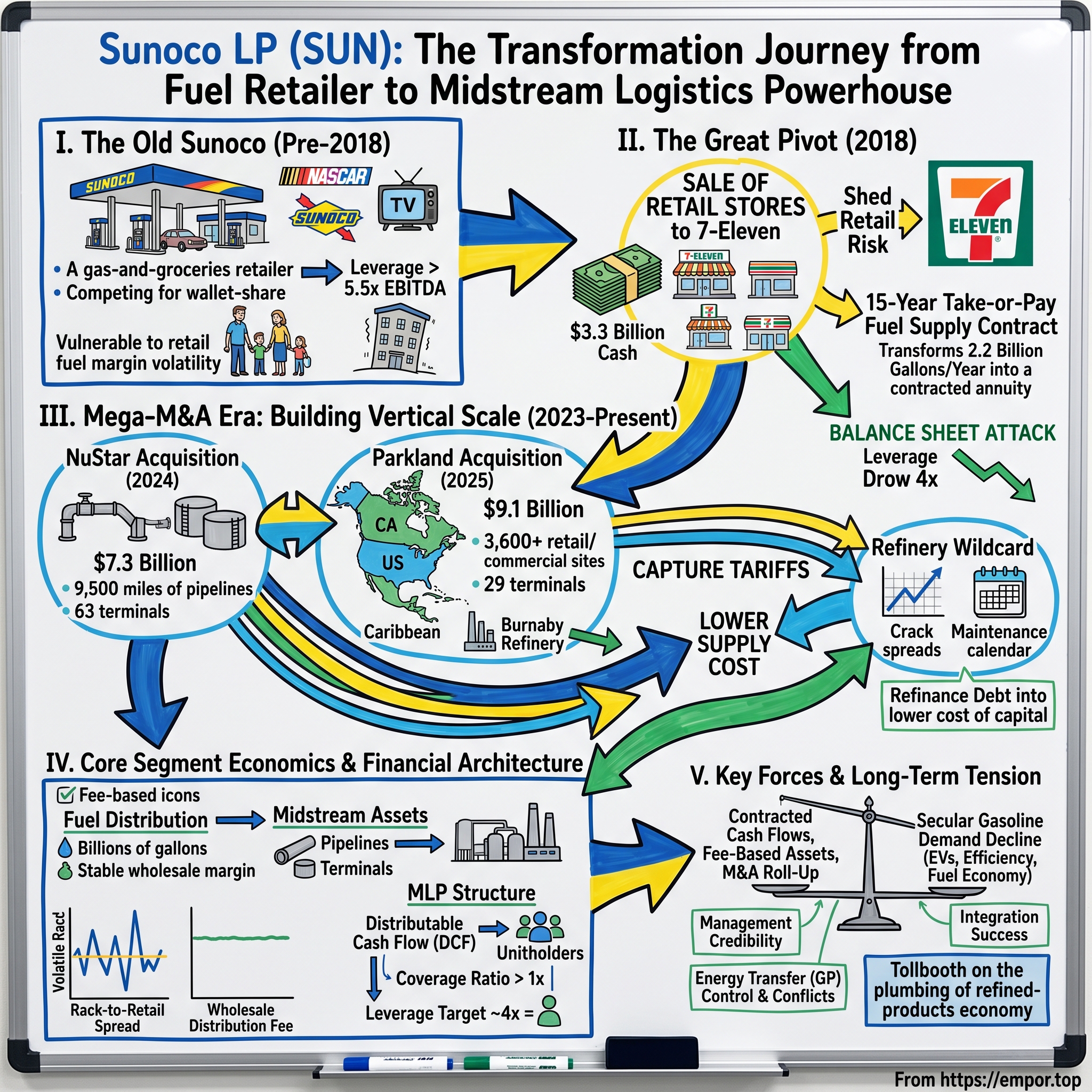
Sunoco LP: The Transformation from Fuel Retailer to Midstream Logistics Powerhouse
I. Introduction & Episode Roadmap
Picture a Sunoco station in the year 2000. The canopy glows in that unmistakable blue and yellow. A NASCAR broadcast plays on a television bolted above the coffee machine inside the convenience store. A family fills up on the way to a summer road trip, grabs a bag of chips and two fountain drinks, and drives off. That was the Sunoco most Americans knew — a gas-and-groceries retailer, one of thousands of corner brands competing for the wallet-share of drivers pulling off the interstate.
Now fast-forward. The blue Sunoco brand still glows over thousands of forecourts, and Sunoco is still the official fuel of NASCAR. But the company that today trades on the New York Stock Exchange under the ticker SUN no longer runs those stores. In early 2018 it handed roughly 1,030 of its own convenience stores to 7-Eleven's parent, 株式会社セブン&アイ・ホールディングス Seven & i Holdings, for about $3.3 billion in cash.1 It kept the pumps' economics without keeping the pumps. And over the following eight years it spent far more than that acquiring pipelines, terminals, storage tanks, and, most recently, an oil refinery in British Columbia — assembling a machine that moves other people's fuel from the refinery gate to the rack for a fee.
The central question of this story is deceptively simple. Sunoco LP is a Master Limited Partnership — an MLP, a structure we will unpack — that today distributes billions of gallons of motor fuel across more than 40 U.S. states, Puerto Rico, Canada, Europe and the Caribbean, while operating roughly 14,000 miles of pipelines and a hundred-plus terminals following its 2024–2025 acquisition spree. It is, in effect, a tollbooth on the plumbing of the refined-products economy. The bull case is that tollbooths are wonderful businesses: they collect fees whether or not the underlying commodity is cheap or expensive, and long-term "take-or-pay" contracts guarantee minimum volumes regardless of what any single quarter's demand looks like.
The bear case is equally clear-eyed. Sunoco makes its money, ultimately, from gasoline and diesel flowing through American engines — a demand pool that most forecasters expect to shrink over the coming decades as electric vehicles, hybrids, and improving fuel economy chip away at consumption. So the tension that animates everything that follows is this: can Sunoco's contracted cash flows, tariff-indexed pipeline economics, and relentless M&A roll-up compound value faster than the secular decline of the gasoline gallon erodes it? That is not a question management can answer with a press release. It is a question the evidence has to answer, quarter by quarter.
Before going further, it is worth demystifying what SUN even is, because the label "gas station company" that most casual observers still attach to it is now three transformations out of date. Sunoco LP is a Master Limited Partnership — a publicly traded partnership rather than a corporation — whose units trade on the NYSE and whose reason for existing is to generate and distribute cash. It sells wholesale motor fuel to dealers, distributors, and large branded customers; it owns and operates crude and refined-products pipelines that charge tariffs; it runs storage-and-throughput terminals that charge fees; and, since late 2025, it even owns a refinery. In a single recent quarter it moved 3.8 billion gallons of fuel and ran more than a million barrels a day through each of its pipeline and terminal networks.12 The through-line is that Sunoco increasingly earns money the way a toll road does — a small charge on enormous volume, collected regardless of whether the commodity flowing through is cheap or dear.
To get there, this story moves through five arcs. First, the deep history — a 130-year-old oil major and the 2012 moment Energy Transfer swallowed it. Second, the 2018 pivot out of retail, the single most important strategic decision in the modern company's life. Third, the mega-M&A transformation — the $7.3 billion NuStar deal and the $9.1 billion Parkland deal that redrew the map.23 Fourth, the unit economics: how a business actually earns money on a cent or two per gallon. And finally, the harder questions — governance under a controlling parent, management's credibility, and the explicit case for why this wins and why it might not.
A word on posture before we begin. This is not an investor-relations retelling. Sunoco's management has, by most measures, executed well, and where the record supports them this story will say so plainly. But a management team saying it will win is not evidence that it will, and the most valuable parts of what follows are the places where the company's own framing deserves to be tested against contract terms, segment economics, and the behavior of the numbers over time. The recurring discipline throughout is to separate what has been proven — closed deals, reported cash flows, contractual floors — from what is merely asserted — that a margin step-up is permanent, that a controlled governance structure treats minorities fairly, that fees will outgrow a shrinking gallon. Both categories matter. Keeping them distinct is the whole job.
 Subscribe on LinkedIn
II. Origins, Energy Transfer Acquisition, & The MLP Conversion (1886–2015)
The story begins with a wildcatter's hunch. In 1886, Joseph Newton Pew — a Pennsylvania businessman who had made early money in natural gas — bought into the oil fields around Lima, Ohio, and founded what would become Sun Oil Company. Pew's Sun grew into one of the great integrated American oil majors of the twentieth century: it drilled crude, refined it, shipped it in its own tankers, and sold it under a brand that became a fixture of the American roadside. If you want the one-line version of Sunoco's cultural DNA, it is high-octane fuel. Sun pioneered custom blending at the pump — the famous "Custom Blended" dial that let a driver choose an octane grade — and its Sunoco 260 became shorthand for premium performance gasoline. The brand's long marriage to motorsports, culminating in its status as NASCAR's official racing fuel, was not a marketing accident; it flowed directly from a century of positioning Sunoco as the gasoline for people who cared about what went into the tank.
There is a deeper reason the octane heritage matters to an investor, and it is not nostalgia. It explains why the Sunoco brand still commands a premium at the pump and why dealers still pay to fly its colors long after the company that owns the name stopped operating stores. Brands in commodity businesses are worth exactly as much as the pricing power they confer, and Sunoco's century of association with performance fuel is a genuine, if modest, intangible asset — one that shows up today as the reason a branded dealer will sign a multi-year exclusive supply contract rather than shop the spot market every week. When we get to switching costs and buyer power later, remember that the brand's roots run back to Joseph Pew's custom-blending dial.
For our purposes, though, the century of refining history matters less than one hinge moment. By the 2010s, "Sunoco" as an integrated oil company had largely faded. The refining business had been carved off — the last major Sun refineries were shut or divested as the company that had been Sunoco Inc. retreated from the capital-punishing economics of East Coast refining. What remained valuable was the logistics and the brand. And that is precisely what caught the eye of one of the most aggressive dealmakers in American energy.
Kelcy Warren and the midstream logic. In April 2012, Energy Transfer — the pipeline empire built by the famously acquisitive Kelcy Warren — agreed to acquire Sunoco Inc. in a cash-and-stock deal valued at roughly $5.3 billion.4 To understand the acquirer is to understand the entire subsequent arc, so a word on Warren. He built Energy Transfer from a modest intrastate gas pipeline operator into one of the largest energy-infrastructure empires in North America through a relentless, sometimes controversial, string of acquisitions and complex partnership structures. Warren's worldview is fundamentally that of a toll-collector: the money in energy is not in guessing the price of the commodity but in owning the pipes, tanks, and rights-of-way that the commodity must pass through, and in stacking those assets into tax-advantaged partnerships that throw off cash.
Here is the crucial insight, and it tells you everything about how midstream operators think. Warren did not want to sell gasoline to soccer moms. Energy Transfer wanted Sunoco's crude-gathering lines, its refined-products logistics network, and its brand equity — the connective tissue of the fuel system, not the retail storefront. Retail gas stations, with their thin and violently volatile margins, were something to be monetized or restructured, not cherished. This is a pattern worth remembering, because a decade later Sunoco LP would run the exact same play in reverse — buying the pipes and tanks and shedding the exposure to store-level margin risk. The student had learned from the master, which is unsurprising given that the master still controlled the school.
The birth of Sunoco LP. Energy Transfer already controlled a small MLP called Susser Petroleum Partners, which it had acquired via the Texas convenience-store operator Susser Holdings. Through a series of "drop-downs" — the MLP practice of a parent selling assets down into its controlled partnership in exchange for cash and units — Energy Transfer moved Sunoco's wholesale fuel distribution and retail assets into that vehicle. Susser Petroleum Partners was renamed Sunoco LP, and by the mid-2010s it stood as a publicly traded partnership carrying the Sunoco brand, roughly 1,300 company-operated convenience stores, and a large wholesale fuel-distribution book.
It is worth pausing on why the MLP structure existed at all, because it explains both the appeal and the eventual friction. A Master Limited Partnership pays no corporate income tax; instead it passes income through to unitholders — who receive distributions and a Schedule K-1 at tax time rather than the simple dividend and 1099 of an ordinary stock — and it exists, structurally, to throw off cash. The trade-off is that MLPs are best suited to assets whose cash flows are predictable enough to underwrite a steady, ideally rising, distribution. That works beautifully for stable, fee-based, infrastructure-like assets — pipelines, storage, contracted throughput, the kind of thing that generates an annuity. It works far less well for a capital-hungry, labor-intensive, execution-sensitive retail store business.
Running roughly 1,300 stores meant constant capital expenditure on remodels and fuel islands, exposure to labor-cost inflation and hourly turnover in a tight labor market, the daily operational grind of merchandising coffee and cigarettes and lottery tickets, and — worst of all for an income vehicle — direct exposure to retail fuel margins that could swing violently from quarter to quarter depending on the gap between wholesale cost and the pump price drivers were willing to pay. In a good quarter a retailer prints money; in a bad one, when crude spikes and stations cannot raise pump prices fast enough, the same gallon barely breaks even. An MLP is supposed to promise unitholders a smooth, growing distribution. A store network promised the opposite: lumpiness, capital intensity, and operational risk stacked on top of commodity risk. By 2016 that mismatch was showing up where it always eventually does — in leverage that had climbed above five and a half times EBITDA and a unit price that reflected the market's doubt that the distribution was safe. Something structural had to change, and management knew it. That pressure set up the single most important decision in the modern company's life.
III. The 2018 Strategic Pivot: Exiting Retail for Wholesale Scale
By 2016, Sunoco LP had a problem that showed up in its unit price. Leverage was uncomfortably high — north of five and a half times EBITDA — and the market had grown skeptical that a store operator could reliably fund the rich distribution the MLP was paying. Something had to give. What management chose to do next was, in retrospect, the masterstroke of the entire story: it decided to stop being a retailer entirely.
The 7-Eleven transaction. In April 2017, Sunoco announced it would sell roughly 1,030 company-operated convenience stores across 17 states to 7-Eleven, Inc. — the U.S. arm of Japan's 株式会社セブン&アイ・ホールディングス Seven & i Holdings — for about $3.3 billion.5 The deal cleared the Federal Trade Commission in January 2018 after Sunoco and 7-Eleven agreed to divest a set of overlapping outlets, and it closed that same month.61 On the surface it looked like a real-estate sale. It was not. The genius was in the fine print.
Sunoco did not merely sell the stores; it signed a 15-year take-or-pay fuel supply agreement under which it would remain the fuel supplier to those very stores, delivering roughly 2.2 billion gallons of fuel a year with a further 500 million gallons of committed growth layered in over time.5 "Take-or-pay" is the phrase to internalize, because it is the single most important structural feature of the modern Sunoco. It means the customer — here, 7-Eleven — is contractually obligated either to take a minimum volume of fuel or to pay for it regardless. The volume floor does not evaporate in a soft demand year; it is a contract, not a hope. That single clause transformed roughly two billion gallons a year of what had been discretionary retail throughput into a contracted, multi-year annuity extending into the 2030s.
Sunoco effectively converted the messiest part of its business into one of the cleanest. It kept the wholesale distribution margin — the cents it earns moving each gallon from rack to dealer — while shedding the stores, the labor, the remodels, and the retail-price risk that had made its earnings so hard to forecast. It sold the cow and kept a fifteen-year contract for the milk. And it did the deal at a moment when 7-Eleven, then in an aggressive North American expansion under its Japanese parent, was a highly motivated buyer of scale — a reminder that the best time to sell an asset is when a strategic acquirer needs it more than you do. The FTC's insistence on divesting a set of overlapping outlets before clearing the deal was itself a backhanded compliment: regulators only force divestitures when a combination would otherwise concentrate real market power.5
What the pivot actually did to the economics. The strategic logic here is the heart of the modern investment case, so it is worth stating plainly rather than in numbers. Retail fuel earnings are unpredictable because retail pump prices are sticky while wholesale costs move daily; in a given quarter a retailer can earn a fortune or almost nothing on the same gallon. Wholesale distribution earnings, by contrast, behave more like a fee: Sunoco buys fuel at the refinery rack and resells it to dealers and branded customers at a relatively stable spread measured in cents per gallon. By exiting retail, Sunoco traded a high-variance, capital-intensive earnings stream for a lower-variance, capital-light one — and it used the $3.3 billion of proceeds to attack the balance sheet, driving leverage down toward the four-times area that would become its enduring target.
There is a subtlety here that a skeptic should not miss, because it complicates the tidy narrative. Selling the stores did not eliminate Sunoco's exposure to gasoline demand; it merely changed the shape of that exposure from operational to contractual. If Americans drive less over the next fifteen years, 7-Eleven still owes Sunoco on the take-or-pay minimum — but when that contract eventually renews, the renewal price will reflect whatever the demand environment looks like then. In other words, the 2018 deal bought Sunoco roughly a decade and a half of insulation from secular decline, not permanent immunity from it. That is genuinely valuable — a decade and a half is a long time to reposition a business — but it is a bridge, not a destination. Understanding that distinction is what separates a clear-eyed view of Sunoco from a promotional one, and it is precisely why management could not simply harvest the wholesale business; it had to build something bigger before the bridge ran out.
Building the pure-play wholesale engine. Freed from stores, Sunoco leaned into what it now was: one of the largest independent motor-fuel distributors in the United States. It supplied branded dealers, commissioned agents, and unbranded wholesale customers across more than 40 states and Puerto Rico. Scale here is a genuine advantage, because a distributor that buys billions of gallons from Gulf Coast and Mid-Continent refiners has negotiating leverage on supply that a small jobber simply cannot match. The analytical takeaway is subtle but important: the 2018 pivot did not make Sunoco a growth company — gasoline demand was already mature — but it made Sunoco a far more predictable company, and predictability is the currency an income-paying partnership trades in. That predictability is exactly what gave management the credibility, and the balance-sheet room, to do something much more ambitious next.
IV. The Mega-M&A Era: NuStar, Parkland, & Vertical Integration (2023–Present)
If the 2018 pivot was about subtraction — shedding what didn't fit — the years that followed were about audacious addition. Having proven it could run a lean, contracted, cash-generative distribution business, Sunoco's management under CEO Joseph Kim made a bet that would double the size of the company twice over: it would move upstream into the pipelines and terminals that supply the very fuel it distributes, capturing more of the value chain per gallon.
The NuStar acquisition. In January 2024, Sunoco agreed to acquire NuStar Energy — a San Antonio-based pipeline and storage operator — in an all-equity transaction valued at approximately $7.3 billion including assumed debt.2 NuStar unitholders received 0.400 SUN units for each NuStar unit; Sunoco issued roughly 51.5 million units worth about $2.85 billion, assumed roughly $3.5 billion of debt, and took on about $800 million of preferred units.7 The deal closed in May 2024.7 Overnight, Sunoco went from a fuel distributor with a modest logistics footprint to an operator of roughly 9,500 miles of pipeline and 63 terminal and storage facilities moving crude oil, refined products, renewable fuels, ammonia, and specialty liquids.2
The strategic rationale was vertical integration in its purest form. A fuel distributor buys product at the rack and resells it; but who owns the pipeline that carries the product to that rack, and the terminal where it is stored and blended? Historically, someone else did, and they collected a tariff on every barrel. By owning those assets, Sunoco could capture that tariff itself and — just as importantly — lower its own cost of supply, structurally widening the margin on every gallon it sells. Think of it as a supermarket that had spent years buying groceries from a distributor suddenly buying the distributor: the same product now pays the company at two points in the chain instead of one, and the company controls the reliability of its own supply.
Management framed the deal as more than $150 million of expected expense and commercial synergies plus at least $50 million a year of additional cash flow from refinancing NuStar's higher-cost debt into Sunoco's lower cost of capital.2 That refinancing angle is worth dwelling on, because it is a quietly powerful and repeatable source of value in MLP roll-ups: NuStar, as a smaller and more leveraged standalone entity, borrowed at higher rates than the larger, better-capitalized Sunoco, so simply moving NuStar's debt onto Sunoco's balance sheet and refinancing it as maturities came due generated tens of millions a year without a single operational change. On the implied economics, Sunoco was paying roughly nine-and-a-half times EBITDA before synergies and closer to eight times after — a reasonable multiple for hard-to-replace infrastructure, provided the synergies were real. That "provided" is where a skeptical investor lives, and we will return to whether management delivered. The all-equity structure was itself a double-edged choice: it protected the balance sheet from taking on cash acquisition debt, but it diluted existing unitholders by issuing 51.5 million new units, which is precisely the friction analysts hammered on when the deal was announced.7
Going global, and going big. NuStar also brought international optionality, and Sunoco pressed it, adding liquid-fuels terminals in Europe — including capacity around Amsterdam and Bantry Bay, Ireland — that opened supply-arbitrage possibilities across the Atlantic. But the truly transformational move came in 2025.
The Parkland transaction. In May 2025, Sunoco agreed to acquire Parkland Corporation, a Calgary-based fuel and convenience giant, in a cash-and-equity deal valued at approximately $9.1 billion including debt.3 Parkland shareholders were offered a mix — 0.295 units plus C$19.80 in cash per share, or cash/unit alternatives subject to proration — representing roughly a 25% premium.3 The deal introduced a new wrinkle in the structure: Sunoco created a publicly traded corporation, SunocoCorp (NYSE: SUNC), to hold the acquisition currency, giving shareholders who could not or would not hold MLP units a C-corp vehicle to receive. The acquisition cleared its key U.S. regulatory hurdle in September 2025 and closed on October 31, 2025.89
Parkland was a different kind of asset than NuStar, and the difference cuts to the heart of the bear case. It brought roughly 3,600 to 4,000 retail and commercial fuel and convenience sites across Canada, the U.S., and the Caribbean — a partial re-entry into the very retail world Sunoco had so deliberately exited in 2018 — plus 29 strategically located terminals and, most notably, the Burnaby refinery in British Columbia, a facility processing roughly 55,000 barrels a day.93 Owning a refinery is a meaningful departure, even a reversal, for a company that had spent the better part of a decade selling itself to income investors as a fee-based, capital-light logistics play. Refineries are the opposite of that: cyclical, capital-hungry, exposed to crack spreads (the margin between crude cost and product value), and periodically shut down for expensive multi-week maintenance turnarounds — precisely the volatility Sunoco had worked to escape.
By early 2026 the Burnaby refinery had become its own reporting segment, and management had flagged a roughly 50-day maintenance turnaround during the year, an event that temporarily removes a chunk of cash flow and reminds investors what they now own.11 So why do it? The Parkland deal's logic was diversification of geography and cash-flow source: the Caribbean and Latin American footprint expands into markets where fuel demand is still growing rather than shrinking, and the Burnaby refinery is a genuinely scarce asset — one of a handful of refineries serving Canada's Pacific coast, with logistics advantages that would be nearly impossible to replicate. The bear will say Sunoco bought cyclicality and capital intensity at the top of an energy cycle, importing exactly the volatility it had promised to avoid, and paid a 25% premium to do it. The bull will say it bought irreplaceable Pacific-coast infrastructure, a growing international footprint that hedges the U.S. secular-decline problem, and $250 million of identified synergies. Both are partly right, and an honest investor holds both thoughts at once rather than resolving the tension prematurely.
Benchmarking the multiples. Were these good prices? Context helps. Sunoco paid roughly eight to nine-and-a-half times EBITDA for infrastructure-heavy assets, which sits in a defensible range for midstream transactions in this era — comparable in spirit to how peers such as Marathon Petroleum built out MPLX and how Phillips 66 rolled its logistics MLP back into the parent. Convenience-retail consolidators like Casey's General Stores and Alimentation Couche-Tard have paid up for prime store networks, but they are buying a different animal: consumer real estate and merchandising, not tariff-earning pipe. The discipline signal in Sunoco's deals is that it structured them to be accretive to distributable cash flow per unit within a couple of years and refused to let leverage run away — the antithesis of the empire-building roll-ups that have destroyed value elsewhere in energy. Whether that discipline holds through the Parkland integration, with a cyclical refinery now in the mix, is the open question.
Capital discipline under pressure. Two consecutive multibillion-dollar deals in a higher-for-longer interest-rate environment raised an obvious question: could Sunoco stay disciplined on leverage? Management's answer, repeated on call after call, was a hard target of roughly four times net debt to EBITDA, funded by strong cash generation, refinancing, and non-core asset sales rather than a distribution cut. The structuring mechanics behind that — bridge facilities to fund the cash portions of deals, refinancing acquired preferred units and higher-cost debt, and layering in synergies to grow the EBITDA denominator — are the unglamorous plumbing that lets an MLP absorb a company nearly its own size without breaking. The pattern — buy large, integrate, delever back to four times, repeat — is the operating rhythm of the modern company, and by early 2026 the reported leverage sat right at that four-times mark, achieved ahead of the originally guided timeline, a point in management's favor that we will scrutinize alongside the segment economics.13
V. Core Segment Economics & Financial Architecture
To understand whether Sunoco is a great business or merely a large one, you have to understand how it actually earns a dollar. After the acquisitions, the company reports across a handful of segments, and by early 2026 those were Fuel Distribution, Pipeline Systems, Terminals, and — newly — a Refinery segment carrying Burnaby. The first quarter of 2026 offers a clean snapshot of the machine at scale.
Fuel Distribution — the volume engine. This is the descendant of the old wholesale business, and it remains the largest profit center. In the first quarter of 2026, Fuel Distribution generated $529 million of segment adjusted EBITDA, more than double the $220 million a year earlier, on 3.8 billion gallons sold at a fuel margin of 17.0 cents per gallon.12 Two things stand out. First, the sheer volume — nearly four billion gallons in a single quarter — is what gives Sunoco its buying power with refiners. Second, and more provocatively, that 17-cent margin runs well above the roughly 11-to-12-cent range the company historically framed as its baseline. Management's own commercial chief, on the Q4 2025 call, was cautious about anointing the high-teens figure as a permanent "new waterline," conceding quarter-to-quarter variability even as he called the direction "directionally accurate."13 For an investor, this is the single most consequential judgment call in the whole story: if the margin step-up is structural — driven by owning cheaper supply through the acquired terminals and pipelines — the business is meaningfully more profitable than it looks on old assumptions. If it is cyclical, current earnings are flattered and will mean-revert.
Pipeline Systems and Terminals — the tollbooths. These are the fee-based, tariff-driven segments that give the story its infrastructure spine. In the first quarter of 2026, Pipeline Systems delivered $179 million of adjusted EBITDA on roughly 1.3 million barrels per day of throughput, and Terminals delivered $107 million on about 1.0 million barrels per day.12 The economics here are fundamentally different from fuel distribution. A pipeline earns a tariff — often indexed to inflation through FERC-regulated escalators — largely regardless of the commodity's price, and a terminal earns storage and throughput fees plus incremental margin from blending and processing transmix (the interface mixture that forms where different fuels meet in a pipeline, which can be reprocessed into salable product). These are the cash flows that behave most like an annuity, and they are precisely what a midstream investor pays up for. Together, the two midstream segments now contribute a large minority of profit — the ballast that steadies the more variable fuel-margin engine.
The refinery wildcard. The new Refinery segment contributed $43 million in the first quarter of 2026 — real money, but also the most volatile and capital-intensive line in the portfolio, and the one most likely to swing with crack spreads and turnaround timing.12 Investors should mentally quarantine this line item and watch it separately, because a strong refinery quarter can flatter the whole company's results and a weak one (or a turnaround quarter) can drag them — neither of which tells you much about the durability of the fee-based core.
The rack-to-retail spread, in plain terms. To understand the fuel-distribution margin, picture the daily choreography of a gallon of gasoline. Sunoco buys it at the wholesale "rack" price, which moves every single day with crude and product markets. It then sells that gallon to a dealer at a contracted spread. The profitable asymmetry that distributors have historically enjoyed comes from timing: when wholesale prompt prices fall, retail and dealer prices tend to fall more slowly, so the distributor's spread temporarily widens; when wholesale prices spike, the spread can compress until prices downstream catch up. Over a full cycle these effects partly wash out, but a distributor with scale, storage, and hedging can smooth the ride and lean into the favorable windows. Sunoco's ownership of terminals and pipelines now feeds directly into this equation, because controlling its own storage and logistics lowers the delivered cost of the gallon it is reselling — the mechanism by which management argues the baseline margin has structurally stepped up. It is a plausible mechanism. It is not yet a proven permanent one, which is the crux of the margin debate.
Operating-cost discipline. The other half of unit economics is what it costs to move a gallon. A distributor's operating expenses — measured, like everything here, in cents per gallon — determine how much of the gross margin survives to the bottom line. Sunoco has historically run a lean operating-cost base measured in low single-digit cents per gallon, and scale is the lever: spreading fixed logistics and overhead costs across billions of gallons drives the per-gallon cost down, which is why a marginal acquisition that adds volume without proportional overhead is immediately accretive. This is the quiet engine of the roll-up — every deal that adds gallons to the same distribution backbone lowers the average cost of moving each one.
MLP mechanics and capital allocation. Sitting atop all of this is the distribution — the reason many investors own SUN at all. In the first quarter of 2026 the partnership declared $0.9899 per unit, a 6.25% sequential increase and more than 10% above the year-earlier level, generating $535 million of distributable cash flow against net income of $644 million and adjusted EBITDA of roughly $858 million.12 Distributable cash flow, or DCF, is the MLP world's key metric: it is essentially the cash a partnership has available to pay unitholders after maintenance capital and interest — the money genuinely up for distribution as opposed to the accounting profit. The discipline mechanism is the DCF coverage ratio — distributable cash flow divided by distributions actually paid — which management targets comfortably above one. A coverage ratio above one means the partnership is paying out less than it generates and retaining the surplus; a ratio below one means it is dipping into borrowings or reserves to fund the distribution, a classic warning sign in the MLP graveyard, where more than one high-yielding partnership has cut its payout after coverage slipped.
That retained cash — the difference between what Sunoco earns and what it pays out — is what lets it delever after a deal without issuing equity at the bottom, and it funds organic growth capital besides. The historical appeal of SUN to income investors has been a distribution yielding in the mid-to-high single digits, an attractive figure in most rate environments, supported by that above-one coverage. Management's 2026 posture reinforced the pattern: a distribution-growth floor of at least 5% for the year, delivered in quarterly increments.1413 The analytical point to carry forward: a rising distribution is only as safe as the coverage behind it, and coverage is only as durable as that fuel margin. The distribution's health and the margin debate are, in the end, the same question wearing two hats — which is why so much of the scrutiny on recent calls has fixated on whether high-teens cents-per-gallon is real.
VI. Management & Governance Deep Dive
Every infrastructure roll-up ultimately rests on the judgment of the people deciding what to buy, what to pay, and when to stop. Sunoco's modern chapter has been authored by a small, notably stable executive core — and it operates inside a governance structure that a skeptical investor should never take at face value.
Joseph Kim, the architect. Joe Kim has led Sunoco as CEO since January 2018 — the very moment the 7-Eleven deal reshaped the company — after rising through Sunoco's retail and commercial operations, with earlier experience at refiner Valero. That background is telling: Kim came up understanding both the retail forecourt and the refining-and-supply chain, which is exactly the perspective needed to see that Sunoco's value lay not in operating stores but in supplying and moving fuel. Kim's tenure is essentially the story of this article: he presided over the exit from retail, the pure-play wholesale build-out, and the back-to-back NuStar and Parkland acquisitions that redefined the company. His public style, evident across years of earnings calls, is that of a disciplined capital allocator who talks in terms of returns, synergies, coverage, and leverage targets rather than empire-building volume — and who tends to under-promise on timelines and then beat them, as the ahead-of-schedule deleveraging after NuStar showed.
On the Q4 2025 call he described Parkland as something that "could be another home run acquisition," an echo of the language he used about NuStar.13 This is where independent judgment has to intrude on an otherwise strong record. A CEO who has hit two big acquisitions may genuinely have a repeatable process — or may be an executive who has fallen in love with dealmaking and is talking his own book. The "home run" framing is confidence that reads either as a well-earned track record or as a warning sign, depending on which way the next few years break. The disciplined analyst's stance is neither cynicism nor applause but a scoreboard: Kim has earned benefit of the doubt on execution, and he has not yet been tested by a deal that went badly.
Karl Fails and the operating spine. Karl Fails, the chief operating officer, is the executive most associated with the unglamorous machinery — wholesale logistics, terminal integration, and supply optimization. It was Fails who, on recent calls, quantified integration progress and synergy ramp, telling analysts the company expected to exit 2026 "well north" of a $125 million run-rate on Parkland synergies.13 On the finance side, Dylan Bramhall has served as chief financial officer, with the treasury and finance function — increasingly fronted in investor communications by senior finance executive Scott Grischow — carrying the load of structuring bridge facilities, refinancing acquired debt, and defending the four-times leverage target on the calls.12 The continuity of this team through two transformational deals is itself a data point: transformations usually churn executives, and Sunoco's largely didn't.
Incentives. Management's long-term incentives are tied heavily to per-unit metrics — distributable cash flow per unit, leverage discipline, and total unitholder return — rather than to raw volume or asset count. That alignment matters, because the fastest way to destroy value in a roll-up is to reward executives for getting bigger rather than for getting richer per unit. On paper, Sunoco's incentive design points the right way.
The Energy Transfer question. Here is where the governance stress test bites hardest, and where an independent story has to be most careful not to drift into management's frame. Sunoco LP is not a widely held, independent public company in the ordinary sense. Energy Transfer owns the general partner of Sunoco LP — meaning ET controls the entity that manages Sunoco, appoints its leadership, and sets its strategic direction — and holds a substantial limited-partner equity stake besides. In plain terms, the parent that sold Sunoco its identity in 2012 still holds the steering wheel. Unitholders who buy SUN are, in effect, minority passengers in a vehicle Kelcy Warren's empire controls.
That structure creates a permanent conflict-of-interest surface. Transactions between ET's pipelines and terminals and Sunoco's distribution network are related-party transactions by definition, and because so much of the North American midstream map runs through Energy Transfer's assets, such dealings are not hypothetical — they are ordinary course. Public unitholders have limited voting power to object; MLP governance typically routes conflicts through a "conflicts committee" of ostensibly independent directors, but the structural reality is that the general partner holds control and the limited partners hold cash flow. A conflicts committee can bless a transaction; it cannot manufacture the arm's-length tension of a genuinely independent counterparty. A skeptical investor should therefore treat every large related-party dealing as something to inspect on its specific terms rather than assume is fair. The flip side, in fairness, is that the alignment with Warren's aggressive consolidation playbook has plainly powered Sunoco's growth — ET's network gave Sunoco a strategic logic and, at times, a pipeline of assets and financing sophistication a standalone distributor would lack. The honest verdict: the governance structure has been an accelerant for growth and remains an unquantifiable discount on trust. Whether it always benefits the minority unitholder on price is a question the structure cannot answer in Sunoco's favor, and it is exactly the kind of tension the competitive and risk analysis must hold in view rather than wave away.
VII. Competitive Landscape & Strategic Frameworks
Drop Sunoco onto a battlefield map and the first thing you notice is that it fights on two fronts at once — against fuel distributors and retailers on one side, and against midstream pipeline-and-terminal operators on the other. That dual identity is either a weakness (jack of two trades) or the whole point (it captures margin across the chain). To adjudicate, it helps to run the business through two classic frameworks.
The competitive set. On the logistics and wholesale side, Sunoco brushes up against giants like Enterprise Products Partners (EPD) and MPLX — pure midstream operators with enormous, hard-to-replicate networks and blue-chip reputations for fee-based stability — as well as its own parent Energy Transfer. Against these, Sunoco is smaller and carries more commodity-linked margin in its mix, which the market has historically rewarded with a somewhat higher yield (read: a lower valuation) than the purest midstream names command. On the retail and integrated-fuel side, the comparison set includes Casey's General Stores (CASY) and Canada's Alimentation Couche-Tard (ATD.TO) — best-in-class convenience-store operators that make real money on merchandise, not just fuel — plus Murphy USA (MUSA), the high-volume, low-cost fuel retailer, and refiner Marathon Petroleum (MPC), whose MPLX logistics arm is the closest structural analog to what Sunoco has built. The key insight is that Sunoco deliberately sits between these camps: bigger and more infrastructure-heavy than a pure distributor, but more commercially oriented toward fuel marketing — and now, post-Parkland, more retail- and refining-exposed — than a pure pipeline MLP. That in-between position is the source of both its differentiated economics and the valuation discount the market applies for its complexity.
Hamilton Helmer's 7 Powers. Two of Helmer's seven powers look genuinely strong for Sunoco. Scale economies are real: distributing on the order of eight-plus billion gallons a year gives Sunoco buying leverage with refiners and shippers that smaller jobbers cannot match, and scale in a low-margin, high-volume business is the difference between viability and irrelevance. Cornered resource is arguably the most durable power in the portfolio — the marine terminals, refined-product pipeline interconnects, and prime dock access acquired through NuStar and Parkland are, in many cases, physically and legally irreplaceable; you cannot permit and build a new coastal fuels terminal in a major harbor at will. Counter-positioning deserves a nuance: as a wholesale supplier that historically did not compete against its own dealer customers, Sunoco could win business that a refiner-owned retail network could not — though the Parkland deal, which brought company-operated retail back into the fold, complicates that clean positioning. Process power — advanced blending, transmix processing, dynamic wholesale pricing — is a moderate, if less decisive, advantage.
A caution on the 7 Powers analysis, since frameworks can flatter as easily as they clarify: powers are only as valuable as the market they operate in. Scale economies in distributing a commodity that is slowly disappearing are a strong defense of a shrinking castle. Cornered coastal terminals are genuinely irreplaceable, but their long-run value tracks the demand for what flows through them. The most durable of Sunoco's powers, in other words, protect it superbly against rivals and hardly at all against the passage of time — a distinction the next section makes central.
Porter's Five Forces. The force most favorable to Sunoco is the threat of new entrants, which is very low: the capital, environmental permitting, and relicensing barriers to building pipelines and fuel terminals are immense, which is exactly why owning existing ones is valuable. In an era when no one is realistically permitting a new refined-products terminal in a major U.S. harbor, the incumbents' assets carry scarcity value that only grows as the regulatory gate swings further shut — a rare case where being in a mature, disfavored industry actually protects the moat around existing physical infrastructure. Supplier power — the refiners — is moderate and arguably tilts Sunoco's way, because refiners need large distributors to clear product. Buyer power is where it gets interesting: individual dealers do have switching options at contract renewal, but brand, fuel-credit programs, supply reliability, and multi-year exclusivity create meaningful switching friction. Rivalry among wholesale distributors is intense and competed on pennies per gallon, which caps how much margin scale alone can defend. And then there is the force that overhangs everything: the threat of substitutes. Near-term it is low — engines still run on liquid fuel — but long-term, EV adoption, hydrogen, and biofuel mandates represent a structural erosion of the underlying gallon. No competitive framework can wish that away; the honest conclusion is that Sunoco's moats are strong against competitors and weak against time. The relevant investor question is whether the fee-based, contracted, and international assets can grow fast enough to offset the slow leak in domestic gasoline demand — and that is precisely what management is asked on every call.
VIII. Primary Evidence & Conference Call Analysis
Filings tell you what happened; earnings calls tell you how management thinks under questioning. Three stretches of calls are especially revealing, and read together they let us test whether the narrative has stayed consistent as the company transformed.
A quick word on method, because earnings calls are the closest an outside investor gets to cross-examining management. Prepared remarks are scripted and reveal what management wants emphasized; the analyst Q&A is where the script breaks down and you learn whether the answers are concrete or evasive, whether the language is consistent with prior calls, and where the sell-side is genuinely worried. Read across several quarters, the calls also let you check narrative consistency — whether management is telling the same story as conditions change, or quietly moving the goalposts.
The NuStar pivot (late 2023 into 2024). When Sunoco unveiled the NuStar deal, the prepared remarks hit the expected notes — balance-sheet strength, accretion to distributable cash flow per unit, a clear synergy figure. But the friction, as always, lived in the Q&A. Analysts pressed on the two things that could break an all-equity midstream deal in a high-rate world: the dilution from issuing 51.5 million units, and the cost and timing of refinancing NuStar's assumed debt.7 Management's response was notably concrete rather than hand-wavy — a specific $150 million-plus synergy breakdown split between expense and commercial synergies, a specific $50 million-plus refinancing benefit, and a firm restatement of the four-times leverage commitment.2 Concreteness under pressure is a credibility signal; the failure mode to watch for is a management team that answers a hard numerical question with a vision statement. Sunoco's did not. That does not guarantee the numbers were right — synergy estimates are famously optimistic across corporate history — but specificity at least creates an accountable target the market can later measure against.
Synergy realization and the margin debate (through 2024–2025). As the acquired assets bedded in, the analyst pushback shifted from "will you overpay?" to "is this margin real?" With wholesale fuel margins printing well above historical norms, the recurring challenge was whether the elevated cents-per-gallon reflected temporary market dislocation or a permanent structural step-up. Management's answer leaned on mechanism rather than assertion: the integrated terminals and pipelines lowered Sunoco's cost of supply, they argued, which permanently widened the achievable baseline margin. This is the right kind of answer — it points to an owned asset rather than to luck — but it is not yet fully proven, and the commercial team's own hedged language about the "new waterline" suggests management knows the burden of proof still sits with them.13
Parkland integration and deleveraging discipline (2025–2026). The most recent calls have centered on execution: ramping Parkland synergies toward and beyond the near-term $125 million run-rate — roughly half of the $250 million ultimately identified — managing the Burnaby refinery's turnaround and cash-flow volatility, and holding leverage at four times.1311 On the Q4 2025 call, COO Karl Fails told analysts the company expected to exit 2026 "well north" of the $125 million run-rate, while CEO Kim framed the distribution-growth guidance as a "multiyear" commitment whose quarter-to-quarter allocation was management's job to optimize.13 The chief commercial officer's carefully hedged answer on whether the high-teens fuel margin was the "new waterline" — "directionally accurate" but subject to variability — is a small model of credible disclosure: it neither over-claims permanence nor disowns the strength.13
Here the evidence is, so far, supportive of management's credibility. They said they would delever back to four times after NuStar, and by year-end 2025 leverage sat at roughly that level — ahead of the originally guided timeline, per the finance chief's remarks.13 They set a 2026 adjusted EBITDA target of $3.1–$3.3 billion and a distribution-growth floor of at least 5%, and reiterated a posture of steady bolt-on M&A of around $500 million a year on top of the big deals.1413 When a management team has repeatedly said "we will delever to four times" and then actually done so, on or ahead of schedule, the next promise earns a measure of benefit of the doubt. But a disciplined analyst keeps the scoreboard open: the Parkland synergies are guided, not yet banked; the margin step-up is asserted, not yet proven durable through a full down-cycle; and the refinery's cash flows are, by their nature, the least predictable thing management has ever asked investors to underwrite. Credibility earned is not credibility owed in perpetuity.
IX. Strategic Risk Radar & Activist/Skeptical Stress Test
Now the adversarial view — because the most useful thing an independent analyst can do is argue the other side as hard as the company argues its own.
The risk radar. Four risks genuinely matter, ranked by how much they could move the thesis. The first and most existential is secular demand risk: domestic gasoline consumption faces long-term erosion from EV penetration, improving fuel economy, and changing driving patterns. This is high-severity but long-horizon, and Sunoco's mitigation — pivoting weight toward fee-based midstream, renewable-fuel and biodiesel logistics, and international markets in the Caribbean, Latin America, and Europe — is credible in direction but unproven in magnitude. The second is cost-of-capital and refinancing risk: after NuStar and Parkland, Sunoco carries a large debt load, and an MLP that must both service that debt and keep raising its distribution is exposed if rates stay high and refinancing windows close. The mitigation is the retained cash flow from DCF coverage above one, which funds paydown without forced equity issuance. The third is rack-spread and margin volatility — a rapid crude spike can compress wholesale margins when pump prices lag — now compounded by the crack-spread exposure of owning the Burnaby refinery. The fourth is governance and GP-conflict risk, the ever-present possibility that related-party dealings with Energy Transfer or parent-level capital demands are not struck on terms that maximize minority-unitholder value.
The activist's angle: complexity and the growth-by-acquisition treadmill. Before the headline bear thesis, consider the structural critique an activist investor would press. Sunoco has become materially more complex in two years — an MLP that now also runs a separately traded corporate vehicle (SUNC) created for the Parkland deal, spans four continents, and reports across fuel distribution, pipelines, terminals, and a refinery. Complexity is not free; it obscures where value is created and destroyed, invites conglomerate-style valuation discounts, and gives management more places to hide a weak segment inside a strong consolidated number. An activist would ask pointed questions: How much of the recent EBITDA growth is organic versus simply acquired? Is the company on a treadmill where it must keep buying to keep growing, because the underlying gasoline gallon is flat to declining? Are related-party dealings with Energy Transfer disclosed in enough detail for minority holders to judge their fairness? And is the roughly $500 million-a-year "bolt-on M&A" guidance a sign of disciplined optionality or of a business that cannot grow without perpetual dealmaking? None of these is a smoking gun, but together they describe exactly the profile — serial acquirer, controlling parent, rising complexity — that draws activist and short-seller scrutiny.
The bear thesis, stated at full strength. A skeptical long/short investor would put it bluntly: Sunoco is buying asset-heavy pipelines, terminals, and now a refinery — late in an energy cycle — partly to mask the slow secular decline of its core gasoline-distribution business behind a wall of acquisition-driven EBITDA growth. On this reading, the elevated fuel margins are cyclical and will fade toward the old baseline; the reported four-times leverage flatters a balance sheet fattened by two debt-heavy deals and could look worse if the acquired EBITDA disappoints; the refinery imports exactly the crack-spread volatility management spent years promising to avoid; and the controlling general partner means minority unitholders are along for a ride they cannot steer. It is a coherent, uncomfortable argument, and no honest treatment of Sunoco should dismiss it.
The counter-evidence. The rebuttal is not rhetoric; it is contract and cash flow. The 7-Eleven take-or-pay agreement runs into the 2030s, putting a hard floor of roughly two-plus billion gallons a year under the distribution book regardless of macro softness. The pipeline and terminal segments generate genuinely fee-based, tariff-indexed cash flows that do not depend on any one year's fuel margin. And the deleveraging track record is real: management has, more than once, bought big and then pulled leverage back to target on schedule. The intellectually honest verdict is that both cases are live. The bear is right that the underlying gallon is shrinking and that the refinery adds cyclicality; the bull is right that the contracted and fee-based layers are more durable than a simple "gas stations in decline" caricature allows. Which force compounds faster is the unresolved crux — and it is why the three KPIs in the final section matter more than any single quarter's headline.
X. Playbook & Core Investment Spine
Step back from the quarter-to-quarter and Sunoco offers a genuine business-strategy case study — a set of transferable lessons about operating in a mature, even declining, end market without being dragged down by it.
Myth versus reality. Before the lessons, it is worth puncturing the consensus shorthand. The myth is that Sunoco is "a gas station company facing an EV apocalypse." The reality is more interesting and more nuanced: Sunoco largely left the gas-station business years ago; its economics now rest on a blend of contracted wholesale distribution, fee-based pipeline-and-terminal logistics, and — newly and more controversially — refining. The EV threat is real but operates on a decades-long horizon and hits the volume of gasoline more than the fees on the infrastructure that moves all liquid fuels, including the diesel, jet fuel, renewables, and specialty products that electrification touches far more slowly. The opposite myth, pushed by the company's boosters, is that Sunoco is now a pure fee-based tollbooth immune to commodity swings. That is also false: fuel-distribution margin still carries real market sensitivity, and the Burnaby refinery reintroduces outright cyclicality. The truthful picture sits between the two caricatures, which is exactly why the stock has traded at a yield premium to the purest midstream names — the market is pricing the ambiguity.
The durable lessons. First, the asset-light pivot: the 2018 decision to sell the stores but keep the fuel contract is a near-textbook example of separating a good economic stream (the wholesale margin) from a bad structural fit (retail operations inside a tax-advantaged partnership). Second, vertical integration in a mature market: when you cannot easily grow volume, you can still grow economics per unit by owning more of the chain — the pipeline, the terminal, the transmix processing, the rack — so that each gallon pays you at several points rather than one. Third, synergy discipline as the price of credibility: Sunoco structured both mega-deals around specific, quantified cost and commercial synergies and then reported against them, which is what allowed it to keep tapping equity and debt markets for the next deal without the market revolting. The meta-lesson tying these together is that a business in a mature or declining end market is not doomed to poor returns — but it must earn its returns through structure, contracts, cost position, and capital discipline rather than through the tailwind of growth, because there is no tailwind.
The explicit spine — why it wins. The affirmative case rests on four legs that are evidence-backed rather than promotional: unrivaled distribution scale that confers real buying power; a contractual cash-flow floor from the 7-Eleven agreement and multi-year dealer contracts; a mid-single-digit-plus distribution supported by coverage held deliberately above one; and vertical integration that, if the margin step-up proves structural, permanently lifts profitability per gallon. Where these are true, Sunoco is a compounding tollbooth.
Why it may not. The falsification conditions are equally specific, and an investor should watch for them without flinching. If EV adoption and efficiency erode domestic fuel volumes faster than midstream and international fees can grow, the whole engine loses fuel — literally. If leverage fails to return to and hold near four times after the Parkland integration, the balance-sheet risk that the deals imported becomes the story. If the elevated fuel margin proves cyclical and reverts toward the old baseline, current earnings and distribution coverage are flattered today and disappoint tomorrow. And if governance friction under the Energy Transfer general partner produces related-party outcomes that favor the parent over minority unitholders, the discount the market applies will be deserved. A credible thesis names its own kill switches; these are Sunoco's.
The three KPIs that matter most. Cut through everything and three numbers tell you whether the story is working — and, crucially, an investor should track them rather than compute them, watching the trend across quarters instead of fixating on any single print.
First, fuel margin in cents per gallon. This is the single most important indicator of whether the acquired-supply advantage is real or the recent strength was a mirage. The debate is not academic: the difference between a mid-teens structural margin and a reversion to the old eleven-to-twelve-cent baseline is the difference between comfortable and stretched distribution coverage. Watch whether elevated margins persist through a period of stable or rising crude prices — margins holding up when the tailwind of falling wholesale costs fades would be the strongest evidence that owning the terminals and pipelines genuinely lowered Sunoco's cost of supply.
Second, distributable cash flow coverage. This tells you whether the rising distribution is being funded out of genuine surplus or quietly borrowed against the future. Coverage comfortably above one means the distribution is safe and the partnership is self-funding its deleveraging; coverage drifting toward or below one would be the early-warning tremor that precedes most MLP distribution cuts. It is the cleanest single read on whether income investors are being paid out of earnings or out of hope.
Third, net debt to adjusted EBITDA. This tells you whether management's central promise — buy big, then delever to roughly four times — is being kept. The whole roll-up model depends on the balance sheet returning to a defensible level between deals; leverage that lingers well above four times after the Parkland integration would signal that the acquisitions are not throwing off the cash management projected, or that the cyclical refinery is dragging. Track those three across several quarters and you will know more about Sunoco than any single earnings headline can tell you — and you will be reading the business the way its own management, and its sharpest critics, actually read it.
XI. Epilogue & Summary Outlook
The blue Sunoco canopy still glows over American forecourts, and the fuel still pours into NASCAR's engines — the surface of the brand looks much as it did a generation ago. But underneath, the company that carries the name has been rebuilt into something its founders would scarcely recognize: not a retailer, barely an oil company in the old sense, but a logistics enterprise that earns its keep moving other people's fuel through pipes, tanks, and racks across four continents, and now refining a slice of it on the Pacific coast.
What makes Sunoco worth studying is that it confronted a hard truth most mature-industry companies dodge — that its core end market was destined to shrink — and responded not with denial but with a deliberate re-engineering of where its profits come from. The 2018 exit from retail bought predictability. The NuStar and Parkland acquisitions bought scale, integration, and geographic diversification. The open question, the one no press release can close, is whether that reinvention compounds faster than the gasoline gallon fades.
There is an irony worth savoring in how far the wheel has turned. Joseph Newton Pew built an integrated oil major that drilled, refined, shipped, and sold under one roof. A century of specialization and divestiture then pulled that empire apart, leaving a brand and a distribution network. And now, through NuStar and Parkland, the modern Sunoco has quietly reassembled a version of the integrated model — logistics, terminals, and even a refinery — under the discipline of a partnership structure Pew never imagined. Whether that re-integration proves wise or merely nostalgic will depend on execution details that are still being written: the synergy dollars still to be banked, the refinery turnaround still to be absorbed, the leverage still to be worked back down.
Management's execution record on deleveraging and synergies has, so far, earned it a measure of credibility; the durability of its fuel margins and the fairness of its controlled governance have not yet been fully tested by a hostile cycle, and the refinery it now owns guarantees that some future quarter will be ugly in ways the old fee-based Sunoco would not have been. For the long-term investor, the task is not to pick a side in the bull-bear debate but to watch the three numbers that will settle it — the cents-per-gallon margin, the coverage ratio, and the leverage line — and to let the evidence, not the narrative, render the verdict. Sunoco is neither the guaranteed tollbooth its supporters describe nor the melting ice cube its detractors fear. It is a genuinely engineered response to secular decline, and its ultimate grade will be written not in any single quarter's distribution but in whether the contracted and fee-based cash flows can, over the long arc, outrun time itself.
References
-
7-Eleven Completes Acquisition of 1,030 Sunoco C-Stores — CSP Daily News, 2018-01 ↩↩
-
Sunoco LP to Acquire NuStar Energy L.P. in Transaction Valued at $7.3 Billion — PR Newswire, 2024-01-22 ↩↩↩↩↩
-
Sunoco LP to Acquire Parkland Corporation in Transaction Valued at $9.1 Billion — Sunoco LP, 2025-05-05 ↩↩↩↩
-
Energy Transfer Equity acquires Sunoco in $5.3bn deal — Financial Times, 2012-04-30 ↩
-
FTC Requires Divestitures as Condition of 7-Eleven Parent Company's $3.3 Billion Acquisition of Nearly 1,100 Retail Fuel Outlets from Sunoco — U.S. Federal Trade Commission, 2018-01 ↩↩↩
-
Form 8-K: Sunoco LP Store Sale to 7-Eleven & 15-Year Supply Agreement — SEC EDGAR, 2018-01-23 ↩
-
Sunoco LP Completes Acquisition of NuStar Energy L.P.; Announces a 4% Increase in Quarterly Distribution — PR Newswire, 2024-05-03 ↩↩↩↩
-
Parkland, Sunoco clear key U.S. regulatory hurdle for acquisition — BNN Bloomberg, 2025-09-22 ↩
-
Sunoco completes cash-and-stock deal to buy Parkland — Business in Vancouver, 2025-10-31 ↩↩
-
Sunoco completes $9.1B US deal to buy Parkland — CBC News, 2025-10-31 ↩
-
Sunoco LP Announces 2026 Guidance — Sunoco LP, 2026-01-06 ↩↩
-
Sunoco LP and SunocoCorp LLC Report Strong First Quarter 2026 Financial and Operating Results — Sunoco LP, 2026 ↩↩↩↩↩↩
-
Sunoco LP (SUN) Q4 2025 Earnings Call Transcript — The Globe and Mail, 2026-02 ↩↩↩↩↩↩↩↩↩↩↩
-
Sunoco issues 2026 guidance, targets $3.1-3.3 billion adjusted EBITDA — Investing.com, 2026-01-06 ↩↩
 LinkedIn
 WhatsApp
 Reddit
 Hacker News
 Email
Email Kindle
 RSS Feed
 Spotify
 Apple Podcasts
 Amazon Music
 Audible
 YouTube