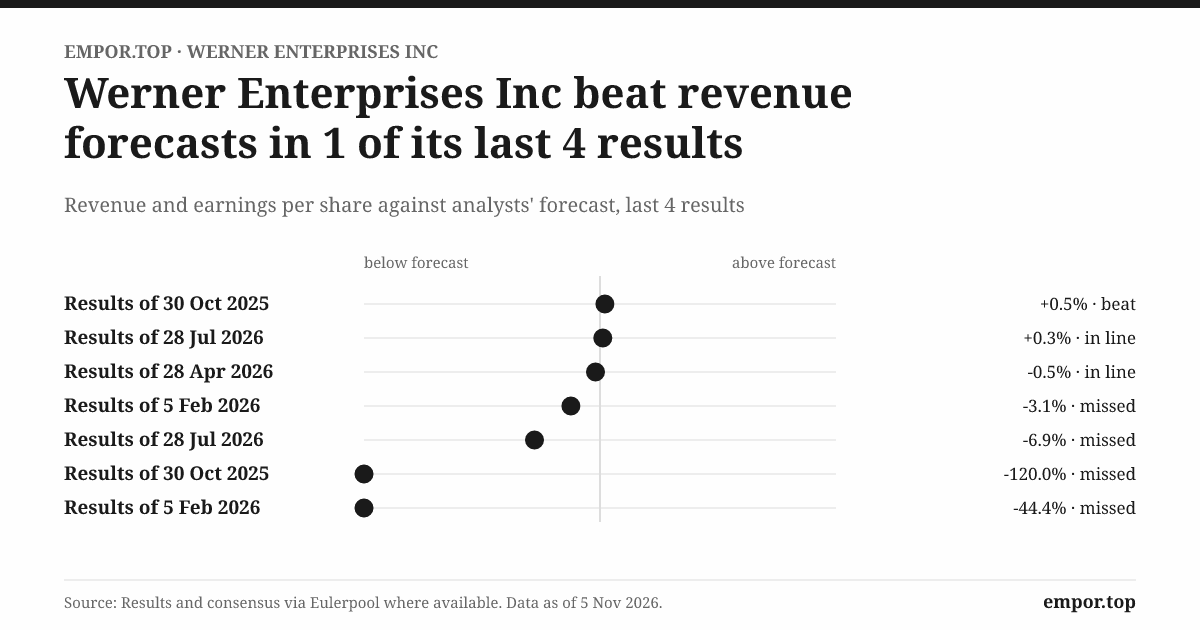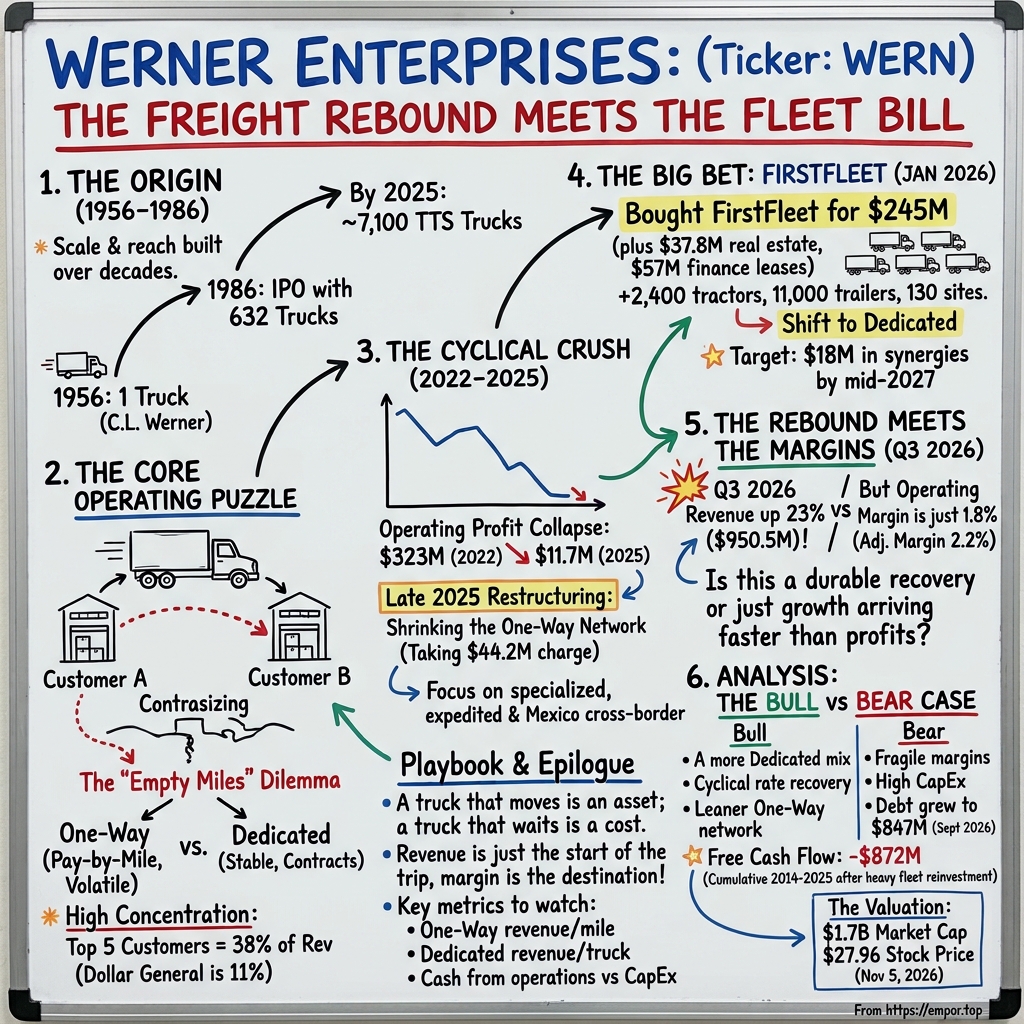
Werner Enterprises: The Freight Rebound Meets the Fleet Bill
I. A 23% Rebound, and a 1.8% Margin
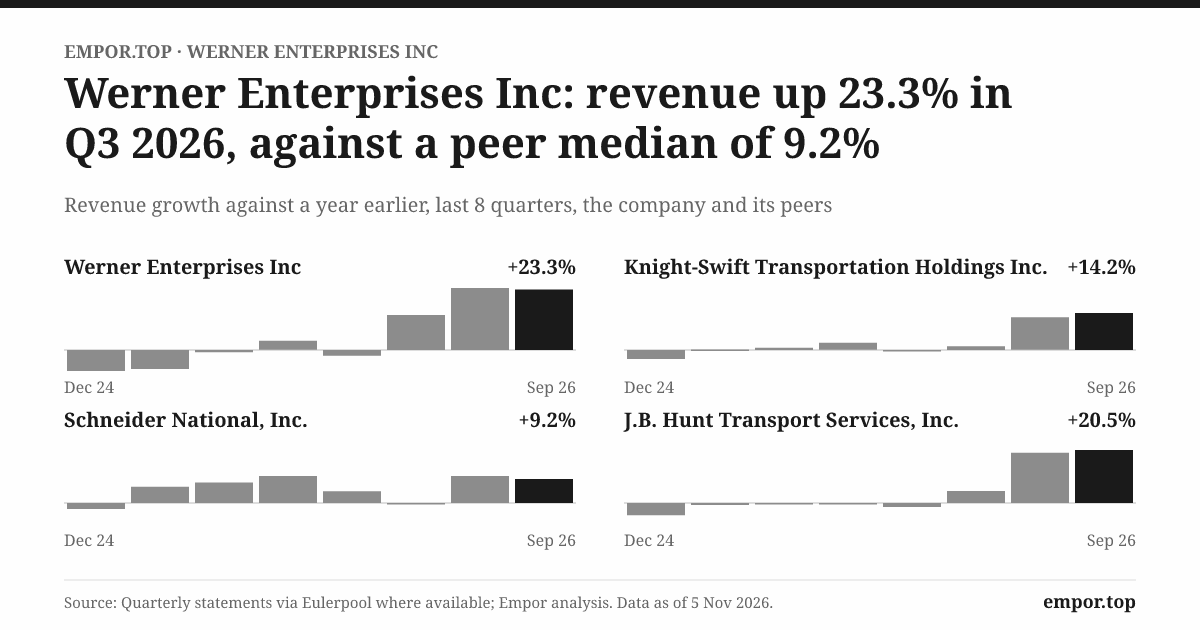
Late in October 2026, Derek Leathers got on the third-quarter earnings call with the kind of headline number trucking executives had not been able to quote for three years. Werner Enterprises' revenue for the quarter was $950.5 million, up about 23% from a year earlier.1 For a company whose sales had shrunk or stalled in almost every quarter since 2023, that looked like the freight recession finally breaking. Analysts had spent years hearing about "the bottom." Now the top line was moving like a recovery.
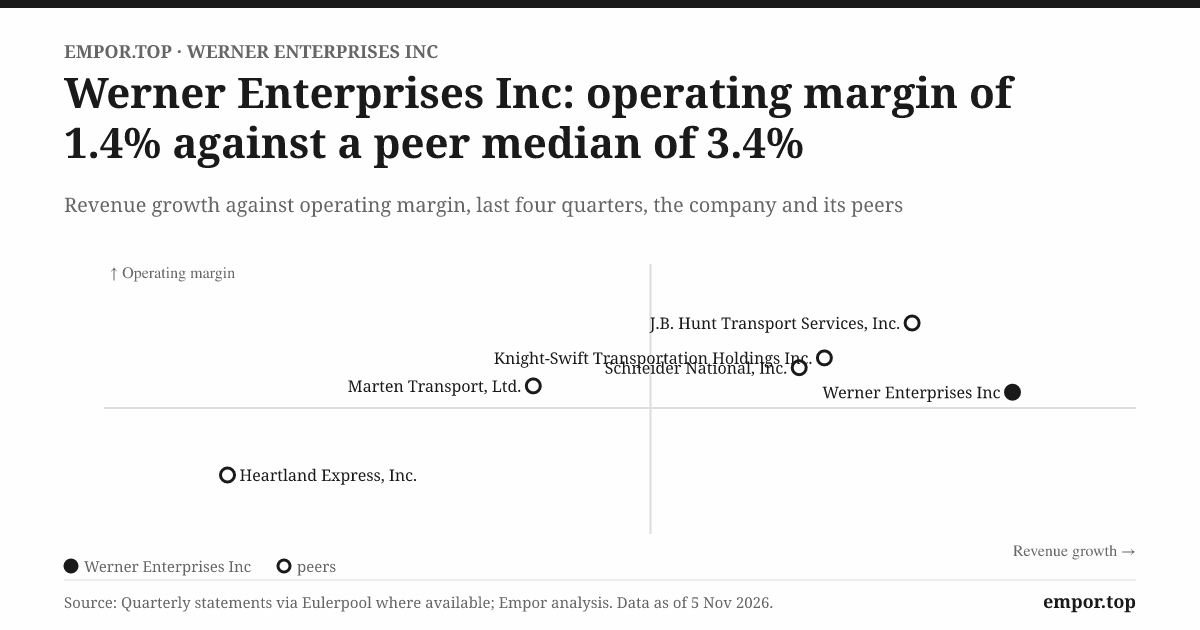
The second number on the page was less festive. Werner's operating margin for the quarter was 1.8%.1 Strip out the items management treats as unusual and the adjusted figure was 2.2%.1 On every $100 of freight Werner billed, it kept roughly two dollars after paying drivers, buying fuel, depreciating its trucks, insuring its loads and running its offices. Operating income was about $17 million, or about $21 million on the adjusted basis.1 That is a better quarter than a year earlier. It is not yet a good one for a company that runs thousands of tractors and owes more than $800 million.
That gap between a fast top line and a thin margin is the whole story in miniature. Revenue in trucking is easy to make look bigger than it is. Some of it is fuel surcharge, which carriers bill to customers when diesel costs rise and which mostly passes straight back out to the fuel supplier. Some of Werner's growth in 2026 was bought. In January the company acquired FirstFleet, a dedicated carrier with more than $600 million of annual revenue, and every dollar FirstFleet billed after the deal closed showed up as Werner growth in the year-over-year comparison.12 So the 23% headline was a blend of three things: an acquisition, fuel and pricing, and genuine improvement in the old business. The question for anyone owning the stock is how much of the third ingredient is in the mix.
The quarter's segment detail made that question sharper rather than softer. Werner's Truckload Transportation Services segment, the core of the company that owns the trucks and employs the drivers, grew revenue by 37%.1 Werner Logistics, the asset-light arm that arranges freight on other carriers' trucks, saw revenue fall by 7%.1 One half of the company was riding an acquisition and a tightening freight market; the other half was still fighting the conditions of the downturn. And the year-earlier comparison was itself flattered in the other direction, because the third quarter of 2025 had absorbed an $18 million class-action settlement that made the base look worse than the business really was.3 A recovery measured against a damaged quarter will always look impressive.
None of this means the rebound is fake. Werner's management pointed to higher revenue per truck, a smaller and more productive One-Way fleet, and early savings from integrating FirstFleet, and those are real operating signals.4 But the honest reading of the October quarter is narrower than the headline. Growth is arriving faster than profit, and the growth rate overstates what can yet be said about the legacy business or about Werner's earning power across a cycle.
So this episode turns on three questions. The first is whether One-Way Truckload, the traditional business of picking up a load wherever a customer needs it and delivering it wherever it has to go, can earn decent money again after Werner deliberately shrank it. The second is whether Dedicated, the business of assigning trucks and drivers to a single customer's operation, and the FirstFleet acquisition that doubled down on it, can earn returns attractive enough to justify the capital tied up in them. The third, and the one that decides the stock over time, is whether Werner can turn a freight-market upturn into cash after paying to replace its fleet. A trucking company that grows revenue but has to buy a new truck every few years to keep that revenue does not compound value unless the trucks earn more than they cost.
The stakes are visible in how far the business has fallen. Werner earned an operating margin of almost 10% in 2022, and in the October quarter it was below 2%.13 Each percentage point of margin on a revenue base that is now running above $3 billion a year is worth more than $30 million of operating profit, which is roughly two good quarters at today's run rate. That is why a single margin point matters so much in this story, and why the revenue headline cannot settle anything on its own.
To understand why that margin point is so hard to win, it helps to look at what Werner actually sells, and at the man who started selling it with a single truck.
 Subscribe on LinkedIn
II. One Truck, Then a Public Company
In 1956, a nineteen-year-old from Nebraska named Clarence L. Werner, known to everyone as C.L., bought a truck and started hauling freight.5 He had no factory, no patent and no brand that a consumer would recognise. What he had was a vehicle and a willingness to drive it wherever the next shipper needed goods to go. That is still, at heart, the business Werner Enterprises is in seventy years later: it does not make anything. It moves other people's products from one dock to another, and it gets paid only if it does so reliably and at a price the customer accepts.
That origin explains a lot about the company that followed. A carrier built around one truck learns early that the vehicle is both the asset and the liability. When it is loaded and rolling, it earns. When it sits in a yard waiting for freight, it costs money every hour: the payment on the truck, the insurance, the driver who wants a paycheck. C.L. Werner's company grew by adding trucks faster than it added problems, and by the time it went public in 1986 it operated 632 tractors.5 Going from one truck to more than six hundred in thirty years was not a technology story. It was a story of accumulating customers, lanes, terminals and drivers, one contract and one route at a time, in an industry where almost anyone with a commercial license and a loan can compete.
The listing gave the company access to public capital, which in trucking is mainly a way to buy equipment more cheaply and at greater scale. Over the following decades Werner became one of the largest truckload carriers in the United States, with its headquarters still in Omaha.3 At the end of 2025 its Truckload Transportation Services segment ran about 7,100 trucks.3 Laid side by side, the three figures make the arc easy to hold in your head: one truck, about six hundred at the IPO, about seven thousand today. That is roughly an elevenfold expansion of the fleet over four decades of public life.
But it is worth resisting the urge to treat that arc as a straight line upward in value. A bigger fleet means more miles, more customers and more revenue. It does not automatically mean better economics per truck. Over the ten years to 2025, Werner's revenue grew at only about 3.6% a year, and its operating profit in 2025 was a small fraction of what it had been a decade earlier.3 Scale has given Werner reach, a national network and the ability to serve big shippers across many lanes at once. Scale has not insulated it from weak pricing or a freight recession. When the market turned in 2023, a seven-thousand-truck fleet fell just as hard as smaller rivals, and in some respects harder, because the fixed costs of a large network do not shrink as quickly as the freight does.
For most of its history Werner grew organically. It added trucks, opened terminals, built a brokerage and logistics arm, and developed a cross-border business into Mexico rather than buying large competitors.3 Acquisitions have become a more visible part of the playbook only recently, culminating in the FirstFleet deal of January 2026.2 That shift matters, because it changes what investors should be judging. An organic carrier is judged on how it prices, dispatches and maintains its fleet. A carrier that buys other carriers is also judged on what it paid, how it financed the deal, and whether the acquired business earns more than the capital it consumed.
That brings the story to the people now running the company. Derek Leathers became chief executive in 2016 and chairman of the board in 2021.6 Christopher Wikoff serves as chief financial officer.6 This is the team that steered Werner through the pandemic freight boom, then through the long downturn that followed, and that made the two big decisions this story will examine: shrinking the One-Way fleet and buying FirstFleet. Leathers is a lifer of the industry and a familiar voice on investor calls, given to framing the cycle in confident terms and to describing downturns as opportunities to reshape the company. The founder's era is history now. The questions that matter concern what this specific management team did with the downturn, and whether its newer capital choices can lift returns above where the old model left them.
Because the story of the last few years is ultimately a story about miles, the next step is to understand the most basic puzzle in the business. One truck can always find a load. How does a large carrier make money on every mile it drives?
III. The Empty Miles Between Two Customers
Picture a Werner tractor pulling away from a retailer's distribution center somewhere in the Southeast. The trailer behind it is empty. The driver has just dropped forty-odd thousand pounds of goods, the customer has signed for them, and the revenue for that trip is booked. Now the truck has a problem. Its next paying load is not here. It might be fifty miles away, or three hundred, on a lane heading in a completely different direction. Every mile the truck drives to reach it is a mile Werner pays for in fuel, wages and wear, and nobody pays Werner back.
That empty stretch is the hidden heart of truckload economics. A carrier does not earn its margin on the loaded mile alone. It earns it on the combination of how many miles each truck runs in a week, what share of those miles carry freight, what rate the customer pays per mile, how much of the fuel bill is recovered through surcharge, and what the driver, the equipment, the insurance and the repairs cost. Get the rate right but let utilization slip, and the margin disappears. Fill the truck but accept a weak rate, and the margin disappears just as surely. Revenue can rise while the economics stay fragile, because revenue only measures one side of that equation.
Werner sells this capacity in two main ways, and they behave differently. The first is One-Way Truckload. A shipper has a load in Atlanta that needs to reach Dallas, and Werner bids to move it, usually for payment by the mile or by the load.3 Many of the important customers in this business do not sign long-term contracts; they award freight lane by lane and can move it to another carrier when they find a better price or better service.3 One-Way is where pricing responds fastest to the market, in both directions. When trucks are scarce, rates jump. When trucks are plentiful, shippers push rates down, and the carrier has to decide whether to accept cheap freight or let its trucks sit.
Fuel surcharge sits on top of that rate. When diesel prices rise, carriers bill customers an extra amount per mile to recover the cost, and when diesel falls, the surcharge falls with it.3 The mechanism protects the carrier from fuel shocks, but it also muddies the reported numbers. A rise in fuel surcharge can inflate revenue without proving anything about underlying pricing power, because most of that money flows straight back out to fuel suppliers. That is why Werner reports and discusses trucking revenue excluding fuel surcharge, and why investors should watch that line rather than the headline.
The second way Werner sells capacity is Dedicated. Here the company assigns specific trucks and drivers to a customer's own operation, such as a retailer's store-replenishment network or a manufacturer's plant-to-warehouse shuttle, often under arrangements that run for several years.3 Think of it as renting out a private fleet with the drivers included. Dedicated revenue is more visible and more stable, because the customer has committed to a fleet rather than tendering one load at a time. The empty-mile problem is partly the customer's problem, since the routes are designed around the customer's network. But the contract does not run the trucks. Werner still has to recruit and keep drivers, price the work so that wage inflation and equipment costs are covered, route the fleet efficiently and renew the contract at a profitable rate when it comes up. Predictability is not the same as profitability.
Inside Werner, Dedicated had already become the larger part of the truck business before FirstFleet arrived. Of the roughly 7,100 trucks in the segment at the end of 2025, about 4,850 were in Dedicated, which left the One-Way fleet at well under a third of the total.3 For investors who still think of Werner as a classic over-the-road carrier picking up spot freight, that number is the first correction. The company had been moving toward contracted, customer-specific work for years.
There is one more piece of geography worth holding onto, because it will matter when Werner explains where it wants to grow. Almost all of Werner's revenue comes from the United States or from North American shipments touching the United States, and most of its foreign freight is billed and paid in dollars.3 Mexico is the main exception: Werner runs a cross-border operation with peso-denominated equipment and liabilities, and currency swings show up as translation gains or losses in comprehensive income rather than in operating profit.3 Cross-border freight is harder to serve than a domestic dry-van lane, because it requires customs expertise, partners on both sides of the border and equipment positioned in the right places. That difficulty is precisely what makes it attractive to a carrier looking for lanes where fewer competitors can bid.
Put the segments in proportion and the shape of the company becomes clear. Truckload Transportation Services is the core. In the third quarter of 2026 it generated about $714 million of revenue, up 37% from a year earlier, and trucking revenue excluding fuel surcharge grew about 28%.1 Werner Logistics adds brokerage, freight management, intermodal and final-mile delivery, much of it using third-party capacity bought from other carriers.3 It is a useful complement, because it lets Werner serve customers when its own trucks are full and offer services its fleet does not provide. But Logistics revenue fell by about 7% in the same quarter, so it cannot carry the recovery story.1 Whatever is happening at Werner in 2026 is happening mainly in the trucks it owns.
The operating equation becomes concrete when you look at the year before the rebound. In 2025, Werner's One-Way business managed to raise revenue per total mile by just 0.8%.3 That is a pricing improvement too small to matter against inflation in wages and insurance. At the same time, miles per truck fell 2.1%.3 So the fleet earned slightly more for each mile and drove fewer miles. Better yield was offset by weaker productivity, and the trucks themselves were not getting cheaper. Dedicated held up better, with revenue per truck per week roughly flat in a year when the freight market stayed weak.3 Flat is not growth, but in a deep downturn it was evidence that the contracted side of the business was doing what it was supposed to do: absorb the cycle rather than amplify it.
This is why the same revenue number can tell two very different stories. A carrier reporting 20% growth might be raising rates on its existing customers and running each truck more miles, which would be the strongest possible sign of a recovery. Or it might be consolidating an acquired company, collecting more fuel surcharge as diesel rises, and still struggling with utilization on its legacy fleet. Both look the same in the headline. Only the per-truck, per-mile and segment-margin numbers show which story is true, and Werner's 2026 numbers contain elements of both.
That leaves one constraint that no amount of dispatch software removes. If many contracts are short, and if customers can shift loads among carriers whenever they like, then the question becomes who holds the bargaining power. The answer depends on where Werner sits in a market full of trucks.
IV. The Big Carrier in a Fragmented Market
Imagine a transportation manager at a large retailer sitting down to award the next quarter's freight. She has hundreds of lanes to cover, each with its own volume and seasonality. On one screen she has bids from Werner. On others, she has bids from Knight-Swift, Schneider, J.B. Hunt, a dozen regional carriers and a few brokers who will find capacity on someone else's trucks. She weighs network coverage, on-time performance, whether the carrier will actually have trucks available during the holiday peak, and, inevitably, price. Then she splits the business. A few lanes go to Werner, some to its rivals, some to backups in case the primary carrier fails to show up.
That scene captures the competitive reality better than any market-share chart. American truckload freight is enormous and fragmented. Werner is one of the larger carriers, with meaningful national scale, but it is far from dominant. Knight-Swift, the industry's largest truckload operator, averaged about 21,428 truckload tractors in 2025, roughly three times the size of Werner's entire year-end segment fleet.73 Schneider and others run substantial fleets too. Above them all sits a long tail of small carriers that can enter the market quickly when rates rise and exit, often through bankruptcy, when rates fall. Werner competes in that crowd on service, network and price. It does not set the price.
The bargaining power on the other side of the table is concentrated. Werner's largest five customers accounted for about 38% of its 2025 revenue, its largest ten for about half, and its largest fifty for roughly four-fifths.3 The single biggest customer, Dollar General, was about 11% of revenue in 2025 and also about 10% of trade receivables at year-end.3 For a carrier, that concentration is a double-edged fact. Winning a large national retailer's freight brings scale, density and long relationships. It also means that a handful of procurement teams can push hard on rates, and that losing or shrinking one relationship would leave a visible hole in the fleet's utilization.
Concentration has also been creeping up rather than down. The top ten customers represented 48% of revenue in 2023 and 2024 and 50% in 2025.3 That is not alarming in itself, and the stability of Dollar General's share over three years suggests a durable relationship rather than a fragile one.3 But it does mean Werner's fortunes are tied ever more closely to the purchasing decisions of a few very large buyers. Werner does not publish an ageing schedule of its receivables or a breakdown of overdue balances, so outsiders cannot judge customer payment behaviour beyond the headline.3 Debtor days of about 51 in 2025 were in line with Werner's own history and down from a peak of 66 in 2021, which is reassuring as far as it goes; nothing in that number suggests a payment problem, and nothing in it rules one out.3 The receivables balance did rise to about $517 million by September 2026, but that rise coincided with FirstFleet's revenue joining the books, which is the obvious explanation.1
So where does Werner's claim to an advantage have substance? Mostly in Dedicated. In the first quarter of 2026, management reported Dedicated customer retention of about 95%.8 When most customers renew, the fleet keeps its routes, its drivers keep their schedules and the carrier avoids the cost of rebuilding operations from scratch. The flat 2025 revenue per truck per week in Dedicated, achieved in a weak market, points the same way. A dedicated fleet embedded in a customer's distribution network is harder to replace than a carrier bidding on spot lanes, because switching means re-recruiting drivers, re-engineering routes and accepting the risk that the new provider fails during peak season.
But useful signs are not proof of durable switching costs. A 95% retention rate is a single snapshot taken during a period when customers had few reasons to experiment, because the downturn had kept capacity plentiful and existing carriers eager. The real test of a Dedicated moat is whether customers renew at prices that cover rising driver pay and equipment costs, not merely whether they renew. Werner does not disclose renewal pricing, the typical length of its Dedicated contracts, or how much of its revenue is under multi-year commitment.3 Investors therefore know the retention rate, not the price at which it was achieved.
On the One-Way side, the evidence for an advantage is thinner. Many of the key customers there have no long-term contracts, and the 2025 data showed One-Way pricing barely moving while productivity declined.3 That is the profile of a business competing mainly on price and capacity. Werner's network is large enough to offer coverage that small carriers cannot, and its specialised services, such as cross-border Mexico freight and expedited loads, give it lanes where fewer competitors can bid. But the broad One-Way market is one where shippers multi-source freely, and multi-sourcing is precisely the behaviour that limits pricing power.
The fair verdict is that Werner has a service-and-network advantage, not a proven moat. Its scale makes it a credible national partner for the biggest shippers, and its Dedicated business shows signs of real customer stickiness. Concentrated buyers and a market full of interchangeable trucks cap how much of that advantage can turn into price. The metric that would move this verdict is retention combined with rate realisation through the 2026 and 2027 renewal cycles: if customers keep their Dedicated fleets with Werner and accept higher rates as the market tightens, the stickiness is worth something. If retention holds only because Werner trims prices, it is not.
That leads to a harder question. When weak freight pricing persisted year after year, did Werner change its business, or did it wait for the market to turn?
V. The Downturn Forced a Smaller One-Way Network
By the final months of 2025, Werner's leadership had lived through almost three years of freight recession. The pandemic boom was a memory. Rates had fallen, small carriers had held on longer than anyone expected, and the One-Way fleet was running fewer miles per truck at prices that barely moved. Something had to give. In the fourth quarter of 2025, Werner took a $44.2 million restructuring and impairment charge and committed to shrinking its One-Way Truckload operation.39
To see why that decision mattered, follow the cycle back to its peak. During the pandemic, freight demand surged as consumers bought goods instead of services and retailers scrambled to restock. Werner's revenue climbed from about $2.4 billion in 2020 to about $3.3 billion in 2022, and operating profit reached about $323 million that year, a margin close to 10%.3 Those were the best economics the company had posted in a long time. Then demand normalised, capacity that had flooded into the market during the boom stayed put, and rates fell.
What happened next is the critical clue. Revenue fell only modestly, from about $3.3 billion in 2022 to about $3.0 billion in 2025, a decline of roughly a tenth.3 Operating profit, on the other hand, collapsed from $323 million to about $11.7 million.3 Sales dropped by about a tenth; operating profit dropped by more than 95%. That asymmetry is what operating leverage looks like in a capital-heavy business. The trucks still had to be depreciated, the drivers still had to be paid, insurance premiums kept rising, and the revenue that would have covered those costs at 2022 prices simply was not there anymore. A cycle explains the direction of that move. Its magnitude says something about how much fixed cost Werner was carrying in a network that had been sized for a better market.
The 2025 operating detail shows where the pressure landed. Trucking revenue excluding fuel surcharge in the segment declined about 2.9% for the year, driven by a smaller average fleet and weaker revenue per truck.3 One-Way productivity deteriorated, with miles per truck down while pricing barely improved.3 The 2025 profit figure was also distorted in both directions by legal items: a $45.7 million reversal of a liability tied to litigation over a 2014 accident, after a favourable court decision, helped insurance expense, while the $18 million class-action settlement accrued in the third quarter hurt.3 Even with the reversal flattering the year, the business barely broke even at the operating line.
Management also pulled a quieter lever during the trough: it slowed the fleet's renewal. Werner has long prided itself on running young trucks, because newer tractors burn less fuel, break down less often and help recruit drivers. In 2025, net additions to property and equipment fell to about $163 million from about $235 million the year before, and the average age of the truck fleet rose from about 2.1 years to about 2.7 years.3 That was rational in a year when operating cash flow was falling. It was also a deferral rather than a saving. A fleet that ages by more than half a year in twelve months will eventually need catching up, and the bill for that catch-up arrives exactly when the company is trying to show investors that its recovery produces cash.
The workforce tells the same story of a business built around people as much as machines. At the end of 2025, Werner employed about 12,000 people, of whom roughly 8,700 were drivers.3 Every decision to shrink or grow the fleet is therefore also a decision about recruiting, training and retaining drivers, a job that gets harder and more expensive precisely when freight markets tighten and rival carriers start bidding for the same people.
So the decision management announced with its fourth-quarter results in February 2026 was a recognition that waiting was no longer a strategy. Werner would shrink the One-Way fleet and concentrate what remained on freight that was harder for commodity carriers to serve: specialised loads, expedited service, cross-border Mexico shipments and engineered freight designed around particular customers' needs.910 The $44.2 million charge covered the cost of right-sizing the operation, including writing down equipment and other assets that no longer fit the smaller network.3 In plain terms, Werner chose to give up volume in the most cyclical part of its business in exchange for a chance at better yield and utilisation on the trucks it kept.
Here the record of management's earlier statements becomes relevant. In April 2024, Leathers told investors that the end of the downcycle was getting closer.11 It was not. Freight conditions stayed weak for well over another year, and Werner later lowered its expectations for One-Way pricing and fleet size as the recovery failed to arrive on schedule.910 That is not a scandal; almost every trucking executive misjudged the length of this downturn, because the capacity overhang lasted longer than past cycles suggested. But it is a reason to treat management's market-timing calls as hopeful rather than reliable. The restructuring itself is a stronger signal of seriousness than any forecast, precisely because it accepted a charge and a smaller business rather than promising a turn.
By the first quarter of 2026, the early results gave management something to point to. On the April call, the team cited both a tightening of industry capacity and its own restructuring as reasons for improvement.8 Miles per truck in One-Way rose about 6% from a year earlier, and One-Way revenue per truck per week rose about 9.6%.8 Those are meaningful numbers. They suggest the smaller fleet was running harder and earning more per truck, which is exactly what the restructuring was supposed to achieve.
The difficulty is separating self-help from market help. A tightening freight market lifts every carrier's rates and utilisation, whether or not the carrier did anything clever. Management's own framing gave credit to both, which is fair but leaves investors unable to say how much of the improvement would survive if the market softened again. The cleanest test will come when the cycle turns down next time: a restructured network should hold its productivity better than the old one did. Until then, the improvement is encouraging evidence, not proof.
It also needs to be held in scale. The third-quarter 2026 operating income of about $17 million, or $21 million adjusted, was a real step forward from the losses of 2025.1 It was also an adjusted consolidated margin of about 2.2% on nearly a billion dollars of quarterly revenue.1 The segment that owns the trucks did better, with an adjusted operating margin of about 3.4% in Truckload Transportation Services.1 Set those figures against the near-10% consolidated margin of 2022 and the gap is obvious. The downturn explains part of the damage. The scale of the collapse and the size of the charge show that management also had to correct its own network and freight mix, and the early recovery has not yet proved the fix through a full cycle.
Which raises an awkward question about timing. With the core fleet only just restructured and profitability still far from normal, why did Werner choose that moment to make the largest acquisition in its recent history?
VI. FirstFleet: Buying a More Contracted Mix
At the end of January 2026, Werner announced that it had acquired FirstFleet, a dedicated contract carrier based in Tennessee.212 The deal brought in a fleet of roughly 2,400 tractors and 11,000 trailers, 37 properties located near about 130 customer sites, and a set of customer relationships that Werner said were unusually long-lived: its top ten FirstFleet customers had worked with the company for an average of seventeen years.12 FirstFleet had reported more than $600 million of revenue in 2025.1213
FirstFleet offered Werner a way to accelerate its shift toward contracted work in one move rather than over years of organic selling. FirstFleet was almost entirely Dedicated. Overnight, Werner added a fleet equivalent to roughly a third of its existing segment trucks, nearly all of it running for customers who had committed to a private-fleet arrangement. Management pitched it as a step toward "dedicated market leadership," and the combination did make Werner a larger force in that part of the market.12
Now the price. Werner paid $245 million for the business, bought FirstFleet-related real estate separately for $37.8 million, and assumed about $57 million of finance leases.214 There is also an earnout of up to $35 million, tied to FirstFleet's revenue excluding fuel surcharge through March 2027.2 The deal was funded with cash and borrowings on Werner's revolving credit facility.14
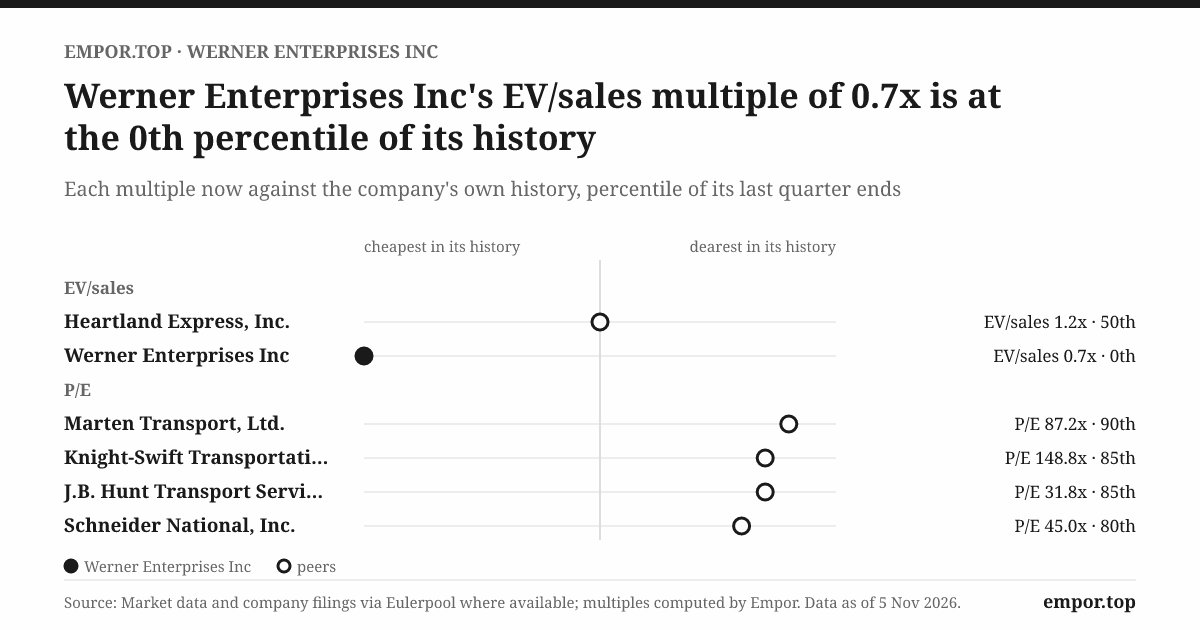
Set the headline price against the target's sales and it looks modest: $245 million for a business with more than $600 million of revenue is about 0.4 times sales.212 Add the separately purchased real estate, the assumed lease obligations and the full earnout, and the all-in cost approaches $375 million, or a bit over 0.6 times sales. That is still not expensive by the standards of public trucking companies. A 2026 review of transportation and logistics deal-making showed public truckload peers trading at an enterprise value of roughly 0.8 times sales.15
But that comparison is weaker than it sounds, for two reasons. First, a public-company trading multiple is not a like-for-like benchmark for a private-company acquisition, which typically carries different growth, margin and risk characteristics. Second, and more important, revenue multiples are the wrong lens for judging a trucking deal. A dollar of trucking revenue can carry a 2% margin or a 12% margin, and the difference is everything. Werner did not disclose FirstFleet's standalone EBITDA or cash flow before the deal, so outsiders cannot compute the multiple that matters most for acquisition returns: what Werner paid for each dollar of cash the business generates.212 A low price-to-sales ratio could mean a bargain or could simply reflect thin profitability.
The earnout deserves a closer look too. It rewards FirstFleet's former owners for delivering revenue, specifically revenue excluding fuel surcharge, through March 2027.2 That aligns them with keeping customers and fleets in place, which matters during integration. It does not align them with profitable revenue. An acquired business can hit a revenue target by keeping customers at low rates, and the investor's test is whether that revenue turns into margin and cash. The earnout's design is common in the industry; it simply measures a different thing from what Werner's shareholders need.
Integration evidence, not promises, is what investors should track, and Werner has been forthcoming with interim milestones. By the first-quarter call in April, management reported that it had reviewed about two-thirds of FirstFleet's customer portfolio and achieved about 98% renewal across that portion, along with more than $1 million of early cost savings.8 On the October call, management said it remained on track for $18 million of annual synergies.4 Retention that high suggests customers did not flee the ownership change, which is the first thing that goes wrong in many trucking acquisitions.
Then there is the contrary evidence, and it belongs right beside those milestones. Werner added debt and lease obligations to buy FirstFleet at a moment when its legacy business was barely profitable. In the first half of 2026, after closing, FirstFleet contributed about $277 million of revenue and about $3 million of net income.14 Three million dollars on $277 million of revenue is a net margin of around 1%. That is positive, and early integration costs and purchase accounting depress reported earnings in any acquisition's first months. But it is thin against a purchase price above $245 million, and it confirms that the 2026 revenue surge was carrying only a small amount of acquired profit with it. If FirstFleet's margins stay near those levels, the deal will have bought Werner a more stable revenue stream without materially improving its returns.
The $18 million synergy target is the bridge between those two pictures. If achieved, it would add meaningfully to FirstFleet's contribution, roughly tripling its annualised first-half net income on a pre-tax basis. Whether it is achieved, and whether the savings stick rather than being competed away in renewal pricing, is the most concrete test of the deal. Synergies in trucking usually come from purchasing scale on equipment, fuel and insurance, from shared maintenance facilities, and from overlapping back-office functions, all of which are plausible for a combination of this kind. But plausible is not the same as delivered.
So the verdict on FirstFleet is provisional. The deal shifts Werner toward a more contracted mix and provides immediate scale in Dedicated, at a headline price that looks modest relative to sales. Available disclosures do not support a reliable EBITDA-multiple judgment or a confident peer valuation conclusion, and the acquisition's return still has to be earned. Customer retention is necessary but not sufficient. If the acquired operation cannot raise margins and produce cash, the deal will have made Werner bigger without making it better.
That judgment ultimately falls on the people who chose to make the bet, and on whether their record and incentives give investors reason to trust that it will pay off.
VII. The CEO's Bet on Better Returns
On the fourth-quarter 2025 call in early February 2026, Derek Leathers did not sound like a man apologising for a bad year. He sounded like a man describing a plan. The downturn, in his telling, had been a period to reshape the business: to shrink the parts that did not earn, to lean into the parts that did, and to position Werner for the upturn when it came.9 Within a few weeks of that call, the same team had closed the FirstFleet deal and was arguing that restructuring, the acquisition and better pricing together could lift earnings meaningfully.912 The pitch was coherent. The question for shareholders is whether the record behind it earns the benefit of the doubt.
Leathers has led Werner as chief executive since 2016 and has chaired its board since 2021, which means the entire cycle from the pandemic boom to the trough and into the rebound happened on his watch.6 Christopher Wikoff, the chief financial officer, is the executive most responsible for the balance sheet that financed FirstFleet and for the refinancing that followed.6 Around them sits an operating team responsible for executing the One-Way restructuring and the FirstFleet integration day to day. These are the people whose decisions matter now. The founder's legacy built the network; this team will determine whether the network earns its cost of capital again.
Start with the behaviour that counts in their favour. Management did not merely talk about the downturn. It disclosed a specific restructuring with a specific charge, named the kinds of freight the smaller One-Way fleet would pursue, set a quantified synergy target for FirstFleet and reported interim progress against it, published customer retention measures in both Dedicated and the acquired business, and updated its 2026 guidance as the year progressed.984 That is the profile of a team willing to be measured. Investors can check every one of those targets against future results, and that is more than many managements in cyclical industries offer.
The behaviour that counts against them is the forecasting record. The April 2024 expectation that the end of the freight downturn was getting closer proved premature by well over a year, and later guidance on One-Way pricing and fleet size had to be trimmed as conditions stayed weak.1110 Combine that with the depth of the profit decline, from more than $300 million of operating profit to roughly breakeven over three years, and the fair conclusion is that this team has proven it can take corrective action but has not yet proven it can call the cycle or protect earnings through one.3 The recovery case management is now presenting may well be right. It rests, in part, on the same kind of market judgment that was early last time.
Incentives deserve the same scrutiny. Leathers's reported total compensation rose from about $5.3 million in 2021 to about $6.05 million in 2025.6 Over the same span, Werner's net income went from roughly $260 million to a loss.63 The 2025 package included about $4.2 million of stock awards and roughly $745,000 of annual non-equity incentive pay.6 A pay line that climbs gently while profits collapse is not proof of misalignment, because much of the package is stock whose value falls with the share price, and boards often hold pay steady to retain executives during downturns. But it is a pattern a skeptical holder will notice: the downturn was painful for shareholders and comparatively gentle for the pay table.
The design of future awards is the more important lever. For 2026, the board tied performance awards to three-year growth in diluted earnings per share.616 That is a reasonable choice for a company coming off a loss, because EPS growth from a trough is measurable and visible. It also has a well-known weakness in a capital-intensive business. Earnings per share can grow because of acquisitions, buybacks or a cyclical rebound, without returns on the capital tied up in trucks and trailers ever reaching an adequate level. An award based on return on invested capital, or on cash generated after fleet replacement, would more directly measure what shareholders need. The 2026 design does not include such a measure as its primary test.6 The CFO's base salary, set at $520,000 from February 2026, is modest by public-company standards and not the issue.16
Ownership tells a related story. Directors and executive officers as a group held about 1.3% of Werner's shares as of March 2026, and Leathers individually held less than 1%.6 The large holders are institutions. BlackRock reported about 14.8%, Vanguard about 10.7%, Dimensional about 6.4% and FMR about 5.7%, though those figures came from filings made at different dates, so they are a rough snapshot rather than a clean trend.6 No controlling shareholder sits on the register. That means management answers to a dispersed set of mostly passive or index-oriented holders, which typically brings less direct pressure on capital allocation than a concentrated owner would apply.
The shareholder vote reflected that. At the May 2026 annual meeting, the advisory vote on executive pay received about 54 million votes in favour and about 1.37 million against, with roughly 840,000 abstentions.17 By any standard, that is broad support. It is also not evidence that the earnings recovery has arrived. Say-on-pay votes in companies dominated by index funds tend to pass comfortably unless pay is egregious, and Werner's is not. The vote tells investors that the board faced no rebellion. It says nothing about whether the strategy will work.
Capital allocation is a mixed record. Werner kept paying its dividend through the deep downturn, about $34 million in 2025, and it repurchased shares as well, even as operating cash flow fell sharply.3 That continuity signals confidence and respects shareholders who rely on income. It also meant cash went out the door in years when the fleet's free cash flow was negative, which was financed in part by debt. The company did not repurchase shares in the third quarter of 2026, with about 5 million shares still available under its authorisation, a sensible pause given the borrowing for FirstFleet.1 Then there is FirstFleet itself, a meaningful new bet that will define this team's capital-allocation reputation for years. The question is simple to state and hard to answer early: will the returns on the acquired fleet and on the existing one exceed Werner's cost of capital?
None of this is a character judgment. Leathers's team has run a large company through a brutal stretch, taken real decisions and disclosed enough to be held accountable. The measurable test is delivery: One-Way rates and productivity, FirstFleet synergies, segment margins and cash generation after fleet investment. If those arrive, the 2024 forecasting miss will look like a timing error. If they do not, the restructuring and the acquisition will look like the moves of a team that bet on a cycle and got the scale but not the returns.
That leads directly to the price investors are paying today, and to what must be true for that price to be justified.
VIII. Analysis & Bear vs. Bull Case
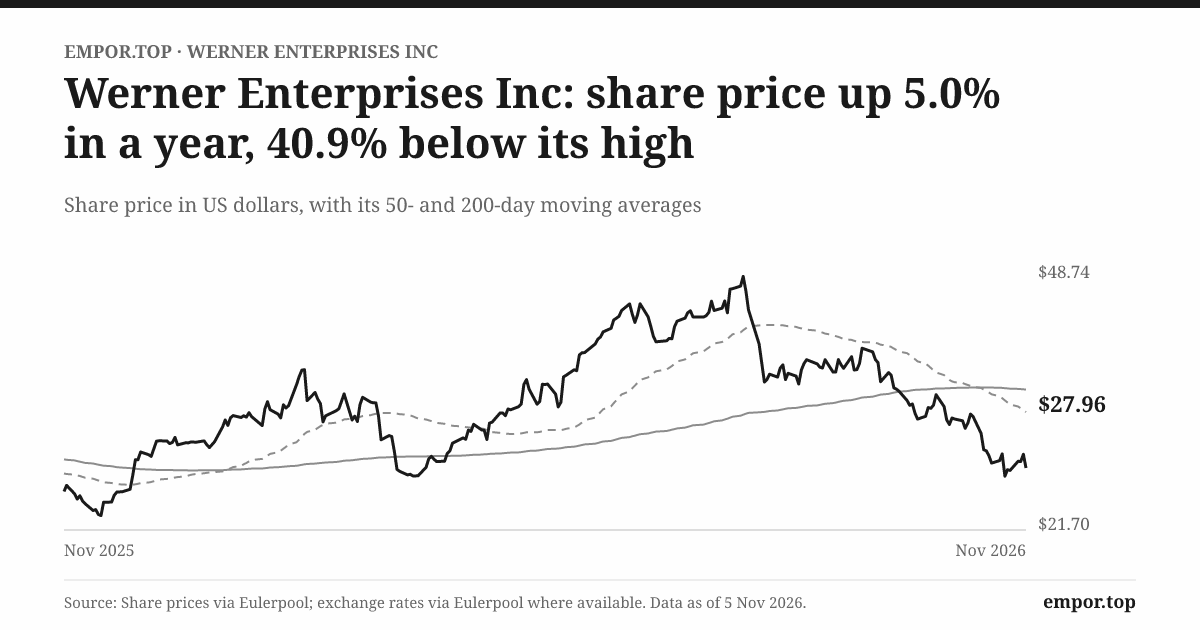
On November 5, 2026, Werner's shares closed at about $27.96.18 That gave the company a stock-market value of about $1.7 billion and, adding debt and subtracting cash, an enterprise value of about $2.6 billion.18 The shares sat about 41% below their 52-week high of roughly $47 and not far above the 52-week low of about $23.18 For a company whose third-quarter revenue had just jumped by nearly a quarter, that is a striking discount to recent optimism. The market had clearly priced in a recovery at some point during the year, then taken much of it back.
Read the valuation carefully, because the conventional measures are misleading at a trough. Trailing earnings per share over the last four quarters were negative, at about minus 32 cents, so the price-to-earnings ratio is not a usable anchor at all.118 Werner's own five-year median P/E of about 19.5 times is a reminder of what investors paid when earnings were normal, but it cannot be applied to losses. The shares traded at about half of annual sales and at about 8.1 times trailing EBITDA, the earnings measure before depreciation.18 In trucking, EBITDA flatters the picture more than in most industries, because depreciation is not an accounting fiction: it is the cost of the trucks that wear out and must be replaced. The dividend yield was about 2%.18 Put together, the market is valuing Werner as a cyclical business whose earnings will recover, but without full confidence that they will return to 2022 levels.
The bull case starts with the freight cycle, though it should not be mistaken for a company-specific moat. After several years of weak rates, capacity has been leaving the industry as small carriers fail and fleets age. When capacity tightens and contract rates reset upward, revenue per mile rises for every surviving carrier, and the fixed-cost structure that hurt Werner on the way down works in its favour on the way up. A business with roughly 2% margins does not need heroic price increases to double its profits. On top of that tide, the bull case adds Werner's own decisions. The Dedicated mix, enlarged by FirstFleet, should make earnings steadier. The smaller One-Way fleet should produce more paid miles per truck, as the early 2026 data suggested. And the $18 million synergy target, if delivered, would add profit that does not depend on the market at all.48 The bull investor sees a leaner, more contracted carrier entering an upturn at a depressed valuation.
The bear case begins with Werner's own history, which offers the strongest disconfirming evidence available. In the last cycle, operating profit reached about $323 million in 2022 and then fell to about $11.7 million by 2025.3 That collapse happened in a business that already had a large Dedicated operation and that management already described as more resilient than a pure One-Way carrier. A recovered top line has not yet shown that 2022 profitability is repeatable, and the bear can reasonably argue that 2022 was the outlier, inflated by pandemic demand, rather than the norm. In that reading, Werner is a business with low structural margins, high customer concentration, a constant need to reinvest in its fleet and rising debt, and those features prevent revenue growth from turning into durable free cash flow.
The cash record is where that argument has the most force. Over the twelve years from 2014 to 2025, Werner generated about $4.2 billion of operating cash flow against about $1.6 billion of net income.3 That looks like excellent cash conversion until the fleet bill arrives. Operating cash in an equipment-heavy business is swollen by depreciation, which is added back because it is non-cash. But trucks must be bought again, and once capital expenditure is subtracted, Werner's free cash flow over those twelve years summed to roughly negative $872 million.3 In other words, by the simplest definition, the fleet consumed more cash than operations produced, and dividends of more than half a billion dollars over the period were funded, in effect, by borrowing and by the proceeds from selling used equipment.
That calculation needs one important qualification, because management uses a different one. Werner's own "free cash flow" figure subtracts net capital expenditure, meaning purchases minus the proceeds from selling old trucks and trailers.1 In trucking, used-equipment sales are a real and recurring source of cash, so the net view is economically defensible. In 2025, for example, gross property and equipment additions were about $250 million while net additions were about $163 million, the difference being proceeds from disposals.3 The gap between the two definitions is large enough to change the conclusion about whether Werner generates free cash. Investors comparing management's claims with independent figures should make the definition explicit every time. Even on management's friendlier basis, 2025 operating cash flow of about $182 million, down from about $330 million in 2024, left little room once fleet needs and dividends were covered.3
Debt and liquidity sit in the same frame. Total debt including finance leases reached about $847 million at the end of September 2026, up from about $752 million at year-end 2025, largely because of FirstFleet.13 At year-end 2025, management reported net debt of about 2.0 times adjusted EBITDA and liquidity of about $702 million, with covenants in compliance.3 In October 2026, Werner replaced its $1.075 billion unsecured credit facility with a new $1.1 billion facility, extending its maturity profile.1 That refinancing reduces near-term funding risk. It does not generate cash. Borrowing capacity lets a company bridge a downturn; only operations can repay the bridge. No public rating rationale from a major agency is available for Werner, so investors must judge credit quality from the company's own figures.
Several operating risks could break either case. Freight demand and pricing are the obvious ones. Driver wages and availability are a persistent pressure, because drivers make up the large majority of Werner's workforce and every tightening of the freight market sets off a bidding war for them. Insurance and claims are the most important accounting judgment: Werner's auditor, KPMG, identified insurance and claims accruals as a critical audit matter because bodily-injury and property-damage reserves depend on actuarial estimates of how claims will develop.3 The 2025 reversal of the litigation liability showed how much a single court decision can move reported profit, and it also means 2025 comparisons are flattered by a non-recurring benefit. The separate Abarca class action, settled for $18 million, received court approval in July 2026, and the remaining funds were distributed in the third quarter, which removes one overhang without removing the broader litigation exposure that comes with running thousands of drivers.1 Werner also carries a smaller, unusual credit exposure through loans to students at driver-training schools: about $71.5 million gross at the end of 2025, against which it held an allowance of roughly $19.4 million, a reserve of more than a quarter of the balance.3 It is not large enough to change the investment case, but it is a reminder that recruiting drivers has a financial cost that does not appear in the wage line. Fuel and equipment costs, customer concentration and higher interest expense as debt rises complete the list. Interest expense was already about $39 million in 2025, several times the year's operating income.3
Technology claims should be bounded with the same care. Werner promotes its EDGE technology platform, automation in its operations and collaborations on autonomous trucking.3 These may improve dispatch, reduce empty miles or lower administrative costs over time. But Werner does not report a material technology revenue stream, does not quantify the efficiency gains, and does not disclose spending on research and development as a separate line.3 Technology here is a tool for running trucks better, not a separate source of value, and it should not be credited as a moat until it shows up in miles per truck and cost per mile.
Now the moat argument, run once and in full. Using Michael Porter's five forces, the picture is unflattering for any truckload carrier. Buyer power is high: Werner's top fifty customers produce about four-fifths of revenue, and large shippers routinely split freight across carriers.3 The threat of new entrants is high in One-Way, because a truck and a license are cheap relative to the market, though it falls in Dedicated and in specialised services like cross-border Mexico, where networks and relationships matter. Supplier power is meaningful, because drivers, equipment manufacturers, insurers and fuel all set costs Werner cannot fully control. Substitutes exist in rail intermodal for long hauls and in shippers' own private fleets, which is the very business Dedicated competes against. Rivalry is intense, with Knight-Swift roughly three times Werner's tractor count and a long tail of small carriers that keep prices low when freight is weak.7
Hamilton Helmer's seven powers framework sharpens the point. Scale economies exist in trucking, mainly in purchasing equipment, fuel and insurance and in network density, but Werner is not the largest player, so it does not hold the scale advantage. Network economies are weak, because a shipper does not benefit from other shippers using Werner. Counter-positioning does not apply. Switching costs are the strongest candidate, and they are real in Dedicated, where a customer's routes, drivers and facilities are built around Werner's fleet; the 95% retention rate and FirstFleet's seventeen-year average customer relationships are evidence for them.812 Branding matters little to shippers beyond reputation for reliability. There is no cornered resource. Process power, meaning an operating capability embedded in how the company works that rivals cannot easily copy, is possible in cross-border and engineered freight but unproven in the numbers. The conclusion is that Werner has a modest switching-cost advantage in Dedicated and a service-and-network edge elsewhere, sufficient to keep customers but not yet shown to command superior pricing.
Three indicators matter most for tracking whether the bull or bear case is winning. The first is One-Way revenue per total mile excluding fuel surcharge, which measures real pricing in the most cyclical business; it rose about 9.7% year over year in the third quarter of 2026, after barely moving in 2025.13 The second is productivity, captured by One-Way miles per truck and Dedicated revenue per truck per week; One-Way miles per truck rose about 6% in the first quarter of 2026, while Dedicated revenue per truck was roughly flat through 2025.83 The third is cash from operations less fleet capital spending, the number that decides whether growth creates value; on the simplest basis it was negative in 2025, at roughly minus $68 million.3
Finally, the question a skeptical long-term holder would put to the board. If the recovery and the acquisition do not lift returns above the cost of capital, where should the next dollar go? Werner can replace and expand its fleet, pay down the debt that financed FirstFleet, keep the dividend growing, or buy back shares at a price near half of sales. Each choice says something different about how management sees its own returns. A team confident that new trucks will earn their keep should keep investing. A team that cannot show that should shrink the fleet further, reduce debt and return capital. The worst outcome would be continuing to grow the fleet, the dividend and the debt together while margins stay near 2%.
IX. Playbook: Business & Investing Lessons
Somewhere in Werner's network tonight, a dispatcher is looking at a screen full of trucks and loads, deciding which tractor goes where next. A few floors above, executives are deciding whether the network needs more trucks or fewer miles. Those two decisions are the same decision at different scales, and Werner's last few years turn them into lessons that reach beyond trucking.
The first lesson is the one the One-Way restructuring taught: fleet productivity matters more than fleet size.38 For any business that owns expensive assets, from aircraft to hotel rooms to semiconductor tools, the number that matters is how hard each asset works, not how many of them there are.
The second lesson is about the 23% headline that opened this story. Revenue is the start of the trip, not the destination. Werner's 2026 revenue surge combined fuel surcharge, FirstFleet's acquired sales and real pricing improvement, and only the last of those says anything about the health of the legacy business.1 FirstFleet's thin first-half margin is a reminder that revenue growth does not guarantee profit.14 An investor who bought the headline would have bought the trip without checking whether it reached anywhere. Margins and cash after reinvestment are the destination, and in Werner's case they remain unresolved.
The third lesson comes from management's premature call in 2024 that the downturn was ending.11 A cycle can explain the wind; it cannot steer the truck. Freight markets rise and fall regardless of what any single carrier does, and it is tempting for management to attribute bad years to the market and good years to execution. Werner's record shows both forces at work, and the restructuring was the moment management stopped waiting for the wind and started steering. For investors, the lesson is to judge management by what it controls, its network design, pricing discipline and capital choices, rather than by how well it predicts the weather.
The fourth lesson belongs to FirstFleet. The best acquisition is the one that earns its keep after the integration slide. Werner's customer renewal and synergy progress are encouraging, but they remain integration milestones, not returns.84 The deal will be judged by whether the combined fleet earns more on its capital than Werner could have earned by paying down debt or buying back stock. That is a judgment that arrives years after the closing press release, and investors who score acquisitions on the day they are announced usually score them wrong.
Taken together, these lessons say that scale is only valuable when the network converts it into productive, paid miles and into cash after replacement spending. Werner has the scale. The next year will show whether it has the conversion.
X. Epilogue
Werner enters the final weeks of 2026 after the FirstFleet acquisition and One-Way restructuring, with much of its One-Way contract repricing still ahead as customers reset rates for the coming year.4 One-Way pricing strengthened in the third quarter.1 Management guided 2026 net capital expenditure to between $190 million and $205 million, a level consistent with continued fleet replacement but still restrained compared with the peak years.1 The company expects to reach its full $18 million FirstFleet synergy target by the middle of 2027.4
The next proof point is not another revenue increase. Revenue will almost certainly keep rising through the comparison periods that include FirstFleet's first quarters and as pricing improves. The proof is a sustained lift in segment margins and in cash after fleet investment, alongside customer retention and integration progress.
The first moment that will decide the story is the fourth-quarter report early in 2027. It will be the first look at full-year 2026 margins for Truckload Transportation Services and for Werner Logistics separately, and it should allow investors to strip out the fuel-surcharge and FirstFleet contributions to see what the legacy business did on its own. If the core segment's adjusted margin keeps climbing from the third-quarter level, the restructuring will look like it worked.1 If it stalls, the recovery will look like it was mostly the market and the acquisition.
The second moment is the contract season. One-Way repricing will show whether the pricing gains of 2026 persist as contracts reset, and whether utilisation holds as the smaller fleet takes on more freight. Dedicated renewals will show whether rates cover driver pay and equipment costs, which is the true test of the switching-cost advantage. Strong renewals at higher prices would confirm the story of a more resilient carrier. Renewals bought with price concessions would suggest the stickiness is real but the pricing power is not.
The third moment is FirstFleet's first anniversary and the earnout period that ends in March 2027.2 By then, investors should know how many FirstFleet customers renewed, how much of the synergy target was realised, what earnings the acquired business is producing, and how much debt, including assumed finance leases, remains attached to it. A deal that delivers its synergies and lifts FirstFleet's margins well above the thin levels of its first half would justify the bet. One that delivers only revenue would not.
Throughout, the cash test matters most. Investors should compare operating cash flow with both gross and net fleet investment and keep the chosen definition of free cash flow consistent, because the gap between those definitions can swing the conclusion. They should also track interest cost and liquidity after the October refinancing. A larger facility buys flexibility, and Werner has it. It does not resolve weak unit economics, and if the recovery stalls, the debt that financed FirstFleet will matter more than the facility that holds it.
That is where the story stands tonight. The rebound has real operating signs. The margin is still thin. The fleet bill keeps coming. And the next few reports will show which of those three facts defines Werner's next chapter.
XI. Outro
Go back to that empty trailer, the old problem C.L. Werner faced with one truck in 1956, now multiplied across more than seven thousand trucks in Werner's core fleet.53 The margin depends on what happens next.
In the third quarter of 2026, Werner filled a lot of trailers and still kept less than two cents of operating profit on every dollar.1 That is the whole tension of the company in one image. The question that belongs to Werner, and to no other carrier in quite the same way, is whether its reshaped, contracted-freight network can turn scale into cash through a full cycle.
References
-
Werner Enterprises Reports Third Quarter 2026 Results — Werner Enterprises / SEC, 2026-10-27 ↩↩↩↩↩↩↩↩↩↩↩↩↩↩↩↩↩↩↩↩↩↩↩↩↩↩
-
FirstFleet Acquisition Form 8-K — Werner Enterprises / SEC, 2026-01-27 ↩↩↩↩↩↩↩↩↩
-
2025 Annual Report on Form 10-K — Werner Enterprises / SEC, 2026-02-26 ↩↩↩↩↩↩↩↩↩↩↩↩↩↩↩↩↩↩↩↩↩↩↩↩↩↩↩↩↩↩↩↩↩↩↩↩↩↩↩↩↩↩↩↩↩↩↩↩↩↩↩↩↩↩↩↩↩
-
Q3 2026 Earnings Call Transcript — The Motley Fool, 2026-10-28 ↩↩↩↩↩↩↩
-
Werner Enterprises 2015 Form 10-K — Werner Enterprises / SEC, 2016-02-26 ↩↩↩
-
2026 Proxy Statement — Werner Enterprises / SEC, 2026-03-31 ↩↩↩↩↩↩↩↩↩↩↩
-
Knight-Swift Transportation 2025 Annual Report — Knight-Swift ↩↩
-
Q1 2026 Earnings Call Transcript — Werner Enterprises, 2026-04-28 ↩↩↩↩↩↩↩↩↩↩
-
Q4 2025 Earnings Call Transcript — Werner Enterprises, 2026-02-05 ↩↩↩↩↩↩
-
Werner Enterprises Restructuring One-Way Fleet — FreightWaves, 2026-02-05 ↩↩↩
-
Werner Enterprises Says End of Downcycle Getting Closer — FreightWaves, 2024-04-30 ↩↩↩
-
FirstFleet Acquisition Call and Release — Werner Enterprises, 2026-01-28 ↩↩↩↩↩↩↩↩
-
Werner Acquires Dedicated Carrier FirstFleet for $245M — FreightWaves, 2026-01-28 ↩
-
Q2 2026 Form 10-Q — Werner Enterprises / SEC, 2026-08-07 ↩↩↩↩
-
Transportation & Logistics M&A 2025 Recap and 2026 Outlook — CliftonLarsonAllen, 2026 ↩
-
Compensatory Arrangements of Certain Officers — Werner Enterprises / SEC, 2026-02-13 ↩↩
-
Annual Meeting Voting Results — Werner Enterprises / SEC, 2026-05-12 ↩
-
Werner Enterprises Investor Relations — Werner Enterprises ↩↩↩↩↩↩
 LinkedIn
 WhatsApp
 Reddit
 Hacker News
 Email
 Kindle
 RSS Feed
 Spotify
 Apple Podcasts
 Amazon Music
 Audible
 YouTube