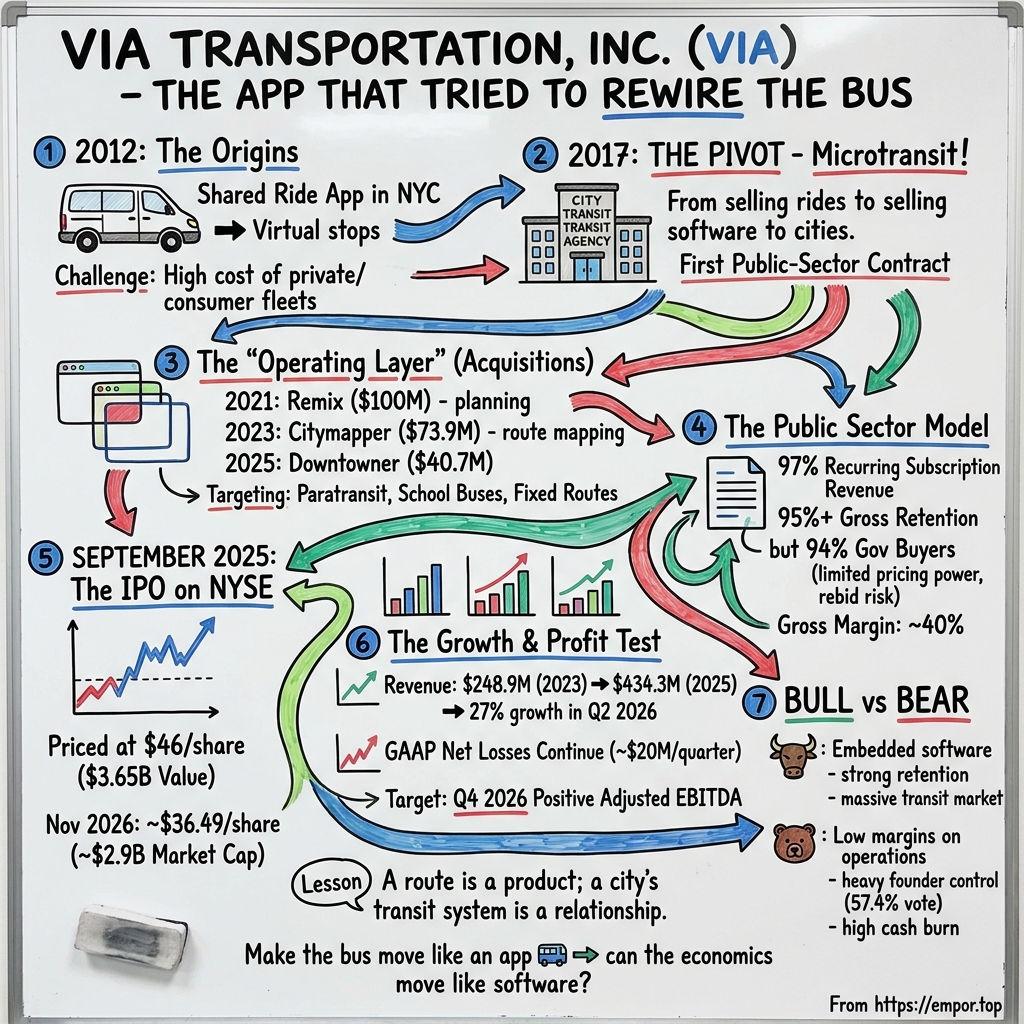
Via Transportation, Inc.: The App That Tried to Rewire the Bus
I. The $3.65 Billion Bet on Public Transit
On the morning of September 12, 2025, a company that most New Yorkers remembered, if they remembered it at all, as a black van that picked up strangers on the Upper East Side began trading on the New York Stock Exchange. The night before, Via Transportation had priced its shares at $46, above the range its bankers had marketed to investors, and the deal raised about $493 million, valuing the company at roughly $3.65 billion.1 Wall Street does not usually get excited about buses. It got excited about this one.
The structure of the deal said as much about Via's past as its future. Of the roughly 10.7 million shares sold, about 7.1 million were new shares issued by the company and about 3.6 million were sold by existing holders.2 So roughly two-thirds of the money, about $308 million before expenses, went into Via's own bank account, and the other third, about $154 million, went to early backers cashing out part of their stakes.2 The listing also tidied up a complicated capital structure built over a decade of private rounds. Convertible notes issued in 2024 turned into shares, preferred stock converted into common, and Via's balance sheet flipped from showing a shareholders' deficit of almost $1 billion at the end of 2024, a quirk of how its preferred stock had been classified, to positive equity of about $628 million a year later.3 Two months after the IPO, Via repaid its credit line.3 For the first time in its life, the company had more cash than it could plausibly burn in the near term.
The ticker was VIA, and the pitch behind it had travelled a long way from those vans. The company that rang the bell no longer described itself as a ride service. It described itself as a technology platform for public transportation: software and services that cities, transit agencies, school districts and other public bodies use to plan bus networks, dispatch on-demand vehicles, run paratransit for riders with disabilities, route school buses and give passengers an app to see it all.2 By the end of 2025 it counted more than 800 customers in over 30 countries.3 Nearly all of its money, 94% of 2025 revenue, came from government entities.3 The startup that had once looked like a smaller, more neighborly Uber had become something stranger and, in its own telling, more durable: a vendor to the public sector.
That transformation is the story of this episode, and it comes with three questions that hang over every page of it. The first is whether Via's growth is durable. In its audited record, revenue climbed from about $249 million in 2023 to about $434 million in 2025, but that recovery followed a period in which the business shrank, and the company only began publishing audited annual accounts with its listing.23 The second is whether its recurring-revenue model gives it a real advantage with buyers who are, by design, hard bargainers. Governments run tenders, set budgets and rebid contracts, and a subscription is only as sticky as the next procurement cycle allows. The third is whether scale can turn growth into cash profit. Via lost about $96 million in 2025 and still burned cash from operations.3
It helps to be precise about what investors own when they buy VIA. Via Transportation, Inc. is the listed parent of the whole consolidated group, including businesses it bought along the way such as the journey-planning app Citymapper and the destination-shuttle operator Downtowner.3 Exor, the Agnelli family's holding company, is one of its largest shareholders, but it is an investor, not a parent; Via's economics are Via's, not Exor's.24 Control, as a later chapter explores, sits with the co-founder and chief executive, Daniel Ramot, through high-vote shares.4
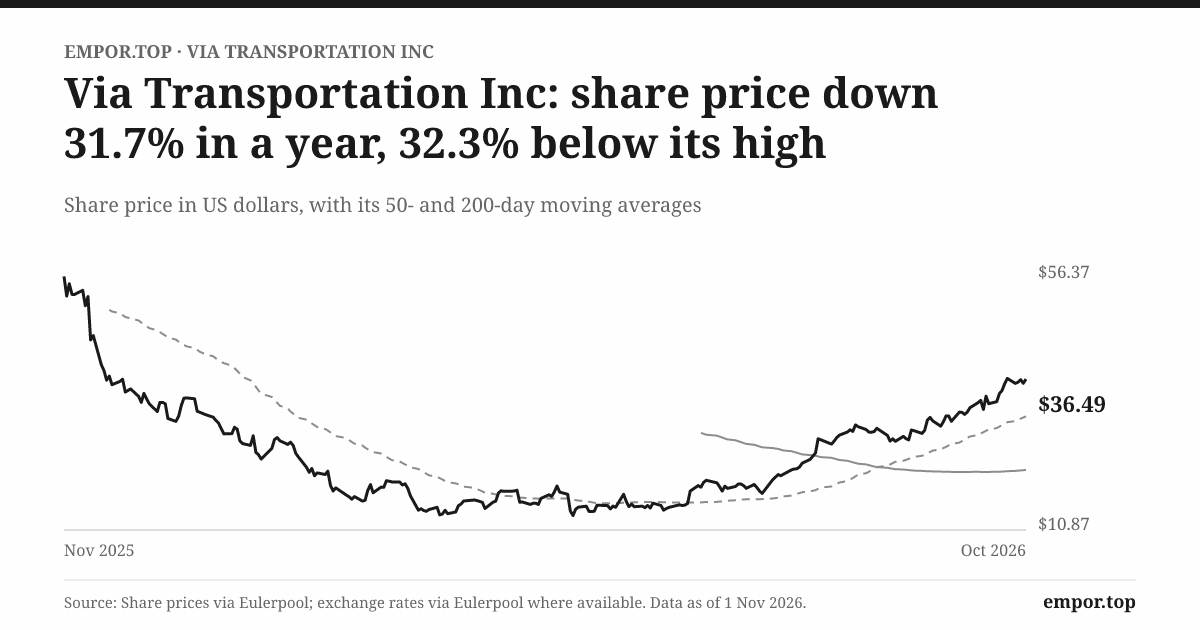
The first year of public life has been a roller coaster. On November 1, 2026, VIA closed at $36.49, about 21% below its offer price, giving the company a market value of about $2.9 billion.5 Somewhere in the past twelve months the stock touched about $54 and, at another point, about $13, a range that would make a biotech investor blink.5 The shares remain about a third below that high, and their one-year volatility runs above 70%.5
That gap between the $46 offer and today's price does not settle anything by itself. A newly listed company with a thin float and a short record can swing wildly while its business improves underneath. What the gap does is put Via on the clock. The IPO was a bet that the company could turn a broad transit platform into predictable, profitable growth. The first half of that bet, the broad platform and the growth, has real evidence behind it. The second half, predictable and profitable, has not yet been proved.
To understand why investors were willing to pay up for a bus-software company in the first place, and why they have since grown less sure, the story has to go back to a much smaller idea: what happens if two strangers going the same way share a ride.
 Subscribe on LinkedIn
II. The Ride That Had to Become a Transit System
Picture Manhattan in the early 2010s. Yellow cabs crawl uptown, each carrying one passenger who is heading roughly where the passenger in the cab beside it is heading. Ride-hailing apps were about to make summoning a private car feel effortless, and in doing so they would put more cars, each mostly empty, on the same crowded avenues. Via's founders looked at that picture and saw an optimization problem.
Via was founded in 2012 and launched its first service in New York City.3 The idea was simple to describe and hard to execute. Instead of sending a private car to every rider, Via's software grouped passengers going in the same direction into one vehicle, and instead of picking each rider up at their door, it asked them to walk a short distance to a "virtual stop," a corner that suited the vehicle's path.3 A rider gave up a little convenience. In return the trip cost less, because the van's cost was split among several fares, and the city got fewer vehicles doing the same work. It was, in effect, a bus that redrew its route every few seconds.
The person who built that bus was not a transport executive. Daniel Ramot is a physicist and engineer by training, with degrees in physics and mathematics from the Hebrew University and in electrical engineering from Tel Aviv University, and a PhD in neuroscience from Stanford.4 He came through Talpiot, the Israeli military's elite science-and-technology program, and developed avionics systems for the Israeli Air Force's F-15s and F-16s before building supercomputers for drug discovery at D. E. Shaw Research.4 That résumé explains a good deal about the company he co-founded with Oren Shoval. Via's founding insight was not a brand or a marketing angle; it was an algorithm. Routing many riders through a moving network in real time is the kind of problem people who build fighter-jet systems and molecular simulations find irresistible.
The trouble was that an algorithm does not make a business on its own, and the consumer version of Via carried every burden of the ride-hailing wars. A consumer ride service has to build two markets at once. It must attract enough riders to fill vehicles and enough vehicles to keep riders from waiting, in each city, against rivals with far deeper pockets and a willingness to subsidize fares for years. Shared rides make the math harder, not easier: they only work when density is high, because a van that cannot find a second passenger going the same way is just an expensive taxi.
So the founders asked a different question. Who already owns the vehicles, the drivers and the riders, and needs exactly the kind of routing intelligence Via had built? The answer was public transit. Cities and agencies run buses on fixed routes that are frequently half-empty, operate dial-a-ride services for disabled and elderly riders that are often booked by phone a day ahead, and struggle to serve suburbs and rural areas where a fixed bus line makes little sense. A public-sector buyer does not need Via to recruit riders or finance a fleet. It needs Via to make its existing service work better.
Via began selling software and operational support to municipalities and transit agencies in 2017.3 Its first city partnership was in Austin, Texas, in late 2017, and the company provided the platform for free to get it started.6 That detail is worth pausing on, because it shows how the pivot actually happened. Via did not walk into city hall with a mature enterprise product and a sales force. It gave away the software to prove a concept, then turned the proof into a business.
The business grew quickly. By March 2021 Via said it had about 200 partners in 24 countries, and by the end of that year more than 500, including Los Angeles Metro, Jersey City, Miami and Arriva Bus in the UK.76 In November 2021 the company said its transit-technology business had more than doubled in a year to an annual run rate above $100 million, eclipsing the consumer operations it still ran in New York and Washington.6 Investors noticed: that month Via raised $130 million at a valuation of about $3.3 billion, in a round led by Janus Henderson with BlackRock-managed funds and existing investor Exor taking part, bringing its total funding to about $800 million.6
That pivot is the hinge of this whole story. Selling rides, Via was a small player in a market defined by Uber and Lyft. Selling a way for transit providers to plan and operate rides, it became a specialist in a market with thousands of potential customers, each with an existing budget line for transportation. The new customer base was much larger and far less likely to vanish in a price war. It was also slower, more political and more dependent on public money. A city does not download an app on impulse. It writes a request for proposals, evaluates bidders, signs a contract of a few years, and then decides, when the contract ends, whether to do it all again.
Anyone who looks for Via's long-run financial history runs into a puzzle. Some data series attached to the ticker show revenue near $1 billion in 2018, followed by a slide to about $249 million in 2023, with profitable years and even dividend payments along the way. Those figures do not fit the company Via described as a private business, one that had raised about $800 million from venture and growth investors by 2021 and whose software business was a run-rate of just over $100 million that year.6 Via's own audited annual record begins with 2023, the earliest year in its IPO prospectus and its first annual report.23 The safest reading is that the long decline is a clue about a business that changed shape, from consumer operations to software and services, rather than a clean, like-for-like measure of today's platform. Investors trying to judge Via's growth should start where the audited numbers start.
Even so, the pivot left a question that the rest of the story keeps returning to. Via's original genius was routing shared rides. Running public transport is a broader, messier job: designing networks, meeting accessibility rules, scheduling drivers, satisfying elected officials and keeping riders informed. Could the company's routing expertise travel from a van on the Upper East Side to the whole operating layer of a city's transit system? Via's answer, in the years after the pivot, was to go shopping.
III. From One Ride to the City's Operating Layer
In March 2021, in the middle of a pandemic that had emptied buses and trains around the world, Via announced that it was buying Remix, a San Francisco company whose software let transit planners redraw bus networks on a map and instantly see who would gain or lose access to service.87 The price was $100 million in cash and equity.7
Remix had an unusually civic origin story. It grew out of a hackathon during a Code for America fellowship in San Francisco, and its founders, including chief executive Tiffany Chu and chief technology officer Dan Getelman, built it into a tool used by more than 350 local governments in 22 countries.7 It had about 65 employees and had raised about $27 million from Y Combinator, Sequoia and Energy Impact Partners.7 For a transit planner, Remix replaced weeks of spreadsheet work with a map: drag a bus line two blocks east, and the software shows how many residents, jobs and low-income households sit within walking distance of the new route.
The strategic logic was clear in Via's own framing. The company called the combination the first end-to-end "TransitTech" solution for cities and transit agencies.8 Before Remix, Via helped a city run service once the city had decided what service to run. After Remix, Via could sit in the room where the decision was made. Think of the difference between selling a city the delivery trucks and selling it the map that decides where the trucks go. The map is upstream, and whoever owns it has a chance to influence everything downstream. Via also chose not to swallow the brand. Remix became a subsidiary that kept its own name, and its founders stayed on to run it, a sign that Via understood how much of Remix's value lived in the trust of the planners who used it.7
At the time of the deal, Via was valued at about $2.25 billion after a $400 million fundraising the year before.7 Paying $100 million for planning software used by hundreds of governments was a bet that the planning relationship would lead to operating contracts. That is a reasonable bet. Whether it paid off cannot be measured from outside, because Via does not report Remix's revenue, renewals or cross-selling rates separately.
Two years later came a bigger brand. In March 2023 Via acquired Citymapper, the London-born journey-planning app that millions of commuters had used to navigate buses, trains and bikes across dozens of cities.9 Via presented the deal as an extension of its end-to-end platform, adding consumer-grade trip planning and a rider-facing app to its toolkit for agencies.9 The purchase consideration was a mix of cash, Via stock, preferred shares and contingent consideration worth about $73.9 million in total.3 Part of that consideration went to entities affiliated with 83North, which received Via preferred stock in the transaction and remain among Via's notable shareholders.2
Citymapper is the acquisition people tend to remember, and it is easy to overstate. A beloved consumer app sounds like a growth engine. In Via's filings, it is not presented as one. Via reports 97% of its revenue as recurring subscription revenue from customers buying its platform, and its revenue disclosures do not break out Citymapper as a separate business or show a meaningful consumer revenue line.3 Citymapper's value to Via, on the evidence available, lies in its technology and its rider experience, which help the company tell agencies that it can handle every step from planning a network to guiding a passenger onto the right bus. That is a supporting role, not a starring one.
The most recent deal was smaller and more operational. In 2025 Via acquired Downtowner, a provider of on-demand services for destination cities, the resort towns and downtown districts that run free or low-cost shuttles to move visitors and residents.3 The price was $40.7 million.3 Downtowner brought 94 customers into Via's count.3 Because the deal closed late in the year, its contribution to 2025 revenue and earnings was not material.3
Around these deals, Via widened its product line organically. It now sells software and services for paratransit, the legally required door-to-door service for riders who cannot use fixed routes; for school transportation; for fixed-route bus operations; and for non-emergency medical transport.23 Each is a separate budget line inside a public agency or school district, and each comes with its own rules, incumbents and procurement habits. The ambition is plain: connect network planning, routing, dispatch and the rider experience so that a city that buys one piece finds it natural to buy the next.
The fair question to ask of any acquisitive company is whether it paid too much. Here the honest answer is that outsiders cannot tell. Via does not publish revenue or earnings for Remix or Citymapper at the time it bought them, so there is no purchase multiple to compare with peers.3 Citymapper's mixed consideration, with stock and contingent payments woven in, makes even the headline price a moving target. Downtowner's acquired revenue and profit were immaterial in the few weeks after closing.3 Without target financials, the case that Via overpaid has no evidence, and the case that it bought cheaply has none either.
What can be measured is the capital at risk. Downtowner's $40.7 million price equalled about 9% of Via's 2025 revenue of about $434 million.3 Add up the three deals and Via has committed more than $210 million in cash, stock and other consideration to buying capabilities it did not build. That is meaningful deployment for a company that, until its IPO, depended on private funding and still loses money. It is not, by itself, a sign of recklessness; buying a respected planning tool or a well-known rider app can be cheaper than building one. But it does mean that a growing share of Via's story rests on integration.
Integration is where acquisitive platforms usually win or lose. Every added product brings new code to maintain, new teams to merge, new sales motions to coordinate. The bullish version of Via's acquisition strategy holds that each piece makes the whole stickier, because a city using Remix to plan, Via to dispatch and a Citymapper-derived app to inform riders has three reasons to stay. The skeptical version holds that the pieces are adjacent rather than essential, and that public buyers often prefer to tender each function separately, picking the best vendor for each slice.
The forward test is not the elegance of the slide that shows the platform. It is whether these additions lead to more customers buying more products and renewing at higher prices, or mainly to more integration work and more acquisition accounting. That test runs straight into the most important relationship in Via's business: the one between the company and the public official deciding whether to sign the contract again.
IV. What a City Buys—and What It Can Take Back
Imagine a transit agency in a mid-sized American county. Its fixed-route buses run every forty minutes through neighborhoods where few people ride them. Its paratransit service, which federal law requires it to provide, is booked by phone the day before and frequently late. The board wants better coverage without a bigger budget, and the general manager has a procurement decision to make. She can buy software alone and keep running the service with her own drivers and vehicles. She can buy software plus Via's operational support, handing over more of the work. Or, when the current contract ends, she can put the whole thing back out to bid and see who else will do it for less.
Every one of Via's 800-plus customers sits somewhere in that decision tree, and how they choose determines what kind of company Via is.
Here is what the agency gets if it picks Via. It defines its service needs: the area to cover, the hours, the riders to serve. Via's platform helps plan the routes, matches incoming trip requests to vehicles in real time, dispatches drivers, and gives riders an app or phone line to book and track trips.3 For on-demand "microtransit," the shared-van service that is Via's original craft, the software does what it did on the Upper East Side, grouping riders headed the same way and steering them to nearby pickup points. For paratransit, it schedules door-to-door trips around strict eligibility and timing rules. For school districts, it routes buses around bell times and student addresses. Depending on the contract, Via also supplies operating support: managing the service, and in some cases arranging the vehicles and drivers that deliver it.3
The way Via charges for this is the heart of its investment case. The company describes its model as predominantly recurring, volume-based subscriptions for access to a platform bundled with services.3 Contracts are typically multi-year, and pricing is generally tied to fleet size, a minimum number of vehicles, or vehicle-hours of service.3 In plain English, a city pays Via according to how much transit the platform runs: more vans or more hours, more revenue. In both 2024 and 2025, 97% of Via's revenue was classified as recurring subscription revenue.3
That label deserves a second look, because "subscription" conjures images of high-margin software rented at near-zero marginal cost. Via's economics are not that. Where Via controls a managed service before it is delivered to the customer, it reports revenue gross, meaning the full contract value, including costs such as the operations it arranges, sits on its income statement.3 That is why the company's gross margin was about 40% in 2025, rather than the 70% to 80% typical of pure software businesses.3 For every $100 a city pays Via, roughly $60 goes to the direct cost of delivering the service before any spending on engineering, sales or overhead. Via is a technology-enabled services company with a software core, and the mix between those two determines how much of each new dollar it keeps.
The evidence that customers stay is genuinely good. Via says its dollar-based gross revenue retention exceeded 95% in both 2023 and 2024, meaning that of the revenue it had from existing customers at the start of a year, it lost less than a twentieth to cancellations or reductions.23 New-customer contracts averaged about 2.3 years in both of those years.3 At the end of 2025 Via had about $294 million of remaining performance obligations, contracted revenue not yet recognized, a figure equal to roughly two-thirds of that year's revenue.3 For a business that sells to governments, those are the signs of a supplier that tends to get renewed.
But each of those numbers carries a limit. The retention figure stops at 2024 in the company's disclosures; there is no published reading for 2025 or the first half of 2026. Gross retention also says nothing about price: a city that renews at a lower rate or with fewer vehicles still counts as retained if the cut is small. Via does not publish the minimum-volume commitments in its contracts or customer-level terms, so outsiders cannot tell how much of that recurring revenue is guaranteed and how much depends on service levels the customer can dial down.3 And because pricing tracks vehicles and hours, Via's own risk disclosures warn that customers may reduce service and that public contracts can be competitively rebid.3
This is where customer count and bargaining power part ways. No single customer accounted for more than 10% of Via's revenue in 2023, 2024 or 2025.3 That spreads the risk of losing any one city. It does not spread the risk of the customer type. Government entities produced about $406 million of Via's 2025 revenue, against about $28 million from commercial customers.3 Governments share habits: they set budgets annually, often under political pressure; they run competitive tenders; they cut service when tax receipts fall or federal grants expire. Via does not disclose how much revenue its top five or top ten customers represent, so the degree of concentration among its largest contracts remains unknown.3
Now the moat question: Does Via's combination of recurring contracts, high retention and a broad platform give it pricing power, the ability to raise prices without losing customers?
Start with what it is up against. Via names a long list of competitors in its annual report: legacy transit-software vendors including the transit businesses of Constellation Software, Tyler Technologies, Giro and its HASTUS scheduling software, and Ecolane in paratransit, alongside newer technology and mobility companies.3 One of those newer rivals, the Canadian microtransit provider RideCo, has been Via's opponent in court: in January 2025 a jury found in Via's favor in a patent case and awarded about $1.4 million in initial damages, and RideCo deposited more than $5.2 million, with further royalty payments held in escrow while the case is appealed.3 Patents can raise the cost of copying, but a verdict under appeal is not a moat, and the sums involved are small against Via's revenue.
Then consider what Via has that rivals lack. Its claim is breadth: the company describes itself as offering an end-to-end platform spanning planning, on-demand service, paratransit, fixed routes and schools, and in its 2026 results releases called itself the only company in the industry offering such an AI-powered, end-to-end combination of software and services.10 More than 800 customers in over 30 countries is real proof of reach.3 It is not proof of market share. Via does not publish its share of any segment, and the transit-software market is fragmented enough that a company can serve hundreds of agencies while remaining a minority supplier.
Switching costs are the most plausible source of advantage. Once an agency has trained dispatchers on Via's tools, integrated its data, taught riders to use the app and built its service around Via's routing, changing vendor mid-contract is painful. Retention above 95% is consistent with that friction. The counterweight is that public procurement is designed to overcome exactly this kind of lock-in. When the contract ends, the agency is often required to tender again, and competitors bid knowing that the incumbent's prices are public record. A two-to-three-year average contract means the friction gets tested often.
So the evidence narrows the claim rather than rejecting it. Via has demonstrated stickiness: customers mostly stay, and they tend to add service. It has not demonstrated pricing power, because nowhere in its disclosures is there a series showing that renewing customers pay more for the same service, or that Via wins rebids at higher prices than incumbents it displaces. The strongest confirmation would be a full procurement cycle in which Via's cohort of customers renews, expands and accepts price increases. Until Via publishes that kind of evidence, buyer leverage should be assumed to be high.
One quieter signal is worth watching here: how fast those government customers pay. Via's receivables equaled about 87 days of revenue in 2023, improved to about 69 days in 2025, then rose back to about 87 days on the latest twelve-month measure as receivables climbed to about $105 million at the end of June 2026 from about $82 million six months earlier.311 Public bodies are rarely credit risks in the conventional sense, and Via's allowance for bad debts is tiny, just $20,000 at mid-2026.11 The risk is timing, not default: slower payment ties up cash that a still-unprofitable company would rather keep. Via does not disclose an aging schedule or overdue-balance history, so the rise is a watchpoint, not evidence of a problem.11
Breadth may make Via harder to replace. Microtransit carries its own political exposure, too. An on-demand van carrying a handful of riders an hour will always look expensive per passenger next to a full bus on a busy corridor, and it will always look cheap next to an empty bus on a suburban loop. Which of those comparisons a city council reaches for depends on who is asking, and the answer can change with an election. For Via, that means every customer relationship has a policy debate sitting behind it, and the company's revenue depends not only on how well its software works but on whether local leaders keep believing that flexible service is worth the money. But breadth also costs money: engineers for each product, implementation teams for each launch, sales people for each new budget line. The question that follows is whether the growth Via has been producing is the kind that pays for all of that.
V. The Growth Rebound Meets the Profit Test
On August 6, 2026, Via reported its second-quarter results, and the headline numbers read like a company finding its stride.12 Revenue rose 27% from a year earlier to about $136 million. The customer count hit 847, the most in the company's history and 23% more than a year before. Gross margin ticked up to 41%. On the company's preferred, adjusted measure, the net loss was almost nothing: about $0.8 million, or a penny a share.12
Then there was the other number. On a GAAP basis, the accounting standard that counts every cost, including the value of stock paid to employees, Via lost about $19.6 million in the quarter, and its operating loss was about $21.8 million.12 Both figures are honest. They describe the same quarter from different angles, and the distance between them is the profit test this chapter is about.
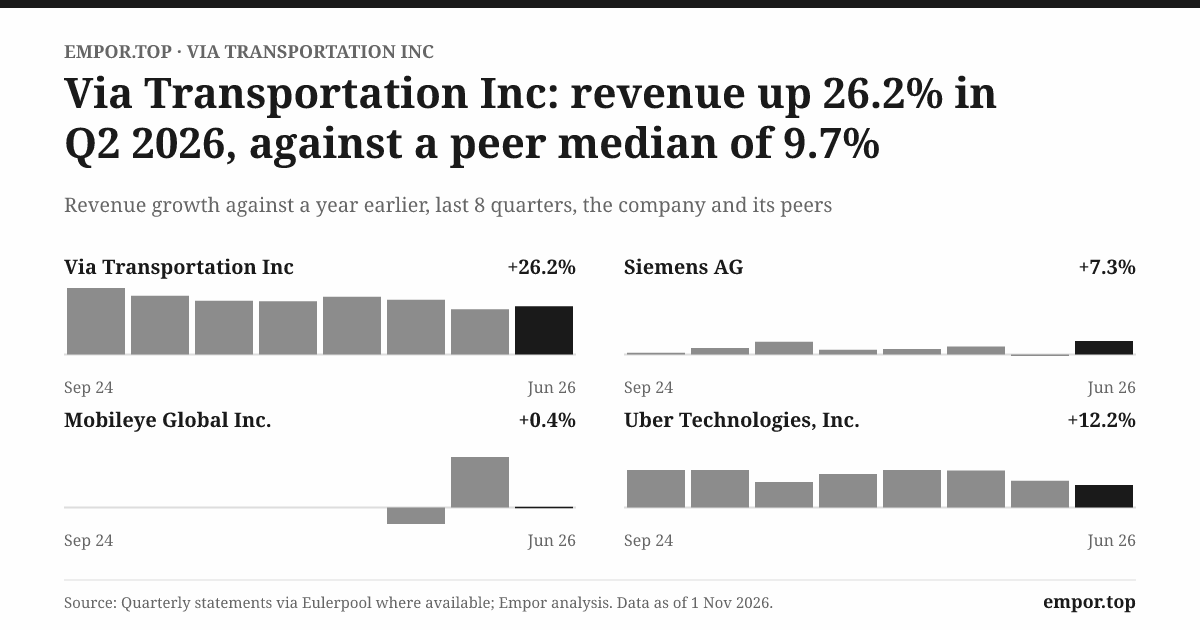
The growth itself is not in doubt over the period the audited accounts cover. Revenue rose about 36% in 2024 and about 29% in 2025, taking the company from roughly $249 million to roughly $434 million in two years.3 It kept compounding at a similar pace into 2026, with first-quarter revenue up 29% and second-quarter revenue up 27%.1012 Revenue from the United States, Via's largest market, rose about 40% in 2025 and 35% in the latest quarter, while revenue from government customers rose about 31% in 2025.312 Management's preferred gauge of scale, platform annual run-rate revenue, reached about $543 million in the second quarter.12
Where did the growth come from? In 2025, Via's customer count rose from 665 to 821.3 About 9 percentage points of the year-on-year customer growth was organic, with the remainder coming from Downtowner's customers, which arrived late in the year.3 That caveat changes how the headline should be read, but less than a skeptic might hope. Downtowner closed too late to matter much to 2025 revenue, so the acquisition inflated the customer count far more than it inflated sales.3 The revenue rebound came mainly from existing customers expanding their service and from new customers, not from bought revenue. The more pointed implication runs the other way: organic customer growth of about 9% is much slower than revenue growth near 30%. Via's growth has been driven more by getting bigger inside existing accounts than by adding new ones, which is consistent with land-and-expand but also means a few large expansions can move the numbers.
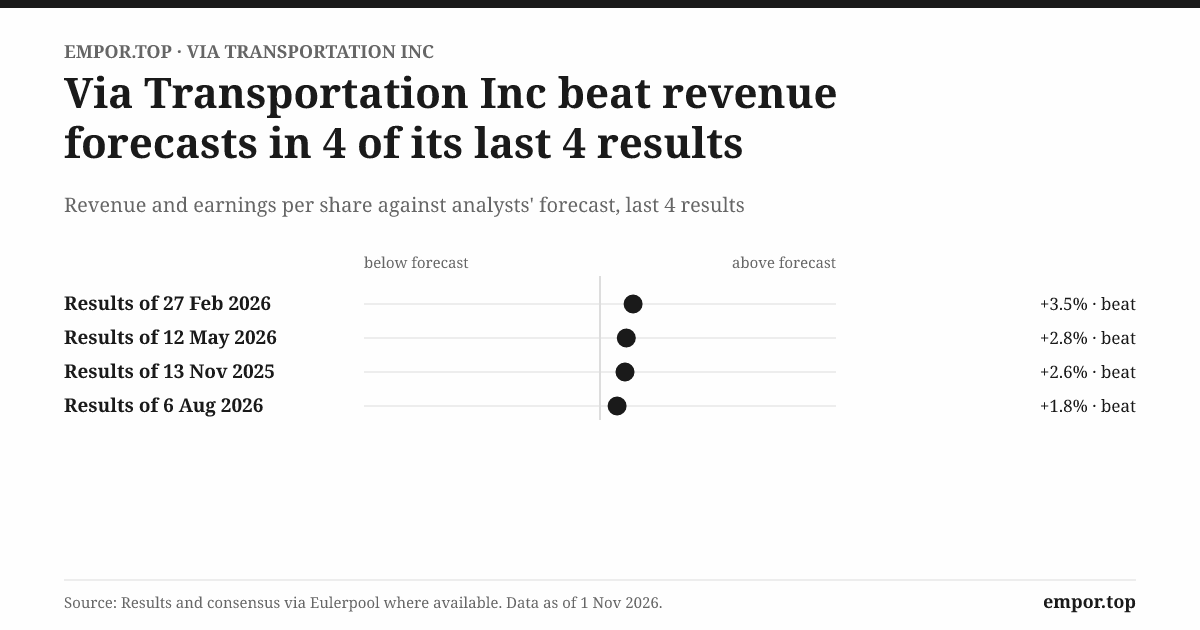
Management's language about demand has been buoyant. In its second-quarter release Via said its sales pipeline had doubled from a year earlier, for the second quarter in a row, and it nudged up its full-year revenue outlook to between $550 million and $553 million, from $547 million to $550 million in May.1210 It guided third-quarter revenue to roughly $138 million, growth of about 26%.12 Raising guidance slightly twice in a public company's first full year is a modest but real credibility point. A doubled pipeline is a claim about opportunities, not revenue; public-sector deals can sit in a pipeline for many months before a council votes, and analysts on the second-quarter call pressed management on deal timing, the pipeline, the school-transportation opportunity, and what Via's backlog actually captures.13 Those were the right questions. A pipeline that doubles while revenue growth eases from 29% to 27% suggests either a lag between bids and launches or a pipeline that converts more slowly than it fills. Sequentially, the picture is steadier than the year-on-year rate implies: second-quarter revenue was about 6.5% higher than the first quarter's, and the third-quarter outlook implies only a small further step up.1210 Public-sector revenue moves in stairs rather than slopes, rising when a large service launches and flattening between launches, which is why a single quarter's growth rate says less about Via's momentum than the trend across several.
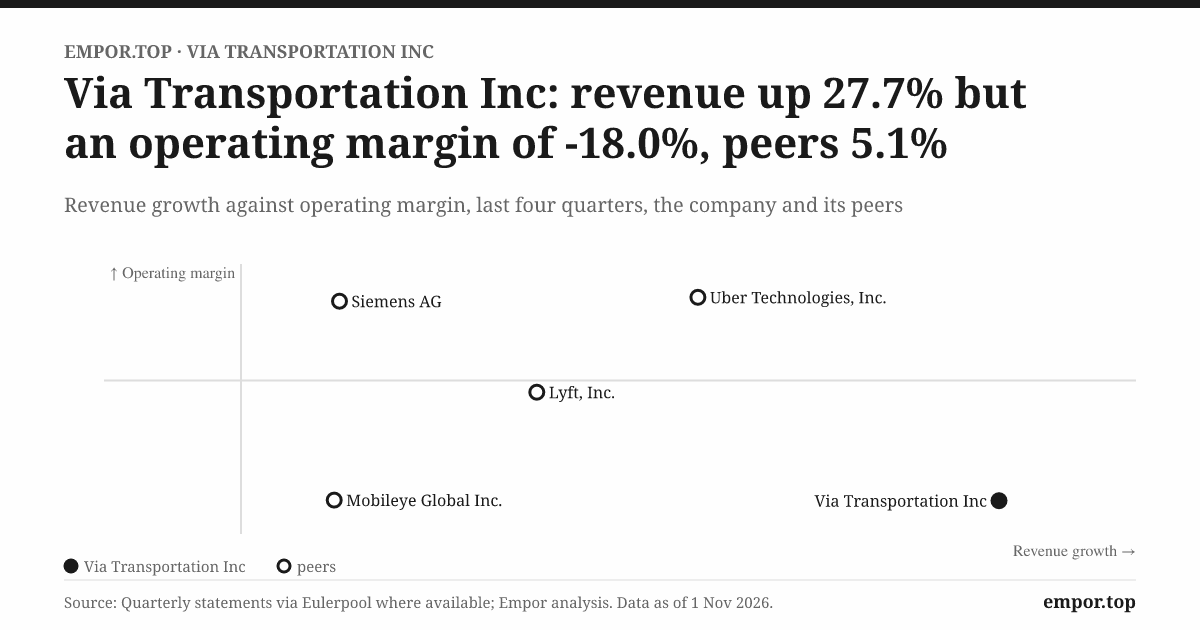
Now the economics. A useful way to see whether a company is getting operating leverage is to look at what happens to each extra dollar of revenue. In 2025 Via kept about 40 cents of each revenue dollar after direct costs.3 Research and development spending was about $92 million, roughly flat in dollars for three years while revenue grew, so R&D fell from about 38% of revenue in 2023 to about 21% in 2025.3 That is the clearest sign of scale in Via's accounts: the engineering base that builds the platform is being spread across far more revenue. The operating loss narrowed from about $114 million in 2023 to about $77 million in 2025, and the operating margin improved from about minus 46% to about minus 18%.3
But the improvement has not been a straight line. Quarterly operating losses shrank through 2024 and into early 2025, then widened again in the second half of 2025, reaching about $24 million in the fourth quarter, before easing to about $22 million in the second quarter of 2026.312 The main reason is the IPO itself. Listing triggered new equity awards, and stock-based compensation, a real cost paid in shares rather than cash, ran to about $31 million in 2025.3 The adjustments matter enormously to the profitability story. In the second quarter, adjusted EBITDA was about minus $3.4 million while the GAAP operating loss was about $21.8 million; most of the gap is stock compensation, depreciation and amortization, and other items management excludes.12 Investors who track only the adjusted line will see a company on the brink of profit. Investors who track GAAP will see one that still loses about 16 cents on every revenue dollar.
The quarterly losses also carry the fingerprints of the listing. The third quarter of 2025, the quarter Via went public, showed a net loss of about $36 million, far worse than the operating loss, largely because the embedded derivative in its pre-IPO convertible notes had to be revalued as the share price rose; for the full year that revaluation cost about $9.3 million, partly offset by a one-off employee retention credit of about $2.5 million and a gain on warrants.3 These are accounting echoes of private-company financing, and they will not recur now that the notes have converted. A more lasting change runs the other way: with hundreds of millions in money-market funds, Via earned about $5.3 million of interest income in 2025, a small cushion that will shrink as cash is spent.3
There is a reassuring signal in how Via accounts for its own investment. Many software companies flatter their earnings by capitalizing development costs, recording them as an asset to be amortized later rather than as an expense today. Via capitalizes very little: about $4.3 million of internal-use software in 2025, against $92 million of R&D expensed, and total cash spending on property and equipment, including that software, was only about 1.4% of revenue.3 Whatever else is true of Via's losses, they are not understated by aggressive capitalization. Its auditor gave an unqualified opinion on the 2023 to 2025 accounts with no going-concern warning, though as a newly public company Via has not yet had to obtain an auditor's attestation on its internal controls.3 The company employed about 1,040 corporate and local operational staff across 18 countries at the end of 2025, a lean base for a business of its revenue, which reflects how much of its service delivery runs through contracted operations rather than payroll.3
The next milestone is explicit. Via has told investors it expects adjusted EBITDA to turn positive in the fourth quarter of 2026, while guiding to a full-year adjusted EBITDA loss of $7.5 million to $12.5 million and a third-quarter loss of $3.5 million to $4.5 million.12 Management reiterated that target on the second-quarter call.13 Hitting it would be a meaningful demonstration of guidance discipline from a new public company. It would not be a demonstration of profitability in the sense that matters to owners, because adjusted EBITDA leaves out the stock compensation that dilutes them.
The cash test is the hardest one. In 2025, Via's operations consumed about $31 million of cash.3 That was much less than its net loss of about $96 million, because about $71 million of the loss was noncash, mainly stock compensation, depreciation and the revaluation of derivatives linked to its pre-IPO convertible notes.3 Over the three audited years from 2023 to 2025, Via's net losses totaled about $304 million while its operating cash outflow totaled about $193 million.3 The gap is real and mostly explained by noncash charges, but neither figure is positive. And the cash pile is shrinking at a measurable pace: Via ended 2025 with about $371 million of cash and equivalents and had about $336 million at the end of the second quarter of 2026.312
That cushion is ample for now. There is no debt wall. Via has a $100 million revolving facility, maturing in April 2028, under which about $86 million was available at the end of 2025, subject to a covenant requiring at least $50 million of liquidity.3 There is, however, a clock: a company burning cash at even the pace of the first half of 2026 has many years of runway, but not unlimited patience from public shareholders.
The rebound is real. Revenue has grown near 30% a year for two and a half years in the audited and quarterly record, adjusted losses have almost disappeared, and R&D intensity has fallen sharply. What remains unproven is whether that growth can produce repeated GAAP operating profit and positive operating cash flow after stock compensation and working capital. A company can grow its way out of losses only if the people running it are measured on the losses, not just the growth. That brings the story to the people.
VI. A Founder's Strategy, a Public Shareholder's Vote
The tally sheet from Via's first annual meeting as a public company, held in May 2026, contains no drama of the kind that makes headlines. Every director was elected. The auditor was ratified. But in the column marked "withheld," one number stands out: about 4.9 million votes withheld from director Arnon Dinur, roughly twice the 2.4 million withheld from fellow director Nechemia Peres.14 In most companies that would be a polite signal. At Via it was something closer to a message in a bottle, because the outcome was never in doubt. Daniel Ramot controls the vote.
The mechanics are straightforward. Via has two classes of common stock. Class A shares, the ones traded on the NYSE, carry one vote each. Class B shares carry ten.24 According to the 2026 proxy, the chief executive together with the company's officers and directors as a group held all of the Class B stock and about 57.4% of total voting power.4 Exor, despite owning about 14.1 million shares, roughly 18% of Class A, is an influential minority holder, not a controlling one.415 Entities affiliated with 83North hold about 6.2 million shares, around 8% of Class A.4
How those holders got there is a capital-markets story in miniature. Exor kept backing Via through its private years, exercising warrants to buy $30 million of preferred stock in February 2023 and a further $20 million in January 2025, months before the IPO.2 Via also sold about $42.5 million of convertible notes in 2024, a bridge that turned into equity at the listing.3 At the IPO, Via had about 1,718 Class A holders of record and only two holders of record of Class B stock.2 Exor reported the same 14.1 million shares as about 18.6% of Class A in its Schedule 13G; the slightly lower percentage in the later proxy reflects a larger share count, not a sale.154 Via has not repurchased any of its own stock.3 The pattern is that of a company that has always been a net taker of capital, which is normal for a business that has not yet reached profitability, and which makes the discipline of its next dollar of spending more important, not less.
Founder control is a double-edged instrument, and Via illustrates both edges. On one side, it is hard to imagine the pivot from consumer rides to public-sector software surviving a typical board of quarterly-minded investors. It required years of selling to slow buyers, a free first contract in Austin, and acquisitions whose payoff was always going to be indirect. Ramot steered through all of it and is still in the chair, serving as both chief executive and chairman.4 His chief financial officer, Clara Fain, a former Goldman Sachs merchant-banking vice president, joined Via in 2016 as head of finance and has been CFO since 2017.4 That continuity is an asset for a company whose customers sign multi-year contracts and value stable relationships.
There is also a web of relationships worth knowing about. Ramot has served as a non-executive director of Stellantis, where Exor is the largest shareholder, since April 2025, and Fain joined the board of Iveco Group, another company long anchored by Exor, the same month.4 Nothing in Via's filings suggests these roles involve related-party business with Via, and the company's related-party disclosures describe Exor's ties as financing transactions, warrant exercises of $30 million in 2023 and $20 million in January 2025, rather than operating revenue or fees.23 But they show how closely Via's leadership sits within the orbit of its most important outside investor, which is worth bearing in mind when weighing how independent that investor's oversight can be.
On the other side of the ledger is pay. Ramot's total reported compensation for 2025 was about $58.9 million, of which about $58.2 million was stock awards; in 2024 it had been about $9.5 million.4 Fain's 2025 total was about $18.4 million, up from about $2 million.4 Those figures dwarf the company's entire 2025 stock-compensation expense of about $31 million, which sounds like a contradiction until one understands how reported award values work.3 The compensation figures in the proxy use the grant-date value of awards, an estimate of what they might be worth, while the company recognizes the expense gradually as the awards vest. Neither is cash paid.
The structure of the CEO's grant tells a more nuanced story than the headline. About $16.7 million of the reported value was a service-based award of restricted stock that vests over three years.4 The larger portion, about $41.5 million of grant-date value, was a performance award of about 2.05 million shares that vests only if Via's stock price reaches a series of hurdles over seven years, starting at $70 and rising to $250, measured on a 60-day average.4 At the end of 2025, none of those hurdles had been met.4 With the shares at $36.49 today, the first hurdle sits nearly double the current price, and the top one sits at more than five times the IPO price.5
That design cuts both ways. A skeptic will note that stock-price hurdles reward share-price performance, not GAAP profitability, and that a high-volatility stock can cross a 60-day threshold on sentiment as easily as on fundamentals. A defender will note that Ramot earns the bulk of the award only if public shareholders have done very well too. What the pay plan does not do, on the face of the proxy summary, is tie the chief executive's largest award directly to positive operating cash flow or GAAP operating income, the measures this story keeps coming back to.
Shareholders had no direct say on any of this in May. The 2026 annual meeting agenda did not include an advisory vote on executive pay, so the withhold votes against individual directors are evidence of dissent about particular nominees, not a referendum on compensation.14 Via does not explain the dissent, and investors should resist reading too much into it.
Governance on paper is more balanced than the voting structure suggests. Six of the seven directors are deemed independent, and the board has a lead independent director, Charles Rivkin, chief executive of the Motion Picture Association and a former U.S. ambassador to France.4 Those are real checks on management. But independence of the board is a weaker safeguard when a single shareholder can, in the end, decide who sits on it.
How should an investor judge management credibility so early? By behavior, not biography. The strategy has broadened since 2017, from microtransit to planning, paratransit, schools and destination shuttles, but it has stayed recognizably centered on transit software and services. There has been no lurch into unrelated businesses. Guidance in 2026 has been raised modestly rather than missed. The tests now are concrete and visible: whether acquisition spending produces measurable gains, and whether the promised positive adjusted EBITDA in the fourth quarter of 2026 arrives on time.
A skeptical investor would ask three questions at the next meeting with management. What milestones link executive pay to durable GAAP economics rather than the share price? What evidence, beyond customer counts, supports the synergies claimed for Remix, Citymapper and Downtowner? And what happens, and who is accountable, if the fourth-quarter profitability target slips? Those questions matter more because the market is already pricing in a version of the answers.
VII. Analysis & Bear vs. Bull Case
Put two numbers side by side. On November 1, 2026, Via's market value was about 5.9 times its revenue over the past twelve months.5 Tyler Technologies, the Texas-based giant of public-sector software and one of the legacy vendors Via names as a competitor, traded at about 6.3 times its sales.163 At a glance, the upstart growing near 30% a year looks cheaper than the incumbent. Then the investor reads further and notices that the two businesses are not alike at all.
Tyler sells a broad portfolio of software to local governments, courts, schools and public-safety agencies, from property-tax systems to court records, and transit is a small corner of its world.17 It is a mature, profitable company. Via is a transit specialist whose revenue includes a large slice of managed services, with gross margins around 40%, a GAAP operating loss and negative free cash flow.3 Comparing their price-to-sales ratios is like comparing the rent per square foot of an office tower and a construction site on the same street. The comparison tells you the neighborhood; it does not tell you the building is a bargain.
The rest of Via's valuation fills in the picture. Strip out the company's net cash, and its enterprise value is about $2.6 billion, or about 5.1 times trailing sales.5 Against management's full-year 2026 revenue outlook of about $550 million, the market value is a little over five times this year's expected revenue.125 Free cash flow is negative, a yield of about minus 1.7%, and there is no price-to-earnings ratio because there are no earnings.5 Via has traded publicly for just over a year, so there is no five-year history of its own valuation to compare against. What the price appears to assume is that Via will keep growing well above 20% a year for several years and eventually convert a meaningful share of that revenue into cash, at margins far better than anything it has yet reported.
The arc of Via's valuation over time is its own small lesson in patience. In 2020, private investors valued the company at about $2.25 billion.7 In late 2021, at the peak of the growth-investing boom, they valued it at about $3.3 billion.6 The IPO four years later priced it at about $3.65 billion, and today the market says about $2.9 billion.15 Across six years, through a pandemic, a rate shock and a listing, the value of the business has stayed inside a band of roughly $2 billion to $4 billion, while its transit-technology revenue went from a run rate of about $100 million to about $543 million.612 In other words, the business got much bigger and the price barely moved. That is either a sign the late-2021 investors paid far too much, or a sign that public investors today are demanding much more proof of profit per dollar of revenue than private investors once did. Both are probably true.
The bull case, at its best, runs like this. Public transit technology is a fragmented market served by many specialists and a few large conglomerates, and the agencies buying it are under pressure to deliver more service for less money. Via offers an unusually broad toolkit, from network planning to on-demand dispatch to school routing, sold on recurring multi-year contracts with gross retention above 95%.3 Customers are growing, pipeline is growing, and the engineering base is already built, so each additional dollar of revenue should carry more margin than the last. If the company crosses into sustained profitability, today's multiple will look modest in hindsight, as it does for many vertical-software companies that once lost money.
The bear case is equally coherent. Via's customers are governments that can rebid, reduce service or switch vendors at the end of a short contract, and the company does not publish the top-customer concentration, minimum commitments or price changes that would show how secure its revenue really is.3 Managed services dilute margins, so Via may never look like the software business its multiple implies. Competition comes from both directions, incumbent vendors with long agency relationships and newer technology firms willing to undercut. And after more than a decade, the company still loses money and burns cash, with the most recent revenue growth easing slightly even as the pipeline doubles.
The classic frameworks help discipline this argument, provided they are tied to evidence rather than vibes. Michael Porter's five forces begin with buyers, and here buyer power is the dominant force. Government entities supplied 94% of Via's 2025 revenue, they purchase through public tenders, and their contracts average a little over two years.3 That is a recipe for strong buyers. Rivalry is real, with Via naming several established vendors alongside newer entrants, but no one publishes a market-share table that would show whether Via is gaining ground.3 The threat of new entrants is moderate: building routing software is within reach of a well-funded startup, but winning public trust, accessibility compliance and references takes years. Substitutes are always present, because an agency can stick with fixed-route buses and phone-booked paratransit or build its own tools. Supplier power is low on the software side, but the operating side depends on drivers and vehicles whose costs rise with wages and inflation.
Hamilton Helmer's seven powers ask a sharper question: what lets a company earn returns above its cost of capital for a long time? Via's best candidate is switching costs. Retention above 95% and multi-year contracts suggest that agencies find it costly to leave once Via's software is embedded in their operations.3 But the evidence supports only a moderate version of the power, because public procurement deliberately reopens the decision every few years. Scale economies show up in the falling share of revenue spent on R&D, a fixed cost now spread over far more customers.3 Network effects are weak; one city using Via does not make the product better for another, except through shared data that improves routing and planning models, a claim management makes and outsiders cannot measure. Via has no cornered resource; its patents, as the RideCo case shows, are contested and narrow.3 Counter-positioning, the idea that incumbents cannot copy Via without hurting their own businesses, has some merit against legacy vendors whose revenue comes from older fixed-route software, but Tyler and Constellation's units have the resources to build or buy on-demand capabilities. Brand matters in government sales mainly as reputation and references, which Via has earned but not monopolized.
The verdict on the moat is therefore narrower than the IPO pitch.
An activist-minded skeptic, looking at Via with fresh eyes, would push on four places. The first is disclosure: a company asking to be valued as a platform should publish the platform metrics, net revenue retention, top-customer concentration and organic growth, every quarter rather than once in a prospectus. The second is portfolio complexity: microtransit, paratransit, fixed routes, schools, planning software, a consumer app and resort shuttles are many businesses for a company of Via's size, and the skeptic would ask which of them earn their keep. The third is the cost of equity pay, which ran to about $31 million of expense in 2025 on top of a cash loss.3 The fourth is accountability: with founder control, the usual tools for pressing a board, from proxy fights to say-on-pay votes, are blunted. None of those challenges proves the business is weaker than it looks. All of them would make it easier for outside investors to tell. Via has a credible, evidence-backed switching-cost advantage and visible scale benefits. It has not shown pricing power, and its largest customers hold most of the bargaining chips.
Then there is artificial intelligence, the theme every software company must address. Via presents AI as an extension of its core: AI-powered dispatch, AI-driven planning tools and voice AI for booking trips, which management discussed on the second-quarter call and which the company frames as a source of both product differentiation and internal efficiency.1310 Taken at face value, routing and scheduling are natural homes for machine learning, and Via has been doing algorithmic optimization since before the term AI came back into fashion. But AI cuts the other way too. Via itself warns that it must keep pace with AI capabilities to retain customers, which is another way of saying that cheaper, AI-native tools could narrow its technical lead.3 Via's filings and calls do not identify any material, separately reported AI revenue. AI belongs inside the platform story, not as a new business line. Cybersecurity and data privacy belong in the same calculation, because Via holds trip records, addresses and, in paratransit and medical transport, sensitive information about riders' disabilities and health; the company lists data breaches and privacy regulation among its risks, and a serious incident would damage the trust that its government relationships depend on.3
Three numbers will settle the debate better than any framework. The first is organic revenue growth, excluding acquisitions; in 2026 it has run in the high 20s, though the company does not break out acquired revenue each quarter, and its customer growth was only about 9% organically in 2025.312 The second is retention and expansion through rebid cycles, where the last published gross retention reading is above 95% for 2024 and the trend since then is not disclosed.3 The third is GAAP operating cash flow measured alongside the adjusted EBITDA target; in 2025, operations consumed about $31 million of cash, an improvement from the prior two years, while adjusted EBITDA is guided to turn positive at the end of 2026.312
Underneath all of it lies the question the market keeps asking with each swing in the share price. Is Via becoming the software layer cities renew without thinking twice, or a project-and-services business whose growth depends on winning the next tender? The answer will determine whether the multiple was cheap or generous. The lessons from Via's journey so far, however, are already visible.
VIII. Business & Investing Lessons
Think back to that black van on the Upper East Side, picking up strangers at a virtual stop, and then to the transit agency general manager weighing whether to rebid her contract. The distance between those two scenes is the distance Via has travelled, and it holds lessons that reach well beyond buses.
The first lesson is that a route is a product, but a city's transport system is a relationship. Via's routing algorithm was clever in 2013 and is cleverer now. What changed the company was its 2017 pivot to selling that algorithm to public transit providers, starting with a free deal in Austin.6 That move swapped the brutal economics of consumer ride-hailing for longer, more predictable customer relationships. It also swapped one kind of fragility for another. A consumer can delete an app; a city can run a tender. Founders who pivot to government customers trade a fickle market for a powerful one, and should price that power into their plans.
The second lesson is that recurring is a revenue pattern, not a guarantee. Via's recurring-revenue and retention figures are strong.3 But the subscription is priced on vehicles and hours, the buyer can dial service down, and the contract runs about two years before the buyer can shop around.3 Investors who see the word "subscription" and reach for software multiples should first ask what the subscriber has promised to buy and when it gets to change its mind. At Via, the honest answer is less than the label implies.
The third lesson is that an end-to-end platform is only as valuable as its integration. Remix brought the planner's map, Citymapper the rider's app, Downtowner the resort-town shuttles.793 Each made strategic sense, and each widened what Via could say to a transit agency. None has disclosed results that show its standalone return, and no one outside the company can yet see whether a city that buys one is meaningfully more likely to buy the next. For acquisitive platform companies, the purchase is the easy part. The proof arrives years later, in cross-selling rates and renewal prices that most companies, Via included, choose not to publish.
The fourth lesson is that scale is not the same as leverage. Via showed operating leverage in R&D as its revenue grew.3 Yet the company remained unprofitable and consumed cash, with losses widening again after its IPO as stock awards poured in.312 Growth spreads fixed costs; it does not automatically produce profit when a large share of costs scale with service delivered and when equity is used as currency for pay. The real turning point is not the quarter revenue crosses a milestone. It is the year GAAP profit and operating cash flow turn positive together and stay there.
There is a fifth, quieter lesson for anyone reading a ticker's long history. Numbers attached to a company name are only as trustworthy as their link to the company's own audited accounts. Via's public audited record begins in 2023, the cleanest starting point for understanding its growth.23 A longer series can lead an investor to the wrong conclusion about the platform Via sells today.
IX. Epilogue
Tonight, Via sits in the quiet stretch between quarters. Its last report, in August, showed the second-quarter figures described above, including about $336 million of cash.12 Its next report is due on November 9, when management will present third-quarter results on its earnings call.13 The company has reiterated the third-quarter outlook and fourth-quarter target described above.12
Each outcome on November 9 would mean something different. If revenue lands at or above the outlook and the fourth-quarter target is reaffirmed, Via will have done what young public companies rarely do: set guidance, raise it modestly, and hit it, in its first full year. That would strengthen the case that management's forecasts can be trusted. If revenue comes in light, the first question will be timing, because public-sector contracts launch on government calendars and new services carry start-up costs before they bring revenue. Investors will need to separate seasonality and launch costs from any sign that the underlying economics are softening. A pushed-back profitability target would be a more serious blow, because it is the one promise the company has made in plain numbers.
Beyond the headline figures, the call will offer clues about the questions this story has carried from the beginning. Does growth come mainly from new customers or from existing ones expanding? Does management offer any updated retention, renewal or minimum-commitment evidence, data the company has not published since its prospectus? Can it quantify cross-selling gains from Downtowner or the older acquisitions? And how much of the revenue growth is organic once acquired customers are set aside?
A few smaller threads will keep running in the background. The RideCo patent appeal is still pending, with escrowed royalties still unrecognized in Via's results.3 A win would be a modest cash windfall and a signal that Via's routing patents have teeth; a loss would cost little in money but remove a talking point about defensibility. The Internal Revenue Service has been examining Via's 2022 tax year, though the company reported no uncertain tax positions at the end of 2025.3 And the revolving credit facility, untouched but available, carries a requirement that Via keep at least $50 million of liquidity, a floor far below today's cash balance and one that will only matter if the burn accelerates sharply.3
Even a perfect fourth quarter would not settle the case. One quarter of positive adjusted EBITDA is a milestone, not a business model. The longer test is positive operating cash flow, after stock compensation is accounted for honestly and after government receivables are collected. Via's cash gives it room to keep executing for years without raising money, which removes the immediate pressure. It does not prove the model. The proof is a full procurement cycle in which cities renew, expand and pay more, and a full year in which the cash comes in faster than it goes out.
X. Outro
Go back to that van in Manhattan, collecting strangers at street corners because an algorithm decided they were all going the same way. More than a decade later, the same idea runs inside the dispatch rooms of transit agencies on several continents, while somewhere a budget committee decides what service it can afford next year.
That is Via's unusual promise and its unusual risk. It wants to make public transit behave like a responsive network instead of a timetable, and it has persuaded hundreds of cities to try. Whether it becomes infrastructure a city chooses to keep depends on renewals it does not fully control and economics it has not yet proved. Via has shown it can make the bus move like an app. Investors are still waiting to see the economics move like software.
References
-
Via Transportation raises $493 million in US IPO, valued at $3.65 billion — Reuters via Yahoo Finance, 2025-09-11 ↩↩
-
Via Transportation, Inc. Final IPO Prospectus (424B4) — SEC, 2025-09-15 ↩↩↩↩↩↩↩↩↩↩↩↩↩↩
-
Via Transportation, Inc. Form 10-K for FY2025 — SEC, 2026-03-06 ↩↩↩↩↩↩↩↩↩↩↩↩↩↩↩↩↩↩↩↩↩↩↩↩↩↩↩↩↩↩↩↩↩↩↩↩↩↩↩↩↩↩↩↩↩↩↩↩↩↩↩↩↩↩↩↩↩↩↩↩↩↩↩↩↩↩↩↩↩↩↩↩↩↩↩↩↩↩↩↩↩↩↩↩↩↩↩↩
-
Via Transportation, Inc. 2026 Proxy Statement — SEC, 2026-04-08 ↩↩↩↩↩↩↩↩↩↩↩↩↩↩↩↩↩↩
-
Via Transportation Investor Relations: stock information — Via Transportation, accessed 2026-11-01 ↩↩↩↩↩↩↩↩↩
-
Via raises $130M to expand on-demand shuttle software business — TechCrunch, 2021-11-30 ↩↩↩↩↩↩↩↩
-
Via buys mapping startup Remix for $100 million — TechCrunch, 2021-03-09 ↩↩↩↩↩↩↩↩↩
-
Via acquires Remix to create the first end-to-end TransitTech solution for cities and transit agencies — Via Transportation, 2021-03-10 ↩↩
-
Via acquires Citymapper to expand its end-to-end TransitTech solution — Via Transportation, 2023-03-16 ↩↩↩
-
Via Announces First Quarter 2026 Results — Via Transportation, 2026-05-12 ↩↩↩↩↩
-
Via Transportation, Inc. Form 10-Q for Q2 2026 — SEC, 2026-08-06 ↩↩↩
-
Via Announces Second Quarter 2026 Results — Via Transportation (SEC Exhibit 99.1), 2026-08-06 ↩↩↩↩↩↩↩↩↩↩↩↩↩↩↩↩↩↩↩↩
-
Events and Presentations, including Q4 2025, Q1 and Q2 2026 earnings calls and transcripts — Via Transportation ↩↩↩↩
-
Via Transportation, Inc. 2026 Annual Meeting Voting Results (Form 8-K) — SEC, 2026-05-21 ↩↩
-
Exor N.V. Schedule 13G on Via Transportation — SEC, 2025-11-13 ↩↩
-
Tyler Technologies Valuation — TickerLandia, data as of 2026-11-01 ↩
-
Tyler Technologies, Inc. Form 10-K for FY2025 — SEC, 2026-02-18 ↩
 LinkedIn
 WhatsApp
 Reddit
 Hacker News
 Email
 Kindle
 RSS Feed
 Spotify
 Apple Podcasts
 Amazon Music
 Audible
 YouTube