Univest Financial Corporation: The Bank Built on Relationships Meets the Credit Cycle
I. The $14.4 Million Credit Test
For most of 2026, Univest Financial Corporation had been telling the kind of story a regional bank likes to tell. Interest rates had stopped squeezing it. Deposits were repricing more gently than loans. Net interest income, the money a bank keeps between what it earns on loans and what it pays for deposits, was climbing again. In the third quarter it rose 10.5% from a year earlier.1 Taken on its own, that line describes a franchise getting its earning power back.
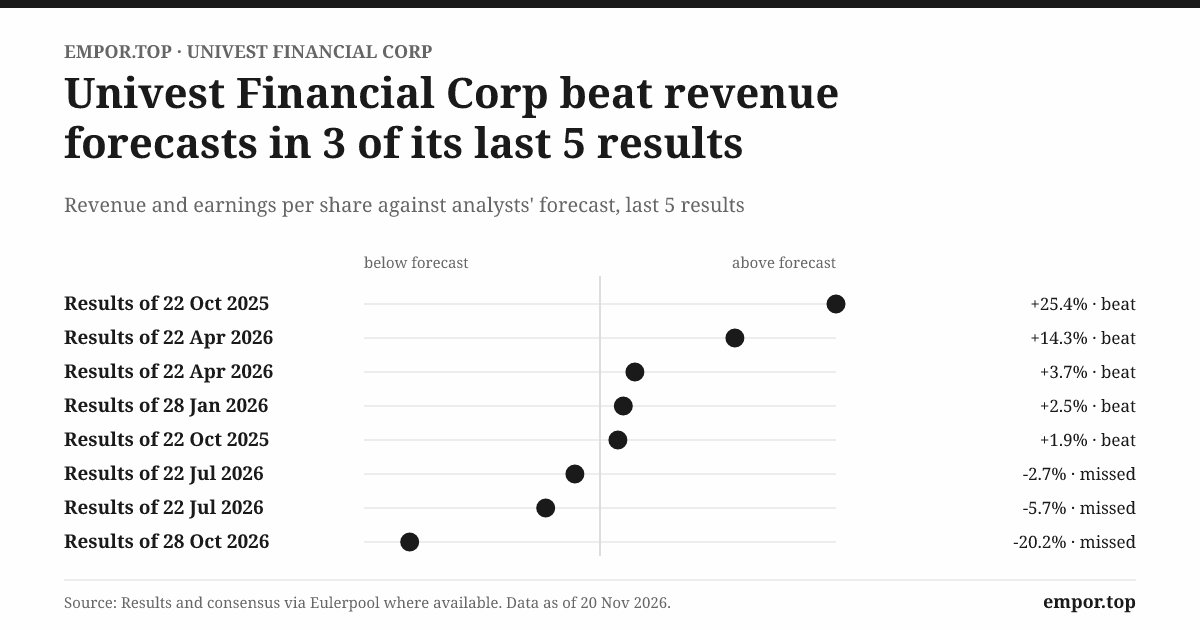
Then came the line that defined the quarter. When the company reported its third-quarter results in late October, it disclosed a $14.4 million charge-off on a single commercial relationship.1 A charge-off is a bank's formal admission that money it lent will not come back. It is the moment a worry becomes a loss. And in a quarter when everything else was moving the right way, one borrower turned the headline from recovery to credit.
The arithmetic was blunt. Net income fell 13.7% from a year earlier, to $21.6 million.1 Net charge-offs for the quarter, meaning loans written off minus anything recovered, reached $17.6 million. A year earlier they had been $480,000.1 That is not a rounding difference. In one quarter, the bank wrote off roughly thirty-five times the previous year's figure.
The story behind the number matters more than the number itself, because it decides whether this was a wound or a symptom. The relationship that produced the large loss was not a surprise that appeared out of nowhere. Univest had already classified it as nonaccrual, the banking term for a loan so troubled that the lender stops booking the interest it is owed because it no longer expects to collect it on schedule.1 The total exposure was $28.3 million, and the bank had already set aside a specific reserve of $9.8 million against it.1 When it charged off $14.4 million, then, it was recognizing a loss larger than the cushion it had built. The difference, about $4.6 million, had to come from fresh provisions that hit this quarter's earnings. What kept the loss from being larger was a letter of intent to sell the borrower's business, which management said supported the remaining carrying value of roughly $14 million.1
That detail cuts both ways. A letter of intent is a real document and a sign that a buyer exists. It is also not a closed sale. The remaining balance was supported by a transaction that, at the time of the filing, had not yet happened. Investors could reasonably take comfort that the bank had marked the loan toward what a buyer would pay. They could equally note that the first reserve proved too small, which is the kind of fact that makes the second estimate worth watching.
A second, smaller relationship added to the bill. Univest charged off $2.7 million on a separate commercial exposure of $6.9 million, and the remaining balance was repaid during the quarter.1 That one at least ended. The loan is gone from the books, the loss is known, and nothing about it lingers.
Put those two together and something useful appears. The two relationships account for about $17.1 million of the $17.6 million in net charge-offs. Strip them out, and the rest of the loan book produced roughly half a million dollars of net losses, which is close to the prior year's pace. That is the strongest version of the bull argument: two borrowers, not the whole portfolio. But it is also the reason the bear argument does not go away, because the broader credit numbers had been deteriorating before the charge-off arrived. Nonaccrual loans and leases rose from $13.7 million at the end of 2025 to $31.2 million at the end of September 2026.1 Nonperforming assets, the wider bucket that adds foreclosed property and loans past due but still accruing, rose from $37.8 million to $51.4 million.1 Those balances were measured after the big relationship had been written down, so the rise is not simply the same loan counted twice.
A rough way to feel the scale: the quarter's net charge-offs, if repeated for a full year, would equal about 1% of a loan book that was around $6.9 billion at the end of 2025.2 No bank wants to run at that pace, and Univest's own provision outlook implies it does not expect to. But the figure shows how quickly a lender with modest loan growth can see a year of earnings momentum interrupted by a handful of decisions made years earlier at a loan committee table.
So the quarter is not a simple bad quarter. It shows two things at once. One is a real earnings engine: a margin that had recovered, deposits that grew and fee lines that expanded. The other is a real credit problem, concentrated in a small number of commercial relationships but large enough to cancel a year's worth of earnings growth in a single reporting period. Whether that problem is contained will not be settled by management's description of it. It will be settled by the next few quarters of charge-offs, nonaccrual balances and loan growth.
That framing sets up the questions this story has to answer. Can core lending absorb losses of this size without turning every quarter into a credit test? Are the deposits that fund the improving margin stable enough to stay when competitors bid for them? How much of Univest's long record of growth came from building, and how much from buying? And does a share price that sits above the company's own historical earnings multiple already assume a smoother credit cycle than the one that just showed up? To answer any of them, it helps to know what kind of bank this actually is, and how a small Pennsylvania lender grew into an institution where a $14 million loss is a setback rather than a catastrophe.
 Subscribe on LinkedIn
II. A Community Bank with a Regional Ambition
Souderton, Pennsylvania, is the kind of town where a bank once doubled as a civic institution. It sits in the Indian Valley of upper Montgomery County, north of Philadelphia, in country that was farms long before it was commuter suburbs. That is where Univest's story starts, and the company still leans on that origin. Its 2025 annual report set 149 years of local banking beside a modern footprint of 38 financial centers and 14 commercial and corporate offices.3 The number of years is the brand. The number of offices is the business.
The long history can be told briefly, because most of what matters to an investor happened recently. A locally rooted bank grew outward from its Pennsylvania base, layered on trust, insurance and investment services, and eventually organized itself as a holding company. Today, the listed company's economics are centered on Univest Bank and Trust Co., with subsidiaries in insurance, wealth management and equipment financing.2 There is no controlling parent and no family block steering the ship; the largest holders are index and institutional investors.4 Univest is a public bank in the plainest sense: its owners are spread out, and its fate is tied to the economies of the counties it serves.
By September 2026, the company held about $8.6 billion of assets and supervised or managed about $6.2 billion of wealth assets for clients.1 For a bank that had roughly $2.2 billion of assets at the end of 2014, that is a transformation.3 Nearly quadrupling the balance sheet in about a decade moved Univest from a community bank into the ranks of serious regional lenders, the tier where a bank can fund larger commercial loans, afford dedicated compliance and technology teams, and carry specialists in areas such as agriculture or equipment finance.
But scale in banking is relative, and it pays to be clear about where Univest sits. It competes in southeastern Pennsylvania and neighboring markets against national banks with hundreds of billions or trillions of dollars of assets, against larger regional lenders and against dozens of community banks that know the same customers.2 An $8.6 billion bank is big enough to matter in a county and small enough to be a rounding error in a national bank's quarterly report.
The deposit rankings capture that position well. In its 2025 report, Univest ranked fourth in deposit market share in Montgomery County, its home county; sixth in Bucks County; and tenth in Lancaster County.3 Across Montgomery, Bucks, Chester and Philadelphia counties combined, it held about 4.0% of deposits.3 That is density, not dominance. Fourth place in a home county means the bank is a familiar name at the local chamber of commerce, but also that three larger institutions are competing for the same household paycheck and the same business operating account.
One niche offers a sharper picture. Univest ranked second among Pennsylvania agricultural lenders and 34th nationally in 2025.3 In a state where dairy farms, poultry operations and agribusiness still matter in counties like Lancaster, that is a genuine specialty. Agricultural lending requires lenders who understand commodity cycles, land values and the seasonality of farm cash flow, and that knowledge is slow to build. It is evidence of a focused lending position. It is not proof of pricing power, because farmers can and do shop their loans, and the Farm Credit system competes hard for the same borrowers.
The newer chapter is geographic. Univest pushed into Western Pennsylvania and Maryland, markets where it had no historic franchise and had to hire bankers who brought relationships with them. By 2025, management reported that those expansion markets had turned profitable and were accretive to earnings.3 That claim matters because it describes a different growth model from the one that built most of the balance sheet. Hiring teams and opening offices is slower than buying a bank, but it avoids paying a premium for someone else's customers.
The company has not disclosed the size of those markets' loans, deposits or profits in a way that lets an outsider calculate their return on the capital and expense invested. "Profitable and accretive" is a threshold, not a yardstick. It tells investors the new offices are no longer a drag. It does not tell them whether they earn more than the bank's cost of capital or how long they took to get there.
That leaves the central question of this chapter. Scale is only useful if it makes the bank better at the local business of gathering deposits, making sound loans and keeping customers. Univest became a regional franchise largely by doing something else first. It bought. And the biggest purchase it ever made is the best place to test whether buying built something durable.
III. The Fox Chase Bet: Buy a Bigger Philadelphia Footprint
In December 2015, Univest announced it would acquire Fox Chase Bancorp, a Hatboro-based bank holding company with a footprint in the Philadelphia suburbs.5 The deal was valued at roughly $244 million in stock and cash, and the logic was geographic and simple: Fox Chase would deepen Univest's presence in Bucks, Montgomery and Philadelphia counties, the most valuable banking markets in its region, with a locally managed bank that already had lending teams, offices and customers there.5
It was a big bite. Fox Chase brought roughly $1.1 billion of assets, $739 million of loans and $718 million of deposits.5 For a company that had about $2.9 billion of assets at the end of 2015, that was the equivalent of adding more than a third to the balance sheet in one move.3 Consideration was split 60% stock and 40% cash, meaning Fox Chase shareholders would become meaningful owners of the combined company.5
The deal also landed on top of another. A year earlier, on January 1, 2015, Univest had completed its acquisition of Valley Green Bank, a smaller Philadelphia-area lender.6 Valley Green gave Univest an urban foothold in the city's northwest neighborhoods. Fox Chase gave it the suburbs on a much bigger scale. Together they turned Univest from a bank anchored in upper Montgomery County into one whose map overlapped with the core of the Philadelphia market.
What Univest paid, and what it promised
Bank acquisitions are priced like most purchases: by what the buyer pays relative to what it gets, and by what it expects to earn afterward. Univest's own presentation gave the investor world both sides.
On price, the deal was valued at 1.34 times Fox Chase's tangible book value and 23.2 times its trailing earnings, with a 10.5% core deposit premium.5 Those three figures describe three different ways of asking the same question. Tangible book is roughly what the bank's net assets were worth on paper after stripping out intangibles; paying 1.34 times that means paying about a third more than the accounting value of the equity. Twenty-three times earnings is the multiple a buyer pays for a stream of profits, and it was well above what Univest's own shares traded at. The deposit premium is the price of the customer relationships: for every $100 of core deposits, Univest effectively paid $10.50 above their tangible equity backing. Univest's benchmark was that the pricing was "in-line" with precedent transactions.5 That is the right comparison for a buyer to make, but note what it is not. It is not a claim that the bank was cheap.
A buyer paying 23 times earnings needs to change those earnings. The projected case relied on $10.2 million of annual pretax cost savings, which the presentation put at about 44% of Fox Chase's noninterest expense.5 That is an aggressive figure on its face, cutting almost half the target's operating costs, though it is the kind of number banks achieve when branches overlap and back offices can be merged. Against that, Univest expected about $20 million of one-time merger costs and took a $13.5 million credit mark, a haircut on Fox Chase's loans to reflect expected losses.5 On those assumptions, management projected roughly 7% accretion to 2017 earnings per share after cost savings, an internal rate of return of about 16%, and an earnback of tangible-book dilution in under five years.5
Those numbers explain the strategy better than any slogan. Univest was paying a full price for geography, and it planned to earn back that price mainly by taking cost out, not by repricing customers. The bet was that a merged branch network and back office could serve Fox Chase's customers far more cheaply than Fox Chase could on its own.
The deal closed in 2016, after the merger was registered with the SEC that year.72 The premium Univest paid above Fox Chase's net assets became goodwill and intangible assets on its balance sheet, which is why Univest's shares today trade at a higher multiple of tangible book than of ordinary book value. That gap is the accounting fossil of the acquisition decade.
Separating the forecast from the result
So did Fox Chase earn its 16%? Univest has never published a standalone return on the acquisition, and once the two banks were combined, there was no clean way for an outsider to isolate one. The filings establish the price and the forecast. They do not provide a realized return that proves the deal met its projected economics.
What the consolidated record does show is instructive. The balance sheet jumped: total assets rose from about $2.9 billion at the end of 2015 to $4.2 billion a year later, and shareholders' equity rose from about $362 million to $505 million, largely because of the stock issued to Fox Chase holders.3 Borrowings also rose sharply that year, from about $74 million to $418 million.3 Earnings went the other way at first. Net income fell from about $27 million in 2015 to $19 million in 2016, and diluted earnings per share fell from $1.40 to $0.73, as merger costs and integration hit the income statement.3 Even the dividend payout ratio spiked to about 89% that year, because the dividend held steady while earnings fell.3
The recovery came, but on a per-share basis it was slower than the balance sheet's growth. Earnings per share were $1.50 in 2017, only modestly above 2015's level, in a year when the federal tax overhaul also distorted bank earnings, and they reached $1.72 in 2018 and $2.24 in 2019.3 Shareholders were also diluted again by a common-stock offering in late 2017.8 The fair reading is that the acquisitions helped change the company's scale and eventually its earning power, but that per-share returns took several years to catch up with the bigger footprint. The record narrows the bull claim. It does not reject it.
Those years left a growth record that looks impressive in a long-run chart and needs care in interpretation. From 2015 to 2025, revenue grew about 12.9% a year and net profit about 12.8% a year.3 Those figures include Valley Green, Fox Chase and, in 2021, the Sheaffer Insurance Agency, which added to the insurance business.2 They are not an organic growth series. They describe what Univest became, not how fast its core franchise grows when it is not buying anything.
Univest has not repeated the Fox Chase playbook. The strategy described in recent company materials emphasizes local expansion through hiring, cross-selling more services to existing customers and operating improvements.9 That shift could reflect discipline, or the simple fact that bank acquisitions became harder to price and approve in the years after 2016. Either way, the test of the strategy has moved. The question is no longer whether Univest can buy a bigger footprint. It is whether the footprint it already owns can earn attractive returns, and that requires opening up what a relationship bank actually sells.
IV. What Does a Relationship Bank Actually Sell?
Picture the owner of a mid-sized manufacturing business in Bucks County. She needs a line of credit to carry inventory, a term loan for a new piece of equipment, a way to collect payments and pay suppliers without running checks across town, insurance for the plant and the trucks, and, eventually, someone to manage the money she takes out of the business. A national bank can provide most of that, and an app can provide some of it. Univest's pitch is that a local banker can connect all of it through one relationship and know her well enough to say yes when a spreadsheet alone would say maybe.
That pitch is the whole company in miniature. Whether it works depends less on the warmth of the relationship than on the economics underneath it.
Start with the core. A bank earns interest on loans and securities and pays interest on the deposits and borrowings that fund them. That spread produced about 73% of Univest's revenue in 2025; fee businesses produced the other 27%.3 Think of the bank as a shop that buys money wholesale from depositors and sells it retail to borrowers. The size of the markup depends on loan yields, what competitors pay for deposits, how much of the funding is free checking money, and how many loans go bad. Each of those forces can shrink the markup before any of it reaches shareholders.
The biggest shelf in Univest's shop is commercial real estate and construction lending, which totaled about $3.53 billion at the end of 2025.2 Against total loans and leases of about $6.91 billion, that is roughly half the book.2 Commercial real estate loans are the bread and butter of regional banks because they are large, secured by property and familiar to local lenders who know the buildings. They also carry a particular risk: when one large project or owner runs into trouble, the loss can be big and lumpy, as the third quarter demonstrated. The relationship model's payoff from commercial borrowers is that they may also bring operating deposits and pay treasury-management fees for payment and cash services, which makes the whole relationship more valuable than the loan alone.
The fee businesses, in proportion
Around that core, Univest runs a set of businesses that charge fees rather than earning spreads. Wealth management is the largest and the one with the clearest momentum. Wealth fees grew 10.3% from a year earlier in the third quarter of 2026, and 11.3% over the first nine months.1 Client assets under management and supervision were about $5.9 billion at the end of 2025 and roughly $6.2 billion by September 2026.31 Wealth fees are attractive because they are typically tied to asset levels rather than to borrowing, so they do not depend on loan demand and require no capital to support a loan book. They do depend on markets: a falling stock market shrinks the asset base on which fees are charged.
It is worth being precise about what $6.2 billion means. It is the value of client money the company manages or supervises, not revenue. A wealth business earning fees on that base collects a small percentage of it each year, so the revenue line is a fraction of the headline asset figure. The headline tells a listener the business is real and growing; it does not tell them it is large relative to the bank.
The other fee lines are best understood as footprint measures. Univest serviced about $1.1 billion of loans for other investors, collecting fees for handling payments on mortgages it originated and sold.3 Its insurance agency wrote about $230 million of premiums for clients, and the company collects commissions on that volume rather than the premiums themselves.3 Equipment-financing outstandings were about $232 million.3 Each of those numbers sounds substantial, and each measures activity rather than profit. A dollar of insurance premium written and a dollar of loan serviced are not comparable to a dollar of revenue.
Mortgage banking adds another, more cyclical piece. Univest closed about $276.7 million of residential mortgages in 2025.3 Mortgage volumes rise when rates fall and refinancing booms, then shrink when rates stay high, so this business makes a smaller and more volatile contribution than wealth or insurance. It is useful as a door into household relationships and a source of gains on loan sales, but it is not a steady earnings engine.
Taken together, the fee businesses make Univest more diversified than a pure lender. KBRA, the rating agency that covers the company's debt, said fee businesses have historically contributed about 25% to 30% of revenue, and cited that diversification as a credit strength.10 That is meaningful. A bank with a quarter of its revenue from fees has some cushion when loan spreads compress. But the cushion is not a replacement for banking. Three-quarters of revenue still comes from the spread, and the spread is where the credit losses land.
The claim that needs proof
The relationship pitch rests on a claim that personal service and cross-selling create customers who stay longer, use more products and are less price-sensitive. That claim might be true. It is also the claim every community bank makes, and it needs operating proof. Univest's filings describe cross-selling efforts and investment in customer experience, but the company does not publish a consistent consolidated series on customer retention, products per customer or deposit concentration that would let an investor test it.2 Without those figures, the moat remains a reasonable hypothesis rather than a demonstrated fact.
There is also a funding side to every relationship, and it is easy to forget. The same banker who wins a business's loan must win its deposits, and deposits can leave faster than loans can be repaid. Univest relies in part on public-fund deposits from municipalities, school districts and other public entities, and those balances are seasonal: they swell when tax revenue arrives and drain as governments spend it.2 Public funds are relationships too, often built over years, but they are relationships with treasurers whose duty is to earn a good rate for taxpayers. That is where the relationship model meets pricing discipline, and it is exactly where the margin story of 2026 is being tested.
V. The Margin Recovery Has a Deposit Bill
Every autumn, money pours into the accounts of Pennsylvania's townships and school districts. In the third quarter of 2026, the tide came in. Total deposits rose 6.1% from the prior quarter, to about $7.35 billion, driven by seasonal public funds and higher commercial balances.1
That inflow made the balance sheet look stronger and the margin look weaker at the same time, and the explanation is the best way to understand how a bank's profitability actually works.
Net interest margin is the bank's markup expressed as a percentage: net interest income divided by the assets that earn interest. In the third quarter, Univest's reported margin was 3.42%, up from 3.17% a year earlier.1 That is a meaningful improvement. A quarter of a percentage point on a balance sheet of more than $8 billion is real money, and it is why net interest income grew by double digits while loans barely moved. Over the first nine months, the margin was 3.41% versus 3.15% a year earlier.1 The recovery is visible in every measure.
But the reported margin actually fell from the second quarter, from 3.49% to 3.42%.1 The reason was the tide. When deposits flood in faster than the bank can lend them, the excess sits in cash and short-term deposits earning modest rates. Those balances add to interest-earning assets, the denominator of the margin, without adding much to income, so the percentage falls even as total income rises. Univest estimated that excess liquidity reduced the third-quarter margin by about 13 basis points; excluding that effect, the margin would have been about 3.55%, a modest improvement from the second quarter on the same basis.111 At the end of September, cash and interest-earning deposits stood at about $625 million.1
That adjustment is reasonable as analysis, and it is also management's preferred lens. The underlying point is real: the bank was not losing pricing power in the quarter; it was carrying idle cash. But the adjusted margin depends on the cash being temporary. If the public funds stay, they need to be lent or invested profitably. If they leave, the bank must have funded its loans without them. Either way, the adjusted figure is a description of a balance sheet in motion, not a stable state.
Free money and borrowed money
The most valuable deposits are the ones that pay nothing. About 19.1% of Univest's deposits were noninterest-bearing at the end of September, roughly $1.4 billion of operating accounts, business checking and similar balances that cost the bank only the expense of servicing them.1 When rates were near zero, every bank had plenty of such money. As rates rose, customers moved cash into interest-bearing accounts, money-market funds and Treasury bills, and banks across the country watched their cheapest funding shrink. A share near one-fifth tells investors that Univest still holds a meaningful base of relationship money, but that four of every five deposit dollars carry a rate that competitors can bid up.
The bank also leans on wholesale funding, meaning borrowing from the Federal Home Loan Bank system, brokered deposits and capital markets rather than from its own customers. KBRA put wholesale funding at about 11% of total funding and listed it, together with public-fund seasonality, as a constraint on the rating.10 In the same review, the agency noted the bank's available liquidity and its diversified fee base.10 At the end of 2025, Univest reported about $2.3 billion of available committed borrowing capacity, a backstop that matters if deposits leave quickly.2
By September 2026, the company's real borrowings were modest: $125 million of long-term debt, about $99 million of subordinated notes and a trivial amount of short-term borrowings.1 Total borrowings had fallen by about $99 million since the end of 2025, mainly as Federal Home Loan Bank advances matured.1 That is the virtuous side of the deposit inflow. Customer money replaced some borrowed money, and because borrowed money is usually more expensive, the swap helped the margin.
What management promised
On the third-quarter call, management framed its operating outlook for 2026 around loan growth of 2% to 3% and net interest income growth of 10% to 11%, while acknowledging deposit competition and the resolution of problem credits as caveats.11 That combination is revealing. A bank that expects interest income to grow four or five times faster than its loans is telling investors that the margin is doing the heavy lifting. Some of that comes from assets repricing upward: fixed-rate loans made when rates were low mature and are replaced at higher yields. Some comes from deposit costs easing. Neither mechanism lasts forever, and both depend on competitors behaving rationally.
The context makes the loan growth target modest. Loans and leases grew from about $6.83 billion at the end of 2024 to $6.91 billion at the end of 2025, a little over 1%.2 A 2% to 3% target is an improvement on that pace, but it is still the growth rate of a bank prioritizing pricing and credit over volume. That is a defensible choice in a year when one commercial borrower showed what a bad loan costs. It also means the margin, not the balance sheet, carries the earnings story.
The next proof point is therefore not complicated. When the public funds flow out in the winter and spring, as they do every year, does Univest keep its core deposits, and does its margin hold without depending on excess liquidity in the denominator? If deposit costs climb to retain balances, the margin recovery will turn out to have had a bill attached. If they hold, the recovery is real. Either way, the credit question will be answered alongside it, because the third quarter showed that a margin recovery can be erased below the line.
VI. The Quarter the Credit Story Changed
Earnings calls usually open with the good news. On Univest's third-quarter call on October 29, 2026, Chairman and CEO Jeffrey Schweitzer led with the loss.11 He walked through the $14.4 million charge-off on the commercial relationship, the reserve the bank had already set aside, the letter of intent supporting the remaining value, and an expectation that criticized and classified loans would decline in the fourth quarter.11 Criticized and classified loans are the bank's internal watch list, the loans that examiners and credit officers have flagged as weaker than they should be, from merely worth monitoring to substandard or doubtful. Telling investors that list would shrink was a forward credit marker, and a specific one.
There is something to be said for that order of operations. A management team that buries the bad number on slide twelve is asking to be distrusted. One that starts with it is at least signaling it understands what investors care about. But tone is not evidence, and the prepared remarks set up a claim that can only be tested later: that the problem was a workout of known relationships rather than the start of a broader deterioration.
The year-to-date numbers show why management could plausibly describe the bank as healthy while the quarter looked weak. Net income for the first nine months of 2026 rose 5.3% from the prior year, even after the charge-off.1 Quarterly net income had been strong in the first half, at about $27 million in the first quarter and $22 million in the second, before falling to $21.6 million in the third.1 The provision for credit losses in the third quarter, the expense a bank records to build reserves for future losses, was $9.0 million.1 Management's outlook for full-year 2026 provisions was $15 million to $17 million, subject to loan growth, economic conditions and how workouts were resolved.11
That range carries an implication worth spelling out. If the first three quarters already included a heavy third-quarter charge, the outlook leaves a limited amount of room for the fourth quarter. A provision at the high end of the range would suggest the problem is still unfolding; anything materially above it would mean the guidance failed within a single quarter. That makes the fourth-quarter report an unusually clean test of management's credit view.
The questions on the call returned to the obvious pressure points: concentration in the commercial book, the expected path of provisions, the margin and loan growth.11 The answers matched the prepared narrative of a contained, identified problem with a plan for resolution. What the call could not provide, because no call can, was proof. A credit officer can describe how a loan went bad and how the bank intends to recover what remains. Only the next filings can show whether the watch list actually shrank.
Do not call it a one-off yet
It is tempting to treat a loss driven mostly by a single borrower as an isolated event, and the arithmetic of the quarter supports part of that view, since two relationships produced nearly all of the net charge-offs. But the rise in nonaccrual balances began before the charge-off and survived it, which means the bank's troubled-loan balances were broader than one name. A single large loss is a story about one underwriting decision. A rising nonaccrual balance alongside slow loan growth is a story about the denominator: if the loan book is not growing much, each problem loan is a bigger share of it, and there are fewer new, freshly underwritten loans to dilute it.
The right way to watch it is in three series moving together: net charge-offs, nonaccrual balances, and criticized and classified loans, set against organic loan growth. If charge-offs return toward their old pace, nonaccruals fall as the letter of intent becomes a sale, and the watch list shrinks as promised, the third quarter will look like an expensive workout. If instead new names appear on the nonaccrual list while loan growth stays slow, the third quarter will look like the first chapter of a credit cycle.
There is a contingent layer to the loan book as well. At the end of 2025, Univest had about $1.81 billion of commitments to extend credit and letters of credit outstanding.2 Those are promises to lend in the future, such as unused credit lines and construction draws, plus guarantees of customers' obligations to third parties. The headline amount is not an expected loss; most commitments are never fully drawn, and those that are become ordinary loans subject to the same underwriting. But they matter for two reasons. They define how much new credit exposure the bank has already agreed to take on, and they are a call on liquidity if many customers draw at once. They belong in the underwriting and liquidity conversation, not in a catastrophe scenario.
The filings do not show a legal overhang behind the credit story. The company said pending and threatened legal actions were not expected to materially affect its results or financial position, and its auditor, KPMG, gave an unqualified opinion on the 2025 financial statements and internal controls with no material weakness reported.12 The credit question is a business question, not an accounting or legal one.
And there is one more decision that sat beside the charge-off in the same quarter. While the loan book was being tested and the watch list was being worked down, management was still buying back stock. That choice says something about how the people running Univest think about capital, value and risk, and it deserves its own look.
VII. Buybacks, Incentives and the Schweitzer Era
In the same three months that Univest wrote off $14.4 million on one borrower, it bought back 301,127 of its own shares at an average all-in price of $42.96.1 That was roughly $13 million returned to shareholders who chose to sell. On November 20, 2026, the shares closed at $38.41.12 On that one date, the company had paid about 12% more for its stock than the market was then asking.
It would be easy to turn that comparison into a verdict, and it would be wrong. A single day's price is noise; the stock had traded as high as about $45 and as low as about $30 over the previous year.12 What the purchase does offer is a window into how management weighs its options, because every dollar spent on buybacks is a dollar not held as capital against a loan book that had just produced its largest loss in years.
The man making that call has run Univest for more than a decade. Jeffrey Schweitzer has been chief executive since 2014 and became chairman of the board in 2024, combining the two top roles.4 Brian Richardson has been chief financial officer since 2019.4 That continuity is a feature for creditors; KBRA cited experienced management as a strength in its rating.10 It also means the record of the past decade is largely this team's record, including the Fox Chase integration, the expansion into Western Pennsylvania and Maryland, and the credit decisions that produced the 2026 losses. The board has twelve members, only one of whom is from management, with a lead independent director.4 Combining the chair and CEO roles is common among American banks, but it puts more weight on the independent directors to provide a counterweight.
What the people in charge are paid to do
Compensation tracks the shape of the business. Schweitzer's total 2025 compensation was about $2.1 million, and the other named executives averaged about $0.9 million.4 Those are modest figures by national bank standards and ordinary for a bank of Univest's size. More telling is how the pay moved. Net income rose from about $75 million in 2024 to $90 million in 2025.2 The proxy reported that annual cash incentives paid out at 122.9% of target, while long-term awards for the 2023 to 2025 performance period vested at 77.8% of target.4
That pair of numbers says more than the totals. The annual bonus rewarded a strong 2025, the rebound year. The long-term award, measured over three years that included the weaker 2023, paid out below target. In other words, the plan worked roughly as such plans are meant to: good years paid more, a mediocre stretch paid less. It does not prove the plan rewards the right things, but it suggests the long-term metrics have teeth.
Ownership gives some, though not a great deal, of alignment. Schweitzer beneficially owned 132,564 shares in the proxy's February 2026 snapshot, worth about $5 million at November's price, more than twice his annual pay.4 The 17-person group of all directors and executive officers owned about 1.8% of the company.4 That is enough to make the people running the bank care about the share price, and nowhere near enough to give them control. The largest holders are institutions: FMR, BlackRock, Dimensional and Vanguard each reported stakes of roughly 5% to 9% in the proxy, and FMR's later filing showed its position at about 5.6% by June 2026.413 Univest's owners are mostly index and active funds who can vote, sell, or do both.
How the buyback fits
The Q3 repurchase did not come out of nowhere. On the fourth-quarter 2025 call in January, management said about 2.3 million shares remained available under the repurchase authorization at year-end and targeted $10 million to $12 million of buybacks a quarter in 2026.14 The third-quarter spend of roughly $13 million was slightly above that range, in the quarter of the big charge-off. That is consistent with the plan management laid out, not an improvisation. It is also a choice to keep buying at a pace above guidance just as credit got worse.
Whether that was wise depends on the price relative to what the shares are worth, and on capital needs. At $42.96, the bank was paying about 1.4 times its book value per share of roughly $30.112 For a bank earning around 10% on its equity, buying stock at 1.4 times book means accepting roughly a 7% earnings yield on the purchase, before considering whether a tangible-book measure would be stricter. That is not obviously a bad trade. It is not a bargain either, and it competes with the alternative of holding capital that KBRA already describes as below peers.10
The dividend is the quieter channel. At the latest quarterly rate of $0.23, the annual dividend is about $0.92 a share, a yield of roughly 2.4% at November's price.112 Over the past dozen years, the payout ratio has ranged from about 25% of earnings to almost 89%, the latter in the 2016 merger year, and it was about 28% in 2025.3 Dividends cost about $25 million in 2025.2 That is a meaningful return, but at roughly a quarter of earnings it is not the dominant use of capital. Buybacks, and the retained earnings that support lending, carry more weight.
The dissent in the ballot box
Shareholders did not wave everything through. At the 2026 annual meeting, the advisory vote on executive pay passed, but with about 561,000 votes against.15 Director Robert Wonderling received 1,430,817 withheld votes in the board election.15 The company does not explain the withheld votes, and investors who withhold rarely publish their reasons, so it would be speculation to assign a specific cause. But a withheld count in the millions for a single director stands out against a company whose market value implies roughly 31 million shares outstanding, and it is a governance signal worth tracking at the next meeting.
Related-party lending is not a channel worth worrying about. Loans to directors, executives and their affiliated companies started 2025 at just $35,000, were collected in full and ended the year at zero, and the company said the terms matched those available to comparable customers.2 For an $8 billion bank, that is effectively nothing.
What matters more for credibility is behavior over time. Management told investors in October that criticized and classified loans would fall in the fourth quarter.11 It told them in January that it would buy back $10 million to $12 million of stock a quarter, and it did. The buyback promise has been kept. The credit promise is the next one to be tested, and a credible team will either deliver it or explain clearly why it could not. That matters more than any compensation table, and it matters most when a bank's advantage is supposed to be the quality of its local judgment.
VIII. The Local Franchise Against the Banks Next Door
Drive through the commercial corridors of Montgomery County, and the competition is visible on the street corners. National and regional names such as PNC, Wells Fargo, Citizens and M&T operate in the same markets as Univest's financial centers.2 Each wants the same deposits, the same small-business owners and the same mortgage customers. That is the battlefield on which Univest has to defend its franchise, and the honest description of its position is that it is a meaningful local lender with a modest deposit share beside the largest institutions.
The share figures make the point. Univest's share across Montgomery, Bucks, Chester and Philadelphia counties remained modest.3 In a peer table filed with the SEC in November 2026, Univest showed about $8.2 billion of assets, close to CNB Financial at about $8.4 billion and larger than Mid Penn at about $7.1 billion.16 Its efficiency ratio, the share of revenue consumed by operating costs, was about 60.3%, against a peer median of 57.7%.16 Put simply, for every $100 of revenue, Univest spent about $60 to run the bank, roughly $2.60 more than the typical peer in the comparison. That is not a dramatic gap, but it is the wrong direction for a company whose scale is supposed to be an advantage.
The five forces in the Philadelphia suburbs
A useful way to war-game Univest's position is to run through the forces that shape any industry's profits, using the bank's own economics rather than abstractions.
Start with customers, who hold real power. A business owner can keep accounts at two banks, and many do. A depositor can move a balance with a few clicks. A treasurer managing public funds is obligated to seek good rates for taxpayers. That broad customer choice is the single most important force acting on Univest, because it caps both loan pricing and deposit pricing at the same time.
Rivalry is intense and comes in several layers. National banks such as PNC, Wells Fargo and M&T bring national brands, large technology budgets and the ability to lend to almost anyone. Regional banks such as Citizens compete for the same middle-market companies. Pennsylvania community and regional banks such as S&T, CNB Financial, Mid Penn, Orrstown and Peoples Financial Services compete for the customers who prefer a local lender.16 Univest is near the scale of several of those community-bank peers and much smaller than the national competitors, which means it faces both a technology gap above it and a local-knowledge contest beside it.
The supplier of a bank's raw material is the depositor, and that turns the supplier force into a second form of customer power. When competitors raise deposit rates, Univest must either match or let money leave. That dynamic is exactly what made the margin a battleground in 2023 and 2024 and what keeps deposit competition on management's list of caveats.11
Substitutes are growing. Money-market funds, Treasury bills and online banks compete for deposits; private credit funds and nonbank lenders compete for commercial loans; fintech payments companies compete for small-business transactions. None has displaced the community bank, but each skims a profitable slice.
The threat of new entrants is lower than in many industries, because a bank charter, capital requirements and regulatory examinations are significant barriers. But that barrier protects the industry as a whole more than it protects any individual bank. The regulatory and compliance costs that keep new banks out also weigh more heavily on smaller institutions like Univest than on national banks that spread those costs over far larger customer bases.
Why Univest might win, and why it might not
The case for Univest's franchise rests on concrete assets. It operates 38 financial centers and 14 commercial and corporate offices.3 It holds deposit-market density in its core counties, with top-five share in its home county.3 It has a sizable agricultural lending position that requires specialist knowledge few competitors bother to build.3 And it owns wealth, insurance, mortgage and equipment-finance businesses that give a banker more than a loan to offer. Those capabilities can support cross-selling, and cross-selling, when it works, makes relationships stickier.
The case against is equally concrete. A 4.0% combined share is not dominance. The 2026 peer comparison showed Univest's efficiency and returns as mixed rather than superior.16 Customers can multi-bank, and larger banks can spread technology and compliance costs over many more customers. A local bank's informational edge, knowing a borrower personally, is real, but the third quarter was a reminder that local knowledge does not immunize a lender against a bad commercial credit.
The strategic language Univest uses, of being a trusted advisor and modernizing its digital capabilities, describes what the company intends to be. Until it publishes evidence of better retention, more new relationships, higher price realization or lower service costs, those phrases should be treated as strategy, not results.3 The small-business program offers one concrete example of the strategy in action: simplified checking fees, better digital access and customer-service investments aimed at small businesses, which are a natural source of low-cost operating deposits.3 In 2025, the program's impact was still being built and measured. It is strategically sensible because small-business checking balances are exactly the kind of funding that stays when public funds flow out. Whether it moves the noninterest-bearing deposit share is the measurable test.
One risk that does not need much attention: currency. Univest has no foreign operations, and its pretax income comes from domestic activities, with no material foreign-currency exposure disclosed.2 Its derivatives are mainly interest-rate swaps, customer credit derivatives and mortgage commitments.2 The franchise lives and dies by U.S. interest rates, local credit and the economies of southeastern Pennsylvania and its neighbors.
That makes the investor's question concrete. The franchise has density, specialty and breadth. It does not have demonstrated cost leadership or a published retention edge. So what is the market paying for, and is that price consistent with what the bank can earn through a full credit cycle?
IX. Analysis & Bear vs. Bull Case
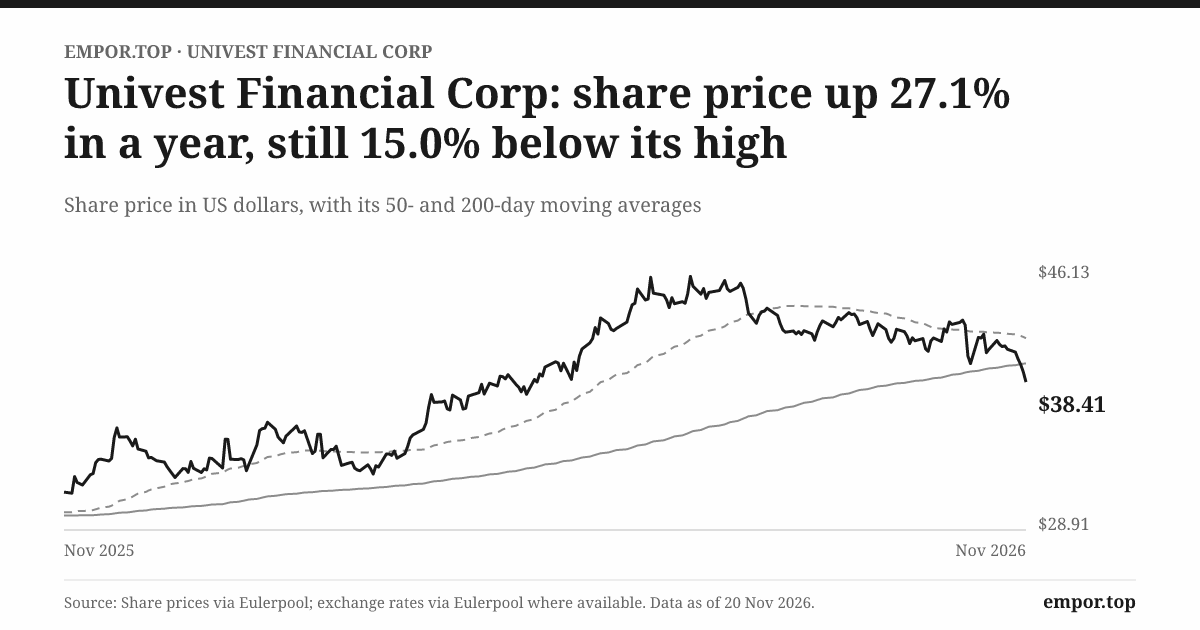
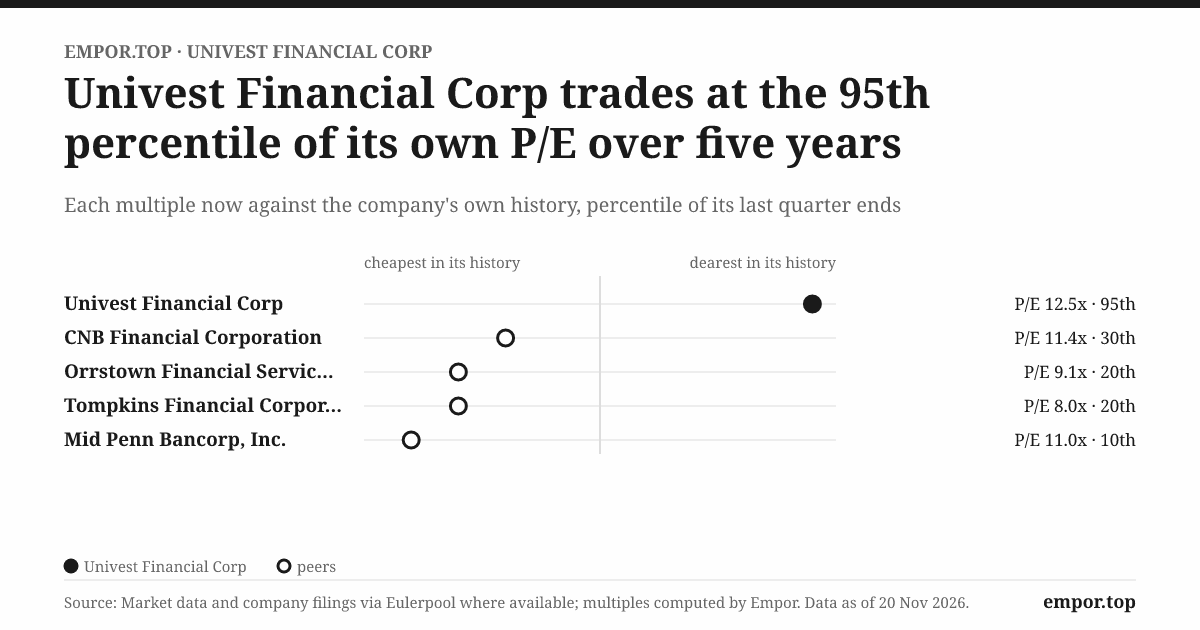
On November 20, 2026, Univest's shares closed at $38.41, about 15% below their 52-week high.12 The stock market valued the company at about $1.2 billion.12 On its trailing earnings of about $3.37 a share, that is about 12.5 times earnings.121 Over the previous five years, the median multiple had been about 10.2 times.12 The shares also traded at about 1.3 times book value and yielded about 2.4%.12
The interesting thing about that valuation is that it points two ways. Against Univest's own history, the stock is more expensive than usual, by about a fifth on the earnings multiple. Against peers, it is not. The September 2026 peer table filed with the SEC showed Univest at about 11.9 times trailing earnings, against a peer median of 12.2 times, and at about 1.52 times tangible book, exactly the peer median.16 The dates and the definitions of book value differ between those snapshots, so they are context rather than a precise comparison. But the message is consistent. The market is pricing Univest roughly like other Pennsylvania regional banks, and richer than it priced Univest itself through most of the last five years.
What does that price appear to assume? For a bank, the relationship between price-to-book and return on equity is the simplest valuation logic there is. A bank that earns exactly its cost of equity should trade at about book value; one that earns more should trade above it. Univest's return on equity was about 9.8% over the last twelve months and about 9.5% in 2025.122 At 1.3 times book, the market is assuming that returns will stay at least there or grow, and that the credit losses of 2026 will not become a recurring tax on earnings. That assumption could prove right. It is an assumption, not a margin of safety.
The bull case, tested
The bull case begins with the margin. It recovered by about a quarter of a percentage point in a year, and net interest income grew by double digits while loans grew slowly.1 Fee businesses contribute about 27% of revenue, and wealth fees are growing at around 10% a year.31 The expansion markets in Western Pennsylvania and Maryland had turned profitable.3 KBRA affirmed its ratings in April 2026 with a stable outlook, citing consistent earnings, experienced management and a common equity tier 1 ratio of 11.2% at year-end 2025, the core regulatory measure of loss-absorbing capital.10
Run that case through the seven sources of durable competitive advantage that strategists use, and the picture narrows. Scale economies are limited: Univest is mid-sized, and its efficiency ratio trails the peer median.16 Network effects do not meaningfully apply to a regional bank. Counter-positioning, a model incumbents cannot copy without harming themselves, is absent; national and regional rivals already offer the same products. Switching costs are real but moderate: moving a business's operating accounts, payment arrangements and credit lines is a nuisance, and treasury-management integration makes it more so, but many customers already multi-bank. Branding exists locally, through a century-and-a-half of presence, but brand in community banking rarely translates into the ability to charge more. Cornered resources are limited to the relationships of individual bankers, who can leave and take customers with them, which is precisely how Univest built its expansion markets. Process power, the hard-to-copy organizational skill embedded in how a bank underwrites, may be the most relevant category, and the third quarter is a reminder that underwriting quality is proved only over a full cycle.
That leaves the most plausible version of Univest's advantage as a combination of moderate switching costs and local process knowledge, supported by breadth across banking, wealth and insurance. That is a real franchise. It is not a wide moat, and the company publishes no retention, products-per-customer or price-realization data that would prove otherwise.
The bear case, tested
The bear case starts with growth. Loans grew a little over 1% in 2025, and management's 2026 target was 2% to 3%.211 Credit costs have risen, with nonaccruals more than doubling in nine months.1 Public-fund deposits are seasonal, wholesale funding is material, and KBRA describes the bank's capital ratios as below peers.10 And a single borrower has already taken a meaningful bite out of quarterly earnings.
The historical record adds weight to the bear side on one claim in particular: the growth rate. The long-run figures look excellent, with revenue and net profit each compounding at about 13% a year from 2015 to 2025.3 But that decade began with Valley Green, absorbed Fox Chase and later added Sheaffer, so those rates include acquired growth.2 They do not establish an organic growth rate, and they do not prove the Fox Chase return forecast was achieved. More recently, net profit grew about 4.9% a year from 2022 to 2025, a fraction of the long-run pace.3 The path was not a straight line either: profits fell in both 2022 and 2023 before rebounding.3 The record therefore narrows the growth claim. Univest is not a 13% compounder by nature; it is a mid-single-digit grower in its recent organic form, with a margin-driven rebound in 2025 and 2026.
The history also tests the stock's resilience. At some point in the last five years, the shares fell by almost half from peak to trough.12 Regional bank shares can swing violently when the market worries about deposits or credit, regardless of a single bank's fundamentals. A multiple above the company's own historical median offers less cushion if that worry returns.
An activist looking at Univest would likely press on three points. First, the efficiency ratio: a bank of this size trailing its peer median on costs invites questions about branch footprint, technology spending and the fee businesses' profitability. Second, capital allocation: buying back stock above 1.4 times book during a credit event, while a rating agency describes capital as below peers, requires a clear explanation of the expected return. Third, disclosure: the company does not publish segment-level returns for its expansion markets, retention data for its relationship model, or a realized return on its acquisitions, which makes the core claims hard to verify from the outside.
The three numbers that decide it
Three measures matter more than any others for tracking whether the bull or bear case is winning.
The first is credit: net charge-offs and nonaccrual balances. The latest readings were $17.6 million of net charge-offs in the third quarter and $31.2 million of nonaccrual loans, both rising sharply.1 They will show whether the third quarter was a workout or a trend.
The second is the core net interest margin and deposit costs after seasonal outflows. The latest reading was a reported margin of 3.42% and a liquidity-adjusted margin of about 3.55%, improving year over year.1 It will show whether the margin recovery survives when public funds leave.
The third is organic loan and fee growth. Loans grew a little over 1% in 2025, while wealth fees grew about 10% in the third quarter of 2026.21 It will show whether Univest can grow without buying another bank or paying away its margin.
Together, those three numbers reveal whether growth, funding and underwriting are working at the same time. A bank can grow loans by lowering standards, protect its margin by refusing to compete for deposits, or keep credit clean by not lending at all. The durable version of Univest is the one where all three improve together. The higher multiple should not be read as proof that the market has recognized a better business. It may simply mean the market has priced in the margin recovery and assumed that credit will normalize. Those are the assumptions the next few quarters will test, and they bring the story back to the deal that first made Univest big.
X. Playbook: Business & Investing Lessons
Go back to December 2015. Univest's board was weighing the price and promised savings of a bigger Philadelphia footprint.5 A decade later, a single commercial relationship had produced a loss large enough to define a quarter.1 Between those two moments sits the whole lesson of the company. Scale arrives in one transaction. Advantage, if it comes at all, arrives one customer at a time.
The first lesson is that a bigger balance sheet is a beginning, not a moat. Fox Chase brought deposits and geography. Per-share earnings, however, took years to catch up with the footprint. The durable payoff from buying a bank never comes from the closing date. It comes from the customers who stay after the sign on the door changes, who borrow again, who move their payroll and their retirement accounts. For investors, the measure of a bank acquisition is not the size of the combined company but the per-share earnings and tangible book value several years later. At Univest, buying the map was easy; earning on it was the work.
The second lesson is that a relationship has two sides. Every community bank celebrates its ability to cross-sell, and Univest has genuine breadth to sell across, from wealth management to insurance to equipment finance. But depositors remain free to move money when a competitor offers more. A relationship is only as strong as the price at which the customer would leave, and that price is set by the competitor down the street, not by the banker who knows her name.
The third lesson is that credit risk hides in concentration. A loan book of nearly $7 billion looks diversified on a slide. The third quarter showed how a small number of commercial relationships can overwhelm that breadth.1 Diversification by category does not prevent concentration by name. In a relationship bank, the largest relationships are the most valuable and the most dangerous, because the same trust that wins the business can soften the questions a credit committee should ask.
The fourth lesson is that buybacks are a price decision. Univest continued its planned repurchases in the third quarter.14 The value of that decision depends on the price and the competing need for capital in a quarter when credit was turning. A repurchase is not a sign of confidence or a gift to shareholders. It is an investment in the company's own stock, and it should be judged like any other investment: by the return it earns against the alternatives, including the alternative of simply holding the capital.
The fifth lesson is that fee diversification cushions the cycle; it does not erase the bank. Wealth and insurance contribute real revenue and real growth, and they deserve credit for making Univest less dependent on the spread than many peers. Fee businesses cushion the cycle, while the spread remains the dominant revenue source.3 When a large commercial loan goes bad, no amount of wealth-management fees changes the fact that the core of the business is lending other people's money and getting it back.
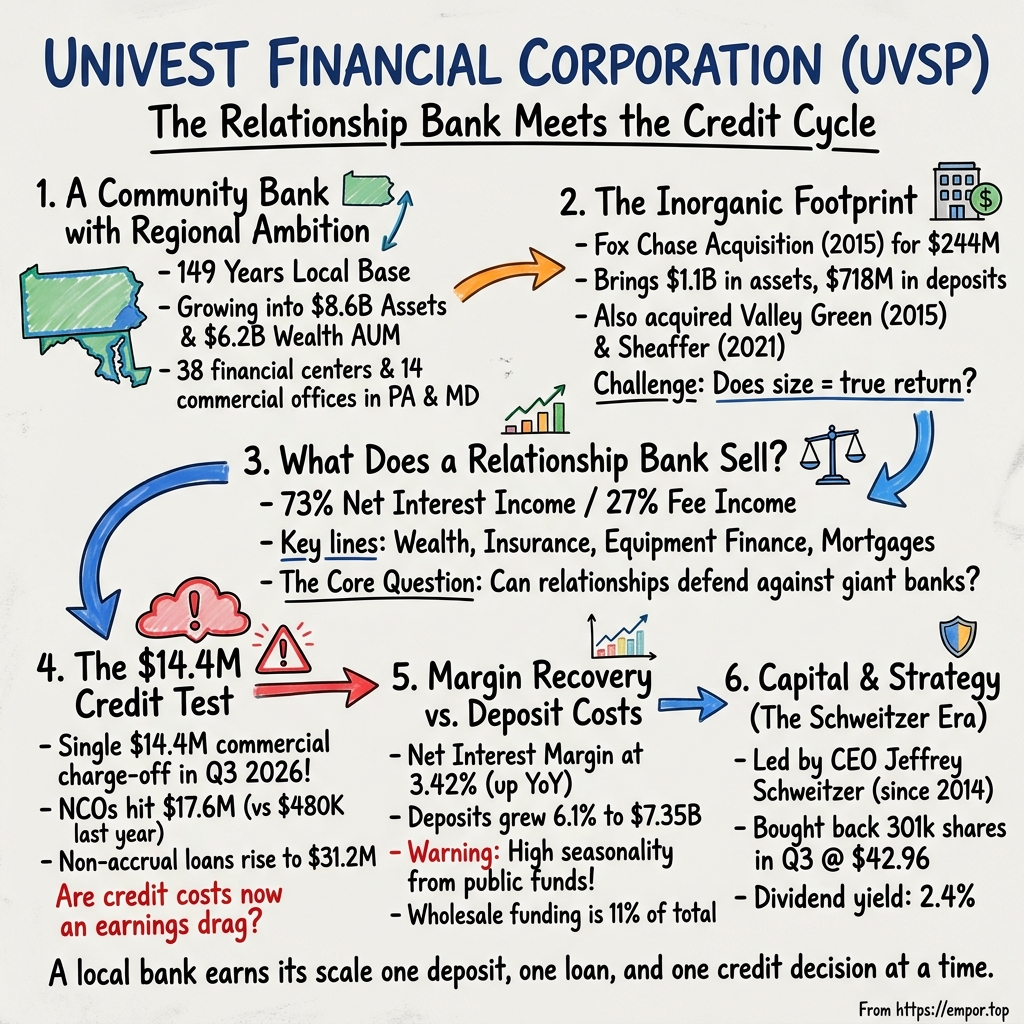
Put all five together, and one line captures Univest better than any balance-sheet total: a local bank earns its scale one deposit, one loan and one credit decision at a time.
XI. Epilogue
Tonight, Univest stands where a good regional bank often stands at the turn of a credit cycle: with a recovering margin, a growing wealth business, an expansion that has started to pay, and a loan book that has just shown it can bite. The company enters the final weeks of 2026 with about $8.6 billion of assets, deposits swollen by seasonal public funds, and a watch list that management has said will shrink.111
The next moment that decides the story is the fourth-quarter report, due around late January 2027 if the company keeps its usual calendar. It will answer the most immediate question first: did criticized and classified loans decline as management forecast, and did nonaccrual balances follow? If the sale closes near the carrying value, the third quarter will look like the expensive end of a workout. If it falls through or closes at a lower price, investors will reasonably ask how many other estimates need revisiting. The full-year provision relative to management’s $15 million to $17 million range will be the cleanest single test of its credit view.11
The second moment will arrive in the first half of 2027, when public funds flow out on their usual schedule. That is when the margin recovery will be tested without excess liquidity to explain it. If Univest keeps its core deposits without paying sharply more, and its liquidity-adjusted margin holds near the mid-3% range, the margin story will have proved durable. If deposit costs climb or the bank leans harder on wholesale funding to replace departing balances, the recovery will turn out to have had a bill attached. Watch, too, whether the company delivers its loan and interest-income targets without reaching for lower-quality growth to hit them.
The third moment is quieter and runs through every quarter: what Univest does with its capital. Compare each quarter's buybacks and dividends against tangible capital, credit needs and the price paid for the shares. A team that keeps buying above 1.4 times book while credit costs rise is making a confident bet. A team that slows the buyback while working out problem loans is making a cautious one. Either can be right, but the choice will reveal how management weighs the risks it sees.
One question will remain open no matter what the next few quarters show: Univest's organic growth record remains incomplete. Future results can narrow that gap, as every quarter without a deal adds to the organic record. But the distinction matters, because acquisition-led growth and organic growth describe different businesses. The market is currently paying a multiple above Univest's own history. The next few quarters will show whether that multiple belongs to the bank that bought its way to scale, or to the one that has to earn it.
XII. Outro
Return to the quarter that opened this story. Net interest income was rising. Deposits were flowing in. Wealth fees were growing. And one commercial relationship cost the bank dearly.1 That is the contradiction at the heart of Univest. Its growth comes from relationships, the local banker who knows the borrower, the treasurer and the business owner by name. Yet a single relationship can make or break a quarter.
The story of Univest is not a simple tale of a small Pennsylvania bank getting bigger. It is the story of a bank that bought its scale, has spent a decade trying to earn on it, and now has to prove that the judgment behind its relationships is as good as the warmth in them. Lending still dominates its revenue, with relationship fees providing the rest.3 Both depend on the same thing.
The final image is a promise made in a Souderton office or a Bucks County conference room, a banker's handshake on a loan. Its value will be measured by two people the banker cannot control: the borrower who must repay it, and the depositor deciding, quarter by quarter, whether to stay.
References
-
Q3 2026 Form 10-Q — Univest Financial Corporation, SEC, 2026-11-03 ↩↩↩↩↩↩↩↩↩↩↩↩↩↩↩↩↩↩↩↩↩↩↩↩↩↩↩↩↩↩↩↩↩↩↩↩↩↩↩↩
-
2025 Form 10-K — Univest Financial Corporation, SEC, 2026-02-12 ↩↩↩↩↩↩↩↩↩↩↩↩↩↩↩↩↩↩↩↩↩↩↩
-
2025 Annual Report — Univest Financial Corporation, 2026 ↩↩↩↩↩↩↩↩↩↩↩↩↩↩↩↩↩↩↩↩↩↩↩↩↩↩↩↩↩↩↩↩↩
-
2026 Proxy Statement — Univest Financial Corporation, SEC, 2026-03-13 ↩↩↩↩↩↩↩↩↩
-
Univest Corporation of Pennsylvania to Acquire Fox Chase Bancorp, Inc. — Univest, 2015-12 ↩↩↩↩↩↩↩↩↩↩
-
Valley Green Merger Completion, Form 8-K — SEC, 2015-01-02 ↩
-
Common-Stock Offering Prospectus Supplement, Form 424B5 — SEC, 2017-11-29 ↩
-
2026 Investor Presentation — Univest Financial Corporation, 2026-07-27 ↩
-
KBRA Affirms Ratings for Univest Financial Corporation — KBRA, 2026-04-01 ↩↩↩↩↩↩↩
-
Third Quarter 2026 Earnings Call Transcript — Univest Financial Corporation, 2026-10-29 ↩↩↩↩↩↩↩↩↩↩↩
-
Corporate Profile and Stock Information — Univest Financial Corporation Investor Relations ↩↩↩↩↩↩↩↩↩↩↩
-
Fourth Quarter 2025 Earnings Call Transcript — Univest Financial Corporation, 2026-01-29 ↩↩
-
Annual Meeting Voting Results, Form 8-K — SEC, 2026-04-23 ↩↩
-
Peer Trading and Operating Metrics — SEC filing, 2026-11-18 ↩↩↩↩↩↩
 LinkedIn
 WhatsApp
 Reddit
 Hacker News
 Email
 Kindle
 RSS Feed
 Spotify
 Apple Podcasts
 Amazon Music
 Audible
 YouTube