Taysha Gene Therapies: The $150 Million Reset and the Rett Bet
I. Thirty-three Patients, One Very Expensive Question
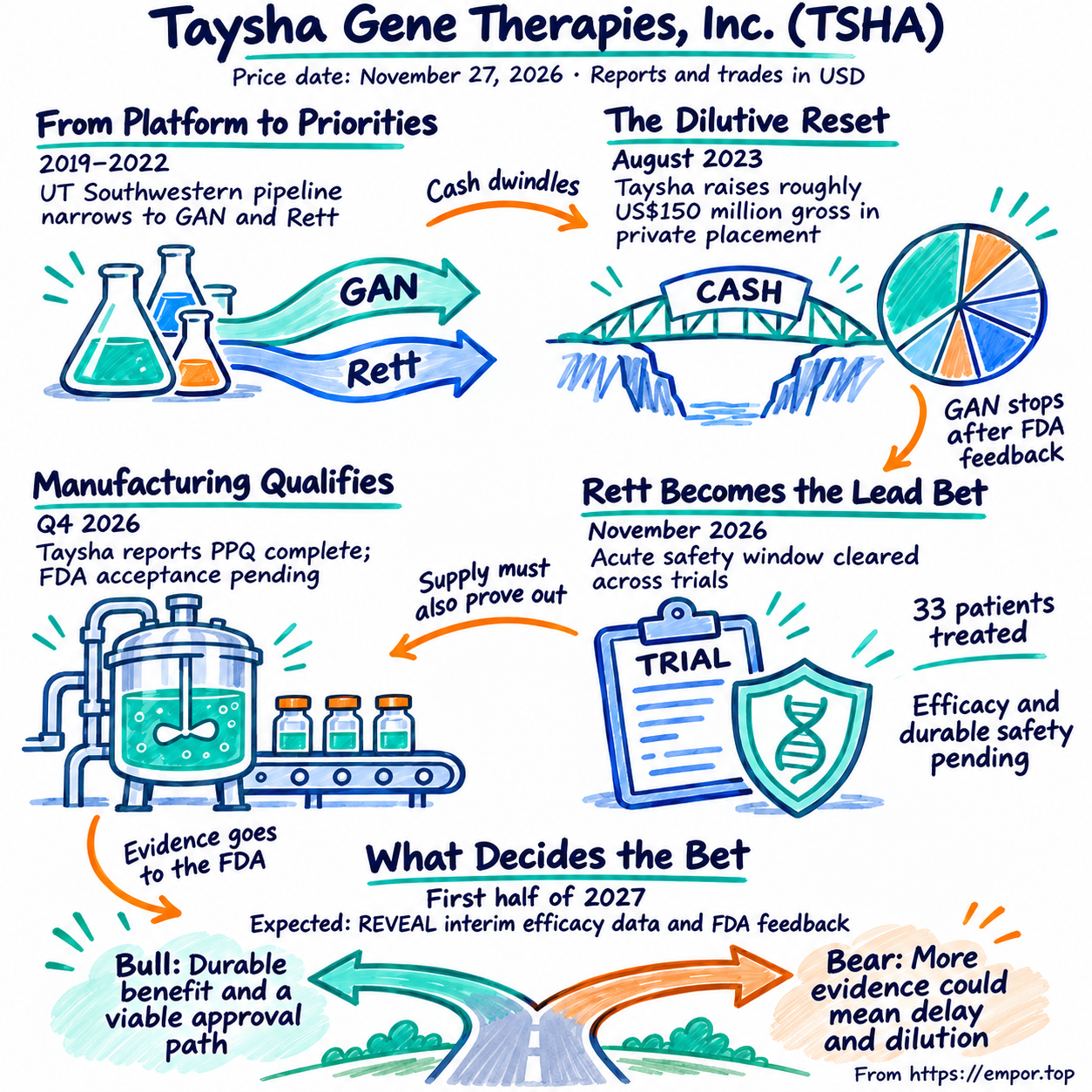
On November 12, 2026, Taysha Gene Therapies told its shareholders something that, a few years earlier, many of them would have doubted they would ever hear. Thirty-three patients had now been treated with the company's experimental gene therapy for Rett syndrome across three clinical trials, and every one of them had passed through the acute monitoring window that follows dosing without a severe treatment-related serious adverse event or a dose-limiting toxicity.[^1] On the conference call that evening, Chief Executive Sean Nolan said the team was "very encouraged by our clearance of the acute safety window."1
That sentence carries a lot of weight, and it is worth being precise about what it does and does not say. It says that a one-time infusion of a viral vector into the spinal fluid of girls and young women with a devastating neurological disorder had, so far, not produced the kind of early catastrophe that has derailed other gene therapy programs. It does not say the therapy works. The answer to that question, the six-month interim readout from Taysha's pivotal trial, was still on the calendar for the first half of 2027, alongside feedback from the U.S. Food and Drug Administration on whether the company's data package could support a Biologics License Application.[^1]
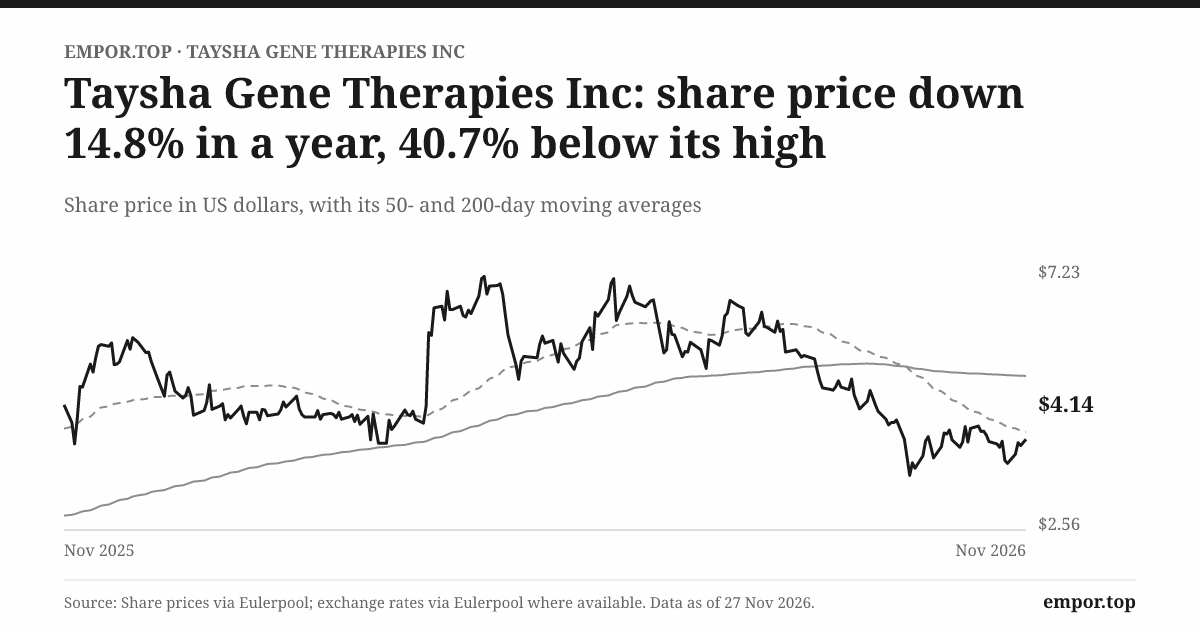
So the company now stands in an odd and familiar biotech position. It has never sold a product. It has no revenue at all in 2026: the first nine months of the year produced zero, while research and development spending reached about $101 million.2 And yet the stock market values it at roughly $1.3 billion, with the shares at $4.14 on November 27, 2026, about 41% below their 52-week high. That valuation is not a multiple of anything the company earns. It is a wager on a single question: can a treatment that can be safely administered in a trial be shown to work well enough, and be manufactured reliably enough, to become a medicine?
Three sub-questions sit inside that wager, and they give this story its shape. The first is clinical and regulatory: will TSHA-102, Taysha's lead program, clear the bar the FDA sets for an approvable therapy in a rare disease? The second is industrial: a gene therapy is a living product grown in cells and purified at great expense, so can Taysha make it consistently, at commercial scale, to a standard regulators accept? The third is financial, and it has haunted this company since the day it went public: can Taysha reach those milestones without going back to shareholders for more money on terms that dilute them further?
On the third question, the company starts from its strongest position in years. It held $422.8 million in cash and equivalents at September 30, 2026, against a $50 million term loan, and management said that cash should fund planned operations into the second half of 2028.[^1] Set against the company's history, that is a remarkable sentence. In August 2023, Taysha raised money at 90 cents a share in a private placement that existing holders still argue about, and it did so while one of its two lead programs was weeks away from being shut down.3[^5]
That earlier moment is the hinge of this story. Taysha began life as a sprawling platform, promising a whole family of gene therapies for rare neurological diseases. It became, through a mixture of scientific setbacks, partner decisions and financial necessity, a company with one lead bet. The bet might pay off spectacularly. Rett syndrome has one approved therapy, an oral drug that treats symptoms rather than the genetic cause, and that drug sold $391 million in 2025.4 A one-time treatment that addressed the underlying defect could be worth far more. But a rival gene therapy is chasing the same patients, the efficacy data are not in, and the company's own record includes a program that looked promising in the clinic and then stopped when the regulatory path came into focus.
Which is why the 33 patients matter, and why they are only a beginning. Safety is the price of admission. Efficacy is the ticket. The question this story asks is whether Taysha, having bought itself time at real cost to its owners, can use that time to turn a biological possibility into an approvable, manufacturable treatment before the clock runs down. To answer it, the story has to go back to the moment Taysha was conceived, when the ambition was not one bet but a whole portfolio of them.
 Subscribe on LinkedIn
II. A Company Built Around a Promise
In 2019, a group of veteran biotech operators and academic scientists in Dallas set out to build something unusual: a public gene therapy company organized around a single university's research engine. Taysha was formed in partnership with UT Southwestern Medical Center, whose gene therapy program would supply the science while the company supplied the development muscle, the regulatory strategy and, crucially, the capital.5 The pitch was ambitious by design. Instead of betting on one disease, Taysha would license a portfolio of adeno-associated virus, or AAV, gene therapies for monogenic diseases of the central nervous system, conditions caused by a single broken gene, and advance them in parallel.5
The leadership pedigree explained a lot of the confidence. Sean Nolan, who became chairman of Taysha's board in 2020, had run AveXis, the company behind the spinal muscular atrophy gene therapy later sold as Zolgensma, through its sale to Novartis.5 Sukumar Nagendran, who joined from the same AveXis orbit, brought clinical development experience with an AAV9 therapy delivered to children with a lethal neuromuscular disease.5 If anyone could argue that the AAV playbook could be run again, in more diseases, faster, it was people who had done it once. The founding chief executive was RA Session II; Nolan's chairmanship gave the company the face of a proven gene therapy operator from the start.5
It helps to understand what AAV actually is, because the technology is both the source of the excitement and the source of the risk. An adeno-associated virus is a small, common virus that does not cause disease in people. Scientists hollow it out, remove its own genes, and pack in a working copy of the human gene a patient is missing. The shell, or capsid, acts as a delivery truck. AAV9, the version Taysha favors, is particularly good at crossing into nervous-system tissue. Once inside a cell, the new gene sits alongside the patient's own DNA and, ideally, starts producing the missing protein for years. That is the promise of a one-time treatment.
But a delivery truck is not a cure. The cargo has to be the right gene, expressed at the right level, in the right cells. The truck has to be manufactured with very few empty or defective shells. The patient's immune system has to tolerate it. And all of that has to be proven in trials that regulators accept. AAV is the vehicle; the product, if one emerges, must still prove its clinical benefit, its safety, its manufacturing consistency and its regulatory path, program by program.
Investors in 2020 were willing to fund that proposition at scale. Taysha filed its registration statement for an initial public offering on September 2, 2020, at the height of a biotech funding boom, less than a year after its formation, and the IPO closed later that month.56 The prospectus described a broad pipeline across multiple CNS indications, with GAN, a rare and fatal nerve disorder called giant axonal neuropathy, and other programs moving toward the clinic.6 It was the kind of story public markets loved in 2020: a famous team, a proven modality, and many shots on goal.
The many shots on goal turned out to be expensive. Operating losses ran from about $43 million in 2020 to about $173 million in 2021, as Taysha hired, built manufacturing capability and pushed multiple programs forward at once.7 Cash fell from about $251 million at the end of 2020 to about $149 million a year later and about $88 million at the end of 2022.7 Biotech funding markets cooled sharply over the same stretch, which meant the platform strategy collided with a capital market that no longer wanted to pay for breadth.
By 2022, Taysha had narrowed its focus. It prioritized two programs, TSHA-120 for GAN and TSHA-102 for Rett syndrome, while pausing much of its other research activity.7 Leadership changed too. Nolan, chairman since 2020, became chief executive in December 2022, and Nagendran became president and head of research and development at the same time.[^10] That detail matters for judging the people in charge today. The leaders running Taysha now did not merely inherit the reset that followed; they ran it, from the financing crunch of 2023 through the TSHA-102 push that followed.
It is also worth noting what kind of company this was not. Taysha did not grow by acquiring other companies. It licensed academic science, most importantly from UT Southwestern, and developed it.5 No material corporate acquisition defines the company's history. The capital-allocation decisions that shaped it were licensing and development choices, and one of them, a $5.5 million license payment tied to the GAN program, would turn out to be among the most consequential.[^5]
Across its life, Taysha has raised about $961 million in gross equity proceeds through 2025, from the IPO, at-the-market sales, follow-on offerings, the 2023 private placement and subsequent offerings.7 That number is the backdrop for everything that follows. A company built around a promise needs a lot of money to keep the promise alive, and by late 2022 Taysha needed a partner who could supply some of it. The partner it found was one of Japan's largest drugmakers.
III. The Astellas Deal Bought Time—and Left an Option
In October 2022, with its cash dwindling and its pipeline already trimmed, Taysha announced a deal with アステラス製薬 Astellas Pharma that looked, on the surface, like a vote of confidence from a global pharmaceutical company. Astellas agreed to invest $50 million, taking a stake of about 15% in Taysha, and received exclusive options to license the two programs Taysha had chosen to prioritize, TSHA-102 for Rett and TSHA-120 for GAN.[^11] For a company whose stock had been falling for most of a year, the headline was a lifeline.
The structure, though, deserves a close look, because it tells you what Astellas was actually buying. Part of the money purchased stock: Astellas paid $30 million for about 7.3 million Taysha shares.7 The rest of the economics went to the collaboration. When Taysha did its accounting, it allocated $16.1 million of the consideration to the collaboration's transaction price, effectively the value of the option rights and associated research activities rather than the shares themselves.7 Astellas also received a non-voting board-observer right.7
What Astellas did not buy was a product, or a commitment to develop one. An option is the right, not the obligation, to do something later. Astellas paid for a front-row seat: access to data as it emerged, and the ability to license either program on pre-agreed terms if the data looked good. If the data did not look good, or if strategic priorities changed in Tokyo, Astellas could walk away having spent a modest sum by big-pharma standards. For Taysha, the cash bought time. For Astellas, it bought information.
That distinction is the first place where Taysha's reported numbers can mislead a casual reader. The company's revenue line, which went from nothing to about $2.5 million in 2022, about $15.5 million in 2023, about $8.3 million in 2024 and about $9.8 million in 2025, looks on a spreadsheet like a business with a 57.5% compound growth rate over three years.7 It is no such thing. Every dollar of revenue in 2024 and 2025 came from Astellas.7 Some of it was recognized as Taysha performed Rett research work under the collaboration; some of it was recognized only when an option ended. There were no product sales, ever.7
The chronology of the options tells the real story. Astellas declined its GAN option in 2023, and Taysha later discontinued its own GAN development after FDA feedback.[^5] The Rett option ran longer. It finally expired unexercised in October 2025, and when it did, Taysha recognized $5.5 million of revenue for the material right that had been sitting on its balance sheet.7 That accounting event produced the fourth-quarter 2025 revenue figure of $5.5 million and therefore the entire trailing twelve-month revenue the company reports today.2
So the irony is precise. The single largest source of Taysha's recent revenue was a partner deciding not to buy the company's lead asset. In 2026, with the collaboration over, revenue fell to zero.2
How much should investors read into Astellas walking away? It is a meaningful commercial signal. A sophisticated pharmaceutical company with access to the data chose not to pay to license the program. That should temper any argument that the partnership itself validated TSHA-102's commercial value. But it is not proof that TSHA-102 cannot work, for several reasons. Option decisions are made on a timetable set by contract, not by science, and the Rett option expired before the pivotal trial had finished dosing, let alone produced efficacy data. Large drugmakers also reshuffle their gene therapy ambitions for reasons that have little to do with any single program: manufacturing strategy, portfolio fit, the cost of late-stage development, and changing views on how much to invest in the modality as a whole. The filings do not disclose Astellas's reasons, and Taysha has not described them.
The calibrated reading is narrower than either extreme. Astellas's money was real and arrived when Taysha badly needed it. Its options were not a commercial endorsement, and the decision to let them lapse is a data point skeptics are entitled to weigh. What remains is the evidence Taysha will produce itself, starting with the pivotal data in 2027. By then, Astellas was no longer in the cap table in any size that mattered; it did not appear among the holders of more than 5% of the stock in the March 2026 proxy.[^10]
There is one more lesson buried in this episode, and it concerns the shape of Taysha's economics. A collaboration line in the income statement can make a clinical-stage company look like it has a business. Taysha's did, for a few years. But the money from Astellas was always finite and always conditional, and once the partner had seen enough, the line disappeared. By the summer of 2023, long before the Rett option expired, Taysha already knew it would need a much bigger source of capital than Astellas was ever going to provide. The question was what that capital would cost.
IV. The $0.90 PIPE and the Program That Stopped
At June 30, 2023, Taysha had $45.1 million in cash.8 For a company running two clinical gene therapy programs, paying for manufacturing, and carrying a term loan, that was not much more than a few quarters of life. The stock had collapsed from its IPO-era highs to around a dollar. Every option on the table was unattractive. A public offering at that price would have been punishing. Doing nothing would have meant a going-concern problem within months.
On August 14, 2023, Taysha announced what it chose instead. It would sell about 122.4 million shares of common stock at $0.90 each, plus pre-funded warrants for up to about 44.3 million more shares at $0.899, in a private placement expected to raise roughly $150 million in gross proceeds.3 Pre-funded warrants are a common device in these deals: the buyer pays almost the whole price up front and can convert to common shares later for a penny, which lets large funds avoid crossing ownership thresholds. Net of fees, the company took in about $140.3 million.7
The buyers were a who's who of specialist biotech investors. On the call that afternoon, management said the round was led by new investor RA Capital Management, with participation from PBM Capital, RTW Investments, Venrock Healthcare Capital Partners and TCGX, among others.8 Nolan told listeners that "this capital infusion significantly bolsters our balance sheet," and that the proceeds, with existing cash, would "extend our runway into the third quarter of 2025."8 Because the deal required more authorized shares than Taysha had, the company also needed a special stockholder meeting to approve an increase.8
Think about what that financing meant for an existing shareholder. The private placement alone created about 167 million new shares or share equivalents, priced at less than a dollar. By the time of the June 2026 annual meeting, Taysha had about 287 million shares outstanding.9 Holders who had bought in at the IPO, or even at the depressed prices of 2022, saw their slice of the company shrink dramatically. The money preserved the company. It also transferred a large share of the future upside to whoever was willing to write the check at the bottom.
The same call shows how management was framing the pipeline at that moment. The Rett program was clearly the priority. Nagendran reported on the first adult patient dosed in the REVEAL trial, a 20-year-old woman with late-stage disease, and said no serious adverse events related to TSHA-102 had emerged through six weeks; he said the company believed its candidate "has transformative potential."8 When an analyst from Wells Fargo asked how the early data compared with the approved Rett drug, Nolan offered only a cautious, high-level answer, noting the limits of a single patient and cross-trial comparison.8 That restraint was appropriate. It also shows how early the Rett story still was when the company raised money to fund it.
The GAN program was in a different place. On the same call, Nagendran described a disease-progression analysis Taysha had submitted to the FDA and said, "The FDA indicated that it's open to regulatory flexibility in the controlled trial setting."8 Management said it looked forward to "a collaborative dialogue with the FDA regarding the potential registrational path."8 The tone was hopeful. Taysha had invested in GAN, including a $5.5 million license payment, and had built its earlier narrative partly around the program's clinical progress.[^5]
Five weeks later, on September 19, 2023, the dialogue had produced its answer, and it was not the one the company wanted. Taysha announced it would discontinue its own development of TSHA-120 after FDA feedback raised feasibility problems for the registrational study that would be required.[^5] Rather than abandon patients entirely, Taysha transferred the IND and remaining clinical material to the National Institute of Neurological Disorders and Stroke.[^5]
It is worth pausing on how quickly that happened, because it is the strongest piece of historical evidence in Taysha's own record against treating clinical progress as proof of a path to market. GAN had patients dosed. It had a hopeful regulatory narrative on an August call. And then, once the FDA spelled out what a pivotal study would require, the program stopped within weeks. The $5.5 million license payment became, in hindsight, a failed capital deployment, and the broader investment in the program bought knowledge rather than a product. The scale matters too: this was one program in a narrowing pipeline, not the failure of TSHA-102 itself, and the dollar loss on the license was small next to the money raised in the same quarter. But the mechanism, a clinical program that could not find a feasible regulatory path, is precisely the risk that still hangs over Rett.
The private placement left a long legal tail. Stockholder litigation followed, alleging claims related to the August 2023 placement against current and former directors and officers and certain investors who participated.7 Taysha recorded no liability, saying it could not estimate a possible loss.7 Late in 2024, the company and certain officers and directors received subpoenas from the Securities and Exchange Commission concerning the placement and certain offerings; Taysha completed its document production in April 2025 and stressed that the investigation was not a finding of wrongdoing.7 A special litigation committee of the board moved to terminate the stockholder action in March 2026.7
Two developments since then have narrowed the overhang. In June 2026, the SEC notified Taysha that it had concluded its investigation without recommending enforcement action.2 And in the latest quarterly filing, the stockholder case was proceeding through the court's process for an unopposed termination motion, which had not yet been finalized.2 That leaves a governance question that is mostly about history rather than ongoing liability: the investors who bought at 90 cents became, in several cases, among the largest holders of the company, and the stock today trades at more than four times that price.
So was the PIPE a rescue or a consequence? The honest answer is that it was both. It rescued TSHA-102 from a financing crisis, and without it there would be no 33 patients to talk about. But the crisis itself was a consequence of earlier choices: a broad platform funded in a boom, spending that outran the capital markets, and a second lead program that did not survive contact with the regulator. With GAN gone, the company that emerged in the autumn of 2023 had one lead bet left.
V. From Two Programs to One Lead Bet
Rett syndrome usually announces itself as a theft. A baby girl seems to develop normally for her first months, sometimes longer, sitting up, babbling, reaching for toys. Then, often somewhere between six months and two years of age, the progress stops and starts to unravel. Purposeful hand use gives way to repetitive wringing or clapping motions. Words that had begun to appear disappear. Walking, breathing and sleep can be disrupted, and seizures are common.7 Parents describe watching skills they had celebrated slip away.
The cause is almost always a mutation in a single gene, MECP2, which sits on the X chromosome.7 MECP2 makes a protein that acts like a master volume control inside nerve cells, helping to switch many other genes on and off at the right levels. Because the gene is on the X chromosome, Rett overwhelmingly affects girls; most boys with a severe mutation do not survive infancy. And because the problem is one broken gene, Rett looks, on paper, like a natural target for gene therapy: deliver a working copy, restore the protein, and perhaps restore function.
There is a catch, and it is the reason Rett has been so hard. MECP2 is exquisitely dose-sensitive. Too little of the protein causes Rett syndrome. Too much causes a different serious disorder, MECP2 duplication syndrome.7 And because Rett affects girls with one healthy and one mutated copy, every girl's nervous system is a patchwork: in some cells, the healthy copy is active and producing normal protein; in others, it is the broken copy. A gene therapy that blindly adds MECP2 to every cell risks overdosing the cells that were already fine.
TSHA-102 is Taysha's attempt to solve that problem. It is a one-time gene therapy delivered intrathecally, meaning injected into the fluid surrounding the spinal cord, using an AAV9 capsid.7 The cargo is a shortened version of the gene, called miniMECP2, small enough to fit inside AAV's limited packaging space. And it carries a regulatory system Taysha calls miRARE, designed to sense how much MECP2 a cell already has and dial expression down where levels are already sufficient.7 The analogy is a thermostat rather than a space heater: the goal is not just to add warmth but to add it only where the room is cold.
That design is elegant. It is also, at this stage, a design intent rather than a demonstrated advantage. Whether miRARE regulates expression as hoped in human patients, across years, is precisely what the clinical program is trying to show.
The medical need is not in question. Rett syndrome is a severe, lifelong disease with a single approved therapy that treats symptoms. But the size of the need is not the same thing as a business case. A serious unmet need can support a meaningful commercial opportunity, and the sales of the existing Rett drug suggest it can. It does not, however, establish that TSHA-102 has a treatment effect, what price a one-time therapy would command, whether insurers would pay it, or how quickly families and specialist centers would adopt a procedure-based treatment. Those are separate questions, and none has been answered yet.
What the focus on Rett has done is concentrate spending. In 2025, Taysha spent about $86 million on research and development against about $10 million of revenue, nearly all of it an accounting event from Astellas.7 In the first nine months of 2026, revenue was zero and R&D reached about $101 million, rising with clinical activity and a larger R&D team.2[^1] Capital spending was tiny by comparison: well under $1 million in each of 2024 and 2025, because the money goes into trials, manufacturing campaigns and people rather than buildings.7 Taysha had 99 full-time employees at the end of 2025.7
The funding model is therefore simple, and it is worth stating plainly. Taysha has no internal source of cash. Every dollar spent on TSHA-102 comes from money raised from investors or borrowed from lenders, plus interest earned on that money while it waits to be spent. The reported growth is economically meaningless.
Concentration cuts both ways. A company with one lead asset can move faster, explain itself more clearly and avoid spreading scarce capital thin, and Taysha has used that focus to push TSHA-102 through a pivotal trial and a manufacturing qualification campaign in roughly three years. But a company with one lead asset also has one way to win. Future product revenue is contingent on positive pivotal results, regulatory approval, commercial manufacturing and market uptake, in that order, with each stage able to fail independently.
The GAN episode is the right yardstick here. It showed that Taysha's earlier, broader platform did not convert clinical activity into an approvable product when the regulatory path proved infeasible. The Rett bet narrows that history into a single test. If TSHA-102 succeeds, the concentration that looks like risk today will look like discipline. If it stumbles, there is no second clinical program to fall back on; the company has said only that it expects to nominate a new CNS gene therapy candidate in the first half of 2027.1 Which brings the story to the place where that test is actually being run: the pivotal trial, and the competitors waiting on either side of it.
VI. The Pivotal Trial Meets the Commercial World
Somewhere in a specialist hospital in late 2026, the last of seventeen participants in Taysha's REVEAL pivotal study received her infusion. It was an undramatic moment by design: a lumbar puncture, a slow injection of a few milliliters of fluid into the spinal canal, then days of monitoring. But with it, Taysha completed dosing in the trial that will decide whether TSHA-102 becomes a product.2 In parallel, four younger participants had been dosed in a separate study, ASPIRE.2 Add the twelve patients from the earlier dose-finding part of REVEAL and the count reaches the 33 that opened this story: 29 across REVEAL's phase 1/2 and pivotal portions and four in ASPIRE.1
REVEAL is registered as a study of TSHA-102 in females with Rett syndrome, designed to assess safety and efficacy after a single intrathecal dose.10 The pivotal portion is built around an interim analysis at six months. Management has described a responder-based approach, in which patients count as responding if they gain or regain developmental skills, compared against what natural history says girls with Rett would be expected to do over the same period.1 On the November call, Nolan was openly bullish about the timeline, describing the six-month data as "all upside" and suggesting it offered "the potential to get to market even faster," with twelve-month data contributing to the label.1 He also said discussions with payers had shown no impediment to approval on six-month data.1 Those are management's views of a regulatory and commercial process that has not yet happened; the FDA's feedback, expected in the first half of 2027, is what will test them.[^1]
What the delivery route trades away
The choice of intrathecal delivery is one of the most consequential decisions in the program, and it is worth understanding why. To reach nerve cells in the brain and spinal cord, a gene therapy can be given intravenously, which requires enormous doses because most of the vector ends up in the liver and elsewhere; it can be injected directly into the brain or its fluid-filled ventricles, which requires neurosurgery; or it can be injected into the spinal fluid through a lumbar puncture, as Taysha does. The intrathecal route sits in between. It uses a procedure that many hospitals can perform, aims to deliver vector more directly to the nervous system than an intravenous dose, and may reduce exposure of other organs. The tradeoffs are real too: distribution through the spinal fluid to all the relevant brain regions is not guaranteed, and the route has to prove that it reaches enough cells to change the disease. Like miRARE, this is design intent. The pivotal data are the evidence.
What is known as of November 2026 is the safety picture. That acute safety record across the 33 participants is not trivial.[^1] Immune reactions to AAV vectors, liver injury and inflammatory syndromes have stopped other programs. But acute safety monitoring is a window of weeks, not years. Durable safety, durable expression and, above all, efficacy remain open.
Now step back and look at the battlefield. Taysha is not entering an empty market, and it is not the only gene therapy company chasing Rett.
The incumbent is Acadia Pharmaceuticals's DAYBUE, or trofinetide, the oral treatment whose commercial scale is already clear.114 DAYBUE is prescribed by the same specialist neurologists Taysha would need to persuade. The existing market does two things for the Taysha story. It shows that families, doctors and insurers will engage with and pay for Rett treatment at scale. And it establishes that any new entrant will be compared against an existing, non-invasive option that patients can start without a lumbar puncture or a one-time genetic intervention.
The direct rival is Neurogene, whose gene therapy NGN-401 also targets Rett syndrome with a regulated MECP2 construct.12 Neurogene delivers its therapy into the brain's ventricles rather than the spinal canal, and it uses its own approach to controlling gene expression.12 It has fully dosed its registrational trial and expects topline data in the second half of 2027.12 Neurogene's own history is a reminder of how unforgiving this field can be: after a participant receiving a higher dose suffered a severe hyperinflammatory reaction in late 2024, the company discontinued that dose and continued at the lower one.12 The Rett gene therapy race is therefore not a story of one pioneer and a slow follower. It is two clinical-stage companies, each with a regulated construct, each with a different delivery route, each a matter of months from pivotal answers.
Relative scale is worth stating honestly. Taysha is pre-commercial and has no market share, because it has no product. DAYBUE is the only commercial Rett therapy. Neurogene is, like Taysha, a development-stage company. Market share comparisons among unapproved products are meaningless; what can be compared is timing, design and data, and on timing Taysha appears to be roughly half a year ahead of Neurogene's topline readout, if both companies hit their guided windows.
How might the competitive forces shape the eventual market? The existing therapy gives patients and prescribers a real alternative, which raises the bar for a gene therapy that requires a procedure and carries the uncertainties of a one-time genetic intervention. Payers and specialist treatment centers will matter enormously to eventual access: a one-time therapy priced in the millions, which is where gene therapies have tended to land, has to be justified to insurers who will demand evidence of durable benefit. The bargaining position of those buyers, and how patients would switch between a daily oral drug and a one-time gene therapy, or combine them, simply is not established. Nobody has yet sold a Rett gene therapy to anyone.
The claims behind the design
Taysha's investor materials list a set of advantages: the AAV9 capsid, the miRARE regulatory system, the intrathecal route, and regulatory designations from the FDA and other agencies that can speed review.7 Each of those may genuinely help development. None is yet a demonstrated commercial moat. AAV9 is widely used across the industry and is not proprietary to Taysha. Regulated expression is an approach Neurogene is pursuing too, in its own form. The intrathecal route is a design choice with tradeoffs, as described above. And regulatory designations shorten timelines; they do not lower the efficacy bar.
The test of whether any of these become durable advantages is concrete. It will be the magnitude of benefit in the pivotal interim data, how many girls respond and how meaningfully; durability at twelve months and beyond; a safety profile that holds as follow-up lengthens; and the FDA's view of whether the package is sufficient or whether an additional study is required. If TSHA-102 shows a clear, durable benefit with clean safety and reaches the market first, early experience at treatment centers and long-term follow-up data could become the beginnings of an advantage. If its benefit looks similar to Neurogene's, the race becomes a contest of convenience, manufacturing and commercial execution. If it disappoints, none of the design features will matter.
So the verdict at this point is clear, and it should be hedged only once. Taysha has a credible clinical hypothesis, a completed pivotal dosing milestone and an encouraging early safety record. It has no proven efficacy advantage and no commercial moat yet. The 2027 dataset has to show meaningful benefit and a viable regulatory path, and safety monitoring, however clean, cannot answer that. And even if it does, the company will face a second test that has broken gene therapy launches before: making the product.
VII. The Factory Is Part of the Drug
Picture a bioreactor in a manufacturing plant in Maryland: a vessel of living cells, coaxed with genetic instructions into producing trillions of tiny viral shells, each supposed to carry a single copy of a shortened human gene.1 After weeks of growth, the cells are broken open and the contents pass through a sequence of filters and purification columns designed to separate the full shells from the empty ones, the debris from the product. At the end, a few vials of clear liquid emerge. Each represents what is meant to be a lifetime dose for one girl.
That image is why gene therapy people say the process is the product. A conventional tablet is a defined chemical; if you make the same molecule, you have made the same drug. A gene therapy is made by living systems, and small changes in how it is grown or purified can change how much of it works, how many shells are empty, and how a patient's immune system responds. Regulators therefore treat process consistency and comparability as part of the clinical case. If the material used in a pivotal trial was made one way and the commercial product another, the company has to prove the two are equivalent.
In the fourth quarter of 2026, Taysha reported that it had completed what the industry calls a process performance qualification, or PPQ, campaign: a set of manufacturing runs, conducted under the conditions intended for commercial supply, meant to demonstrate that the process reliably produces product meeting its specifications.[^1] Management said all process parameters and analytical results met predefined product specifications and comparability criteria, and on the call it highlighted single-digit levels of empty capsids, the hollow shells that carry no gene and add immune load without benefit.1[^1] For an AAV product, low empty-capsid levels are a meaningful marker of purification quality.
It is important to be exact about what that milestone does and does not show. It shows that Taysha's process, run in a commercial facility, hit the targets Taysha set for it. It does not show that the FDA agrees those targets are sufficient, that future batches will continue to meet them, or that the supply chain can handle launch volumes. A PPQ campaign is a necessary entry in a Biologics License Application. It is not approval. Management said it expected feedback from a chemistry, manufacturing and controls meeting with the FDA around the turn of the year, which will be the first external read on the manufacturing package.1
The manufacturing partner is Catalent. In August 2026, Taysha and Catalent expanded their relationship so that Catalent would serve as Taysha's planned primary commercial manufacturer for TSHA-102 after potential U.S. approval.13 That secures a partner and a capacity framework. It does not create demand, and it creates a dependency: Taysha does not own the commercial plant, so its supply depends on a contract manufacturer's performance, scheduling and quality systems. The filings describe the use of contract manufacturers and clinical sites but do not quantify concentration across suppliers.7 For a single-product company, that dependency is part of the risk profile, even if it is the industry's standard arrangement.
Manufacturing is only the first link in what the industry calls the patient journey. A one-time therapy delivered by lumbar puncture has to be shipped frozen to specialist treatment centers, thawed and administered by trained teams, with patients screened for immunity to the AAV9 vector and monitored afterward. Each center has to be qualified. Each patient's insurer has to agree to pay. Those logistics shape launch economics as much as the cost of goods does, and they explain why Taysha's general and administrative expense rose to $13.1 million in the third quarter of 2026 from $8.3 million a year earlier, with management citing compensation, consulting and launch readiness.1 The company is starting to build a commercial organization before it knows whether it will have a product to sell.
The disconfirming evidence is the industry's own history. Gene therapy launches have repeatedly been slowed not by science alone but by manufacturing hiccups, slow center activation and payer friction, and several approved gene therapies have struggled commercially despite strong data. Taysha has never launched a product. Its executives have, at AveXis, which is a genuine asset, but a team's past experience at another company is not the same as an organization's proven capability.
The milestone, then, is real and should be weighed as real. It reduces one important execution uncertainty. But manufacturing success for TSHA-102 will mean something more demanding: a regulatory package the FDA accepts, followed by repeated compliant batches delivered on schedule to centers that can treat patients. One completed campaign is the start of that record, not the record itself. And everything that remains, the BLA, the commercial build, the first batches, has to be paid for out of a finite pile of cash.
VIII. The Cash Clock, the Cap Table, and the Next Raise
Look at Taysha's balance sheet on September 30, 2026, and the first number that leaps out is $422.8 million in cash and cash equivalents.2 For a company that held $45 million three years earlier, it is a transformation. The second number is less prominent but just as important: a $50 million term loan from Trinity Capital, drawn in 2025.2 And behind both is the cumulative financing record: about $1.19 billion of gross capital raised from equity and debt through September 2026.2
To understand what that cash can and cannot do, start with how much Taysha has lost over its life and how much cash it has actually burned. From 2019 through 2025, net losses added up to about $695 million, while cash used in operations came to about $483 million.7 The gap is not hidden profit. It is mostly non-cash charges, chiefly stock-based compensation, plus the timing of collaboration money that arrived as cash in one year and was recognized as revenue in another. In 2025, for example, the net loss of about $109 million translated into about $93 million of operating cash use, with $13.3 million of stock compensation among the main differences.7 Neither number reflects product cash generation, because there is none.
Current burn is running higher. In the first nine months of 2026, Taysha used $89.6 million of cash in operations, roughly $30 million a quarter, with R&D rising as development and headcount expand.2 Here is the interesting arithmetic. At that pace, $422.8 million would last about three and a half years. But management's runway guidance only goes into the second half of 2028, about two years out.[^1] The difference implies that management expects annual spending to rise sharply, roughly toward double the current run rate, as the company files a BLA, builds commercial infrastructure, buys inventory and prepares to launch. The guidance is therefore not conservative padding around today's burn; it embeds a step-up. The company does not publish a year-by-year spending forecast, so the exact shape of that ramp is unknown.
Interest income cushions the burn but does not fund it. In 2025, Taysha earned about $9.2 million in interest on its cash, partly offset by a $6.2 million expense from changes in the fair value of its term loan and a $1.2 million loss on warrant liabilities.7 With nearly half a billion dollars on hand, interest is real money, but it is a rounding error against a burn heading toward $200 million a year.
The Trinity loan deserves a careful explanation because its terms are friendlier than a headline about secured debt suggests. The $50 million is secured by substantially all of Taysha's assets and carries interest at the greater of prime plus 4% or 11.5%, an expensive rate that reflects the risk of lending to a pre-revenue company.2 It is interest-only for 48 months from August 2025, extendable to 60 months if milestones are met, then amortizes to August 2030.2 Crucially, it has no financial or minimum-cash covenant, though it contains negative covenants and default provisions.2 Two additional $25 million tranches exist, but they depend on BLA submission and approval; they are milestone-contingent, not committed money Taysha can draw at will.2 Debt is modest relative to cash. Its real significance is that it is senior to shareholders and that its fair-value accounting makes reported other income swing from quarter to quarter.
Then there is the cap table, which is where the financing history is written most plainly. The 2023 private placement priced shares at 90 cents. Later public offerings in 2024 and 2025 and warrant exercises added more shares; the company's cash from financing in 2025 alone, including the loan, came to about $275 million.7 In April 2025, about 9.6 million pre-funded warrants were exercised on a cashless basis.7 By the June 2026 record date, there were about 287 million shares outstanding, and pre-funded warrants held by large funds sit on top of that.9[^18] Each financing reduced near-term cash pressure; each also expanded the base over which any future success will be divided.
Who owns the company now? A concentrated group of specialist funds. As of March 31, 2026, the proxy reported Avoro-affiliated entities and RA Capital-affiliated entities at 9.99% each, entities affiliated with Paul B. Manning, whose PBM Capital participated in the 2023 placement, at 8.91%, and RTW at 8.49%, with these percentages including exercisable securities.[^10] In November 2026, RA Capital reported 32.8 million shares beneficially owned, about 9.9%, including common shares and pre-funded warrants held subject to a 9.99% ownership blocker.[^18] There is no controlling shareholder. Insiders, by comparison, own relatively little: the proxy reported 1.53% beneficial ownership for Nolan and 3.48% for all directors and executive officers as a group.[^10]
That ownership structure cuts two ways. Concentrated, sophisticated holders who have funded the company through its darkest moment can be a stabilizing force and a ready source of future capital. They also bought much of their stake at prices far below today's, which means the cap table's economics were reset in their favor in 2023.
No public credit rating exists to give an outside view of Taysha's balance sheet, so investors are left with management's runway statement and the arithmetic.2 Three indicators will tell the story better than any guidance. The first is quarterly operating cash use, which ran around $30 million a quarter in 2026 and, on management's own runway, is set to rise. The second is the fully diluted share count, including pre-funded warrants, which shows how much any future value will be divided. The third is whether the pivotal data and FDA feedback timetable holds in the first half of 2027. A runway into 2028 is enough time to reach the data. It is not, on any reasonable reading, enough to reach approval, a launch and profitability without another raise if the FDA asks for more. That makes the credibility of the people managing the clock the next question.
IX. Can Investors Trust the People Holding the Clock?
In April 2026, Taysha's board published its proxy statement, and in it was a number that captured the tension of this company in a single figure. Sean Nolan's total compensation for 2025 was $4.10 million, and the board had assessed the company's achievement of its corporate goals at 140% of target.[^10] In a year when Taysha's net loss widened to about $109 million and its partner let the lead program's option lapse, management was paid above target for hitting its goals.[^10]7
To judge whether that is reasonable, start with the people. Nolan has chaired the board since 2020 and has been chief executive since December 2022.[^10] He is the operator who sold AveXis to Novartis, and his style, on calls, is that of a seasoned commercial executive: confident, timeline-focused, quick to frame milestones as derisking events. Kamran Alam has been chief financial officer since 2020, steering the company through the 2023 placement and every raise since.[^10] Sukumar Nagendran, a physician by training, has served as president and head of R&D since December 2022 and is the voice of the clinical program on calls.[^10] Nolan's pay was $4.73 million in 2024; Alam received $2.15 million and Nagendran $2.09 million in 2025.[^10]
The incentive design is standard for a clinical-stage biotech. Cash bonuses are tied to corporate and individual goals, which for a company like Taysha mean clinical, regulatory and manufacturing milestones; equity awards provide long-term exposure to the share price.[^10] Nolan's 2025 package included about $543,000 of non-equity incentive compensation.[^10] The 140% factor reflects the board's view that the company exceeded its operating milestones, which, in fairness, included advancing pivotal dosing and the manufacturing program. But milestone-based goals measure activity rather than outcomes, and a skeptical holder can reasonably ask whether a goal framework that pays above target in a year of widening losses and a lost partner is calibrated to shareholder results.
Some shareholders asked exactly that. At the June 1, 2026 annual meeting, about 168.1 million shares voted for the executive compensation proposal and about 36.4 million voted against, so roughly 18% of the votes cast opposed the pay package.9 Nolan's own re-election to the board drew about 35.7 million withheld votes, and director Laura Sepp-Lorenzino drew about 54.8 million.9 Shareholders also voted overwhelmingly to hold the pay vote every year.9 Those numbers do not amount to a revolt, and with a register dominated by funds that have backed management, they would be hard to produce. But a dissenting bloc of that size is a signal worth weighing. The filings do not record why individual holders voted against, and it would be speculation to assign a single cause.
Now weigh delivery against the record. On the delivery side, current management has done what it said it would do in the most recent phase of the story: it moved TSHA-102 from a single adult patient in 2023 to a fully dosed seventeen-patient pivotal trial, plus the ASPIRE cohort, and completed a commercial-scale manufacturing qualification campaign, while keeping guided timelines broadly intact.[^1]8 The runway promise made in August 2023, into the third quarter of 2025, was superseded by later raises rather than tested to exhaustion, which is itself telling: the company has repeatedly extended its life by issuing more stock.8
On the other side of the ledger sits the same leadership's hopeful August 2023 framing of the GAN program's regulatory dialogue, followed five weeks later by its discontinuation, and a capital history in which existing holders absorbed heavy dilution.8[^5] To management's credit, the GAN decision was made quickly and explained; the program was handed to the NIH rather than left to drift. But it does narrow any claim of broad execution strength. The defensible version is this: current management has executed well on a focused program since 2023, after a period in which the broader company, under the same chairman, overreached.
The governance overhang is bounded. The SEC's investigation ended without an enforcement recommendation in June 2026.2 The stockholder litigation over the 2023 placement had not been finally terminated in the latest filing, which described the court's process for an unopposed termination motion.2 Deloitte issued an unqualified audit opinion on the 2025 financial statements, and its critical audit matter, the area requiring the most judgment, was the fair value of the Trinity loan.7 As a smaller reporting company and non-accelerated filer, Taysha was not required to obtain an auditor's attestation on its internal controls, which is common for companies of its size but means investors rely on management's own assessment there.7
The decisive credibility test is just ahead. Management has guided to pivotal interim data and FDA feedback in the first half of 2027, a CMC meeting outcome around the turn of the year, and a new development candidate in the same window.1 If those milestones arrive on time, and if any changes in plan come with clear explanations, the record of the past three years will look like a team earning back trust. If timelines slip without explanation, the 140% goal factor will look generous in hindsight. All of which brings the story to the question every investor ultimately has to answer: what is all this worth?
X. Analysis & Bear vs. Bull Case
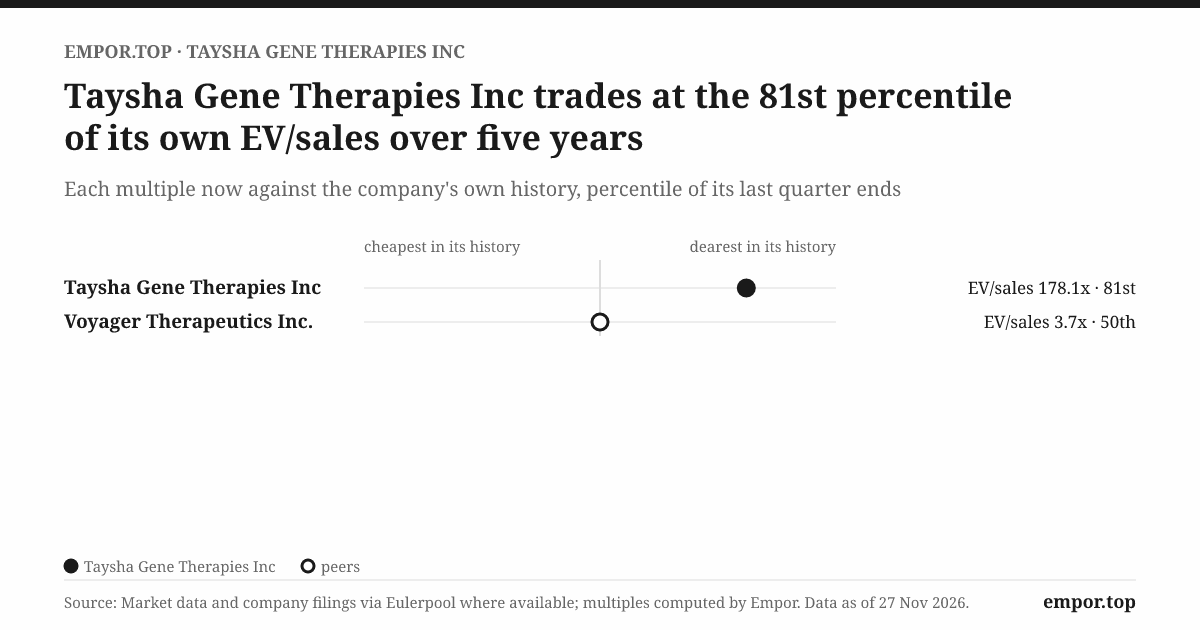
On November 27, 2026, Taysha's shares closed at $4.14, giving the company a market value of about $1.3 billion and, after subtracting cash and adding debt, an enterprise value of about $977 million. On paper, that is 245 times trailing sales, or 178 times on an enterprise-value basis. Those multiples are absurd, and they are also irrelevant. The denominator is the $5.5 million Astellas option lapse.2 The trailing operating loss is about $161 million.2 There are no earnings for a price-to-earnings ratio, no product revenue for a sales multiple to mean anything, and no history of commercial operations against which to compare.
What the market is actually pricing is a probability-weighted clinical asset. Roughly a billion dollars of enterprise value is the market's estimate of TSHA-102's eventual commercial value, multiplied by the odds of approval and discounted for time and future dilution. The useful way to think about the valuation, then, is not as a multiple but as an implied bet: what must go right for that billion dollars to be cheap, and what could make it expensive?
The bull case begins with the disease and the data so far. DAYBUE's sales demonstrate that families, physicians and payers will support a real commercial market.4 TSHA-102 has completed pivotal dosing, with an encouraging acute safety record across 33 patients.[^1] Its regulated construct is designed to address the dose-sensitivity problem that makes MECP2 so hard. The company says it has completed a PPQ campaign and lined up a commercial manufacturer.[^1]13 Its cash runway reaches the 2027 data and regulatory milestones, and it appears to be roughly half a year ahead of its direct gene therapy rival in reporting pivotal data.12 If the interim data show a clear responder rate well above natural history, with durable benefit and clean safety, and the FDA agrees the package supports a BLA, Taysha could be the first company to bring a gene therapy for Rett to market.
The case against is equally concrete. Taysha has no product sales and a single lead asset. Its efficacy advantage is unproven; the design features remain unproven until the data are in. Neurogene will report its pivotal data months later, and if its benefit is comparable, Taysha's lead may not translate into durable share. GAN, one of Taysha's earlier clinical programs, stopped when the FDA spelled out what a registrational study would require.[^5] The FDA could ask for longer follow-up, a different analysis or an additional study, any of which would push revenue further out while the burn rises. And the financing record shows a company that has repeatedly diluted shareholders to survive.
The competitive structure can be read through Michael Porter's five forces, applied only where evidence supports them. Rivalry is real and direct: Neurogene is a near-identical bet on the same patients. The threat of substitutes is concrete in DAYBUE, an oral daily therapy already embedded in specialist practice, and in the possibility that future genetic medicines, including other gene therapy or RNA approaches, target the same biology. Buyer power will be high: payers will scrutinize a multi-million-dollar one-time therapy, and the specialist centers that administer it can choose between products. Supplier power is meaningful because Taysha depends on Catalent and on clinical research organizations for capacity it does not own. Barriers to entry are high in the narrow sense that gene therapy is expensive and slow to develop, but Neurogene's existence shows they are not prohibitive.
Hamilton Helmer's 7 Powers framework gives a sharper answer to the moat question, and the answer today is that no power is established. Process know-how, the kind of manufacturing and clinical expertise that is hard to copy, could become a power if Taysha's product proves consistently manufacturable and its clinical results are superior; that is the most plausible future advantage. Switching costs do not apply in the usual way to a one-time therapy. Scale economies would require volume that no Rett gene therapy has. Cornered resources, such as exclusive rights to a uniquely effective construct, are not demonstrated: AAV9 is widely used, regulated expression has more than one form, and regulatory designations do not exclude competitors. Counter-positioning, network effects and brand are not relevant at this stage. Technology labels, regulatory designations and a manufacturing campaign do not by themselves establish any of these powers.
How should DAYBUE be used as a benchmark? Its sales demonstrate a sizable Rett treatment market, but it is not a direct revenue or margin comparison for TSHA-102: one is a daily oral drug with recurring revenue, the other a one-time procedure with a lump-sum price and a launch constrained by treatment center capacity and payer approval. Neurogene is a direct development rival, not a proven market-share benchmark.
Now apply the skeptical investor's stress test. Meaningful approval odds require clear pivotal efficacy, durable benefit, FDA alignment on the six-month package and acceptance of the manufacturing process. If the FDA asks for more evidence, the cash and share-count path changes quickly: the runway that reaches the second half of 2028 assumes a ramp toward launch, and a delay would push the company back to the capital markets, likely before revenue arrives. An activist-minded holder would add pointed questions about why G&A is rising for launch readiness before the data are known, why pay exceeded target in a year of widening losses, and whether the board has a disciplined plan for the new CNS candidate that will compete for the same cash.
The risks that matter most to this company are specific: clinical efficacy and durable safety, the FDA pathway, AAV manufacturing and supply through a single contract manufacturer, the leap from trial execution to commercial execution, dilution, and competition from Neurogene. Currency and macroeconomic risks are not what drive this story; Taysha has no significant long-lived assets outside the United States and reports no material currency exposure.7
The verdict follows from the evidence. The valuation depends on four linked tests: pivotal efficacy, regulatory alignment, durable safety and manufacturable supply. The bear case only requires one of them to fail before commercial economics exist. Both cases are live, and the first half of 2027 will move the probabilities more than anything that has happened to date. Before turning to that moment, it is worth drawing out what Taysha's journey so far teaches.
XI. Business & Investing Lessons
Taysha's GAN program remains the clearest warning: clinical progress is not a regulatory path.8[^5] Dosed patients, hopeful early data and a constructive tone from the regulator are all inputs; what matters is whether a feasible pivotal study exists that the FDA will accept and the company can afford to run. For founders, that means designing the registrational path before falling in love with a program. For investors, it means discounting clinical progress until the regulatory endpoint is visible.
Taysha's Astellas deal offers a subtler lesson: partner interest can fund the clock without promising to buy the asset, as the expired Rett option demonstrated.[^11]7 An option deal is a partner buying information, and sometimes the most important information it buys is the reason to walk away. Read the structure, not the headline.
The 2023 private placement is Taysha's defining financial moment, and its lesson is the bluntest. The financing rescued the Rett program at a steep cost to existing shareholders.3 Runway can save a program and still cost existing owners dearly. Survival financing is not neutral: it determines who gets paid if the science works.
The PPQ campaign completed in late 2026 supplies the fourth lesson. A factory milestone matters only when regulators accept the evidence and treatment centers can reliably administer the product.
Each of these lessons comes back to the same discipline, the one that runs through Taysha's whole story: distinguishing technical progress, financing and commercial proof. They are three different things. Taysha has had the first two in abundance. It has never had the third. Promising science and patient capital are inputs; only an approvable, manufacturable treatment can convert them into durable company economics.
XII. Epilogue
Tonight, Taysha heads toward 2027 with pivotal dosing complete, a manufacturing qualification campaign reported complete, roughly $423 million in the bank, and every decisive question still open.[^1] The next six months will compress years of uncertainty into a handful of announcements.
The first is the REVEAL interim readout, expected in the first half of 2027.[^1] When it arrives, the details will matter more than the headline. How is a responder defined, and how many of the seventeen pivotal patients meet that definition? How long have they been followed? How does the result compare with what natural history predicts for girls of the same age and disease stage? A strong, clean result would make TSHA-102 the leading Rett gene therapy and set the bar Neurogene must clear later in the year. A muddy one would invite exactly the questions that ended the GAN program.
The second is the FDA's feedback on the BLA pathway, guided for the same window.[^1] Nolan has called the six-month data "all upside," but it is the agency, not the company, that decides whether six months is enough.1 If the FDA accepts the package, Taysha could file and begin the review clock. If it asks for longer follow-up or another study, the runway arithmetic changes, and so does the probability of another raise before any revenue.
Around those two moments sit smaller signals. The CMC meeting feedback will be the first outside verdict on the manufacturing package.1 Management has said it expects to nominate a new CNS gene therapy candidate in the first half of 2027; until development begins and its capital demands are disclosed, that is optionality, not value.1 The runway guidance into the second half of 2028 should be revisited each quarter alongside the cash burn, the fully diluted share count and the milestone timetable, because a runway is only meaningful in relation to the milestones it is meant to reach.[^1] And the stockholder litigation over the 2023 placement remains to be finally resolved through the court's termination process.2
Behind all of these is the second-half 2027 readout from Neurogene, which will either confirm that two regulated gene therapies can work in Rett, or reshape the race.12
The central questions remain open for specific reasons. The pivotal efficacy dataset has not been reported. The FDA has not given its view of the BLA path. Durable follow-up is measured in months, not years. And launch-scale manufacturing exists as a qualified process and a contract, not yet as a supply chain feeding patients. Taysha has bought itself the time to answer all four. What it has not yet bought is the answer.
XIII. Outro
Return to the opening scene: the 33 patients who passed through the acute safety window. That is a real achievement, and the people who built it—the clinicians, the scientists, the families who enrolled—deserve to have it counted.
But there is a gap between a gene therapy that can be safely administered in a trial and a treatment that works well enough, consistently enough, to reach every girl who might benefit from it. After seven years and one discontinued program, Taysha has reached the edge of that gap. The bet is not that the vector can carry the gene. It is that Taysha can carry the evidence all the way to approval.
References
-
Taysha Gene Therapies Q3 2026 Earnings Call Transcript — Equibles, 2026-11-12 ↩↩↩↩↩↩↩↩↩↩↩↩↩↩
-
Form 10-Q for the quarter ended September 30, 2026 — U.S. Securities and Exchange Commission, 2026-11-12 ↩↩↩↩↩↩↩↩↩↩↩↩↩↩↩↩↩↩↩↩↩↩
-
Form 8-K: $150 Million Private Placement — U.S. Securities and Exchange Commission, 2023-08-14 ↩↩↩
-
Acadia Pharmaceuticals Reports Fourth Quarter and Full Year 2025 Financial Results — Acadia Pharmaceuticals, 2026-02 ↩↩↩
-
Form S-1 Registration Statement filing index — U.S. Securities and Exchange Commission, 2020-09-02 ↩↩↩↩↩↩↩
-
Form S-1/A IPO Prospectus Amendment — U.S. Securities and Exchange Commission, 2020-09-11 ↩↩
-
2025 Form 10-K — U.S. Securities and Exchange Commission, 2026-03-19 ↩↩↩↩↩↩↩↩↩↩↩↩↩↩↩↩↩↩↩↩↩↩↩↩↩↩↩↩↩↩↩↩↩↩↩↩
-
Taysha Gene Therapies Q2 2023 Earnings Call Transcript — Equibles, 2023-08-14 ↩↩↩↩↩↩↩↩↩↩↩↩
-
Form 8-K: 2026 Annual Meeting Voting Results — U.S. Securities and Exchange Commission, 2026-06-02 ↩↩↩↩↩
-
REVEAL Study of TSHA-102 in Rett Syndrome (NCT05606614) — ClinicalTrials.gov ↩
-
Clinical Programs in Rett Syndrome — International Rett Syndrome Foundation, 2026-02 ↩
-
Neurogene Form 10-Q for the quarter ended September 30, 2026 — U.S. Securities and Exchange Commission, 2026-11 ↩↩↩↩↩↩
-
Taysha Gene Therapies and Catalent Expand Strategic Partnership to Include Future Commercial Manufacturing — Catalent, 2026-08-03 ↩↩
 LinkedIn
 WhatsApp
 Reddit
 Hacker News
 Email
 Kindle
 RSS Feed
 Spotify
 Apple Podcasts
 Amazon Music
 Audible
 YouTube