Trevi Therapeutics: Can a Cough Drug Make It Through the Trials?
I. A promising signal, two years from its first pivotal answer
On July 17, 2026, GSK told the world it was walking away from camlipixant, the chronic-cough drug it had spent years pursuing, including through a multibillion-dollar acquisition.12 The drug had gone through two large Phase 3 trials, CALM-1 and CALM-2. One met its main measure. The other did not. And even where the primary endpoint landed, the program fell short of key secondary thresholds that regulators, doctors and payers would have wanted to see.1 Trade press read the announcement for what it was: the end of blockbuster hopes for one of the most advanced cough drugs in the industry.2
In New Haven, Connecticut, a company with 34 employees was watching closely.3 Trevi Therapeutics had just started its own pivotal program in the same broad territory, chronic cough, with a different drug and a different first target. Its first Phase 3 study, OCEAN-1, had begun in the second quarter of 2026, and the company had told investors to expect the results of a second, shorter study, OCEAN-2, in the second half of 2027, with OCEAN-1 following in the first half of 2028.[^4] In other words, the moment GSK learned its answer, Trevi was standing at the very beginning of the long walk toward its own.
That is the shape of this story. Trevi is a clinical-stage biotech with one investigational medicine, Haduvio, an oral extended-release form of an old drug called nalbuphine.3 It has never sold a product. Its revenue line has read zero in every year of its reported history, and it has lost money every year since it was founded in 2011.3 What it has instead is a signal: a randomized Phase 2b trial called CORAL, in 165 patients with idiopathic pulmonary fibrosis and chronic cough, which was published in JAMA in January 2026 and showed that the drug cut measured cough far more than placebo over six weeks.4
A signal is not a product, and the distance between the two is where biotech investors either earn their returns or lose their capital. So this is a story built around three linked tests. The first is scientific: does Haduvio work in pivotal trials that run longer, enroll more patients and measure more carefully than anything Trevi has run before? The second is financial: does the money last until those answers arrive, and how much of the company do existing owners give up to fund the wait? The third is commercial, and it is the one that gets the least attention: if the trials succeed, can a single-molecule company with a single disclosed supplier and a licensed asset turn approval into a durable business?
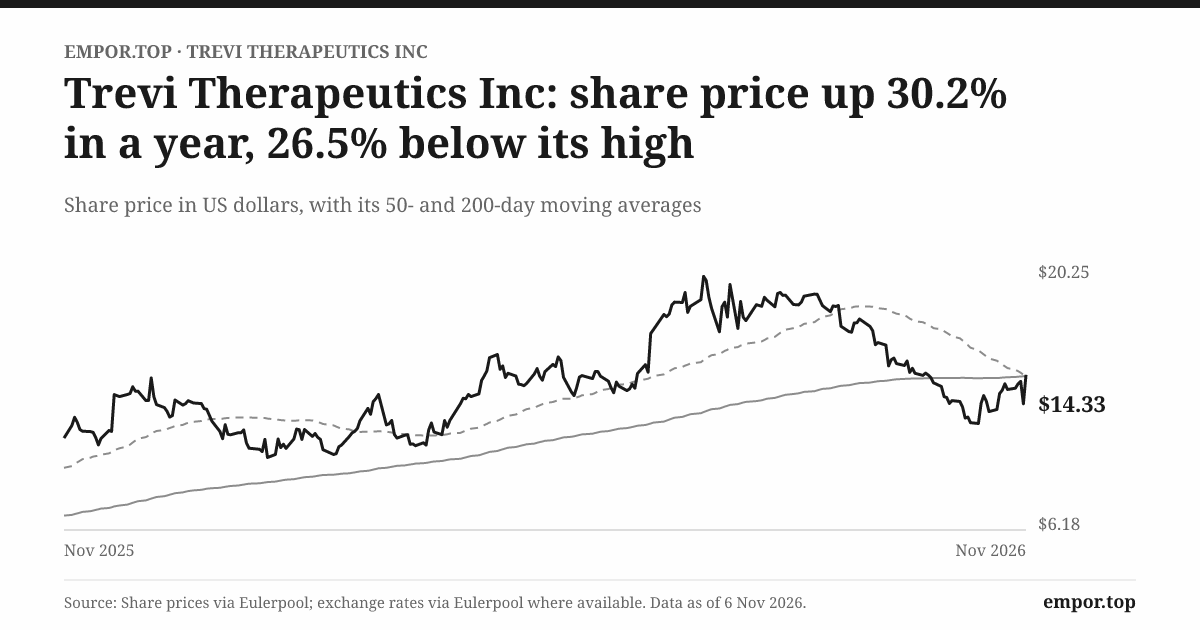
The market has already placed its bet on those questions. On November 6, 2026, Trevi's shares closed at $14.33, about 27% below their 52-week high of $19.50 and well above their low of $9.99.[^6] Multiply that price by the 142.4 million shares outstanding at the end of June and the equity is worth about $2.0 billion.5 Some quoted market values sit closer to $1.9 billion, which appears to reflect an older, smaller share count; the June figure, which includes the April 2026 offering, is the better base, and every later exercise or issuance would push the true number higher still. Subtract the $318.9 million in cash and marketable securities Trevi held in June and the market is valuing the clinical asset, the know-how and the option on a future business at somewhere around $1.7 billion.5 Ordinary multiples are useless here. An enterprise-value-to-sales ratio of zero says nothing when there are no sales, and a price-to-book ratio of about seven times mostly tells you that the book is a pile of Treasury bills and the value is in the trial.
What would a reasonable person need to believe to own that? That the CORAL effect is real, that it survives longer treatment, that tolerability holds up in a broader population, that the FDA agrees, and that the company can build a launch without either diluting its owners into irrelevance or surrendering most of the economics. None of those things is proven. Several are plausible. And GSK's July decision is a reminder that plausible, in chronic cough, has failed before at the last hurdle.
This is not a forecast disguised as a result. It is a story about evidence and uncertainty, about how a small team pivoted one molecule from itching to cough, what its best data actually show, how it paid for the next chapter, and what would make the bet look wise or foolish in hindsight. It begins with a choice Trevi made years ago, when the drug was meant for a very different disease.
 Subscribe on LinkedIn
II. One molecule, two very different diseases
In 2022, anyone reading Trevi's annual report closely would have found two stories sitting side by side, pulling in opposite directions.[^8] The first was about itch. Trevi had built its early identity around prurigo nodularis, a miserable skin condition in which patients develop hard, intensely itchy nodules and scratch themselves into a cycle of damage. An earlier Phase 2 trial of Haduvio in that disease had missed its primary endpoint.[^8] The second story was smaller, newer and more interesting: a 38-patient trial called CANAL, testing the drug in the persistent cough that afflicts people with idiopathic pulmonary fibrosis, had come back positive.[^8]
To understand why one company would carry both, start with the molecule. Nalbuphine is not new. It has been used for decades as an injectable painkiller, and its interest lies in how it touches the body's opioid system. It stimulates the kappa opioid receptor while blocking, or partly blocking, the mu receptor, the one responsible for much of the euphoria, respiratory depression and addiction risk associated with drugs like morphine.3 That mixed profile is why the drug is not a controlled substance in the way many opioids are, and why Trevi's founders thought an oral, slow-release version could be useful in conditions driven by overactive nerve signals: chronic itch on the skin, and, as it turned out, the cough reflex in the lungs and brain.
The rights came cheaply. In May 2011, the newly incorporated company signed an agreement with Penwest, later merged into Endo Pharmaceuticals, for an exclusive worldwide license to nalbuphine products including extended-release versions, paying an upfront fee of just $25,000 in exchange for future milestones and royalties.6 That license, which has since passed to Keenova, still shapes the economics of any eventual product, and it will come back later in this story.3 Jennifer Good has run the company from its first day, alongside co-founder and chief scientific officer Thomas Sciascia, and she has been president, chief executive and a director since 2011.7 Trevi went public in May 2019, closing an initial public offering and concurrent private placement on Nasdaq.83
The positive trial that was not enough
The prurigo nodularis chapter is often remembered as a failure. The record is more complicated, and more instructive. After the earlier Phase 2 miss, Trevi ran a much larger Phase 2b/3 study called PRISM. In 353 patients, PRISM reported positive results on its primary and secondary endpoints.[^12] On its face, that is the kind of result a small biotech dreams about: a big trial, a clean win, a disease with unmet need.
And yet, in its filings from that period, Trevi said it anticipated that another Phase 3 trial would likely be needed to support a marketing application in prurigo nodularis, and it described the regulatory and enrollment challenges of running one.[^12] So a positive trial had opened a door, and behind it was another corridor. The company would need more money, more patients and more time to reach an approvable package, in a dermatology market where much larger companies were developing their own treatments.
What Trevi did next was the defining strategic decision of the past five years. It narrowed. The cough program, which had started as a sideline, became the company. The RIVER trial, a Phase 2a study in refractory chronic cough, and then CORAL, the Phase 2b trial in IPF cough, became the evidence base on which everything since has been built.3[^4]
What the pivot does and does not prove
There is a flattering version of this story, in which a founder spotted the better opportunity and moved decisively. There is an unflattering one, in which a company that could not finish the first job simply moved its only asset to a new set of unknowns. The evidence supports something in between. PRISM showed that Trevi could design and complete a sizable randomized trial and get a positive result. It also showed that a positive result, on its own, did not establish a path to market, and that the company was willing to step back from an indication rather than spend scarce capital chasing it. That is a meaningful course correction and evidence of capital discipline in the narrow sense of not throwing good money after a long regulatory road.
What it is not is a commercialization record. Over roughly fifteen years, the company has accumulated a deficit of about $330 million and never reported a dollar of product sales.3 Across the decade from 2016 to 2025, annual operating losses widened from under $9 million to about $49 million as trials grew larger.3 That arc is the normal arc for a development company, but it means investors are judging management on its ability to run trials and raise money, not on any record of selling a drug.
So the unresolved question from the pivot carries straight into the present. Does cough give Trevi a more complete regulatory path than itch did, with clearer endpoints, a clearer patient population and a clearer FDA conversation? Or has the company simply moved its single asset into a different disease where the hurdles are just as high but not yet visible? The answer depends a great deal on what kind of problem chronic cough really is, and who, if anyone, has managed to solve it.
III. The cough problem Trevi is trying to own
Picture a patient with idiopathic pulmonary fibrosis. The disease scars the lungs progressively and, for reasons medicine still does not fully understand, it is relentless. The patient may already be taking one of the approved antifibrotic drugs that slow the decline in lung function. Those drugs do something important. They do not stop the cough. And for many patients, the cough is the part of the disease they feel every hour: the fits that interrupt conversation, the nights broken into fragments, the exhaustion, the embarrassment in public, the sense that the body is fighting itself. There is no U.S.-approved treatment specifically for IPF-related cough.3
That is the opening Trevi is trying to walk through. In its May 2026 Investor and Analyst Day materials, the company estimated about 140,000 people in the United States with IPF and said most of them experience cough.[^13] Its broader estimate for refractory chronic cough, the stubborn cough that persists despite treatment of any underlying cause, was two to three million people.[^13] Those are large numbers. They are also company estimates, built for an investor audience, and they describe patients, not paying customers.
How the drug is meant to work
The cough reflex is a little like a smoke alarm wired to a sensitive switch. Nerve endings in the airways detect irritation and send a signal up to the brainstem, which decides whether to fire a cough. In chronic cough, that alarm is hypersensitive: it goes off at the slightest provocation, or with no clear provocation at all. Haduvio's theory is that, by acting on kappa and mu opioid receptors, it can turn down the sensitivity of that system both at the nerve endings in the body and at the control center in the brain.3 Trevi describes this as a central and peripheral mechanism, and it is the core of the company's scientific argument for why the drug might work across different kinds of chronic cough.
That breadth is also why Trevi now talks about three indications rather than one. IPF-related cough is the lead, and it is the one in Phase 3. Refractory chronic cough is in a Phase 2b trial called LAKE. And cough in non-IPF interstitial lung disease, a family of related scarring lung conditions, is a potential additional program that, as of the latest reported quarter, still depends on discussions with the FDA.[^4]
The graveyard and the survivors
Cough has attracted big companies before, and their experience is the best evidence available about how hard this market is. Merck's gefapixant, which works through a different mechanism by blocking a receptor called P2X3 on airway nerves, was approved in Japan, and it has since been approved in some other markets outside the United States. In the U.S., the FDA declined to approve it, and Merck's January 2022 regulatory update described the agency's complete response letter alongside the Japanese approval.9 GSK's camlipixant, another P2X3 drug, was supposed to fix gefapixant's main weakness, a taste disturbance that bothered many patients, and it was the asset behind GSK's acquisition of Bellus Health. Then, in July 2026, GSK ended development for refractory chronic cough.12
It would be easy, and wrong, to read GSK's exit as a win for Trevi. A competitor stepping aside does create space. But the more important lesson is about the field. Two of the largest pharmaceutical companies in the world, with deep development teams and patient-reported outcome expertise, could not produce a chronic-cough drug that cleared every bar in the United States. The shared failure mode was not a lack of signal in early trials. It was the difficulty of producing a large, consistent, clinically meaningful effect across long, multi-site Phase 3 programs, where placebo response is substantial and small effects get diluted. Unmet need is real. So is the difficulty of meeting it.
Trevi's answer is that IPF cough is a cleaner place to start: a defined population, a severe disease, patients already under specialist care, and a mechanism that is not the P2X3 approach the big companies tried. That is a reasonable argument and a testable one. It is also, today, an argument rather than a result.
What "market" would actually mean
Patient counts are the easiest part of a biotech market model to write down and the least informative. A market, in practice, is a pulmonologist deciding to prescribe a twice-daily opioid-receptor drug to a frail, often elderly patient already taking other medicines. It is that patient tolerating the side effects long enough to feel the benefit. It is an insurer deciding the benefit is meaningful enough to pay for. And it is the effect being large enough, and lasting enough, to change how doctors treat cough rather than merely adding another option they rarely reach for.
Trevi has demonstrated none of those things commercially because Haduvio is not approved.3 On the Q2 2026 call, management discussed how refractory chronic cough patients might be segmented and how pricing could differ across indications, but it disclosed no price and no payer commitment.10 That is not a criticism of the company so much as a description of where it stands. The unmet need is credible. Addressable demand, pricing and adoption are still hypotheses.
Which brings the story to the one piece of evidence that turns those hypotheses from wishful thinking into something worth testing: the six-week trial that made Trevi's case.
IV. CORAL's six weeks—and the years still ahead
In June 2025, Trevi announced top-line results from CORAL.[^4] Seven months later, in January 2026, the full randomized trial appeared in JAMA, one of the most widely read medical journals in the world.4 For Trevi, that publication mattered beyond the prestige. Peer review does not prove a drug works, but it does mean outside experts examined the design, the statistics and the claims, and a journal with that reach put the data in front of the very pulmonologists who would one day have to decide whether to prescribe.
The design was straightforward. Of 223 people screened, 165 adults with IPF and chronic cough were randomized to one of three doses of nalbuphine extended-release, 27, 54 or 108 milligrams twice a day, or to placebo, and treated for six weeks.4 The primary measure was objective: patients wore a cough monitor, a small recording device that counts coughs over 24 hours, so the result did not depend on how anyone felt about their cough but on how often they actually coughed.
Reading the result honestly
The headline number is the one Trevi leads with. At the 54-milligram dose, the dose the company selected to take forward, 24-hour cough frequency fell by 53.4% from baseline after six weeks.4 That sounds like a dramatic halving of a debilitating symptom, and for the average patient on that dose, it roughly was.
But the number that matters most is not the drop from baseline. It is the gap between drug and placebo, because placebo patients improved too. Their cough frequency fell by 16.9%.4 Why would sugar pills reduce coughing? Part of it is the attention and reassurance of being in a trial, part is regression to the mean, since people tend to enroll when symptoms are at their worst, and part is the natural variability of a symptom that waxes and wanes. Whatever the cause, the placebo response is the floor every cough drug has to clear, and in larger and longer trials it has a habit of rising. The CORAL gap, roughly 36 percentage points at the selected dose, is large by the standards of the field. It is the reason the company exists in its current form.
The dose response adds some reassurance. The lowest dose cut cough by 47.9% and the highest by 60.2%, so the effect rose with dose, which is the pattern one would expect from a real pharmacological effect rather than noise.4 The 54-milligram dose also improved patients' own reports of cough frequency, which matters because regulators and payers care whether patients feel the difference, not just whether a device registers it.4
Why not take forward the highest dose, which produced the biggest drop? Because a cough drug is a trade, not a trophy. Nalbuphine acts on the central nervous system and the gut, and the side effects follow: nausea, dizziness, vomiting and related events, concentrated around the period when patients are titrated up to their target dose.11 In CORAL, discontinuations due to treatment-emergent adverse events were similar between placebo and the active groups, about 5% in each, which suggests the drug was broadly tolerable over six weeks.11 Even so, titration-related events like nausea were common in the combined nalbuphine groups.11 Trevi adjusted its dose-titration approach for Phase 3 in response to this earlier experience.[^13] Selecting a middle dose and smoothing the titration is a sensible attempt to maximize the effect patients can live with. It is also an admission that tolerability is part of the commercial product, not a footnote to it.
What six weeks cannot tell you
Here is the uncomfortable truth about CORAL: six weeks is a short time in the life of a chronic disease. Patients with IPF cough would, if the drug works, take it for months or years. Six weeks cannot reveal whether the effect fades as the body adapts, whether side effects that seem manageable early become intolerable later, or whether rare safety signals emerge only in larger populations. A Phase 2 sample of 165 patients split across four arms leaves around 40 people per group, enough to detect a large effect but not enough to rule out every surprise.4 The paper itself treats confirmation in longer studies as the next necessary step.4
Analysts raised exactly that issue on Trevi's August 2026 earnings call, asking whether results from shorter trials could read through to the longer OCEAN studies.10 It is the right question. Management's answer, whatever confidence it conveyed, is an argument about what future trials will show. The evidence already observed is narrower: a large six-week effect, consistent across doses and across objective and patient-reported measures, in one randomized trial. That distinction is the whole investment case in a sentence.
The places where a Phase 3 result could turn out less persuasive than CORAL are not hard to name. A higher placebo response in a larger, more geographically spread trial would shrink the gap even if the drug performed exactly as before. Longer treatment could erode the effect or the tolerability. The 54-milligram dose, chosen partly for tolerability, gives up some efficacy relative to 108 milligrams, so the margin for error is smaller than the headline suggests. Anyone who listened to Trevi's appearances, including its September 2026 presentation at the Morgan Stanley Global Healthcare Conference, should have listened for how management talked about treatment duration, placebo response and dose selection, and whether the answers stayed consistent from one audience to the next.12
The income statement of a pre-revenue biotech tells the rest of this part of the story in a single line: spending is rising to meet the trial load. Research and development reached $25.1 million in the first half of 2026, up from $17.2 million a year earlier, and quarterly operating losses widened to about $20.5 million in the June quarter, the largest in the company's recent history.5 That is what it costs to convert one six-week answer into several longer ones. CORAL bought the right to ask the next question. Trevi decided to ask several at once.
V. The pivot from one cough study to three programs
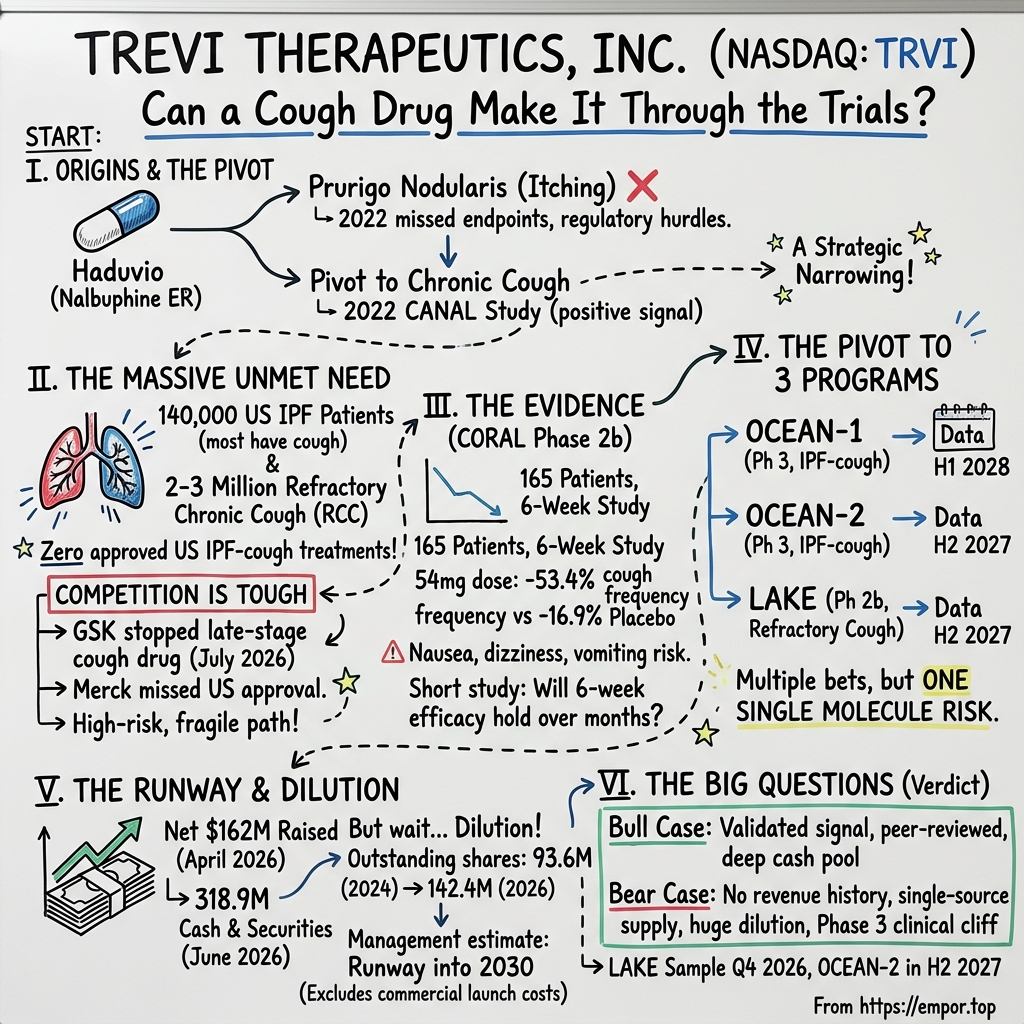
The spring of 2026 was the busiest stretch in Trevi's history. In April, the company closed its largest-ever stock offering. In the second quarter, it started two trials almost at once: OCEAN-1, its first Phase 3 study in IPF-related cough, and LAKE, a Phase 2b study in refractory chronic cough.[^4] In May, it brought investors and analysts together to explain why one molecule should now be developed in three cough indications rather than one.[^13]
For a company that had spent years learning the cost of spreading itself thin across itch and cough, this was a striking choice. Trevi was broadening again, but this time within a single symptom.
The calendar as it stood
The sequence matters because the order of readouts determines what investors learn and when. OCEAN-1 began in the second quarter of 2026, with top-line results expected in the first half of 2028.[^4] OCEAN-2, the second IPF trial and the shorter of the two, had been expected to begin in the third quarter of 2026, with results expected in the second half of 2027.[^4] That means the trial scheduled to start second is expected to finish first, and its 12-week answer will become the first pivotal evidence the market sees.[^13] LAKE is set to undergo a sample-size re-estimation in the fourth quarter of 2026, with top-line results projected for the second half of 2027.[^4] Non-IPF interstitial lung disease, the third indication, remained at the stage of discussions with the FDA as of the latest reported quarter.[^4]
Two of those programs are real trials enrolling real patients. OCEAN-2's start is still to be confirmed, and the non-IPF ILD program remains a plan. Keeping them distinct is the first act of discipline in reading Trevi's story.
The logic of a shared call point
Management's strategic logic runs like this. The doctors who treat IPF are pulmonologists, often at specialty centers. The doctors who treat severe refractory chronic cough and other interstitial lung diseases overlap heavily with that group. So if Haduvio is approved for IPF cough, a small, focused U.S. sales force could call on a concentrated set of prescribers, and every additional indication would ride on the same commercial infrastructure, the same relationships and the same medical-education effort.[^13]3 In the language of the industry, the indications share a call point.
That is a coherent commercial hypothesis, and it has a real benefit: if it works, the cost of adding the second and third indications is mostly the cost of trials, not of building new sales teams. But a shared call point is not a distribution advantage today. Trevi has no sales force, no prescribers or reimbursement contracts.3 The claim can only be tested after approval, by whether pulmonologists actually adopt the drug and whether the second indication sells more cheaply than the first.
Three bets, one molecule
The deeper problem with calling these three programs diversification is that they are not independent. Every one of them depends on the same investigational drug, the same safety profile, the same manufacturing chain, the same 34-person organization and the same cash pool.3 If OCEAN-2 reveals a tolerability issue in longer treatment, that issue would hang over LAKE and the ILD program as well. If the single drug-substance supplier stumbles, all three stall together. Real diversification would mean different molecules or different mechanisms. What Trevi has is a set of options on one underlying asset, which can multiply the upside if the drug works and offers almost no protection if it does not.
There is also an execution question. Running two Phase 3 trials and a Phase 2b trial in parallel is a heavy load for a small company, and the cost shows up directly in the rising R&D line. Contract research organizations do much of the operational work, and the cost of that work is hard to estimate in real time: Trevi's auditor, Ernst & Young, flagged the estimation of CRO costs as a critical audit matter, because trial progress and vendor invoicing do not always line up.3 That is not an accusation of error. It is a sign of how much of the company's financial picture now depends on judgments about trials in progress.
The organization running all this is strikingly small. At the end of 2025, Trevi had 34 employees, 21 of them in research and development.3 That is not a flaw in itself; lean sponsors that outsource trial operations are the norm in biotech, and a small team keeps fixed costs low while the science is unproven. But it does shape where risk lives. The people who actually recruit patients, run sites and clean data mostly work for contractors, so Trevi's job is closer to that of a general contractor overseeing builders than of a builder. The cash statement shows the shift. In the first half of 2026, prepaid and other current assets rose by about $5.8 million, mostly deposits and prepayments for clinical-trial work, while accrued research costs stood at $2.3 million at the end of June.5 Money is going out the door before the work is billed, which is how large trials are bought. It also means that if a trial is paused or resized, some of that cash is already committed. For a company this size, the quality of its vendor oversight is as much a determinant of the calendar as the drug itself.
The decision points ahead
LAKE's sample-size re-estimation deserves particular care, because it will be tempting to read it as a result. It is not. A re-estimation is a planned look, partway through a trial, at whether the original assumptions about variability and effect size still hold, so the trial can be resized if needed. It can reveal whether the trial is adequately powered. It offers no efficacy conclusion. A decision to enlarge the trial could mean the effect looks smaller or noisier than assumed. A decision to keep the size could mean the assumptions held. Neither tells investors whether the drug works in refractory chronic cough.
Then there is the third-quarter question. The company had guided to starting OCEAN-2 in the third quarter of 2026, and its third-quarter results, scheduled for November 9, will be the first chance to confirm whether that happened on time and whether any other guidance moved.[^6] For a company whose investment case rests on a calendar, a quarter's slip would not be catastrophic. A pattern of slips would be. Either way, the trials are only half the question of what Trevi is building. The other half is what happens if they succeed.
VI. A clinical edge is not yet a moat
Buried in the business section of Trevi's 2025 annual report, past the trial descriptions and the scientific rationale, is a sentence that every long-term investor should read twice. Trevi relies on a single supplier, Par Health, for the nalbuphine hydrochloride drug substance at the heart of Haduvio, and it has no agreement in place guaranteeing either the quantity or the price of that supply.3 At the time of the report, no alternate source had been qualified.3 For a company that hopes to turn one molecule into a business, that is the kind of detail that can matter as much as a p-value.
This section asks the question that the trial calendar tends to crowd out: if Haduvio works, what would make Trevi's economics durable?
What the market structure says
Think about the forces that would act on Trevi as a commercial company. Buyers, meaning physicians who choose whether to prescribe and payers who choose whether to reimburse, will have options if other cough therapies emerge, and payers in particular are skilled at squeezing drugs whose benefit is measured in symptom relief rather than survival. There are no switching costs yet and no record of patient retention, because there are no patients on commercial therapy. Suppliers have unusual leverage, because there is one disclosed supplier and no contract guaranteeing terms. New entrants face real barriers in the form of clinical evidence and regulatory approval, but Trevi does not yet own either of those barriers; it is still trying to build them. And substitutes, from off-label use of existing medicines to future drugs with different mechanisms, will define the ceiling on price.
Read that way, Trevi today has a potential product and a developing patent position. It does not have a moat.
The claimed advantage, tested
The company's case for an edge rests on the CORAL signal and Haduvio's different mechanism. Both support a testable clinical thesis. Neither proves price power, patient preference or superiority. There has been no head-to-head trial against any competitor. Cross-trial comparisons in cough are treacherous, because populations, durations, placebo responses and measurement methods differ, so it would be unwise to conclude that a larger percentage drop in one trial means a better drug than another.
The competitor record cuts both ways. Gefapixant's U.S. rejection9 and camlipixant's inconsistent Phase 3 results1 tell you neither that Haduvio will win. Together they say the field is open precisely because it is hard.
The supply chain and the license
The supply risk deserves a plain explanation. Drug substance is the active ingredient, the chemical that makes the pill do anything at all. If Par Health raised prices, prioritized other customers, ran into manufacturing or regulatory problems, or simply declined to scale up for a commercial launch, Trevi would need a second source, and qualifying one takes time, testing and regulatory filings. With no guaranteed volume or price and no qualified alternate reported in the 2025 annual report, the company's commercial future depends, at least for now, on a relationship rather than a contract.3
The license adds a second layer to the economics. The original 2011 agreement provided for mid-single-digit royalties on net sales and milestones tied to development.6 Under the current agreement with Keenova, Trevi owes milestone payments of $0.3 million and $0.8 million, royalties on net sales, low-to-mid double-digit percentages of certain sublicense income, and a low-single-digit know-how and trademark royalty after the main royalty term.3 The exact royalty rates beyond those ranges are not disclosed. None of this is unusual for a licensed asset, and the amounts are modest relative to what a successful drug could earn. But the sublicense term matters more than it first appears: if Trevi partners the drug outside the U.S., as it says it intends to, a meaningful slice of the partner's payments would flow on to Keenova rather than to Trevi's shareholders.3
Patents are a clock, not a wall
Then there is exclusivity. Some of the in-licensed patents covering the formulation expire between 2026 and 2029.3 Trevi does not own or exclusively license composition-of-matter patents on nalbuphine itself, which is an old molecule.3 Its newer protection is method-of-use: a patent covering the use of the drug in IPF cough that the company expects to run until 2039.3 Method-of-use patents can be valuable, especially for a new indication with a specific label, but they are generally narrower than a patent on the molecule, and their strength depends heavily on the eventual label and on how aggressively others try to work around them.
So patent life is not a moat by itself. What will matter is what the FDA label actually says, whether Trevi secures binding commercial supply terms, how much of each dollar of sales the license takes, and whether a successful competitor arrives with a better-tolerated or more convenient drug. Approval, in other words, is the first step toward durable value, not the last. And every step has to be paid for, which is where the story turns from science to finance.
VII. The runway was bought with shares
In April 2026, with OCEAN-1 about to begin and the CORAL paper fresh in physicians' minds, Trevi went to the equity market and raised about $173 million gross, or roughly $162 million after fees, by selling 13.34 million new shares, including the underwriters' full option.[^18][^19] Among the buyers were entities affiliated with Fidelity's parent, FMR, which took about 2.5 million shares, and affiliates of BlackRock.7 The timing was textbook biotech finance: raise when the data are strongest and the stock is buoyant, before the long, quiet period of a Phase 3 trial when there is little news to support the price.
By the end of June, against operating cash use of about $42 million in 2025, that balance looked like a fortress.35 And on the strength of it, management told investors that it expected its funds to last into 2030.5
What "into 2030" covers
Runway estimates in biotech are carefully worded, and Trevi's is no exception. The company said its cash should fund operations into 2030, through the IPF Phase 3 program and a potential U.S. approval for IPF-related cough.5 It also said the estimate excludes the costs of a commercial launch and does not cover full development through approval in non-IPF interstitial lung disease or refractory chronic cough.5 And it stated plainly that further capital will be needed for full development and commercialization.5
So the runway is a calendar with assumptions attached. It assumes trials enroll roughly as planned, costs track the budget, no additional studies are demanded, and the company does not build a sales force before it knows whether the drug is approved. Every one of those assumptions has been broken by some biotech somewhere. That does not make the estimate unreasonable. It makes it management's estimate, not a promise that the whole three-indication plan is paid for.
The burn is already accelerating. Operating cash use in the first half of 2026 was $34.1 million, up from $23.6 million a year earlier, and research and development is rising as the pivotal trials expand.5 Full-year 2025 R&D was $33.5 million; in the first half of 2026 alone it was $25.1 million.35 One small cushion is the cash itself. Interest income reached $6.5 million in 2025, a meaningful offset to the operating burn when the treasury is invested in money-market funds, Treasuries and other investment-grade paper.3 That income is a feature of high interest rates and a large cash pile, not of the business, and it shrinks as the cash is spent.
Capital allocation in a company with no customers
In most companies, capital allocation means choosing among acquisitions, buybacks, dividends and reinvestment. At Trevi, it means one thing: how much equity to sell, when, and what clinical progress each raise buys. There is no acquisition program to judge, no buyback, no dividend. The marketable securities on the balance sheet are treasury holdings parked until the trials need them, not productive business investments. Nearly all the real capital deployment is clinical R&D.
The record of that deployment is three major raises in under two years. In December 2024, Trevi sold about $50 million of stock. In June 2025, it raised about $115 million. In April 2026 came the $173 million offering.3[^18] Each raise was followed by the next stage of development: RIVER and CORAL data, then the Phase 3 launch. In that sense, the money went where the company said it would go.
The cost to existing owners is visible in the share count. Shares outstanding rose from 93.6 million at the end of 2024 to 128.3 million at the end of 2025, and then to 142.4 million by June 2026, an increase of about 52% in eighteen months.35 At their annual meeting in June 2026, stockholders also approved doubling the number of authorized shares from 200 million to 400 million and added 8 million shares to the incentive plan.13 Authorization is not issuance, but it is capacity, and it tells you the board wanted room to sell more stock without going back to shareholders for permission.
Was the dilution worth it? The honest answer is that it depends on whether the trials succeed. A shareholder who owned 1% of Trevi at the end of 2024 owned about two-thirds of a percent by mid-2026, but of a company with far more cash, a published Phase 2b trial and a running Phase 3 program. If OCEAN-2 reads out positively, that smaller slice of a much more valuable company will have been a good trade. If it does not, the dilution will have funded an expensive answer.
The cash story behind the losses
One long-run comparison helps make sense of Trevi's books. Over the decade from 2016 to 2025, the company's cumulative net losses came to about $281 million, while the cash it used in operations came to about $255 million.3 In a normal company, a gap like that might suggest earnings turning into cash. Here it means something more mundane. Stock-based compensation is an expense that does not consume cash, lease and other noncash charges add a little more, and working capital moves from year to year as CRO prepayments and accrued trial costs rise and fall; accretion on discounted investments works partly in the other direction.3 In 2025, for example, the $42.8 million net loss and $42.1 million of operating cash use were almost identical once $5.2 million of stock compensation and a $3.5 million working-capital outflow were netted against each other.3 There are no customers paying anything. The gap is accounting, not cash earnings.
The books themselves raise few alarms. Ernst & Young gave the 2025 financial statements an unmodified opinion with no emphasis-of-matter paragraph, and the CRO estimate it highlighted as a critical audit matter was a description of difficult judgment, not a finding of misstatement.3 Because Trevi is a smaller reporting company, the auditor was not engaged to audit its internal controls over financial reporting, so outside assurance on those controls is narrower than at a large company.3 The company reported no material legal proceedings, no unrecognized tax benefits and no accrued tax penalties, though its tax years from 2011 through 2024 remained open to examination, which for a loss-making company mostly matters for the value of accumulated tax losses rather than for any bill.3 Interest income is the one line worth watching more closely: at about 15% of the 2025 pre-tax loss, it flatters the reported net loss relative to the operating burn, and it will shrink as the treasury is spent and if interest rates fall.3 An investor tracking runway should therefore watch operating cash use, not net loss.
The balance sheet carries no funded debt. At June 30, 2026, Trevi reported no borrowings, and its only meaningful recognized financial obligation was about $605,000 of office lease liabilities.5 So the central financing risk is not refinancing. It is the cost and timing of trials, and whether, when the next raise comes, the stock price makes it cheap or punishing. Which raises the question of who decides when to raise, and how they are rewarded.
VIII. The founder's bet—and the public shareholders' terms
At the May 2026 Investor and Analyst Day, Jennifer Good stood in front of investors with the largest cash balance in Trevi's history and laid out a plan to develop one molecule in three cough indications.[^13]14 She had steered the company through its IPO, through the prurigo nodularis chapter, through the pivot to cough and through a run of equity raises that kept the lights on.7 Few biotech founders stay in the chief executive's chair for fifteen years. Fewer do it at a company that has never sold a product.
That longevity is the first thing to understand about Trevi's leadership. Good has been the constant through every strategic turn, and the company's identity, its persistence with an old molecule, its willingness to narrow, its fluency with capital markets, is in many ways her identity. Around her, the current team has been assembled for the next phase. David Hastings became chief financial officer on January 6, 2026, after the previous CFO, Lisa Delfini, left in August 2025 and Good served as interim principal financial officer in between.[^22]15 Hastings joined with a $522,000 salary, an annual incentive of up to 40% and an option on 375,000 shares.[^22]7 James Cassella leads development, Thomas Sciascia remains chief scientific officer, and Farrell Simon is chief commercial officer, the executive who would build a launch if there is one to build.7
Pay, and what it is paid for
Good's reported compensation was $3.94 million in 2025, up from $2.59 million in 2024.7 Most of the 2025 figure, $2.97 million, was option awards, with a cash bonus of $343,750.7 The proxy's pay-versus-performance table reported a much larger number, $15.38 million in "compensation actually paid," but that figure marks the value of equity awards to market as the share price moves; it is not cash she received.7 For a listener, the distinction is simple: most of the CEO's pay is a bet on the stock, which aligns her with shareholders in direction, if not always in scale.
The board scored corporate performance at 100% for 2025.7 Given a year that included positive CORAL results, the start of Phase 3 preparations and successful financing, a high score is defensible on development milestones. Set beside a $42.8 million net loss and an unapproved product, it also shows how biotech boards define success: by the milestones they set, not by the profits that remain years away.3 Shareholders should want those milestones published in measurable terms, because a 100% score is only as meaningful as the targets behind it.
There is also a family dimension, small in dollars but worth naming. The 2026 proxy disclosed that one of Good's daughters, employed by Trevi, received $405,229 in total compensation in 2025, and that another daughter was expected to receive about $253,000 for March through December 2026.7 Those amounts are a rounding error against the company's operating costs, under 1% of 2025 operating expense. They are a governance and perception question rather than an operating-cost story, and the right response is the one investors would expect anywhere: clear disclosure, independent oversight and pay in line with the role.
The counterweights
The board's structure offers some reassurance. Every director except Good is independent under Nasdaq rules, and the audit and compensation committees are independent.7 David Meeker, an experienced drug-industry executive, chairs the board.7 Say-on-pay passed with about 98 million votes in favor and 2 million against.7 Ownership is concentrated but not controlled: as of April 2026, NEA-affiliated entities held about 11.6% and Frazier-affiliated entities about 10%, with BlackRock and FMR each around 5%, and executives and directors together about 15.4%.7 NEA later reported a stake of about 10.5% as of May 2026 after the offering enlarged the share base.16 One director, Edward Mathers, is affiliated with NEA but disclaims voting or investment control over its shares.7
The ownership history adds a useful detail. A year earlier, the 2025 proxy had shown NEA at about 14.6% and Frazier at about 10.5%.17 Their percentages fell not because they sold, but because the company kept issuing shares to new buyers. NEA-related entities had also participated in Trevi's 2021 and 2022 private placements, on terms the company said it believed were as favorable as it could have obtained from unrelated parties.7 That is the normal life cycle of a venture-backed biotech: early specialist investors fund the hard years, then generalist institutions like BlackRock and Fidelity arrive once the data look investable, and the founders' and venture backers' share of the company steadily thins. Only 17 holders of record appeared on Trevi's register in March 2026, but that number reflects shares held in brokerage names; the true number of beneficial owners is far larger and not disclosed.3 For outside shareholders, the practical point is that a handful of specialist and institutional holders can carry most votes, which makes their continued support at each financing a quiet but important signal.
The finance function also changed hands at a sensitive moment. The gap between Delfini's departure in August 2025 and Hastings's arrival in January 2026 meant the chief executive doubled as principal financial officer through the closing of a fiscal year and the run-up to the largest raise in company history.15[^22] Nothing in the record suggests that caused a problem, and the April offering was completed after Hastings arrived. But a new CFO's first full year coincides with the heaviest trial spending Trevi has ever undertaken, and the consistency of cash-use guidance from quarter to quarter will be one of the clearest early tests of the new team.
A 98% vote is a signal, not proof of alignment. When insiders and a few large holders own a big share of the votes, lopsided results are partly a function of who is voting. And the doubled authorized share count and expanded incentive plan, both approved in June, give management more flexibility to issue stock in the years ahead.13
A provisional verdict
So what does Good's record say? It says she has sustained a company through a consequential strategic narrowing, funded a trial build-out at favorable moments and assembled a team for late-stage development. It cannot yet say anything about commercial execution or launch discipline, because Trevi has never launched. The cough strategy has clearer milestones than the itch strategy ever did, which makes the next test measurable. Trial execution on the stated calendar, timely and candid guidance updates when things slip, and how much new equity it takes to reach the data: those behaviors, not past presentations, will determine whether confidence in management is earned. With the people and the money in place, the remaining question is the one everything else depends on: can the drug win?
IX. Analysis & Bear vs. Bull Case
Picture the CORAL results laid out on a chart: four lines tracking cough frequency over six weeks, the placebo line drifting down modestly, the three nalbuphine lines falling much faster and further. Now extend the chart's horizontal axis to twelve weeks for OCEAN-2, and further still for OCEAN-1.4[^13] The entire debate about Trevi comes down to what those lines do in the space beyond the end of CORAL. Do they hold? Do they drift back toward placebo? Does the placebo line fall further as patients settle into a longer trial? Nobody knows. Everyone has a view.
Why Trevi could win from here
The bull case begins with the quality of the evidence: CORAL was randomized and published in a major journal, and its objective and patient-reported measures supported a dose response.4 The selected 54-milligram dose produced a large gap against placebo, which, if it held in Phase 3, would represent a meaningful clinical effect in a disease with no approved cough treatment.4 The mechanism differs from the P2X3 approach that disappointed at Merck and GSK, so their struggles are not direct evidence against Haduvio.91 The prescribers who would use the drug are concentrated in specialty pulmonology settings, so a launch could, in principle, be focused rather than sprawling.[^13] And the company says its cash should reach several important readouts, including both IPF Phase 3 results and the refractory chronic cough Phase 2b answer, without an immediate need to raise.5
Why the case could break
The bear case uses the same evidence and asks what it leaves out. Six weeks is not a chronic-disease answer, and the history of cough drugs shows how earlier signals can weaken over longer trials. Placebo response is the hidden variable; it does not need to rise much to make the gap look ordinary. Tolerability matters more for a twice-daily drug acting on the central nervous system in an older population, and nausea and dizziness that seem manageable over six weeks may become reasons to stop over six months.11 FDA approval is not guaranteed even after positive trials, as Merck learned in the United States.9 And above all, one molecule carries the entire company's value. There is no second product, no revenue, no fallback.3
GSK's July 2026 decision is the most relevant stress test. Its mixed Phase 3 results fell short of key secondary thresholds.1 The lesson for Trevi is not that its drug will fail. It is that a strong earlier signal, or even one successful pivotal endpoint, may not add up to a compelling product, and that the bar is the totality of evidence across trials, endpoints and patient experience.
The moat, argued once
The industry forces reinforce the same point: Trevi faces high supplier power, an untested buyer response, real substitution risk and thin rivalry, while the clinical, regulatory and patent barriers to entry remain to be earned.3
Hamilton Helmer's framework of seven durable powers gives the same answer from a different angle. There is no scale economy, because there is no scale. There are no network effects and no switching costs, because there are no users. There is no brand with prescribers, because there is no product. Counter-positioning, the idea that an incumbent cannot copy a newcomer without hurting its own business, does not apply in a field where incumbents have retreated rather than defended. The two powers that could become real are a cornered resource, in the form of clinical data, an FDA label and method-of-use patent protection running to 2039, and process power, if the company's trial know-how in cough becomes hard to replicate.3 Both are conditional on the trials. Today Trevi has no demonstrated moat, only the raw materials from which one might be built.
What the price seems to assume
With no sales and no earnings, the usual valuation tools fail. The meaningful frame is probability-weighted: the market's roughly $1.7 billion enterprise value reflects the chance of a successful drug against the cost and dilution required.5 Book value is no substitute for that calculation, and there is no listed company with the same program and no sales to serve as a like-for-like comparison. The stock's own history is a reminder of how quickly such estimates change: over the past five years, it has fallen as much as 75% from a peak, and its one-year volatility runs around 60%.[^6]
The three numbers that matter
Three measures will tell investors more than any other in the year ahead. The first is trial execution: whether OCEAN-1 and OCEAN-2 enroll and complete on the stated calendar, with OCEAN-2's results guided for the second half of 2027.[^4] The second is efficacy reported in full: objective cough frequency and patient-reported outcomes together, compared with placebo, not just within-group drops. The third is the funding ratio: quarterly operating cash use, which ran at about $17 million a quarter in the first half of 2026 and rising, and the share count, 142.4 million in June, set against the milestones still to be funded.5
A skeptical shareholder would push management on two points. What minimum efficacy and tolerability would justify moving from development into the 50- to 75-person focused U.S. sales force management has described, and when would that spending start relative to approval?14 And what evidence would justify more dilution before the pivotal proof arrives? Those questions do not have answers yet. An activist would add a few more. Why not lock in a binding commercial supply agreement with Par Health, or qualify a second source, before the pivotal data arrive, when Trevi's negotiating position is weaker after a success than before one? Why not partner the drug outside the United States early, accepting a smaller slice of distant markets in exchange for non-dilutive cash, even with Keenova's share of sublicense income? Why should a company with no product publish only qualitative corporate goals for bonuses, rather than measurable milestones with dates attached? And why double authorized shares now, rather than when a specific financing need is on the table? Management may have good answers to each; some involve trade-offs that favor waiting. But each question puts a price on a choice that is otherwise easy to leave implicit. They are the ones worth asking at every call, which makes this a good moment to step back and ask what Trevi's path teaches.
X. Playbook: Business & Investing Lessons
Go back to the moment when PRISM, Trevi's 353-patient prurigo nodularis study, came back positive, and the company looked at its own result and concluded it would probably need another Phase 3 trial anyway.[^12] Then look at the cough program today, entering Phase 3 with a published JAMA paper behind it and a calendar stretching to 2028.4[^4] The contrast between those two moments holds most of what Trevi has to teach.
The first lesson is that a positive trial opens the next door; it does not mean the market is already there. PRISM was a win by the usual definition, and it led nowhere commercial. The win established that the drug did something in that disease. It did not establish a regulatory package, an enrollable next trial or a market a small company could afford to pursue. Founders and investors in development-stage companies tend to treat each positive readout as a step on a staircase. Trevi's history suggests it is more like finding a key that fits one lock in a building with many doors. The right question after a positive result is not "did it work?" but "what does this let us do next, and what does it cost?"
The second lesson is that a runway is a calendar with assumptions attached. When Trevi said its funds would last into 2030, the statement was true in the way such statements are true: under a specific plan, excluding launch costs, excluding full approval in two of its three indications.5 A runway estimate is a model, and models fail at the assumptions. The disciplined way to read one is to list what it excludes, then ask which of those exclusions is most likely to arrive early. For Trevi, the answer is probably commercial preparation, because the pressure to build a launch before approval grows with every positive readout.
The third lesson is that when one molecule is the company, every indication is diversification only on paper. IPF cough, refractory chronic cough and non-IPF interstitial lung disease look like three programs on a pipeline chart. They are one drug, one supplier, one safety profile and one bank account. If the drug works, the indications multiply the opportunity. If it does not, they all fail together. The lesson for investors is to value a single-asset company as a single bet with several payoffs, not as a portfolio, and to discount any strategic narrative that implies the extra programs reduce risk.
The fourth lesson is that the share count is part of the cost of a clinical milestone. Trevi's OCEAN program is funded, but it was funded by successive offerings that took the share count from about 94 million to about 142 million in eighteen months.35 That is not a criticism; it is how pre-revenue biotech works. But a shareholder who measures progress only by trial milestones misses half the ledger. The real question is not whether Trevi reached Phase 3 but how much of the company each step consumed, and whether the value created exceeded the ownership given up. That is a calculation each holder has to make, because the press release will only report the milestone.
The fifth lesson is that a single supplier is a partner you never formally chose. Trevi's whole future rests on drug substance from Par Health, without a contract guaranteeing how much or at what price.3 In development, that dependence is cheap and invisible, because trials need small quantities. At launch, it becomes leverage, and leverage held by someone else. The broader point for founders is that the moment to secure a supply chain is before success makes it expensive, and for investors, that a biotech's diligence file should include the contracts behind the molecule, not just the data about it. The next chapter of that calculation is already being written.
XI. Epilogue
On the evening of November 8, 2026, Trevi Therapeutics stands in the quiet middle of its story. It has a published Phase 2b result and trials under way; the company says its cash should last into 2030, while its share price has drifted down from its highs as the market waits.5[^6] It remains pre-revenue.3
The next public moment arrives tomorrow. On November 9, Trevi will report its third-quarter results.[^6] The company had guided to starting OCEAN-2 in the third quarter, so the first thing to look for is whether that happened on schedule, and the second is whether any other piece of the calendar moved.[^4] Behind those headlines sit the less glamorous numbers: enrollment progress, quarterly cash use, any change to the runway into 2030, and the share count. None of these will be known until the company publishes them, and none should be assumed.
Then the calendar becomes the plot. LAKE's sample-size re-estimation is due in the fourth quarter.[^4] The FDA discussion on non-IPF interstitial lung disease remains open.[^4] Results are expected in the second half of 2027,[^4] with OCEAN-1 to follow in the first half of 2028.[^4]
Each outcome maps onto one of the story's central questions. A clean, positive OCEAN-2 would strengthen the case that CORAL's six-week effect holds over twelve weeks, and it would make the longer OCEAN-1 more likely to succeed, though not certain. A mixed result, strong on one measure and weak on another, would send Trevi straight into GSK's territory, where one good number was not enough. A negative result would put the whole company's value under question, because there is nothing else on which to stand.
Outside the trials, four kinds of news could change the funding and ownership case without changing the science. A commercial partnership could bring cash and expertise but would share the economics. A new equity raise would extend the runway at the cost of dilution, and the price at which it happened would say a great deal about how the market weighed the data. A binding supply agreement or a qualified second source for nalbuphine would reduce one of the most underappreciated risks in the business. And any change to guidance, a delay, a resized trial or a new indication would test whether management's narrative stays consistent with its record.
So the year ahead can clarify execution and trial powering. The final pivotal IPF answer, the one that decides whether Haduvio becomes a medicine, remains on the far side of 2027. Until then, Trevi is a company whose value is a belief about a future data set, and the tension is that every quarter of waiting costs money, while every quarter brings the answer closer.
XII. Outro
Somewhere in CORAL, a patient with scarred lungs clipped on a small recording device and went about the day. The device did not care how the patient felt or what anyone hoped the drug would do. It simply counted coughs, hour after hour.4 That simple act of counting is the most honest thing about Trevi Therapeutics. It turned a symptom people endure every day into a number a regulator can judge.
What makes Trevi unlike an ordinary drug company is that the number is not yet a business. Haduvio is the same licensed molecule carried from itch into cough.6 The monitors are counting again now, in OCEAN. Whether the count stays down is the whole story.
References
-
GSK Update on Phase 3 CALM-1 and CALM-2 Trials — GSK, 2026-07-17 ↩↩↩↩↩↩
-
GSK Axes Chronic-Cough Drug After Phase 3 Results — Fierce Biotech, 2026-07-17 ↩↩↩
-
2025 Form 10-K — U.S. Securities and Exchange Commission, 2026-03-17 ↩↩↩↩↩↩↩↩↩↩↩↩↩↩↩↩↩↩↩↩↩↩↩↩↩↩↩↩↩↩↩↩↩↩↩↩↩↩↩↩↩↩↩↩↩
-
CORAL Randomized Clinical Trial — JAMA, 2026-01-22 ↩↩↩↩↩↩↩↩↩↩↩↩↩↩
-
Q2 2026 Form 10-Q — U.S. Securities and Exchange Commission, 2026-08-06 ↩↩↩↩↩↩↩↩↩↩↩↩↩↩↩↩↩↩↩
-
2019 Form 10-K — U.S. Securities and Exchange Commission, 2020-03 ↩↩↩
-
2026 Proxy Statement — U.S. Securities and Exchange Commission, 2026-04-21 ↩↩↩↩↩↩↩↩↩↩↩↩↩↩↩↩
-
2019 Form S-1/A — U.S. Securities and Exchange Commission, 2019-04-22 ↩
-
Merck Gefapixant U.S. and Japan Regulatory Update — Merck, 2022-01-24 ↩↩↩↩
-
Q2 2026 Earnings Call Transcript — Stock Analysis, 2026-08-06 ↩↩
-
Phase 2b CORAL Nalbuphine Extended Release in IPF, ATS 2026 Poster — Trevi Therapeutics, 2026-05 ↩↩↩↩
-
Morgan Stanley Healthcare Conference Transcript — Seeking Alpha, 2026-09-15 ↩
-
Form 8-K, Annual Meeting Results — U.S. Securities and Exchange Commission, 2026-06-04 ↩↩
-
Investor and Analyst Day Transcript — Seeking Alpha, 2026-05-07 ↩↩
-
Form 8-K, CFO Departure — U.S. Securities and Exchange Commission, 2025-08-20 ↩↩
-
NEA Schedule 13D/A — U.S. Securities and Exchange Commission, 2026-05-07 ↩
 LinkedIn
 WhatsApp
 Reddit
 Hacker News
 Email
 Kindle
 RSS Feed
 Spotify
 Apple Podcasts
 Amazon Music
 Audible
 YouTube