TriMas Corporation: The Billion-Dollar Exit That Changed the Question
I. The Sale That Made the Old Scorecard Useless
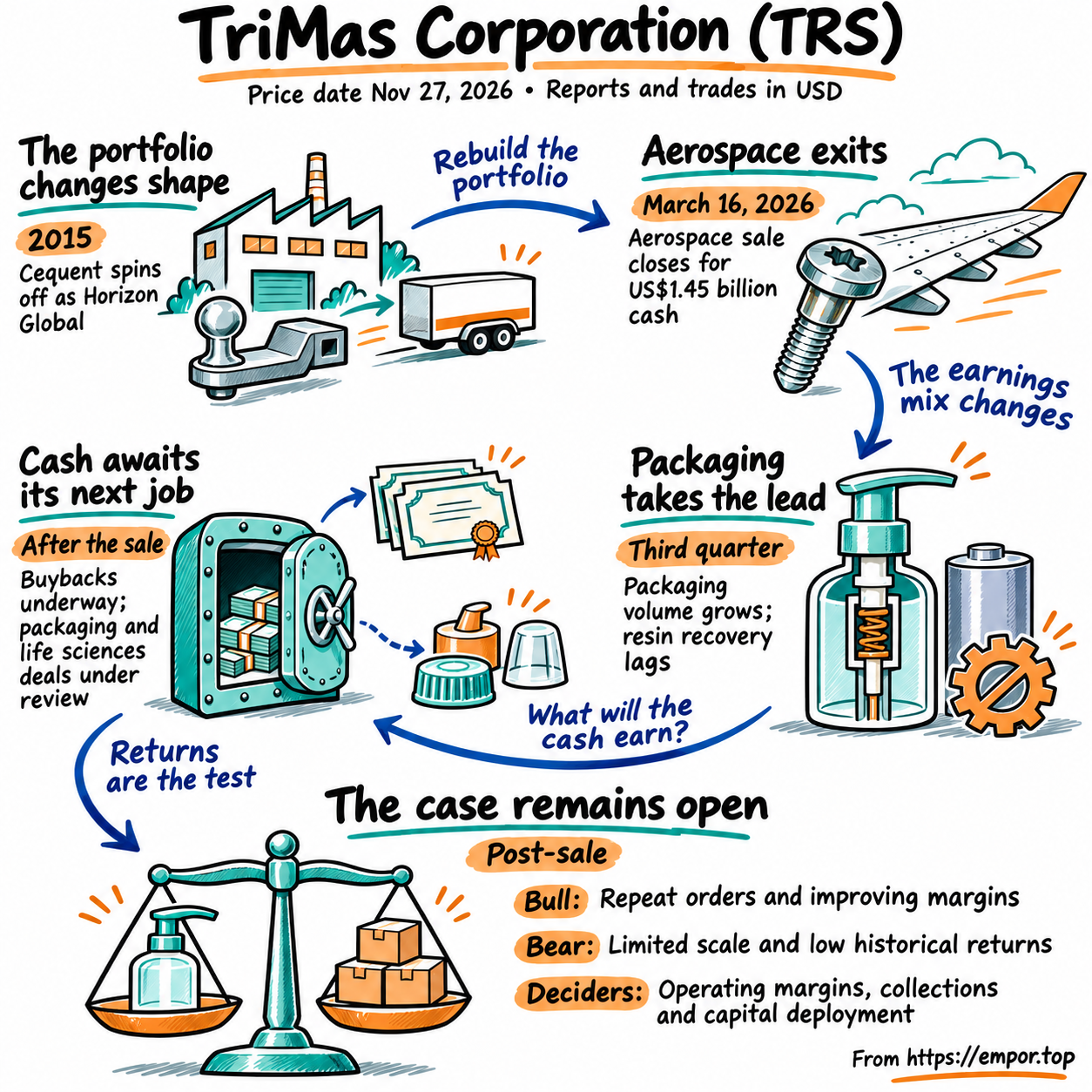
On the morning of November 4, 2025, TriMas Corporation told the market that it had agreed to sell the best-performing piece of itself. TriMas Aerospace, the maker of fasteners, collars and engineered components that hold aircraft together, would go to an affiliate of the private-equity firm Tinicum, with Blackstone taking a minority stake, for $1.45 billion in cash.1 For a company whose entire stock-market value had spent most of the previous decade hovering around one to one and a half billion dollars, that was not a portfolio trim. It was the company selling something close to its own price tag.
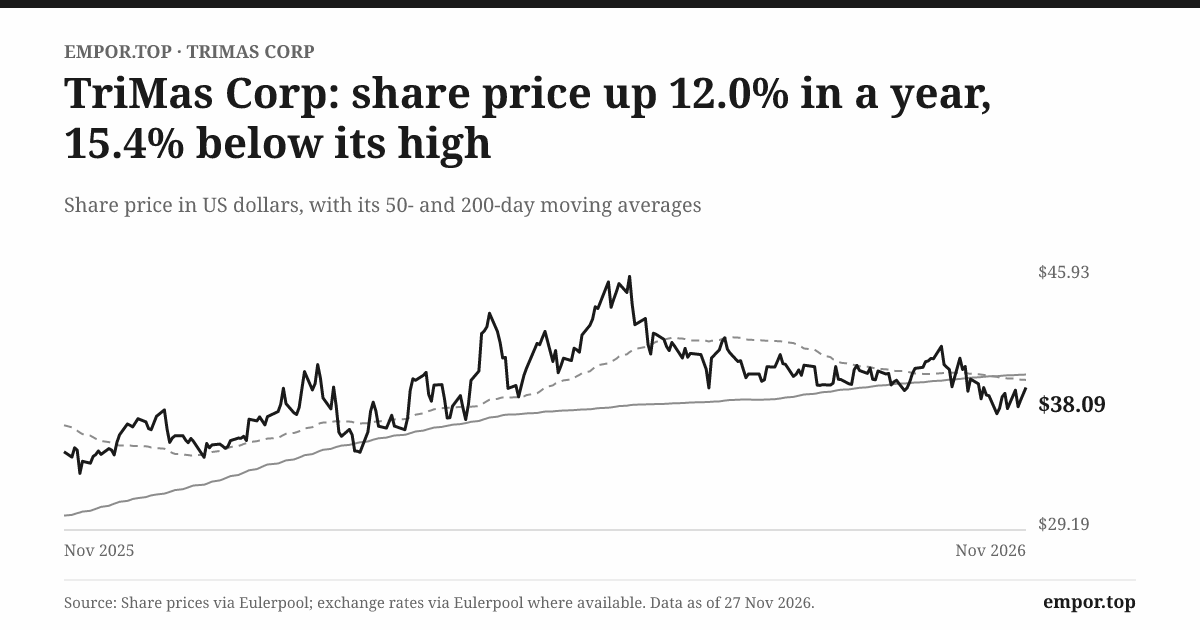
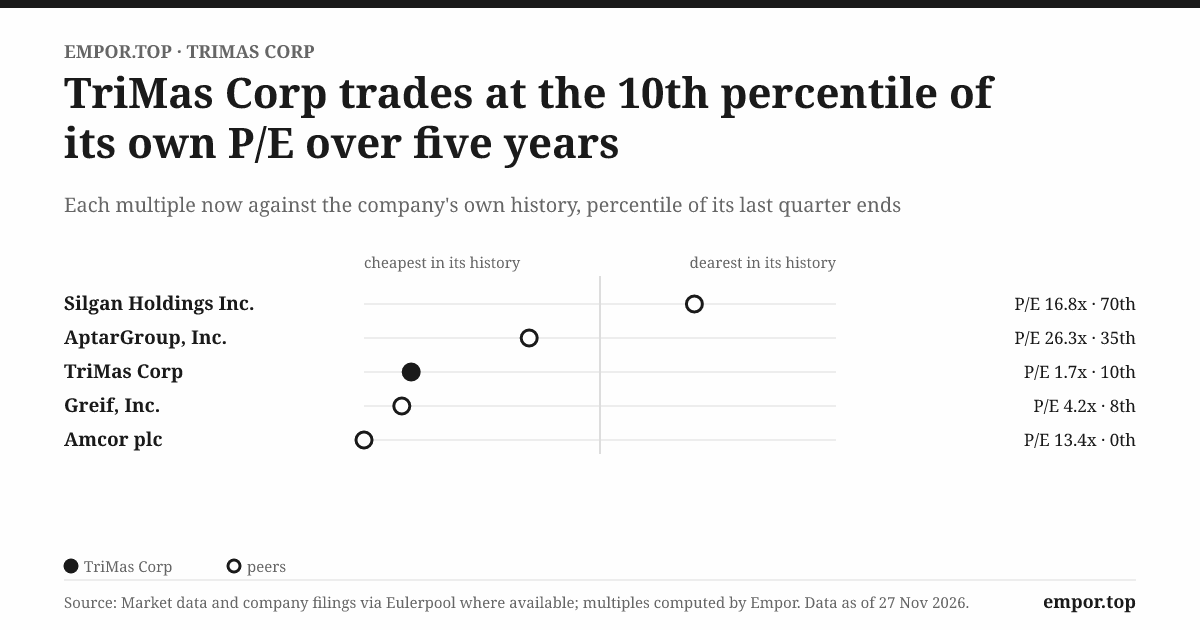
The deal closed on March 16, 2026.2 After the taxes on the gain, TriMas expected to keep about $1.2 billion.2 And then the accounting did what accounting does. In the first nine months of 2026, TriMas reported $804.6 million of net income from discontinued operations, carried by a gain of roughly $1.04 billion on the disposal.3 Run those numbers through a stock screen and the result looks like a misprint. Over the twelve months to September 2026, TriMas earned $24.34 a share.3 On November 27, 2026, the shares closed at $38.09.[^4] That is a price-to-earnings ratio of 1.7, against a five-year median of almost 24.
Anyone who has spent time with screens knows the feeling. A 1.7x multiple on a profitable American manufacturer is either the bargain of the decade or a sign that the "E" in P/E has stopped describing the business. In TriMas's case it is plainly the second. The $24 of earnings is almost entirely a one-time event: the conversion of an operating business into cash. Strip out the gain and the picture changes completely. Management's own guidance for 2026 adjusted earnings per share was $1.60 to $1.70, and even that range included about $10 million in expected fourth-quarter interest income on the sale proceeds.4 On that basis, the same $38 share price is more than twenty times earnings, not less than two.
So the old scorecard is broken, and it is broken in a revealing way. Almost every long-run number about TriMas is now a number about a company that no longer exists. The ten-year revenue line includes businesses that were spun off, impaired, sold and bought. The latest year's net profit includes a sale. The return on equity of 63% over the past twelve months is a gain divided by a balance sheet, not a sign of a high-return franchise.3 Even the market value is an awkward mix: roughly $1.5 billion of equity sits on top of a balance sheet that held $1.159 billion of cash and $397.1 million of debt at the end of September.3 Subtract the net cash and the market is valuing the operating company itself at well under a billion dollars.
That is the setup for this story, and it reframes the questions an investor should ask. The first is whether the businesses that remain can grow and earn better returns than the ones TriMas has reported for the past few years. The second is whether TriMas sold its strongest asset at the right moment, at a price that made the decision obviously right, or whether it gave away its growth engine to buyers who know how to compound it. The third, and the one that will matter most to anyone holding the stock over the next five years, is whether management can turn a pile of cash into lasting value per share, rather than letting it sit idle or spending it on an acquisition that never earns its keep.
The company that faces those questions is very different from the TriMas of a decade ago. It is a NASDAQ Global Select manufacturer headquartered in Michigan whose center of gravity is now packaging: closures, caps, pumps, foamers and trigger sprayers that sit on top of bottles of shampoo, cleaning spray and food, plus specialized packaging for life-sciences customers.5 Alongside it sits a much smaller Specialty Products segment built around Norris Cylinder, a maker of steel cylinders for industrial gases.5 In November 2026 TriMas also sold Rapak, its flexible bag-in-box product line, a small business that brought in around $20 million of sales a year.3
What remains is a company with roughly $650 million to $700 million of annual sales, a new chief executive who arrived in mid-2025, a new chief financial officer who arrived at the end of that year, and more than a billion dollars in the bank. The interesting question is not whether TriMas got a good price for Aerospace. The interesting question is what the rest of the company is worth when it has to stand on its own, and what the people running it will do with the money. To answer it, the story has to start with how TriMas came to own such a mixed bag of businesses in the first place, because this is a company that has changed its shape more often than most.
 Subscribe on LinkedIn
II. The Portfolio That Kept Changing Shape
In 2014, TriMas was a sprawling industrial conglomerate with six reporting segments, selling everything from packaging closures to towing hitches, from aerospace fasteners to oil-field engines and gaskets for refineries.6 Revenue that year was about $1.5 billion.6 By the standards of mid-cap American industrials, TriMas was a respectable, diversified, slightly hard-to-describe company, the kind of stock that analysts often called "a collection of good niche businesses" and investors often valued at a discount because nobody could explain in one sentence what it did.
That description had history behind it. TriMas had been part of Metaldyne, the auto-parts and industrial group controlled by the private-equity firm Heartland Industrial Partners, before TriMas was separated and set up as its own company.6 Under Heartland's influence and then as a listed company, TriMas built itself the way many private-equity-shaped industrials do: by buying small, specialized manufacturers in niches where a good product, a stable customer and a competent plant manager could generate decent margins, and then bolting them together under a shared corporate structure. Some of the businesses fit together. Many simply sat next to each other.
The largest of those businesses was Cequent, which made towing, trailering and cargo-management products: trailer hitches, brake controllers, roof racks and the hardware that connects a boat trailer to a pickup truck. In 2014, Cequent's two segments together accounted for about $612 million of TriMas's sales, roughly two-fifths of the company.6 And in mid-2015, TriMas spun it off to shareholders as a separate public company called Horizon Global.7
The effect on TriMas's reported numbers was immediate and brutal. Revenue fell from about $1.5 billion in 2014 to about $863 million in 2015, a drop of more than 42%.7 That decline did not mean TriMas customers walked away or that its factories went quiet. It meant that a whole set of factories, products and customers moved into another company, and that TriMas shareholders received shares in that company. A shareholder who held both stocks experienced the spin-off as a reshuffle of the same assets. A shareholder who only looked at the TriMas revenue line saw a collapse.
This matters because the long-run numbers that a screen will show today begin from that distorted base. Over the ten years to 2025, TriMas's revenue fell at about 2.9% a year; over five years it fell 3.5% a year; over three years, almost 10% a year.5 Read literally, that is the profile of a shrinking business. Read correctly, it is the profile of a company that kept redrawing its perimeter. Each line in that history is a different TriMas.
The redrawing did not stop with Cequent. In 2015, the same year as the spin-off, TriMas took impairment charges of about $75.7 million related to its energy and engine reporting units, the businesses tied to oil and gas drilling and gas-compression that had been hit by the collapse in crude prices.7 A year later came a larger and more uncomfortable write-down: about $98.9 million in Aerospace, the very segment that would later be sold for $1.45 billion.8 Those two charges help explain why TriMas reported net losses in both 2015 and 2016, even though its businesses continued to generate operating cash.8
The energy business was eventually reorganized and sold off in pieces. Arrow Engine, which made engines and compressors for oil-field use and had been tucked into Specialty Products, was sold in January 2025.5 And then, in March 2026, Aerospace itself left.2 Between those two endpoints, TriMas also kept acquiring, especially in packaging and aerospace, which further changed what the revenue line contained. The result is a company with 2025 continuing-operations sales of about $645.7 million that shares a name, a ticker and a headquarters with the $1.5 billion company of 2014, but not much else.5
There is a useful way to think about this. Imagine following a sports franchise through a decade in which it traded away half its roster, cut several players with expensive contracts, signed a few free agents and then sold its star to a rival for a record fee. The team's win-loss record over that decade tells you something about the front office. It tells you very little about how the current roster will play. TriMas's long revenue decline is real as a shareholder experience: the share price reflects the businesses that were written down as much as the ones that were sold well. But it is not a like-for-like operating trend, and it is not evidence that today's packaging operations have been shrinking at the same rate.
The more relevant recent number is narrower and more encouraging. In 2025, organic sales from continuing operations, which strip out acquisitions, disposals and currency moves, rose about 4.8%, with gains in both Packaging and Specialty Products.5 That is the kind of growth an ordinary packaging business can produce in a decent year. It is not a breakout, but it is also not a business in structural decline.
So the honest verdict on TriMas's portfolio history is mixed. The company has been willing to change its shape, which is a virtue when the changes recognize value and a vice when they reflect earlier mistakes. Some of its reshaping was clearly value-creating, like the separation of a large, cyclical towing business that had little in common with packaging. Some of it was cleanup of capital that had been spent in businesses whose expected value fell. And the most recent and largest change, the Aerospace sale, has left a smaller company that still has to show it has a durable growth engine of its own. To judge whether TriMas can find one, it helps to look at how it built the engines it had, and that means looking at its record as a buyer.
III. A Roll-Up Built Around Packaging—and Then Aerospace
In 2012, TriMas bought 70% of a family-founded company in Southern California called Arminak & Associates for about $64 million.9 Arminak was not a household name, but its products were in almost every household. It designed and sold foamers, lotion pumps, fine-mist sprayers and other dispensing devices: the small plastic mechanisms that turn a bottle of hand soap into a squirt of foam or a bottle of perfume into a cloud. Its customers were brands in beauty, personal care and household products, the kind of companies that care intensely about how a pump feels under the thumb and how reliably it works on the ten-millionth unit.
Two years later TriMas bought the rest. In early 2014 it paid about $51 million for the remaining 30%, plus up to $7 million of contingent consideration tied to performance.9 The pricing tells a small story of its own. TriMas paid about $64 million for the first 70%, which implied a valuation of roughly $91 million for the whole company in 2012, and then roughly $51 million to $58 million for the last 30%, which implied a whole-company value of $170 million to $190 million two years later. In other words, the minority stake cost far more per share than the controlling stake had. That could mean Arminak grew strongly under TriMas ownership, which would be a sign that the acquisition worked, or that the purchase agreement locked in a formula favorable to the sellers. TriMas does not publish Arminak's standalone earnings, so the record cannot settle which. What it does show is that TriMas was willing to pay up to own all of a dispensing business it believed in.
Arminak mattered strategically because it moved TriMas Packaging from being mainly a maker of closures for industrial drums and containers toward the higher-value world of dispensing, where design, feel and reliability can command better prices than a plain cap. Dispensing is where the big competitors, especially Aptar and Silgan, make much of their money. Arminak gave TriMas a seat at that table.
The second great building project ran through Aerospace. Over roughly a decade, TriMas assembled a string of specialized aerospace businesses: Martinic, which made machined components; Mac Fasteners and Allfast, both makers of fasteners and rivets; RSA Engineered Products, which made ducting and connectors; TCI Precision Metals, a machining specialist; Weldmac, a fabricator of complex metal assemblies; and the businesses grouped under the TriMas Aerospace banner.5 The logic was clear. Aircraft programs are long, certification is demanding, and once a part is designed into a plane it tends to stay there for the life of the program. Owning a broad catalog of fasteners and engineered components let TriMas sell more to the same airframe and engine customers, and position itself for the multi-year recovery in aircraft production after the pandemic.
TriMas disclosed some of the purchase prices. Weldmac, bought in 2023, cost about $34 million plus contingent consideration.5 In packaging and life sciences the company made similar-sized moves, including Intertech, bought for about $64.1 million in 2022.5 But for most of the Aerospace string, the record does not include the acquisition-level earnings history that would let an outsider compute a payback: what each business earned when TriMas bought it, what it earned five years later, and how much capital TriMas put in along the way. Investors can see the price paid for the platform, and they can see the price received for it. They cannot see the return on each brick.
That gap is important, because the most tempting conclusion is the wrong one. When TriMas sold Aerospace for $1.45 billion, it said the price represented about 18 times the business's last-twelve-months adjusted EBITDA at the time of the agreement.1 Eighteen times EBITDA is a rich multiple for an industrial business; it is the kind of price paid for assets with long contracts, high margins and strong growth. It is tempting to read that multiple backward and conclude that TriMas was a brilliant acquirer. The exit price is evidence that buyers in 2025 valued the platform highly, at a moment when aerospace supply chains were scarce and aircraft makers were desperate for parts. It is not proof that each piece was bought cheaply or integrated well.
Indeed, the company's own record contains the strongest disconfirming evidence against the idea of consistently skilled buying. The 2016 Aerospace impairment and the 2015 energy and engine impairment show that the expected value of some businesses fell.87 Neither charge proves that the later Aerospace purchases were bad. Allfast and the others came after 2016 and were bought into a very different aerospace market. But together the charges show that TriMas's acquisitions have produced both sides of the ledger: businesses later written down and businesses later sold at a premium.
So the record narrows the claim that TriMas knows how to buy. A fair version would be that TriMas has shown it can assemble a platform in a niche that buyers will eventually pay a lot for, and that it has also shown it can overpay for businesses exposed to cycles it did not anticipate. That combination is common among industrial roll-ups. It means acquisition skill at TriMas is not a proven, repeatable edge. It is a coin that has landed on both sides.
That is precisely why the next chapter carries so much weight. TriMas now has more cash than it has ever had to deploy, and management has said its search for deals is focused on packaging and life sciences.10 The Aerospace exit has answered one question about the past. It has opened a sharper one about the future: can the company redeploy a large pool of cash at returns better than the roughly 4% it earns sitting in a bank account, and better than buying back its own shares? Before getting to that question, though, the story has to look closely at the business that now carries almost all of TriMas's profit, because whatever management buys will be judged against it.
IV. Packaging Is the Center of Gravity
Pick up a bottle of liquid hand soap, press the pump and watch what happens. A spring compresses, a small piston pushes liquid through a valve, a second valve stops the liquid from flowing back, and a measured dose lands in your palm. When you let go, the spring returns and the chamber refills, ready for the next press. The whole mechanism is a few grams of plastic and metal, costs a fraction of a dollar, and has to work thousands of times without leaking, sticking or dribbling, across temperatures, liquids and shipping conditions that its designers never see. Multiply that by hundreds of millions of units a year, and you have the business that now carries TriMas.
TriMas Packaging's products fall into four broad families.5 The first is closures: caps and lids, including the large tamper-evident closures and venting caps that go on industrial drums, pails and containers, and the smaller ones that sit on food and beverage bottles. The second is dispensing systems: pumps, foamers, sprayers and trigger sprayers for beauty, personal care and household products, much of it descended from the Arminak purchase. The third is life-sciences packaging and components, where products go into medical devices, diagnostic kits and pharmaceutical packaging and where the qualification requirements are stricter. The fourth was flexible packaging, centered on Rapak's bag-in-box systems for liquids such as wine and syrups; TriMas largely exited that business in November.3
The economics of all four start with how the company gets paid. TriMas generally recognizes revenue when a product ships.5 There is no subscription, no membership fee and, as far as the company discloses, no meaningful backlog of minimum-volume contracts guaranteeing future sales. TriMas does not say how much of its revenue is recurring or committed. Prices are adjusted for customer volume discounts and allowances, and many contracts have provisions that pass changes in resin and other raw-material costs through to customers, often with a delay of a quarter or so.5 In plain terms, TriMas is paid per unit, and its sales move with how much its customers sell, how much stock they choose to hold, and what plastic costs.
That might sound like a commodity business, but there is a feature that pushes in the other direction. Many TriMas products are designed or qualified for a particular customer use. A cosmetics brand launching a new serum wants a pump that delivers the right dose with the right feel; a life-sciences customer wants a component validated for its device and its regulators. Customers often own the tooling, the precision steel molds that shape the plastic, and TriMas can be reimbursed for building that tooling over time.5 Once a mold is cut, a product validated and a production line tuned, changing supplier means repeating some or all of that work. That supports repeat orders, and it is the most important source of whatever stickiness TriMas has.
The temptation is to call that a moat. The evidence does not support that word yet. TriMas does not disclose how often customers re-source, how long a typical program lasts, what share of a customer's spending it captures or what price increases it has pushed through beyond cost pass-through. The company itself warns that customers may diversify their supply base.5 A qualified product is a reason to stay, not a lock. Large brand owners routinely qualify two or three suppliers for important components precisely so that none of them has leverage. The tooling can belong to the customer, and a customer-owned mold can, in principle, be moved.
The competitive field shows why that matters. TriMas names its rivals as Amcor, Aptar, Bericap, Greif, Mold-Rite, Phoenix Closures, Silgan and a range of smaller Asian manufacturers.5 Several of those names are much larger than TriMas. Silgan's dispensing and specialty-closures business alone had about $2.7 billion of sales in 2025, roughly five times the size of TriMas Packaging's entire $535.5 million.11 Amcor, the global packaging giant, is larger still across its whole business. Those are scale comparisons, not market-share figures, because the companies do not sell exactly the same product mix in exactly the same markets. But scale matters in this industry. It spreads the cost of design, automation, resin purchasing and global plant networks across more units, and it lets a supplier offer a big customer one-stop shopping across many product families.
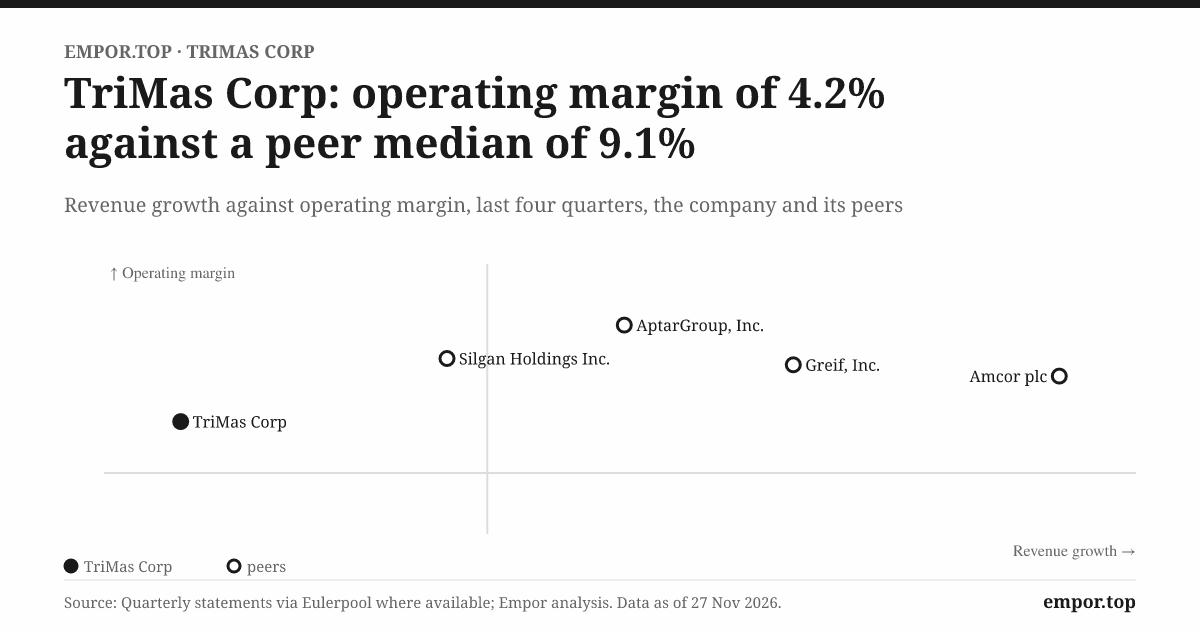
Against that, TriMas's own numbers are respectable rather than dominant. In 2025, Packaging produced $535.5 million of sales and $68.1 million of operating profit, a margin of about 12.7%.5 That made it about 83% of continuing sales and about 94% of continuing segment profit.5 The company is not, in any meaningful sense, a diversified industrial any more. It is a packaging business with a small industrial appendix.
The customer data adds another layer. No single customer accounted for 10% or more of TriMas's consolidated revenue between 2023 and 2025.5 But in 2025 one customer represented at least 10% of sales in each of the two continuing segments.5 TriMas does not name those customers, nor does it disclose how much the top five or ten customers buy. That combination tells a careful listener two things. The company is not hostage to a single buyer the way some auto suppliers are. But each segment has at least one account big enough that losing it, or being squeezed on price by it, would show up in results.
Put all of this through the moat test once, and the verdict is clear enough to state. TriMas has a broad catalog, real engineering and qualification work embedded in its customer relationships, and a manufacturing footprint that lets it serve global brands. What the record does not show is a protected position: there is no published series on market share, customer retention, or price realization above cost, and the largest competitors are several times bigger. TriMas's strongest case is execution in selected niches where its design capability and service matter more than scale. Its weakest point is that buyers have alternatives and the biggest rivals can outspend it.
What 2026 has revealed about the machine
If execution is the case, 2026 has been a good test of it. The year started with a familiar packaging problem. Resin prices rose from the middle of the first quarter through much of the second, and because many of TriMas's contracts adjust prices only quarterly, the company under-recovered those higher costs in the second quarter, which CFO Paul Swart estimated pressured Packaging margins by around 100 basis points.10 At the same time, demand was mixed. Second-quarter Packaging sales were essentially flat at about $143 million, as growth in industrial and life-sciences products and a currency tailwind offset weaker beauty, personal-care, food and beverage demand.10 Part of the food-and-beverage weakness was self-inflicted: TriMas was consolidating its Atkins facility, which reduced capacity while equipment moved.10
What stood out was that margins held up anyway. Packaging's adjusted operating profit rose about 4% in the second quarter to $21.2 million, with the margin up half a percentage point to 14.8%.10 That was the first visible sign that the cost program management had announced was doing something. CEO Thomas Snyder described a program worth $10.5 million of savings in 2026 and $16 million a year once fully in place.10
The third quarter was stronger on the top line. Packaging sales rose about 8.8% to $147.6 million, with organic growth of roughly 8%, driven mostly by volume across beauty and personal care, food and beverage, life sciences and industrial markets.4 Adjusted operating profit rose about 12% to $20.4 million, and the margin rose 40 basis points to 13.8%.4 But the details complicate the celebration. Management said the net benefit of price against cost was "more modest than anticipated," because resin costs had stayed higher than expected, and mix was less favorable.4 The resin catch-up it had promised in July for the third and fourth quarters was arriving more slowly.
Read together, the two quarters tell a specific story about how this business works. When resin rises, TriMas absorbs the cost first and recovers it later, so a spike costs it margin for a quarter or two and a decline can flatter it for a while after. When volumes rise across most end markets at once, as they did in the third quarter, factories run fuller and margins improve. The cost actions are real enough to have offset some of the second-quarter squeeze. What 2026 has not yet shown is pricing power, the ability to raise prices faster than costs. The evidence points the other way: TriMas recovers costs on a lag and with friction, which is what a capable supplier without a dominant position looks like.
That is the context for "One TriMas," the initiative management introduced in 2026 to bring the company's various legacy packaging brands under a single TriMas Packaging identity. Snyder said it was "strengthening commercial alignment, simplifying the customer experience."10 There is a logic to it. A big brand owner buying closures from one TriMas business and pumps from another may get a better service, and TriMas may sell more, if both arrive through one commercial team. But management has not attached a financial target to it, and on the second-quarter call, when an analyst from BWS Financial asked whether growth was coming from customers ordering more or from the new customer-experience approach, Snyder pointed to a customer survey, new leadership, strong customers and pent-up food-and-beverage demand, without quantifying any of them.10 For now, One TriMas is a reorganization with a sensible thesis. The proof will be measurable order wins, organic growth above the market and margins that hold through the next resin cycle.
Management has also guided to what it expects Packaging to deliver for the full year. In October it said Packaging sales would grow 4% to 5% in 2026 and that the segment's operating margin would come in at "nearly 14%," down from the 14% to 15% range it had pointed to in July.410 That is still a meaningful improvement on the 12.7% of 2025. It is also a reminder that the July guidance was a little too optimistic about resin.
The verdict for TriMas's center of gravity is therefore balanced. The packaging business has customers who keep coming back, a broad range of products, and a cost program that appears to be lifting margins. It does not have the scale of its largest competitors, and it has not shown it can set prices rather than chase costs. If the company is to be worth more than a fair multiple of a decent packaging business, it will have to be because management can widen that margin and grow faster than the market for several years in a row. The smaller segment sitting beside it is, at the moment, doing the opposite.
V. The Smaller Segment Where Execution Shows Up Fast
On October 29, 2026, during TriMas's third-quarter results call, management spent a surprising amount of time on a business that represents less than a fifth of company sales. Specialty Products, they explained, had a problem that was not about demand. Orders were there. Sales had risen. The trouble was inside the factory: "further machine downtime, lower labor productivity, and throughput constraints," as the company put it, all tied to ramping up production to meet that demand.4 The result was stark. Specialty Products' sales rose 2.7% to about $31.2 million in the quarter, while its operating profit fell to about $0.1 million from $2.4 million a year earlier.4 On more than $31 million of sales, the segment earned roughly nothing.
The segment needs a brief introduction, because it is easy to inflate. Its core is Norris Cylinder, which makes large steel cylinders for industrial gases.5 Specialty Products also includes a few other smaller specialty manufacturing operations. Arrow Engine, the segment's former oil-field business, is gone.5 In 2025, Specialty Products produced about $110.2 million of sales and $4.2 million of operating profit, a margin of under 4%.5 Compared with Packaging's $68 million of profit, it is a footnote in the earnings, though not in the share of management attention it currently consumes.
The demand side has genuinely been good. Second-quarter sales rose about 10% to nearly $32 million, driven by demand for Norris cylinders and what management described as share gains.10 Nine-month sales were up about 9.5%.4 Management has pointed to customers seeking domestically made products as one source of that demand, and in July it raised its full-year sales growth guidance for the segment to 6% to 9%, and later to 7% to 10%.104
But that is exactly where the problem started. To meet higher orders, Norris added staff, used more temporary labor and overtime, and pushed equipment harder. In the second quarter, operating profit fell to $0.7 million from $1.3 million, as the cost of ramping staffing and throughput overwhelmed the benefit of extra sales.10 At that point, management still expected the segment's full-year operating margin to come in between 6% and 8%.10 By October, after a third quarter in which two key machines suffered major downtime and higher steel costs arrived faster than customer price adjustments, that guidance was cut to 4% to 6%.4
This is the clearest example in the current TriMas of a pattern a skeptical investor should watch for: the gap between a story about demand and a reality about execution. The "Made in USA" tailwind is real enough to have produced orders. It is not yet an advantage, because an advantage should show up as profit, and so far it has shown up as overtime. A business that wins more orders and makes less money on them has a capacity and operations problem, and in a steel-cylinder plant, where the machines are large, specialized and slow to replace, that problem can take quarters to fix.
Management's explanation, to its credit, is specific and owned. It described the issues as "temporary and internal in nature," said the two machines that had suffered the worst downtime were "now operating near expected levels," and said it had strengthened operational leadership and was improving production planning and the matching of labor to demand.4 When analysts on the call pressed on Norris, management said it expected fourth-quarter margins to improve on the third quarter but that full recovery "will take time."4 That is a more honest answer than a promise of a quick fix. It is also a reminder that the July guidance had underestimated how long the ramp would hurt.
The steel-cost issue is the same mechanism that showed up in Packaging with resin. Norris's customer price adjustments follow steel prices with a lag, so when steel rises quickly the segment absorbs the difference for a while.4 That makes the segment's margins more volatile than its sales, and it means that even after the machines run smoothly, a period of falling steel prices could flatter margins and a period of rising prices could squeeze them again.
So what should an investor make of a segment this small? It will never drive the TriMas valuation on its own. But it is useful as a test of the new management team's operating skill, precisely because its problems are internal and its results show up so quickly. If the machine reliability, labor efficiency and planning changes work, Specialty Products should move back toward the mid-single-digit margins it earned before the ramp, and the evidence should be visible in unadjusted segment operating profit within a few quarters. If they do not, it will raise questions about whether the operational discipline management describes across the company is as real as its presentations suggest. Either way, both segments now have to carry TriMas without the business that used to make their numbers look better. To understand how much they have to carry, the story has to go back to the decision to sell Aerospace.
VI. The Aerospace Sale Was a Great Price—and a New Test
The decision to sell did not arrive out of nowhere. TriMas's board had launched a strategic review of the company's portfolio, and Aerospace was the obvious candidate for a buyer to want.1 In 2025 the segment grew sales by about 34.7% to $396.4 million, and it earned about $92.0 million of adjusted EBITDA, a margin of roughly 23.2%.25 Those are excellent numbers for an industrial supplier. They reflect a period in which commercial aircraft production was recovering, Boeing and Airbus were struggling to get enough parts, and suppliers of certified fasteners and components found themselves with both volume and pricing leverage.
Into that market, TriMas offered the business for sale, and the winning bid came from an affiliate of Tinicum, a private investment firm, with Blackstone taking a minority investment.1 The price was $1.45 billion, all cash.1 TriMas described it as about 18 times Aerospace's adjusted EBITDA over the twelve months before the agreement.1 Measured against the full 2025 figure, which came in higher, the multiple was closer to 16 times, which is still a premium price for a manufacturer of components.
To appreciate what TriMas gave up, it helps to put the segments side by side. In 2025, Aerospace's adjusted EBITDA of about $92 million was larger than the combined operating profit of Packaging and Specialty Products, about $72 million.5 Those are not quite the same measure, since EBITDA adds back depreciation and amortization, but the comparison makes the point clearly. Aerospace was not a low-return business dragging down the company that management was relieved to dispose of. It was the fastest-growing, highest-margin part of TriMas, roughly 38% of combined sales.
That is why the sale is best understood as a valuation call, not a portfolio cleanup. The board, in effect, judged that a buyer was willing to pay more for Aerospace's future cash flows than those cash flows were worth inside TriMas, or than the market would credit TriMas for them. That judgment has a lot going for it. The stock market had long valued TriMas as a whole at a much lower multiple than the one Tinicum paid for Aerospace alone. In an environment where aerospace assets commanded scarcity prices, selling at the top of the cycle locked in a price that the public market had not been willing to give. On the evidence of the price received, the sale was a good deal for TriMas shareholders on the day it was signed.
The harder question is what it means for the company left behind. A useful comparison is the current market value. At about $1.5 billion, TriMas's equity is worth roughly what Aerospace alone sold for.[^4] That might suggest the market is valuing the rest of the company at close to nothing, but that is too simple. After taxes, TriMas kept about $1.2 billion, used part to repay its revolving credit borrowings and buy back shares, and still has $400 million of bonds outstanding.102 Proceeds do not belong to shareholders dollar for dollar, and the right way to think about it is net cash plus the operating businesses, not sale price versus market cap.
At the end of September, TriMas held about $760 million in net cash, with part of the remaining tax bill on the sale still to be paid.34 Against a roughly $1.5 billion market value, that leaves something in the region of $700 million to $800 million for the operating businesses, which generate about $650 million to $700 million of sales a year. Whether that is cheap or expensive depends entirely on what those businesses can earn, which is the subject the rest of this story keeps returning to.
There was a second, much smaller sale. On the third-quarter call, management said TriMas had agreed to sell Rapak, the flexible bag-in-box product line, to Ringmetall, a global packaging company, with closing expected in early November.4 The sale closed on November 2, 2026.3 Rapak brought in about $20 million of annual sales with what management called a "below average margin profile."4 That makes it a minor trim that slightly improves the reported margin of what remains, not a second strategic exit, and management declined to give its specific margin effect.
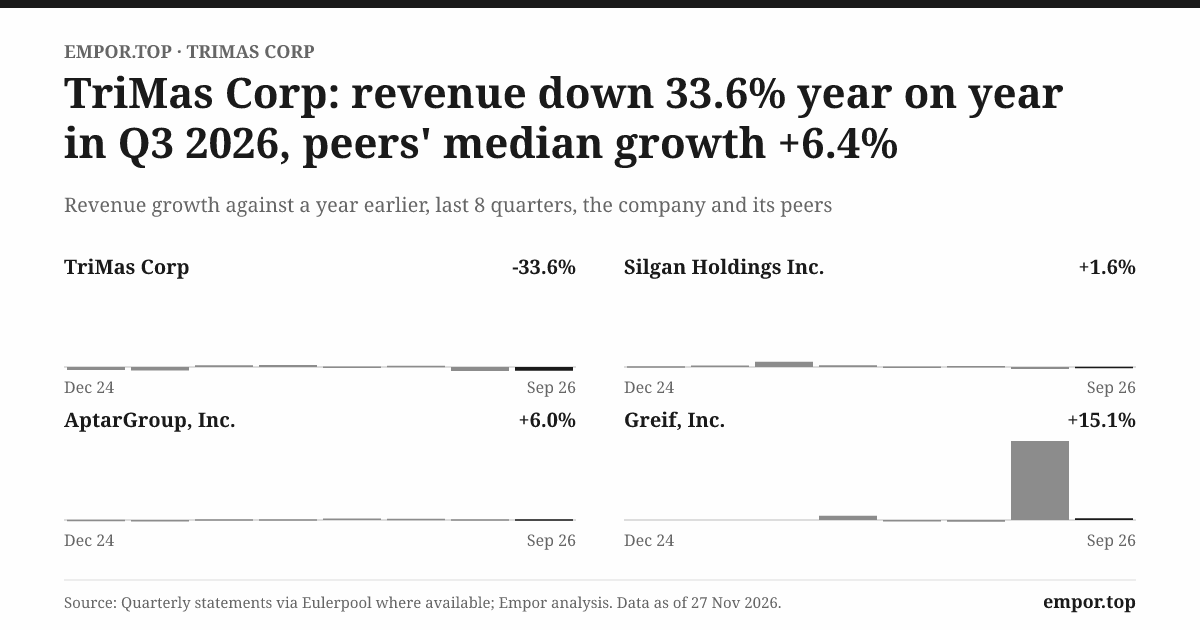
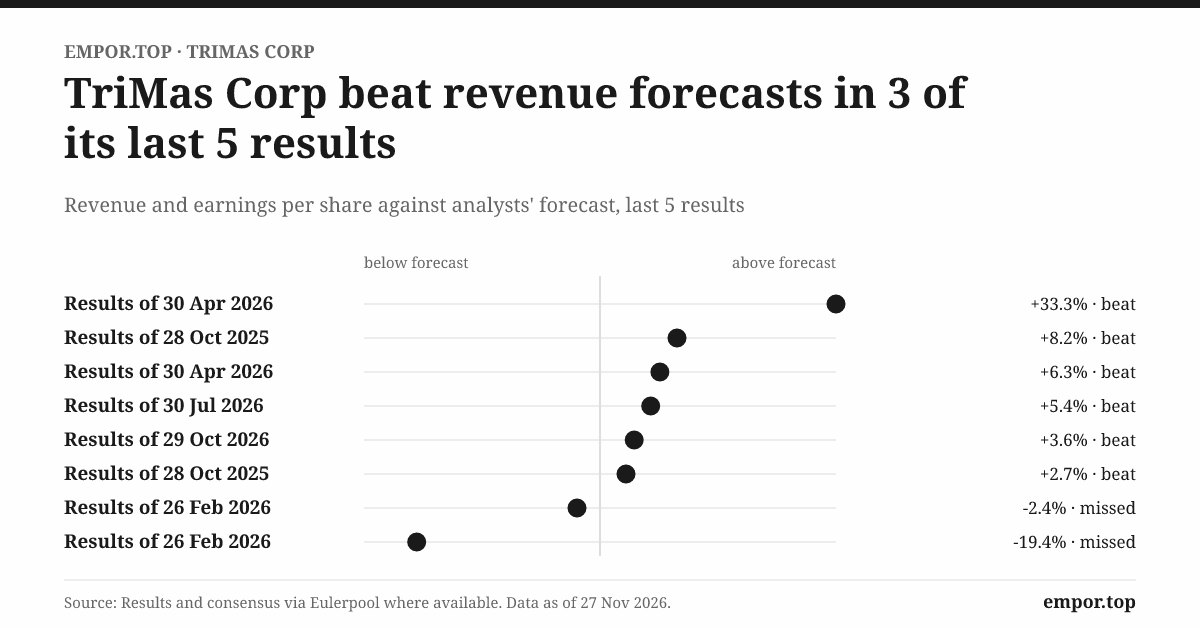
What remains started 2026 reasonably well on the top line. Third-quarter sales from continuing operations rose 7.7% to $178.7 million, with organic growth of about 7%, and adjusted operating profit rose about 48% to $13.6 million.4 For the first nine months, sales were up 6.4% to $521.6 million.4 Packaging grew across its major end markets, while Specialty Products grew sales but not profit.
The outlook moved in a revealing way. In July, management expected full-year sales growth of 3% to 6% and adjusted operating margin improvement of more than 300 basis points compared with 2025.10 By October, the sales range had been raised to 4% to 6%, but the margin improvement had been trimmed to about 250 basis points, with management pointing to extended throughput challenges in Specialty Products and slower-than-expected resin recovery in Packaging.4 Adjusted earnings per share guidance was held at $1.60 to $1.70.4 That combination, more sales but less margin improvement, is the signature of a company where demand is fine and execution has slipped. To management's credit, the reduction was explained with specific causes rather than vague references to headwinds. To an investor's caution, it was the second guide in two quarters to embed assumptions that turned out to be optimistic on costs.
The analysts' questions on the October call focused on exactly the issues that will determine whether the Aerospace sale is ultimately judged a success. KeyBanc's Ken Newman pressed on the acquisition pipeline, packaging price and cost, Norris, and the outlook for 2027.4 On acquisitions, management described an active pipeline in life sciences and premium packaging and a "patient and disciplined" approach, but gave no indication of size, return targets or timing.4 On 2027, it declined to give guidance, describing demand as fairly stable.4 Management's own prepared remarks acknowledged the elephant in the room: "We recognize investors are eager to see the deployment of remaining Aerospace proceeds."4
So the verdict on the sale splits in two. As a transaction, it crystallized substantial value at a strong multiple, and it is hard to argue TriMas could have done better by holding on. As a strategy, it removed the company's fastest-growing and highest-margin business and left behind a smaller profit base whose margins are improving from a low level. Success now depends on whether Packaging and Specialty Products can grow profitably without Aerospace's earnings cushion, and on what management does with the money. That second question has, for now, a large and conspicuous answer sitting in the bank.
VII. The Cash Has Not Yet Found Its Next Job
There is a particular kind of quarterly call that only happens to a company that has just sold a large business. Management walks through the results of the businesses that remain, then turns to the balance sheet, and everyone on the line waits for the same thing. In TriMas's case, the balance sheet at the end of September 2026 showed more cash than the company had ever held, sitting mostly in liquid, interest-bearing accounts.3 And for two consecutive calls, the answer to the obvious question, what will you do with it, was some version of "not yet."
The cash waterfall itself is easy to follow. TriMas received the $1.45 billion at closing in March.2 It used part of it to pay down borrowings under its revolving credit facility, leaving only its $400 million of 4.125% senior notes due 2029 as debt, carried at $397.1 million after issuance costs.3 It set aside money for taxes on the gain, about $200 million in total.10 Through the third quarter, it had paid about two-thirds of that, and it said it had reduced its tax bill by using discounted purchased tax credits, a legitimate technique in which a company buys transferable clean-energy tax credits from their owners at less than face value and uses them to settle its tax bill.4 The remaining tax was expected to be paid over the following couple of quarters.4 It bought back shares. And it put the rest in the bank, where it earned an average yield of about 3.9% in the third quarter.4 Interest on the proceeds contributed $23.9 million of the company's other income in the first nine months.3
The buyback is the most tangible use so far. Since the Aerospace deal was announced in November 2025, TriMas has spent nearly $184 million repurchasing more than 5.4 million shares, an average of roughly $34 a share.4 The shares outstanding fell to about 35.6 million, and the company had about $67 million left under its repurchase authorization.34 At the November 27 closing price of $38.09, that buying looks reasonably priced relative to where the stock trades now.[^4] But the right test is not the share price after the fact; it is the value of what was bought. Using management's adjusted EPS guidance of $1.60 to $1.70, which includes interest income on the cash pile, TriMas bought back its own shares at roughly 20 times adjusted earnings. Removing the cash and pricing only the operating business, the effective multiple paid for the operating earnings was lower. Neither number is a bargain basement. The buyback is a reasonable use of capital if the operating business improves, and an expensive one if it does not.
On the second-quarter call, Swart ranked organic investment as "the most immediate and highest return" use of capital, followed by a "balanced, disciplined approach" to acquisitions and buybacks.10 He said TriMas was "actively spending money with third parties evaluating potential deals," mainly in packaging and life sciences, and Snyder added: "we are not going to rush to get through that."10 When KeyBanc asked about acquisition criteria, Swart said TriMas was "looking for higher-quality companies," with weight placed on customer relationships and intellectual property more than on margin, but he declined to give more detail on timing.10 The October call added the line about investors being eager, but no new specifics.4
There is nothing wrong with patience. Many of the worst capital-allocation decisions in corporate history were made by companies with too much cash and too much pressure to spend it. But patience has a price, and the price here is measurable. Every year that net cash earns about 4% before tax, it earns well below what the company implicitly promises shareholders by holding it rather than returning it. And the record of the 2015 and 2016 write-downs, set beside the Aerospace sale, of acquisitions later impaired as well as ones later sold at a premium, means the market has no reason to assume that the eventual deal will be well priced. A skeptical investor would ask management three things: what return threshold will govern acquisitions, how will that threshold compare with the return from buying back shares, and will TriMas disclose post-deal performance well enough that shareholders can judge the outcome? So far, none of those questions has a public answer.
Incentives and ownership are part of the same question. Thomas Snyder became chief executive on June 23, 2025, succeeding Thomas Amato, who stepped down at the end of that month.12 Snyder's reported 2025 compensation was about $12.1 million, of which about $11 million consisted of stock and option awards described as inducement grants, the kind of package companies use to lure an executive from another employer.12 As of the record date for the 2026 proxy, Snyder was listed as beneficially owning no TriMas shares, and Paul Swart, who became CFO in December 2025 after Scott Mell resigned in March and Teresa Finley served as interim CFO, was listed with 980.12 The company has stock ownership guidelines for executives, and the large equity awards will, if they vest, give Snyder a substantial stake.12 But the point stands: the people deciding how to spend more than a billion dollars of shareholders' money had, at the start of 2026, almost no money of their own in the stock.
Shareholders noticed. At the May 2026 annual meeting, the advisory say-on-pay vote passed, with about 23 million shares voting in favor and 5.2 million against.13 Roughly 18% of votes cast against executive pay is not a revolt, but it is meaningful dissent in a world where most say-on-pay votes pass with more than 90% support. The shareholder base itself has also shifted. Trend International Holding, associated with director Shawn Sedaghat, reported beneficial ownership of about 16.9% in June 2026, noting that the increase reflected TriMas's falling share count rather than new purchases.14 Bank of America, listed in the proxy with about 11.3%, reported in November that its stake had dropped to about 0.5%.1215 The largest holder is now a strategic-minded investor with a board seat, which may bring pressure for discipline, or simply a single strong voice in the allocation decision.
The credit market has also weighed in. After the sale, S&P lowered TriMas's corporate rating to B+ and its senior notes to B in March 2026, and on October 29, 2026 Moody's lowered the corporate family rating to B1 and the senior notes to B2, with a stable outlook.3 At first glance it seems odd for a company with more cash than debt to be downgraded. The logic is that credit agencies rate the operating business and its future, not today's cash pile: the sale removed the larger and more profitable business, and the cash can be spent on acquisitions or buybacks at any time. The downgrades are therefore a message about what lenders think of the remaining business on its own, and about the risk that the cash may not stay. They do not threaten any near-term refinancing, because TriMas has no debt maturities before 2029.3
One more recent datapoint belongs here, in proportion. On November 10, 2026, TriMas filed a Form 12b-25, the notice a company submits when it cannot file a periodic report on time, saying it needed more time to complete its third-quarter financial statements and disclosures.16 The 10-Q followed on November 13.3 A late filing after a year of a large divestiture, discontinued-operations accounting and a change of CFO is not, by itself, evidence of a restatement or a control failure, and the company has not reported either. The 2025 auditor gave unqualified opinions on both the financial statements and internal controls.5 But a return to on-time, complete filings is worth watching. A company asking shareholders to trust it with more than a billion dollars of capital decisions benefits from a reporting process that never gives them a reason to wonder.
So the cash is real, the buyback is tangible, and the balance sheet is safe. What is not settled is the most important decision of this management team's tenure. The 3.9% yield on cash is the hurdle the next move must beat, and the downgrades are a reminder that outsiders are not yet convinced the remaining business can stand on its own. Before judging whether it can, it is worth asking a simpler question: across its long and messy history, how well has TriMas actually turned its accounting profits into cash?
VIII. The Cash Conversion Story Has Two Sides
Add up TriMas's reported net profit over the twelve years from 2014 to 2025 and you get about $435 million. Add up the cash it generated from operations over the same period and you get about $1.2 billion, roughly 2.7 times as much.56 That is the kind of gap that bulls love to quote: a business whose cash flow consistently outruns its earnings, suggesting conservative accounting and hidden value. It is also the kind of gap that deserves a second look, because cash can exceed profit for good reasons and for less flattering ones.
The first explanation is the impairments. The large charges of 2015 and 2016, and the write-downs in other years, reduced reported profit without costing any cash in the year they were booked.78 The cash had been spent years earlier, when the businesses were bought. Depreciation and amortization, stock-based compensation and the accounting for asbestos-related liabilities have also reduced profit without reducing cash in later years.5 So part of the gap is not evidence of a hidden cash machine. It is the echo of capital spent on acquisitions that later lost value, flowing through the income statement after the money was already gone. The company's disclosures do not allocate the entire twelve-year difference among non-cash charges and working-capital movements, but the pattern is clear enough.
The second part of the story is what happened to the cash. Over those twelve years, TriMas generated about $735 million of free cash flow after capital spending.5 Of that, it paid only about $25.6 million in dividends, around 3% of the total; it paid no dividend at all from 2014 through 2020.5 And yet its cash balance at the end of 2025 was only about $3 million higher than at the end of 2013.5 Most of the free cash went somewhere else: into acquisitions, debt repayment and share repurchases. That is entirely consistent with a roll-up strategy, and it means the real test of TriMas's cash generation is the same as the test of its acquisitions. The cash was reinvested, and the returns on that reinvestment are what investors were actually buying.
Those returns have weakened. In 2025, TriMas's return on capital employed was about 1.1% and its return on invested capital about 1.2%, far below the high-single-digit or low-double-digit levels it reported in years like 2014 or 2018.5 Some of that deterioration reflects one-off costs, restructuring and the accounting for the Aerospace business in the year before its sale, so 2025 is not a perfect measure of the continuing business. But even the trailing twelve months to September 2026, which benefit from interest income and include the improved operating results, show a return on capital employed of only about 3%.3 Cash conversion has been strong; it has not translated into high returns on the capital the company has put to work. Cash can outlast earnings, but it cannot substitute for them.
The most recent cash datapoint is receivables. Debtor days, the average number of days it takes customers to pay, rose from about 48 in 2014 to a peak of about 95 in 2024, before falling back to about 63 in 2025.5 The 2024 peak came in a year when the portfolio and its reporting were in flux, so it should not be read too literally, but the long upward drift is real. In 2026 the number rose again. Net receivables increased from about $111 million at the end of 2025 to about $150 million at the end of September 2026.3 TriMas says days sales outstanding rose 12 days in the first nine months, primarily because sales grew with customers who generally have longer payment terms.3
That explanation should be taken at face value and then watched. Longer payment terms are a commercial concession that big customers often demand from suppliers, and if TriMas is growing faster with large brand owners, it would be normal for receivables to rise faster than sales. Nothing in the filings suggests the customers are delinquent; the allowance for doubtful accounts was only about $1.7 million against $150 million of receivables at the end of September.3 But the company does not publish an aging schedule or name the customers on longer terms. And longer terms are, in economic terms, a price cut: TriMas is financing its customers for longer, which ties up cash and lowers the return on the sale. The question is whether growth is being bought with payment terms, and the answer will show in whether days sales outstanding stabilize once the sales mix settles.
TriMas also expects the fourth quarter to be its strongest for free cash flow, after a nine-month period in which free cash flow was negative.4 That pattern is partly seasonal and partly a consequence of the receivables build and the transaction-related tax payments. It makes the full-year 2026 cash flow, stripped of tax payments on the sale, a particularly useful number when it arrives.
The verdict, then, has two sides. TriMas's long history shows a company that reliably generates more cash than its accounting profits suggest, partly because its profits were reduced by charges that recorded the loss of value from past acquisitions. That cash has mostly been reinvested, and the reinvestment has not produced high returns in recent years. The latest receivables build has a plausible, benign explanation that the company has given directly, and that explanation should be tested against collections rather than assumed. With the history of the business, its segments and its cash now in view, the case for and against TriMas from here can be stated plainly.
IX. Analysis & Bear vs. Bull Case
Imagine two investors reading the same third-quarter release. The first sees Packaging orders rising across every major end market, margins climbing despite a resin squeeze, a cost program that management says is on track, a Specialty segment whose problems are internal and fixable, and a balance sheet with more than a billion dollars of cash and no debt due until 2029. The second sees a company that sold its best business, whose remaining operations earned low single-digit returns on capital last year, whose biggest competitors dwarf it, and whose management has spent two quarters telling shareholders it is patient about a pile of cash it has not yet decided how to deploy. Both are reading the same facts. The difference is which facts they think will matter.
The bull case starts with the platform. TriMas sells a broad range of closures, dispensing systems and life-sciences components to customers who design them into their products, qualify them and often pay for tooling that stays in TriMas plants.5 Its end markets are diversified across beauty and personal care, food and beverage, household products, industrial and life sciences, so no single consumer trend dominates. About two-thirds of continuing sales are in North America, with the rest spread across Europe and other regions, giving it a global manufacturing footprint that big brand owners value.5 Demand improved through the third quarter of 2026, with organic growth of around 7% in the third quarter.4 The cost program is delivering. And because the company has so much cash, it can fund organic investment, buy back stock and make acquisitions at the same time without stretching its balance sheet. In this version of the story, TriMas is a focused packaging company that has been undervalued for years because it was hidden inside a conglomerate, and the Aerospace sale has finally made the opportunity visible.
The bear case starts with scale. TriMas Packaging, at roughly half a billion dollars of sales, competes against companies whose dispensing businesses alone are five times its size.11 Those rivals can spread design, automation and purchasing costs across far more volume, and they can offer big customers a single supplier across many product families. TriMas does not publish market share, customer retention or price realization, so investors cannot verify that its relationships are as sticky as the bull case assumes. The company itself warns that customers can diversify supply.5 Its margins depend on resin and steel prices that it passes through only with a lag. And its earnings base is now much smaller than it was with Aerospace. In this version, TriMas is a decent, sub-scale packaging supplier with a long record of low returns, and the cash is as likely to be spent on an expensive acquisition as on something that creates value.
Michael Porter's five forces help weigh those two stories. Rivalry is high: packaging components are fragmented across many product lines, with global giants and smaller Asian manufacturers competing alongside regional specialists, and customers can compare quotes. Buyer power is credible: large brand owners buy in volume, qualify multiple suppliers and, as the 2026 receivables build shows, can negotiate longer payment terms.3 Supplier power is meaningful: resin and steel are commodities whose price swings reach TriMas's margins before they reach its prices.10 The threat of substitutes and new entrants varies by product. A basic cap is easy to make; a validated life-sciences component or a high-end cosmetic pump is not. Taken together, the forces describe an industry where a competent, focused supplier can earn decent returns but where structural pressure keeps them from becoming exceptional.
Hamilton Helmer's seven powers offer a sharper test of whether TriMas has a durable advantage. Scale economies favor its larger rivals, not TriMas. Network effects do not apply to a manufacturer of physical components. Counter-positioning, a business model incumbents cannot copy without hurting themselves, does not describe anything TriMas does. Branding matters to its customers' consumers, not to TriMas; nobody chooses a shampoo for its pump supplier's name. A cornered resource, such as an exclusive patent portfolio or unique raw-material access, is not evident in the company's disclosures. Process power, the embedded operational know-how that lets a company produce better or cheaper than rivals over time, is the claim implied by management's focus on operational excellence, but the 2026 struggles in Specialty Products and the lag in cost recovery in Packaging do not yet support it. That leaves switching costs, the strongest candidate. Qualification, tooling and validation create real friction, especially in life sciences. But the company does not disclose retention rates or how often programs are re-sourced, and its own warning that customers diversify supply limits how far the claim can be taken. The honest verdict is that TriMas has modest switching costs in some product lines and no demonstrated power beyond them.
Three operating measures will tell an investor more than any narrative. The first is organic sales growth on the post-sale portfolio. In 2025 it was about 4.8%; in the third quarter of 2026 it was about 7%; management's full-year guidance implies 4% to 6% total growth.54 The direction is positive. Sustained organic growth above the packaging market would be the best evidence that customer relationships are deepening rather than being bought with terms. The second is unadjusted segment operating margin. Packaging's margin was about 12.7% in 2025 and is guided to nearly 14% in 2026, while Specialty Products is guided to 4% to 6%.54 The direction is up for Packaging and down for Specialty against earlier expectations. These margins, unadjusted for restructuring and one-off costs, are the cleanest measure of whether the operating improvements are real. The third is days sales outstanding, which rose 12 days in the first nine months of 2026.3 The direction is the wrong one for now, and it is the number that shows whether growth is coming with a hidden cost.
The historical record narrows one more claim. Management describes its approach to acquisitions as "disciplined."10 The record includes acquisitions later impaired in energy and aerospace as well as businesses later sold at a high multiple.781 Discipline is a word; the evidence will be the price paid, the returns earned and the willingness to report both. Until management states a return threshold and discloses how its deals perform after purchase, "disciplined M&A" remains a promise.
Valuation should be read with that in mind. The headline P/E of 1.7x is useless as a decision anchor, because the sale gain dwarfs recurring earnings.3 A more useful frame is the operating business net of cash. With net cash of roughly $760 million and a market value of about $1.5 billion, the market is paying around $700 million to $800 million for operating businesses with about $680 million of expected 2026 sales.[^4]3 That is around one times sales, broadly in line with the enterprise value-to-sales median of about 1.2 times that Stockrow reports for the packaging and containers industry, though that peer set is not a perfect match for TriMas's mix.17 On EBITDA, the industry median is about 9.2 times; TriMas's 7.8 times, as currently calculated, mixes pre-sale and post-sale periods and is distorted in both directions.17[^4] The cleanest valuation will only be possible once a full year of post-sale operating earnings, without interest income or transaction effects, is reported.
What would a skeptical activist push on? Not leverage, because there is none to speak of. Not related-party dealings, because the company does not disclose any material ones with a controlling holder.5 The pressure points are capital allocation, disclosure and accountability: the size of the idle cash, the absence of a stated return hurdle, the large inducement awards to a CEO who owned no shares at the record date, two rounds of guidance that embedded optimistic cost assumptions, and a late quarterly filing. An activist would likely argue for a larger, faster return of capital unless management can show it has acquisitions that clearly beat buybacks. Management would argue that patience is the disciplined choice. Both arguments are reasonable, and the next few quarters will decide which looks wiser.
The bull case, at its strongest, is a focused packaging company with repeat customer demand, improving margins and an unusually large amount of financial flexibility. The bear case, at its strongest, is that limited scale, buyer alternatives, low historical returns and uncertain cash deployment leave TriMas with no demonstrated moat and no proven growth trajectory. The record supports a narrower version of the bull case: a competent supplier in selected niches with an opportunity, not yet a proof, to compound. The lessons of how it got here are worth drawing out.
X. Business & Investing Lessons
There is a moment in the TriMas story that captures it better than any ratio: a company sells a division for roughly 18 times its earnings before interest, taxes, depreciation and amortization, and then discovers that its remaining operations last year earned a return on capital of about 1%.15 Both facts are true at the same time. One describes what a buyer was willing to pay. The other describes what shareholders now own. The lessons in TriMas's history mostly live in the space between them.
The first lesson is that a long record is only as comparable as the company you still own. TriMas's ten-year revenue decline looks like the story of a shrinking business. It is actually the story of a company that spun off its largest segment in 2015, wrote down energy and aerospace assets, sold an engine business, sold its aerospace platform and then trimmed its flexible-packaging line. An investor who extrapolated the ten-year trend would have been wrong, and so would one who ignored it. The useful question was always which parts of the history belonged to the businesses that remain. For founders and investors elsewhere, the lesson is that compound growth rates are only meaningful when the perimeter is stable, and the first job in analyzing any serial acquirer or divester is to rebuild the history on a like-for-like basis.
The second lesson is that a rich exit price is not the same thing as a great next investment. The Aerospace sale proved that TriMas had built something buyers valued. It did not prove that TriMas can buy well again, and it did not tell shareholders what the $1.2 billion of after-tax proceeds would earn. The sale was the end of one investment and the start of another, and the next major investment has not yet been made. Every company that sells a prized asset faces the same trap: the success of the sale creates both the money and the confidence to spend it, and the confidence often outruns the opportunities. The test is whether the next use of the cash beats the simplest alternative, which is giving it back.
The third lesson is that cash can outlast earnings, but it cannot substitute for returns. As the cash-conversion record showed, much of the gap came from impairments of businesses that had been bought and later written down, so the cash had already been spent on assets that did not earn what was hoped.5 A company can produce steady cash for years while its returns on capital decline, and investors who focus only on cash conversion can miss that the reinvestment is the real story.
The fourth lesson is particular to TriMas's current moment: a balance sheet full of cash is a question, not an answer. The downgrades by Moody's and S&P after the sale show that lenders judge the business, not the bank balance, and the bank balance can disappear in a single acquisition. The quiet signal of a company's quality after a big sale is not how much cash it has; it is what management chooses to do with it and how transparently it reports the outcome.
The company-specific lesson follows naturally. TriMas has spent much of its life proving it can buy, build and sell businesses. The next chapter will be less about proving it can sell well and more about proving it can compound what it kept.
XI. Epilogue
Tonight, at the end of November 2026, TriMas is a company caught between two versions of itself. Its operating businesses are growing modestly and improving margins from a low base. Its balance sheet holds a fortune that is earning bank-account interest. Its stock trades at a price that the screens describe as absurdly cheap and that a sensible analysis describes as roughly fair for a mid-sized packaging business plus a large pile of cash. The question is which way the next twelve months will tilt it.
The first moment that will matter is the full-year 2026 result, expected early in 2027. Management has guided to total sales growth of 4% to 6% and to about 250 basis points of adjusted operating margin expansion over 2025, with adjusted earnings per share of $1.60 to $1.70.4 Hitting that range would show that management can set and meet targets after two quarters of trimming cost assumptions. Missing it, especially on margin, would suggest that the operating improvements are slower or smaller than presented, and that the post-sale company has less earnings power than hoped.
The second moment is the first clean year. 2027 will be the first full year without Aerospace and Rapak, and without most of the transaction-related taxes and one-off charges. That will allow investors to see what the continuing business earns over a full year, though interest income on any remaining proceeds will still contribute to reported results. If Packaging margins hold near or above 14% through a full resin cycle and Specialty Products returns to mid-single-digit margins once Norris's machines and staffing settle, the operating business will look stronger than its recent returns suggest. If margins slip back as resin recovery fades and cost savings are absorbed, the bear case about scale and buyer power will look closer to the truth.
The third moment is the decision about the cash. Management has described a patient approach to acquisitions in life sciences and premium packaging.4 When it acts, the size, price and disclosed rationale of that action will tell investors more about this management team than any earnings call. A well-priced acquisition with clear return targets and transparent post-deal reporting would begin to answer the question the Aerospace sale opened. A large purchase at a full price with vague synergies would revive every concern raised by the 2015 and 2016 impairments. A larger return of capital would be the cleanest signal that management sees no better use for the money than its own shares.
The fourth set of signals is quieter. Days sales outstanding will show whether growth is being purchased with payment terms. Moody's and S&P will respond to whatever happens to the cash. And a return to on-time, complete quarterly filings will confirm that the November delay was a one-off in a year of complex accounting rather than a symptom of anything deeper.
Each of those moments bears on the central question. Until reported operating performance, collections and capital deployment replace one-time transaction earnings as the evidence, the case remains open.
XII. Outro
In November 2025, TriMas agreed to sell its best business for $1.45 billion, and the deal closed in March 2026.12 A year after the announcement, some of the after-tax proceeds had gone to buybacks and taxes, while the rest remained in interest-bearing accounts, waiting for a job.3 Beside it sits the packaging business, still working to improve returns.5
That is what makes TriMas unlike a simple packaging turnaround. The turnaround is happening, slowly and measurably, in its factories. But the defining decision has already been made, and the next one is still pending. Its future valuation will be earned not by what it sold but by what the smaller businesses and the capital between them can become.
TriMas sold its best answer; now it has to show the question was worth asking.
References
-
TriMas Enters Agreement to Sell Aerospace for $1.45 Billion — TriMas Corporation, 2025-11-04 ↩↩↩↩↩↩↩↩↩
-
TriMas Completes Aerospace Divestiture — TriMas Corporation, 2026-03-16 ↩↩↩↩↩↩↩
-
Third Quarter 2026 Form 10-Q — TriMas Corporation, 2026-11-13 ↩↩↩↩↩↩↩↩↩↩↩↩↩↩↩↩↩↩↩↩↩↩↩↩
-
TriMas (TRS) Q3 2026 Earnings Call Transcript — The Motley Fool, 2026-10-29 ↩↩↩↩↩↩↩↩↩↩↩↩↩↩↩↩↩↩↩↩↩↩↩↩↩↩↩↩↩↩↩↩↩↩↩↩
-
2025 Annual Report and Form 10-K — TriMas Corporation, 2026-03-02 ↩↩↩↩↩↩↩↩↩↩↩↩↩↩↩↩↩↩↩↩↩↩↩↩↩↩↩↩↩↩↩↩↩↩↩↩↩↩↩↩↩
-
Arminak Acquisition Filing — TriMas Corporation, 2014-03-17 ↩↩
-
TriMas (TRS) Q2 2026 Earnings Call Transcript — The Motley Fool, 2026-07-30 ↩↩↩↩↩↩↩↩↩↩↩↩↩↩↩↩↩↩↩↩↩
-
2026 Annual Meeting Voting Results — TriMas Corporation, 2026-05-21 ↩
-
Form 12b-25 Notice of Delayed Q3 Filing — TriMas Corporation, 2026-11-10 ↩
-
Packaging & Containers Industry Valuation Data — Stockrow ↩↩
 LinkedIn
 WhatsApp
 Reddit
 Hacker News
 Email
 Kindle
 RSS Feed
 Spotify
 Apple Podcasts
 Amazon Music
 Audible
 YouTube