Greif, Inc.: The Drum, the Deal and the Paper Mill
I. A Packaging Company Sells the Paper
A paper mill is about as permanent as industrial capitalism gets. It has a machine the length of a city block, a water permit, a rail spur, a boiler that has to be fed every hour of every day, and a workforce whose skills are tuned to one product. Nobody builds a mill for a five-year view. So when Greif said in September 2026 that its paperboard mill in Sweetwater would close by the end of the year, and that the company would leave the coated recycled paperboard business altogether, the announcement carried more weight than a routine plant rationalisation.[^1] Coated recycled paperboard, the grey-backed board that becomes cereal boxes and folding cartons, was a market Greif had entered only a few years earlier, when it bought Caraustar Industries.[^1]1
That is the strange shape of the Greif story in 2026. A company best known for the steel drums and plastic containers that carry the world's chemicals had, within one decade, spent heavily to become a much bigger paper company, and then spent the following years taking that paper company apart. The Caraustar purchase, announced in December 2018, carried an enterprise value of $1.8 billion.1 In August 2025, Greif sold its Containerboard Business for $1.8 billion.2 The symmetry of those two numbers is a coincidence of rounding, not a round trip: the businesses were not the same, the years in between were full of cash flows and costs, and the sale did not simply undo the purchase. But the rhyme is hard to ignore, and the Sweetwater exit makes it louder.
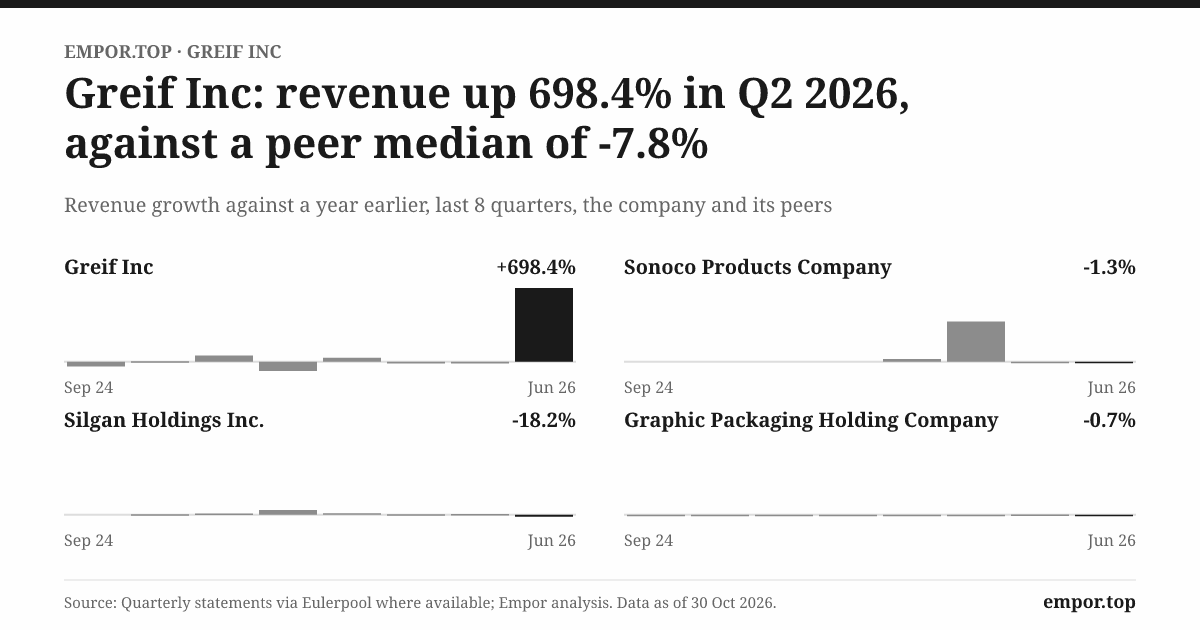
Meanwhile the businesses that remain are doing better than they were a year ago. In the quarter to June 2026, Greif reported $183.4 million of adjusted EBITDA, its own measure of operating earnings before interest, tax, depreciation and amortisation, with some charges stripped out.[^4] That was up almost a quarter from a year earlier, and management was blunt about why: "Those results were not driven by stronger markets," Chief Executive Ole Rosgaard told analysts. "They were driven by disciplined execution."3 Price increases, cost cuts and a smaller, simpler set of plants did the work, not a recovering industrial economy.
So the question this story asks is not whether Greif is a survivor. A company that has lasted since the nineteenth century has already answered that. The question is what kind of business Greif is now trying to be, and whether the reshaping of the last seven years has made it a better one. Three tensions run underneath that question. The first is whether the remaining packaging businesses can turn price increases and cost savings into durable cash, rather than a few good quarters. The second is whether the portfolio reset improved the company's earning power, or mainly made its accounts harder to read. The third is whether management can allocate capital well after a costly acquisition and a round of exits, because the next dollar it spends will be judged against the last ones.
Before going further, it helps to be precise about what is being analysed. Greif, Inc. is a Delaware corporation headquartered in Delaware, Ohio, and its accounts consolidate a network of subsidiaries across the world.2 It has two classes of common stock on the New York Stock Exchange. Class A shares carry economic rights but, in ordinary matters, no vote; Class B shares are the voting class, and they are concentrated in the hands of descendants of the founding families and their trusts.4 When this story speaks of "Greif," it means that listed, consolidated company, with no outside parent above it.
The calendar also needs care, because Greif changed it. The company used to close its books at the end of October. In 2025 it moved to a September year-end, so its fiscal 2025 was an eleven-month transition period ending September 30, 2025, reported in a filing called a 10-KT.2 Any comparison that sets fiscal 2025 beside fiscal 2024 compares eleven months with twelve, and in Greif's case it also compares a company with a containerboard business to one that had sold it partway through the year. Some annual figures that circulate for Greif blend these periods differently from the 10-KT itself, which is one more reason the headline numbers deserve suspicion.
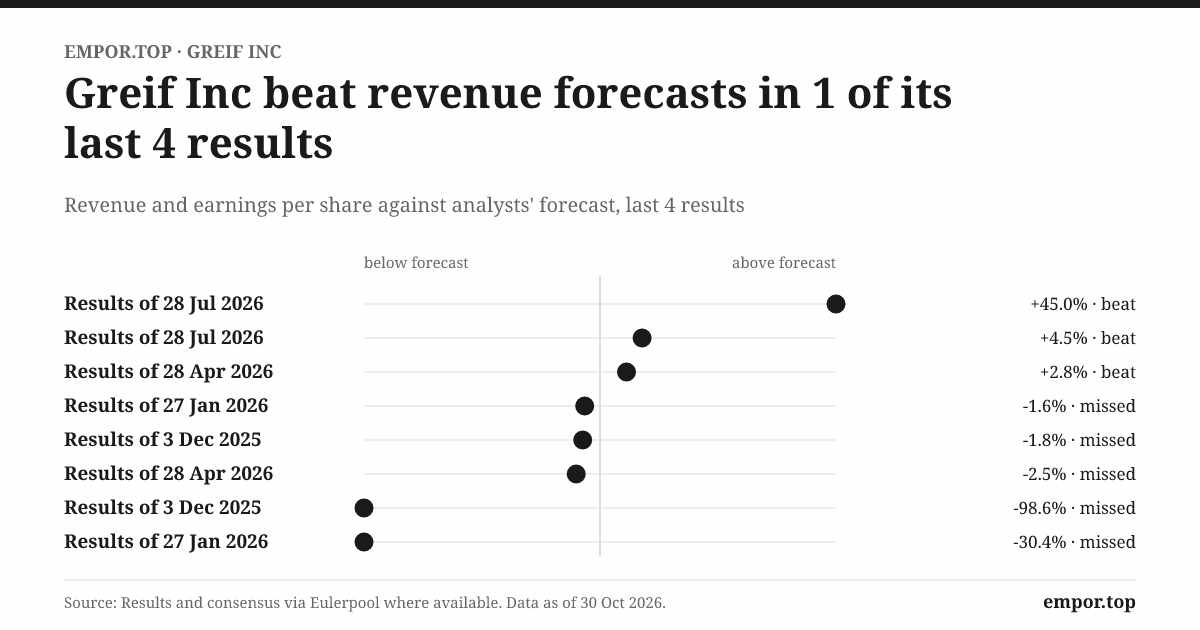
And the next verdict is days away. Greif scheduled its fiscal 2026 results for November 3, 2026, with a conference call the following morning.[^7] Everything in this story uses results through the third quarter, the three months to June 30, 2026. That matters because management has made a specific promise for the full year: between $615 million and $635 million of adjusted EBITDA and between $305 million and $325 million of adjusted free cash flow.3 By the time many readers meet this story, that promise will have been either kept or broken.
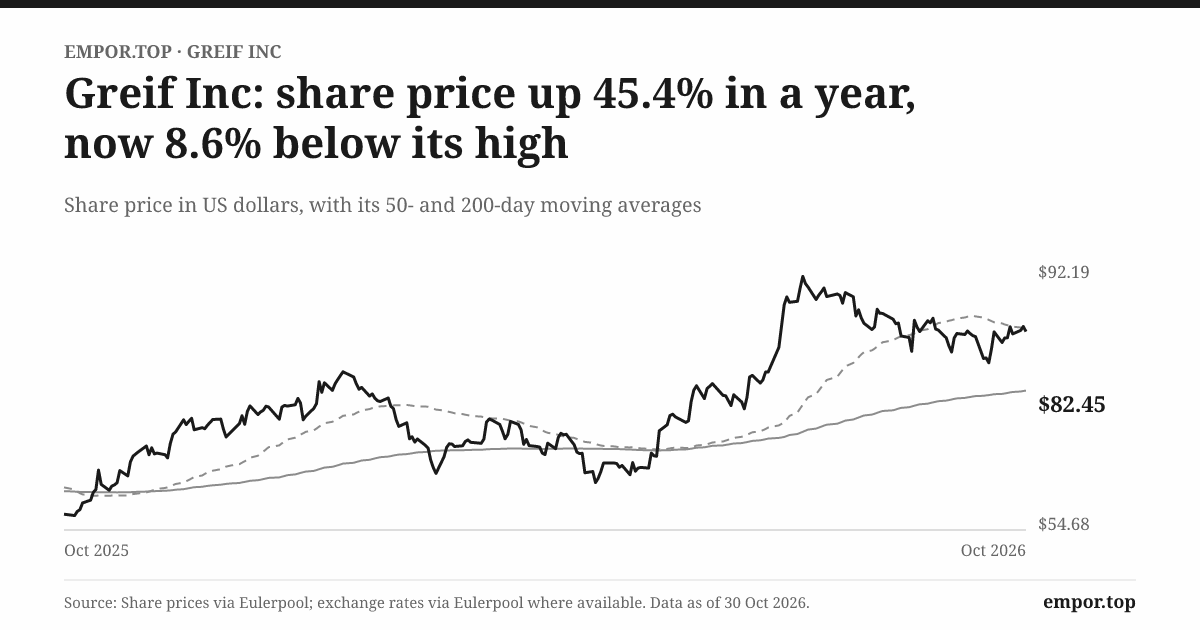
The stock market, for its part, has priced Greif as though it is unsure which way that will go. At $82.45 on October 30, 2026, the shares stood about 9% below their 52-week high, and the company was worth about $3.8 billion in equity and $4.8 billion including debt.2 On the surface, Greif looks extraordinarily cheap: about four and a half times its last reported annual earnings. Underneath, those earnings include the gain from selling the containerboard mills, and the free cash flow the business produced in its transition year was negative. A cheap multiple built on a one-time gain is not a bargain until someone proves otherwise.
To understand how Greif got here, and why the closure of one mill in one town says something about the whole company, the story has to start much earlier, with a family of barrel makers in Cleveland and a problem that has not changed in almost 150 years: how to move a dangerous liquid from one place to another without losing it on the way.
 Subscribe on LinkedIn
II. From Cooperage to a Global Packaging Network
In 1877, in Cleveland, Ohio, the Greif family went into the cooperage business, making the wooden barrels and kegs that carried nearly everything nineteenth-century commerce needed to move in bulk.[^8] A cooper's craft was physical and local. Staves were bent over fire, bound with iron hoops, tested for leaks, and sold to the brewers, oil refiners, merchants and farmers whose goods would spoil, evaporate or spill without them. The cooper's customer was not buying wood. The customer was buying the confidence that what went into the barrel would come out the other end intact.
That idea is the thread connecting the Cleveland cooperage to the company that exists today. Over the next century and a half, the materials changed completely. Wood gave way to steel drums, then to drums made of moulded plastic and of layered fibre, and then to the intermediate bulk container, or IBC: a plastic tank, roughly a cube a little over a metre on each side, held in a steel cage and mounted on a pallet so that a forklift can move a thousand litres of liquid at a time.2 Greif added closures, the caps, plugs and dispensing parts that seal those containers, and services such as reconditioning, which cleans and requalifies used drums and IBCs so they can carry another load.2 Paper entered the mix as well, first through fibre drums and the tubes and cores on which yarn, film and paper are wound, and later, on a much larger scale, through containerboard and recycled paperboard mills.
What lasted, in other words, was not a product. It was a customer problem. A chemical producer in Texas, a flavour house in the Netherlands or a pharmaceutical ingredient maker in India has to store and ship materials that may be flammable, corrosive, toxic, perishable or simply expensive. Each shipment must comply with rules on how dangerous goods are packed, with specifications that describe exactly what container a given substance can travel in, and with a customer's own quality systems. A container that fails does not just lose its contents. It can close a highway, contaminate a port, or end a supplier relationship. Industrial packaging is a low-glamour product with a high cost of failure.
Greif built its footprint around that problem. Today it operates in more than 35 countries, with plants placed close to the chemical, food and industrial customers that fill its containers.2 Proximity matters because drums and IBCs are bulky and mostly air when empty, so shipping them long distances is expensive. A drum plant earns its keep partly by being near the customer's filling line. That makes the network map one of the most important things Greif owns, and also one of the most expensive to maintain.
The way Greif describes its own business changed in 2025, and that change makes historical comparisons harder. After selling its containerboard operations, the company reorganised into four reporting segments.2 Customized Polymer Solutions houses the plastic drums, IBCs, small plastic containers and related services. Durable Metal Solutions is the steel drum business. Sustainable Fiber Solutions holds the remaining paper-based operations, including uncoated recycled paperboard, tubes and cores, and fibre drums. Innovative Closure Solutions makes the closures and dispensing systems.25 The labels sound like marketing, and in part they are, but the boundaries also matter: results reported under the old segment names before 2025 do not line up neatly with the new ones, so the long-run record by segment has to be pieced together with care.
The temptation, with a company of this age and reach, is to translate scale into dominance: to say Greif is "the global leader" in industrial packaging and leave it there. The evidence does not support that shortcut. Greif's filings describe a fragmented, competitive global market, and they do not establish a precise market share for the company in drums, IBCs or closures.2 Scale is real. Dominance is unproven.
The competitors that matter most are two privately held groups that overlap with Greif in drums and bulk containers. Mauser Packaging Solutions, an American company built through its own string of acquisitions, makes steel and plastic drums, IBCs and reconditioning services across many of the same markets. Schütz, a family-owned German group, is a formidable force in IBCs in particular. Both make products a buyer can line up against Greif's, both operate international plant networks, and neither publishes the kind of detailed financial statements that would allow a like-for-like comparison of margins, returns or market share. Beyond those two lie dozens of regional producers, reconditioners and, for some customers, the option of using different packaging formats altogether.
That competitive landscape frames the central economic question for Greif, and it is worth stating plainly because it recurs through the rest of this story. Does a wide product range and a dense plant network let Greif earn better returns than a smaller rival would, because customers value one supplier that can serve them across formats and continents? Or does the network mainly let Greif stay in the game in a business where price usually decides who wins the order? The long record offers a hint. Over the decade to fiscal 2025, Greif's revenue grew by less than 2% a year, and its operating margin moved within a band of roughly 5% to 12%.2[^8] That is the profile of a durable industrial company, not the profile of a business with the pricing power to grow steadily through cycles.
Longevity, then, proves something narrower than it seems to. It proves that Greif has repeatedly adapted its materials and its footprint to keep solving the same customer problem. It does not prove that solving that problem earns an exceptional return on the capital needed to do it. That gap between survival and returns is exactly where Greif's biggest bet of the last decade landed. In 2018, the company decided that the way to earn more from its network was to go much deeper into paper.
III. The Containerboard Bet That Reversed
On December 20, 2018, Greif announced that it would buy Caraustar Industries from an affiliate of the private-equity firm H.I.G. Capital for an enterprise value of $1.8 billion in cash.1 Caraustar was not a household name, but in its corner of the packaging world it mattered. It was a leading maker of uncoated recycled paperboard, the thick, grey board used for tubes, cores and similar industrial products, and of coated recycled paperboard, the board used for folding cartons. It ran more than 80 operating facilities across the United States.1 For a company of Greif's size, it was a transformational purchase.
The architect on Greif's side was Pete Watson, then chief executive. "Caraustar offers an exceptional strategic and cultural fit for Greif," he said in the announcement.1 The strategic fit was easy to describe. Greif already made paper-based packaging and ran its own recycled paperboard and containerboard mills. Caraustar would add more mills and more converting plants, give Greif greater control of the board that went into its tubes, cores and fibre drums, and shift the company's mix toward the United States and toward paper. Management projected that paper packaging would rise to about half of Greif's sales, from 23%, and that the United States would supply about two-thirds of revenue.1 This was a deliberate choice to make Greif more of a North American paper company.
The financial case came with numbers attached. Greif said Caraustar had generated $220 million of run-rate EBITDA over the previous twelve months, a figure that adjusts reported earnings for the full-year effect of recent actions, and that combining the companies would produce at least $45 million a year of cost savings within three years.1 On those figures, the $1.8 billion price was about 8.2 times Caraustar's run-rate earnings, falling to about 6.8 times if the promised savings arrived.1 Greif also said the deal would add to margins, earnings per share and free cash flow.1
Two details in the same announcement deserve attention, because they show where the risk sat. The first is that Caraustar's reported EBITDA for the twelve months to September 2018 was $174 million, not $220 million.1 The difference between the reported figure and the run-rate figure was itself a forecast: it assumed that recent price increases, cost actions and operational changes would deliver a full year of benefit. The second is that the synergy-adjusted multiple depended on Greif finding and delivering $45 million of savings in a business it had not yet run. Strip those two assumptions away and the price looked much richer: roughly ten times the earnings Caraustar had actually reported. Neither assumption was unreasonable. Both meant that the bargain, if there was one, depended on execution.
Was 8.2 times a high price? It is tempting to compare it with what the market pays for packaging companies today. The market currently values Greif itself at about 10.8 times EBITDA, and a sector screen in March 2026 put diversified and specialty packaging companies at about 8.5 times.6 But those comparisons are separated by seven years, different interest rates, and very different businesses. A recycled-board maker in late 2018 and a diversified industrial packager in 2026 are not the same asset. The fair conclusion is narrower: the headline price was not obviously excessive against the earnings base Greif disclosed, but the cheaper-looking synergy multiple was a promise rather than a fact.
The deal also changed Greif's balance sheet. The company paid in cash, funded largely with debt, and expected its leverage, meaning net debt as a multiple of EBITDA, to be about 3.5 times at closing.1 Its own target range was 2.0 to 2.5 times, and management projected getting back there within 36 to 48 months.1 By the end of fiscal 2019, Greif's borrowings had roughly tripled to about $2.8 billion.[^11] That is not reckless for a company with stable cash flows, but it shifted the burden of proof. A leveraged acquisition earns its keep only if the acquired cash flows arrive on schedule and pay down the debt.
For a while, the paper strategy looked like it was working. The industrial and consumer boom that followed the pandemic pushed demand and prices for paperboard and containerboard sharply higher, and Greif's EBITDA climbed to above $800 million a year in fiscal 2021 through 2023, with operating margins reaching about 11.6% in fiscal 2023.[^8] Borrowings fell back toward $2.2 billion by fiscal 2022.[^8] Anyone judging Caraustar at that peak would have called it a success.
Then the cycle turned. Industrial demand softened, paper prices eased, and Greif's revenue fell by roughly a sixth in each of fiscal 2023 and fiscal 2024.[^8] EBITDA dropped to about $570 million in fiscal 2024.[^8] And in the same period, Greif made a strategic decision that cut directly against the logic of 2018. In 2025, it sold its Containerboard Business, the corrugated-box raw material operation at the heart of its paper segment, to Packaging Corporation of America for $1.8 billion.2 The sale closed in August 2025.2
The Containerboard Business was not the same thing as Caraustar. Greif had owned containerboard mills before it bought Caraustar, and much of what Caraustar brought, the uncoated recycled board and its converting network, sat in what is now the Sustainable Fiber segment. But the sale told the market something important. Greif no longer wanted to be a broad paper company. It wanted to be an industrial packaging company with a paper arm sized to support it. In 2026, it went further, selling Soterra, its timberland business, and then announcing the Sweetwater closure and its exit from coated recycled paperboard.5[^1] Earlier, on its third-quarter call in July 2026, Chief Financial Officer Lawrence Hilsheimer had described the closure of a Los Angeles mill as primarily a coated recycled board matter.3 Piece by piece, Greif was dismantling the coated board leg of the very business it had paid $1.8 billion to acquire.
What remained of Caraustar's strategic logic? Some of it survives in the uncoated recycled board mills, which still feed Greif's tubes, cores and fibre drums, and which were running at about 96% of capacity in the third quarter of fiscal 2026.3 Hilsheimer told analysts that Greif had pushed through two price increases of $60 a ton each on that board, in April and June, and had fully implemented them with customers whose contracts are not tied to published industry price indices.3 That is evidence of some pricing power in a tight market. But the broader thesis of 2018, that Greif would become roughly half a paper company and earn more for doing so, has been abandoned.
There is an older chapter in Greif's record that helps calibrate how much weight to put on acquisition stories. In fiscal 2014, Greif recorded a $50.3 million goodwill impairment that fully wrote off the goodwill in its Flexible Products & Services segment, the business making large woven bags for bulk materials.7 The company tied the write-off to lower expected cash flows, planned plant shutdowns and divestitures, and currency pressure.7 Goodwill is the premium a buyer pays above the value of the assets it acquires, so writing it to zero is an admission that the expected earnings power has disappeared. The amount was modest relative to Greif's size, and the business was nothing like Caraustar. But the episode is a reminder that expansion stories at Greif have met operating limits before, and that the company has a habit of buying, restructuring and then shrinking.
So was the Caraustar acquisition a mistake? The honest answer is that the public record does not settle it. Greif enjoyed strong paper earnings in the boom years, and it sold a containerboard business for a large sum in 2025. Whether the full set of cash flows from Caraustar, net of the debt cost, integration costs, closures and the eventual exits, earned more than Greif's cost of capital is not something the company has disclosed. What the record does show is that Greif did not keep the paper portfolio it bought. The Sweetwater closure can be read two ways. It may be a disciplined response to a business with weak economics: closing a mill that cannot earn its keep is better than feeding it capital. Or it may be a costly admission that the paper strategy did not work as intended. The evidence that would decide between those readings is specific: the size of the closure charges, any stranded costs left behind in the remaining paper business, and proof that the capital and management attention released by the exit flow into higher-return packaging lines.
That last test matters because those packaging lines are now the whole case. With most of the paper bet unwound, Greif is asking investors to judge it on the drums, containers and closures it sells to chemical companies, pharmaceutical makers and food processors. That means going out onto the road with one of its products, and asking why a customer chooses it.
IV. The Container on the Road: Where Greif Wins or Loses
Picture a tanker-load's worth of a specialty chemical, corrosive and regulated, that has to travel from a plant on the Gulf Coast to a customer's production line hundreds of miles away. It will not go in a tanker. It will go in a few dozen IBCs strapped onto a flatbed. The chemical company's procurement manager has three questions about those containers. Will they meet the specification, including the certification for dangerous goods that the regulator requires? Will they arrive at the filling line on the right day, in the right quantity? And what do they cost? The first two questions decide whether a supplier is on the approved list. The third decides who gets the order.
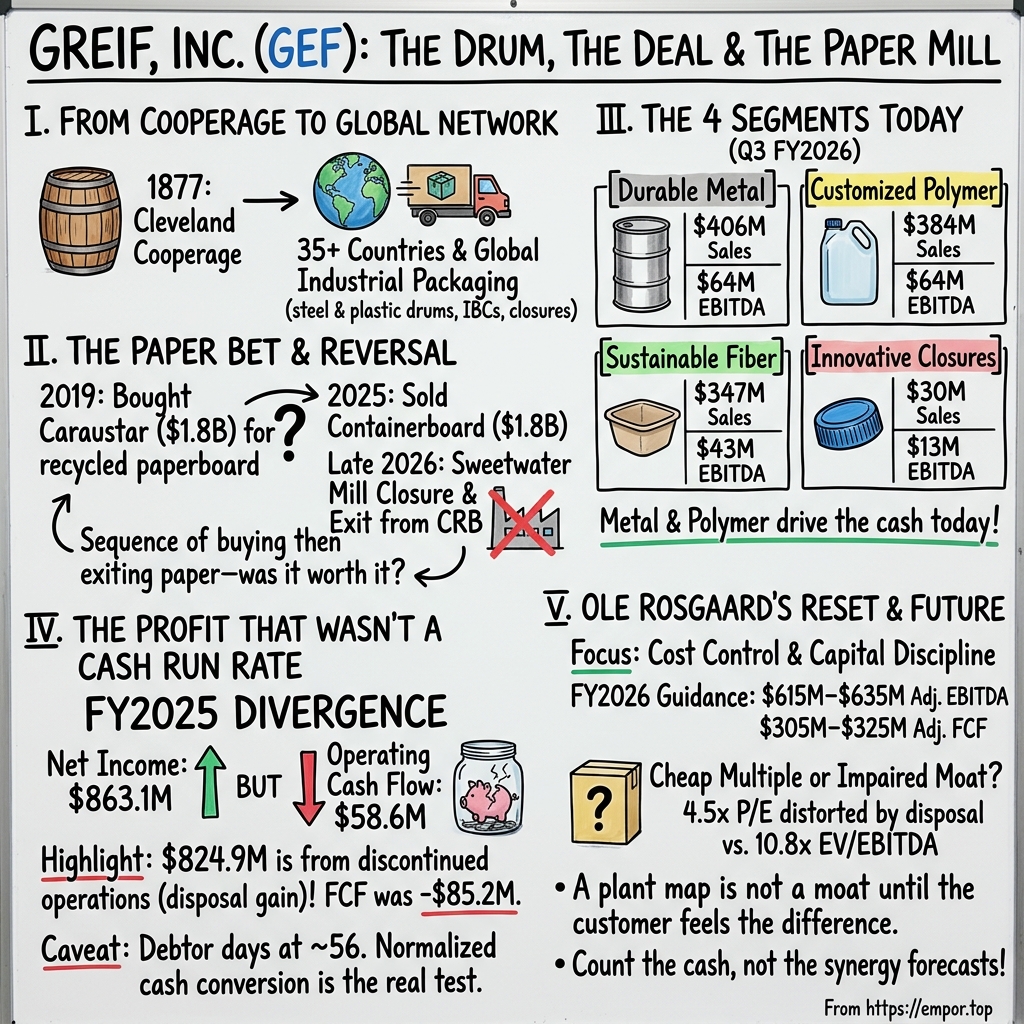
That scene is Greif's business in miniature. The company sells steel drums, plastic drums, IBCs, fibre drums, small plastic containers and closures to chemical, food, pharmaceutical, flavour and fragrance, agricultural and other industrial customers.2 In the quarter to June 2026, the four segments reported roughly the following: Durable Metal had about $406 million of sales, Customized Polymer about $384 million, Sustainable Fiber about $347 million and Innovative Closure about $30 million.[^4] The ordering by earnings was different. Polymer and Metal each produced about $64 million of adjusted EBITDA, Fiber about $43 million and Closures about $13 million.[^4]
Those figures say three things. The first is that steel and plastic carry the company. Together they produced about two-thirds of segment earnings in the quarter.[^4] The second is that margins differ sharply. Polymer converted about 17% of its sales into adjusted EBITDA and Metal about 16%, while Fiber converted about 12%, a reflection of weaker prices and volumes in paper-based products.[^4] The third is that Closures, at well over 40% of its sales, is by far the most profitable business per dollar of revenue, but it is tiny.[^4] Closures is strategically adjacent, because every drum and IBC needs a cap and every cap sold to a rival's container is a foothold, but at its current scale it cannot carry the company. Treating it as a separate growth engine would put more weight on it than its earnings can bear.
To understand how these businesses make money, it helps to think of a drum maker as a converter. Greif buys steel coil or plastic resin, shapes it into containers, and sells those containers at a price that is supposed to cover the material, the labour, the energy, the freight and a margin. When the price of resin or steel rises, Greif tries to pass that increase on. In many contracts, prices are linked to published indices, so the pass-through happens automatically, but with a delay. During that delay, the converter absorbs the cost. When raw-material prices fall, the reverse happens: selling prices drop, but often more slowly than costs, and the converter enjoys a temporary windfall. Over a full cycle, those gains and losses roughly cancel. Over a single quarter, they can dominate the results.
The third quarter of fiscal 2026 showed that mechanism at work. Consolidated sales were roughly flat from a year earlier, but inside that total the picture moved in different directions.3 Polymer and Metal sales rose, driven mainly by higher selling prices and currency translation, while Metal's volumes fell.5[^4] Hilsheimer told analysts that Greif had "seen dramatic price increases in resin through Q3," and said the company expected neither a continued surge nor a decline.3 He also explained that Greif had deliberately held more inventory than usual during the quarter because of the conflict in the Middle East, which raised raw-material prices and threatened supply chains, and that the extra stock was costly.3 In plain terms, Greif's revenue line in mid-2026 was swollen by inflation in its inputs, not by customers buying many more containers.
Volume is the number that best reveals underlying demand, and the volume picture was mixed. Rosgaard said Polymer volumes rose about 1.5% in the quarter, and that closure volumes sold to outside customers rose by a mid-single-digit percentage.3 But steel drums and fibre products were, in his words, "pressured by the chemical market" and by muted housing activity, with some indicators at historic lows.3 When an analyst from Baird asked whether demand had turned, Rosgaard declined to call it: "I will hesitate to confirm that this is an inflection," he said, describing an improvement "from a very low base."3 That caution is to his credit, but it also means the earnings recovery has not yet been tested by a volume recovery.
Where does Greif win? The plausible advantages are real, even if hard to measure. A customer qualifying a container for a hazardous substance must test it, document it and certify it, and switching to a new supplier means repeating some of that work. A multinational chemical company that wants the same IBC in Texas, Belgium and Singapore benefits from a supplier that can make it in all three places. Reconditioning networks, which collect, clean and requalify used containers, can tie the customer more closely to a supplier that can both sell new containers and take back old ones. And reliable supply, in a market where a missed delivery can stop a production line, is worth something beyond price.
Management pointed to evidence that these advantages were winning business. On the third-quarter call, Rosgaard cited new customer wins and growth in pharmaceutical and flavour and fragrance markets, where packaging specifications tend to be more demanding and margins higher.3 The 2024 purchase of Ipackchem, a maker of high-barrier plastic containers for crop protection, pharmaceutical and flavour and fragrance customers, pointed in the same direction.8 In 2026, Greif added Envaplast, a Spanish maker of small polymer containers mostly for agrochemicals, which Hilsheimer said earns EBITDA margins "well above 18%."3 The strategy is coherent: move the mix toward smaller, more specialised containers where qualification matters more and price matters a little less.
How much Greif reinvests to keep that position also matters, because a manufacturer that starves its plants can flatter cash flow for a few years and then pay for it. In the eleven-month transition period, Greif spent about $64 million on research and development, roughly 1.6% of sales, up from about 1.4% in the prior full year, while capital expenditure fell to about $108 million, roughly 2.7% of sales, from about 3.1%.2 The periods are not like-for-like, and the lower capital spending partly reflects a smaller company after the containerboard sale. Management describes continued spending on high-return organic projects and on investments that support cost savings and growth.3 The figures do not suggest a business being harvested, but they also do not suggest one investing heavily to widen a technical lead. Greif's edge, if it has one, is operational rather than technological: it sells reliability, not invention.
But the evidence that would prove those advantages translate into lasting economics is largely absent from Greif's disclosures. The company does not publish contract durations, the share of revenue under multi-year agreements, customer retention rates, or how often customers split their volume among several suppliers.25 Management referred on the call to "non-RISI contract-based customers," meaning customers whose prices are not linked to a published index, without saying how large that group is.3 Without those numbers, the switching friction is a plausible story, not a measured one.
The counterevidence sits in the same filings. No single customer accounted for 10% or more of Greif's revenue in fiscal 2023, fiscal 2024 or the transition period of fiscal 2025.2 That protects Greif from the loss of any one buyer, but it does not mean customers are weak. Greif's own risk disclosures say that consolidation among its customers and its suppliers has increased pricing pressure, and that for some inputs it has limited supplier alternatives.2 Large chemical companies negotiate hard, buy in volume and can, at least for standard formats, qualify a second supplier. Greif does not disclose how concentrated its top five or ten customers are.2 And the steel drum, in particular, is a mature, standardised product where a buyer who has qualified two suppliers can move volume between them at the next contract renewal.
So what does the container on the road tell an investor? It says Greif is a capable, scaled supplier in a market where qualification, reliability and reach matter, and where those qualities probably earn it a seat at most large customers' tables. It does not yet say that customers pay Greif a premium for those qualities, or stay with Greif when a rival offers a lower price. The test for a moat is visible in the numbers Greif does publish: price realisation that holds when input costs fall, volumes that grow faster than industrial production, margins that stay high through a downturn, and cash that keeps arriving. On the evidence so far, the advantage survives in a narrower form: real in specialised niches, unproven in the core drum business. Whether that narrower advantage is enough depends heavily on the people now running the company, and on whether their recent promises turn into cash.
V. Ole Rosgaard's Reset: Savings, Guidance and the Next Dollar
In the spring of 2026, Greif's management sounded like people bracing for a long winter. On the second-quarter results call in April, they described the industrial environment as soft, adopted a more conservative outlook and emphasised the levers they could control: cost reduction and cash generation.[^14] One quarter later, the tone had changed. Adjusted EBITDA in the third quarter rose 24.7% from a year earlier to $183.4 million, adjusted margins expanded by more than 2.6 percentage points, and management raised the bottom of its full-year earnings range.[^4]3 The question for investors is whether that swing reflects a management team that is good at running a cyclical business, or one that set a low bar and then cleared it.
The man at the centre of that question is Ole Rosgaard. He joined Greif in 2015, after a career in European industrial manufacturing that included senior roles at Icopal, the roofing-materials company, where he ran operations in Denmark and later across Western Europe.4 At Greif, he rose through group president roles running large parts of the industrial packaging business from 2017, became chief operating officer in July 2021, and took over as chief executive in February 2022.4 He is, by background, an operator rather than a dealmaker: a European executive who spent his formative years running plants and regions rather than investment banks or strategy departments. His language on calls reflects that. He talks about "disciplined execution," about commercial transformation and about cost optimisation in the vocabulary of a plant manager, not a financier.3
His partner on the money side is Lawrence Hilsheimer, chief financial officer since 2014.4 Hilsheimer came to Greif from Scotts Miracle-Gro, where he was finance chief, and before that held senior roles at Nationwide and spent years as a partner at Deloitte & Touche.4 That makes him the institutional memory of Greif's capital decisions: he was CFO when Caraustar was bought, when the containerboard business was sold, and when the current cost programme was designed. Where a decision needs attribution, it is worth remembering that the Caraustar deal was announced under Rosgaard's predecessor, Pete Watson, while the exits from paper have happened on Rosgaard's watch.12
The reset Rosgaard leads has three parts. The first is portfolio simplification: selling containerboard, selling Soterra, and leaving coated recycled board.25[^1] The second is cost: management said in July 2026 that it had already reached a run rate of $90 million in annual cost savings, earlier than planned, and set a target of $120 million by the end of the next fiscal year.3 The third is capital return: Greif completed a $150 million share buyback in April 2026, repurchasing about 1.8 million Class A and 0.4 million Class B shares, then authorised a further $150 million, and raised its dividend by about 10.7%.53
Comparing what management said in the spring with what it said in the summer reveals a lot about how it communicates. In the second quarter, the emphasis was on caution, on the soft industrial backdrop, and on not promising a recovery that had not arrived.[^14] In the third quarter, the prepared remarks celebrated a strong quarter, but the full-year targets moved only slightly, from a $610 million low end to a range of $615 million to $635 million of adjusted EBITDA, while the adjusted free cash flow range stayed at $305 million to $325 million.3 Hilsheimer said the company was still absorbing about $20 million of costs linked to the Middle East conflict.3 That pattern, conservative guidance followed by a modest raise, is the profile of a management team that would rather beat expectations than miss them. It builds credibility, but it also means the earnings recovery partly reflects a low starting bar.
The question-and-answer session was more revealing than the prepared remarks. When a Raymond James analyst asked whether published price indices would reflect Greif's paperboard price increases, Hilsheimer gave a concrete operating figure, 96% mill operating rates, and acknowledged that guidance did not include the new prices.3 When the same analyst asked about price and mix in Polymer, he offered a direction for resin costs but no dollar figure for the price-cost spread.3 When the Baird analyst asked about month-by-month demand, Rosgaard gave no data, and when asked about the commercial transformation programme, he said "it's early days."3 Quantified where the news was good, general where it was uncertain: that is not unusual for an industrial management team, but it means the most important unknown, underlying volume, remained unquantified.
The capital record is where the judgement gets harder. Caraustar took Greif's leverage to about 3.5 times at closing.1 Under Rosgaard, Greif bought Ipackchem in April 2024 for $538 million plus a $38 million "ticking fee," a payment to compensate the seller for profits earned between the signing and the close, funded through Greif's credit facility.8 The targeted synergies were $7 million.8 Greif has not disclosed Ipackchem's standalone EBITDA in a form that would allow its purchase multiple to be calculated, so the deal's price cannot be judged against its earnings the way Caraustar's can. Then came the containerboard sale, debt reduction, and the buyback.
The two acquisitions should be judged with calibrated confidence. Caraustar's quoted multiple was within the range of deal values for packaging assets at the time, but the overall return on that $1.8 billion remains unresolved. Ipackchem's price and synergy target are known, but not its entry multiple, which leaves its value unknown. The 2014 goodwill write-off in Flexible Products is too old and too different to condemn today's management, but it argues for tracking returns after a deal rather than accepting synergy claims at face value. What would make an activist investor uneasy is the pattern: Greif has bought businesses, then restructured and exited several of them, and each turn of the cycle has been accompanied by a new strategic narrative.
That unease extends to how executives are paid. Rosgaard's reported total compensation rose from about $4.4 million in fiscal 2023 to about $9.4 million in fiscal 2025, of which about $6.1 million came in stock awards.4 Part of that rise reflects the long-term incentive plan for 2023 to 2025, which paid out at 200% of the original performance-share target, the maximum, after the performance goals were revised to account for a divestiture.4 Revising targets after a portfolio change is common, because the original targets assumed a business that no longer exists. But it is also exactly the kind of decision that deserves scrutiny, because a maximum payout in a period when continuing-operations income attributable to Greif was just $15.1 million is a striking contrast.24
Shareholder dissent was negligible, but that tells less than it seems. At the annual meeting in February 2026, the advisory vote on executive pay received about 17.2 million votes in favour and about 80,000 against.9 Only Class B shares vote, and Class B ownership is concentrated: the 2026 proxy lists several family members and trusts, each holding roughly 13% to 16% of the class on a beneficial basis, with ownership attributed across overlapping trusts.4 The company had just 47 Class B holders of record in November 2025.2 In that structure, a lopsided vote shows that the controlling holders are content. It does not show that the much larger body of Class A shareholders, who cannot vote on the matter, agree.
The governance structure has a benefit and a cost. Family control can let management take a long view and avoid being pushed into short-term financial engineering. It can also insulate management from outside pressure when capital allocation goes wrong. Greif's record contains evidence for both readings, which is why the next tests matter so much. The cleanest test of Rosgaard's credibility is whether Greif delivers its fiscal 2026 cash-flow target, which Hilsheimer described as about 50% conversion of adjusted EBITDA.3 Through the third quarter, cash generation lagged, partly because of the deliberate inventory build.3 The fourth quarter needs to release that inventory and collect from customers. If it does, the reset has a solid foundation. If it does not, the gap between reported profit and cash, a gap that has been unusually wide at Greif lately, will become the story.
VI. The Profit That Wasn't a Cash Run Rate
In its transition year ended September 30, 2025, Greif reported net income of $863.1 million.2 For a company that had earned between roughly $100 million and $400 million a year over the previous decade, that was a spectacular number, the largest profit in its history. Yet in the same eleven months, the business generated just $58.6 million of cash from its operations.2 After capital spending, free cash flow was negative, at about minus $85 million.2 The profit was real in an accounting sense. It was not a sign of what the business could earn and collect in a normal year.
The reconciliation is a lesson in how accounting splits a company's year into pieces. Of the $863.1 million of net income, $824.9 million came from discontinued operations, overwhelmingly the containerboard business and the gain on selling it.2 Income from continuing operations attributable to Greif's shareholders was just $15.1 million.2 When a company sells a business, the gain on the sale flows into net income, but the cash from the sale is recorded as investing cash flow, not operating cash flow. So Greif's investing cash flow in the transition year showed an inflow of about $1.68 billion, and its financing cash flow showed an outflow of about $1.73 billion, much of it the repayment of debt.2 The operating line, the cash the remaining business generated from making and selling containers, told a much smaller story.
Viewed over a longer horizon, Greif's cash conversion looks respectable. Across the twelve fiscal years from 2014 through 2025, the company reported about $3.1 billion of net profit and about $4.3 billion of cash from operations, roughly 140 cents of operating cash for every dollar of profit.2[^8] That is what you would expect from a manufacturer whose depreciation charges, the accounting cost of wearing out its plants, are substantial and do not consume cash in the year they are recorded. Over that period, free cash flow totalled about $2.4 billion, and dividends absorbed a little over half of it.2[^8]
But a twelve-year average cannot vouch for the latest year. It smooths over the boom years of fiscal 2022 and 2023, when operating cash flow exceeded $600 million a year, and the transition year, when it collapsed.[^8]2 Cash from operations as a share of EBITDA, a simple measure of how much of the operating profit arrives as cash, was around 80% in the good years and about 13% in the transition period.[^8]2 Some of that collapse reflects the sale itself, because tax payments, transaction costs and the loss of containerboard's cash flow after the sale all hit the operating line. Some of it reflects working capital, and that is the part worth watching.
Working capital is the cash a company ties up in running its business: inventory sitting in warehouses, and money customers owe but have not yet paid. For a drum maker, the second item is especially important. Greif's debtor days, the number of days of revenue sitting in unpaid customer invoices, rose from 43 in fiscal 2014 to 63 in fiscal 2024, before easing to 56 in the transition year.[^8]2 Put plainly, a decade ago Greif waited about six weeks to be paid; by 2024 it waited about nine. Every extra day of credit extended to customers is cash Greif has earned but cannot use, effectively an interest-free loan to its buyers. Some of the change reflects the mix of the business and the timing of the year-end, but the direction is unfavourable.
At September 30, 2025, Greif's net trade receivables stood at about $655 million, with an allowance for doubtful accounts of $7.2 million, up from $6.1 million a year earlier.2 That allowance is small relative to the receivables, roughly 1%, which suggests that Greif does not expect large losses from customers failing to pay. The company sets its allowance by how many days invoices are overdue and by specific customer risks.2 But Greif does not publish an ageing schedule showing how much of its receivables are overdue, by how long, or how much it has written off in practice, so an outside investor cannot see whether the lengthening of payment terms reflects deliberate commercial choices, slower-paying customers or simple timing.25
The pattern continued into fiscal 2026. In the first nine months, Greif's operating cash flow was $170 million, against net income of about $279 million.5 Receivables consumed $83.3 million of cash, which the company attributed to higher sales and the timing of collections.5 Higher sales, in this case, largely meant higher prices driven by resin and steel inflation, so Greif was financing its customers' higher bills before collecting them. Add the deliberate inventory build ahead of supply disruption, and the result is a business whose earnings recovered faster than its cash.
The balance sheet, at least, looks very different from the one that carried the Caraustar debt. The containerboard proceeds paid down borrowings sharply, and in February 2026 Greif replaced its earlier credit agreements with new facilities maturing in 2031.5 At June 30, 2026, it had $703.8 million outstanding under those agreements and $330.5 million of short-term borrowings, which included a receivables financing programme, against $288.5 million of cash.5 That receivables financing is worth noticing: it means part of the money tied up in customer invoices is effectively funded by lenders, so a rise in receivables shows up partly as short-term debt. Lease obligations, about $176 million of operating leases and $27 million of finance leases, sit separately.5 Management said in July that leverage was about 1.1 times EBITDA, well below the company's ceiling, and that it expected to keep it below 1.5 times for now.3
The new credit agreements cap leverage at 4.0 times and require interest coverage of at least 3.0 times, and Greif reported being in compliance with roughly $593 million of undrawn revolving credit available.5 The rating agencies noticed the change. Moody's upgraded Greif's long-term rating to A2 in February 2026 with a positive outlook, and S&P affirmed its A- rating and revised its outlook to positive in April.[^16] Those are strong investment-grade ratings for an industrial manufacturer. But a credit rating measures the likelihood that lenders will be repaid, which depends heavily on how little a company owes. It says much less about whether the business earns an attractive return on its equity. Greif's lenders are in a much better position than they were. Its shareholders still need the operating cash to arrive.
Two smaller items sit beneath the balance sheet and deserve a sentence each, because they could move a quarter even if they are unlikely to move the thesis. The first is environmental. At June 2026, Greif carried $16.8 million of environmental reserves, of which $9.8 million related to the Diamond Alkali Superfund site, the heavily contaminated stretch of the Passaic River in New Jersey where many industrial companies share clean-up liability.5 The company says it does not expect any individual site to be material, but acknowledges that a series of adverse developments could hit a particular period, and it reported no pending legal proceedings material to its interim accounts.5 For a manufacturer that has handled steel, paint, chemicals and paper for well over a century, that is a modest overhang.
The second is currency. Greif earns a large share of its money outside the United States, and it has used cross-currency swaps to convert about $651 million of its dollar fixed-rate debt synthetically into euro debt, effectively matching some of its borrowing to its European earnings.5 It also hedges certain transactions with forward contracts, and it reported that foreign-exchange transaction losses were not material in recent years.2 The hedges dampen the shock of a swing in the euro, but they do not remove it: when the dollar strengthens, Greif's overseas profits translate into fewer dollars, and when it weakens, as currency translation helped in the third quarter of 2026, reported sales look stronger than the underlying volume would suggest.5
The question that remains open is specific and answerable within months. What does Greif's continuing business generate in cash in a full, normal year, with disposal effects stripped out and working capital stabilised? The company has not yet reported a full fiscal year in its new shape. The fourth-quarter results will show whether the year-end released cash from inventory and receivables, whether debtor days fell as price inflation eased, and whether operating cash flow approached the level implied by management's free cash flow guidance. Until then, the stock market is being asked to value a company whose most recent annual profit is mostly a one-time gain, and that is precisely why its valuation multiple is so misleading.
VII. The Cheap Multiple and the Expensive Question
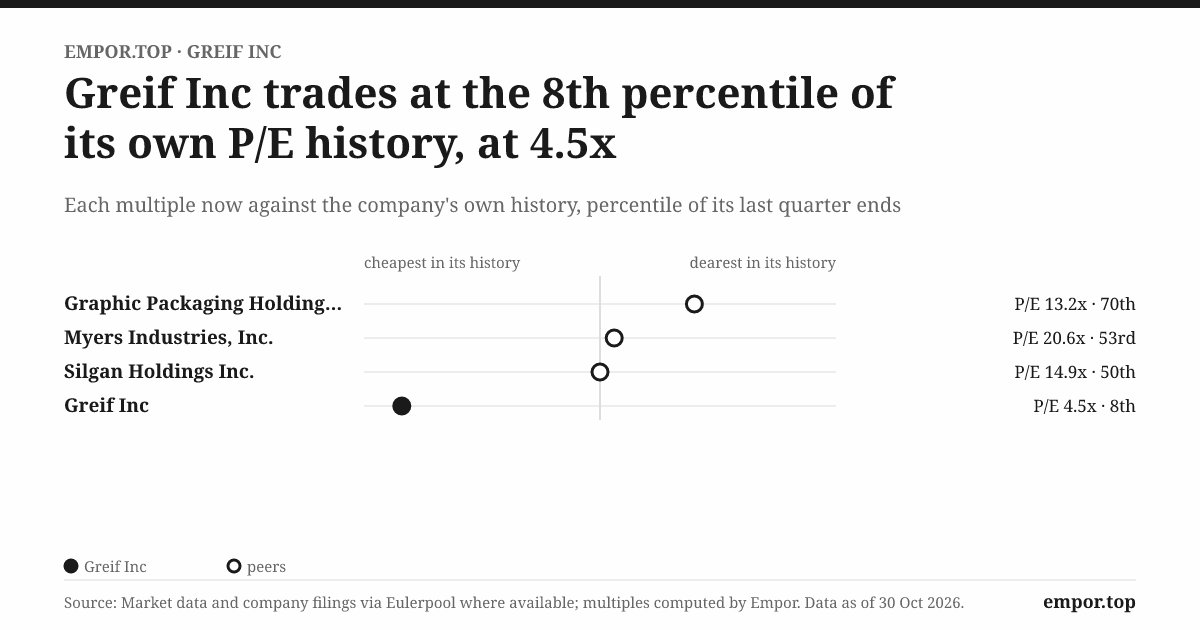
On October 30, 2026, Greif's shares traded at a price-to-earnings ratio of about 4.5, based on the last reported annual earnings per share.2 Greif's median P/E over the previous five years was about 8.7 times. On a screen sorted by price-to-earnings, Greif looks like one of the cheapest industrial companies in America, with an earnings yield, the inverse of the multiple, of about 22%. A quantitative investor who stopped there would see a company priced at half its usual valuation, with a strengthened balance sheet, a raised dividend and a buyback underway.
The screen is misleading, and the reason is now familiar. The earnings in that multiple are $14.37 a share from the transition year, a figure inflated by the gain on selling containerboard.2 Over the last four reported quarters, earnings per share were closer to $3.14, which would put the multiple at roughly 26 times.5 Neither figure is a clean measure of what Greif earns in a normal year, because the trailing number includes some quarters before the sale and restructuring charges after it. But the gap between them shows how far the cheap multiple depends on a one-time gain.
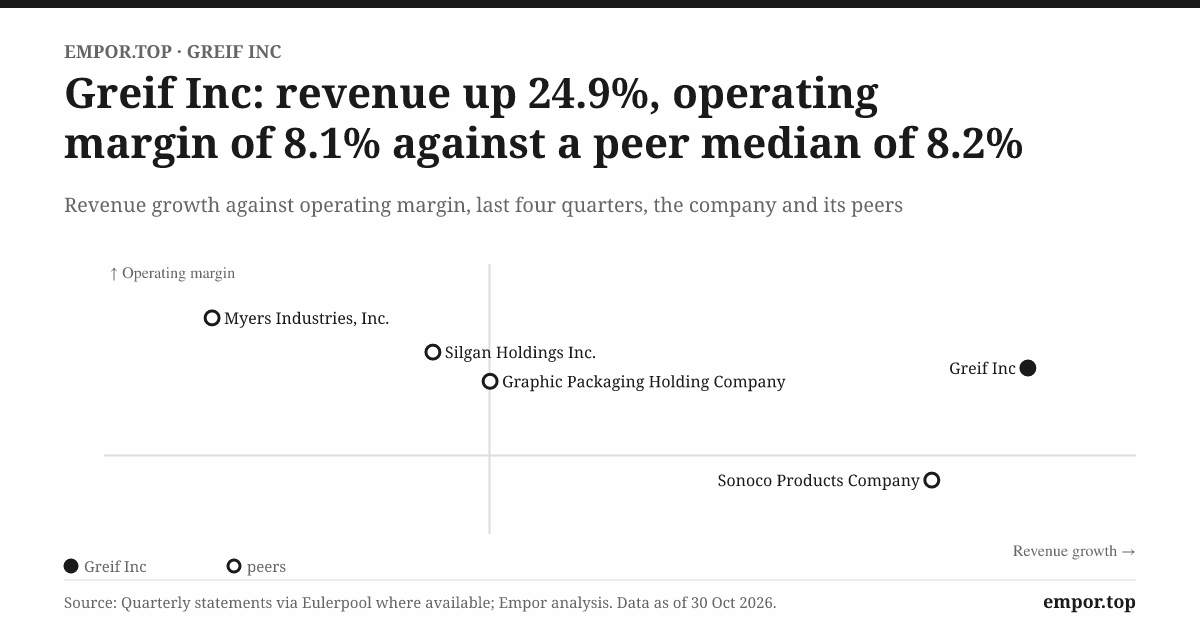
Other valuation measures tell a less flattering story. On enterprise value to EBITDA, which counts debt as well as equity and earnings before interest and depreciation, Greif trades at about 10.8 times.2 That is above the 8.5 times a March 2026 screen gave for diversified and specialty packaging companies, though that comparison uses a different date, a different peer set and a different method.6 On free cash flow, Greif's yield is negative, about minus 6%, because the transition year's free cash flow was below zero.2 Its return on invested capital in that year was about 3.5%, and its return on capital employed about 6.3%, both below what most investors would consider the cost of capital for a cyclical manufacturer.2 By those measures, Greif is not cheap at all. It is priced like a company the market expects to recover.
That recovery is the bull case, and it has substance. The portfolio reset, debt reduction and investment-grade ratings give that case substance.25[^16] The company says it has reached $90 million of annual cost savings and targets $120 million.3 Its adjusted EBITDA is growing by double digits while industrial demand remains weak, which suggests that when volumes recover, operating leverage could add meaningfully to earnings.3 Management's guidance implies roughly $305 million to $325 million of adjusted free cash flow for fiscal 2026, which against a $3.8 billion market value would be a free-cash-flow yield of roughly 8%.32 If that cash is real and repeatable, the market is paying a reasonable price for a cleaner, less indebted business.
The bear case is just as specific. Revenue has fallen by about 12% a year over the three years to fiscal 2025, partly from divestitures but also from lower volumes and prices.2[^8] Returns on invested capital have declined from above 12% in fiscal 2021 and 2022 to single digits.[^8]2 Free cash flow has been negative, and working capital keeps absorbing cash. Greif's core drum business is mature, and its exposure to chemicals, a sector under pressure from weak demand and, in Europe, from high energy costs, leaves it hostage to an industrial cycle it cannot control. In that reading, the low returns are not temporary noise from the portfolio reset. They are the true earning power of a business that sells a commodity-like product into a price-sensitive market.
To weigh those cases, it helps to look at the industry's structure. Start with rivalry. Greif competes directly with Mauser and Schütz and with many regional producers, in products that are often standardised by regulation. Rivalry in standard steel drums and IBCs is intense, which limits pricing power, though it is softened somewhat by the cost of shipping empty containers long distances, which turns some markets into regional contests. Next, the power of buyers. Greif's customers are often large chemical and industrial companies that buy in volume and can qualify multiple suppliers, and Greif itself says customer consolidation has raised pricing pressure.2 Buyer power is high, tempered only by the absence of any single dominant customer.2 The power of suppliers is meaningful too: steel and resin are global commodities whose prices Greif cannot control, and the company acknowledges limited supplier alternatives for some inputs.2 Index-linked contracts protect the margin over time but expose it to lags. The threat of new entrants is low in the big formats, because building a network of qualified, certified plants takes years and capital, though regional players can enter niche markets. Substitutes are present but limited: a customer can switch from drums to bulk tankers or flexible containers for some products, and from steel to plastic, but many hazardous materials require a rigid, certified container.
Through Hamilton Helmer's lens of seven sources of durable competitive power, Greif's position looks thinner still. Scale economies exist in procurement and in the density of its plant network, but its private rivals have comparable scale in key markets. Switching costs, rooted in qualification and certification, are real but modest for standard products and higher for specialised containers. There is no meaningful network effect in drums. Brand matters at the margin, as a signal of reliability, but rarely commands a premium on its own. Greif has no cornered resource such as an exclusive patent or raw-material source. Counter-positioning, a business model rivals cannot copy without hurting themselves, does not apply. The strongest candidate is process power, the accumulated know-how of running a global, safety-critical manufacturing network efficiently, but that is hard to verify from the outside, and the long record of single-digit returns suggests it has not yet produced an exceptional economic advantage.
A skeptical long-short investor, the kind who reads proxy statements as closely as income statements, would press on a few points. What normalised free cash flow and return on capital would justify the next round of buybacks or bolt-on acquisitions? Rosgaard told analysts that Greif expects to make "a number of similar acquisitions a year," adding that it is not pursuing transformative deals.3 That is reassuring after Caraustar, but small deals accumulate, and the company does not publish post-deal returns. What would make management stop deploying capital? Greif's commitment to buy back about 2% of its shares a year is a reasonable use of surplus cash, but only if that cash is genuinely surplus.3 And how will the incentive plan be designed after the next divestiture, given that the last long-term plan paid its maximum after revisions?
Three numbers will settle the argument more than any framework. The first is organic volume and adjusted EBITDA by segment, especially in Polymer and Metal, which together produce most of Greif's earnings; in the third quarter, Polymer volumes rose about 1.5% while Metal volumes fell.3[^4] The second is cash conversion: operating and free cash flow against EBITDA, and debtor days, which stood at 56 at the end of the transition year after peaking at 63.2[^8] The third is the return on invested capital of the continuing business, which was about 3.5% in the transition year and needs to move back toward double digits to justify the capital the business consumes.2 Add the fourth-quarter guidance result and the cost of closing Sweetwater, and an investor has a short list of facts that will show whether the market's price is too cheap, too dear or about right.
The more useful question is whether the market's enterprise-value multiple, which already assumes recovery, is justified by a business whose returns have lagged for years. The answer will arrive in the cash flow statement, not the income statement. And that brings the story back to the lessons a company like Greif teaches about owning a physical network, and about the risks of reshaping it.
VIII. Business & Investing Lessons
Every great industrial company is ultimately a map: plants, warehouses, mills, rail spurs and trucking routes laid across a continent. Greif's map has been redrawn many times since a cooperage opened in Cleveland.2[^8] The lessons from its recent history are about what that map is worth, and what it costs to redraw.
The first lesson is the one posed by the container on the road: Greif's reach matters only if it gives customers a reason to pay more or stay when rivals undercut. That remains unproven. A plant map is not a moat until the customer feels the difference. For any investor evaluating an industrial network business, the test is not how many plants it owns but whether those plants change what customers are willing to pay.
The second lesson starts with Caraustar.1 The public record does not show whether the promised synergies were fully delivered and kept, and much of the acquired portfolio has since been sold or closed.2[^1] Synergies are a forecast, not a return. Count the cash after integration, not the savings in the announcement. The same discipline applies to every bolt-on Greif now promises: Ipackchem's $7 million of synergies and Envaplast's high margins are claims to track, not results to bank.83
The third lesson is the one the containerboard sale illustrated: it repaired the balance sheet and supported upgraded credit ratings and a buyback.2[^16]5 It did not prove that buying Caraustar was wise, because whether the combined set of cash flows earned an adequate return over those years remains undisclosed. A good exit can repair a bad fit; it cannot rewrite the price paid. Investors who judge a management team by its exits alone will miss the cost of the entries.
The fourth lesson comes from Greif's lengthening collection cycle and recent cash tied up in invoices.[^8]25 In a business that converts commodities into containers, profit that has not been collected is not profit an investor can spend. A profitable drum that waits 56 debtor days to get paid is still tying up capital. Cash timing is part of the product, and in industrial businesses it deserves as much attention as the margin.
The final lesson pulls the others together. Greif has spent the last seven years adding, subtracting and renaming segments, and its accounts have become harder to compare as a result.2 None of that reshaping matters unless the business that remains earns its cost of capital through a full industrial cycle, including the next downturn. The best portfolio is the one whose returns survive the next downturn, not the one with the most segments. Greif's story fits neither the roll-up template of a serial acquirer nor the steady-compounder template of a quality industrial. It is something more ordinary and more demanding: a company whose value depends on matching capital to businesses that can earn through cycles, and proving that promised savings become cash.
IX. Epilogue
Greif stands four days from the result that will judge its year. On November 3, 2026, the company is due to report its fiscal 2026 results, and on the following morning Rosgaard and Hilsheimer will take questions from analysts.[^7] It is the first full year for the new Greif: a company without its containerboard mills, without Soterra's timberland, with a coated board exit underway and with a cost programme that management says is running ahead of plan.25[^1]3
The first thing to watch is whether the company delivers its fiscal 2026 guidance.3 Hitting the EBITDA range would confirm that the third quarter's strength was not a one-off. Hitting the cash range would matter more, because it would show that management's spring caution and summer reaffirmation were grounded in a realistic view of the business. A shortfall on cash, especially one explained by working capital, would revive every doubt raised by the transition year.
The second thing is working capital itself. Hilsheimer told analysts that the third quarter's deliberately heavy inventory should normalise in the fourth.3 If it does, and if receivables fall back as resin prices stabilise, the year-end could release a meaningful amount of cash. If debtor days rise instead, it will suggest that higher prices are being financed by longer payment terms, and that the earnings recovery is not converting into money in the bank.
The third is Sweetwater. The mill is due to close by year-end, and the fourth-quarter report and the next annual filing should show what that costs: closure charges, asset write-downs, severance, and any stranded overhead left in the remaining Fiber segment.[^1] They should also show whether Greif keeps customers who bought coated board from Sweetwater for other products, or loses them, and where the capital released by the exit goes. An exit that quietly feeds a higher-return polymer plant is a different story from one that simply shrinks the company.
The fourth is how each segment travels on its own path. Third-quarter results set the baseline for the four segments.[^4] Investors will want to see whether Polymer's volumes keep growing and Metal's stop falling; whether Fiber, after the coated board exit, earns a better margin on a smaller base; and whether Closures grows into something more than a small, highly profitable adjacency.
The fifth is the longest test: whether Caraustar and Ipackchem ultimately earn adequate returns in the businesses that remain, a question the company does not report directly.
Each outcome tells a different story. If Greif meets its cash guidance, reduces debtor days and closes Sweetwater without large hidden costs, the reset will look like what management says it is: a simpler, stronger industrial packaging company priced below its potential. If cash falls short, working capital keeps rising and the closure brings more charges, the market's caution will look justified. Greif may be becoming a stronger, simpler company. What it has not yet done is produce a full year of normalised cash that proves it.
X. Outro
At a Greif plant somewhere tonight, a forklift is loading a pallet of filled IBCs onto a truck. The containers are grey, plain and stamped with codes that only a regulator would read. Nobody who passes that truck on the highway will think about them, and that is the point. Packaging like Greif's is designed to disappear into the supply chain. It is noticed only when it fails.
The paper mill in Sweetwater will soon go quiet, and with it one more piece of the bet Greif made seven years ago. The company has shown that it is willing to close a business that no longer fits, and to sell assets it once paid heavily to own. That willingness is a kind of discipline. But the investor still needs to see those returns through the next turn of the industrial cycle. Greif's product is built to carry someone else's business; its story is whether it can carry its own returns.
References
-
Greif to Acquire Caraustar Industries — Greif, Inc., 2018-12-20 ↩↩↩↩↩↩↩↩↩↩↩↩↩↩↩
-
Greif, Inc. Form 10-KT for the transition period ended September 30, 2025 — SEC, 2025-11-19 ↩↩↩↩↩↩↩↩↩↩↩↩↩↩↩↩↩↩↩↩↩↩↩↩↩↩↩↩↩↩↩↩↩↩↩↩↩↩↩↩↩↩↩↩↩↩↩↩↩↩↩↩↩↩↩↩↩↩
-
Greif Q3 FY2026 Earnings Call Transcript, Form 8-K Exhibit 99.2 — SEC, 2026-07-31 ↩↩↩↩↩↩↩↩↩↩↩↩↩↩↩↩↩↩↩↩↩↩↩↩↩↩↩↩↩↩↩↩↩↩↩↩↩
-
Greif, Inc. 2026 Proxy Statement — SEC, 2026-01-09 ↩↩↩↩↩↩↩↩↩
-
Greif, Inc. Form 10-Q for the quarter ended June 30, 2026 — SEC, 2026-07-29 ↩↩↩↩↩↩↩↩↩↩↩↩↩↩↩↩↩↩↩↩↩↩
-
Greif Completes Acquisition of Ipackchem — Greif, Inc., 2024-04-17 ↩↩↩↩
-
Greif, Inc. Form 8-K, 2026 annual-meeting voting results — SEC, 2026-02-25 ↩
 LinkedIn
 WhatsApp
 Reddit
 Hacker News
 Email
 Kindle
 RSS Feed
 Spotify
 Apple Podcasts
 Amazon Music
 Audible
 YouTube