Gentherm Incorporated: The Seat Warmer That Bought a New Company
The CEO’s “fundamentally different company”
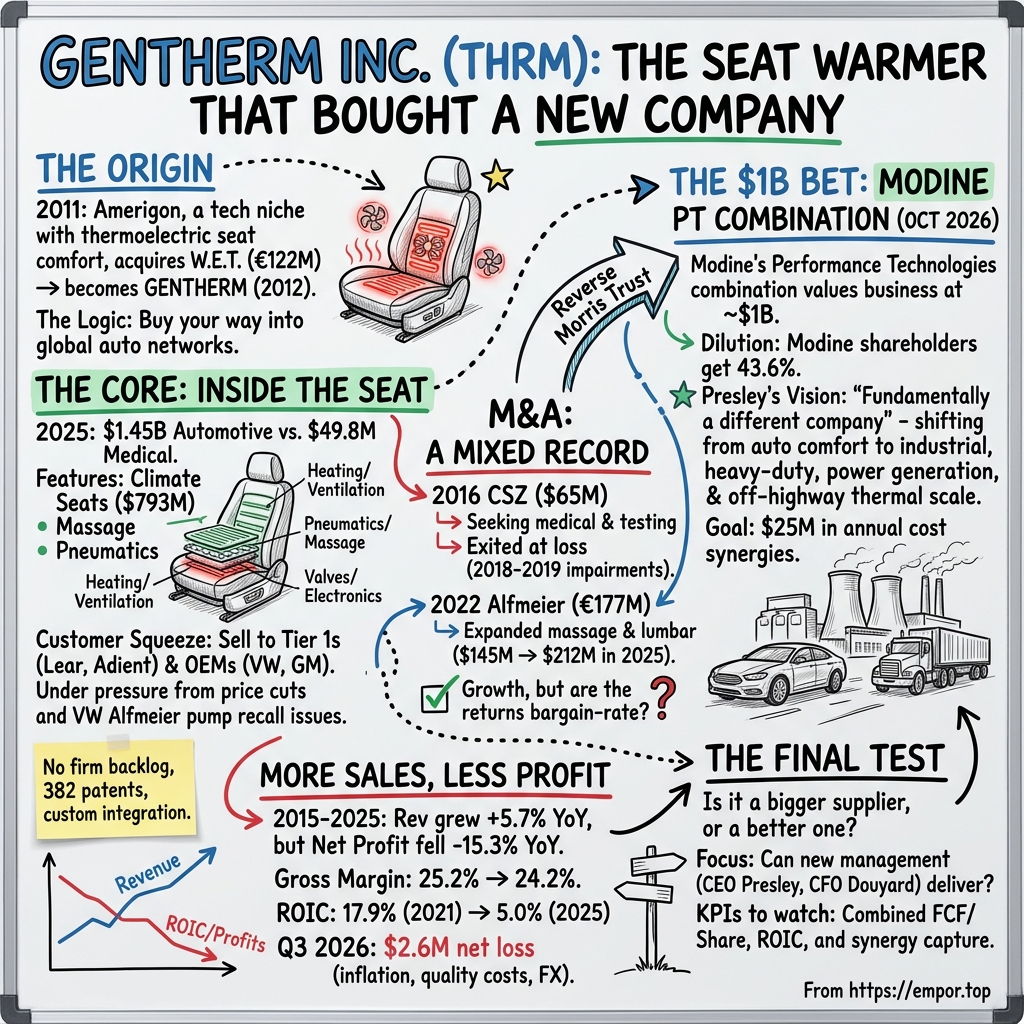
On October 1, 2026, a company best known for warming the seats of luxury cars stopped being only that. That morning Gentherm closed its combination with the Performance Technologies business that Modine Manufacturing had carved out of itself.[^1] The paperwork turned shareholders of a Wisconsin heat-exchanger maker into owners of a Michigan comfort-technology supplier. When the exchange ratios settled, former Modine holders held about 43.6% of the combined company.[^1] Gentherm had not bought a bolt-on. It had invited a second company to move in and handed it close to half the house.
Three weeks later, on the first earnings call after closing, chief executive Bill Presley described Gentherm as "fundamentally a different company."[^2] That is a big claim from a man who had been in the job for less than two years. It is also the claim this story sets out to test.
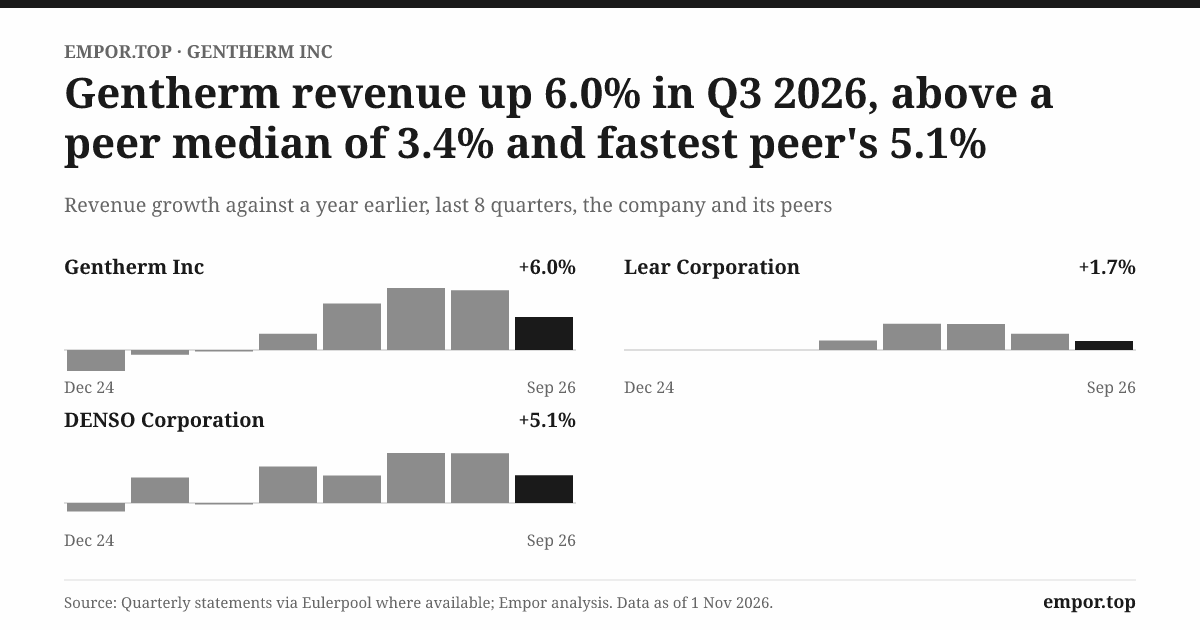
The numbers that arrived alongside the phrase were awkward. In the quarter to September, the last one before the deal closed, legacy Gentherm sold about $405 million of products, up 6% on a year earlier.1 Yet it lost $2.6 million.1 Sales were rising and profit was going the other way, which had become a familiar pattern.
And within days of closing, before the combined company had reported a single quarter, Gentherm had already spent $60 million buying back its own stock.1 So the company was growing, earning less, and returning cash all at once. A business does not usually do all three of those things at the same time unless it believes the next chapter will look very different from the last one.
The stakes come down to three questions. The first is whether a bigger, more diversified Gentherm can smooth out the automotive cycle that has whipsawed its earnings for a decade. The second is whether the billions of dollars of automotive "awards" the company announces each year turn into profitable cash rather than just revenue. The third, and the one that will matter most to anyone holding the shares, is whether management can make a deal that diluted the old owners by more than two-fifths earn back its cost.
A boundary has to be drawn before going further, because it shapes every number that follows. Everything Gentherm reported through September 30, 2026 describes the old company: seat heaters, ventilation, massage systems, electronics, valves and a small medical business.2 The combined company, with Modine's former business inside it, begins on October 1.2 Mixing the two produces nonsense, such as calling post-close revenue growth "organic" or crediting legacy Gentherm with headcount and end markets it never had.
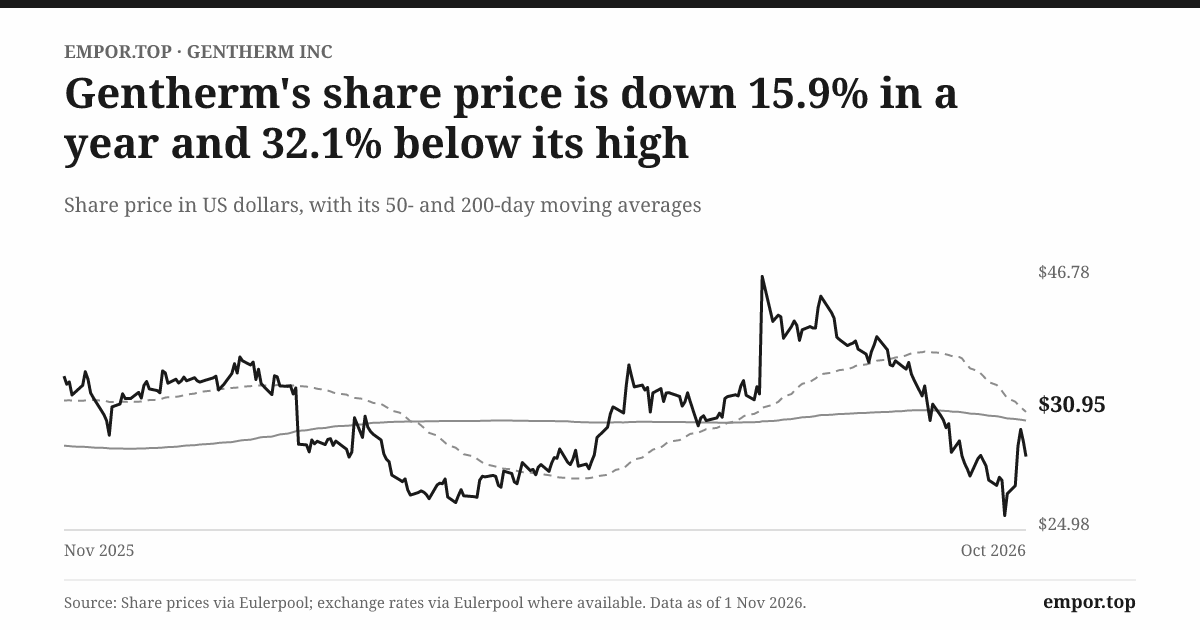
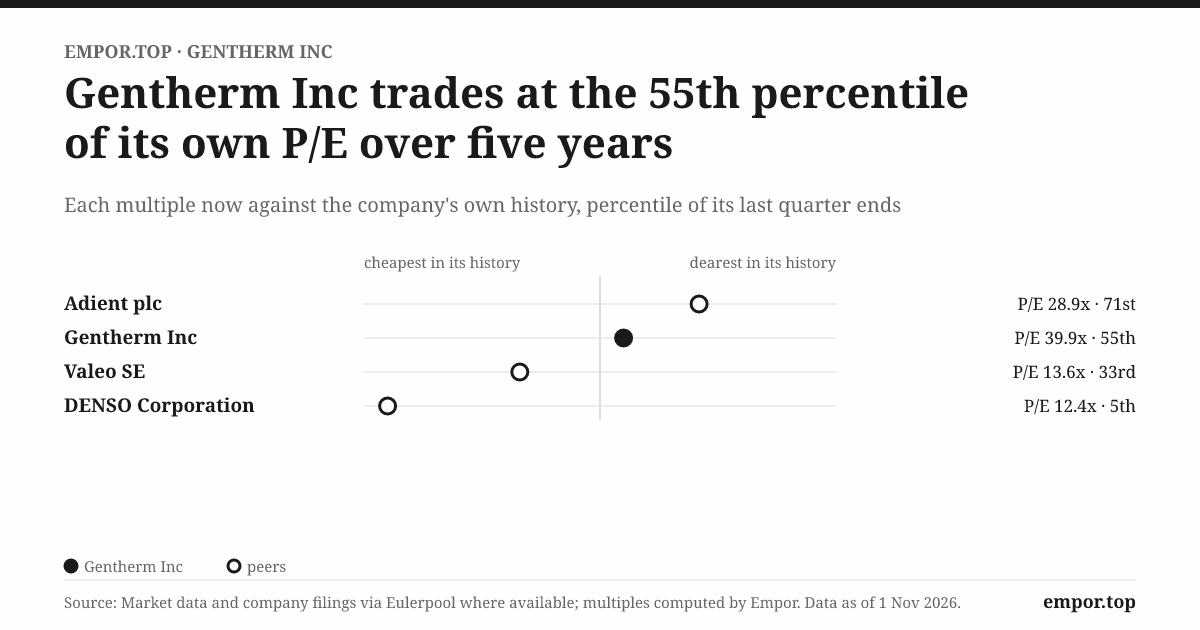
The market's own scoreboard has not caught up with that boundary either. At $30.95 a share on November 1, with 52.5 million shares outstanding after the transaction, Gentherm's equity was worth roughly $1.63 billion.2 Some data screens, built on the pre-deal share count, still showed a market value closer to $957 million and a price-to-earnings ratio near 40.3
Those two figures cannot both be right. The share count changed by more than 40% overnight, and the trailing earnings belong to a smaller company. Any honest view of what investors are paying has to rebuild the denominator first, and this story will do that when it reaches the valuation.
To understand why a seat-comfort supplier would want to become a broader thermal company, and why its record makes the bet both plausible and risky, the story has to go back to the last time this company transformed itself through a deal. Back then it was not called Gentherm at all. It was a small American firm called Amerigon, with a clever technology and a problem: it did not have the global customer reach to sell it.
 Subscribe on LinkedIn
Amerigon buys its way into the global seat
The heart of the original business is a piece of physics that sounds like a magic trick. Pass an electric current through a junction of two different semiconductor materials and one side gets cold while the other gets hot. Reverse the current and the sides swap.
It is called the thermoelectric, or Peltier, effect, and it lets you build a tiny heat pump with no compressor, no refrigerant and no moving parts other than a small fan. Amerigon built its business by putting that heat pump inside a car seat, so a driver in Phoenix could have cool air drawn through the cushion and a driver in Detroit could have warmth. It called the product the Climate Control Seat.
Engineering the product turned out to be the easy part. Selling it was harder. Automakers do not buy seat components the way a consumer buys a gadget. They pick suppliers years before a car is built, they want those suppliers to have engineering teams near their design centers and factories near their assembly plants, and they prefer partners who have shipped millions of parts without a recall.
A small company with a strong patent position and a handful of programs can find itself stuck: too big to be a start-up and too small to be on the shortlist for a global platform.
The bridge was in Germany. W.E.T. Automotive Systems was an established maker of seat heaters, the low-tech cousin of Amerigon's ventilated seat, with customer relationships across European, Asian and American automakers and manufacturing in lower-cost countries. In 2010 it had revenue of about €227 million, which made it considerably larger than Amerigon.[^6] The two companies were not friends. They had been fighting each other in court over intellectual property.
On February 28, 2011, Amerigon announced an agreement to buy a majority stake in W.E.T.[^6] The offer valued W.E.T.'s equity at roughly €122 million, before counting the debt Amerigon would assume and the cash it would acquire.[^6] The deal also settled the patent litigation between the two companies, turning a rival into a subsidiary.[^6]
To pay for it, Amerigon used a mix of cash, new bank debt and convertible preferred stock.[^7] That financing mix is worth noticing. It was an early sign of a pattern that runs through this whole story: when Gentherm wants to change its shape, it is willing to use its balance sheet and its share register to do it.
The transaction closed in May 2011, giving Amerigon control of W.E.T.[^7] The full integration followed over the next few years, and in 2012 the company renamed itself Gentherm, a name meant to signal a broader thermal-management business rather than a single seat technology.4 The new identity was more than branding. The heated seat, the ventilated seat, the steering-wheel heater and the electronics that controlled them could now be sold as a package to the same automaker teams, from a supplier with plants and engineers spread across the major auto regions.
Was it a good deal? The strategic logic is easy to see. W.E.T. supplied the thing Amerigon lacked: a global footprint and a book of existing automaker relationships that would have taken a decade or more to build from scratch. Amerigon supplied a premium technology that W.E.T. could sell into those relationships. What the record does not settle is whether the price was cheap or merely fair.
There is no clean comparison against similar seat-supplier deals of the time, and the purchase came with assumed debt and a complicated minority stake. The safe conclusion is that the deal created the company that exists today. Whether it created that company at a bargain is a different claim, and the evidence does not support it either way.
The combination also changed what Gentherm could charge for. A seat heater is a commodity in most markets: a wire mat and a controller, sold in very large numbers at low unit prices. A ventilated or actively cooled seat is a premium feature, usually found on higher trim levels where the automaker can charge customers more. By owning both, Gentherm could sell a spectrum, from the basic heater on a mass-market car to the full climate seat on a luxury model, and offer an automaker one engineering partner for both.
That is the idea of "content per vehicle," which every automotive supplier lives by: rather than depending only on how many cars are built, it tries to put more of its own dollars into each one. The weakness of that idea is that premium features are the first thing automakers cut when they need to hit a price point, and the heated mat at the bottom of the range is the first thing they re-bid.
Why a platform award feels like an annuity, and why it is not
The W.E.T. deal mattered because of how money flows through an automotive supplier. Gentherm describes the cycle in its annual report. An automaker selects a supplier for a part on a specific vehicle program, typically one to three years before that vehicle goes into production.4 Once production starts, a program can run for five to ten years.4 So winning a platform is a bit like winning a long lease: if the car sells, the supplier ships parts for the life of the model.
That is the bull case for any supplier with good platform positions, and it was the logic of buying W.E.T.'s customer base. The fine print is less comforting. The actual purchase orders arrive close to production, not at the award.4 The volumes depend on how many cars the customer builds, which the supplier does not control.
Gentherm says it typically has no firm backlog, and that customers can terminate some awarded business without penalty.4 Then there is price. The company says annual price reductions are customary over a vehicle's production life.4 The "lease," in other words, comes with a landlord who expects the rent to fall every year.
This is the central tension that carries through the rest of the story. A long customer program can create repeat business. It does not guarantee orders, volume or pricing. To see who actually holds the power in that relationship, the next step is to climb inside the seat itself.
What is inside the seat—and who gets paid?
Picture the chain of decisions that puts a Gentherm part into a car. An automaker, say Volkswagen or General Motors, designs a new vehicle and decides what the seats should do: heat, cool, massage, adjust lumbar support. A Tier 1 seat supplier such as Lear or Adient wins the job of building the whole seat.
Somewhere inside that seat sit a heating mat, a ventilation fan and duct, an air bladder and pump for lumbar and massage, a control module, and perhaps valves. Gentherm makes many of those pieces. It works with both the automaker and the seat maker to engineer them into that specific vehicle design.4
That position is the key to the economics. Gentherm generally does not sell the whole seat.4 It sells systems that live inside it. That has two consequences. The good one is that each system must be engineered to fit the vehicle's shape, electrical architecture and software, which makes it hard to swap a supplier mid-program. The bad one is that Gentherm sits two steps away from the end buyer and is often paid by a company, the seat maker, that also builds some of the same things.
The scale of the business shows how concentrated the economics are. In 2025, legacy Gentherm generated about $1.50 billion of product revenue, and automotive accounted for about $1.45 billion of it, roughly 97%.4 Climate Control Seats alone, the descendant of Amerigon's original idea, brought in about $793 million.4 Medical, which makes patient temperature-management products for hospitals, contributed about $49.8 million.4
The profit split is even more lopsided than the revenue split. The automotive segment earned about $183 million of segment operating income in 2025, while medical earned about $0.5 million.4 Put another way, for every dollar of medical sales, Gentherm kept roughly one cent of segment profit. Medical gives the company a foothold outside cars, but it was not an earnings engine. Anyone who describes Gentherm as a diversified thermal company on the basis of its pre-deal portfolio is describing a hope, not a profit pool.
The customer list shows where the bargaining power sits. In 2025, Lear accounted for 16% of revenue and Adient for 11%.4 Those two seat makers also represented 17% and 11% of year-end receivables, so they are not just large buyers but large debtors.4 Behind them stand the automakers who actually specify the parts: Volkswagen and General Motors each represented 12% of revenue on the company's end-customer measure.4
Gentherm does not disclose its combined top-five or top-ten customer share. Even so, the picture is of a supplier whose fate depends on a small club of very large buyers. The Lear and Adient shares barely moved between 2023 and 2025, which suggests stable relationships rather than a customer exit, but stability with a powerful buyer is not the same as leverage over that buyer.4
The moat claim, tested once
Does Gentherm own a defensible piece of the vehicle? The case for yes rests on three things. First, engineering integration: a seat climate system must be tuned to a vehicle's design, and changing suppliers mid-program means re-validation, re-testing and risk to a launch date. Second, know-how protected by patents: Gentherm reported 382 patents in its 2025 filing.4 Third, tenure: once a supplier is on a platform for five to ten years, it accumulates the data, test results and engineering relationships that make it the default choice for the next generation.
In Hamilton Helmer's language, that is a mix of switching costs and process power, with some counter-positioning against generalist seat makers who would rather buy a specialist's module than build one. In Michael Porter's language, it is an argument that the threat of substitution within a program is low.
The case against is just as concrete. Buyer power is the dominant force in this industry, and Gentherm's own filings concede it. The company says those price reductions are customary.4 Automakers can direct which suppliers a Tier 1 uses, and the Tier 1s themselves, including Lear and Adient, compete with Gentherm in some product areas.4
Customers can re-source at the next platform award. Supplier power runs the other way too: Gentherm identifies semiconductors and copper as inputs it cannot easily substitute, so it is squeezed from both ends, by large buyers on price and by commodity and chip markets on cost.4
The map of where Gentherm makes things tells the same story from another angle. Its currency exposures read like a tour of the auto industry's low-cost manufacturing belt: the euro, the Mexican peso, the Hungarian forint, the North Macedonian denar, the Ukrainian hryvnia, the Czech koruna, the Vietnamese dong and the Moroccan dirham, alongside the Japanese yen, Chinese yuan and Korean won.4
A supplier that has to beat annual price-downs builds plants where labor is cheaper and close to the assembly lines it serves, then hedges the resulting currency risk with derivatives, which Gentherm says it uses for operational and financial exposures rather than speculation.4
That footprint is part of the moat, because a new entrant would need years to replicate it. It is also part of the cost problem, because every plant in a lower-cost country eventually faces wage inflation, and every currency mismatch between where a part is made and where it is sold can move margins in a quarter.
What would settle the debate is evidence the company does not publish: market share in seat climate systems, win rates on re-bids, or proof that it can hold price better than peers. Gentherm discloses none of these. Comparing it with Lear or Adient by size is not a substitute, because their seat businesses include frames, foam, fabric and assembly that Gentherm does not make. The honest verdict is that Gentherm's moat is real but narrow. It protects programs that have been won. It does not reliably protect price, and it has to be re-earned at every new platform.
When the product fails
The integration that creates switching costs also creates liability. In 2025 Gentherm disclosed two Volkswagen-related recall matters.4 One involved 261,257 vehicles tied to a suction-jet pump issue in products from Alfmeier, the German business Gentherm had acquired in 2022.4 The other covered 13,508 Volkswagen and Porsche vehicles tied to a seat-heating mat connection.4 In the first matter Gentherm had not accepted responsibility and said it could not estimate its potential cost, while warning that indemnity costs could be material.4
Those disclosures matter because a heated seat feels like a minor feature until it overheats or a pump fails across a quarter of a million cars. Recall costs are exactly the kind of expense that can wipe out a year's profit on a program, and the customer, not the supplier, often decides who pays first.
The larger point is about leverage. A long platform keeps Gentherm embedded in the car, but the automaker controls the production schedule, the warranty process and the next round of commercial terms. That is why the company has spent much of the last decade trying to broaden what it sells, and its record of doing so is mixed.
The acquisition that broadened the comfort promise
In 2016, Gentherm went shopping in Cincinnati. It paid about $65 million for Cincinnati Sub-Zero, a maker of temperature-management equipment with three very different lines: medical products for warming and cooling patients, industrial chambers, and environmental testing equipment.5 The idea was elegant on a slide. Gentherm's core skill was moving heat in small spaces. Hospitals need to move heat to and from patients. Labs and factories need chambers that can hold a precise temperature. Why should a thermal company limit itself to car seats?
That question had an answer within about two years, and it was not the one management wanted. By 2018 Gentherm had decided to sell or exit several of the businesses it had collected.5 It marked the industrial and testing part of Cincinnati Sub-Zero for sale, along with Global Power Technologies, a remote-power business it had bought earlier.5 It shut down several advanced-research programs, including battery-related work that had once been pitched as a growth avenue.5 It recorded about $11.5 million of impairments tied to the industrial and testing business and to Global Power Technologies.5
The exits followed in 2019. Gentherm sold the Cincinnati Sub-Zero industrial and testing business, together with the Cincinnati headquarters, for about $47.5 million.5 Global Power Technologies went for a nominal amount.5 The medical piece of Cincinnati Sub-Zero stayed.
The timing of that retreat matters. It came as the core business itself was slipping. Gentherm's operating margin, above 14% in 2015, had fallen to about 7% by 2018 as revenue kept rising.5 A company whose main profit engine was losing efficiency had also spread management attention across research programs, a battery venture, test chambers and remote power.
Cutting back was the right decision, and the board deserves credit for making it rather than doubling down. But the cost was real: years of capital and engineering time spent on businesses that ended up sold at a loss or shut, while the core automotive margins it needed to protect kept eroding. A portfolio retreat is a sign that a company can recognize mistakes. It is not evidence that the mistakes were cheap.
It would be wrong to read this as proof that every Gentherm acquisition fails. W.E.T. built the company. But the 2018 retreat does narrow any claim that Gentherm's capital allocation has been consistently disciplined. Within a few years the company spent money entering adjacent markets, then wrote down part of that money and sold most of what it bought for less than the strategy had promised. The lesson the company seemed to draw was to stay closer to the car, and that was where the next large deal landed.
Alfmeier and the price of massage
In May 2022, Gentherm agreed to buy the automotive business of Alfmeier, a German maker of pneumatic seat systems, valves and actuators.[^10] Pneumatics are the hidden plumbing of seat comfort: small air pumps, valves and bladders that inflate to support a driver's lower back or ripple in sequence to give a massage. Gentherm already sold heating and cooling into the seat. Alfmeier let it sell the air-driven support and massage features too, so it could offer a more complete comfort package to the same customer.
The headline price was about €177.5 million, against roughly €232 million of Alfmeier's 2021 revenue, or about 0.7 times sales.[^10] In cash terms Gentherm paid about $170.7 million net in 2022.[^11] A revenue multiple below one sounds cheap, but for an auto supplier it tells you very little on its own. Automotive component businesses often earn thin margins, and a business with low margins can be expensive at half its sales. Gentherm did not publish Alfmeier's EBITDA in a way that allows a clean acquisition multiple, so there is no basis for claiming it overpaid or underpaid.
What can be tested is commercialization. Gentherm's lumbar and massage product category grew from about $145 million in 2023 to about $212 million in 2025.4 That is meaningful growth for a category in an otherwise slow-growing company, and it suggests customers wanted the combined offer. The company does not separate how much of that rise came from products Alfmeier brought versus new programs Gentherm won after the deal, so the figure supports the strategic logic without proving the deal's standalone return.
There is also a cost that belongs in the same breath as that growth: the quarter-million-vehicle Volkswagen recall matter involves an Alfmeier pump.4 An acquisition brings its products' history and liabilities along with its customer relationships, and that one has not yet been resolved.
So the record narrows to this. Gentherm's best deals have been the ones closest to the automotive seat. Its worst were the ones that chased adjacent markets on the strength of a shared technical skill. The Modine combination is far bigger than any of these, and it is a hybrid: thermal engineering, as the company's core is, but sold into commercial vehicles, off-highway equipment and power generation, markets where legacy Gentherm had little presence.
Before judging whether that bet can avoid the old gap between strategic promise and realized return, it is worth looking at what was happening to the core business while the deal was being negotiated. The answer is that it was earning less every year.
More sales, less profit
Open Gentherm's 2025 annual report and the puzzle is right there on the income statement. Revenue rose about 2.6%.4 Operating profit fell about 22.7%, to $82.7 million.4 Gross margin, the share of each sales dollar left after making the product, slipped from about 25.2% to about 24.2%.4 The company sold more and kept less.
The causal chain is worth walking through slowly because it shows where the pressure comes from. On the revenue side, higher automotive volumes and favorable currency movements added sales, while unfavorable pricing took some away.4 That pricing line is the annual price-down customers expect, showing up in the accounts exactly as the moat analysis predicted.
On the cost side, cost of sales grew faster than revenue, and management named higher quality costs and labor costs among the reasons, alongside currency.4 Quality costs are the expense of fixing, replacing or warranting parts that did not perform. Labor costs reflect wage inflation in the plants. Neither is a currency story.
That matters because the easiest explanation for a bad year is that the exchange rate did it. Gentherm did suffer a currency hit in 2025: a foreign-exchange loss of about $28.4 million, most of it an unrealized loss on an intercompany U.S.-dollar receivable held by a foreign subsidiary.4 That receivable was settled during 2025, so the loss should not recur in the same form, and in the first nine months of 2026 the FX loss shrank to about $1.1 million from $27.4 million a year earlier.2
There was also a 2025 other loss of about $4.6 million, mainly a non-cash impairment of equity investments in companies Gentherm does not control.4 Both items sit below operating profit. They explain much of why net income collapsed to about $18.3 million, but they do not explain why operating profit fell.4 The decline in the core business came from the gross-margin squeeze.
The longer arc makes the point harder to dismiss. Between 2015 and 2025, revenue grew about 5.7% a year while net profit shrank about 15.3% a year.4 Operating margin, which was above 14% in 2015, was about 5.5% in 2025.4 Over the most recent three years the gap was still there: revenue grew about 7.5% a year, helped by the Alfmeier acquisition, while net profit fell about 9.1% a year.4 This is not a single bad year. It is a decade in which Gentherm got bigger and its profit per dollar of sales roughly fell by half or more.
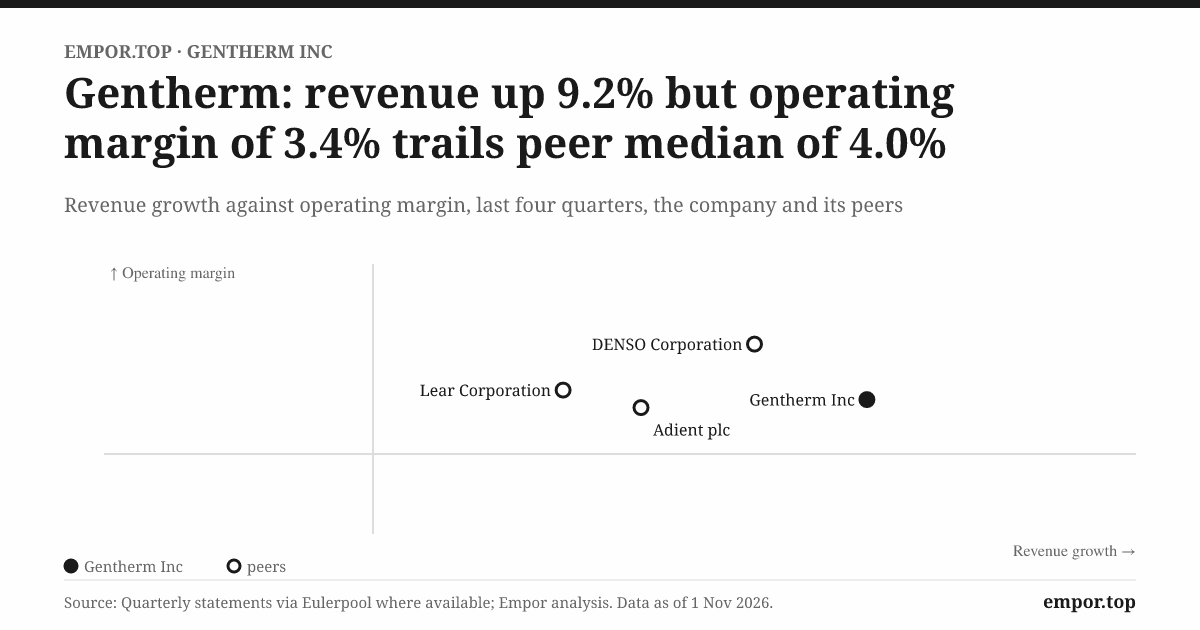
The 2026 quarters continued the pattern. Revenue growth accelerated, running at roughly 6% to 11% a year above 2025 levels through the first three quarters.1 Operating margin went the other way, falling to around 3% for much of the year.1 In the September quarter, revenue rose 6.0% while operating profit fell about 39.8% to $14.4 million, and Gentherm reported a $2.6 million net loss.1
Management attributed gross-margin pressure to currency, material costs and inflation, and the quarter's selling and administrative expense included about $6.5 million of merger and acquisition costs tied to the Modine deal.1 The tax line made the loss worse: tax exceeded pre-tax profit in the quarter, a sign of losses in jurisdictions where Gentherm cannot use them against taxes owed elsewhere.
The shape of the last two years is worth holding in mind as a single picture. In the first half of 2025, Gentherm earned essentially nothing at the net level in two consecutive quarters, as the currency loss on the intercompany receivable flowed through and tax charges consumed what pre-tax profit remained.4
The second half recovered at the net level, then 2026 brought faster sales and still thinner operating margins. A company whose net income swings between zero and a few million dollars a quarter on roughly $400 million of sales has almost no buffer. A single recall settlement, a customer's production cut or a bad currency month can flip a quarter from profit to loss, which is exactly what happened in September 2026.
The tax line deserves its own sentence because it has quietly become one of the largest costs in the business. Gentherm's effective tax rate was about 48.6% in 2025, compared with roughly a quarter in 2023.4 When a multinational's tax rate approaches half its pre-tax profit, it usually means profits are being earned in some countries and losses in others, and the losses cannot be offset.
For Gentherm that pattern points back to the manufacturing footprint: restructuring costs and weaker plants in some jurisdictions, profitable operations in others. A margin recovery that comes from the loss-making plants would therefore help net income twice, once through operating profit and again through a lower tax rate.
Strip out the deal costs and the quarter still shows an operating margin well below the levels of 2023 and 2024. The transaction expense explains part of the decline. It does not explain most of it.
Awards are a forecast, not a backlog
The defense of this record usually points to the order pipeline. In 2025 Gentherm reported about $2.2 billion of automotive awards, an estimate of the lifetime revenue of programs customers had chosen it for.4 That is a large number against roughly $1.45 billion of annual automotive revenue, and it suggests the company is still winning business.
The company's own wording, though, puts tight limits on what the number means. Awards are projections based on customers' assumptions about production volumes and timing, and they are not firm orders.4 They can change, and many will be priced with the same annual reductions that eat into current margins. An award pipeline proves that customers keep picking Gentherm. It does not prove that the business will be more profitable when those programs launch than the programs they replace.
Competing for those awards also costs real money. Gentherm spent about $94.8 million on net research and development in 2025, or about 6.3% of product revenue, up from 6.1% a year earlier.4 Capital expenditure was about $55.7 million in 2025, after $73.3 million in 2024.4
At the same time the company was restructuring its factory network, closing and consolidating capacity.4 This is not a harvest strategy. Gentherm is spending to stay on the shortlist while trying to cut its cost base. That is a sensible combination, but it means the margin recovery has to come from somewhere other than spending less.
So is the pressure temporary or structural? The evidence points to a middle answer. Some of it is clearly temporary: the 2025 FX loss, the impairments and the 2026 deal costs. But the gross-margin squeeze has persisted through rising and falling volumes, and the company itself names quality, labor and material costs, not just currency.
The open test is whether Gentherm can recover material-cost inflation from customers and fix quality costs fast enough to lift margins on its new programs. Until operating margins in the legacy business move back toward the 7% to 9% range of 2023 and 2024, the case that weak earnings are temporary remains a claim rather than a finding.
The next question is whether the accounting losses tell the whole story, because a company can report thin profits and still generate cash. Gentherm has done exactly that for more than a decade.
Cash arrives; returns still lag
Here is a number that changes the tone of the story. Add up Gentherm's results from 2014 to 2025 and the company reported about $652 million of net profit.4 Over the same twelve years it generated about $1.2 billion of cash from operations, close to twice its reported earnings.4 After capital spending, free cash flow came to about $642 million.4 For a business whose profits have been shrinking, that is a lot of real money.
The gap has a clear source. Gentherm's income statement carries large non-cash charges, chiefly depreciation of factories and amortization of acquired intangible assets, plus stock-based pay, inventory provisions and impairments. In 2025, for example, $18.3 million of net income was supplemented by about $110.2 million of non-cash charges, while deferred taxes, inventory and receivables pulled some of that back.4
Operating cash flow ended the year at about $116.8 million.4 Not every dollar of that gap is recurring. Impairments happen once, and depreciation reflects money that has to be spent again to keep the plants running. But it does mean the reported losses overstate how badly the business is doing on a cash basis.
Where did all that cash go? Not to dividends: Gentherm paid none from 2014 through 2025.4 Cash and short-term investments grew by only about $106 million over the period, from about $55 million at the end of 2013 to about $161 million at the end of 2025.4 The rest went into acquisitions, including Cincinnati Sub-Zero and Alfmeier, and share repurchases, which ran at about $50.2 million in 2024 and $10.0 million in 2025.4 In other words, Gentherm has been recycling its cash into deals and buybacks, which makes the return on that capital the real measure of management.
The long-run average also hides how lumpy the cash has been. In 2022, the year Gentherm bought Alfmeier while the industry was still fighting a semiconductor shortage, operating cash flow collapsed to about $14 million and free cash flow turned negative, at roughly minus $25 million.[^11] Inventory built up as the company stockpiled scarce chips and customers stopped and started their assembly lines, and the acquisition was funded largely by drawing on credit.
Cash recovered the following year, to about $119 million from operations.4 The episode is a useful reminder of how the supplier's cash flow behaves in a shock. When automakers' production schedules break, the supplier carries the inventory and the receivables, and the cash conversion that looks so reliable over twelve years can vanish for a year. A combined company with more end markets should, in theory, be less exposed to one industry's supply crisis. It will also carry more inventory in more places.
That measure has been falling. Return on invested capital, a rough gauge of how much after-tax operating profit the business earns on the money tied up in it, was about 17.9% in 2021.4 By 2025 it was about 5.0%, and over the twelve months to September 2026 it was closer to 3%.2 For an industrial company that borrows at mid-single-digit rates and whose equity investors expect more, a return in the low single digits means the capital deployed has barely covered its cost. Cash conversion has been good. Returns on capital have not.
Working capital is the leak to watch
The other place cash disappears is working capital: money owed by customers and money tied up in inventory. In the first nine months of 2026, receivables absorbed about $43.5 million of cash and inventory about $22.1 million.2 By September, customers owed Gentherm about $326.2 million, up from about $281.1 million at the end of 2025.24
Some of that rise follows sales growth. But the trend in collection speed deserves attention. Gentherm took about 61 days to collect from customers in 2014, about 97 days at the 2020 peak when pandemic shutdowns scrambled the industry, and about 78 days in 2025.4 That is better than the worst year and noticeably worse than a decade ago.
The company does not publish an ageing table or name customers with overdue balances, though it warns that collection delays can occur and can be significant.4 The 2025 accounts also include about $18.2 million of capitalized payments to customers, money Gentherm paid up front that it expects to recover over the life of the programs.4 That is a quiet signal of buyer power: to win some business, the supplier effectively lends money to the customer.
The balance sheet supporting all this is not stretched. At September 30, 2026, Gentherm had $307 million drawn on a secured $550 million revolving credit facility that it had extended in June to mature in June 2031, plus about $13.4 million of finance leases.2 It had about $242 million of unused capacity and reported compliance with covenants that cap net leverage and require minimum interest coverage.2
Operating leases, about $57.8 million at the end of 2025, are rent obligations rather than funded borrowing and should not be added to the debt total.4 No agency credit rating rationale is published in Gentherm's recent filings; the comfort here comes from the bank facility and the company's own disclosures, not an independent view.
Two smaller details sharpen the picture. At the end of 2025, about $103 million of Gentherm's roughly $161 million of cash sat outside the United States, where the plants and customers were, which means not all of the headline cash was immediately available for buybacks at the parent.4
And by September 2026 cash had risen to about $252 million, but that rise came alongside heavier borrowing on the revolver ahead of the transaction, so it was not a sign of surplus earnings.2 Interest expense of about $13.8 million in 2025 was manageable against operating profit, but it already amounted to a sixth of operating profit.4 A company earning low single-digit returns on capital cannot borrow its way to better per-share results for long.
The verdict is two-sided. Gentherm converts profit to cash better than its income statement suggests, and that cash gave it the flexibility to do the Modine deal and buy back stock. But cash generation is only valuable if it is reinvested at good returns, and the record of the last five years is one of falling returns on a growing capital base. The combined company now has a much larger base to earn on, and a new management team responsible for doing so.
A new CEO inherits an old promise
On January 1, 2025, two new executives took charge at Gentherm's headquarters in Northville, Michigan. Bill Presley became chief executive and Jon Douyard became chief financial officer.6 They replaced Phil Eyler, who had led the company through the pandemic, the chip shortage and the Alfmeier acquisition, in what the board presented as a planned succession.6 The new team arrived as the company began a strategy review that would, within a year, become negotiations with Modine.
Presley came from Aptiv, the automotive technology supplier spun out of Delphi, where he had run operations.6 That background is relevant. Aptiv is a company built on electrical architecture and global manufacturing scale, and an operations leader from that culture tends to focus on plant efficiency, quality systems and supply chains, exactly the areas where Gentherm's margins have been leaking. Douyard's background includes specialty vehicles and industrial businesses.6 For a company about to own commercial-vehicle, off-highway and power-generation products, a CFO who has seen those markets is a deliberate choice.
The pay structure shows what the board asked them to deliver. Presley's 2025 reported compensation was about $13.0 million, a striking figure against company net income of about $18.3 million that year.6 Most of the headline is explained by his hiring. About $2.7 million of cash and $4.7 million of restricted stock were one-time make-whole awards replacing pay he forfeited when he left his previous employer.6 Strip those out and his recurring package was closer to $5.6 million, including about $4.0 million of annual equity.6 His 2025 performance awards were tied to adjusted EBITDA margin and revenue growth.6
Those metrics are a reasonable start, but notice what they leave out. Neither measures return on capital or cash per share. A team paid on margin and revenue growth can hit both by acquiring a larger business, even if the deal dilutes shareholders. That is not an accusation, only a reminder that the incentive design does not directly reward the outcome that matters most after the Modine deal.
Ownership adds little alignment on its own. Presley's proxy disclosure showed 178,314 shares beneficially owned before the transaction, about 0.6% of the company at the time.6 After the issuance to Modine holders, the same stake is about 0.34% of the 52.5 million shares outstanding.2 That is a meaningful personal investment but not a controlling one.
Nor is there a controlling owner standing above management to hold it to account. Gentherm's register has long been dominated by index and institutional money. In the 2024 proxy, BlackRock held about 16.9%, Vanguard about 11.6% and Trigran Investments, a concentrated active investor, about 6.0%.[^13] A year later those figures were about 17.4%, 11.9% and 6.1%.7
Index funds rarely push a company's strategy, and the share issuance diluted every legacy holder, so the post-deal company has a dispersed register in which no single holder can easily force a change of course. Gentherm reported only 36 holders of record in February 2026, a figure that reflects shares held in street name rather than a small investor base.4 The board did add a new member on closing: Paul Mascarenas joined the post-combination board on October 1.[^1]
The governance record is clean but young. The 2026 proxy reported eight of nine directors as independent.6 Shareholders approved executive pay in May 2026 with about 91.6% of votes cast in favor.8 At the September special meeting, the share issuance for the Modine deal passed with about 28.1 million votes for and only 8,725 against, a near-unanimous result among those who voted.[^16] Ernst & Young issued unqualified opinions on the 2025 financial statements and on internal controls, flagging goodwill valuation as a critical audit matter on about $108.9 million of goodwill.4 No material weakness was reported.4
That last point carries a historical counterweight. In its 2018 annual report, Gentherm disclosed a material weakness in information-technology controls at the newly acquired Cincinnati Sub-Zero subsidiary.5 The problem was remediated, and the 2025 audit reported none. It is a bounded point: acquisitions bring control risks, and Gentherm is now integrating a business far larger than Cincinnati Sub-Zero. Clean audits in a legacy company are not proof that the integration will be clean too.
So has the new team earned confidence? Not yet, and not because it has failed. The record is still too short. During their tenure, Presley and Douyard presided over weak results while negotiating a company-changing deal. Their explanations have leaned on the pressures facing the business and the deal's transaction expense.1
The test for the next year is whether they explain misses in operating terms, with specific actions on quality, labor, pricing recovery and restructuring and a visible recovery path, or whether the macro explanations continue while the deal story takes the spotlight. And the deal story is the biggest thing they have done.
The $1 billion bet on thermal scale
When Gentherm announced the Modine transaction in January 2026, the structure required a diagram, so here it is in words. Modine wanted to separate its Performance Technologies business, which makes heat-transfer and thermal-management products for commercial vehicles, off-highway equipment and power-generation customers.
Instead of selling it for cash, which would have triggered tax, Modine spun the business out to its own shareholders and immediately combined it with Gentherm. Modine's shareholders ended up owning a large slice of Gentherm, and Gentherm ended up owning the business.9 This is called a Reverse Morris Trust, and it was structured to be tax-free for Modine and its shareholders.9 The trade-off for the acquirer is that it pays mostly in its own stock.
The machinery took most of 2026. Gentherm filed the registration statement for the new shares on July 2, the SEC declared it effective on August 12, and the definitive proxy statement and prospectus went to shareholders soon after.9 To make room for the issuance, the transaction authorized up to 110 million common shares, more than three times the roughly 30 million Gentherm had outstanding before closing.9
Not all of that authorization was used, but it shows how much headroom the board wanted for a deal that would reshape the register. Shareholders then approved the issuance at the September special meeting in a near-unanimous vote.
The announced transaction valued the business at about $1 billion.10 Management presented the price as about 6.8 times $147 million of adjusted EBITDA including expected synergies.10 That framing deserves a second look. On the company's estimate of adjusted EBITDA before synergies, about $123 million, the multiple is roughly 8.1 times.10 The difference is the $25 million of annual cost synergies Gentherm expects to capture by combining purchasing, plants and overhead.10 So the cheaper-looking multiple assumes savings that have not happened yet, measured against an adjusted earnings figure that excludes some costs by definition.
Is 8 times pre-synergy EBITDA expensive? For context, large seat suppliers traded at much lower multiples at the end of October 2026: Lear at about 4.9 times EV/EBITDA and Adient at about 3.9 times.3 Those are larger, lower-margin businesses, and a precision thermal business serving data-center power and commercial vehicles may deserve more.
Gentherm's own pre-deal multiple was around 10 times.3 Paying 8 times in stock that the market valued at roughly 10 times can be accretive on paper. The price is not obviously extreme. But it is not obviously cheap either, and the attractive version depends on synergies being delivered and adjusted EBITDA turning into cash.
The ownership split moved during the process. The original framing in January was roughly 60% for Gentherm holders and 40% for Modine holders.10 At closing, after the exchange-ratio adjustment, former Modine holders received about 43.6%.[^1] Legacy holders were diluted further than the announcement suggested. BlackRock, the largest pre-deal holder at about 15.1%, was shown on a pro forma basis at about 9.0%; Vanguard Portfolio Management at about 6.0% fell to about 3.6%.9
What Gentherm actually bought
Strategically, the business adds what Gentherm never had: exposure to commercial vehicles, off-highway and heavy-duty equipment, and power generation, alongside precision thermal-management products.10 Management said about one-third of pro forma revenue would come from those markets.10 The combined company describes itself as having more than 18,000 employees across 17 countries.1 Those figures belong to the new entity. They should not be read back into legacy Gentherm, which remained dominated by automotive comfort.
The diversification thesis has a clear logic. Passenger-car production cycles are brutal and Gentherm's customers squeeze price. Power generation, including cooling for backup generators and data-center equipment, has been growing, and commercial vehicles move on a different cycle from cars. A company with both should, in theory, have steadier earnings.
Management also pitched cross-selling: bringing Gentherm's electronics and thermal know-how to the acquired customers and vice versa.11 That claim is the least proven part of the deal. Cost synergies are an internal matter, and companies usually capture most of them. Revenue synergies depend on customers who have their own sourcing processes and no obligation to buy more from a newly combined supplier.
There is also the matter of related-party balances, which can look alarming in the merger documents. Before separation, the Modine business carried receivables, payables and other balances with its parent, and the pro forma accounting eliminated or settled them, including about $54.6 million of related-party receivables and $91.1 million of other current liabilities.9 Those were the plumbing of a division inside a larger company, not evidence of ongoing trade between Gentherm and Modine. Gentherm itself reported no related-person transactions requiring disclosure in 2023 through 2025.6
The cash came out before the proof came in
The capital-allocation sequence around closing is where an investor should slow down. The transaction included a special cash dividend of $2.07 a share, paid on October 7, 2026.[^1] Gentherm then repurchased stock and retained a $400 million buyback authorization.1 The company reported post-close net leverage of about 0.4 times and liquidity of about $494 million.1
Leverage that low gives room, and management can argue that buying back stock at a depressed price, about a third below its 52-week high, partly offsets the dilution from the deal. A skeptical investor would ask a different question. The combined company has not reported a single quarter. Integration costs are still to come. The legacy business just lost money.
Is the best use of $60 million, within weeks of a transformative merger, to shrink the share count rather than to hold cash until the integration risk is visible? Buybacks are only as good as the price paid relative to value, and the value of the combined company is precisely what nobody yet knows. Some market screens now show a dividend yield that reflects the one-time special payment; it is not a recurring dividend, and should not be read as one.
There is a further test in comparing the story at announcement with the story at close. In January, management presented the synergy number, the end-market mix and the multiple.11 By October, the company emphasized liquidity, leverage, the buyback and its new identity.1 Neither set of materials yet provides what matters most: a timetable for synergy capture tied to reported costs, a separate segment for the acquired business, and evidence that a cross-selling win has actually happened.
The proof point is specific. When Gentherm reports its first full year as a combined company, investors will be able to measure free cash flow per diluted share and return on invested capital, with the acquired business's contribution and deal costs separated out. If both rise above the legacy baseline, the dilution was worth it. If revenue doubles while cash per share stalls, Gentherm will have become bigger without becoming better. That is the hinge on which the whole investment case now turns.
Analysis & Bear vs. Bull Case
Put the two cases side by side and they are built from the same facts, read in opposite directions.
The bull case starts with position: Gentherm keeps winning long-running programs and has turned its engineering footprint into a source of cash. Alfmeier strengthened its comfort offer, and the Modine combination adds exposure to commercial vehicles, heavy equipment and power generation, markets with different cycles and, in power generation, a strong growth tailwind. If the combined company captures its promised cost savings, lifts legacy margins back to recent levels and converts even modest cross-selling, its earnings power could be meaningfully higher than any trailing number shows.
The bear case uses the same record: margins and profit have eroded under concentrated buyers, annual price cuts and recall risk. A previous push beyond the car seat ended in impairments and divestments. And Gentherm has just issued more than two-fifths of its equity for a business whose returns it has not yet reported, then used cash on buybacks before reporting a single combined quarter.
The moat under pressure
Running Porter's five forces against the evidence produces a clear shape. Buyer power is high: two seat makers account for more than a quarter of revenue, two automakers for about a quarter on the end-customer measure, and price-downs are built into the contracts. Supplier power is moderate to high, with semiconductors and copper hard to substitute.
Rivalry is real because Tier 1 customers also compete in some products. The threat of new entrants is lower, because qualifying a new supplier for a platform takes years and a clean quality record. The threat of substitutes within a running program is low, but at each new platform the automaker can choose a different design or supplier.
Helmer's seven powers point to the same conclusion. Gentherm has some switching costs and process power within won programs, and its patents protect specific designs. It has no network effects, no brand that end consumers recognize, and no cornered resource. Scale economies might increase with the combination, but the combined company's scale is spread across different markets, which limits shared purchasing and plant benefits. The power that Gentherm most needs, the ability to resist price cuts, is the one its own filings say it lacks.
The moat claim survives in a narrower form: Gentherm is hard to remove from a program once it is on it, and it keeps being chosen for new ones. What would weaken it further is visible: lost re-bids, a Tier 1 bringing seat climate systems in-house, a qualified lower-cost competitor winning a major platform, or award values that keep rising while margins on launched programs keep falling.
The deal's own stress test is about evidence. The company expects $25 million a year in cost synergies. The commercial cross-selling is not quantified at all. The test is whether combined operating margin and return on invested capital exceed the legacy baseline once deal and integration costs are separated out.
Imagine a skeptical activist taking a stake after closing. The letter would likely ask four things. Why did the company buy back stock within weeks of issuing more than two-fifths of its shares, rather than waiting to see the integration? Why do executive incentives reward margin and revenue growth but not return on capital, at a moment when return on capital is the metric in question?
Why does the medical business, which earned about one cent of segment profit per dollar of sales, still belong in the portfolio? And when will the company report the acquired business as its own segment, with its own margins, so that investors can see whether the synergies arrive? None of those questions implies that management has made the wrong choice. Each names a place where disclosure or discipline would show whether it made the right one.
Financial strength is less of a worry than per-share strength. The revolver is covenant-compliant and liquidity is ample. But borrowing rose ahead of closing, the special dividend and buyback sent cash out, and the denominator has grown sharply. A balance sheet can be safe while per-share returns disappoint.
Rebuilding the price
The valuation has to be rebuilt before it can be discussed. At the November 1 price and post-deal share count, Gentherm's equity was worth about $1.63 billion.2 Some data screens still show a market value near $957 million and a P/E around 40, reflecting the old share count and earnings base.
The trailing twelve-month EPS of about $0.29 belongs to legacy Gentherm with roughly 30 million shares.1 Applying it to the new share count and the new company makes no sense, and applying the new share count to the old earnings makes the P/E look even higher than 40.
The right comparison will require three things on the same post-close boundary: the combined share count, net debt including borrowings drawn to fund the enlarged business, and earnings or EBITDA that include the acquired business for a full period. Until then, investors can only frame what the price appears to assume.
A combined equity value of about $1.6 billion, plus a few hundred million of net debt, against the sum of legacy Gentherm's EBITDA and the acquired business's roughly $123 million pre-synergy EBITDA, implies the market is pricing the combination as a mid-to-high single-digit EBITDA multiple business. That is above where Lear and Adient trade and roughly where Gentherm itself traded before the deal.3 In other words, the market is not paying for a turnaround. It is paying for the combination to work roughly as advertised, not much more and not much less.
Earnings multiples tell a starker story than EBITDA multiples, and the gap is itself informative. At the end of October, Lear traded at about 10.4 times earnings and Adient at about 28 times.1213 Adient's high P/E reflects depressed earnings, much like Gentherm's; Lear's low one reflects a business that keeps more of its operating profit after interest and tax.
Gentherm's earnings multiple on any basis sits far above Lear's, which means the market is either looking through the current trough or giving the company credit for a richer mix than a standard seat supplier. The EV/EBITDA comparison, closer to Gentherm's own history, is the more reliable lens until net income stops being distorted by tax rates above 45%, currency swings and deal costs.
Against its own history, Gentherm's P/E has been high for five years because earnings have been depressed, with a five-year median near 38 times on the old basis.3 That history says less about cheapness than about how far earnings have fallen. A multiple on depressed earnings looks expensive and can still be cheap if earnings recover. The question is whether they will.
Three measures will settle the thesis. The first is combined operating margin, which in legacy Gentherm was about 5.5% in 2025 and nearer 3% through 2026; it needs to rise.41 The second is free cash flow per diluted share, the single number that captures whether growth survives the new denominator.
The third is return on invested capital, about 5% in 2025 and lower over the trailing twelve months, which needs to climb back toward double digits to show the deployed capital is earning its cost.42 Automotive award conversion and working-capital days provide the operating context around those three. The fourth figure, the one investors cannot yet see, is what the acquired business earns on its own inside Gentherm.
Business & Investing Lessons
Go back to the moment in 2011 when Amerigon bought into W.E.T. A small company with a better technology realized that a better product does not win global contracts on its own; reach, factories and relationships do. And then look at the long tail of that decision: the platforms it won, the customers who keep choosing it, and the price cuts those customers demand every year.
The lesson is that a good component wins a seat; a good supplier earns the redesign. Being specified once is an invitation. Being specified again, at a price that still pays, is the business. For founders building components for powerful buyers, the moat is not the patent but the record that makes the buyer choose you next time.
Now look at 2018, when Gentherm wrote down its industrial and testing business, marked it and the remote-power business for sale, and shut down battery-related research it had once described as a growth opportunity. The shared skill of moving heat had seemed to open a dozen markets. Most of them turned out to be places where Gentherm had no customers, no distribution and no advantage.
A market opportunity is not a market. A technology that works everywhere is worth only as much as the customers who will actually buy it from you, and a company's adjacent bets should be judged by the revenue they produce, not the slides they inspire.
Then there is the Modine deal, whose cheapest-looking valuation depends on forecast synergies. They may well arrive. But synergies belong in the price only after the cash shows up. Investors who accept that valuation at announcement are paying for integration before it has happened, and the people who promised the synergies are the people paid to deliver them.
And finally there is the dilution. The combined Gentherm will be much larger, and every dollar of earnings will be shared among far more shares. Growth belongs to shareholders only when it survives the denominator. A company that doubles its revenue by issuing nearly as many shares as it had before has achieved nothing for its owners until free cash flow per share rises. This is the yardstick that will tell whether "fundamentally different" means better or merely bigger.
Epilogue
Tonight, Gentherm is a company with two businesses, one balance sheet and a share count that is not yet a month old. The legacy seat business is growing its sales and shrinking its margins. The acquired thermal business is inside the company but has not yet appeared in a reported quarter. Gentherm has spent cash on a special dividend and a buyback. The company expects $25 million of annual cost savings, has reported net leverage of about 0.4 times, and has adopted a new identity as a broad thermal-management supplier.[^1]1
The first moment of truth will be the first combined quarterly report and then the first full combined year. Investors will want to see segment revenue and operating income, a margin bridge that separates price, cost, volume and currency, integration costs reported openly, and synergy realization measured against the original timetable.
If that report shows the acquired business earning steady margins and legacy margins beginning to recover, the deal will start to look like the diversification management promised. If it shows integration costs, restructuring and adjusted metrics that are hard to reconcile, the story will look more like the 2016 adventure in Cincinnati, at five times the scale.
The second moment comes from the automotive pipeline. The $2.2 billion of 2025 awards will turn into production over the next few years. The question is whether those programs launch at margins that are better than the ones they replace, without new quality problems and without price concessions that eat the gains. A clean resolution of the Volkswagen recall matter, or a costly one, will be part of that picture.
The third is cash. Receivables rose sharply in 2026. If working capital normalizes and cash flow per share rises on the enlarged base, the company's long record of turning accounting profit into cash will carry over into the new entity. If receivables and inventory keep absorbing cash as sales grow, the buyback will start to look like it was funded by borrowing rather than by surplus.
And then there is the valuation, which remains an open loop. Once shares, debt and earnings all sit on the same post-close boundary, the multiple may look very different from the pre-deal snapshot. It could look cheaper if the acquired business's earnings are strong and the legacy margins recover. It could look richer if neither happens. The tension that remains is simple to state and hard to resolve: Gentherm has changed its size and its markets, but it has not yet changed its returns, and only the next set of reports can show which of those changes matters.
Outro
Come back to the seat. A small company's invention became a global automotive business, where margins came under pressure. On October 1, 2026, that business became the foundation of something much larger: a broader thermal company.
Bill Presley called it "fundamentally a different company." The test behind his words is not about scale, which is already settled, but about returns. Gentherm's business has always been invisible engineering, the warmth you feel but never see. Its next chapter will be judged on whether that invisible engineering finally becomes visible in the one place it has been missing: cash per share that grows.
References
-
Gentherm Reports 2026 Third Quarter Results — Gentherm Incorporated, 2026-10-22 ↩↩↩↩↩↩↩↩↩↩↩↩↩↩↩
-
Form 10-Q for the quarter ended September 30, 2026 — Gentherm Incorporated, 2026-10-30 ↩↩↩↩↩↩↩↩↩↩↩↩↩
-
Form 10-K for 2025 — Gentherm Incorporated, 2026-02-19 ↩↩↩↩↩↩↩↩↩↩↩↩↩↩↩↩↩↩↩↩↩↩↩↩↩↩↩↩↩↩↩↩↩↩↩↩↩↩↩↩↩↩↩↩↩↩↩↩↩↩↩↩↩↩↩↩↩↩↩↩↩↩↩↩↩↩↩↩
-
Form 10-K for 2018 — Gentherm Incorporated, 2019-02-26 ↩↩↩↩↩↩↩↩↩
-
2026 Proxy Statement — Gentherm Incorporated, 2026-04-01 ↩↩↩↩↩↩↩↩↩↩↩
-
2026 Annual Meeting Voting Results, Form 8-K — Gentherm Incorporated, 2026-05-14 ↩
-
Definitive Proxy Statement/Prospectus, Form 424B3 — Gentherm Incorporated, 2026-08-12 ↩↩↩↩↩↩
-
Transaction Presentation, Exhibit 99.2 — Gentherm Incorporated, 2026-01-29 ↩↩↩↩↩↩↩
-
Transaction Call Transcript, Form 425 — Gentherm Incorporated, 2026-01-29 ↩↩
 LinkedIn
 WhatsApp
 Reddit
 Hacker News
 Email
 Kindle
 RSS Feed
 Spotify
 Apple Podcasts
 Amazon Music
 Audible
 YouTube