TriCo Bancshares: The California Bank That Chose a Bigger Map
I. The 2.095-share question
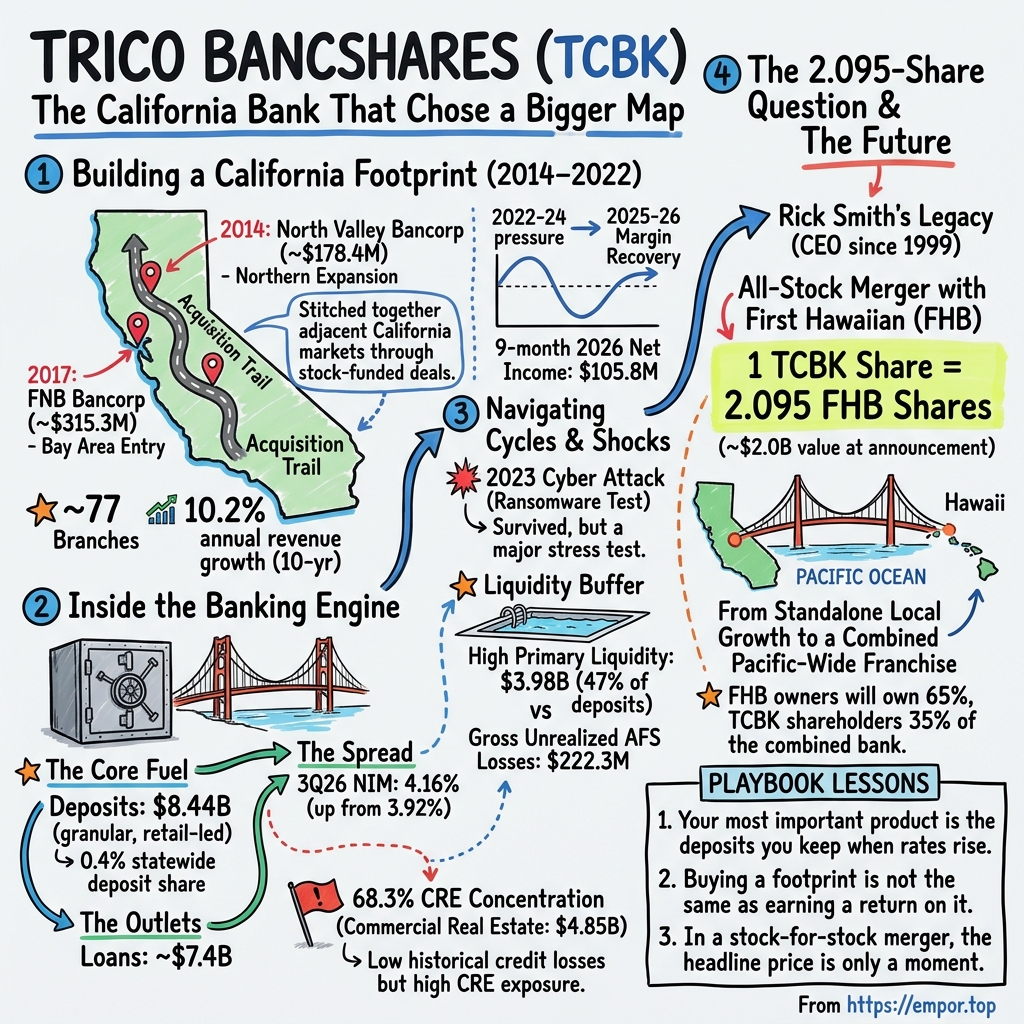
On Friday, July 10, 2026, First Hawaiian's stock closed at $30.13 on the Nasdaq.1 Nobody outside two boardrooms knew it yet, but that closing price was about to become the most important number in the life of a bank headquartered roughly 2,400 miles away, in Chico, California. Two days later, on a Sunday, TriCo Bancshares and First Hawaiian signed a merger agreement. The terms were simple enough to fit on an index card: every TriCo share would become 2.095 First Hawaiian shares, and nothing else.1
Multiply Friday's price by that ratio and each TriCo share was worth $63.12, against a TriCo closing price of $53.64 that same day.1 In one weekend, a California community bank that had spent half a century assembling itself county by county had agreed to become part of a Pacific-wide franchise valued, at announcement, at about $2.0 billion for TriCo's equity alone.1
The index card hid a twist. A fixed exchange ratio means TriCo shareholders were never promised $63.12. They were promised 2.095 pieces of another company, and the price of those pieces moves every trading day. By September 15, when the joint proxy statement went to print, First Hawaiian had slipped to $25.85, and the same 2.095 shares were worth $54.16.1
Roughly nine dollars per TriCo share had evaporated in about two months without anyone at TriCo doing anything at all. TriCo's own stock barely moved over that span, closing at $53.82 on the proxy's reference date, which tells you the market had already stopped pricing TriCo as an independent bank and started pricing it as a claim on First Hawaiian.1
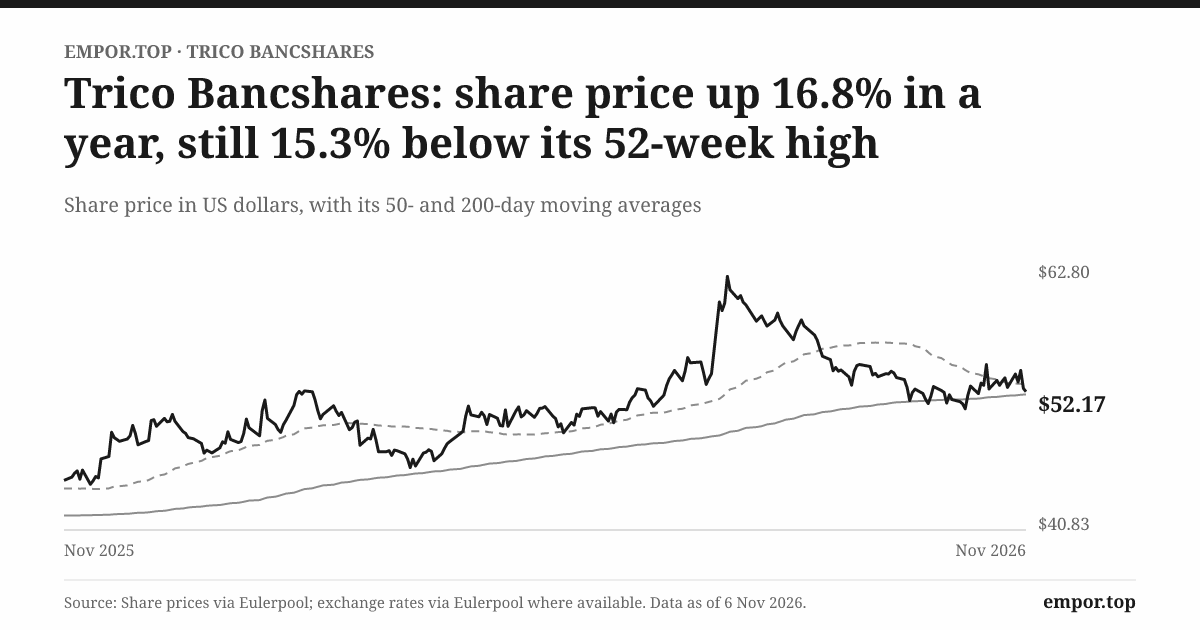
On October 29, 2026, the shareholders spoke. More than 24.1 million TriCo shares voted for the merger and about 223,000 voted against, a margin of better than a hundred to one among the votes cast.2 First Hawaiian's holders approved their side the same day.2 On November 6, TriCo's stock closed at $52.17, about 15% below its 52-week high of $61.62.3 The vote is done. The deal is not. Regulatory approvals from the Federal Reserve, the FDIC and the banking departments of Hawaii and California were still required, along with customary closing conditions, when the vote results were filed.12
That leaves a curious question for anyone who owns or studies TriCo tonight. What is this bank actually worth on its own, and what will its shareholders own next? The honest answer is that both matter, but in different ways. The standalone bank is the asset being contributed. First Hawaiian's share price is the currency being received. A shareholder who believes TriCo is a superb franchise but doubts First Hawaiian's stock is in an awkward spot, because the ratio is locked and the currency floats.
The arithmetic of who carries that risk is worth spelling out. About 67.1 million new First Hawaiian shares are to be issued to TriCo's owners, and when the dust settles those owners will hold about 35% of the combined company, with First Hawaiian's existing holders keeping about 65%.1 Every dollar First Hawaiian's stock gains or loses between now and closing therefore lands, in proportion, on the people who used to own a bank in Chico. They have stopped being owners of a California bank with a Hawaiian bid and become, in effect, future minority owners of a Hawaiian bank with a California division. The market has priced them that way since July.
This story runs three tests on the asset before it changes hands. The first is whether TriCo's 2026 earnings rebound is durable, or merely the welcome end of a painful rate cycle. The second is whether its credit culture, which outside analysts have long called conservative, can hold up in a loan book where commercial real estate is by far the largest category. The third is what the merger actually solves: whether it addresses the real limits of a $10 billion bank competing against national giants, or simply exchanges one set of risks for another.
A boundary is worth drawing now. Everything below is the story of TriCo Bancshares and its operating bank, Tri Counties Bank, up to the moment of closing. First Hawaiian's own franchise, its Hawaiian deposit base and its decisions after the deal belong to a different chapter, one that has not been written yet. What TriCo's shareholders are handing over is a record, and the record is where the evidence lives.
That record begins not with a merger agreement but with a supermarket.
 Subscribe on LinkedIn
II. A local bank grows by stitching together California
When Richard Smith joined Tri Counties Bank in 1993, his title was Vice President, Supermarket Banking.4 It is a revealing place for a future chief executive to start. Through the 1990s the bank pushed branches into grocery stores across the Sacramento Valley and beyond, betting that a teller window beside the produce aisle would catch depositors who no longer wanted to drive to a marble lobby.
By September 2002, the bank ran 32 traditional branches and ten in-store branches spread across roughly twenty California counties.5 The bank had been founded in Chico in 1975, and for most of its first quarter-century the growth formula was patient and physical: open a location, hire local lenders, gather deposits, repeat.3
Smith climbed quickly through the operating side of the house. He became chief information officer in 1994, ran customer and employee support from 1995, rose to president and chief operating officer of the bank in September 1998, and in November 1999 became chief executive of both the bank and its holding company.4 He later added the chairman's title.6 An operator who started in supermarket kiosks and came up through technology and support was an unusual profile for a California bank CEO, and it fit what came next. Organic branching could only take a Northern California bank so far. Buying neighbours could take it further, faster.
There is a reason that sequence matters for the rest of this story. Community banks in California's interior grow slowly on their own, because the towns they serve grow slowly. A bank that wanted to spread its fixed costs, its compliance staff, its technology contracts, its credit department, across a bigger base had two choices: wait for Chico and Redding to grow, or buy the bank across the county line.
TriCo, under Smith, chose to buy, and it chose to pay mostly in its own stock rather than cash. That choice kept the balance sheet strong and avoided debt. It also meant every deal would be measured, eventually, by whether the shares handed over were worth less than the franchise received.
The first test of that idea was small. In 2003 Tri Counties acquired North State National Bank, a local lender in its home region.5 The bigger move came a decade later. On January 21, 2014, TriCo agreed to combine with North Valley Bancorp of Redding, its northern neighbour, in an all-stock deal valued at about $178.4 million when announced.7 North Valley shareholders received roughly 6.6 million TriCo shares.8 The logic was density. Redding and the far-northern counties overlapped with TriCo's existing territory, which meant branches could be consolidated, back offices merged and the combined bank could be the most familiar name in a stretch of California that national banks often treated as an afterthought.
The second deal had a different purpose. On December 11, 2017, TriCo announced it would acquire FNB Bancorp, the parent of First National Bank of Northern California, based in South San Francisco, for about $315.3 million at announcement. The deal was again paid in stock, with about 7.4 million TriCo shares.9 North Valley had filled in the map TriCo already knew.
FNB pushed the bank into the San Francisco Bay Area, a richer and far more competitive deposit market, where TriCo would be a small newcomer rather than a local fixture. The balance sheet shows the scale of the step: shareholders' equity jumped from about $506 million at the end of 2017 to about $827 million a year later, almost exactly the value of the stock issued.1011
The third deal pointed south. In 2022 TriCo completed its acquisition of Valley Republic Bancorp of Bakersfield, issuing about 4.1 million shares worth roughly $174.4 million.11 Valley Republic gave TriCo scale in the southern Central Valley, an agricultural and energy economy quite unlike the Bay Area. Three deals, three purposes: fill in the north, open the Bay, extend down the valley.
Each purpose carried its own risk. The northern deal was the safest, because TriCo knew those towns and their borrowers. The Bay Area deal was the boldest, because it placed a Chico bank against some of the best-funded competitors in American banking, in a market where deposit customers are more rate-conscious and business borrowers have more options.
The valley deal added agricultural and energy-linked credit, which brings its own cycles of water, commodity prices and regulation. By the end of the sequence, TriCo was no longer the bank of a handful of north-state counties. It was a bank of several distinct Californias, with the advantages of diversification and the complications of running very different markets from one headquarters.
Here is the part the long-run growth numbers do not tell you on their own. Over the ten years to 2025, TriCo's revenue grew about 10.2% a year and its net profit about 10.9% a year.10 Those are excellent figures for a community bank. They are also, in large part, the arithmetic of acquisition. When a bank buys another bank's earnings with newly issued shares, total profit rises immediately, but so does the number of owners sharing it. The cleaner test is per-share earnings.
Diluted EPS went from $1.90 in 2015 to $3.73 in 2025, which works out to roughly 7% a year.10 That is still respectable compounding. It is also several points below the headline profit growth, and the gap is the cost of the shares handed to North Valley, FNB and Valley Republic holders. Those three deals issued about 18 million TriCo shares in total, a figure equal to more than half of the roughly 32 million shares outstanding in September 2026.128911
Does that mean TriCo overpaid? Not necessarily. Paying in stock is not overpaying if the acquired earnings per share issued exceed what TriCo's own shares were earning, and if the acquired deposits stay. The deal values alone cannot settle it. The tools that could are the purchase premiums over tangible book, the cost savings achieved against the cost savings promised, and the earnings each franchise contributed after integration.
TriCo does not publish a post-deal scorecard for any of the three, so outsiders have to infer from the aggregate. The aggregate is reasonable rather than spectacular: per-share earnings roughly doubled over a decade, the dividend grew faster than that, and no impairment of acquired goodwill appears in the recent annual reports.10 That is evidence that the deals did not destroy value. It is not proof that they created much more than patient organic growth would have.
There is also a more recent and less flattering stretch. Over the three years from 2022 to 2025, net profit fell about 1.1% a year even as revenue kept rising.10 That was the period after the last acquisition closed, when TriCo had to earn a return on everything it had bought without a new deal to lift the totals. The decline had a clear external cause, which comes later in this story, but its timing is the point. When the acquisitions stopped, so did the profit growth, at least for a while.
The pattern that emerges is a bank that used its own stock as a reasonably disciplined acquisition currency for two decades, building a footprint from the Oregon border toward Bakersfield. It does not look like an empire built on reckless overpayment. It does look like a franchise whose growth record cannot be separated from its deal record. Which raises the more basic question underneath all of it: what exactly was TriCo buying when it bought those banks, and why would a depositor in Redding or South San Francisco choose it over a bank a hundred times its size?
III. What does a community bank sell when it sells trust?
Picture a farm-supply business owner in a Central Valley town, depositing a week's receipts at the local Tri Counties branch. The money does not sit in a vault. Within days, some of it has become part of a loan to a dentist buying her building in Chico, some of it a mortgage on a house in Redding, some of it a government-agency bond in TriCo's securities portfolio.
The business owner earns a little interest, or none at all if the money sits in a checking account. The dentist pays considerably more. The difference between those two rates, after the bank pays its staff, absorbs its loan losses and covers its rent and technology bills, is TriCo's profit.
That spread is the whole engine. At September 30, 2026, TriCo held about $8.44 billion of deposits and about $7.4 billion of loans.12 Its fully tax-equivalent net interest margin, the spread measured as a share of earning assets, reached 4.16% in the third quarter of 2026, up from 3.92% a year earlier.12 For a sense of scale, a margin above 4% is well above what large national banks typically earn, because big banks hold more low-yielding securities and lend more to large corporations at thin spreads. A community bank with a 4% margin is getting paid well for lending to the small and middle-sized borrowers that big banks find too fiddly to serve.
A simple way to hold the number in your head: for every $100 of loans and securities on the books, TriCo earns a little over $4 a year more in interest than it pays out to fund them. Out of that $4, it must pay the rent on its branches, more than a thousand salaries, its technology vendors and its loan losses, and still leave a profit for shareholders. Small changes in that $4 matter enormously, which is why the margin is the number every TriCo analyst watches first.
Fees are the supporting act. In 2025 TriCo's noninterest income was $68.3 million, of which $53.4 million came from service charges and fees, the steady drip of account charges, ATM and debit-card interchange, and similar items.10 Asset management and commissions added about $7 million more.10 Set against total revenue in the mid-$500 millions, fee income is perhaps an eighth of the business.10 It matters for stability, but no one should mistake TriCo for a wealth manager or a payments company. It is a spread lender that collects some fees along the way.
The competitive question is why the dentist and the farm-supply owner choose TriCo at all. In California, the obvious alternatives are Wells Fargo and Bank of America, whose statewide branch networks and deposit bases dwarf TriCo's many times over. TriCo operated around 65 traditional branches, three in-store branches and nine loan production offices, all in California.1 By the FDIC's deposit market share data, it held only about 0.4% of the state's deposits.13 On that measure, it is a rounding error.
Statewide share is the wrong lens, though, and TriCo's case rests on a different one. California is not one banking market. It is dozens of local markets, and in the rural and small-city counties of the north state and the Central Valley, the competition looks nothing like Los Angeles or San Francisco. The bank's Community Reinvestment Act assessment areas, the regions regulators judge it on for serving local borrowers, stretch across Northern California counties, the Sacramento Valley, the Central Valley and parts of the Bay Area.14
In the smaller counties where TriCo grew up, its share of deposits is many times its statewide figure, and its rivals there are other regional and community banks, credit unions and the local branches of the national giants. That is where the “relationship bank” claim can be real: a business owner may have a loan officer who has known the family for years and can get a credit decision made in Chico instead of Charlotte.
The obvious question is whether that relationship advantage shows up in numbers, or only in brochures. Three pieces of evidence are worth weighing. The first is deposit cost. KBRA, the rating agency, has repeatedly cited TriCo's granular retail deposit base and low deposit costs as core strengths, along with a historically above-peer net interest margin.15 Cheap deposits are the closest thing a bank has to pricing power, because they mean customers are leaving money at TriCo for reasons other than the rate.
The second is granularity. TriCo says its deposits come mostly from individuals and businesses in its markets, and that no single person or group provides a material portion of them.10 That is reassuring, though the bank does not disclose the share held by its largest depositors, so outsiders cannot measure concentration directly. The third is liquidity behaviour under stress, which this story reaches in the spring of 2023.
The limits are just as clear. A 0.4% statewide share means TriCo cannot match the national banks on technology budgets, marketing, product breadth or the ability to serve a business that outgrows its credit limits. KBRA's own list of constraints notes that TriCo's smaller size leaves it more exposed to digital competition and deposit repricing, and more dependent on outside technology providers.15 Neither the annual report nor the rating agency documents customer retention rates, cross-selling ratios or a measurable switching cost. The relationship advantage is plausible, and the margin data supports it, but it has not been proven to be a moat in the strict sense.
Technology deserves a sentence of proportion here. Artificial intelligence will not replace the interest spread, because someone still has to hold insured deposits and bear the credit risk of a loan. What digital tools can do is change who keeps the customer.
A depositor who does everything on a phone has less reason to value a branch on Main Street, and a bank that cannot match a national app's convenience or fraud protection may lose that depositor's next dollar even if it keeps the first one. TriCo's own merger disclosures flag technology and AI among the competitive risks.1 For a bank of its size, the technology question is less about disruption and more about cost: how much it must spend simply to stay competitive.
The expense line shows that tension playing out. TriCo's average full-time staff fell from about 1,214 in 2023 to about 1,164 in 2025, yet salaries and benefits rose about 6.5% in 2025, which the bank attributed to merit raises, higher incentive pay tied to loan and deposit production, and targeted hiring.10
Fewer people, each paid more, with pay increasingly linked to bringing in business: that is what it looks like when a community bank tries to keep its relationship model while squeezing its cost base. It is not the pattern of a franchise being harvested. Nor is it proof of an efficiency advantage, since the bank still spends most of its non-interest budget on people, as any branch-based lender must.
So TriCo sells trust in a specific form: local knowledge, local decision-making and a low-cost deposit base built on everyday checking and savings accounts. That product works best when money is cheap and depositors are not shopping for yield. Between 2022 and 2024, money stopped being cheap.
IV. The rate cycle turns—and the earnings story turns with it
For a bank like TriCo, the pandemic years were a strange kind of bonanza. Deposits flooded in as businesses parked government relief money and households saved. Interest rates sat near zero, so those deposits cost almost nothing. TriCo's net profit jumped from about $64 million in 2020, a year depressed by pandemic loan-loss provisioning, to about $117 million in 2021 and $125 million in 2022.10 The 2021 surge partly reflected the unwinding of pandemic-era provisioning for losses that largely never came, so the cleaner comparison is 2022, which also marked the first full year of Valley Republic. Looking back, it marked the peak.
Then the Federal Reserve raised rates faster than at any time in four decades. The effect on a bank's spread is easiest to understand as a race. On one side are the bank's assets: loans and securities, many of them made at fixed rates during the cheap-money years, which reprice only as they mature or get refinanced. On the other side are deposits and borrowings, which can reprice almost overnight once depositors notice that a money-market fund pays 5%. In 2023, the liabilities won the race. Depositors moved money out of non-interest-bearing accounts into higher-yielding ones or left entirely, and TriCo had to replace that funding.
The bank's response is visible in its borrowings. At the end of 2022 TriCo had about $443 million of borrowings; by the end of 2023 that had climbed to about $795 million.10 Those borrowings, largely short-term funding from the Federal Home Loan Bank system, were expensive by community-bank standards. They kept the balance sheet funded, but they squeezed the margin. Net profit slid to about $117 million in 2023 and $114 million in 2024.10 In the third and fourth quarters of 2023, quarterly profit was running 19% to 28% below the prior year.1210
The recovery came from slowly reversing that squeeze. Through 2024 and 2025 TriCo paid down the higher-cost borrowings, which fell to about $216 million at the end of 2024 and about $80 million at the end of 2025.10 By September 30, 2026, other borrowings were gone entirely.12 Meanwhile older, low-yielding loans matured and were replaced at higher rates, and deposit costs eased as the Fed began to cut. The race reversed: assets were now repricing upward while funding costs drifted down. Net profit rose to $121 million in 2025.10
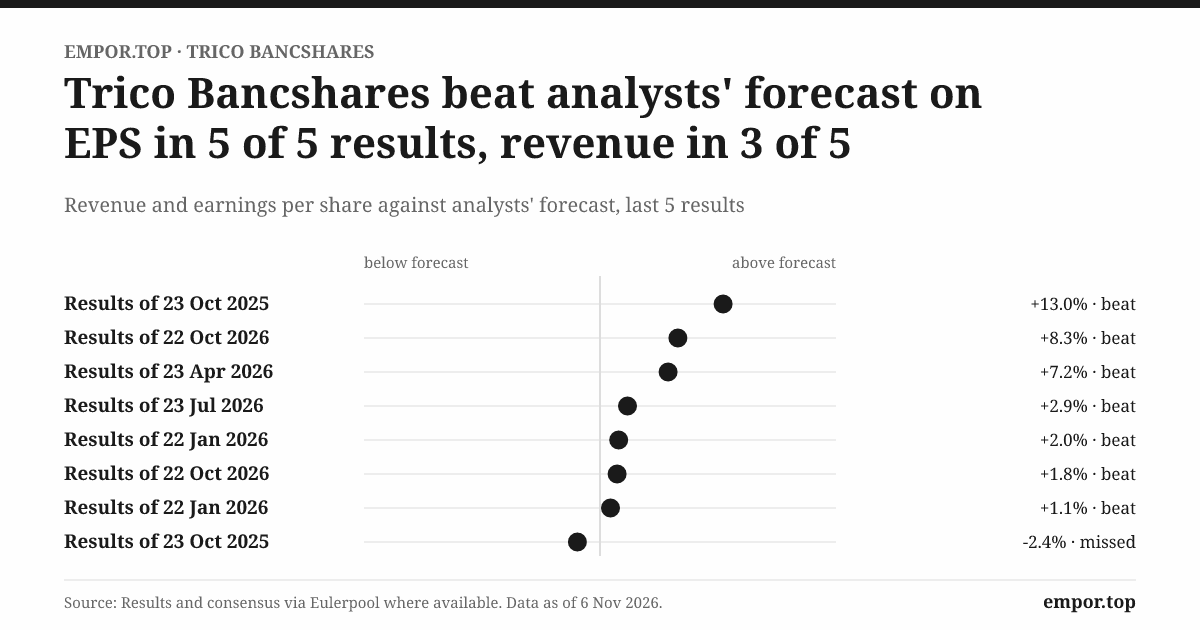
The 2026 numbers are the best in the bank's recent history. Third-quarter net income was $38.0 million, up about 12% from a year earlier, and nine-month net income reached $105.8 million against $87.9 million in the same period of 2025.12 Quarterly diluted EPS of $1.18 was the highest in the series.12 On a trailing basis, TriCo earned $4.32 a share over the twelve months to September.12
It is worth separating what is repeatable in that third quarter from what is not. The quarter included a $1.9 million benefit from credit-loss provisions, meaning TriCo actually released a small amount of reserves rather than adding to them.12 It also carried $3.9 million of merger-related expense.12
Together, they reduced reported earnings by about $2 million, though neither will repeat in the same way: merger costs will grow as integration approaches, and reserve releases cannot continue indefinitely if loan growth continues. The core of the improvement is net interest income, driven by higher loan yields, some loan growth and lower deposit costs.12 That is the kind of improvement that tends to persist, at least until the rate cycle turns again.
Now set the recovery against the longer record. Full-year 2025 net profit of about $121 million was still below 2022's $125 million.10 The 2026 run rate will very likely surpass 2022, but that would mean TriCo has climbed back to where it was four years earlier, not that it has found a new growth trajectory. The longer growth record reflects acquisitions, while the recent decline came after they stopped.10 Neither proves that the bank could have repeated its long-run growth organically.
The balance sheet's sensitivity to rates explains why caution is warranted. In its 2025 annual report, TriCo's static model estimated that a sudden 300-basis-point rise in rates would cut net interest income by about 5.2%, and the bank described itself as liability-sensitive, meaning its funding reprices faster than its assets.10 That is a model, not a forecast. It holds the balance sheet frozen and ignores what management would do in response. But it confirms the lesson of 2023: TriCo's earnings fall when rates rise sharply, and rise when the rate pressure eases. The 2026 improvement is, in large part, the second half of that same mechanism.
TriCo's quarterly results materials have emphasised margin, deposit costs and credit metrics in much the same order, quarter after quarter.16 What the record shows consistently is a management team that described the 2023 margin compression as a funding-cost problem and treated debt paydown as the fix, and then delivered the paydown. That consistency between the stated problem and the action taken counts in management's favour. It does not tell anyone whether the margin will hold.
The forward test is specific. If TriCo's full-year 2026 earnings land well above 2022's peak and the margin holds near 4.1% to 4.2% as the Fed's cuts push asset yields lower, the rebound will look like a durable reset. If the margin peaks and slips as loan yields fall faster than deposit costs, 2026 will look like the top of a cyclical recovery. Either way, the margin is only half of bank earnings. The other half is what happens to the loans themselves, and TriCo's loans have a concentration that its own description of itself tends to understate.
V. The loan book's quiet concentration
TriCo's annual report contains a sentence that sounds reassuring and requires careful reading. The company says its loans are not materially concentrated in any single industry or group of related industries.10 A few pages later, the loan portfolio table shows commercial real estate at $4.85 billion at the end of 2025, about 68% of all loans.10 Both statements are true. They are true because "commercial real estate" is not, in the bank's classification, a single industry. It is office buildings, retail centres, warehouses, apartment complexes, farmland, owner-occupied medical offices and more, each with its own borrowers and cash flows.
That distinction matters, but it should not be pushed too far. Commercial real estate loans share a common vulnerability: their value depends on property values and on the rents or business cash flows that service the debt. When rates rise, property values tend to fall, because buyers pay less for a given stream of rent when they can earn more elsewhere. When a regional economy weakens, vacancies rise across property types at the same time. A bank with two-thirds of its loans secured by commercial property is a bank whose credit performance is tightly linked to the California property cycle, however diversified the borrowers may be.
Consider how the mechanism works on a single loan. An investor buys a small retail strip in a valley town for $5 million, borrowing $3.5 million from the bank. As long as the tenants pay rent, the loan is serviced and the bank collects its spread. If rates rise and the loan must be refinanced at a higher rate, the same rent covers less of the interest bill.
If a tenant leaves, the cover shrinks further. And if the property's value falls by a quarter, the bank's $3.5 million loan suddenly sits against collateral worth not much more. None of that requires the borrower to be reckless. It only requires the cycle to turn. Multiply that across thousands of loans, and the significance of the 68% figure becomes clear.
The rating agency's view sharpens the point. In August 2025, KBRA affirmed TriCo's ratings with a stable outlook and praised its conservative credit culture and historically nominal credit losses.15 In the same report, it flagged TriCo's investor CRE exposure, meaning loans on properties held for rental income rather than occupied by the borrower's own business, at about 289% of risk-based capital as of mid-2025, which KBRA described as above peers.15 Bank supervisors have long used 300% of capital as a level at which investor CRE concentration attracts heightened scrutiny. TriCo sat just below that line.
The positive evidence is real. TriCo's allowance for credit losses was $128.2 million at September 30, 2026, or 1.73% of loans, compared with 1.77% at the end of 2025 and 1.78% a year earlier.12 A reserve of that size, against a loan book with low historical losses, is a substantial cushion. Net charge-offs in 2025 were $10.6 million, or roughly 0.15% of loans, a modest figure by any historical standard.10 For every $1,000 of loans, TriCo wrote off about $1.50 last year and holds about $17 in reserve. That is the arithmetic of a bank that expects losses to stay low and has prepared for them not to.
The warning is also real. Nonperforming assets rose to $70.5 million at the end of 2025 from $46.9 million a year earlier, an increase of about half, with farmland loans a notable source of the additions.10 Farmland is a distinctive exposure for a Central Valley bank: its value depends on water availability, crop prices and the economics of almond and walnut orchards, which have faced difficult years.
Nonperforming assets remained small relative to the loan book, under 1%, but the direction was the wrong one. KBRA had also noted a rise in net charge-offs in the first half of 2025 tied to a single acquired commercial and industrial loan, a reminder that credit inherited through acquisitions does not always behave like credit underwritten at home.15
So which claim survives? The record supports the conservative-credit description in its narrow form: TriCo has historically lost little money on its loans and holds a reserve above many peers.
The record narrows the broader claim of a "diversified local bank." With two-thirds of loans in commercial real estate, investor CRE near the supervisory threshold and nonperformers rising, TriCo's credit risk is concentrated in property, and its low losses have yet to be tested by a severe California commercial real estate downturn of the kind that hit the state's banks in the early 1990s. The low losses of 2023 to 2025 came during a period of rising rates but a still-resilient California economy. That is a meaningful test, but not the hardest one.
Comparing reserve levels with similarly sized California banks would sharpen the picture, but the comparison is not straightforward, because banks classify CRE differently and acquired-loan accounting distorts allowance ratios. The more useful approach is to watch TriCo's own trend line. The measures that will tell the story are criticized and classified loans, the bank's internal early-warning categories; nonaccrual and past-due loans; net charge-offs; the allowance ratio; and the CRE share of the book. If nonperformers keep rising while the allowance ratio drifts lower, the reserve cushion is being spent. If nonperformers stabilise and charge-offs stay near current levels, the conservative-credit claim will have survived a real test.
One more figure belongs in this picture, carefully labelled. At September 30, 2026, TriCo had about $1.94 billion of commitments to extend credit: lines of credit and loan approvals that borrowers have not yet drawn.12 These are not loans on the balance sheet, and most will never be fully drawn at once. But they represent credit TriCo has promised, and in a downturn, borrowers in difficulty tend to draw their lines precisely when the bank would prefer they did not.
A bank's credit risk and its funding risk usually arrive together. Bad loans make depositors nervous; nervous depositors make funding expensive. TriCo had a rehearsal for a different kind of shock in 2023, one that had nothing to do with loans at all.
VI. The bank survived a cyberattack; what does the merger ask it to absorb?
In February 2023, TriCo discovered that criminals had broken into its systems in a ransomware attack.17 The incident temporarily disrupted some of the bank's systems, and the investigation that followed found that confidential information had been taken.17 For a bank whose pitch rests on trust, it was about as direct a test as could be imagined. The attack led to customer notifications, litigation and governmental inquiries, which TriCo disclosed in its 2023 annual report.17
The timing made it worse. Barely a month later, Silicon Valley Bank collapsed in a run that began with a few hundred technology-industry depositors and spread at the speed of a group chat. Within weeks, depositors across the country were asking whether their own banks were next. A California bank that had just suffered a public data breach was entering the most nervous deposit market in a generation.
TriCo came through. It did not need emergency equity, did not sell its securities portfolio at a loss to raise cash, and did not see a run. It did increase its borrowings sharply through 2023, a funding strain that reflected the industry-wide shift in deposit costs as much as anything specific to TriCo.
By the 2025 annual report, TriCo said neither it nor its subsidiaries was party to any material pending legal proceeding, which suggests the cyber litigation had been resolved or reduced to immateriality.10 The full financial cost of the incident, including any settlement, remediation spending and lost customers, is not separately quantified in the company's later annual reports. The incident stands as a concrete historical stress test that the bank passed, with costs that were real but apparently contained.
Two other signals from the record point the same way. TriCo's auditor issued an unqualified opinion on both the 2025 financial statements and the bank's internal control over financial reporting, with no material weakness identified.10 And no material regulatory action against the bank appears in its 2025 annual report or its third-quarter 2026 filing.1210 For a bank that had its systems breached two years earlier, a clean controls opinion is the closest thing to an outside verdict that the remediation was taken seriously, though it is an audit of financial reporting, not a certificate of cyber safety.
The broader lesson concerns how to judge a bank's resilience. For most companies, investors look at free cash flow. For a bank, that measure is close to meaningless, because a bank's operating cash flows include changes in loans and deposits, which are the business itself. The right question is liquidity: if a large share of depositors wanted their money tomorrow, could the bank pay them?
TriCo's answer, at September 30, 2026, was $3.98 billion of primary liquidity, combining cash, unpledged securities and committed borrowing capacity.12 That was equal to about 47% of total deposits and 139% of the bank's estimated uninsured deposits.12 Put plainly, TriCo could have paid out every depositor above the FDIC's insurance limit and still had money left over, without selling a single loan. Uninsured deposits, by the same arithmetic, were roughly a third of the total, far below the levels that sank Silicon Valley Bank. For a community bank, that is a strong position.
There is a qualification hiding in the securities portfolio. TriCo's available-for-sale securities carried about $222.3 million of gross unrealized losses at September 30, 2026.12 These are bonds bought when rates were lower, now worth less on the market because newer bonds pay more. TriCo attributes the losses to interest rates and spreads, not to credit problems with the issuers, and expects to collect the full contractual cash flows.12
As long as TriCo holds the bonds to maturity, the losses will unwind. If it ever had to sell them in a hurry, they would become real. Set against shareholders' equity of about $1.3 billion, the unrealized losses equal roughly a sixth of the bank's book capital.10 They are already reflected in accounting equity through other comprehensive income, but they show how much of TriCo's balance sheet is still marked by the cheap-money years.
The funded debt picture is now notably clean. At September 30, 2026, TriCo had no other borrowings, $41.2 million of junior subordinated debt, a legacy of trust-preferred structures many banks used in the 2000s, and $25.2 million of operating lease liabilities, which are obligations on rented branches rather than borrowed money.12 That marked a full reversal of the 2023 funding scramble.10
Liability sensitivity belongs here as a mechanism rather than a forecast. Ample liquidity protects a bank from running out of money. It does not protect a bank from paying more for money. If rates rose sharply again, deposit costs would rise faster than loan yields, and earnings would fall, even with $4 billion of liquidity in reserve. Liquidity buys time and options; it does not change the shape of the spread.
Now consider what the merger asks TriCo to absorb. TriCo has about $9.8 billion of assets.10 The combined company will have about $34 billion in assets, $29 billion in deposits and $22 billion in loans, based on June 2026 balances.1 Integration means converting core banking systems, merging branch networks where they overlap, aligning credit policies, retaining relationship lenders who might be recruited away by rivals, and doing all of it without losing the customers who chose a local bank precisely because it was local. Bank mergers often stumble not at the signing but at the systems conversion, when customers discover their online banking login no longer works or their loan officer has left.
The merger proxy is unusually candid on one point: it notes that First Hawaiian has not in its recent history engaged in M&A activity.1 TriCo, the junior partner, is the one with recent integration experience, having absorbed three banks in eight years. First Hawaiian, the acquirer, will be learning on TriCo's franchise. That is not a reason to expect failure. It is a reason to watch the integration milestones closely, because the people who know how to integrate a bank will mostly be working for the company being integrated.
The decision to accept that risk was made by a board led by a man who had run TriCo for more than a quarter of a century. Why he chose to sell, and on what terms, is the next part of the story.
VII. Rick Smith's last capital-allocation decision
The conversation that ended TriCo's independence started at an investor conference. In February 2025, Richard Smith met Bob Harrison, First Hawaiian's chief executive, and the two kept in touch.1 On September 22, 2025, Harrison flew to Chico, and the two men first discussed the possibility of combining their banks.1 No price was mentioned. Two weeks later, on October 7, TriCo's board, advised by the investment bank KBW, authorised exploratory talks not just with First Hawaiian but with three other potential partners, identified in the proxy only as Companies A, B and C.1
What followed was a slow-motion auction. First Hawaiian's first term sheet arrived on December 12, 2025, offering 1.960 of its shares per TriCo share, a premium of about 15% to TriCo's 90-day average price, and about 34% ownership of the combined company for TriCo holders.1 Company A dropped out because, in the proxy's words, TriCo and Company A did not have compatible cultures.1 Company C said in March 2026 that it would remain independent.1
Company B made an offer on April 1 implying a premium of just 5.5%.1 First Hawaiian responded on April 6 by raising its ratio to 2.054, then on May 1 to 2.095, a premium of about 14% on April 30 prices, and on May 4 told TriCo it would go no higher.1 TriCo asked for four seats on the combined board, the two sides agreed exclusivity on May 7, and the agreement was signed on July 12.1
That sequence answers a question skeptical shareholders often ask about bank sales: did management shop the bank, or simply accept the first friendly offer? TriCo's board talked to four counterparties over roughly seven months, used the competing bid to extract two price increases, and stopped when the buyer said it was done. That is a real process. It is also a process in which the eventual buyer improved its offer by only about 7% from first bid to final terms, and in which the only rival bid was weaker. The auction established that First Hawaiian was the best available partner. It did not establish that selling was better than staying independent.
The man at the centre of that decision is worth a closer look. Smith has been TriCo's chief executive since 1999 and chairman as well, an unusually long tenure in an industry where chief executives of mid-sized banks often last a decade or less.46 His background runs through operations and technology rather than lending, and his record is the three-deal expansion that turned a Northern California bank into a statewide one.
In 2025 his total compensation was about $2.99 million, including a $1.065 million cash bonus, roughly 31 times the median TriCo employee's pay of about $96,900.6 That multiple is modest for a public company chief executive. He owned about 1.02% of TriCo's shares as of March 2026, worth roughly $17 million at early-November prices, and directors and executive officers together held about 4.9%.63 Shareholders have generally approved: more than 95% of votes cast supported the 2025 say-on-pay resolution.6
The shareholder register behind those votes is dominated by large index and active fund managers rather than any controlling owner. As of March 2026, FMR held about 9.1% of TriCo, BlackRock about 7.8%, and Dimensional Fund Advisors and Franklin Mutual Advisors about 5% each.6 No single holder could have forced or blocked the sale.
Related-party dealings were small: loans to directors, executives and their affiliates totalled about $1.6 million at the end of 2025, down from about $2.5 million a year earlier, and the proxy reports no other material transactions with insiders.106 In other words, the governance record contains no hidden self-dealing to explain the deal. The incentives worth examining are the ordinary ones attached to the merger itself.
Smith is expected to continue participating in the combined company as both an employee and a board member, and the TriCo board cited his continued participation among its reasons for supporting the merger, alongside the retention of chief financial officer Peter Wiese and chief banking officer Dan Bailey in management.1 Four TriCo directors are to join First Hawaiian's board at closing.1 Smith was also awarded a transaction bonus in connection with the deal.1 Those arrangements are common in bank mergers and arguably useful, since the people who know TriCo's customers are the ones most likely to keep them.
They also mean the executives recommending the deal have personal stakes in it beyond their shareholdings. Shareholders noticed. The advisory vote on merger-related compensation drew about 1.29 million votes against, roughly 5% of votes cast, compared with less than 1% against the merger itself.2 The compensation vote was not binding and not a condition of closing, but the gap between the two results is a clear signal that some investors liked the deal more than the payments attached to it.2
Capital returns sat alongside the negotiations. In 2025 TriCo paid out about 37% of its profit as dividends and repurchased about 709,000 shares.10 In the first nine months of 2026 it bought back another 497,852 shares for $24.2 million, an average of roughly $49 a share, and paid $34.6 million in dividends.12 Buying back stock at around $49 while negotiating a sale that would value each share at $63 on announcement is, viewed from the remaining shareholders' side, a good trade: each share retired at a discount to the eventual deal value increased the remaining holders' slice of the merger consideration.
Viewed from the sellers' side, it is less comfortable. The shareholders who sold stock back to the company during those months did so without knowing what the board knew about the talks. TriCo does not disclose precisely when within the nine months the repurchases took place, and nothing in the record suggests any rule was broken, but it is the sort of question an activist would raise.
The board's case for the deal rests on four claims. The combined footprints are complementary. The combined company will be the sixth-largest bank headquartered in the Western United States by deposits.1 The deal is expected to be accretive to earnings per share, without a capital raise.1 And TriCo shareholders, with about 35% of the combined company, will share in a larger, more diversified bank's future.1 At the July 10 reference price, the offer valued TriCo at about 15.0 times its estimated 2026 earnings per share.1
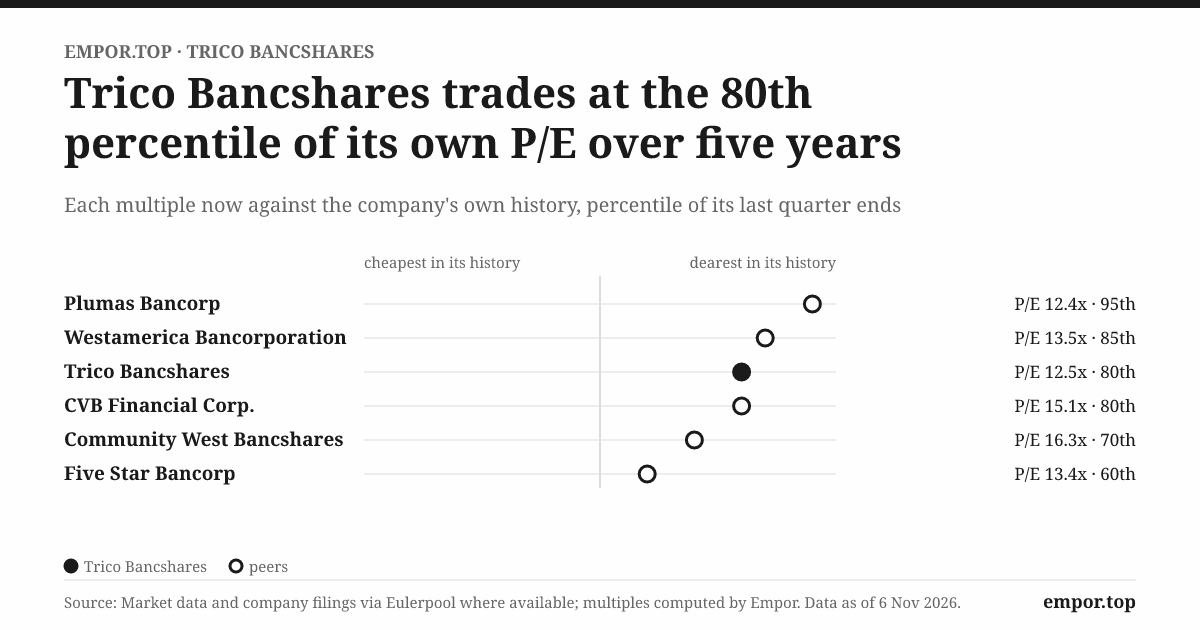
Those claims deserve testing against TriCo's own alternatives. In KBW's peer analysis, eleven Western US banks traded at a median of about 13.5 times estimated 2026 earnings and 1.76 times tangible book value, while TriCo itself traded at about 12.6 times and 1.69 times.1 So the deal at announcement offered TriCo holders a multiple above both their own stock's and the peer median, a genuine premium.
First Hawaiian's adviser, Evercore, applied ranges of roughly 10.5 to 13 times 2027 earnings and 1.6 to 2.1 times tangible book in its own valuation work.1 TriCo's board did not quantify expected cost savings or the exact percentage of earnings accretion, and First Hawaiian's board cited expected accretion and the anticipated recovery of tangible book dilution without putting a public number on the earnback.1 Those are assumptions, not results.
Now the skeptical case. TriCo agreed to sell just as its margin was recovering and its quarterly earnings were reaching new highs. A shareholder could reasonably argue that the board sold at the moment its standalone story was turning, accepting a fixed number of another bank's shares whose value has already fallen. The September 15 value of $54.16 was barely above TriCo's own pre-announcement price of $53.64.1 If First Hawaiian's stock does not recover, TriCo holders will have surrendered their independence for something close to no premium at all.
The counterargument is that TriCo's structural limits made a larger balance sheet and a different deposit base in Hawaii more attractive than another round of California acquisitions. First Hawaiian's limited recent merger experience is identified as a risk in the proxy.1 And by agreeing to an $80 million termination fee, TriCo committed to a meaningful cost if it walked away for a better offer.1
Smith's record supports some confidence in the process and the integration plan. He ran three acquisitions of increasing size, none of which produced an impairment or a public credit disaster, and he navigated a cyberattack and a funding crisis in the same year. His record also includes a three-year profit decline after the last acquisition and a deal that was struck just as earnings rebounded. Management's credibility on the merger will be judged by the integration: whether the systems conversion goes smoothly, whether TriCo's relationship lenders stay, and whether the accretion First Hawaiian's board expects shows up in the combined company's earnings.
Which brings the story back to the asset itself. Strip away the merger for a moment, and ask what kind of bank TriCo really is, and whether its model can win.
VIII. The investment case in one California loan book
There is a paradox at the heart of TriCo. Statewide, it is tiny: about 0.4% of California's deposits.13 In parts of its home territory, it is one of the most familiar banks on the high street. Its standalone stock price, meanwhile, has become almost secondary, tied to First Hawaiian's shares by the fixed exchange ratio. To understand what TriCo's shareholders are contributing to First Hawaiian, it helps to make both the bull and the bear case for the standalone bank as concretely as possible.
The bull case starts with the deposit base. TriCo gathers money from individuals and small businesses in markets where it has operated for decades. Those deposits are granular and historically cheap, which KBRA has identified as a central strength.1015 They fund loans at spreads that produce a margin above 4%.12 Historically low credit losses mean most of that spread reaches the bottom line. And TriCo has proven it can survive shocks, including a cyberattack, a regional banking crisis and a rate cycle that compressed margins across the industry.1017
The bear case is equally concrete. TriCo is small beside its largest competitors, with no meaningful scale advantage in technology, marketing or product breadth. Its statewide share is negligible. Its loans are concentrated in commercial real estate, and its investor CRE exposure sits near the level at which regulators start asking questions.1015 Its earnings are liability-sensitive, falling when rates rise sharply.10 And none of its filings demonstrate the kind of switching costs, retention data or pricing power that would justify calling its relationship model a moat.
Michael Porter's five forces help organise the competitive picture. Depositors, the bank's suppliers of money, have real bargaining power: they can move funds with a few taps and compare rates online, as 2023 showed. Borrowers, its customers, can choose among regional banks, national banks and credit unions, and larger commercial borrowers can tap private credit.
The threat of new entrants is low, because bank charters, capital requirements and deposit insurance create genuine barriers, which is one of the few structural protections TriCo enjoys. Substitutes are growing: fintech and digital providers compete for payments, savings and small-business lending, though none replace insured deposit-taking. Rivalry among existing banks is intense in the Bay Area and less so in TriCo's rural and small-city markets, where the bank's advantages are strongest.
Hamilton Helmer's seven powers offer a stricter test. Of the seven, scale economies, network effects, counter-positioning, switching costs, branding, cornered resource and process power, TriCo's strongest claim is a weak version of scale economies at the local level: density of branches and relationships in specific markets can lower the cost of gathering deposits and improve lending decisions through local knowledge. Some might argue for switching costs, since businesses with loans, deposits and treasury services at one bank find it inconvenient to move.
But the filings do not disclose retention rates or demonstrate that customers pay a premium to stay. TriCo's branding is regional, not a pricing tool. Its process power, the conservative credit culture, is real but unproven through a severe CRE downturn. On Helmer's demanding standard, TriCo has advantages but not a power. Its edge is local, earned and defensible, but not proven to be durable enough to resist erosion by scale and technology.
Returns on capital tell the same story from a different angle. TriCo's return on equity has hovered around 9% to 12% over the past five years, and was about 10.4% over the twelve months to September 2026, with return on assets steady at about 1.2%.1210 For a bank, a return on assets above 1% is a mark of a solid franchise.
A return on equity of around 10% is roughly what investors typically demand from a bank stock, which means TriCo has been earning approximately its cost of capital rather than far above it. A business with a genuine moat usually shows returns well above that line for long stretches. TriCo shows returns at the line, which is consistent with a well-run bank in a competitive industry, and with the market's willingness to pay only about 1.3 times book value for it.
That leaves the valuation question. At the November 6 price, TriCo traded at about 12.5 times trailing earnings, against its own five-year median of about 12.0 times, and about 1.3 times book value, with a dividend yield of about 2.8%.312 In other words, the market prices TriCo close to its historical average, which suggests investors are treating the stock mostly as a claim on First Hawaiian rather than as a standalone franchise worth re-rating.
The deal-date and September reference values reflect different First Hawaiian share prices, not any change in TriCo's own business.1 A same-date comparison with peer banks is not straightforward, because the peer group in the proxy was set at the deal date and the multiples have moved since; the honest conclusion is that TriCo's standalone multiple tells shareholders less than First Hawaiian's stock price does.
The verdict on the standalone case is that it is credible but conditional. Granular, low-cost deposits and local relationships can support attractive margins and low losses, as TriCo's record shows. Small statewide scale, rate sensitivity and CRE concentration narrow that case to a smaller claim: TriCo is a well-run community bank with strong local positions, not a franchise with a protected moat. For current shareholders, the closing of the deal and First Hawaiian's share price will matter more than whether TriCo's own multiple sits slightly above or below its history.
Three indicators will tell the story from here. The first is the net interest margin, which reached 4.16% in the third quarter of 2026, and the deposit cost behind it; its direction will reveal whether the funding advantage persists as rates fall.12 The second is credit quality, specifically nonperforming assets, which rose to $70.5 million in 2025, and net charge-offs; their direction will reveal whether the CRE book is holding.10 The third is the deal itself: regulatory approvals, closing and integration milestones, and First Hawaiian's share price, which determines what TriCo holders receive. Those three numbers are the whole case, compressed.
What does TriCo's path teach beyond its own shareholders? The lessons are specific to this bank, but they travel.
IX. Playbook: Business & Investing Lessons
A bank's most important product may be the deposits it can keep when rates rise. TriCo's margin tells a familiar bank story: cheap deposits helped in the low-rate years, then repriced sharply in 2023.
Its recovery came from paying down expensive funding and letting deposit costs settle. The lesson for anyone valuing a bank is that the loan book gets the attention, but the deposit franchise does the work. The best test of a deposit franchise is not how cheap it is in good times, but how much it costs to keep when money market funds pay 5%.
Buying a footprint is not the same as earning a return on it. TriCo's acquisitions expanded its California footprint, but per-share earnings grew more slowly than total profit because it paid in shares.
That is not a failure; it is the cost of growth by acquisition. But it means the headline growth rate overstates what each shareholder received. For founders and investors, the lesson is that a bigger map is only valuable if each new market earns more than the shares spent to buy it. The right measure is per-share earnings and tangible book per share, not total assets.
Liquidity buys time; it does not erase the price of risk. TriCo survived the 2023 ransomware attack and regional banking panic without a run. Its liquidity position was strong by September 2026, but it did not prevent funding costs from rising in 2023 or erase the securities and commercial real estate risks. A bank with ample liquidity can wait out a storm; it cannot make the storm cheaper. The lesson is that investors should value liquidity as insurance against the worst outcomes, not as evidence that a bank's risks have disappeared.
In a stock-for-stock merger, the headline price is only a moment. TriCo's shareholders agreed to a fixed ratio of First Hawaiian shares. Their value fell as First Hawaiian's share price fell, though TriCo's business did not change. For sellers in an all-stock deal, the real question is not the premium on announcement day, but whether they would choose to own the buyer's stock at today's price. A fixed ratio turns a sale into an investment decision, and TriCo's shareholders have made that decision without knowing what their stake will be worth at closing.
A shopped bank is not the same as a bank sold at the top. TriCo's board tested alternatives and negotiated improved terms from First Hawaiian. But a sound process only finds the best price available in that room, at that moment.
It cannot tell shareholders whether the room was the right place to be, just as the bank's margin and quarterly profits were climbing back to records. The broader lesson for boards and investors is that process quality and timing are separate questions, and only one of them is visible in the proxy.
X. Epilogue
Tonight, TriCo Bancshares is a bank in waiting. Its shareholders voted yes on October 29, and the regulators are still deciding.2 The merger requires approvals from the Federal Reserve, the FDIC, the Hawaii Division of Financial Institutions and the California Department of Financial Protection and Innovation, along with the usual closing conditions.1 The merger agreement allows until July 12, 2027 to complete the deal, with an option to extend.1 Until then, Tri Counties Bank must keep operating as an independent bank, gathering deposits, making loans and managing credit, while preparing to hand all of it to a new owner.
The first moment that will decide the story is regulatory approval. Bank mergers of this size typically receive approval, though regulators can impose conditions or delays, especially if community groups raise concerns about branch closures or lending in underserved areas. TriCo's CRA record will matter here, because regulators consider a bank's history of serving its communities when deciding whether to approve a merger.14 An approval without significant conditions would clear the way to closing; a delay or condition would extend the period in which TriCo operates under the merger's constraints, with its management focused on integration and its stock tied to First Hawaiian's.
The second moment is the closing itself, and with it the value of First Hawaiian's shares on that day. If First Hawaiian's stock recovers toward its July level, TriCo holders will receive something close to the announced premium. If it remains near its September level or falls further, they will have exchanged their bank for little more than its pre-deal market value. Neither outcome depends on TriCo's own performance. It depends on how investors value First Hawaiian, a bank with a very different deposit base in Hawaii, a smaller recent record of acquisitions and its own sensitivity to rates.
The third moment is the next set of results. TriCo's fourth-quarter and full-year 2026 numbers will show whether its margin holds near 4.16% as the Fed's cuts work through loan yields, and whether its deposit costs keep falling.12 They will also show whether nonperforming assets, which rose through 2025, have stabilised, and whether the allowance of 1.73% of loans remains adequate.12
If the margin holds and credit stabilises, TriCo will enter the merger at the top of its recovery, which strengthens the combined company and the case that its shareholders contributed a valuable franchise. If the margin slips or credit worsens, the merger will look like a timely exit, and the combined company will inherit the problem.
The fourth moment comes after closing: integration. Converting TriCo's systems, retaining its relationship lenders and keeping its customers through the transition will determine whether the combined company realises the earnings accretion its board expects. Integration is where many bank mergers lose value, and First Hawaiian's limited recent experience makes it a genuine test.1 TriCo's liquidity gives the combined company room to manage the transition, but liquidity cannot retain a customer who decides that a Hawaiian bank is no longer local.12
The central questions of this story remain open. TriCo's earnings rebound looks real but too short to call a new growth trend. Its credit culture has passed the tests it has faced, but not the hardest one. And the merger addresses TriCo's scale constraints while adding integration risk and tying its shareholders to another bank's stock. The answers will come over the next year, in regulatory decisions, quarterly results and First Hawaiian's share price. Until then, TriCo's shareholders own a California bank whose value is set in Honolulu.
There is one more possibility worth naming, because the proxy names it. Bank deals can fail to close. Regulators can withhold approval, a material adverse change can intervene, or the termination date can pass. If that happened, TriCo would return to being an independent bank, with a recovering margin, a strong liquidity position and a management team that had spent a year preparing to sell.
Its shareholders would keep the bank and lose the premium. The record of the past four months suggests that outcome is unlikely, since both shareholder groups approved and the regulatory applications were filed in August.1 Unlikely is not the same as impossible, and the gap between TriCo's stock price and the value of 2.095 First Hawaiian shares is the market's running estimate of that risk.
XI. Outro
Go back to the farm-supply business owner depositing a week's receipts at a Tri Counties branch in a Central Valley town. That deposit is the start of everything this story has followed: the loan to the dentist in Chico, the margin that collapsed in 2023 and recovered in 2026, the commercial real estate concentration, the liquidity buffer that held through a cyberattack and a banking panic. That depositor chose TriCo because it was local. Soon, the deposit will sit on the balance sheet of a bank headquartered in Honolulu.
TriCo's defining asset was never its size. It was a network of local relationships, built branch by branch and acquisition by acquisition, from a supermarket counter in the 1990s to a statewide franchise. Its last independent act was to agree to exchange that network for a fixed number of shares in a larger, more distant bank. TriCo spent decades building a California map; now its shareholders are betting on what that map is worth inside First Hawaiian.
References
-
Joint Proxy Statement/Prospectus for First Hawaiian Merger — SEC, 2026-09-16 ↩↩↩↩↩↩↩↩↩↩↩↩↩↩↩↩↩↩↩↩↩↩↩↩↩↩↩↩↩↩↩↩↩↩↩↩↩↩↩
-
TriCo Special Meeting Vote Results, Form 8-K — SEC, 2026-10-30 ↩↩↩↩↩↩
-
Richard Smith, TriCo Bancshares, CEO Interview — The Wall Street Transcript, 2004-03-15 ↩↩↩
-
TriCo Bancshares and North State National Bank Merger Prospectus, Form 424B3 — SEC, 2003 ↩↩
-
TriCo Bancshares 2026 Proxy Statement — Tri Counties Bank, 2026 ↩↩↩↩↩↩↩
-
TriCo Bancshares 2025 Form 10-K — SEC, 2026-03-02 ↩↩↩↩↩↩↩↩↩↩↩↩↩↩↩↩↩↩↩↩↩↩↩↩↩↩↩↩↩↩↩↩↩↩↩↩↩
-
TriCo Bancshares 2024 Form 10-K, Valley Republic merger consideration — SEC ↩↩↩
-
TriCo Bancshares 3Q 2026 Form 10-Q — SEC, 2026-11-06 ↩↩↩↩↩↩↩↩↩↩↩↩↩↩↩↩↩↩↩↩↩↩↩↩↩↩↩
-
2024 Community Reinvestment Act Performance Evaluation for Tri Counties Bank — FDIC ↩↩
-
KBRA Affirms Ratings for TriCo Bancshares — KBRA, 2025-08-22 ↩↩↩↩↩↩↩
-
TriCo Bancshares 2023 Form 10-K, cyberattack disclosure — SEC ↩↩↩↩
 LinkedIn
 WhatsApp
 Reddit
 Hacker News
 Email
 Kindle
 RSS Feed
 Spotify
 Apple Podcasts
 Amazon Music
 Audible
 YouTube