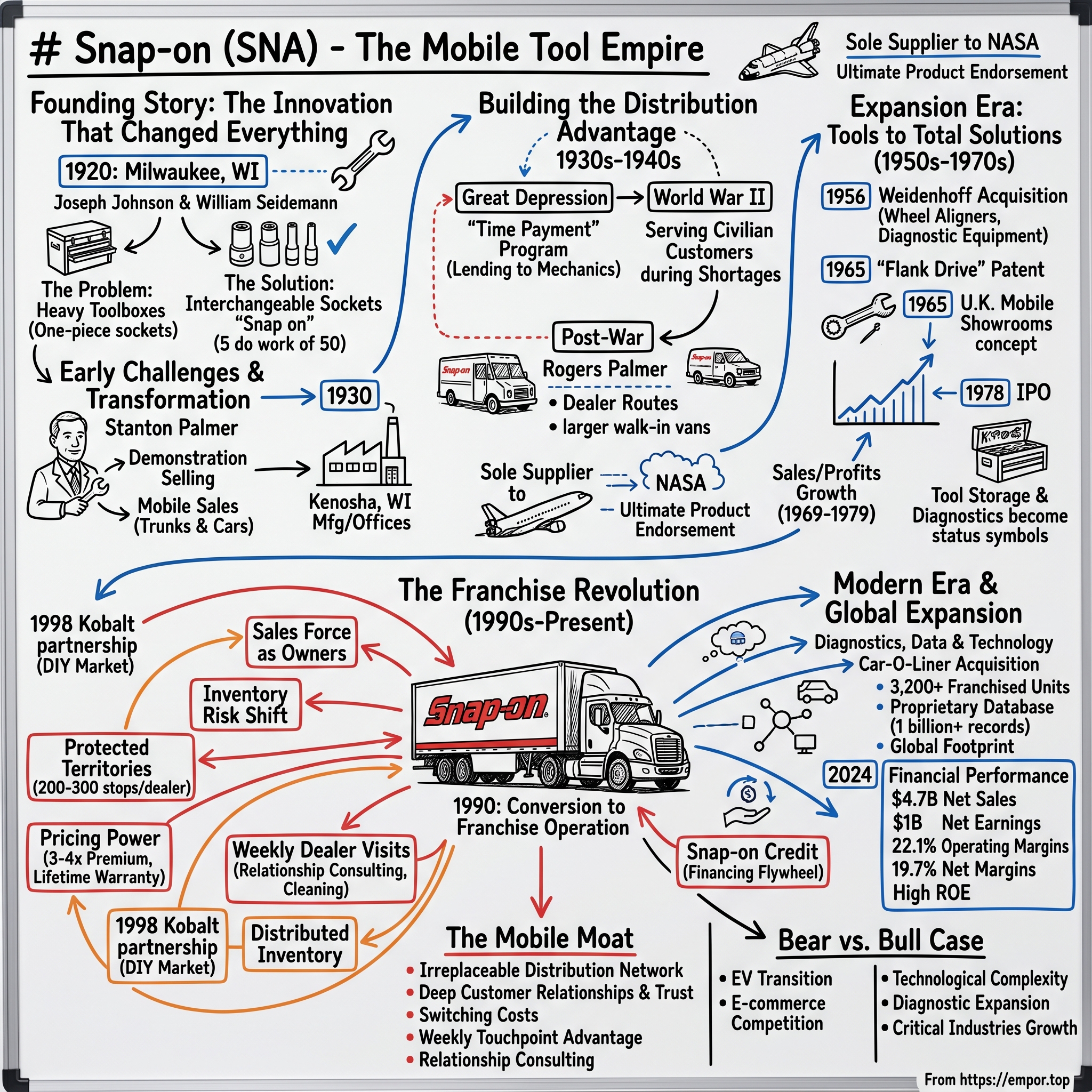
Snap-on: The Van That Became a Financial System
I. Five Sockets, One Big Question
In 1920 a Milwaukee engineer named Joseph Johnson had an idea that sounds almost too small to build a company on. Mechanics of the day carried a separate wrench for every size of nut, a heavy, clanking kit that slowed every job. Johnson's alternative was five handles and ten sockets that snapped on and off interchangeably.
He and a co-worker, William Seidemann, made two sample sets on weekends, using crude bending jigs and what the company's own history calls "pure muscle."1 The pitch fit on a slogan, "Five do the work of Fifty," and it worked: the demonstration sets produced more than 500 cash-on-delivery orders, and the Snap-on Wrench Company was formed.1
More than a century later, the scene that matters is not a workshop in Milwaukee but a parking lot outside a repair shop almost anywhere in America. Once a week a white van pulls up. A franchisee opens the side door onto a rolling store of ratchets, torque wrenches, tool chests and diagnostic scanners. A technician on a short break climbs in, looks at a new impact wrench, and has to decide whether to buy it, and if so, whether to pay over the next few months or the next few years. That moment, repeated thousands of times a day across roughly 4,700 routes worldwide,2 is the real engine of Snap-on.
The company that grew from those ten sockets is large and unusually profitable. In fiscal 2025 Snap-on booked about $4.7 billion of product sales and roughly $5.2 billion of total revenue once the income from its lending arm is added, and it earned just over $1 billion of net income.2 On October 29, 2026, the stock market valued the whole enterprise at about $18.8 billion.3 Those numbers describe a company that keeps about twenty cents of every revenue dollar as profit, which is extraordinary for something that, at first glance, sells wrenches.
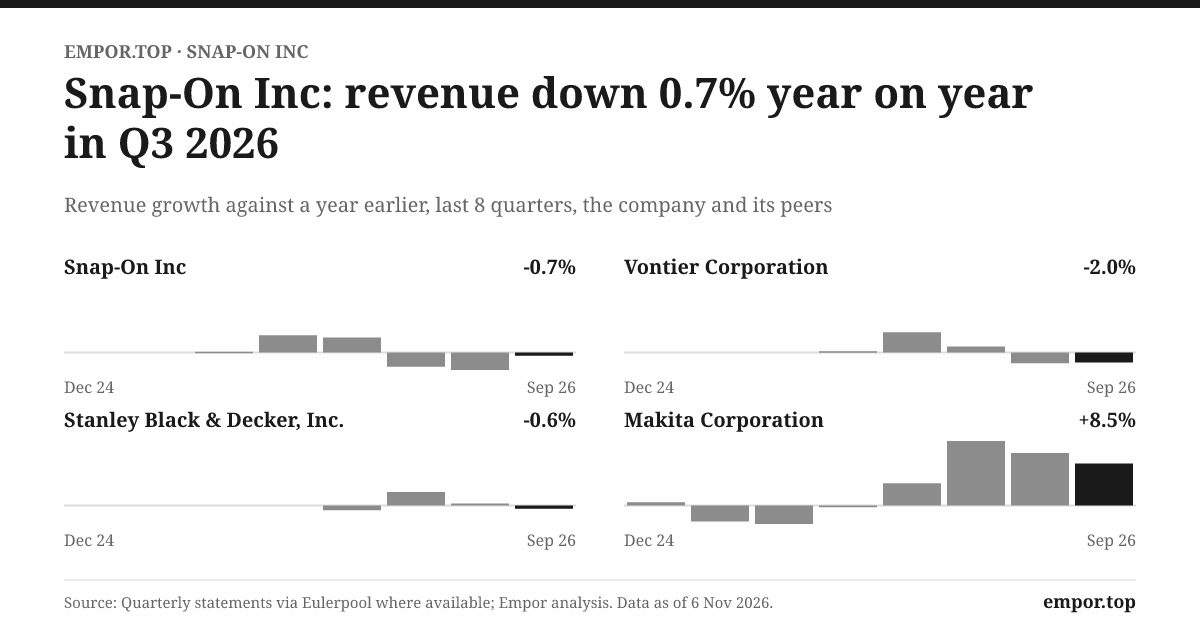
But the most recent numbers tell a less comfortable story. In the third quarter of 2026, organic sales, which strip out acquisitions and currency swings, fell 2.8% from a year earlier, and the Tools Group that runs the vans dropped 7%.4 Management blamed a sudden surge in diesel prices that prompted franchisees to run their vans with less inventory, even as technicians kept buying.4 That explanation may well be right. It is also exactly the kind of explanation an investor should test, because it arrived after several years in which growth had already been running below the company's long-term pace.
So the story of Snap-on is not really the story of a better wrench. It is the story of a system built around that wrench: the product, the route that delivers it, the credit that pays for it, the repair data that increasingly accompanies it, and the cash that the whole machine throws off and hands back to shareholders. Four questions run through everything that follows.
Does the mobile franchise network still give Snap-on an edge, now that rivals, retailers and online sellers all chase the same technician? Can diagnostics and repair information become a bigger, more recurring business, or is that mostly a promise? Does in-house credit deepen loyalty without letting losses outrun the returns? And is the recent slowdown a pause in a long climb, or the first sign of a lower growth rate?
To answer them, the story has to start where Johnson started: with what he understood about mechanics before anyone at Snap-on knew how to sell to them.
 Subscribe on LinkedIn
II. A Socket Set That Sold Time
The early Snap-on was a lesson in what a customer actually buys. A mechanic in 1920 was not paid for owning tools. He was paid for finished repairs, so every minute spent hunting for the right-sized wrench, or wrestling a tool into a cramped engine bay, was a minute of income lost. Johnson's interchangeable set attacked that problem directly. Five handles could do the work of dozens of fixed wrenches, which made the kit lighter, made the job faster, and made the toolbox fit the way a mechanic moved.1 What Snap-on sold, from the very first order, was time.
The founders were engineers, and they knew it. The selling fell to two partners, Stanton Palmer and Newton Tarble, who by December 1920 had picked out 20 cities for branch offices.1 Their method was not to stock hardware stores and wait. It was to put a salesman in front of a working mechanic with the tools in hand and let the demonstration close the deal.
By 1925, five years after the first sample sets, Snap-on had 17 branches and 165 salesmen selling directly to mechanics.1 That is a remarkable footprint for a company whose product had barely existed half a decade earlier, and it tells you where the founders thought the value lay: not just in the steel, but in the contact.
That contact turned out to be the company's best source of ideas. In 1923 Snap-on filed its first patent, for a ratcheting attachment to the original socket wrenches, and published its first catalog.1 As car models multiplied, the company began producing customized tool sets for each model; the kit for Ford's Model T came with a diagram showing where each tool was meant to be used.1
That small detail captures the pattern that would define the company. Snap-on did not simply make tools and look for buyers. It studied the job, built the tool around the job, and then made the buyer's workflow easier. The sales force was the sensor network that made that possible, carrying complaints and requests from the bay back to the engineers.
Two other early inventions would echo for a century. During the Great Depression, when mechanics could not get loans elsewhere, Snap-on began offering what it called "Time Payment" selling, letting customers pay for tools in installments; the company describes itself as the first tool company to do so, and its credit arm was formally launched in the 1960s.1
And during the Second World War, tool shortages pushed Snap-on to sell or consign tools directly to its salesmen, a shift that, in the company's telling, gave birth to "the concept of the salesman as an independent businessman."1 Credit and the independent seller were not later bolt-ons. They were improvisations born in hard times, and both stuck.
Snap-on also learned early that a mechanic's problems did not stop at hand tools. By the late 1930s it had a torque-measurement line, and in the 1950s it bought Weidenhoff for engine test equipment and Judson Engineering for wheel alignment, chasing the millions of alignments then being performed each year.1 In 1939 it paid its first dividend, the start of what the company describes as an unbroken run of quarterly dividends that have never been reduced.1
It would be easy to turn all this into a century-long victory lap, and the company's own history page does a fair amount of that. The more useful inheritance is narrower. Snap-on began with a concrete productivity improvement and a direct line to the person who used it. That access became a strategic asset in its own right.
What it does not prove, on its own, is that today's tools command a durable premium or that today's customers cannot switch. Plenty of tool companies have invented good wrenches. Very few built a sales channel that drives to the customer's door every week, and that channel, more than any single product, is where the modern story begins.
III. The Van Becomes the Store
In 1965, in the English Midlands town of Kettering, Snap-on tried something new. Instead of salesmen who carried samples and took orders, it put the inventory itself on wheels, serviced by a new branch and distribution center in Northamptonshire.1 The van model meant a technician could see, touch and buy a tool on the spot, and it meant the salesman could deliver a warranty replacement in the same visit. The format spread. In 1990, Snap-on became the first mobile tool company in the United States to convert its sales force into a franchise operation.1
That conversion formalized a bargain that has defined the company ever since. Each franchisee buys Snap-on's products at a discount from suggested list prices, carries the inventory on the van, and resells at whatever prices the franchisee chooses.2 In the United States, Snap-on gives each franchisee a list of calls, the shops and technicians that form the route, and a franchisee can add a limited number of additional routes over time.2
By the end of fiscal 2025, about 3,400 of its routes were in the United States, and roughly 5% of its routes were company-owned. Those owned routes serve open territories, train future field staff and let Snap-on test sales ideas before rolling them out to franchisees.2
The division of labor is worth spelling out, because it explains both the strength and the fragility of the model. Snap-on supplies the brand, the product line, training, marketing, the technology that runs the route and, crucially, financing. Through its U.S. credit subsidiary it lends franchisees money for van leases, working capital and even the purchase of the franchise itself.2
The franchisee supplies the things a corporation cannot easily replicate: the personal relationship with a technician, knowledge of which shop is busy and which is struggling, and the working capital tied up in a van full of inventory. Snap-on, interestingly, earns very little directly from the franchise relationship. It describes its initial and monthly fees as "nominal," and franchise fee revenue totaled about $21 million in 2025, a rounding error against nearly $2 billion of Tools Group sales.2 The money is made on the product margin, and on the loans.
That arrangement creates a quiet alignment of interests. When a franchisee does well, Snap-on sells more tools and books more financing. When a franchisee struggles, the pain shows up first on the van and in the franchisee's own bank account, and only later in Snap-on's numbers. The company even offers U.S. and Canadian franchisees a stock purchase plan, tying some of their savings to the parent's share price.2 It is a structure that can absorb shocks, but it can also hide them for a while, which is exactly what makes the third quarter of 2026 so interesting.
The model also travelled. Beyond the United States, Snap-on runs franchise networks in Canada, the United Kingdom, Japan, Australia, Germany, the Netherlands, South Africa, New Zealand, Belgium and Ireland, markets where, as in America, the purchase decision is made or influenced by the technician and the shop owner.2 Japan offers a sense of how slowly such networks are built: by the fall of 1992, Snap-on Tools Japan had 133 franchised vans and about $12 million in sales.1
The vans themselves have evolved too, from rolling stockrooms into showrooms; by 2017 the company had more than 50 "TechKnow Express" vans demonstrating diagnostics and more than 60 "Rock N' Roll Cab Express" vans built to show off tool storage.1 A tool chest that costs thousands of dollars is easier to sell when the technician can open every drawer.
Is the van a moat? The honest answer is that it is an advantage, not a monopoly, and Snap-on's own filings have long said as much. In its fiscal 2008 annual report, the company named MAC Tools, then owned by Stanley Works, Matco, then owned by Danaher, and Cornwell as its major competitors in the mobile van channel, and listed a long roster of other rivals: Craftsman, Husky, Kobalt, NAPA and AutoZone among the stores, plus industrial and power-tool brands from Makita to Milwaukee.5
Today's filing no longer names names, but it says the same thing in general terms: various competitors sell to technicians through mobile vans, while others sell online, through retail stores, parts outlets and tool distributors.2 The format was copied long ago.
What the copying did not do, at least not yet, is erase the scale gap. A rival franchisor, Matco, publishes a comparison that counts about 3,300 U.S. mobile franchises for Snap-on against roughly 1,800 for Matco, 1,100 for Mac Tools and 800 for Cornwell, using end-of-2024 data.6 Matco publishes that table to recruit franchisees, and it uses it to point out that Snap-on charges a royalty its rivals do not,6 so it is marketing rather than audited fact.
But it lines up with Snap-on's own count of roughly 3,400 U.S. routes,2 and it suggests that Snap-on runs more mobile routes in America than its next two van competitors combined. Density matters on a route business, because more stops in a given area mean more sales per mile of diesel and per hour of the franchisee's day.
There is a lot the company does not publish about the network. It does not disclose average franchisee sales, franchisee profitability, failure rates or retention, which are the numbers that would show whether the route is getting stronger or weaker. On the third-quarter 2026 call, management said franchisee attrition was mainly age-driven, people retiring rather than failing, and that it saw no broad franchisee distress beyond the diesel squeeze.7 That is a reassuring statement, and it may be true. It is also a statement the outside world cannot check.
So the van got Snap-on into the shop every week, and the network that runs it is bigger than any direct rival's. The more interesting question is what else a company can sell once it has a reserved parking spot outside its customer's workplace. Snap-on's answer, over the past four decades, has been: almost everything a repair needs.
IV. From Wrench to Workshop System
Picture a technician staring at a late-model SUV with an intermittent fault. The check-engine light comes and goes. A wrench will eventually be needed, but not yet. First the technician has to find out what is wrong, which means plugging a scan tool into the car's computer, reading fault codes, and then figuring out what those codes actually mean on this particular make, model and year. That last step, the gap between "the car says something is wrong" and "here is the known fix," is where a modern repair stalls, and it is where Snap-on has spent decades trying to plant itself.
The company built that position mostly by buying it. Through the 1990s, brands such as Sun, Mitchell1, John Bean and Hofmann brought Snap-on diagnostics, repair information, wheel alignment and undercar equipment.1 In 2002 it acquired Nexiq Technologies, a maker of heavy-duty truck diagnostic tools, and in 2006 ProQuest Business Solutions, which supplied electronic parts catalogs to vehicle dealers.1 Each purchase extended the same idea that produced the Model T kit: be useful at the exact moment the job gets hard.
Today Snap-on reports through four businesses, and weighting them honestly matters. The Snap-on Tools Group, which runs the vans, had segment sales of just under $2 billion in fiscal 2025 and is the largest single segment.2 Repair Systems and Information, which sells diagnostics, repair databases, shop equipment and dealership programs to repair-shop owners and car-company dealerships, had about $1.9 billion of segment sales, and the Commercial and Industrial Group, which sells tools and torque equipment to aerospace, military, energy and manufacturing customers, about $1.5 billion.2
Those segment figures overlap, because the industrial and repair-systems groups also sell products that end up on the vans, so about $560 million of internal sales are eliminated to reach the company's $4.7 billion of net sales.2 Financial Services added $413 million of revenue on top.2
The segment that looks most like the future is also the most profitable product business. Repair Systems and Information earned about $500 million of operating profit in 2025, a margin of roughly 27% on its segment sales, against about 22% for the Tools Group and 15% for Commercial and Industrial.2 A different cut of the same numbers shows the direction of travel.
Snap-on also reports sales by product type, and between 2023 and 2025 its "diagnostics, information and management systems" category grew from about $990 million to about $1.1 billion, a gain of roughly 12% in two years. Over the same stretch, hand and power tools were flat at about $2.5 billion, and shop equipment fell by about a tenth.2 In a company whose total sales barely moved in those two years, software and diagnostics were the part that grew.
That is the heart of the bull case for the data business, and it rests on a plausible mechanism. Vehicles keep getting more complicated, with more sensors, more software and more systems that interact. Management likes to point out that the average American vehicle is about 12.8 years old,8 which means millions of out-of-warranty cars flowing to independent shops that lack the car companies' dealer tools.
Snap-on says it is building its proprietary databases, using artificial intelligence to speed that work, and it describes those databases as increasingly effective at streamlining repairs in independent shops.24 In June 2026 it paid about $100 million for Diesel Laptops, a South Carolina company that sells diagnostics, repair information and digital tools for commercial trucks and off-highway equipment used in mining, agriculture and infrastructure.9 That is a bet that the same logic extends from the family car to the bulldozer.
The industrial business applies the old Model T idea to new customers. Commercial and Industrial sells to what management calls the critical industries: aerospace, the military, natural resources, power generation and technical education, places where a missing or mis-torqued tool can ground an aircraft or stop a mine.2 Its pitch is customized kits built around a specific job, plus tool-control systems that track every wrench so none is left inside a jet engine.
On the first-quarter 2026 call, management credited growth in that business to added capacity, more customized kits and share gains, and mentioned rising demand for tool kits built for data centers.8 It is a small but telling example of the system at work: the same habit of fitting tools to the task, sold through direct and distributor channels rather than vans, to buyers whose budgets do not depend on a technician's paycheck. So far in 2026, it has been the part of Snap-on that grew fastest.4
Here, though, the evidence needs careful handling, because there is a big difference between a product sale and a recurring revenue stream. When a technician buys a scan tool, Snap-on books the sale once. When a shop subscribes to a repair database, Snap-on recognizes the revenue over the life of the contract, which typically runs 12 to 60 months.2
Subscriptions are the more valuable kind of revenue, because they renew without a new sales call and they make a customer's workflow depend on the vendor. But Snap-on does not disclose how much of its revenue comes from subscriptions, how many subscribers it has, or how many renew.2 The "diagnostics, information and management systems" category mixes one-time hardware sales with software, so its growth cannot be read as subscription growth.
The record also shows how lumpy this business can be. In 2025, Repair Systems and Information grew organically by about 4%, helped by a double-digit increase in activity with car-company dealerships.2 Those dealership sales are tied to programs: when a manufacturer launches a new model, its dealers need the specialized tools and equipment to service it, and Snap-on supplies many of them.
In 2026 that tailwind reversed. Organic sales in the segment were roughly flat in the first quarter, up less than 1% in the second, and down 5.5% in the third, as manufacturers changed their new-model rollouts.8104 Program revenue is valuable, but it is not recurring in the way a subscription is; it arrives when the car companies decide it will.
Then there is the competition, which is formidable in exactly the area Snap-on wants to grow. Snap-on identifies the car manufacturers themselves, with their proprietary parts catalogs, diagnostics and information systems, as major competitors in selling to dealers and independent shops.2 Snap-on previously named specialist rivals including ALLDATA, owned by the parts retailer AutoZone, alongside equipment makers such as Hunter Engineering and Corghi.5 Snap-on does not have the information field to itself, and the most important source of repair truth, the carmaker, is also a competitor.
Artificial intelligence cuts both ways here. Snap-on lists AI as a tool for expanding its databases and warns that technological developments in the industry may require greater use of AI, and that failing to keep pace could hurt its competitive position.2 A system that can read a fault code, search millions of past repairs and suggest a fix is exactly what a data-rich incumbent would want to build. It is also exactly what a well-funded newcomer, or a carmaker, might build and give away. For now neither the opportunity nor the threat shows up as a disclosed revenue line.
The fair verdict is that Snap-on's core remains a product business, and the data business is strategic potential rather than a proven subscription engine. The growth in diagnostics is real; its quality is not yet measurable from the outside. The figure that would change that verdict is simple to name and conspicuously absent: a disclosed split of software and subscription revenue, with renewal rates. Until then, the more measurable part of the system is the one that helps customers pay for all of this, and that part is a bank.
V. Credit Turns the Route into a Flywheel
Back in the van, the technician has picked out a large rolling tool cabinet, the kind of purchase that costs as much as a used car. The franchisee does not need to send the customer to a bank. A contract can be written right there, and the tools go home with the technician today. Behind that moment, at Snap-on's credit subsidiary, a new receivable appears: an installment loan to an individual technician, with an average term of about four years, secured by the tools themselves.2
That loan is the hinge of the whole system. Snap-on Credit, the company's U.S. lending arm, and its international finance subsidiaries originate extended-term contracts for technicians and shop owners buying through the franchise network, plus leases and loans to franchisees.2 The arrangement does three things at once. It lets a technician afford a premium tool that would otherwise be out of reach. It lets the franchisee sell bigger-ticket items without carrying the credit risk alone. And it turns a one-time product sale into four years of interest income for Snap-on.
The economics are striking. In fiscal 2025, Financial Services generated $413 million of revenue, about 8% of the company's total, but $282 million of operating earnings, roughly a fifth of all segment profits.2 The reason is the price of the credit. The average yield on Snap-on's finance receivables was 17.6% in 2025,2 which is closer to a credit-card rate than a car loan.
Contract receivables, mostly equipment leases and franchisee loans, yielded about 9%.2 Snap-on lends to technicians at high rates because the loans are small, the borrowers are individuals with variable incomes, and some of them would struggle to borrow elsewhere, which is exactly the population the Depression-era "Time Payment" plan first served.
Is the customer captive? Not by contract. The decision to finance through Snap-on or another source is solely the customer's, the company says.2 A technician with a good credit card can pay that way. But convenience is its own kind of lock-in. Financing at the van door, from someone who visits every week and knows the customer, is a smoother experience than a bank application, and a technician who is still paying off one tool chest has a reason to keep the relationship friendly.
That brings the risk into focus, because a lending business is only as good as its losses. At the end of fiscal 2025, Snap-on held about $1.96 billion of finance receivables, of which $69 million were at least 30 days past due, and about $560 million of contract receivables, of which only $3.5 million were delinquent.2 The more telling figure is the charge-offs.
During 2025 the company wrote off about $83 million of finance receivables.2 Loans made in 2024, with about $457 million still outstanding at year-end, accounted for $33 million of 2025's write-offs on their own.2 In other words, a technician loan tends to go bad in its first two or three years, which means the quality of each year's new lending shows up quickly.
On the third-quarter 2026 call, management gave the latest readings. Balances in the United States that were 60 or more days past due stood at 2.1%, up 10 basis points from a year earlier, while trailing twelve-month net losses were 3.63% of outstanding balances, a small improvement from 3.7% the quarter before.7
Set the loss rate against the yield and the business makes sense: Snap-on charges roughly 17.7% and loses something under 4% a year, leaving a wide spread to cover funding and overhead.97 That spread is why the finance arm earns so much. It is also why a recession that pushed technician losses sharply higher would hit Snap-on harder than a typical toolmaker.
The collection mechanics explain how that spread is defended. Snap-on decides whether to lend using credit bureau data, its own proprietary credit model and the value of the tools being financed.2 Because the franchisee visits the borrower every week, the lender has something most consumer lenders lack: a person who sees the customer, knows whether the shop is busy, and can talk about a missed payment face to face.
When that fails, the company typically writes a finance receivable off once it reaches 120 days past due, unless the tools are repossessed, in which case the account is written off within 60 days of repossession.9 Used tools are decent collateral, but they are rarely worth the full balance of the loan, so repossession limits losses rather than eliminating them. The model works best when it is used sparingly.
Two details show where the risk really sits. First, the auditor flagged the allowance for finance-receivable losses as the critical audit matter in the 2025 annual report, because estimating losses over the remaining life of four-year contracts requires judgment about the timing, frequency and severity of future defaults.2 That is not a red flag about the accounts; it is a statement that this number is the one most likely to be wrong.
Second, write-offs on finance receivables are partially offset by recourse from franchisees, according to the filings.9 Part of the credit risk, in other words, is pushed back onto the franchisee who made the sale. That protects Snap-on's numbers, and it adds one more burden to a franchisee whose van inventory, working capital and sometimes the franchise itself are already financed by the same company.
The rest of the receivables book is less dramatic. Ordinary trade receivables, money owed by distributors, shops and industrial customers on normal 30-to-120-day terms, were about $920 million gross and $880 million net of allowances at the end of 2025.2 Across the business, the time it takes to collect has improved, from a peak of about 130 days of revenue in 2020 to about 113 days in 2025.2 That is a useful signal about collections discipline, but because it blends ordinary trade accounts with the lending book, it is no substitute for watching how each year's batch of technician loans performs.
And there is a softer warning in the latest numbers. Originations, the dollar value of new loans written, fell about 5% in 2025 to $1.12 billion and slipped another 1.3% in the third quarter of 2026.24 Management said technicians were reluctant to take on big financial commitments.7 Fewer new loans mean fewer big-ticket sales today and, over time, a slowly shrinking interest-income stream. Credit is a flywheel when technicians are confident. When they hesitate, it spins the other way.
Snap-on has run this machine profitably for decades, so the record supports the claim that credit deepens the relationship without letting losses run away. But it narrows the claim to this: the flywheel works as long as delinquency stays in its recent band, and the first places to look for trouble are the 60-day delinquency rate and the trailing net-loss rate. Both are stable to slightly worse today. Who decided that this was a machine worth running, and how hard to run it, is the next part of the story.
VI. Nick Pinchuk's Operating System
On October 22, 2026, Nick Pinchuk opened another earnings call by explaining why sales had fallen. It is a ritual he has performed for nearly two decades. Pinchuk has been Snap-on's chief executive since December 2007 and its chairman since 2009, and at the start of 2026 the company listed his age as 79.2
Before Snap-on, he held senior roles at Carrier, the air-conditioning maker owned by United Technologies, including running its global refrigeration operations and its Asia Pacific business. He joined Snap-on in 2002 to lead what became the Commercial and Industrial Group, and before any of that, he served as an officer in the U.S. Army in Vietnam.2
Anyone who has listened to a Snap-on call knows the Pinchuk style. He speaks in a distinctive, almost oratorical register, full of phrases like "Snap-on Value Creation," "runways for coherent growth" and the "critical industries," and he wraps disappointing quarters in vivid weather metaphors. The third-quarter release described "an unprecedentedly accelerated rise in diesel prices" and promised progress "as the wave passes."4 The language can be colorful or opaque depending on the listener. Either way, it is a long record against which to judge him, and long records are more useful than charisma.
The center of his operating philosophy is what the company calls Rapid Continuous Improvement, or RCI: a structured set of tools and processes, deployed across factories and offices, meant to eliminate waste and improve operations.2 It is Snap-on's version of the lean manufacturing systems used at companies such as Danaher, and its results show up most clearly in margins.
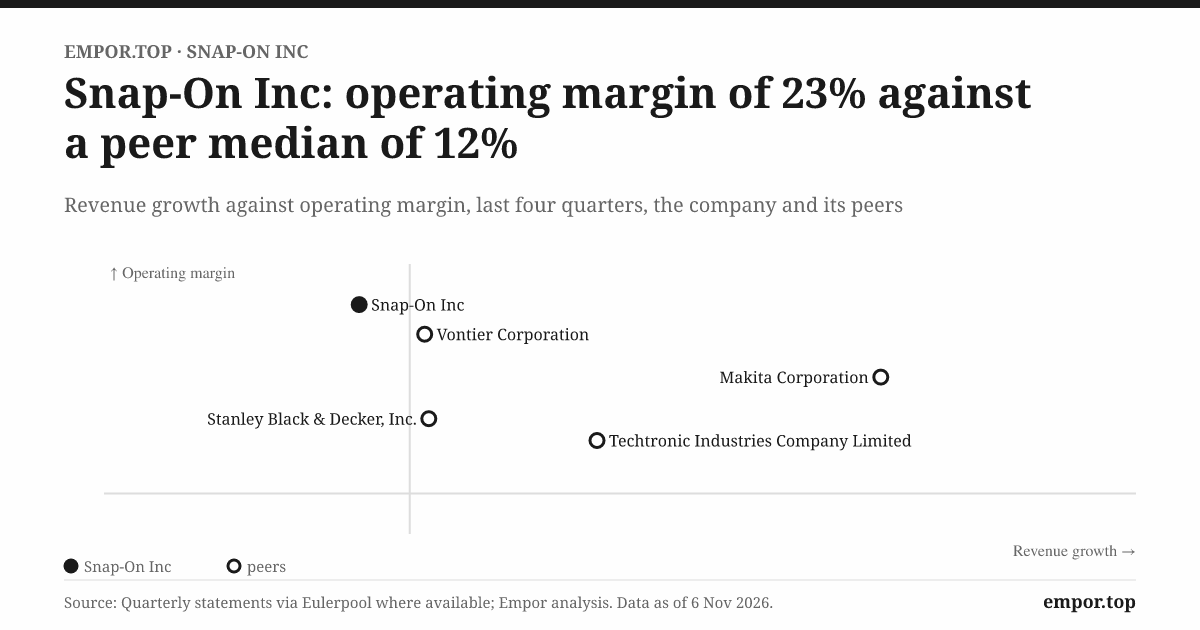
Over the decade to fiscal 2025, the consolidated operating margin climbed from about 23% to about 26%, and net margin rose from about 14% to about 20%.211 A good part of the net-margin gain came from the 2017 U.S. tax cut, which took Snap-on's tax rate from about 31% to about 22%,112 but the operating improvement was earned the hard way, through pricing and costs.
The third quarter of 2026 shows both the strength and the limits of that machine. Gross margin, the share of each sales dollar left after making the product, held at 51.0%, up slightly from a year earlier, with RCI savings offsetting higher material costs.4 Yet the consolidated operating margin fell to 24.7% from 26.9%.4 Most of that drop has a simple explanation that management made clear: a year earlier, the company had booked a $22 million benefit from settling a legal matter, worth about 170 basis points of margin.4
Strip that out and the decline is closer to half a point. The filings do not identify the legal matter or its terms, and the company had also recorded benefits from legal payments received in 2024.2 One-off legal gains have flattered comparisons more than once in recent years, which is a reason to read every margin trend net of them.
The segments diverged sharply. Commercial and Industrial set a record operating margin of 18.5%, up from 15.6%, on organic growth of 7.4% led by military and general industrial demand.4 But that record had help: on the call, management said about 130 basis points came from the sale of a building.7
Meanwhile the Tools Group's margin fell from 21.7% to 18.0% as volume dropped and the company kept spending on brand, product and franchisee training.4 A careful listener should separate three things: genuine productivity gains, favorable one-off items, and a mix shift toward industrial customers. RCI is real, but not every margin record is RCI.
The harder question is whether productivity has been bought at the expense of the next growth engine. Research and engineering spending rose from about $65 million in 2023 to about $72 million in 2025, roughly 1.4% of revenue.122 Capital spending fell over the same period, from about $95 million to $76 million, or about 1.5% of revenue, though the company expects around $100 million in 2026.1224
Headcount was about 13,000 at the end of 2025, roughly 7,300 in the United States and 5,700 abroad, little changed from 13,200 two years earlier.212 Those are the numbers of a disciplined, stable business, not one in an aggressive reinvestment phase. For a company whose best growth story is software and data, R&D at under 1.5% of revenue looks modest, though Snap-on also capitalizes some software development costs and grows through acquisitions, so the reported line understates total spending on new products.2
Pay and alignment are conventional. Pinchuk's reported compensation was about $10.1 million in fiscal 2025, down slightly from 2023, with most of it in stock and options and his annual incentive falling as earnings flattened.13 Shareholders approved the company's pay practices with about 96% support at the 2026 annual meeting.14 Directors and executive officers as a group owned about 3.8% of the shares,13 and Pinchuk set up a pre-arranged trading plan in November 2025 to exercise options, expiring in February 2027, on up to 135,000 shares.2 None of that is unusual. It is context for alignment, not a verdict on performance.
The more pressing governance question is one the filings answer only by implication. Snap-on is led by a chief executive who has held the job for almost nineteen years, who is approaching 80 and who also chairs the board, and its senior officers are long-tenured too: the chief financial officer, Aldo Pagliari, has held the job since 2010.2 Long tenure has given Snap-on consistency; it also concentrates a great deal of institutional judgment in a few people, and a transition at some point is a certainty rather than a risk.
The credibility test is how management explains bad news. On the third-quarter call, Pinchuk was clear that the Tools decline reflected franchisees choosing to reduce inventory, and when an analyst pressed, management said van sales to technicians were "up but not by much."7 It also declined to comment on October orders.7 That is a consistent account, and a specific one, which is to its credit.
But it sits against a first-quarter call in which Pinchuk described technician confidence for long-term purchases as "tepid," with customers favoring shorter-payback tools.8 Technicians were cautious before diesel spiked. The question is whether the diesel story explains a sudden quarter, or arrived on top of a slower trend. Between those two calls the story moved in steps.
In April, management pointed to "green shoots," mainly in tool storage, helped by a lower-priced roll cart and a commemorative "Tribute to America" tool box, while describing diagnostics sold from the vans as tepid.8 In July, the Tools Group reported organic growth of 3%, though its margin slipped.10 By October the narrative had become one of external turbulence.
Each explanation is plausible on its own terms, and each was specific; what the sequence lacks is a single measure, such as sell-through to technicians, published consistently every quarter, that would let outsiders check the account rather than take it on trust. To answer that, it helps to follow the cash Pinchuk's machine has produced, and where he chose to send it.
VII. Small Deals, Large Cash Returns
In May 2014, Snap-on paid about $42 million for Pro-Cut International, a maker of on-car brake lathes with about $24 million of annual sales.15 In October 2016 it paid $152 million for Car-O-Liner, a Swedish maker of collision-repair equipment, and in May 2017 about $72 million for Norbar, a British maker of torque wrenches and calibrators used in critical industries.11
And in fiscal 2025 the company spent $329 million buying back about a million of its own shares.2 Put those numbers side by side and the shape of Snap-on's capital allocation becomes clear: small, adjacent acquisitions, and much larger, steadier returns to shareholders.
The acquisitions follow a recognizable logic. Pro-Cut added brake-servicing equipment for repair shops; Car-O-Liner added collision-repair equipment and truck alignment systems, extending Snap-on's reach with body-shop owners; Norbar added precision torque tools for aerospace, energy and other industries where a bolt tightened incorrectly can be catastrophic.1511
The 2026 deals continued the pattern: Hi-Force, a British maker of high-pressure hydraulic tools and lifting systems, for about $57 million in April, and Diesel Laptops in June.9 Each extends an existing product system rather than creating a new one.
Measured against the company, these were modest bets. Car-O-Liner, the largest of the older deals, cost about 3% of Snap-on's fiscal 2025 revenue, and the others were smaller still. Snap-on's filings describe such acquisitions as neither significant nor material to its results, and the company does not report their stand-alone performance afterward.152 That is the honest limit of any judgment here.
There is no evidence of a disastrous deal, and also no published evidence of what each one returned. Most of the purchase prices were recorded as goodwill, the premium paid over the value of the assets, which is common in buying brands and know-how; for Diesel Laptops, about $96 million of the $100 million price was booked that way, on a preliminary basis.9 Goodwill is only as good as the future profits it represents, and those profits are never broken out.
The bigger story is the cash itself. From fiscal 2014 through 2025, Snap-on earned about $8.8 billion of net profit and generated about $9.6 billion of operating cash flow, roughly 109 cents of cash for every dollar of reported profit.211 That ratio says the earnings are real: they turned into cash rather than piling up as unpaid invoices or unsold inventory. After capital spending, free cash flow over those twelve years came to about $8.6 billion. Dividends absorbed about $3 billion of that, and the company's cash pile grew by about $1.4 billion. The bulk of the remainder went into buybacks and acquisitions.
One subtlety matters for anyone valuing the company on free cash flow. Snap-on records the money it lends to technicians, and the repayments it collects, in its investing cash flows rather than its operating ones.4 When the loan book grows, that lending consumes cash that a standard free-cash-flow figure does not subtract.
In recent years the portfolio has been roughly stable, with new lending and collections nearly matching, so the distortion is small: in the first nine months of 2026, new finance receivables of about $668 million were almost fully offset by $647 million of collections.4 But in a year when Snap-on chose to grow credit aggressively, reported free cash flow would overstate the cash truly available to shareholders.
Shareholders have been the main beneficiaries. Dividends paid rose from about $108 million in 2014 to about $462 million in 2025, more than four times higher,211 and the share of profits paid out as dividends climbed from about a quarter to 45%, the highest level in that span.2 Buybacks reduced the share count by roughly a tenth over the decade, which is why earnings per share grew faster than net income: profit rose at about 7.8% a year from 2015 to 2025, while earnings per share rose about 9% a year, from about $8 to about $19.2
On April 30, 2026, the board authorized a new $500 million repurchase program, and by the end of the third quarter about $431 million of it remained.147 In the first nine months of 2026, the company paid $379 million in dividends, spent $278 million on buybacks and $158 million on acquisitions.9
So is the balance sheet a source of flexibility, or an excuse to buy back stock? At the end of the third quarter, Snap-on held about $1.67 billion of cash against about $1.2 billion of debt, and its $900 million credit line was untouched.9 The rating agencies rate it solidly in the A range.9 A skeptical shareholder could reasonably ask why a company with that much spare cash, and with R&D under 1.5% of revenue, keeps returning more to shareholders rather than spending more on software, data or bigger acquisitions in diagnostics.
Part of the answer is that not all of the cash is idle: about $550 million of the year-end 2025 balance sat outside the United States, which the company says supports local working capital and expansion.2 A fuller management answer would point out that Snap-on has kept making acquisitions when it found suitable ones, that its returns on invested capital of around 18% suggest it is not starved of profitable opportunity, and that holding a large cash buffer supports a lending business funded partly by the parent.2
The fair conclusion is that the acquisitions were strategically sensible and too small to move the needle on their own, and that capital returns have been large, rising and well-covered by cash flow. Whether they are the best use of each dollar cannot be proven either way from the outside. The test that matters is the one against Snap-on's own record: future per-share returns should keep pace with the company's operating returns, not merely with its ability to shrink the share count. That test gets harder if the business itself stops growing, which is exactly the worry that arrived at the van door this year.
VIII. The Slowdown Arrives at the Van Door
In the summer of 2026, diesel prices rose fast, and a Snap-on van runs on diesel. For a franchisee, fuel is one of the biggest running costs of the business, and it has to be paid in cash every week, while the inventory on the shelves only turns into cash when a technician buys something. So when the fuel bill jumped, franchisees did what small-business owners do when cash gets tight: they stopped restocking as quickly. In the third quarter, Snap-on's Tools Group sales fell sharply on an organic basis, even though, according to management, demand from the technicians those franchisees serve stayed "very stable."4
That is the company's account, and it has a clean internal logic. The Tools Group sells to franchisees, not directly to technicians. Its reported sales are what franchisees buy from Snap-on, which is called "sell-in," while what technicians buy from the vans is "sell-through." If technicians keep buying and franchisees buy less, the van shelves get emptier and Snap-on's sales drop, but the end demand has not changed. Eventually the shelves need refilling. Management said on the call that the destocking "appears to have flattened," and when analysts asked whether franchisees would cut inventory much further, the answer was that they probably would not.7
The analyst questions on that call were more revealing than the prepared remarks. One analyst asked about orders at the company's big annual franchisee sales event, and management acknowledged they were soft, while saying cancellations were not elevated.7 Another asked whether franchisees were in distress, and the answer was that there was no broad problem beyond fuel costs, and that franchisee departures were mostly a matter of age.7
A third asked about the dealership business and heard that dealers were facing pushback from their own customers on the price of service work.7 And when asked how October was going, management declined to say.7 Taken together, the answers were specific about the channel and guarded about the near term, which is roughly what honest management would sound like if it believed in a recovery but could not yet see it.
The account is testable, which is the best thing about it. If it is right, Tools Group orders should recover as fuel costs stabilize and franchisees restock, and the recovery should show up within a few quarters. If it is wrong, or only partly right, organic sales will stay weak after diesel settles, and the explanation will shift to something broader.
There are reasons for caution before accepting the pause thesis. The first is timing. The quarter before diesel struck, the Tools Group was growing: organic sales rose in the first half of 2026.810 Over the first nine months of the year, total net sales were still up about 3% on the prior year.4 So the sharp drop is real but recent, which supports management's story. But zoom out and a slower trend appears underneath.
Snap-on's net sales were essentially flat between 2023 and 2025, at about $4.7 billion each year.2 The Tools Group's sales actually declined over those two years, before diesel was an issue.2 And in the first quarter of 2026, Pinchuk himself had described technicians as cautious about long-term purchases.8 The diesel shock landed on a channel that was already soft.
The longer record says the same thing in a different way. Over the decade from fiscal 2015 to 2025, revenue grew about 4.4% a year and net profit about 7.8% a year.211 Over the three years from 2022 to 2025, growth slowed to about 2.1% and 3.7%.2 The five-year rates look much better, about 7.5% and 10%, but they start from 2020, when the pandemic depressed sales, and include the 28% rebound of 2021, so they flatter the trend.
Net earnings peaked at about $1.04 billion in fiscal 2024 and slipped to about $1.02 billion in 2025.2 None of that is a collapse. It is the profile of a business whose growth rate has been drifting down for several years, which is exactly why one bad quarter deserves more scrutiny than management's framing suggests.
The other segments complicate the picture further. Repair Systems and Information also weakened in the third quarter, amid changes to manufacturers' new-model plans.4 Commercial and Industrial, by contrast, continued to grow, driven by military and industrial demand.4 Snap-on is therefore not one business slowing down but three businesses moving in different directions, with the largest, the vans, and the one with the best story, repair information, both weakening at once.
Margins need the same careful reading. Consolidated operating margin fell, partly because the prior year's legal settlement did not recur.4 The rest was genuine operating deterioration, much of it concentrated in the Tools Group, where volume fell and the company chose to keep spending on brand and training.4 An investor who reads the headline as a margin collapse is wrong; one who reads the settlement adjustment as proof that nothing changed is also wrong.
Three readings will settle the question, and they are the numbers worth tracking above all others. The first is organic sales in the Tools Group, which fell sharply in the third quarter after growing in the second.104 That is the clearest single measure of whether the van network is healthy. The second is the credit quality of the technician loan book, which remained broadly stable.7
If franchisees are cutting inventory because technicians are actually struggling, it will show up here before it shows up anywhere else. The third is organic growth in Repair Systems and Information, which also weakened in the latest quarter,4 and will reveal whether the data and diagnostics business can grow when dealership programs are not helping.
What would falsify management's account? Order declines that persist after fuel prices stabilize. Technician demand that weakens rather than holding steady. Signs that Snap-on is giving up price to move product. Or margins that keep falling even as the RCI savings keep coming. None of those has happened yet, and none can be ruled out. Which brings the story to the question that underlies all of them: if the slowdown does turn out to be more than a pause, what is it that has kept customers coming back to the van for so long, and how well protected is it?
IX. Playbook: The Mobile Moat
Imagine two technicians on the same Tuesday morning. The first breaks a specialized socket halfway through a job. The nearest auto-parts store might stock something close, so the technician loses most of an hour driving there, finding the right part and driving back, an hour that, for a technician paid by the job, is lost income. The second technician breaks the same socket and puts it aside, because the Snap-on van comes on Thursday, the franchisee will swap it under warranty on the spot, and in the meantime there is a backup in the tool chest. Snap-on's whole business case is the gap between those two mornings.
That gap is the moat, and it is a bundle rather than a single wall. It combines a premium brand, specialist products, the convenience of delivery to the workplace, a personal relationship with a franchisee, financing available at the van door, and, increasingly, diagnostic and repair information. The scale of the network that delivers it is real: about 4,700 routes worldwide,2 and a Tools Group with nearly $2 billion of sales that remains the company's largest segment.2 The question is how much of the premium each layer of the bundle protects.
The best way to test it is to look at what the technician could do instead. Start with direct rivals. Mac Tools, Matco and Cornwell all run mobile van networks built on the same idea, and Snap-on has named them as its main van competitors for years.5 Snap-on's U.S. network appears to be larger than its next two rivals combined,62 which gives it more routes, more stops and more efficient territories. But the format itself is not protected, and a technician who prefers a Matco franchisee's personality, prices or credit terms can switch with little friction. Rivalry in the van channel is real, even if Snap-on is its largest player.
Next come the substitutes: retail and online. Home-improvement chains, parts stores and online sellers offer tools at lower prices, sometimes far lower, and the quality gap has narrowed for many everyday items.52 A technician who is buying a basic screwdriver set does not need a weekly van visit. The van's advantage is strongest where tool failure is expensive and specialization matters: the specific tool for a specific job, the warranty replacement delivered without a trip, the big-ticket item that needs financing. It is weakest in commodity tools, which is precisely where retail and online sellers compete hardest.
Then there is the most underrated alternative of all: waiting. A technician who is nervous about the economy can simply delay buying a new tool chest or diagnostic scanner, and Snap-on's own management has described that behavior repeatedly in 2026, with technicians reluctant to take on long-term commitments and favoring quick-payback purchases.87 Buyer power in this business does not come from concentration, since no customer accounts for 10% of Snap-on's revenue;2 it comes from the ability of hundreds of thousands of individual buyers to postpone discretionary purchases all at once.
Supplier power is modest. Snap-on buys steel, plastics and electronics from numerous suppliers and makes many of its own products,2 though tariffs and material costs did squeeze the industrial group's margins early in 2026.8 The threat of new entrants into the professional van channel is low, because building thousands of routes, a financing arm and a brand takes decades. The threat of new entrants into repair information is different, because software and AI can scale without vans. That asymmetry is important: the part of the moat that is hardest to copy, the physical network, is also the part that is growing slowest.
Brand and quality matter most where a failed tool costs work time, and that is where Snap-on's premium is easiest to justify. But the company does not publish the numbers that would prove how much of a premium it earns or keeps. It does not disclose warranty claims, customer retention, win rates against rivals, or how its prices compare to competitors' over time. The financing layer raises affordability while adding credit risk. The information layer may add switching costs, since a shop that has built its workflow around a particular repair database is reluctant to retrain, but retention and subscription economics are not disclosed either.
The fair conclusion is that Snap-on's strongest evidence is an integrated distribution and product system, not proof that every tool is worth its price premium or that every technician is locked in. The moat is real, but it is narrower than the brand's mystique suggests: it is deepest in specialized, high-value tools sold to professionals who value time and convenience, and shallowest in commodity tools and in information, where the competition is fiercest. Whether that narrower moat justifies what the stock market is paying for it is the question investors have to answer next.
X. Analysis & Bear vs. Bull Case
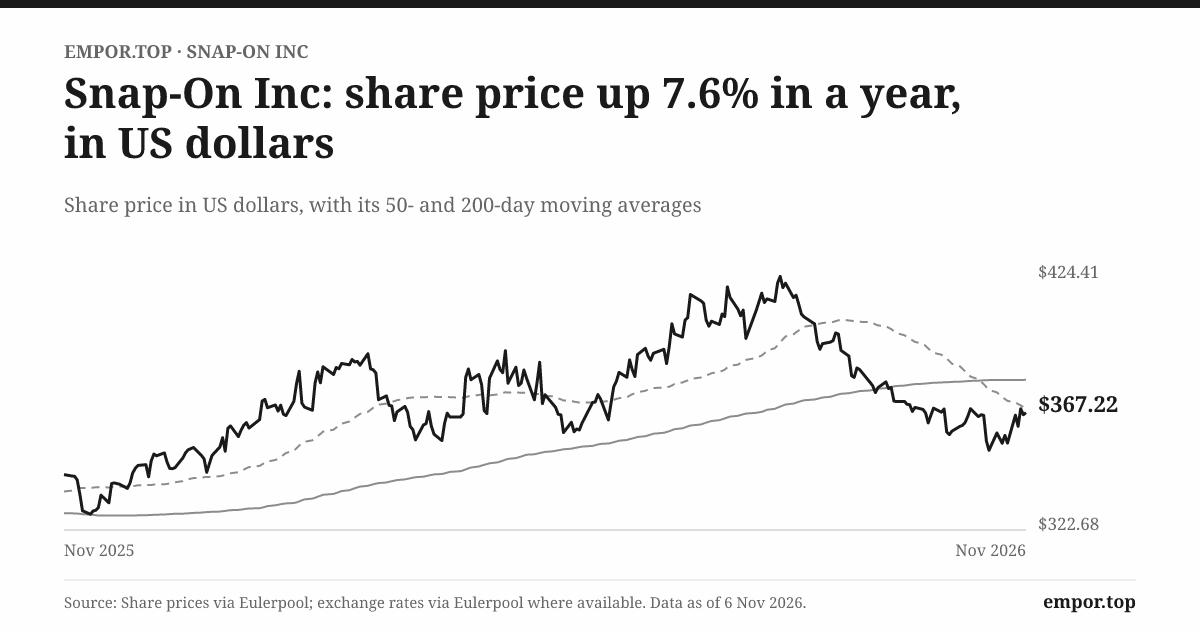
On October 29, 2026, Snap-on's shares closed at about $356, roughly 15% below their high of the previous twelve months.3 At that price the company was valued at about 18.6 times its earnings, about 12.4 times its earnings before interest, taxes, depreciation and amortization once debt and cash are taken into account, and it offered a dividend yield of about 2.7% and a free-cash-flow yield of about 5.5%.3 Those numbers frame the investor's question: is Snap-on a durable, high-quality business available at a reasonable price, or does even this multiple already assume a recovery that has not yet arrived?
A useful way to see what the price implies is to combine the cash yield with growth. If the multiple stays where it is, an investor's return comes roughly from the cash the business produces plus its growth. A 5.5% free-cash-flow yield plus low-single-digit growth points to a mid-to-high single-digit annual return. That is not a forecast; it is arithmetic. It does, however, show that the price is not assuming much heroic growth. It assumes that the cash keeps coming and the business keeps creeping forward.
Compared with nearby companies, the multiple looks modest, but the comparison is imperfect. Around the same date, Stanley Black & Decker traded at about 25 times earnings, Illinois Tool Works at about 25 times, and W.W. Grainger at about 35 times.161718 None of those is a pure peer: Stanley is a broader tool and outdoor-products maker, Illinois Tool Works a diversified industrial company, and Grainger a distributor of industrial supplies.
Mac Tools is part of Stanley and Matco belongs to a larger company, so neither trades on its own. Snap-on's lower multiple may reflect its slower recent growth, its lending exposure, or simply the market's view of its niche. It does not, by itself, imply the stock is cheap.
The bull case starts with quality. Snap-on earns strong returns and converts profits into cash.2 It owns premium products, the densest worksite channel in its market, and a lending arm that helps customers afford them.
That complexity should support demand for diagnostics.8 Industrial customers in aerospace, defense and energy broaden demand beyond the auto repair bay, and that part of the business is growing.4 The balance sheet remains strong.9
The bear case starts with growth. Recent slowing growth is the central risk.42 Premium tools face cheaper retail and online substitutes, and the van channel depends on the financial health of thousands of small-business owners whose own economics the company does not disclose.
The data business that is supposed to carry the next chapter remains unquantified, and its most powerful competitors include the car manufacturers themselves.2 And the lending arm, which produces about a fifth of segment profits, is exactly the kind of business that looks excellent until a recession arrives.2
Hamilton Helmer's framework of seven sources of lasting competitive advantage offers a sharper way to weigh those cases. Of the seven, Snap-on's evidence is strongest for scale economies in distribution: a larger route network produces more sales per stop and supports investment in brand, training and financing that smaller rivals struggle to match. It has a meaningful brand, in the sense that technicians appear willing to pay more for the name in categories where failure is costly, though the size of that premium is not published.
It has some switching costs in its software and financing relationships, but the company does not disclose the retention figures that would measure them. It has a cornered resource of sorts in its proprietary repair data, though carmakers hold more of the underlying truth. Network effects, counter-positioning and process power are weaker or unproven: RCI is a real operating discipline, but it is the kind of lean manufacturing practice that competitors can and do adopt.
The technology risks are real but undecided. Electric vehicles still need repairs, diagnostics and tools, but they have fewer moving parts in some systems and different ones in others, and the net effect on Snap-on's tool demand is not yet clear. Artificial intelligence could make Snap-on's repair databases more powerful, or it could let carmakers and software companies give away the kind of diagnostic guidance Snap-on sells. Neither is yet a disclosed profit pool or a disclosed loss.
The balance sheet does not present a near-term problem. About $300 million of 3.25% notes mature on March 1, 2027, and the company's $900 million credit line, which runs to September 2028, is undrawn.9 Its covenant ratios sit comfortably inside their limits.9 That maturity is something to watch, not a refinancing crisis.
Currency is a second-order risk: about 29% of 2025 revenue came from outside the United States, and the company hedges its net exposures with forward contracts, so foreign-exchange losses after hedging ran between about $4 million and $11 million a year from 2023 to 2025, small against a billion dollars of profit.2
Translation can still move reported sales and margins from quarter to quarter, as it did in the first quarter of 2026, when currency trimmed the operating margin.8 Ownership is dominated by index funds: Vanguard held about 12% of the shares and BlackRock about 8% according to the 2026 proxy, and there is no controlling holder or activist on the register.13
The conditional verdict is straightforward. Snap-on shows strong returns and a cash-rich balance sheet, and its multiple sits below those of nearby industrial companies. But the investment case does not turn on whether the multiple looks low today. It turns on three things the company will reveal over the coming quarters: whether organic growth recovers in the Tools Group and in repair information, whether credit losses stay contained as technicians grow more cautious, and whether diagnostics becomes a disclosed, durable revenue stream rather than a promising category inside a product business. Those are also, in different words, the lessons the van has been teaching for a century.
XI. Lessons from the Route
The first lesson is the one Johnson taught in 1920: make the job easier first, and the channel earns its keep every week. The socket set and the van both made that promise tangible.
Everything Snap-on has added since, from torque tools to repair databases, has succeeded when it saved a technician time and struggled when it simply added to the catalog. For founders, the point is that distribution is not a separate function from the product. At Snap-on, the weekly visit is part of what the customer is buying. A tool is a product; a tool that arrives on Thursday is a service.
The second lesson is that convenience is a moat only while it saves more than it costs. The van network carries real advantages in access and service, but every one of those advantages depends on a franchisee who has to pay for fuel, inventory and a loan, and on a technician who has to believe the premium is worth paying. The 2026 diesel spike showed how quickly franchisee cash can come under pressure. The route is only as strong as the person driving it.
The third lesson belongs to Snap-on and few other toolmakers: credit can sell the tool and reveal the risk. Its long history of financing premium products makes the point. When you are your customer's banker, every sale is also a bet on their next paycheck.
The fourth lesson is about cash. Snap-on's record of cash generation and returns supports confidence in management's discipline, but it does not prove that every dollar returned was worth more to shareholders than another dollar invested in software, data or a larger deal. Cash is a strategy only when each use of it earns its return.
XII. Epilogue
Tonight, the vans are back on their routes. Somewhere a franchisee is deciding whether to refill the shelves this week or wait one more month. Somewhere else a technician is deciding whether this is the year to finance a new tool chest. And in Kenosha, Snap-on's managers are getting ready to explain, early in 2027, whether those two decisions started moving in the same direction again.
The next results will be harder to read than usual. Snap-on's fiscal 2025 had an extra, 53rd week in its fourth quarter, while fiscal 2026 is a normal 52-week year,27 so the coming fourth-quarter comparison will look worse than the underlying trend. Investors will need to look past the headline to the organic growth figures. If the Tools Group's organic decline narrows sharply, and if franchisees start restocking, the pause thesis will look right. If the decline persists after diesel stabilizes, the explanation will have to change.
Three other moments will matter. The first is the next annual report, which will publish a fresh table of technician loans by the year they were made and how much of each batch was written off. That table will show whether the loans made during this cautious period are performing worse than earlier ones.
The second is whether repair information and diagnostics can grow without help from car-company programs, a test of whether the data story is a growth engine or a cycle. The third is whether Snap-on begins disclosing what investors have long wanted to see: the share of its revenue that comes from subscriptions, and how many of those subscribers renew. Until it does, the most promising part of the business remains the hardest to measure.
Beyond the numbers, there is a longer clock. That March 2027 bond maturity is manageable for a company with more cash than debt.9 And at some point Snap-on will have to hand its system to a leader other than the one who has run it for almost two decades.
Each of the story's central questions has an answer that is coming, not merely a debate. A channel restock and recovering organic growth would support the idea of a pause. Persistent weakness, worsening credit or flat diagnostic growth would narrow the moat and lower the growth outlook. Either way, the answer will be written first not in Kenosha but in the parking lots, one van stop at a time.
XIII. Outro
Snap-on began with its interchangeable socket set. It grew by reducing something else: the distance between the mechanic and the tool. First the salesman came to the shop, then the van, then the loan that let the mechanic take the tool home today, and then the database that told the mechanic which tool to reach for.
That is what makes Snap-on distinctive among tool companies. Its storefront drives to its customer, its cash register doubles as a bank, and its next chapter depends on whether it can be as useful when the repair is digital as when it simply needs a wrench. The van pulls away from the shop. The technician stays at work, with the right tool in hand. Whether that system keeps earning its premium is still being decided, one weekly visit at a time.
References
-
2025 Form 10-K — Snap-on Incorporated, 2026-02-12 ↩↩↩↩↩↩↩↩↩↩↩↩↩↩↩↩↩↩↩↩↩↩↩↩↩↩↩↩↩↩↩↩↩↩↩↩↩↩↩↩↩↩↩↩↩↩↩↩↩↩↩↩↩↩↩↩↩↩↩↩↩↩↩↩↩↩↩↩↩↩↩↩↩↩↩
-
Q3 2026 Earnings Release — Snap-on Incorporated, 2026-10-22 ↩↩↩↩↩↩↩↩↩↩↩↩↩↩↩↩↩↩↩↩↩↩↩↩↩
-
Snap-on (SNA) Q3 2026 Earnings Call Transcript — The Motley Fool, 2026-10-22 ↩↩↩↩↩↩↩↩↩↩↩↩↩↩↩↩
-
Snap-on (SNA) Q1 2026 Earnings Call Transcript — The Motley Fool, 2026-04-23 ↩↩↩↩↩↩↩↩↩↩↩
-
Q3 2026 Form 10-Q — Snap-on Incorporated, 2026-10-22 ↩↩↩↩↩↩↩↩↩↩↩↩↩
-
Snap-on Announces Second Quarter 2026 Results, Form 8-K Exhibit — Snap-on Incorporated, 2026-07-23 ↩↩↩↩
-
2026 Annual Meeting Results, Form 8-K — Snap-on Incorporated, 2026-04-30 ↩↩
-
Q2 2014 Form 10-Q (Pro-Cut acquisition) — Snap-on Incorporated, 2014 ↩↩↩
-
Stanley Black & Decker (SWK) Stock Data — Stock Analysis, 2026-10-29 ↩
-
Illinois Tool Works (ITW) Stock Data — Stock Analysis, 2026-10-29 ↩
-
W.W. Grainger (GWW) Stock Data — Stock Analysis, 2026-10-29 ↩
 LinkedIn
 WhatsApp
 Reddit
 Hacker News
 Email
 Kindle
 RSS Feed
 Spotify
 Apple Podcasts
 Amazon Music
 Audible
 YouTube