Sylvamo: The Paper Company That Had to Get Smaller
I. The $199 Million Loss That Wasn’t the Whole Story
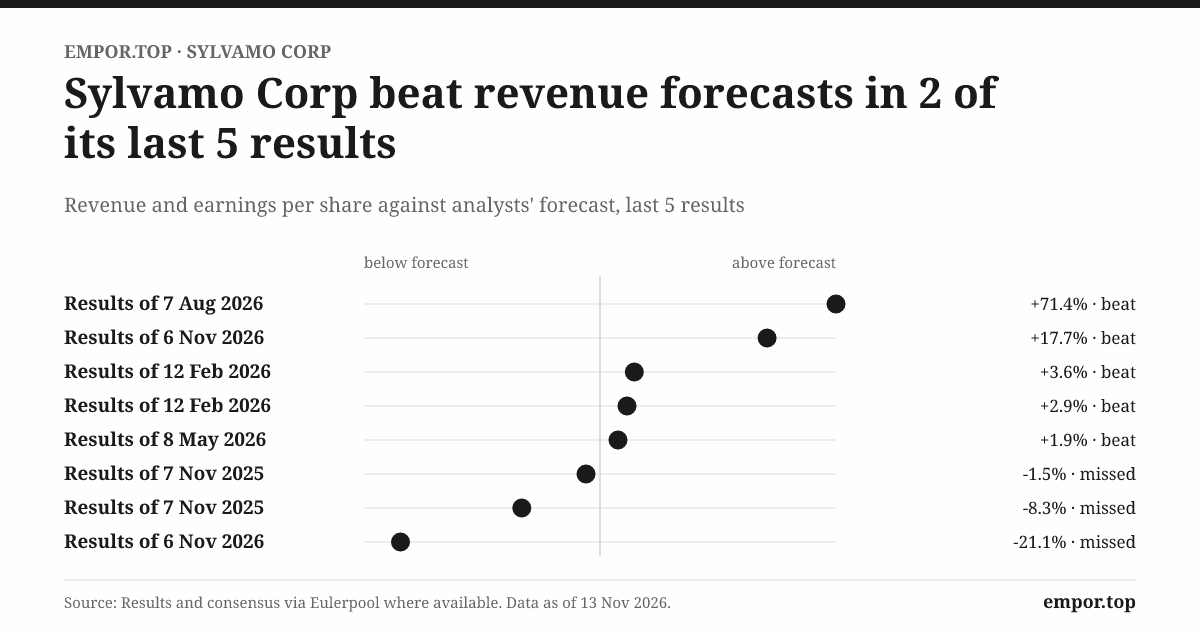
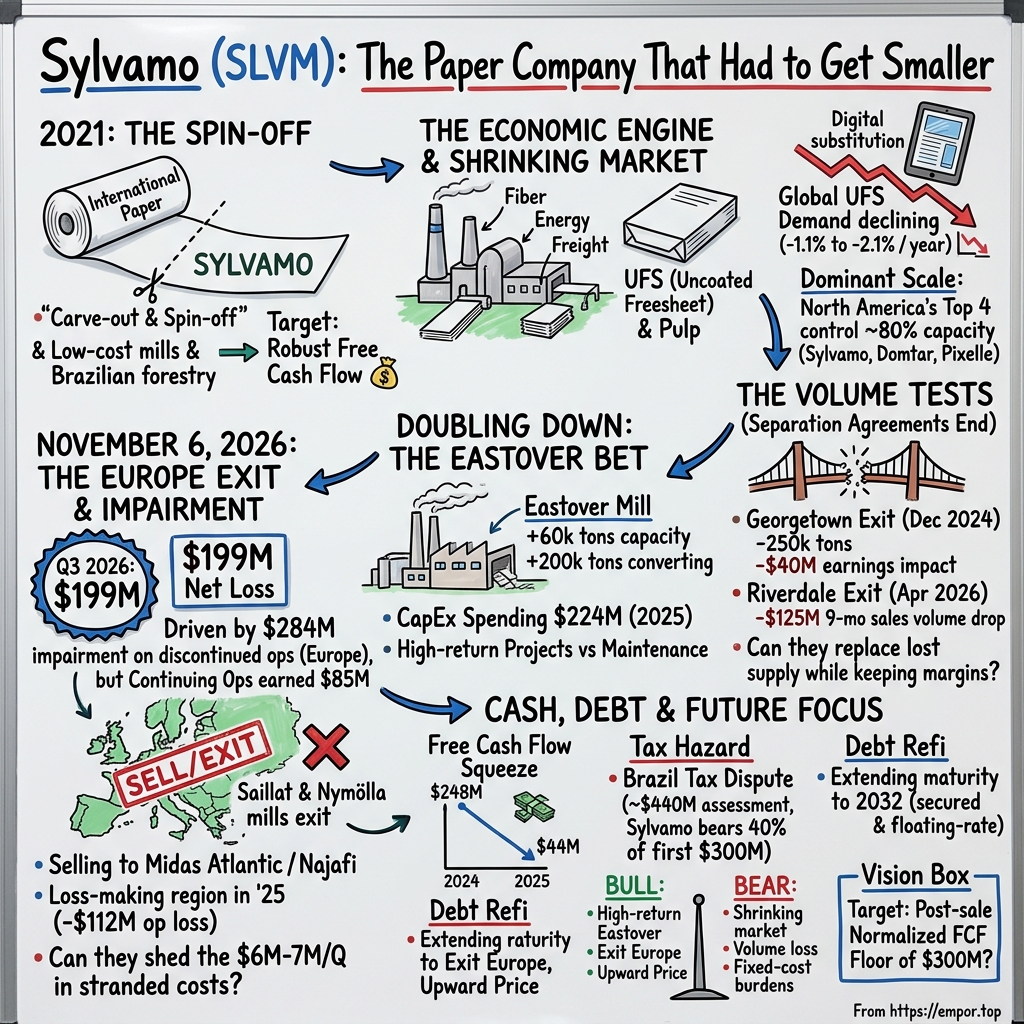
On the morning of November 6, 2026, Sylvamo reported its third quarter, and the headline was ugly. The company that calls itself the world's paper company lost $199 million in three months, or almost five dollars a share.1 For a business whose market value sat around $1.5 billion a week later, that is the kind of number that makes an investor put down the coffee.1 On the same morning, management announced that it would leave Europe. The Saillat mill in France's Limousin countryside, the Nymölla mill on the Swedish coast, the forests and the sales offices that supported them would pass to a new owner led by Midas Atlantic Partners, in partnership with The Najafi Companies.2
The two pieces of news were really one piece of news. Almost the entire loss came from the business being sold. Once Sylvamo agreed to part with Europe, accountants had to mark the European assets down to what the deal implied they were worth, and that write-down drove a $284 million loss from discontinued operations.1 Strip it out and the mills that Sylvamo is keeping, in the United States and Brazil, earned $85 million in the quarter, a respectable 13 cents of profit on every dollar of sales.2 So the worst-looking quarter in the company's short public life was also, underneath, one of its better operating quarters of the year.
That is the comforting reading, and it is only half true. The European business was not a small appendage. It sold $741 million of paper and pulp in 2025, roughly a fifth of the company, and it lost $112 million at the operating line doing so.3 A business that size does not swing to a nine-figure loss and then get handed to a buyer for a share of its future distributions unless something has gone badly wrong. The impairment is an accounting entry; the decision behind it is an admission. The global footprint that Sylvamo carried out of International Paper in 2021, with mills on three continents, was not earning its keep.
That admission frames the whole story. Sylvamo sells uncoated freesheet, the plain white paper that goes into office printers, envelopes, forms and books, along with market pulp. It is a product that the world needs a little less of every year. The company's bet, from the day it was spun off, was that a low-cost producer can make good money in a shrinking market if it runs the right mills in the right places and refuses to chase volume it cannot profit from. November 2026 was the moment that bet narrowed. Sylvamo is choosing to become smaller on purpose, and the question is whether smaller will also mean better.
Four questions carry the story from here. The first is whether the 2021 spin-off created a durable standalone business or simply relabeled a division that had always leaned on its parent. The second is whether Sylvamo's cost position can outrun the steady fall in paper demand, because a cost advantage in a shrinking market buys time, not immunity. The third is whether the company can replace the volume it lost when International Paper's Riverdale mill stopped supplying it, without surrendering the price and margin that make the remaining volume worthwhile. The fourth is whether leaving Europe will improve returns enough to support the debt, the reinvestment and the dividend that shareholders have come to expect.
It helps to be precise about who the protagonist is. Sylvamo is a Delaware company listed on the New York Stock Exchange, and it has been fully independent of International Paper since IP sold its last shares in 2022.4 International Paper is still in the story, as a former parent, a counterparty to supply agreements and a partner in a Brazilian tax fight. But IP's packaging empire, its boxes and containerboard, is not Sylvamo's business and is not Sylvamo's growth story. When IP converts one of its own paper mills to make containerboard, that matters to Sylvamo only because it changes who supplies white paper and who buys it.
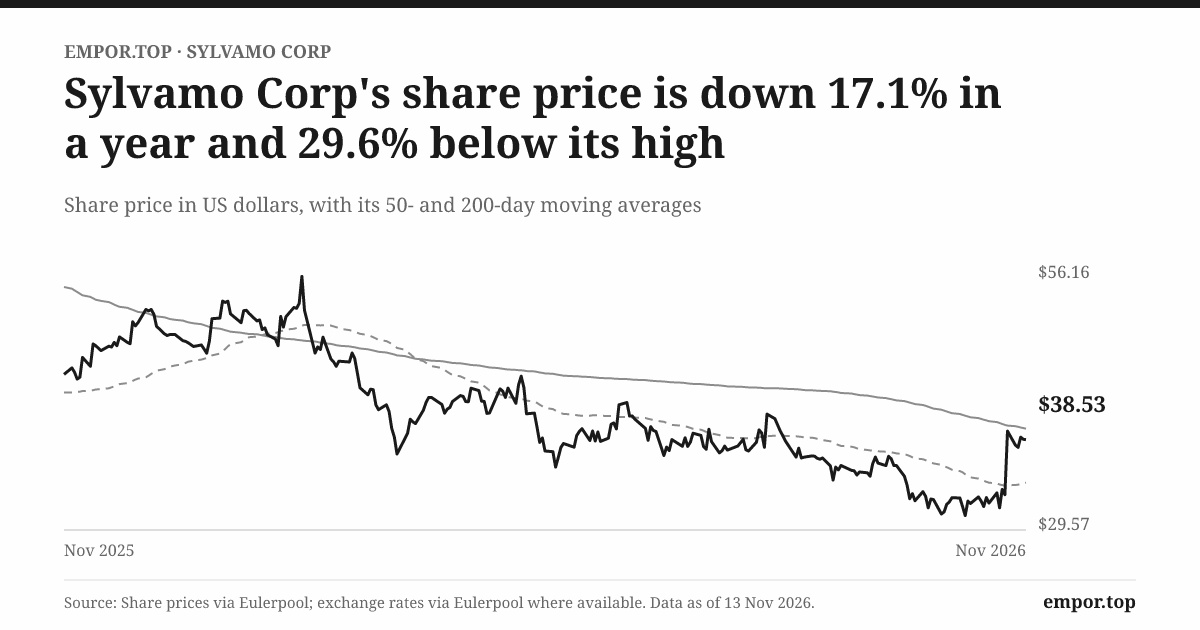
The market's verdict on all this was cautious. The shares closed at $38.53 on November 13, nearly 30% below their 52-week high.1 The headline loss masks a profitable continuing business, but the sale is also a confession that the old shape did not work. Whether the new shape works depends on what Sylvamo inherited in 2021, and on how much of that inheritance was really an asset.
 Subscribe on LinkedIn
II. The Spin Was a Bet on Staying in Paper
On October 1, 2021, International Paper handed most of its paper business to its own shareholders. For every eleven IP shares they held, investors received one share of a new company called Sylvamo, and with that distribution IP gave away 80.1% of the newcomer while keeping 19.9% for itself.4 There was no roadshow in the usual sense, no bankers building an order book, no IPO price. A spin-off is a corporate divorce in which the children get stock. The shareholders who woke up owning Sylvamo had not chosen it; they had chosen International Paper, and IP had decided that its future lay in packaging.
That decision tells you what IP thought of white paper. Corrugated boxes rode the e-commerce wave, while printing paper had been in slow retreat since the office went digital. IP's management wanted a cleaner packaging story, and the cleanest way to get one was to set the paper mills free. The new company's leaders had to argue the opposite case: that a business IP no longer wanted could thrive once it stopped being an afterthought inside a packaging group.
They made that argument at an investor day on September 9, 2021, a few weeks before the separation. The pitch centered on low-cost mills in attractive regions, a Brazilian forestry base that supplied cheap eucalyptus fiber, strong brands such as Hammermill in North America and Chamex in Brazil, and above all cash. Management described a business built to produce robust, resilient cash flow, and it pointed to more than $100 million of high-return projects with potential internal rates of return above 25%.5 The message to investors was simple. This would not be a growth story. It would be a cash story, and the cash would be returned.
The man delivering that message was Jean-Michel Ribiéras, the long-serving International Paper executive who became Sylvamo's chairman and chief executive. His finance chief was John Sims, a 27-year IP lifer who had run the North American papers business and IP's operations in Europe, the Middle East, Africa and Russia before becoming Sylvamo's first CFO.6 They were not outsiders brought in to shake up a tired division. They were the people who had run it, and the spin asked them to prove that the same assets could do more under their own flag.
The financial history attached to Sylvamo needs care. The figures from 2018 to 2020 are the combined accounts of a carved-out business, a division's results reassembled after the fact, not the record of a company that had to fund itself.4 That is why the long-run numbers look strange. The equity on the balance sheet collapsed from about $2.1 billion at the end of 2020 to under $200 million a year later, while borrowings jumped from almost nothing to about $1.4 billion.3 That is the fingerprint of a spin: before IP let the company go, Sylvamo borrowed and sent cash to its parent. The newborn company began life with a heavy debt load and a thin equity cushion, and the early years of its public life were spent working that down.
The separation left behind more than debt. Sylvamo got the mills, the brands and the Brazilian forests, but it also got a set of transitional agreements with IP. Some of those agreements let Sylvamo buy paper from IP mills that were staying with the parent, notably Georgetown in South Carolina and Riverdale in Alabama, and sell that paper to Sylvamo's customers.3 This made sense on day one. It kept customers supplied with the full range of product they were used to and kept the order book intact. But it meant that a meaningful slice of Sylvamo's sales came from mills Sylvamo did not own and could not control, and that the former parent kept a hand inside the operating model. Those agreements had termination rights. The bridge was always going to end.
In the first two years, the cash story looked like it was working, and the portfolio began to move. Russia's invasion of Ukraine forced Sylvamo out of its Svetogorsk mill near St Petersburg, which it sold in October 2022 to a management buyout vehicle for $420 million, and the company said $325 million of the proceeds would go to repay debt.7 Russia had been about 15% of revenue, and the forced exit removed a meaningful slice of the footprint before the company had even settled into its new shape.7 Weeks earlier, in September 2022, International Paper had sold its last stake.4
Then, on January 2, 2023, Sylvamo did something that runs against the shape of this story. It bought a mill. Stora Enso, the Finnish forest-products group, was leaving the paper business, and Sylvamo paid about €150 million for Nymölla in Sweden, a two-machine site with capacity of roughly 485,000 tonnes of paper and its own pulp lines.8 Ribiéras said the mill strengthened Sylvamo's uncoated freesheet mix.8 Nymölla was not a transformative acquisition, and it was paid for with cash rather than shares. But it was the biggest outside purchase Sylvamo made as a public company, and less than four years later it is one of the two mills being handed to a new owner along with a write-down. Any account of Sylvamo's capital allocation that calls it disciplined has to sit next to that fact.
The rest of the post-spin capital story is internal. There has been no merger that defines the company. The money has gone into mill maintenance and upgrades, debt reduction, a dividend that began in 2022, and share repurchases.3 That is the shape management promised. The difficulty is the most recent result. Free cash flow, the money left after keeping the mills running and investing in them, was $248 million in 2024 and $44 million in 2025.3 A business pitched on robust, resilient cash flow produced, in its fourth full year, about a sixth of what it produced the year before.
That collapse does not by itself refute the spin's logic. A paper company's cash flow swings with the cycle, and 2025 was a bad year for paper prices, outages and lost volume. But it does mean the first public-company years are too short to prove the claim either way. Sylvamo has existed as an independent company for five years and has not yet shown what it earns across a full cycle, with good years and bad years averaged out. The promise was robust, resilient cash flow. The record so far is robust in some years and fragile in others. To understand which is the normal state, one has to go inside the mill and look at how a ton of paper makes or loses money.
III. A Ton of Paper Is Won at the Mill, Then Sold in a Shrinking Market
Follow a single sheet of copy paper backward from the printer tray. Before it was a ream on a distributor's shelf, it was a carton on a truck, and before that a jumbo roll the size of a small car spinning off the end of a paper machine at Eastover, South Carolina, or Mogi Guaçu in Brazil. Before that it was pulp: wood chips cooked in chemicals until the fibers separated, washed, bleached and poured as a watery slurry onto a moving wire screen that runs the length of a building. Water drains, rollers press, steam-heated cylinders dry, and a continuous sheet emerges, several meters wide, at speeds a car would struggle to match on a city street.
Every step of that journey costs money, and most of the cost does not care how much paper the mill sells. The machine, the boilers, the pulp line and the people who run them are there whether the order book is full or half empty. That is the first rule of paper economics: it is a fixed-cost business, so profit depends heavily on keeping the machines running flat out. The second rule is that the variable costs are commodities. Wood fiber, natural gas and electricity, caustic soda and other chemicals, and diesel for the trucks all move with markets that no paper company controls. The third rule is that the selling price is set by supply and demand, not by the mill. Sylvamo describes the industry's pricing in exactly those terms.3
So the economic engine is easy to state and hard to run. Revenue is tons sold multiplied by price, adjusted for mix, because a ton of branded cut-size paper in reams is worth more than a ton of offset rolls sold to a printer. Against that comes the cost of fiber, energy, chemicals and freight, and the cost of downtime, which includes the planned maintenance outages that every mill takes and the unplanned breakdowns that every mill dreads. Sylvamo sells through direct relationships with large customers and through agents, resellers and distributors, and its customers generally have no minimum purchase commitments.3 Nobody signs a ten-year contract for copy paper. They buy what they need, from whoever offers a good price and reliable delivery.
The ground beneath all of this is shrinking. Global demand for uncoated freesheet fell at about 2.1% a year from 2019 to 2025, and at about 1.1% a year from 2021 to 2025, after the pandemic's sharpest hit had passed.3 The cause is not mysterious. Bills went paperless, forms went online, offices printed less and stored documents in the cloud. Sylvamo itself lists digitization and electronic media as structural pressures on demand for graphic papers.3 Artificial intelligence is not a direct substitute for a sheet of paper, but it pushes in the same direction by making digital workflows easier still. A business in this market is walking up a down escalator. It can make progress, but only by walking faster than the stairs fall.
The thing that has kept paper companies profitable on that escalator is supply discipline. When demand falls, the weakest mills close or convert to other grades, and if capacity shrinks faster than demand, prices hold or even rise. North America is a concentrated market for that reason: Sylvamo says the four largest producers of uncoated freesheet account for about 80% of North American capacity.3 The leading names are Domtar, now part of Paper Excellence, Sylvamo itself and Pixelle.3 Sylvamo does not publish a current market-share table, and older third-party estimates of each producer's capacity are best read as directional. What matters is the shape: a handful of producers, each aware that adding capacity in a shrinking market is a way to destroy everyone's prices.
International Paper's own decisions have been one of the biggest sources of that discipline. When IP closed Georgetown and then converted Riverdale to containerboard, it took capacity out of white paper. On the second-quarter 2026 call, CFO Don Devlin said the Riverdale conversion alone removed about 7% of annual industry supply.9 For Sylvamo this was a double-edged sword. Losing Riverdale's supply cost it volume, but the industry losing Riverdale's capacity supported the price of every ton Sylvamo still made. That tension will run through the rest of this story.
Does Sylvamo have a real advantage, or is it simply a big supplier in a shrinking commodity market? The bull case rests on four assets. The first is low-cost mills: large, integrated sites that make their own pulp, sitting in the lower part of the industry cost curve. The second is Brazilian forestry. Eucalyptus planted in Brazil grows to harvest in about seven years, far faster than the pine and hardwood of the American South or Scandinavia, and owning the forests gives the Latin American mills cheap, secure fiber. The third is brands, which let Sylvamo sell reams under familiar names. The fourth is channel relationships with the distributors and office suppliers who decide what goes on the shelf.
Those assets are plausible sources of advantage, and Fitch cited low-cost scale and Brazilian forestry as strengths when it rated the company in 2024.10 But the company's own disclosures do not prove how much protection they buy. Sylvamo does not publish a customer-retention rate, a win rate on large accounts, or a mill-by-mill comparison of its costs against rivals. There is no switching cost when a distributor moves its copy paper order to Domtar, and no contract that stops it doing so. The advantage, where it exists, is operational: it shows up in a lower cost per ton and a higher operating rate, and it has to be earned again every year.
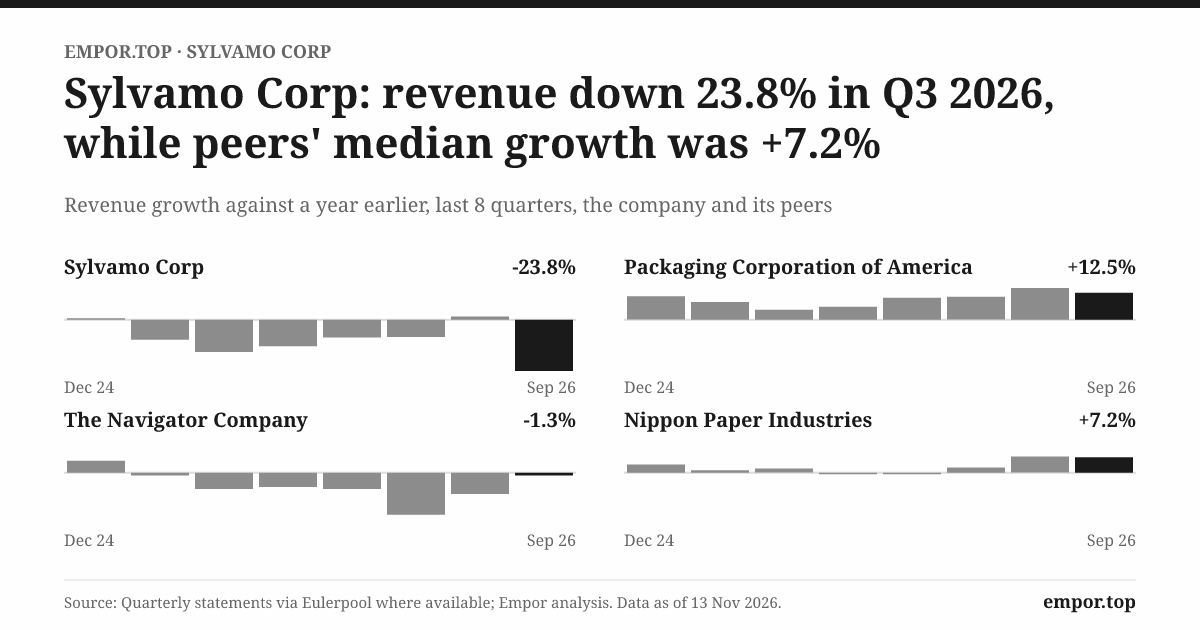
The record of 2025 shows how that advantage holds up when tested. Sales fell 11.2% for the year, and operating profit fell from $444 million to $249 million.3 Higher prices and a better mix helped at the margin, but the volume losses were material, and most of them came from the end of the Georgetown supply arrangement. Demand fell, customers did what customers without commitments do, and the company could not hold its tonnage. The lesson is not that Sylvamo lacks an edge. It is that the edge is a cost edge, and a cost edge protects margin on the tons you keep; it does not guarantee you keep the tons.
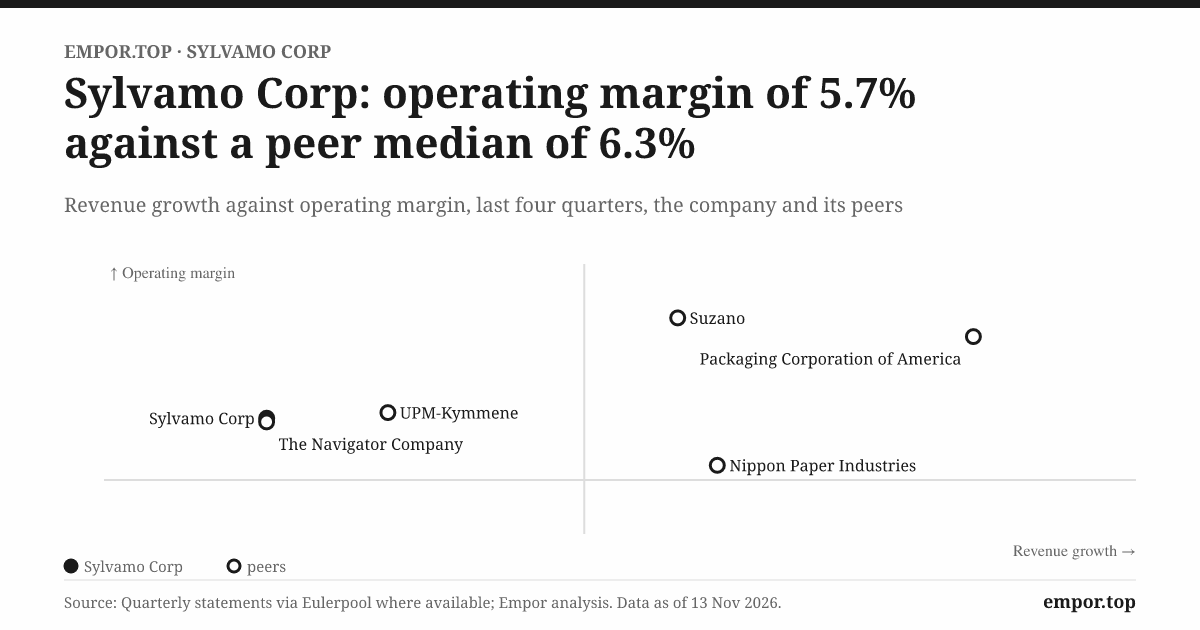
The regional profit pool makes the real shape of the company plain. In 2025, North America sold about $1.75 billion of paper and earned $263 million of segment operating profit, about 15 cents on the dollar.3 Latin America, built around the Brazilian mills and forests, sold about $900 million and earned $100 million, about 11 cents on the dollar.3 Europe sold $741 million and lost $112 million.3 Put those numbers side by side and the European decision almost makes itself. North America is the earnings anchor. Latin America is profitable diversification with a fiber advantage. Europe, which had earned $10 million the year before, was destroying value at a rate that consumed more than the entire profit of the Latin American business.3
The verdict on the moat, then, is narrower than the investor-day pitch. Scale, forests and regional spread support a genuine cost position, but the evidence does not establish pricing power or customer lock-in. Prices move with industry supply, and customers can walk. Sylvamo's advantage is the kind that must be demonstrated in mill costs, uptime and margins every quarter, while the market contracts beneath it. The metric that would confirm a durable edge is North American segment margin holding in the mid-teens even as volume falls. The event that would challenge it is a quarter in which price increases fail to stick because rivals or imports undercut them. And the most direct test of all came when the supply bridge from International Paper collapsed and the customers it had served had to be won again.
IV. Georgetown Was the Rehearsal; Riverdale Was the Bigger Test
Picture the problem from the customer's side. For years, a large office-supply distributor has received a certain grade of paper, made at an International Paper mill and sold to it by Sylvamo. Then the mill stops making it. Sylvamo would like the distributor to switch to the same kind of paper made at a Sylvamo mill, perhaps under the same brand. But the distributor's buyer has no contract that obliges it to stay. It can ask for quotes from Domtar, from Pixelle, from importers bringing paper in from Brazil, Indonesia or Portugal. The order does not follow Sylvamo home automatically. It has to be re-won, and the price of re-winning it is set by whoever else wants the business.
That is the situation the separation agreements created in slow motion. When the spin was designed, supply and offtake agreements with IP were the bridge that kept Sylvamo's customers whole. The bridge carried paper from IP's Georgetown and Riverdale mills to Sylvamo's customers. But the agreements came with termination rights, and IP had every reason to use them: white paper was the business it had just exited.3 The bridge was temporary by design, and everyone knew it. The only uncertainty was when it would end and how many customers would still be on the Sylvamo side when it did.
Georgetown came first. In October 2024, Sylvamo announced that the Georgetown supply agreement would end in December 2024 by mutual agreement, as IP moved to close the mill.11 The numbers were stark. Georgetown had been expected to supply about 250,000 tons in 2024. Sylvamo said it had retained and qualified roughly 100,000 tons of that business on its own mills, and it expected the exit to cut earnings by about $40 million at 2024 margins.11 Put plainly, Sylvamo kept about two-fifths of the volume and let the rest go. Management's argument was that it kept the profitable products, the cut-size reams and grades its own machines could make well, and walked away from tons it could not serve profitably.
The 2025 accounts show what that choice cost. North American sales fell by $275 million. Lower volume took out $292 million, primarily because of Georgetown, while higher price and mix added only $19 million back.3 The price gains were real but small next to the lost tonnage. That is Georgetown's verdict in one relationship: management could protect the quality of the business it kept, but it could not replace the quantity it lost. Price and mix are a useful lever in a fixed-cost business, but they are a lever measured in tens of millions of dollars, and lost volume is measured in hundreds.
Riverdale was the bigger test, because it came at a worse moment. IP's Riverdale mill in Selma, Alabama, was converting to containerboard, and the supply agreement that fed Riverdale paper to Sylvamo's customers ended in April 2026.1 Devlin told analysts in August that the Riverdale volume had run at a little less than 100,000 tons a year, and that about 90,000 tons had come through by April.9 Sylvamo also booked a $10 million charge tied to Riverdale in the first quarter.9 Management's framing was set early. On the second-quarter call, Sims described 2026 as a transition year to work through the termination of the Riverdale supply agreement.9
The first nine months of 2026 show what that transition looked like in the accounts. Lower sales volume cut revenue by $125 million, primarily because Riverdale had ended, while higher price and mix added $17 million.1 It is Georgetown again in smaller numbers: price helps, volume hurts more. The third quarter was more encouraging. Price and mix improved by $25 million from the second quarter, while volume was roughly flat as stronger Latin American sales offset lower North American volume from the Riverdale loss.2 Devlin said most of the previously announced price increases had been realized across the regions, and that North American supply and demand remained healthy.2 Some of that health is the consequence of Riverdale itself. With 7% of industry supply removed, the remaining producers found it easier to make a price increase stick.
Listen to the three 2026 calls in sequence and the story management tells evolves in a revealing way. In the first quarter, results were weak; Sylvamo reported a small loss as Riverdale, outages and high costs bit.12 By the second-quarter call, the explanation had a name: transition year. Management guided to a much stronger second half, with $75 million to $85 million of benefit from price and mix versus the first half, about 70% of it from pure price.9 By the third quarter, adjusted EBITDA had nearly doubled sequentially to $128 million.2 The prepared remarks were consistent and the direction matched the guidance. That is a point in management's favor: it said the second half would be better, and it was.
The Q&A tells a more guarded story. Analysts asked, in several ways, how much of the Riverdale volume Sylvamo had actually replaced, and what customers had done. Management gave concrete answers on price, outages and costs. It gave no number for retained or replacement tons. In the third quarter, Sims spoke about setting a new standard for customer experience and loyalty, and on the second-quarter call management laid out 2030 goals for customer satisfaction scores and perfect-order rates.29 Those are aspirations, not outcomes. Devlin did say North American volume would be relatively flat in 2027, which implies the company expects to stabilize rather than recover the lost tons.2 The most useful sentence on replacement came from the Eastover discussion: once the Riverdale loss and Eastover's added capacity work through, Devlin described the net reduction as about 40,000 tons.9 In other words, Sylvamo is not winning the Riverdale customers back. It is building more of its own paper to fill part of the hole.
Customer power hangs over all of this. In 2025, Sylvamo's ten largest customers accounted for about 41% of sales, and one of them accounted for about 15%.3 The company does not name them. Nor does it publish an ageing table for its receivables or customer-specific credit terms. What it does disclose is suggestive: the allowance for credit losses rose from $14 million at the end of 2025 to $17 million in September 2026, and the nine-month results included a $3 million provision for credit losses on customer receivables.1 Those are small numbers next to $300 million of receivables, but they bear watching in a business where one customer is a seventh of sales and has no obligation to keep buying.
Georgetown showed that management could keep the more profitable products but not the full volume. Riverdale is the larger current proof, and the scorecard so far is mixed. Price has held, helped by the very capacity closures that cost Sylvamo its supply. The replacement volume has not been specified. A fixed-cost mill business cannot run on price alone for long, because every ton that disappears leaves the overhead behind it. That is why the answer to Riverdale is not only a sales story. It is a construction project, and it is happening at Eastover.
V. Eastover Is the Bet That the Remaining Mills Can Do More
Eastover sits on the flat land southeast of Columbia, South Carolina, near the Wateree River, and it is the kind of mill that justifies the low-cost claim if any mill does. In late 2026 it is also a construction site. Crews are modernizing the woodyard, where logs arrive and are debarked and chipped, and adding a new softwood line that the company says is due to start in the first quarter of 2027.9 Engineers are speeding up a paper machine, squeezing more tons from equipment that already exists. And the mill took an extended outage of about 50 days, longer than the 45 days originally planned, to do the work.29 For nearly two months, one of Sylvamo's best mills was making less paper on purpose, in a year when the company could least afford it.
The logic is straightforward. With Riverdale gone, Sylvamo cannot build a new mill in a shrinking market, and nobody would lend it the money to try. What it can do is get more out of the mills it already owns. The company says the paper-machine work at Eastover targets about 60,000 additional tons a year; by November, management said it was about 60% complete, on schedule and on budget, with ramp-up to begin early in 2027.2 More tons from the same fixed costs means a lower cost per ton, which is the cleanest way to strengthen a cost advantage.
The second half of the plan is about converting. Paper leaves the machine as a giant roll; to become cut-size reams for printers, it must be sheeted, cut and wrapped. If the machine makes more paper but the sheeters cannot keep up, the extra tons must be sold as lower-value rolls or converted elsewhere at extra cost. So Sylvamo bought a new sheeter, which passed acceptance testing in June 2026.9 By the third-quarter call, management said the plan had shifted: the sheeter will go to the Sumter site, where Sylvamo will keep its two existing sheeters and add the new one, giving Sumter 500,000 tons of cut-size capacity, an increase of about 200,000 tons.2 That change came with costs. Management said the revised plan needs about $25 million of additional capital in 2027 for Sumter's infrastructure, and that the company will carry about $20 million of extra converting costs in 2027 until the new sheeter runs, with startup expected around the middle of the year.2
Management's claims for the projects are ambitious. On the second-quarter call it said the paper-machine speed-up and the sheeter would together deliver about $50 million a year of benefit, with $30 million to $40 million arriving in 2027, and that four projects, including a warehouse sale-leaseback, would add about $55 million a year.9 In November, it said the combined project should still exceed a 30% internal rate of return even with the extra Sumter spending.2 Those are management estimates. A stated return is a forecast built on assumptions about price, volume and cost; a realized return is what shows up in the cash flow statement after the project is finished.
To judge whether the investment is enough, separate the maintenance from the growth. In 2025, Sylvamo spent $224 million on capital projects, about 6.7% of sales. Most of it, $162 million, went to maintenance, regulatory work and reforestation, the cost of keeping mills safe, compliant and supplied with fiber.3 Only $62 million went to what management calls high-return projects.3 In the first nine months of 2026, spending was $156 million, including $57 million of high-return work, and the company expected about $105 million of such spending for the year.1 That is roughly a doubling of growth investment, undertaken while free cash flow was close to zero. It is not reckless on its own; the money is going into the core assets, not into an acquisition. But it shows how little room there is. When maintenance alone consumes most of operating cash in a bad year, every growth dollar is a dollar not paid to shareholders or used to cut debt.
The timing cost is already visible. On the third-quarter call, Devlin quantified the Eastover-related drag on 2026 at about $65 million, of which about $25 million will not recur in 2027 because the extended outage is a one-time event.2 Working capital also absorbed $42 million in the third quarter, mostly because North America built inventory to keep customers supplied while Eastover was down.2 Investment in a downturn is the right instinct in a fixed-cost business, because projects are cheaper to execute when demand is soft and the capacity is ready when it returns. But the instinct has a price, and in 2026 shareholders paid it in cash flow.
There is also an earlier promise to measure this one against. At the 2021 investor day, management pointed to more than $100 million of projects with potential returns above 25%.5 Five years later the company is still describing high-return projects, now with a 30% target, but the consolidated record does not yet show the earlier wave in its returns. Return on invested capital was about 23% in 2024 and about 10% in 2025.3 That decline mostly reflects lower prices, lost volume and Europe's losses, which overwhelm whatever the earlier projects added. The point is not that the projects failed. It is that, from the outside, there is no way to isolate their contribution, because Sylvamo reports project returns as intentions and consolidated returns as outcomes, and never connects the two. The proof will have to come in specific figures: Eastover's delivered tons, its unit cost, the length of future outages, and free cash flow after the projects are complete.
The people now responsible for that proof are new to their chairs. John Sims became chief executive on January 1, 2026, succeeding Ribiéras, who retired as chairman and CEO at the end of 2025.6 The succession had been planned since April 2025, when the board named Sims chief operating officer and Don Devlin chief financial officer, effective May 1.13 At the same handover, the board separated the roles of chairman and chief executive and named David Petratis, the former lead independent director, as independent chairman.6 Sims joined a seven-member board on which he is the only non-independent director.14
Sims is a finance-and-operations executive rather than a salesman. He spent 27 years at International Paper, running the North American papers business and the region spanning Europe, the Middle East, Africa and Russia, before serving as Sylvamo's CFO from the spin.6 That background matters: he knows these mills, the IP agreements and the European business intimately, because he helped build the structure he is now dismantling. His language on calls is the language of a plant manager with a spreadsheet. He talks about lean manufacturing, continuous improvement, perfect orders, and machine efficiency, and in November management cited about $15 million of annualized benefits identified so far from lean work.2 His long-term target, set on the second-quarter call, is free cash flow of more than $300 million a year and a return on invested capital above 15%.9
His pay is built around long-term equity, as Ribiéras's was. Ribiéras's 2025 total compensation was about $7.7 million, down from $8.4 million in 2024, and included $5.4 million of stock awards.14 Shareholders were not troubled by the pay structure: at the May 2026 annual meeting, say-on-pay received about 30.3 million votes in favor and about half a million against.15 But the old CEO is not the protagonist of what comes next. His pay fell less than the company's free cash flow did, which says something about how executive pay responds to a downturn, but the investor question now is narrower and more urgent. Sims and Devlin have a recovery plan built on Eastover's tons, price discipline and a smaller footprint. The single largest piece of that footprint decision was announced on November 6, and it was not about building anything.
VI. Europe’s Exit: Focus, or a Smaller Company With Stranded Costs?
Saillat-sur-Vienne is a small village in the Limousin, where the paper mill has long dominated the riverbank. Nymölla sits on the Baltic coast of southern Sweden, a mill town built around its pulp lines. On November 6, 2026, the people who work in both learned that their mills were going to a new owner. Sylvamo had signed a put option agreement with Midas Atlantic Partners, in partnership with The Najafi Companies, under which it may sell Saillat, Nymölla and the supporting forestry and business operations once French and Swedish works councils and employees have been consulted.2 Management expects the consultation to finish and the deal to close by the end of the first quarter of 2027, subject to regulatory approvals.2 Until then, it is a proposed exit, not a completed sale.
Three months earlier, the tone had been different. On the second-quarter call, Sims said he was not happy with the European operations, and Devlin called European margins unacceptable.9 Asked whether Sylvamo would sell or close the business, Sims said the options were essentially everything, and that a decision would probably come in 2027.9 The decision came faster than he had indicated. That can be read two ways. A generous reading is that management found a buyer sooner than expected and moved decisively. A skeptical reading is that the European problem was more urgent than the August language suggested. Both readings end in the same place: Europe could not stay.
The deterioration was swift. Europe earned $10 million of segment operating profit in 2024 and lost $112 million in 2025.3 The company attributed the swing to lower prices and a weaker mix, heavy maintenance outages, higher operating costs and expensive wood.3 European paper mills face many of the same pressures as American ones, falling demand and powerful competitors, plus higher energy costs and, in Sweden and France, wood markets where Sylvamo did not own its forests the way it does in Brazil. Without the fiber advantage that makes Latin America profitable, Europe was a high-cost producer in a crowded market. That is not a business a low-cost strategy can defend.
It is worth being clear about what the accounting does and does not say. The large impairment in the third quarter reduced reported earnings, because Sylvamo wrote the European assets down to what the transaction implies they are worth.1 It is a non-cash charge. It does not tell listeners how much cash Sylvamo will receive or pay. On that question, the answer is striking. Sylvamo will not receive a conventional cash price. Its consideration is a right to 20% of any future distributions from the European business, including a share of proceeds if the buyer later sells it on.2 Management said Sylvamo will have no equity ownership, no voting position and no obligation to put in more cash.2 And at closing, the business will carry roughly €50 million of working capital and about €35 million of net cash.2 Put simply, Sylvamo is leaving the cupboard stocked. It is paying, in effect, to hand over a loss-making business, in exchange for a lottery ticket on its future profits.
That structure is common for distressed industrial divestitures, and it is not necessarily a bad deal. A business losing more than $100 million a year can destroy far more value than it costs to give away. If Europe's losses had persisted at 2025 levels, every year of ownership would have consumed most of what Latin America earns. Closing the mills instead would have meant severance, environmental liabilities and site cleanup costs in two countries with strong labor protections, a path that can cost more than a sale. Seen that way, the transaction converts an open-ended drain into a defined, one-off cost. That is the logic of focus, and it is credible.
But focus has mechanics, and the mechanics are where the value is made or lost. Europe represented about 23% of Sylvamo's sales in the first nine months of 2026.1 When a quarter of the revenue leaves, some costs leave with it and some stay behind. Sylvamo said about $6.5 million a quarter of corporate costs had previously been allocated to Europe, and that after the sale those costs would fall on the remaining segments, about 60% on North America and 40% on Latin America.2 That is roughly $26 million a year of overhead with no European revenue to absorb it. Management said it intends to reduce those costs over time, but it did not give a timeline.2 Until it does, the continuing company's margins will look worse than the segment figures suggest.
The analysts on the November call understood this. They asked whether normalized free cash flow after the sale could exceed the $300 million a year that Sims had described in August as the company's potential, and how the cash would be allocated.2 Sims declined to give a range. He said the company would share more about long-term potential at the appropriate time, after the transaction closes, and management postponed a planned capital markets day without setting a new date.2 That is defensible caution for a deal that has not closed. It also means the investment case for the smaller Sylvamo, the case that justifies giving Europe away, has not yet been laid out in numbers.
Remember where Nymölla came from. Sylvamo bought it from Stora Enso at the start of 2023 for about €150 million, and is now handing it over with working capital and cash attached.8 Stora Enso, the seller, booked a loss on the disposal at the time; it was leaving the business.8 Sylvamo was entering it, betting that a good mill in the wrong owner's hands would earn more in a dedicated paper company. Within three years the European segment was losing money and the mill was part of a package being given away. Whatever the merits of the exit, the round trip says something about the limits of management's judgment on capacity in Europe.
The verdict on Europe is therefore split. The strategic logic is sound: a large, loss-making business with no fiber advantage is a poor fit for a company whose case rests on low cost. The value case is unsettled. It depends on the closing terms, how quickly the stranded overhead is cut, and whether the continuing North American and Latin American businesses can produce the cash that justifies the smaller footprint. The first full year after closing, with corporate costs and continuing-segment margins visible, will be the test. And because the cash cushion is thin, the test will be watched closely by the people Sylvamo owes money to.
VII. The Cash Has to Cover More Than the Dividend
There is an old line about running a capital-intensive business: profit is an opinion, cash is a fact. For Sylvamo, the fact at the end of September 2026 was $93 million of cash and temporary investments, down from $135 million at the start of the year.1 That is not a crisis. The company has borrowing capacity under its revolving credit line and no maturities pressing in the next few years. But it is a small cushion for a business with about $3 billion of revenue, a pending European exit, a construction program at Eastover and Sumter, and a dividend that costs roughly $70 million a year.3 Several claims are competing for a smaller pool of cash, and the order in which they are paid tells you what management values.
The long-run record is better than the recent one. Across 2018 to 2025, the business produced about $3.7 billion of operating cash flow against about $2.1 billion of net profit.3 That gap is normal in a mill business, because depreciation and timber depletion are real costs but not cash costs, and they add back nearly $180 million a year.3 On that record, Sylvamo converts its accounting profit into cash comfortably. But the eight-year figure includes the carved-out years before 2021, when the business was part of IP, and it hides the turn. Operating cash flow was $469 million in 2024 and $268 million in 2025.3 Through September 2026, operating cash from continuing operations was $141 million, against $240 million a year earlier, with working capital absorbing $50 million.1 After capital spending, free cash flow went from deeply negative in the first quarter to minus $23 million in the second and plus $16 million in the third.92 Sims called the first two quarters probably the trough. That is a forecast, not yet a fact.
The uses of cash have changed to match. In 2025 Sylvamo paid $73 million of dividends and bought back $82 million of shares, about $155 million in all.3 That was more than three times the year's free cash flow, so the difference came from the balance sheet. The dividend payout reached about 55% of net profit, the highest in the company's short history.3 In 2026 the company adjusted. It paid $54 million of dividends in the first nine months and repurchased no shares.1 Sims calls the dividend a foundation and says buybacks will come where there are opportunities, after the balance sheet is maintained.2 That ordering is the right one for a company in this position, but it is a quiet change from the earlier pitch, in which cash returns were the headline.
The debt picture improved in one important way in May 2026. Sylvamo refinanced its $257 million term loan due in 2027 with a new $357 million secured term loan due in 2032, and used the extra $100 million to repay borrowings on its revolving credit line.1 That pushed the nearest large maturity out by five years, which removes the most obvious refinancing risk at a time when earnings were weak. It did not reduce the total debt; it moved it. Reported total debt was about $842 million at the end of 2025, and the term loans and the revolver are secured and floating-rate, so interest costs move with market rates.3 Interest-rate swaps covering about $428 million partly offset that exposure.3 Debt costs rose in 2026, and leverage remains sensitive to EBITDA. A Truist analyst cited leverage of about 2.2 times at the end of June.9
That number matters because of how credit analysts frame this company. When Fitch first rated Sylvamo in July 2024, it assigned a BB+ issuer rating, one notch below investment grade, and a BBB- rating on the secured debt, with a stable outlook.10 It praised the low-cost scale, the Brazilian forestry, positive free cash flow and conservative capital policy, and it warned about secular declines in demand and the expiry of the Georgetown and Riverdale agreements.10 It said sustained leverage below 1.5 times could lead to an upgrade, and leverage above 2.5 times, or weaker margins, free cash flow or liquidity, could lead to a downgrade.10 That rationale predates the 2025 downturn, the refinancing and the European sale, so it is an old framework rather than a current verdict. But it tells you where the line is. A leverage figure around 2.2 times sits much closer to the downgrade threshold than to the upgrade one.
The largest contingent claim on the cash sits in Brazil, and its size is easy to misread. Brazilian tax authorities have challenged deductions taken by the Brazilian subsidiary over 2007 to 2015, and the assessments, including interest, penalties and fees, totaled about $440 million at September 30, 2026.1 After an administrative ruling upheld the remaining portion, the company filed a challenge in federal court in January 2026.1 That sounds like a $440 million liability for a company worth $1.5 billion. It is not. Under the tax matters agreement signed at the spin, International Paper and Sylvamo share the first $300 million, with IP paying 60% and Sylvamo 40%, and IP bears everything above $300 million.1 So Sylvamo's maximum share of the current assessment, if it lost entirely, would be 40% of $300 million, or about $120 million, and IP controls the litigation.1 That is material, roughly a year of dividends, but it is a bounded exposure with a long timeline. Sylvamo's auditor, Deloitte, flagged the dispute as a critical audit matter, while giving the 2025 accounts a clean opinion and finding internal controls effective.3 A separate São Paulo VAT assessment of about $51 million carries no reserve, because management judges a loss not probable.3
Put those pieces together and the verdict on the balance sheet is clear. The business has historically turned profit into cash well, but recent cash generation weakened sharply, and the company has spent more on dividends, buybacks and projects than it earned in free cash flow. The refinancing eased the maturity calendar; it did not remove the leverage, the floating-rate exposure or the Brazilian tax risk. The dividend is safe for as long as the second-half recovery holds. It is not safe in a world where prices slip again while Eastover is still ramping.
That leaves three numbers that tell an investor whether the recovery is real and self-funded. The first is tons sold and price and mix by region, the clearest read on whether Sylvamo is holding customers after Riverdale; in the third quarter, volume was roughly flat and price and mix rose $25 million from the second quarter.2 The second is segment operating profit, and the margin it implies; adjusted EBITDA reached $128 million in the third quarter, a 20% margin, up from $60 million in the second.29 The third is free cash flow after capital spending, the number that funds everything else; it turned positive at $16 million in the third quarter, after two negative quarters.2 All three moved in the right direction in the latest quarter. None has yet held there for a year.
VIII. The Case for the Focused Sylvamo
Imagine two investors at the same table in November 2026, looking at the same filings. One sees a cheap, improving, simpler company. The other sees a shrinking business that has just given away a fifth of itself and lost the supply that used to fill its order book. Both are reading the facts correctly. The disagreement is about which facts will matter more in two years.
The bull begins with the businesses Sylvamo is keeping. North America earned $263 million on about $1.75 billion of sales in 2025, and Latin America earned $100 million on about $900 million.3 Those are healthy margins for a paper company, earned in a weak year. Take away Europe's $112 million loss, and the continuing business looks markedly more profitable than the consolidated company did.3 Add the price increases that stuck in the second half of 2026, Eastover's extra tons, the sheeter at Sumter, about $15 million of lean savings, the non-repeating $25 million of outage cost, and the eventual cutting of stranded overhead, and the bull sees a path to earnings well above 2025's.2 The supply side helps too. With Georgetown closed and Riverdale converted, the North American industry has fewer tons chasing a slowly shrinking pool of buyers, which is the condition under which paper prices hold.
The bear begins with the same escalator. Demand for uncoated freesheet falls every year, and nothing Sylvamo does will reverse it.3 Customers can leave, because they have no commitments. The volume lost from Georgetown and Riverdale has not been specified as replaced, and management expects North American volume to be flat at best in 2027.2 Imports rose in both regions in 2026, and in Latin America, Colombia scrapped antidumping duties on Brazilian paper.2 In a fixed-cost business, weak utilization magnifies every lost ton. And the European exit, while sensible, leaves behind roughly $26 million a year of overhead with no timetable for removal, plus whatever working capital and cash Sylvamo transfers at closing.2
The industry structure explains why both investors can be right. Start with the five forces that shape profits in this market. Buyer power is high: ten customers account for about 41% of sales and one for about 15%, and none is bound by minimum purchases.3 Supplier power is moderate and varies by region. In Brazil, Sylvamo's own forests neutralize it; in Europe, where Sylvamo bought wood on the market, rising wood costs helped push the segment into loss.3 Energy and chemicals are commodities priced by markets Sylvamo does not influence. The threat of substitutes is the defining force: digital media replace paper slowly and permanently, and that pressure never reverses.3 The threat of new entrants is low, because nobody builds a new uncoated freesheet mill in a declining market; the capital cost is enormous and the returns uncertain. Rivalry is concentrated but real. Four producers hold about 80% of North American capacity, which encourages discipline, but imports and the occasional desperate competitor can break it.3 The sum of those forces is a market with low barriers to customers leaving and high barriers to new mills entering, which is exactly the kind of market in which profits depend on how fast the incumbents shrink.
Hamilton Helmer's seven powers offer a sharper test of whether Sylvamo has anything durable. Scale economies are its strongest claim. Large integrated mills spread fixed costs over more tons, and Eastover's speed-up is an attempt to deepen that advantage. But scale economies in a declining market are fragile, because the scale itself erodes as volume falls. Cornered resource is the second plausible power: the Brazilian eucalyptus forests give the Latin American mills cheap, secure fiber that rivals in that market cannot easily replicate, and that is the clearest reason Latin America earns 11% margins while Europe lost money.3 Branding offers some help: Hammermill and Chamex are familiar names on office shelves. But the 2025 record, in which customers left with Georgetown's tons, suggests that brand loyalty does not survive a better price elsewhere. There are no network effects, no meaningful switching costs and no counter-positioning; incumbents can copy any process improvement Sylvamo makes. Process power, the accumulated know-how of running mills efficiently, is the power that lean and continuous improvement are trying to build, but it is unproven in the numbers.
So the honest summary is that Sylvamo has a cost advantage, rooted in scale in North America and cornered fiber in Brazil, and little else. That advantage is real enough to keep it profitable in a downturn, which 2025 demonstrated in the Americas. It is not strong enough to protect volume, which Georgetown and Riverdale demonstrated. The bull case needs the cost advantage to be enough. The bear case says it is not, because a cost advantage in a shrinking market buys time while the market shrinks.
A skeptical activist would also look at the register and the governance. The shareholder base is dispersed and institutional, with one notable block. ACR Group Paper Holdings and its affiliates held about 16% of the shares, BlackRock about 15%, Vanguard about 8% and Integrated Core Strategies about 5%, based on filings through March 2026.14 ACR reported its 6.31 million shares on a Schedule 13D, the form used by holders who may seek to influence a company, rather than the passive 13G form that index managers use.16 That is a significant block, but there is no public campaign on the record, and the company has no controlling parent. At the May 2026 annual meeting, the full slate of directors was elected.15 Management said a shareholder rights plan, the defense that limits how much stock one holder can accumulate, was allowed to expire on November 9 without renewal.2 An activist reviewing this company would ask the obvious questions: why the European exit took this long, why Nymölla was bought in the first place, whether the dividend and past buybacks were sized for the cycle rather than for the good years, and whether a company this small needs the corporate overhead it now has to reallocate. Those are fair questions. They are also not evidence of misconduct; the board split the chair and CEO roles in 2026, and say-on-pay passed easily.615
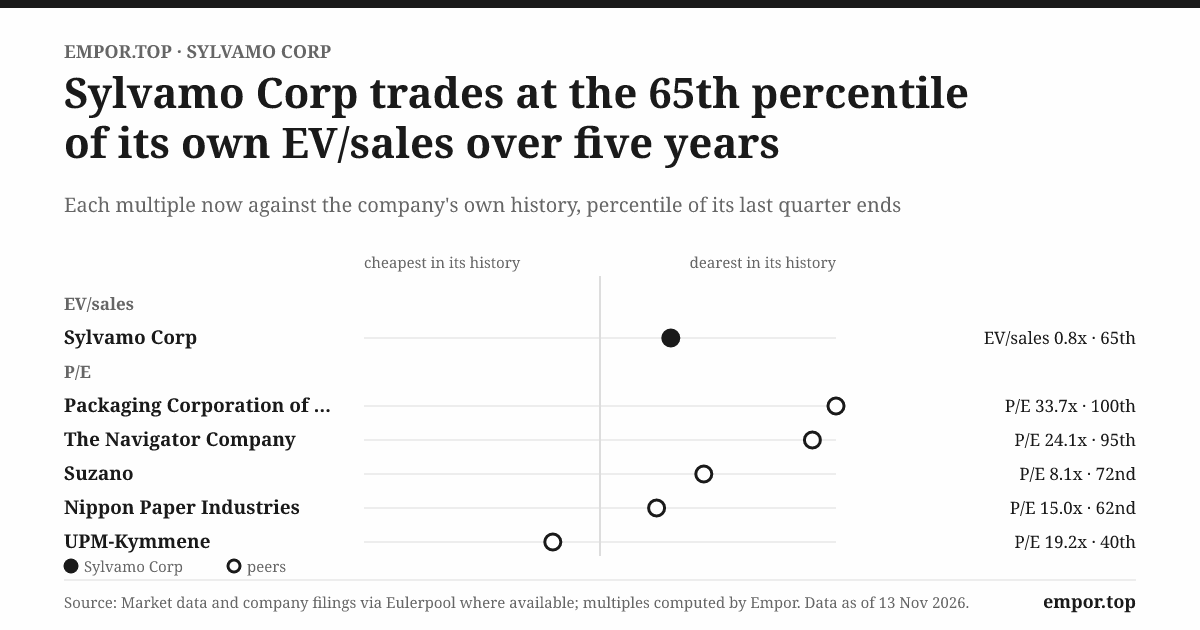
The valuation sharpens the disagreement rather than resolving it. At $38.53 a share, Sylvamo was worth about $1.5 billion, and about $2.4 billion including debt.1 Measured against earnings, it looks expensive: a price-to-earnings ratio of 19.6 times, almost double its own five-year median of 10.3 times.1 But that figure uses twelve months of earnings ending in June 2026; on twelve months to September, which include the European impairment, earnings are negative and the ratio is meaningless.1 On enterprise value to EBITDA, at about 7.3 times, and enterprise value to sales, at about 0.8 times, it looks unremarkable.1 Its dividend yield of about 4.7% looks generous, and its free-cash-flow yield of about 1.5% looks thin; those two numbers together restate the cash problem from the previous section.1 A mid-2025 comparison put Sylvamo at about 4.4 times EV to EBITDA against a peer median of 9.1 times, but that peer set mixed packaging and forest-products companies with very different growth prospects, and the comparison is now more than a year old.17
What does the price assume? It does not assume a return to the 2024 peak, nor does it price the company as a melting ice cube. It roughly assumes that the continuing business earns something like its historical mid-cycle profit and that the European exit removes losses without much further cost. That is a reasonable expectation, but it is not a bargain priced for disaster or a premium priced for growth. It is a price that awaits proof.
The proof points are concrete. Post-Riverdale tons and price and mix in North America will show whether customers are staying. Eastover's delivered output and unit cost will show whether the capital program pays. Continuing-segment cash generation after the European sale closes will show whether the smaller company can produce the $300 million of free cash flow management has described as its potential. And the closing proceeds and the speed at which stranded costs fall will show whether focus has been bought at a fair price. Until those numbers arrive, the focused Sylvamo is a credible case, not a demonstrated one.
IX. Business & Investing Lessons
Return to September 2021, to the investor-day slides promising robust, resilient cash flow from a portfolio of low-cost mills.5 Then fast-forward five years, to a company that lost the supply its former parent provided, gave away its European business with cash attached, and produced $44 million of free cash flow in its weakest full year.3 Neither moment tells the whole story. Together they teach a few things that belong to Sylvamo and no other company.
The first lesson is that a spin-off gives a business a ticker; it does not give it a moat. When IP set Sylvamo free, it did not hand over customer contracts, because there were none to hand over. It handed over mills, brands and supply agreements that expired. The low-cost-mill promise was real, but cost advantage is a property of mills, not of customer relationships, and the customers turned out to be loyal to price and supply rather than to the new name on the invoice. Any investor sizing up a newly separated business should ask what exactly holds its customers in place once the parent's scaffolding comes down. At Sylvamo, the honest answer was that nothing did except the next quote.
The second lesson is that, in a mill business, volume that disappears leaves a bill behind. Georgetown and Riverdale did not just remove revenue. They removed the tons over which Sylvamo's fixed costs were spread, so every remaining ton had to carry more of the overhead. Price and mix added tens of millions; lost volume took away hundreds of millions. The arithmetic of a fixed-cost operation is unforgiving: a modest decline in volume turns into a much larger decline in profit, and the only cure is either winning the tons back or running fewer, fuller machines. Sylvamo's answer, at Eastover and in Europe, is the second. That is a smaller company by design.
The third lesson is that a project is high-return only after the cash arrives. Management promised returns above 25% on projects in 2021 and now promises returns above 30% on Eastover and Sumter. The intervening years produced lower consolidated returns, a $65 million Eastover-related drag on 2026 and a change of plan that added $25 million of capital spending and $20 million of temporary converting costs. None of that means the projects will fail. It means that a stated return is a forecast with a press release attached. The investor's job is to wait for the delivered tons and the unit cost before treating the promised return as anything more.
The fourth lesson is about what giving something away really costs. Sylvamo bought Nymölla for about €150 million in early 2023 and, less than four years later, agreed to hand it over with working capital and cash attached in exchange for a 20% share of future distributions. In a declining industry, the right price for a struggling asset can be negative. A buyer who takes on a money-losing mill is providing a service, and that service has a fee. The lesson for capital allocators is that the decision to buy capacity in a shrinking market must clear a far higher bar than the decision to build it in a growing one, because the exit, when it comes, is rarely a sale.
X. Epilogue
As 2026 draws to a close, Sylvamo stands in a strange half-state. In the accounts, Europe is already gone, classified as a discontinued operation and written down. In Saillat and Nymölla, the works councils are still meeting and the mills are still running under Sylvamo's name. At Eastover, the extended outage is over, the speeded-up paper machine is moving toward its ramp-up, and the woodyard's new softwood line is due to start in the first quarter. In Sumter, a sheeter that passed its acceptance tests in June waits for the infrastructure that will let it run. The company is between shapes.
The next few months contain the events that will decide which shape it takes. The first is the European closing, expected by the end of the first quarter of 2027.2 If the consultations conclude and the deal closes on the announced terms, Sylvamo will hand over the business, the working capital and the cash, keep its 20% interest in future distributions, and address the roughly $26 million a year of overhead that the business used to carry. If the consultations drag on, or the terms change, the European losses continue for longer and the cost of leaving rises. Either way, the moment of closing will be the first time investors see the transfer costs and the cost base that remains.
The second set of events is in South Carolina. The company expects Eastover to begin ramping up toward 60,000 additional tons early in 2027, and the new sheeter at Sumter to start around mid-year.2 The measures to watch are delivered output, downtime and unit cost, and, after a few quarters, the free cash flow left once the capital spending is done. If Eastover produces its extra tons at a lower cost per ton and the sheeter turns them into higher-value reams, the bull case gains real evidence. If the ramp-up stumbles or the tons cannot be sold without discounting, the company will have spent heavily in a downturn for capacity it cannot fill.
The third test is the oldest: whether the Americas can carry the company. After Riverdale, management expects Sylvamo's North American volume to be roughly flat in 2027, which means profit will depend on price holding and costs falling.2 The question that analysts asked in November, whether normalized free cash flow after the sale can exceed $300 million a year, is the cleanest summary of that test.2 Sims has promised a fuller answer after closing. When he gives it, the investor's task will be to compare it with the 2021 promise of robust, resilient cash flow and with what the company has actually delivered since.
Two longer tests run in the background. The Brazilian tax case is in federal court, and its resolution, which could take years, will set whether Sylvamo pays nothing, something, or as much as about $120 million under its agreement with IP.1 And the paper cycle itself will turn as it always does. The industry's capacity closures have supported prices in 2026. If demand falls faster or imports rise further, that support could weaken just as Eastover's new tons arrive. The company is walking into 2027 with a thinner cash cushion, a clearer footprint and a set of promises that, for the first time, can be checked against delivered results within a year.
XI. Outro
Go back to the sheet of paper in the printer tray. Before it was a ream, it was a roll; before it was a roll, it was a slurry on a wire; before that, a tree, perhaps a eucalyptus in Brazil or a pine in South Carolina. At every step, somebody decided whether it was worth making: whether the mill would run, whether the machine would be speeded up, whether the customer would still buy, and whether the company that made it would still want to own the mill at all.
Sylvamo still calls itself the world's paper company. The name was chosen when its mills spanned three continents and its supply ran through its former parent. The company it is becoming is smaller and more concentrated: two regions, a handful of large mills, a forest in Brazil and a bet that running fewer machines better can turn a shrinking commodity into reliable cash. Whether that bet pays will not be decided by the name on the letterhead. It will be decided ton by ton, at the mill, in a market that needs a little less paper every year.
References
-
Sylvamo Form 10-Q for the quarter ended September 30, 2026 — SEC, 2026-11-06 ↩↩↩↩↩↩↩↩↩↩↩↩↩↩↩↩↩↩↩↩↩↩↩↩
-
Sylvamo (SLVM) Q3 2026 earnings call transcript — Motley Fool, 2026-11-06 ↩↩↩↩↩↩↩↩↩↩↩↩↩↩↩↩↩↩↩↩↩↩↩↩↩↩↩↩↩↩↩↩↩↩↩↩↩↩
-
Sylvamo 2025 Form 10-K — SEC, 2026-02-20 ↩↩↩↩↩↩↩↩↩↩↩↩↩↩↩↩↩↩↩↩↩↩↩↩↩↩↩↩↩↩↩↩↩↩↩↩↩↩↩↩↩↩↩
-
Sylvamo Form 10-Q for the quarter ended September 30, 2021, spin-off discussion — SEC, 2021-11-12 ↩↩↩↩
-
Sylvamo 2021 Investor Day presentation — Sylvamo, 2021-09-09 ↩↩↩
-
Sylvamo Names John Sims CEO and David Petratis Chairman — Business Wire, 2025-12-17 ↩↩↩↩↩
-
Sylvamo Completes Sale of Russian Operations — Sylvamo, 2022-10-06 ↩↩
-
Sylvamo Acquires Mill in Nymölla, Sweden — Sylvamo, 2023-01-02 ↩↩↩↩
-
Sylvamo (SLVM) Q2 2026 earnings call transcript — Motley Fool, 2026-08-14 ↩↩↩↩↩↩↩↩↩↩↩↩↩↩↩↩↩
-
Fitch Assigns First-Time BB+ Rating to Sylvamo Corporation; Outlook Stable — MarketScreener, 2024-08-13 ↩↩↩↩
-
Sylvamo Form 8-K, Georgetown supply agreement termination — SEC, 2024-10-30 ↩↩
-
Sylvamo first-quarter 2026 earnings release — SEC, 2026-05-08 ↩
-
Sylvamo Names John Sims as Next CEO, Don Devlin as CFO — Paper Advance, 2025-04 ↩
-
Sylvamo Form 8-K, 2026 Annual Meeting results — SEC, 2026-05-18 ↩↩↩
-
Sylvamo Schedule 13D/A, ACR Group Paper Holdings — SEC, 2025-11-06 ↩
-
Pulp & Paper — Global Comparable Public Companies — Seale & Associates, 2025-Q2 ↩
 LinkedIn
 WhatsApp
 Reddit
 Hacker News
 Email
 Kindle
 RSS Feed
 Spotify
 Apple Podcasts
 Amazon Music
 Audible
 YouTube