Packaging Corporation of America: The Box That Became a Bet on Scale
I. Nine Mills, One Expensive Question
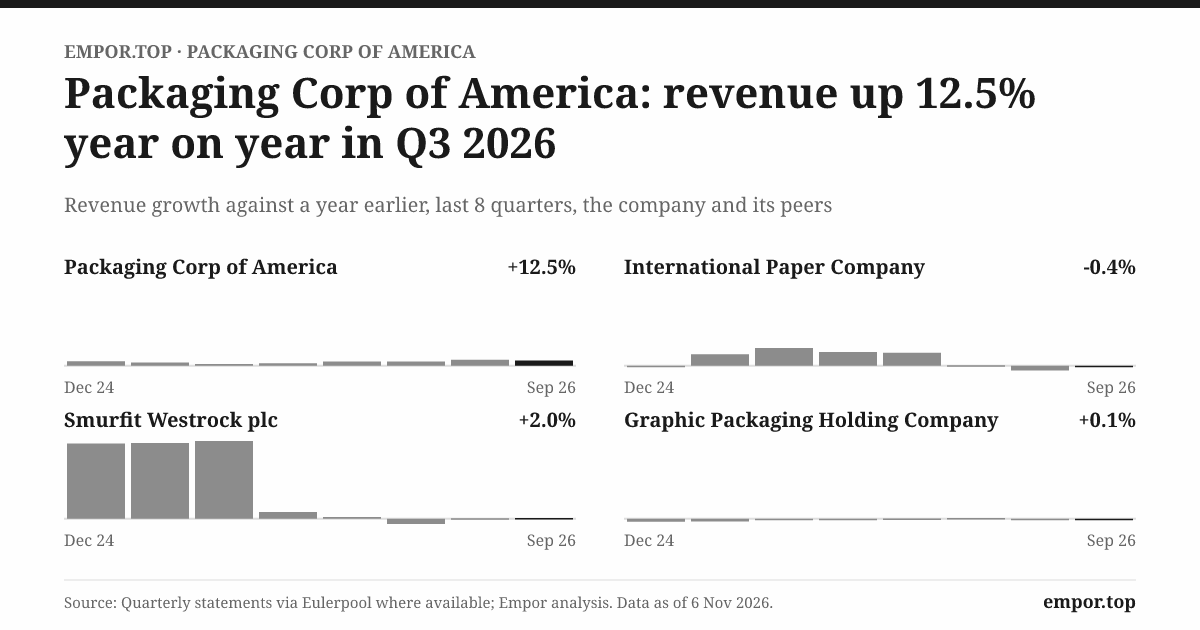
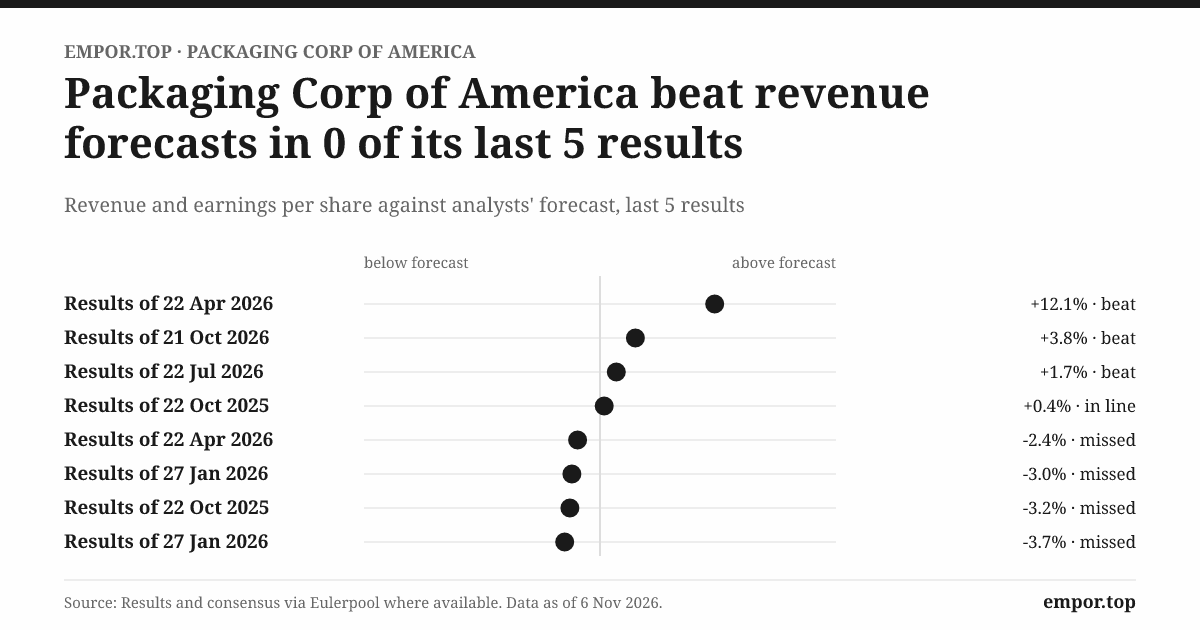
On October 21, 2026, Packaging Corporation of America told investors it had just had the biggest quarter in its history. Sales for the three months to September reached about $2.60 billion, up 12.5% from a year earlier, and operating profit jumped by almost 30%.[^1] For a company whose product is the brown corrugated box, a thing most people flatten and throw into a recycling bin without a second look, that is a remarkable headline. The press release had the tone of a company that knew it was getting bigger.
Read two lines further, though, and the story gets more interesting. Total corrugated shipments rose 10.6%, but that figure included a business PCA had not owned a year earlier: the containerboard mills and box plants it bought from Greif in September 2025. Strip those out and shipments from PCA's own long-standing plants fell by about half a percent per working day.[^1] The company was bigger. Its original box business was, for that quarter at least, slightly smaller.
The earnings bridge tells the same tale in a single sum. Adjusted earnings per share rose by 31 cents from the prior-year quarter, and 24 of those cents came from the Greif operations, which swung from a loss of 11 cents a share a year earlier to a contribution of 13 cents.[^1] That leaves roughly 7 cents of improvement for everything else PCA does: its seven decades of mills, its network of box plants, its price increases and its cost savings combined. On the call the next morning, management pointed to soft agricultural end markets, including problems with lettuce crops, and to elevated freight and recycled-fiber costs, and insisted that the weaker legacy volume did not reflect lost customers.1 That may well be true. It is also exactly what an investor would need to see proven over more than one quarter.
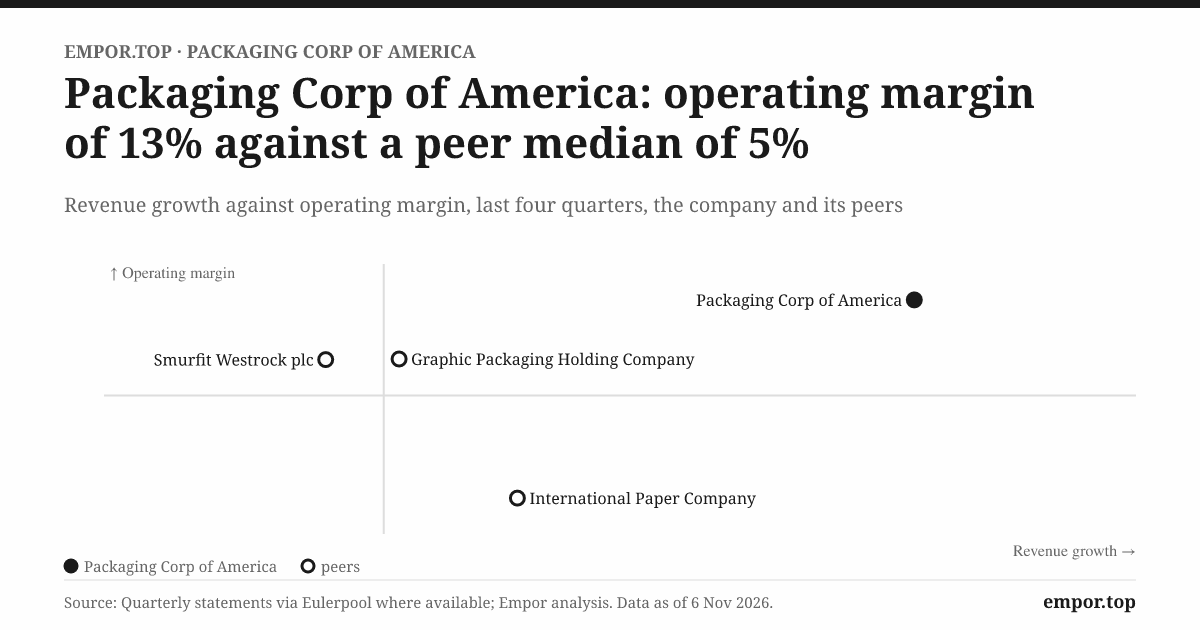
The shape of 2026 sharpens the point. Through the year, reported revenue grew in the low-to-mid teens every quarter, and operating margin climbed from about 11.5% in the first quarter to about 16.2% in the third, the highest quarterly level in at least three years.[^1][^3] Those numbers describe a business gathering momentum. Yet nearly all of the volume growth arrived through the door marked Greif, and the margin recovery owed a good deal to price increases pushed through early in the year and to a lighter schedule of planned mill outages than the year before.2 A rising margin built on price and on acquired tons is not the same thing as a rising margin built on a growing core, and the difference will only become visible as the comparisons become like for like, now that the acquisition has passed its anniversary.
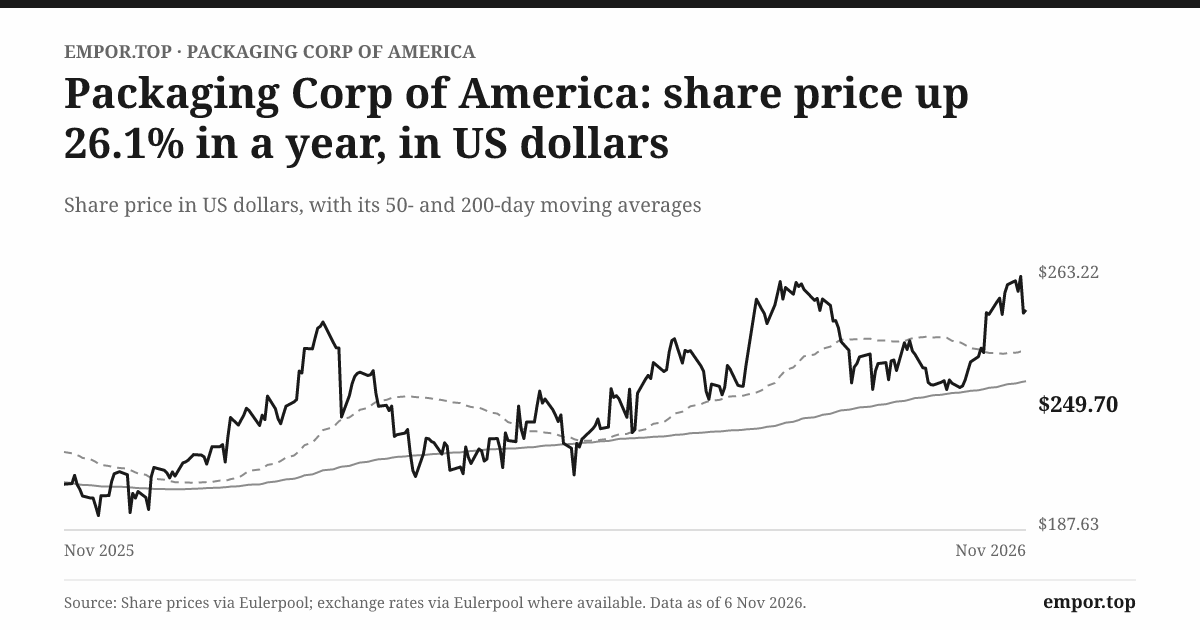
So this is a company with an expensive question hanging over it. PCA is not a small or fragile business. It sold about $9 billion of packaging and paper in 2025 and describes itself as the third-largest producer of containerboard in North America.3 On November 2, 2026, the stock traded at about $257, within a whisker of its 52-week high, giving the company a market value of roughly $23 billion.[^6] Investors, in other words, are paying a premium price for this box maker at precisely the moment its growth has become harder to read.
Three questions sit underneath that price. The first is whether PCA can earn a proper return on the roughly $1.8 billion it paid for Greif's containerboard business, and on a capital program that has nearly doubled in three years. The second is whether its cash and margins can hold steady through the swings in fiber, energy, freight and working capital that define this industry. The third is whether today's valuation already assumes a stronger earnings cycle than the legacy business is currently delivering.
Answering them requires going back a long way, because PCA's current bet, that a bigger, more integrated network of mills and box plants is a better business, is not new. It is the same bet the company has made, in different forms, since three ordinary regional box makers decided they would be stronger together. This is the story of how an unglamorous product became a valuable industrial system, and of the evidence that could still undo that case.
 Subscribe on LinkedIn
II. Three Box Makers and a Mill in Tennessee
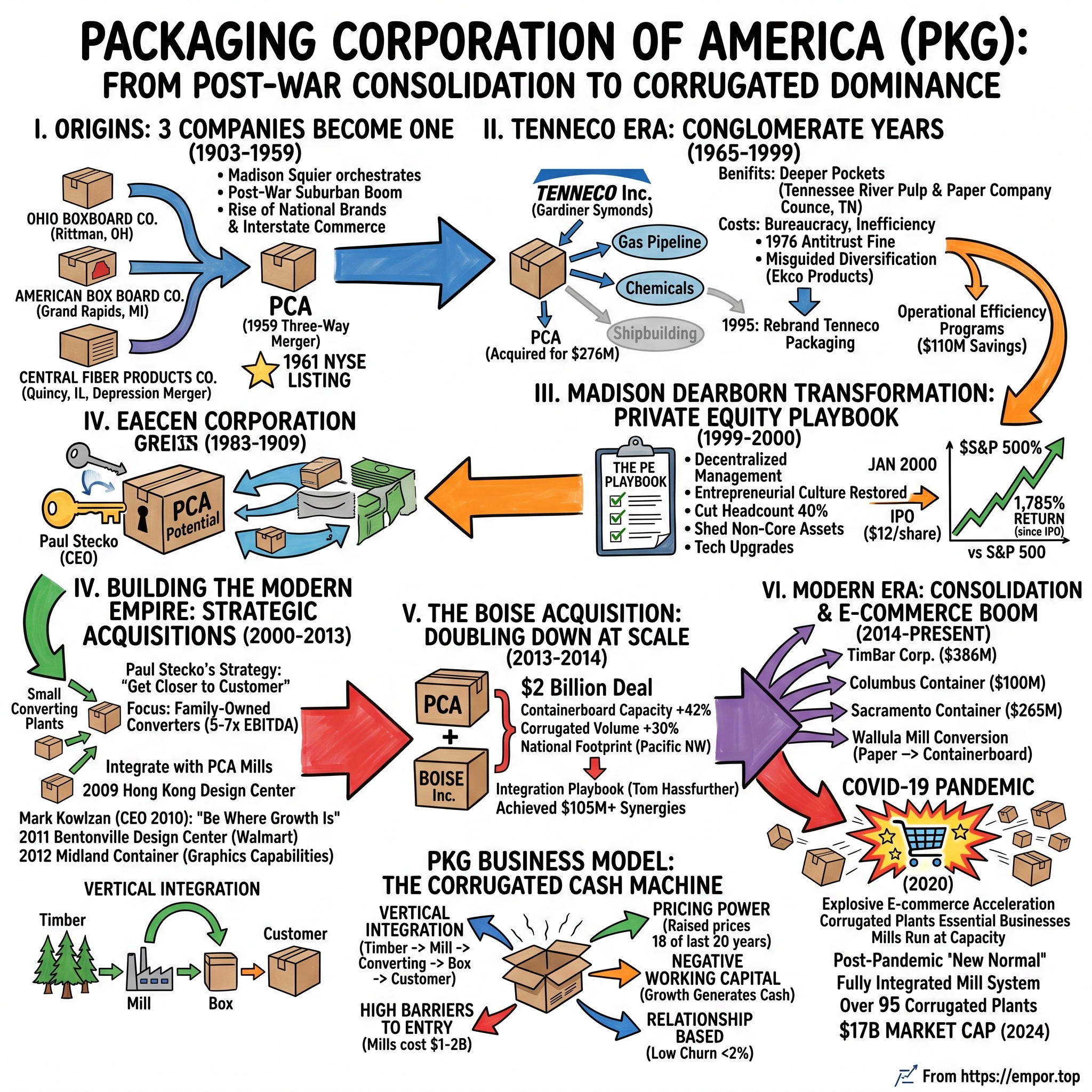
The roots of PCA run back to the age of the horse cart. In 1867 a paper mill opened in Quincy, Illinois, and through a chain of mergers and successors that mill became part of the family tree of Central Fiber Products. Two other strands began in 1903, when Ohio Boxboard and American Paper Box opened for business.4 None of these companies was famous. They made paperboard and boxes for the factories, farms and shippers of the industrial Midwest, competing on whether they could deliver the right carton to the right loading dock at a price that beat the next mill down the road.
The industry they inhabited was fragmented and brutal. Paperboard is a commodity at the mill gate: one ton of linerboard is much like another, and prices rise and fall with the balance of supply and demand. The box made from that board is a different thing. It is cut, printed and glued to a customer's specification, and it is bulky and mostly air, which makes it expensive to ship far. A box plant therefore lives close to its customers, while a mill lives close to its trees, its water and its energy. Joining the two, so that a company owns both the source of the board and the plants that turn it into boxes, became the central strategic idea of the American containerboard industry.
Central Fiber Products already understood this. It had itself been assembled in 1931 from five separate businesses.4 Consolidation was in its DNA long before the modern PCA existed. In 1959 Central Fiber Products, American Box Board and Ohio Boxboard combined to form Packaging Corporation of America.4 The logic was not glamorous. It was about putting paper supply, converting plants and regional customer networks under one roof, so that each plant had dependable board and each mill had dependable demand. That is the same logic, at a much larger scale, behind the deal PCA closed in 2025.
The next chapter brought PCA into the orbit of a conglomerate. In 1965 Tenneco, then a sprawling empire that began in natural-gas pipelines and expanded into everything from shipbuilding to farm equipment, acquired PCA.4 Under Tenneco the company gained something that would define it for the next half-century: the containerboard mill at Counce, Tennessee, on the banks of the Tennessee River. PCA took full ownership of Counce in 1970.4 Counce is a kraft linerboard mill, which means it makes board from virgin wood fiber, cooked into pulp and pressed into the strong outer layers of a corrugated box. It became the largest and most important mill in the system and remains a cornerstone of PCA's network today.3
It is worth pausing on why a mill like Counce matters so much. A modern containerboard mill is one of the most capital-intensive objects in American industry: a paper machine can stretch the length of a football field, it runs around the clock, and the economics depend on keeping it full. A mill running near capacity spreads its huge fixed costs across many tons. A mill running at 80% of capacity watches those same fixed costs crush its margins. Owning box plants that reliably pull board from the mill is how a company keeps the machines running. That is the bone structure of PCA: mills, timber, converting plants and regional customer reach, bolted together so that each part protects the economics of the others.
For three decades that skeleton lived inside Tenneco's corporate body, sharing capital with businesses that had nothing to do with boxes. A common shorthand among investors is that PCA has been a public company since the early 1960s. The record is different. The PCA that trades on the New York Stock Exchange today is the product of a new entity formed by the private-equity firm Madison Dearborn Partners in 1999, which bought the business out of Tenneco's packaging arm and listed it on the NYSE in early 2000.45 The old company provided the mills and the name. The new one provided something PCA had not had since the 1960s: its own balance sheet and its own owners.
That distinction matters for anyone trying to judge the business. The long history explains why PCA's assets are where they are and why integration is the company's instinct. But the record that counts for an investor begins in 1999, when a focused box business had to stand on its own and prove it could earn more than it cost to run. The question at that point was simple and urgent: what exactly had the buyers bought, and could it carry the debt they had put on it?
III. The Conglomerate Sells the Box Business
By the late 1990s Tenneco was dismantling itself. The conglomerate model that had looked so modern in the 1960s had fallen out of favor, and investors wanted focused companies they could value on their own terms. Tenneco's packaging operations were being reorganized into a separate company, Pactiv, best known for consumer products such as Hefty bags and foam containers. The containerboard mills and box plants did not fit that consumer story. They were heavy, cyclical and capital-hungry, and they were for sale.
Madison Dearborn Partners, a Chicago private-equity firm, saw something else in them. In April 1999 it formed a new company, bought Pactiv's containerboard and corrugated operations, and restored the old name: Packaging Corporation of America.4 The transaction valued the business at about $2.2 billion, and roughly $1.8 billion of that was financed with debt.5 In plain terms, the buyers put up a small slice of equity and borrowed the rest against the future cash flows of the mills. Pactiv kept a minority stake in the new company for a time, which is part of why the separation is easy to blur: for a while the two remained linked by ownership even as the operations went their separate ways.
That structure tells you how the buyers thought about the asset. Nobody loads $1.8 billion of debt onto a business unless they believe its cash flows are dependable enough to service it through a downturn. The mills were large and well-located, the box plants were spread across the country's manufacturing heartland, and the integration between them meant that much of the board the mills made went straight into PCA's own boxes. A leveraged buyout is a bet on exactly that kind of predictability, combined with a belief that a focused management team can run the assets better than a distracted conglomerate did.
The man who ran it was Paul Stecko, who had come to Tenneco's packaging business after a long career at International Paper, the industry's largest player, and who became chief executive of the new PCA.4 Stecko's job was not to reinvent the box. It was to run the mills harder, cut costs that had been tolerated inside a conglomerate, and turn the cash flow toward paying down debt. In January 2000, less than a year after the buyout, PCA sold shares to the public, giving Madison Dearborn a path to exit and giving the company access to public equity markets.5
It is worth keeping the economics straight. Before 1999 the business's results were buried inside Tenneco and then Pactiv, mixed with consumer packaging, and the group's figures say little about how the containerboard business itself performed. The meaningful record of PCA as an independent business starts with the separation. And the defining feature of that starting point was the debt. With so much borrowed money on the balance sheet, operating execution and cash generation were not optional virtues; they were the conditions of survival. A bad year at the mills would not merely depress earnings, it would test whether the company could meet its obligations.
The first years of public life were spent working that debt down. The company's focus on mill reliability and cost became part of its identity, and over the following decade the balance sheet steadily strengthened as cash flowed from operations toward lenders and, increasingly, toward shareholders. Madison Dearborn eventually sold down its stake, and the company that emerged was widely held, with no controlling shareholder, as it remains today.6 One echo of that private-equity origin still sits in the boardroom: Samuel Mencoff, a co-founder of Madison Dearborn, has been a PCA director since the buyout and remains on the board.6
What the separation created, above all, was a capital-allocation machine with a simple choice at its heart. A focused containerboard company generates cash from its mills and plants. It can return that cash to shareholders, reinvest it in the existing mills, or use it to buy more mills and plants. Over time the answer tilted decisively toward shareholders. By the mid-2010s the debt of the buyout years was a manageable fraction of the balance sheet, and the dividend had become a central part of the company's identity. Annual dividend payments roughly tripled between 2014 and 2025, from about $157 million to about $450 million, and in a typical year PCA paid out a bit under half its profit.3 That is a high payout for a company that also needs to rebuild paper machines, and it tells you how management and the board see the business: as a mature, cash-generative system whose owners should be paid steadily, with growth coming in occasional large steps rather than a constant stream of reinvestment. Every major decision PCA has made since 1999 is a variation on that choice, and the company's record of answering it is the best evidence an investor has about whether to trust the next answer.
Before following those decisions, though, it helps to understand where the money is actually made. A box is a deceptively simple product, and the advantage of a company like PCA does not live where most people would look for it.
IV. A Box Is a Local Product With a National Supply Chain
Picture a mid-sized food processor somewhere in the Midwest that needs a new shipping case for a line of frozen meals. Its buyer calls the local PCA box plant, not a distant headquarters. A designer at the plant works out the dimensions, the board grade needed to survive a freezer and a stacked pallet, and the printing on the side. The plant orders containerboard, which arrives by rail or truck from one of PCA's mills, where it was made from wood chips, recycled fiber or both. Corrugating machines glue fluted medium between sheets of linerboard to make the familiar rippled sandwich, then die-cutters, printers and folder-gluers turn that sheet into a flat box blank. Within days, pallets of flat boxes are on a truck to the customer's dock, ready to be erected and filled.
That chain explains PCA's business in a single sequence. The company sells three things: containerboard, the raw board used to make boxes; corrugated packaging, the finished boxes and sheets; and uncoated freesheet, the white office and printing paper made by its Boise Paper division. It books revenue when control of the product passes to the customer, which in practice means when the boxes or board ship.3 There is no subscription, no recurring software fee, no long-term take-or-pay arrangement disclosed across the customer base. PCA earns its money one truckload at a time.
The scale of that activity is concentrated in one place. In 2025 the Packaging segment sold about $8.29 billion of products, roughly 92% of the company's total, and earned about $1.13 billion of segment operating income.3 The Paper segment, which makes the white paper, sold about $615 million and earned about $130 million.3 Paper is still a profitable business, with a margin that looks respectable for a mature product, but it represents only about 7% of sales and a modest slice of profit. This is a box company with a paper division attached, not the other way around. The paper business earns roughly 21 cents of operating profit on each dollar of sales, a healthy margin for a product whose demand has been shrinking for years as offices print less. PCA's approach has been to manage it for cash rather than growth, converting machines to containerboard when the numbers favor it and trimming capacity elsewhere. That makes Boise Paper a useful source of cash but not a part of the story that will decide the investment case.
Where the advantage actually lives
If the box is so ordinary, why would a customer stay with PCA rather than shop every order to the cheapest supplier? Part of the answer is practical friction. A custom box is designed for a specific product, machine and supply chain. Changing suppliers means retesting the box, recalibrating packing lines and trusting that the new plant can deliver on time, every time. For a food processor whose line stops if the cartons do not arrive, reliability is worth real money. PCA serves roughly 12,000 customers across some 27,000 locations, and around 70% of its corrugated sales go to regional and local customers rather than national accounts.3 That mix matters. Smaller customers tend to value design help, short lead times and a plant that answers the phone, and they have less purchasing muscle than a national retailer or consumer-goods giant.
But it would be a mistake to call this a deep moat. No single customer accounts for more than 10% of Packaging sales, which is reassuring about concentration.3 Yet PCA does not disclose how much of its business its top five or ten customers represent, how long its contracts run, or how many customers it keeps from year to year. A box buyer can, and often does, buy from more than one supplier, and a sophisticated customer will happily use a second mill's quotes to discipline the first. The stickiness is real, but it is the stickiness of good service, not of a contract that makes leaving impossible.
The price mechanism makes this clearer. PCA says its corrugated agreements commonly include negotiated provisions that move box prices with published containerboard prices.[^3] When the industry's benchmark price for board rises, box prices generally follow after a lag. When it falls, they come down. That is a sensible arrangement for both sides, but it means that even PCA's longest customer relationships do not insulate it from the commodity cycle. The relationship decides who gets the order. The market decides, to a large extent, what the order is worth. Early in 2026, for example, PCA pushed through a $70-per-ton containerboard price increase. Management told investors in January that the benefit would mostly arrive from the second quarter onward.2 That kind of increase depends on industry-wide conditions holding up, not on any one customer's loyalty.
A war game with five big players
The competitive map of North American containerboard looks very different from the fragmented world of 1959. PCA names International Paper, Smurfit Westrock, Georgia-Pacific and Pratt Industries among its national competitors, alongside many smaller regional players.3 A capacity snapshot published in May 2025, before PCA bought Greif's mills, put International Paper at roughly 28% of North American containerboard capacity and Smurfit Westrock at about 19%, followed by Georgia-Pacific and PCA in the high single to low double digits and Pratt at around 5%.7 PCA describes itself as the third-largest producer.3 Smurfit Westrock itself was born of consolidation: Smurfit Kappa and WestRock agreed in September 2023 to combine into a transatlantic giant.8
Run this market through Michael Porter's five forces and a mixed picture emerges. Rivalry is tempered by concentration: when a handful of large producers control most of the capacity, they have strong incentives not to flood the market. The industry's recent behavior shows that discipline at work. In August 2025 International Paper said it would close two Georgia containerboard mills, at Savannah and Riceboro, taking capacity out rather than fighting for share.9 Capacity closures like that support prices for everyone, including PCA. The threat of new entrants is low, because building a modern mill costs well over a billion dollars and takes years. Substitutes exist at the margin, such as reusable plastic crates, but the corrugated box remains the default shipping container for most of the economy.
The other two forces cut the other way. Buyers have meaningful power because they can multi-source and because box pricing is anchored to a public board price. Suppliers matter too: wood fiber, recycled fiber, energy, chemicals and freight are large costs, and they move with markets PCA does not control. In the third quarter of 2026 management specifically cited higher freight and recycled-fiber costs as headwinds.1 So the industry structure supports reasonable returns for disciplined players, and PCA's scale is real. What the evidence does not show is pricing power that persists independent of market conditions. PCA's margins rise and fall with the cycle, as the shrinking of profits in 2020 and 2023 demonstrated.
It is also worth addressing the technology question that hangs over almost every company today. Generative artificial intelligence is not going to replace a corrugated box. A frozen meal still needs a physical container to get from a factory to a freezer. The technological forces that matter in this industry are more mechanical: automation in box plants, the reliability of paper machines, lightweighting that uses less fiber per box, and shifts in customer demand, such as the rise of e-commerce shipments or changes in agricultural output. Those forces can help or hurt PCA, but they reward operators who run efficient plants rather than threatening the product's existence.
So the advantage PCA has comes down to integration, proximity, service and execution: mills that run efficiently, box plants close to customers, designers who solve problems, and a supply chain that delivers. Those are real advantages, but they are advantages of operating skill rather than structural lock-in. And operating skill at this scale is expensive to extend. The obvious way to get bigger quickly is to buy someone else's mills. In 2013 PCA did exactly that, on a scale that changed the company.
V. Boise Made the 2000s Public Company a Different Scale
On September 16, 2013, PCA announced that it would buy Boise Inc. for $12.55 a share in cash.[^13] Boise was not a box company in the way PCA was. It was the paper and packaging business that had emerged from the old Boise Cascade, with a portfolio split between white office paper and containerboard, and a footprint that reached into the Pacific Northwest and the Gulf South where PCA had little presence. The total transaction value was about $1.995 billion, including roughly $714 million of Boise debt that PCA would assume.[^13]
Until that moment, PCA's growth since its listing had come in modest steps: improvements at existing mills, and bolt-on purchases of individual box plants and small regional converters that slotted into its existing network. Boise was a different animal. It was a step change in footprint and scale. PCA said the deal would lift its containerboard capacity from about 2.6 million tons a year to about 3.7 million, an increase of more than 40%, and raise its corrugated products volume by roughly 30%.[^13] Management projected about $105 million of annual synergies from combining the two companies, mostly from optimizing mill production, freight and purchasing.[^13]
The strategic logic was the same consolidation instinct that had created PCA in 1959, with a modern twist. Boise brought two containerboard mills, at DeRidder, Louisiana, and Wallula, Washington, along with a network of box plants. More mills meant more flexibility: PCA could run each machine on the grades it made most efficiently, ship board to box plants from the nearest mill, and spread purchasing and freight costs across a larger base. In an industry where every ton of mill output must be sold and every box plant must be fed, a bigger, better-balanced system can be meaningfully cheaper to run than two smaller ones.
But there was a complication on the paper side. Boise came with a white-paper business, the uncoated freesheet used in printers and copiers across offices, a product in long-term structural decline as offices go paperless. At the time of the deal, PCA presented figures showing that the combined packaging businesses represented about 75% of pro forma sales and 83% of pro forma EBITDA.[^13] In other words, paper was meaningful but packaging was the earnings engine. PCA was buying a box business that came with a paper business attached, and it would spend the next decade deciding how much of that paper capacity to keep.
What the integration actually delivered
The best way to judge Boise is to look at what PCA became afterward. The Packaging segment was responsible for nearly all of the company's growth in 2025.3 Over the decade from 2015 to 2025, revenue grew at about 4.6% a year and net profit at about 5.8% a year.3 Those are not breathtaking numbers, but for a business making a mature commodity product they represent steady compounding, and PCA's return on invested capital stayed in the low-to-high teens across most of that period, peaking at almost 18% in 2022.3
At DeRidder, PCA converted a paper machine to make containerboard, and the Jackson, Alabama mill now makes both paper and board.3 More recently, the company restructured operations at the Wallula mill, shutting machines and cutting jobs, with the work then scheduled to be finished by mid-February 2026 and the company expecting cost improvements from the second quarter.2 That is a sign of active portfolio management. It is also a reminder that parts of what PCA bought in 2013 were not producing adequate returns more than a decade later.
DeRidder carries another legacy. In February 2017 an explosion at the mill killed three contract workers, and the resulting litigation stretched for years. In 2024 PCA recorded about $95 million of litigation expense related to DeRidder and other matters, offset by the same amount of insurance recoveries.3 The accounting washed out, but the timing of the cash and the receivables from insurers moved PCA's operating cash flow around, a theme that returns when the cash is followed through the mill system.
So was Boise a good deal? The honest answer is that the evidence supports the strategic thesis but does not settle the price. The deal expanded the packaging platform materially, added geographic reach, and gave PCA mills it could reconfigure as markets shifted. PCA did not publish a clean standalone earnings base for the acquired business after integration, so it is impossible to compute a definitive return on the $2 billion it paid. Calling Boise a bargain or an overpayment would require a normalized deal multiple and a standalone profit stream that the company's disclosures do not provide. What can be said is that PCA grew into a larger, more profitable company in the decade after the deal, and that the paper business it inherited has been steadily shrunk and reshaped rather than celebrated.
That leaves the discipline question hanging. Boise proved that PCA could absorb a large acquisition and come out the other side bigger and still highly profitable. It did not prove that every future acquisition would be priced for returns rather than for size. For twelve years after Boise the company made no deal of comparable scale. Then, in the summer of 2025, it reached for the biggest purchase since.
VI. Greif: The Biggest Bet Since Boise
On July 1, 2025, PCA announced that it had agreed to buy the containerboard business of Greif for $1.8 billion in cash.[^14] Greif is best known as a maker of industrial packaging: steel and plastic drums, intermediate bulk containers and other heavy-duty vessels for chemicals and lubricants. Its containerboard operations were a side business, and Greif was in the middle of reshaping its portfolio. For PCA, the side business looked like a ready-made expansion: two containerboard mills, at Riverville, Virginia, and Massillon, Ohio, plus eight sheet-feeder and corrugated plants, and about 1,600 employees.[^14]3
The deal closed on September 2, 2025, barely two months after it was announced.3 That speed is part of the appeal of buying rather than building. A new greenfield containerboard mill takes years to permit and construct and costs well over a billion dollars before it makes a single ton of board, and then it has to win customers. An acquired mill comes with machines that are already running, employees who already know them and customers who already buy from them. PCA's strategic case was that it could plug these assets into its existing system, optimize which mill made which grade, route board to the nearest box plants, and squeeze out costs Greif could not reach at its smaller scale.
The price is where an investor has to slow down. The acquired business had generated about $1.2 billion of sales over the prior twelve months.[^15] PCA's acquisition presentation put the business's trailing EBITDA at about $230 million, which means PCA paid about 7.9 times that figure.[^15] Management also targeted about $60 million of annual synergies.[^15] If those synergies were fully realized and simply added to the trailing EBITDA, the purchase multiple would drop to roughly 6.2 times. That is the arithmetic of the bull case for the deal: a reasonable price that becomes an attractive one if integration delivers.
Benchmarking the price honestly
How does 7.9 times compare? Today the market values PCA as a whole at about 13.8 times enterprise value to EBITDA.[^6] On the surface, PCA appears to have bought assets at a lower multiple than the market places on its own. That is a tempting comparison, and a misleading one if pushed too far. A public company's trading multiple reflects its whole network, its track record, its management and the market's expectations for the cycle. A pair of mills and eight box plants bought in a private transaction, at one point in the cycle, from a seller exiting the business, is a different asset. A trading multiple is not a deal comparable. The price was not facially excessive, but nor was it obviously a bargain. For a cyclical asset, the trailing EBITDA a buyer pays for can itself be high or low depending on where the cycle stood.
The evidence since closing has been encouraging. The early months were bumpy: in the fourth quarter of 2025 the acquired operations ran into extended outages, and management spent about three and a half months essentially rebuilding the Massillon mill.2 By January 2026 the company was describing Massillon as "the little mill that could" and estimated that operating efficiency at both acquired mills had improved by around 15%.2 By the third quarter of 2026, the Greif operations had swung from a loss to a 13-cent contribution to adjusted earnings per share.[^1] On the call, management said integration and operational performance were running ahead of its synergy targets.1
That swing is the strongest evidence yet that the deal can work. Turning a loss-making operation into a meaningful contributor in a year is exactly what an integrator is supposed to do. But it comes with three caveats that a careful investor would keep in view.
The first is the gap between acquired and organic growth. The third-quarter results show that legacy PCA shipments still declined.[^1] Greif accounted for most of the earnings growth too. Reported growth, for now, is mainly purchased growth. That is not a criticism of the deal; buying growth is a legitimate strategy. It does mean that the headline numbers say more about the acquisition than about the health of PCA's underlying demand.
The second is the control environment. At the end of 2025 the Greif business represented about 18% of PCA's consolidated assets but only about 4% of its sales, because PCA had owned it for just four months.3 PCA's auditor, KPMG, excluded the acquired business from its assessment of internal controls over financial reporting for 2025, a routine practice for recent acquisitions, but one that means the new assets had not yet been tested under PCA's own control framework.3 The 2026 audit will be the first full-year look.
The third is that the real test is returns, not reported earnings. PCA paid $1.8 billion in cash, financed largely with new term loans and unsecured notes.3 To earn its cost of capital, the acquired business needs to generate after-tax operating profit well above what it earned under Greif, sustained across a full cycle, not one strong quarter. The concrete settlement points are clear enough. Realized synergies should be measured against the $60 million target, which S&P expects to be reached by the end of 2027.10 Earnings and cash from the acquired business need to hold up through the first full year after the deal anniversary and beyond. And legacy shipments need to stabilize, so that growth is not simply the acquisition masking a shrinking core.
So the Greif verdict, for now, is promising but unproven. The price was defensible, the early operating improvement is real, and management's claim that integration is ahead of plan is backed by a measurable earnings swing. What remains open is whether those gains persist, whether they translate into returns above the cost of the capital deployed, and whether PCA's legacy business can grow alongside its acquired one. Those are questions about the people running the company and how they deploy its money.
VII. The Current Management Team Has to Turn Spending Into Returns
On the morning of October 22, 2026, Mark Kowlzan and Thomas Hassfurther joined analysts on PCA's third-quarter call with a good story and a few awkward facts.1 How a management team handles the gap between those two kinds of news is one of the best windows an investor has into its judgment.
Kowlzan is a mill man. He spent roughly two decades at International Paper before joining PCA in 1998 to run its containerboard mill system, became chief executive in 2010 and later took on the role of board chair.6 His formative experience is the operation of large, complex paper machines, and it shows in PCA's emphasis on mill reliability, energy efficiency and cost. Hassfurther, the president, comes from the other side of the business: a long career in corrugated products, the sales and box-plant end of the chain where customer relationships live.6 Kent Pflederer became chief financial officer in May 2025, succeeding Robert Mundy, who stayed on as an adviser until his retirement in March 2026.3 Pflederer had previously been the company's senior legal and administrative executive, so the finance chair passed to a long-tenured insider just as the company was preparing its biggest deal in a decade.6
The way these executives are paid tells you what the board wants them to focus on. Executive awards are tied to adjusted earnings per share, return on invested capital and total shareholder return relative to peers.6 Kowlzan's reported compensation for 2025 was about $17 million, up from about $15.7 million in 2024, and his annual incentive award came in at 101% of target.6 He held 463,138 shares in the proxy's snapshot, well under 1% of the company.6 That combination creates meaningful exposure to results without making him a controlling owner. Shareholders seem broadly comfortable with the arrangement. At the May 2026 annual meeting, only about 2.9% of the votes cast for or against the say-on-pay proposal opposed it, though some directors drew more dissent, including Roger Porter and Samuel Mencoff, who received about 11.9 million and 8.7 million votes against respectively.11
The inclusion of ROIC in the pay formula matters, because that is precisely where the evidence is most uncomfortable. PCA's return on invested capital peaked at about 17.7% in 2022. By 2025 it had fallen to about 11.3%.3 That is the lowest reading in at least twelve years, below even the 12.5% the company earned in the pandemic-disrupted year of 2020. Part of the decline is a timing artifact: PCA's year-end capital base included the full $1.8 billion Greif purchase, while its income statement captured only four months of Greif's earnings. But the decline began well before Greif. ROIC had already fallen to around 13% in 2023 and 2024, as earnings retreated from the 2022 peak while the capital base kept growing.
Spending more to earn back the returns
The spending has been heavy and rising. Capital expenditures rose from about $470 million in 2023 to about $829 million in 2025, climbing from roughly 6% of sales to over 9%.3 The money has gone into mills, converting equipment, energy projects and reliability work. On the third-quarter call, management pointed to ongoing projects at the Jackson and DeRidder mills and a pending permit for a gas-turbine project at Riverville, one of the acquired Greif mills, and said the energy-project benefits would show up more fully in 2028.1 For 2026, the company's capital spending guidance was $865 million to $890 million.1
At the same time, PCA has continued to return large sums to shareholders. It paid about $450 million in dividends in 2025 and repurchased about $153 million of its own stock, in the same year it borrowed heavily to buy Greif.3 Over the twelve years from 2014 to 2025, dividends consumed about 54% of the company's free cash flow.3 An activist looking at this record would ask a pointed question: why buy back shares in a year when the company was taking on debt to fund an acquisition and simultaneously stepping up capital spending? The defense is that the buybacks were modest, the dividend is a long-standing commitment, and the balance sheet could carry the load. The challenge is that every dollar returned to shareholders in a debt-funded acquisition year is a dollar not used to pay down that debt.
The investment program needs to be stress-tested against the cash cycle too. Debtor days, the number of days of sales tied up in receivables, rose to 52 in 2025, and the cash-conversion cycle, the time between paying for inputs and collecting from customers, stretched to 94 days, up from 67 in 2014.3 Part of that reflects the acquisition and timing effects, but a lengthening cash cycle in a business spending more on capital is worth watching. The other telling ratio is asset turnover, the dollars of sales generated by each dollar of assets. It slipped from about 1.09 in 2014 to about 0.82 in 2025.3 Some of that is Greif arriving on the balance sheet with only a third of a year of sales behind it. Some of it is simply what happens when a company spends faster than it grows: every new turbine and corrugator adds to the asset base before it adds to revenue. If the investment program works, turnover should recover as projects come online. If it does not, the company will have become heavier without becoming more productive.
The calls offer a way to test management's consistency over time. In January 2026, on the first call after a full quarter of Greif ownership, Hassfurther told analysts the company had been "ultimately disappointed with December shipment volume," while describing better trends in January.2 By the second quarter, PCA reported acquisition contributions alongside higher legacy volume.[^3] By the third quarter, the legacy volume had turned negative again, and management attributed the decline to specific agricultural customers and crop issues rather than lost business.1 That is a coherent narrative, and management has been reasonably specific about drivers rather than resorting to vague talk of tight markets. But it also shows that legacy demand has been choppy rather than steadily improving. When analysts pushed on volumes and costs, the answers were concrete about causes but could not offer a clear forecast for when legacy shipments would return to growth.
The verdict on management is therefore mixed in a precise way. The team has a consistent operating philosophy, has delivered a strong early integration result at Greif, and explains its quarters with specific drivers rather than excuses. But returns have fallen materially from their 2022 peak while capital spending and debt have both grown, and the incentive plan rewards ROIC at a time when ROIC is at a twelve-year low. The proof will be post-deal returns and cash, not the confidence of the prepared remarks. And cash, in a business like this, is never quite as simple as it looks.
VIII. The Mill System Can Make Cash—and Tie It Up
Lay PCA's 2025 cash-flow statement beside its year-end balance sheet and two very different pictures emerge. One shows a business throwing off strong operating cash: about $1.56 billion, roughly twice its net income of $774 million.3 The other shows a company that spent about $2.6 billion on investing activities in a single year, most of it on Greif and the rest on its rising capital program, and that ended the year with about $4.0 billion of debt, up from about $2.5 billion a year earlier.3 Both pictures are true. Understanding why is the key to judging whether PCA's cash engine can keep funding its mills, its dividend and its acquisitions through a downturn.
Start with the gap between profit and cash. Over the twelve years from 2014 to 2025, PCA reported about $7.8 billion of net profit and about $13.2 billion of operating cash flow.3 That is a large and persistent difference, and in some companies it would be a warning sign of aggressive accounting. Here, the explanation is mostly mundane. A paper mill is a giant machine that wears out slowly. Accounting rules require PCA to spread the cost of that machine over its useful life as depreciation, an expense that reduces reported profit each year without any cash leaving the building. PCA also records depletion on the timber it owns and uses. In 2025, depreciation, amortization and depletion came to about $653 million, up from about $526 million in 2024, partly because of the newly acquired assets.3 Add those non-cash charges back, and operating cash naturally runs well ahead of net income.
The counterweight is that depreciation is not free money. A mill that is depreciating is a mill that will eventually need to be repaired, upgraded or replaced. That is why the right measure of PCA's discretionary cash is free cash flow, operating cash minus capital spending, and why that figure is much smaller than operating cash. Over the same twelve years, free cash flow totaled about $7.1 billion.3 In 2025 alone, free cash flow was about $729 million, against dividends of about $450 million and buybacks of about $153 million.3 In other words, the company spent nearly all of its free cash on shareholder returns and borrowed to buy Greif.
Where the cash gets stuck
Annual cash, moreover, swings with working capital and with one-off events. In 2025, PCA said higher depreciation and deferred tax liabilities explained most of the increase in cash before working-capital movements, while changes in operating assets and liabilities, including the timing of insurance recoveries tied to the DeRidder litigation, added more.3 That is a reminder that a good cash year can be flattered by timing, just as a bad one can be depressed by it.
Receivables deserve a closer look because debtor days have risen from 41 in 2014 to 52 in 2025.3 PCA's customers generally pay within 30 to 60 days, and the company's allowance for credit losses at the end of 2025 was a modest $5.5 million, down from $9.8 million a year earlier.3 Those figures do not point to a credit problem. The company does not, however, publish an aging schedule of its receivables or a history of write-offs, so an outsider cannot see whether the lengthening reflects slower-paying customers, a change in mix toward larger accounts, or acquisition timing. Inventory tells a similar story. Inventory days rose from about 52 to about 64 over the same period, while the days PCA takes to pay its own suppliers slipped from about 26 to about 22.3 Put together, the company is holding more stock, collecting more slowly and paying faster than it did a decade ago, and each of those small shifts ties up cash. For a business with roughly $9 billion of annual sales, every extra day in the cash cycle locks up something like $25 million. One more detail matters for reading the cash flow fairly: PCA sells certain customer receivables without recourse through supply-chain financing programs, which turn receivables into cash early. Those sales were about 2% of sales in both 2025 and 2024.3 It is a small program, but because those receipts show up in operating cash flow, it gives the cash figures a modest lift that would disappear if the programs were withdrawn.
There is also one related-party relationship worth putting in proportion. PCA consolidates Louisiana Timber Procurement Company, a 50-50 venture with Boise Cascade that buys wood fiber for both companies. In 2025 the venture recorded about $71 million of sales to Boise Cascade, roughly 0.8% of PCA's revenue, and an equivalent amount of expense; it is largely a pass-through.3 PCA also bought about $8.7 million of fiber from Boise Cascade's wood-products business.3 These amounts are small against the company's scale. The one gap is that PCA does not specify the method used to set prices on these transactions, which is the sort of detail a diligent investor would want but which, at this scale, does not threaten the investment case.
The liabilities beyond the debt are similarly bounded but real. At the end of 2025, PCA carried about $31 million of environmental reserves, most of it for asset-retirement obligations at its mills, and management said it did not consider additional costs above that reserve reasonably likely to be material.3 Its debt structure is conventional for an investment-grade industrial: about $1.0 billion of the borrowings carry floating rates, which means interest costs move with short-term rates, and the next large maturity is $500 million of 3.40% notes due in 2027, with the remaining notes stretching out as far as 2051.3 PCA also had about $573 million of unused revolving credit at year end.3 Nothing in that profile suggests refinancing stress. It does mean that net interest expense, which nearly doubled to about $79 million in 2025, has become a larger claim on operating profit than it was before Greif.3
The uses of cash come down to four: dividends, mill investment, acquisitions and debt reduction. The temptation is to treat free cash flow as fully discretionary, but in an asset-heavy business that is a mistake. PCA's mills require constant upkeep, its energy projects are part of keeping costs competitive, and its paper machines need periodic rebuilds just to stay reliable. What looks like free cash in a good year is partly a deferred obligation to the machines.
That gives the cash engine a clear verdict. Over the long run, PCA converts its profits into cash at a healthy rate, mostly because of the non-cash charges inherent in a mill business, and it has funded a rising dividend out of that cash for more than a decade. But annual cash swings with working capital, litigation timing and investment, and in 2025 the company spent nearly all its free cash on shareholders while borrowing to grow. The question is whether the market, now pricing PCA at a premium, has fully reckoned with that combination.
IX. Bull Versus Bear: A Bigger Box Business at a Bigger Price
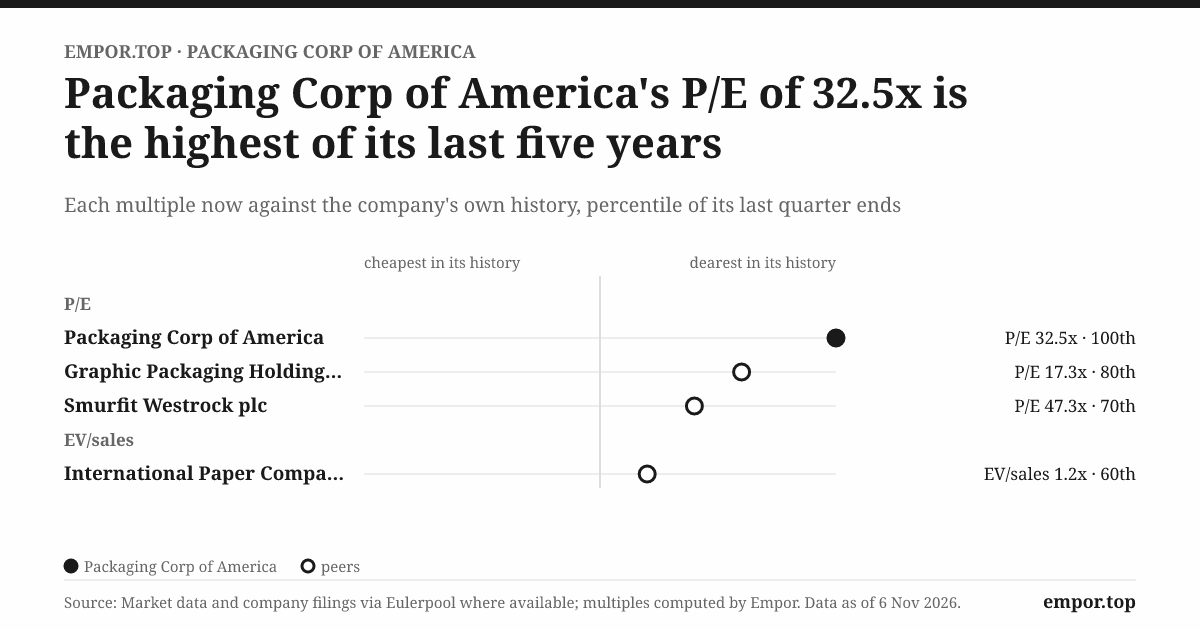
On November 2, 2026, PCA's shares closed at about $257, just 0.3% below their 52-week high and about a third above their low of roughly $192 in the past year.[^6] At that price, investors were paying about 33 times the company's reported earnings over the last twelve months. Over the past five years, the median multiple was about 20 times.[^6] Put simply, the market is paying around two-thirds more for each dollar of PCA's trailing earnings than it typically has. That premium is the frame for everything else in the debate. A great business can deserve a higher multiple. A cyclical business at a high multiple needs its next few years to go right.
Some of the gap is an accounting quirk worth understanding before anyone draws conclusions. The trailing earnings include the fourth quarter of 2025, when net income fell by about 54% to roughly $102 million amid weak December shipments, Massillon's rebuild and the restructuring at Wallula.2 Strip out one-time charges, and the trailing earnings would be higher and the multiple lower. The enterprise-value measures, which look at operating profit before such items and include the company's debt, tell a less extreme story: about 13.8 times EBITDA and a free-cash-flow yield of about 3.2%.[^6] Even on those measures, though, the stock is not cheap, and the trend in earnings does not obviously justify the premium. Net profit fell at about 9% a year from 2022 to 2025, against growth of almost 6% a year over the decade.3 The market, in other words, is looking through a softer three-year record toward a stronger post-Greif earnings base.
PCA's own history is the best stress test of that optimism. In 2020, as the pandemic disrupted demand and the company absorbed mill outages, net profit fell by about a third and operating margin slid to about 12.6%.3 In 2023, as customers worked down the inventories they had built during the supply-chain scramble, revenue fell about 8% and net profit about 26%.3 Neither episode was a catastrophe; PCA stayed solidly profitable and kept paying its dividend. But both show how quickly earnings in this business can drop by a quarter to a third when volume or price turns. At 20 times earnings, a drop like that is painful. At 33 times, it leaves the shares with little cushion, because the market would be paying a premium multiple on a smaller earnings base.
Testing the moat, force by force
The bull case starts with structure. The North American containerboard industry is consolidated, with a handful of large producers controlling most capacity, and the leaders have shown willingness to close mills rather than flood the market, as International Paper's Georgia closures demonstrated.9 PCA is one of those large producers, with integrated mills feeding a broad box-plant network, roughly 12,000 customers and a customer base tilted toward regional and local buyers who value service.3 It has pushed through price increases, including the $70-per-ton containerboard increase in early 2026.2 And its newest assets are, by management's account and by the third-quarter earnings swing, integrating ahead of plan.1
Hamilton Helmer's seven powers offer a sharper lens on whether that structure adds up to a durable advantage. Scale economies are PCA's clearest power: a larger mill system lets it run machines on their most efficient grades, spread fixed costs, and buy fiber, energy and freight on better terms. Cornered resource applies modestly: its mills, timberland access and permits are hard to replicate, since a new mill costs well over a billion dollars and takes years. Process power, the accumulated know-how of running mills reliably and integrating acquisitions, is plausible given the Boise and Greif records, but it is hard to prove from the outside. The other powers are thin. Network effects do not exist in box-making. Switching costs are moderate at best, because customers can multi-source and box prices are tied to public board prices. Brand matters little to a buyer of brown boxes. Counter-positioning does not apply, since PCA's main competitors run the same model. That leaves PCA with a real but bounded advantage: scale and operating excellence in a disciplined oligopoly, not a moat that guarantees returns regardless of the cycle.
The bear case is the mirror image. Customers can and do multi-source. Many of PCA's end markets, from agriculture to industrial goods, are cyclical. Fiber, energy, freight, labor and mill outages can squeeze margins quickly, as the third quarter's freight and recycled-fiber pressures and the fourth quarter of 2025's outages both showed.12 And legacy shipments fell even as acquired volume lifted reported growth.[^1] A skeptic would argue that the market is capitalizing a strong integration quarter as if it were a new normal, at a time when the core business is not growing.
The capital-allocation stress test is the heart of the matter. PCA has committed $1.8 billion to Greif and $865 million to $890 million of capital spending in 2026.[^14]1 Its ROIC sits at about 11.3%, down from almost 18% in 2022.3 For the bull case to work, those investments need to earn returns above PCA's cost of capital and lift company-wide ROIC back toward its historical range. If they do, today's multiple may prove reasonable in hindsight. If they do not, PCA will have spent several billion dollars to become a larger company with lower returns, which is not a recipe for a premium valuation.
The balance sheet adds a layer of comfort, not a verdict. Debt rose sharply with Greif, but on September 16, 2026, S&P upgraded PCA's credit rating to BBB+ from BBB with a stable outlook, citing adjusted leverage below two times despite the acquisition, expected synergies and pricing actions.1210 S&P also flagged the cyclical market, cost inflation and integration risk as constraints.10 An upgrade like that says PCA can borrow comfortably and service its debt. It says nothing about whether the money it borrowed is earning a good return. Financing access and investment returns are separate questions, and only the second determines whether shareholders are paying a fair price.
The valuation test, then, is straightforward. PCA trades well above its own five-year median at a time when its three-year earnings trend has been negative. A fair comparison with listed peers would require matching periods and measures that are not available on a consistent basis, so it is not possible to say from the data whether PCA trades at a premium or discount to them. What can be said is that the market is assuming a stronger earnings cycle and a successful integration. The margin of safety, if legacy demand weakens or acquisition returns disappoint, is thin.
Three operating measures will settle the debate. The first is legacy corrugated shipments per day, the cleanest measure of whether PCA's original business is growing: its latest reading is a decline of 0.5% in the third quarter of 2026, after improvement earlier in the year.[^1][^3] The second is the acquired business's synergies and returns, measured against the $60 million target and the 13-cents-a-share quarterly contribution it reached in the third quarter.[^1][^15] The third is ROIC after integration, which stood at 11.3% for 2025 and has been falling since 2022.3 Alongside them, the cash-conversion cycle, at 94 days and lengthening, is the check on whether growth is consuming working capital.3
X. Playbook: The Lessons Inside the Box
Go back to 1999, when a private-equity firm borrowed most of $2.2 billion to buy a box business a conglomerate no longer wanted. Jump to 2013, when the same company paid about $2 billion for Boise and raised its containerboard capacity by more than 40%. Jump again to 2025, when it paid $1.8 billion for Greif's mills at a stated 7.9 times trailing EBITDA. Across a quarter-century the company made the same choice again and again: a larger network of mills and plants. The lessons from that record belong to PCA in a way they could belong to no other company.
The first lesson is that a box is local at the loading dock and industrial at the mill. PCA's customers experience it as a nearby plant that designs and delivers custom boxes on short notice, which is why around 70% of its corrugated sales go to regional and local buyers. Its profits, though, are made or lost at a few giant mills that must run full to cover their costs. The art of the business is balancing those two worlds: enough plants close enough to customers to win orders, and enough orders flowing back to keep the machines humming. Every acquisition PCA has made is, at bottom, an attempt to improve that balance. Founders in any physical business face the same tension between proximity and scale, and the winners are rarely the ones who maximize just one.
The second lesson is that buying capacity is the beginning of the return, not the return. Boise lifted PCA's stated capacity dramatically, but the payoff took years of mill conversions, restructuring and integration, and parts of the paper business are still being reshaped more than a decade later. Greif's early numbers are encouraging, but the Massillon rebuild showed that acquired capacity can arrive needing work. A capacity figure in a press release is a promise about potential, not evidence of profit. Investors who judge acquisitions by the tons added rather than the returns earned are measuring the wrong thing.
The third lesson is that in a commodity business, service is the margin you can defend. PCA cannot control the price of containerboard, which moves with the industry cycle and feeds into its contracts. What it can control is whether its plants deliver on time, whether its designers solve customer problems, and whether its mills run reliably. Those things do not make PCA immune to the cycle, and the company does not disclose customer retention or the share of business won on service rather than price. But in an industry where the product is nearly identical, the experience of buying it is the one thing a supplier can make genuinely its own.
The fourth lesson is that cash is a record of the whole cycle. PCA's cumulative operating cash has run well ahead of its profit for more than a decade, mostly because of the depreciation on its mills. But the cash story only makes sense across the full cycle. In 2020, net profit fell by about a third and PCA paid out roughly two-thirds of what it earned as dividends rather than cutting the payout.3 In 2025, it spent nearly all its free cash on shareholder returns while borrowing to grow. The question for any asset-heavy business is never what it earns in a good year. It is what the cash looks like when the cycle turns, the machines need rebuilding and working capital stretches out, all at once. Scale, in the end, creates options for PCA, not automatic value; integration and returns decide whether each bigger footprint becomes a better business.
XI. Epilogue
Tonight, somewhere in Virginia, a paper machine at the Riverville mill is turning wood fiber into linerboard. The rolls will travel to a box plant, perhaps one PCA bought from Greif, perhaps one it has run for decades, and leave as flat cartons on a truck to a customer's dock. That ordinary scene now sits inside a much larger and more expensive system than it did two years ago, and the next twelve months will reveal whether the larger system is a better one.
The checkpoints are clear. Synergies at the acquired business need to reach the roughly $60 million target by the end of 2027, the date S&P has penciled in.10 The acquired mills and plants need to keep contributing earnings at or above the third quarter's level as they lap their first full year inside PCA. Legacy shipments, which slipped by half a percent per day in the third quarter, need to return to steady growth rather than swinging between quarters.[^1] The energy projects at Jackson, DeRidder and Riverville need to deliver the cost benefits management expects more fully from 2028.1 And ROIC, at 11.3% for 2025, needs to recover as the full-year Greif earnings arrive against a capital base that already includes the purchase price.3
If those things happen, the thesis strengthens in a specific way. Stabilizing legacy volume would show that PCA's core business is holding up rather than being disguised by acquired growth. Synergies appearing in segment profit would show that the integration skill management claims is real. And ROIC recovering without a worsening cash-conversion cycle, now at 94 days, would show that the bigger PCA is earning more on each dollar invested, not just reporting more sales.3
If they do not, the thesis weakens in an equally specific way. Reported growth that remains acquisition-led would suggest the core is shrinking. Costs that outpace pricing would compress margins just as the company's capital needs are rising. Capital intensity that stays high, with spending near 9% of sales, would leave less cash for shareholders and debt reduction. And returns that keep falling would mean PCA had spent billions to become a bigger, lower-return company, with a share price that had assumed the opposite.
The central tension, then, is not whether PCA is a good business. It has been one for a long time. It is whether the company's latest step up in scale makes its unit economics better or merely makes it larger. The next few quarterly reports, each one a new reading of shipments, synergies and returns, will start to answer that question.
XII. Outro
Return to that frozen-meal box from the loading dock in the Midwest: plain, brown, printed with a logo, destined for the recycling bin within days of being filled. Its value, and PCA's, depends on the whole system working together.
That is what makes PCA unlike a company that merely ships boxes. Scale can make the box cheaper and the network harder to match. But capital only becomes value when the network earns a return on it, and PCA has just added a very large new piece.
References
-
Packaging Corporation of America Q3 2026 Earnings Call Transcript — StockAnalysis, 2026-10-22 ↩↩↩↩↩↩↩↩↩↩↩
-
PCA Details Efficiency Gains at Upgraded Greif Mills — Packaging Dive, 2026-01-28 ↩↩↩↩↩↩↩↩↩
-
2025 Form 10-K — Packaging Corporation of America, 2026-02-26 ↩↩↩↩↩↩↩↩↩↩↩↩↩↩↩↩↩↩↩↩↩↩↩↩↩↩↩↩↩↩↩↩↩↩↩↩↩↩↩↩↩↩↩↩↩↩↩↩↩↩↩↩↩↩
-
Company filing index, Packaging Corporation of America — U.S. Securities and Exchange Commission ↩↩↩
-
2026 Proxy Statement — Packaging Corporation of America, 2026-03-27 ↩↩↩↩↩↩↩↩
-
Containerboard Market Overview, Investor Presentation — Cascades, 2025-05 ↩
-
Smurfit Kappa and WestRock Agree to Combine — Associated Press, 2023-09-12 ↩
-
International Paper to Close Two Georgia Mills — Associated Press, 2025-08-21 ↩↩
-
S&P Upgrades Packaging Corp. Rating to BBB+ on Low Leverage — Investing.com, 2026-09-16 ↩↩↩↩
-
2026 Annual Meeting Voting Results, Form 8-K — Packaging Corporation of America, 2026-05-13 ↩
-
Packaging Corp. of America Upgraded to BBB+ — S&P Global Ratings, 2026-09-16 ↩
 LinkedIn
 WhatsApp
 Reddit
 Hacker News
 Email
 Kindle
 RSS Feed
 Spotify
 Apple Podcasts
 Amazon Music
 Audible
 YouTube