Slide Insurance Holdings, Inc. Common Stock: The Policy Book That Came Through Florida’s Side Door
I. A $1.50 dividend after a $34 million storm quarter
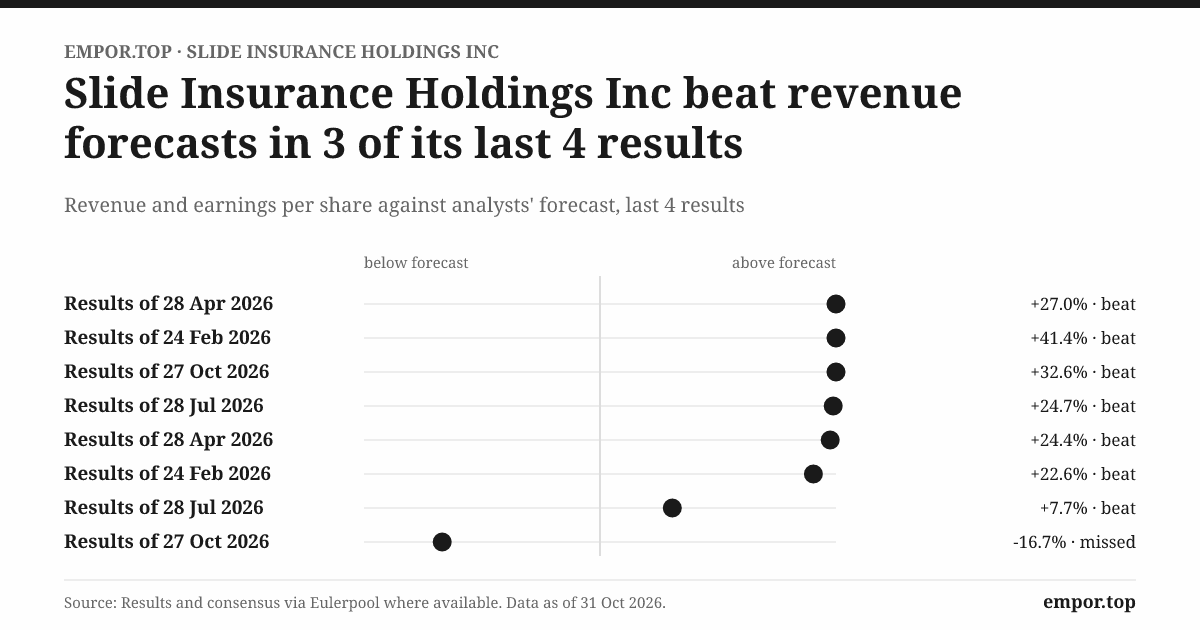
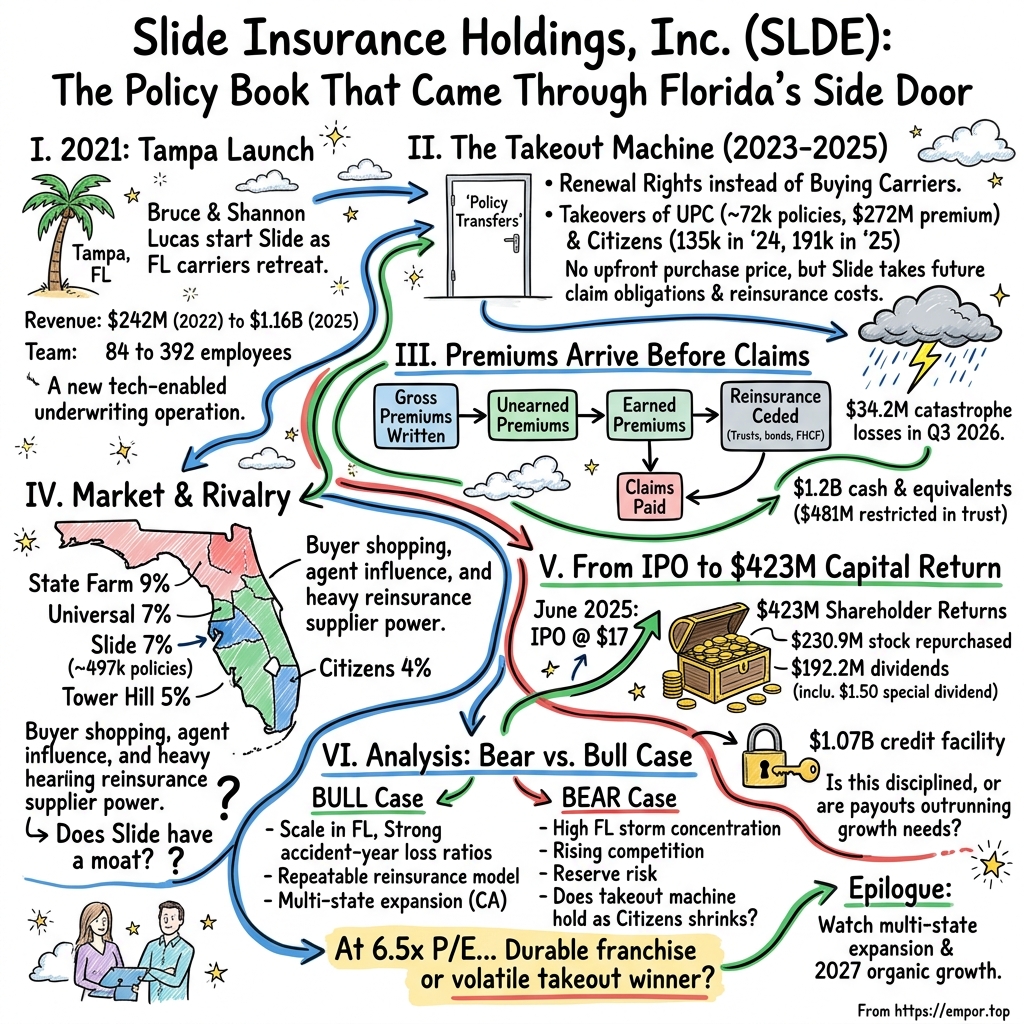
On October 27, 2026, a Tampa insurer that had not existed six years earlier told its shareholders two things in the same breath. Florida's thunderstorms, hail and wind had cost it $34.2 million in catastrophe losses during the summer quarter. And it had earned $138.2 million anyway, enough that the board declared a one-time special dividend of $1.50 a share on top of its regular seven-cent quarterly payout.[^1] The same week, the company signed a new secured credit agreement worth about $1.07 billion.1 Storm losses, a fat dividend and a billion-dollar borrowing line, all in one news cycle: that is Slide Insurance Holdings in miniature.
The company that made those announcements is a Delaware holding company listed on Nasdaq under the ticker SLDE. It does not itself write insurance policies. Its results are the consolidated output of insurance subsidiaries licensed to write homeowners and condominium coverage, plus a reinsurance vehicle, a retail agency and service companies that handle the plumbing of the business.[^3] That distinction sounds legalistic, and it is about to matter a great deal, because the profit an insurance subsidiary earns and the cash a holding company can hand to shareholders are two different numbers, separated by regulators, reinsurers and the claims that have not yet been filed.
Look closely at the third-quarter numbers and a puzzle appears. Gross premiums written, the dollar value of the policies Slide sold or renewed during the quarter, rose about 9%, to roughly $507 million.2 Revenue rose almost 36%, to about $361 million. Net income rose about 25%.[^1] A business whose sales are growing at single digits does not usually report revenue growing four times as fast. Something else is going on, and it is the first clue to how an insurer's accounts work: premiums are booked as revenue over the life of a policy, not when it is sold, so this quarter's revenue is mostly the echo of policies Slide took on in earlier quarters, many of them in large batches from other carriers and from Florida's state-backed insurer of last resort.
There is a second clue in the profit line. The combined ratio, the industry's basic scorecard that adds claims costs and operating expenses and divides them by earned premium, rose to 59.3% from 48.5% a year earlier.[^1] A combined ratio below 100% means the insurer made money on underwriting before counting any investment income; below 60% is a number most property insurers never see. Yet the ratio got worse, not better, even as profit grew. The storms explain part of that. The rest comes from how much of last year's profit came from releasing money that had been set aside for old claims.
So the headline earnings are strong, but they are not self-explanatory. They are a blend of three things that move on different clocks: the premium growth Slide wins today, the earned premium from policy books it absorbed in the past, and the weather. Pull those apart and four questions take shape. How much of Slide's growth comes from its own sales, and how much from policies transferred to it by other insurers and by Citizens Property Insurance Corporation, the state-created carrier?
Can its underwriting returns survive a year with ordinary storms and no tailwind from reserve releases? How much of the capital on its balance sheet is genuinely available to shareholders after claims, reinsurance and regulators take their share? And does the control of its founder, who owns about 45% of the company, line up with the interests of the public investors who own the rest?3
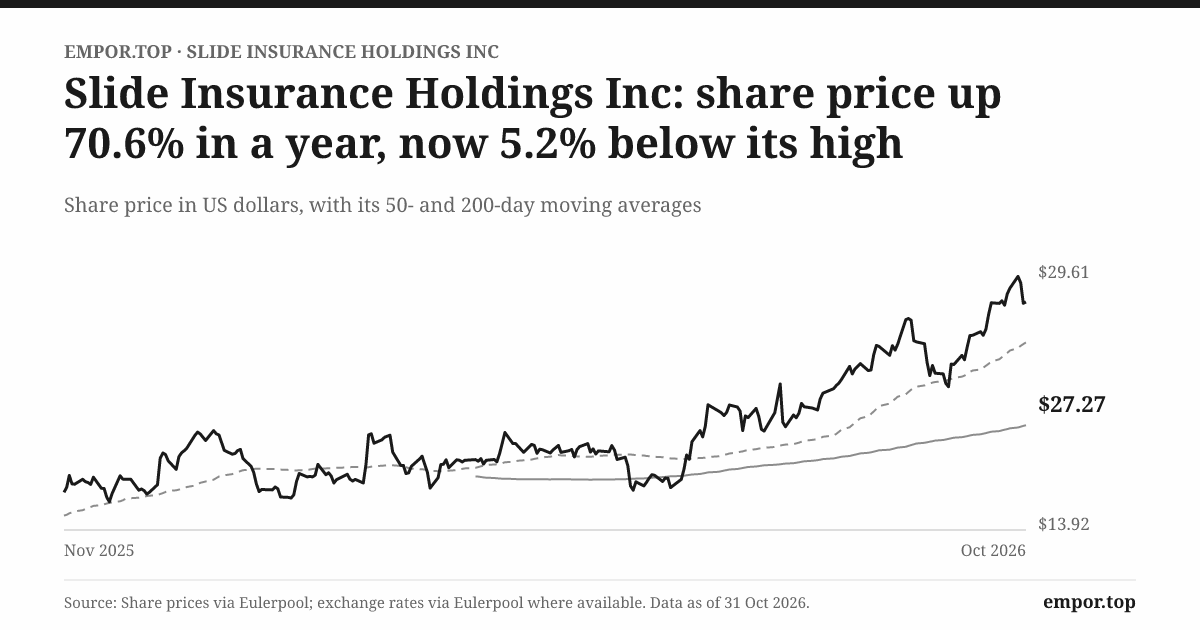
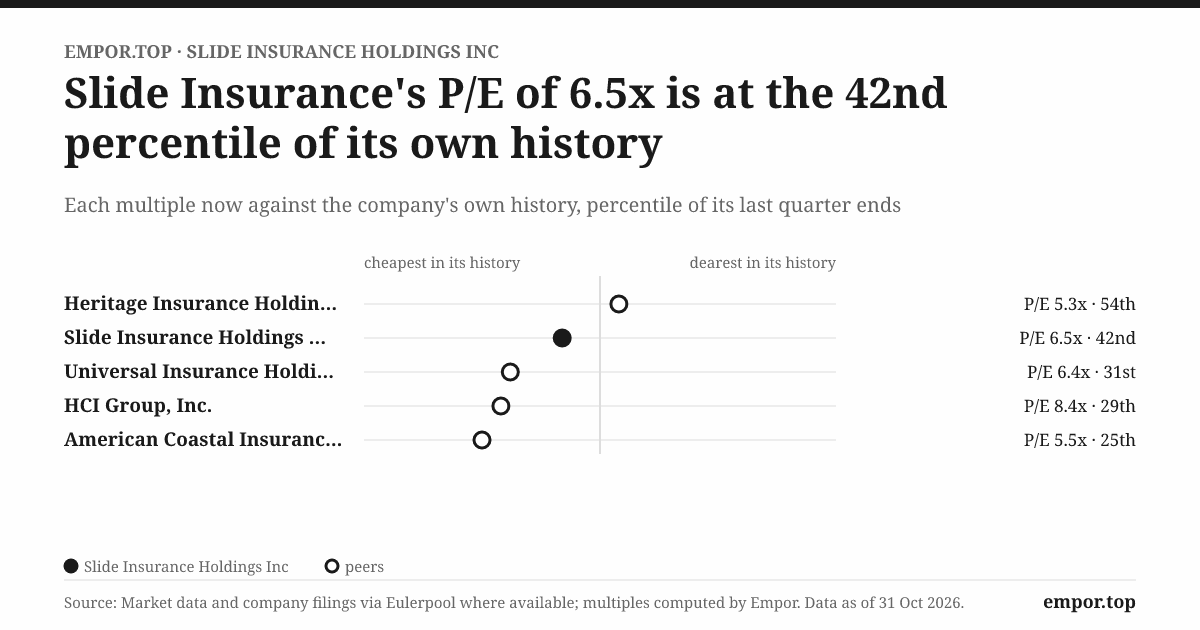
None of those questions can be answered by an earnings beat. Accounting revenue tells you when premium was earned, not whether it was priced correctly. Cash on the balance sheet tells you what the company holds today, not what it owes after the next hurricane. Even the dividend, which looks like the clearest possible signal of confidence, is a decision about capital that can only be judged against what the insurance subsidiaries need to keep. The market, for its part, seems unsure what kind of company it is looking at: at the end of October 2026 the shares traded at about $27, close to their 52-week high, yet at only about 6.5 times trailing earnings.[^6] Investors either think Slide's profits are unusually fragile, or they have not yet decided to believe them.
To decide which, the story has to start where Slide did, in a Florida homeowners market that most insurers were trying to leave.
 Subscribe on LinkedIn
II. Bruce Lucas starts over in a market others are leaving
In 2021, writing homeowners insurance in Florida looked like a way to lose money slowly and then very quickly. The state's property insurers had spent years in the red, squeezed by hurricane exposure, rising reinsurance costs and a litigation system that made roof claims unusually expensive to settle. Carriers were cutting back, withdrawing, or failing outright, and the industry would not post a collective underwriting profit until 2023, its first in seven years, after the legislature rewrote the rules on attorney fees and assignment of benefits in late 2022.4 Into that market, Bruce and Shannon Lucas launched a new insurer from Tampa.5
Bruce Lucas was not a newcomer to the problem. He had founded Heritage Insurance, another Florida property carrier, and led it through its public listing, so he knew the economics of hurricane country from the inside: how reinsurance towers are built, how Citizens depopulation works, how a policy book can be grown quickly and how quickly it can turn on you.5 Shannon Lucas, his wife, co-founded Slide with him and became its president and chief operating officer.5 In December 2021 the young company raised a $100 million Series A round, a large bet for an insurer with almost no policies, and pitched itself as a technology-driven carrier that would use data and automation to choose and price risks better than incumbents.6
It is worth being precise about what that experience does and does not prove. A founder who has built one Florida insurer knows where the potholes are, how to talk to regulators and reinsurers, and which distressed books might come loose. That is real advantage in a relationship-driven market. But it is not evidence that Slide's own underwriting is good. Heritage's record belongs to Heritage, under a different balance sheet and a different era of Florida law. The fair test of Slide is how Slide's policies perform under Slide's management, and that record only begins in 2021.
The product itself is simple to describe and hard to get right. A homeowner, usually through an independent agent or broker, buys a policy that runs for twelve months.[^3] The premium is often paid up front or in installments, and Slide earns it over the year.
Claims, meanwhile, follow their own calendar. A wind-damaged roof might be reported the week after a storm, or a year later, and a disputed claim can take longer still to close. That gap between collecting money and paying claims is the entire business: the insurer is paid to hold risk and the money that comes with it, and it only finds out whether it priced correctly after the fact.
Slide grew into that business at remarkable speed. Its reported revenue went from about $242 million in 2022 to about $1.16 billion in 2025, roughly a fivefold increase in three years.[^3] The organization had to be built while the book was arriving. The company counted from 84 employees at the start of 2023 to 392 full-time staff by March 2025.5 By the end of 2025, Slide had 493,532 policies in force, up from 343,056 a year earlier.[^3] That is a carrier hiring adjusters, underwriters and engineers almost as fast as it could seat them, while also building the systems to quote, bind, bill and adjust half a million policies.
The technology story deserves the same scrutiny as the founder story. Slide describes data, analytics and automation as central to how it selects, prices and services risks, and it capitalized internal-use software as projects entered service.5 What it does not do is break out research and development spending or provide a consistent measure of how much capital it pours into software relative to revenue.[^3] Investors are therefore asked to judge the technology by its outputs, the loss ratios and expense ratios, rather than by any disclosed input. That is a reasonable test, but it means "insurtech" is a description of method, not a moat. Every serious Florida carrier now uses aerial imagery, catastrophe models and automated underwriting rules. The question is whether Slide uses them measurably better, and only the claims experience can answer it.
There was one more thing Lucas understood about Florida that a pure technology start-up might not have. When insurers fail or retreat, their policyholders do not vanish. Somebody has to cover them. Some land at Citizens, which by law is meant to be the market of last resort and which the state actively tries to shrink. Others sit in the books of carriers that want to sell renewal rights before they run out of capital. For a new insurer with fresh capital, a strong reinsurance relationship and a founder who knows the playbook, those orphaned policies look like a shortcut to scale that would otherwise take a decade of agent-by-agent selling.
That shortcut is the side door through which Slide entered Florida's market. It is also the place where the risk hides, because a transferred policy arrives with its own roof, its own coastline, its own claims habits and its own reinsurance cost, none of which Slide chose from scratch. The most important example of that trade came in early 2023, when one of Florida's best-known carriers ran out of road.
III. The UPC deal bought renewal rights, not an insurer
By the start of 2023, United Property & Casualty Insurance Company was a carrier in retreat. Its parent had tried to shrink the Florida book in an orderly way, ceding risks and trimming exposure, but losses from Hurricane Ian and years of claims pressure overwhelmed the plan. In February 2023 the company was declared insolvent and headed toward liquidation; the orderly runoff, as one trade publication put it, did not work.7 For the Florida households holding UPC policies, the question was simple: who would cover their houses when those policies expired?
Slide had already signed the answer for a large share of them. Under a renewal-rights agreement filed by UPC's parent at the start of February 2023, Slide gained the right to offer replacement coverage to UPC's Florida homeowners policyholders, starting with about 72,000 policies, with rights to additional policies beyond that initial group.8 Slide said the book represented roughly $272 million of annual premium.8 On the surface, that looks like Slide buying a quarter-billion-dollar business. It did nothing of the kind, and the difference is the most important structural fact in its early history.
A renewal right is not an insurer. Slide did not buy UPC, its capital, its investment portfolio or, crucially, its old claims. Those stayed behind with UPC and, after the insolvency, with Florida's guaranty and receivership machinery. What Slide acquired was access: the ability to write new policies for those customers when their old ones came due, along with the information to underwrite them. The agreement specifies no purchase price for the renewal rights beyond the transfer of unearned premium, the portion of premium already collected by UPC for coverage still to be provided.8 A separate asset purchase and services agreement covered intellectual property and operating services, with compensation set at reimbursed costs plus 2% of earned premium.9
That structure makes the usual acquisition arithmetic meaningless. Analysts like to say a buyer "paid two times premium" for a book, as if a renewal-rights deal were a car dealership. Here there was no conventional purchase consideration to divide by premium, so there is no multiple to compare and no basis for saying Slide overpaid. What Slide did take on was the forward risk. Every claim on a Slide policy written after the transfer was Slide's claim, and every one of those policies had to be covered by Slide's reinsurance and serviced by Slide's staff. The premium base came with costs and liabilities attached; it simply did not come with a sticker price.
UPC was not the first such move, nor the last. Before it came St. Johns Insurance, another Florida carrier that was winding down, whose policies Slide also took through a transfer arrangement.5 Later, in 2025, Slide took renewal rights on a Florida book from Truck Insurance Exchange, part of the Farmers group, which was reducing its exposure in the state.[^3] Each deal followed the same logic: a carrier that wanted out, a set of policyholders who needed a home, and a younger insurer that could underwrite the incoming risks and decide which ones to keep.
The larger engine was Citizens. Florida's state-created insurer swelled during the crisis years as private carriers retreated, and the state has every incentive to move policies back out. Its takeout program lets approved private insurers offer to assume Citizens policies; policyholders who receive a comparable offer can be moved to the private carrier, which then takes over the risk from the assumption date.10 For Slide, the takeouts became the main source of growth. In 2024 it assumed 135,974 Citizens policies carrying about $290 million of unearned premium; in 2025 it assumed 191,850 policies carrying about $373 million.[^3] A single October 2025 assumption of 60,186 policies was, in Bruce Lucas's words, the largest in the Florida market.11
Citizens assumptions share UPC's key feature: there is no upfront acquisition price. Slide does not pay Citizens to take its policies. But the absence of a purchase price is not the absence of a cost. From the assumption date, every covered claim belongs to Slide, and before it can safely take on tens of thousands of coastal homes it must have reinsurance to protect them, which it buys at market prices. Slide also chooses which policies to bid for, which is the underwriting judgment its technology is meant to sharpen. A takeout is therefore less like an acquisition and more like a bulk sale at the door: a chance to pick from a large pool of customers without paying agents a commission on each one, in exchange for owning the risk the moment the door opens.
That model has a bright side and a dim one. The bright side is speed and expense. Transfers can add hundreds of thousands of policies in a few years, faster than any agent network could, and they avoid some of the acquisition costs that new voluntary business carries. Management has argued that takeouts typically produce superior combined ratios, making them accretive to earnings.11 The dim side is that the growth comes from a finite pool. Citizens shrinks as private carriers take its policies, so the supply of attractive takeouts falls just as more competitors line up for them. Renewal behavior matters too: a policyholder moved into Slide did not choose Slide, and at the next renewal an agent may shop that policy elsewhere.
The accounting adds one more wrinkle. When Slide assumes a book, it receives the unearned premium and begins earning it over the remaining policy term. That is why reported revenue keeps rising well after the assumption itself. The 2024 and 2025 transfers flowed through earned premium for months, then renewed or did not. A reader who sees revenue up 36% in the third quarter of 2026 is partly watching the delayed digestion of policies that arrived in late 2025, not a new burst of selling.
So did the transfers create value? The best evidence says they gave Slide scale at low acquisition cost, and that the books it selected have so far produced strong underwriting results. What they cannot yet prove is durability. A transferred policy is valuable only if it renews at an adequate price, and only if the claims it generates over several years, including a bad storm year, stay within what Slide charged. That brings the story to the mechanics of the business itself, and to the strange gap between the money an insurer collects and the profit it reports.
IV. Premiums arrive before the claims
Picture a single policy. A homeowner in Sarasota renews coverage with Slide on the first of the month and pays a year's premium. On that day the money lands in Slide's bank account, but almost none of it is profit. Slide records it as written premium and then sets almost all of it aside as unearned premium, a liability that represents the coverage it still owes.
Each day the policy stays in force, a little of that liability turns into earned premium, which is what the income statement counts as revenue. If a storm peels shingles off the roof in month nine, Slide records a loss, estimates what the claim will eventually cost, and holds a reserve for it. The check to the roofer might go out months later. If the claim is disputed, it might be paid years later.
Multiply that by half a million homes and the shape of Slide's financial statements comes into focus. Gross premiums written measure what was sold during a period. Premiums earned measure the portion of past and present sales that has been used up. That timing helps explain the third quarter of 2026: gross premiums written grew about 9%, but net premiums earned grew about 37%, to roughly $333 million.2 The accounts are telling the truth, just on a delay.
Reinsurance is the next layer, and it is where Florida economics diverge from almost everywhere else. A carrier holding half a million Florida homes cannot survive a major hurricane on its own capital. So it buys insurance for itself. Slide passes part of its catastrophe risk to private reinsurers, to the Florida Hurricane Catastrophe Fund, a state-run reinsurance pool, and to investors in catastrophe bonds, securities that pay attractive interest but lose principal if a defined disaster strikes.[^3]
As of June 2025, Slide had $660 million of catastrophe-bond coverage in place.5 The premiums Slide pays for all this protection are deducted from what it keeps, which is why analysts talk about net premiums: gross premiums minus the cost of reinsurance. When reinsurance gets cheaper, as Lucas said it did in the 2026 renewal, every policy becomes more profitable; when it gets dearer, the same book earns less without a single claim being filed.12
The last layer is investment income. Because premiums arrive before claims, an insurer always holds a pool of money that belongs, in an economic sense, to future claimants. Warren Buffett made the word "float" famous for exactly this. Slide's float is invested mostly in high-quality bonds, carried at fair value with an average credit quality around AA-.[^3] In 2025 that portfolio produced about $66 million of net investment income, roughly 11% of Slide's pre-tax income of about $589 million.[^3] That is a meaningful contribution, but it also shows how different Slide is from a mature float-driven insurer: almost nine-tenths of its pre-tax profit came from underwriting itself, which makes the business far more sensitive to the weather than to interest rates.
Now the cash. At the end of 2025, Slide held about $1.2 billion of cash and cash equivalents, nearly as much as its entire year's revenue.[^3] It is tempting to treat that pile as a war chest. It is not. About $481 million of it sat as restricted cash inside a reinsurance trust, a structure that holds assets to secure reinsurance obligations and that Slide consolidates as a variable interest entity.[^3] Against the rest stood the liabilities that the cash exists to pay: unearned premiums for coverage not yet provided, loss reserves for claims already incurred, and reinsurance payables.
Above all of it stand Florida's capital rules, which set how much surplus each insurance subsidiary must hold and limit how much it can dividend to the parent without regulatory approval. By September 2026, much of that cash had been reinvested; Slide reported roughly $700 million of cash and about $850 million of invested assets.2 The total had grown, but its purpose had not changed.
The cash-flow statement makes the same point from another angle. In every year from 2022 to 2025, Slide's operating cash flow ran well above net income; in 2025 it was about $797 million of operating cash against about $443 million of profit.[^3] For an industrial company, that would look like spectacular cash conversion. For an insurer growing quickly, it mostly reflects timing. Premiums from new and assumed policies arrive up front, unearned premium liabilities swell, and claims payments lag behind. The nine months to September 2026 showed the other side of the timing: large cash outflows for prepaid reinsurance, the protection Slide buys at the start of the hurricane season and expenses over the year.13 Cash flow from operations is real money, but it is money held on behalf of policyholders until their claims are settled.
That is why one of the most eye-catching numbers attached to Slide's stock is also one of the least useful. Measured as operating cash flow minus capital spending, divided by market value, Slide's trailing free-cash-flow yield came out near 29% in late October 2026. Taken literally, that would mean the business generated cash equal to nearly a third of its market value every year.
It means nothing of the kind. The same arithmetic produces an enterprise value of about $1.9 billion, roughly half the $3.6 billion market value, by subtracting cash that is largely spoken for. For a bank or an insurer, these measures confuse the money held for customers with the money owned by shareholders. The fair question is not how much cash Slide generated, but how much surplus capital its subsidiaries can release once claims and regulators are satisfied.
There is one small signal worth watching in the receivables. Policyholders often pay in installments, and Slide carries premiums receivable on its balance sheet. The allowance it holds for premiums it does not expect to collect rose from about $3.3 million at the end of 2025 to about $7.3 million by September 2026, while net receivables rose more slowly, to about $107 million.13 The amounts are small against a business of this size, and Slide does not publish an ageing schedule that would show who is paying late. But a doubling allowance on a book full of assumed policies is a reminder that customers who were moved to Slide, rather than choosing it, may behave differently.
All of this machinery leads to one question that no quiet quarter can answer. The premiums Slide collects today are an estimate of what its policies will cost, made before the claims arrive. If the estimate is good, the float compounds and the subsidiaries accumulate surplus that can eventually be released. If it is wrong, the cash on the balance sheet was never really profit at all. Whether Slide's estimates are good depends partly on luck and partly on whether it has a genuine edge in a market that is filling up with rivals.
V. Porter's Five Forces & 7 Powers
Every few months, Citizens publishes a report that reads like a census of Florida's homeowners market, ranking the insurers by how many residential policies each one carries. The March 2026 edition told a story that would have been hard to imagine five years earlier. Slide, a company founded in 2021, sat near the top of the table with about 497,000 policies, roughly 7% of Florida's personal residential market.14 State Farm Florida, the local arm of the country's largest home insurer, led with about 646,000 policies, or 9%. Universal, a long-established Florida carrier, held about 568,000, also around 7%. Tower Hill had about 411,000, or 5%. And Citizens itself, which at the peak of the crisis had become the state's largest property insurer by far, had shrunk to about 317,000 policies, around 4%.14
That last number is the hinge of the competitive story: as Citizens shrinks, the takeout opportunity does too, while more insurers chase the homeowners who remain. To judge whether Slide's position can hold as Florida returns to competition, it helps to walk through the forces that set profits in this industry, and then ask which, if any, of the durable powers that protect great businesses Slide actually possesses.
Start with how the market is wired. Florida homeowners mostly buy through independent agents and brokers, who can quote several carriers and move a client at renewal.[^3] Regulators approve the rates insurers may charge, so pricing is not a free market in the usual sense; a carrier that underprices can be slow to correct, and one that overprices may not get approval. Reinsurance capacity and its price set an outer limit on how much exposure any carrier can take. And Citizens' takeout program moves eligible policies into private hands on a schedule set by state rules. Those features shape every force below.
Buyer power is subtle here. Each homeowner is a tiny customer with no individual bargaining leverage and no ability to negotiate a filed rate. Yet as a group, buyers hold one powerful card: the annual renewal. Every year, each policy is up for grabs, and the agent standing between Slide and the homeowner has every incentive to shop it if a cheaper or better-rated alternative appears. When Florida had few willing carriers, that card was weak, because there was nowhere to go. As reforms have restored profits and new capital has returned, the card gets stronger. Slide does not disclose a voluntary retention rate that would show how often its customers stay when they have a real choice, so this force is the one investors know least about.
Rivalry has moved through a full cycle in a few years. During the distressed period, rivalry was low in a peculiar way: the best opportunities came from rivals failing, not from beating them. UPC's collapse and the swelling of Citizens were, in effect, customer acquisition for whoever had capital and nerve. The legislative reforms of late 2022 and the profitable years that followed changed that. Florida insurers made an underwriting profit in 2023 for the first time in seven years, which is exactly what invites competition back.4
On the third-quarter 2026 call, Lucas said there was "competition everywhere," but that Slide was not seeing anything outsized or problematic.2 A quarter earlier he had said competition was not hurting the top line or compressing margins.12 That is the right thing for a chief executive to say, and it may be true, but the decline in gross premium growth to single digits is at least consistent with a market where winning business has become harder.
The threat of new entrants is moderate and cyclical. Starting a Florida insurer requires regulatory approval, a capital base, a reinsurance program and a distribution network, which keeps casual entrants out. But Slide itself is proof that a well-capitalized team can go from nothing to the top of the table in four years when the market is distressed. The same door that let Slide in can admit the next founder with a Series A and a reinsurance relationship.
Supplier power is where Florida insurance differs most from almost any other business. Slide's critical supplier is not a vendor of parts; it is the reinsurance market. Reinsurance is not a commodity input that can simply be swapped out at will. The capacity Slide needs to protect a coastal book must be bought every year, priced by a limited group of global reinsurers, the state catastrophe fund and capital-market investors, and its cost can swing sharply after a big loss year anywhere in the world.
Slide's new credit agreement even contains default provisions tied to catastrophe retention and reinsurer concentration, a sign that its lenders see the reinsurance program as part of the credit itself.1 In 2026, that supplier was in a generous mood: Lucas reported a double-digit risk-adjusted rate decrease alongside a larger tower.12 The same supplier can tighten in a single season.
The threat of substitutes is low in the narrow sense: a mortgaged Florida home must be insured, and there is no practical alternative to a policy. But there is a substitute for Slide's specific product, and it is the surplus-lines or excess-and-surplus market, where carriers write outside the admitted rate system, as well as Citizens itself when private pricing gets too high. Slide is moving into that territory in California with an excess-and-surplus program, which shows the line between admitted and non-admitted business is a competitive lever, not a fixed boundary.2
Now the harder question: does Slide possess any of Hamilton Helmer's seven powers, the structural advantages that let a business earn superior returns persistently? The list is scale economies, network economies, counter-positioning, switching costs, branding, cornered resources and process power. A homeowners insurer has no network effects; one more Slide customer does not make the product better for the next. Switching costs are minimal; an agent can move a policy at renewal with paperwork. Branding barely exists in independent-agent channels, where the homeowner may scarcely know which carrier holds the risk. No cornered resource is established either; Slide's data and AI tools are tools, built on catastrophe models and imagery that competitors can also buy.
That leaves three candidates. Scale economies are real but limited: a larger book spreads fixed costs and may improve reinsurance terms, and Slide's expense ratio fell from about 35% to about 29% in the third quarter of 2026 as the book grew.2 But State Farm and Universal are larger or comparable in Florida, so scale is a ticket to compete, not a barrier against rivals. Counter-positioning had a moment: in the distressed years, Slide's willingness to grow aggressively through takeouts while incumbents shrank was a strategy others did not want to copy.
That window closes as the market heals. Process power is the strongest claim. If Slide's combination of policy selection, pricing, geographic spread and reinsurance modeling consistently produces better loss ratios on the same kinds of homes, that would be a genuine and hard-to-copy advantage, the kind Progressive built in auto insurance over decades.
The trouble is that process power can only be proven over time and against peers, and the record is short. Slide does not publish peer-adjusted retention, price realization or the rate at which its takeout bids win the policies it most wants. Its results are excellent, but they have been earned largely during a period when Florida reforms lowered claims costs for the whole industry, Citizens offered a buffet of policies to choose from, and reinsurance prices were falling. Strong results in a favorable market are evidence of competence. They are not yet evidence of a moat.
So the verdict on Slide's competitive position is a narrowed version of the bull thesis. Slide has meaningful scale and an underwriting process that has worked well so far. It has not yet shown that the process creates durable excess returns once the conditions that helped it fade. The moat thesis can be stated in a form that will either survive or fail in public: if Slide has process power, its accident-year combined ratio, its voluntary retention and its net catastrophe losses after reinsurance should stay strong as transfers normalize and competition rises. The first real test of that thesis came in the summer of 2026, when storms finally returned.
VI. The 52% combined ratio meets a storm season
The third quarter of 2025 was the kind of quarter that makes Florida insurers look like geniuses. The hurricane season was quiet for the state, claims came in light, and Slide reported a combined ratio of 48.5%.[^1] For every $100 of premium it earned, it spent less than $49 on claims and expenses. Over the full year, the combined ratio was 52.1%, and net income more than doubled to about $444 million.[^3] Twelve months later, the third quarter of 2026 brought convective storms across Florida, hail and wind events that do not get names but do generate claims, and the combined ratio rose to 59.3%.[^1]
On the surface, that looks like deterioration. It is more interesting than that. To see why, it helps to break a combined ratio into its moving parts, the way an engineer would break down a bridge load. There is the accident-year loss ratio, which measures the claims cost of events that occurred during the period itself, excluding catastrophes. There is the catastrophe load, which captures the storm losses. There is the expense ratio, the cost of running the business. And there is prior-year development, which is the revision to estimates for claims from earlier periods. If last year's reserves turn out to have been too generous, the insurer releases the excess and reports a gain; if they were too thin, it adds to them and reports a loss.
Apply that to the two quarters. In the third quarter of 2025, Slide's underlying combined ratio, before catastrophes and reserve releases, was about 62%. Then about $32.5 million of favorable prior-period development, worth roughly 13 percentage points of earned premium, pulled the reported number down to 48.5%.2 In the third quarter of 2026, the underlying ratio had improved to about 54%, helped by an accident-year loss ratio that fell to 25.5% from 27.5% and an expense ratio that fell to about 29% from about 35%.[^1]2 Then the storms added about 10 points of catastrophe losses, and a smaller reserve release of $18 million took off roughly 5 points.2 The arithmetic comes out at 59.3%.
The reveal is that the core underwriting got better, while the reported result got worse. The year-ago quarter was flattered by a large reserve release; the current quarter carried real weather. An investor who looked only at the headline combined ratio would have concluded the opposite of what happened underneath. That is exactly why the headline ratio is not a normalized earnings number for this company.
The same lesson runs through Slide's annual results. In 2024, named storms cost Slide about $87.9 million in catastrophe losses, and the combined ratio and earnings reflected it.[^3] In 2025, the year that produced the 52.1% ratio, Slide also recorded $81.8 million of favorable prior-year reserve development.[^3] Put those two figures beside each other and the problem is plain. One year of storms and one year of reserve releases are each worth around $80 million to $90 million of pre-tax profit, which is a large share of a business that earned about $589 million before tax in its best year. The swing between a bad weather year with reserve strengthening and a quiet year with reserve releases could easily move reported earnings by a third.
Favorable reserve development is not a bad sign in itself. It means Slide's earlier estimates were cautious, which is what regulators and auditors want. Slide's auditor gave an unqualified opinion on the 2025 financial statements but identified the estimation of loss and loss-adjustment-expense reserves as a critical audit matter, the auditor's way of flagging the area that required the most judgment.[^3] That label is common among property insurers. It is still the right lens: the reserve is management's estimate of what claims will cost, and the release of those reserves is profit that was earned in earlier periods and recognized later. A company that has been releasing reserves for several years will eventually run out of past caution to release, unless each new year is reserved just as conservatively.
The catastrophe side has its own rhythm. Slide says its 2025-26 reinsurance program protected it up to a modeled 1-in-143-year event, meaning a storm severe enough that catastrophe models expect it roughly once every 143 years.[^3] On the second-quarter 2026 call, Lucas said the new treaty was bought to a return period "well in excess" of 130 years for a first event, and that he thought it was around 180.12 Those figures are risk-management evidence. They are not promises against loss. A modeled return period depends on the model, and Florida's history includes storms that models underestimated. More important for shareholders is the retention, the amount Slide pays itself before reinsurance responds, and the speed with which reinsurance recoveries arrive when they are needed.
The third-quarter 2026 call offered a live example. Just after the quarter closed, Hurricane Isaias, a Category 2 storm, came ashore near the Florida Panhandle and Alabama border. Lucas estimated roughly $50 million of pre-tax retained losses, called that estimate very conservative, and said he did not expect a loss to reach the reinsurance panel.2 Management folded the storm into its updated full-year outlook rather than leaving it as a surprise.2 That is disciplined communication. It is also a reminder that even a storm Lucas described as minor costs Slide a retention measured in tens of millions, before any year when a major hurricane makes landfall across its densest coastal exposure.
The call also showed where analysts are pushing. Prepared remarks emphasized voluntary growth, new markets and the special dividend. The questions went to the slower premium growth, the contribution from new states, and what drove the decline in general and administrative costs; Lucas said those costs had been front-loaded in earlier quarters.2 Nobody on the call disputed that the underlying ratios were strong. The live question was whether they could stay strong without the earlier tailwinds.
That gives investors three recurring tests, each of which strips out a different source of noise. The first is the accident-year combined ratio excluding catastrophes, which shows whether the core book is priced well; it stood at about 54% in the third quarter of 2026, down from about 62% a year earlier.2 The second is prior-year reserve development, which shows whether past estimates were right and whether reported profit is borrowing from the past. The third is net retained catastrophe losses and reinsurance recoverables, which show what the weather actually costs Slide after its protection responds. A business with process power should pass all three over several years, including at least one year with a significant hurricane.
The underwriting evidence so far is strong, and the improvement in the underlying ratio in a storm quarter is a genuinely encouraging sign. But Slide's story has a growth chapter as well as an underwriting one, and that chapter was quietly changing. The takeout machine that had filled the book was slowing down, and the company was changing its pitch.
VII. The takeout machine slows—and the sales pitch changes
On the second-quarter 2026 earnings call in late July, Bruce Lucas made an admission that sounded technical and was actually strategic. Slide's pace of Citizens assumptions had slowed during the quarter, he said, "in order to allow the company to bind its 2026 reinsurance treaty."12 The logic was straightforward: reinsurance is priced on projected exposure, and if Slide grew faster than it had told reinsurers, it could owe what Lucas called a "very substantial true-up payment."12 So it paused its biggest growth engine to keep its biggest supplier happy.
By the third quarter, the narrative had shifted. Lucas attributed the 9% growth in gross premiums written to "continued growth in voluntary sales and the early contributions from our expansion markets."2 California, where Slide launched a residential excess-and-surplus program in May 2026, was ramping up. Texas residential writing had begun. New York and New Jersey were slated for the coming quarters, and Slide had already secured approval for Rhode Island and New Jersey as its fourth and fifth states.212 The story of Slide as a Citizens takeout specialist was being rewritten as the story of a multi-state underwriter growing through its own sales.
The numbers support the direction of that shift but not yet its scale. The third-quarter growth figures show the transition.[^1] Earned premium is still being lifted by the big transferred cohorts of 2025; written premium, which captures what Slide wins now, has slowed to a rate that a mature insurer would recognize. On the second-quarter call, Lucas said California held "probably a couple of million" dollars of premium, a rounding error against a company writing roughly half a billion dollars a quarter.12 New states matter as a diversification story, but they are not yet a growth engine.
It is worth being careful with the word "organic." Management uses it for new voluntary business and renewals. But a renewal of a policy that arrived through a takeout is not quite the same as a customer who chose Slide through an agent. And the earned premium on previously transferred policies is not organic growth in any sense; it is the accounting delay of an earlier acquisition of customers. Slide does not provide a clean multi-year bridge that separates voluntary new business, assumed policies, retention and rate changes. Without it, outsiders cannot fully isolate how much of the business is growing on its own.
The record of what management said a year earlier helps calibrate the present claim. On the third-quarter 2025 call, Lucas explained that Slide had been "reserving underwriting capacity in anticipation of significant fourth-quarter takeouts," then announced the record 60,186-policy October assumption and said more takeouts were expected in November and December.11 He argued that takeouts typically have superior combined ratios and would be accretive to earnings.11 At that point, takeouts were the plan. Twelve months later, takeouts were being paced around reinsurance and voluntary growth was the headline. That is not inconsistency so much as a strategy adapting to a shrinking Citizens book. But it means the voluntary-growth claim is newer than the takeout claim, and has had much less time to prove itself.
Management's guidance has moved upward through the year. In October 2026, Slide raised its full-year outlook to $1.90 billion to $1.95 billion of gross premiums written, lifting the bottom of the prior range, and to $500 million to $520 million of net income, up from $455 million to $470 million, even after including up to $50 million of expected pre-tax losses from Hurricane Isaias.2 On the second-quarter call, Lucas had said Slide wanted to keep "a very conservative forward guidance" and that net income was trending toward exceeding it.12 That pattern, conservative guidance followed by raises, has so far held. The raised range is still management guidance, not a result, and the fourth quarter has not been reported.
For 2027, chief financial officer Andy Omiridis offered a floor of 8% to 9% gross premium growth before any added contribution from new territories, back-end loaded because reinsurance projections are set in February.2 That is a far more modest growth rate than the takeout years produced, and it is a candid one. It also means the bridge from inherited policies to voluntary business is the central operating story of the next year. The proof points will be voluntary policy growth, retention at renewal and renewal pricing, none of which can be read from a single quarter.
Meanwhile, the company was doing something that young insurers growing quickly rarely do. It was sending a great deal of money back to its shareholders.
VIII. A $17 IPO becomes a $423 million capital-return plan
In June 2025, Slide priced its initial public offering at $17 a share and listed on Nasdaq; the offering closed on June 20.1516 The IPO sold 24 million shares. About 16.67 million were new shares issued by Slide itself, raising roughly $283 million in gross proceeds for the company before fees. The other 7.33 million were sold by existing shareholders, whose proceeds went to them, not to Slide.1516 In the run-up to the deal, Slide had been reported to be targeting a valuation above $2 billion.17 Before the IPO, the company had raised about $123.5 million of net private equity through the end of 2024.5
That split matters for understanding what came next. The IPO was partly a capital raise and partly a liquidity event for early investors. Slide's own share of the proceeds strengthened the balance sheet at a moment when it was absorbing large takeout books and needed surplus to support them. Within weeks, the company began to reverse the flow.
In August 2025, Slide's board authorized a $75 million share repurchase program.[^3] By the third-quarter 2025 call in November, the company had bought more than 1.4 million shares at an average price of $14.22, below the IPO price, and the board had raised the authorization to $120 million.11 Lucas said Slide planned to "aggressively buy back stock until we believe the share price is trading in a manner that reflects our fair value."11 The authorization was later expanded again. By October 2026, Slide reported $230.9 million of repurchases since the IPO, with $114.1 million still authorized.[^1] Lucas put the average cost at about $17.28 a share.2
Was that a good use of money? On price alone, the early buybacks look well timed. Shares bought in the low and mid-teens in 2025 were worth about $27 by the end of October 2026, and the stock had ranged from roughly $15.57 to $28.77 over the prior year.[^6] Repurchases at those prices were accretive to the shareholders who stayed, provided the business is worth what the later price implies. But a buyback is not judged only by its price. It is judged by what the capital might otherwise have done, and in an insurer the alternative uses include supporting more policies, absorbing a catastrophe, and keeping regulators comfortable.
Dividends came next. Slide initiated a regular quarterly dividend of seven cents a share and, in October 2026, declared the one-time $1.50 special dividend that opened this story.[^1] Lucas said the special dividend complemented the repurchase program.2 Adding the buybacks to dividends paid and declared, Slide estimated it had returned about $423.1 million to shareholders since its IPO, including about $192.2 million in dividends.[^1] That is roughly one and a half times the gross proceeds Slide raised in the offering, returned in a little over sixteen months.
The same week, the capital structure changed shape. On October 26, 2026, Slide replaced a $530 million revolving credit facility, on which it had nothing drawn at the end of September, with secured facilities totaling about $1.072 billion: a $670 million revolver and a $402 million delayed-draw term loan, maturing in October 2031.113 It drew $50 million of the term loan at signing to refinance the old agreement and pay costs.1 The covenants require leverage no higher than 2.5 times, fixed-charge coverage of at least 1.2 times, a minimum net worth, and that the insurance subsidiaries meet their risk-based capital requirements.1 Before this, Slide's debt was trivial; at the end of 2025 its long-term debt was about $34 million.[^3]
Capacity is not cash. The $1.07 billion facility is a borrowing option, and only $50 million of it is funded. But the size of the envelope is striking for a company whose market value is about $3.6 billion. Asked why Slide needed it, Lucas said one of the primary reasons was "to pursue ex-Florida growth and potentially strategic M&A," and described acquisitions as a possible route to something "transformative" in 2027, if the price was right.2 The facility, in other words, is not just a safety net. It is a war chest for deals that have not been announced and whose economics are unknown.
This is where a skeptical investor would push hardest. If underwriting opportunities are as attractive as management says, and if growth into new states and possible acquisitions require capital, why return more than $400 million in sixteen months? There are good answers available. Slide's statutory subsidiaries may hold more surplus than they need; the holding company may have accumulated distributable cash from subsidiary dividends and fees; and returning excess capital is better than letting it sit idle. But Slide does not publish a reconciliation from consolidated cash to holding-company unrestricted cash, insurer statutory surplus and regulator-approved dividend capacity. Without that bridge, outside investors cannot verify that the payout is truly surplus to what policyholders and regulators need after a stress event.
The restrictions on cash and subsidiary dividends still apply, as do the new credit agreement's covenants on capital adequacy and reinsurance structure.1 Borrowing at the holding company while paying special dividends is not reckless by itself. It does mean that the capital story is no longer as simple as "the cash is ours."
Slide's capital returns may prove to be disciplined; the timing of the 2025 buybacks looks good in hindsight. But the evidence that would settle the question is not a share-price chart. It is a demonstration, after a real hurricane season, that the subsidiaries remained well capitalized and that the holding company did not need to lean on the facility to replace capital it had sent to shareholders. And all of these decisions, about buybacks, dividends and a billion-dollar credit line, were made by a board led by the same person who owns almost half the company.
IX. The founder still owns the steering wheel
Bruce Lucas holds three titles at Slide in practice, even if only two appear on the letterhead. He is chief executive officer. He is chairman of the board. And he is, by a wide margin, the largest shareholder, beneficially owning about 51.5 million of roughly 114.5 million shares outstanding as of April 2026, or about 45%.3 Shannon Lucas, his wife and co-founder, runs the company's operations as president and chief operating officer, and held about 6% of the shares after the IPO.153 When the Lucas family speaks, it speaks with more than half of the company's voice.
Founder control cuts both ways, and in insurance the arguments are unusually sharp. The case for it is alignment. A chief executive who owns 45% of the company loses far more from a reserving mistake or a reckless reinsurance decision than he gains from any bonus. Lucas's stake was essentially unchanged from the IPO, when he held about 45.1%, through April 2026.153 He did not use the offering to cash out heavily. A founder with that much at risk has every reason to price conservatively, buy ample reinsurance and avoid the kind of growth-at-any-cost behavior that sank several of his Florida competitors.
The case against is oversight. When the same person chairs the board and runs the company, and his spouse is the second-most senior executive, the people charged with evaluating management's judgment are evaluating the controlling shareholder's family. Slide has a lead independent director, which is the standard partial remedy.3 But the most important judgments in an insurer, how much to reserve, how much risk to retain, how much capital to send upstairs, are exactly the ones where an independent check matters most, because they are estimates that can be made more or less optimistic without anyone being able to prove otherwise for years.
Compensation is the clearest window into how the board exercises its role. Lucas's reported total pay was about $9.7 million in 2023, rose to about $21.2 million in 2024, and fell to about $4.0 million in 2025.35 The 2024 figure was driven by about $14.4 million of stock awards and a $5.9 million bonus; the 2025 figure included a $3.0 million bonus.3 Reading 2024 as an annual run rate would be a mistake, since stock awards of that size are often lumpy grants ahead of a listing. But it is fair to ask why a founder already owning almost half the company needed a $14 million equity award in the year before the IPO. Equity grants to a controlling holder add little alignment and some dilution.
Shareholders voiced some unease at the June 2026 annual meeting. Director Andrew Wright received about 10.0 million withheld votes against about 73.5 million in favor, and director Beth W. Bruce received about 9.3 million withheld against about 74.2 million in favor.[^21] With Lucas controlling about 45% of the shares, those withheld votes represent a substantial share of the shares not held by him. That is not an activist campaign, and both directors were elected easily. It is a signal that a meaningful bloc of outside investors had reservations about the board's composition or conduct, worth watching in future votes.
Two smaller items fill out the picture. In July 2021, Lucas lent the company $500,000, interest-free, for working capital, and it was repaid that December.5 In 2024, Slide paid about $185,500 to an aircraft company in which a director held an indirect controlling interest, for up to 50 hours of flight time.5 Neither is material to a company of Slide's size, and neither has recurred in a way the company discloses. They are the ordinary related-party texture of a founder-led company and warrant ordinary attention, not alarm.
The executive bench has also turned over at one key seat. Chief financial officer Jesse Schalk retired at the end of November 2025, and Andy Omiridis took over on December 1, with Schalk staying on in an advisory role into March 2026.[^3] The new CFO arrived just before Slide's first full year of public reporting, and it was Omiridis who delivered the raised 2026 guidance and the 2027 growth floor on the October call.2
The fairest test of management is not structure but behavior over time. Here the record so far is good. Management's 2025 takeout strategy was executed as Lucas described.11 In 2026, it again raised guidance after saying it expected to beat it, while acknowledging slower premium growth and a gradual rollout in new states.122 Those are the habits of a team that sets targets it can hit and explains the trade-offs it makes. What the record does not yet include is a bad year, which is when governance matters most.
The auditor reported no material weakness in the 2025 statements; reserve estimation remained its critical audit matter.[^3] That points back to the single most important judgment in the company. The founder controls the board, the board oversees the reserves, and the reserves determine how much of today's profit is real. Founder ownership aligns the chief executive with shareholders on the long-term value of the stock. It does not, on its own, guarantee that the estimates will be right, and the 2024 pay award and the 2026 director dissent are reasons for investors to keep watching how independent the oversight really is. The market's price for all of this is the next thing to examine.
X. Analysis & Bear vs. Bull Case
At the end of October 2026, Slide’s shares remained near $27, about 5% below their 52-week high and up from a low near $15.57.[^6] Trailing earnings were about $4.40 a share, putting the stock at roughly 6.5 times earnings, while the company’s median multiple since listing had been about 11 times.[^6] Book value was about $9.87 a share, so the market paid about 2.5 times book, which is a premium valuation for a property insurer.[^6] Return on equity over the prior twelve months was about 45%.[^6]
Those numbers point in different directions, and the tension between them is the market’s real verdict. A price-to-book of 2.5 says investors believe Slide’s equity is worth far more than its accounting value, which is only rational if the company can keep earning very high returns on that equity. A price-to-earnings of 6.5 says investors do not trust the current earnings to persist. The two are reconciled by a simple assumption: that today’s returns are far above what Slide will earn in an average year. In effect, the market is capitalizing a normalized profit well below the trailing figure, because it expects storms, reserve revisions or competition to pull returns down from the mid-40s.
The comparison with peers reinforces the point. In late October 2026, Heritage Insurance, the Florida carrier Lucas founded, traded at about 5 times earnings; Universal Insurance at about 5.9 times; Hippo at about 8.3 times; Allstate at about 4.8 times; and Progressive at about 11.2 times.18 Slide sits in the middle of its Florida peers, not at a deep discount to them. Florida catastrophe insurers as a group trade at low earnings multiples because investors have learned that one hurricane can erase a year of profit.
None of those peers is a like-for-like comparison: Allstate and Progressive are national, diversified and far larger; Hippo has a different business mix and history; Heritage and Universal share Florida exposure but have different reserve histories and capital positions. Slide’s own “median” multiple covers only its brief life as a public company, which spans little more than a year, so it is a thin benchmark too.
The bull case starts with what Slide has already done. In under five years it has built a top-tier position in the country’s most difficult homeowners market, with roughly 7% of Florida residential policies, comparable to Universal’s share and below State Farm Florida’s 9%.14 It has done so while reporting accident-year loss ratios that improved even through a storm quarter, and an underlying combined ratio near 54% in the third quarter of 2026.2 It has built a layered reinsurance program, bought at falling prices in 2026 and to a modeled return period management describes as above 130 years for a first event.12
Both transfers and voluntary growth have contributed to the book, and the company is beginning to diversify into California, Texas and states in the Northeast.2 If the underwriting results hold as acquired policies normalize, the current earnings are not a peak but a base, and a 6.5 times multiple would be unusually cheap for a business earning 40% or more on equity.
The bear case is just as specific. Florida concentration remains high, and the new states are too small to change that soon. Policyholders can leave at every renewal, and the agent channel gives them an easy way to do it. The takeout window that delivered hundreds of thousands of policies without an upfront acquisition price is narrowing as Citizens shrinks, and the expense advantage those policies offered will fade as growth depends on paid distribution. The 2025 profit was boosted by favorable reserve development, which may not recur.[^3]
Reinsurance pricing, which helped in 2026, can turn sharply after a heavy global loss year. And a single severe hurricane, or a year of adverse reserve development, can overwhelm a quarter or a year of earnings, as 2024’s storm losses showed on a smaller scale.[^3] Layer onto that a founder-controlled board, a new billion-dollar credit facility explicitly linked to possible acquisitions, and a capital-return program that has already exceeded the IPO proceeds, and the bear sees a company harvesting a favorable cycle.
It helps to weigh these arguments against the forces that shape the business. Slide’s most credible advantage is process: underwriting selection and reinsurance buying that produce better-than-average loss ratios. Its biggest structural weakness is that buyers can switch at renewal and the most important supplier, reinsurance, sets terms annually. Those facts make the moat narrower than the trailing returns suggest. A process advantage is real if it persists, but it does not lock in customers or prevent competitors from bidding for the same policies. That is why Slide’s valuation looks cheap on earnings but not on book: investors are paying for an above-average underwriter, not for a franchise that cannot be challenged.
The live debate on the earnings calls tracks this closely. In the third quarter of 2025, the story was about capacity reserved for Citizens takeouts and their superior margins.11 By the second quarter of 2026, the story was about binding a reinsurance treaty at lower prices and pacing takeouts to fit it.12 By the third quarter of 2026, it was about voluntary growth, new states, a modest 2027 growth floor and a possible acquisition.2 The analysts’ questions have followed the same path, from “how many policies can you take?” to “how fast can you grow without them?” Management’s answers have been consistent and candid, but the underlying shift is clear: the easy phase of growth is over.
For anyone following the company, three numbers carry most of the information. The first is the accident-year combined ratio excluding catastrophes and reserve development, which stood at about 54% in the third quarter of 2026, improved from about 62% a year earlier.2 If that ratio drifts back up as the book matures and competition intensifies, the process advantage is weaker than it looks. The second is growth in gross premiums written, the clearest available proxy for voluntary demand while Slide does not publish retention: it slowed to about 9% in the third quarter, and management’s floor for 2027 is 8% to 9%.[^1]2
The third is prior-year reserve development, which was favorable in the quarter; a turn to adverse development would be the earliest warning that reported profits had been too optimistic.2 Behind all three sits the capital question, which Slide answers only partially: how much surplus remains after the next catastrophe and the subsidiaries’ regulatory requirements.
The low multiple, in the end, is not proof that the market has mispriced Slide. It is the market’s way of saying that it has seen Florida insurers earn spectacular returns before, and has also seen what happens next. The question is whether Slide has learned something its predecessors did not, which brings the story to what this company actually teaches.
XI. Playbook: Business & Investing Lessons
Every era of Florida insurance produces a few companies that seem to have cracked the code, and a few lessons that outlast them. Slide's story, still being written, already offers four.
The first is about UPC's 2023 renewal-rights deal.8 A renewal right can buy time and customers; it cannot buy a clean catastrophe history. The absence of a purchase price did not remove the risk: future storms on those roofs became Slide's problem. For founders, the lesson is that a distressed market offers bargains in customers, not in risk. For investors, it is that the absence of an acquisition price is not the absence of a cost; the cost simply shows up later, in the loss ratio.
The second is about Slide's 2025 combined ratio of 52.1%, partly aided by reserve releases, and the storms the following summer.[^3][^1] A profitable year is a result, not yet a record. The lesson for anyone reading an insurer's results is to separate the year's own underwriting from the gifts and bills of the past. A large reserve release tells you more about prior estimates than current pricing.
The third is about Slide's cash at the end of 2025.[^3] Cash belongs first to the claims it may have to pay. That cash was committed to claims and policyholders, making the screen's free-cash-flow yield a mirage. For founders, the discipline is to treat float as a liability with a timer, not a treasury. For investors, it is to ask what can actually leave the insurance subsidiaries before asking what the buyback is worth.
The fourth is about Slide's decision to pace Citizens takeouts around its reinsurance treaty.12 The best growth engine is the one you can still use after the takeouts end. Slide now has to prove that voluntary sales can replace transferred growth.2 Inherited customers are a head start; chosen customers are a business. The difference will show up in retention and voluntary premium growth, not in policy counts.
Put together, Slide is a case study in how policy selection, distribution and reinsurance can turn a distressed market into a growth engine, and in why premium volume, however impressive, is not proof of durable underwriting value. The book has to earn its keep after the transfer. That is the test that lies ahead.
XII. Epilogue
Tonight, at the end of October 2026, Slide stands at a crossroads it chose for itself. It had just raised its full-year outlook.2 It had launched or secured approval in several new states.122 It had signed a large credit facility and told analysts it was open to acquisitions in 2027.12 And it had set a premium-growth floor for next year before new territories add anything.2 The pieces of a multi-state underwriter are on the table. Whether they assemble into one is the open question.
The next moments that will decide it are already on the calendar. The fourth-quarter results and the 2026 annual report will show whether the raised guidance was met, how Hurricane Isaias actually developed against the roughly $50 million retention estimate, and whether reserve development stayed favorable.2 The 2027 reinsurance renewal will reveal whether Florida's supplier market stays generous or tightens. Each quarter of 2027 will show how much of Slide's premium growth comes from voluntary business, how many customers renew and at what price, and whether the new states grow to a share that matters.
Each outcome would point a different way. If voluntary growth holds near management's floor, retention is strong and the accident-year combined ratio stays in the mid-50s, Slide will have shown that its process works without the takeout tailwind, and the market's skepticism will look overdone. If growth slows further, the expense ratio climbs as distribution costs rise, or reserve releases give way to strengthening, the 2025-26 earnings will look like the high point of a favorable cycle, and the capital returned to shareholders will look generous rather than surplus.
The credit facility is the wild card. Used to fund measured growth or to support subsidiary capital after a storm, it is a sensible safety net. Used to finance a large acquisition before the new states prove their economics, or to keep distributions flowing in a bad year, it would change the risk profile of the holding company. Slide's lenders have already written their view of the risks into the covenants.1
And above everything sits the weather. Florida's next major hurricane will test every claim in this story at once: the reinsurance tower, the retention, the speed of recoveries, the reserves, the capital that remains after the payouts, and the board's judgment about how much to send to shareholders. The new-state opportunity matters for diversification, but California and the Northeast are still far too small to carry the investment case. For now, Slide is what it has been since 2021: a Florida underwriter betting that it can price the state's risk better than the companies it replaced.
XIII. Outro
Go back to that October week in 2026. On one side of the ledger, that special dividend, a check that would land in shareholders' accounts as proof that the young insurer was making real money.[^1] On the other, the summer's catastrophe claims, each one a roof, a window, a family waiting for an adjuster.[^1]
Both came from the same business, where premiums had to cover claims before value could reach shareholders. That is the wager at the heart of Slide: that a policy book assembled faster than almost any in Florida history can price and transfer enough risk to leave real value for shareholders after the storm arrives. The dividend says the wager has paid so far. The claim file says the bet is never finished.
References
-
Credit Agreement Form 8-K — Slide Insurance Holdings via SEC, 2026-10-27 ↩↩↩↩↩↩↩↩
-
Q3 2026 Earnings Call Transcript — Stock Analysis, 2026-10-28 ↩↩↩↩↩↩↩↩↩↩↩↩↩↩↩↩↩↩↩↩↩↩↩↩↩↩↩↩↩↩↩↩↩↩
-
2026 Proxy Statement (DEF 14A) — Slide Insurance Holdings via SEC, 2026-04-28 ↩↩↩↩↩↩↩
-
Florida Insurers Made Money Last Year for First Time in 7 Years — Associated Press, 2024-03-25 ↩↩
-
Form S-1 Registration Statement — Slide Insurance Holdings via SEC, 2025-05-23 ↩↩↩↩↩↩↩↩↩↩↩
-
Orderly Runoff Didn't Work; Florida's United P&C Now Insolvent, Headed for Liquidation — Insurance Journal, 2023-03-20 ↩
-
UPC–Slide Asset Purchase and Services Agreement — SEC, 2023-02-01 ↩
-
Florida Thrusts Chunk of Citizens Policies Into Private Market — Axios, 2023-06-08 ↩
-
Q3 2025 Earnings Call Transcript — Stock Analysis, 2025-11-05 ↩↩↩↩↩↩↩↩
-
Q2 2026 Earnings Call Transcript — Stock Analysis, 2026-07-29 ↩↩↩↩↩↩↩↩↩↩↩↩↩↩
-
Q3 2026 Form 10-Q — Slide Insurance Holdings via SEC, 2026-10-29 ↩↩↩
-
Florida Residential Market Share Report, March 2026 — Citizens Property Insurance Corporation, 2026-03-31 ↩↩↩
-
Final IPO Prospectus, Form 424B4 — Slide Insurance Holdings via SEC, 2025-06-20 ↩↩↩↩
-
IPO Closing Form 8-K — Slide Insurance Holdings via SEC, 2025-06-20 ↩↩
-
Insurtech Slide Targets Over $2 Billion Valuation in IPO — Reuters via Investing.com, 2025-06-09 ↩
 LinkedIn
 WhatsApp
 Reddit
 Hacker News
 Email
 Kindle
 RSS Feed
 Spotify
 Apple Podcasts
 Amazon Music
 Audible
 YouTube