SBA Communications: The Tower Company That Bought Its Way Into Scale—and Started Pruning
I. The Towers It Bought—and the Markets It Left
On September 10, 2026, a company from Boca Raton, Florida, sold every tower it owned in Chile and Ecuador. In the same stretch of weeks it signed an agreement to sell its towers in Peru as well, a deal waiting on the local regulator and expected to close before the end of the year.1 When Brendan Cavanagh, SBA Communications' chief executive, described the move, he framed it as an exit, not a retreat: the three sales would complete SBA's departure from South America outside Brazil.1 Together the three markets held roughly 1,800 sites, carrying about $43 million of annual leasing revenue and about $20.5 million of annual adjusted EBITDA.2
Twelve months earlier, the same company had been doing the opposite. During 2025 SBA added 7,146 towers to its portfolio, and 7,110 of them came in a single transaction: the purchase of Millicom's tower assets in Central America, the backbone of the Tigo mobile networks that cover much of the isthmus.3 So within roughly a year, a company famous for buying towers had bought one of the largest regional portfolios in its history and then started selling off whole countries.
That looks like a contradiction. It is actually the clearest statement SBA has made in decades about what it thinks scale means. For most of its life, SBA grew the way tower companies grow: buy sites, build sites, sign tenants, borrow against the rent, repeat. More flags on the map meant more rent. The pruning of 2025 and 2026 says something different. SBA now wants to be a leading operator in each market it serves, the landlord a carrier has to call, and it would rather leave a country than remain a distant number three or four in it.
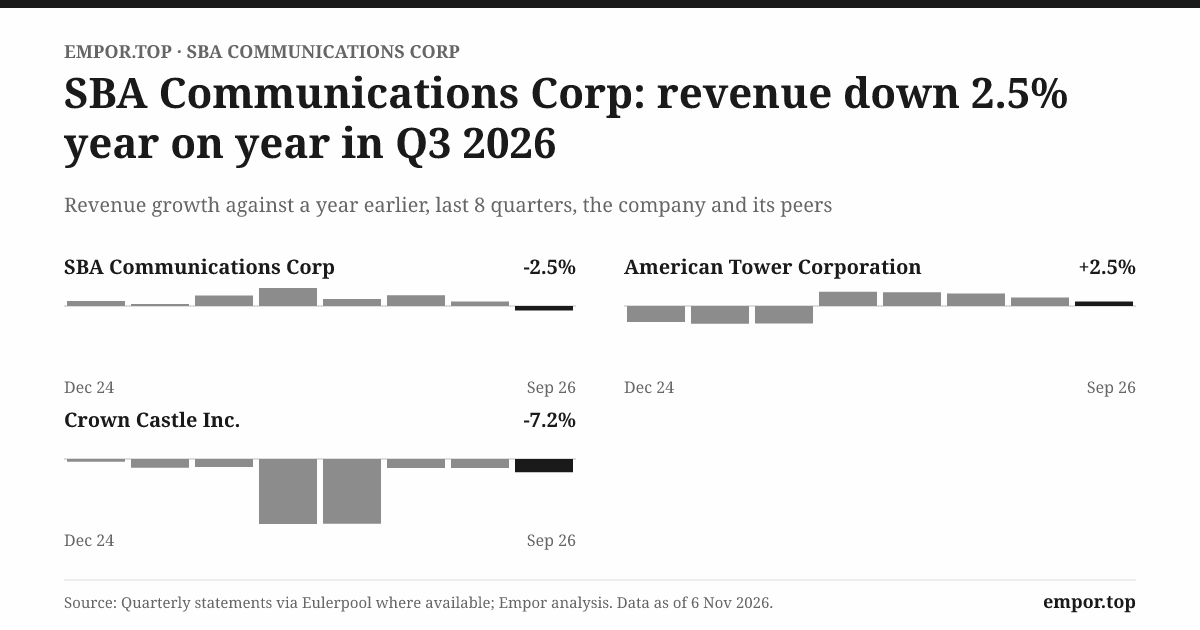
The investment question is whether that definition of scale pays. Three tensions run underneath it. The first is growth. SBA's revenue grew at about 5.6% a year over the last decade, but only about 2.3% a year over the last three, and in the third quarter of 2026 reported revenue actually fell 2.5% from a year earlier.31 The second is price. SBA paid close to a billion dollars for the Millicom towers, and the value of that check depends on how many new tenants and how much new rent those towers attract. The third is money. SBA carries about $12.5 billion of net debt, is refinancing maturities in a market where borrowing costs have risen, and still pays a dividend and buys back stock.1 All three tensions pull at the same pool of cash.
To understand the company that has to resolve them, it helps to place it precisely. SBA Communications Corporation is a real estate investment trust listed on the NASDAQ Global Select Market. At the end of 2025 it owned or operated 46,328 communication sites across the United States, Latin America and Africa.3 By the end of September 2026, after the Canadian, Chilean and Ecuadorian sales, it owned 45,252 sites: 17,340 in the United States and its territories and 27,912 abroad.1 Most of those sites are steel towers, a few hundred feet tall, sitting on a small patch of leased or owned ground, with antennas from one or more wireless carriers bolted at different heights.
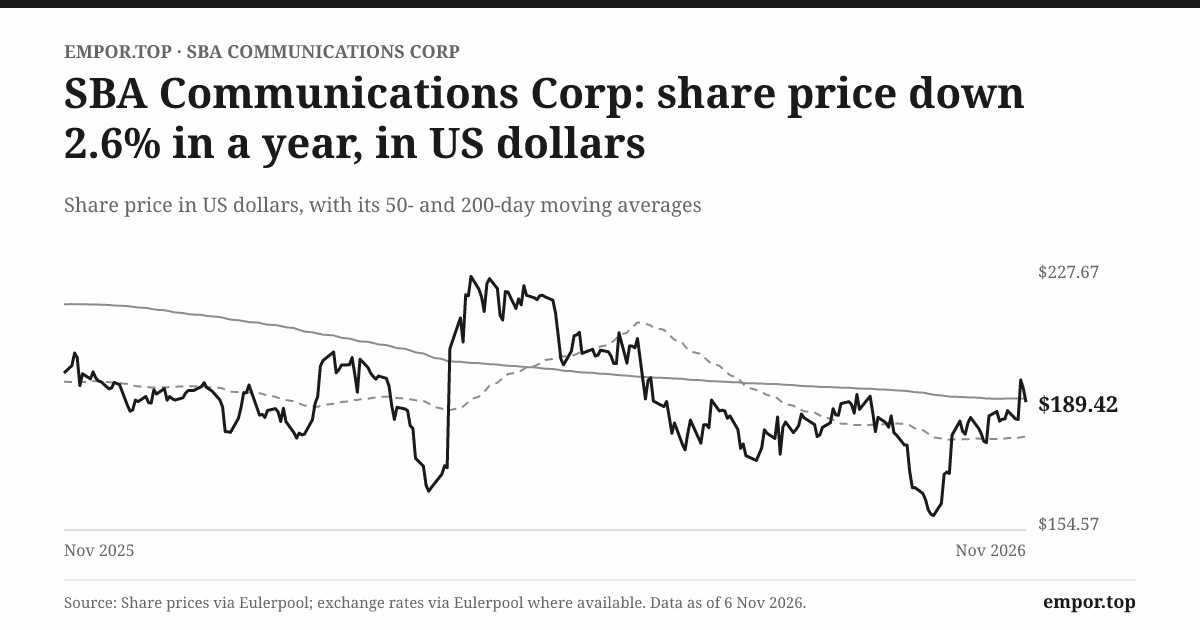
SBA sells no phones and carries no traffic. It rents vertical space. On November 4, 2026, the market valued that rent stream at about $19.9 billion of equity and about $34.7 billion including debt.1 The stock traded around $185, roughly 17.5% below its 52-week high. A business that sells long contracts to the three biggest wireless carriers in America is not supposed to look this uncertain. How it got here starts with a man who spent the 1980s trying to figure out where to put cellular antennas.
 Subscribe on LinkedIn
II. From McCaw's Network to SBA's First Sites
In the mid-1980s, a cellular phone was a heavy box in a car, and a cellular network was a set of radio sites that somebody had to find, lease, permit and build before anyone could make a call. McCaw Cellular, the aggressive Seattle-based operator that would later be bought by AT&T, was racing to light up markets across the country. Steven Bernstein worked there in the second half of the decade, helping to develop the company's cellular system in Pittsburgh.4
The job taught a set of lessons that no one in the industry had written down yet. A radio engineer could draw a perfect circle of coverage on a map, but the circle had to land on actual land. That land belonged to farmers, churches, office-building owners and municipalities, each with opinions. Zoning boards held hearings. Neighbours objected to the look of a tower. Landlords asked for rents that made no sense, or for nothing at all, depending on whether they understood what they were being asked. Building a network was a real estate business in disguise, and the carriers, staffed with engineers and marketers, were often not built to do real estate.
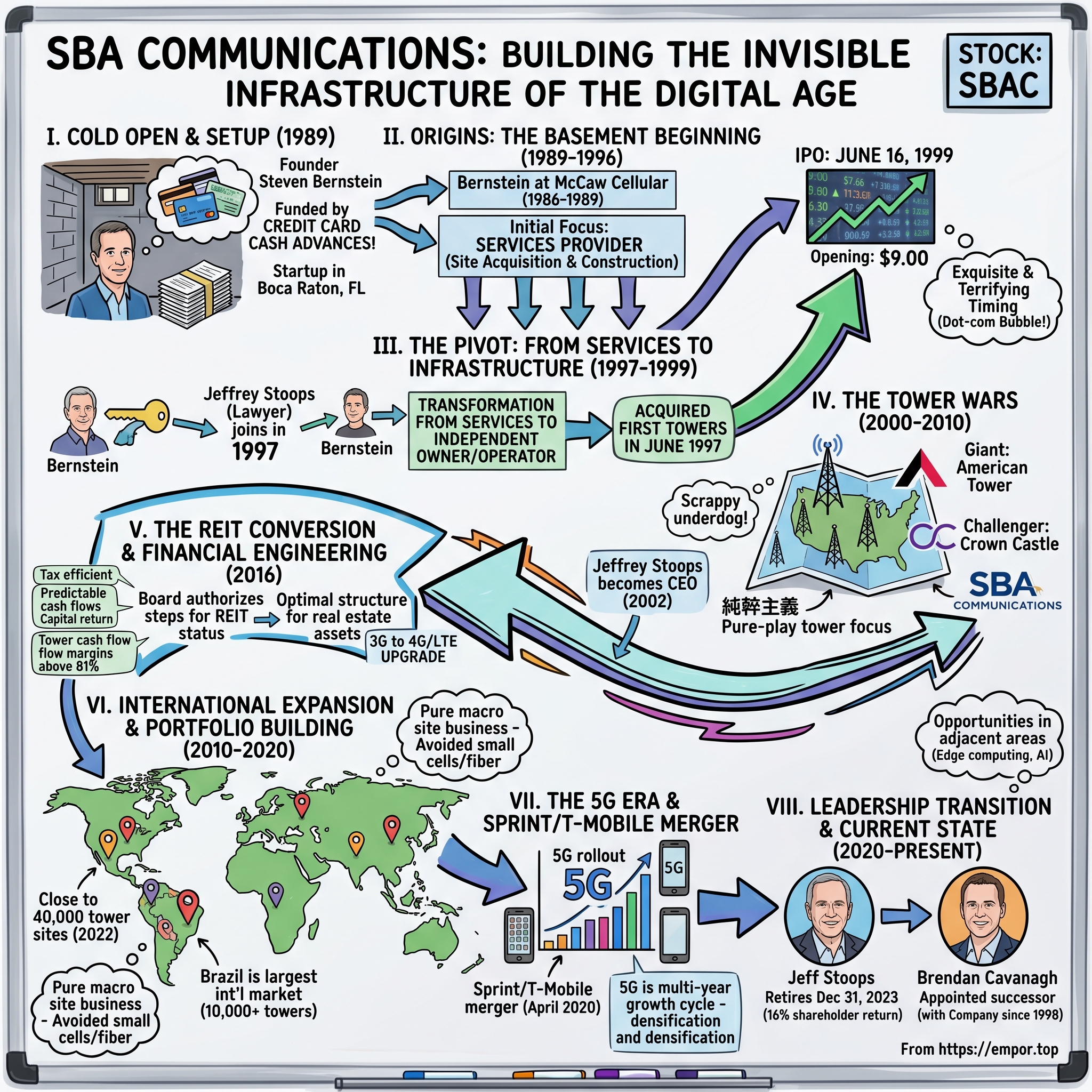
In 1989 Bernstein left McCaw and started his own firm, Steven Bernstein and Associates, the company whose initials later became SBA.45 The idea was simple and unglamorous. Carriers needed sites; SBA would find them. It would scout the locations, negotiate with the landowners, shepherd the permits through local government, and manage the construction. The company describes its starting point plainly: it began as a consultant for wireless carriers, helping them build their networks.5 By the mid-1990s, it had become one of the largest site-acquisition and construction-consulting businesses in the country.5
That vantage point turned out to be more valuable than the fees. A site-development firm sees the map before anyone else does. It knows which neighbourhoods a carrier needs to cover next year, which hilltops are already spoken for, which town councils will approve a new tower and which will fight one for eighteen months. It learns the real cost of putting steel in the ground, and it learns how few good locations exist in any given area.
It also learns who ends up owning the tower once it is built. In the early cellular era, that was almost always the carrier. Each operator built its own network on its own structures. But a tower is a strange asset for a phone company to own. It costs a lot to build, it lasts for decades, and it has more space on it than a single carrier needs. A second or third carrier covering the same area needs a site at nearly the same spot. If the first carrier owns the tower, its competitor either rents from a rival or builds its own steel a few hundred yards away.
By the second half of the 1990s, the 1996 Telecommunications Act and a fresh round of spectrum auctions had brought a wave of new wireless entrants into the American market, and each of them needed thousands of sites quickly. SBA was busy. But the people running it began to see that the services business had a ceiling. A consultant gets paid once per job. When the tower is built, the fee ends, and the asset that will produce rent for thirty years belongs to someone else.
So SBA faced the choice that defined it. It could remain a services firm, paid for its expertise, project by project. Or it could use that expertise to own the sites itself and rent them, over and over, to the carriers that had been its clients. One path was a business of fees. The other was a business of leases. The leases would require far more capital, and capital was the one thing a consulting firm did not have.
III. When SBA Chose to Own the Site
In 1997 SBA brought in Jeffrey Stoops, a lawyer who had worked in corporate and securities practice before joining the company, and he became central to the transition from a services firm to an owner of towers.4 Stoops ran SBA for most of the next quarter-century, first as president and then, from 2002, as chief executive until the end of 2023. He handed the role to Cavanagh and later became chairman.6 His style was that of a capital allocator more than an engineer. Under him, the company's internal question shifted from "how many sites can we develop for carriers?" to "how much rent can each site we own eventually produce?"
The logic of ownership rests on a single physical fact. A tower is built for many tenants but paid for once. When SBA builds a tower for a first carrier, the rent from that carrier might cover the cost of capital and not much more. When a second carrier hangs its antennas on the same tower, the extra rent arrives with almost no extra cost: the steel, the land lease, the access road and the power connection already exist. A third tenant improves the economics again. That is the whole game of tower ownership, and everything else in this story is a variation on it.
SBA's knowledge of site development gave it an edge in playing that game. A firm that already knew where carriers needed coverage could build towers in those places before the carriers asked, or build them on contract and keep them. Its existing relationships with carriers' engineering teams meant it was in the room when network plans were drawn. The services business became a scouting operation for the ownership business.
The lease is what turns that physical fact into a financial asset. SBA's site leases generally run for five to fifteen years, and they are usually non-cancelable. Large carriers sign master lease agreements that set the commercial terms across hundreds or thousands of sites, and then individual site leases attach to each location.3 Most of the agreements contain built-in rent escalators, either a fixed annual percentage in the United States or an inflation-linked increase in many international markets.3 At the end of 2025, SBA's non-cancelable tower leases committed customers to about $11.55 billion of future minimum payments, including those fixed escalations.3
That number deserves a moment, because it is the foundation of how investors value a tower company. It is roughly four years of SBA's total revenue, already contracted. It is not a forecast of what tenants might add; it is what they have signed for. A business with that kind of backlog behaves less like a telecom supplier and more like a landlord with a building full of tenants on long leases, and that is how the market eventually came to price it.
To get there, SBA needed money. In June 1999 the company went public on Nasdaq, raising about $102 million at $9 a share.5 The timing mattered. The late 1990s were the peak of the telecom build-out, when capital flowed freely to anything connected to wireless or the internet, and towers were becoming a recognised asset class. American Tower and Crown Castle were going public or raising capital around the same years, and the race to own the American tower map was on. The IPO gave SBA the currency to build and buy at scale, and the company soon began accumulating sites far faster than its services business could ever have justified.
The telecom bust that followed in 2001 and 2002 tested the model hard. Carriers cut spending, highly leveraged tower companies saw their shares collapse, and the industry discovered that a lease is only as good as the tenant behind it. Tower owners that had borrowed heavily against future tenants that never arrived had to retrench. The lesson SBA carried out of that period was a narrow one: long leases protect the rent you already have, but they cannot create the rent you have not signed.
The lease form, in other words, was attractive. Whether SBA could win enough sites and enough tenants to compete with larger owners was a different question. In a business where a second tenant is the source of nearly all the profit, scale is not vanity. A bigger portfolio gives a carrier more reasons to sign a master agreement, and more places for a new tenant to land. SBA had the model. It did not yet have the map.
IV. The TowerCo Bet That Changed SBA's Scale
By 2012 the American tower industry had sorted itself into three large public owners and a long tail of private portfolios. American Tower and Crown Castle were the giants. SBA was the third, smaller and hungrier, and it had spent the years after the financial crisis buying towers wherever it could find a reasonable price. The largest of those purchases closed on October 1, 2012.
That day SBA completed its acquisition of TowerCo II Holdings, a private tower owner with 3,256 sites spread across 47 states and Puerto Rico.7 SBA paid $1.2 billion in cash and issued 4.6 million shares of its Class A common stock.7 Valued at SBA's share price around the time, the stock component brought the total to roughly $1.45 billion, or about $446,000 for each tower. The cash part was financed with new 5.625% senior notes due 2019, a $300 million term loan and cash on hand.7 In one transaction SBA added more than three thousand sites, a large step for a company of its size.
Why pay that much for towers someone else had built? Because the economics of a tower portfolio improve with size, giving SBA more to offer when a carrier plans a regional upgrade. It also spreads the fixed costs of running a leasing organisation, from site-management systems to legal teams, across more rent. A bigger map is a better shop window.
The per-site price is useful as a reference point, but it is easy to misuse. SBA's closing filing did not state a purchase multiple of tower cash flow, and any multiple depends heavily on what was bought.7 TowerCo's sites were in the United States, the richest tower market in the world, with relatively mature tenants and escalating leases in dollars. Some towers carry two or three tenants and some carry one; some sit on land SBA owns and others on ground leases that will need renewing. Two portfolios with the same number of sites can produce very different rent. So TowerCo's roughly $446,000 per site tells you what SBA was willing to pay for American towers at the time. It does not, by itself, tell you whether a later purchase in another market was cheap or expensive.
The cost of growing this way showed up on the balance sheet. SBA financed its expansion overwhelmingly with debt. At the end of 2012, its net debt was 7.3 times annualised adjusted EBITDA, and management described that as squarely inside its target range of 7 to 7.5 times.8 That target itself is the revealing part. SBA was not borrowing heavily by accident; it was running the business deliberately at high leverage, on the theory that contracted, escalating tower rent could carry far more debt than an ordinary company could. As long as rent grew and interest rates stayed low, the excess cash and the rising value of the towers would let the company grow into its borrowings.
For much of the following decade, that theory worked. Revenue grew from about $1.5 billion in 2014 toward $2.7 billion by 2023, and the company kept adding sites at home and abroad, especially in Brazil, where SBA had begun building a large position.3 Leverage gradually drifted down as cash flow rose. The shareholder who bought the stock through these years was buying a leveraged bet on tower rent, and it paid off.
TowerCo also established a pattern that would matter later: SBA's management grew comfortable writing large cheques for portfolios. That comfort is an asset when prices are reasonable and debt is cheap. It becomes a risk when either condition changes. The question that TowerCo left behind was not whether SBA could buy scale. It clearly could. The question was whether each subsequent purchase would buy durable cash flow, the kind that grows as tenants are added, or simply a larger site count that would have to be financed whether or not the tenants arrived.
Before following SBA into its next big bet, it is worth stopping at a single tower to see what all that money was actually buying.
V. The Tower Is the Product, but the Lease Is the Business
Picture a lattice tower beside a highway interchange somewhere in suburban Texas. One carrier installed its antennas there years ago, near the top, where coverage is best. Now that carrier needs more capacity: its customers are streaming video, and it has new spectrum to deploy. It does not need a new tower. It needs to bolt on more antennas and radios, perhaps run new cabling, perhaps replace some equipment with heavier gear. It calls the landlord and amends the lease. Rent goes up. SBA's cost barely moves.
A few years later, a second carrier looks at the same interchange and faces a choice. It can find land nearby, negotiate a ground lease, apply for zoning, fight the neighbours, and build its own steel at a cost of several hundred thousand dollars and a year or more of waiting. Or it can rent a slot on the existing tower a little lower down, and be on air in a fraction of the time. Almost every carrier, almost every time, chooses the second option. That decision, repeated tens of thousands of times, is the engine of the tower business.
SBA reports two segments that reflect this split. Site leasing is the rent. Site development is the services business that the company grew out of: consulting and construction work for carriers, from site acquisition and zoning to installing equipment, typically performed under fixed-price project contracts and recognised as the work progresses.3 In 2025 site development made up about 9% of revenue, while site leasing generated 97.9% of the two segments' combined operating profit.3 The proportions say most of what needs saying. SBA still does the work it was founded to do, but the money comes from owning the asset.
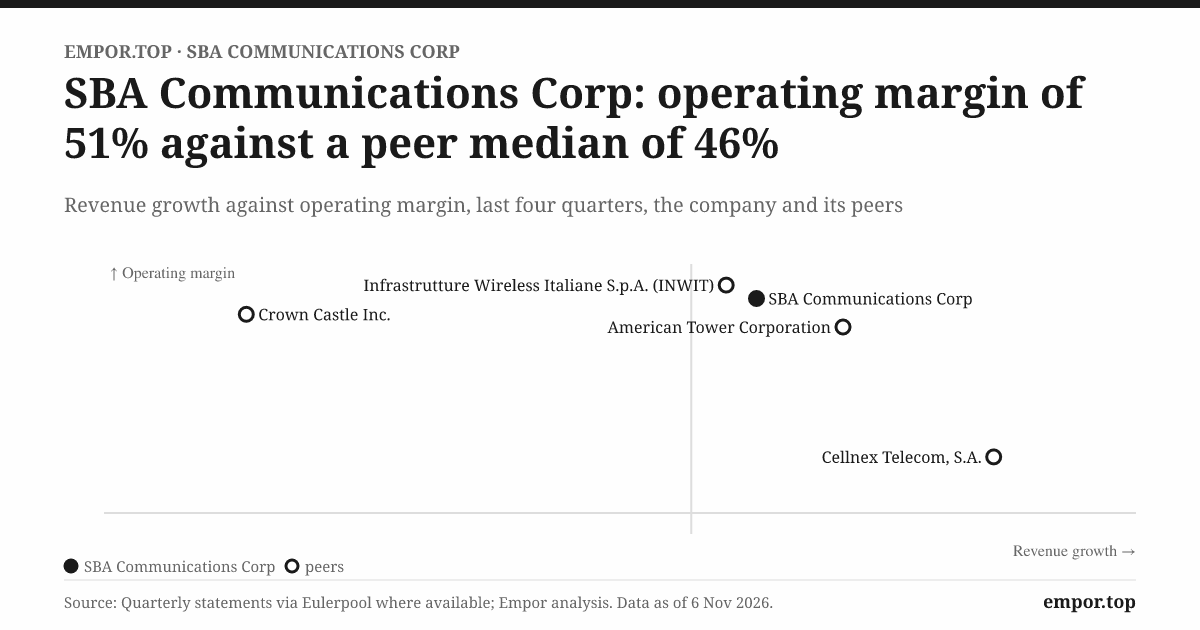
The profitability of that rent is extraordinary by the standards of almost any business. In the United States, SBA's tower cash flow margin, the rent left after the direct costs of operating sites such as ground leases, maintenance and utilities, runs above 80%.1 It is higher than in its international markets, where costs such as power and ground rent are a bigger share of revenue and where rents are often lower. The reason is the arithmetic of the second tenant.
SBA has said for years that it bases its strategy on these incremental economics. The aim is to add tenants and equipment to sites it already owns, to build new towers where carriers commit to anchor them, and to buy portfolios where it believes it can lift the number of tenants per tower over time. Every one of those approaches depends on a single input: carriers wanting more space.
The services business is the counterweight. It brings SBA into carrier projects and keeps it close to their engineering plans, but it behaves very differently from rent. It is lumpy, because it depends on when carriers decide to deploy and when local authorities grant permits. It is lower margin, because SBA is selling labour and project management rather than space on an existing asset. And it carries credit risk of a kind the leasing business rarely does: SBA performs work and then waits to be paid.
That waiting showed up in 2025. Measured across all receivables on its balance sheet, the time SBA took to turn sales into cash rose from about 39 days of revenue in 2024 to about 86 days in 2025. That is a striking jump for a company whose main customers are among the most creditworthy in the country. The trade-receivable line itself rose more modestly, from about $146 million to about $171 million, but the portion tied to site development nearly doubled, from about $26 million to about $48 million.3 SBA's allowance for doubtful accounts rose to about $19 million from about $15 million, and the company booked a provision of $9.4 million against $6.1 million of write-offs during the year.3 SBA says its credit-loss exposure lies primarily in site development, and it also attributed part of a decline in 2025 operating cash flow to the timing of customer payments.3
The scale of the issue should not be exaggerated. A provision of under $10 million is small against a business producing nearly $2 billion of EBITDA. But it is a reminder that the services side, however strategically useful, is not the safe part of SBA. SBA does not publish an ageing schedule of overdue receivables or name the customers whose payments slowed, so investors cannot tell whether the stretch reflects a single large project, a slow-paying carrier or a broader shift in payment terms. The next annual report will show whether the gap closes.
The deeper question is about the moat. Why can't a carrier simply walk away? The answer starts with location. A tower in a good spot is hard to replicate, because zoning boards are reluctant to approve a new tower next to an existing one, and because the radio network around it has been tuned for that exact location. Moving equipment means re-engineering neighbouring sites, and the downtime and cost of relocation usually outweigh any savings in rent. That is a genuine switching cost, and it explains why tower leases renew at very high rates in ordinary times.
But it is not the whole story. Switching costs protect a lease when the carrier still needs coverage at that spot. They do nothing when two carriers merge and suddenly find themselves paying rent on two towers a few hundred yards apart, covering the same neighbourhood. Then one lease becomes redundant, and no amount of zoning difficulty will persuade the merged company to keep paying for both. The tower business is protected against the carrier that wants to leave. It is much less protected against the carrier that no longer exists, or that no longer needs the site.
That limit becomes central later. First comes the question of what SBA did with the cash its high-margin leases generated.
VI. The REIT Became a Capital-Allocation Choice
In 2016 SBA made a decision that changed how Wall Street looked at it: it elected to be taxed as a real estate investment trust, starting with its 2016 tax year.9 American Tower and Crown Castle had already made the same move. The appeal was straightforward. A REIT generally avoids corporate income tax on the income it distributes, provided it pays out most of its taxable income to shareholders. For a business whose assets are, in the end, pieces of property leased to tenants, the structure fitted.
What makes SBA's election interesting is what the company did next, which for a while was very little. A REIT must distribute its taxable income, but SBA carried large accumulated tax losses from its years of heavy depreciation and interest costs, which meant that for several years it had little taxable income to distribute. So it did not pay a dividend at all until 2019.3 Instead it spent its cash on buying back stock and on buying and building towers. The REIT label was in place; the REIT payout was not. That sequencing tells you that management saw the structure as a financing and tax tool, not as a commitment to hand out cash at the expense of growth.
To understand why SBA could do this, you have to look past its reported profits, because by that measure the company barely looked profitable at all. Across the twelve years from 2014 to 2025, SBA reported about $3.2 billion of cumulative net profit. Over the same years it generated about $12.5 billion of cash from operations, nearly four times as much.3 The gap is mostly depreciation and amortisation. A tower company records the cost of its steel, and of the leases it acquired in portfolio purchases, as an expense spread over many years, even though the towers keep standing and keep earning rent long after the accounting says they are worth less. Add non-cash charges such as stock-based compensation and asset write-downs, and accounting profit becomes a narrow window onto the business's real cash generation. In 2025 alone, depreciation, accretion and amortisation, impairments and decommissioning costs, and non-cash compensation together exceeded half a billion dollars.3
That is why tower investors focus on adjusted funds from operations, or AFFO, a measure that adds back non-cash charges and subtracts the capital spending needed to maintain the towers. It is a better proxy for the cash a tower company could distribute. It is also a measure the company itself defines, and investors should treat it as management's lens rather than an audited figure.
The cash gap, however, is not a pile of surplus money. Over those same twelve years, SBA produced about $10.4 billion of free cash flow after capital spending, and only about $2.1 billion of that went to dividends.3 The rest was absorbed by the competing claims on a tower company's cash: acquisitions of towers and of the land beneath them, construction of new sites, repurchases of its own shares, and the cost of servicing a heavy debt load. The balance of cash and short-term investments barely moved, rising from about $128 million at the end of 2013 to about $439 million at the end of 2025.3 Almost every dollar the towers produced was put back to work somewhere.
The payout ratio tells the story of a company growing into its dividend. In 2020, dividends were more than eight times net profit, a figure that looks alarming until you see that profit that year was unusually low, depressed by foreign-exchange losses and other charges, while cash flow was perfectly healthy.3 By 2025 the dividend had grown to about $479 million a year and represented about 45% of a much larger net profit.3 The quarterly dividend declared in November 2026 was $1.25 a share.1
Buybacks remained a central lever. In 2025 SBA repurchased about 2.5 million shares for about $498 million, more than it paid in dividends.3 In the third quarter of 2026 alone it bought back about 1.7 million shares for $300 million, at an average of about $180 a share, leaving about $0.8 billion under its authorisation.1 One consequence of years of buybacks funded alongside heavy borrowing is that SBA's shareholders' equity is negative, about minus $4.9 billion at the end of 2025.3 That is not a sign of insolvency; it is the accounting residue of returning more capital to shareholders, over many years, than the company's cumulative reported earnings, with the difference financed by debt secured on the towers' rent.
So did the REIT structure make SBA's rent more valuable to shareholders? It helped, mainly by reducing tax leakage and by placing SBA in a category of investor portfolios that value steady distributions. But the long-run shareholder return came from two other sources working together: tower rent that grew steadily for many years, and a financial structure that magnified the effect of that growth on a shrinking share count. Operating growth supplied the engine; leverage and buybacks supplied the gearing. That gearing works beautifully when rent rises and debt is cheap. The next chapter is about what happens when the rent stops rising as fast, starting with SBA's biggest customer.
VII. The Sprint Merger Turned Carrier Consolidation Into Tower Churn
When T-Mobile and Sprint closed their merger in April 2020, it was celebrated in Washington as the creation of a strong third national carrier capable of competing with AT&T and Verizon in 5G. For tower owners, it was something more complicated. Two separate networks were about to become one. Thousands of locations where both companies had been paying rent, often on towers only a short distance apart, were about to become duplicates.
The integration played out not as a single event but as a multi-year process. T-Mobile moved Sprint customers onto its own network, decommissioned the redundant Sprint equipment, and, as Sprint's leases came up for renewal or as contractual terms allowed, declined to renew them. At the same time, T-Mobile was investing heavily in its 5G network, adding new equipment to many sites. So SBA was receiving new rent from T-Mobile with one hand and losing old Sprint rent with the other. SBA estimated the total Sprint-related churn on its cash site-leasing revenue at about $75 million spread over several years.3
Then a second source of churn arrived. DISH Network, which had set out to build a fourth national 5G network after the Sprint merger and signed leases across the tower industry, combined with EchoStar and later stepped back from its own network ambitions. Leases that tower owners had expected to grow became leases at risk. On the third-quarter 2026 call, management walked through the expected 2026 churn from these two sources: about $55 million to $56 million related to Sprint, and about $56 million related to EchoStar.2 For the full year, SBA had expected total domestic churn of roughly $132 million to $136 million.3
Those numbers are expectations of rent lost, not of growth forgone, and the distinction matters. A tower company's organic growth is the result of a race. On one side are new leases and amendments: carriers adding antennas, deploying new spectrum, signing on to new sites. On the other side are cancellations and non-renewals. Before SBA can grow its domestic rent at all, new business has to outrun churn. In the third quarter of 2026, it did not. Domestic site-leasing revenue fell 3.4% from a year earlier, to about $454 million.1
The customer concentration that makes SBA's rent so predictable is the same concentration that makes this race so dependent on a handful of decisions. In 2025 T-Mobile accounted for 31.1% of SBA's total revenue, AT&T for 20.3% and Verizon for 15.1%.3 Together, three companies provided about two-thirds of everything SBA earned, and nearly 88% of its domestic site-leasing revenue.3 Each of those carriers plans its network centrally, signs master agreements, and can tilt SBA's growth up or down with a single capital-spending decision.
The last six years have put that limit into practice: long leases could not prevent T-Mobile from dropping redundant Sprint sites or EchoStar from stepping back from its network build. Long contracts provide visibility; they do not guarantee growth, and they do not neutralise consolidation. The claim that survives is a smaller one: well-placed towers with tenants who still need them are durable. Towers whose tenants have merged away are not.
What would tell an investor that the race is turning? Management's message on the third-quarter call was that Sprint-related churn is largely behind the company after 2026, and that EchoStar churn, while still elevated, will eventually run out as the leases in question roll off.2 Management also said the domestic carriers were continuing to invest in their networks, with leasing activity driven by spectrum deployment and capacity additions.2 Those statements are guidance, not results. The figure that will confirm or refute them is net domestic churn set against new lease billings over the next four quarters. If domestic leasing revenue returns to growth once the Sprint tail is gone, the consolidation thesis will be bounded to a temporary hit. If it does not, the problem is demand, not churn.
While the American carriers were reshaping SBA's home market, the company was making its biggest bet abroad.
VIII. The Millicom Deal Bought a Regional Position
In October 2024, Millicom, the Luxembourg-incorporated operator that runs the Tigo networks across Central and South America, announced that it had agreed to sell its Central American tower portfolio to SBA.10 The price was about $975 million for roughly 7,000 towers, with a possible additional earn-out payment tied to the portfolio's performance.10 Millicom would remain on the towers as a long-term anchor tenant, and SBA agreed to build up to 2,500 additional sites for Millicom over the following years.10
The structure is a sale-and-leaseback, a familiar move in the tower industry. Millicom turns passive infrastructure, which ties up capital and produces no direct customer revenue, into cash it can use to pay down debt or invest in its networks. In exchange, it becomes a renter on steel it used to own. SBA, for its part, buys a portfolio with a guaranteed tenant from day one, a pipeline of build-to-suit sites with that tenant already committed, and, critically, a large regional position in a group of markets where it already operated but lacked dominant scale. The company had owned towers in Central America for years; the Millicom deal turned it into one of the region's leading tower landlords overnight.
Most of that transaction closed during 2025. SBA's acquisition capital spending for the year totalled about $1.06 billion, and the vast majority of the 7,146 towers it acquired that year came from Millicom.3 It was, in scale, a TowerCo-sized bet in a very different place.
So did SBA pay a sensible price? The headline works out to roughly $139,000 per initial site. That looks cheap next to the roughly $446,000 per tower SBA paid for TowerCo in 2012. But that comparison is the trap the earlier deal warned against. Central American towers carry rents in markets with lower average revenue per user than the United States, lower tower costs, different currency exposure and, initially, mostly a single tenant on each site. A one-tenant tower in Honduras and a multi-tenant tower in Texas are different assets that happen to look alike in photographs. The price per site establishes very little about value on its own.
What would establish it is the cash flow. The public transaction announcement did not give a standalone tower cash flow figure for the Millicom portfolio, so a clean purchase multiple cannot be calculated from it.10 That leaves investors to judge the deal by its results, which are still emerging. In the third quarter of 2026, SBA's international site-leasing revenue rose 13.3% from a year earlier, or about 9.8% excluding currency movements.1 That is a strong number, but much of it reflects the Millicom sites being included for a full period rather than a partial one. It shows that SBA bought rent. It does not yet show how much additional rent the purchased towers can attract.
That second part is the real test. Most of the Millicom towers start with one tenant. The investment case depends on adding second and third tenants, through competitors of Tigo deploying their own networks or through new uses, and on the 2,500 new builds coming in at sensible costs. Each new build also requires capital, which competes with debt reduction and buybacks for the same cash. A tower portfolio bought at a modest multiple of today's single-tenant rent becomes a very good deal if tenancy rises and a mediocre one if it stays flat.
There is also the earn-out. A contingent payment linked to performance aligns the seller's incentives with the portfolio's success, but it means the final price is not yet fully known, and higher performance comes with a higher bill.10 And there is the concentration. In buying the largest tower position in several Central American markets with Millicom as anchor tenant, SBA bought a relationship with a single carrier that matters greatly in that region, recreating, on a smaller scale, the same dependence on a handful of customers that defines its American business.
The strategic logic is clear and coherent: scale where it matters, with a leading carrier as anchor. Whether SBA overpaid cannot be answered from the price per site. It will be answered by two numbers that management does not yet report in isolation: tenancy additions on the Millicom towers, and the return on the build-to-suit sites. The cheque has been written; the rent that justifies it is still being signed. And that cheque was not an isolated decision. It was one half of a portfolio strategy the new chief executive had begun the moment he took over.
IX. Cavanagh's Portfolio Review: Lead the Market or Leave It
Brendan Cavanagh became SBA's chief executive at the start of 2024, after years as the company's chief financial officer and then its president and chief operating officer.6 He had been with SBA for more than two decades, and he inherited a company that had spent the Stoops era doing what tower companies do best: accumulating sites. Within weeks, on his first earnings call as CEO, he described a review of SBA's international portfolio.11 The tone was not one of a new leader tearing down his predecessor's work. It was one of an insider asking which parts of that work were earning their keep.
The screen he described was simple. In each market, SBA wanted to be a leading operator, with enough sites to matter in every carrier's planning, enough scale to keep operating costs down, and enough market position to negotiate fair rents. Where it could not reach that position, it would consider leaving.11 The Philippines became the clearest illustration. SBA had entered a market where the government had encouraged independent tower companies, and where, by Cavanagh's account, more than 30 tower operators were competing for the business of a small number of carriers.11 In a market like that, nobody has pricing power, and a subscale owner is a price-taker.
The exits followed. SBA sold all its towers in the Philippines on January 10, 2025, and ended operations in Colombia during the first quarter of the same year.3 The Philippine portfolio went to Alliance Towers Corporation, a tower company backed by Bersama Digital Infrastructure.12 In October 2025, SBA sold its 365 towers in Canada for about CAD 446 million.3 And in 2026 came the Chile, Ecuador and Peru exits.21
Beside these exits sits the Millicom purchase, and the two are less contradictory than they look. Both moves apply the same test. In Central America, Millicom gave SBA a leading position with a leading carrier; in the Philippines or Chile, SBA had a small presence in crowded or low-return markets. The aim is a portfolio concentrated in places where SBA can be the landlord carriers depend on: the United States, Brazil, Central America and its African markets of South Africa and Tanzania.3
This is not the first time SBA has decided that an adjacent business was worth less to it than its sale price. Years earlier, the company had invested in ExteNet, a provider of small cells and distributed antenna systems, the compact equipment carriers use to add capacity in dense urban areas and inside buildings. On the call where he unveiled the portfolio review, Cavanagh said SBA had sold that investment after it roughly doubled in value over about five years, and that management had concluded the small-cell business was more capital intensive and lower margin than towers.11 It was a profitable exit, and also an admission: not every telecom infrastructure adjacency shares the economics of macro towers. Owning steel on a hilltop and owning thousands of small boxes on city lamp posts are different businesses.
That history is worth bearing in mind with SBA's newest adjacency. Under the name SBA Edge, the company has talked about using power connections and ground space at existing sites to host small data-centre and computing equipment, positioning its towers for an era in which some artificial-intelligence processing moves closer to users.2 The idea has some logic: many tower sites already have power, fibre and secure enclosures. But on the third-quarter call, management did not point to material revenue from the effort.2 For now it is optionality, a possibility rather than a profit engine. The ExteNet experience suggests that SBA is willing to back away from adjacencies that do not match tower economics, which is a point in its favour; it also suggests that such adjacencies rarely turn into a second engine.
How credible is the review? The fairest test is behaviour rather than tenure. On that test, the record is concrete. Management said it would concentrate the portfolio, and it then sold assets in five countries and bought a large regional position in another. It said it would focus on returns, and it built its executive pay around AFFO per share, return on invested capital and relative shareholder return.6 Shareholders largely backed that structure, approving executive pay by roughly 88 million votes to 6 million at the May 2026 annual meeting.13
The review also has limits. Selling small markets reduces complexity, but each sale also removes rent: the 2026 sales alone took annual EBITDA out of the business, and the company cut its 2026 site-leasing revenue guidance by about $13 million at the midpoint in the third quarter.1 If the proceeds go to buybacks, debt reduction or higher-returning builds, the trade improves per-share cash flow. If they are absorbed by the rising cost of debt, the portfolio is simpler but not more profitable. That is the measurable test: whether leasing growth and returns on capital improve after the transaction costs and lost rent are counted.
Which brings the story to the cost of debt, and the bill that has started to arrive.
X. The Refinancing Bill Arrives Before the Growth Rebound
When SBA reported its third-quarter results on November 2, 2026, the headline leverage figure was 6.4 times. That was the company's net debt as a multiple of its annualised adjusted EBITDA, down from the 7-plus range of the TowerCo era and sitting near the bottom of the 6.0 to 7.0 times range SBA now targets.114 Total debt stood at about $13.0 billion, half of it secured, and net debt after cash was about $12.5 billion.1
Those borrowings are separate from another large obligation that does not appear in that debt total. Most of SBA's towers stand on land it leases from landowners, and accounting rules require the company to record those ground leases as liabilities. At the end of 2025, SBA carried about $12.9 billion of debt and, separately, about $2.4 billion of operating and finance lease liabilities.3 The auditor singled out the accounting for those ground leases as its critical audit matter, because measuring them depends on judgments about the interest rate SBA would pay to borrow, and it issued a clean opinion.3 The debt is what SBA owes its lenders. The leases are what it owes the farmers, churches and landowners under its towers. Both draw on the same rent.
The financing story of 2026 is a transition. For years SBA borrowed primarily through securitisations, debt secured by the cash flow of pools of towers, which offered low costs but tied up assets. In July 2026 the company issued $3.5 billion of unsecured senior notes at a blended coupon of about 5.1% and an average maturity of about 4.9 years.151 It used the proceeds to repay about $1.0 billion of revolving credit borrowings and a $2.2 billion term loan, and it set up a new $2.5 billion unsecured revolving credit facility, followed in September by a $2.5 billion commercial paper programme.1
That shift is the result of a credit upgrade. S&P raised SBA to BBB, an investment-grade rating, in 2026.16 Investment-grade issuers can borrow without pledging specific assets, and they reach a wider pool of investors. Moody's, however, has been more cautious. On October 20, 2026, it affirmed its Ba1 rating, one notch below investment grade, while keeping a positive outlook.17 In its earlier December 2025 assessment, Moody's credited SBA's scale, international diversification and strong positions in the United States, Central America and Brazil, while emphasising leverage and the company's revised target range.14 Two agencies looking at the same company and landing on opposite sides of the investment-grade line is a precise summary of SBA's position: the rent is good enough to earn the label, the leverage high enough to make one agency hesitate.
The cost of the transition is visible in the earnings. When rates were near zero, SBA refinanced old debt with cheaper new debt, and interest costs were a tailwind for per-share cash flow. Now the opposite is true. Debt raised at 5% replaces debt raised in an era of 3% or less, and every percentage point on $13 billion is about $130 million a year in interest, a sum larger than the annual leasing revenue lost from all three South American exits combined. In the third quarter, AFFO per share fell about 3.3% from a year earlier, to $3.19.1 Management still raised its full-year AFFO-per-share outlook slightly, to between $12.15 and $12.37, and said buybacks and other adjustments helped, even as it lowered its revenue and EBITDA ranges.1
On the call, management was candid about the timeline. CFO Marc Montagner described 2027 as a transition year, with international churn still elevated and higher cash interest costs weighing on results, before potential improvement from 2028.218 Asked how SBA would handle its 2027 maturities, he said the company would likely use unsecured instruments and that timing, rather than access, was the key uncertainty in an elevated-rate environment.2 That answer is reasonable. It is also a statement of intent, not a completed transaction, and the difference matters: the July notes are done and priced, while the next round depends on the market at the moment SBA chooses to borrow.
An activist reading SBA's capital allocation would put the issue sharply. In 2025 SBA spent about $1.06 billion on acquisitions, about $498 million on buybacks and about $479 million on dividends, while borrowing costs were rising and domestic leasing was weakening.3 In the third quarter of 2026 it spent another $300 million buying back stock.1 Every dollar returned to shareholders at high leverage is a dollar not used to pay down debt that will be refinanced at higher rates. Management's answer is that leverage sits inside its target range and that buying back shares at current prices is a good use of cash. Both claims can be true, and the choice still raises the stakes on the next refinancing.
The verdict is that SBA's balance sheet is not fragile. It has long-term contracts, high margins and access to unsecured markets. But it is not roomy either. At 6.4 times, a modest stumble in EBITDA or a meaningfully higher refinancing rate would push the ratio up, and the investment-grade migration, still only half complete, would stall. The terms of the next major refinancing, and leverage after it, will show how much flexibility remains. Before that test arrives, it is worth asking a broader question: beyond the general economics of owning towers, does SBA have an advantage of its own?
XI. The Moat Is a Good Location, With Three Large Tenants
Return to the carrier's network planner from earlier, now sitting with a spreadsheet of thousands of sites and a budget that has been cut. On every line, the planner asks a version of the same question. Does this site still cover a part of the network we need? If yes, the rent is a small price for a location that would be costly and slow to replace. If no, because coverage overlaps with another site after a merger or because the market no longer justifies the capacity, the lease becomes a cost to remove. The tower company's moat lives in the answer to that question, one site at a time.
Michael Porter's five forces framework offers a useful structure for weighing that moat, and the forces split cleanly. The threat of new entrants is low: building a competing tower near an existing one requires land, zoning approval and capital, and local authorities often resist new structures where shared ones exist. Rivalry among existing tower owners is moderate in the United States, where the three public companies and a few large private owners hold most sites in established positions, but intense in some international markets, as SBA learned in the Philippines. The threat of substitutes is real but partial. Supplier power is limited, though ground-lease landlords have learned to ask for more.
Buyer power is where SBA is weakest. Three carriers accounted for about two-thirds of SBA's revenue in 2025.3 Those customers negotiate master agreements covering thousands of sites, they can choose between landlords for new deployments, they can consolidate and cancel redundant leases, and they occasionally build their own towers. A landlord with three tenants who together pay two-thirds of the rent does not set the terms. It negotiates them.
Hamilton Helmer's 7 Powers framework sharpens the point. SBA's clearest power is the switching cost created by relocating equipment from a well-placed tower. It has something close to a cornered resource in specific locations, because a zoning approval on a scarce hilltop or a busy interchange is hard to replicate. It has scale economies within each market, since a bigger regional portfolio spreads costs and offers carriers a broader menu. What it lacks is a network effect: one carrier's presence on SBA towers does not make the towers more valuable to the next carrier in any systematic way, beyond the simple fact that a site with existing infrastructure is cheaper to join. And it does not have obvious counter-positioning or brand power with carriers that view towers primarily as a cost.
Size compounds the buyer-power problem. At the end of 2025, SBA owned 46,328 sites, while American Tower operated 149,686 communications sites worldwide, more than three times as many.319 Site counts are not market share, because American Tower also owns data centres and operates heavily in India and Europe, where SBA does not compete. But in negotiating a nationwide master agreement in the United States, the larger landlord simply offers more of the map. Crown Castle, the third major American public tower owner, also brings fibre and small cells to those conversations. Private tower owners and carrier-controlled portfolios add more alternatives. SBA's footprint, concentrated in the Americas and parts of Africa, is meaningful but rarely the biggest at the table, except in markets such as Central America where it has now deliberately made itself so.
What about substitutes? Fibre, small cells and satellites are often cited as threats to the macro tower, and none of them is a simple replacement. Small cells add capacity in dense areas, but they cover only a few hundred metres each and need fibre and power at every node. Fibre is the backhaul that connects towers to networks, not an alternative to them. Satellite-to-phone services can fill coverage gaps in remote areas, but they lack the capacity to carry the traffic of a city or a suburb. These technologies form part of a network mix, and their impact on any individual tower depends on each carrier's deployment plans. The real substitute for a tower lease is not another technology. It is a merged carrier that needs fewer sites.
The evidence from SBA's own operations supports a bounded version of the moat claim. Margins above 80% on U.S. tower cash flow are evidence of strong economics on the leases that exist.1 The recent fall in domestic leasing revenue, despite carrier investment, is evidence that those economics do not automatically produce growth.1 The moat, in other words, is real at the site level and least proven as a broad pricing advantage. SBA has locations carriers need. It does not have the ability to make carriers need more of them.
That narrower moat is the context for how the market currently prices the stock.
XII. The Investment Case at 20 Times Earnings
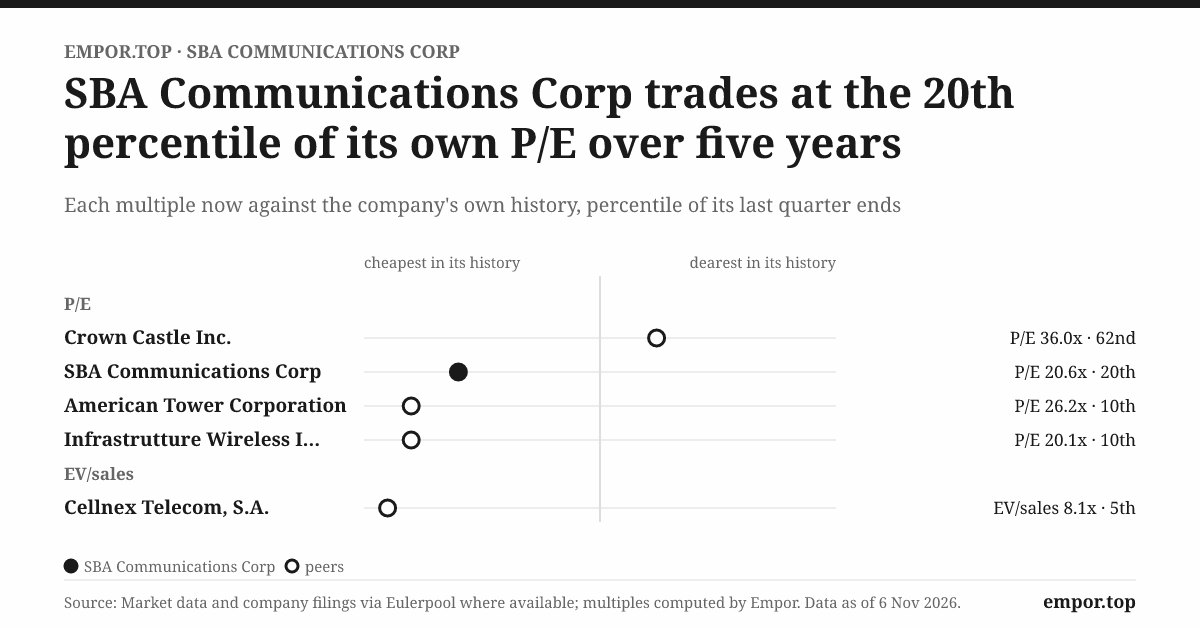
On November 4, 2026, SBA's shares traded at about $185, valuing the company at roughly 20 times its last twelve months of earnings.1 Over the previous five years, the median multiple had been about 42 times. Measured against its enterprise value, which includes debt, the company traded at about 17 times EBITDA. That placed it close to American Tower, around 17 times, and below Crown Castle, around 20 times, on comparable measures at the start of November.20 Meanwhile, reported quarterly revenue had turned down: third-quarter revenue of about $714 million was 2.5% lower than a year earlier.1
Read quickly, the gap between today's multiple and the five-year median suggests a bargain. Read carefully, it says less. The five-year median includes years when interest rates were near zero and when every income-producing asset, towers included, was priced generously. A multiple that made sense with 2% borrowing costs does not automatically make sense with 5% borrowing costs, and the market's lower price is in part a judgment that the cost of SBA's money has permanently risen. SBA's own history is therefore a market signal, not a fair-value anchor.
The earnings themselves need adjusting before the multiple can be trusted. In 2025 SBA reported net profit of about $1.1 billion, but that figure included about $366 million of other income, most of it from two sources that will not repeat on schedule: a $208 million gain on selling assets, chiefly the Canadian towers, and a $122 million gain from remeasuring intercompany loans denominated in foreign currencies.3 The latter is an accounting effect that swings both ways; a year earlier, the same item had produced a $237 million loss.3 Strip those gains out and 2025 earnings look materially smaller, and the price-to-earnings multiple on underlying profit correspondingly higher. For a tower company, the more meaningful yardsticks are free cash flow and AFFO. On free cash flow, the stock yields about 5.3%, and the dividend yields about 2.6%.
Two other popular measures are close to useless here. SBA's book value per share is negative, about minus $45, and its return on equity is therefore negative as well. Both reflect years of distributions and buybacks financed with debt, not a business destroying value. An investor screening for companies with positive equity would never find SBA, and would miss the point that the towers produce real cash even when the balance sheet shows a deficit.
The bull case runs as follows. SBA owns tens of thousands of towers under long leases with built-in escalators, with $11.55 billion of contracted future rent.3 Its U.S. leasing margins are among the highest in any industry. International leasing grew strongly in the third quarter, and the Millicom portfolio offers years of tenancy additions and build-to-suit growth.1 Sprint churn will largely be done after 2026, and EchoStar churn, while still present, will eventually run out, so the race between new leases and cancellations should become easier to win. The portfolio is now concentrated in markets where SBA leads. Leverage sits inside the target range, S&P rates the company investment grade, and Moody's outlook is positive.17 On this view, a temporary reset is being priced as a permanent decline.
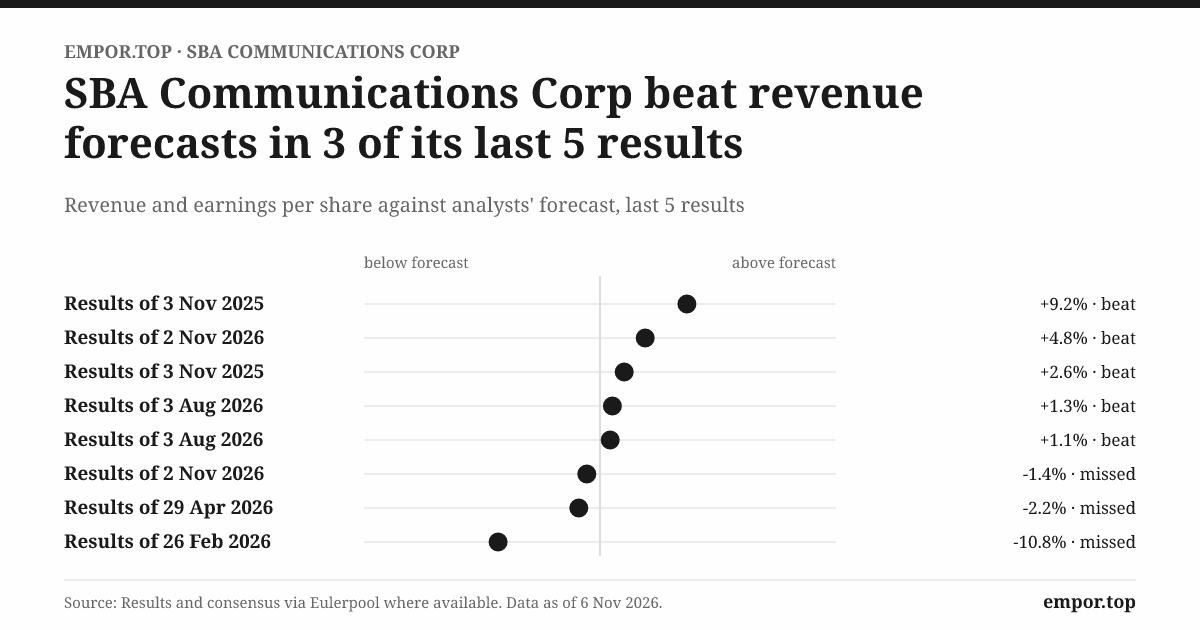
The bear case is just as specific. Carrier consolidation has shown that tower revenue can shrink, and the three largest customers retain enormous bargaining power. Domestic leasing revenue was falling in the latest quarter, and management's 2027 transition-year guidance reinforces the risk.2 Refinancing at higher rates will absorb part of whatever growth arrives, and AFFO per share was already declining year over year.1 Collections in site development weakened in 2025. And the strategy of selling smaller markets removes rent that must be replaced through growth elsewhere. On this view, the lower multiple reflects a slower-growing, higher-cost business, not a temporary dislocation.
Weighing the two, the evidence supports a middle conclusion. The durability of SBA's contracted rent is well established; the growth of that rent is not, at least not at the rates that once justified a 40-times multiple. The market appears to be pricing a business that grows its cash flow slowly while carrying the cost of its debt.
Three measures will decide which story wins. The first is organic cash site-leasing growth excluding acquisitions and currency, the cleanest test of whether carriers want more space on existing towers; in the third quarter, domestic leasing revenue was down 3.4% while international cash leasing grew about 9% excluding currency, flattered by acquisitions.1 The second is churn net of new lease billings, which shows whether new business is outrunning cancellations; management expects the gap to narrow as Sprint and EchoStar churn subsides.2 The third is net leverage alongside the all-in cost of refinancing, now 6.4 times, with the latest unsecured notes priced at about 5.1%.1 If the first rises, the second shrinks and the third holds, the bull case gains ground. If not, the bear case does.
XIII. Lessons from the Tower Lease
In 1989 Steven Bernstein left a carrier to help carriers build their networks. Thirty-seven years later, the carriers are still SBA's customers, and they still decide which sites they need. The company's history offers a handful of lessons that belong to it and no one else.
The first lesson comes from the early consulting years. A services business can be a map of where infrastructure is scarce. SBA learned where carriers needed sites, how hard they were to permit, and how few good locations existed, before it ever owned a tower. That knowledge turned into ownership, but only because the lease economics justified the capital. Founders in any infrastructure business can take the point: doing the work shows you where the asset is valuable; owning the asset is only worth it when the rent pays for the money. Expertise finds the hilltop. Capital has to earn its keep on it.
The second lesson comes from the Sprint merger. A site count is not a moat: leases cannot protect rent when tenants merge. The value of each site depends on the tenant's network plan, which the landlord cannot control. Investors in any business with concentrated customers should remember this one: the lease protects you from the tenant who wants to leave, not from the tenant who stops existing.
The third lesson comes from Cavanagh's portfolio review. A strategic review is credible when it changes the portfolio and when better returns follow. SBA has done the first part, selling out of five countries and buying a regional leadership position in Central America. The second part, measurable improvement in leasing growth and returns on capital, is still to come. A review that shrinks the map without raising the rent is just a smaller company.
The fourth lesson comes from the balance sheet, from TowerCo through the July 2026 notes. Debt can accelerate a tower roll-up, but refinancing costs arrive on a schedule of their own. SBA ran at 7-plus times leverage when money was cheap and grew into it. It now runs at 6.4 times when money is dearer, and the coupon on every new note eats into the per-share growth that leverage once magnified. Leverage turns a good asset into a great return only while the cost of money cooperates. When it stops cooperating, the asset is the same, and the return is not.
XIV. Epilogue
Tonight, SBA is a smaller company than it was two years ago in country count and a larger one in Central America. It has about 45,000 sites, about $12.5 billion of net debt, a dividend of $1.25 a quarter and a buyback programme still running.1 Management says its biggest domestic customers are still investing, and its domestic rent is still shrinking. Its international rent is growing, partly because it bought it.
The next annual results, due early in 2027, will cover the first full year with the Millicom towers, a year in which most Sprint churn is expected to occur, and the first year without Chile, Ecuador and, if the sale closes, Peru. That report will be the first real test of whether the portfolio strategy has worked. If the Millicom sites show rising tenancy and the build-to-suit programme adds sites at reasonable cost, the price SBA paid will start to look justified, and the regional-leadership strategy will have its proof. If the sites stay mostly single-tenant, the deal will look like a large purchase of steady but slow-growing rent, financed at higher rates.
The American race between new leases and churn will deliver its own verdict over the same months. Management expects churn to ease as Sprint leases roll off and EchoStar's run out. If domestic leasing turns positive in 2027, the consolidation era will look like a bounded episode. If it stays negative, the problem will have moved from churn to demand.
Then there is the money. The proceeds from the South American exits and the cash flow given up with them will have to be measured against what SBA does with the money: buybacks, new builds or debt reduction. And management's description of 2027 as a transition year will be tested by the terms of the next large refinancing. A smooth unsecured issue at a manageable rate would support the investment-grade path; a costlier or delayed one would put pressure on the 6.4-times leverage that now gives SBA its room.
The thesis is still testable, and that is its virtue. SBA must show that a more focused portfolio, with a larger Central American position, can grow cash leasing faster than churn and interest expense consume it. For now, the rent is secure and the growth is a promise.
XV. Outro
Somewhere tonight a phone in Tegucigalpa or Tucson connects to a network its owner never thinks about. Above a street, beside a highway or on a hill, a steel tower holds antennas for one carrier, sometimes two or three, each renting a few feet of height. The tower does not know who owns it. It was found, permitted and built by people doing the kind of work Steven Bernstein started doing in 1989, when the business of putting antennas on land did not yet have a name.
SBA still depends on those places, and it has to keep proving they are worth the rent. The tower stays. The tenant decides.
References
-
SBA Communications Corporation Reports Third Quarter 2026 Results, Updates Full Year 2026 Outlook and Declares Quarterly Cash Dividend — SBA Communications, 2026-11-02 ↩↩↩↩↩↩↩↩↩↩↩↩↩↩↩↩↩↩↩↩↩↩↩↩↩↩↩↩↩
-
SBA Communications Q3 2026 Earnings Call Transcript — Benzinga, 2026-11-02 ↩↩↩↩↩↩↩↩↩↩↩
-
SBA Communications Form 10-K for fiscal year 2025 — SEC, 2026-02-27 ↩↩↩↩↩↩↩↩↩↩↩↩↩↩↩↩↩↩↩↩↩↩↩↩↩↩↩↩↩↩↩↩↩↩↩↩↩
-
SBA Communications 1999 Form S-1/A Filing Index — SEC, 1999-06-15 ↩↩↩
-
SBA Communications Form 8-K, Completion of TowerCo Acquisition — SEC, 2012-10-01 ↩↩↩↩
-
SBA Communications Fourth Quarter and Full Year 2012 Results, Form 8-K Exhibit 99.1 — SEC, 2013-02-21 ↩
-
SBA Communications REIT Election Announcement — SBA Communications, 2016 ↩
-
Millicom Tower Sale Announcement, Form 6-K — Millicom / SEC, 2024-10 ↩↩↩↩↩
-
SBA Communications Q4 2023 Earnings Call Transcript — Reportify, 2024-02-26 ↩↩↩↩
-
SBA Communications Exits the Philippines — Capacity Global ↩
-
SBA Communications 2026 Annual Meeting Voting Results, Form 8-K — SEC, 2026-05-22 ↩
-
SBA Communications Gets Positive Outlook from Moody's — Investing.com, 2025-12-19 ↩↩
-
SBA Communications 2026 Debt Prospectus Supplement, Form 424B2 — SEC, 2026 ↩
-
SBA Communications Form 10-Q for Q2 2026 — SEC, 2026-08-06 ↩
-
Moody's Affirms SBA Communications at Ba1, Outlook Positive — Cbonds, 2026-10-21 ↩↩
-
SBA Communications (SBAC) Q3 2026 Earnings Call Transcript — The Motley Fool, 2026-11-02 ↩
-
American Tower EV/EBITDA and Peer Comparison — Stockrow, 2026-10-28 ↩
 LinkedIn
 WhatsApp
 Reddit
 Hacker News
 Email
 Kindle
 RSS Feed
 Spotify
 Apple Podcasts
 Amazon Music
 Audible
 YouTube