Replimune Group, Inc.: The Virus That Made It Through the FDA
I. Two Rejections, One Approval—and a Trial Still to Come
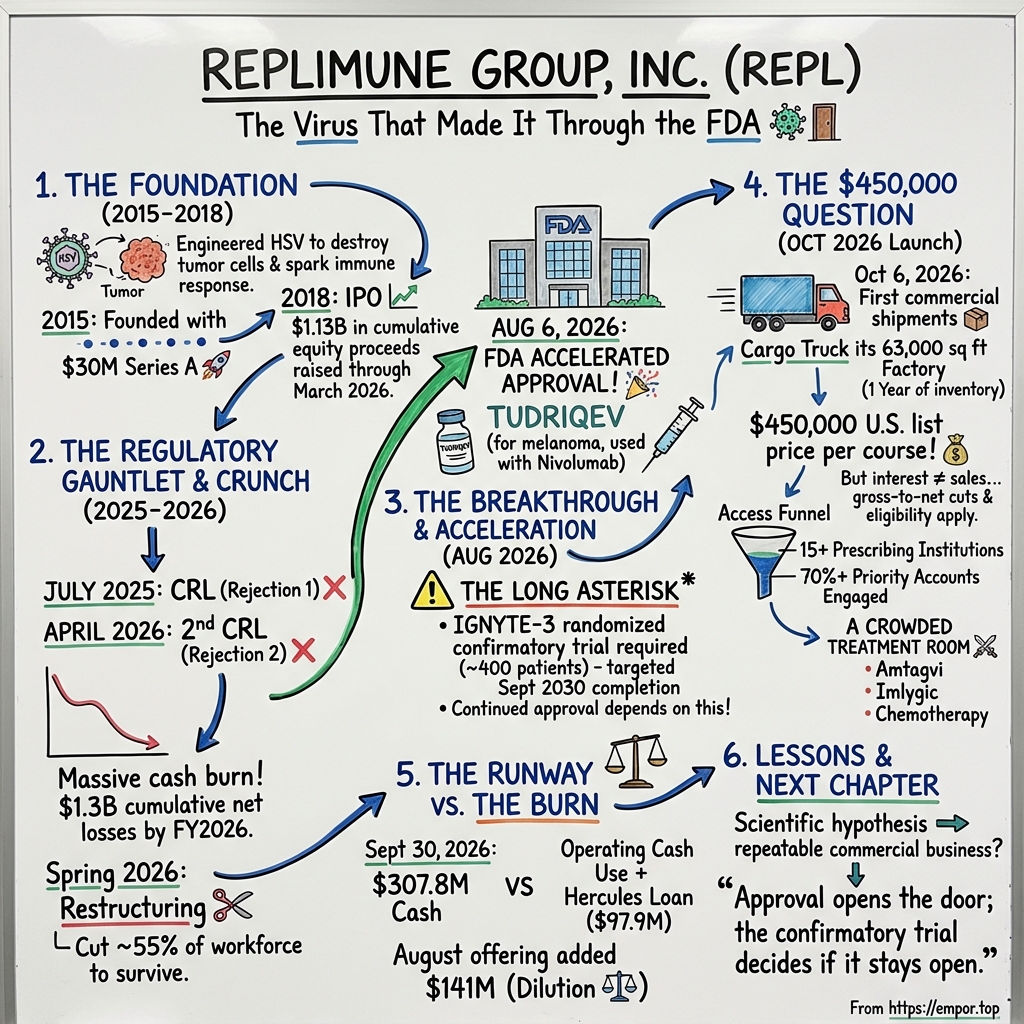
On August 6, 2026, the Food and Drug Administration posted a short notice on its cancer-approvals page. It said the agency had granted accelerated approval to vusolimogene oderparepvec, sold as TUDRIQEV, a genetically modified herpes virus to be injected directly into tumors and given alongside the immunotherapy nivolumab. The patients it was meant for were adults with advanced cutaneous melanoma that could not be removed surgically and that had kept growing despite a PD-1 blocking drug, the class of medicines that transformed melanoma care over the previous decade.1 For most companies a notice like that is the end of a long climb. For Replimune Group, it came after the climb had nearly killed the company.
The same agency had said no twice. On July 21, 2025, the FDA sent Replimune a Complete Response Letter, the formal document regulators use to tell a drug company its application cannot be approved as submitted. Replimune resubmitted in October. On April 10, 2026, a second letter arrived, citing the same principal deficiencies.2 Between those two letters and the approval, the company cut roughly 55% of its workforce,3 its auditor warned of substantial doubt about its ability to continue as a going concern,3 and its share price fell to a 52-week low of about $1.70.[^4] Then, after a third filing, an advisory committee meeting on July 30 and four days past the agency's own target date, the answer changed.2
What makes the reversal unusual is that the evidence underneath it barely changed. The FDA's own Summary Basis for Regulatory Action, the document in which the agency explains its decision, says the second resubmission "did not introduce substantive new efficacy data to resolve the deficiencies articulated in the prior CRLs."2 It added an updated three-year survival analysis from the same study, but the core problem stayed where it had been. The study at the heart of the application, called IGNYTE, began life as an exploratory trial testing the virus across a variety of solid tumors, alone or with anti-PD-1 drugs. The melanoma cohort that eventually carried the application, 140 patients whose disease had progressed on anti-PD-1 therapy, was added later by amendment, "rather than being prospectively designed as a pivotal cohort from the study's outset," and further amendments materially changed who could enroll and how the cohort was run.2
The FDA's objections were specific. The agency said the method used to assess tumor response was unreliable and confounded the reported response rate and duration. It said that without a concurrent control group there was no way to establish what TUDRIQEV contributed on top of nivolumab. And it said that the mixed patient population, together with the absence of a well-established historical comparison, limited what the response rate could mean.2 The primary clinical review team, the doctors and statisticians who live inside the data, did not recommend approval even at the end. The approval came from a level above them, where the agency's Office of Therapeutic Products weighed the advisory committee's view, the unmet need and the flexibility the accelerated pathway allows, and decided to approve "with full acknowledgment of the remaining uncertainties."2
That phrase is the hinge of the whole story. Accelerated approval lets the FDA approve a drug for a serious disease on the basis of an early signal, here tumor shrinkage and how long it lasted, on the condition that the company runs a proper trial to confirm that patients actually benefit. TUDRIQEV's confirmatory trial, IGNYTE-3, is a randomized study of about 400 patients with overall survival as its primary endpoint, and the FDA set its completion date for September 2030, with a final report due in March 2031.2 Continued approval, the agency said, is contingent on that trial verifying clinical benefit.1
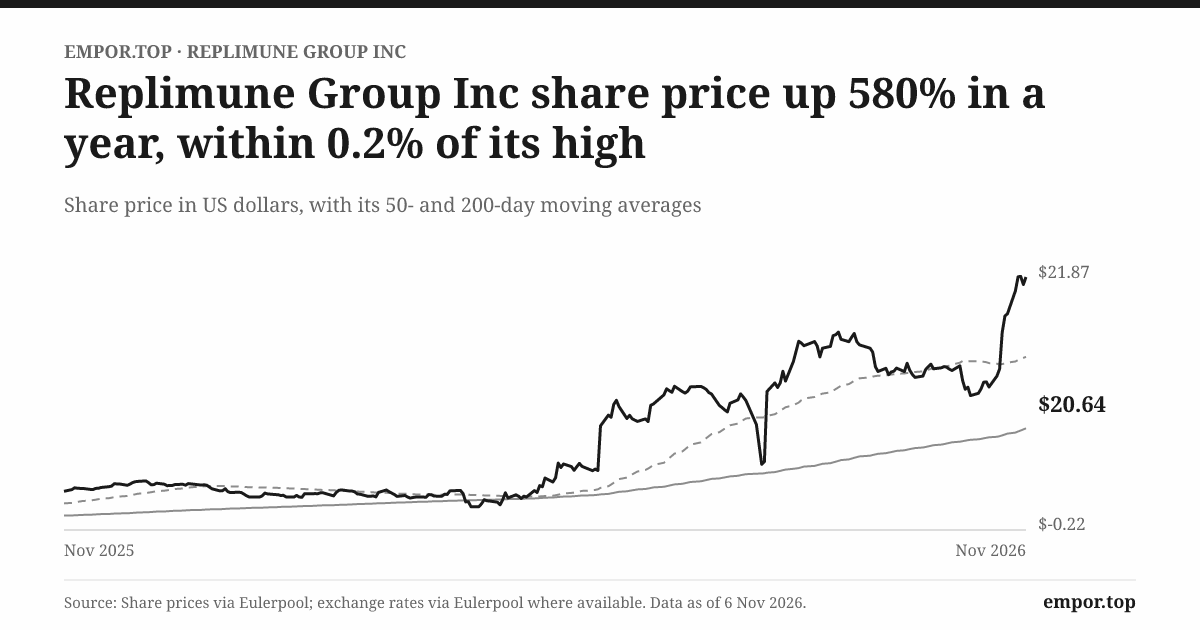
So the approval did not settle the question the FDA spent two years asking. It moved the question into the market. Replimune now has to do three things at once. It has to get a frozen virus into the hands of cancer centers and through the billing systems of insurers. It has to finish a randomized trial that will, years from now, either vindicate the drug or undermine it. And it has to do both with a balance sheet that has never been funded by its own sales. On November 6, 2026, investors valued the company at about $1.7 billion, with trailing losses of $2.79 a share and not a dollar of commercial product revenue yet reported.[^4]4
The market has decided that the approval matters enormously. The share price on that date, about $20.64, sat within a fraction of its 52-week high and roughly twelve times its low.[^4] The question for a long-term investor is narrower and harder: did August 6 turn Replimune into a commercial biotech, or did it begin a longer test of whether its drug works and sells? To answer that, it helps to go back to the idea the company was built on, and to the team that had already taken a virus like this one through the FDA once before.
 Subscribe on LinkedIn
II. The Company Built Around a Virus
The idea sounds like science fiction and is older than most of the people now prescribing it. A herpes simplex virus, the same family that causes cold sores, is very good at getting into human cells, copying itself and bursting them open. Strip out the genes that let it cause disease in healthy tissue, and you have something that prefers to replicate in tumor cells, which tend to have weaker antiviral defenses. Inject it into a tumor, and it kills cancer cells directly.
The bigger prize is what happens next: dying tumor cells spill their contents, the immune system notices a viral infection and a mess of tumor proteins in the same place, and, in the best case, it learns to recognize the cancer elsewhere in the body. The virus acts less like a poison than like a flare fired into a dark room, showing the immune system where the enemy is hiding.
TUDRIQEV is a version of that flare with extra charges packed in. According to the FDA's review, it is a modified HSV-1 with two viral genes functionally deleted, ICP34.5 and ICP47, and it carries two added payloads: human GM-CSF, a signaling protein that recruits immune cells, and a modified gibbon ape leukemia virus fusion protein, called GALV-GP R-, which makes infected tumor cells fuse with their neighbors and die in clumps.2 Replimune's 2018 registration statement described the platform, which it called Immulytic, as an engineered HSV-1 strain "armed" with a fusogenic protein intended to substantially increase anti-tumor activity.5 In mice, the FDA noted, the virus and an anti-PD-1 antibody worked together far better than either alone.2 That pairing is the bet: the virus wakes the immune response, and the checkpoint drug takes the brakes off it.
The people who made that bet had done something similar before. Replimune's founders and core management, including Robert Coffin, the company's first chief executive, Philip Astley-Sparke, its executive chairman, and Colin Love, its operating chief, had been the founding and senior team of BioVex Group, the company that, in Replimune's words, "invented and developed T-Vec."5 T-Vec became Imlygic, the first oncolytic virus approved by the FDA, in 2015, after Amgen acquired BioVex in 2011.5 Replimune's first chief medical officer, Howard Kaufman, had been the principal investigator on the pivotal trial that won T-Vec its approval.5 Few start-ups in any field begin with a team that has already walked the specific regulatory path they are about to walk again.
That precedent cuts both ways, and it is worth being precise about what it proves. BioVex showed that a herpes-based virus could be engineered, manufactured, tested in a randomized trial and approved. It did not show that such a product could become a large business. Imlygic's label, as later chapters of this story will show, is narrow and carries a frank limitation on what it has been shown to do. Coffin's team left with deep know-how and a conviction that a more potent virus, used in combination with checkpoint drugs, could reach far more patients. The new company was a second attempt at the same scientific idea, with a sharper weapon and a broader ambition.
Replimune Limited was organized in England in March 2015.5 In September of that year it announced a $30 million Series A financing.[^7] By March 2018 the company had raised $86.9 million of gross proceeds from preferred shares, from a roster of specialist investors that included Atlas Venture, Bain Capital Life Sciences, BVF Partners, Cormorant, Forbion, Foresite, Omega Funds and Redmile.5 A Delaware parent, Replimune Group, was formed in July 2017, and the principal office moved to Woburn, Massachusetts.5
The July 2018 initial public offering on Nasdaq raised about $101 million net.3 What the company said it would do with the money tells you the strategy. Alongside trials of the lead virus, then called RP1, and early work on two follow-on viruses, RP2 and RP3, roughly $20 million was earmarked for building its own manufacturing plant in Framingham, Massachusetts, which management expected to produce clinical-grade material in the first half of 2020.5 That was an unusual choice for a company with no approved product. Most young biotechs rent capacity from contract manufacturers. Replimune decided early that making live virus well was part of the moat, not a chore to outsource, and that a team that had scaled T-Vec should own the process this time.
Here is where the founding myth meets the ledger. Replimune did not grow by buying other companies. Its filings show no material acquisition-led expansion, which means there is no purchase price to second-guess and no goodwill to write down.3 Instead, the money went into science, trials and that factory. Over the ten fiscal years through March 2026, Replimune reported about $1.3 billion of cumulative net losses and used about $1.0 billion of cash in operations.3 To pay for that, it sold stock again and again. After the IPO came five follow-on public offerings through November 2024, a private placement in June 2024 and at-the-market sales, for cumulative net proceeds of about $1.13 billion since the listing.3 Annual losses rose from about $7 million in the first year on record to about $314 million in fiscal 2026.3
The gap between the $1.3 billion of losses and the $1.0 billion of cash burn is not hidden profitability. Most of it is stock-based compensation, a real cost paid in shares rather than cash, which ran above $30 million a year in the last two fiscal years.3 Shareholders paid it through dilution instead of through the bank account. The company also earned interest on its cash pile, about $13.6 million in fiscal 2026, but treasury income was a rounding error beside the losses.3
Leadership changed along the way. Philip Astley-Sparke served as chief executive until April 2024 and then became executive chairman, and Sushil Patel took over as chief executive.6 The later stretch of rising losses, the two rejections and the restructuring all happened on Patel's watch, with Astley-Sparke still in the chair, so the current team cannot attribute the recent record to predecessors.
Put together, the first decade reads like a disciplined version of the classic biotech life cycle. The company built its own platform, its own trials and its own plant, and it got one product approved. What it has not yet shown is the thing a business ultimately needs: a repeatable engine that turns science into revenue. Ten years and roughly $1.3 billion of losses is the price of the first approval. It is also the hurdle the first product now has to begin to clear. The obvious next question is what, exactly, the FDA said yes to.
III. The FDA's Yes Came With a Long Asterisk
Advisory committee meetings are the closest thing drug regulation has to a public trial. On July 30, 2026, the FDA convened its Cellular, Tissue, and Gene Therapies Advisory Committee, a panel of outside experts, to look at Replimune's data in the open.1 The agency did not ask the panel whether the drug should be approved. It asked two sharper questions: whether the single-arm IGNYTE study, as designed and conducted, allowed a reliable determination of the response rate and how long responses lasted, and whether the responses it saw indicated systemic anti-tumor activity attributable to TUDRIQEV.2 The briefing document the agency prepared for the panel framed the meeting around "the reliability and interpretability of the efficacy data."7 It was, in effect, an invitation to argue about whether the numbers meant what Replimune said they meant.
The road to that room had been long and, for a while, smooth. Replimune held its first pre-IND meeting with the FDA in October 2017 and opened its investigational file in February 2018, months before its IPO. It held a pre-application meeting in September 2024, submitted its Biologics License Application on November 21, 2024, and won Breakthrough Therapy designation the same month. The FDA accepted the filing in January 2025 and gave it priority review.2 On paper, everything pointed toward approval in mid-2025. Instead, the first rejection led to a Type A meeting with the agency in September 2025 to work out what had gone wrong, and the fix it produced did not satisfy the reviewers either.2
The third attempt, filed on June 2, 2026, was accepted on June 26 as a Class 1 resubmission, the shortest review category, with an action date of August 2.3 Calling an advisory committee at that late stage told everyone that the agency was still divided and wanted outside judgment before it decided.
To see why that argument mattered, start with what a single-arm trial is. In a randomized trial, patients are split by chance between the new treatment and a comparison, so that any difference in outcomes can be credited to the treatment. In a single-arm trial, everybody gets the new treatment, and the investigators compare results against what history suggests would have happened otherwise. That works when the historical baseline is well known and the effect is dramatic. It struggles when the patients are diverse, the comparison is fuzzy, and the new drug is given together with an old one.
IGNYTE's melanoma cohort had all three problems. Every patient received TUDRIQEV plus nivolumab, an anti-PD-1 drug, even though they had already progressed on anti-PD-1 therapy. If tumors shrank, was that the virus, or nivolumab working on a second pass, or the combination? The trial had no arm that could separate them.2 The patients themselves were a mixture. According to the FDA's review, about 44% had previously received a PD-1 drug combined with an anti-CTLA-4 drug, about a quarter had received anti-PD-1 therapy only after surgery, as a preventive treatment, and 40% had received more than one line of anti-PD-1 therapy. About 29% had stage III disease and nearly a fifth had disease limited to the skin, which the FDA said could make the group more favorable than some historical comparisons.2
Then came the measuring. Replimune reported that 33.6% of the 140 patients responded, including 23 complete responses, with a median duration of response of 24.8 months.2 Those are striking numbers for patients whose cancer had beaten a checkpoint drug. The FDA reanalyzed them and arrived at a much lower figure. Its reviewers pointed out that over half of the responders had all their target lesions injected, or had no measurable target lesions at baseline. If the doctor injects every lesion being measured, a shrinking tumor shows that the virus works locally, but it says little about whether the immune system has been turned against cancer elsewhere in the body, which is the claim that matters for survival.
The agency also flagged patients treated beyond progression with new or enlarging lesions re-injected, 115 invasive procedures such as biopsies and resections on responders' lesions, at least seven responses reclassified using pathology findings in ways standard response criteria do not normally permit, and runs of non-evaluable assessments that left gaps in the duration-of-response record.2
The FDA's own analysis looked only at the 91 patients who had at least one lesion that was not injected, a cleaner test of the systemic effect. In that group, the response rate was 24.2% and the median duration of response was 14.1 months.2 That is the figure in the approval notice.1 It is still a meaningful signal in a population with few good options. It is also about a third lower than the headline Replimune presented, with responses lasting a little over half as long. Investors who remember only the company's number are remembering the higher of two readings of the same data.
The panel heard all of that and voted 10 to 3 that the IGNYTE efficacy results were evaluable and clinically meaningful. According to the FDA's summary, the majority, which included melanoma oncologists, trial specialists and patient advocates, acknowledged the significant methodological limitations while emphasizing the unmet need, the biologically plausible mechanism, tumor shrinkage in both injected and non-injected lesions, and the durability of responses in a subset of patients.2 The experts did not say the FDA's critique was wrong. They said that, in this population, the signal was worth acting on anyway.
That left an internal split on the record: the primary clinical review team still did not recommend approval, while office-level leadership did.2 It is rare to see an agency document lay out that disagreement so plainly, and it matters for how investors should read the approval. The yes was not a finding that the evidence was clean. It was a judgment that the evidence was good enough, given the disease, to let patients have the drug while a better trial does its work.
The safety record was part of that balance. The most common side effects included fatigue, fever, chills, infections, nausea and injection-site reactions. Adverse events of special interest included tumor bleeding, sepsis, collapsed lungs linked to injections into internal lesions, herpes-like infections and one case of cytokine release syndrome, and the FDA counted two deaths as possibly related to treatment.2 The label carries warnings on accidental exposure, herpetic infection and complications of the injection procedure.1 Shedding data were reassuring: live virus appeared in less than 1% of injection-site swabs, and no herpes infections were reported among caregivers or close contacts.2 None of that appears to have been the reason for the rejections. The arguments were about efficacy, not toxicity.
The answer to the efficacy question now sits with IGNYTE-3. Replimune dosed the first patient in that trial in August 2024, before the first rejection.3 The randomized, open-label trial compares TUDRIQEV plus nivolumab with a physician's choice of treatment, with overall survival as the primary endpoint.2 After the first rejection, the FDA told Replimune that nivolumab plus relatlimab, the combination sold as Opdualag, may be an acceptable comparator.3 Survival is the gold-standard endpoint precisely because it cannot be argued about the way tumor measurements can. If patients on TUDRIQEV live longer than patients on the alternative, the debate about injected lesions becomes history.
There is a detail in the trial design that deserves attention. IGNYTE-3 enrolls patients whose disease has progressed on both an anti-PD-1 and an anti-CTLA-4 drug, given together or in sequence.2 The approved label is broader: it requires only progression on a PD-1-based regimen.1 So the confirmatory trial tests the drug in a more heavily pretreated slice of the population than the label covers. That is not unusual for confirmatory studies, and it may be a harder test, which would make a positive result more persuasive. But it means the trial will not directly answer every question about every patient the drug can now be sold to.
The timeline is the other asterisk. The final protocol was due by August 31, 2026, the study is to be completed by September 2030, and the final report is due in March 2031.2 On the October 2026 earnings call, management said the confirmatory study was enrolling and had opened to additional sites in Europe, but it gave no enrollment count.8 The commercial story, in other words, will unfold for several years before the clinical verdict arrives. Doctors will form opinions, payers will set policies and Replimune will burn or earn cash long before anyone knows what the survival curve looks like.
It helps to keep the regulatory risk in proportion. This is a real approval, not provisional hype. The drug can be marketed, coverage policies are being written, and the FDA has said the benefit-risk profile supports it.2 A negative or ambiguous IGNYTE-3 could remove the product's legal basis for being sold in this indication.1
Two other overhangs travel with the approval. After the first rejection, shareholders filed a securities class action alleging that the company's disclosures about the application had been misleading, and they amended the complaint after the second rejection. The defendants deny wrongdoing and have moved to dismiss, with briefing scheduled to finish in December 2026. Three related derivative suits are stayed.34 Separately, the Securities and Exchange Commission closed its investigation into RP1 in June 2026 without recommending enforcement action.3 Those are allegations, not findings, and the SEC's decision removes one of the two clouds. But the private case is still live, and its central question, what management knew about the FDA's concerns and when, will be argued in court while the drug is on the market.
So what did the FDA approve? A narrow, real medicine in a setting where patients have run out of good choices, backed by a signal the agency's own reviewers did not trust and its leadership chose to act on. The burden of proof did not disappear on August 6. It was handed to IGNYTE-3. In the meantime, the company has a more immediate test, one that starts with a price tag.
IV. A $450,000 Course Is Not Yet $450,000 of Revenue
On October 1, 2026, Replimune announced that TUDRIQEV was available in the United States.[^11] In the first week of October, the first commercial shipments left for treatment centers.8 The product that went out is a peculiar thing to sell. It is a live virus, stored frozen at about minus 80 degrees Celsius in single-dose glass vials holding a milliliter each, and the FDA's review notes it is stable for four years frozen but only days once thawed.2 On the earnings call, management said the drug can be delivered the next day, with injections given in an outpatient setting.8 It is less like a pill bottle and more like a carefully timed delivery to an operating theatre.
The list price was the number that drew the headlines. On the October 28 call, chief financial officer Emily Hill said TUDRIQEV's list price is $450,000 per course of therapy "before customary rebates and discounts."8 For a single company with one product, that figure makes even a small launch consequential. A few hundred patients a year at anything close to that price would be a business. But to understand what that number will turn into, it helps to separate two units: the unit of treatment and the unit of accounting.
Start with treatment. The dose depends on the tumors. The label sets the injection volume at one milliliter per centimeter of the largest tumor dimension, up to 10 milliliters across all lesions per dose. The first dose uses a weaker concentration, and later doses are ten times stronger. Injections come every two weeks for eight doses, with nivolumab added from the third week.1 A patient with a few small skin nodules uses far less product per visit than a patient with large or deep tumors that need injecting under imaging guidance. Hill said the cost per patient varies "with tumor burden and the number of cycles a patient receives," and that patients may receive eight or more cycles.8 So $450,000 is not a fixed toll. It is a reference point for a variable amount of virus spread over several months.
Now accounting. Replimune sells through specialty distributors, with Cardinal Health as its exclusive U.S. third-party logistics provider.34 Under the company's disclosed policy, revenue is recognized when a distributor receives the product and title and risk of loss pass.4 It is not recognized when an oncologist decides a patient is a candidate, when a hospital's pharmacy committee puts the drug on its list, or when an insurer approves the claim. Because product ships for each treatment visit and a course runs for months, Hill said revenue from a patient starting therapy "may be recognized over more than one quarter."8 A patient who starts in late December contributes a sliver to one quarter and the bulk to the next. Early quarterly numbers will be fragments of courses, not whole ones.
Then there is the gap between list price and the money the company keeps, which the industry calls gross-to-net. Replimune's quarterly filing describes the deductions it will estimate: rebates, group-purchasing and distributor fees, chargebacks, returns and copay assistance for patients.4 Each is a slice taken from the list price before it reaches the income statement. Medicare and Medicaid rules, hospital discount programs and commercial payer contracts all bite in different ways. For a new oncology product, the net price can be meaningfully below list, and there is no history yet to say how far. On the call, management did not discuss the gross-to-net discount.8 Investors are, for now, valuing a list price.
The cleanest thing that can be said about Replimune's commercial economics is that, as of September 30, 2026, there were none to analyze. The company reported no product revenue and no trade receivables, because it had not yet shipped commercial product.4 The filing describes allowances for returns and credit losses, but it has no aging, write-off or overdue history to show.4 That is a clean pre-launch baseline, not a clue about how payers will behave. The first useful evidence will be the December-quarter receivables and how actual deductions compare with management's estimates.
Billing friction is part of the near-term story too. At launch, providers are billing TUDRIQEV under a miscellaneous code, and management said it expects a permanent product-specific billing code by April 2027.8 Miscellaneous codes work, but they require more paperwork and manual review, which can slow reimbursement and make hospital finance departments cautious about stocking a $450,000 product. A dedicated code tends to smooth that path. Replimune also launched a patient-support program, Replimune Connect Plus, to help with coverage and access.8
Management offered almost no numbers that would let an outsider model the first quarter of sales. "We will not be providing revenue guidance at this time," the company said on the call.8 Asked by an analyst about patient counts, Hill said it is "difficult for us to track the exact patient numbers," and that updates would focus on accounts with the drug on formulary and accounts that had written a first prescription. Real insight into real-world volume, she said, would come "once we've seen a cohort of patients complete their eight or more cycles."8 Another analyst asked whether patients were showing up with more or less tumor than in IGNYTE, which would affect how much product each course uses; chief executive Sushil Patel said it was "a little too early" to tell, while Hill said the company believes IGNYTE was "a representative population of the real world."8
Read neutrally, that caution is defensible. The company really does sell through distributors and really does not see every patient. But it also means the first year of the launch will be judged on metrics management chooses, until the revenue line speaks for itself. The structure of the treatment adds a lag: if each patient takes about four months to complete a course, the first full cohort of finished courses will not exist until early 2027.
The economics, then, are potentially attractive and almost entirely unproven. A high price and a self-made product could produce rich margins once the plant is running, but every link in the chain between a vial and recognized revenue is still being forged: eligible patients, a doctor willing to inject, a hospital that has approved the drug, an insurer that pays, a course that runs long enough to use meaningful product, and a net price that survives the rebates. Early prescriptions are a start, not proof. The next question is whether enough clinics will make TUDRIQEV routine, and that depends on what else is already sitting in the treatment room.
V. Fifteen Prescribing Institutions Meet a Crowded Treatment Room
Four weeks after launch, Replimune's leadership got on the phone with analysts and put its first numbers on the table. "As of Friday," the chief commercial officer said, "over 15 institutions have written one or more" prescriptions for TUDRIQEV. The company said it had proactively engaged more than 70% of its initial 200 target accounts, and that about 20 accounts had placed the drug on formulary. It named Moffitt Cancer Center and Memorial Sloan Kettering, two of the highest-volume melanoma centers in the country, among those that had added it.8 Some sites, the company said, were "expediting, and in some cases bypassing, the usual formulary review."8 The quarterly filing, with information as of October 23, reported the formulary count at about 20 institutions.4
Those are real signs of clinical interest, and in oncology the academic centers matter disproportionately: they train the community oncologists, write the protocols and see the hardest cases. But it is worth laying out the funnel those numbers sit in, because each step tells you something different. First, an account has to be engaged by the sales team. Second, the hospital has to put the drug on its formulary, the list of medicines its pharmacy will stock. Third, a doctor has to write a prescription. Fourth, a patient has to start treatment, which requires insurance approval, scheduling and, for deep lesions, an interventional radiologist. Fifth, and most important for the business, the patient has to stay on treatment through the course, and the institution has to come back with the next patient. As of late October, public counts existed only for the first three steps.
On the analyst call, there were hints about the next ones. The commercial chief described accounts that ordered on a Friday and dosed on the following Tuesday, and accounts that ordered on a Monday and started a patient the next day. She said scheduling interventional radiology for the injection cycles "is working best," and that accounts with no prior TUDRIQEV experience, meaning sites that had not been part of the trials, had already treated patients.8 Asked what was holding things up, Patel said, "I wouldn't say that there's been anything that's been a major hold-up," while acknowledging that some hospitals have more restrictive schedules for their pharmacy and therapeutics committees.8 The company suggested it could roughly double the number of active accounts by the end of the calendar year.8 That is an aspiration, not a reported result.
Access looked better than many launches at this stage. Management said commercial payers covering a majority of commercially insured lives had published policies covering the label, including retreatment where clinically appropriate; that Medicare coverage had been established; and that the National Comprehensive Cancer Network had rapidly listed TUDRIQEV as a category 2A recommendation in its melanoma guidelines.8 The NCCN guidelines are the playbook many oncologists and insurers follow, and a 2A listing means the panel reached uniform consensus based on lower-level evidence. These developments remove barriers. They do not create demand. A doctor who can prescribe a drug and get paid for it still has to believe it is the best option for the patient in front of them.
That patient has options, and the treatment room is crowded. The FDA's own review laid out the landscape: after progression on anti-PD-1 therapy, the optimal treatment "is not well-defined" and may include rechallenge with one or two checkpoint drugs, BRAF and MEK inhibitors for patients whose tumors carry the BRAF mutation, chemotherapy, the older oncolytic virus talimogene laherparepvec, or lifileucel.2 The agency also noted that national guidelines regard nivolumab plus ipilimumab as a reasonable option for patients who progressed on a single checkpoint drug.2 TUDRIQEV is not entering an empty field; it is asking doctors to choose it over several established habits.
The most direct rival for attention is lifileucel, sold by Iovance Biotherapeutics as Amtagvi. The FDA granted it accelerated approval in February 2024 for adults with unresectable or metastatic melanoma previously treated with a PD-1 blocking antibody and, if the tumor carries a BRAF V600 mutation, a BRAF inhibitor with or without a MEK inhibitor.9 Amtagvi is a different kind of medicine altogether. It is a personalized cell therapy: surgeons remove a piece of the patient's tumor, a central facility grows the immune cells found inside it into billions, and the cells are infused back after the patient goes through chemotherapy to make room for them.
That process takes weeks and demands an authorized treatment center and an inpatient stay. TUDRIQEV, by contrast, comes off a shelf in a freezer and is injected in an outpatient clinic. Patel made a pointed version of that contrast on the call, emphasizing that TUDRIQEV's label requires no prior BRAF-targeted therapy and that the U.S. addressable population is roughly 10,000 patients.8 The 10,000 figure is management's estimate, not an audited market size, and the competitive comparison was his framing rather than a head-to-head result. No trial has compared the two products.
The other comparison is with Replimune's own ancestor. Amgen's Imlygic, the T-Vec virus that Coffin's BioVex team built, is indicated for the local treatment of unresectable skin, under-skin and lymph-node lesions in melanoma that recurs after initial surgery, and its label states that it has "not been shown to improve overall survival or have an effect on visceral metastases."10 That sentence is a decade-old warning about what oncolytic viruses have and have not proved. TUDRIQEV's label is broader: it is for PD-1-progressed melanoma, in combination with nivolumab, and its injections can reach deep and internal lesions.1 Whether that breadth translates into a survival benefit is precisely what IGNYTE-3 must show. Until then, the most honest description is that TUDRIQEV is positioned as a more powerful, more broadly usable version of an idea that once won approval but stayed a niche.
That history is the strongest disconfirming evidence against the most optimistic launch narrative. Imlygic was first in class, was backed by Amgen's sales force, and still never became a mainstream melanoma therapy. The reason was not that doctors could not prescribe it. It was that the label was narrow, the procedure was fiddly, and checkpoint drugs arrived and changed the field. Replimune's argument is that the combination, the potency and the broader label solve those problems. The early data on institutions is consistent with that argument but cannot yet test it, because a first prescription is the easiest sale a company ever makes. The hard sale is the tenth patient at the same center.
There is no market-share series to consult and no post-launch revenue base against which to judge the launch. What the record shows by the end of October is that TUDRIQEV reached real clinical sites quickly and got through the access gates faster than many new oncology drugs. What it does not yet show is patient volume, repeat use, revenue or share. The next proof point is whether those institution counts turn into sustained treatment volume at a net price that holds up. And whether Replimune can afford to wait for that proof depends on decisions made in the spring, when the company had no approval at all.
VI. The Factory and the Runway Were Built Before the Market Arrived
In the spring of 2026, Replimune was a company prepared for a launch that the regulator had just refused for the second time. It had a fully operational manufacturing plant of about 63,000 square feet in Framingham, Massachusetts.3 It had hired a commercial organization. On March 31, it had 465 full-time employees, 349 in research and development and 116 in selling and administration.3 And on April 10, it had a second Complete Response Letter.2 That month, the company announced a restructuring that cut its workforce by approximately 55%.3 It is hard to overstate how brutal that sequence is. More than half the people who had built the product, prepared the launch and run the trials were let go, a few months before the product they had built was approved.
The cuts were a response to arithmetic. In fiscal 2026, the year ending March 2026, Replimune used about $280 million of cash in operations.3 Research and development spending had risen to about $221 million from about $189 million, driven partly by roughly $14 million more for IGNYTE-3 and about $14 million more for RP2, its second virus, now being tested mainly in uveal melanoma, a rare cancer of the eye.3 Selling and administrative costs rose to about $99 million from about $72 million as the company added people for a launch it expected to happen in 2025.3 At March 31, cash and short-term investments were about $269 million.3 With roughly a year of spending in the bank and no product to sell, the company's auditor included a going-concern paragraph in its June 2026 report, stating that recurring losses and funding needs raised substantial doubt about Replimune's ability to continue.3
The restructuring changed the cost line quickly. In the first half of fiscal 2027, the six months to September 2026, R&D fell to about $84 million from about $116 million a year earlier, and selling and administrative costs fell to about $41 million from about $59 million.4 The net loss for the half narrowed to about $127 million from about $170 million.4 The September quarter's loss was about $57 million, the smallest in more than three years.4 It is tempting to read that as the start of a turnaround. It is not. Lower losses so far reflect cost reduction, not commercial success, because there were no product sales in either period. Replimune did not disclose its post-restructuring headcount in the September filing.4
The cuts also say something about what management chose to protect. Spending on IGNYTE-3 continued, and so did RP2, which the company said was enrolling.8 The September quarter's selling and administrative costs ticked up from the June quarter, which Hill attributed to "field hiring, launch readiness, and patient support programs."8 Patel described the sales team as "almost fully staffed and right-sized to execute."8 The bet, in other words, was to shrink everything except the confirmatory trial, the lead follow-on program and the people who would sell TUDRIQEV if the FDA changed its mind. That is a coherent choice. Whether it shrank the pipeline too far to sustain a multi-product company later is a question the next few years will answer.
The factory deserves its own moment, because it is the clearest example of Replimune's capital being spent ahead of demand. The plan in the 2018 IPO prospectus had been to build a facility in Framingham to make clinical material by 2020.5 The FDA's pre-license inspection of that plant took place in April 2025; all observations were resolved, and the agency classified the inspection as "voluntary action indicated," a category meaning it found issues that did not warrant regulatory action.2 At launch, Patel said the company had "more than a year of inventory on hand produced at our in-house manufacturing facility."8
For a launch, that is a genuine asset. Contract manufacturing of live viruses is scarce and slow, and a company that controls its own supply cannot be bumped from a contractor's queue. But a factory is also fixed cost, and a year of inventory is cash already spent on vials that have to be sold before their four-year shelf life runs out.2 If uptake disappoints, the plant becomes underused overhead and the inventory becomes a write-down risk. Capacity bought ahead of demand only becomes an advantage once demand shows up.
The money to bridge the gap came, as it always had, from shareholders. On August 10, four days after approval, Replimune priced a follow-on offering: about 9.7 million common shares and about 2.74 million pre-funded warrants, at roughly $12.06 each, raising about $141 million net.113 Baker Brothers, the specialist health-care investor that had long been Replimune's largest backer, bought all of the pre-funded warrants for about $33 million.12 A pre-funded warrant is essentially a share that has been paid for in advance but not yet issued, often used by large holders who want to stay below ownership thresholds. The timing tells you something about the company's bargaining position. It raised money immediately after approval, at a price well below where the stock trades today, because it could not afford to wait and see whether the launch would lift the shares.
In September, shareholders approved doubling the company's authorized common stock from 150 million to 300 million shares.13 Common shares outstanding were about 94.8 million on October 23.4 Authorization is not issuance, but it gives management room to issue roughly twice the current share count without going back to shareholders for permission. That expands financing capacity. It does not create value by itself, and it signals that future dilution remains a realistic tool.
The offering did what it was designed to do. At September 30, Replimune held about $308 million in cash and cash equivalents, held in money-market funds backed by government securities, and the quarterly filing said the substantial doubt about its going-concern status had been alleviated, with cash expected to last more than twelve months.4 On the call, Hill described a runway of "greater than 12 months" that included continued funding of IGNYTE-3 and the uveal melanoma study for RP2.8 Twelve months is a disclosure threshold, not a comfortable cushion. At the fiscal 2026 burn rate, $308 million would not last much beyond that; at the lower post-restructuring rate, it lasts longer, but only if the launch does not demand large new spending.
Then there is the debt. Replimune borrows from Hercules Capital, a lender to venture-backed companies, under a loan that had $97.9 million of principal outstanding at September 30.4 The cash interest rate is the greater of 8.5% or the prime rate plus 1.75%, and the loan also accrues 1.5% of payment-in-kind interest, which is added to the principal rather than paid in cash.4 It is expensive money. Separately, the company had about $27 million of lease liabilities, mostly finance leases tied to its facilities.4
The loan's covenants are what matter most. The company has to keep a minimum level of cash, and once principal reaches $100 million, it must either meet a revenue test or maintain specified market-capitalization and cash thresholds; the lender also holds security over collateral, including cash accounts.4 With PIK interest steadily nudging the principal upward from $97.9 million, that $100 million line is not far away.
The approval brought one important concession. Under the loan's terms, FDA approval extended the maturity from October 2027 to October 2029, with interest-only payments through September 2029.4 That removes a near-term refinancing cliff that would otherwise have hung over the first full year of launch. It does not remove the covenant risk. A weak launch combined with a falling share price could push Replimune toward the revenue or market-cap tests at the worst possible moment, which is the classic way venture debt turns from a cheap bridge into a constraint on strategy.
The people running the company have been paid well through all this. Sushil Patel's reported compensation rose from about $3.7 million in fiscal 2025 to about $5.85 million in fiscal 2026, most of it in stock and option awards, in a year when the net loss widened from about $247 million to about $314 million and the company received its first rejection.6 His cash incentive was about $315,000.6 The proxy lists his beneficial ownership below 1%.6 Shareholders approved the pay package by a wide margin, about 48.6 million votes in favor to about 620,000 against.13
That approval reflects the structure of the register as much as the merits of the plan: a few specialist funds own a large share of the company, and one board member, Michael Goller, is an employee of the Baker Brothers adviser.6 Equity-heavy pay at least ties the chief executive's reward to the share price. Investors still have to judge him against the things he controls: launch execution, trial delivery and cash discipline.
One small housekeeping item belongs in the record because it touches the people in charge. On November 6, Replimune amended its September quarterly filing to add disclosure of Rule 10b5-1 trading plans, pre-arranged schedules for selling shares, adopted by Astley-Sparke, Patel and chief medical officer Konstantinos Xynos, which the original filing had omitted. The amendment said the financial statements were unchanged.14 It is a procedural fix, not a red flag. But it means the three most senior figures in the company had set up plans to sell stock in the weeks after the shares rose many times over from their spring low.
The pattern of the last year is clear. Management cut deeply, protected the confirmatory trial and the sales force, raised money the moment it could, and got the debt maturity pushed out. Those moves bought time. They did not buy independence from capital markets. The company still depends on launch conversion, careful spending and continued access to investors, and the factory and inventory now have to earn their keep. That raises the question the market has already tried to answer with a $1.7 billion price: what is this business actually worth, and why?
VII. Analysis & Bear vs. Bull Case
Put the two pictures side by side. On one side, by late October, a handful of melanoma centers had written their first prescriptions, a commercial team was knocking on the doors of 200 priority accounts, and frozen vials were moving from a Massachusetts plant to clinics overnight.8 On the other side, on November 6, the stock market valued the company at about $1.7 billion, with an enterprise value of about $1.5 billion after subtracting net cash, trailing losses of $2.79 a share and no commercial revenue on its books.[^4]4 Somewhere between those two pictures is the investment case. The market is paying for a future in which a single injected virus becomes a durable franchise. The question is what evidence supports that future today and what would break it.
The bull case starts with the label. TUDRIQEV is approved for a population with limited and variable options, where the FDA itself described the best treatment as poorly defined.2 It is an off-the-shelf therapy given in outpatient clinics, a practical advantage against a personalized cell therapy that requires surgery, manufacturing and a hospital stay.9 The company says early adoption at top centers has been fast, payer policies and Medicare coverage arrived quickly, and the NCCN listing gives doctors and insurers a reference to point to.8
Replimune owns its manufacturing, and the company says it has more than a year of inventory. Its second virus, RP2, is in development for uveal melanoma, which gives it a path to becoming more than a one-product company.83 If even a modest share of the roughly 10,000 patients management estimates are addressable were treated at a meaningful fraction of list price, the arithmetic would support a large business relative to today's cost base.8
The bear case starts with the same facts read the other way. The company had yet to report product revenue.4 Its historical cash burn was high.3 It has a single commercial product, approved despite the FDA's clinical reviewers' reservations, with a confirmatory trial that will take years to read out.2 It sits in a crowded treatment room where doctors have several alternatives, and its ancestor virus never escaped its niche.10 Its financing history is a long sequence of equity raises, the latest at roughly $12 a share, with authority now in place to double the share count.1113 And the debt carries covenants that tighten exactly when things go wrong.4
Michael Porter's five forces help organize the argument about whether the business can earn returns once the launch is over. The threat of substitutes is high. Doctors can choose among several established treatments, and nothing in the record shows TUDRIQEV beating any of them head to head.2 Buyer power is concentrated in two places: the institutions whose formulary committees decide whether to stock the drug, and the payers whose policies and rebate demands decide what Replimune is actually paid. Today, those buyers have been accommodating, but early coverage policies are not the same as realized net price, and the gross-to-net discount is still undisclosed.84
Supplier power is partly buffered by the in-house plant, but the company relies on a small number of vendors for manufacturing and raw materials, and the FDA's review lists several outside testing facilities.32 Rivalry includes not only Amtagvi and established drugs but also the steady stream of new melanoma regimens moving through trials. And the threat of new entrants is limited by the time, money and regulatory scrutiny it takes to bring an oncolytic virus to market, as Replimune's own decade demonstrates, though approval alone does not lock anybody out of a disease.
Hamilton Helmer's seven powers framework is a stricter test, because it asks what gives a company persistent advantage after competitors respond. The candidate powers here are few. There is a form of cornered resource in the approval itself and in the specialized know-how of making live HSV-1 at commercial scale, built over two companies and two decades by the same core team.5 That know-how is real, and the FDA's pre-license inspection, whose observations were resolved, is evidence that Replimune can manufacture to standard.2 But a cornered resource has to be both exclusive and valuable on attractive terms, and the value depends on whether the product wins patients.
There is no evidence yet of switching costs: a doctor who tries TUDRIQEV on one patient is not locked into using it on the next. There are no network effects in an injected oncology drug. A durable cost advantage is plausible in principle, given in-house manufacturing, but no margin data exists to test it. Scale economies, branding and process power all require years of commercial operation the company does not yet have.
The fairest verdict on the moat, then, is that it is promising but unproven. The history narrows rather than rejects the claim. Replimune has shown that it can engineer, test, manufacture and win approval for a virus, which is more than most of its peers have done. It has not shown that the product beats alternatives in a randomized comparison, that doctors who try it keep using it, or that payers will pay a price close to list. Each of those is a falsifiable test with a date attached. The randomized survival result is years away. The repeat-use and net-price data will begin to appear in the next few quarterly reports.
That makes it easy to choose what to watch. Three measures carry almost all the information. The first is quarterly net product revenue and, as soon as it can be inferred, the realized gross-to-net discount; its latest reading is zero.4 The second is operating cash use and the runway it implies; the restructuring sharply lowered the recent loss.34 The third is IGNYTE-3 enrollment and milestones, which management says are progressing.8 Everything else, from formulary wins to institution counts, is an input to those three.
Valuation in this situation has to be handled carefully. With no revenue, the fact that the enterprise value is many times sales is not a meaningful statement, and the ratio of price to book value, about 11 times, mostly reflects a book value being depleted by losses.[^4] There is no usable five-year history of valuation multiples, because the company has never had earnings or sales, and comparing Replimune with other single-product oncology launches would require assumptions about uptake that nobody can yet support. What the price does reveal is the market's implied view.
A $1.7 billion valuation on a company with about $308 million of cash and about $98 million of debt assigns more than a billion dollars of value to the future cash flows of TUDRIQEV and the pipeline.[^4]4 That is a bet that the launch works, the confirmatory trial confirms and the company gets there without diluting today's shareholders out of most of the gains. It is also a bet placed in a stock whose one-year volatility is about 148% and which has fallen as much as 73% within the last five years.[^4]
A skeptical long-short investor or activist would push on a few specific points. They would question the August equity raise and the company's reluctance to disclose patient counts. They would ask whether the enlarged share authorization, the board ties and executive pay create too much room for dilution or weaken incentives.6 And they would point out that the company's headline efficacy figure is the one the FDA's reviewers rejected, and ask that management's commercial messaging be measured against the label rather than against IGNYTE's original readout.2
None of those questions makes the company uninvestable. Together, they define the burden of proof. The skeptical investor's test is straightforward: can management show paid, repeat treatment and real trial progress before cash and covenants force another dilutive raise? That test has lessons attached that reach well beyond one virus.
VIII. Business & Investing Lessons
Go back to April 2026. The second rejection arrived just as Replimune had prepared for launch, and the company let go of more than half its people before the regulator made its final decision.23 Four months later, the drug was approved. That whiplash compresses most of what Replimune can teach.
The first lesson is that a scientific platform is a hypothesis until a product earns repeat use. Replimune's founders had already proven the science once. The first generation won approval and stayed small.510 The newer product is broader, but the business lesson from the first generation is that approval and adoption are different achievements. A platform is worth what its products are used for, not what they are approved for. Founders who build around a modality should price in the possibility that being right about the biology is the easy part.
The second lesson is that approval opens the door, but the confirmatory trial decides whether the door stays open. The approval came despite unresolved reviewer concerns and a divided process.2 Investors who treat August 6 as a de-risking event have mispriced the asterisk. The legal right to sell TUDRIQEV is conditional on a survival result due around 2030. In accelerated approval, the regulator's yes is a loan of credibility, and IGNYTE-3 is the repayment schedule.
The third lesson is that a high list price is not a business model until patients receive treatment and payers pay. The $450,000 list price is only a reference point; recognized revenue will be lower after rebates and fees, and no net price is established yet.84 The gap between list price and cash collected is where many promising launches have quietly disappointed. A sticker price is a hope; a net price is a fact.
The fourth lesson is that capacity bought ahead of demand can become either a launch advantage or stranded cost. Replimune's in-house plant gave it control of supply at launch, but also added fixed cost before demand was proven.58 Vertical integration in biotech is a bet on the timing of approval and the scale of demand. When both arrive, the factory looks like foresight. When either slips, the factory is a bill.
The final lesson sits in the offering documents and the share authorization. Financing extended the runway, but the raises and larger share authorization diluted existing owners and left room for more dilution.31113 The shareholder who arrives today owns a smaller slice of a more valuable company than the shareholder of 2018 did, and future slices may get thinner still. In a company like this, the question is never just whether the drug works. It is how much of the company you will still own when it does.
IX. Epilogue
Tonight, Replimune stands where few biotechs ever get and many of its peers would envy. Its product is on the market. Shipments are flowing from its own plant to cancer centers.8 Its cash, debt maturity and inventory give it runway while the confirmatory trial continues, with its answer years away.482 The first commercial quarter, the three months to December 2026, is already underway, and the next four quarters will do most of the work of deciding whether August 6 was the beginning of a business or a reprieve.
The first moment to watch arrives with the December-quarter results, likely in early 2027. That report will show the first net product revenue, the first receivables and, if management chooses, the first glimpse of how much of the $450,000 list price survives rebates. A strong number would begin to answer the commercial question. A weak one would not necessarily be a verdict, because courses are long and revenue arrives in fragments. But investors will have to read the revenue line alongside operating cash use and the remaining runway, because sales that rise without burn control may still fail to finance the plan. The question that has framed this whole story, whether TUDRIQEV's sales can outrun the cash it costs to make, sell and test them, finally gets its first data point.
The second moment comes in April 2027, when management expects a permanent billing code.8 That should make it easier for hospitals to get paid and could accelerate adoption at sites that have hesitated. By then, the first cohort of patients will have completed their eight or more cycles, and the company has said that is when it will have better insight into real-world use.8 If account growth stalls, or if the average course turns out to be shorter or smaller than management assumes, the second half of fiscal 2027 will show it.
The third thread runs much longer. IGNYTE-3 has to enroll about 400 patients and follow them until enough have died to compare survival between the two arms.2 Enrollment progress is worth tracking, because a slow trial lengthens the period in which the drug is sold on provisional evidence. But enrollment is not efficacy. A full trial with a disappointing survival curve would be worse for the company than a slow one with a strong result. Interim readouts, if the trial design allows them, will carry enormous weight, and investors should judge their quality by the same standards the FDA applied to IGNYTE.
The fourth thread is management's own narrative. On the October call, the leadership described a launch going "very, very well" and declined to give patient numbers.8 Over the next year, those descriptions can be checked against prescriptions, treatment starts and revenue. If the account-by-account commentary is matched by the numbers, credibility builds. If the language stays enthusiastic while the revenue line lags, the gap itself becomes information.
The outcomes are not symmetrical. If the launch works and the trial confirms, Replimune becomes a commercial oncology company with its own manufacturing, a second program behind it and the scientific credibility to raise money on its own terms. If the launch works and the trial fails, the company could lose the indication that generates its revenue. If the launch stalls, the trial may never matter, because the money will run out first, and the covenants and the share authorization describe what happens then. The open question is no longer whether Replimune can get a product approved. It is whether one product can become a durable business before financing becomes the story again.
X. Outro
Picture the two images that define Replimune this autumn. In one, a frozen glass vial leaves a factory in Framingham, a building the company planned in its IPO prospectus eight years ago, and travels overnight to a clinic where a patient who has run out of easy options will have it injected into a tumor.58 In the other, a randomized trial, slow and indifferent to stock prices, enrolls patient after patient, half of them on the virus and half on something else, and waits for the one number that cannot be argued with.
Replimune has crossed the line from developing a virus to selling a medicine. It has not yet crossed from approval to proof. Its founders once took a virus through the FDA and watched it stay small. This time, the virus is stronger, the label is wider and the company owns the factory, but the tests that matter most, whether patients live longer and whether doctors keep coming back, are still ahead. Replimune made it through the FDA door; now the market and the trial have to let it stay.
References
-
FDA Grants Accelerated Approval to Vusolimogene Oderparepvec-wtpg in Combination with Nivolumab for Melanoma — FDA, 2026-08-06 ↩↩↩↩↩↩↩↩↩
-
Summary Basis for Regulatory Action: TUDRIQEV — FDA, 2026-08-06 ↩↩↩↩↩↩↩↩↩↩↩↩↩↩↩↩↩↩↩↩↩↩↩↩↩↩↩↩↩↩↩↩↩↩↩↩↩↩↩↩↩
-
Annual Report on Form 10-K for FY2026 — SEC, 2026-06-29 ↩↩↩↩↩↩↩↩↩↩↩↩↩↩↩↩↩↩↩↩↩↩↩↩↩↩↩↩↩↩
-
Quarterly Report on Form 10-Q for September 30, 2026 — SEC, 2026-10-28 ↩↩↩↩↩↩↩↩↩↩↩↩↩↩↩↩↩↩↩↩↩↩↩↩↩↩↩↩
-
FDA Briefing Document, Cellular, Tissue, and Gene Therapies Advisory Committee Meeting, BLA 125827 — FDA, 2026-07-30 ↩
-
Q2 FY2027 Earnings Call Transcript — Equibles, 2026-10-28 ↩↩↩↩↩↩↩↩↩↩↩↩↩↩↩↩↩↩↩↩↩↩↩↩↩↩↩↩↩↩↩↩↩↩↩↩↩↩
-
Annual Meeting Results and Charter Amendment, Form 8-K — SEC, 2026-09-16 ↩↩↩↩
 LinkedIn
 WhatsApp
 Reddit
 Hacker News
 Email
 Kindle
 RSS Feed
 Spotify
 Apple Podcasts
 Amazon Music
 Audible
 YouTube