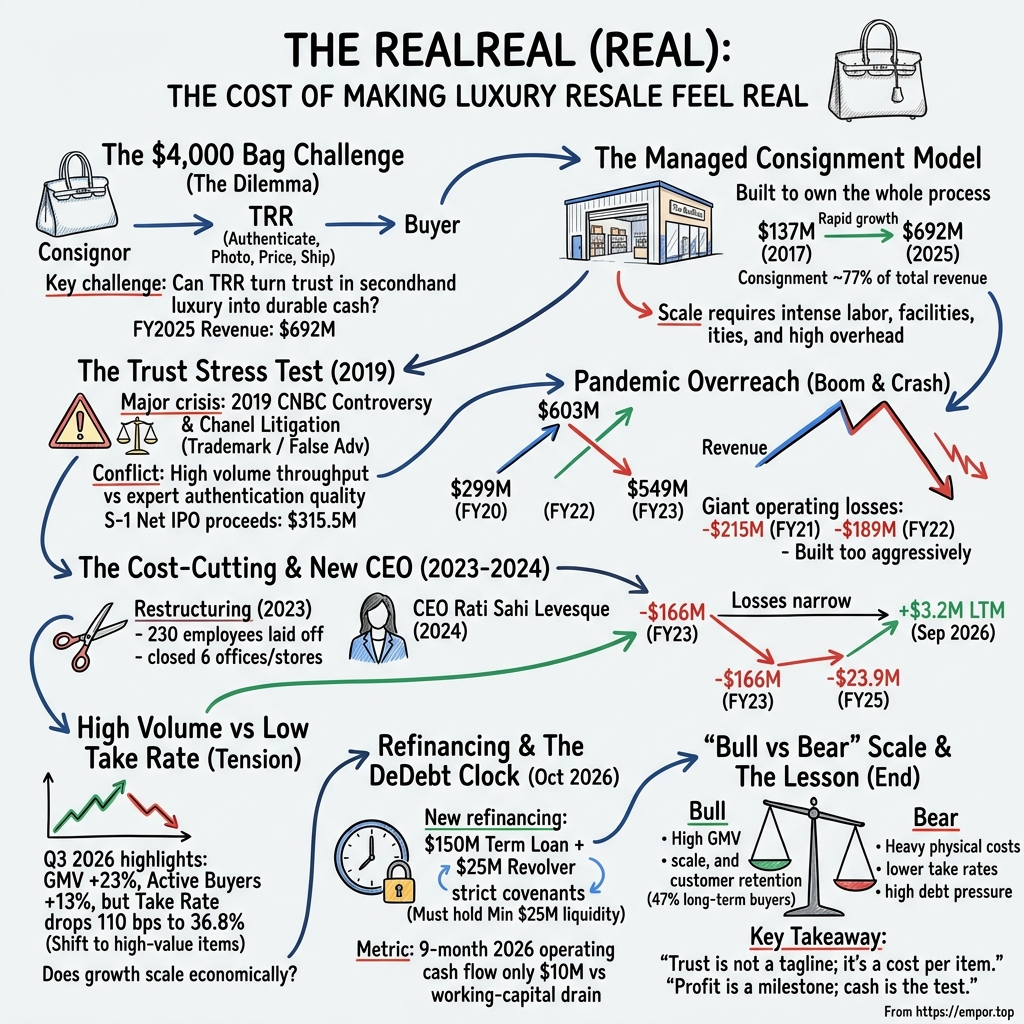
The RealReal: The Cost of Making Luxury Resale Feel Real
I. The $4,000 Bag That Had to Be Trusted
Picture a black leather handbag on a phone screen late at night. It is a design the buyer has wanted for years, the kind that sells new for several thousand dollars, and here it is at a discount, a few clicks away. The photographs are clean and evenly lit. The condition is graded. The price sits close to what the bag would fetch elsewhere. And under the listing is a promise that carries the whole transaction: this bag is real.
The buyer sees about thirty seconds of the story. The rest happened weeks earlier and far away from the screen. Somebody had to persuade the bag's owner to let it go, probably someone who had never sold anything secondhand and did not want to haggle with strangers on the internet. Somebody had to collect it or receive it, open the box, and decide whether the stitching, the hardware, the date code and the leather were what they claimed to be. Somebody had to describe it in language a buyer would trust, price it so it would sell without giving value away, photograph it, store it, and finally pack it and send it across the country. Every one of those steps cost money before a single dollar of revenue arrived.
That is the business of The RealReal, and that is the tension running through its whole history. A resale marketplace sells convenience to the person with the closet and confidence to the person with the credit card. Both are easy to promise and expensive to deliver, because in luxury goods the confidence comes from physical work done one item at a time.
For most of its life, the company has been far better at the promise than the economics. Revenue grew from about $137 million in 2017 to about $692 million in 2025, a five-fold increase that turned an odd idea into the best-known name in American luxury consignment.2 Yet over those same nine years, the business lost about $1.2 billion and burned about $771 million of free cash flow.2 It paid no dividends, because there was nothing to pay them from.
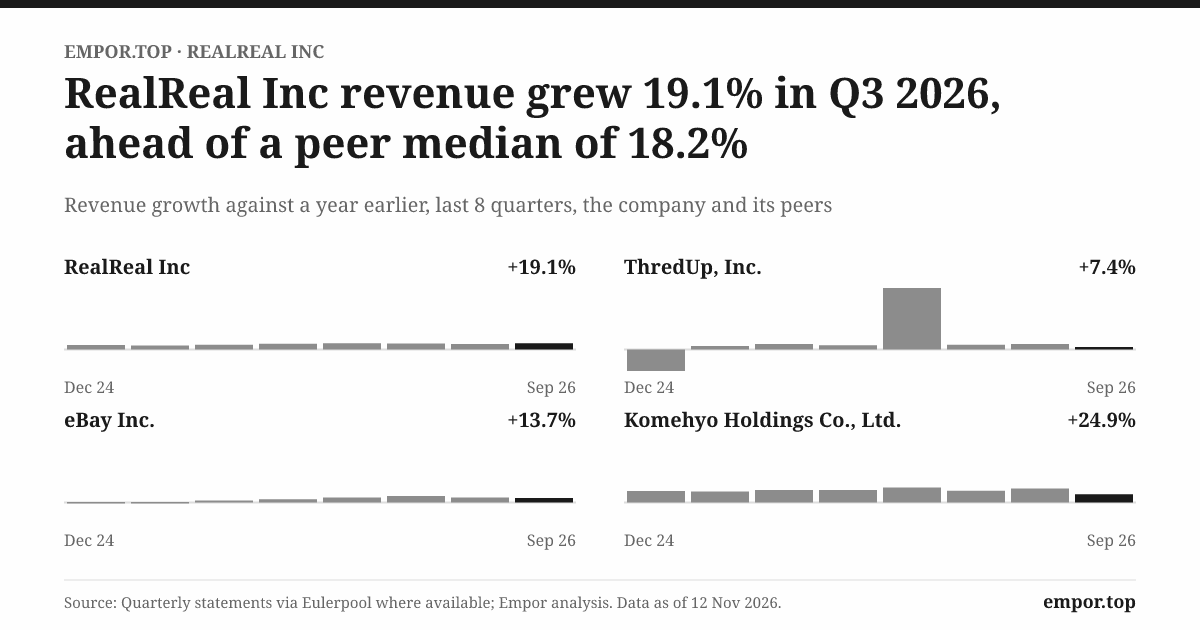
Tonight, the picture looks different. In the third quarter of 2026, revenue grew 19% from a year earlier, gross merchandise value, the total value of goods sold through the platform, grew 23%, and the company posted its highest-ever quarterly figures for GMV, revenue and orders.1 For the first time in its history as a public company, the four most recent quarters added up to a small operating profit, about $3 million.4
There is a catch hidden inside that growth. The take rate, the share of each sale the company keeps, fell to 36.8%, about 110 basis points lower than a year earlier, as the mix shifted toward more expensive goods.1 The marketplace is moving more merchandise, but it is keeping a slightly smaller slice of each dollar.
Three questions follow from that, and they organize everything that comes after. Can the marketplace grow faster for more than a quarter or two, after a three-year stretch in which revenue crept ahead at under 5% a year? Can the trust-and-service operation, the people and buildings behind each listing, scale without its costs growing just as fast? And can improving profits become cash that reduces debt, rather than profit that lives only on the income statement?
The stakes on that last question are concrete. In October 2026, the company refinanced its secured notes into a $150 million term loan and a $25 million revolving credit line from lenders managed by Fortress, with covenants that cap leverage and require at least $25 million of liquidity at every quarter-end.5 Lenders, not just shareholders, are now watching whether the turnaround produces cash on a timetable.
The verdict going in is simple to state and hard to settle. The latest activity is strong. But this is a company whose good quarters have come before, and whose long-run record was built by spending heavily to make an inherently laborious service feel effortless. Whether it can grow, keep its trust intact and generate cash all at once is the investment case. To understand why that is so difficult, the story has to begin with a choice made at the very start: to take the hard work in-house.
 Subscribe on LinkedIn
II. The Marketplace That Took the Work In-House
In 2011, a Silicon Valley veteran named Julie Wainwright started an online consignment business in San Francisco.6 She was not a fashion insider by résumé. She had run Pets.com, one of the most famous casualties of the dot-com collapse, and she had spent years thinking about why some internet businesses worked and others turned into cautionary tales.6 The lesson she seemed to carry into The RealReal was that the internet does not remove friction on its own. Someone has to absorb it.
Luxury resale was a market full of friction. In 2011, a woman with a closet of barely worn designer clothes had a handful of bad options. She could drive to a local consignment shop that would take a large cut, accept a narrow range of brands and pay her slowly. She could list items herself on a general marketplace, photograph them on her bed, answer questions from strangers, and wonder whether a buyer would claim the item was fake and demand a refund. Buyers faced the mirror image of the same problem. A used designer bag at a good price was tempting, but how could anyone know it was genuine?
The company's wager was that luxury resale could move online at scale if one business took responsibility for every part of the transaction that ordinary listings left unresolved. The RealReal would not just connect sellers and buyers. It would pick up the goods, inspect them, decide what they were, write the description, set the price, photograph them, store them and ship them. The consignor would hand over a bag and later receive a payout. The buyer would see a curated store rather than a flea market.
That design solved a two-sided problem every marketplace faces. Buyers come where the inventory is, and sellers come where the buyers are. By making consigning nearly effortless, the company could attract supply that would never have appeared on a do-it-yourself platform, the closet full of items whose owner wanted the money but not the hassle. By guaranteeing authenticity and presentation, it could make that supply more valuable to buyers, who in turn made the platform more attractive to the next consignor.
The economics of that transaction are worth slowing down for, because they shape every number later in the story. When a consigned item sells, The RealReal does not book the full sale price as revenue. It acts as the consignor's agent, so it records only its commission, the take rate, as consignment revenue.2 When it sells goods it owns outright, it books the full price as direct revenue, along with the cost of buying those goods. It also earns revenue from shipping services.2 In 2025, consignment revenue was about $536 million out of roughly $693 million, about 77% of the total.2
An analogy helps. Think of the company less as a store and more as a talent agent for handbags. The agent does the negotiating, the marketing and the logistics, and keeps a percentage. The client keeps the rest. That is why GMV, the value of everything sold, is so much larger than revenue, and why a change of a single percentage point in the take rate matters so much.
Strip the model to its levers and there are only a handful. How many items do consignors send? What share of them sell, and how quickly? How many orders do buyers place, and how large is each one? What commission does the company keep? And how much does it cost in labor, space and shipping to handle each item? Every strategy the company has pursued over fifteen years amounts to pulling on some combination of those levers.
What the model lacks is just as important. The RealReal has not described a subscription business, a contract backlog or any minimum commitments from customers.2 Every quarter's revenue depends on consignors choosing to send goods and buyers choosing to buy them. Nothing locks either side in. Why would anyone hand over nearly 40% of a sale? Because the alternative is not keeping 100%. The consignor who sells her own bag online has to photograph it, write the listing, answer messages, ship it, and absorb the risk that a buyer disputes the sale or claims it is fake. She may also accept a lower price, because buyers discount goods they cannot trust. The RealReal's commission is the price of outsourcing all of that, plus whatever premium a trusted listing commands. The model works only as long as that premium and that convenience are worth more to the consignor than the commission costs her. Every consignor, in effect, recalculates that bargain each time she has something new to sell.
That makes the business more like a retailer than a software company, however sophisticated its technology becomes, and it means demand can fall as quickly as it rises.
The managed model, in other words, is both the product and the problem. Taking the work in-house makes the service far more compelling than a peer-to-peer listing, and it gives the company control over pricing, presentation and the customer relationship. But it also ties volume to people, buildings and careful execution. A software marketplace can double its listings with little extra cost. A managed consignment business that doubles its intake needs more authenticators, more photographers, more warehouse space and more trucks.
For years, the bet looked like it was working. Revenue grew from about $137 million in 2017 to about $207 million in 2018, and kept compounding at roughly 50% a year into the IPO.26 Operating losses grew alongside, from about $52 million in 2017 to about $100 million in 2019, but growth investors were prepared to fund that gap if the marketplace was winning.2
The whole promise, however, depended on one word that the company put in its name. People had to believe the goods were real. In the autumn of 2019, just months after the company had become a public company, that belief faced its first serious public test.
III. The Trust Promise Meets the Authentication Queue
On June 28, 2019, The RealReal's shares began trading on Nasdaq under the ticker REAL. The company had priced 15 million shares at $20 each, above its own expected range, and the stock opened well above that.7 Including the underwriters' option, the IPO brought the company about $315.5 million in net proceeds.6 For a business that had never made a profit, it was a vote of confidence that the managed model could become something large.
The prospectus leaned on authenticity as the core of what the company sold. Its pitch was that trained experts examined the items it listed, and that this inspection was what separated its marketplace from the risks of buying luxury goods from strangers.6 That claim was the reason consignors trusted the company to handle their goods, and the reason buyers paid prices close to those of the primary market.
Less than five months after the listing, in November 2019, CNBC published an investigation titled "Fakes and Mistakes: Inside The RealReal."8 Former employees described a process that, they said, did not always match the company's public account. They described copywriters, rather than senior specialists, handling many items, limited training for some staff, and pressure to process large numbers of goods quickly.8 The investigation also reported on counterfeit items that had made it through the system to buyers.8
The company answered within a week. In a public statement titled as an effort to "set the record straight," it defended its authentication process as multi-layered, disputed the investigation's characterization of how goods were handled, and described the role its experts played in categories where counterfeit risk was highest.9 Its argument, in essence, was that not every item needs a gemologist, and that a tiered process is how any operation of this scale must work.
Both sides of that dispute deserve a fair hearing. The reporting did not show that most items on the platform were misrepresented, and the company's distinction between high-risk and low-risk goods is a reasonable one for any operation handling millions of items. But the episode revealed something structural about the model. The faster the company tried to grow, the more items each person had to process, and the more pressure there was to route goods through faster, cheaper paths. Throughput and trust pulled in opposite directions.
That is the uncomfortable truth at the center of a managed marketplace. A peer-to-peer platform can blame a bad seller. A company that personally inspects and lists every item has no one else to blame. Its guarantee is its brand, and every counterfeit that slips through is a withdrawal from an account that took years to fill.
A second, longer-running challenge had begun even before the IPO. In 2018, Chanel sued The RealReal in federal court in Manhattan, alleging trademark infringement, false advertising and unfair competition, and arguing in essence that the company could not credibly claim to authenticate Chanel goods without Chanel's involvement.102 The RealReal responded with antitrust counterclaims, arguing that Chanel was trying to suppress the resale market.2 The case has dragged on for eight years. The court was still issuing orders in August 2026, and the company's most recent annual report does not quantify any probable loss.102
The Chanel suit matters less for the dollars, which are undisclosed, than for what it represents. A powerful brand owner disputing the right of a reseller to vouch for its goods is a reminder that The RealReal's authority rests on its own expertise, not on any partnership with the houses whose products it sells. If brands increasingly build their own resale programs or certification systems, that authority could be contested in the market as well as in court.
The investor's problem is that trust is very hard to measure from the outside. The RealReal has not published a consistent, long-run series for authentication accuracy, counterfeit incidents, processing time, return rates or customer retention. Its auditor signed off on its 2025 financial statements without qualification and identified the information-technology systems behind revenue recognition as a critical audit matter, which is a reassuring signal about accounting, not about whether a given bag is genuine.2
So the honest conclusion is narrower than either the company's marketing or its critics. Authentication and the service layer around it are central to what makes The RealReal different, and the company has kept growing its buyer base long after the 2019 controversy, which suggests that the damage was not fatal. But the moat remains plausible rather than proven, because the one trend that would prove it, a disclosed quality record improving as volume grows, does not exist in public.
The authentication controversy also exposed a deeper issue. The infrastructure that made the promise possible also made growth expensive. Within months of the CNBC report, the pandemic arrived, and for a while volume seemed to settle the argument. It was only later that demand and costs began moving in different directions.
IV. When the Pandemic Surge Became a Cost Base
In the spring of 2020, stores closed across America, and for a few months, luxury retail stalled. The RealReal's revenue slipped about 5% that year, to roughly $299 million.2 Then something remarkable happened. Stuck at home, people cleaned out their closets. Stimulus money and stock-market gains flowed into discretionary spending. Online shopping became a habit rather than an alternative, and secondhand luxury suddenly looked like a smart, even virtuous, way to buy.
The rebound was spectacular. Revenue jumped about 56% in 2021 to roughly $467 million, and grew another 29% in 2022 to about $603 million.2 In two years, the business had doubled. For anyone who believed resale was the future of fashion, this looked like the moment of proof.
The income statement told a different story. Operating losses did not shrink as revenue soared. They widened, to about $173 million in 2020 and about $215 million in 2021, before easing only slightly to about $189 million in 2022.2 In 2021, the company lost roughly 46 cents of operating profit on every dollar of revenue. Scale had arrived. Profitable scale had not.
Where did the money go? Into the physical machine. The company's property and equipment, the authentication centers, stores, consignment offices and equipment that sat behind every listing, rose from about $56 million at the end of 2019 to about $241 million by the end of 2022, more than four times as much.2 The managed model meant that capacity had to be built before the goods arrived. You cannot authenticate a surge of handbags in a building that does not yet exist.
Inventory tells the same story from a different angle. The goods The RealReal owns outright, as opposed to the consigned goods it merely holds, swelled during the boom. Measured against the cost of sales, inventory went from about 70 days' worth at the end of 2019 to about 137 days at the end of 2020, and stayed above 130 days through 2021.2 In plain terms, the company was holding nearly twice as much owned merchandise, relative to what it sold, as it had before the pandemic. Some of that was opportunistic buying in a disrupted market. All of it tied up cash in goods that had to be sold before the money came back. By 2025, inventory had fallen back to about 54 days, one more sign of a company unwinding choices made at the peak.2
The cash flow statement completes the picture. In 2020 and 2021, the business consumed about $134 million and $142 million of operating cash, while raising about $152 million and $252 million from financing.2 The growth was not paying for itself. Capital markets were paying for it, at a moment when money was cheap and investors were eager to back anything that looked like the future of commerce.
The funding came from debt. The company had essentially no borrowings at the end of 2019. By the end of 2022, its borrowings, mostly convertible notes, had climbed to almost $600 million.2 Investors had financed a bet that the pandemic surge was the new baseline. Shareholders' equity, positive after the IPO, turned negative in 2022 as the accumulated losses ate through it.2
Then the baseline moved. In June 2022, founder Julie Wainwright stepped down as chief executive, chair and director.12 The board named two insiders, Rati Sahi Levesque, then president and chief operating officer, and Robert Julian, the chief financial officer, as co-interim CEOs.12 The company said the departure was not caused by any disagreement, but the timing spoke for itself: losses were still enormous, and the growth story that had justified them was starting to slow.
By the time the company reported its 2022 results in February 2023, management was describing a different world. Demand from buyers had normalized faster than the company had anticipated, and the cost structure it had built during the boom was too large for the business it actually had.11 The language had shifted from growth to profitability, and from expansion to discipline.11
The correction arrived in concrete form. In February 2023, the company announced that it would cut about 230 employees, roughly 7% of its workforce, and close six stores or consignment offices.13 Revenue in 2023 fell about 9%, to roughly $549 million, the first decline outside the pandemic year.2 The company also began deliberately shrinking lower-margin activity, accepting less revenue in exchange for better economics.
It is tempting to read this as a pure macro story, the luxury boom fading and dragging every resale company down with it. That reading lets management off too easily. The business had to retreat from locations and staffing that it had chosen to add during its growth push. The capacity that looked prescient in 2021 looked excessive in 2023. That is a judgment about capital allocation, not just about the economy.
There is no transformative acquisition in this story to benchmark against industry deal prices. The consequential capital decisions were internal: buildings, people and technology, funded by convertible debt, built ahead of demand that did not arrive on schedule. When property and equipment fell back to about $190 million at the end of 2023 and about $161 million by the end of 2025, the shrinking footprint was the visible record of that over-build.2
The pandemic surge, then, brought real scale. It established that a lot of people would buy secondhand luxury goods online. What it failed to establish was that the company could do so profitably. By 2023, the question was no longer whether The RealReal could grow. It was whether management could take cost out without weakening the supply and service that made the marketplace worth using at all.
V. The Turnaround Moves From Footprint to Profit
When Rati Sahi Levesque was named chief executive in October 2024, she was not an outsider brought in to rescue a stranger's company. She had been there from the start. She helped launch The RealReal in 2011 as its first employee, and over the following years worked as its chief merchant, then as president and chief operating officer.14 Before that, she had been an entrepreneur in fashion and had started a luxury consignment business of her own.14
That biography matters because of the decisions she had already helped make. Levesque was co-interim CEO during the hard months after Wainwright's departure in 2022, sharing the job with the chief financial officer until the board brought in an outside chief executive, John Koryl, in 2023.1214 Koryl's tenure was short. When he stepped down in October 2024, the board did not run another external search. It promoted the operator who had spent thirteen years inside the building.14
Her style is that of a merchant and operator rather than a visionary founder. Where Wainwright's pitch had been about transforming fashion, Levesque's emphasis has been on the mechanics of supply: where consignors come from, how the company acquires them efficiently, which categories earn the best returns, and how to grow without rebuilding the cost structure that nearly sank the company. Her board chair, the former Neiman Marcus chief executive Karen Katz, credited her with the company's recent strategic shift when she was appointed.14
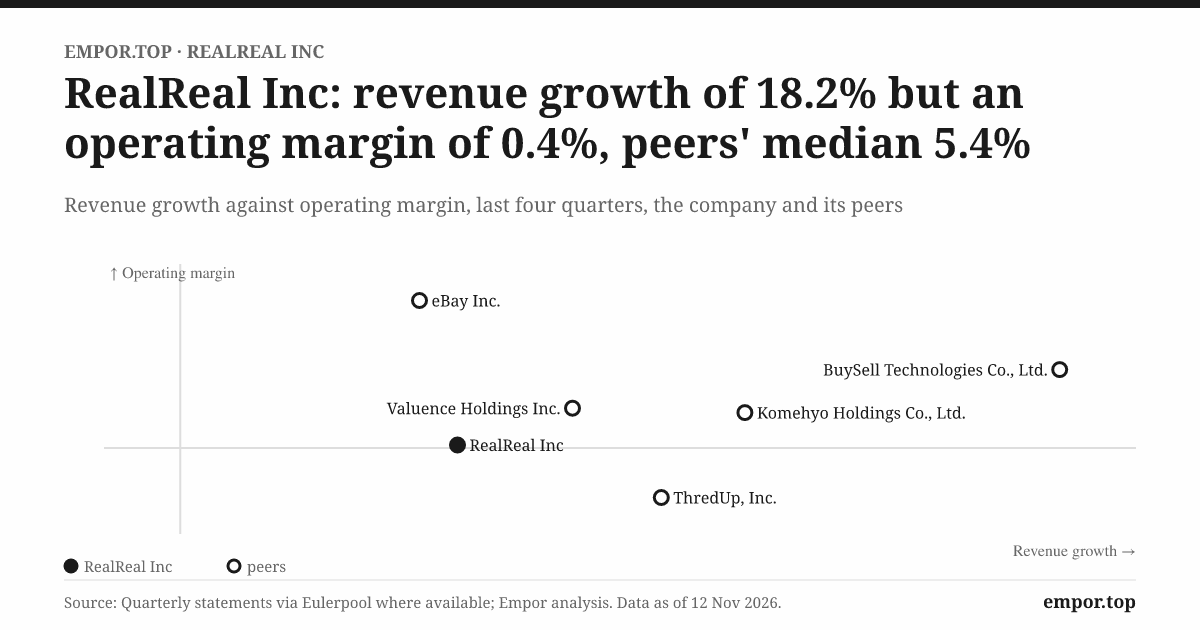
The numbers show how far that shift has gone. Operating losses shrank from about $166 million in 2023 to about $57 million in 2024, and then to about $24 million in 2025.2 Over the four quarters to September 2026, the company finally earned a small operating profit, about $3 million.4 An operating margin that had been negative 30% in 2023 had moved to just below break-even.2
No single action explains that improvement. Lower operating costs mattered, including the store and office closures, the smaller workforce and a more selective approach to consignor acquisition. A better gross-profit performance mattered too, as the company shrank lower-margin direct sales and focused on consignment, where it does not carry the cost of goods. And a changing revenue mix toward consigned goods, which are booked net, made revenue smaller but higher-margin. The improvement came from many levers pulled at once, which is encouraging, because it is less fragile than a turnaround built on a single cost cut.
The shape of revenue growth also changed. In 2023, revenue fell as the company walked away from unprofitable activity. Then, from the second quarter of 2024 onward, growth returned and kept rising: about 11% in mid-2024, about 15% by mid-2025, and between 16% and 19% in every quarter since.4 Costs grew more slowly than that, which is the definition of operating leverage. Each additional dollar of revenue cost less to serve than the dollars that came before it, because the buildings, the software and the management layer were already in place.
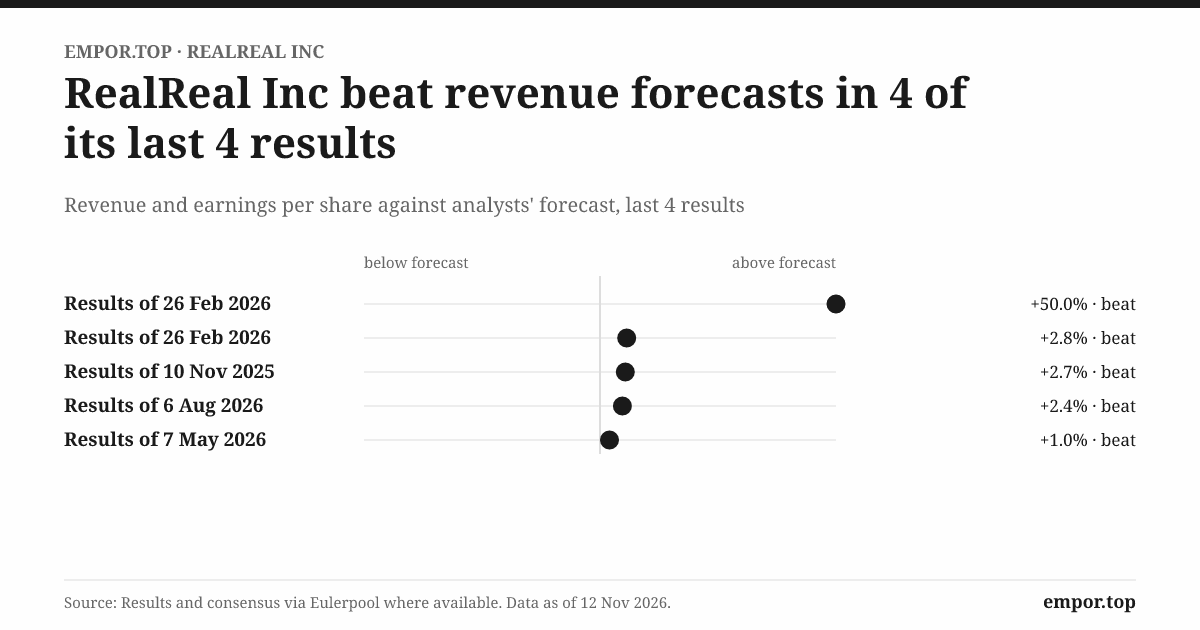
That pattern also matters for judging the team. After the third quarter of 2026, management raised its full-year outlook rather than cutting it.1 Raised guidance is not proof of strategy, since a team can set targets it expects to beat. But it is the opposite of the pattern in 2022, when expectations were reset downward as demand faded, and it suggests that the current leadership has been conservative in what it promises.
But the result is still thin, and the reported profits are noisier than they look. Quarterly operating profit has hovered around break-even: a profit of about $6 million in the fourth quarter of 2025, small losses in each of the next two quarters, and then a profit of about $1.5 million in the third quarter of 2026.4 That is a business near the line, not comfortably above it.
Net income is even harder to read, because debt accounting keeps moving it around. In 2025, the company recorded a $40.8 million gain from retiring debt for less than its face value.2 Without that one-time gain, the pretax loss of about $41 million would have been roughly twice as large. In the third quarter of 2026, net income of about $16 million included a $21.2 million noncash gain from revaluing warrant liabilities; without it, the quarter would have shown a loss.14 Investors who look only at the bottom line will see a company swinging wildly between profit and loss. The operating line is the better guide, and it shows a steady climb toward break-even rather than a decisive break above it.
How credible is the management team? The best evidence is behavior over time. The company did what it said it would do after 2022: it cut costs, shrank its physical footprint and narrowed its losses year after year. That is a real record. The test now is whether the same discipline survives a period of faster growth. The lesson of 2021 is that growth makes it easy to justify new buildings and new hires before the revenue arrives. Investors should compare each new round of guidance against delivery, and watch for any shift back toward expansion that runs ahead of cash.
The incentives are worth a look too. Levesque held less than 1% of the company's shares as of the 2026 proxy, and all directors and executive officers together held about 2.7%.15 This is not a founder-controlled company with insiders whose wealth rides on every share. Her reported compensation was about $11.5 million in 2024, the year she became CEO, mostly because of a $10 million stock award, and about $2.1 million in 2025.15 Shareholders approved the pay program in 2026 by a wide margin, with about 74 million votes for and 4 million against.16 Yet they also rejected three management-backed charter proposals that needed a supermajority to pass, a reminder that governance changes require broad support from a dispersed shareholder base.16
The operating rebound is visible, and the management team that delivered it has earned a measure of credibility through actions rather than words. But a smaller loss is not the same as a strong business. The next question is whether the marketplace's renewed growth carries enough economics with it to turn break-even into something durable.
VI. More Orders, a Lower Take Rate
On October 29, 2026, The RealReal reported the best quarter in its history by the measures that matter most to a marketplace. Gross merchandise value reached about $642 million, up 23% from a year earlier.1 Revenue was about $206 million, up 19%.1 Orders rose 15%, the fastest order growth since 2022, and active buyers rose 13%.13 Management raised its full-year outlook, guiding to revenue of about $806 million to $810 million for 2026.1
At first glance, this is exactly the kind of quarter a turnaround story needs. Every arrow points up. But look closely at the relationship between those arrows, and a puzzle appears. If GMV grew 23%, why did revenue grow only 19%?
The answer is in the bridge between the two. Because The RealReal keeps only a commission on most consigned sales, merchandise value and company revenue are not interchangeable. A dollar of GMV turns into roughly 37 cents of consignment revenue, and the exact conversion depends on what is sold. In the third quarter, the take rate was 36.8%, about 110 basis points lower than a year earlier.1 Over full years, the consignment take rate slipped from 38.4% in 2024 to 37.7% in 2025.2
Why would the take rate fall? The company's explanation is mix. It has been selling a larger share of higher-value goods, such as expensive handbags, watches and fine jewelry.12 Those items carry lower commission percentages, because a consignor parting with a $20,000 watch has more negotiating power, and more alternatives, than one sending in a $200 sweater. So the company earns more dollars per item but a smaller share of each dollar.
Average order value rose about 8% in the quarter, which fits that explanation.3 Put the pieces together: more buyers, more orders, larger orders, and therefore much more merchandise, but a commission rate that slipped a little. That combination explains why revenue grew more slowly than GMV.
It is worth doing the full conversion once, because it shows how much of the merchandise value actually becomes company revenue. Roughly $642 million of goods sold in the quarter produced about $206 million of total revenue, including direct sales and shipping.1 That is about 32 cents of revenue for every dollar of merchandise. For the full year, management expects GMV of roughly $2.6 billion and revenue of a little over $800 million, the same proportion.1 The rest belongs to consignors. That is the scale of the money the company handles on behalf of others, and it is why a shift of even one percentage point in the take rate moves revenue by tens of millions of dollars a year.
Whether that mix shift is good or bad depends on what it costs. Higher-value items can be wonderful for a marketplace: a single watch sale might generate as much commission as dozens of clothing items, with a fraction of the handling, photography and shipping. If that is what is happening, a lower take rate could still mean better profit per hour of labor. But higher-value goods also concentrate risk. They demand the most rigorous authentication, attract the most competition from specialist dealers, and leave the company more exposed to swings in demand for a small number of expensive categories.
There is evidence on both sides. Gross margin was about 75% in the quarter, and adjusted EBITDA, management's preferred measure, was about 8% of revenue.1 Those are healthy-looking numbers. On the earnings call, management pointed out that the take rate had improved by about 90 basis points from the second quarter, suggesting the decline might be stabilizing.18 But the company does not publish contribution margin by category, so investors cannot see directly whether a watch sale is more or less profitable than a sweater sale once all the handling costs are counted.
One clue about the health of the customer base deserves attention. About 47% of third-quarter GMV came from buyers who had been on the platform for at least five years.3 That is a meaningful sign of loyalty: nearly half the merchandise value comes from people who first bought before or during the pandemic boom and kept coming back. Management also highlighted Gen Z as its fastest-growing group of buyers, a cohort it says increasingly both buys and consigns.18 What the company does not publish is a full cohort-retention table or customer-acquisition cost. The 47% figure says long-time buyers matter; it does not say how many new buyers stay, or what it costs to win them.
Then there is the question of base rates. Revenue growth of 19% in the third quarter is far above the roughly 4.7% annual growth the company managed from 2022 to 2025.21 Growth has accelerated through 2025 and 2026, staying in the mid-to-high teens for six straight quarters.4 That is more than a single good quarter. But it is still a short run measured against a three-year record of near-stagnation, and part of the acceleration reflects easy comparisons against 2023 and 2024, when the company was deliberately shrinking.
The key question is whether the mix shift is strategic and repeatable, or a temporary tailwind. If wealthier consignors are discovering the platform for the first time, and if the company has found efficient ways to attract them, then higher-value mix could persist and the falling take rate would simply be the price of moving upmarket. If, on the other hand, the luxury market is enjoying a burst of high-end resale activity that later fades, then the company could be left with a lower commission rate and less volume to compensate.
The verdict on this section is cautiously positive. The activity measures, orders, buyers and GMV, support a real revival in demand, and the mix explanation for slower revenue growth is plausible. What the evidence does not yet show is that this growth produces improving contribution economics. Investors should watch three things together: the take rate, gross margin and operating cash flow. If all three hold up, the mix shift is working. If the take rate keeps falling while margins stall, the company is buying growth by giving up economics.
That raises a sharper question. When a consignor with a valuable watch or a rare bag decides where to sell it, why should she choose The RealReal at all?
VII. The Store, the Specialist, and the Algorithm
Inside one of the company's authentication centers, a box arrives. Inside are a handbag, a scarf and a pair of shoes from a single consignor. Nothing about them is standard. The bag might be a common model or a rare variant; the scarf might be vintage or recent; the shoes might be lightly worn or nearly new. Each item is, in effect, a product the company has never seen before. Before it can be sold, a human expert and a stack of software have to turn that irregular object into a trustworthy, searchable listing with a price that will clear in a reasonable time.
This is the operating system behind the website, and it is labor-intensive by design. At the end of 2025, the company employed about 3,140 full-time equivalent workers, all in the United States.215 It also capitalized about $13.5 million of software development in 2025, and another $10.9 million in the first nine months of 2026, as it built tools for pricing, cataloguing and logistics.24 Those two figures sum up the model: thousands of people, supported by software, doing work that a pure marketplace would leave to its users.
The competitive landscape shows what that choice buys and what it costs. ThredUp, the best-known mass-market resale operator, reported about $311 million of revenue in 2025, less than half The RealReal's roughly $693 million.[^17]2 But that comparison is imperfect: ThredUp handles mostly inexpensive clothing, and the two companies recognize revenue in different ways. In luxury, Vestiaire Collective runs a marketplace in which sellers list their own goods, while Fashionphile and Rebag concentrate on handbags and accessories and court sellers with outright purchase offers as well as consignment.17 Each of these rivals offers a consignor a different bargain: speed, a higher payout, or less handling in exchange for more effort.
The ThredUp comparison is still revealing, in one specific way. In 2025, ThredUp grew revenue about 20% and active buyers about 30%, faster than The RealReal's 15% revenue growth that year.[^17]2 It also reported adjusted EBITDA of about 4% of revenue for the full year.[^17] In other words, the mass-market specialist was growing faster and was also only thinly profitable. Resale, at both the cheap and the expensive end of the market, is a business where handling one-off items is costly and margins are slim. Neither company has yet shown that scale alone turns resale into a high-margin business.
The RealReal describes itself as the largest online marketplace for authenticated, consigned luxury goods. Investors should treat that descriptor with care. No comparable market-share data across these different models is publicly available, and revenue comparisons are distorted by the difference between commission-based and owned-inventory models. Size is real; dominance is unproven.
What would a durable advantage look like? Start with supply. The company's consignment network, built over fifteen years, gives it access to goods that buyers want, and that supply attracts buyers, whose presence in turn reassures consignors. That is the classic marketplace flywheel. The 47% share of GMV coming from long-standing buyers suggests the demand side of the flywheel is sticky. But consignors can, and do, use several channels at once. A woman selling a closet might send her bags to a dealer offering instant cash, her shoes to a peer-to-peer app and only her clothes to The RealReal. There is no lock-in.
Authentication know-how is the second candidate. Expertise accumulated over millions of items, and the data generated by that work, is genuinely hard to replicate. But it must withstand constant pressure from counterfeiters whose fakes improve every year, and it is contestable by brands that may build certification programs of their own, which is part of what makes the Chanel dispute strategically relevant.
Technology and artificial intelligence are the third piece, and they need to be described carefully. Management describes AI and proprietary data as tools for pricing items, writing descriptions, routing goods through the right level of inspection and improving efficiency.23 Those are real applications. A pricing model trained on millions of past sales can set prices faster and more accurately than a new hire. But AI here is a tool, not a separate business or a proven moat. It matters only if it lowers the cost of handling each item or raises conversion without weakening trust. The company does not publish a cost-per-item series, so the payoff remains a claim rather than a measured result.
Physical scale is the fourth piece, and it cuts both ways. Stores and consignment offices give the company a place to meet wealthy consignors in person and bring in high-value goods. But they create fixed costs that do not shrink when demand falls. The closures in 2023 showed that the company had already built more physical capacity than it could use profitably. The asset base has since become more productive: revenue relative to total assets rose from about 1.0 times in 2022 to about 1.7 times in 2025, mostly because the asset base shrank while revenue grew.2
Put together, the strongest potential advantage is the combination of luxury supply, expertise, data and a managed customer experience, all reinforcing one another. The evidence for it includes the company's scale, its repeat buyers and its survival through a severe reset. The evidence against it includes the absence of any disclosed market share, service-quality series or switching-cost measure, and the ease with which consignors can sell elsewhere.
The model wins when buyers and consignors value convenience and confidence enough to accept the company's economics, a commission of nearly 40%. It loses when service friction, lower payouts or faster competitors make a do-it-yourself or instant-cash route more attractive. Which of those forces prevails is ultimately a question of cash, and since October 2026, the company has been answering it under the eye of its new lenders.
VIII. The Refinancing That Put a Clock on the Turnaround
In October 2026, The RealReal signed a credit agreement with lenders managed by Fortress Investment Group. It borrowed $150 million under a senior secured term loan, arranged a $25 million revolving credit facility that it left undrawn, and used the proceeds to redeem its secured notes due in 2029.54 On the surface, it was a routine refinancing. Underneath, it changed the terms of the turnaround.
Some context is needed. At the end of September 2026, before the refinancing closed, the company held about $130 million of cash and cash equivalents, plus about $15 million of restricted cash.4 Against that, beyond the secured notes, it carried two series of convertible notes: about $190 million of principal due in 2031 and about $48 million due in 2028.4 Those are real borrowings that will have to be repaid or refinanced. The company also had about $105 million of operating lease liabilities at the end of 2025, the rent obligations on its buildings.2 Those leases are real commitments, but they are not funded debt, and adding them to the borrowings overstates the company's leverage.
The new loan comes with covenants, rules the company must meet to avoid default. Two matter most. First-lien gross leverage, the secured debt measured against a defined measure of earnings, may not exceed 4.75 times through 2028, after which the limit steps down to 4.25 times.5 And the company must hold at least $25 million of liquidity at the end of every quarter.5
In plain terms, the lenders have put a clock on the turnaround. The leverage test means earnings must keep improving, or debt must fall, for the company to stay comfortably within its limits. The liquidity test means cash cannot be allowed to drain away. A rough worked example shows where the company stands. Management expects adjusted EBITDA of roughly $71 million to $73 million for 2026.1 If, as its name implies, the leverage test counts only the secured debt, the $150 million term loan would sit at around twice that earnings figure, well inside the 4.75 times ceiling. The precise covenant definitions in the agreement differ from management's adjusted figure, so this is an approximation, not a calculation the lenders would accept. But it suggests the leverage test has headroom today, and that the liquidity test, with about $130 million of cash against a $25 million floor, is not tight either.45
Neither is a crisis today. But they turn a story about margins into a story about cash, and they give lenders a seat at the table if the recovery falters.
That is why the cash numbers matter more than the profit numbers. In the first nine months of 2026, the company reported net income of about $27.7 million.4 Its operating cash flow over the same period was only about $10 million.4 The gap came from two directions. Noncash items, including stock-based compensation and depreciation, added cash, while gains such as the warrant revaluation added profit without adding cash. And about $32 million drained into working capital: more inventory, higher receivables and lease payments, all part of handling a bigger volume of goods.4
Add the investment the business needs to keep running, about $21 million of property and equipment and about $11 million of capitalized software over those nine months, and the company spent roughly $22 million more than its operations generated.4 For a business that has just told its lenders it can meet leverage and liquidity tests, that is the number to watch.
The receivables are not the worry they might be at a business-to-business company. Most of the company's receivables are balances owed by payment processors, the firms that handle card payments, and most of those settle within two business days.2 No single customer accounted for 10% or more of receivables.2 The risk is timing rather than credit. In the first nine months of 2025, a delay at one processor pushed receivables up by about $12 million; in the same period of 2026, receivables rose about $6 million simply because sales were higher.4 Money owed by card processors tends to arrive. The question is how much cash the business ties up in inventory and other working capital as it grows, and how quickly it comes back.
The interesting point about the convertible notes is what they reveal about the market's past view of the company. In 2024 and 2025, the company exchanged and repurchased some of its notes at less than face value, which is how it recorded gains on extinguishing debt.2 The bondholders who accepted those terms were, in effect, signaling that they had doubts about full repayment. The rally in the stock since then has eased that pressure, but the next refinancing will test whether credit markets now see the company differently.
There is a seasonal caveat. The fourth quarter is typically the company's largest, and it may generate cash that offsets the first nine months. Indeed, full-year operating cash flow turned positive in both 2024, at about $26 million, and 2025, at about $37 million.2 In 2025, free cash flow after capital spending was about $18 million, the first meaningful positive figure in the company's history.2 That contrast is encouraging: it shows the business can generate cash when it is not consuming working capital to fund growth.
But the longer record sets that improvement in perspective. From 2017 through 2025, the company burned about $504 million of operating cash and about $771 million of free cash flow, with no dividends paid.2 That gap was funded by the IPO, by convertible notes, and by the exchanges and repurchases of those notes in 2024 and 2025 that let the company retire debt at a discount.4 Those exchanges produced the accounting gains that flattered the income statement, but they also reflected creditors accepting less than face value, a sign of how much risk the market priced into the company's debt.
No credit-rating agency has published a public rating rationale for the company, so there is no independent view of credit quality to set against management's account. The Fortress terms are the closest thing to a third-party verdict, and they are telling. Lenders were willing to provide secured financing, but only with tight conditions attached.
One reassurance is worth stating plainly. This is not a story of hidden transfers to a parent company. The RealReal has no controlling shareholder, and its filings disclose no material related-party sales, royalties, management fees or intercompany loans.215 FMR, the parent of Fidelity, held about 10.5% of the shares, the only holder above 5%.15 The financing risk is the ordinary kind: a public company with a history of losses that has to prove it can generate enough cash to service its debt.
So the refinancing extends the company's secured financing and buys time. It leaves a real test in place. The question is whether the improvement in operating cash flow seen in 2024 and 2025 can persist through a period of faster growth, when more inventory and more receivables absorb cash. That is the question every investor in the stock is now implicitly answering, and the price they are paying says a great deal about which answer they expect.
IX. Analysis & Bear vs. Bull Case
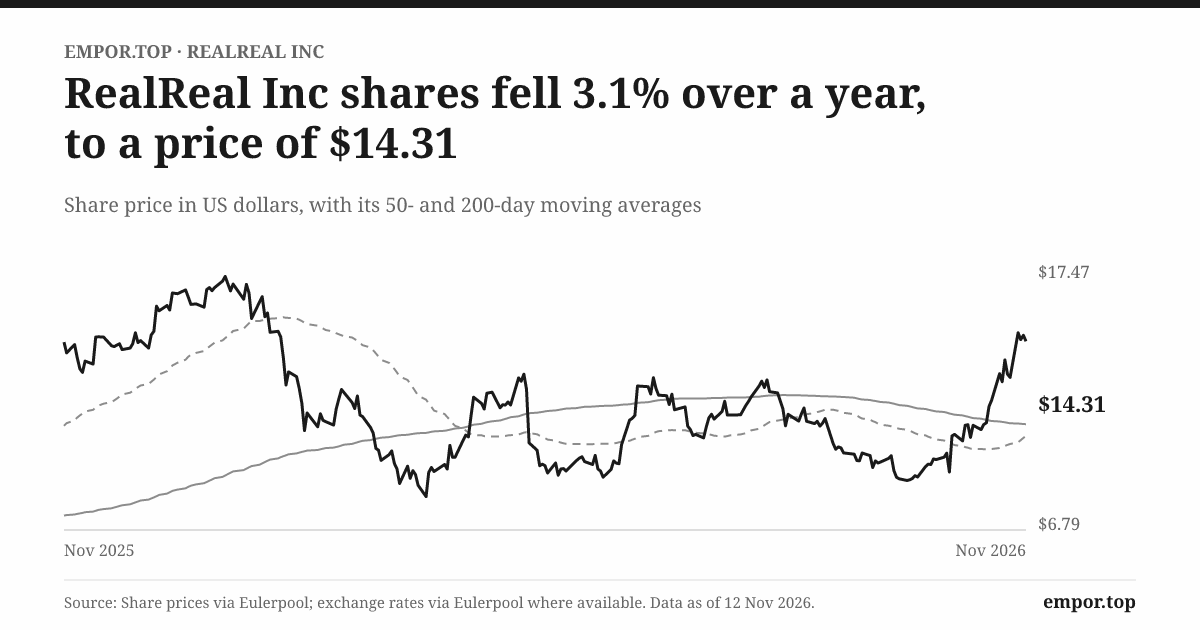
On November 12, 2026, The RealReal's shares closed at about $14.31. That was within about 15% of their 52-week high and well above the 52-week low of about $8. It was also still below the $20 IPO price of 2019, and far above the depths of a collapse that, at its worst over the past five years, erased about 94% of the stock's value. Investors who bought on the first day of trading have endured a long, painful round trip.
At that price, the market valued the company's equity at about $1.7 billion and its enterprise value, including debt and net of cash, at about $2.0 billion. That is about 2.6 times trailing sales, about 39 times trailing EBITDA, and more than 600 times trailing operating profit. The profit multiples are almost meaningless, because the profits they divide by are tiny. Sales multiples are easier to interpret, and they say the market expects the margin recovery to continue for years. A company with a negative 3.5% operating margin in 2025 is being priced as though it will become meaningfully profitable.2
Look forward rather than backward and the picture changes only a little. Against management's guidance for 2026 revenue of a little over $800 million, the enterprise value is still about two and a half times sales.1 Against its guided adjusted EBITDA of roughly $72 million, it is close to 28 times, a full price for a business whose adjusted earnings leave out costs that still have to be paid and whose cash generation has yet to match them.1 There is no clean peer set or long history of profitable trading multiples to compare against, because for most of its public life the company had no profits to value. What the price does say is that investors are no longer valuing The RealReal as a distressed business. They are valuing it as a recovering one.
So what would have to be true for that price to make sense, and what could go wrong?
The bull case begins with demand. Buyers, orders and GMV are all growing in the double digits, and revenue growth has stayed in the mid-to-high teens for six quarters. Operating losses have narrowed for three years, and the trailing four quarters show a small operating profit. Nearly half of GMV comes from buyers of five years or more, suggesting real loyalty. And the company operates a differentiated managed service in a resale category that has been growing faster than traditional apparel retail.17 In this telling, the hard work is done: the cost base has been reset, the brand survived its trust crisis, and growth will now carry operating leverage straight to the bottom line.
The bear case does not argue that resale lacks demand. It argues that the company may not capture enough of the economics to fund its labor-intensive model and its debt. Recent growth has not yet been sustained through a full cycle. The take rate is falling. The historical record includes enormous losses, a footprint expansion followed by retrenchment, and deeply negative cumulative free cash flow. In this telling, the company has made the losses smaller, but has not proved it can generate cash through a growth phase.
The frameworks of competitive strategy help weigh these claims. Start with the five forces. Buyer power is meaningful: shoppers have broad choice, from new luxury goods to rival resale platforms, and prices are easy to compare online. Supplier power, which here means consignors, is the force that matters most. No single consignor accounted for a meaningful share of revenue, so there is no concentration risk.2 But consignors collectively can multi-home, sending goods wherever the payout or speed is better. The threat of substitutes is high, because sellers can always list goods themselves. The threat of new entrants is moderate: building a trusted authentication operation takes years, but well-funded rivals and brand-run resale programs can enter. And rivalry is intense, with ThredUp, Vestiaire Collective, Fashionphile, Rebag and others competing for the same goods and buyers.
Hamilton Helmer's 7 Powers framework sharpens the question of durability. Scale economies are possible, because fixed authentication and technology costs can be spread over more items, but the evidence is mixed: the company built scale during the pandemic without profits, and only recently has scale begun to show operating leverage. Network effects exist in principle, because more supply attracts more buyers, but the company does not publish liquidity or retention data that would prove the network is strengthening. Switching costs are low on both sides. Brand is the most plausible power: years of trust, the visibility of the company's name and its record with repeat buyers count for something real. A cornered resource is unlikely, since authentication expertise can be hired away. Process power, the hard-won operating knowledge of handling one-off luxury goods at scale, may be the most underrated, but it is difficult to verify from outside without a quality series. Counter-positioning against brand-owned resale is limited, because brands could eventually pursue the same business.
Weighing it together, the moat narrows to a smaller version of the bull's claim. The company has a defensible brand and process advantage in authenticated luxury consignment, but no strong switching costs, no proven network effect, and no cornered resource. That advantage is real enough to sustain the business, but not strong enough to guarantee pricing power. The falling take rate is consistent with that conclusion.
An activist investor would push on a few specific points. Why should a business with negative shareholders' equity of about $416 million carry so much convertible debt?2 Why is free cash flow still negative during the first nine months of a record year? Is the shift toward higher-value goods a strategy or a tailwind? And will management resist the temptation to rebuild the physical footprint now that growth has returned? Those are fair questions, and the answers will show up in the cash flow statement, not in the adjusted EBITDA line.
Management credibility deserves one more test. In 2022, the company lowered its expectations as demand normalized, and in early 2023, it reset its cost base.1113 Its current message is profitable growth. The behavior since 2023 supports that message: costs came down, losses narrowed and the footprint shrank. But the company has also been here before, telling investors in 2021 that scale would deliver profitability. Comparing the prepared remarks of each quarter against the answers given to analysts, and comparing each guidance range against what is delivered, is the best way to judge whether this time is different.
If investors track only three measures, these are the ones that matter. The first is revenue growth decomposed into GMV and take rate: in the third quarter, GMV grew 23% and the take rate fell about 110 basis points, a sign of strong volume and slightly weaker economics.1 The second is orders and active buyers, along with the share of GMV from repeat buyers: orders grew 15%, buyers 13%, and long-time buyers accounted for 47% of GMV, all moving in the right direction.13 The third, and most important, is operating cash flow after working capital alongside funded debt and covenant headroom: nine-month operating cash flow of about $10 million against net income of about $28 million, with leverage and liquidity covenants now in force.45 That third measure is the one that will decide whether this is a lasting turnaround.
X. Lessons From a Marketplace That Has to Touch Every Item
Go back to the box arriving at the authentication center, the bag, the scarf and the shoes, each a product the company has never seen. Everything The RealReal has learned in fifteen years is contained in what happens next. A few of those lessons belong to this company and no other.
The first is that trust is not a tagline; it is a cost per item. When CNBC described copywriters handling goods under pressure in 2019, the reporting landed hard because it exposed the bargain at the heart of the business. Every guarantee of authenticity has a price measured in labor, training and time, and the temptation to lower that price grows with every new shipment. Founders building any marketplace that promises quality on behalf of its users should understand that the promise does not scale for free. The cost of keeping it rises with volume, and cutting it is the fastest way to destroy the thing customers pay for.
The second is that growth can hide the bill until demand turns. In 2021, revenue was soaring and the company was adding buildings, people and debt to keep up. The losses were enormous, but growth made them easy to explain away. Only when demand normalized in 2022 did the bill come due, in the form of layoffs, store closures and a balance sheet with negative equity. The lesson for investors is that rapid growth in a physical business is not proof of a durable model. It is a period in which the cost structure is built on assumptions that will be tested only when the growth slows.
The third is that a marketplace's take rate is only real if the seller keeps sending goods. The RealReal keeps nearly 37 cents of every dollar it sells. That is a large slice, and it is justified only as long as consignors believe the convenience and the prices are worth it. The steady decline in the take rate as the mix moved upmarket shows the limit: the more valuable the goods, the more bargaining power the seller has. A commission is a negotiation, renewed every time a consignor decides where to send the next bag.
The fourth is that profit is a milestone, and cash is the test. After fifteen years, The RealReal has reached operating break-even over twelve months. That is a real achievement. But in the first nine months of 2026, positive net income became only a modest amount of operating cash, and less than nothing after investment. The new lenders measure the company by liquidity and leverage, not by adjusted earnings. Companies emerging from long periods of losses often celebrate the first profitable quarter as the end of the story. For The RealReal, it is the beginning of a harder one, in which every quarter's cash flow is a report card.
The fifth lesson is about who turns a company around. When the founder left in 2022 and an outside chief executive came and went, the board eventually handed the business to its first employee. The person who knew how a consignment appointment worked, how long an item sat in a warehouse and which categories paid their way, turned out to matter more than a fresh vision. Operating knowledge is not glamorous, and it rarely makes headlines. In a business where every item has to be touched, it may be the most important asset there is.
The broader lesson for founders and investors is about what it means to own a customer experience. Many marketplaces succeed by pushing work onto their users: the seller takes the photographs, the buyer bears the risk. The RealReal chose the opposite path, taking responsibility for everything. That choice created a better product and a harder business, and the history of the company is the history of trying to make those two things compatible.
XI. Epilogue
As of mid-November 2026, The RealReal stands at an unusual point in its history. For the first time, it is growing quickly and earning a small operating profit at the same time. It has refinanced its secured debt and pushed the next major maturity out to its convertible notes. Its management team has delivered on the promise to cut costs. And its stock trades well above the lows of the reset years, though still below the price at which it went public.
The next proof arrives with the fourth-quarter results, expected early in 2027. Management has guided to fourth-quarter revenue of about $218 million to $222 million and adjusted EBITDA of about $28 million to $29 million.1 The holiday quarter is the company's largest and usually its strongest for cash. If it delivers on that guidance and the full year produces solid operating cash flow after working capital, the nine-month shortfall will look like a seasonal dip. If it does not, the lenders' covenants will start to feel tighter.
Beyond that quarter, the questions that will decide the story are the same three that framed it. Can revenue growth stay well above the 4.7% annual pace of 2022 to 2025, and can GMV growth keep converting into revenue without the take rate eroding further? A year from now, if the take rate has stabilized while GMV keeps growing in the high teens, the mix shift will look like a smart move upmarket. If the take rate keeps sliding, it will look like a business paying for growth with its own economics.
The second question is cash. Investors should watch operating cash flow after working capital, the balance of funded debt, quarter-end liquidity against the $25 million minimum, and the headroom under the leverage covenant. The 2028 convertible notes are the next maturity that will require a decision, and the company's ability to handle them without diluting shareholders or adding expensive debt will be a clear test of the turnaround.
The third question is trust, and it is the hardest to measure. The company does not publish a consistent series for authentication accuracy, returns or processing quality. Until it does, claims that scale is making the operation more efficient without weakening trust remain difficult to verify. A new disclosure, such as an annual measure of authentication error rates or processing time, would be a meaningful signal of confidence.
Two other threads will run in the background. The Chanel case, now eight years old, remains unresolved, and its outcome could shape how brand owners treat resale platforms. And future proxy votes, especially on governance proposals that failed in 2026, will show whether the company's dispersed shareholders are content with its direction. Neither substitutes for operating evidence, but both are worth following.
The story remains open on durability, not direction. The company has improved materially, and the evidence of renewed demand is real. But the proof that matters, repeated cash generation without sacrificing growth or trust, is still ahead. The next few earnings calls will begin to show whether The RealReal has built a lasting business or simply survived its hardest years.
XII. Outro
Return, one last time, to the bag on the phone screen. The buyer clicks "buy." The box arrives a few days later, the tissue paper folded neatly, the leather exactly as described. To the buyer, it feels effortless.
Behind that moment sits everything this story has described: a consignor persuaded, an expert who examined the hardware, a photographer, a warehouse, a pricing model, a delivery truck, and a balance sheet carrying debt. The RealReal is trying to make a marketplace feel effortless by taking on the work that effortless usually hides. Its future depends on whether convenience, trust and cash economics can finally travel together in the same box.
References
-
The RealReal Announces Third Quarter 2026 Results — The RealReal, 2026-10-29 ↩↩↩↩↩↩↩↩↩↩↩↩↩↩↩↩↩↩↩↩
-
Form 10-K for FY2025 — The RealReal, Inc., SEC, 2026-02-26 ↩↩↩↩↩↩↩↩↩↩↩↩↩↩↩↩↩↩↩↩↩↩↩↩↩↩↩↩↩↩↩↩↩↩↩↩↩↩↩↩↩↩↩↩↩↩
-
Form 10-Q for Q3 2026 — The RealReal, Inc., SEC, 2026-10-29 ↩↩↩↩↩↩↩↩↩↩↩↩↩↩↩↩↩↩
-
October 2026 Credit Agreement, Exhibit 10.1 — The RealReal, Inc., SEC, 2026-10-15 ↩↩↩↩↩↩
-
The RealReal Inc. Announces Pricing of Initial Public Offering — The RealReal, 2019-06-27 ↩
-
Fakes and Mistakes: Inside The RealReal — CNBC, 2019-11-05 ↩↩↩
-
The RealReal Sets the Record Straight on Its Authentication Process — The RealReal, 2019-11-12 ↩
-
Chanel v. The RealReal: August 2026 Order — U.S. District Court, S.D.N.Y., 2026-08-19 ↩↩
-
The RealReal Announces Fourth Quarter and Full Year 2022 Results — The RealReal, 2023-02-28 ↩↩↩
-
Founder Julie Wainwright to Step Down as CEO, Chairperson and Director of The RealReal — The RealReal, 2022-06-07 ↩↩↩
-
Form 8-K, 2023 Savings Plan — The RealReal, Inc., SEC, 2023-02-15 ↩↩
-
The RealReal Appoints Rati Sahi Levesque as Chief Executive Officer — The RealReal, 2024-10-28 ↩↩↩↩↩
-
2026 Proxy Statement — The RealReal, Inc., SEC, 2026-04-27 ↩↩↩↩↩
-
2026 Annual Meeting Voting Results — The RealReal, Inc., SEC, 2026-06-12 ↩↩
-
Fashion Reincarnated: 2026 Resale Perspectives — OC&C Strategy Consultants, 2026-02 ↩↩
-
RealReal Q3 Earnings Call Highlights — MarketBeat, 2026-10-29 ↩↩
 LinkedIn
 WhatsApp
 Reddit
 Hacker News
 Email
 Kindle
 RSS Feed
 Spotify
 Apple Podcasts
 Amazon Music
 Audible
 YouTube