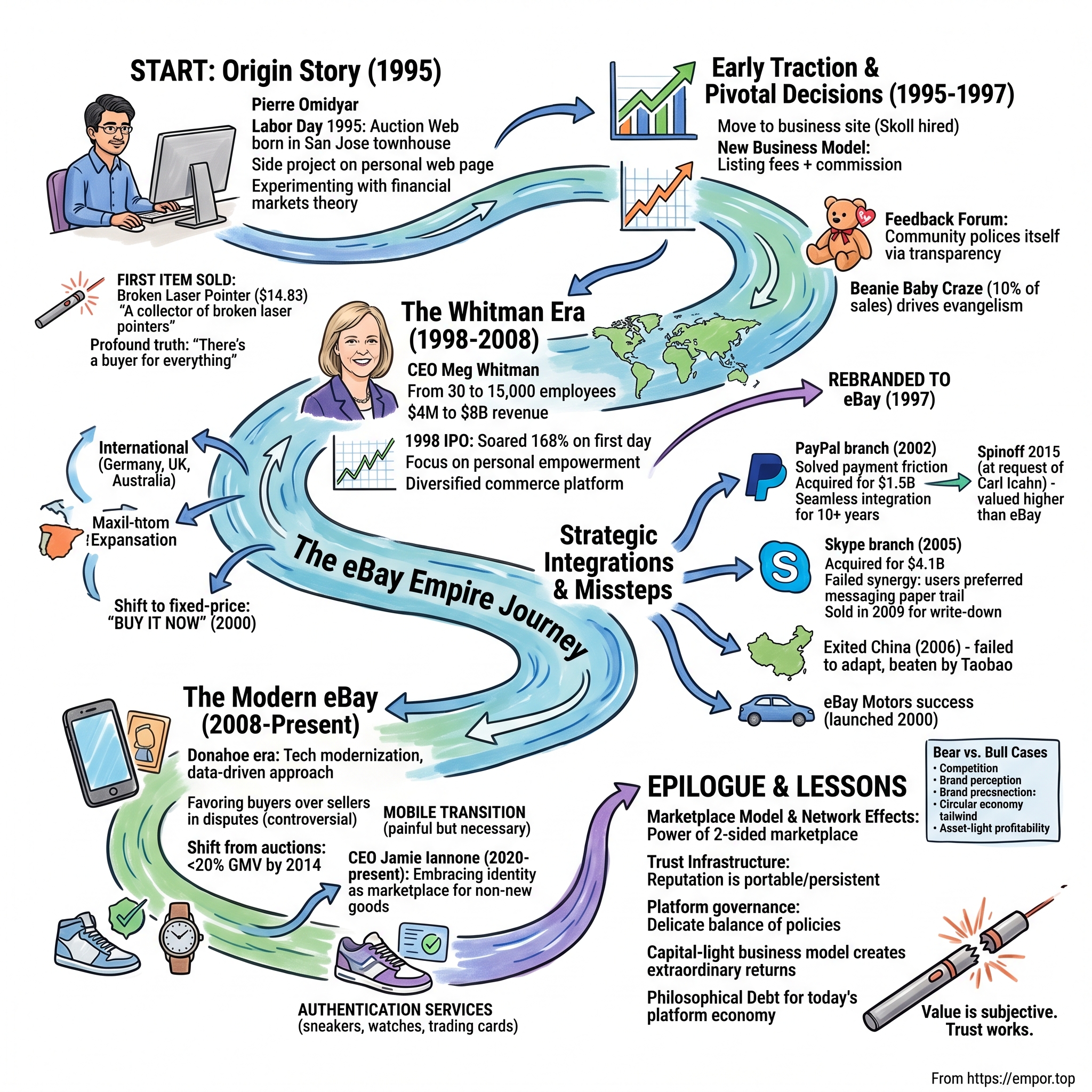
eBay Inc.: The Marketplace Empire's Third Act
I. Introduction & Episode Roadmap
There is a broken laser pointer at the center of this story. In the autumn of 1995, a 28-year-old programmer in San Jose posted one on a website he had coded over Labor Day weekend. It sold for $14.83. Puzzled, he emailed the winning bidder to confirm the buyer understood the item did not work. The reply, which has since been repeated so often it has calcified into corporate folklore, was that the buyer was a collector of broken laser pointers.
Whether or not that story is literally true — Pierre Omidyar has told it consistently for three decades, and no one has produced the buyer — it captures a durable truth about the business that grew out of it. eBay's underlying economic premise is that somewhere on Earth there is a buyer for an item no ordinary retailer would stock. Amazon sells what everyone wants. eBay sells what almost nobody wants, taking a cut for being the only platform where that buyer and seller can meet.
Thirty-one years later, that premise generates roughly $80 billion a year in gross merchandise volume (GMV) alongside approximately 28% non-GAAP operating margins. In fiscal 2025, eBay posted $79.6 billion in GMV, up 7%, and $11.1 billion in revenue, up 8%, with a non-GAAP operating margin of 27.8%.1 Growth accelerated through the first half of 2026: second-quarter GMV reached $22.4 billion, up 15%, revenue reached $3.1 billion, up 15%, and non-GAAP operating margin expanded to 28.5%.2 For a company that spent much of the 2010s written off as a declining legacy business, this trajectory warrants careful scrutiny beyond standard turnaround narratives.
The underlying paradox. eBay's GMV today remains roughly where it was in 2018, after adjusting for divested businesses. Its active buyer count — 136 million in the second quarter of 2026, up 2% — remains well below its pandemic-era peak.2 Yet earnings per share has compounded at rates typical of a growth company, driven by relentless share repurchases: basic shares outstanding fell to 444 million as of April 24, 2026, down from roughly 1.2 billion following the PayPal separation.3 A company can expand earnings per share for an extended period without expanding its underlying top line. The central question for long-term investors is whether recent acceleration signals genuine business growth or simply a temporary tailwind boosting a familiar financial machine.
The core thesis, stated neutrally. Management contends that eBay has transitioned from a generalist e-commerce platform to a specialized marketplace centered on high-trust "focus categories" (auto parts, luxury goods, trading cards, refurbished electronics), a rapidly expanding first-party advertising business, and consumer-to-consumer resale. Management reports these priority areas account for over 70% of GMV, with each expanding by more than 20% in the second quarter of 2026.4 The strategic argument is that this business mix is structurally superior — featuring lower substitutability, higher take rates, and capital-light operations.
That claim is plausible and supported by partial evidence, but it remains unproven. This analysis tests management's claims against eBay's historical operational record, which includes several notable failures in e-commerce history.
Three central themes. First, platform versus retailer economics — how a marketplace that owns no inventory and operates no fulfillment warehouses maintains 28% margins with minimal capital expenditure, as well as the trade-offs involved. Second, the unbundling and re-bundling cycle — how eBay aggregated broad merchandise categories, saw vertical specialists unbundle them, and is now attempting to re-bundle around authentication and trust infrastructure. Third, capital allocation as the primary operating narrative — spanning the Skype acquisition, the divestitures of PayPal, StubHub, and Classifieds, the share repurchase engine, and the return to M&A in 2026.
That shift in capital allocation is critical. On July 30, 2026, eBay completed its acquisition of Depop from Etsy for approximately $1.4 billion in cash — comprising a $1.2 billion headline price plus roughly $200 million in purchase price adjustments and interest.5 After six years of divesting assets and repurchasing stock, management has resumed acquiring businesses. Whether this deal represents a disciplined extension of a proven strategy or a return to legacy M&A missteps is a key analytical focus.
Roadmap. The narrative traces eBay from Omidyar's initial marketplace model through Meg Whitman's decade of scaling, before analyzing its M&A record, activist interventions, modern financial model, leadership under Jamie Iannone, competitive dynamics, and a critical evaluation of the key bull-case assumptions.
The analysis begins where every marketplace originates: addressing the problem of trust between strangers.
 Subscribe on LinkedIn
II. Pierre Omidyar & The Accidental Empire (1995–1997)
The server sat in Pierre Omidyar's living room in San Jose, sharing a residential internet connection with whatever else the household was doing. The site was called AuctionWeb. It was a page on his personal domain, ebay.com, alongside a page about the Ebola virus — which is why early users joked that the emerging commerce platform shared a URL with a hemorrhagic fever.
Omidyar's background explains the site's architecture far better than the company's mythology. Born in Paris to Iranian parents and raised in Maryland, he had written code at Apple's software subsidiary, Claris, and co-founded eShop, an early e-commerce software company that Microsoft later acquired. He was not a merchant. He was a systems architect with a libertarian orientation and an interest in whether markets could self-organize.
The Pez dispenser myth. For most of the 2000s, the standard origin story held that Omidyar built AuctionWeb to help his fiancée trade Pez dispensers. While memorable, the narrative was pure public relations. The tale was constructed in 1997 by an eBay PR manager seeking a warmer story than a programmer testing market efficiency. Omidyar has since acknowledged that the framing was inaccurate. The underlying experiment was far more rigorous: could total strangers—with no intermediary, no escrow, no legal recourse, and no reputation history—transact with each other over an unpoliced network?
The answer was mostly yes, because Omidyar constructed the digital scaffolding to enable it.
The monetization accident. AuctionWeb was initially free. As traffic expanded, Omidyar's internet service provider reclassified his account from a $30-a-month personal plan to a $250-a-month business plan. To cover operating costs, he instituted seller fees: a small fee to list an item, plus a percentage of the final sale price upon completion.
That improvised pricing structure defined the economics of online marketplaces for decades. A listing fee charges for virtual shelf space regardless of outcome, while a final value fee charges for liquidity. Combined, the platform monetized both supply and successful transactions. Because the marginal cost of hosting an additional listing was near zero, nearly every incremental dollar of fee revenue flowed directly to operating income. Thirty years later, that mechanic explains how eBay generates retailer-scale revenue on marketplace-scale costs.
As physical check payments filled his mailbox, Omidyar was soon earning more from his side project than his full-time job. He resigned to focus entirely on the platform.
Beanie Babies and the liquidity flywheel. The category that transformed eBay into a viable commercial enterprise was not broken electronics, but collectibles—specifically Ty's Beanie Babies, which fueled a speculative frenzy between 1996 and 1997. Beanie Babies possessed ideal marketplace characteristics: lightweight and cheap to ship, wildly variable in perceived value, artificially scarce, and traded by enthusiasts focused on condition and provenance. At its peak, Beanie Baby listings were estimated to account for roughly 10% of the site's total sales volume.
The strategic takeaway—which eBay would later forget and painfully relearn—was that marketplaces do not win by launching with broad reach. They win by establishing deep liquidity within a specific vertical first, then leveraging that trust into adjacent categories.
The Feedback Forum: trust as infrastructure. In February 1996, Omidyar introduced the Feedback Forum, enabling buyers and sellers to rate one another post-transaction. Though ubiquitous across modern e-commerce, in 1996 it represented a fundamental innovation: a portable reputation asset accumulated by sellers that could not be transferred off the platform.
This created early eBay's primary structural advantage. A seller with 4,000 positive ratings possessed a valuable commercial asset stored exclusively inside eBay's database. Switching platforms meant abandoning that reputation and starting from zero. It functioned as an effective switching cost embedded inside a community feature, shielding eBay's early network effect from direct competition.
However, that competitive moat had clear boundaries. Feedback scores protect against competitors copying eBay's platform format, but not against entrants altering the category structure itself—as occurred decades later when StockX introduced central physical authentication for sneakers, rendering individual seller reputation irrelevant.
Becoming eBay. By 1997, the platform required formal corporate identity. Omidyar's consulting entity was Echo Bay Technology Group; because echobay.com was already registered by a Canadian mining company, he shortened the domain to ebay.com. AuctionWeb was formally renamed eBay. Jeff Skoll, a Stanford MBA graduate and the company's first employee, joined as president to draft the business plan that converted a project into an institution—and eventually made Skoll a prominent philanthropist via his equity stake.
The company possessed product-market fit, a proprietary reputation system, a high-margin fee model, and rapid transaction growth. It lacked executive leadership with experience scaling a large organization. That operational void would soon be filled by a Bain-trained executive whose background centered on consumer branding at Playskool and Disney.
III. Meg Whitman & The Dot-Com Scaling Era (1998–2008)
Margaret Whitman's first day at eBay in March 1998 arrived with an immediate operational crisis: the website crashed. The outage cascaded as the infrastructure assembled by a handful of engineers buckled under user growth that far exceeded initial models. The incoming chief executive of a 30-person startup discovered on arrival that the platform she had been hired to scale could not stay online.
Whitman had taken the role reluctantly. She brought executive experience from Harvard Business School and Bain & Company, alongside senior brand management roles at Disney, Stride Rite, FTD, and Hasbro, where she ran the Playskool division. She was, by background, a consumer packaged goods executive — a corporate profile that Silicon Valley in 1998 often viewed with condescension. She flew to California to meet Omidyar largely out of curiosity and reportedly found the website visually unappealing.
What she recognized, which differed from the engineering team's focus, was that eBay was not purely a software company. It was a community business built on a technology substrate, and sustaining it required rigorous operational discipline: high uptime, structured customer support, active category management, trust and safety enforcement, and brand building.
The IPO. eBay completed its initial public offering on NASDAQ on September 24, 1998, pricing shares at $18. The stock opened at $53.50 and closed its first trading day up roughly 163%, marking one of the signature market debuts of the dot-com era. While the offering raised modest capital relative to later tech IPOs, it validated eBay's stock as acquisition currency and created vast paper wealth for Omidyar, Skoll, and Whitman within hours.
Crucially, the public listing highlighted an operational model that persisted for decades. In 1998, eBay reported $4.7 million in revenue for fiscal 1997 while already generating net profits — an unusual combination among dot-com companies. Because the marketplace model avoided inventory ownership and capital-intensive fulfillment infrastructure, it generated cash almost immediately. That structural cash-generation engine remains the central thread connecting its 1998 debut to its modern balance sheet.
The site outage of June 1999. In June 1999, less than a year after the IPO, eBay suffered a 22-hour service disruption that took the marketplace completely dark and wiped billions of dollars off its market capitalization. Whitman responded by moving into the engineering war room, recruiting Maynard Webb from Gateway as president of eBay Technologies, and establishing platform availability as an executive priority. The episode marked the point where the business transitioned from an informal startup to an enterprise platform.
Category expansion and the fixed-price pivot. Whitman's decade systematically converted a collectibles auction board into a broad-based commerce platform. eBay Motors launched in 1999 and grew into one of the world's largest online vehicle marketplaces, followed by expansions into consumer electronics, fashion, and industrial equipment.
The broader structural change occurred in 2000, when eBay introduced "Buy It Now," allowing sellers to list items at fixed prices. While auctions excel at price discovery for illiquid or unique items—such as a broken laser pointer, a rare trading card, or a vintage instrument—they create friction for standardized goods where buyers expect immediate checkout rather than a multi-day bidding window.
As eBay expanded into standardized merchandise, auction formats became a drag on growth. Fixed-price listings expanded from a minority of volume to the vast majority of transactions; by 2026, auctions represent only a low single-digit percentage of total GMV. While this shift increased overall GMV, it simultaneously diluted eBay's core differentiation by placing the platform in direct competition with Amazon's faster fulfillment network and standardized return policies.
Strategic implications. The Whitman era delivered impressive top-line scale—annual revenue crossed $8 billion by 2008—but it also introduced long-term strategic confusion. By pursuing general commodity merchandise, eBay entered a competition against logistics-focused retailers without building corresponding fulfillment infrastructure. While Whitman established operational reliability and corporate scale, directing the platform toward general merchandise compromised its structural marketplace advantages.
The decade also marked the beginning of eBay's aggressive corporate acquisitions, establishing an M&A track record that would shape its capital allocation and corporate strategy for the next two decades.
IV. Capital Allocation Anatomy: The M&A Hall of Fame & Shame
In September 2005, Meg Whitman took the stage to explain why an online auction platform had agreed to pay $2.6 billion for Skype, a Luxembourg-based internet telephony company founded by a Swede and a Dane. The logic presented was that buyers and sellers of expensive, complex items—such as used cars, real estate, and industrial machinery—needed to communicate directly by voice, and Skype provided the vehicle. Whitman framed it as the third leg of a commercial stool: find it, pay for it, talk about it.
The strategic rationale generated immediate skepticism. The Skype acquisition remains the anchor case in eBay's capital allocation history, serving as the baseline against which management's deal-making discipline must be judged.
Skype (2005): the structural misfire. eBay paid roughly $2.6 billion upfront, with an earnout structure that pushed total potential consideration toward $4.1 billion. The promised synergies failed to materialize because the acquisition misread user incentives: eBay's core value proposition was built on eliminating the need to speak directly with transactional counterparties. The Feedback Forum had already established trust without requiring direct voice negotiation. Skype attempted to solve an operational problem that eBay had already addressed through platform infrastructure.
By October 2007, eBay recorded a $1.4 billion impairment charge on the acquisition and paid out the remaining earnout to settle the agreement.6 In 2009, eBay sold roughly 70% of Skype to an investor group led by Silver Lake for approximately $1.9 billion in cash, valuing the business at $2.75 billion. Microsoft subsequently purchased Skype outright in 2011 for $8.5 billion.
While the retained minority stake generated a modest financial return upon Microsoft's purchase, the initial transaction represented a strategic failure. eBay never identified a mechanism to integrate Skype into its core marketplace model. The transaction was a top-of-market purchase justified by integration assumptions that proved incompatible with buyer and seller behavior. When assessing whether current management's capital allocation is disciplined, Skype remains the foundational baseline.
PayPal (2002): the operational success, and eventual separation. The counter-example offers a different lesson. In 2002, eBay acquired PayPal for approximately $1.5 billion in stock. The acquisition was driven by operational necessity: eBay had launched its own payment system, Billpoint, in partnership with Wells Fargo, but users overwhelmingly preferred PayPal. eBay effectively acquired the payment solution that its community had already adopted.
The transaction aligned with effective marketplace strategy: acquiring a proven user preference that reduces transaction friction at a price reflecting standalone performance. Following the acquisition, paper checks and money orders vanished from the platform, driving conversion rates higher. PayPal subsequently expanded beyond eBay's ecosystem, growing its off-platform transaction volume faster than the core marketplace.
That off-platform growth eventually created structural tension. In September 2014, eBay announced plans to separate the two entities. The spin-off completed in July 2015, with PayPal listing independently at a valuation of roughly $45 billion.[^7] While activist investor Carl Icahn campaigned publicly for the separation, the split resolved a structural conflict: maintaining ownership of PayPal restricted its ability to partner with competing retailers, while eBay required flexibility to optimize its checkout architecture. Separation resolved the operational conflict, though it required eBay to navigate payments as a third-party client rather than an owner.
StubHub (2007): category expansion and exit timing. eBay acquired StubHub, a secondary ticketing marketplace founded by Eric Baker and Jeff Fluss, for approximately $310 million in 2007. The business matched eBay's platform model, operating in a ticket resale category characterized by trust, liquidity, and verification requirements. StubHub subsequently established a leading position in U.S. event ticketing.
eBay completed the sale of StubHub to viagogo for $4.05 billion in cash on February 13, 2020.[^8] The transaction closed weeks before the COVID-19 pandemic halted live events globally. The sale generated a roughly 13-fold return on capital over a 13-year holding period, illustrating effective monetization of an adjacent marketplace asset.
Classifieds (2020–2021): conglomerate unbundling. eBay's Classifieds Group—comprising platforms such as Kijiji in Canada, Gumtree in the UK and Australia, mobile.de in Germany, and Marktplaats in the Netherlands—operated as a high-margin portfolio within the company. On July 21, 2020, eBay announced the transfer of the classifieds business to Adevinta in a cash-and-stock transaction valued at approximately $9.2 billion.[^9] eBay received cash alongside an equity stake in Adevinta, which it systematically monetized in subsequent years.
The transaction reflected a clear operational separation: classified platforms monetize listings rather than completed transactions, operate locally rather than globally, and share minimal technology with the core marketplace. Holding these assets within eBay had subjected them to a conglomerate discount, as market valuations for general marketplaces differed from those applied to specialized classified operators. Eliminating the structure unlocked several billion dollars in asset value.
Gmarket / eBay Korea (2009–2021): competitive disruption in logistics. eBay acquired control of Gmarket in South Korea in 2009, combining it with Internet Auction Co. to secure a leading position in the Korean e-commerce market. However, the subsequent entry of Coupang—built on owned logistics infrastructure and rapid delivery—exposed the limits of eBay's asset-light model in a market where fulfillment speed became the primary competitive factor. In 2021, eBay sold an 80% stake in eBay Korea to Shinsegae's E-Mart for approximately $3.0 billion.
While the sale yielded positive nominal proceeds, it marked an operational exit from a major e-commerce market. eBay surrendered its market position when competing against an operator willing to commit substantial capital to logistics infrastructure. This exit highlights a persistent vulnerability: the degree to which an asset-light marketplace model can defend its network effects against capital-intensive, logistics-focused competitors.
Evaluating the M&A record. Across two decades, eBay's major non-core transactions include one notable integration failure (Skype), one core payment acquisition that outgrew the parent company (PayPal), and two adjacent platform investments that generated substantial realized returns upon exit (StubHub and Classifieds). Historically, eBay created value when acquiring pure marketplace models with existing liquidity and destroyed value when attempting to acquire adjacent technology platforms.
The 2026 acquisition of Depop fits the marketplace model. However, paying $1.4 billion for an asset that Etsy acquired for roughly $1.6 billion in 2021—and subsequently impaired—presents financial trade-offs, particularly given management's acknowledgment that the deal will initially dilute earnings.5
By 2019, persistent conglomerate discounting and capital allocation decisions drew formal activist intervention, setting the stage for structural changes to the company's asset base and capital return strategy.
V. The Activist Intervention & The Great Unbundling (2019–2020)
On January 22, 2019, Elliott Management's Jesse Cohn published a letter to eBay's board of directors. Elliott had built a position of more than 4% and advocated for structural changes. The letter argued that eBay was "deeply undervalued," that public markets were applying a conglomerate discount to a portfolio of assets worth dramatically more apart than together, and that management had masked years of core marketplace underperformance behind non-core holdings.7
Starboard Value launched a parallel campaign within days with a matching thesis. The simultaneous arrival of two prominent activist hedge funds targeting the same company within the same quarter signaled a visible sum-of-the-parts valuation disparity.
What the activists actually saw. The underlying arithmetic was straightforward. Comparing eBay's total enterprise value against reasonable standalone valuations for StubHub and Classifieds revealed that public markets were assigning the core marketplace—a business generating billions of dollars in free cash flow—a valuation multiple typical of structurally declining assets.
The activists contended that this disparity stemmed from governance and operational misalignments. Executive attention was split across four distinct business models, corporate capital allocation was inconsistent, and gross merchandise volume in the core marketplace had stagnated for years while corporate narrative emphasized portfolio breadth.
The settlement. eBay reached a settlement with the activists rather than fight a proxy contest. Jesse Cohn joined the board alongside Matt Murphy, then chief executive of Marvell Technology, and the company launched a formal strategic review of its portfolio. Chief Executive Officer Devin Wenig, who had led the company since 2015, departed in September 2019, citing differences with the board regarding strategic direction.
Whether framed as activist investors forcing a reluctant management team to unlock value or as an accelerated execution of a strategic review management had already contemplated, the financial outcome was clear. Within eighteen months, eBay agreed to divest StubHub and Classifieds for a combined headline value exceeding $13 billion—a substantial sum relative to its roughly $30 billion market capitalization when Elliott published its letter.
The capital return machine turns on. Rather than reinvesting the divestiture proceeds into speculative acquisitions, management redirected capital to shareholders. eBay introduced a quarterly dividend in 2019 and launched an aggressive share repurchasing campaign that transformed its per-share financial profile. The company effectively pivoted from a top-line growth narrative to a cash-return vehicle built on marketplace cash flows.
Share repurchases do not alter underlying operational performance; they neither add active buyers, improve conversion rates, nor expand competitive moats. Instead, repurchases concentrate existing cash flows across fewer outstanding shares. If a business generates a stable $2 billion in annual free cash flow while retiring 6% of its equity each year, per-share free cash flow expands by 6% annually despite zero underlying revenue growth. While beneficial to equity holders, this compounding reflects financial mechanics rather than operational expansion, and its utility is inherently finite.
So what. The unbundling eliminated the conglomerate discount and established clear valuations for eBay's divested assets. However, it also narrowed the company's strategic flexibility. Following the 2021 divestitures, eBay operates as a single marketplace platform. Incremental value creation now depends entirely on organic growth, take-rate expansion, or continued share repurchases, with no remaining non-core assets available for monetization.
Consequently, the company's investment thesis rests entirely on the operational economics of its core marketplace.
VI. Modern eBay Economics & Segment Financials
The mechanics of modern eBay mirror a traditional physical marketplace. The operator charges sellers a table fee and takes a cut of completed sales, generating core transaction revenue. The operator also offers premium placement—such as prime locations near the entrance—to vendors seeking higher foot traffic, generating advertising revenue. Finally, the operator manages the central cash register, capturing a small processing spread on every sale through managed payments.
Over the past decade, eBay's financial trajectory has hinged on discovering that these secondary and tertiary revenue streams carry higher profit margins and greater expansion potential than traditional transaction fees alone.
One segment, two revenue lines. eBay reports financial results as a single marketplace segment, splitting total revenue into net transaction revenues and marketing services and other. This reporting structure imposes a notable disclosure limitation: investors cannot analyze the standalone profitability of advertising relative to core transactions and must infer mix shifts primarily from executive commentary on take rates. Critics and activist investors have noted that a company whose margin expansion relies increasingly on high-margin advertising should disclose standalone operating metrics for that product line.
GMV: the volume base. Gross merchandise volume—the aggregate dollar value of all merchandise transacted on the platform—hovered in the mid-$70 billion range across most of the post-divestiture period before reaching $79.6 billion in full-year 2025, a 7% increase.1 Expansion accelerated in the first half of 2026, with second-quarter GMV reaching $22.4 billion, up 15% as reported.2
That acceleration requires context. First, volume growth is geographically uneven: U.S. GMV expanded roughly 24% year over year in the second quarter of 2026, whereas international GMV grew approximately 6%, signaling slower momentum abroad. Second, management noted that second-quarter comparisons benefited from specific lapping dynamics—including a prior-year Klarna partnership and temporary marketing gains—and guided third-quarter 2026 GMV to between $22.0 billion and $22.4 billion, indicating an imminent growth deceleration.2 Projecting mid-teens volume growth into future quarters ignores explicit guidance from leadership.
Take rate: where the real story is. Take rate—the percentage of gross merchandise volume that eBay retains as net revenue—historically hovered between 8% and 9%. The overall take rate stands at approximately 14%, remaining flat year over year in the second quarter of 2026.4
That long-term expansion stems from two primary engines:
Managed payments. In January 2018, eBay announced it would take control of platform payment processing, naming Adyen as its primary processing partner and phasing out PayPal as the default checkout provider.8 Prior to that shift, PayPal captured transaction processing fees. By intermediating payments directly, eBay absorbed those economics, recapturing several hundred basis points of take rate from its former subsidiary. While the transition required multi-year seller onboarding and created initial operational friction, it effectively restored payment monetization to eBay's income statement.
Advertising. Advertising represents the higher-margin engine for take-rate expansion. Through its Promoted Listings suite, eBay allows merchants to bid for higher visibility within search results. In the second quarter of 2026, total advertising revenue reached $596 million, led by first-party advertising revenue of $570 million—up 25% year over year—pushing advertising penetration to nearly 2.7% of GMV.2
Incremental advertising revenue carries minimal marginal cost, as ad units populate pre-existing search result pages. Consequently, ad revenue converts to operating income at margins substantially higher than core transaction fees—a dynamic similar to Amazon's advertising expansion and the primary driver of eBay's margin expansion during periods of flat GMV growth.
However, monetization via advertising introduces non-financial trade-offs. Elevated ad volume acts as an implicit fee on sellers while potentially degrading buyer search relevance. Elevating sponsored listings over organic matches risks eroding platform trust built over decades. Management has not disclosed specific quantitative caps or quality metrics used to monitor this balance.
The buyer problem. eBay closed the second quarter of 2026 with 136 million active buyers, a 2% increase year over year, with management acknowledging that subsequent buyer growth relies in part on consolidating Depop's user base starting in the third quarter.4 This reliance indicates that organic buyer acquisition remains constrained, making external acquisitions a primary driver for expanding top-line user metrics.
Management counters this concern by highlighting "enthusiast buyers"—users who complete six or more purchases annually and account for a disproportionate share of GMV. The strategic premise holds that a concentrated pool of high-frequency buyers yields higher long-term profitability than a broad base of occasional bargain seekers. While economically sound during category optimization, this strategy faces limits: once mix shift toward high-intent buyers stabilizes, sustained growth requires either expanding GMV per buyer or re-accelerating net user acquisition.
Margins and cash. Non-GAAP operating margin reached 28.5% in the second quarter of 2026, expanding from 27.8% in full-year 2025.12 Because a marketplace platform operates without physical inventory or logistics networks, low capital expenditure requirements allow a substantial portion of operating income to convert directly into free cash flow. This capital-light model enables eBay to generate high revenue volume with software-like capital intensity.
However, non-GAAP metrics obscure significant expenses. GAAP operating margin stood at 21.6% in the second quarter of 2026. The 6.9-percentage-point divergence primarily reflects stock-based compensation, an ongoing cost that dilutes existing shareholders unless counteracted by share repurchases. Consequently, a notable portion of the $2.5 billion deployed for share buybacks in 2025 functioned to absorb equity compensation dilution rather than net share count reduction.1
Operational leadership of this financial framework has rested with the chief executive officer who took charge in April 2020.
VII. Current Management & Strategic Pivot: The Jamie Iannone Era
Jamie Iannone became eBay's chief executive officer in April 2020, assuming leadership as global pandemic lockdowns began. He inherited an enterprise in the middle of asset divestitures, an activist settlement, and a payments migration, alongside a sudden surge in online retail volume as consumer behavior shifted temporarily indoors.
That pandemic volume surge created a strategic risk. As gross merchandise volume expanded in 2020 and active buyers peaked near 163 million, equity markets re-rated the stock on expectations of sustained top-line acceleration. Iannone's central strategic decision—made while macro tailwinds remained strong—was recognizing that the volume surge was largely temporary. Rather than pursuing low-margin commodity e-commerce in direct competition with Amazon, management opted to narrow the platform's strategic focus.
Who he is. Iannone brought extensive institutional familiarity to the role. He worked at eBay from 2001 to 2009 in product and operational leadership before managing Barnes & Noble's digital operations and subsequently serving as chief operating officer of Walmart eCommerce and chief executive of SamsClub.com. His tenure at Walmart offered direct exposure to a capital-intensive logistics campaign against Amazon. Upon returning to eBay, Iannone concluded that an asset-light marketplace could not win a logistics race and should instead differentiate through specialized selection.
His management approach emphasizes incremental execution and consistent reporting metrics. Rather than offering broad strategic pivots, Iannone has framed quarterly performance around a consistent lexicon: "focus categories," "enthusiast buyers," "recommerce," and consumer-to-consumer transactions. While stable corporate communication avoids the narrative drift common in multi-year turnarounds, it can also obscure persistent operational challenges—most notably an active buyer base that management has cited as a strategic priority for several years without achieving sustained organic expansion.
CFO Steve Priest. Chief Financial Officer Steve Priest joined eBay in June 2021 after serving as CFO of JetBlue during the COVID-19 pandemic. Transitioning an airline executive into a high-margin technology marketplace brought an operating focus on capital discipline, balance-sheet volatility management, and strict liquidity targets. Under Priest's financial stewardship, eBay maintained consistent leverage targets, an expanding dividend, and systematic share repurchases, allocating $2.5 billion to buybacks and $531 million to dividends in 2025.1
The four pillars, and what evidence supports each.
Parts & Accessories. The auto parts category represents eBay's most defensible vertical, supported by proprietary fitment data. Matching a replacement component to a specific vehicle make, model, year, and engine size relies on a structured catalog developed over decades of transactional history. eBay backstops this data through its "Guaranteed Fit" program, absorbing financial risk on misattributions. Competing platforms have struggled to replicate this catalog depth due to limited long-tail inventory for vintage or out-of-production parts, establishing a persistent liquidity advantage for eBay in specialized auto supply.
Luxury. In luxury categories—including pre-owned watches, handbags, jewelry, and collectible sneakers—eBay introduced physical inspection through dedicated authentication centers prior to buyer delivery. High-value resale markets are primarily constrained by buyer trust rather than product selection. Physical verification shifts transaction security from individual seller feedback to a platform guarantee. This counter-positioning directly addresses market share lost to vertical specialists such as StockX, though competing effectively remains challenging given the multi-year head start and brand affinity those specialists established with younger demographics.
Trading cards. Collectibles represent eBay's core category heritage, where liquidity concentration remains highest. To solidify this position, eBay acquired collectible card marketplace TCGplayer for up to approximately $295 million in 2022 while establishing vault storage and grading partnerships for high-value cards. However, trading cards remain highly sensitive to broader speculative cycles; valuation pullbacks in discretionary collectibles directly compress both gross merchandise volume and high-margin transaction mix.
Recommerce and refurbished. Beyond certified refurbished electronics, management has expanded consumer-to-consumer apparel resale. This strategy underpins the $1.4 billion acquisition of Depop, a marketplace catering to Gen Z and millennial buyers that reached 9 million active buyers by the end of the second quarter of 2026, up from 7 million at announcement.4 With fashion already generating over $10 billion in annual GMV for eBay, the transaction represents an effort to acquire demographic exposure that the core platform struggled to attract organically.5
Generative AI. eBay launched automated listing tools—branded "Magical Listing"—that convert product photos into generated item descriptions, categories, and attributes. For a consumer-to-consumer marketplace, reducing listing friction addresses a primary constraint on seller supply. Management expanded these automated tools to all new and reactivated sellers in the United Kingdom, Germany, and Australia, with Australia becoming the first market to offer the feature to all consumer-to-consumer sellers.4
While automating seller onboarding targets inventory creation rather than demand generation, its financial impact remains unverified. Management has not disclosed quantitative data linking automated listing adoption to incremental listing volume, gross merchandise volume growth, or long-term buyer retention.
The share count. The most consistent operational driver of earnings per share expansion has been equity reduction. Basic shares outstanding fell to 444 million as of April 2026, down from approximately 1.2 billion following the PayPal separation.3 This lower share count, representing a reduction of over 60% across roughly a decade, provides the mathematical basis for per-share earnings growth during periods of flat top-line merchandise volume.
So what. Leadership's performance presents a nuanced operational record. Management successfully avoided over-investing in pandemic-era demand, expanded high-margin advertising, and established defensible vertical category positions. However, organic buyer growth remains constrained, rendering recent top-line momentum partially dependent on external acquisitions such as Depop. Subsequent quarters of active buyer trajectories and spend-per-buyer metrics will clarify whether recent performance reflects genuine structural growth or finite financial engineering.
VIII. Competitive Landscape & Helmer's 7 Powers / Porter's 5 Forces
Picture eBay's competitive position as a stronghold originally built to defend an open plain that now finds itself defending a series of narrow mountain passes. The plain—general merchandise—was lost years ago. The passes are the specialized categories where competitor logistics and scale advantages do not apply.
The three fronts.
Against Amazon and Walmart Marketplace—eBay conceded the general merchandise market and ceased competing directly in standard commodity retail. Amazon's Fulfillment by Amazon (FBA) network converts third-party listings into a logistics-guaranteed service eBay cannot match without investing tens of billions of dollars in physical infrastructure. On new, in-stock commodity goods, eBay's value proposition is weak and its market share reflects that reality.
Against Temu, Shein, and AliExpress—low-cost cross-border platforms targeted eBay's value-conscious buyers through lower prices and aggressive customer acquisition spending. This competitive front was reshaped in 2025 by regulatory shifts rather than direct platform features, an area examined in subsequent analysis.
Against vertical specialists—StockX and GOAT in sneakers, Etsy in handmade and vintage items, Chrono24 in luxury watches, and Mercari, Poshmark, and Whatnot in apparel and live-stream selling. This represents the most dangerous front because these platforms attacked eBay's core strength: taking categories where eBay held existing liquidity, adding specialized services eBay lacked—such as centralized physical authentication, curated user experiences, and live video—and capturing high-value users.
Helmer's 7 Powers, applied honestly.
Network economies—Real, but sharply bounded. eBay's network effect is not global or horizontal; it is local and category-specific. The platform's value to a buyer searching for rare vintage camera lenses is substantial, whereas its value to a buyer purchasing a standard USB cable is minimal. Treating eBay's network as a single broad moat rather than a portfolio of niche liquidity pools misinterprets the platform's economics, as its international performance demonstrates.
Counter-positioning—This represents eBay's strongest structural advantage. The company owns no inventory, operates no fulfillment centers, and does not compete with its sellers by launching private-label products. Amazon cannot replicate eBay's capital-light cost structure without undermining the logistics infrastructure that underpins its primary competitive advantage. This counter-positioning explains why a marketplace generating a fraction of Amazon's gross sales can sustain higher operating margins.
Process power—eBay's fitment database for auto parts and its authentication workflows serve as narrow but genuine examples of process power. Proprietary data sets and specialized verification protocols accumulated over decades cannot be easily duplicated and degrade slowly.
Scale economies—Modest. eBay secures volume discounts on shipping rates and payment routing that individual merchants cannot obtain independently. However, these efficiencies provide advantages over small individual sellers rather than large enterprise competitors such as Amazon.
Switching costs—Weakening. Although seller feedback history provides lingering platform stickiness, multi-homing has become standard operational practice. Commercial resellers frequently list inventory across eBay, Mercari, Poshmark, Whatnot, and Depop simultaneously, utilizing automated cross-listing software that reduces the marginal cost of multi-channel distribution to near zero. The seller lock-in established via eBay's early feedback system has been substantially diluted by modern software tooling.
Cornered resource and branding—Neither provides a meaningful moat. eBay holds no exclusive supply agreements, and its brand—while globally recognized—retains legacy associations with cluttered listings and unverified sellers that the company has spent a decade attempting to reposition.
Porter's Five Forces.
Buyer power is split by category. For commodity items, buyer power is high: consumers easily switch tabs to compare prices. For discontinued auto parts or rare collectibles, buyer power drops significantly due to limited alternative supply sources. eBay's strategic pivot toward focus categories represents a deliberate migration toward markets with lower buyer price sensitivity.
Supplier power—among sellers—is moderate and expanding. Merchants frequently cite combined final value fees, promoted listing costs, and payment processing charges, while cross-listing tools lower switching barriers. However, for rapidly liquidating non-standard inventory, eBay retains the largest aggregated buyer demand, which constrains seller defection and supported historic take-rate expansion.
Threat of substitutes is substantial in general retail but limited in long-tail categories. Zero-fee platforms such as Facebook Marketplace serve as direct substitutes for local consumer-to-consumer transactions, which explains why maintaining eBay's U.S. consumer-to-consumer market position required both the Depop purchase and sustained marketing spend that management flagged as necessary.4
Rivalry remains intense in entry-level resale but is stabilizing among vertical specialists, as early-stage competitors face increased capital discipline and profitability demands.
Barriers to entry are low for developing marketplace software but exceptionally high for establishing transaction liquidity. Creating software infrastructure can be accomplished quickly, whereas replicating thirty years of accumulated long-tail supply and demand history presents a formidable barrier.
So what. This analysis indicates that eBay has effectively retreated to defensible category niches. While narrowing its operational footprint was strategically necessary, defensive category passes represent a smaller overall addressable market. Consequently, eBay's competitive position functions as a collection of specialized local monopolies operating within a broader e-commerce market where top-line expansion is occurring elsewhere.
Evaluating the durability of this defensive posture requires examining the core assumptions underlying the bull thesis.
IX. Historical Falsification Layer: Testing Core Investment Claims
Every bull case on eBay rests on five load-bearing claims. Each has an extensive historical record against which it can be tested, and in several instances the company's own history provides the most compelling counter-evidence available.
Claim 1: "eBay's two-sided network effect creates a durable marketplace moat."
The disconfirming evidence is not a critic's speculation; it is eBay's international track record.
In China, eBay acquired EachNet and held a commanding early market share. Alibaba launched Taobao with zero listing fees, introduced the Alipay escrow service to solve transaction trust in ways eBay's feedback score failed to address locally, and integrated real-time buyer-seller chat. eBay responded by migrating EachNet onto its standardized global technology stack, degrading the localized product experience. By December 2006, eBay effectively conceded the market, folding its Chinese operations into a joint venture with TOM Online.9
In Japan, eBay entered after Yahoo! Japan had established dominant liquidity, ultimately exiting in 2002 without gaining meaningful traction. In South Korea, eBay held the leading market position for over a decade before selling its stake after Coupang's logistics investments redefined competitive expectations. In general U.S. retail, Amazon's Fulfillment by Amazon network captured standard commodity commerce.
This record spans four major retail markets and three distinct failure modes: failing to adapt to local product preferences, entering too late against an established network, and losing a capital-intensive logistics war.
Verdict: The claim fails in its broad form. eBay's network effect is not a global horizontal moat, and the historical record refutes that interpretation. The claim holds only in a narrower form: within categories where inventory is genuinely scarce, non-substitutable, and geographically dispersed, eBay's accumulated liquidity remains difficult to displace. The fitment-driven auto parts business and long-tail collectibles support this narrower thesis, whereas international exits refute the broader one. The key performance indicator that would falsify even the narrow claim is focus-category volume growth decelerating below overall platform expansion. In the second quarter of 2026, focus categories expanded 26% and represented 40% of total merchandise volume, indicating that the narrow claim currently holds.4
Claim 2: "Focus categories and authentication drive platform buyer growth."
The counter-evidence appears directly in user metrics. Active buyers peaked near 163 million during the 2020 demand surge and have settled at 136 million.2 That represents a 17% decline from peak levels across a five-year period during which focus categories, authentication centers, and category management were fully deployed. If the strategy were driving top-of-funnel user acquisition, five years provides sufficient time for results to materialize.
Management's commentary reinforces this reality. On the second-quarter 2026 earnings call, executive team members framed modest 2% active buyer growth around the planned inclusion of Depop's user base starting in the third quarter.4 When an enterprise relies on external acquisitions to bolster organic user metrics, it signals that the organic acquisition engine remains constrained.
Verdict: The claim is rejected as stated and survives only in a modified form. The evidence supports the premise that focus categories increase spending per retained high-frequency buyer, as gross merchandise volume expanded while user counts remained flat. However, the evidence does not support the claim that focus categories expand the total buyer base. Investors should evaluate volume per active buyer as the operational metric the strategy actually drives, while monitoring whether third-quarter 2026 buyer counts rise by materially more than the roughly nine million users contributed by Depop. Without a larger increase, organic buyer growth in the third quarter of 2026 remained negative.
Claim 3: "Sellers will continue to absorb take rate expansion."
Historically, eBay's take rate hovered between 8% and 9% before expanding to approximately 14%. Critically, take rate remained flat year over year in the second quarter of 2026.4 This plateau provides initial empirical evidence that the broad monetization engine has reached its limit. Management attributed the flat take rate to category mix and slower monetization in emerging initiatives such as live-stream commerce, with advertising growth offsetting rather than exceeding those headwinds.
Structural limits to take-rate expansion are clear. Managed payments represented a one-time structural capture; eBay can only intermediate transaction processing once. While advertising can continue expanding, incremental ad units risk cluttering search results and degrading user experience. Meanwhile, automated cross-listing software has lowered multi-homing costs for professional merchants, while alternative marketplaces offer viable distribution channels for consumer resale.
Verdict: The claim is narrowed significantly. Broad take-rate expansion has reached a ceiling. The realistic scenario is that advertising penetration—currently at 2.7% of merchandise volume—can continue rising toward industry benchmarks, while the overall take rate remains largely flat due to offsetting category mix dynamics.2 The key metric to watch is advertising revenue as a percentage of gross merchandise volume; if ad penetration stalls below 3%, eBay's primary remaining revenue expansion lever will have closed.
Claim 4: "Cross-border trade from Asia is a durable low-cost supply vector."
This claim has been disproven by regulatory policy. Effective August 29, 2025, the United States suspended duty-free de minimis customs treatment for shipments from all countries, accelerating a policy change previously expected in 2027.10 Merchandise under the former $800 threshold that previously entered the U.S. without tariffs or formal entry now faces customs duties and administrative processing.
The operational impact on eBay is direct: international sellers generate approximately half of platform volume, with cross-border listings from China and Hong Kong serving as a key source of low-cost inventory. When a $40 purchase faces unpredictable customs duties, transaction conversion drops significantly. Shares of eBay and Etsy declined sharply following the policy announcement.11
Verdict: Rejected outright. Low-cost cross-border arbitrage was a regulatory policy artifact rather than a structural marketplace advantage. However, the regulatory change imposed greater disruption on fast-fashion and direct-from-China platforms whose models relied entirely on de minimis exemptions, while leaving eBay's domestic pre-owned inventory unaffected. This dynamic likely contributed to eBay's U.S. merchandise volume accelerating to roughly 24% growth in the second quarter of 2026.2 Consequently, a portion of recent U.S. growth reflects a temporary policy windfall from competitor disruption rather than underlying platform improvements—and policy windfalls eventually lap.
Claim 5: "Management's capital allocation is disciplined."
eBay's divestiture record is strong, and its share repurchase program has been executed consistently rather than opportunistically. However, capital discipline must also be judged on capital deployment. The $1.4 billion cash acquisition of Depop created a 3-to-4-percentage-point headwind to operating income growth and mid-single-digit earnings-per-share dilution in the third quarter of 2026, with financial dilution expected to persist through the year.4 Furthermore, Etsy acquired Depop for approximately $1.6 billion in 2021 before subsequently writing down the asset, meaning eBay purchased a business its previous owner struggled to integrate profitably.
Verdict: The historical record demonstrates that eBay has been disciplined regarding asset exits, while capital deployment under the current regime remains unproven. Skype serves as the historical reference point for the risks of overpaying for assets outside the core marketplace. While Depop aligns more closely with eBay's core consumer-to-consumer operations, the key test for capital discipline will be avoiding future impairment charges and demonstrating that Depop delivers sustained consumer-to-consumer volume growth beyond 2026.
X. Analyst & Investor Transcript Guide
For fundamental investors, the primary value of tracking eBay's quarterly earnings calls lies in executive consistency: management has repeated the same core narrative for several years, making strategic shifts and performance deviations easily visible. Reviewing these calls in sequence provides a clear benchmark for testing execution against past guidance.
Q2 2026 (August 2026). In prepared remarks, management highlighted that strategic priorities—focus categories, consumer-to-consumer resale, and recommerce—represented more than 70% of total merchandise volume, with each segment expanding over 20%, while focus categories alone grew 26% to reach 40% of total volume.4 Chief Executive Officer Jamie Iannone dedicated significant time to eBay Live, noting that interactive video buyers spend roughly 70% more than non-live buyers, with nearly half that incremental spending occurring outside live events.
The subsequent analyst session highlighted key operational pressures. Analysts focused on three primary vulnerabilities: the divergence between 24% U.S. merchandise volume growth and 6% international growth, the adequacy of 2% active buyer growth five years into the focus-category pivot, and near-term earnings dilution from the Depop acquisition. Management provided specific parameters on Depop—quantifying a three-to-four-percentage-point operating income headwind and mid-single-digit per-share earnings dilution. Conversely, explanations for international softness relied on broad macroeconomic factors, a rationale that is difficult for investors to evaluate independently.
Q4 2025 and FY2025 (February 2026). This transcript established the top-line acceleration narrative, reporting full-year merchandise volume of $79.6 billion, up 7%, and revenue of $11.1 billion, up 8%, alongside fourth-quarter volume growth of 10% and revenue growth of 15%.1 Revenue expanding faster than gross transaction volume encapsulates eBay's monetization push through high-margin advertising. During the call, analysts questioned whether volume gains reflected higher unit transaction counts or price inflation across luxury items and collectibles. Management did not provide a volume-versus-price breakdown, leaving an ongoing gap in platform activity disclosure.
Q4 2024 (February 2025). This call serves as a baseline for measuring executive framing over time. While prepared remarks focused on advertising penetration milestones and free cash flow distribution, comparing the 2025 and 2026 transcripts reveals a subtle narrative pivot: executive commentary on take rates transitioned from highlighting continuous expansion to emphasizing rate stability. Although management reported underlying metrics accurately, leadership did not explicitly highlight this shift in trajectory.
The 2022 and 2024 Investor Days. These presentations outlined the strategic framework for focus categories and high-value enthusiast buyers. Evaluating 2022 targets against 2026 results shows that while category specialization successfully shifted merchandise mix, broad active buyer expansion missed long-term targets. Nevertheless, management's decision to continue disclosing active buyer counts prominently despite flat growth demonstrates consistent reporting transparency.
Analytical priority. In evaluating future earnings calls, investors should monitor four key metrics in sequence: focus category volume growth, advertising penetration as a percentage of gross merchandise volume, organic active buyer counts excluding Depop, and international volume trends. Together, these indicators reveal whether platform momentum reflects underlying operational health or temporary accounting tailwinds.
XI. Bear vs. Bull Case Analysis & Material Risk Radar
The Bull Case
1. A cash machine with software capital intensity. The combination of roughly 28% non-GAAP operating margins, minimal capital expenditure, and negative working capital dynamics produces free cash flow that substantially exceeds what a traditional retailer of comparable revenue could generate.2 This financial model forms the platform's foundation, shifting the key analytical focus from cash generation to capital deployment.
2. Genuinely non-substitutable inventory. Out-of-production auto parts, rare collectibles, and pre-owned luxury goods cannot be sourced by first-party retailers at scale because they do not exist in traditional wholesale channels. Competitor logistics advantages are largely irrelevant to this long-tail supply. This represents the most defensible segment of eBay's competitive moat, supported by focus categories growing 26% and reaching 40% of gross merchandise volume.4
3. Advertising runway. At nearly 2.7% penetration of gross merchandise volume, eBay's advertising business remains materially below mature retail media network benchmarks.2 Because advertising revenue carries minimal marginal cost, each incremental point of penetration expands operating margins independent of overall merchandise volume growth.
4. The share count effect. Retiring more than 60% of basic shares outstanding over roughly a decade allows even modest net income growth to compound meaningfully on a per-share basis.3 Supported by a stable dividend and steady repurchases, the long-term equity return profile does not depend on rapid top-line expansion.
5. Optionality in recommerce. Resale and secondhand commerce are expanding structurally, driven by younger consumers and sustainability preferences, with eBay holding a leading incumbent position. The acquisition of Depop and expanded consumer-to-consumer investments represent a deliberate effort to capture demographic exposure in younger user segments.
The Bear Case
1. Growth is partly borrowed. The top-line acceleration in 2026 coincides with a regulatory policy shift that disrupted low-cost cross-border competitors alongside favorable prior-year comparisons that management explicitly flagged.210 Adjusting for these temporary tailwinds reveals a more modest underlying growth rate. Third-quarter 2026 gross merchandise volume guidance of $22.0 billion to $22.4 billion, compared to second-quarter volume of $22.4 billion, indicates an immediate growth deceleration.2
2. Buyers are not growing organically. Five years of focus-category strategy execution have failed to reverse active buyer declines from the 2020 peak, leaving user expansion in 2026 dependent on external acquisitions.4 A marketplace unable to expand its active buyer base relies entirely on increasing spend per buyer, a growth vector that eventually encounters natural limits.
3. Take rate has plateaued. A flat year-over-year take rate signals the end of the primary driver of margin expansion following the managed payments transition.4 Moving forward, revenue growth must rely on expanding total merchandise volume or deepening advertising penetration, as broad transaction fee monetization reaches its structural limit.
4. International growth remains weak. International merchandise volume expanded by roughly 6% in the second quarter of 2026 compared to approximately 24% in the United States, highlighting a widening geographic performance gap alongside eBay's historical record of international market exits.2 Nearly half of platform volume originates in markets where the company has struggled to establish a durable competitive advantage.
5. Capital allocation discipline remains unproven. After six years of asserting that asset simplification and share buybacks maximize shareholder value, management's decision to deploy $1.4 billion for a marketplace with a history of ownership write-downs introduces structural earnings dilution for at least eighteen months. While consumer-to-consumer fashion aligns with category priorities and Depop's active buyer base expanded from 7 million to 9 million between announcement and close,4 management carries the burden of proof given past M&A integration challenges.
6. Disclosure gaps limit verification. eBay provides no standalone advertising profitability metrics, no volume-versus-price decomposition of gross merchandise volume, and no quantitative data connecting automated listing tools to incremental inventory supply. While individually defensible, these reporting gaps collectively prevent outside investors from verifying the primary operational drivers of the bull case.
Material Risk Radar
Tariff and customs policy represents an active regulatory overhang. The suspension of de minimis customs exemptions has altered cross-border transaction economics, while potential tariff escalations could increase costs across the international seller network that supplies roughly half of platform volume.10 Although regulatory friction also impacts cross-border competitors such as Temu and Shein, the net effect on eBay's international corridors remains negative.
Take rate saturation and seller churn. If merchants determine that aggregated final value fees, advertising costs, and payment processing charges exceed the value of eBay's buyer demand, professional sellers can redirect inventory to alternative distribution channels at minimal switching cost. Key metrics to monitor include seller sentiment and listing volumes among high-volume merchants.
Macroeconomic sensitivity in discretionary categories. Collectibles, luxury resale, and trading cards contain strong discretionary and speculative elements. A broader economic downturn compresses transaction volume and average selling prices simultaneously, impacting gross merchandise volume more severely than standard retail product mixes.
Integration and execution risk on Depop. Deploying $1.4 billion in cash for a business that suffered a prior impairment under Etsy carries tangible operational risk. Key evaluation checkpoints include whether consumer-to-consumer merchandise volume accelerates and whether initial earnings dilution ends according to management's timeline.
Accounting adjustments and stock-based compensation. The gap between GAAP and non-GAAP operating results remains wide, primarily reflecting stock-based compensation. Investors should evaluate share buyback capacity net of equity compensation dilution rather than on a gross basis. Additionally, goodwill recognized from the Depop acquisition will require regular impairment testing, where any future write-down would provide a definitive verdict on deal execution.
Generative AI as a structural risk. While eBay uses generative AI tools to lower listing friction for sellers, AI-driven shopping agents that query multiple platforms concurrently could commoditize front-end discovery and dilute direct traffic to eBay. For a marketplace built on being the primary destination for hard-to-find inventory, an aggregation layer capable of discovering rare items across the web presents an unproven structural challenge.
The KPIs That Matter
Investors evaluating eBay's operational execution should monitor three primary metrics:
1. Focus category volume growth and share of total volume. This metric directly tests whether defensible verticals are outperforming the broader platform. Supported by 26% growth and representing 40% of gross merchandise volume in the second quarter of 2026, category specialization currently underpins top-line performance.4
2. Advertising penetration as a percentage of gross merchandise volume. With overall take rates stabilizing, advertising represents the primary remaining monetization driver. Advertising penetration reached nearly 2.7% of volume in the second quarter of 2026.2
3. Acquisition-adjusted active buyers. Organic active buyer growth remains the key operational metric management has failed to expand. Beginning in the third quarter of 2026, evaluating organic user trends requires adjusting total active buyer counts to exclude Depop's user contribution.
XII. Key Business & Investing Lessons
Know where your moat ends. eBay spent roughly a decade attempting to compete with Amazon in standard retail commodity categories—such as delivery speed, logistics reliability, and standardized selection—an effort that cost the platform market share, margin expansion, and executive focus. The business stabilized when management acknowledged that a marketplace's core advantage lies in category-specific liquidity rather than broad retail scale, refocusing capital and category management toward hard-to-source inventory that logistics networks cannot easily replicate. Ultimately, a competitive moat defined too broadly invites competition in areas where the enterprise holds no structural advantage.
Exits and entries are different skills. eBay's capital allocation history illustrates a critical analytical distinction. The same enterprise that completed the troubled Skype acquisition in 2005 later executed a series of portfolio divestitures—including PayPal, StubHub, and Classifieds—that unlocked more than $13 billion in asset value. Selling an asset effectively requires recognizing that it holds greater value under different ownership—an exercise in honest operational evaluation. Purchasing an asset requires accurately predicting future integration synergies. Demonstrating discipline in asset sales does not guarantee success in asset acquisitions, and investors should evaluate divestitures and acquisitions as distinct corporate capabilities.
Financial engineering is real but bounded. Retiring more than 60% of basic shares outstanding since 2015 has compounded per-share earnings through years of stagnant transaction volume. However, share repurchases redistribute existing cash flow across fewer equity claims rather than generating new operating revenue. This mechanism accelerates per-share metrics while underlying operations remain stable and stock valuations remain reasonable, but it loses efficacy if core merchandise volume declines—at which point buybacks merely concentrate shrinking cash flows. Furthermore, a substantial portion of buyback capital absorbs stock-based compensation dilution rather than reducing net share count. Continuous equity reduction can compound returns, but it cannot substitute for fundamental top-line growth.
Trust requires infrastructure, and the infrastructure keeps changing. Pierre Omidyar's founding insight in 1996 was that peer reputation could substitute for institutional trust. That mechanic proved effective for two decades before encountering structural limits: in high-value categories, a five-star seller rating provides insufficient protection against a counterfeit luxury watch. As a result, trust infrastructure had to escalate—moving from feedback scores to buyer protection guarantees, structured fitment databases, and physical authentication centers staffed by expert inspectors. Each layer of verification requires greater capital investment while shielding a narrower slice of transactions. In trust-mediated marketplaces, the cost of guaranteeing a transaction rises alongside item value; platforms that fail to invest in verification risk losing high-margin categories to vertical specialists.
The most valuable inventory is the inventory nobody else can get. This structural reality forms the central thread connecting Pierre Omidyar's original broken laser pointer in 1995 to eBay's 2026 financial results. Categories where eBay competes for standard, mass-produced merchandise have faced continuous commoditization. Conversely, verticals that aggregate unique, out-of-production, or non-standard items have preserved transaction liquidity, seller pricing power, and platform margins.
XIII. Epilogue & Future Outlook
Thirty-one years after Pierre Omidyar launched his initial listing board, eBay operates as a mature, highly profitable enterprise generating roughly $22 billion in quarterly gross merchandise volume across 136 million active buyers, supported by a share count that has been cut by more than half.23 This financial profile fits neither the hyper-growth narrative of its proponents nor the terminal decline predicted by critics a decade ago. Instead, it reflects a company that surrendered general retail logistics to Amazon, retreated to defensible category niches, and focused on capital returns and disciplined compounding.
The long-term outcome of this third act remains unresolved, presenting balanced arguments for both bullish and bearish trajectories.
What would confirm the bull case. Focus categories maintaining growth rates well above total GMV, proving that inventory specialization drives structural compounding rather than a temporary baseline shift. Advertising penetration advancing beyond 3% of GMV without degrading search relevance or user engagement. Organic active buyer growth turning positive, demonstrating that automated listing tools and consumer-to-consumer investments expand the top-of-funnel user base rather than merely increasing spend per existing user. Finally, Depop achieving smooth operational integration without repeating the write-downs experienced under Etsy.
What would break it. Platform take rates shifting from stabilization to outright decline, signaling that merchant friction and cross-listing options are constraining monetization. Focus category growth converging toward overall platform GMV, indicating that vertical specialists are eroding eBay's specialized niches. International GMV contracting further, demonstrating structural weakness across non-U.S. operations. Lastly, a resumption of large, non-core acquisitions—repeating the strategic missteps that led to the Skype impairment.
Significant operational questions persist. Can generative AI reduce listing friction enough to re-engage casual individual sellers, restoring the supply-side flywheel that originally built the platform? Can the company sustain real GMV expansion once current tariff-driven tailwinds against cross-border competitors lap? And can a marketplace platform established on peer feedback continuously scale its physical authentication and trust infrastructure fast enough to defend the high-value categories anchoring its financial performance?
What endures is the platform's foundational economic premise, which explains why eBay survived while many dot-com contemporaries vanished. Omidyar did not construct a standardized retail store; he designed a platform connecting the long tail of specialized supply with the long tail of niche demand—matching a seller holding an obsolete or rare item with the specific buyer seeking it. While Amazon built an enterprise to make standard merchandise universally available, eBay built a marketplace to make hard-to-find inventory accessible. Those remain distinct business models, and preserving that distinction remains eBay's central strategic challenge.
References
-
eBay Inc. Reports Fourth Quarter and Full Year 2025 Results — eBay Inc., 2026-02-25 ↩↩↩↩↩↩
-
eBay Inc. Reports Second Quarter 2026 Results — eBay Inc., 2026-08-05 ↩↩↩↩↩↩↩↩↩↩↩↩↩↩↩↩
-
eBay Inc. Form 10-Q for the quarter ended March 31, 2026 — SEC EDGAR, 2026-04-30 ↩↩↩↩
-
eBay Inc. (EBAY) Q2 2026 Earnings Call Highlights — GuruFocus, 2026-08-06 ↩↩↩↩↩↩↩↩↩↩↩↩↩↩↩↩
-
eBay Completes Acquisition of Depop — eBay Inc., 2026-07-30 ↩↩↩
-
eBay Takes $1.4 Billion Write-Down on Skype Acquisition — The Wall Street Journal, 2007-10-01 ↩
-
Elliott Management Letter to the Board of Directors of eBay Inc. — SEC Schedule 13D Exhibit, 2019-01-22 ↩
-
eBay drops PayPal for Adyen to process payments — Reuters, 2018-01-31 ↩
-
GUIDANCE: Suspension of Duty-Free De Minimis Treatment for All Countries — U.S. Customs and Border Protection, 2025-08-29 ↩↩↩
-
Etsy, eBay and Shein reel as 'de minimis' tariff exemption ends — Fortune, 2025-08-29 ↩
 LinkedIn
 WhatsApp
 Reddit
 Hacker News
 Email
Email Kindle
 RSS Feed
 Spotify
 Apple Podcasts
 Amazon Music
 Audible
 YouTube