QuinStreet, Inc.: The Company That Sells the Click
I. A Record Quarter, and Five Questions Behind It
Somewhere in America tonight, a driver whose car insurance renewal just jumped is typing a question into a search box. A homeowner in a suburb is looking at a water stain on the ceiling and wondering what a new roof costs. Neither of them has heard of QuinStreet, and neither of them will remember the company's name tomorrow. Yet in a quiet way, QuinStreet may be standing between both of them and the company that eventually sells them a policy or sends a contractor up a ladder. It does not write insurance. It does not shingle roofs. What it sells is the moment of intent: the click, the call, the form filled in, routed to a business that is willing to pay for it.
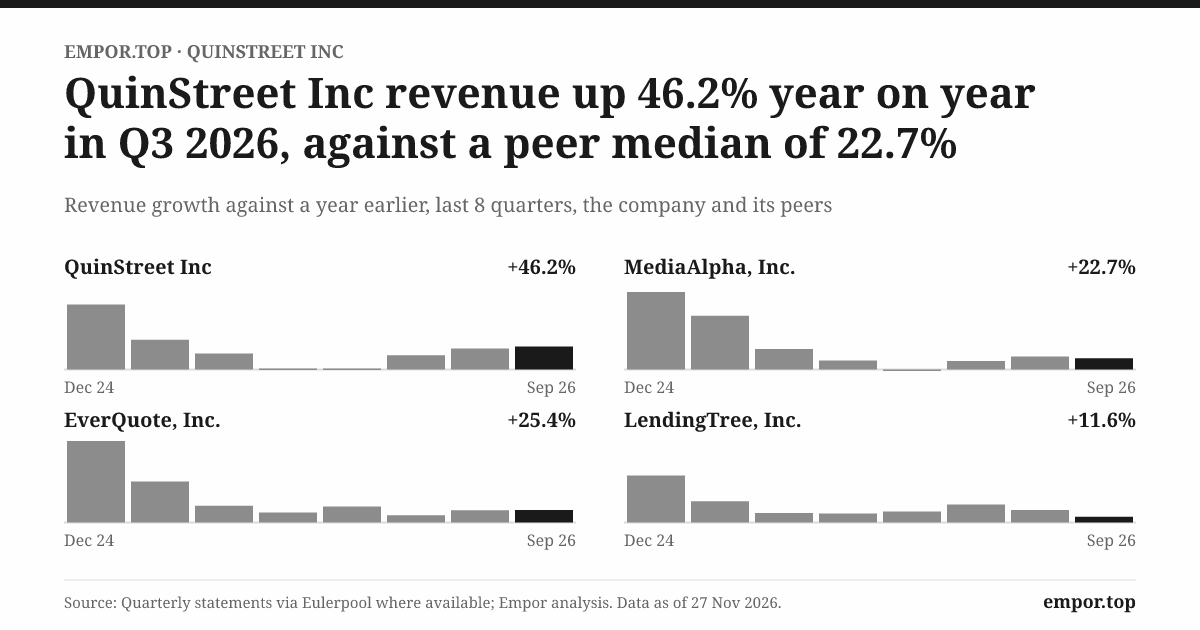
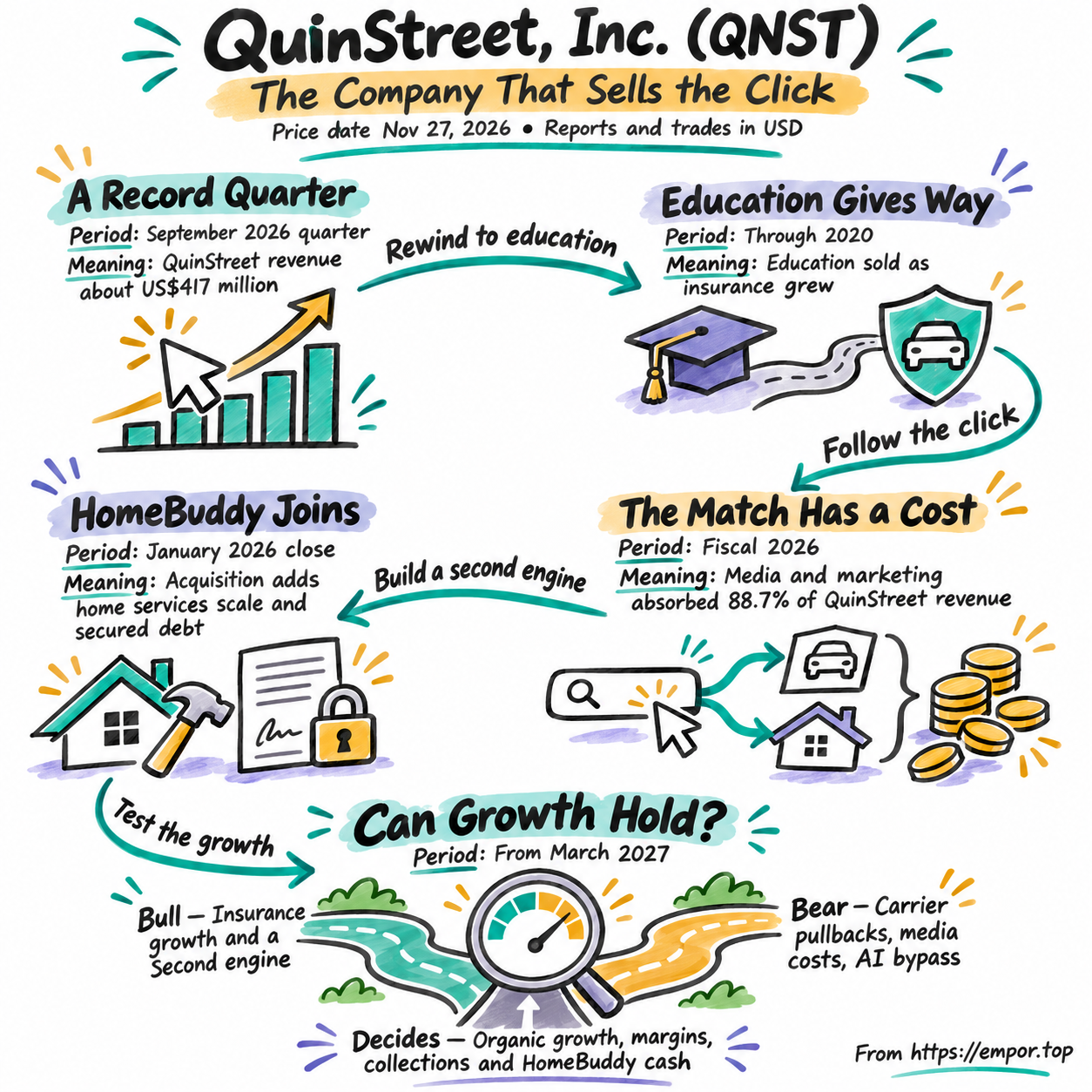
In early November 2026, that strange business produced the best quarter in its history. For the three months to September, QuinStreet reported revenue of about $417 million, up 46% from a year earlier, the first time the company had ever crossed $400 million in a single quarter.1 GAAP net income was about $17 million.1 Home Services, the segment that connects homeowners with contractors, grew 86% and now makes up about 35% of revenue, swollen by the HomeBuddy acquisition that closed in January.1 Financial Services, the older engine built on insurance and loans, grew 31% to about $271 million.1 Management raised its outlook for the fiscal year to June 2027, guiding to revenue of $1.5 billion to $1.6 billion and adjusted EBITDA of $155 million to $165 million.2
To put the quarter in perspective, QuinStreet's revenue for the entire fiscal year ending June 2016 was about $297 million.[^3] A single quarter now brings in more than that full year did. A company that spent most of the 2010s going sideways has, in three years, more than doubled.
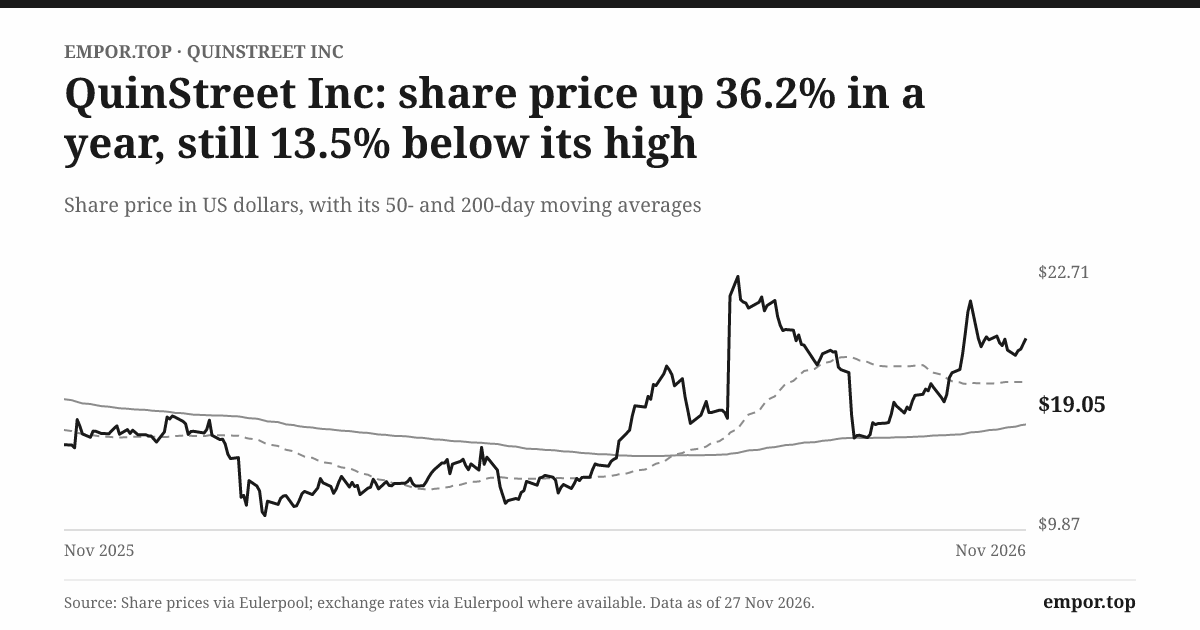
So why does a business with that kind of momentum trade at a market value of only about $1.1 billion, less than one year of revenue? The share price closed at about $19 on November 27, roughly 13.5% below its 52-week high of $22 and comfortably above the low of about $10.56 it touched over the same twelve months. On trailing earnings, the stock trades at about 13.9 times, against a five-year median of 52 times. On its face, that looks like a growth company priced as if growth were about to stop.
The faces of these numbers are deceptive, and the rest of this story is an attempt to look behind them. Five questions decide whether the record quarter is the payoff from a durable marketplace or a lucky mix of acquisitions and a generous moment in customer spending.
The first is how much of the growth is organic. HomeBuddy did not exist inside QuinStreet a year ago, so part of the 46% is simply bought revenue. The second is whether the old financial-services engine is genuinely stronger or merely enjoying a cyclical tide, because insurers spend on customer acquisition when their policies are profitable and slash that spending when they are not. The third is whether margins can survive the cost of media: QuinStreet buys most of the traffic it resells, and in fiscal 2026 nearly 89 cents of every revenue dollar went straight back out the door to pay for media and marketing.3 The fourth is whether the company paid a sensible price for HomeBuddy and can carry the debt it took on to buy it. The fifth, hovering over all of them, is whether artificial intelligence will make an intermediary like QuinStreet more useful or route around it entirely.
There is one more wrinkle in that cheap-looking price-to-earnings ratio, and it matters enough to flag now. The trailing earnings include a large, one-time accounting gift: in the December 2025 quarter, QuinStreet released a tax valuation allowance worth about $60.7 million, a noncash benefit that turned a quarter with roughly $1 million of pretax profit into one with about $50 million of net income.3 Strip that out and tax the remaining profit at a normal rate, and trailing earnings shrink to something closer to 60 cents a share, which would put the multiple in the low 30s rather than below 14. Annualize only the latest quarter, with its $17 million of net income and an ordinary tax charge, and the multiple lands around 16 times. The honest answer to "is this stock cheap?" therefore depends heavily on which slice of a short, volatile profit recovery an investor believes is representative.
That uncertainty is the real subject. The acceleration is real; the quarter alone cannot tell us how much of it is organic, repeatable, or profitable once acquisition costs are counted. To understand why the market hesitates, it helps to go back to an earlier QuinStreet, one that also looked like a diversified growth machine until one of its biggest markets stopped cooperating.
 Subscribe on LinkedIn
II. When the Education Leads Stopped Looking Like Growth
In the summer of 2011, QuinStreet looked like one of the cleanest stories in internet marketing. The company had filed to go public in November 2009, presenting itself as a vertical marketing specialist rather than a consumer brand: it built websites, bought traffic and matched people researching a decision in a particular industry with companies that wanted to sell into it.4 For the fiscal year to June 2011, revenue reached about $403 million, up 20%.5 Adjusted EBITDA was about $90 million, a margin of roughly 22%, and GAAP net income was about $27 million.5
The mix tells the story of what came next. Two businesses carried the company almost equally. Education, which sold inquiries from prospective students to colleges and universities, generated about $176 million. Financial services, mostly insurance, credit cards and mortgages, generated about $182 million.5 Everything else together was less than $50 million.5 To an investor in 2011, that looked like diversification: two big markets, two big pools of advertising budgets, one shared technology platform.
It turned out to be something less comfortable. Education lead generation in that era was heavily tied to for-profit colleges, which spent aggressively to recruit students financed by federal aid. That spending pattern drew regulators. In June 2012, QuinStreet entered into a multistate Assurance of Voluntary Compliance with state attorneys general over its education marketing.[^7] The company did not concede that its sites were misleading, and the agreement was framed as voluntary.[^7] But the episode exposed a structural truth about the business: when you sell a consumer's interest in a regulated product, the regulator of that product is effectively one of your stakeholders, whether or not your name is on the license.
The financial consequences arrived more slowly than a single dramatic collapse would suggest, which is part of why the story is instructive. Revenue drifted down for years. By fiscal 2015, QuinStreet's revenue had fallen to about $282 million, roughly 30% below the 2011 peak, and the company was losing money: an operating loss of about $19 million that year, with losses continuing through fiscal 2017.[^3] A business that had earned a 22% adjusted EBITDA margin was now struggling to break even at the operating line.
The company did not stand still. Financial services kept growing, and by fiscal 2018 revenue had rebounded to about $404 million with an operating profit again.[^3] By fiscal 2019, financial services was 73% of total revenue, at about $330 million, while education had shrunk to 15%, or about $69 million.6 The pivot toward insurance had largely happened before education's sharpest blow.
That blow came from Dream Center Education Holdings. Dream Center had bought a group of for-profit colleges and then fell apart, collapsing into federal receivership. On the fiscal 2019 year-end call in August 2019, CFO Gregory Wong said the decline in education "was due to the loss of DCEH, formerly our largest education client," and that adjusted EBITDA, excluding a one-time charge related to the client, would have been $40.3 million rather than $34.5 million, with the charge costing about $5.8 million.6 He warned that education would remain a tough year-over-year comparison until the company lapped the customer loss at the end of calendar 2019.6
The Dream Center episode is small in dollars but large in what it reveals. A lead business has two exposures to a distressed client, not one. The first is obvious: the client stops buying, so revenue disappears. The second is quieter: the client may already owe money for leads that were delivered and recognized as revenue, and when it fails, that receivable becomes a write-off. In a business that earns thin margins on large gross revenue, a single customer's collapse can erase months of profit from that relationship.
Fiscal 2019 also contained a detail that will echo later in this story. Net income that year was about $62 million on pretax profit of only about $10 million, the gap filled by a large tax benefit.[^3] Reported earnings looked spectacular for a year and then normalized: fiscal 2020 net income fell back to about $18 million.7 QuinStreet has, in other words, been through the experience of a tax-flattered profit year before, and the market has seen what happened to the multiple afterward.
In 2020, QuinStreet finished the job. It sold its education vertical for about $20 million and also divested its business-to-business technology marketing, mortgage and Brazil operations, narrowing the company toward the markets management believed offered better opportunities.7 The same year, it bought Modernize, a home-improvement lead business, for net consideration of roughly $70 million, planting the seed of the segment that now drives the headlines.7
The conventional telling of this history is that QuinStreet escaped a dying vertical and found a better one. The record supports a narrower lesson. Education did not fail because the matching technology stopped working; inquiries still flowed. It faltered because the clients' budgets and the regulatory climate around them changed, and QuinStreet had no control over either. Financial services had been growing all along. What the company learned was that a portfolio of verticals is only as diversified as the independence of the budgets behind them, and that a lead business can look balanced right up to the moment one buyer group pulls back.
That is the lens worth carrying into the present. Today's QuinStreet is concentrated in two markets, insurance and home services, and one insurance client alone accounts for about a fifth of revenue. Before testing whether that concentration is safe, it is worth being precise about what QuinStreet actually sells, and what it does not own.
III. The Product Is a Match, but the Inventory Is Someone Else's
Follow the driver from the opening scene. She searches for cheaper car insurance and lands on a comparison page, either one QuinStreet runs itself or one belonging to a publisher whose traffic QuinStreet buys. She answers a few questions: zip code, age of car, current insurer, driving record. In the background, QuinStreet's systems decide who should see her: which insurers want a driver with her profile in her state today, how much each will pay, and whether she should be shown a list of quotes, passed along as a lead, connected by phone to an agent, or clicked through to a carrier's own site. When she clicks, calls or submits, and the result matches what the client agreed to buy, QuinStreet earns a fee.
That is the entire business in miniature. QuinStreet's clients pay for delivered results, whether clicks, leads, calls, applications or customers.3 Client agreements generally run for short periods, are priced on results delivered, and can usually be cancelled or paused without a minimum commitment or a cancellation penalty.3 QuinStreet sits between three parties: consumers who do not pay it anything, media sources from which it buys or generates their attention, and clients who pay it for the outcome.
A useful analogy is a busy produce wholesaler. The wholesaler does not grow tomatoes and does not run the restaurants that buy them. Its value lies in knowing which farms have what, which kitchens need what, and how to move perishable goods between them faster and with less waste than either side could manage alone. Its margins depend on two prices it does not set: what farmers charge and what restaurants will pay. QuinStreet's tomatoes are moments of consumer intent, and they spoil fast; a driver who wanted a quote this afternoon may have bought a policy by tonight.
The economics of that model are visible in the media bill described earlier.3 The business is also almost entirely American: of fiscal 2026 revenue, about $13 million came from outside the United States, and clients pay predominantly in dollars, so currency is a non-issue and the U.S. insurance and housing markets are the whole story.3
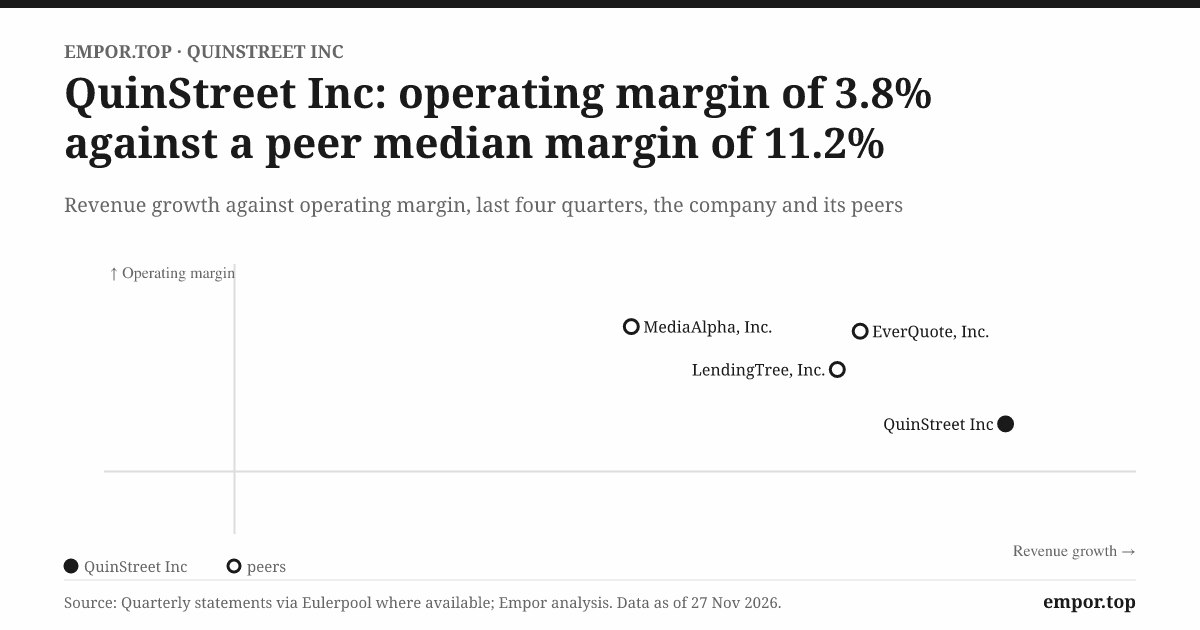
Back to the funnel. That leaves about 11 cents of gross profit from each revenue dollar, up from about 7.5 cents in fiscal 2024.3 Out of those 11 cents the company pays for engineers, salespeople, compliance staff, offices, stock compensation and acquired-intangible amortization, which is why the operating margin for the full year was only about 2.7%.3
That thin layer cuts both ways, and it is worth dwelling on why. Because media costs are so large relative to gross profit, a small improvement in buying efficiency has an outsized effect. If the company can pay one cent less for each dollar of traffic it resells, gross profit rises by about a tenth. That is precisely what seems to have happened between fiscal 2024 and fiscal 2026: the rise from roughly 7.5 to roughly 11.3 cents of gross profit per dollar was worth something like $45 million a year at current revenue, more than the entire fiscal 2026 operating profit. But the same arithmetic runs in reverse. A one-cent increase in what Google, Meta or a large publisher charges for a qualified visitor, unmatched by higher prices to clients, would take away a similar chunk. A company whose gross profit is a sliver between two large flows is, structurally, a business of leverage, and leverage cuts in both directions.
What, then, does QuinStreet do that a client could not do for itself? Management's answer has three parts. The first is reach: by aggregating traffic from its own sites, partner publishers and paid channels, QuinStreet offers clients volume they would struggle to buy one source at a time. The second is matching: data on which consumers convert for which client, accumulated over years, lets QuinStreet price and route each visitor more precisely. The third is plumbing: compliance controls, consent records and direct integrations into clients' systems, which matter in industries such as insurance and lending where a sloppy lead can create regulatory exposure for the buyer. The company says its product set and media relationships let it capture more of each client's budget.2
The evidence for those claims is real but partial. The gross-margin improvement is the strongest piece: whatever QuinStreet changed in its media buying and product mix, it is extracting more value per dollar of traffic than it did two years ago. Reinvestment has continued, too. Product-development expense rose from about $30 million in fiscal 2024 to about $37 million in fiscal 2026, and the company capitalized another $9 million to $11 million of internal software development each year.3 Headcount grew from 899 at June 2024 to 1,074 at June 2026, partly through HomeBuddy.38 That is not the profile of a company harvesting an old asset.
The evidence against overclaiming is just as important. QuinStreet does not own the media market. It does not disclose a share of recurring revenue, because there is none in the subscription sense; every quarter's revenue has to be re-earned from clients who can redirect their spending at little notice.3 It does not report client retention, the number of active clients, or spending per client over time, the very statistics that would show whether customers find it costly to leave. The gross-margin gain is therefore evidence that QuinStreet runs its marketplace better than it did. It is not, on its own, evidence that clients cannot leave.
The balance sheet adds a working-capital clue. Because QuinStreet usually pays its media suppliers before or around the time its clients pay it, the speed of collection matters. Measured as days of revenue, receivables peaked at about 67 days in fiscal 2024 and improved to about 51 days in fiscal 2026.3 By September 2026, net receivables had grown to about $207.5 million, up from about $181 million in June.9 That sounds alarming until it is set against the quarter's sales: $207.5 million was roughly 46 days of the September quarter's revenue, so receivables grew roughly in step with the business rather than faster than it. The allowance for credit losses and revenue reserves was only about $3.7 million at September.9 QuinStreet does not publish an ageing table, so investors cannot see how much of that balance is overdue; the best available signals are the pace of receivables growth relative to sales and the concentration of what is owed. That concentration is meaningful.
The company's regulatory history belongs here too, briefly. The 2012 education agreement showed that compliance is not an optional feature for a business that markets regulated products, and today QuinStreet sells compliance as part of what clients buy. But compliance is table stakes rather than a lock-in by itself: every serious competitor in insurance lead generation must offer the same kinds of consent and data controls, and a client that is satisfied with a rival's controls can move its budget.
So the product is a match, and the match is valuable. The inventory, however, belongs to someone else, and the buyers can walk. Nowhere is that tension more consequential than in the insurance market that produces nearly two-thirds of QuinStreet's revenue.
IV. The Insurance Market Is Large Enough to Hide a Commodity
Picture the marketing department of a large American auto insurer in 2023. Claims costs had spiked as repair bills, parts prices and medical costs rose faster than premiums could be repriced. Every new customer acquired at the old rates was a customer the carrier would lose money on. So carriers did the rational thing: they cut acquisition spending, sometimes drastically. Now picture the same department in late 2024, after a long series of rate increases had restored underwriting profit. Suddenly every new policyholder was worth having again, and budgets came roaring back.
QuinStreet's quarterly results trace that arc with almost uncomfortable precision. In the September 2023 quarter, revenue was about $123 million, down 14% from a year earlier, and the company lost nearly $10 million at the operating line.[^3] A year later, revenue had more than doubled to about $279 million, and in the December 2024 quarter it grew 131%.[^3] Management attributed the rebound largely to insurance carriers returning to spending as their profitability improved.8 Then growth slowed abruptly: in the September and December 2025 quarters, revenue grew only about 2%.[^3] The engine had not broken; it had simply lapped the surge.
This is the context for the latest numbers. Financial Services generated about $271 million in the September 2026 quarter, up 31%, and management cited broad demand across its carrier base.12 For fiscal 2026 as a whole, financial-services revenue grew about 9%, with insurance revenue up about $79 million on higher demand from a broad carrier base.3 The question is not whether insurers are spending; they clearly are. It is how much of that spending QuinStreet would keep if the cycle turned.
QuinStreet is not alone in the field. In its annual report, the company lists MediaAlpha, LendingTree, advertising agencies and other online marketing companies among its competitors.3 EverQuote is another visible insurance marketplace. Some quick scale comparisons help, as long as they are treated as signals of size rather than market share. MediaAlpha reported about $1.1 billion of revenue for calendar 2025.10 EverQuote reported about $693 million.11 QuinStreet's fiscal 2026 revenue of about $1.3 billion places it among the largest participants, but it also spans home services and loans, and the companies present revenue differently. No harmonized market-share estimate exists, so the honest conclusion is that QuinStreet is a scaled player in a contested market, not a dominant one.
War-game the forces around it. Start with the buyers. Insurers are large, sophisticated and data-rich, and they can pause a campaign with an email. One client represented about 21% of QuinStreet's fiscal 2026 revenue; in fiscal 2025, two clients represented about 23% and 12%.3 At September 2026, one client was about 19% of quarterly revenue, and two clients accounted for about 19% and 11% of net receivables.9 QuinStreet does not name these clients. The top 20 clients contributed about 58% of fiscal 2026 revenue, down from 62% the year before, a modest broadening.3 Still, when a fifth of revenue comes from one buyer with no minimum spend, that buyer holds real bargaining power over price, lead quality standards and payment terms.
Then the suppliers. QuinStreet's raw material is traffic, much of it purchased from search engines, social platforms and publishers. Those suppliers are, in several cases, far larger than QuinStreet, and they set prices through auctions in which QuinStreet's competitors and its own clients also bid. A carrier that finds it can buy search traffic directly at a lower effective cost does not need an intermediary for that slice of its budget.
Then substitutes and rivals. Consumers can shop through captive agents, independent agents, carrier websites, comparison apps, or, increasingly, through AI assistants. Agencies and rival marketplaces compete for the same marketing dollars. New entrants face real barriers in data, compliance and client integrations, but the barrier is lower for well-funded adjacent players than for a startup.
Against that backdrop, QuinStreet's claim to win rests on its scale and technology. That combination plausibly lowers a carrier's cost of acquiring a customer relative to doing everything itself, which is why the carriers keep buying. What the public record does not show is whether QuinStreet earns better economics than its rivals for doing so, or whether clients would pay more to keep it. The company discloses no retention rate, no conversion data, no client-level economics and no measure of price realization.
There is a test that could falsify the moat thesis, and it uses numbers QuinStreet does report. If revenue keeps rising while the share from the largest client climbs, receivable days stretch and gross margin stalls, that pattern would suggest scale is buying volume from powerful customers rather than conferring power on QuinStreet. If instead revenue grows with a broadening client base, stable collection and rising margins, the case for a genuine advantage strengthens. The fiscal 2026 data points modestly in the second direction: top-20 concentration eased, receivable days improved and gross margin rose. The September quarter's single-client share of 19% of revenue is a reminder that the dependence has not gone away.
Finally, separate the tide from the boat. The carrier spending surge of 2024 and 2025 lifted every insurance marketplace, not only QuinStreet. A company-specific edge would show up as outperformance through a downturn, and the most recent downturn, in 2022 and 2023, showed QuinStreet suffering alongside the industry, with operating losses in both fiscal 2023 and fiscal 2024.8 History does not reject the claim that QuinStreet has an edge; it narrows it. The edge is in execution within a cycle, not insulation from the cycle.
So the insurance engine is large, well-run and exposed. Whether that engine generates earnings an investor can rely on is a separate question, and the profit-and-loss statement tells a twistier story than the revenue line.
V. Growth Returns, but Profit Does Not Arrive in a Straight Line
Lay two years side by side. In fiscal 2024, QuinStreet lost about $31 million.3 In fiscal 2026, it earned about $81 million.3 A swing of more than $110 million in two years, on a market value of about $1.1 billion, is the kind of turnaround that sends value screens blinking. The temptation is to take the later figure, divide it into the share price, and declare a bargain. The more careful approach is to ask what changed underneath.
Part of the change is genuine. Revenue grew from about $580 million in fiscal 2023 to about $1.3 billion in fiscal 2026, roughly 31% a year.83 Operating profit, the cleanest measure of whether the core business makes money before financing and taxes, moved from losses of about $21 million in fiscal 2023 and $28 million in fiscal 2024 to a profit of about $35 million in fiscal 2026.3 Over the last twelve months to September 2026, operating profit reached about $54 million, and the September quarter alone produced about $23 million at a margin of 5.6%, the best in the period.31 The business has crossed from loss to profit at the operating line and is widening that profit as revenue scales. That is not an accounting illusion.
But the jump in net income needs a qualification, and it is a large one. Of the roughly $81 million of fiscal 2026 net income, about $60.7 million came from the noncash release of a deferred-tax valuation allowance.3 In plain terms, a company that has lost money in the past accumulates tax losses it can use to shelter future profits. Accounting rules require it to keep those potential tax savings off the books, through a valuation allowance, until it can show it is likely to earn enough to use them. Once profitability looked durable enough, QuinStreet's accountants concluded the tax assets were now usable and booked them as a one-time gain. The judgment is reasonable, and it says something positive about management's and the auditors' confidence in future profits. It does not, however, represent cash earned from customers in the year, and it will not repeat.
The company's history sharpens that caution: fiscal 2019 also had a tax-flattered profit year.[^3] Four years later, in fiscal 2023, a pretax loss of about $21 million became a net loss of about $68 million, a gap consistent with tax assets being written back down as the business slipped into losses.8 Tax assets that are recognized in good times can be reversed in bad ones. An investor judging recovery quality should therefore look first at operating profit and cash flow, not at the bottom line.
Cash flow, on its face, tells a more flattering story. Fiscal 2026 operating cash flow was about $131 million, against net income of about $81 million and operating profit of about $35 million.3 Over the twelve years from fiscal 2015 through fiscal 2026, QuinStreet generated about $451 million of operating cash against only about $50 million of cumulative net profit.[^3]3 Taken at face value, that would suggest earnings massively understate the business's economic output.
The explanation is partly benign and partly not. Depreciation and amortization, about $25 million in fiscal 2026, is a real noncash charge for a company with acquired intangibles and capitalized software.3 The largest single item, though, is stock-based compensation: about $37.4 million in fiscal 2026, roughly equal to the year's entire operating profit.3 Cash-flow statements add stock compensation back because no cash leaves the company when it is granted. But it is a real cost to shareholders, paid in dilution rather than dollars. A company that pays a meaningful slice of its workforce in shares and then spends cash buying those shares back has converted the noncash expense into a cash one, just one line further down the statement. Working-capital swings, which moved in QuinStreet's favor in fiscal 2026 as payables lengthened, add further noise.3 The recent filings explain the direction of the twelve-year gap; they do not reconcile all of it, and the historical cash-to-profit ratio should not be treated as a clean measure of earnings quality.
This matters for how the market reads management's preferred metric. QuinStreet guides on adjusted EBITDA, which excludes stock compensation, depreciation and amortization, and acquisition-related items. Guidance of $155 million to $165 million for fiscal 2027 sounds very different from twelve-month GAAP operating profit of about $54 million.23 Both numbers are accurate. The gap between them is largely stock pay and the amortization of things QuinStreet bought, and an investor who wants to know what the business earns for owners has to decide how much of that gap to treat as a real cost.
Reinvestment has continued through the recovery, but it has not grown as fast as revenue. Product development rose to about $37 million in fiscal 2026, yet fell from about 4.9% of revenue in fiscal 2024 to about 2.9%.3 Capital expenditure stayed small, a few million dollars a year, with capitalized internal software of about $11 million in fiscal 2026.3 Declining research intensity as revenue scales is a normal source of operating leverage. It becomes a concern only if it signals that the technology edge the company claims is being under-funded relative to rivals, and there is no public peer benchmark precise enough to say so.
Three operating signals cut through the noise. The first is organic revenue growth by vertical, which tests whether demand is broadening or merely being acquired. The second is gross and operating margin, which tests pricing against media costs. The third is receivable days, which tests whether the cash actually arrives. In fiscal 2026, all three moved the right way. The next twelve months will show whether that persists once the largest acquisition in QuinStreet's history is fully inside the numbers.
VI. HomeBuddy: A $180 Million Bet on the Next Vertical
On January 5, 2026, QuinStreet announced that it had closed the acquisition of HomeBuddy, a platform that connects homeowners with contractors for home-improvement projects.[^14] To pay for it, the company did something it had largely avoided for years: it took on meaningful secured debt, drawing on a new revolving credit facility.3 For a business that had spent most of its public life with little or no borrowing, it was a decisive bet that home services could become a second engine as large and as profitable as insurance.
The price, as later recorded in the accounts, was about $179.7 million on a preliminary basis: about $114.8 million in cash at closing and about $64.9 million as the fair value of deferred payments due later.3 At announcement, management said it expected HomeBuddy to contribute at least $30 million of adjusted EBITDA in its first twelve months after closing.[^14] Divide one by the other and the purchase price comes to roughly six times that forecast, before any synergies. That is a modest multiple for a growing internet business, if the forecast holds. The important caveat is the "if": the six-times figure is an announcement-based benchmark built on management's own adjusted forecast, not a realized multiple on audited standalone earnings.
QuinStreet does not publish HomeBuddy's standalone historical revenue or earnings in its annual and quarterly filings, and there is no clean set of comparable private transactions against which to judge the price.3[^15] The pro forma financial information filed after the deal provides combined figures, but the purchase-price allocation and the subsequent integration make it hard to isolate HomeBuddy's own trajectory.[^15] An honest observer therefore cannot say whether QuinStreet bought cheaply or expensively. What can be tested is whether HomeBuddy delivers the contribution management promised, at what integration cost, and how quickly the cash spent comes back.
The early numbers make HomeBuddy impossible to ignore. It contributed about $88.9 million of revenue in the roughly six months it was part of fiscal 2026.3 By the September 2026 quarter, Home Services as a whole reached about $145.7 million, up 86%.1 Do the rough arithmetic: if HomeBuddy alone was running at the roughly $45 million a quarter its first half-year implies, then the legacy home-services business, built on Modernize, still grew in the quarter, but at something closer to a quarter than to 86%. That estimate is approximate, because QuinStreet does not break out HomeBuddy's quarterly revenue, but it shows why headline segment growth flatters the organic picture.
HomeBuddy also sits on the shoulders of an earlier bet. In 2020, QuinStreet bought Modernize for net consideration of roughly $70 million, at a time when home services was a minor vertical.7 Over the following years the company built the segment out, and that experience is the best evidence that it knows how to operate in this market. The new deal is roughly two and a half times larger, and it is financed differently, which raises the stakes for execution.
The financing deserves a closer look. QuinStreet arranged a $150 million senior secured revolving facility with MUFG; at September 2026, $70 million was drawn and $80 million remained available.9 The facility matures on January 2, 2031, carries a floating rate above SOFR or a base rate, and is secured by liens over substantially all of the company's assets and those of certain subsidiaries.39 It includes leverage and interest-coverage covenants, and QuinStreet was in compliance at quarter end.9 On top of the bank debt, the company owed about $68.7 million of post-closing acquisition payments and about $11.5 million of contingent consideration at June 2026.3 Against that, cash was about $141.5 million at September.9
Put those numbers together and the balance sheet looks neither stretched nor idle. Cash roughly covers the drawn revolver and a good portion of the acquisition obligations, but not all of both at once. The company has room, and the lender's willingness to extend secured credit is independent evidence that a bank views the cash flows as reliable. Covenant compliance, however, is a snapshot of current capacity, not proof that leverage is immaterial. In a business whose largest customers can pause spending, a sharp cyclical downturn would test those covenants at exactly the moment cash flow weakened. Interest expense, about $4.4 million in fiscal 2026, is manageable today.3
Then there is the question of how the acquisition sits alongside buybacks. In fiscal 2026, QuinStreet repurchased about 2.3 million shares for about $31.4 million, and about $25.4 million remained under its $40 million authorization at June 30.3 It made no repurchases in the September quarter.9 Repurchases of that size roughly offset the dilution from stock compensation rather than shrinking the share count meaningfully. A skeptical shareholder might ask whether buying back stock in the same year as borrowing for an acquisition reflects a coherent capital-allocation rule or simply two programs running in parallel. Management has not articulated an explicit framework that ranks repurchases, debt reduction and deals against one another.
On the September quarter call, management described the integration as going well.2 The skeptical follow-up is whether HomeBuddy is producing profitable, incremental client and media relationships after acquisition accounting, not simply adding acquired revenue to the top line. The first anniversary of the closing will arrive in January 2027, and with it the first chance to compare realized contribution against the $30 million forecast. That comparison, and the pace at which deferred payments and revolver borrowings come down, will say more about the quality of the deal than any multiple calculated on announcement day.
The person who will be judged on that outcome has been running QuinStreet for more than a quarter century.
VII. Doug Valenti's Long Tenure Meets a New Capital Cycle
Doug Valenti has been QuinStreet's chief executive since 1999, which means he has run the company through the dot-com bust, the rise of search advertising, the boom and regulatory reckoning in education marketing, the long stagnation of the 2010s, the insurance whiplash of 2022 to 2024 and now the biggest acquisition in its history.12 He is also chairman of the board.12 In a sector where founders often hand over to professional managers once a company goes public, a 27-year tenure is unusual. It means the strategy on the table today is not inherited; it is his, and so is the record against which it should be judged.
That record contains both pruning and expansion, and it rewards being read as a whole rather than selectively. On the pruning side, Valenti's team sold education, business-to-business technology marketing, mortgage and Brazil, accepting a smaller company in exchange for a more focused one.7 On the expansion side, Modernize turned into a meaningful home-services franchise, and HomeBuddy is a much larger wager on the same thesis. In between sits a decade in which revenue took about seven years to climb back to its fiscal 2011 level, a reminder that the long tenure includes long stretches of disappointment as well as the current recovery.[^3]5
How is the chief executive paid, and does that pay line him up with outside shareholders? Valenti's reported compensation was about $6.8 million for fiscal 2026, down from about $7.7 million in fiscal 2025, with roughly 91% in stock awards and no cash bonus or non-equity incentive pay.12 CFO Gregory Wong received about $2.9 million.12 Stock-heavy pay gives the leadership a direct interest in the share price, and the absence of a cash bonus in a year of record revenue is notable restraint. But ownership is modest. Valenti held about 1.9% of the shares, and directors and executive officers together held about 3.5%.12 That is enough to care about, not enough to control. QuinStreet is a widely held company; the largest disclosed holders were institutions, with BlackRock at about 14.6% and Private Capital Management at about 11.1%, though those figures rest on regulatory filings from April 2025 and February 2024 and should not be read as today's register.12
Governance is conventional. Every director other than Valenti was deemed independent, and the board has a lead independent director to balance the combined chairman and CEO role.12 At the October 2026 annual meeting, shareholders approved executive pay by a wide margin, with about 42.7 million votes for and about 1.1 million against, and withheld between roughly 1.3 million and 2.6 million votes from individual directors.13 They also approved about 2.16 million additional shares for the employee stock purchase plan, a further source of potential dilution to set alongside the stock awards.13 None of this amounts to a referendum on HomeBuddy. It is simply evidence that shareholders were not, as of October, in revolt.
The more revealing test of management is how it talks about results, and the September quarter call offered a good example. Management raised its fiscal 2027 guidance after the quarter, and described the margin expansion of the preceding year as a mix of higher volume, leverage on semi-fixed costs and acquisition effects.2 Analysts pressed for the split: how much came from HomeBuddy, how much from better media buying, how much from simply growing faster than overhead. Management did not quantify the separate contributions.2 That is not evasion in any dramatic sense; many companies decline to break out such figures. But it leaves the investor unable to distinguish durable efficiency from favorable mix, which is precisely the distinction that matters most for valuing a thin-margin marketplace.
There is an earlier precedent for how this management describes trouble. In August 2019, as Dream Center collapsed, Wong told investors that education would be a tough comparison until the company lapped the loss at the end of that calendar year, and that is broadly what happened, though the eventual answer was to sell the vertical outright.67 Management's forward statements in that episode were specific and, within their scope, accurate. The current claims, that the integration is going well and that margins will keep expanding, are similarly testable. The next several quarters will show whether Home Services growth, segment margins, acquisition-related cash needs and guidance line up with what management told investors in November.
The auditors provide one more independent check. PwC issued unqualified opinions on QuinStreet's fiscal 2026 financial statements and on its internal control over financial reporting.3 It flagged two critical audit matters: revenue recognition and the valuation of the customer relationships acquired with HomeBuddy.3 Critical audit matters are not qualifications; they are areas where the auditor had to exercise especially complex judgment. But they are a useful map of where the accounting is most dependent on estimates, and both sit squarely on the questions this story is asking. Elsewhere, the company disclosed about $1.0 million of litigation-settlement expense in fiscal 2026 and about $2.9 million of uncertain tax liabilities whose timing could not be estimated, and said pending legal matters were not reasonably expected to have a material adverse effect.3
The verdict on management is therefore a measured one. Long tenure and equity-heavy pay create partial alignment, and the team has shown it can cut losing businesses and build new ones. But the capital cycle has changed. For the first time in years, QuinStreet is carrying secured debt and deferred acquisition payments, and the credibility of the strategy now rests on measurable outcomes rather than on tenure. Those outcomes will be shaped by a force that no management team in this industry fully controls: the way consumers find products is changing again.
VIII. Can QuinStreet Become the Control Layer for AI Shopping?
Imagine the driver from the opening scene a year or two from now. Instead of typing a search and clicking through a comparison page, she asks an AI assistant to find her cheaper car insurance. The assistant asks her the same questions a quote form would, then comes back with three options. Who decided which three? Who verified that she consented to be contacted? Who passed her details to the insurer in a format its systems could accept, and who gets paid when she buys?
On the September 2026 quarter call, QuinStreet's management offered its answer. AI agents, in their view, will still need what QuinStreet provides: structured data about which consumers fit which products, compliance controls over consent and disclosures, and integrations into the systems of insurers, lenders and contractors.2 Management said the company was already integrating with AI platforms and using AI internally to improve efficiency.2 It also acknowledged the obstacles: clients worry about security, compliance and brand control, and some are wary of letting AI agents access their systems directly, while new channels can create conflict with existing ones.2 The pitch, in short, is that QuinStreet can become the control layer between AI front ends and the businesses that ultimately serve the customer.
It is a coherent thesis, and it has a genuine logic. Buying insurance or hiring a roofer is not like buying a book. The product varies by state, by risk profile and by local availability; the seller is regulated; and a mismatched lead wastes money on both sides. An AI assistant that wants to complete such a transaction needs somewhere to send the consumer, and a marketplace that is already wired into many carriers and contractors is an obvious candidate. In that world, AI could be a new source of traffic for QuinStreet rather than a competitor for it.
The bear case is equally coherent, and it starts with where the consumer's intent is captured. Today, a large share of the traffic QuinStreet resells originates in search and on publisher sites, where QuinStreet can buy access. If AI assistants answer questions directly rather than sending users to websites, the supply of that traffic could shrink or be repriced. If the AI platforms themselves build direct integrations with the largest insurers, they could bypass intermediaries for the most valuable consumers, leaving marketplaces with the harder-to-place remainder. And if AI makes it easier for carriers to build their own acquisition tools, one of QuinStreet's selling points weakens.
None of this is a new kind of risk for QuinStreet, only a new form of an old one. The company's own risk disclosures have long named changes in search engines' algorithms and policies, alongside regulation, interest rates and seasonal swings, as forces that can change the volume and price of the traffic it depends on.3 Every few years, a platform decision somewhere upstream has altered how many consumers reach comparison pages and what it costs to reach them. AI is the largest such shift in a generation, but the company has spent its whole life adapting to someone else's distribution decisions. The question is whether this shift, unlike the others, moves the point of decision so far upstream that the marketplace is no longer where the match is made.
The useful question is where the control actually sits. It could sit with the consumer-facing AI platform, which owns the conversation. It could sit with the media supplier, which owns the attention. It could sit with the insurer or contractor, which owns the product and the customer relationship. Or it could sit with the marketplace coordinating the match. QuinStreet's history suggests that the marketplace's share of value depends on how fragmented the other parties are. Where buyers and media are fragmented, the coordinator earns a decent spread. Where one party concentrates, the coordinator's margin compresses. AI, by concentrating consumer attention in a few assistants, could shift the balance toward the platforms.
There is a meaningful asymmetry in what can be measured today. QuinStreet does not disclose any revenue, client spending or contribution from AI channels.2 Home Services, by contrast, is already a measurable growth vector, with about $145.7 million of revenue in the September quarter.1 One is a business; the other is an aspiration. Its history offers a useful calibration: revenue recovered after falling well below its 2011 level.[^3] That record does not reject the AI opportunity, but it argues for treating it as optionality rather than as a pillar of the investment case.
What would convert the thesis into evidence? Three things, and they are straightforward. The first is profitable volume that the company attributes to AI integrations, disclosed in a way that can be tracked. The second is evidence that the volume is incremental, meaning new client budgets or new consumers rather than existing traffic arriving by a different door. The third is a candid explanation of any traffic substitution, if search volumes decline and AI volumes rise. Until those appear, the control-layer idea remains management's thesis rather than a demonstrated advantage.
With growth, margins, the acquisition, management and AI each examined, the investment question can finally be posed directly: at today's price, what exactly is the market being asked to believe?
IX. Analysis & Bear vs. Bull Case
The stock's roughly 63% peak-to-trough fall over five years and annual volatility of about 57% say something important. This is not a sleepy stock that drifts toward fair value; it is one that swings violently as investors argue about whether the latest cycle is the new normal.
Enterprise value is about 13.6 times trailing EBITDA and about 20 times trailing operating profit. Free cash flow over the trailing period represents a yield of about 11%. Against its own five-year median price-to-earnings ratio of 52, the stock looks cheap. But that median is a poor anchor, because QuinStreet's earnings were tiny or negative through much of the period, making for an enormous multiple. It reflects a period when the company was barely profitable, not one when investors were paying a premium for durable profits.
The more useful comparisons are with operating reality and with peers. The tax-adjusted and annualized earnings comparisons put the multiple between the low 30s and the mid-teens. The free-cash-flow yield also flatters, given the weight of stock compensation and the role of buybacks in offsetting dilution. EverQuote, the closest listed insurance-marketplace comparison, traded at about 9 times earnings on the same date.14 That single data point should not be over-read, because the companies' mix and earnings histories differ, and no harmonized multiple set across MediaAlpha and other peers is available. It does suggest that the market applies modest multiples to the whole category, presumably because it views insurance lead generation as cyclical.
Now the bull case, as its strongest advocates would put it. Financial Services is growing at a 31% clip without any acquisition help.1 Home Services gives QuinStreet a second material vertical, though HomeBuddy's contribution remains to be proven. Revenue and operating margins have scaled sharply since fiscal 2023.831 Fiscal 2027 guidance implies further growth, and a business with this much operating leverage could see profits grow far faster than revenue.
The bear case is just as serious. Client spending can stop at short notice, concentration is high, and media costs leave margins exposed. AI could reshape how consumers find financial and home-service products, and QuinStreet does not yet disclose any AI-channel revenue. GAAP earnings were flattered by a large tax release, which has a precedent in the company's history. HomeBuddy's contribution remains a forecast, and the company now carries secured bank debt plus deferred acquisition payments.
Where does the moat argument land? Run it through Michael Porter's five forces first. Buyer power is high: insurers are large and sophisticated, and client concentration is significant. Supplier power is also significant: large traffic platforms set prices through auctions. The threat of substitutes is real and rising, from direct carrier acquisition to AI assistants. Rivalry is intense among marketplaces and agencies. The threat of new entrants is moderate, tempered by the data, integrations and compliance infrastructure a newcomer would need. An industry with powerful buyers and suppliers and active rivals in the middle rarely earns fat margins, and QuinStreet's 11% gross margin is consistent with that structure.
Hamilton Helmer's seven powers framework sharpens the question of whether QuinStreet has anything durable inside that tough structure. Scale economies are the most plausible power: a larger marketplace can spread its technology and compliance costs over more transactions, and more clients mean more ways to monetize each visitor. The gross-margin improvement is consistent with that. Network effects exist in a weak form, since more clients make the marketplace more valuable to traffic sources and vice versa, but clients and publishers multi-home, which limits the effect. Switching costs appear modest: integrations take effort, but contracts are short and cancellable, and the company publishes no retention data to prove otherwise. Process power, the accumulated know-how of running vertical marketplaces through multiple cycles, is a plausible source of advantage but is hard to observe. Counter-positioning, brand, and cornered resources do not apply in any convincing way; consumers do not know the QuinStreet name, and the company owns no unique asset its rivals cannot obtain. The honest summary is that QuinStreet has real operating know-how and scale advantages, but public filings do not establish strong switching costs or durable pricing power. Customer retention and organic client-spend data would be needed to make the stronger claim.
An activist-minded skeptic would press three points. The first is disclosure: a company asking investors to value it on margin expansion should split that expansion into organic efficiency and acquisition effects, and should disclose organic growth by vertical. The second is capital allocation: borrowing for an acquisition while also buying back stock deserves an explicit framework, especially when the buybacks mostly neutralize stock-based dilution. The third is the gap between adjusted EBITDA and GAAP operating profit, driven by stock compensation roughly the size of operating profit; investors who use the adjusted figure should be clear that they are ignoring a real cost.
The skeptical investor's test is simple to state. If QuinStreet can fund the HomeBuddy obligations from cash flow and still show organic growth, rising margins and stable receivables, the acquisition will have strengthened the platform and the current multiple will look modest in hindsight. If margins depend on favorable media pricing or on acquired volume, and the insurance cycle turns, the multiple may not be a bargain at all.
Three numbers belong on the dashboard, and only three. The first is organic revenue growth by vertical; Financial Services grew 31% in the September quarter without acquisition help, while Home Services' 86% includes HomeBuddy.1 The second is operating margin with acquisition effects explained; the latest reading was 5.6%, up from about 1.7% a year earlier.1 The third is receivable days alongside client concentration; receivable days were about 51 for fiscal 2026, improved from 67 two years earlier, while the largest client accounted for about 19% of the latest quarter's revenue.39 Those three numbers will tell investors more about whether the moat is widening than any valuation multiple can.
X. Business & Investing Lessons
Go back to QuinStreet in 2011, selling two very different kinds of consumer intent through the same machinery. On one side, a prospective student wondering whether a degree could change her life. On the other, a driver wondering whether he was overpaying for car insurance. The software that matched them to buyers was much the same. The fates of the two businesses were not. One was sold for about $20 million in 2020, less than a decade later, after regulators and a client collapse had done their work.7 The other grew into an engine that now produces about 65% of the company's revenue.1 The lessons QuinStreet teaches come out of that divergence, and out of everything the company has built since.
The first lesson is that a marketplace can own the match without owning the market. QuinStreet has learned to extract more gross profit from each dollar of traffic, but media and marketing still absorbed about 88.7% of revenue in fiscal 2026.3 It owns the moment in between, and the moment is narrow. For founders, the wider point is that a business built on brokering someone else's inventory to someone else's customers can grow large without ever becoming powerful. Scale is necessary, not sufficient. The question to keep asking is which party in the chain could most easily do without you, and what you are doing to make that harder.
The second lesson is that diversification starts when the next vertical can pay its own way. QuinStreet's 2011 mix looked balanced, but the budgets behind the two verticals were not independent enough to protect it when education faltered. The later pivot into financial services and home services succeeded because each new vertical generated revenue that stood on its own before it was asked to carry the company. Investors evaluating any multi-vertical marketplace should ask not how many verticals it serves, but how independent the budgets behind them really are. Insurance and home improvement respond to different forces, which is a better kind of diversification than education and insurance turned out to be. It is still not immunity, because both depend on the same traffic channels.
The third lesson is that a good acquisition is a forecast that survives contact with cash. At announcement, the company said HomeBuddy would contribute at least $30 million of first-year adjusted EBITDA, against a preliminary purchase price of about $180 million.[^14]3 On paper, that is six times earnings for a business growing quickly in a large market. But paper is where every acquisition looks good. The deferred payments still have to be made, the revolver still has to be repaid, and the forecast is in adjusted terms that exclude the very stock compensation and amortization a long-term owner pays for. The test of HomeBuddy is not the multiple on announcement day; it is the cash that comes back over the next several years, measured against the cash that went out. For any acquirer, the discipline is to write down, at the moment of purchase, what success would look like in cash terms, and then to report against it.
The fourth lesson is that revenue is the easy part of a lead business; profitable attention is the scarce part. QuinStreet has proven again and again that it can grow revenue. It grew strongly in 2011, again after the education exit, explosively in 2024 and 2025, and again in the latest quarter. What has been far harder to sustain is margin, because every new dollar of revenue requires a new dollar of attention bought from someone else, and the price of that attention moves. Its earlier operating losses show what happens when revenue and attention costs move against each other.[^3]8 The investor who wants to understand a lead business should spend less time on the top line and more on the spread between what clients pay and what attention costs, and on how concentrated the client side of that spread has become.
There is a fifth, quieter lesson in the tax line. QuinStreet's tax-related earnings swings can make its bottom line a poor standalone measure of the business.[^3]83 Accounting gains of that kind are not fraudulent or even unusual; they are a legitimate reflection of management's and auditors' view of the future. But they make the bottom line a lagging indicator of confidence rather than a measure of the business. A price-to-earnings ratio built on such a year tells an investor about the accountant's mood as much as the company's earnings. The cure is old-fashioned: read the operating line, read the cash-flow statement, and treat the tax line as a footnote.
XI. Epilogue
Tonight, QuinStreet stands at a historic high by revenue measures. It reported its first quarter above $400 million1 and raised its fiscal 2027 outlook, while the company said the HomeBuddy integration was going well.2 Home Services contributed about $145.7 million in the September quarter.1 The balance sheet carries real debt for the first time in years, but also more cash than it held at any fiscal year-end in the past decade.93
The next few moments will decide whether this is a new plateau or a cyclical peak. The first comes early in 2027, when QuinStreet reports its December quarter. That will be the last quarter in which HomeBuddy inflates the year-over-year comparison, since the acquisition closed in January 2026. From the March 2027 quarter onward, Home Services growth will be measured against a base that already includes HomeBuddy, and the organic growth rate of that segment will finally become visible in the headline number. If Home Services keeps growing at double-digit rates once the acquisition is lapped, the second-engine thesis will have passed its first real test. If growth collapses to low single digits, investors will conclude that much of the 2026 surge was bought.
The second moment is the first anniversary of the HomeBuddy closing in January 2027. The first-year adjusted EBITDA forecast will come due, and it will be revealing to see whether management reports against it explicitly and whether the deferred payments and $70 million revolver draw begin to come down in the quarters that follow.[^14]9 A company that pays down acquisition debt from organic cash flow while growing has demonstrated something. A company that borrows more, or that stops talking about the forecast, has demonstrated something else.
The third moment is less a date than a pattern: the insurance cycle. Carrier spending surged in 2024 and 2025 as underwriting profits returned, and it remains strong today. Insurance cycles do turn, however, and when carriers next feel the squeeze, they will cut acquisition budgets as they did in 2023. QuinStreet's ability to grow through that period, or at least to shrink less than its peers, will be the clearest test of whether its marketplace has become more essential to its clients or merely bigger.
Underneath all three moments sit two quieter signals this story has returned to throughout. If client concentration rises well above a fifth of revenue, the growth story becomes more dependent on one customer's continued enthusiasm. If receivable days reverse their improvement and climb toward the fiscal 2024 peak,3 the company will be financing its clients' growth with its own balance sheet. And on each call, investors should listen for two things management has not yet supplied: a quantified explanation of how much margin expansion came from efficiency rather than acquisition, and any evidence that AI integrations are producing revenue rather than only internal efficiency.
Each of those outcomes maps onto the questions with which this story began. Organic growth answers whether the acceleration is durable. HomeBuddy's realized contribution answers whether the company paid a sensible price. Margin quality answers whether QuinStreet keeps the value it creates. Receivables and concentration answer whether the growth is safe. None of those answers is available tonight. That is the tension that remains, and it is why a business reporting record results trades at a price that suggests the market is still waiting to be convinced.
XII. Outro
Return to the driver with the expensive renewal, and the homeowner with the stain on the ceiling. By the time either of them finds what they need, a dozen systems will have evaluated them, priced them, and passed them along. A policy will be written by a company whose name is on the card in the glove box. A roof will be fixed by a crew whose truck sits in the driveway. Neither will think of QuinStreet, and QuinStreet will not mind, because its whole existence takes place in the fraction of a second between a question and an answer.
That is what makes this company unlike most of the businesses that end up in a story like this one. It makes nothing, owns no consumer relationship, and controls no consumer's attention. What it owns is a route between intention and purchase, built over more than twenty-five years, rebuilt each time a market changed under it, and now extended into the American home. Its story is the story of a company proving, quarter by quarter, that the route is worth paying for, and of the people who pay to use it deciding, quarter by quarter, whether they still agree.
References
-
Q1 Fiscal 2027 Results, Exhibit 99.1 — QuinStreet, Inc. via SEC, 2026-11-04 ↩↩↩↩↩↩↩↩↩↩↩↩↩↩↩
-
QuinStreet (QNST) Q1 2027 Earnings Call Transcript — The Motley Fool, 2026-11-05 ↩↩↩↩↩↩↩↩↩↩↩↩
-
Form 10-K for fiscal year ended June 30, 2026 — QuinStreet, Inc. via SEC, 2026-08-26 ↩↩↩↩↩↩↩↩↩↩↩↩↩↩↩↩↩↩↩↩↩↩↩↩↩↩↩↩↩↩↩↩↩↩↩↩↩↩↩↩↩↩↩↩↩↩↩↩↩
-
Form S-1 Registration Statement — QuinStreet, Inc. via SEC, 2009-11-19 ↩
-
QuinStreet Fiscal 2011 Fourth Quarter and Full Year Results, Exhibit 99.1 — QuinStreet, Inc. via SEC, 2011-08 ↩↩↩↩↩
-
QuinStreet (QNST) Q4 2019 Earnings Call Transcript — The Motley Fool, 2019-08-09 ↩↩↩↩
-
QuinStreet Fiscal 2020 Results, Exhibit 99.1 — QuinStreet, Inc. via SEC, 2020-08-05 ↩↩↩↩↩↩↩
-
Form 10-K for fiscal year ended June 30, 2025 — QuinStreet, Inc. via SEC, 2025-08-21 ↩↩↩↩↩↩↩↩
-
Form 10-Q for quarter ended September 30, 2026 — QuinStreet, Inc. via SEC, 2026-11-06 ↩↩↩↩↩↩↩↩↩↩↩
-
MediaAlpha Announces Fourth Quarter and Full Year 2025 Financial Results — MediaAlpha via GlobeNewswire, 2026-02-23 ↩
-
EverQuote Announces Fourth Quarter and Full Year 2025 Financial Results — EverQuote, 2026-02-23 ↩
-
2026 Proxy Statement — QuinStreet, Inc. via SEC, 2026-09-16 ↩↩↩↩↩↩↩
-
Form 8-K: 2026 Annual Meeting Voting Results — QuinStreet, Inc. via SEC, 2026-11-03 ↩↩
 LinkedIn
 WhatsApp
 Reddit
 Hacker News
 Email
 Kindle
 RSS Feed
 Spotify
 Apple Podcasts
 Amazon Music
 Audible
 YouTube