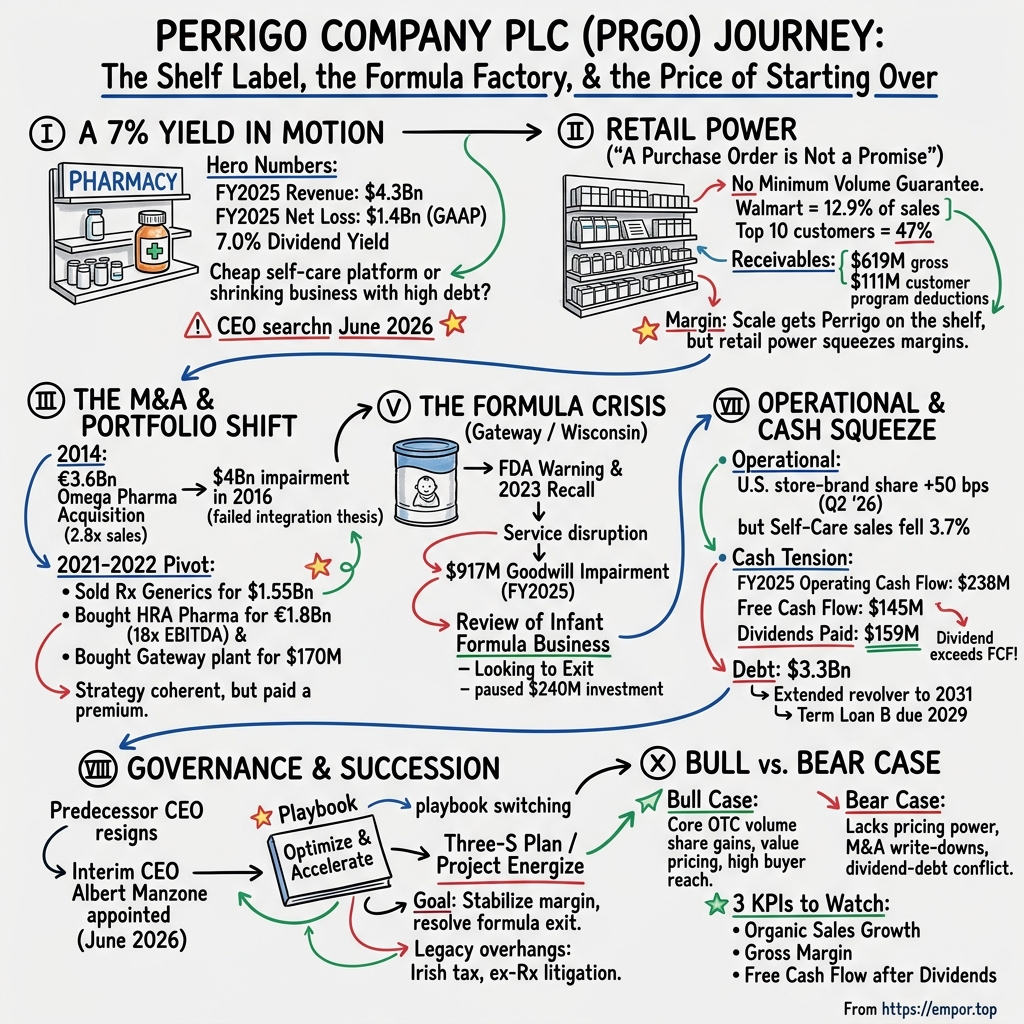
Perrigo Company plc: The Shelf Label, the Formula Factory, and the Price of Starting Over
I. A 7% Yield on a Company Still in Motion
Walk into almost any American pharmacy and go to the cough-and-cold aisle. Next to the famous orange and blue boxes sits a quieter row of packages with the store's own name on them: the Walmart bottle, the CVS bottle, the Kroger bottle. The active ingredient is the same as the brand beside it, the price is lower, and the label says nothing about who made it. Very often the answer is Perrigo, a company most shoppers have never heard of.
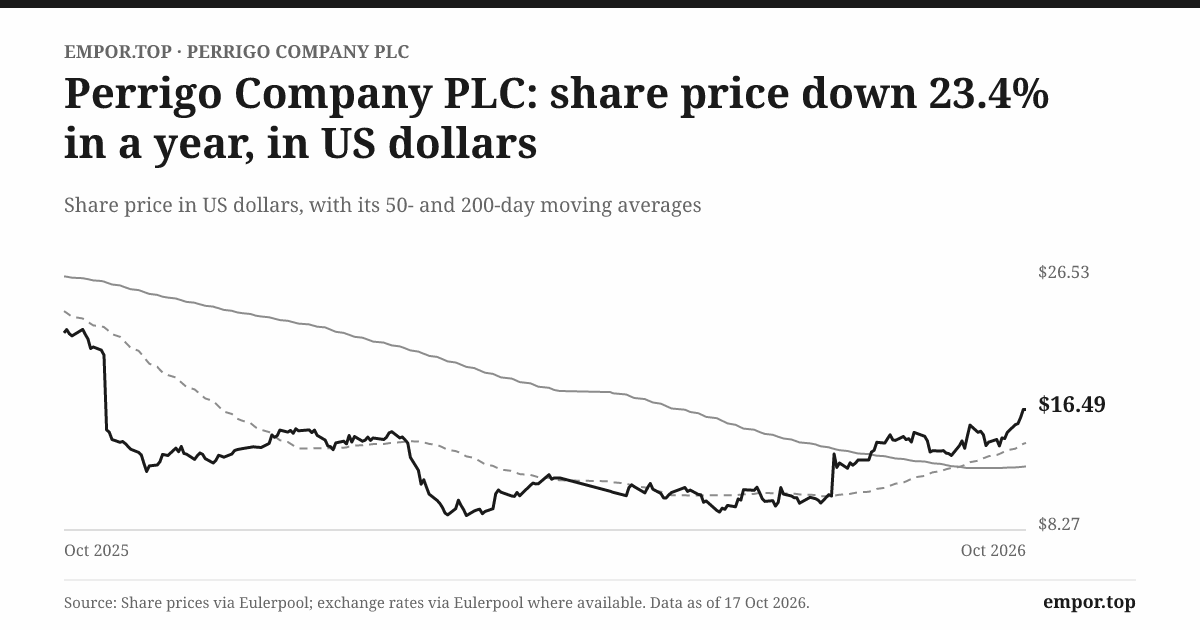
That anonymity is the business model, and in the autumn of 2026 it is also a fair description of how the stock market treats the company. On October 17, 2026, Perrigo's shares closed at about $16.49, giving the whole enterprise a market value of roughly $2.3bn.2 Five years earlier the stock had been worth about five times as much. The dividend, which Perrigo has raised every year for more than two decades, now works out to a yield of about 7%.2 And the company is looking for a chief executive. In June 2026 the board announced that Patrick Lockwood-Taylor had resigned after a finding that his personal conduct violated the company's code and values, and that director Albert Manzone would serve as interim CEO.1
The headline numbers make an odd pair. Perrigo sold about $4.3bn of products in FY2025, which is real scale in consumer health.2 It also reported a net loss of about $1.4bn that year.2 A 7% yield on a company losing that much money sounds like either a bargain or a warning, and the honest answer is that the market price is a statement of doubt rather than a verdict. Investors are not sure which story they are buying.
Four questions run through this episode. The first is whether retail scale can produce durable margins, or whether being the supplier to the biggest retailers in the world simply means handing them the savings. The second is whether Perrigo's long run of acquisitions built value or mostly bought impairments. The third is whether the company can leave infant formula, a business it entered only in 2022, without another expensive lesson. The fourth is whether the cash it generates can cover both the dividend and the debt reduction its lenders and rating agencies want.
Before any of that, one distinction matters. Perrigo reports two kinds of results. Its GAAP accounts, the ones audited and filed with the SEC, showed an operating loss of about $1.1bn in FY2025, because the company wrote down $1.33bn of goodwill.2 Its adjusted measures strip out those write-downs, amortization of acquired brands and restructuring costs, and they show a business that earns a modest operating profit. Both are true. The adjusted figure says what the plants and brands earned that year; the GAAP figure says what the company admitted about the price it paid for them. A careful listener should keep both in mind before calling Perrigo profitable.
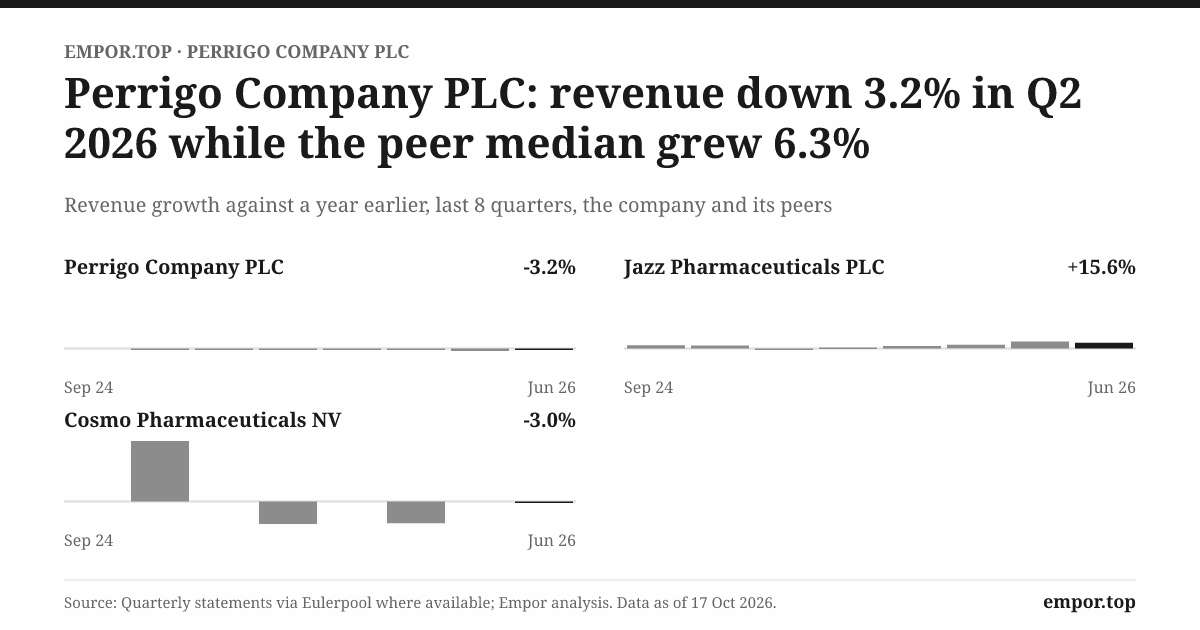
The first clue to the puzzle came in the most recent quarter. In the three months to June 2026, Perrigo's U.S. store-brand products gained market share, yet its consolidated sales fell about 3% and its operating margin shrank.4 Share up, sales down, margins down. Which side of that contradiction matters more is the question this story keeps returning to, and answering it starts with something deceptively simple: what exactly does Perrigo sell, and to whom?
 Subscribe on LinkedIn
II. A Purchase Order Is Not a Promise
Picture a category buyer at a big-box retailer in the weeks before flu season. The shelves of store-brand cough syrup, allergy tablets and pain relievers need filling. The buyer's system sends a purchase order to the manufacturer for so many cases at a negotiated wholesale price. The manufacturer ships, invoices and waits. Next month there will be another order, or perhaps a smaller one, or perhaps, if a rival bids lower or the season is mild, none at all.
That is the shape of Perrigo's revenue. It sells store-brand and branded self-care products to pharmacies, mass merchants, grocers and online retailers at prices negotiated per unit or per case.2 Its supply agreements with the largest customers carry no mandatory minimum volumes; revenue arrives as retailers replenish what consumers take off the shelf.2 There is real breadth here, across cough and cold, allergy, pain, digestive health, nicotine replacement, skin care, women's health and infant nutrition, and across the U.S. and Europe. In the second quarter of 2026 Perrigo's U.S. operations sold about $626m and its European operations about $372m.3 But breadth is not a contract. A purchase order is a request for goods, not a promise of next month's business.
The customer list explains why that matters. Walmart alone accounted for about 12.9% of Perrigo's FY2025 sales, roughly $549m, up from under 12% two years earlier.2 No other single customer crossed 10%, but the top ten together accounted for 47% of sales in both FY2024 and FY2025.2 Nearly half the company's revenue depends on ten buying departments, each of which knows exactly how many other manufacturers would like the same shelf. A supplier in that position can win the volume and still lose the negotiation.
Since 2026 Perrigo has reported the business by category rather than by geography. In the second quarter, Self Care, the core of over-the-counter medicines and personal care, produced about $577m of sales and $79m of segment operating income.3 Specialty Care, which holds the higher-value brands, sold about $227m and earned $48m.3 Infant Formula sold $101m and earned just $4m.3 Those segments do not add up to the whole company; an "All Other" line contributed another $119m of sales.3 The pattern is already visible. Specialty brands earn the richest margins, the core store-brand business earns a thinner but meaningful one, and formula barely breaks even.
One reassuring corner of the accounts is collection. A business that sells to Walmart, CVS and Amazon is not worried that its customers will go bankrupt. At the end of FY2025 Perrigo carried about $619m of gross receivables against a credit-loss allowance of only $6.5m, about 1%.2 Debtor days, the number of days of sales tied up in unpaid invoices, had fallen to about 53 from 58 in FY2022.2 Bad debts are not the risk. The risk sits one line over, in the $111m of accrued customer programs at year end: rebates, return reserves, shelf-stock adjustments and promotional allowances.2 These are the deductions retailers take from what they owe, and management has to estimate them before it knows the final number. When a big buyer leans on a supplier, it rarely refuses to pay; it simply pays less.
Who else wants that shelf? On the private-label side, Perrigo's rivals include PL Developments and the European contract manufacturer Aenova.18 On the branded side sit Kenvue, maker of Tylenol, and Haleon, maker of Advil, both far larger and spending far more on advertising, while Prestige Consumer Healthcare is a closer-sized branded over-the-counter company.2 Perrigo does not publish a market-share figure that maps cleanly onto those rivals, and comparing shares across companies that define categories differently would be misleading. What can be said is that Perrigo sits between the brand giants and the smaller private-label makers, larger than the latter, cheaper than the former.
So the first answer to the story's question is uncomfortable. Perrigo's scale probably keeps it on the shelf, because few suppliers can make so many regulated products, in so many forms, to the quality retailers require. But scale on the shelf is not the same as control over price. If customers can move orders and capture any cost savings the manufacturer finds, then the shelf space is secure and the margin is not. That tension did not begin with private label. It began with a decision, a decade ago, to stop relying on store brands alone.
III. The $4.5 Billion Bet on Omega
November 2014 was a heady month to be running Perrigo. The company had spent decades as a Michigan maker of store-brand medicines, and had only a year earlier merged with Elan, the Irish drug company, a deal that moved its legal home to Dublin.2 Now it announced it would buy Omega Pharma, a Belgian over-the-counter company with brands sold across Europe, for an enterprise value of about €3.6bn.5 With euros then worth well over a dollar, the bill was in the region of $4.5bn. Perrigo said the deal would create a top-five global OTC company.5
The logic was easy to state. Store brands were mostly an American phenomenon; Europe was a market of pharmacy-sold brands. Omega offered a ready-made portfolio, a pan-European sales force and a path out of dependence on U.S. retailers. The price, at roughly 2.8 times Omega's 2014 sales, was rich for a business of Omega's margins but not outlandish for branded consumer health, where established brands often changed hands at several times revenue.5 A revenue multiple alone does not prove overpayment. What proves it, or disproves it, is what the asset earns afterwards.
The Elan merger deserves a sentence of context and no more. It gave Perrigo an Irish parent and a lower group tax rate, and it left a long tail of cross-border tax questions that still sit in the accounts. It did not make Elan's old drug businesses part of Perrigo's operating story; the economics that matter here are those of the listed company's own self-care businesses.
What made Omega different from an ordinary acquisition was the hunter circling outside. In 2015 Mylan, the generics giant, launched a hostile bid for Perrigo, offering a package valued at about $205 a share.2 Perrigo's board rejected it, arguing the offer undervalued the company, and Mylan's tender failed to win enough shares. Independence was preserved. But independence was also a promise: by saying no to $205, the board implicitly told shareholders that the plan on its own, Omega included, would be worth more. Years later, investors who claimed the company had misled them during the defense would win a $97m class-action settlement.2 That is a measure of how far reality fell short of the story told in 2015.
The reckoning arrived quickly. Within two years of closing, Perrigo recorded more than $4bn of impairment charges, most of them tied to Omega's goodwill and brands.6 The FY2016 accounts showed a net loss of about $4.0bn.2 At the same time Perrigo restated earlier filings, which added accounting credibility to the list of things the new management had to repair.6 A write-down is an accountant's way of saying the cash an asset will produce no longer justifies the price paid. Arriving that fast, at that scale, it is the clearest available test of the Omega thesis, and the thesis failed it. Europe did not deliver the growth the purchase price assumed, and the integration did not produce the earnings to make up the difference.
The balance sheet carried the scars. Perrigo financed its acquisition era with debt, and borrowings stood at about $6bn in mid-2015.2 Goodwill and debt together made every shortfall in earnings more consequential: lower profits meant both an impairment and a tighter cushion against lenders' covenants. Shareholders' equity, about $10bn in 2015, fell to roughly $6bn after the 2016 charges and has kept falling since.2
Omega was not worthless. Perrigo still sells many of its brands in Europe, and the European business remains a real part of the company. But the lesson of Omega was that Perrigo could buy reach and could not, at that price, buy growth. The question it left behind was whether the next transformation would be built from the inside, or whether Perrigo would once again purchase the growth it could not produce.
IV. Sell the Generics, Buy the Growth
Murray Kessler arrived as CEO in late 2018 with a clear thesis: Perrigo should stop being a little bit of everything. The company at the time sold store-brand OTC medicines, European consumer brands and a generic prescription drug business that was exposed to falling prices and, as it would turn out, years of antitrust litigation. Kessler's answer was to become a pure consumer self-care company.2
The first move was subtraction. In July 2021 Perrigo sold its generic prescription business to the private-equity firm Altaris for $1.55bn.2 The sale made strategic sense. Prescription generics answer to pharmacy benefit managers and wholesalers, not to shoppers in an aisle, and they demand a different kind of regulatory and pricing expertise. Shedding them simplified the portfolio and put cash on the balance sheet, which at the end of 2021 held about $1.9bn.2
The second move was addition, and here the old instinct returned. In September 2021 Perrigo agreed to buy HRA Pharma, a French consumer-health company, for about €1.8bn.7 HRA brought ellaOne, a leading emergency contraceptive in Europe, Compeed blister plasters, and a portfolio in women's health and skin care. It also brought a regulatory project that would become famous: the effort to make a daily oral contraceptive available without a prescription in the United States. Perrigo itself told investors the price represented about 18 times HRA's expected 2022 adjusted EBITDA.7
Was 18 times a lot? A broad snapshot of consumer-health deal values from early 2021 put sector valuations near 16.6 times EBITDA.8 That is not a matched set of comparable deals, and premium brands with unique positions can deserve premium prices. But the gap is indicative. Perrigo paid somewhat above the going rate for consumer health, which meant the deal only worked if HRA's brands kept growing and kept their margins after the purchase. A portfolio of good brands is not the same thing as proof of a good return on buying them, and the later accounts would test that distinction.
The third move was smaller and, in hindsight, the riskiest. In 2022, during the American infant-formula shortage, Perrigo bought Nestlé's Gateway formula plant in Eau Claire, Wisconsin, for $170m.2 Perrigo already made store-brand formula; owning more capacity looked like a way to serve retailers who had just watched their shelves empty. But a formula plant is among the most heavily regulated factories in consumer health, and buying one means inheriting its equipment, its processes and its inspection history.
Kessler's team, and then his successor's, wrapped all this in ambition. In 2023 the company spoke of long-term organic growth of 3% or more.9 What followed was the opposite. Revenue fell about 6% in FY2024 and almost 3% in FY2025.2 Some of that decline reflected deliberate exits from low-margin products, and some reflected weak cough-and-cold seasons and retailer destocking. Yet the direction was down, and by 2025 the company had moved to a new framing at its investor day, a plan to "consumerize, simplify and scale" the self-care platform.9
The pivot itself was coherent. Selling prescription generics and buying branded self-care moved Perrigo toward the part of the market with better margins and loyal consumers. The underwriting was the problem. HRA was bought at a premium, Gateway was bought into a crisis, and goodwill impairments in FY2025 showed that the forecast growth had not arrived.2 The return on the new portfolio remains unproven. And the most dramatic chapter of the new strategy unfolded not in a European pharmacy but on a production line in Wisconsin.
V. The Wisconsin Line That Changed the Plan
Infant formula is unforgiving in a way cough syrup is not. A batch must be sterile, nutritionally exact and traceable from dairy input to can, and the U.S. Food and Drug Administration inspects formula plants with particular care after the 2022 shortage exposed how few factories fed the country's babies. When Perrigo took over Gateway, it inherited both the opportunity of that scarcity and the scrutiny that came with it.
The chain of events that followed is the clearest cause-and-effect sequence in the company's recent history. Integrating the plant proved harder than planned. The FDA issued a warning letter over manufacturing conditions, and in 2023 Perrigo recalled formula made at the site.2 Remediation followed, which meant downtime, lost production and disrupted service to retail customers who had been promised supply. Those customers had alternatives, and the lost volume weighed on sales and profit in Perrigo's Americas business. In Q4 2025 the company recorded a $917m goodwill impairment on its consumer self-care Americas unit, the largest single piece of that year's write-down.2 A $170m factory purchase did not cause all of that charge, but the formula troubles were central to the weaker outlook it reflected.
By November 2025 management had seen enough. Perrigo announced a strategic review of the infant formula business, which it expected to generate about $360m of sales in 2025, and said it would reconsider a planned $240m multi-year investment in the operation.10 In plain terms, the company that bought into formula three years earlier was now asking whether to sell, partner or close.
The latest numbers make the decision less urgent but not easier. In the second quarter of 2026 formula sales rose 23% from a year earlier to $101m, and the segment earned $4m of operating income after losing $12m a year before.4 That is genuine progress: the plant is producing and customers are buying again. It is also a modest profit on a business that represents a little over a tenth of group sales. Formula matters to Perrigo for its cash needs, its quality risk and the management attention it consumes, more than for its contribution to earnings.
There is a precedent for an exit. In 2026 Perrigo sold its Dermacosmetics business, the European skin-care brands ACO, Biodermal and Iwostin, for cash proceeds of approximately $359m, booking a pre-tax gain of about $130m and using most of the money to repay debt.3 That showed the company can sell non-core assets at a price above book value. It does not show the same can be done for formula, a business with a recent recall, an open quality history and fewer natural buyers.
The legal shadow complicates the sale further. In November 2025 a federal securities class action was filed in New York alleging that Perrigo and its executives misled investors about the formula operations.2 The case is at an early stage and Perrigo disputes it. But a buyer weighing a formula plant will price in the FDA's continuing quality requirements, the remediation still needed and the reputational exposure, which is exactly the risk management wants to be rid of. The seller wants to shed the risk; the buyer wants to be paid to take it.
The real test, then, is not the review itself, which was sensible, but its conclusion: a signed deal, a shutdown plan or a partnership, with the proceeds weighed against what Perrigo must keep paying or guaranteeing afterward. Until that arrives, formula is a question mark on the balance sheet. And it distracts from a bigger question about the business Perrigo plans to keep: whether its share gains can ever turn into pricing power.
VI. Share Gains, Thin Pricing Power
On the August 2026 earnings call, management had good news to share. Perrigo's U.S. store-brand OTC products had gained about 50 basis points of volume share, a sign that cost-conscious consumers were trading down from national brands to store labels.11 In a soft year for the cough-and-cold category, that was the kind of evidence the private-label thesis is built on.
Then came the rest of the quarter. Consolidated net sales fell about 3%.4 Self Care sales declined 3.7% and its operating income fell about 16%; Specialty Care sales dropped 2.8% and its operating income about 28%.4 Adjusted gross margin was 35.6%.4 Formula grew, but its profit was $4m. Perrigo was winning share in its core market and making less money doing it.
To understand why, consider the shape of the industry. At the top sit the branded portfolios. Kenvue and Haleon spend heavily on advertising, own household names, and earn gross margins well above 55%.2 Their shoppers pay for a brand they trust. Below them sit store brands, which compete on value: the same active ingredient at a lower price, sold under the retailer's own name. Perrigo dominates the supply of those store brands, but it does not own the name on the box, and the retailer, not Perrigo, decides the shelf price. Alongside Perrigo sit smaller private-label and contract manufacturers that are happy to take any order it loses.
Run the moat tests once and the picture becomes clear. Buyer power is high: ten customers account for nearly half of sales, and none of them is obligated to buy a minimum volume.2 Switching costs exist but are partial. A retailer cannot change suppliers overnight, because each product must be qualified, packaged to its specification and made in an FDA-compliant plant, and Perrigo's breadth means one supplier can cover a whole aisle. That is a real convenience. Yet Perrigo publishes no retention rate or price-realization series that would prove customers are locked in, and the falling sales of recent years suggest volume can and does move. The evidence supports an advantage of scale and execution, not of pricing.
The cost side shows why scale alone does not lift margins. Making OTC medicines means buying active ingredients, some from single or limited sources, paying for specialized packaging, running quality systems that the FDA audits, and keeping plants busy through a highly seasonal year.2 When volumes dip, fixed plant costs are spread over fewer units and margins fall. Perrigo also carries a lot of inventory: inventory days rose to about 152 in FY2025 from roughly 140 two years before.2 More inventory means more cash tied up before products reach the shelf, and more risk of write-offs if demand disappoints.
Then there is the innovation case. Opill, the first daily oral contraceptive approved for over-the-counter sale in the U.S., came from the HRA deal and launched in 2024.2 It is a genuine regulatory first. But a first is not a franchise. Perrigo's record of converting acquired brands into growth has been weak, and the test for Opill is repeat purchases, market share and margin contribution over many quarters, not approval or launch publicity. Until those numbers appear in the accounts, Opill is optionality, not a growth engine.
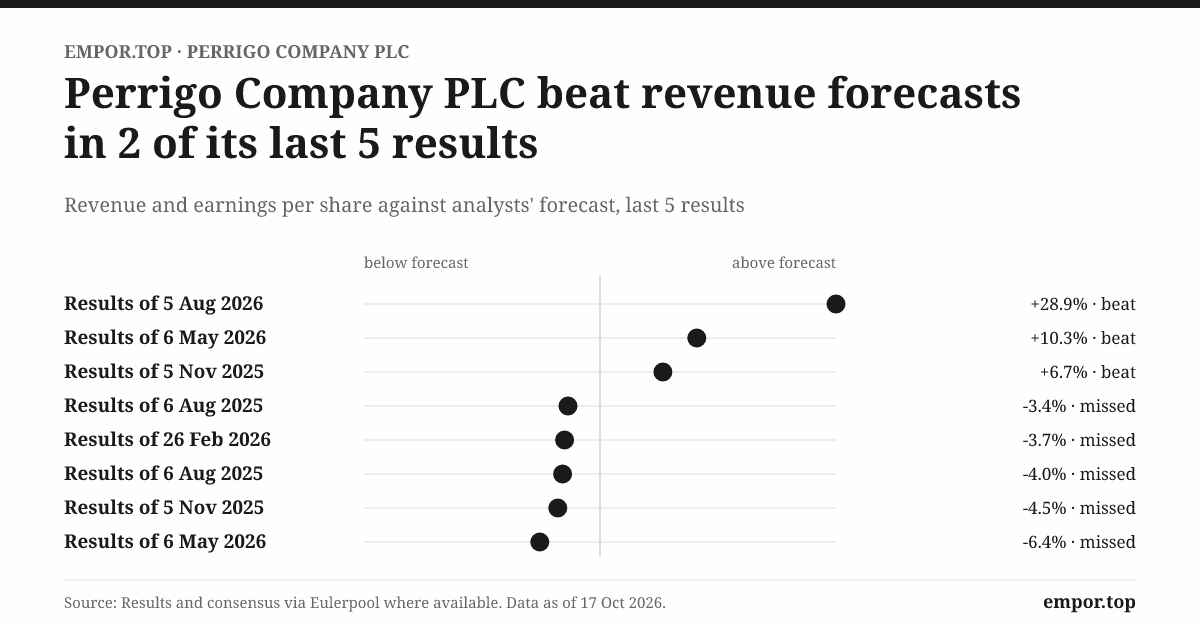
Management's language on the 2026 calls leaned on market share and category weakness. On the May call, executives pointed to retailer destocking and a soft season; by August, the message emphasized share gains and the savings program.1211 What remained harder to find was a quantified explanation of how much of the margin pressure was controllable, such as pricing concessions, plant under-utilization or product mix, rather than attributed to the category broadly.
The history narrows the moat claim to a smaller, defensible version: Perrigo is a credible, broad, regulated supplier that retailers find convenient, which keeps it on the shelf when consumers trade down. It does not show that Perrigo can keep the benefit. If demand returns, will Perrigo pocket the gains, or will large retailers negotiate them away? The cleanest place to look for the answer is the cash.
VII. Cash Paid for the Story It Told
Open the FY2025 accounts and two numbers seem to contradict each other. The company lost about $1.4bn. And yet it generated about $238m of cash from operations and raised its dividend again.2 How can a business lose more than a billion dollars and still have cash to hand to shareholders?
The answer is that most of the loss never touched the bank account. Impairment charges in FY2025 totaled about $1.36bn, including roughly $1.33bn of goodwill write-downs.2 Goodwill is the premium paid in past acquisitions over the value of the assets acquired; writing it down admits that premium was too high, but the cash went out the door years ago. Add back those charges and the ordinary amortization of acquired brands, and the cash picture looks very different from the GAAP loss. One caution is needed here. Some data services report an operating profit of about $343m for FY2025, which is an adjusted figure; the audited GAAP statement shows an operating loss of about $1.12bn, and the two can only be compared through the company's own reconciliation.2
So far, so reassuring. Now follow the cash further. Of the $238m Perrigo generated from operations, it spent about $93m on capital equipment, leaving free cash flow of about $145m.2 It then paid about $159m in dividends.2 The dividend exceeded the free cash flow. For the first time in this story's recent history, the payout was not covered by the cash the business produced after reinvesting in its plants.
Why did cash fall so far? Operating cash flow dropped by about a third from FY2024, and the company's own accounts point to two culprits: working capital, including an inventory build of about $61m, and roughly $63m of cash paid for restructuring and severance.2 Both are partly the cost of the turnaround itself. That is the trap. Restructuring promises lower costs later, but it consumes cash now, at the same time as the dividend and the debt need it.
The long record looks better and deserves a careful read. From FY2015 to FY2025, Perrigo reported cumulative net losses of roughly $5.5bn but generated about $5.6bn of operating cash and $4.0bn of free cash flow, of which dividends took about a third.2 The gap is explained mostly by noncash charges: more than $6.5bn of impairments over the period and depreciation and amortization of roughly $330m a year.2 That proves the business has consistently produced cash. It does not prove that the cash represents strong underlying earnings, because amortization of acquired brands is a real economic cost in disguise: it reflects money paid for assets that are wearing out. Those long-run totals also need care because Perrigo changed its fiscal year in 2015, leaving overlapping June and December columns in the data.
There is a reinvestment trend under all of this. Research and development spending fell from about $123m in FY2023 to about $95m in FY2025, from roughly 2.6% of sales to 2.2%.2 Capital spending also fell to about $93m. Spending less supports near-term cash. It also means fewer new products and less renewal of plants, in a business whose competitive edge rests on regulated manufacturing.
The dividend's real test is therefore not the yield implied by any single share price. It is FY2026 free cash flow after restructuring and working capital, and whether that number clears about $160m with something left over. Which brings the story to the people deciding what to do with that cash, and to the moment in June when the person at the top left.
VIII. The CEO Leaves; the Strategy Stays
Patrick Lockwood-Taylor came to Perrigo in mid-2023 from Bayer, where he had run the consumer-health business in North America.13 He inherited the formula crisis in its first months, launched the Project Energize restructuring in 2024, and in 2025 unveiled the "Three-S" plan to consumerize, simplify and scale.9 In June 2026 he resigned. The board said an investigation had found that his personal conduct violated the company's code and values, and that the departure was unrelated to the business, its operations or its financial reporting.1 Albert Manzone, a director, became interim CEO while a search for a permanent leader began.1
The company's statement that the exit had nothing to do with the numbers should be taken at face value; there is no evidence to the contrary. But for investors, a CEO departure in the middle of a turnaround is a governance and succession test regardless of its cause. The plan now belongs to an interim leader whose record as an operator and capital allocator at Perrigo has yet to be written.
Look at the historical pay record with that boundary in mind. Lockwood-Taylor's FY2025 compensation was about $9.0m, the largest element of which was about $7.0m of stock awards.13 He held about 129,000 shares, and directors and named executives together owned about 0.6% of the company.13 Those figures describe the predecessor, not Manzone's pay or ownership. They show an incentive structure tilted toward equity at a time when the company reported consecutive annual losses and the share price fell steeply. Equity-heavy pay is meant to align management with shareholders; in this case, shareholders and the outgoing CEO both suffered from the same falling price, which is alignment of a sort but not evidence that the incentive produced results.
Without a controlling shareholder, Perrigo's accountability rests on its board and its institutional investors. There is no founding family, no parent company and, for three years running, no related-party transactions requiring disclosure.13 The largest holders are index and active managers such as T. Rowe Price, BlackRock and Vanguard, each with more than 10%.13 That structure removes one set of risks, such as self-dealing, but it also means no single owner has the weight to force change quickly.
The strategy has shifted shape several times. In 2023 it was "Optimize and Accelerate." In 2024 Project Energize targeted $140m to $170m of annualized savings by 2026.2 In 2025 came the Three-S plan, supply-chain reinvention, and a move to report by category.9 Then came the formula review, a review of oral care, and the Dermacosmetics sale.3 Some of this is a sensible response to events. But it is worth separating three things that management presentations tend to blur: savings delivered and visible in the accounts, savings targeted but not yet realized, and organic growth. The first is partly evident in adjusted margins; the third has not yet appeared.
Shareholders have not revolted. At the April 2026 annual meeting, say-on-pay passed with about 98% support, while Manzone himself drew about 14% opposition to his re-election and another director about 11%.14 That is a modest signal of discontent, not a mandate either way.
The board's next credibility test is concrete. It must appoint a permanent CEO, deliver guidance it does not have to cut, and present a capital-allocation plan that earns returns instead of repeating the cycle of buying, writing down and selling. Much of that plan depends on the balance sheet, and on a debt deadline that has quietly moved.
IX. Which Debt Deadline Is Real?
In early 2026, anyone reading Perrigo's year-end filing would have seen a looming problem. About $1.42bn of credit facilities, a $422m Term Loan A and an undrawn $1bn revolving credit line, were due in April 2027.2 With the company's ratings slipping and its earnings under pressure, that looked like a refinancing wall arriving just as the business was weakest.
Then, in March 2026, the wall moved. Perrigo amended its credit agreement, extending the $1bn revolver to 2031, and used a draw on it to repay the Term Loan A.15 Later in the year, it used about $335m of the Dermacosmetics proceeds to pay down revolving borrowings.3 By the end of June 2026, total debt was about $3.3bn, only about $93m was drawn on the revolver, and the largest near-term obligation was a $972m Term Loan B due in 2029.3 Perrigo was in compliance with its covenants.3
That changes the story. The near-term alarm is stale. What remains is a slower, more ordinary leverage problem: the Term Loan B in 2029 and $750m of notes due in 2030 matter, and leverage relative to earnings stays high. It is worth being precise about what counts as debt. Contractual borrowings, meaning the term loans, bonds and revolver draws, are what must be repaid on fixed dates. Broader measures used by some data services include lease liabilities, which explains why a figure near $4.0bn appears for the end of 2025 against contractual borrowings of about $3.64bn.2
The credit agencies are not reassured. At mid-2026 Moody's rated Perrigo Ba3, S&P B+, and Fitch BB, with negative outlooks at Moody's and Fitch.163 Fitch, revising its outlook in March 2026, pointed to weak OTC consumption, a slow recovery in formula and gross-margin compression, and warned that debt could stay above 4.5 times EBITDA through 2027.16 Covenant compliance is evidence of present liquidity, not proof of durable deleveraging.
Here the dividend and the debt collide. Every dollar paid to shareholders is a dollar unavailable to repay borrowings. At roughly $160m a year, the dividend is larger than most single years of recent debt reduction from operations. Cutting it would free cash, but it would not fix the operating model, and it would break a two-decade record of increases that management has treated as part of the company's identity.2 The board faces a choice between two signals: keep paying and risk the lenders' patience, or cut and risk admitting the turnaround is further away than promised.
The figure that matters is net debt against cash flow from continuing operations once the portfolio exits and restructuring costs are behind the company, measured against the 2029 and 2030 maturities. If that ratio falls, the balance sheet will have been repaired from earnings. If it falls only because of asset sales, the business will have bought time, not strength. And time is precisely what the legacy obligations make expensive.
X. The Tax Bill That Outlived the Elan Deal
An Irish parent company, a Michigan heritage, plants in Europe and America, and a prescription-generics business it sold five years ago: Perrigo's structure is a map of its history, and each layer left something behind.
Start with tax. The Elan merger moved Perrigo's parent to Ireland and created intercompany arrangements that tax authorities have examined for years. At the end of FY2025, Perrigo reported about $300m of gross unrecognized tax benefits, about $92m of accrued interest and penalties, and a separately measured liability for uncertain tax positions of about $265m.2 These are different definitions of overlapping exposures, and adding them together would overstate the risk. The record has gone both ways. Perrigo won a largely favorable federal judgment in Michigan over omeprazole transfer pricing and legal-fee deductions, though an adverse appeal could expose it to tens of millions of dollars for later years.2 It also resolved an IRS challenge to interest deductions on Elan-era intercompany debt using reserves already set aside.2
Then there is the business Perrigo no longer owns. Its former prescription-generics unit remains a defendant in the sprawling multidistrict litigation alleging an industry-wide conspiracy to fix generic drug prices.2 A Canadian class action against Perrigo was dismissed in February 2026, but U.S. claims continue, including state attorney-general actions.2 A bellwether trial of Humana's claims was scheduled for September 2026. On September 16, 2026, the federal court postponed it for 45 days.17 That is a timing update, not a verdict; later bellwether trials involving Kroger and Cigna are scheduled for 2027 and 2028.2 Perrigo cannot sell its way out of liabilities attached to conduct alleged before the Rx sale.
Currency is the third inheritance. Omega and HRA made Perrigo a significant earner in euros and sterling. Translating those businesses into dollars swung the company's accumulated comprehensive income from a loss of about $173m in FY2024 to a gain of about $205m in FY2025 as the euro strengthened.2 Perrigo uses net-investment hedges, cross-currency swaps that offset some of the balance-sheet swing.2 Translation moves do not change cash generation directly, but they change the dollar value of European earnings and the apparent leverage of the group.
None of these exposures, on present evidence, threatens Perrigo's survival. Together they mean that even a simpler self-care company carries the legal, tax and currency consequences of the acquisitions that built it. Which leaves the central question in plain view: is the market's discount a mistake, or a fair price?
XI. Analysis & Bear vs. Bull Case
Hold two facts from the second quarter of 2026 side by side. Perrigo's U.S. store brands gained share in core OTC categories.11 And its core adjusted earnings per share fell about 21% from a year earlier.4 The bull and the bear are looking at the same quarter and reading different halves of it.
The bull case starts with what Perrigo does that few can. It combines FDA-regulated manufacturing, a product range that spans almost every OTC category, value pricing and relationships with the largest retailers in the U.S. and Europe. When consumers trade down, the trade-down lands on Perrigo's lines, and the 2026 share gains suggest the offer still works even in soft categories. Restructuring savings could lift margins, the formula exit could remove a drag, and a market value below book suggests investors are pricing in little recovery.
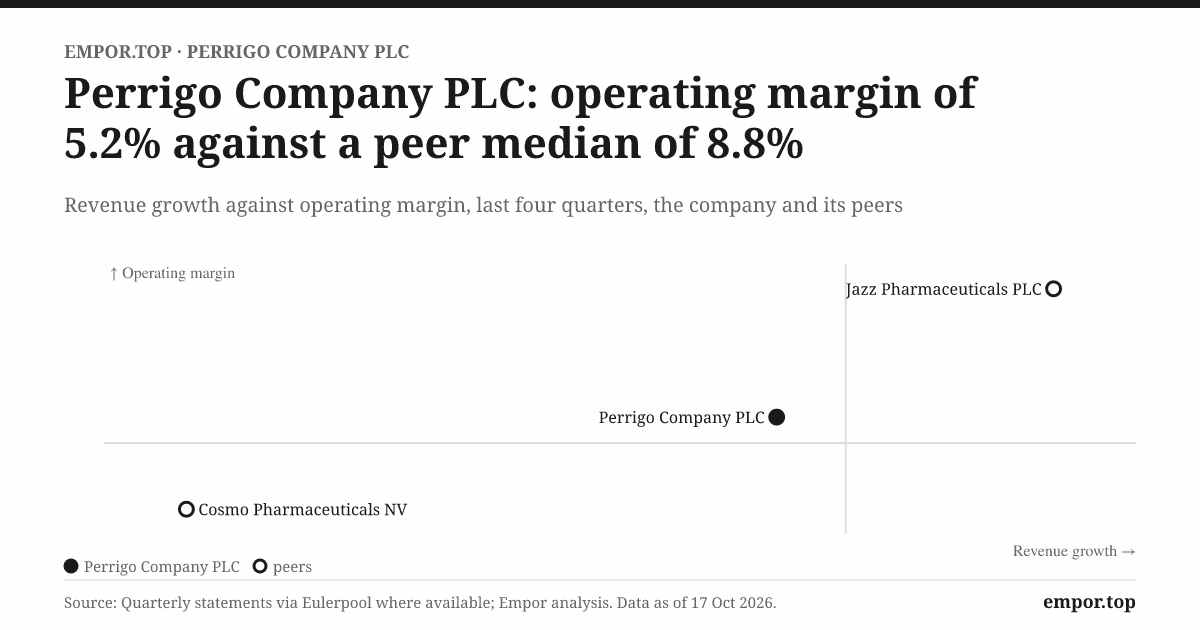
The bear case has the longer record. Omega was impaired within two years. HRA and the formula plant were followed by more than $1.3bn of goodwill write-downs in FY2025 and another structural impairment of about $332m in early 2026.23 Revenue fell in each of the last two full years. Margins are thin compared with branded peers, reinvestment has fallen, and the dividend exceeded free cash flow in FY2025. Customer concentration means that any cost savings may be competed away in the next negotiation.
The valuation reflects that tension. On October 17, 2026, Perrigo traded at about 0.9 times book value, about 0.5 times sales and an enterprise value of about 1.3 times sales.2 Kenvue and Haleon trade at several times sales, and Prestige Consumer at around three times.2 But comparing price-to-sales across private-label and branded businesses mostly measures the difference in their margins, not mispricing. EV-to-operating-profit comparisons need consistent definitions too, because Perrigo's GAAP earnings are distorted by impairments. The market appears to assume that Perrigo's margins stay where they are and that its cash is split between debt and dividends without much left for growth.
Run the industry forces once. Buyers are powerful: ten customers make up 47% of sales, with no volume commitments.2 Suppliers have some power, because certain active ingredients, specialized packaging and formula inputs come from single or limited sources that require FDA validation.2 Rivalry runs on two fronts, against branded portfolios that can cut promotional prices and against private-label makers that can bid for the same contracts. Substitutes are limited within categories, since a pain reliever is a pain reliever, but that cuts both ways: the brand owner's product is a substitute for Perrigo's. New entrants face real regulatory barriers, which is Perrigo's strongest protection.
Through the lens of Hamilton Helmer's seven powers, Perrigo has some scale economies in manufacturing and regulatory compliance, and a form of process power in operating dozens of qualified product lines. It lacks the branding power of Kenvue and Haleon in its core store-brand business, and it has no demonstrated switching-cost power: no published retention or pricing data shows customers are locked in. Network effects and a cornered resource do not apply. The verdict is that Perrigo has an edge in scale and know-how, but not a moat that delivers superior margins.
Three numbers will tell which side is right. The first is organic sales growth, which was negative in Q2 2026 at about 3%.4 The second is gross margin, which on an adjusted basis stood at 35.6% in the quarter, below where it was in FY2023.42 The third is free cash flow after dividends, which was slightly negative in FY2025.2 Sustained margin expansion with positive organic growth would strengthen the bull case. Continued sales decline or dividend coverage below one would weaken it.
The investment answer, stated plainly, is that Perrigo has a credible reason why it can win in value-focused self-care supply. It has not yet shown why it will win at returns above its cost of capital. Its return on invested capital in FY2025 was about 4%.2 That gap is the whole story, and it carries lessons that reach beyond this company.
XII. Business & Investing Lessons
The first lesson comes from the Walmart account. Perrigo's largest customer buys more than half a billion dollars of its products a year, which is a testament to the company's reliability and reach.2 It is also a reminder of who holds the pen. A shelf-space win is not pricing power. Being the supplier everyone needs can still mean being the supplier everyone squeezes, and investors should judge distribution by what it lets a company keep, not by how much it lets it sell.
The second comes from Brussels and Dublin. Perrigo paid about €3.6bn for Omega and wrote down more than $4bn within two years.56 A decade later, the HRA and formula era ended in another goodwill charge of more than $1.3bn.2 An impairment is a strategy scorecard, filed years after the press release. The cheapest due diligence on any acquisitive company is to read its old deal announcements beside its later write-downs and ask whether the forecast growth ever arrived.
The third comes from Eau Claire. A $170m plant purchase became an FDA warning letter, a recall, years of remediation, lost customers and finally a strategic review.210 A factory is a regulated promise. In businesses where quality failures stop production, the quality system is part of the product, and buying a plant means buying its history along with its machines.
The fourth comes from the FY2025 cash-flow statement, where $159m of dividends sat against $145m of free cash flow.2 A dividend is a cash claim, not a tradition. Twenty years of increases are a record of past cash, not a guarantee of future coverage, and a streak that must be defended with borrowed money has stopped being evidence of strength.
The fifth comes from the Dermacosmetics sale, whose proceeds paid down the revolver.3 It was a sensible move, well executed. But selling an asset can buy time; it cannot make the core grow. Deleveraging through disposals shrinks the company that must eventually earn its way out.
XIII. Epilogue
Tonight Perrigo stands between quarters. The third-quarter results will arrive within weeks, with an interim CEO presenting a strategy he did not design, a search for a permanent leader still under way, and reviews of infant formula and oral care still open.14
The first moment that will decide the story is the CEO appointment. A permanent leader will reveal what the board thinks went wrong: an operator who fixes plants, a brand builder who grows Specialty Care, or a dealmaker who keeps simplifying the portfolio. Investors should watch whether the board explains how incentives, capital allocation and accountability will change, not just who fills the chair.
The second is the formula outcome. A sale at a decent price with few retained liabilities would close the most expensive chapter of the Kessler-era strategy and let the company focus. A shutdown with heavy exit costs, or further impairment of the remaining assets, would confirm that the plant was a write-off in slow motion. Oral care adds a smaller version of the same question.
The third is the next two quarters of operating results. Organic growth in the core, gross margin and free cash flow after dividends will show whether Project Energize's savings reach the bottom line or are passed to retailers. Annualized savings targets are promises; reported margins are evidence.
The fourth is the courtroom and the tax authorities. The Humana trial will be rescheduled, other bellwethers loom in 2027 and 2028, and the Michigan tax judgment may face appeal.172 Delays change timing, not exposure.
And behind all of it sits 2026 guidance and the 2029 Term Loan B, the next real deadline. Perrigo has bought time. The question that remains is whether it can use that time to show a business that grows, or only one that shrinks more carefully.
XIV. Outro
Go back to that pharmacy aisle. The store-brand bottle sits where it always has, the same ingredient as the famous brand, a few dollars cheaper, the retailer's name on the label. Shoppers will keep buying it, and Perrigo will probably keep making a great many of them. Its $4.3bn of sales and its place with the ten customers who buy nearly half of everything it makes are not in doubt.2
What is in doubt is the simplest question in retail: who captures the value, the maker or the seller? For a decade Perrigo tried to answer it by buying brands that would put its own name on the box, and paid for each attempt in impairments. Its next chapter will be decided by something less glamorous. Not a new acquisition, but whether a scale supplier, in a market where scale secures the shelf, can finally earn the right to keep the cash it makes.
References
-
Perrigo Announces Leadership Transition — Perrigo, 2026-06-08 ↩↩↩↩
-
Perrigo Company plc 2025 Annual Report / Form 10-K — SEC, 2026-02-26 ↩↩↩↩↩↩↩↩↩↩↩↩↩↩↩↩↩↩↩↩↩↩↩↩↩↩↩↩↩↩↩↩↩↩↩↩↩↩↩↩↩↩↩↩↩↩↩↩↩↩↩↩↩↩↩↩↩↩↩↩↩↩↩↩↩↩↩↩
-
Perrigo Company plc Q2 2026 Form 10-Q — SEC, 2026-08-05 ↩↩↩↩↩↩↩↩↩↩↩↩↩
-
Perrigo Reports Second Quarter 2026 Financial Results From Continuing Operations — Perrigo, 2026-08-05 ↩↩↩↩↩↩↩↩↩
-
Perrigo Company plc To Acquire Omega Pharma NV For EUR 3.6 Billion — Perrigo, 2014-11-06 ↩↩↩↩
-
Perrigo Company plc Form 10-Q/A restatement filing — SEC, 2017 ↩↩↩
-
Perrigo to Acquire Leading Consumer Self-Care Company, HRA Pharma — Perrigo, 2021-09-08 ↩↩
-
Q1 2021 Consumer Health Sector Snapshot — Bourne Partners, 2021 ↩
-
Perrigo Provides Detailed Plan to Consumerize, Simplify and Scale its Unique Global Self-Care Platform at its Virtual Investor Day — Perrigo, 2025-02-28 ↩↩↩↩
-
Perrigo to Conduct Strategic Review of its Infant Formula Business — Perrigo, 2025-11-05 ↩↩
-
Perrigo (PRGO) Q2 2026 Earnings Call Transcript — The Motley Fool, 2026-08-12 ↩↩↩
-
Perrigo (PRGO) Q1 2026 Earnings Call Transcript — The Motley Fool, 2026-05-07 ↩
-
Perrigo Company plc 2026 Proxy Statement — SEC, 2026-03-20 ↩↩↩↩↩
-
Perrigo Company plc 2026 Annual Meeting Voting Results, Form 8-K — SEC, 2026-05-05 ↩
-
Perrigo Amended and Restated Credit Agreement — SEC, 2026-03-20 ↩
-
Fitch Revises Perrigo's Outlook to Negative; Affirms IDR at 'BB' — Fitch Ratings, 2026-03-18 ↩↩
-
In re Generic Pharmaceuticals Pricing Antitrust Litigation, Humana bellwether opinion — U.S. District Court E.D. Pa. / GovInfo, 2026-09-16 ↩↩
 LinkedIn
 WhatsApp
 Reddit
 Hacker News
 Email
 Kindle
 RSS Feed
 Spotify
 Apple Podcasts
 Amazon Music
 Audible
 YouTube