PROCEPT BioRobotics Corporation: The Robot Is Installed. Now It Has to Be Used.
I. The Operating Room Has a New Robot. How Often Does It Work?
Somewhere in an American hospital tonight, a robot stands under a dust cover in the corner of an operating room. It has a console, a robotic arm, an ultrasound probe and a pump that can drive a thin stream of saline hard enough to cut tissue. It cost the hospital something close to half a million dollars. Tomorrow it may treat two patients, or none. Nothing about the machine itself decides which. A urologist decides, a scheduler decides, a patient referred by a primary-care doctor decides, and somewhere behind all of them a hospital administrator wonders whether the capital committee made a good call.
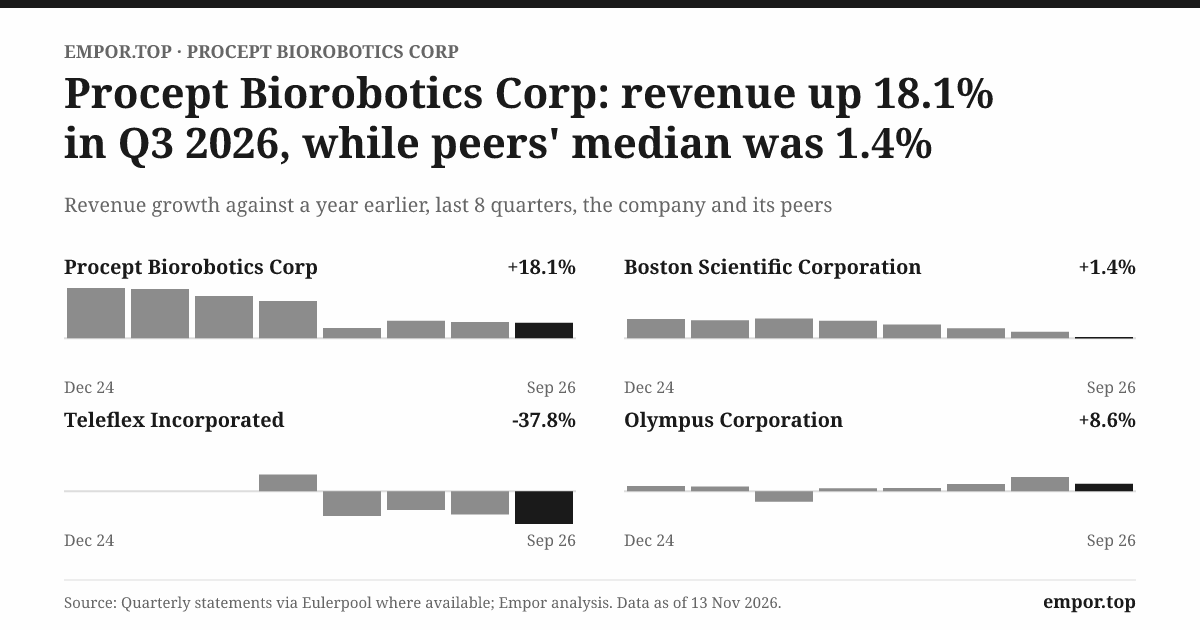
That idle-or-busy question is the whole of PROCEPT BioRobotics. On November 4, 2026, the San Jose company reported third-quarter revenue of about $98 million, up 18% from a year earlier, with U.S. procedures up about 22%.1 On paper that is a healthy medical-device quarter. On the conference call, though, chief executive Larry Wood spent much of his time on a subtler problem. Older AquaBeam robots, the first generation of the company's system, were being used less. Surgeons were moving their cases to the newer HYDROS machine, and the older fleet was going quieter as they did.3 The company was, in a sense, competing with itself.
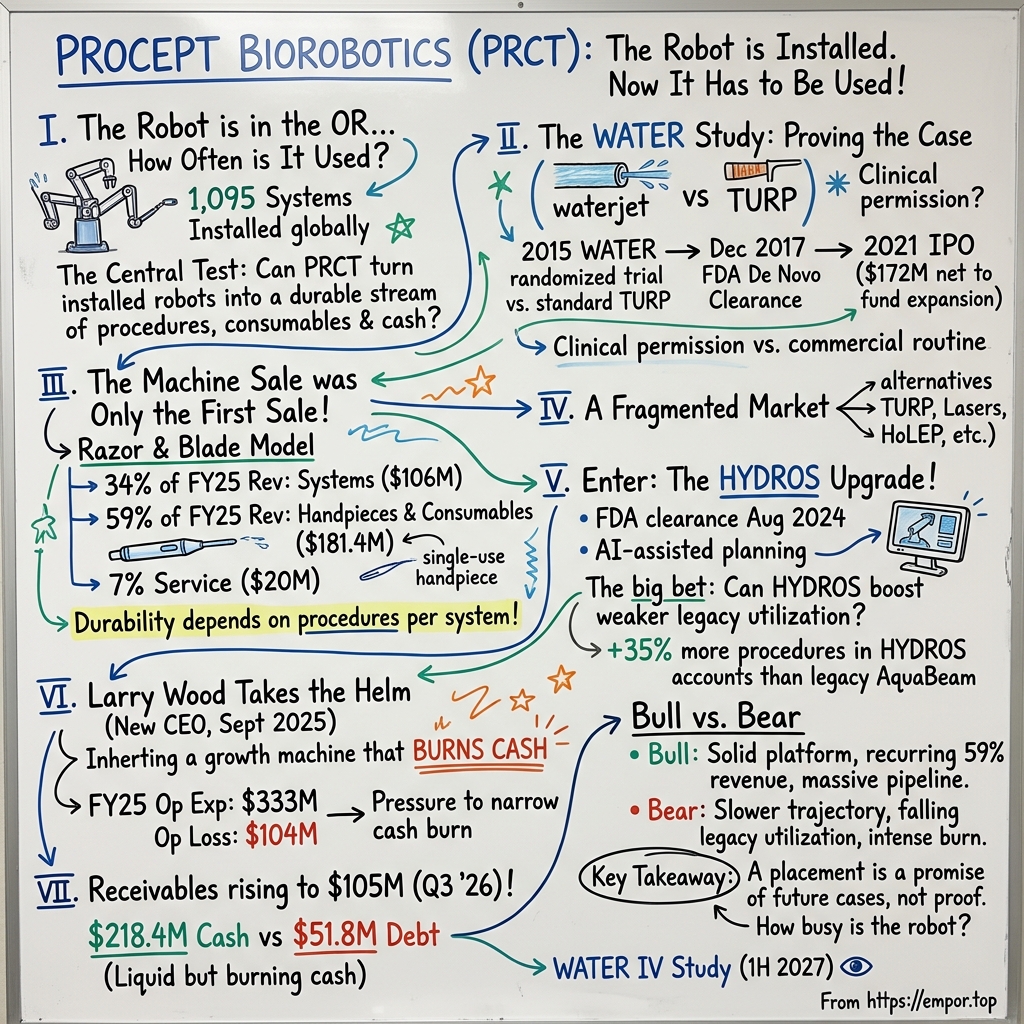
The numbers that frame the story are simple enough to hold in one hand. At the end of September 2026, PROCEPT had 1,095 systems installed around the world, 858 of them in the United States.2 A robot sold is a one-time event; what follows it is supposed to be a stream. Every Aquablation procedure consumes a single-use handpiece, and every handpiece is revenue that recurs as long as the surgeon keeps choosing the robot. So the investment case turns on a chain of human decisions. A hospital has to buy the system, a surgeon has to adopt the procedure, patients have to be routed to it, and the repeat sales of handpieces have to follow, month after month, at a scale that eventually pays for one of the most expensive commercial organizations in small-cap medtech.
The condition being treated is benign prostatic hyperplasia, or BPH: a non-cancerous enlargement of the prostate that squeezes the urethra and makes urination slow, urgent and frequent. It is about as common as conditions get in older men, and for decades the surgical fix has been some version of carving or vaporizing tissue from the inside. PROCEPT's procedure, Aquablation, does the carving with water, guided by ultrasound and executed by a robot following a map the surgeon draws.8 The clinical idea is elegant. The business idea is the razor-and-blade model, adapted for hospitals.
For years, the story investors told about this company was a placement story: count the robots shipped and extrapolate. Revenue roughly quintupled between 2021 and 2025, from about $34 million to about $308 million, and almost every quarter brought a new record installed base.4 But growth has since slowed sharply. The quarterly growth rate, which ran above 80% in early 2024, fell to the high teens by 2026.1 The company is still losing money, about $26.5 million in the third quarter alone, and it burned about $66 million of operating cash in the first nine months of the year.12
So the central test has shifted. It is no longer whether PROCEPT can place machines; it plainly can. It is whether it can keep them busy, and whether the new generation can lift the productivity of the whole installed base rather than simply cannibalizing the old. Three questions run through everything that follows. Can HYDROS raise utilization across the fleet? Can the recurring stream of handpieces and consumables carry the economics toward profitability? And can management deliver operating leverage before the cash cushion runs down?
One simplification helps. PROCEPT is a focused, independent public company, a Delaware corporation listed on Nasdaq under the ticker PRCT, with no parent conglomerate whose economics need to be untangled from its own.2 Every robot, every handpiece and every dollar of loss in this story belongs to PROCEPT. There is nowhere for good news or bad to hide. To understand why a company would build a business on such a narrow foundation, it helps to go back to the moment it first had to prove that the water jet worked at all.
 Subscribe on LinkedIn
II. The WATER Study Made the Case for a Different Kind of BPH Surgery
Every new surgical device has to cross a moat that has nothing to do with engineering. Urologists have been performing transurethral resection of the prostate, or TURP, for most of a century. They learned it in residency, they know its complications, and their hospitals have the instruments and the billing codes in place. A surgeon who has done a thousand TURPs does not abandon the procedure because a startup has a clever machine. The burden of proof sits entirely on the newcomer.
PROCEPT's founding idea was to replace the electrified wire loop of TURP with a high-velocity waterjet. The device would not burn tissue; it would remove it with a precisely controlled stream of saline, delivered by a robotic probe whose path the surgeon planned on real-time ultrasound images.8 Think of it as the difference between a sculptor freehanding a chisel and a computer-controlled cutter following a pattern traced by the sculptor. The surgeon still decides where the tissue goes. The robot decides how steadily it gets there.
The pitch had a second, more personal dimension. Many men dread prostate surgery less for its risks to survival than for its effect on sexual function, especially ejaculation. PROCEPT's approach allowed the surgeon to map around the anatomy associated with those side effects, and the company built its clinical story around the claim that patients could get TURP-like symptom relief with a lower rate of those complications.8
Claims, however, are not evidence, and the company needed money to produce evidence. In 2015, PROCEPT raised $42 million to fund a limited commercial launch and its clinical program.6 The money went toward the trial that would define the company: WATER, a randomized comparison of Aquablation against TURP.
Why a randomized trial? Because in medicine, an uncontrolled case series is a brochure, and a randomized trial is an argument. Hospital value-analysis committees, the panels that decide whether a capital purchase goes ahead, want to know whether a new device is at least as good as what they already do. Surgeons want to know whether their own patients will be better off. By randomizing men to either Aquablation or TURP, PROCEPT exposed its technology to a direct, head-to-head comparison with the incumbent. The company has since presented WATER's results as showing symptom relief comparable to TURP with a lower rate of sexual side effects, and that evidence became the foundation of everything its sales force says.8
The regulators followed. In December 2017, the U.S. Food and Drug Administration granted AquaBeam a De Novo classification, the pathway for novel devices that have no existing predicate to be compared against.5 That detail matters more than it seems. A De Novo grant is not just permission to sell; it creates a new regulatory category, which means the company was not cloning an existing device. It was defining a new one.
Yet the history of medical devices is crowded with clever products that won clearance and then quietly failed in the market, and this is the place to draw the line clearly. WATER and the De Novo grant gave Aquablation technical and clinical permission to compete. They did not prove that the procedure would become routine, or that a hospital buying the robot would fill its schedule, or that the business would ever be profitable. Clinical evidence answers the question "does it work?" Commercialization has to answer three others: will surgeons learn it, will hospitals pay for it, and will patients be routed to it? Those are training problems, scheduling problems and capital-budget problems, and none of them is solved by a journal article.
PROCEPT's early commercial record shows how slow that conversion can be. Revenue was about $6 million in 2019 and about $8 million in 2020, two full years after FDA clearance.6 The pandemic, which shut down elective surgery across the United States in 2020, explains part of that. But the deeper explanation is structural. A hospital that buys a robot for a procedure its surgeons have never performed is making a bet on change in clinical behavior, and change in clinical behavior is expensive to sell.
The public-market wager
In September 2021, PROCEPT went public. It sold about 7.54 million shares at $25 apiece, including the underwriters' option, and took in roughly $172 million after fees.67 The timing coincided with a window in which investors were paying generously for medical-technology growth stories, and the company's revenue that year jumped to about $34 million as hospitals began to reopen their operating rooms.4
The IPO did two things at once. It financed the commercial expansion that turned a handful of clinical sites into hundreds of hospital accounts. And it began the public-market test that still runs today: could growth eventually outrun spending? Public investors would see every quarter's placements, every quarter's procedures and every quarter's losses. Venture investors can wait out a slow adoption curve. Public investors tend to reprice it.
The capital story did not end with the IPO, either, and the record here corrects the tidier version in which the listing paid for everything that followed. PROCEPT went back to investors for fresh money in each of 2023 and 2024, when financing activities brought in roughly $167 million and $180 million respectively.4 Those raises lengthened the runway and came at the cost of dilution; shares outstanding reached about 57.5 million by late October 2026.2 For a company of this stage that is normal, but it means "funded by the IPO" is the wrong summary. PROCEPT has been funded by repeated trips to the equity market, and its present cushion exists because shareholders kept writing checks.
The next clinical bet
The clinical program has kept moving. WATER IV is a randomized study comparing Aquablation with radical prostatectomy in men with localized prostate cancer, a vastly more serious condition than BPH. On the third-quarter call, Wood said the trial was fully enrolled with 280 patients and that the company expected to present the primary endpoint at the American Urological Association's annual meeting in May 2027.3 The earnings release described the data as on track for the first half of 2027.1
It is tempting to treat that trial as a second act already written. The record counsels patience. It took PROCEPT years after its BPH clearance to build a meaningful business, and prostate cancer brings oncologists, different referral paths and a far higher clinical bar. Management itself said its 2027 planning assumptions included nothing for prostate cancer.3 WATER IV is optionality, not revenue. The milestone to watch is the data in 2027, and then the slow, expensive work of turning data into practice that the BPH story has already shown can take years.
All of which brings the story to the economics. If the clinical evidence opened the operating room door, what exactly does PROCEPT earn once it walks through?
III. The Machine Sale Was Only the First Sale
Follow one robot from purchase order to revenue stream. A hospital's capital committee approves a HYDROS system. In the third quarter of 2026, the average U.S. price for a new HYDROS was about $495,000, up from about $435,000 a year earlier.1 PROCEPT recognizes that revenue when the system is delivered and installed, and the hospital typically pays on terms of 30 to 90 days.4 That is the first sale, and it is a big one.
Then the real work starts. A urologist has to be trained. The operating-room staff has to learn the setup. The hospital's schedulers have to block time. The surgeon's office has to start telling eligible patients about Aquablation, and the primary-care doctors and referring urologists in the region have to start sending patients. Only when a case lands on the table does the second sale happen: a single-use handpiece, the disposable that delivers the waterjet. In the third quarter, the average U.S. handpiece sold for about $3,570, up 12% from a year earlier, and the company sold roughly 106 handpieces for every 100 U.S. procedures.1 Over time, a third, smaller sale follows: service contracts, generally invoiced annually and recognized over the coverage period.4
Put those three together and you see the model. In 2025, PROCEPT's revenue was about $308 million. Handpieces and consumables brought in about $181 million, roughly 59% of the total. Systems and rentals contributed about $106 million, or 34%, and service about $20 million, or 7%.4 The company reports no separate operating segments; these are revenue categories within a single business, not independent companies.4 But the mix tells you something important. The disposables are already the largest stream. The razor blades out-earn the razors.
There is a useful way to think about what one robot is worth. Divide U.S. handpiece and consumables revenue in the third quarter, about $54 million, by the 13,400 or so U.S. procedures, and each case generated roughly $4,000 of disposable revenue.1 A system that performs one case a week therefore produces about $200,000 a year in consumables; a system doing three cases a week produces about $600,000. That simple multiplication is why utilization, not placements, drives the long-run economics. A hospital that buys a robot and uses it rarely gives PROCEPT one big sale and a trickle. A hospital that builds a program around it gives PROCEPT an annuity worth more than the robot every single year.
The two smaller streams carry their own signals. Service revenue is the quiet compounder: in the third quarter, U.S. service revenue rose about 53% to roughly $7.3 million, because every robot that rolls off its initial warranty becomes a candidate for an annual contract.1 It is small, but it grows with the age of the fleet rather than with this quarter's sales, which makes it the most predictable line PROCEPT has. International revenue is the other frontier. It reached a record of about $12.5 million in the third quarter, up about 32%, across systems, handpieces and service alike.1 Some of those sales are billed in British pounds and other currencies, but the company says a 10% move in the dollar would not have materially changed its results, and it runs no hedging program.4 International markets remain a modest slice of the business, roughly an eighth of quarterly revenue, and they come with their own reimbursement systems and hospital budgets. They are an option on breadth, not yet a pillar.
The installed base, meanwhile, kept expanding. The U.S. fleet grew from 505 systems at the end of 2024 to 718 at the end of 2025, and then to 858 by September 2026.42 U.S. procedures rose to about 43,300 in 2025, up 56% from roughly 27,800 the year before.[^10] Those are the numbers of a business that has escaped the early-adoption trap. Hospitals are buying, surgeons are operating, and handpieces are flowing.
Growth with a bill attached
Now look at the cost of that growth. Gross margin, the share of each sales dollar left after the cost of making the products, improved from about 61% in 2024 to about 64% in 2025, largely because higher volumes spread fixed manufacturing overhead across more units, partly offset by warranty costs.4 That is exactly what a manufacturer scaling up should show. In the third quarter of 2026 gross margin reached about 66%.1
But below the gross line, the picture changes. Operating expenses rose about 28% in 2025, with sales, general and administrative costs up about 33% to roughly $229 million as the company built out its commercial and administrative infrastructure.4 Research and development grew more slowly, about 14% to around $71 million, falling from roughly 28% of revenue to roughly 23%.4 The net result was a loss of about $95.6 million for 2025.4 Revenue grew faster than R&D, but the sales machine consumed nearly every incremental dollar of gross profit.
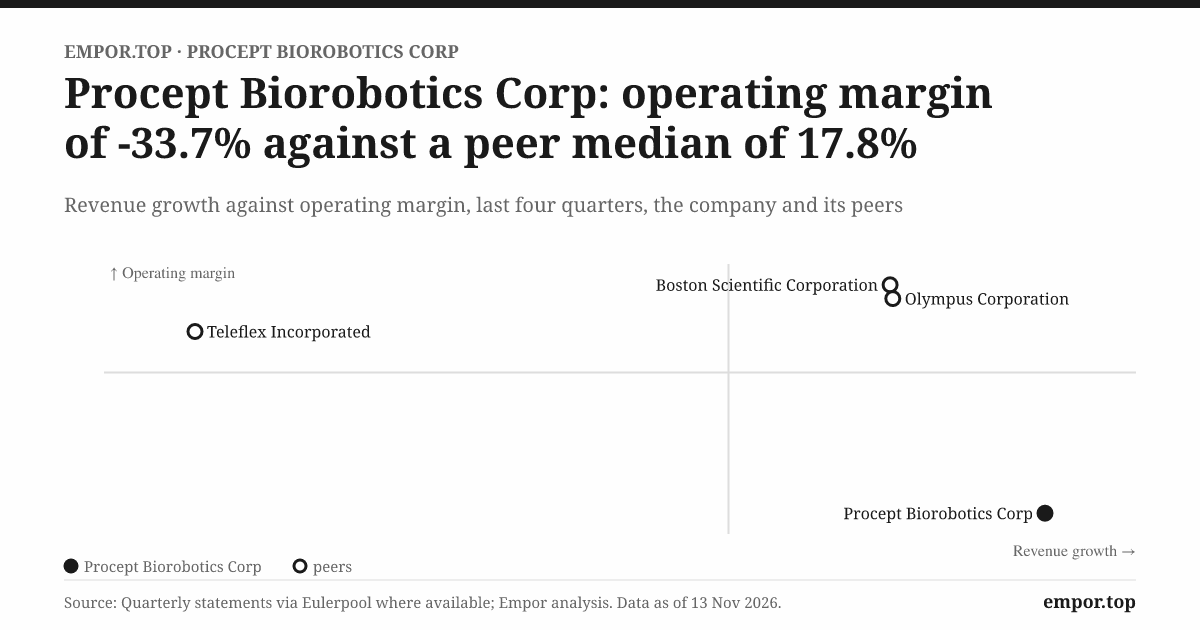
The third quarter of 2026 sharpened the point. Revenue grew about 18%, but sales, general and administrative expense grew about 23%, from $59 million to $72.5 million.1 Operating loss widened from about $23 million to about $27 million.1 In plain terms: for each extra dollar of sales, the company kept about two-thirds as gross profit, and then spent more than that on selling and administration. That is the opposite of operating leverage. It may be temporary, the cost of reorganizing a sales force and launching a new platform, but it is the fact on the table.
This is where the model's apparent strength turns into its central question. The consumables stream is real and already dominant. But its durability depends on procedures per system, and the company does not publish that measure split by generation. It does not disclose a recurring-revenue rate, a standard system contract length or any minimum-volume commitments from hospitals.4 Hospitals that buy robots owe PROCEPT nothing afterward. The annuity exists only as long as surgeons keep choosing to use it.
The unresolved unit, then, is procedures per installed system, split between HYDROS and legacy AquaBeam, alongside handpiece revenue per procedure. The second number is visible and rising, about $3,570 per handpiece, which suggests PROCEPT has held price on its disposables.1 The first is the one that matters most and is reported only in pieces. One clue sits in the third quarter's mix: U.S. handpiece revenue grew about 21% while U.S. procedures grew about 22%, so price gains on the handpiece were roughly offset by a falling ratio of handpieces sold to procedures, which Wood attributed to inventory normalizing in the field.13 Consumable revenue, in other words, is now moving almost exactly in step with cases. There is no hidden stocking tailwind left. From here on, the stream grows only if procedures grow.
And whether procedures grow depends on something no spreadsheet captures neatly: whether a urologist, standing in front of a patient, thinks Aquablation is the best choice among many.
IV. A Fragmented Market Leaves Room to Win—and Many Ways to Lose
Picture a hospital's value-analysis committee on a weekday afternoon. Around the table sit a urology chief, an operating-room director, a finance officer and a supply-chain manager. On the agenda is a request for a surgical robot whose only job is to treat enlarged prostates. The finance officer asks the obvious question: we already treat these patients, so why do we need this?
That question frames PROCEPT's competitive world. BPH is not an untreated disease waiting for its first cure. It is one of the most crowded treatment markets in urology, with options at every level of invasiveness. A ten-year analysis of a large U.S. database tracked how usage and costs shifted among these surgeries, a reminder that this is a market of substitution rather than a vacuum.14
Start with TURP, the century-old reference procedure. It is familiar, reimbursed and taught everywhere, and it remains the benchmark against which every newcomer is measured. Then come the laser procedures, especially holmium laser enucleation of the prostate, or HoLEP, which can treat very large glands and has passionate advocates, though it demands a long learning curve. Below those sit the minimally invasive options designed for men who want to avoid a resective operation altogether. Teleflex's UroLift places small implants that hold the prostate lobes apart. Boston Scientific's Rezūm uses steam to shrink tissue. Both can be done in an office or outpatient setting, often without general anesthesia, and both are sold by large companies with deep sales forces.
Aquablation slots into the resective tier, competing most directly with TURP and laser procedures for the men who need tissue removed. Its pitch rests on four claims: randomized evidence against TURP, a standardized procedure that is less dependent on surgeon skill than HoLEP, a treatment plan that can preserve ejaculatory function, and suitability for a wide range of prostate sizes.8 Those are real differentiators. Notice, however, that none of them is "it's a robot." Robotics is the delivery method, not the moat. The question is whether the clinical and workflow advantages are strong enough that hospitals and surgeons will keep choosing it when alternatives improve.
The five pressures on a single procedure
Run the market through Michael Porter's lens and each pressure has a specific face. The buyers are hospitals, and they hold real power: they decide capital budgets, they control operating-room time, and they can delay a purchase for a quarter or a year without explanation. Inside the hospital sits a second buyer, the surgeon, who decides case by case whether to use the robot at all. The substitutes are everywhere, from TURP to lasers to office-based implants, and their presence constrains what PROCEPT can charge. New entrants face a high bar, because any rival would need its own clinical trials and regulatory pathway, though large device companies could develop or acquire competing technology. Suppliers matter more than they might appear to: PROCEPT builds its systems and handpieces in San Jose but buys components from global suppliers, and every system includes a third-party ultrasound system and probe.2 The company warns about single-source exposure in its risk factors but does not quantify how concentrated its supply base is.2
On one front, the news is reassuring. No single customer accounted for more than 10% of revenue in 2023, 2024 or 2025, or in the first nine months of 2026, and no customer exceeded 10% of receivables at the latest quarter-end.42 PROCEPT is not hostage to one hospital system. But that diffusion cuts both ways. Hundreds of hospitals, each with its own committee, means hundreds of separate capital decisions and hundreds of potential delays. Customer dispersion reduces single-account risk without removing the collective bargaining power of hospitals as a class.
Competition came up directly on the third-quarter call. Asked by a TD Cowen analyst whether rivals had changed the picture, Wood said competitive dynamics "didn't change in the quarter," and he placed the headwind almost entirely on PROCEPT's own legacy fleet.3 That answer is worth weighing in both directions. It is reassuring that management does not see share loss to lasers or implants as the cause of the slowdown. It is less reassuring that the cause is internal, because a problem inside the installed base cannot be blamed on anyone else, and has to be fixed by the company's own execution. Seasonality supplies the rest of the near-term texture. Management pointed to summer vacations as a drag and to the fourth quarter as a seasonal high point, when patients who have met their insurance deductibles rush to schedule elective procedures before the reset in January.3 Elective surgery is a calendar business, and Aquablation lives on that calendar like every other BPH treatment.
What the evidence proves, and what it does not
Weigh the case for differentiation honestly. The randomized WATER evidence is genuine, and the company cites inclusion in urology guidelines as further support.4 Procedure volumes have grown fast, from about 27,800 U.S. cases in 2024 to about 43,300 in 2025, and the third quarter of 2026 ran at more than 13,400.[^10]1 A treatment that surgeons did not value would not show that trajectory. So the history does not reject the claim that Aquablation is clinically differentiated; it supports it.
What the history does not show is a moat in the investor's sense. The company has published no evidence of switching costs that lock a hospital in once it buys a robot. It does not disclose account-level retention, the share of accounts that increase or decrease volume, or what happens to utilization when a competing technology arrives at the same hospital. There is no reliable, comparable share figure for PROCEPT across the full BPH treatment market, so claims of market leadership cannot be inferred from system growth.
It is also worth resisting the most seductive comparison in this industry. Intuitive Surgical, the maker of the da Vinci robot, is the canonical example of a surgical-robot razor-and-blade business that became a compounding machine. PROCEPT's board even includes Frederic Moll, who co-founded Intuitive Surgical.[^10] But Intuitive's robot serves many procedures across many specialties, which spreads each system's fixed cost over a vast case mix. PROCEPT's robot does one thing. A da Vinci that loses one procedure type can fill its day with another; an Aquablation system that loses BPH patients has nothing else to do. Comparing the two as peers, in valuation or in moat, mistakes a shared category for a shared economics.
Which brings the analysis back to utilization, and to the most uncomfortable disclosure of 2026. Management said HYDROS accounts were doing more procedures than legacy accounts while AquaBeam utilization weakened.3 Strip out the noise, and that statement says the surgeons at older accounts were, in aggregate, doing fewer Aquablation cases than before. The forward proof of differentiation is not equipment shipments. It is sustained use across the whole fleet. And that is exactly the problem the next-generation robot was designed to solve.
V. HYDROS Turns an Upgrade into a Commercial Test
In August 2024, the FDA cleared HYDROS through the 510(k) pathway, the route for devices that are substantially equivalent to something already on the market, in this case PROCEPT's own AquaBeam.[^8] The company presented it as the next-generation Aquablation system: a robot with updated imaging, artificial-intelligence-assisted treatment planning and a redesigned workflow intended to make each case faster and easier to set up.[^8]8
The AI label deserves a moment of translation. In an AquaBeam case, the surgeon outlined on ultrasound images the region of prostate tissue to remove, and the robot executed that plan. HYDROS uses software to propose a treatment plan from the imaging, which the surgeon then reviews and adjusts.8 The analogy is a navigation app suggesting a route that the driver can accept or change. That can save time and reduce the variability between surgeons, which matters a great deal if the goal is to make Aquablation routine for the average urologist rather than a specialty of a few enthusiasts. But "AI-powered" here is a product feature inside the robot. It is not a separate business, and on its own it is not a moat; any well-funded rival can write planning software.
The commercial evidence for HYDROS is where the story gets interesting. On the third-quarter call, Wood said procedure volume at HYDROS accounts was more than 35% higher than at legacy AquaBeam accounts.3 He also said surgeon migration from AquaBeam to HYDROS was the single biggest factor behind lower AquaBeam utilization.3 Read those two statements together and they say something precise. The new robot is pulling cases. Part of what it is pulling, though, are cases that would otherwise have been done on the old robot.
That is not necessarily bad. A hospital that owns both systems and shifts its surgeons to the newer one has not lost a single Aquablation case. But it complicates the headline comparison. If HYDROS accounts are disproportionately the hospitals with the most enthusiastic surgeons, or the largest programs, or the newest launch support, then a 35% gap between account groups could reflect who chose HYDROS as much as what HYDROS does. Management has not published procedures per system by generation and launch cohort, which is the analysis that would separate platform effect from account mix.
The launch teams
The company's answer to the adoption problem has been organizational as much as technological. During 2026, PROCEPT built dedicated launch teams whose job is to stand up a new system, train the staff and get the first cases on the schedule. Wood said about 70% of third-quarter systems were launched by these teams, and that the company expected to have capacity to launch every new system by year-end.3 He also said launch-team systems reached first cases sooner and showed higher-than-historical utilization, though he gave no figure for either.3
That is a plausible mechanism. The hardest weeks in a new hospital account are the first ones, when the robot is installed but the surgeons are inexperienced and the referral network has not yet formed. A team that compresses that period could change a system's whole utilization curve. But it is a management-reported early indicator, not a measured result. The company has not published how launch-team cohorts compare with historical cohorts after six or twelve months, and until it does, the claim rests on the company's word.
The awkward parts
Two things in the third quarter did not fit the clean upgrade story. The first was new placements. PROCEPT shipped 62 HYDROS systems in the United States, but 20 were replacements of older AquaBeams, leaving 42 new placements.1 Wood said greenfield placements, meaning sales to hospitals that had never owned a system, "fell short of our expectations," and attributed the shortfall largely to timing, with several systems shifting into the fourth quarter because of shipping.3 He also stressed that the company did not discount to pull deals into the quarter.3 U.S. system revenue was flat year over year despite the higher selling price.1 Higher prices on fewer new units can signal discipline; it can also signal softer capital demand. The fourth quarter's deliveries will reveal which.
The second was the replacement cycle itself. PROCEPT completed 20 replacements in the third quarter and 36 in the year to date, and Wood called accelerating the transition from AquaBeam to HYDROS a strategic priority.31 Management guided to 50 to 60 replacements in 2026, at an average price of about $315,000.3 Replacements can restart utilization at a sleepy account: a new machine, a fresh launch, renewed surgeon enthusiasm. But they consume sales and launch resources, and each one swaps an old robot for a new one without adding a single system to the installed base. A replacement is revenue today in exchange for the promise of more cases tomorrow.
Price tells a related story. A new HYDROS sold for about $495,000 in the United States in the third quarter, while a replacement brings in roughly $315,000, so every replacement that occupies a salesperson's quarter carries about a third less revenue than a greenfield sale.13 The gap is the trade-in credit a hospital receives for its old AquaBeam, which is a sensible inducement if the upgraded account then does more cases. It is also the reason a quarter heavy in replacements can show strong unit shipments and flat system revenue at the same time, which is exactly what happened in the United States in the third quarter.1 The company has also begun to offer operating leases selectively, two in the quarter, as a way to reach hospitals that cannot find the capital.3 Each lever, trade-ins and leases alike, makes it easier to put a HYDROS in a hospital. Each also makes the per-unit economics depend more heavily on what happens after installation.
Chief financial officer Kevin Waters said HYDROS would make up more than 60% of the installed base by the end of the year.3 That makes the transition consequential. If the platform genuinely raises productivity, a fleet that is majority-HYDROS should show rising procedures per system in 2027. If the 35% gap mostly reflects which accounts upgraded first, the remaining AquaBeam accounts, the ones that have not yet chosen to upgrade, may be the quieter part of the fleet, and converting them may yield less.
The verdict on HYDROS is therefore narrower than the marketing. It is a meaningful product transition and the most important commercial bet the company has made since launching AquaBeam. It is not yet a proven second growth engine. The proof would be procedures per system, by generation and by launch cohort, alongside handpiece revenue per procedure, and those are figures management has not supplied. Without them, the upgrade remains a promising hypothesis, and responsibility for testing it has fallen to a chief executive who has been in the job little more than a year.
VI. The New CEO Inherits a Growth Machine That Still Burns Cash
In July 2025, PROCEPT announced that Reza Zadno, the chief executive who had taken the company through its IPO and its fastest years of growth, would hand over to Larry Wood.9 Wood took the role in September 2025.[^10] The announcement came alongside preliminary second-quarter revenue, which tied the leadership change to the company's numbers in a way investors could not miss.9
Wood was not a stranger. He had joined PROCEPT's board in 2024, and before that he spent a long career at Edwards Lifesciences, where he ran the transcatheter heart valve business.[^10]9 That is a résumé with a particular meaning in medtech. Transcatheter aortic valve replacement was a new therapy that required persuading cardiac surgeons and interventional cardiologists to change how they treated a common disease, building hospital programs from scratch and generating clinical evidence trial by trial. In other words, Wood spent years doing at much larger scale almost exactly what PROCEPT now needs: turning a clinically proven device into a standard of care.
Relevant experience, however, is not the same as a track record at this company. Wood inherited a business with strong historical growth, but growth had already begun to slow. Revenue rose about 37.5% in 2025 to around $308 million, but operating expenses reached about $333 million, leaving an operating loss of roughly $104 million.4 In the first nine months of 2026 revenue grew about 19% to roughly $276 million, while operating cash outflow widened to about $66 million from about $39 million a year earlier.2 The growth rate halved and the cash burn grew. That is the inheritance, and it is also the beginning of Wood's own record.
What changed under Wood
Wood's visible decisions have been organizational. The company reorganized its commercial coverage. It created the launch teams. And it moved its sales representatives away from what he called routine case coverage, the practice of standing in the operating room during procedures, toward physician offices, where they could drive therapy adoption and referrals.3 "Our sales representatives are out of routine case coverage and in physician offices," he said on the third-quarter call.3
That shift is worth understanding. In many device companies, the sales rep spends a large part of the day in surgery, troubleshooting equipment and reassuring the surgeon. It builds loyalty but does not create new patients. Moving reps upstream, toward the referral sources that generate cases, is a bet that the constraint on Aquablation is no longer surgeon confidence in the operating room but patient flow into the surgeon's clinic. If the bet is right, procedures per system should rise. If it is wrong, surgeons who relied on in-room support may do fewer cases. The evidence that will settle it is the same metric that settles nearly everything in this story: utilization by account, over time.
The analysts on the third-quarter call pushed on the soft spots. They asked about the light system sales, about whether AquaBeam declines would persist and about the path to profitability.3 Wood answered that the shortfall was timing, that the company had held its price, and that the headwind was "almost exclusively driven by the weakness" in AquaBeam utilization.3 Waters said the company still expected positive adjusted EBITDA, a measure that excludes stock compensation and depreciation, in the fourth quarter, in a range of roughly $3 million to $9 million.3 Management's own fourth-quarter assumptions included continued year-over-year declines in AquaBeam utilization, and its planning starting point for 2027 was about 20% revenue growth, assuming essentially no change in utilization trends.3
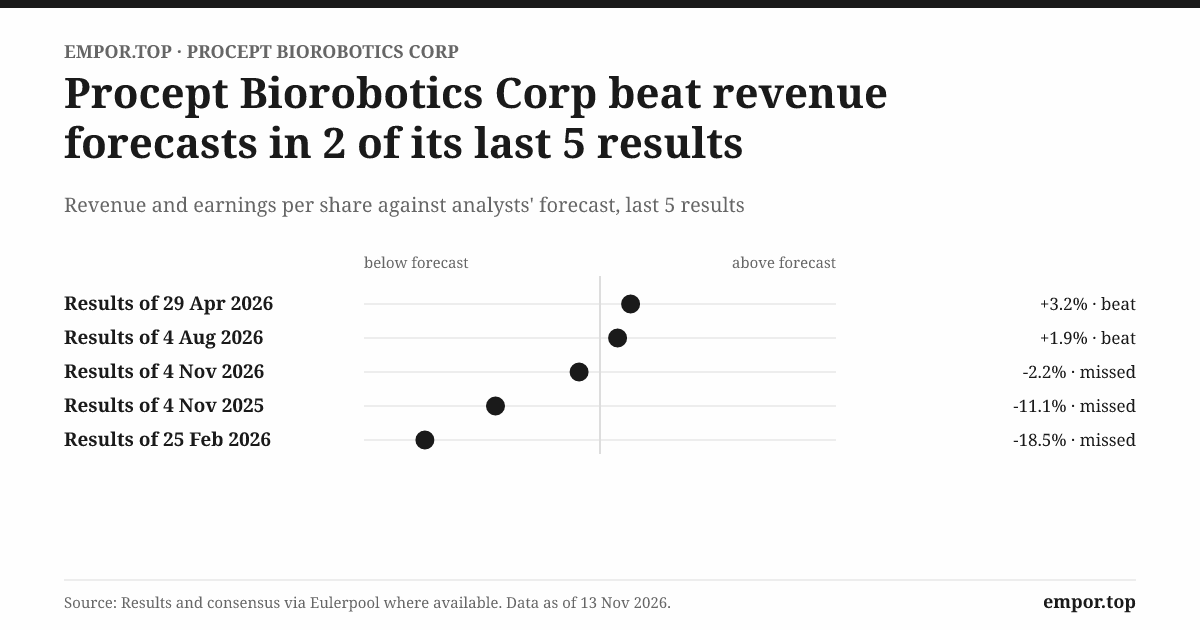
That candor deserves credit, and it also sets a scoreboard. The market had already reacted sharply to earlier signs of strain: after the second-quarter report in August 2026, the shares fell even though revenue beat expectations.10 The fourth quarter will test the timing explanation, and the 2027 guidance will test whether "20% as a starting point" is conservative planning or the new ceiling. A management team that explains a miss as timing gets one chance at that explanation; the second time, investors stop believing it.
The procedure guidance offers a smaller, cleaner test of the same discipline. PROCEPT entered the year guiding to 54,000 to 56,000 U.S. procedures, roughly 25% to 29% growth, and reiterated that range in November.1 On the call, though, Waters said the company now expected to land around 54,000, the bottom of the range.3 A Piper Sandler analyst asked how the fourth quarter could deliver the step-up that implies, and management pointed to a strong September and the deductible-driven seasonal surge, with Waters framing the required sequential growth at roughly 14% to 29%.3 That is a wide band for a single quarter, and the fact that the company quietly steered toward the low end while formally reiterating the full range is the kind of nuance worth noticing. It is not a broken promise. It is a promise being renegotiated in the fine print.
Ask what Wood has actually promised, then, and the list is short and checkable: placements that slipped will ship, AquaBeam declines will be offset by HYDROS gains, the fourth quarter will be profitable on an adjusted basis, and 2027 will grow about 20% without heroic assumptions. Framing 2027 as a "starting point for planning" rather than a target is itself a choice of style: a former large-company operator setting a floor rather than a ceiling, and asking to be judged on delivery.3
Pay, votes and alignment
The incentives are worth examining with care. The 2026 proxy reported Wood's 2025 compensation at about $6.8 million, most of it in equity: roughly $3.8 million in stock awards and $1.3 million in options.[^10] Because he served as chief executive for only part of the year, that figure is not a clean annual run rate. His predecessor received about $16.8 million in 2025, including a one-time bonus of about $1.7 million and roughly $14.4 million of combined stock and option awards.[^10] The company's 2025 incentive plan rested on corporate goals, and its stock-ownership policy requires the CEO to hold shares worth three times base salary.[^10]
Shareholders noticed. At the June 2026 annual meeting, the advisory say-on-pay vote drew about 27.0 million votes in favor and 9.9 million against, meaning roughly a quarter of the votes cast opposed the pay package.11 In the director elections, two nominees, Antal Desai and Mary Garrett, each drew several million withheld votes, against only about half a million for Frederic Moll.11 Dissent at that level does not threaten control, but it is a clear signal. A company that has never earned an annual profit paying its departing chief executive more than $16 million in a single year invites exactly the questions those votes asked.
Ownership offers no controlling anchor. The proxy listed four institutions above 5%: AllianceBernstein at about 6.0%, BlackRock at about 5.9%, T. Rowe Price at about 5.7% and BNP Paribas Asset Management at about 5.4%.[^10] None controls the company, and executive ownership is modest relative to those holdings. Alignment here comes from equity awards and the ownership policy, not from founders or insiders with large personal stakes. For a long-term investor, the relevant question is whether those awards pay out only if procedures and cash flow improve, or whether they pay out regardless.
Capital allocation, by contrast, is unglamorous. PROCEPT has funded product development and commercial buildout from its own balance sheet, replenished by the IPO and the follow-on raises of 2023 and 2024.4 It has made no material acquisition, which means no goodwill to impair and no deal price to benchmark.4 The capital-allocation test is therefore not M&A discipline. It is whether the money spent on salespeople, launch teams and R&D produces procedures, and whether the dilution required to fund it is ever repaid in cash. That test has a quieter, more technical front, one that sits on the balance sheet rather than in the operating room.
VII. The Receivables Grew Faster Than the Story's Easy Version
On the third-quarter call, a detail slipped by that most listeners would have missed. Among the 62 HYDROS systems shipped in the quarter, three had been delivered and installed, yet PROCEPT had not booked their revenue.3 The reason was simple: the company was waiting to be paid. Waters said the company expected payment, and revenue recognition, in the fourth quarter.3
On its own, three systems is a footnote. But it sits inside a larger trend. Trade receivables, the money hospitals owe PROCEPT, rose from about $83.5 million at the end of 2025 to about $105 million by September 2026.2 The allowance for credit losses, the company's estimate of what it may never collect, doubled from about $1.1 million to about $2.2 million over the same period.2 And in the first nine months of the year, the growth in receivables absorbed about $22.9 million of cash, compared with about $3.1 million in the same period of 2025.2
To read those figures fairly, start with the longer pattern. Receivables measured as days of revenue, known as debtor days, climbed from roughly 67 in 2019 to a peak of about 136 in 2024, then improved to about 99 in 2025.4 Capital equipment sold to hospitals tends to carry long collection cycles, so a high number is not alarming by itself, and the 2025 improvement was genuine progress. The 2026 build-up reversed part of that progress just as revenue growth slowed. When sales grow 19% but receivables grow more than 25% in nine months, the gap is cash the company has earned on paper and not yet banked.
Who pays late? The company answers as far as its disclosures go. Its standard terms are 30 to 90 days.4 No single customer exceeded 10% of receivables at the end of September.2 PROCEPT says it has not experienced significant credit losses and sets its allowance using aging, customer financial condition and collection history.2 It does not publish a full aging table or quantify overdue balances. There is no evidence of a broad customer default problem, and the doubled allowance is small in absolute terms against $105 million of receivables. But the direction of travel, more owed and slightly more doubt about collecting it, deserves attention in a company that is spending cash heavily.
A second, smaller item points the same way. The company's net investment in sales-type leases, arrangements in which a hospital effectively finances a system over time, rose from about $4.8 million at year-end to about $6.2 million.2 Waters said on the call that the company had placed two systems on operating leases in the quarter, expected one or two such deals per quarter, and that cash sales would remain the main model.3 Leasing can open doors at hospitals short of capital. It also shifts financing risk onto PROCEPT's balance sheet. The auditor had already flagged robotic-system revenue recognition as a critical audit matter in the 2025 audit, because of the judgment it requires, while giving an unqualified opinion with no material weakness.4 Deferred-payment systems, case-by-case trade-ins and leases are exactly the kinds of arrangements that make that judgment harder.
The cash that never arrived
Step back and look at cash over the company's whole public-reporting history. From 2019 through 2025, PROCEPT accumulated net losses of about $531 million and operating cash outflows of about $483 million.4 The gap of roughly $48 million is not evidence of hidden cash generation. It is mostly the effect of noncash charges, stock compensation and depreciation, partly offset by cash tied up in receivables and inventory. Inventory is its own drag: the company has held inventory equal to more than 200 days of cost of sales in every year since 2019, which is common for a device maker carrying robot components and disposables but adds to the cash it needs.4
The current burn is worse than last year. In the first nine months of 2026, operating cash outflow was about $66.4 million. Net operating assets, mainly receivables and inventory, rose by about $31.4 million, which more than offset the $50.1 million of noncash charges added back to the loss.2 Put simply, the losses alone would have produced a smaller burn; working capital made it larger.
One more cushion hides inside the income statement. Because PROCEPT holds a large cash balance, it earns interest on it: about $12.1 million of interest and other income, net, in 2025, which offset roughly an eighth of the pretax loss.4 That income rose because average cash balances were higher, partly offset by lower rates.4 It is genuine money, but it is money earned from shareholders' capital sitting in money-market funds, not from selling robots. As the cash balance shrinks, so does the interest, which means the reported loss will tend to widen slightly even if the operating business is unchanged. A company that relies on interest income to soften its losses is, in effect, spending its own capital twice: once as burn, and again as forgone yield.
The balance sheet keeps this from being an emergency. At the end of September, PROCEPT had about $218 million in cash and cash equivalents, primarily in money-market funds, against about $52 million of long-term debt.2 The debt is a senior secured term loan from CIBC, secured by substantially all of the company's assets including its intellectual property, bearing interest at SOFR plus 2.25%.412 In September 2026 the company amended the loan to push its maturity from October 2027 to October 2028.12 The agreement contains a trigger: if available cash falls below $100 million, PROCEPT must meet either a minimum-cash covenant or a minimum-revenue-and-growth covenant.4 At $218 million, that threshold is distant.
Distant, but not irrelevant. At a nine-month burn of about $66 million, plus capital spending, the cushion above the covenant trigger is roughly a couple of years of current-pace outflow, and the loan itself is a bullet that falls due in full in 2028. Liquidity buys time. What defines the constraint is the rate of burn, the covenant floor and that secured maturity. The settling evidence is close at hand: fourth-quarter collections on the three deferred systems, receivables and the allowance measured against revenue, and operating cash flow with working-capital movements shown separately. If the receivables build unwinds and the promised fourth-quarter adjusted EBITDA arrives, this section of the story will look like noise. If not, it will look like the beginning of a harder conversation, which is precisely the conversation the share price is already having.
VIII. Analysis & Bear vs. Bull Case
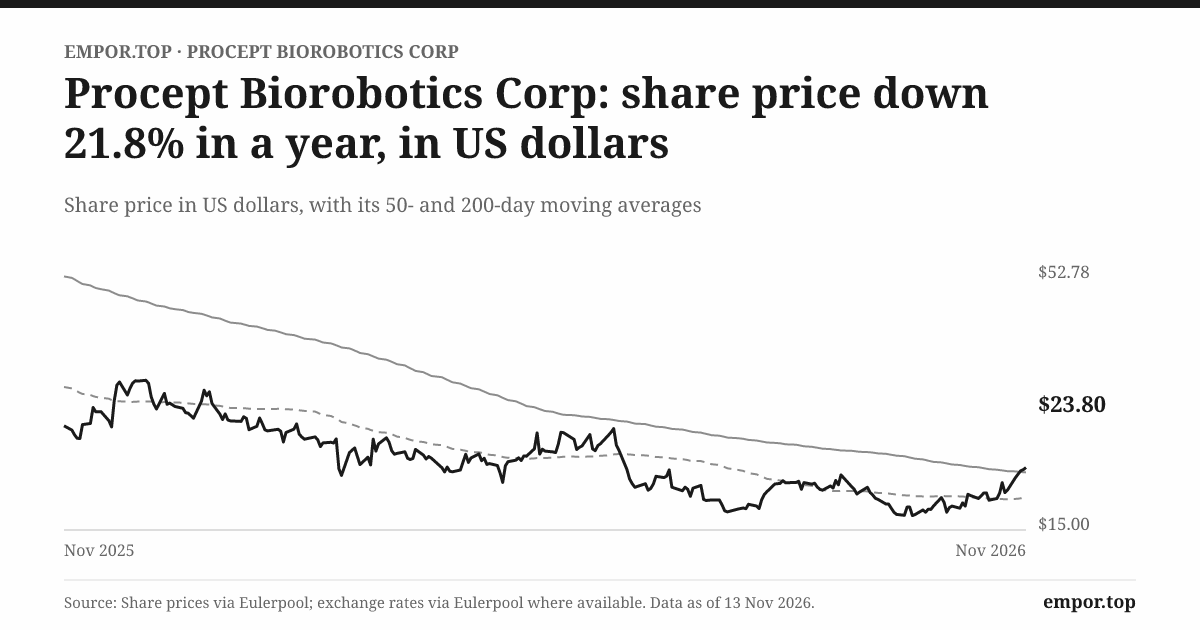
On November 13, 2026, PROCEPT's shares closed at $23.80. They sat about 34% below their 52-week high of $36.10 and well above the low of about $17. The stock had a market value of roughly $1.3 billion and an enterprise value, after netting cash against debt, of about $1.2 billion. Over five years the shares had suffered a peak-to-trough fall of about 83%, and their volatility over the past year ran at about 65%. Those numbers describe a stock the market has repriced from a growth darling to a show-me story.
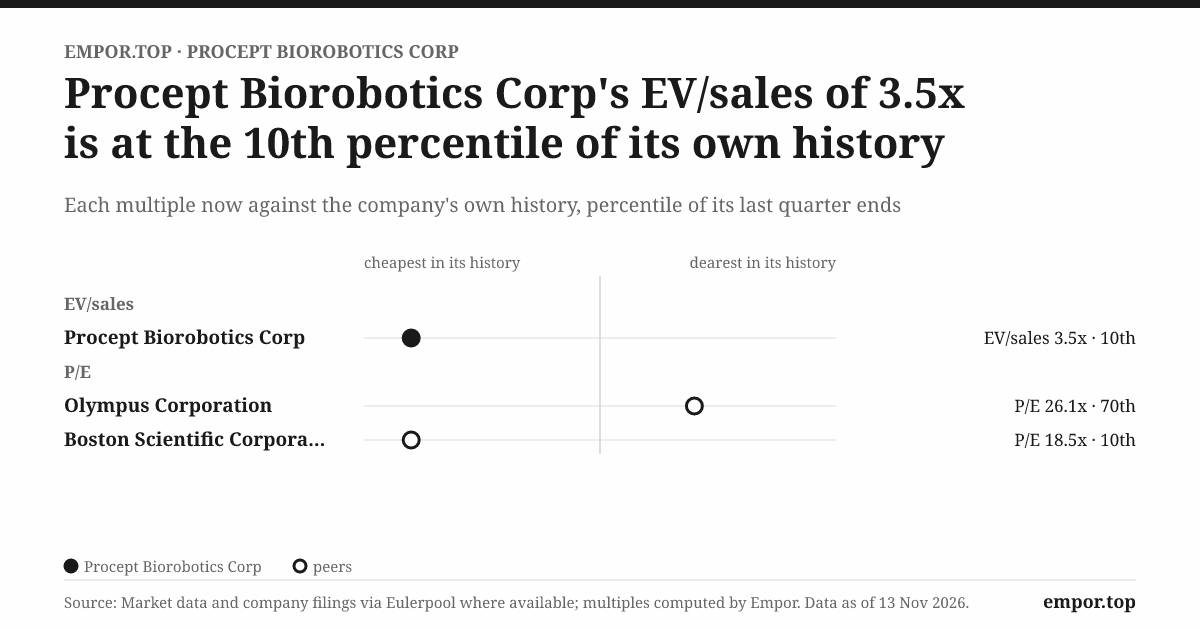
At that price, investors were paying about 3.8 times trailing sales, and about 3.5 times sales on an enterprise-value basis.12 Because the company loses money, the usual earnings multiples do not exist, and the free-cash-flow yield is negative, at about minus 9.5%. A June 2026 snapshot put PROCEPT's enterprise value at about 3.4 times sales, against roughly 12.7 times for Intuitive Surgical and 5.2 times for Stryker.13 That gap is real, but it is not a bargain signal by itself. Intuitive and Stryker are large, profitable and diversified; PROCEPT is single-procedure, loss-making and still proving its unit economics. The discount reflects those differences. What the current price appears to assume is that revenue keeps growing at a solid rate and that the company eventually converts a 65%-plus gross margin into real operating profit, without a further capital raise large enough to dilute today's holders materially.
The bull case
The bull case starts with real assets. The installed base is large and growing, at 1,095 systems worldwide.2 Procedures are growing faster than revenue, at about 22% in the third quarter, and handpieces and consumables already supply most of the revenue.1 The handpiece price rose about 12% year over year, evidence of pricing that has held even as volumes grew.1 HYDROS accounts report higher procedure volumes, and by the end of 2026 HYDROS should be more than 60% of the installed base.3 Gross margin is expanding, and management has said it sees no ceiling at 65% to 66%, describing 100 to 200 basis points of annual expansion as a reasonable place to be.3 International revenue grew about 32% in the third quarter, a small base with room to grow.1 And WATER IV adds an option on prostate cancer that the current valuation does not obviously price.3
In the bull's telling, 2026 is a transition year. The company reorganized its sales force, built launch teams and accelerated an upgrade cycle all at once, and a temporary drop in system revenue and a rise in spending are the cost of that rebuild. Once the fleet is mostly HYDROS and the launch teams are fully staffed, utilization rises, consumables compound, and operating leverage finally appears.
The bear case
The bear case starts with the growth curve. Revenue growth fell from above 80% in early 2024 to the high teens, and management's own planning starting point for 2027 is about 20%.3 System placements are uneven, with greenfield sales missing internal expectations in the third quarter.3 Older-system utilization is falling, and management assumes it will keep falling.3 Operating expenses are growing faster than revenue, the company is still losing more than $100 million a year at the operating line, and cash burn rose in 2026.2 Every dollar of the cushion was raised from shareholders, and equity awards keep adding to the share count.
In the bear's telling, HYDROS is less a growth engine than a treadmill: the company sells replacements to its own customers to restart utilization at accounts that had cooled, and calls the result growth. The 35% HYDROS advantage could reflect account selection, and the falling AquaBeam numbers could be a preview of what happens to any account once the novelty wears off.
Testing the moat
Hamilton Helmer's seven sources of durable power offer a sharper test than the word "moat." Scale economies are emerging but modest: gross margin rose as volume spread overhead, but PROCEPT is far too small to have a cost advantage over larger device companies. Network economies are absent; one hospital's use does not make the robot more valuable to another, except through the indirect effect of surgeon training and published evidence. Counter-positioning has some force, because established BPH competitors selling lasers or implants would cannibalize their own products by embracing waterjet robotics. Switching costs are partial: a hospital that has bought a robot and trained its staff has sunk money and time, but nothing stops it from leaving the robot idle and sending patients to HoLEP or UroLift. The robot's sunk cost binds the hospital's budget, not the surgeon's choice. Branding among urologists exists but is narrow. Cornered resource is the strongest candidate, through the patents, the De Novo pathway and the randomized evidence base, although evidence can be matched by rivals willing to run their own trials. Process power, the kind of embedded organizational know-how that is hard to copy, is what the launch teams are trying to build, and it is unproven.
Weighed against the record, the moat claim survives in a narrower form. Clinical differentiation is real. Durable power, in the sense of switching costs, repeatable utilization across cohorts or pricing power that holds against substitutes, is not yet proven. The handpiece price increase is a point in its favor; falling AquaBeam utilization is a point against. The claim is intact but unproven, and the evidence that would confirm or falsify it is the same everywhere: whether accounts stay busy years after they buy.
A skeptical long-short investor would press on one definition in particular. Management's preferred profitability yardstick, adjusted EBITDA, excludes stock-based compensation along with interest, taxes, depreciation and amortization.1 In the third quarter, PROCEPT reported an adjusted EBITDA loss of about $9.8 million against a net loss of about $26.5 million.1 The difference is largely the cost of paying employees in shares, which is real dilution for existing owners even though no cash leaves the company. So when management promises positive adjusted EBITDA in the fourth quarter, it is promising a swing of roughly $13 million to $19 million in a single quarter on a measure that leaves out a material, recurring expense. That swing is plausible given the seasonal surge in procedures and the systems pushed out of the third quarter. But an investor should hold the company to the measures that include stock compensation, operating loss and operating cash flow, because those are the ones that tell whether shareholders, rather than employees, end up owning the gains.
Financial strength gets a similar verdict. About $218 million of cash and modest secured debt provide runway, and the loan extension removed a near-term maturity.212 But the company has needed new equity in two of the past three full years, burn accelerated in 2026, and its covenant trigger at $100 million is close enough to matter if the fourth-quarter profitability promise slips. Financial strength is adequate for now, not ample.
Three numbers decide the argument. The first is procedures per installed system, split by generation; the company reports the ingredients, procedures and installed base, but not the split, and AquaBeam utilization is falling while HYDROS accounts run more than 35% higher.3 The second is handpiece and consumable revenue growth relative to procedure growth, which in the third quarter ran at about 21% against 22%, meaning the consumables stream is now tracking cases one-for-one.1 The third is operating cash flow with working-capital movements separated, which in the first nine months of 2026 was an outflow of about $66 million, wider than a year earlier.2
The risks that matter flow through those three numbers. Elective-procedure demand and hospital capital budgets drive placements; a recession or reimbursement squeeze would slow both. Slower cases reduce consumables directly. Global component sourcing, including the third-party ultrasound in every system, can disrupt production. And commercial execution must convert upgrades into cases. Speculative threats, such as AI-enabled rivals or broad macro worries, deserve less weight than these mechanical ones. A sufficiently capable competitor in BPH could arrive, but today's risk is more prosaic: that robots go quiet.
The valuation cannot be called cheap from a peer snapshot alone. Whether today's price leaves enough room depends entirely on whether the next year brings evidence of procedure growth and operating leverage. And that returns the story to the operating room, where the lessons of this company were written.
IX. Lessons from a Robot That Needs a Surgeon
Go back to the loading dock. A hospital accepts delivery of a HYDROS system, signs for it, and the crate disappears down a corridor. For PROCEPT, revenue has been booked. For the hospital, a bet has been placed. Neither knows yet whether the machine will treat two hundred men a year or twenty. The lessons of this company sit in the space between those two numbers.
The first lesson is that a placement is a promise of future cases, not proof of them. For years PROCEPT's investors counted robots, because robots were easy to count and their growth was spectacular. Then 2026 revealed that a large slice of the fleet, the older AquaBeam systems, was being used less, even as the total installed base passed one thousand. The robots had not gone anywhere. The cases had. For founders selling capital equipment with a consumable tail, the lesson is that the metric which matters is the one customers control after the sale, and it should be measured and published from the beginning. For investors, a company that discloses placements but not utilization by cohort is telling only the easy half of the story.
The second is that a clinical milestone opens the door; commercialization pays the rent. WATER and the De Novo clearance in 2017 gave Aquablation scientific legitimacy and regulatory permission. They did not fill an operating-room schedule. Revenue in the two years after clearance stayed in single-digit millions, and nearly a decade later the company is still building launch teams to help hospitals get their first cases on the calendar. The gap between "this works" and "this is what we do now" is where device companies spend most of their capital, and it should temper how anyone values the next trial, WATER IV included.
The third is that growth can hide the bill until working capital comes due. While revenue grew at 50%, 60% and 80% a year, rising receivables and inventory looked like the natural byproduct of expansion. When growth slowed to the high teens in 2026, the same build-up of receivables, three shipped systems awaiting payment and a doubled credit allowance became visible as what it always was: cash the company had spent and not yet recovered. Fast growth is a generous accountant. Slower growth audits the books.
The fourth is that an upgrade only counts if the account gets busier. PROCEPT's replacement program sells new HYDROS systems to hospitals that already own AquaBeams. Each replacement brings revenue, a fresh launch and, management says, more procedures. But a replacement does not add a single robot to the installed base, and without cohort-level utilization data no one outside the company can tell whether the upgraded accounts are doing more cases in total or simply moving them from one machine to another. In medical devices, as in software, a version upgrade is worth exactly what it changes in customer behavior. The question for the year ahead is whether it changes enough.
X. Epilogue
PROCEPT enters 2027 in a peculiar position: larger than ever, more cautious than ever and with more of its future riding on a single metric than at any point since its IPO. Replacements are underway, the launch teams are expanding toward every new placement, and management has promised a next phase in which utilization improves. Tonight, the company has about $218 million in the bank, a fleet of more than a thousand robots, and a plan.2
The first moment of truth comes with the fourth-quarter results in early 2027. Those numbers will show whether the systems that slipped from the third quarter actually shipped, whether the three deferred systems were paid for, and whether the company delivered the positive adjusted EBITDA it guided to.3 They will also show the year-end installed base and how much of it is HYDROS, which management expects to exceed 60%.3 If all three promises land, the timing explanation earns credibility, and the 2027 outlook starts from a firmer base. If they slip, the story changes from transition to reset.
The second moment is the 2027 guidance itself. Management's starting point was about 20% revenue growth, assuming roughly unchanged utilization.3 Investors will compare procedure growth with system placements, and they will look for something the company has not yet provided: procedures per system by generation. A management team that wants credit for HYDROS has every incentive to publish that number. If it chooses not to, that choice will itself be information.
The third moment is the slow one: margin and spending. Management has described 100 to 200 basis points of annual gross-margin expansion as a reasonable target.3 That only matters if selling and administrative costs grow more slowly than revenue, which they did not in the third quarter of 2026.1 Watch handpiece growth and gross margin alongside SG&A, never in isolation. Then watch operating cash flow, receivables and collections, and the distance between the cash balance and the $100 million covenant trigger on the secured loan due in 2028.12
The wild card is WATER IV, with primary data expected in the first half of 2027.1 Positive results would give Aquablation a foothold in prostate cancer, a disease where the treatment stakes are higher and the patient pool overlaps with the urologists PROCEPT already serves. Negative or ambiguous data would leave the company exactly where it is: dependent on BPH. Even good results would only open a door. Commercialization evidence, years later, is what would establish their financial weight.
Weighed together, these moments will answer the story's central question. Either HYDROS proves to be a bridge, a better robot that makes the whole fleet busier and carries the company to operating leverage before its cash cushion thins, or it proves to be an expensive reset, a necessary upgrade that restores lost cases without creating many new ones. The next twelve months should tell the difference.
XI. Outro
Return to that operating room, and the robot under its cover in the corner. It is already paid for. The hospital has already trained its staff. PROCEPT has already booked the sale. And yet, for the company that built it, the robot's real value has not been realized at all, because that value arrives one patient, one surgeon and one handpiece at a time.
That is what makes PROCEPT unlike the surgical-robot companies it gets compared with. It does not sell a platform that fills its day with a hundred procedures; it sells a single procedure with a robot attached, and the robot earns its keep only if a urologist chooses it tomorrow morning, and the morning after that. The company has 1,095 machines in the field. The measure of this business was never how many robots it could ship. It is how reliably each one earns its place.
References
-
Q3 2026 earnings release — PROCEPT BioRobotics Corporation, 2026-11-04 ↩↩↩↩↩↩↩↩↩↩↩↩↩↩↩↩↩↩↩↩↩↩↩↩↩↩↩↩↩↩
-
Form 10-Q for Q3 2026 — PROCEPT BioRobotics Corporation, 2026-11-04 ↩↩↩↩↩↩↩↩↩↩↩↩↩↩↩↩↩↩↩↩↩↩↩
-
Q3 2026 earnings call transcript — Stock Analysis, 2026-11-04 ↩↩↩↩↩↩↩↩↩↩↩↩↩↩↩↩↩↩↩↩↩↩↩↩↩↩↩↩↩↩↩↩↩↩↩↩↩↩↩↩↩
-
Form 10-K for FY2025 — PROCEPT BioRobotics Corporation, 2026-02-26 ↩↩↩↩↩↩↩↩↩↩↩↩↩↩↩↩↩↩↩↩↩↩↩↩↩↩↩↩
-
FDA De Novo classification order for AQUABEAM — U.S. Food and Drug Administration, 2017-12-21 ↩
-
Final IPO prospectus, Form 424B4 — PROCEPT BioRobotics Corporation, 2021-09-15 ↩↩↩
-
IPO closing, Form 8-K — PROCEPT BioRobotics Corporation, 2021-09-17 ↩
-
Aquablation and the HYDROS Robotic System — PROCEPT BioRobotics ↩↩↩↩↩↩↩
-
CEO transition announcement and Q2 preliminary revenue, Form 8-K — PROCEPT BioRobotics Corporation, 2025-07-25 ↩↩↩
-
Q2 2026 earnings call transcript — Investing.com, 2026-08-04 ↩
-
2026 annual-meeting voting results, Form 8-K — PROCEPT BioRobotics Corporation, 2026-06-10 ↩↩
-
Third Amendment to Loan and Security Agreement, Form 8-K — PROCEPT BioRobotics Corporation, 2026-09-24 ↩↩↩↩
-
BPH surgery utilization trends, ten-year U.S. database analysis — UROLUTS ↩
 LinkedIn
 WhatsApp
 Reddit
 Hacker News
 Email
 Kindle
 RSS Feed
 Spotify
 Apple Podcasts
 Amazon Music
 Audible
 YouTube