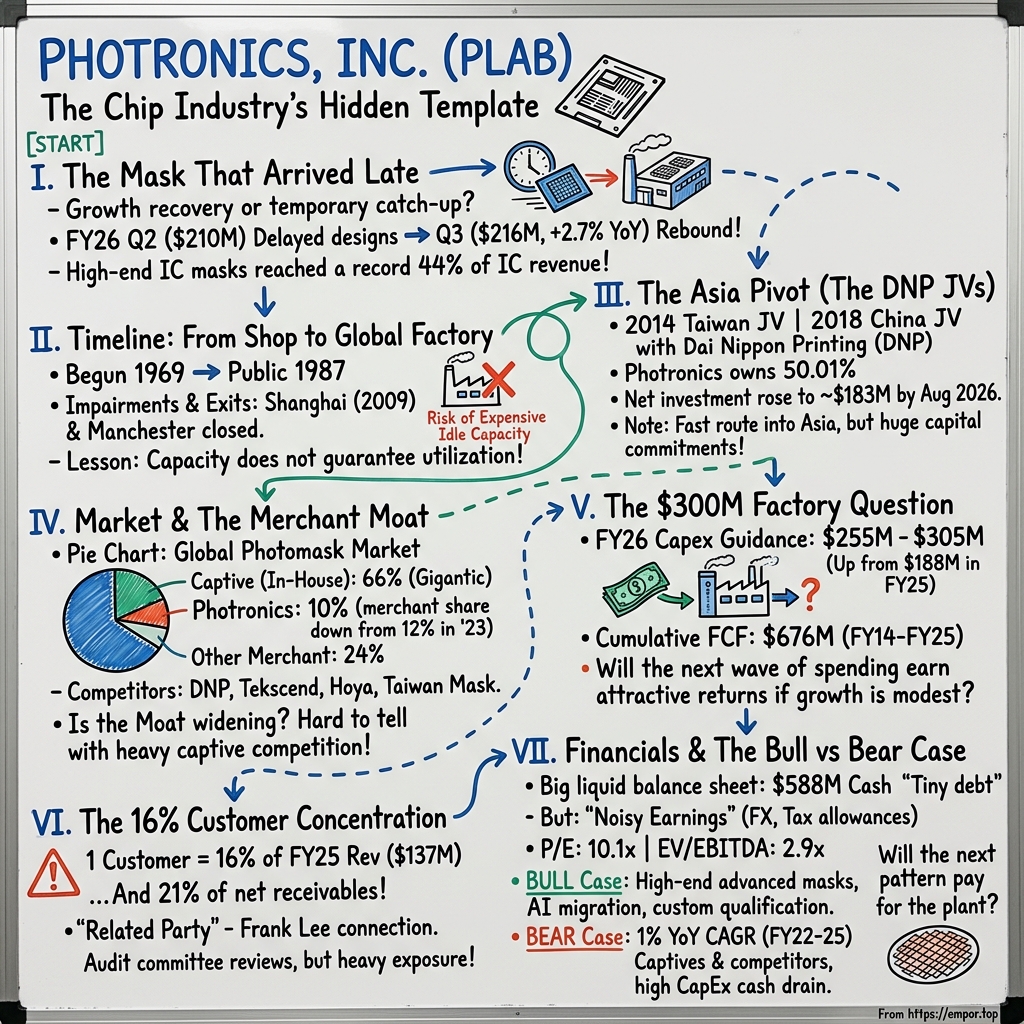
Photronics: The Chip Industry's Hidden Template
I. The Mask That Arrived Late
Every new chip starts life as a file. Engineers at a design house spend months, sometimes years, arranging billions of transistors into a pattern, and when the pattern is finished they "tape out," the old industry phrase for handing the design to the factory. Before a single wafer can be printed, though, someone has to turn that file into a physical object: a slab of ultra-flat quartz carrying the circuit pattern in microscopic detail. That object is the photomask. In the spring of 2026, a lot of those files simply did not arrive.
Photronics, a company headquartered in Brookfield, Connecticut, that makes photomasks for chipmakers and display makers around the world, felt the silence first in its order book. Its executives had expected the usual rush of orders before Chinese New Year, followed by a short lull and then a seasonal recovery. The lull came on schedule at the end of February. The recovery did not. On the company's second-quarter call in late May, Frank Lee, the longtime Photronics executive who had run the company as chief executive until the previous year, told analysts that the slowdown after the holiday had lasted "much longer than we anticipate."1 Chief financial officer Eric Rivera dated the moment visibility turned cloudy to the start of the conflict between the United States and Iran, after which fab utilization began to bite as well.1
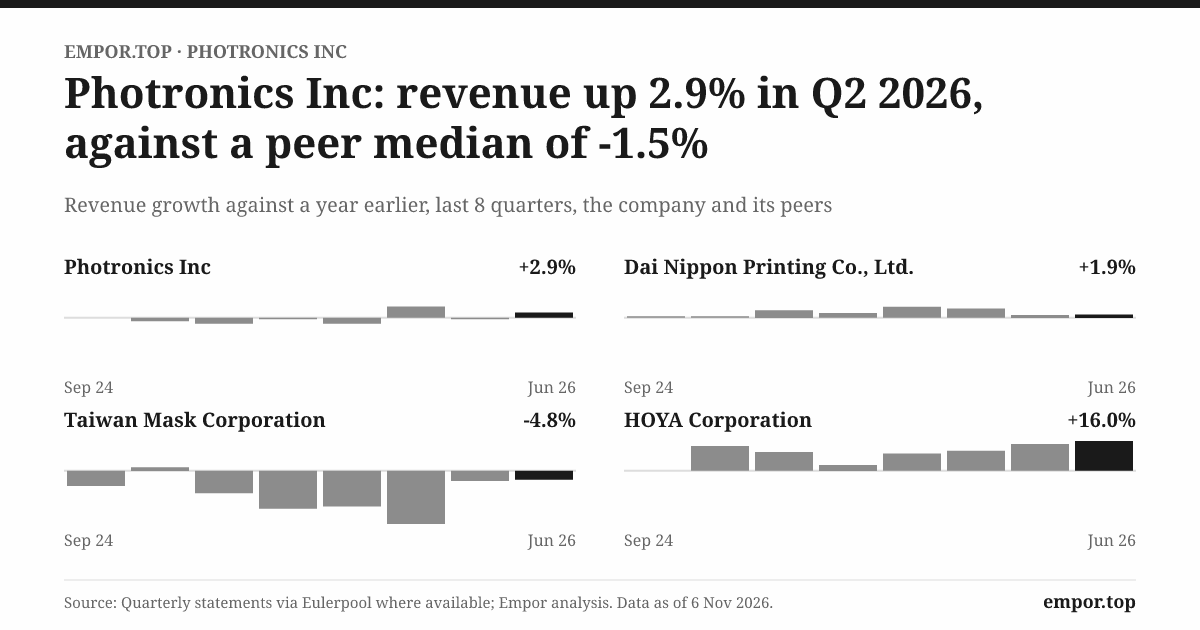
The numbers that followed were not a collapse, and that is part of what makes them interesting. Revenue for the quarter ended in early May came in at about $210 million, essentially flat on a year earlier.1 Underneath that flat line, the integrated-circuit business, the mask lines that serve chipmakers, fell 5% year over year to about $148 million, and only a record quarter from the display-mask business kept the total steady.1 Executive chairman and chief executive George Macricostas blamed three forces: chip factories running so full that they could not accommodate new designs, a memory shortage that was delaying consumer electronics launches, and geopolitical uncertainty.1
Then, three months later, the files began to arrive again. In the quarter ended August 2, 2026, Photronics reported revenue of $216.0 million, up 2.7% year over year and above the top of its own guidance range.2 Integrated-circuit revenue rose about 5% to roughly $155 million, and the high-end masks, the ones made for the most advanced chip geometries, reached a record 44% of IC revenue.2 Macricostas called it "a recovery of some of the temporarily delayed semiconductor design releases."2 On the call, Rivera was more careful. Many of the designs that should have arrived in the second quarter did arrive in the third, he said, but "the conditions that were present in Q2 still largely remain."3
That sentence is the whole puzzle of this story in miniature. A delayed order that finally ships is a catch-up, not growth. The question for anyone trying to understand Photronics in November 2026 is whether the third quarter was the first page of a new growth chapter or the last page of an old pause, and whether the company can tell the difference before it spends hundreds of millions of dollars on new factories.
The reason the question is hard is the odd rhythm of the mask business. Macricostas reminded listeners on the May call that photomask demand "is more closely aligned with semiconductor design releases than to wafer starts."1 A chip factory can run flat out for a year printing the same design without ordering a single new mask, because a mask set, once made, is reused for wafer after wafer. Photronics gets paid when something new is designed, not when something old is manufactured. That makes it a strange kind of semiconductor company: essential to every chip, yet partly insulated from, and partly at odds with, the boom in chip volumes. In 2026 the industry's factories were so busy that they were turning away new designs, which is the rare situation in which a semiconductor boom actively hurts the mask maker.
Scale helps frame the stakes. Photronics booked $849 million of revenue in fiscal 2025, the year that ended in October 2025.4 That sounds like a business riding the greatest chip cycle in history. Yet from fiscal 2022 to fiscal 2025 its revenue grew only about 1% a year, after peaking at $892 million in fiscal 2023 and drifting lower for two years.4 Over the longer decade, growth averaged closer to 5% a year. Something in the past three years has slowed the company to a crawl even as the world argued over the scarcity of advanced chips.
Three questions run through what follows. Can advanced masks, the high-end share that hit a record in August, lift growth rather than just reshuffle the mix? Will the next wave of factory spending, aimed at Texas and South Korea, earn its keep? And how durable is the company's cash generation when one customer, connected by family to a senior executive, supplies roughly a sixth of revenue?
One clarification belongs at the very start, because it shapes every number that follows. Photronics is an independent company listed on Nasdaq, not a subsidiary of anyone.4 Its partner in two large Asian joint ventures is 大日本印刷 Dai Nippon Printing, the Japanese printing and electronics group usually called DNP, which owns 49.99% of each venture while Photronics owns 50.01%.4 DNP is a partner and, outside Taiwan and China, a competitor. It is not the parent. To see how a Connecticut mask shop ended up sharing its most profitable factories with a Japanese rival, the story has to go back to the beginning.
 Subscribe on LinkedIn
II. When a Mask Shop Had to Become a Global Factory
Picture a stencil. If you want to paint the same pattern on a hundred walls, you cut it once and spray through it a hundred times. A photomask is a stencil for light. Ultraviolet light shines through the quartz plate, the opaque chrome pattern blocks it in some places and lets it pass in others, and a lens shrinks the resulting image onto a silicon wafer coated with light-sensitive chemicals. Each layer of a chip needs its own stencil, which is why customers typically buy masks in sets, with each mask corresponding to one layer of the circuit.4 A simple chip might need a modest set. A leading-edge processor needs dozens of layers, each written with a precision measured in nanometers, and each one has to be perfect, because a single flaw on the mask is copied faithfully onto every chip it prints.
Flat-panel displays work the same way at a vastly larger scale. The masks that pattern the thin-film transistors behind a smartphone's OLED screen or a television panel are enormous glass plates, and the newest generations of display factories need masks so large that only a handful of machines in the world can write them.4 That is the second business Photronics runs, and it will matter later in the story as a shock absorber that does not always absorb.
Photronics was organized as a Connecticut corporation in 1969 and was founded by Constantine Macricostas, who still sits on its board more than half a century later.564 It went public through a registration statement that the Securities and Exchange Commission declared effective in March 1987.6 The early decades followed a logic that shaped the whole industry. In the beginning, chipmakers made their own masks in-house, in what the industry calls captive shops. As mask-writing equipment grew more complex and expensive, many chipmakers decided they could not use the machines efficiently enough to justify them, and they sold or closed their captive operations.4 Independent "merchant" suppliers such as Photronics bought those shops, built new ones near customers, and grew by becoming the outsourced mask department for the industry. By fiscal 2005, Photronics had reached about $441 million in annual sales.6
The 2005 annual report captures the company at the peak of that expansion instinct. It was spending about 7% of revenue on research and development, and it was building two new factories: a display-mask plant in 台中 Taichung, Taiwan, and an integrated-circuit plant in Shanghai, both scheduled for completion in 2006.6 The strategy was simple to state. Masks are custom products with delivery windows measured in days, so the supplier that sits near the customer's fab wins the urgent orders. Build where the chips are going to be made, and the work will come.
The work did not come to Shanghai, at least not enough of it. In January 2009, as the financial crisis gutted chip demand, Photronics stopped making photomasks at its plant in Manchester, England, and in July 2009 it did the same in Shanghai, recording restructuring charges of roughly $13.6 million tied to the two closures, on top of an earlier impairment charge at Manchester.7 The company's own explanation was blunt: the closures were meant to lower operating costs and increase manufacturing efficiency.7 A factory that had been planned with high hopes only a few years earlier had become a cost to be cut. Photronics also warned investors at the time that it could not assure there would be no further closures.7
It is worth pausing on what those closures actually prove, because they are the historical counterweight to everything Photronics is building today. They do not prove that China was a bad idea; the company returned to China a decade later with far better results, as the next chapter shows. What they prove is narrower and more durable. In the mask business a factory is not an asset in the way a brand or a patent is. It is a bet on utilization. Mask-writing tools are fantastically expensive, the employees who run them are skilled and hard to replace, and most of those costs are fixed whether the factory is busy or idle. A plant that wins enough qualified customer work throws off cash. A plant that does not becomes a write-down. Photronics has been profitable every year since fiscal 2010, but it has lived through net losses before, and its filings still say so.4
The second lesson from that era was about the structure of the market itself, and it has never gone away. The trend toward outsourcing that built Photronics turned out to be reversible. As chipmakers raced to hit their technology roadmaps, some of the biggest captive mask shops invested faster than the independents could, and the market swung back to being majority captive-supplied.4 Captive operations held about two-thirds of the total photomask market in 2025, up from roughly 63% in each of the three preceding years.8 In other words, most of the masks the world's chipmakers use never reach a merchant supplier at all. They are made by the chipmakers themselves.
That single fact frames the rest of the story. Photronics competes for the third of the market that the giants choose not to make for themselves, and the giants can change their minds. The company says captives have recently begun to steer more production toward independent suppliers, and its expansion plans lean heavily on that trend.41 Yet the most recent share chart shows the captive slice growing in 2025, not shrinking.8 A mask shop that wants to be a global factory has to win business from customers who are also, in effect, its largest potential competitors. Photronics' answer to that problem, when it next went looking for scale in Asia, was not to build alone. It was to bring along a rival.
III. The Taiwan Partnership That Rewrote the China Bet
On April 4, 2014, a Taiwanese mask company owned by DNP merged into Photronics' own Taiwan subsidiary. The deal was technical on paper and strategic in effect. DNP Photomask Technology Taiwan, a wholly owned DNP unit, folded into Photronics Semiconductor Mask Corporation, and the combined company took the name Photronics DNP Mask Corporation, or PDMC.9 Photronics came out owning 50.01% and DNP 49.99%.9
To understand why a company would invite a direct competitor into its Taiwan operations, it helps to know what Taiwan meant to the mask industry by 2014. The island was home to the world's dominant contract chipmakers and a dense cluster of design houses. Being a local mask supplier in 新竹 Hsinchu was like being a tailor on Savile Row: the customers were demanding, the deadlines were brutal, and proximity was everything. Photronics had been in Taiwan for years, and it had spent the preceding three years buying out the minority shareholders of its Taiwanese subsidiary through tender offers and buybacks until it owned all of it.9 Then, almost immediately, it gave up half to DNP in exchange for DNP's Taiwanese operation.
The accounting outcome tells only part of the story. Photronics recorded a gain of about $16.4 million on the transaction in fiscal 2014.9 That figure reflects how the acquired business was valued against what was given up under accounting rules; it is not a purchase price, and Photronics never published a multiple or a like-for-like benchmark that would let an outsider say whether it got a good deal or a poor one. What the structure did deliver is clear. Photronics gained a larger Taiwanese footprint and a partner with deep technical resources, without writing a large cheque in a conventional acquisition.
Four years later, Photronics ran the same play in mainland China. In the fourth quarter of fiscal 2016 a Photronics subsidiary had signed an investment agreement with the administrative committee of the Xiamen Torch Hi-Tech Industrial Development Zone to build an integrated-circuit mask plant in 厦门 Xiamen.10 In January 2018, Photronics and DNP formed a second joint venture under which DNP took 49.99% of that young Chinese business, which was then still under construction.10 The venture became Photronics DNP Mask Corporation Xiamen, known as PDMCX. Photronics explained that the partnership would let it "compete more effectively for the merchant photomask business in China" and benefit from the "additional resources and investment that DNP will provide."10 The total planned investment was about $160 million, split between the partners and supplemented by local borrowing, and the company said the expansion was "substantially supported by customer commitments for its output."10
Separately, and wholly on its own account, Photronics committed to invest at least $160 million in a display-mask plant in 合肥 Hefei, backed by incentives from the local high-tech zone, with initial capability for the largest generation of display masks and AMOLED products.10 China in 2018 was the second coming of the Shanghai bet, only bigger, and this time Photronics had hedged half of the integrated-circuit risk with a partner and tied much of the capacity to customer commitments before the concrete set. The 2018 annual report noted, with a hint of the old scar tissue, that the global manufacturing network "will expand to eleven manufacturing sites in 2019" and that any decline in design releases could leave the company with "excess or underutilized production capacity" and "write-offs from asset impairments."10
The plants opened and ramped in 2019, and the cost was visible immediately. Capital spending that year climbed to about 32% of revenue, and free cash flow, the cash left after equipment spending, turned negative by about $110 million.84 For a company that had closed its previous Chinese factory a decade earlier, that was a large act of faith.
The test of that faith is not the size of the buildings but what came out of them, and here the record is genuinely encouraging. Within three years of the China ramp, Photronics' operating margin climbed from about 10% in fiscal 2019 to roughly 28% in fiscal 2023, while revenue rose from $550 million to $892 million.4 The chip shortage of those years did a lot of the lifting, and every mask shop benefited. Still, the facilities that Photronics and DNP built together in Taiwan and China were positioned to catch the wave rather than watch it.
One correction to a common reading of this structure matters for anyone trying to value the company. It is tempting to assume that a 50/50 venture sits off to the side of the accounts, reported as a single line of "share of earnings." That is not how Photronics reports either venture. Because Photronics appoints the majority of the PDMCX board and directs its management and investments, it treats the venture as a variable-interest entity of which it is the primary beneficiary, and it consolidates it line by line; DNP's 49.99% appears as a noncontrolling interest.4 The Taiwan venture is consolidated the same way. Every dollar of revenue and operating profit in Photronics' reported results therefore includes the joint ventures in full, and DNP's share is subtracted only at the very bottom, before arriving at the profit that belongs to Photronics' own shareholders.
That final subtraction is large, and it is the clearest measure of how much the DNP partnerships now matter. In fiscal 2025, net income attributable to noncontrolling interests, essentially DNP's half of the two ventures, was about $53.8 million.4 Doubling that suggests the Taiwan and China ventures together earned roughly $108 million, more than half of the company's consolidated net income of about $190 million that year.4 In the nine months to August 2026, DNP's share rose again, to $44.0 million from $37.0 million a year earlier, driven by the Taiwan venture.11 The joint ventures, in plain terms, are not a side bet. They are the profit engine, and DNP owns nearly half of it.
The cash tells the same story. At the end of the third quarter of fiscal 2026, Photronics held about $673 million of cash and short-term investments, but roughly $504 million of it, three dollars in every four, sat inside the 50.01%-owned ventures.2 Photronics' own net investment in PDMCX alone had grown to about $183 million by August 2026, from about $160 million at the fiscal 2025 year-end, and DNP held a matching stake.114
The partnership also carries a clause worth knowing. Under certain circumstances, including unresolved disputes over strategy, DNP has the right to put its PDMCX interest to Photronics, or to buy Photronics' interest, at its share of the venture's net book value.104 DNP has not indicated an intention to exercise it.11 The clause is not a sign of conflict. It is a reminder that a joint venture is a negotiated relationship, and the economics of Photronics' best factories depend on that relationship staying cooperative.
So did the DNP partnerships give Photronics a more efficient route into Asia's leading-edge market? The evidence supports a qualified yes. The ventures gave Photronics local scale, a technically strong partner and shared funding, and they have earned high returns through the shortage and after it. The price was structural: half of the profit from the company's most productive assets belongs to someone else, and most of the cash on the consolidated balance sheet cannot simply be shipped to Connecticut. There is no evidence in Photronics' disclosures that DNP controls the parent, but there is every reason for a Photronics shareholder to read the consolidated numbers with DNP's half in mind. That raises the obvious next question. If the factories are this good, why has Photronics been growing so slowly?
IV. The Market Photronics Can Reach—and the One It Cannot
A design house finishes a new chip. It tapes out the data to a foundry, and the foundry, not the designer, picks the mask house and places the order. Lee walked analysts through that chain on the May call, explaining that in the second-quarter slowdown the delay happened "at the very beginning," at the design house, before any order existed.1 From that moment the clock runs fast. Photronics' typical backlog is only one to two weeks for integrated-circuit masks and two to three weeks for display masks.11 The mask has to be written, inspected, repaired if needed, and delivered in days, and it has to be right the first time, because every hour of delay holds up a multimillion-dollar production line and the customer's product launch behind it.
That is the moment Photronics sells, over and over, to about 636 customers a year.4 The supplier that wins it must have the right writing tools for the geometry, a qualified process that the foundry trusts, yields high enough to deliver on time, and a factory close enough to the fab to get the plate there quickly. The company's own pitch to investors lists those things in roughly that order: responsive delivery, high yields, process expertise, customer relationships, and a global footprint.8
The business that makes this happen is overwhelmingly about chips. In the third quarter of fiscal 2026, integrated-circuit masks produced about $155 million of revenue, roughly 72% of the total, and display masks produced about $61 million.28 Photronics does not report profit by segment, so investors cannot see which business earns more per dollar of sales, but the IC side is clearly the main economic engine by size. Within it, the company draws a line at 28 nanometers: masks for chips at 28nm or smaller count as high-end, while larger geometries are "mainstream."4
Who else is trying to win that moment? Photronics names its rivals plainly: DNP outside Taiwan and China; Tekscend Photomask, the former Toppan photomask business; Hoya; LG이노텍 LG Innotek; SK-Electronics; 台灣光罩 Taiwan Mask; Compugraphics; two Shenzhen suppliers, 路维光电 Newway Photomask and 清溢光电 Qingyi Photomask; and, most importantly, the captive mask shops of the chipmakers themselves.4 The filing then adds a sentence that any honest analysis of the company has to keep in view: competition "in the past, has led to pressure to reduce prices," and the company said it expected that pressure, along with the heavy capital needed for high-end masks, to continue.4
The merchant market is a strange arena. The largest buyers can make the product themselves. The suppliers include a Japanese conglomerate that is simultaneously Photronics' partner in Asia and its competitor everywhere else. Chinese newcomers attack from the mainstream end, where the technology is mature and price matters most. Rivera confirmed on the August call that the Chinese market is competitive "primarily on the mainstream," with local mask houses focused there, and that Photronics had spent the past year and a half to two years pushing its efforts toward the high end, "where we have our competitive advantage."3 That is a candid admission that the low end of the Chinese market is being contested and that the company has chosen to retreat up the technology curve rather than fight on price.
The share chart shows where all that leaves Photronics. In 2025, by revenue, captive suppliers held about 66% of the total photomask market, Photronics about 10% and all other merchants about 24%.8 Strip out the captives and look only at the pool merchants actually compete for, and Photronics held roughly 29% of it. That is a meaningful position, plausibly the largest single slice among independents. But the trend runs the wrong way for the moat argument. In 2023, Photronics had about 12% of the total market and roughly 32% of the merchant pool.8 Two years later both figures were lower. The company went from about a quarter of the merchant pool in 2021 to about a third in 2023 during the shortage, then gave back part of that gain.8
That is the first piece of evidence against the idea that Photronics' advantage is widening. The second comes from the shape of its customer list. Most of its customers use more than one photomask supplier, the company says.4 Its five largest customers supplied about half its revenue in each of the past three years, with the three biggest at about 16%, 13% and 8% in fiscal 2025.4 These are sophisticated buyers who can split orders, qualify alternatives and, in many cases, make the product in-house. In Michael Porter's language, buyer power is high, and the threat of substitution, in the form of the buyer simply doing the work itself, never goes away.
The forces that protect Photronics are real, too. A high-end mask factory requires multi-beam electron-beam writers and inspection tools that cost tens of millions of dollars each, plus years of process know-how to run them at high yield. The company says it has installed the most advanced multi-beam mask writer for IC work.4 New entrants at the leading edge are rare, and the capital bill alone keeps most of them out. The threat of new competition at the high end is therefore low, even if Chinese entrants are crowding the mainstream. Supplier power exists, since the company depends on a small set of equipment makers and on suppliers of mask blanks, the specialized quartz plates, and it warns that delays or quality problems with blanks could hold up shipments.4 But the decisive forces are the two on the demand side: customers who can multi-source and customers who can insource.
What about switching costs, the mechanism most often cited for why a mask supplier keeps its customers? The logic is sound as far as it goes. A foundry qualifies a mask house's process for a given technology, the qualification takes time and money, and once a design's mask set is in production, changing supplier for the next revision carries risk. Photronics calls its process "Advanced Process-of-Record," industry shorthand for being the qualified source that a production process is built around.8 The difficulty is that the company publishes almost nothing that would let an investor measure how sticky that relationship is. It does not disclose customer retention rates, contract durations, win rates, or how prices move when contracts renew. The revenue note describes most sales as recognized over time, with no per-mask pricing formula, minimum purchase commitments or recurring-revenue share disclosed.4 Switching costs are plausible. They are not proven, and the record offers at least one reason for caution.
That reason is Micron. For years Photronics owned 49.99% of MP Mask, a mask joint venture with the American memory maker. In May 2016, it sold its stake to Micron for $93.1 million, and a one-year supply agreement began under which Photronics would be the majority outsourced supplier of Micron's masks.10 The agreement expired in May 2017.10 Photronics' revenue fell about 8% in fiscal 2016 and another 7% in fiscal 2017, and operating margin dropped to about 7%, its lowest in years.4 Several forces were at work in those years, so the episode is not a clean experiment. It does show the mechanism that limits the moat: a large customer that wants to bring mask-making inside can buy the shop, sign a short supply bridge, and then decide for itself how much work to send out.
Technical capability raises a similar caution. The company says its Boise, Idaho, site is qualified to produce masks at the 7-nanometer node, and management says it is working with customers on more advanced nodes.1 On extreme-ultraviolet lithography, the technology used for the most advanced chips, the company has supplied research masks through partnerships and EUV-related masks to equipment makers, but it is deliberately waiting for the merchant EUV market to mature before investing in full in-house capability.3 Rivera explained the reason directly: those investments are very large, and the company wants confidence in the internal rate of return first.3 That is a prudent stance and also an honest statement of position. At the very top of the technology stack, where the largest captive shops operate, Photronics is a partner and a follower, not the leader. Equipment, qualifications and a record high-end share are evidence of capability. They are not, on their own, evidence of lasting share gains.
The record 44% high-end share deserves the same scrutiny. Break the third quarter apart and the high-end IC business produced about $68.5 million, up 28% from a year earlier, a genuinely strong result.8 But mainstream IC revenue fell about 9% to $86.2 million over the same period.8 The high-end share rose partly because the high end grew and partly because the mainstream shrank. Rivera framed that as node migration, the natural movement of designs toward more advanced geometries with higher prices per design, and called it "an overall positive."3 It may well be. It also means the headline mix record overstates the improvement in the business as a whole, because total IC revenue rose only about 5%.
The display business follows its own clock. Display-mask demand depends on panel technology cycles and on the launch schedules of smartphones, watches, tablets and televisions. In the second quarter of fiscal 2026, display revenue jumped 13% to about $62 million, one of the strongest quarters in the history of that business, and it carried the company through the IC slump.1 In the third quarter it slipped 2% to about $61 million, still near record levels, as tight memory supplies disrupted consumer-electronics launches aimed at emerging markets.23 The company said its newest display writer, installed in Korea, entered mass production in the third quarter to serve the move to larger Generation 8.6 AMOLED panels, which use higher-value mask layers.3 About 85% of display revenue now comes from high-end masks.8 The display business is a technological strength, but it is not a reliable hedge, because the same memory squeeze that delayed chip designs also delayed the phones those displays were meant for.
Then there is artificial intelligence, the theme that hovers over every semiconductor conversation. Macricostas opened the May call by saying demand for leading-edge memory and logic chips for AI "remains exceptionally strong," and that making those chips requires many high-end masks.1 The annual report mentions programs to deliver "AI grade photomasks."4 Yet the company does not isolate AI-related revenue anywhere, and the clearest effect of the AI boom in 2026 was negative: it filled the world's fabs so completely that new designs were pushed back. Rivera pointed directly to "the influence of elevated AI demand on fab utilization and therefore, design starts" when setting third-quarter guidance.1 AI may become a demand driver for Photronics. In the year in which it dominated the industry, it showed up first as a reason for delay.
Put together, the evidence narrows the moat claim rather than rejecting it. Photronics holds a substantial share of the merchant market, a technically demanding product, and qualified positions with demanding customers. But two-thirds of the market is captive and growing, the company's own share of the merchant pool fell from 2023 to 2025, the largest customers multi-source, past price pressure is acknowledged in the filings, and nothing published measures retention or pricing power. The defensible version of the claim is "a strong merchant position with real barriers at the high end," not "a widening moat." The KPI that would confirm the stronger version is simple to state: rising merchant share alongside growth in high-end revenue, not just high-end mix. With that bar set, the next question is how much weight to place on management's explanation for the slowdown that made 2026 such a test.
V. The Quarter When "Temporary" Became a Test
The second-quarter call began, as these calls do, with a carefully worded script. Macricostas described "a mix of supportive long-term drivers alongside temporary headwinds," and he used the word "temporary" deliberately.1 The long-term story was AI, regional chip manufacturing and node migration. The short-term story was a list of three villains: fabs too full to take new designs, a memory shortage that was pushing back consumer product launches, and geopolitical uncertainty. Rivera put flesh on each. Chipmakers were running at higher-than-normal utilization and had "been unable to accommodate additional design releases," while many chip companies were choosing to keep printing profitable existing products rather than launch new ones. Memory prices had surged, delaying new consumer gadgets as manufacturers scrambled to secure supply and manage costs. And the U.S.-Iran conflict had added macroeconomic fog.1
As explanations go, that is unusually specific. It names mechanisms, and each mechanism is checkable against what the rest of the industry was saying. It also has a convenient property for any management team: all three causes sit outside the company's control. The real test of an explanation like that is not how plausible it sounds on the day. It is whether the next quarter behaves the way the explanation predicts.
The analysts' questions on the May call circled exactly that. Max Michaelis of Lake Street Capital asked when visibility turned cloudy and whether customers had offered any timeline for bringing back the delayed designs. Lee's answer was candid: customers remained optimistic about the mid-term outlook, "however, in the near-term, the visibility remains kind of limited," though some delayed tape-outs had already begun to arrive since early May.1 Gowshihan Sriharan of Singular Research asked whether the delays involved designs already in the pipeline or new ones; Lee said they were new designs held back at the design houses themselves.1 Sriharan then asked the question that matters most for a fixed-cost business: if demand stayed soft for a couple more quarters, were there costs the company could cut? Rivera's answer was refreshingly direct. "Very little levers we can pull," he said, because most of the company's costs are fixed.1
That answer is the key to the company's operating leverage. A mask factory's costs are largely depreciation on tools, rent for and power to clean rooms, and salaries for skilled engineers. They do not fall when the order book thins. So a few points of revenue in either direction move margins sharply, and a small number of high-end orders, which carry much higher prices than mainstream masks, can swing a quarter. Rivera noted that "even a small number of orders can materially impact revenue and earnings."1
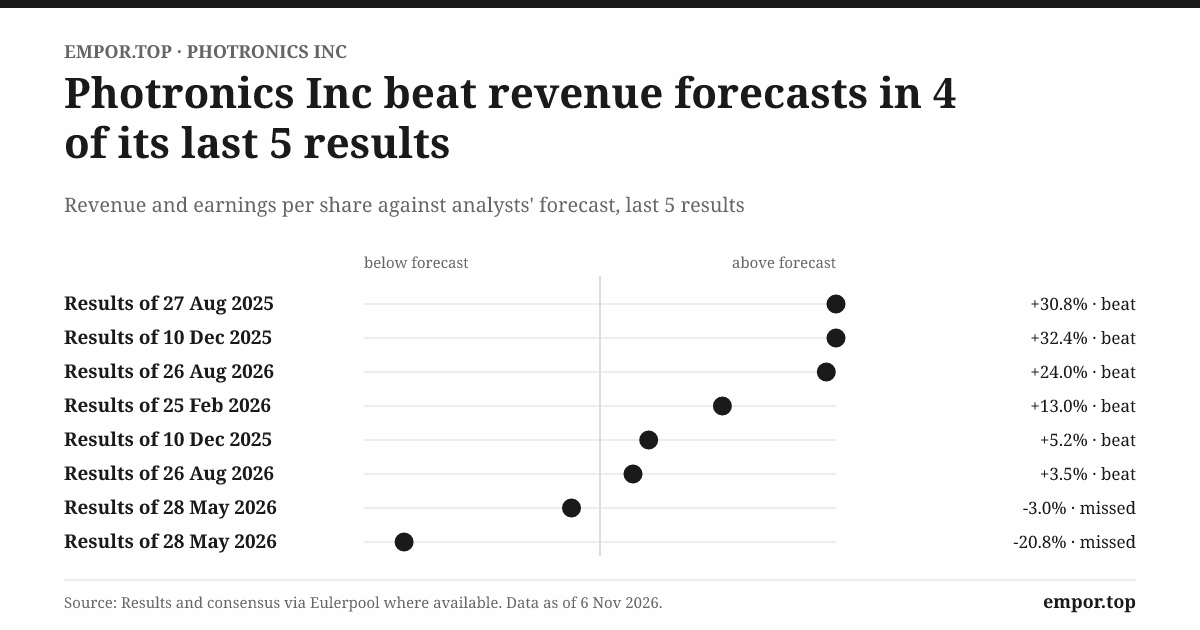
Management then set a bar for itself. It guided third-quarter revenue to between $207 million and $215 million and operating margin to between 18% and 20%.1 When August came, revenue landed at $216.0 million, just above the top of the range, and operating margin at about 21%.28 Measured against its own guidance, the team delivered. The explanation also passed its first test in a narrower sense: designs that slipped out of the spring did show up in the summer, and Macricostas could point out that the recovery had begun in May, "as we had previously communicated."3
The third-quarter Q&A, though, revealed how much uncertainty remained. Michaelis asked the question everyone wanted answered: were they fully caught up? Rivera said much of the delayed second-quarter work had in fact landed in the third quarter, "particularly helpful for Q3," but the three headwinds "still largely remain."3 Danial Yermakhan of Freedom Broker asked why the fourth-quarter guidance range had widened to about $20 million, from $207 million to $227 million, with operating margin anywhere from 19% to 24%.3 Rivera repeated the three factors and said visibility was "even more limited than it has been in the past." Macricostas added a line that every investor should remember: a single high-end mask set can swing "a couple of million plus dollars in a quarter easily," and results "could get a bit choppier, less predictable" until conditions normalize.3
Put the two calls side by side and the story is consistent, which counts for something. Management did not change its explanation, did not blame new villains, and did not overpromise the recovery. But consistency is not the same as resolution. The second quarter's explanation predicted a catch-up, and a catch-up arrived. It did not predict that the underlying conditions would ease, and they have not. A quarter that benefits from orders pulled forward out of the previous one looks better than the run rate it will be compared with next year.
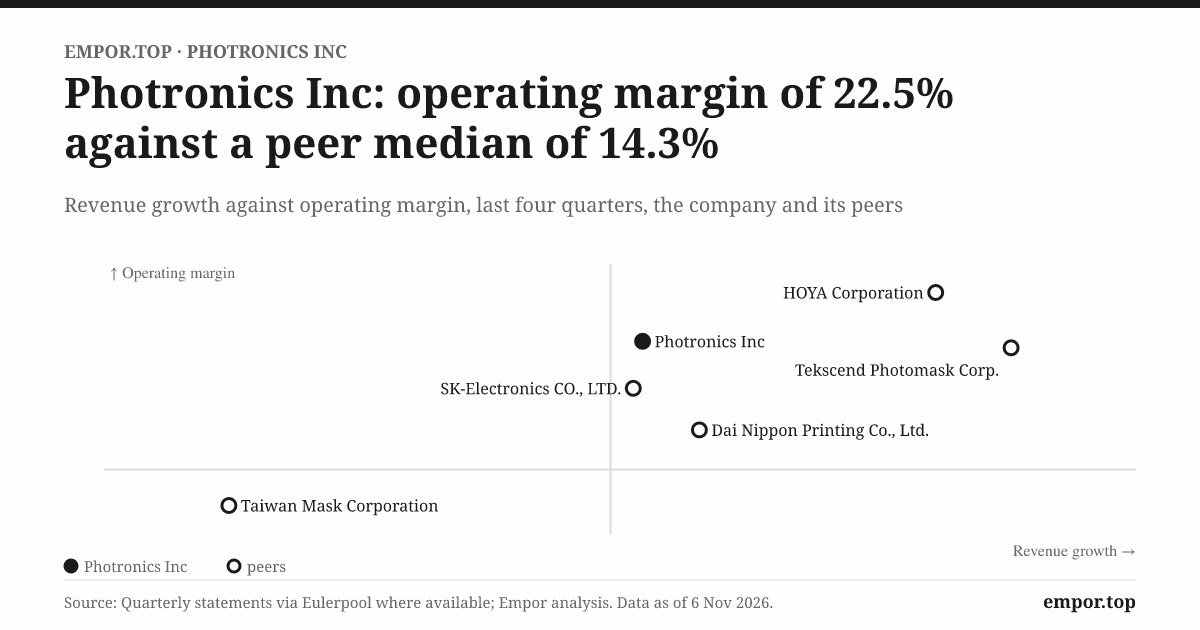
The margins make the point more sharply than the revenue. Third-quarter operating margin of about 21.1% was nearly two percentage points below the 22.9% of a year earlier, even though revenue was slightly higher and the high-end mix was at a record.8 Gross margin also slipped, to about 33.2% from 33.7%.8 When Sriharan pressed on why margins had compressed despite a richer mix, Rivera attributed it to volumes and to mix, "not just product mix, but also geographical mix of where the earnings and where the revenue occurs."3 That is a reasonable answer for a company with plants in Taiwan, China, Korea, the United States and Europe, each with its own cost base, but it is not a specific one. Over the longer run the trend is clearer: operating margin peaked at about 28% in fiscal 2023, fell to about 25% in fiscal 2025, and in the past two quarters has run at 20% to 21%.48 Some of that decline reflects revenue softness on a fixed cost base. Some may reflect depreciation from the expansion wave, which is only beginning.
After a strong second quarter1, the display business slipped slightly in the third23 and offered no reliable cushion, as tight memory conditions again disrupted consumer-electronics launches.
There is one more change between the two calls, quieter but worth noticing. In May, Lee was introduced as President of Photronics' Taiwan business. In August, Rivera was introduced as President and chief financial officer, and Lee as "Senior Executive, Asia."13 The company has not explained the reshuffle on its calls in any detail. It sits on top of a chief-executive transition only fifteen months old, which means the team now explaining delays and capital plans is still building its own record.
So how much confidence does the slowdown explanation deserve? Enough to take it seriously, because it was specific, consistent across two calls, and partly confirmed by the catch-up. Not enough to call the slowdown temporary in its economic effects. One quarter of recovered orders does not show that design activity has returned to a growth path, and the company itself says visibility has worsened. The verdict will come from the full-year numbers, when the catch-up washes out and investors can see whether revenue and margins resume a trend consistent with Photronics' longer record. That matters more than usual in 2026, because the company is in the middle of the largest factory-spending cycle in its recent history.
VI. The $300 Million Factory Question
In Allen, Texas, just north of Dallas, Photronics has been installing new equipment in a plant that has served U.S. chipmakers for years. By May 2026 the site was producing qualification masks, the trial plates customers use to certify a new process before they trust it with production, and the company was targeting first revenue from the expansion late in the fiscal year.1 Halfway around the world, in 천안 Cheonan, South Korea, technicians were preparing a clean room for equipment that would extend Photronics' Korean capabilities to 8 nanometers and below, with first revenue from that project expected by the end of fiscal 2027.14 In the third quarter, Macricostas reported that the Korean clean room was substantially complete and that the first tools had arrived.3
These two projects, plus a peak cycle of replacing end-of-life mask writers, are the reason Photronics' capital spending has surged. In fiscal 2025 the company spent about $188 million on equipment and facilities, roughly 22% of revenue, up from about 15% in each of the two prior years.4 For fiscal 2026 it guided to $330 million, a number it reaffirmed in May.1 At the August call the guidance changed: Rivera cut the range to $255 million to $305 million, while saying the company remained "committed to the projects and time lines" behind the original figure.3 The difference, he explained, reflected the cadence of orders and the delivery timing of certain high-value tools, and any spending that slipped would carry into fiscal 2027.3 Asked whether the peak of end-of-life tool upgrades, previously expected in 2026, might shift, he answered that "the peak may be in '27 as opposed to '26."3
The company's own chart of capital intensity, capital spending as a share of revenue, puts that in perspective. Expected fiscal 2026 intensity of 29% to 35% sat right alongside the 32% of fiscal 2019, the year the Chinese plants were built, and well above the 12% to 17% of the years in between.8 Photronics is, in other words, back at the top of its investment cycle. The last time it was here, free cash flow was deeply negative.4
To judge whether this wave can pay, it helps to understand where Photronics' cash has gone over a long stretch. Across the twelve fiscal years from 2014 to 2025, the company reported cumulative net profit of about $807 million but generated about $2.0 billion of operating cash flow, two and a half times as much.4910 That gap is not an accounting trick. It is the signature of a capital-intensive business: depreciation on mask writers, which in fiscal 2025 alone ran about $77 million, is subtracted from profit but does not consume cash in the year it is charged, and share-based pay adds a further non-cash expense.4
The catch is that depreciation is the memory of cash already spent, and the tools must be replaced. Subtract capital spending and the same twelve years produced about $676 million of free cash flow, roughly a third of operating cash flow.4 That is the real figure for what the business could hand back to its owners, and even that overstates what belongs to Photronics' own shareholders, because part of it was generated inside the joint ventures and belongs to DNP. The PDMC venture in Taiwan, for instance, paid a dividend in early fiscal 2019 of which about $26 million went to DNP's noncontrolling interest.10
Where did the free cash go? Photronics paid no dividends to its own shareholders at any point in those twelve years.4 Instead, it repaid debt, which fell from about $140 million in fiscal 2014 to almost nothing, built its cash pile, which rose by about $373 million to $588 million at the end of fiscal 2025, and bought back stock.410 The repurchases have come in bursts. Between September 2020 and October 2022 the company bought back about 5.8 million shares for about $68 million, and in fiscal 2025 alone it repurchased 5.0 million shares for about $97 million, at an average of about $20 a share.11 It bought none in the first nine months of fiscal 2026, as the factory bills came due.11
Those choices are defensible. They are also the ones a skeptic would question first. A company growing slowly, holding most of its cash in ventures half-owned by a partner, and about to spend its largest capital budget since the China build is asking for patience on two fronts at once. The fiscal 2025 buyback at about $20 a share looks well timed against a share price of about $27 in November 2026, but buybacks are only as good as the per-share cash flows that follow them.11
The balance sheet looks stronger than it is liquid, too. Most of that cash sat inside the Taiwan and China ventures.2 Against that, Photronics reported about $215 million of outstanding capital commitments and another $49 million of accrued equipment liabilities at August 2, 2026.11 Rivera told analysts that to fund the planned investments, including EUV, "we may supplement our existing liquidity through borrowing."3 For a company that has carried almost no debt in recent years, that is a notable shift in posture. At the time, the company remained conservative by most standards, with no reliance on borrowing. But cash in Taipei and Xiamen does not pay for tools in Texas without a dividend that also sends a share to DNP.
The cash generation of fiscal 2026 so far is reassuring on its face. In the first nine months, operating cash flow was about $221 million, up from about $160 million a year earlier.11 The third quarter alone produced about $76 million, more than a third of revenue, against capital spending of $37 million.2 Year-to-date capital spending of about $130 million against a full-year range of $255 million to $305 million implied a fourth quarter of roughly $125 million to $175 million, more than three times the third-quarter level.3 The full-year cash picture for fiscal 2026 and fiscal 2027 will look very different from the cash picture in any single quiet quarter.
What exactly is being bought? The Allen expansion is the clearest case to study, and the answers on the calls were revealing. Asked how much revenue the fully used Allen plant could produce, Rivera declined to give a number.3 Asked whether early Allen revenue would come from new customers, he said the customers were "largely the same with a few exceptions."3 The plan, as Macricostas and Rivera described it, is to move the "less critical part of the high end," midrange nodes such as 65 nanometers, from Boise to Allen, freeing Boise to take more high-end work at higher prices.3 In May, Lee framed it the same way: the expansion was as much a technology upgrade as a capacity addition, aimed at gaining share in nodes Allen could not yet produce.1 Rivera added that from 2027 onward, the company expected its rate of revenue growth to be larger in the United States than anywhere else.1
That logic is coherent. It also illustrates the risk precisely. The first phase of Allen's return depends partly on moving existing work between Photronics' own sites and partly on the company winning more of the U.S. high-end market from Boise. If the second part happens, the investment can pay well. If it does not, Photronics will have spent heavily to reshuffle its own order book. Management said it did not expect the current environment to depress the returns it expects from Allen.1 There is no public metric yet that would let an outsider check that claim.
History offers both warnings and encouragement. Shanghai remains the warning.67 The Xiamen and Hefei plants, built with partner money and customer commitments, ramped into the chip shortage and helped lift the company's returns on invested capital from single digits in fiscal 2019 to more than 30% from fiscal 2022 onward.4 The difference was not the technology in the buildings. It was whether enough qualified customer work arrived at good prices once the tools were installed.
So it is too early to call this plan disciplined or reckless, and anyone who does so in advance is guessing. The measures that will decide it are visible and specific: capital intensity falling back toward the mid-teens once the wave passes, operating margin holding or rising as Allen and Korea add depreciation, and free cash flow after capital spending recovering through fiscal 2027. The shift of the spending peak from 2026 into 2027 matters here, because it pushes back the moment when investors can judge the investment cycle as a whole. Until then, one feature of Photronics' revenue base deserves particular attention, because it concentrates both the opportunity and the risk.
VII. One Customer, Two Kinds of Exposure
Buried near the end of Photronics' fiscal 2025 annual report, Note 20 runs to exactly four sentences. It says that one of the company's executive officers is related to an individual in a position of authority at one of its largest customers, that Photronics recorded revenue of about $137.3 million from that customer in fiscal 2025, that the customer owed it about $38.3 million at year end, and that the company believes the terms were negotiated at arm's length and no less favorable than it could have obtained from unrelated parties.4 The company's 2026 proxy statement identifies the executive as Frank Lee, the former chief executive.[^12]
Read together with the customer-concentration disclosure in the same filing, that note answers a question many investors assume is left open. The related-party customer is the company's largest single customer. Its $137.3 million of revenue equals about 16% of fiscal 2025 sales, the same share disclosed for "Customer A."4 The relationship is not new or small. The same customer generated about $127 million of revenue in fiscal 2024 and about $127 million in fiscal 2023, and in the first nine months of fiscal 2026 it produced about $103 million, essentially unchanged from a year earlier.411 In the third quarter of fiscal 2026 alone, related-party revenue was about $35.8 million, roughly a sixth of the company's total.11
Photronics does not name the customer. It also does not explain what "a position of authority" means. Those gaps matter less than they might seem, because the economic facts are disclosed: how much the customer buys, how that has trended, and how much it owes. What is missing is the context that would let an outsider judge the quality of the relationship, such as the length of contracts, the share of the customer's mask spending that Photronics wins, or how its prices compare with what other customers pay.
Two different kinds of exposure are bundled here, and they deserve to be pulled apart. The first is governance. When a senior executive has a family relationship with a person of authority at the largest customer, investors need confidence that pricing, credit terms and capacity allocation are set in Photronics' interest. The company's answer is procedural. It says the terms were no less favorable than with unrelated parties, and its policy requires the Audit Committee to review in advance any contract involving the interests of management.4[^12] There is no public evidence that the terms are unfavorable. There is also no independent way to verify the arm's-length claim from outside, because the comparison data are not published.
The second exposure is commercial, and the controls do nothing to reduce it. A customer that supplies a sixth of revenue has enormous bargaining power with a supplier in a market where buyers multi-source and can make masks in-house. If that customer redirected a meaningful share of its orders to a rival merchant or to its own mask shop, the effect on Photronics' utilization and margins would be immediate, given its limited cost flexibility.1 The governance link may make the relationship stickier. It may also make it more fragile, because relationships that rest partly on personal ties can change when people change roles, as Lee's recent role changes show.
The receivables offer the most concrete check on the customer's payment behavior. At August 2, 2026, the related customer owed about $39.7 million, roughly 21% of Photronics' net receivables of about $188 million.11 Against the customer's third-quarter revenue of about $35.8 million, that balance represents a little more than one quarter's sales, which is in line with the company as a whole: Photronics' receivables equaled about 96 days of revenue at the end of fiscal 2025.114 On those numbers, the customer does not appear to pay materially more slowly than everyone else. The company's general invoice terms run from 30 to 90 days, depending on geography and customer, and the total allowance for credit losses was a modest $1.1 million at August 2026.411
The company-wide trend is worth one sentence of context. Debtor days were about 76 in fiscal 2014, peaked at about 115 in fiscal 2021, and stood at 96 in fiscal 2025.4 Customers today, in aggregate, take about three weeks longer to pay than they did a decade ago, which means more of Photronics' cash is tied up in receivables than in the past. Photronics does not publish an ageing table showing how much of the balance is past due, or customer-level overdue history. Without it, the right conclusion is limited: the concentrated customer's balance is consistent with its sales and with company-wide terms, and nothing disclosed suggests it pays late. Nothing disclosed proves the opposite either.
The governance story intersects with the leadership transition. Lee led Photronics as chief executive from May 2022 until May 2025, a period that included the record revenue of fiscal 2023 and the decline that followed.[^12] George Macricostas, son of the company's founder, became executive chairman in January 2025 and chief executive in May 2025.[^12] Lee moved to running the Taiwan business and, by the August 2026 call, to the role of senior executive for Asia.13 The related-party disclosure follows the executive, not the title, so the relationship persists regardless of his role. For investors, the transition creates a new management regime to judge on its own record, while the most important customer relationship remains tied to the previous one.
None of this amounts to evidence of wrongdoing. It is a disclosed concentration with a disclosed personal link, governed by a disclosed review policy. But it is the kind of exposure a skeptical long-term owner would want watched every quarter: the customer's revenue trend, its receivable balance against sales, and any change in the executive's role or in the Audit Committee's description of its review. And it is one of several reasons why Photronics' reported earnings deserve to be read carefully rather than taken at face value.
VIII. A Strong Balance Sheet, Noisy Earnings
Look at Photronics' fourth quarter of fiscal 2025 and you would think the business had a blockbuster three months. Net profit attributable to shareholders jumped to about $61 million, nearly three times the third quarter's $22 million, even though revenue had risen only about $5 million.4 Operating profit tells a calmer story: about $52 million, up a few million from the prior quarter.4 Almost everything that made the quarter look spectacular happened below the operating line.
Two forces did the work. The first was currency. Photronics earns and spends in the Korean won, the New Taiwan dollar, the Japanese yen, the Chinese yuan and several European currencies, and when its subsidiaries hold assets or liabilities in currencies other than their own, every swing in exchange rates passes through the income statement.4 In the fourth quarter of fiscal 2025, those swings produced about $18.6 million of foreign-currency gains.4 The second force was tax. In the same quarter, Photronics released a $16.7 million valuation allowance, a reserve it had held against deferred tax assets it previously doubted it could use, and the effective tax rate for the quarter turned negative.4 Neither event says anything about how many masks the company sold or at what price. Over the whole of fiscal 2025, by contrast, currency movements produced a net loss of about $8.3 million.4
The swings have continued. In the first nine months of fiscal 2026, currency produced a gain of about $25.5 million, compared with a loss of about $26.9 million in the same period a year earlier, a turnaround of more than $50 million.11 Management now reports a non-GAAP earnings figure that strips currency out. In the second quarter of fiscal 2026, reported diluted earnings per share were $0.54, but excluding foreign exchange they were $0.42.1 In the third quarter the two figures were nearly identical, at $0.49 and $0.50.2 The company's own sensitivity analysis shows the scale of the exposure: a 10% adverse move in the relevant currencies would have produced an unrealized pretax loss of about $70.1 million at the end of fiscal 2025, with the Taiwan dollar and the won the largest risks.4 That is roughly a third of a year's operating profit.
The practical lesson is that reported net income at Photronics can rise or fall in a quarter without any change in the factories. Investors who want to see the mask business should watch operating profit and cash flow after capital spending, and read headline earnings per share as operating results plus or minus currency swings and tax adjustments. That noise also flatters the valuation picture: trailing-twelve-month earnings in late 2026 include currency gains that would not repeat in a calmer year, and the fiscal 2025 tax release made that year look better than its operations did.
The balance sheet, by contrast, is unusually clean. The headline borrowings figure of about $6 million at the end of fiscal 2025 is largely lease accounting: reported debt was just $24,000 of finance-lease obligations, alongside about $5.9 million of operating lease liabilities.4 By the third quarter of fiscal 2026, the company's presentation showed debt of about $3.9 million, still trivial, and the company reported no variable-rate borrowings.811 Conventional funded debt is effectively zero, there are no covenants to worry about, and refinancing risk is absent for now.
That strength does not settle the investment case, given the joint-venture cash, more than $260 million of capital commitments and accrued equipment bills,11 and management's stated openness to borrowing for expansion and EUV.3 A fortress with half its treasury in a partner's vault and a large building program under way is still a fortress, just one with less room to spare than its headline cash suggests.
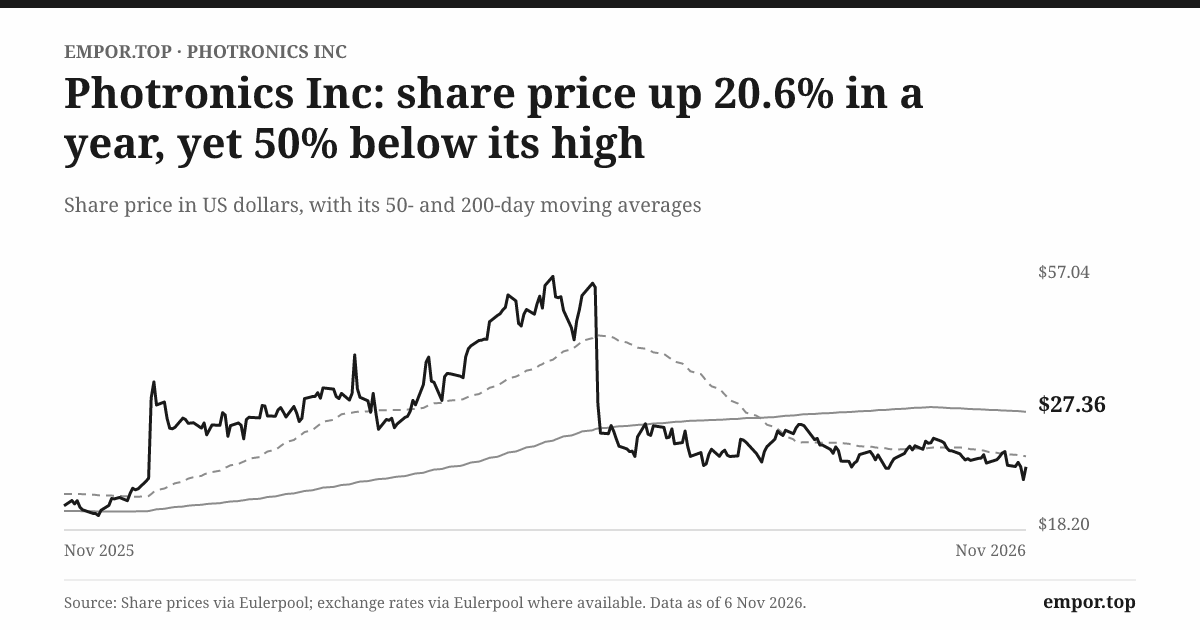
One live uncertainty also deserves mention. On July 6, 2026, a shareholder filed a proposed class action in federal court in Connecticut, Cooper v. Photronics, Inc., against the company and certain directors and officers, alleging that they made materially false and misleading statements in violation of the securities laws.11 The plaintiff seeks unspecified damages. Photronics disputes the allegations, intends to defend itself vigorously, and has recorded no liability, saying it cannot estimate a range of possible loss.11 The suit followed a period in which the share price fell sharply; at about $27 in early November 2026, the stock sits about half below its 52-week high of roughly $55.12 The complaint is an allegation, not a finding, and at this stage it is a reminder of how heavily the market's expectations shifted during 2026 rather than evidence about the merits. Separately, the company's auditor gave a clean opinion on the fiscal 2025 financial statements and on internal controls.4
So Photronics carries a strong balance sheet and noisy earnings, and the right lens is the same one the factory question already demanded: operating profit and cash after capital spending, not headline net income. With that lens in hand, the case for and against owning a stake in this business can finally be argued in full.
IX. The Case for a Better Mask—and the Case Against
On November 6, 2026, the market valued Photronics at about $1.6 billion, or roughly ten times its trailing earnings.12 For a company that sells an indispensable input to the most celebrated industry on earth, that is a modest price. It reflects a stock that had fallen by about half from its high of the past year, a business that had barely grown in three years, and a management team asking investors to fund its biggest spending cycle since 2019 before the growth that spending is meant to produce has appeared. The question underneath the price is the one every serious owner of the stock must answer: why does Photronics win from here, and what would prove that it does not?
The bull case starts with mix. More advanced chips need more mask layers, written at finer geometries, and each of those masks carries a much higher price than a mainstream plate. The third quarter's high-end IC revenue rose 28% from a year earlier, and high-end masks reached a record 44% of IC sales.8 Rivera described node migration as "a natural evolution to higher ASPs per chip design," and Macricostas observed that migrations to 28, 22 and 14 nanometers were happening "across a broad set of customers in different geographic locations."3 If fabs keep moving designs down the node ladder, Photronics' average revenue per design should keep rising even if the number of designs does not.
The second leg is geography. Chipmaking is regionalizing, with governments pushing production onshore in the United States and elsewhere, and a mask supplier must sit near the fab to deliver in days. Photronics already has high-end capability in Boise and is expanding Allen; Lee told analysts in May that the company's goal was to be "the main photomask supplier in the United States."1 The third leg is outsourcing. Management argues that captives, facing the escalating cost of high-end mask tools, will increasingly send work to merchants, and it is building Korean 8-nanometer capability partly to capture that.13 Add a clean balance sheet, a decade of strong cash conversion and a display business with a lead in large AMOLED masks, and the bull case is coherent: a capable merchant positioned for a cycle in which more masks are more complex, more regional and more outsourced.
The bear case is equally concrete, and it rests on Photronics' own record. Revenue grew about 1% a year from fiscal 2022 to fiscal 2025, well below the company's ten-year pace.4 Its share of the total photomask market fell from about 12% in 2023 to about 10% in 2025, while the captive share rose to about 66%, the opposite of the outsourcing trend the strategy depends on.8 Capital spending is rising much faster than sales, with fiscal 2026 intensity guided to around a third of revenue.8 Operating margin has slid from about 28% to about 21% over three years.48 And the largest customer, linked to a senior executive, provides about a sixth of revenue.4 A skeptic does not need to invent risks. The bear case is simply the last three years, extended.
The industry structure, war-gamed in full through the lens of the design-release moment, explains why both cases can be true at once. Buyers are concentrated, can multi-source and can insource, so buyer power is high. Capital intensity and process know-how keep new entrants out of the high end, so the threat of entry there is low, though Chinese mainstream suppliers are a real force at the bottom. Substitution comes not from another technology but from the customer's own mask shop. Rivalry among merchants has, by the company's own account, produced price pressure in the past. That is a market with high barriers and powerful customers, which tends to produce respectable but not exceptional economics through a cycle.
Hamilton Helmer's 7 Powers framework sharpens the point, because it asks which durable advantages actually exist. Network economies and branding do not apply; nobody buys a mask for its logo. A cornered resource is hard to see, since the company itself says no significant technology used by competitors is unavailable to it.4 Scale economies exist only locally: a fab cluster served by a nearby, fully used mask plant has a cost and speed advantage, which is why Photronics builds near customers. Switching costs are the strongest candidate, through qualification, but as the Micron episode showed, they bind a customer to a qualified process rather than guaranteeing volume or price. Process power, the embedded know-how that lets a mask shop achieve high yields on difficult plates, may be Photronics' most genuine advantage, and it would show up as superior margins against peers through a cycle. The company's record there is mixed: excellent in the shortage years, ordinary before them. The honest verdict is that Photronics has a merchant franchise with real but bounded power, closer to "hard to displace" than "able to set prices."
The skeptical investor's next questions concern capital allocation, and they should be asked plainly. Why repurchase nearly $100 million of stock in fiscal 2025 and then commit to the largest capex wave in years while growth is low?11 Why hold most of the consolidated cash inside joint ventures and then consider borrowing at the parent?23 Why not set out a return target for Allen or Korea that shareholders could hold the company to? The company's answer, given on both 2026 calls, is a three-part capital-allocation ranking: reinvest for organic growth, pursue strategic opportunities, and return capital, while staying "disciplined and opportunistic."13 That is a statement of priorities, not evidence. The evidence will come in utilization, returns and per-share free cash flow once the new capacity runs.
Incentives and ownership add context rather than resolution. George Macricostas' reported compensation for fiscal 2025 was about $5 million, mostly in stock awards, with a salary of about $492,000 and a bonus of $675,000.[^12] The proxy describes most executive pay as variable or at risk.[^12] Despite the family's long history with the company, no individual Macricostas family member listed in the 2026 proxy held as much as 1% of the shares; the largest holders were index and quantitative managers, with BlackRock at about 16.5%, Vanguard at about 10.3% and Dimensional Fund Advisors at about 8.2%.[^12] There is no controlling shareholder, which means the board is the main check on management. At the April 2026 annual meeting, the say-on-pay proposal passed comfortably, with about 39.0 million votes for and 1.8 million against, but director Daniel Liao received about 5.4 million withheld votes, the most of any nominee and notably more than his peers.13 That is a modest signal of shareholder discontent, not a rebellion.
Management credibility under the new chief executive is unproven rather than poor. In its first test, the team guided the third quarter conservatively and beat the top of the range.12 It kept the same explanation for the slowdown across two calls, and it stuck to its Allen timeline of first revenue late in the fiscal year. Against that, it cut capex guidance within a single quarter of reaffirming it, widened its revenue guidance range in August, reshuffled senior titles, and now faces a securities class action over its disclosures.311 Fifteen months is too short a record to judge a regime. The next four quarters, comparing what management says with what it reports, will be the real evidence.
Valuation deserves care, because the cheap headline multiples are partly an artifact of the structure. At about ten times earnings, 1.9 times sales and an enterprise value of about 2.9 times EBITDA, the shares look inexpensive.12 But the enterprise value of about $970 million is essentially the market value less the whole consolidated cash pile, three-quarters of which sits in ventures DNP half-owns, and the EBITDA in the denominator includes DNP's half of the ventures' earnings.122 Adjust for DNP's claims on both and the multiple rises meaningfully. The earnings in the price-to-earnings ratio, meanwhile, include currency gains that may not repeat. Against its own history, one market-data series puts Photronics' five-year median price-to-earnings ratio at about 11.3 times, which would put the current multiple modestly below its norm, though medians of this kind depend heavily on how each provider handles the volatile earnings years, and the comparison is worth no more than its methodology.12 DNP, the closest listed peer by business line, traded at about 13.6 times earnings, but it is a diversified printing and electronics group rather than a pure mask maker, so it is context rather than a benchmark.14 The market appears to be pricing Photronics as a cyclical, slow-growth merchant with a heavy capital bill, not as a structural beneficiary of AI. That could be too pessimistic or exactly right. The next eighteen months will decide which.
Three measures will tell that story better than any multiple. The first is high-end IC revenue in dollars, not just as a share: it was about $68.5 million in the third quarter, up 28% a year, a record 44% of IC revenue.8 The second is operating margin as new capacity ramps: about 21% in the third quarter, down nearly two points from a year earlier.8 The third is operating cash flow minus capital spending: about $60 million in fiscal 2025, the lowest since fiscal 2021 and well under half the level of fiscal 2024.4 If all three rise together through fiscal 2027, the bull case is happening. If high-end mix rises while margins and free cash flow fall, the company is buying its mix improvement at the cost of returns.
X. Lessons from a Business That Must Rebuild Its Factory
The first lesson is that an essential product is not the same as a powerful business. Photronics' customer and Micron histories show that technical indispensability does not guarantee commercial power: customers can multi-source, insource and redirect work. An essential input can still be a hard business when the customer can make it and the supplier must keep buying the next generation of tools.
The second lesson lives in two cities. Shanghai's failed bet and the later Xiamen and Hefei plants show that buildings are not the difference. Utilization is. That is the lens through which Allen and Cheonan should be judged, and it is the lens that capital-intensive companies too often abandon when a new building program begins. A factory is a promise until utilization turns it into cash.
The third lesson is about the record 44%. It is a real achievement and a genuinely encouraging sign of node migration. But it arrived in a quarter flattered by delayed orders, as mainstream revenue fell and fabs filled with AI demand. Mix is the most promising growth number Photronics has. Mix also has to survive the cycle, and the company's wide fourth-quarter guidance range admits as much. The best growth number may be mix, but mix has to survive the cycle.
The fourth lesson belongs to the partnership with DNP, and it may be the most distinctive thing about Photronics. Two joint ventures now sit at the heart of the company's economics, with DNP sharing in their profits and cash. That arrangement solved the hardest problem in the mask business, how to get scale and technology in Asia's most demanding markets without betting the company, and it created an enduring one: half of the best economics belong to a rival. A partnership can be the cheapest way to build a factory and the most expensive way to own one.
Taken together, these lessons describe a company caught in the tension between technical progress and capital returns. Photronics must keep advancing, to 8 nanometers in Korea, to more of the high end in Texas, eventually to EUV, because standing still in this industry means being left with the low end and the Chinese price competition that comes with it. But each step forward costs more than the last, and the returns arrive only if customers send enough qualified work at profitable prices. That is not a flaw unique to Photronics. It is the shape of the mask business, and Photronics has lived inside it for more than half a century.
XI. The Next Design Release
Photronics enters the final stretch of 2026 in a peculiar position. The delayed designs of the spring have mostly come through. The capital spending that was meant to peak this year has partly slipped into the next. The customers said they were optimistic about the medium term, and the company said its visibility was worse than it had been. The stock has halved from its high, a securities lawsuit is pending, and a new management team has had barely fifteen months to establish its record.
The first verdict arrives in December, when the company reports its fiscal fourth quarter and full year and, Rivera has promised, gives its first capital-spending guidance for fiscal 2027.3 Through the first nine months, revenue totaled about $651 million, a little ahead of the prior year.11 If the fourth quarter lands within the guided range of $207 million to $227 million, full-year revenue will come in somewhere between roughly $858 million and $878 million, growth of about 1% to 3% over fiscal 2025.24 That would extend the flat-to-low-growth pattern of the past three years rather than break it. The more telling figure will be whether high-end IC revenue keeps growing in dollars once the catch-up orders wash out, and whether the fourth-quarter operating margin lands near the top or the bottom of its unusually wide 19% to 24% guided range.2
The second moment is the factories. Allen was expected to book its first expansion revenue in the fourth quarter, with larger contributions in fiscal 2027.8 Korea's 8-nanometer project is meant to produce first revenue by the end of fiscal 2027.1 If both qualify and ramp on schedule and win new high-end work, the capex wave will start to earn its keep. If the capital spending peak moves again, deeper into 2027, the judgment day for the investment cycle moves with it.
The third is cash. Operating cash flow has been strong this year, but the fourth quarter's implied capital spending is heavy, and the fiscal 2027 guidance will reveal how much more is coming. The figure to watch is cash from operations less capital spending, on a full-year basis and, ideally, with DNP's share in mind. If management does borrow, the reasons and the terms will say a great deal about how much parent-level cash is really available.
The fourth is the customer that matters most. Each quarterly filing discloses the related-party revenue and receivables; a sustained change in either, or any change in how the company describes the relationship, would matter. Photronics has never named the customer or published a receivables ageing, and nothing suggests it will. Investors will keep judging the relationship from its disclosed outlines.
None of those questions has an answer tonight, because the company has not yet reported results through a full year of the new investment cycle. What can be said is what each outcome would mean. Rising high-end revenue, steady margins and recovering free cash flow would suggest that 2026's pause was a pause and the factories were well timed. Flat revenue, falling margins and a growing capex bill would suggest that Photronics is spending to stand still. The likely truth, as so often in this business, will sit somewhere between, and it will arrive one design release at a time.
XII. The Pattern on the Mask
Hold a photomask up to the light and you see almost nothing: a plate of quartz, a faint shimmer of chrome. The pattern that matters is too small for the eye. Yet without it there is no chip, no phone, no data center, no AI model, and every one of the billions of transistors on a modern processor begins as a shadow cast through a plate like this one.
Photronics has spent more than half a century making those invisible patterns, and it has learned that the patterns are the easy part. The hard part is the factory bill: the writers, the clean rooms, the engineers, and the patience to keep investing before anyone knows when the next design will arrive. Photronics prints the pattern that makes the chip possible; the market is waiting to see whether the next pattern pays for the plant.
References
-
Photronics (PLAB) Q2 2026 Earnings Call Transcript — The Motley Fool, 2026-05-29 ↩↩↩↩↩↩↩↩↩↩↩↩↩↩↩↩↩↩↩↩↩↩↩↩↩↩↩↩↩↩↩↩↩↩↩
-
Photronics Reports Third Quarter 2026 Results — Photronics via SEC, 2026-08-26 ↩↩↩↩↩↩↩↩↩↩↩↩↩↩↩↩
-
Photronics (PLAB) Q3 2026 Earnings Call Transcript — The Motley Fool, 2026-08-26 ↩↩↩↩↩↩↩↩↩↩↩↩↩↩↩↩↩↩↩↩↩↩↩↩↩↩↩↩↩↩↩
-
Photronics, Inc. Form 10-K for fiscal year ended October 31, 2025 — SEC, 2025-12-17 ↩↩↩↩↩↩↩↩↩↩↩↩↩↩↩↩↩↩↩↩↩↩↩↩↩↩↩↩↩↩↩↩↩↩↩↩↩↩↩↩↩↩↩↩↩↩↩↩↩↩↩↩↩↩↩↩↩↩↩↩↩
-
Photronics Q3 FY2026 Earnings Presentation — Photronics via SEC, 2026-08-26 ↩↩↩↩↩↩↩↩↩↩↩↩↩↩↩↩↩↩↩↩↩↩↩↩↩
-
Photronics, Inc. Form 10-K for fiscal year 2018 — SEC, 2018-12-21 ↩↩↩↩↩↩↩↩↩↩↩↩
-
Photronics, Inc. Form 10-Q for the quarter ended August 2, 2026 — SEC, 2026-09-10 ↩↩↩↩↩↩↩↩↩↩↩↩↩↩↩↩↩↩↩↩↩↩
-
Photronics P/E Ratio and Valuation — PortfoliosLab, data through 2026-11-06 ↩↩↩↩↩
-
Photronics Annual Meeting Voting Results — Photronics, 2026-04-09 ↩
-
Dai Nippon Printing Financial Ratios — Stock Analysis, 2026-11-08 ↩
 LinkedIn
 WhatsApp
 Reddit
 Hacker News
 Email
 Kindle
 RSS Feed
 Spotify
 Apple Podcasts
 Amazon Music
 Audible
 YouTube