Pacira BioSciences: The $36.50 Question
I. The Offer at the 52-Week High
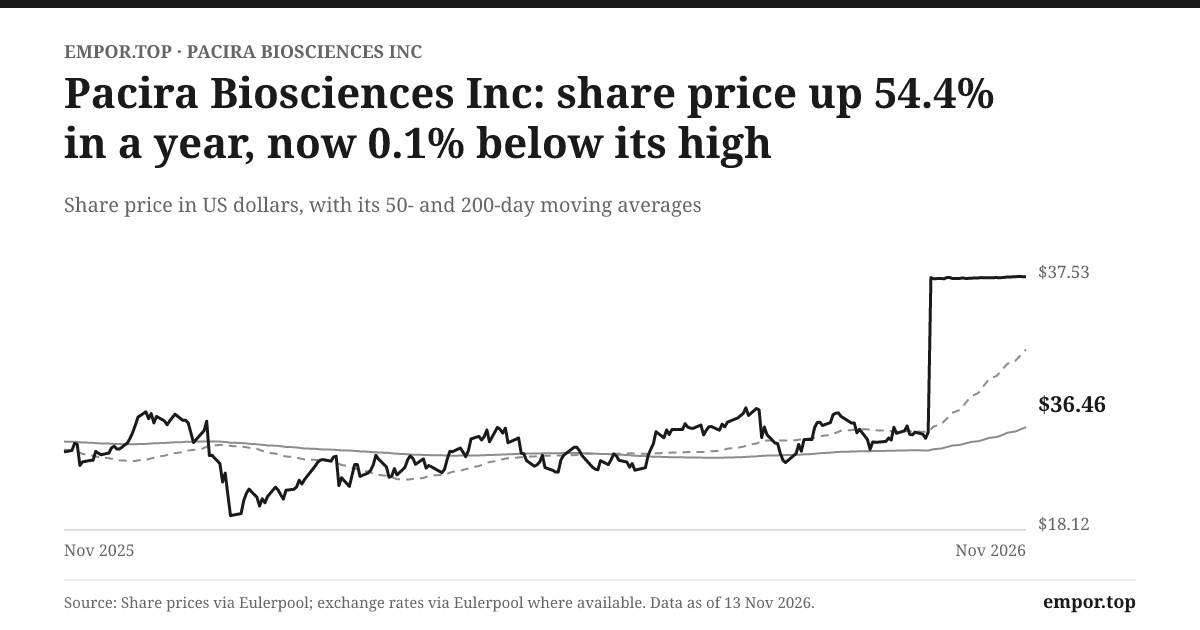
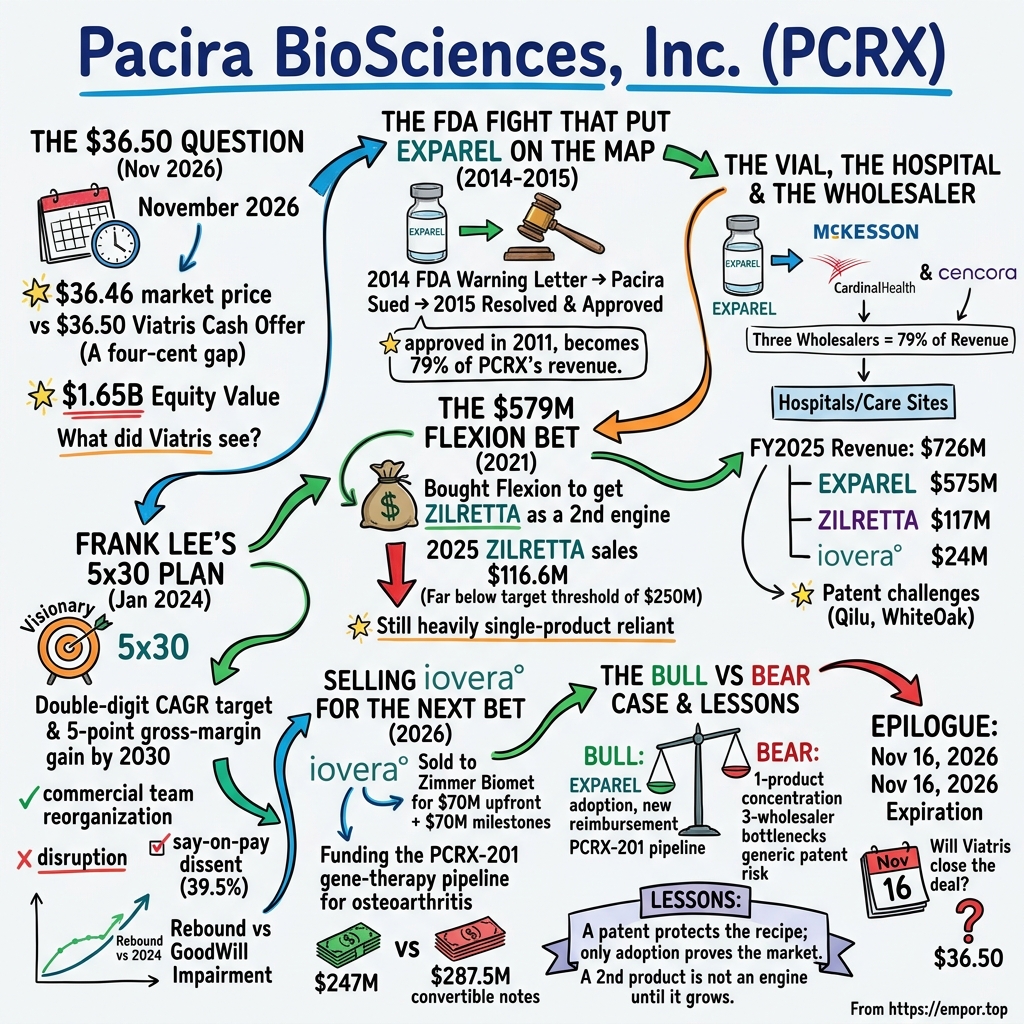
On Friday, November 13, 2026, Pacira BioSciences closed the trading day at $36.46 a share.[^1] That number would be unremarkable for most companies on most Fridays. For Pacira it was almost the whole story. Five weeks earlier, Viatris had agreed to buy the company for $36.50 a share in cash.1 The gap between what the market would pay on Friday afternoon and what Viatris had promised to pay was four cents, about one-tenth of one percent. A stock that had swung around violently for years, one that had fallen as much as three-quarters from a peak within the past five years, had gone almost perfectly still.[^1]
Stillness like that is a market's way of saying it has stopped arguing about the business and started arguing about the calendar. The tender offer that Viatris launched on October 30 is scheduled to expire one minute after midnight at the end of November 16, unless it is extended.2 For the offer to succeed, holders of a majority of Pacira's outstanding shares must tender, and the customary regulatory and closing conditions must be met.2 Pacira had already withdrawn its 2026 financial guidance and cancelled its third-quarter earnings call because of the pending deal.3 The ordinary rhythm of a public company, with its quarterly promises and quarterly reckonings, had been suspended. What remains is a deadline.
The headline terms were simple. At $36.50 a share, Viatris put the equity value of Pacira at roughly $1.65 billion.1 The price was a premium of about 45% to Pacira's closing price of $25.20 on October 7, the last trading day before the deal was announced.1 Viatris described Pacira as a business with about $746 million of revenue and $177 million of adjusted EBITDA over the twelve months to June 2026, and framed the deal as a way to become a leader in non-opioid pain therapies.1 Pacira's board unanimously approved the merger agreement and recommended that shareholders tender.2 Viatris said it would fund the purchase mainly from cash on hand, with the rest from short-term borrowing, and that the offer was not conditioned on financing.4
So what did Viatris see? The simplest answer is a product. Pacira sells EXPAREL, a long-acting form of the old local anesthetic bupivacaine, injected at the surgical site to numb pain for days rather than hours. In 2025, EXPAREL produced about four out of every five dollars Pacira earned.5 Around it sat a smaller osteoarthritis injection called ZILRETTA, a gene-therapy program called PCRX-201, a manufacturing operation that took years to scale up, and a hospital sales force that has spent more than a decade teaching surgeons and anesthesiologists to use a branded drug in a market full of cheap generic alternatives.
The more difficult question is whether the offer settles anything about what Pacira could have become on its own. It does not, at least not completely. A takeover price is one buyer's judgment, shaped by that buyer's cost of capital, its distribution system and its strategic needs. It tells shareholders what a willing acquirer would pay after a sale process. It does not prove that the company's own growth plan would have worked, nor that it would have failed. The board's recommendation, by definition, judged the certain cash to be worth more than the uncertain standalone path.2 That judgment deserves to be tested, not simply accepted.
Four questions run beneath the four-cent gap, and they will shape this story. The first is whether EXPAREL could keep growing when a single product and three drug wholesalers dominate the business. The second is whether the margin recovery Pacira reported in 2025 was durable, or mostly the echo of one-off charges and favorable comparisons. The third is whether Pacira's acquisitions and its large share buybacks built lasting value for owners. The fourth is what will be left to judge if Viatris closes the deal and Pacira's independent record simply stops.
A boundary is worth setting at the outset. This is Pacira's story and Pacira's economics. Viatris, a much larger company built largely on off-patent medicines, enters only as the buyer and the prospective owner. Its revenue, its margins and its strategy matter here only insofar as they shape what happens to Pacira's products after the deal.
The four-cent gap compresses fifteen years of operating history into a single number. To understand why the number was $36.50, and not $25 or $50, the story has to rewind to the product that made the company worth buying, and to the fight with the Food and Drug Administration that nearly defined what that product was allowed to be.
 Subscribe on LinkedIn
II. The FDA Fight That Put EXPAREL on the Map
In September 2014, the FDA's Office of Prescription Drug Promotion sent Pacira a warning letter.6 For a young drug company, this was not a minor bureaucratic note. The agency usually handles advertising problems with an "untitled letter," a gentler reprimand; a warning letter is a sharper instrument, the kind of document that can make hospital pharmacy committees nervous and investors reach for the sell button.6 The FDA objected to an educational flashcard set and a journal advertisement for EXPAREL. It argued that they gave the impression that the drug was approved for uses beyond those studied in its pivotal trials, which involved two specific operations, the removal of a bunion and the removal of hemorrhoids.6
To understand why that fight mattered, start with what EXPAREL actually is. Bupivacaine has been around for decades. It is a local anesthetic, a numbing agent that surgeons and anesthesiologists inject into tissue so that nerves stop sending pain signals. The problem with ordinary bupivacaine is time. It wears off within hours, and the worst postoperative pain often arrives after that. For years, the common answer to that gap was opioids.
Pacira's technology, which it calls DepoFoam, is a way of buying time. Imagine a microscopic honeycomb, a particle made of many small chambers separated by fatty membranes, each holding a tiny dose of drug. When injected, those chambers break down gradually, releasing bupivacaine over a period of days rather than all at once.5 The technical name is a multivesicular liposome. The commercial idea is easy to understand: numb the surgical site for longer, so the patient needs fewer opioids in the days after surgery. Pacira was built around that delivery system. The company was formed in 2007 to acquire the San Diego injectable-drug business that held the DepoFoam platform, and its founding chief executive, Dave Stack, went on to lead it for about sixteen years.78
EXPAREL was approved by the FDA in October 2011, months after Pacira's February 2011 initial public offering raised about $42 million at $7 a share.57 The label described the drug as administered into the surgical site to produce postsurgical analgesia, but the approval rested on trials in bunionectomy and hemorrhoidectomy.9 That is where the ambiguity lived. Was EXPAREL approved for those two operations, or broadly for surgical sites, with those two operations serving as models? A company whose total market is two procedures is a small company. A company whose label covers the surgical site in general has a shot at a very large one.
Pacira argued from the start that the label supported its broader claims; its chief executive said the company planned to explain its position to the agency.6 In February 2015, Pacira said it had resolved the matter with the promotion office.9 Then, in September 2015, it went further and sued the FDA in federal court in Manhattan, arguing that the warning letter violated its free-speech and due-process rights.10 The timing was deliberate. A month earlier, the same court had ruled in a case brought by Amarin that the FDA could not prosecute companies for truthful, non-misleading speech about approved drugs, even when it concerned unapproved uses.10
The FDA chose not to risk another loss. In October 2015, it rescinded the warning letter, conceding that different statements in the label had created ambiguity about the scope of the indication and that the indication referred broadly to surgical sites.11 In December 2015, the two sides filed a settlement: the agency confirmed the letter was withdrawn and agreed to approve label revisions clarifying the indication.1112 Pacira's lawyers called it a landmark. The FDA, notably, said the resolution was specific to the parties.10
The consensus version of this episode is a tidy origin myth: plucky drug company stands up to overreaching regulator and wins. The record supports a narrower reading. Pacira won the right to describe EXPAREL as broadly indicated for surgical-site infiltration. It did not win a ruling that every application doctors might want, such as nerve blocks, was on the label. That boundary showed up again in 2018, when the FDA convened an advisory committee to consider expanding EXPAREL's use to nerve block anesthesia.13 Each new use still had to be earned with evidence and regulatory review. Pacira did earn some of them. In 2018 the FDA approved EXPAREL for one kind of nerve block, the interscalene brachial plexus block used in shoulder surgery, and later label expansions widened its reach further, including to younger patients and to additional nerve blocks.5 Each expansion took years of trials. The pattern was set early: the label grew, but it grew one study at a time.
There was another coda. During the same period, federal prosecutors had been examining how Pacira encouraged doctors to use EXPAREL. In July 2020, Pacira agreed to pay $3.5 million to resolve False Claims Act allegations that it had used research grants as inducements to prescribe the drug, including allegedly conditioning grants on hospitals placing EXPAREL on their formularies, conduct the government said ran from 2012 to April 2015.14 Pacira denied wrongdoing and admitted no liability.14 The amount was small, but the allegation went to the heart of the commercial problem. Winning a label is one thing. Getting a hospital to stock a branded drug, when a vial of generic bupivacaine costs a fraction as much, is a different and harder fight.
That is the real lesson of the regulatory years. EXPAREL's opioid-sparing promise was compelling as a public-health story. The commercial test was more prosaic: whether surgeons, anesthesiologists, pharmacy committees and hospital finance departments saw enough practical value to pay for a premium product. The FDA fight cleared the road. It did not drive the car.
And the car did move. By 2025, EXPAREL generated about $575 million in revenue, roughly 79% of Pacira's total.5 The product had survived its regulatory fight and grown into the center of a public company. The next question was what that franchise actually looked like on the ground, and who stood between Pacira and the hospital that used its vials.
III. The Vial, the Hospital and the Wholesaler
Follow a single order. A hospital pharmacy in Ohio, say, needs EXPAREL for a week of knee replacements and spine surgeries. The order goes to a wholesaler, most likely McKesson, Cardinal Health or Cencora, the three giant intermediaries that sit between American drugmakers and American hospitals. But the wholesaler does not usually take the vials into its own warehouse. Under Pacira's drop-ship arrangement, the wholesaler processes the order and the product moves directly to the end user.5 The hospital receives the drug, the wholesaler bills and collects, and Pacira books the sale to the wholesaler.
That arrangement explains one of the most striking facts about Pacira. In 2025, McKesson accounted for about 31% of total revenue, Cardinal Health about 26% and Cencora about 22%. Together, three companies represented 79% of everything Pacira sold.5 In the first nine months of 2026, the share was essentially unchanged at 78%.15 The hospital decides whether to use EXPAREL. The wholesaler controls the pipe through which the decision becomes revenue.
Before going further into that pipe, it helps to see the whole product shelf by economic weight. In 2025, Pacira reported total revenue of about $726 million, and EXPAREL remained its dominant product.5 ZILRETTA, an extended-release steroid injection for knee osteoarthritis pain, contributed about $117 million. The iovera° system, a handheld device that freezes targeted nerves to block pain, brought in about $24 million. A veterinary version of the liposomal bupivacaine, sold for use in animals, added about $7 million, and royalties a few million more.5 In plain terms, Pacira was a one-engine aircraft with a smaller auxiliary motor and two small accessories.
How did the engine grow? In 2025, EXPAREL revenue rose about 5%.5 Underneath that headline were two forces pulling in opposite directions. Gross vial volume rose about 6%, so more vials went into more procedures.5 But each vial earned a bit less on average. Pacira sells EXPAREL in different vial sizes, and the mix shifted toward lower-revenue configurations. Group purchasing organizations, the buying consortia that negotiate contracts on behalf of thousands of hospitals, secured allowances that lowered the net price Pacira realized per unit. A January price increase offset part of that pressure.5 The pattern is worth pausing on. Volume growth is evidence that clinicians keep using the drug. Lower realized price is evidence that buyers have leverage. Both are true at once.
The moat on trial
Why would a hospital pay for EXPAREL at all? The competing alternatives are cheap and familiar. Generic bupivacaine, ropivacaine and other local anesthetics cost far less. Anesthesiologists can place nerve-block catheters that infuse drug continuously, use pumps, combine non-opioid pills such as acetaminophen and anti-inflammatories, or simply rely on opioids in the old way. Pacira's case is that one injection of a long-acting formulation at the end of surgery can reduce pain and opioid use without the hassle of catheters and pumps, and that this can shorten stays or smooth recovery. The company does not publish reliable data on its share of the postsurgical pain market, so any claim about how much of that market EXPAREL controls is guesswork. What the record does show is that the product competes on convenience and outcomes against alternatives that are cheaper per dose.
Reimbursement helps. Under the federal NOPAIN Act, Medicare began paying separately for certain qualifying non-opioid pain treatments in the outpatient setting from 2025, and EXPAREL qualified.5 For a drug sold into hospitals that often absorb the cost of a procedure inside a single bundled payment, a separate payment matters because it shifts the drug from a cost that eats into the hospital's margin toward a reimbursed item. But reimbursement access is not the same as adoption, and the 2025 numbers show the same tension: volume grew, while GPO terms pushed price down.
Commercial insurers matter too, because they decide whether a hospital is paid for the drug or must swallow it inside a fixed surgical fee. On the fourth-quarter 2025 call, Pacira's president and chief operating officer, Brendan Teehan, said about 102 million covered lives sat outside the surgical bundle at the end of 2025, after policy changes at insurers including Aetna, Cigna and Humana, and that the number had climbed to about 110 million early in 2026.16 Lee was blunt about why that mattered. The financial barriers to using EXPAREL, he said, had been real, both in buying the product and in getting paid for it.16 That is a striking admission from the chief executive of a company whose drug had been on the market for fourteen years: the main obstacle to growth was not whether surgeons believed in the product, but whether hospitals could afford to use it.
Patents are the other wall. Here the record is more eventful than investors sometimes remember. In August 2024, a federal court in New Jersey found one of Pacira's important EXPAREL patents, the '495 patent, invalid in litigation against the generic developer eVenus.17 The stock sold off sharply on the news. Pacira then negotiated its way to a settlement. In April 2025, it agreed to let Fresenius Kabi, eVenus and their partner Jiangsu Hengrui sell a volume-limited generic version starting on a confidential date in early 2030, beginning at a high-single-digit percentage of U.S. volume and rising each year, with unrestricted sales permitted no earlier than 2039.17 Pacira paid the Fresenius parties $7 million as part of the settlement.17 Its last Orange Book-listed EXPAREL patent runs to July 2044.17
That settlement bought time and some predictability. It also put a date on the calendar. From early 2030, a generic competitor can begin selling a capped slice of the market. And the generic interest did not stop there: in 2025, two more applicants, Qilu and WhiteOak, challenged EXPAREL patents, and the litigation was still described as a live risk in the 2026 filings.515 A patent estate is evidence of protection; it is not proof that the protection is permanent. The 2024 ruling demonstrated that a court can knock out a patent Pacira considered strong.
Manufacturing is the quieter barrier. Making a multivesicular liposome at commercial scale is genuinely hard; the particles must be uniform, sterile and stable. Pacira spent years building larger manufacturing suites, with roughly four times the capacity of its older 45-liter process, and in 2025 it decommissioned the older suite and cut its workforce accordingly.5 Complexity of this kind does slow generic entrants, and the long road the generics took through the courts is partial evidence of that. But it slows them; it does not stop them, as the 2030 settlement makes plain.
What about switching costs, the stickiness that keeps a customer once it has adopted a product? The honest answer is that Pacira's filings do not give enough evidence to call them strong. There are no disclosed multi-year contracts or minimum purchase commitments, and payment terms are generally zero to four months.515 Adoption happens procedure by procedure, protocol by protocol, through formulary decisions and GPO contracts. That is real stickiness when a surgical team builds its recovery pathway around a product. It is also reversible when a hospital CFO decides the economics no longer work. The best evidence of how strong the hold is lies in two numbers: whether volume keeps growing and whether net price per vial holds.
The concentration in wholesalers deserves one more pass, because its risk is subtler than it looks. The wholesalers are not the decision-makers on whether to use EXPAREL. They are distributors, and Pacira says they do not physically take possession of the product.5 Their importance lies in credit, terms and continuity. At year-end 2025, the three largest wholesalers accounted for about 72% of Pacira's receivables, and debtor days had crept from about 41 in 2014 to about 62 in 2025.5 Pacira's allowance for bad debts was tiny, and there was no record of a major customer loss.5 The risk here is not an imminent default. It is leverage: three counterparties with enormous scale, sitting on most of the cash Pacira is owed.
Put the pieces together and the picture is of a company with a distinctive product, hard-won manufacturing know-how, a patent estate with a known expiry path, and a hospital channel that it understands well. Those are real assets. But a business in which one product supplies four-fifths of revenue, and three intermediaries carry four-fifths of the sales, has a structural problem that no amount of clinical marketing can solve. It needs a second engine. In 2021, Pacira went shopping for one.
IV. The $579 Million Flexion Bet
In October 2021, Pacira announced it would buy Flexion Therapeutics, a Massachusetts company built around a single marketed drug, ZILRETTA.18 The offer was $8.50 a share in cash plus a contingent value right, a kind of IOU, worth up to $8.00 more per share if certain goals were reached.18 Pacira completed the acquisition that November.19 Its acquisition accounting put the total consideration at about $579 million, a figure that bundled the cash paid for shares with the estimated value of the contingent payments and other items.19
The logic was easy to state. ZILRETTA is an extended-release form of triamcinolone, a corticosteroid that doctors inject into an arthritic knee to reduce pain. Ordinary steroid injections wear off quickly. ZILRETTA uses microsphere technology to release the steroid more gradually. In other words, Flexion had done for a knee steroid roughly what Pacira had done for a local anesthetic: taken an old molecule and made it last longer. Pacira said the deal would broaden its non-opioid pain portfolio, put an already marketed product in its bag, and add clinical programs, including a gene therapy called FX201 that would later become PCRX-201.18
The fit had a compelling surface. Both products were sold to doctors who treat musculoskeletal pain. Both told an opioid-sparing story. Pacira's sales force already called on orthopedic surgeons. If the two products could ride the same relationships, the combined company would look less like a one-drug company and more like a pain franchise.
The contingent value rights encoded what that franchise was expected to become. The first ZILRETTA sales milestone would pay holders $1 per CVR if annual net sales reached $250 million in a calendar year; higher tiers were set at $375 million and $500 million. Other payments depended on FDA approvals for two pipeline candidates. Each milestone had to be met by the end of 2030.18 A CVR is a useful instrument for historians, because it is a written record of what the buyer and seller considered plausible. Both sides thought it reasonable to set the first sales bar at $250 million.
Here is what happened. ZILRETTA's 2025 revenue was about $116.6 million, down from $118.1 million a year earlier.5 Kit volume fell about 4%, partly offset by higher prices, so sales slipped about 1%.5 Four years after the acquisition, the product was running at less than half the first CVR sales threshold, with less than five years left on the clock. In the first nine months of 2026, Pacira recorded a gain from remeasuring the contingent consideration, because it had lowered its forecast for ZILRETTA sales through 2030 and therefore expected to owe less.15 An accounting gain that arises because the company now expects its acquired product to sell less is, in plain English, a quiet admission.
A simple scale comparison helps a listener hold the numbers. Pacira paid about $579 million; ZILRETTA's 2025 revenue was about one-fifth of that. This is not an acquisition multiple, and it is not proof of overpayment, because the price also bought pipeline assets, people and technology. Nor is there a clean set of comparable deals that would support a verdict on price. But the comparison makes the gap visible: the acquisition did not turn into a second business of comparable weight to EXPAREL.
The goodwill tells a related story. In the third quarter of 2024, Pacira recorded a goodwill impairment of about $163 million, which drove the year to an operating loss.5 Goodwill is the accounting residue of paying more for a company than the value of its identifiable assets; an impairment is the formal recognition that the residue is no longer supported by the company's market value or expected cash flows. The charge did not single out Flexion in a way that lets an outsider attribute it precisely, but it arrived in the wake of the patent ruling and a falling share price, and it wrote down value that past acquisitions had placed on the balance sheet.5 In 2025, Pacira took another $25.9 million impairment on intangible assets.5
The strongest counterevidence deserves fair weight. Flexion did contribute a real, marketed product. More than $100 million of annual revenue is not nothing; it is roughly one-sixth of Pacira's sales. ZILRETTA gave the company experience selling into orthopedic and sports-medicine practices, a channel adjacent to its hospital base. And the deal brought FX201, the gene-therapy program now called PCRX-201, which is the most important pipeline bet Pacira had at the time of the Viatris offer. The expansion thesis was narrowed by the record. It was not erased.
So why did ZILRETTA stall? Part of the answer was organizational: the company later said that how it deployed its sales forces disrupted ZILRETTA and iovera°. Part of it is the market. Knee osteoarthritis patients have many options, from generic steroids to hyaluronic acid injections and physical therapy, and reimbursement for a premium injection can be slow and paperwork-heavy. A product that is better in some patients can still be hard to grow when the cheaper option is good enough for most of them.
The lesson for Pacira's capital allocation is uncomfortable. The company correctly diagnosed that it needed a second engine. It bought a product with a plausible strategic fit. But the product did not grow on Pacira's watch, and five years after the deal, EXPAREL's share of revenue was still about 79%.5 The single-product exposure that motivated the deal remained largely intact. And ZILRETTA has its own clock. When Pacira's management prepared long-range forecasts for the board in 2026, it assumed ZILRETTA would lose exclusivity in the second half of 2031 and that its sales would fall by more than a quarter the following year.2 The window in which the acquired product could have grown into a second engine was always finite; by the time of the sale, most of it had passed with the product running flat. The question for the management that took over in 2024 was whether it had learned from that gap, and what it would do differently.
V. Frank Lee's 5x30 Plan Meets the Numbers
On January 2, 2024, Frank D. Lee became Pacira's chief executive officer.8 He replaced Dave Stack, the executive who had led the company from its formation, through the EXPAREL launch, the FDA fight and the Flexion deal.8 The handover marked a change in temperament as much as in personnel. Stack was a founder-era operator who had spent his career turning a delivery technology into a brand. Lee arrived from the world of large-company product strategy and venture-backed drug development.
His résumé was a big-pharma education followed by a biotech exit. Lee trained as a chemical engineer at Vanderbilt and earned an MBA from Wharton.8 He worked at Eli Lilly, Janssen and Novartis before spending about thirteen years at Genentech, where he rose to senior vice president for global product strategy and head of immunology, ophthalmology and infectious diseases.8 He then ran Forma Therapeutics as chief executive from 2019 until Novo Nordisk bought it in 2022.8 In other words, the board hired someone who knew how large companies plan portfolios and how small ones get sold. Both skills would turn out to matter.
Lee's signature was a plan with a memorable name. Pacira called it 5x30: five goals to reach by 2030.20 The company would treat more than three million patients a year. It would grow product revenue at a double-digit compound annual rate. It would improve gross margin by five percentage points. It would advance at least five clinical programs. And it would establish five partnerships.20 To its credit, the plan was measurable. A double-digit growth target and a five-point margin target can be checked against reported numbers, which is more than many corporate visions offer.
Set the plan against the starting point, and the size of the ambition becomes clear. Over the decade from 2015 to 2025, Pacira's revenue grew about 11% a year, which is the kind of growth the plan aimed to restore.5 But that long-run average was built on EXPAREL's launch years and the Flexion acquisition. Over the three years from 2022 to 2025, revenue grew less than 3% a year.5 In 2025 it grew about 3.7%.5 Returns on capital were thin: operating profit after tax came to under 5% of the capital invested in the business in the twelve months to September 2026.155 Double-digit growth required more than tripling the recent pace.
The before-and-after chart that lies
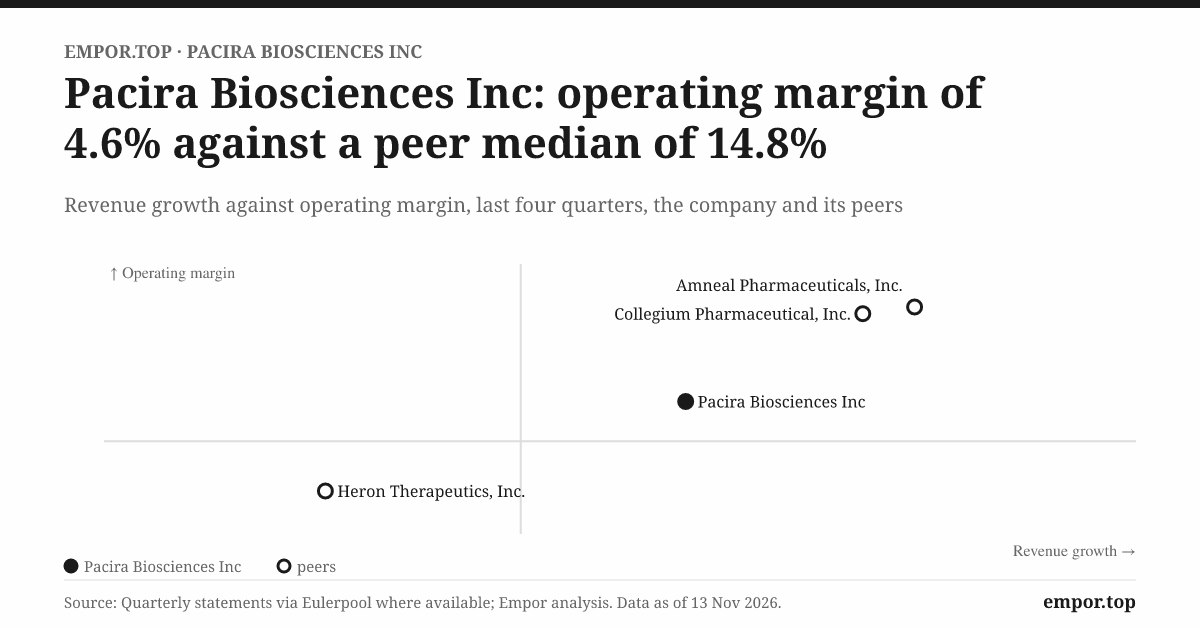
Pacira's 2024 and 2025 income statements look, at first glance, like a turnaround. In 2024 the company reported an operating loss of about $73 million; in 2025 it swung to an operating profit of about $33 million, an operating margin of roughly 4.6%.5 A listener could be forgiven for drawing a line from Lee's arrival to the improvement. But the comparison is distorted.
The 2024 loss contained the goodwill impairment of about $163 million.5 Strip that out and 2024 would have been a profitable year, with an operating margin around 13%. Seen that way, 2025 was not a rebound from a loss but a decline in underlying operating profit, as R&D spending jumped and impairments and restructuring charges arrived. On the other side of the ledger, 2025 did have genuine improvements. Gross margin rose from about 76% to about 79%.5 Part of that came from lower manufacturing costs as the larger suites came online. Part came from a legal win: in April 2025, a federal court in Nevada concluded that Pacira no longer owed royalties to the Research Development Foundation on EXPAREL made with its larger-scale process, ending that royalty expense.5 The court victory was valuable. It was also a one-time change in cost structure, not evidence of improved pricing or demand.
Lee deserves credit for a moment of candor that many chief executives avoid. On the fourth-quarter 2025 earnings call, he explained that the company's decision to prioritize EXPAREL and split out separate sales forces for ZILRETTA and iovera° had caused disruption during the transition.16 That is an admission of a controllable mistake, made in public, with a specific mechanism. The outcomes are consistent with the explanation: EXPAREL volume grew while ZILRETTA's kit volume fell.5 Management did not blame the market or the weather. It said the reorganization hurt, which is the kind of explanation that can be checked against later quarters.
His exact words were plain. Pacira had restructured to stand up a separate sales force for ZILRETTA and another for iovera°, and, as he put it, that "caused some disruption, and that was impacting sales."16 The decision had been deliberate: "we said we are going to prioritize EXPAREL. So that is what we did."16 For ZILRETTA, the company had also brought in a partner. Lee told investors that Johnson & Johnson's orthopedics sales force was now fully trained and tripled Pacira's reach for ZILRETTA in the United States; Teehan added that J&J had written ZILRETTA growth objectives into its own incentive plans for 2026.16 Pacira did not disclose the economic terms of that arrangement.16 The move was revealing in itself. A company that had bought ZILRETTA to build its own second engine was now leaning on someone else's sales force to restart it.
The same call laid out what 2026 was supposed to look like. Chief financial officer Shawn Cross guided to total revenue of $745 million to $770 million, with EXPAREL alone at $600 million to $620 million, and assumed ZILRETTA and iovera° would be roughly flat.16 He also put a number on the price-versus-volume problem. In the fourth quarter of 2025, EXPAREL volume grew about 7%, but less favorable vial mix and the discounts given to a third group purchasing organization each took away roughly equal pieces of that growth; Cross said he expected the gap between volume and revenue to narrow once the company lapped that third GPO contract in the middle of 2026.16 Lee described the market for elective procedures as relatively soft.16 The guidance, in other words, implied mid-single-digit EXPAREL growth, a respectable number that was nowhere near the double-digit trajectory of 5x30.
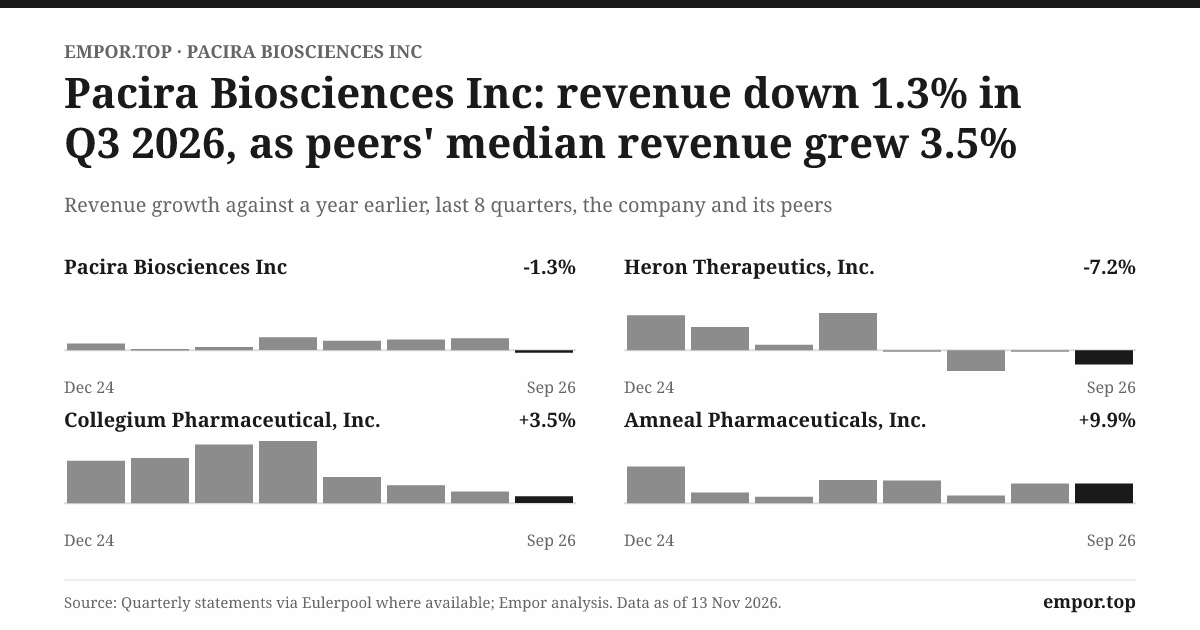
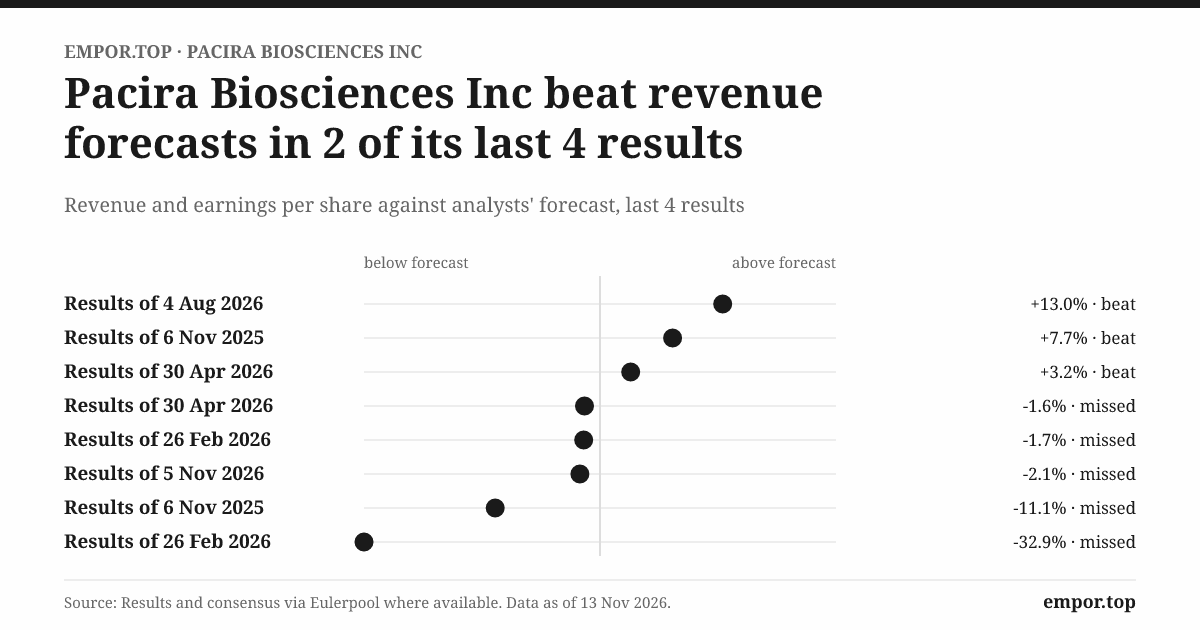
The next quarters gave mixed evidence. Revenue grew a little over 5% in the first quarter of 2026 and about 6% in the second, the fastest pace in two years.[^22] In August 2026, after selling iovera°, Pacira lowered its 2026 revenue guidance to $735 million to $760 million from $745 million to $770 million, reflecting the divestiture.[^22] On the second-quarter call, management emphasized EXPAREL's progress and its pipeline.21 Then, in the third quarter, revenue fell about 1% year over year to about $177 million, partly because iovera° was no longer in the numbers; EXPAREL revenue rose about 2%, to about $142.5 million from $139.9 million.15 By then the deal with Viatris had been signed and guidance withdrawn, so the natural test of management's 2026 promises was interrupted.
Buybacks, awards and the shareholder vote
Capital allocation offers a more pointed test. In 2025, Pacira spent about $148 million repurchasing its own stock under a $300 million program.5 It did so in the same year it repaid the remaining $202.5 million of convertible notes that came due, retired its term loan, and drew $101 million on a revolving credit line.5 In other words, it borrowed short-term money in the same year it bought back stock. A year earlier, in May 2024, it had issued $287.5 million of new convertible notes due 2029 and used much of the money to repurchase $200 million of its 2025 notes and $25 million of stock.5 By September 30, 2026, Pacira had repurchased about 6.8 million shares under the program.15 Management was explicit about its reasoning. In the fourth quarter of 2025 alone, Pacira spent $50 million retiring about two million shares, leaving roughly 41 million outstanding, and Cross said the company would stay opportunistic with repurchases "given what we believe is a significant disconnect in our market valuation."16
Were those buybacks good for owners? It depends on the price paid relative to value, and on whether share count actually fell after new stock awards. Shares bought in 2025 at prices well below the eventual $36.50 offer look, in hindsight, like accretive purchases. But hindsight is not a strategy. At the time, the company was spending most of a year's operating cash flow on its own shares while R&D spending was rising and the revolver balance was growing. A skeptical investor would ask whether that money was better kept for the pipeline, or for the balance sheet, at a moment when the single-product risk had just been sharpened by the patent ruling.
The shareholders delivered their own verdict on pay. At the 2025 annual meeting, only 39.5% of votes cast supported the company's executive compensation, a remarkably low number for an advisory vote that usually passes with large majorities.[^24] The board attributed the dissent in part to one-time awards to the new chief executive and chief financial officer.[^24] Lee's total compensation for 2025 was about $11.6 million, including a restricted-stock award of 350,000 units valued at about $9.2 million, against a company that had lost $99.6 million in 2024 and earned $7 million in 2025.[^24]5 His pay was about 53 times the median employee's.[^24] Lee held about 1.2% of Pacira's shares.[^24] The company responded with shareholder outreach, compensation-policy changes and new performance-share units in 2026, and the 2026 advisory pay vote received about 70% support.[^24] The response was real. So was the original dissent.
One figure looks, at first glance, like a hidden strength. Over the twelve years from 2014 to 2025, Pacira generated about $1.1 billion of operating cash flow while reporting cumulative net profit of only about $48 million.5 That gap would normally suggest an exceptionally cash-generative business hiding behind conservative accounting. Here it needs context. The cumulative profit figure is depressed by large non-cash charges: depreciation and amortization of about $91 million in 2025 alone, stock-based compensation, the 2024 goodwill impairment and the 2025 intangible and investment impairments.5 It is also distorted in the other direction by a large tax benefit that inflated 2020 net income to about $145 million.5 The cash is real. The gap is a poor standalone measure of earnings quality.
Working capital told a less flattering story. In 2025, inventory absorbed about $27.6 million of cash and receivables another $10.7 million.5 Operating cash flow fell to about $152 million from about $189 million, with management citing higher operating expenses, clinical investment and inventory.5 Inventory days, the number of days of production costs sitting in stock, rose to about 373, and the full cash-conversion cycle, from paying for materials to collecting from customers, stretched to about 398 days.5 Some of that may reflect manufacturing transitions and the build of supply in new suites. But a business that holds more than a year's worth of production costs in inventory has tied up cash that could have funded research or reduced debt.
What, then, can be said about Lee's first three years? He articulated measurable goals, explained a commercial misstep candidly, sold a non-core product, and pushed more money into research. The record is too short to say 5x30 was on track. Revenue growth had not reached double digits. The 2025 margin improvement leaned on one-time cost changes. The buybacks and pay awards drew investor skepticism. Management's own targets point to the watchlist that matters: EXPAREL net price and volume, gross margin excluding one-offs, and operating cash flow after working capital. The most visible move in Lee's portfolio, though, was a sale. In 2026, Pacira let go of a product to concentrate its bets.
VI. Selling iovera° to Fund the Next Bet
On July 31, 2026, Pacira closed the sale of iovera° to Zimmer Biomet, the orthopedic device maker.[^22] The headline terms were $70 million up front and up to another $70 million in milestone payments, for a potential total of $140 million.22 After purchase-price adjustments, Pacira actually received about $73.6 million in cash at closing.[^22] The milestones were tied to how well iovera° sells in Zimmer's hands: payments of $18.5 million, $23.5 million and $28 million if annual iovera° revenue reaches $50 million, $60 million and $70 million in any calendar year from 2027 through 2031.[^22] Pacira said it would use the proceeds to strengthen its balance sheet and pay down its revolving credit line, and that it would keep collaborating with Zimmer on a spasticity program built on the technology.[^22]
iovera° is worth a beat in this story, not a chapter. It is a clever device. A clinician presses a handheld probe with fine needles against the skin; the needles get extremely cold, freezing a targeted sensory nerve so that it temporarily stops carrying pain signals. No drug enters the body. In a company whose strategic identity is non-opioid pain relief, that made iovera° a tidy fit on paper. In practice, it generated about 3% of Pacira's total revenue in 2025.5 It was a sub-scale device inside a drug company, and devices need a different kind of sales force, service model and surgeon training than injectable drugs.
The sale tells you something about Lee's priorities. Zimmer Biomet already sells knee implants and calls on the same orthopedic surgeons; for Zimmer, a nerve-freezing tool for knee-replacement patients is an add-on to an existing bag. For Pacira, the device had been one of the products caught in the sales-force reorganization that management admitted had caused disruption.16 Selling it to an owner with a better channel, while keeping a share of the upside through milestones, is a sensible piece of capital recycling. It converts a small, distracting business into cash today and an option on tomorrow.
It also shows that the milestones encode an expectation. For Pacira to collect the first payment, Zimmer has to roughly double iovera°'s 2025 revenue within five years. Contingent payments in health-care deals are often never earned in full, and Pacira's own Flexion CVRs, set at a sales bar the product never approached, are a reminder close to home. The second $70 million is best treated as a possibility rather than an asset.
The bet the cash was meant to fund
The money freed by the sale, and the cash generated by EXPAREL, were meant to support a bigger wager: PCRX-201. The program came to Pacira with Flexion, where it was called FX201, and it rests on a gene-therapy vector from GQ Bio Therapeutics, a company with which Pacira later deepened its financial ties.195 The idea is ambitious. Instead of injecting a drug that wears off, a doctor would inject a gene into the knee joint that instructs local cells to produce an anti-inflammatory protein over a long period. If it works, a single injection could relieve osteoarthritis pain for far longer than a steroid shot. If it works, it would also add a new kind of platform to a portfolio still dominated by a long-acting anesthetic.
The spending reflected the seriousness of the bet. Research and development expense rose to about $117 million in 2025, roughly 16% of revenue, up from about $82 million, or 12%, a year earlier.5 In the third quarter of 2026, Pacira said PCRX-201 platform development costs were rising even as some other trial costs and iovera° expenses fell away.15 Money was moving from the old periphery toward the new frontier.
The clinical record at the time of the sale was early but not empty. Lee told investors in February 2026 that a Phase I study of PCRX-201 had followed 72 patients for three years and that he considered the results compelling.16 The program had moved into a two-part Phase II study called ASCEND, comparing PCRX-201 against a short-acting steroid injection; results from the first part, including 52-week data, were expected near the end of 2026, and a second part of about 90 patients was due to begin enrolling in mid-2026.16 Lee himself cautioned that, like most Phase II studies, ASCEND was not powered to prove efficacy, and that the first readout would be mostly about safety and trends.16 That is an honest framing, and it is the right one: a study designed to look for signals cannot by itself establish a product.
But technical progress is not commercial proof. Gene therapies face long trials, complex manufacturing, uncertain pricing and payers who demand evidence of durable benefit. A clinical update, a successful dose cohort or a regulatory designation can move a stock. None of them is revenue. Pacira's own history counsels caution here. Its great success, EXPAREL, took years after approval to become a large franchise, and its main acquisition-driven product, ZILRETTA, has not grown under Pacira's ownership. The approval-based milestones in the Flexion CVR were a reminder that pipeline assets come with dates attached, and the sales milestone for ZILRETTA remains distant.1815 The record of converting technical promise into growing revenue is mixed, and PCRX-201 should be judged in that light.
The financing frame does not suggest distress, and it should not be overstated. At September 30, 2026, Pacira held about $247 million of cash and cash equivalents.15 Its main debt was $287.5 million of convertible notes paying 2.125% interest and due in May 2029, plus only $11 million drawn on its revolver after repaying $80 million during the first nine months of the year.15 The credit agreement carries a leverage covenant and restrictions on additional debt, repurchases and dividends, and no breach had been disclosed.515 Pacira does not have a credit rating from the major agencies.5 The balance sheet could carry the pipeline for some time.
What it could not easily do was carry the pipeline, the working capital and the buyback appetite all at once while also proving double-digit growth. Inventory and receivables were absorbing cash; the 2029 notes would eventually need refinancing or conversion; and the most promising new platform was years away from sales. That leaves the strategic question the board had to answer in 2026. Could Pacira fund a long pipeline horizon on its own while sustaining the core business, or was selling to a company with more scale the clearest route to realizing the value of what it had built? The answer the board chose is the subject of the bull-and-bear argument that follows.
VII. Analysis & Bear vs. Bull Case
Place two facts side by side. In 2025, EXPAREL's vial volume grew about 6%, but lower realized price and a weaker vial mix absorbed part of that growth.5 And in October 2026, after announcing a plan for double-digit growth to 2030, Pacira's board agreed to sell the company. The first fact is the operating debate in miniature. The second is the board's answer to it. Everything else in the investment case lives between those two.
Start with the structure of the industry, using Michael Porter's five forces as a lens. Buyer power is high. Hospitals and the group purchasing organizations that negotiate on their behalf decide formulary placement and extract allowances, which is exactly what the 2025 net price pressure shows.5 Behind them, three wholesalers carry about four-fifths of Pacira's sales and most of its receivables.5 Pacira's buyers are concentrated, sophisticated and price-sensitive. Supplier power is moderate: Pacira depends on certain raw materials and contract manufacturers, with about $37 million of minimum non-cancelable contract-manufacturing commitments at the end of 2025, but it makes EXPAREL in its own facilities.5 The threat of substitutes is high. Generic local anesthetics, nerve-block catheters, multimodal oral regimens and opioids all compete for the same clinical job, and they are cheaper per dose. The threat of new entrants is moderated by patents and manufacturing complexity, but it now has a date: volume-limited generic EXPAREL can arrive in early 2030, and other challengers are in court.1715 Rivalry among branded long-acting anesthetics exists but is less decisive than the gravitational pull of cheap generics.
Hamilton Helmer's seven powers framework sharpens the question of whether Pacira has a durable advantage. Of the seven sources of power, which are scale economies, network economies, counter-positioning, switching costs, branding, a cornered resource and process power, two fit Pacira plausibly. The patent estate and the DepoFoam know-how look like a partial cornered resource, but the 2024 ruling and the 2030 entry date show that the corner is leaky.17 The manufacturing capability, especially the ability to produce multivesicular liposomes at large scale and declining cost, looks like process power, and the 2025 gross-margin improvement is partial evidence of it.5 Switching costs are modest; nothing contractual stops a hospital from reverting to a cheaper protocol. Branding with surgeons and anesthesiologists exists, but the GPO allowances show that brand loyalty does not translate into pricing power. Network economies and counter-positioning do not apply. Scale economies exist in manufacturing but not in a way that prevents a large generic manufacturer from eventually matching them. The verdict is that Pacira's power is real but narrow and time-limited: a protected, hard-to-make product with a known erosion schedule.
Now make the bull's argument in its strongest form. It begins with use. EXPAREL's gross vial volume grew about 6% in 2025, which is evidence that clinicians continue to adopt the product even after more than a decade on the market.5 In the third quarter of 2026, EXPAREL revenue was still growing, at about 2% year over year.15 Separate Medicare payment under the NOPAIN Act improved the economics for outpatient sites, where much surgery is moving.5 The larger manufacturing suites cut cost per vial, and the end of royalties on large-scale product removed a permanent drag on gross margin.5 The settlement with Fresenius and its partners delays meaningful generic competition until 2030 and limits its volume for years after that.17
The bull also sees the portfolio becoming more focused. R&D at about 16% of revenue funds a gene-therapy platform that, if it works, could reshape osteoarthritis treatment.5 The iovera° sale delivered cash and a relationship with Zimmer Biomet, and ZILRETTA still generates more than $100 million of revenue a year.5[^22] And management showed it could admit and correct an error, which is a better sign than a management that never admits anything.
The bear's argument begins with the same 6% and asks where it went. Volume grew faster than revenue because price and mix fell. A product that must give back price to grow volume is a product whose buyers have the upper hand, and that pressure will only grow as the generic date approaches. EXPAREL still carries about 79% of revenue; three wholesalers carry about 79% of sales.5 Two more generic applicants, Qilu and WhiteOak, were still in litigation in 2026.15 Growth was slow even before the deal: less than 3% a year from 2022 to 2025.5
The bear then turns to capital allocation. The most important acquisition, Flexion, produced a product that shrank in 2025, and in 2026 Pacira lowered its sales forecast for that product.515 The goodwill impairment of 2024 and further intangible and investment impairments in 2025 wrote down past deployments.5 Pipeline milestones are not revenue, and PCRX-201 is years from commercial proof. The company spent about $148 million on buybacks in 2025 while drawing on its revolver, and shareholders rejected its pay practices with just 39.5% support.5[^24]
A skeptical activist would have focused on exactly these points, asking why a company with one dominant product, slow growth and a generic date on the horizon was spending heavily on buybacks and a long-dated gene-therapy program, rather than either maximizing cash returns or selling to a buyer with greater scale. The board's decision to sell can be read as the answer to that critique.
What the price says
Weighing these, the history narrows the bull case without rejecting it. EXPAREL's adoption is genuine and durable enough to keep volume growing; the evidence does not support a claim of strong pricing power or a permanent moat. The margin recovery is partly real, from manufacturing scale and the royalty ruling, but too dependent on one-time effects to prove a new, higher level of profitability. And the second engine is unproven: neither ZILRETTA's growth nor PCRX-201's commercial value has been established. The revised claim, then, is a smaller one: Pacira owns a valuable, cash-generating product with a protected runway of several years and an uncertain future beyond it.
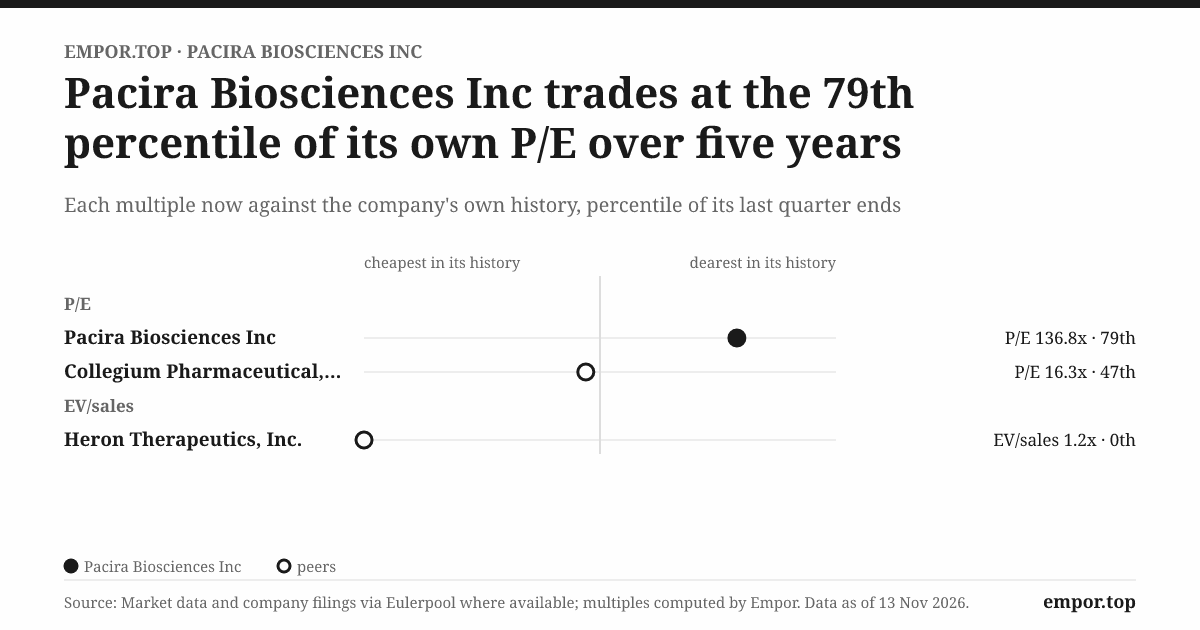
Valuation reflects that ambiguity. At $36.46, Pacira traded at about 137 times trailing earnings, far above its own five-year median of about 82 times.[^1] That headline multiple says less than it seems, because GAAP earnings have swung from losses to small profits with impairments and one-offs. On cash-flow measures, the stock looked much cheaper: the enterprise value of about $1.7 billion was roughly 13 times trailing EBITDA and about two times sales, and free cash flow was equal to about 11% of the market value.155 On Viatris' own adjusted EBITDA figure of $177 million, the deal valued the whole company at somewhere around ten times.1 That is not an extravagant multiple for a branded drug franchise; it is consistent with a buyer pricing in the 2030 generic date and limited growth. The pending cash offer, not any earnings multiple, dominated the share price in November. No standalone peer comparison would add much here, because the price was set by a transaction.
How the price was made
The sale process itself is the best evidence of what sophisticated buyers thought the standalone plan was worth. Viatris' chief executive, Scott Smith, first emailed Lee in March 2026 about a possible partnership on a different pain drug, meloxicam; in July, Viatris told Pacira it intended to propose buying the whole company, with a written offer of $31 a share.2 Over the next eleven weeks the price climbed. Viatris raised its cash offer to $34.25 in August, then to $35.25 plus a $2 contingent payment if PCRX-201 won FDA approval by the end of 2032.2 At the end of September, Viatris pulled back from an indicated $36.25, citing perceived risk at a third-party site that manufactures EXPAREL and ZILRETTA.2 In early October, Viatris offered $36.25 in cash if the contingent payment were dropped; Pacira's board insisted on $36.50, and Viatris agreed.2
Two details from that negotiation deserve a pause. The first is that the board traded away a contingent payment tied to PCRX-201 approval for 25 cents more of certain cash. Whatever the board privately believed about the gene therapy, it chose not to hold out for a share of its success. The second is what happened when Pacira's banker, Goldman Sachs, contacted five other potential strategic buyers. Four declined, citing lack of fit or financial capacity. The fifth, identified only as Party A, signed a confidentiality agreement and then withdrew a week later, citing among other things concerns over Pacira's litigation and patent strategy for EXPAREL.2 Only Viatris made a proposal.2 The market for Pacira, in other words, consisted of one bidder.
The projections management gave the board show why. They forecast revenue rising from about $762 million in 2026 to about $1.05 billion in 2030, with adjusted EBITDA of about $260 million that year, which would have been meaningful growth but an annual rate below the double digits promised by 5x30.2 More striking were the assumptions behind the long-range case: U.S. EXPAREL revenue would begin to decline in 2030 as two volume-limited generic entrants arrived, fall 22% in 2034 and 86% in 2039; ZILRETTA would lose exclusivity in the second half of 2031; and PCRX-201 would launch in 2032.2 That is management's own map of the moat, and it has an edge. Goldman's discounted cash-flow analysis produced an illustrative range of about $32 to $39 a share, and its review of comparable takeover premiums implied roughly $33 to $36.2 The $36.50 price sat near the top of the second range and inside the first. Goldman's fee, about $43 million, was contingent on the deal closing, and Pacira would owe Viatris a $62 million termination fee if it accepted a superior offer.2 Set those projections beside the 5x30 plan and the gap is instructive. The public plan spoke of double-digit growth and five new partnerships by 2030. The private long-range forecast, prepared by the same management for the same board, showed growth slowing into 2030 and the core product then beginning its decline. Both can be true at once: a company can grow handsomely for four years and still face a cliff in the fifth. But a buyer pays for the whole curve, not just the climb, and the curve explains why the price stopped where it did. Among the reasons the board listed for selling, one sentence summarized the whole strategic problem: Pacira "currently commercializes only two products."2
Three numbers would settle the operating debate if Pacira remained independent, or if Viatris reported them after the deal. The first is EXPAREL net price and volume: in 2025, volume grew about 6% while net price per vial fell, and the direction of that gap is the cleanest measure of whether demand comes with pricing power.5 The second is GAAP operating margin excluding impairments, restructuring and transaction costs, which was low single digits in most quarters of 2025 and the first half of 2026 before rising to about 13% in the third quarter of 2026.155 The third is operating cash flow after investment in inventory and receivables, which fell from about $189 million in 2024 to about $152 million in 2025.5
Pacira did not hold a third-quarter 2026 earnings call. The last live window into management's thinking is the second-quarter call in August, when the iovera° sale had just closed and guidance had just been adjusted, and the Schedule 14D-9, which lays out the board's reasoning for the sale after a process that included outreach to strategic buyers.212 In effect, the transaction interrupted the normal test of management's promises. The guidance for 2026 will never be compared with an actual year-end report from an independent Pacira. What remains is what the story can teach.
VIII. Business & Investing Lessons
Go back to the fall of 2015, when the FDA rescinded its warning letter and Pacira won the right to call EXPAREL a drug for surgical sites in general rather than for two operations.11 It felt like the moment the market opened. It was. But the next ten years showed that opening a market and owning it are different things. The later court ruling and settlement showed the limits of patent protection.17 What built the franchise was a decade of surgeons, anesthesiologists and hospital pharmacists deciding, one protocol at a time, that a premium vial was worth the money. The lesson that belongs to Pacira is this: a patent can protect the recipe; only adoption proves the market.
Then go to November 2021, when Pacira closed the Flexion deal and set a $250 million sales milestone for ZILRETTA in the contingent value rights.1819 Five years later, the product was selling less than half that and shrinking slightly.5 Flexion was not a fraud or a folly; it brought a real product and the seed of PCRX-201. But it did not change the shape of the business, and EXPAREL's share of revenue in 2025 was about the same as before. A second product is not a second engine until it grows. Founders and acquirers in specialty pharma, where portfolios often look diversified on a slide and concentrated in the income statement, would do well to remember it.
The third scene is the fourth-quarter 2025 call, when Frank Lee said the company's sales-force reorganization had disrupted ZILRETTA and iovera°.16 That candor matters, because measurable targets only help investors if management will say when it is missing them. Pacira then sold iovera° to a buyer with a better channel.[^22] When a target is measurable, missed execution should change the plan, and the next quarter should show it. Pacira's next quarters showed some of that change. They never got the chance to show whether it worked.
The fourth scene is quieter: 2025, when Pacira bought back stock while drawing on its revolver, and shareholders rejected its pay practices.5[^24] Over twelve years the company generated more than a billion dollars of operating cash, yet reported profits barely accompanied it, and returns on invested capital stayed thin.5 Cash is not the same as value. Cash generation is not value creation until the reinvestment and the share count earn their keep.
The last scene belongs to September 2026, when a would-be bidder studied Pacira's books and walked away over EXPAREL's patent position.2 Nobody doubted that the product worked or that surgeons used it. What the bidder could not get comfortable with was how long the protection would last. Management's own forecast put a date on that, with revenue from the core product beginning to fall from 2030.2 For investors, it is the most transferable lesson in the story: a moat with an expiry date is priced like one, however wide it looks today.
Taken together, the lessons describe a particular kind of company: one that owned a differentiated formulation but never fully owned a diversified growth engine. Pacira's real achievement was technical and commercial, turning a hard-to-make liposome into a branded hospital drug with half a billion dollars of sales. Its real limitation was that the next layer of value, the second product and the next platform, depended on capital deployed with less success than the first.
IX. Epilogue
Tonight, the tender offer is still open through its stated November 16 deadline, unless Viatris extends it.2 Viatris has said it expected to close the transaction by the end of November.4 If the tender succeeds, Viatris will buy the tendered shares and then acquire the rest through a second-step merger at the same $36.50 price.24 As of November 14, the deal remains pending; because no separate shareholder vote is needed once the tender succeeds, completion could follow around November 17.2
The near-term decision is binary. If the deal closes, Pacira's shareholders will receive their cash and Pacira will become a part of a much larger company. The stock will stop trading, and the public-market argument about EXPAREL's pricing power and PCRX-201's promise will end. The questions will not disappear; they will move inside Viatris. Viatris will have to decide whether its distribution footprint and international presence can expand EXPAREL and ZILRETTA, products that today sell almost entirely in the United States, with less than 1% of Pacira's revenue coming from abroad.5 It will have to decide how much to invest in a gene-therapy platform, after Pacira's research and development spending reached roughly a sixth of its revenue. And it will face the 2030 generic date on the same terms Pacira did. Viatris built much of its business on medicines that had already lost exclusivity, so it understands better than most how quickly a branded product's economics change when a generic arrives. The question is whether it bought Pacira for the four years of growth before that date, for PCRX-201 after it, or for a commercial system in hospitals that it can fill with other products.
For anyone tracking the story after the close, the discipline will be to keep Pacira's legacy products distinct from the larger group's reported results, which will blend them with a far bigger business. Product-level disclosures for EXPAREL and ZILRETTA, if Viatris provides them, will be the best guide to whether the acquisition thesis is working.
If the deal does not close, perhaps because too few shares are tendered or a condition fails, Pacira will return to the unsettled tests of the standalone story. EXPAREL net price against volume, PCRX-201's clinical milestones, margin quality once the one-offs fade, and working-capital discipline will once again decide the stock. The company will face them with the added cost of a failed transaction and without the guidance it withdrew.3
The final question is not simply whether Pacira sold. It is what its most valuable asset really was: the product, the manufacturing platform that makes it, or the commercial system that tried to turn one product into a portfolio and never had time to prove itself.
X. Outro
Return to the vial. It leaves a manufacturing suite where a microscopic honeycomb of fat and drug has been built at a scale few companies can match. It is ordered through a wholesaler that never touches it, shipped straight to a hospital, and drawn into a syringe at the end of an operation, so that a patient wakes up needing fewer pills in the long hours afterward. Multiply that journey by millions, and it became a franchise with about $575 million of annual sales.5 Then a buyer looked at the whole system and put a price on it: $36.50 a share.1
Pacira made a specialized delivery technology into a large branded drug business, but it never fully escaped dependence on the product that began it. Pacira's story is the long journey from making a drug last longer to proving a company could last beyond it.
References
-
Viatris Agrees to Acquire Pacira BioSciences — Viatris, 2026-10-08 ↩↩↩↩↩↩
-
Schedule 14D-9 — Pacira BioSciences, Inc., 2026-10-30 ↩↩↩↩↩↩↩↩↩↩↩↩↩↩↩↩↩↩↩↩↩↩
-
Form 8-K on Viatris Tender Offer and Withdrawal of Guidance — Pacira BioSciences, Inc., 2026-11-05 ↩↩
-
Q3 2026 Quarterly Report on Form 10-Q — Viatris Inc., 2026 ↩↩↩
-
2025 Annual Report on Form 10-K — Pacira BioSciences, Inc., 2026-02-26 ↩↩↩↩↩↩↩↩↩↩↩↩↩↩↩↩↩↩↩↩↩↩↩↩↩↩↩↩↩↩↩↩↩↩↩↩↩↩↩↩↩↩↩↩↩↩↩↩↩↩↩↩↩↩↩↩↩↩↩↩↩↩↩↩↩↩↩↩↩↩↩↩↩
-
FDA Sends Warning Letter Over Anesthesia Drug's Claims — Regulatory Affairs Professionals Society, 2014 ↩↩↩↩
-
Amendment No. 4 to Form S-1 — Pacira Pharmaceuticals, Inc., 2011-01-26 ↩↩
-
Pacira Appoints Frank D. Lee as Chief Executive Officer — Pacira BioSciences, Inc., 2023-12-21 ↩↩↩↩↩↩
-
Pacira Resolves Warning Letter with FDA's Office of Prescription Drug Promotion — Healio, 2015-02-25 ↩↩
-
FDA Avoids Another Free-Speech Ruling by Cutting a Deal with Pacira — Fierce Pharma, 2015-12 ↩↩↩
-
2015 FDA Settlement and Revised EXPAREL Label — Pacira Pharmaceuticals, Inc., 2015-12-15 ↩↩↩
-
Ropes & Gray Advises Pacira Pharmaceuticals in Reaching Landmark Settlement Agreement with FDA — Ropes & Gray, 2015-12 ↩
-
FDA Advisory Committee Briefing Document on EXPAREL — U.S. Food and Drug Administration ↩
-
Pharmaceutical Company Agrees to Pay $3.5 Million to Resolve Allegations of Violating False Claims Act — U.S. Attorney's Office, District of New Jersey, 2020-07-28 ↩↩
-
Q3 2026 Quarterly Report on Form 10-Q — Pacira BioSciences, Inc., 2026-11-05 ↩↩↩↩↩↩↩↩↩↩↩↩↩↩↩↩↩↩
-
Q4 2025 Earnings Call Transcript — The Motley Fool, 2026-02-26 ↩↩↩↩↩↩↩↩↩↩↩↩↩↩↩↩
-
Pacira Settles Patent Dispute Over EXPAREL With Fresenius and Others, Generic Entry Delayed Until 2030 — Benzinga, 2025-04-07 ↩↩↩↩↩↩↩↩
-
Pacira to Acquire Flexion Therapeutics — Pacira BioSciences, Inc., 2021-10-11 ↩↩↩↩↩↩
-
2021 Annual Report on Form 10-K — Pacira BioSciences, Inc., 2022-02-25 ↩↩↩↩
-
Q4 2024 Earnings Call Summary and Transcript — Quartr, 2025-02-27 ↩↩
-
Q2 2026 Earnings Call Summary and Transcript — Quartr, 2026-08-04 ↩↩
-
Zimmer Biomet Buys Non-Drug Pain Relief System from Pacira for $140M — Fierce Biotech, 2026 ↩
 LinkedIn
 WhatsApp
 Reddit
 Hacker News
 Email
 Kindle
 RSS Feed
 Spotify
 Apple Podcasts
 Amazon Music
 Audible
 YouTube