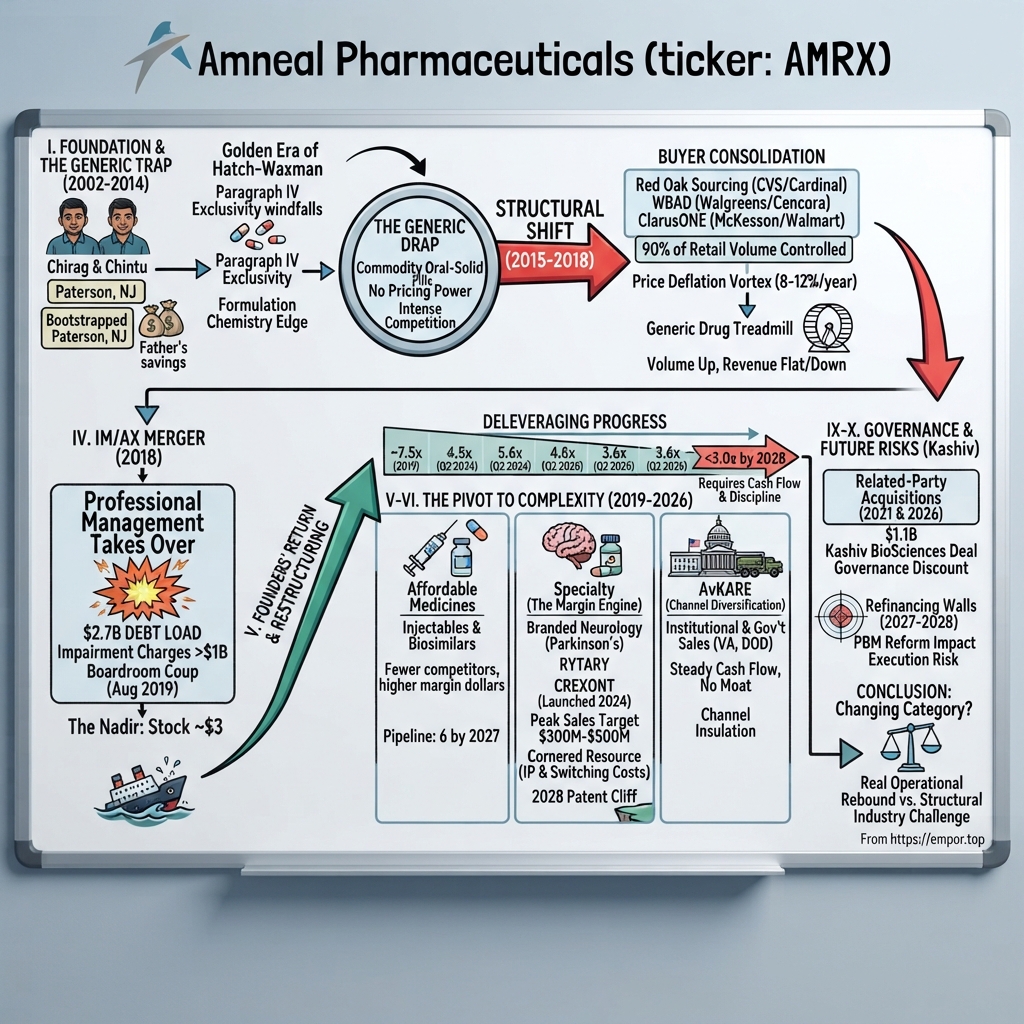
Amneal Pharmaceuticals: Escaping the Generic Drug Graveyard
I. Introduction & The Generic Trap
On the morning of August 6, 2019, the phones at Amneal Pharmaceuticals' Bridgewater, New Jersey headquarters started ringing before the market opened. The company had just announced that Paul Bisaro, the executive chairman who spent three decades building Watson and Actavis into a generics powerhouse, and Robert Stewart, the former Allergan chief operating officer recruited to run Amneal, were both stepping down. Their departures were effective immediately, with neither executive retaining a board seat.1
Taking their place were Chirag and Chintu Patel, the brothers who had founded the business in a Paterson, New Jersey contract packaging plant and had stepped aside less than fifteen months earlier to hand operational control to outside industry veterans.
The stock dropped another 7% that day to roughly $3.08 per share, completing an 87% collapse from its August 2018 peak of $24.25.2 Credit markets had already delivered their verdict: Amneal's term loans traded at distressed levels signaling an impending restructuring, and contemporaneous reports revealed that the company had hired financial advisors to evaluate emergency options, including breaking up the business.3
The root cause was straightforward. In May 2018, privately held Amneal Pharmaceuticals LLC combined with publicly traded Impax Laboratories in a reverse merger that created the fifth-largest generic drug manufacturer in the United States, saddling the combined balance sheet with more than $2.7 billion in debt.4 The transaction was underwritten on the assumption that generic pricing power and margin profiles from 2015 and 2016 would persist. Instead, industry economics deteriorated rapidly. The downturn was structural rather than cyclical: the wholesale purchasing market had consolidated into three dominant buying consortia that controlled nearly the entire retail volume.
Amneal had stepped onto the generic drug treadmill just as the machine shifted into reverse.
What this story is actually about
Fast-forward to September 2026, and Amneal trades around $18.71 per share with a market capitalization near $6.0 billion—a sixfold recovery from its 2019 nadir that sits within a few percent of its 52-week high.5 Full-year 2025 net revenue rose 8% to $3.02 billion, yielding $688 million in adjusted EBITDA and delivering the first meaningful GAAP net income in the company's public history.6 That operational momentum carried directly into 2026: second-quarter revenue reached $796 million, prompting management to lift full-year guidance for the second time in a year.7
The turnaround is a genuine operational rebound. Yet for long-term investors, the central question is not whether Amneal avoided insolvency, but whether it has genuinely changed category—whether a company built on high-volume, commodity oral-solid pills can durably reposition itself into complex injectables, biosimilars, institutional contracts, and proprietary specialty neurology, thereby neutralizing the structural buyer oligopsony that nearly broke it.
Management points to this strategic transition as a proven thesis. This analysis examines that claim against the company's historical record: an aggressive debt burden, more than a billion dollars in subsequent asset impairments, a regulatory setback on its flagship pipeline asset, and repeated commercial transactions with entities owned by the founding family.
The story unfolds across eight chapters: two immigrant brothers bootstrapping an operation in Paterson; the golden era of Hatch-Waxman and the purchasing cartels that ended it; the Impax integration and the boardroom coup; the founders' restructuring playbook; a segment-by-segment review of where profits are actually generated; the commercial gamble to transition RYTARY to CREXONT before 2028; the corporate governance questions surrounding Kashiv; a competitive audit through the frameworks of Porter and Helmer; and the financial metrics that will ultimately decide the outcome.
The story begins with the origins of the business.
 Subscribe on LinkedIn
II. Immigrant Hustle & The Bootstrapped Empire (2002–2014)
The company's founding narrative begins with a father's savings.
Kanu Patel had emigrated with his family from Gujarat to the United States. When his sons sought to acquire a struggling contract packaging plant in Paterson, New Jersey, in 2002, he contributed his retirement savings to fund the purchase. The origin story remains a staple of corporate presentations for good reason: building the business without institutional private equity meant outside investors did not dictate terms, demand short-term financial engineering, or force a premature exit.
The two brothers divided responsibilities according to their professional disciplines. Chintu Patel managed formulation and development, applying his background as a pharmacist and chemist to the challenge of controlled drug release in the gastrointestinal tract. Chirag Patel oversaw commercial strategy, dealmaking, and customer relationships. They named the venture Amneal by combining the names of their young sons, Aman and Neal, reflecting a long-term family holding strategy rather than a private-equity flip.
Why the 2000s were the right decade to start
The timing proved remarkably advantageous, aligning directly with the regulatory architecture of the American generic pharmaceutical market.
The Drug Price Competition and Patent Term Restoration Act of 1984—commonly known as Hatch-Waxman—established the modern generic framework. In exchange for granting brand pharmaceutical companies patent-term extensions to compensate for regulatory review delays, the statute created the Abbreviated New Drug Application (ANDA). This pathway allowed generic drugmakers to demonstrate that their copy was bioequivalent to the reference brand without repeating full clinical trials. Crucially, the law rewarded the first generic applicant to successfully challenge an innovator's patent via a Paragraph IV certification with 180 days of market exclusivity. For six months, that first filer competed only against the brand, typically pricing at 60% to 80% of the brand price while operating with generic manufacturing cost structures.
Six months of duopoly economics on a blockbuster molecule generated enormous cash windfalls for agile manufacturers. The 2000s and early 2010s delivered a wave of patent expirations: therapies such as Lipitor, Plavix, Nexium, and Singulair faced historic patent cliffs, unlocking tens of billions of dollars in commercial brand value to generic competition.
Amneal's advantage in this environment lay in formulation chemistry. The primary barrier in Paragraph IV challenges was rarely just courtroom litigation; it was engineering around secondary patents that brand companies layered over their core active ingredients, including novel coatings, extended-release mechanisms, specific salt forms, and proprietary delivery systems. Reverse-engineering difficult release profiles and submitting an ANDA robust enough to secure first-cycle approval from the Food and Drug Administration—avoiding repeated cycles of deficiency letters—allowed Amneal to reach market months ahead of larger competitors.
The choice not to take outside money
Equally consequential was the founders' capital allocation strategy. Amneal remained private throughout this boom, avoiding the debt-laden private-equity recapitalizations common among mid-tier generic rivals during the 2000s. Operating cash flow was consistently reinvested into internal research and physical manufacturing infrastructure, expanding oral-solid and sterile injectable capacity in New Jersey and Gujarat, India.
Vertical integration into active pharmaceutical ingredient (API) production and dosage manufacturing in Gujarat provided significant operational leverage. Establishing low-cost synthesis and formulation facilities in India gave Amneal a structural cost advantage over purely domestic manufacturers, while insulating the company from third-party contract manufacturing bottlenecks and foreign supplier quality failures. Owning manufacturing assets and upstream API supply became an operational cornerstone that later supported Amneal's push into sterile injectables and biosimilars.
By 2014, Amneal had grown into a substantial private pharmaceutical enterprise with a deep ANDA pipeline, manufacturing operations spanning two continents, and an unencumbered balance sheet free from outside investor redemption pressure.
Yet the company was also approaching an earnings peak it would spend the next decade trying to recapture. The fragmented wholesale market that enabled its early growth was about to consolidate into three dominant buying cartels.
III. The Structural Trap: Buyer Consolidation & The Price Deflation Vortex (2015–2018)
Between 2013 and 2016, the most decisive structural shift in the American generic drug industry occurred on the other side of the negotiating table.
For decades, generic manufacturers selling into U.S. retail pharmacies bargained with a fragmented mosaic of counterparties: regional wholesalers, retail pharmacy chains, independent drugstores, and mail-order operations. Negotiating against a dispersed buyer base gave approved suppliers meaningful commercial leverage. Prices held relatively steady or drifted modestly upward, and operating margins remained attractive.
Then the buyers combined their purchasing operations.
The three desks
This consolidation took the form of joint-venture purchasing consortia that paired a national wholesaler with a major retail pharmacy chain to negotiate collective volume:
Red Oak Sourcing united CVS Health and Cardinal Health. Walgreens Boots Alliance Development (WBAD) paired Walgreens with AmerisourceBergen (now Cencora). ClarusONE linked McKesson with Walmart.
By the time the realignment settled, these three purchasing desks negotiated the overwhelming majority of generic drug procurement in the United States. Industry and sell-side analyses consistently estimated that more than 90% of all domestic retail generic drug volume flowed through these three entities.
The consolidation radically altered supplier leverage. Previously, a manufacturer sold to dozens of commercial accounts, making the loss of any single contract manageable. Under the consortium model, losing one account meant forfeiting roughly a third of the addressable U.S. retail market. Furthermore, each consortium could credibly run competitive tenders across every molecule in each contracting cycle. They played a global roster of manufacturers against one another—including Teva, Viatris, Sandoz, Sun Pharma, Dr. Reddy's, Aurobindo, Hikma, Lupin, and Zydus—each desperate to preserve factory utilization and protect volume.
Pricing dynamics inverted almost immediately. What had been low-single-digit annual price inflation turned into persistent, severe deflation. Between 2015 and 2019, base generic portfolios experienced annual price declines of 8% to 12%. This shift was not a temporary cyclical downturn, but a permanent transfer of economic surplus from drug manufacturers to wholesale-retail consortia, and downstream to payers and patients.
The treadmill
The mathematical reality of this deflationary environment quickly undermined traditional generic business models.
When an existing commercial portfolio suffers a 10% annual price erosion against flat prescription volume, a manufacturer must generate an equivalent 10% of its revenue base from new product launches each year simply to maintain flat top-line sales. For a producer generating $1 billion in oral-solid generic revenue, that dynamic required formulating, filing, gaining regulatory approval for, and commercializing 20 to 30 new molecules annually—indefinitely—even as financial returns per launch steadily deteriorated.
This dynamic created the generic industry's "treadmill": a structural condition where drugmakers appear active and growing based on headline launch counts, while their underlying revenue base continuously erodes.
Regulatory policy inadvertently amplified the pressure. The Generic Drug User Fee Amendments (GDUFA), first enacted in 2012 and reauthorized in subsequent five-year cycles, provided the FDA with user-fee funding to eliminate review backlogs and establish predictable review timelines. The program achieved its legislative goal: generic drug approvals surged. However, faster review times compressed the window of limited competition following patent expiration from several years down to a matter of months. Molecules that historically supported two or three profitable producers rapidly attracted six to eight competing market entrants within a year of initial launch, driving realized prices down 85% to 95% from the branded originator.
The primary escape hatch from the treadmill—replacing price-eroded legacy drugs with newly launched molecules—narrowed precisely as price erosion accelerated.
What a rational operator should have concluded
By 2017, the strategic reality facing U.S. generic executives was unmistakable: commodity oral-solid pills had ceased to offer defensible economics. The category featured zero product differentiation, negligible switching costs, no pricing power, a consolidated three-buyer oligopsony, and a regulator accelerating competitive market entry. In response, generic manufacturers had three logical paths: pivot away from commodity oral solids toward technically complex, hard-to-formulate therapies; diversify out of retail channels toward institutional or hospital buyers beyond the three consortia; or aggressively pursue scale through consolidation in hopes that larger volumes would protect unit economics.
In 2018, Amneal chose to pursue scale.
IV. The Impax Merger Disaster: When Professional Management Broke the Machine (2018–2019)
By 2017, Impax Laboratories was facing intense operational pressure and actively seeking a partner. Like its peers, Impax saw its base generics business battered by industrywide price deflation. Yet it also possessed an asset of distinct strategic value: a specialized branded neurology franchise anchored by RYTARY, an extended-release carbidopa/levodopa capsule for Parkinson's disease.
Announced in October 2017 and completed in May 2018, the transaction was structured as a reverse merger: privately held Amneal Pharmaceuticals LLC combined with publicly traded Impax Laboratories under a new holding company, Amneal Pharmaceuticals, Inc., which assumed the Impax listing.8 Amneal's existing owners emerged with roughly three-quarters of the combined equity, while Impax shareholders held the remainder.
To satisfy antitrust review, the Federal Trade Commission required the divestiture of rights and assets across ten generic drugs where the two companies' product lines overlapped.[^9] While standard in generic mergers, these forced asset sales quietly removed a slice of the commercial volume that original synergy projections had relied upon.
The logic, and the flaw inside it
On paper, the strategic rationale appeared sound: scale up generic manufacturing to improve bargaining power against the three wholesale purchasing consortia, secure a branded neurology foothold to diversify away from retail price wars, and gain a publicly traded currency for future transactions. The deal also brought in a veteran corporate executive suite. Paul Bisaro had built Watson into Actavis and led Allergan's global generics business, while Robert Stewart had served as Allergan's chief operating officer.9 With outside industry veterans at the helm, the Patel brothers stepped back into co-chairman roles and relinquished daily operational control.
The structural flaw lay in financial underwriting. More than $2.7 billion in funded debt was placed on the combined balance sheet, with the cash flows required to service it calibrated against EBITDA margins earned across the industry in 2015 and 2016—before structural price deflation had fully compounded through the base business.10
Debt leverage is fundamentally a bet that the future will resemble the recent past. In an industry where the purchasing side had permanently restructured into an oligopsony, that proved to be the wrong bet.
The unwind
Between late 2018 and mid-2019, operational realities diverged sharply from projections. The base generic portfolio eroded faster than budgeted as the three buying consortia aggressively rebid product lines. Integrating Impax absorbed executive focus while delivering fewer operational synergies than promised, and key pipeline launches slipped past their target dates.
At the same time, the acquired intangible assets—the in-process research and development and commercial product rights capitalized on the balance sheet at merger valuations—began failing routine impairment tests. An asset whose future cash flows were modeled on 2016 pricing collapsed in economic value under 2019 deflation. Across 2018 and 2019, Amneal recorded massive write-downs against goodwill, intangible assets, and in-process R&D as management marked those merger assumptions to market reality.
This balance-sheet destruction provides the clearest historical test of a question central to Amneal's long-term investment case: how effectively can the company convert acquired pipeline assets into cash? The Impax record was unsparing. Amneal had issued equity and assumed heavy debt obligations to acquire a pipeline of future products, only to find that a material portion of that portfolio could not be commercially monetized. The assets were not merely delayed; they were fundamentally unviable.
As operating profits deteriorated under the debt load, net leverage climbed toward 7.5 times EBITDA. At that multiple, beneath an eroding revenue base, the business ceased to trade as an operating equity; it traded as a high-risk option on debt refinancing. Public equity markets priced that distress directly, sending Amneal shares to an all-time low near $2.80 by mid-2019.
In July 2019, management cut its full-year profit guidance. Less than a month later, Bisaro and Stewart were gone.11
Reading the boardroom reversal
The boardroom intervention in August 2019 reflected a straightforward corporate survival calculation. The Patel brothers, holding a commanding voting block, concluded that outside management lacked a turnaround plan that did not culminate in a comprehensive debt restructuring—a process that would likely wipe out common shareholders. Contemporaneous reporting described a company under intense financial pressure and reviewing its options broadly.12 Chirag and Chintu Patel returned to executive leadership not out of sentimentality, but because the founding family had the greatest equity stake at risk.
Founder control backed by substantial equity ownership is a defining characteristic of Amneal's governance, and it cuts both ways. In an acute crisis, large insider ownership aligns executive incentives with equity preservation; the founders were unwilling to surrender the company to creditors while their own capital was at stake. Yet that same centralized control also established the corporate environment that later enabled the family to orchestrate commercial transactions between their privately held businesses and the publicly traded corporation.
In August 2019, however, the immediate operational challenge was far more urgent: how could an over-leveraged generic manufacturer survive and regain profitability in a market dominated by three consolidated buyers?
V. The Founders' Return & The Pivot to Complexity (2019–2022)
The strategy Chirag and Chintu Patel adopted upon returning to executive leadership was straightforward: stop competing where the company had no structural advantage, and deploy capital into markets where the three wholesale consortia did not dictate pricing.
The initial restructuring was immediate and operational. Management launched an aggressive cost-reduction program that yielded more than $50 million in annualized overhead savings. Unprofitable international outposts, including operations in the United Kingdom and Germany that had been assembled without a coherent strategic thesis, were closed or divested. Filings for low-margin, commodity oral-solid generics were sharply curtailed. After two years focused on chasing volume through the Impax merger, Amneal's new operational mandate centered on subtraction.
Management then organized the business around three operating pillars, each structured to address a different customer base and reduce dependence on the retail buying cartels:
Affordable Medicines remained the primary volume driver, but its product mix began migrating away from standard oral tablets toward dosage forms with high technical barriers to entry, including sterile injectables, ophthalmic treatments, complex drug-delivery systems, and biosimilars.
Specialty served as the margin engine, focusing on branded neurology and endocrinology therapies marketed directly to prescribing physicians rather than tendered to retail purchasing desks.
AvKARE represented an unexpected third pillar: a specialized distribution and packaging platform focused on government and institutional accounts.
The AvKARE acquisition: buying a different customer
In January 2020, Amneal acquired AvKARE for $255 million in upfront cash along with a 20% earn-out interest.[^14]
On the surface, the transaction appeared counterintuitive: a generic drug manufacturer purchasing a lower-margin distributor. The strategic logic, however, rested on AvKARE's customer base. The business supplied pharmaceuticals to the U.S. Department of Veterans Affairs and Department of Defense, alongside institutional hospital networks and unit-dose packaging clients. These federal agencies operate under a distinct procurement regime governed by the Trade Agreements Act, which enforces country-of-origin requirements that disqualify substantial volumes of low-cost international manufacturing. Meeting these compliance, reporting, and security mandates created a formidable operational barrier to entry.
The federal government was not another Red Oak. While federal procurement officials maintained strict cost controls, they operated on separate contracting schedules, evaluated suppliers under different legal standards, and placed a premium on supply-chain reliability and domestic manufacturing—capabilities Amneal's manufacturing infrastructure could readily support.
Financial performance supported that strategic rationale. AvKARE generated $745 million in revenue in 2025, more than doubling its top line since 2020 and growing 12% year over year.13 Relative to the $255 million upfront purchase price, the transaction emerged as one of the most effective capital allocation decisions in Amneal's public history, providing a tangible counterweight to the earlier Impax asset impairments.
The distribution model nevertheless introduced structural trade-offs. AvKARE operates at gross margins in the mid-to-high 20% range, significantly below the profitability of Amneal's manufactured pharmaceutical lines. While the segment diversified the revenue base and generated steady cash flows with modest capital expenditure requirements, it provided minimal pricing leverage. The expansion of AvKARE improved the stability of the business by dampening consortium exposure, but it did so by diluting the company's blended gross margin.
Building the hard-to-make engine
Between 2020 and 2022, Amneal redirected capital toward pharmaceutical manufacturing segments where competitive moats were physical and operational rather than purely legal.
Sterile injectables represented the clearest implementation of this strategy. While manufacturing standard oral tablets involves widely understood chemistry and tableting mechanics, producing sterile injectables—such as lyophilized powders, suspensions, and emulsions that must remain chemically stable and free from particulate or microbial contamination—demands specialized clean-room facilities, rigorous process validation, and a spotless regulatory inspection record. The industry has historically penalized operational missteps in this category; FDA warning letters, import alerts, and consent decrees have repeatedly sidelined major competitors' sterile product lines for years at a time.
Amneal sought to internalize these capabilities rather than outsource production. In 2021, the company acquired India-based Puniska Healthcare for approximately $93 million, integrating sterile injectable production directly into its proprietary manufacturing network.
The company entered the biosimilar market initially through commercial partnerships. Amneal licensed a portfolio of oncology and supportive-care biosimilars from developers such as mAbxience—including bevacizumab (Alymsys), pegfilgrastim (Stimufend), and filgrastim (Releuko). The partnership structure allowed Amneal to establish an institutional commercial footprint in hospitals without assuming upfront clinical trial expenses. The economic trade-off, however, was that royalty and supply-transfer payments capped Amneal's operating margins on these products. That margin ceiling would later serve as management's primary justification for pursuing the largest transaction in the company's history.
In 2022, Amneal broadened its specialty commercial platform by acquiring the U.S. rights to Saol Therapeutics' baclofen portfolio, including LIORESAL. The asset integrated directly into the specialty neurology sales force already calling on movement-disorder specialists who prescribed RYTARY.
What the pivot actually accomplished
By the close of 2022, the operational realignment had begun to alter Amneal's financial profile. Exposure to the three retail purchasing consortia, which had generated the overwhelming majority of pre-merger revenue, dropped substantially as AvKARE and Specialty expanded and commodity oral-solid volume was deprioritized.
Yet the pivot left fundamental structural challenges unresolved. Funded debt remained elevated, and the base generic portfolio continued to face annual price deflation. What had shifted was the composition of top-line growth: for the first time since the Impax merger, the majority of Amneal's incremental sales originated from channels outside the direct pricing control of the three retail buying cartels.
Whether that shift in revenue mix represents a durable competitive advantage—or simply a temporary reprieve before these newer categories face their own competitive commoditization—is the central question addressed by the underlying segment economics.
VI. Segment Deep-Dive: Sizing Revenue, Profits, and Economic Moats
Evaluating Amneal as an investment rather than a turnaround narrative requires analyzing its three operating divisions separately. Beyond sharing a corporate balance sheet, they share few underlying commercial economics.
Taking 2024 as the baseline—the final full fiscal year before major biosimilar transactions altered the corporate profile—net revenue reached $2.79 billion with adjusted EBITDA of $627 million.[^16] By 2025, those figures rose to $3.02 billion and $688 million, respectively, while the second quarter of 2026 generated $796 million in net revenue and $206 million in adjusted EBITDA.14
Affordable Medicines: the volume base
Affordable Medicines remains the primary volume driver, accounting for roughly three-fifths of total revenue. In the second quarter of 2026, the unit generated $489.9 million, a 13% increase year over year.15 The division spans the company's legacy oral-solid pills, complex generics, sterile injectables, and biosimilars.
Gross margins here generally range between 40% and 45%, a respectable figure for generic manufacturing that reflects Amneal's ongoing shift toward higher-barrier formulations. Yet the division's reported top-line expansion masks an essential operational tension: persistent price deflation across the legacy oral-solid portfolio offset by incremental revenue from new injectable and biosimilar launches. When the company reports double-digit growth in Affordable Medicines, that expansion reflects new product introductions rather than pricing power on existing lines; underlying base revenue continues to erode.
This dynamic is an inherent feature of the post-consolidation generic marketplace: segment growth remains strictly dependent on launch cadence. If Amneal were to pause new product introductions for eighteen months, the segment would contract.
The sterile injectables portfolio now exceeds forty commercial molecules, and management highlights this catalog as structurally insulated. That assessment is only partly accurate. While sterile clean-room manufacturing and contamination controls limit the pool of credible market entrants—often keeping competition to three or four manufacturers rather than seven or eight—a three-player market remains a competitive arena rather than a monopoly. Prices still erode over time, albeit at a slower pace, punctuated by temporary pricing windfalls whenever a competitor encounters regulatory compliance issues or receives an FDA warning letter.
Specialty: where the equity value lives
Specialty generated $149.3 million in the second quarter of 2026, an increase of 17% year over year, following full-year 2025 revenue of $529 million, which was up 19%.16 While the division contributes only about a sixth of consolidated sales, it represents the primary engine of corporate equity value.
Under standard pharmaceutical margin structures, Specialty accounts for well over a third of operating profit. Branded therapies carrying gross margins between 75% and 80% convert revenue into operating profit at more than twice the rate of the generic portfolio and roughly three times the rate of AvKARE.
The commercial portfolio centers on Parkinson's disease treatments RYTARY and its newly approved successor CREXONT, alongside UNITHROID for hypothyroidism, movement-disorder therapies ONGENTYS and LIORESAL, and BREKIYA, a dihydroergotamine autoinjector targeting migraine specialists.
Specialty serves as Amneal's valuation fulcrum because of fundamental unit economics. An incremental dollar of branded specialty revenue yields significantly more EBITDA than a dollar of generic sales. More importantly, public markets value branded franchises at substantially higher earnings multiples due to physician prescribing relationships, patent exclusivity, and real patient switching costs. Every percentage point shift in revenue mix toward Specialty expands Amneal's blended valuation multiple—making the commercial longevity of this division beyond 2028 the critical question facing equity investors.
AvKARE: cash, not moat
AvKARE produced $157.0 million in the second quarter of 2026, a decline of 4% year over year—illustrating that insulation from retail pharmacy consortia does not eliminate quarterly revenue fluctuations.17 Federal pharmaceutical procurement operates on irregular bidding cycles, contract renewals, and seasonal purchasing schedules that frequently cause top-line swings independent of underlying patient demand.
AvKARE's operational value lies in channel diversification, modest capital expenditure requirements, and rapid cash conversion—crucial traits for an enterprise working to de-lever its balance sheet. However, the business does not confer structural pricing power. Institutional and government buyers possess substantial counterparty leverage and routinely enforce strict budgetary limits, solicit competing bids, and modify procurement terms. AvKARE provides access to a distinct procurement ecosystem, not an unassailable economic moat.
The mix conclusion
Viewed in aggregate, Amneal has engineered a meaningful realignment of its revenue base. Sales tied directly to the three retail buying consortia have fallen from approximately three-quarters of revenue prior to the Impax merger to less than half today, replaced by federal institutional contracts, hospital channels, and physician-prescribed specialty brands.
Yet a critical distinction remains: Amneal has diversified its buyer base rather than acquired structural pricing power. Broadening the customer roster reduces the acute vulnerability to unilateral price cuts by retail consortia, but true pricing leverage requires therapies that lack viable clinical substitutes. Within Amneal's portfolio, only the Specialty division possesses those characteristics—and its flagship commercial franchise faces patent expiration in 2028.
That looming deadline sets up the most consequential commercial gamble in the company's history.
VII. The Specialty Bet: Parkinson's Disease, The 2023 CRL, and CREXONT
On July 3, 2023, Amneal disclosed that the FDA had issued a Complete Response Letter for IPX203, the extended-release carbidopa/levodopa capsule designed to anchor the future of the Specialty segment.[^21] The stock fell roughly 15% intraday. Equity analysts who had modeled a 2024 commercial launch pushed their estimates out and openly questioned the durability of the company's specialty transition.
The sharp market reaction reflected the complex clinical and commercial dynamics governing Parkinson's disease treatment.
The levodopa problem, in plain terms
Parkinson's disease destroys the brain neurons responsible for producing dopamine. Since the 1960s, the therapeutic standard of care has paired levodopa, which the brain converts into dopamine, with carbidopa, an agent that prevents that conversion from occurring prematurely in the bloodstream. The combination remains clinically effective, but in its standard immediate-release formulation, it is inexpensive and widely available as a commodity generic.
The primary pharmacological obstacle is levodopa's short half-life. The drug clears the body rapidly, creating sharp peaks and troughs in blood concentration rather than a steady therapeutic level. In the early stages of the disease, the brain's remaining neural capacity buffers these fluctuations. As the disease advances, that buffering capacity erodes, leaving patients vulnerable to the physical peaks and troughs: periods of functional motor control known as "On" time, periods where tremors and rigidity return known as "Off" time, and peak-dose complications characterized by involuntary writhing movements termed dyskinesia.
To manage these swings, patients often take five, six, or seven doses a day, carefully timed around meals because dietary protein competes with levodopa for intestinal absorption. This demanding dosing regimen represents a central unresolved challenge in long-term Parkinson's management.
Managing the condition this way resembles trying to heat a room to a constant temperature with a manual space heater switched on and off by hand; for four decades, pharmaceutical formulation scientists have sought to engineer an effective thermostat.
RYTARY, and its ceiling
RYTARY—the branded asset Amneal acquired through the Impax merger—represented a genuine formulation advance. By encapsulating extended-release beads designed to dissolve at varying rates throughout the digestive tract, the therapy smoothed drug absorption relative to standard immediate-release pills, eventually growing into a commercial franchise generating between $180 million and $200 million annually.
Yet the product faced clear clinical and commercial boundaries. Patients still required multiple daily doses, and the therapy's key patents expire in 2028. Upon patent expiration, generic market entrants typically capture the majority of prescription volume and sharply compress price. For a specialty division that underpins Amneal's equity valuation, the 2028 patent cliff represents an urgent commercial deadline.
What CREXONT actually does differently
IPX203, developed commercially as CREXONT, pairs two distinct drug-delivery mechanisms within a single oral capsule: immediate-release granules engineered for rapid therapeutic onset, alongside extended-release beads coated with a proprietary mucoadhesive polymer. This specialized polymer binds transiently to the mucosal lining of the upper intestine, holding the active compound within its primary absorption window rather than allowing it to wash downstream before uptake can occur.
In clinical practice, the immediate-release component establishes therapeutic blood levels quickly, while the mucoadhesive beads maintain a steady supply of medication from an anatomical site where the body can readily absorb it.
The FDA's 2023 Complete Response Letter focused specifically on carbidopa pharmacokinetics—the absorption profile of the secondary partner molecule—rather than the therapeutic efficacy of levodopa delivery. Amneal conducted a supplementary pharmacokinetic study in healthy volunteers during the fourth quarter of 2023, resubmitted its application in February 2024, and secured FDA approval on August 7, 2024.[^22]
The thirteen-month recovery from regulatory rejection to commercial approval demonstrated solid execution, showing management could resolve a technical deficiency within a single review cycle. Nevertheless, the regulatory delay consumed a full year of commercial runway before the 2028 patent expiration—a fixed deadline that cannot be extended.
The commercialization question, tested honestly
Management has guided to U.S. peak sales between $300 million and $500 million for CREXONT.18 The central strategic test is whether technical formulation advantages can convert into sustained prescription growth in a therapeutic category where incumbent generic alternatives cost only pennies per dose.
Early commercial performance has exceeded initial skepticism. CREXONT generated roughly $60 million to $65 million during its partial launch year in 2024, reaching approximately 22,000 patients and securing about 3.2% market share; management projected revenue would more than double in 2025 to over $120 million, setting a 5% to 6% market share target for 2026.[^24] On the second-quarter 2026 earnings call, management highlighted that approximately 80% of new prescriptions originated from general neurologists rather than movement-disorder specialists—a notable milestone, as general neurologists write the vast majority of Parkinson's prescriptions and typically represent a slower, more conservative audience to convert.19 Supporting that commercial outreach, interim Phase IV data from the ELEVATE-PD clinical study reported that patients gained roughly three or more hours of daily "Good On" time.20
Yet the structural hurdles to broad market adoption remain formidable. Commercial insurers and pharmacy benefit managers routinely enforce step-therapy protocols and prior authorization requirements against branded neurology agents when cheap generic alternatives exist. Clinicians are often cautious about adjusting regimens for patients whose symptoms are reasonably controlled, because the titration process carries real risks of acute motor destabilization. Furthermore, a meaningful portion of CREXONT's initial prescription volume represents cannibalization of existing RYTARY patients. While intentional, that internal substitution means reported brand growth partly reflects portfolio replacement rather than net expansion.
The commercial evidence to date neither disproves management's peak-sales target nor confirms its upper boundary. Annual sales tracking near $120 million, supported by penetration among general neurologists and positive Phase IV data, align with a trajectory toward the lower-to-middle portion of the $300 million to $500 million guidance. Reaching the upper half of that range requires prescription share gains to accelerate significantly before 2028, when RYTARY's genericization will eliminate the franchise's established pricing floor and introduce an authorized extended-release alternative that payers can designate as a lower-cost preferred option.
The durability of the thesis will be determined by observable commercial milestones: quarterly Specialty revenue and verified CREXONT market share tracked against management's 5% to 6% target for 2026. If share expansion stalls in the mid-single digits while RYTARY revenues recede, the long-term peak-sales projection will require substantial downward revision. If adoption continues compounding into high single digits alongside stable reimbursement coverage, the specialty strategy will remain on track.
Amneal's response to the 2028 patent cliff, however, does not rely entirely on CREXONT. It also depends on an ambitious and controversial expansion into complex biologics—executed through a transaction with an entity owned by the founding family.
VIII. Capital Allocation, Governance, & The Kashiv Entanglement
Every founder-controlled public company eventually faces the same test, and Amneal has now faced it twice with the same counterparty.
Chirag and Chintu Patel control a large economic and voting interest in Amneal — in the high-twenties to low-thirties percent range through direct holdings, family trusts, and entities including Kanan LLC. That concentration is the reason the company still exists in its current form; it is also the reason the following transactions require scrutiny rather than assumption.
The 2021 precedent
In April 2021, Amneal completed the acquisition of a 98% interest in Kashiv Specialty Pharmaceuticals — a company co-founded and substantially owned by the Patel family.[^27]
The procedural safeguards were the right ones on paper. An independent Conflicts Committee of the board evaluated the transaction, with its own financial advisor (RBC) and its own legal counsel (Shearman & Sterling). The family did not negotiate with itself.
The substantive question is whether the price was right, and that is genuinely hard to answer from outside. What can be said is that the structure established a pattern: the family develops assets in a private vehicle, and when those assets mature, the public company buys them.
The 2026 transaction
On April 21, 2026, Amneal agreed to acquire Kashiv BioSciences — the parent entity — for $375 million in cash and $375 million in equity at closing, plus up to $350 million in milestone and contingent payments, for total consideration of up to $1.1 billion.21 The transaction closed on August 10, 2026, following a shareholder vote.22
What Amneal bought: a biologics platform assembled over roughly twelve years with more than $900 million of cumulative investment, over 600 employees, and four R&D and manufacturing sites — and notably, the status of being among the small number of U.S.-based companies that both manufacture and hold marketing authorization for multiple biosimilars.23
The strategic case management made is coherent. Amneal's existing biosimilars were licensed in, which meant paying away a share of the economics to the developer. Owning the development and manufacturing engine converts a royalty stream into internal margin, and it positions the company ahead of what management characterized as a global biologics loss-of-exclusivity wave exceeding $300 billion over the coming decade.24 On the second-quarter call, the division of labor was put plainly: Kashiv brings the science and manufacturing engine, Amneal brings the U.S. commercial engine.25 Management also outlined capacity scaling from 26,000 liters at the end of 2026 to 75,000 liters by 2028, six commercial biosimilars by 2027, and a pipeline of twenty-plus programs.26 Separately, the peptide and GLP-1 capability — with facilities targeted to be operational in 2029 and supply commencing in 2030 under a Pfizer partnership — is a genuinely long-dated option.27
The activist cross-examination
Here is what a skeptical long/short investor would put to the board, and these are fair questions rather than rhetorical ones.
Did public shareholders capitalize a private family entity? Kashiv had absorbed more than $900 million of investment over twelve years. Amneal paid $750 million at closing with $350 million contingent. On the surface that is not an obviously generous price relative to invested capital — but invested capital is not value, and a private vehicle that had not yet monetized its platform at scale found, in the public company its founders control, a buyer with a compelling strategic narrative for paying up. The Conflicts Committee process is a procedural answer to a substantive question.
Does the equity component dilute at a convenient moment? $375 million of stock issued in 2026, after the shares had roughly doubled over the prior year, is materially less dilutive than the same dollar amount would have been in 2023. That timing favors continuing shareholders. It also means the family received stock at an elevated price — a fact that cuts the other way.
What does it do to the deleveraging promise? This is the sharpest point. Net debt stood at $2.66 billion as of June 30, 2026, with net leverage at 3.6 times trailing EBITDA — down from 3.9 times at the end of 2024 and 3.5 times at the end of 2025.28 Management now projects leverage falling below 3.0 times by 2028 as Kashiv-related cash flow and new launches scale.29 Note what happened: a target that was being approached steadily through organic deleveraging has been pushed out by roughly two years to accommodate an acquisition, and the company is carrying that leverage into a period with refinancing walls and a $350 million contingent obligation still outstanding. The Term Loan B repricing that cut 50 basis points and saves about $12 million annually is real and helpful, and it does not change the maturity profile.30
And the governance pattern itself? Two related-party acquisitions from the same family vehicle, both defended on strategic grounds, both approved by independent processes the family's board appointed. An investor is entitled to conclude that the procedural safeguards were adequate. An investor is equally entitled to note that the pattern reduces the information advantage of outside shareholders, since the family knows the acquired assets far better than the market does, and to discount accordingly.
The honest verdict on capital allocation
Weighing the record over the full public history: Impax was a value-destroying deal executed by hired management with founder board approval. AvKARE was an excellent deal at an attractive price that has more than doubled. Puniska and Saol were small, sensible, and integrated without incident. Kashiv Specialty was defensible but unprovable from outside. Kashiv BioSciences is too new to judge and is the largest bet the company has ever made after Impax.
That is a mixed record trending better — not a record that supports describing this management team as disciplined capital allocators without qualification. The team that is deploying $1.1 billion into biologics in 2026 is substantially the same founding team that approved $2.7 billion of debt for Impax in 2018, having stepped back from operations at exactly the wrong moment. They learned from it; the recovery is evidence of that. But the claim "management maintains strict balance-sheet discipline" does not survive contact with the record intact. It survives narrowed: management has demonstrated operational discipline and steady deleveraging since 2019, while retaining an appetite for large, strategically-rationalized acquisitions that periodically resets the deleveraging clock.
The falsification test is straightforward and dated: does net leverage actually reach below 3.0 times by 2028 without another deal resetting it again?
IX. Strategic Frameworks: Porter's 5 Forces & Hamilton Helmer's 7 Powers
Strategic frameworks are most useful when they test corporate narratives against structural economic reality. Applied to Amneal, they produce clear, if sobering, conclusions.
Helmer's 7 Powers, scored honestly
Process Power — present, and the most defensible advantage in the portfolio. Hamilton Helmer defines process power as an embedded set of organizational capabilities that competitors cannot replicate quickly even with full knowledge of the operational blueprint. Sterile injectable manufacturing fits this definition. The combination of validated clean-room protocols, an unblemished regulatory inspection record, and the institutional knowledge required to keep a lyophilization line operating within precise specifications cannot be bought off the shelf; it builds over years and can be compromised by a single adverse FDA inspection finding. The validation of this barrier is the industry's historical casualty list: manufacturers whose sterile facilities failed regulatory reviews, resulting in entire U.S. commercial portfolios being sidelined for years. Amneal's extended-release multiparticulate formulation work on CREXONT falls into this same category.
The structural limitation is that process power in generic manufacturing protects supply, not price. It restricts the number of qualified market entrants per molecule, but it does not prevent those few approved producers from competing aggressively on price.
Cornered Resource — present in Specialty, absent across the rest of the business. CREXONT's formulation patent estate serves as an authentic cornered resource for the duration of its patent protection. UNITHROID and the movement-disorder brands carry narrower proprietary defenses. Across Affordable Medicines, cornered resources are absent by definition: the foundational premise of generic manufacturing is that no single producer retains exclusive rights to the molecule.
Switching Costs — bifurcated across operating divisions. In neurology, switching costs are clinical, asymmetric, and significant. A clinician who has spent months titrating a Parkinson's patient to motor stability assumes acute clinical risk by adjusting a functional regimen, creating therapeutic inertia that protects an incumbent therapy. That dynamic works against Amneal when converting patients from standard therapies to CREXONT, but works for Amneal once those patients are stabilized on therapy—illustrating why the commercial conversion race prior to 2028 is decisive. In retail generics, switching costs are nonexistent by regulatory design; pharmacies automatically dispense whichever bioequivalent product offers the lowest acquisition cost in a given contracting cycle.
Scale Economies — modest in absolute terms, functional within specific niches. Amneal lacks the sheer research budgets and global manufacturing scale of Tier-1 generic giants such as Teva, Sandoz, or the largest Indian multinational producers. Instead, the company pairs a vertically integrated low-cost manufacturing footprint in Gujarat with domestic U.S. facilities that satisfy federal procurement regulations—a specialized hybrid footprint that relatively few direct competitors maintain. This structure functions as an operational niche advantage rather than broad, industry-dominating scale economies.
Branding, Network Economies, and Counter-Positioning — absent. Amneal possesses no consumer brand equity in retail pharmacies, experiences no network effects, and operates no business model that larger pharmaceutical incumbents are structurally constrained from copying.
Across Helmer's seven powers, Amneal exhibits four to varying degrees, with only two offering meaningful strategic protection—and one of those tied to patents that begin expiring in 2028. This scorecard reflects the reality of a mid-cap pharmaceutical manufacturer, and it directly explains why public markets value the enterprise at a discount to pure-play branded drugmakers.
Porter's Five Forces
Bargaining power of buyers: critical, and the defining structural feature of the sector. The three wholesale purchasing consortia—Red Oak, WBAD, and ClarusONE—retain immense commercial leverage across domestic retail generics. Amneal's strategic reallocation of capital since 2019 has been designed to reduce the proportion of corporate revenue directly exposed to their tenders. On the branded specialty side, pharmacy benefit managers exert comparable gatekeeper power, determining CREXONT's commercial trajectory through formulary placement, prior authorization hurdles, and step-therapy mandates.
Threat of new entrants: bifurcated by technical complexity. Barriers to entry remain exceptionally low in commodity oral-solid pills, where global active ingredient synthesis and tableting capacity is abundant. Conversely, barriers are substantial in sterile injectables, complex delivery systems, and biosimilars, where establishing compliant facilities requires hundreds of millions of dollars in capital expenditure alongside rigorous regulatory inspection standards. Amneal's capital allocation has deliberately targeted this higher-barrier end of the spectrum.
Rivalry among existing competitors: intense. In retail generics, global producers—including Teva, Viatris, Sandoz, Sun Pharma, Dr. Reddy's, Hikma, Aurobindo, and Lupin—compete aggressively for high-volume supply contracts on near-identical cost structures. While competition in sterile injectables and biosimilars involves fewer qualified market entrants, competitive pressure in those categories is gradually intensifying as rival manufacturers invest in identical technical capabilities.
Threat of substitutes: acute within the Specialty franchise. In branded neurology, the primary clinical substitute for CREXONT is immediate-release generic carbidopa/levodopa, priced at pennies per dose. This availability of low-cost generic alternatives provides the economic justification for pharmacy benefit managers to mandate step therapy and enforce prior authorizations before approving branded extended-release options.
Bargaining power of suppliers: moderate, with concentrated geographic exposure. Reliance on active pharmaceutical ingredient synthesis concentrated in India and mainland China exposes manufacturers to raw-material price volatility, quality-control interruptions, and import alerts. Amneal's backward integration into internal active ingredient facilities in India dampens these risks, but does not fully insulate operations from broader international supply-chain shocks.
The composite picture is a company operating in a structurally challenging industry that has engineered a credible partial transition into its more defensible niches. Amneal has achieved a far more resilient operational footing than it held in 2019, but it has not built an unassailable economic moat.
X. Risk Radar & Historical Falsification Matrix
Testing Amneal's investment case requires evaluating each load-bearing thesis against the company's historical record rather than accepting management's framing at face value. Three primary assertions underpin that case.
Claim one: complex generics and biosimilars provide durable pricing power
The primary disconfirming evidence emerges from the broader biosimilar market rather than Amneal's internal operations. In the United States, biosimilar commercialization has followed a consistent pattern: modest introductory discounts, followed by rapid average selling price deflation—frequently 50% to 70% within two years—once three or more competitors enter the market. Bevacizumab, pegfilgrastim, and most visibly adalimumab have all demonstrated this compression. Furthermore, reference originators often retain market share far longer than standard generic models assume, because pharmacy benefit manager rebate structures can make an expensive branded drug cheaper net to the plan sponsor than an incoming biosimilar.
Amneal experienced this dynamic directly through its licensed oncology biosimilars.
Verdict: the claim does not survive in its strongest form. It narrows to an outcome that remains commercially valuable: biosimilars generate substantially higher absolute gross profit per unit than commodity oral-solid pills and attract fewer qualified competitors, ensuring that the dollar opportunity remains meaningful even as percentage margins compress. The strategic rationale behind acquiring Kashiv aligns with this revised premise: internalizing development and manufacturing is how a producer preserves cash margins when market prices decline predictably. Management's 75/25 portfolio construction—weighting toward lower-competition molecules while selectively addressing large markets—represents a rational response to this dynamic, and its execution remains observable through the target of commercializing six biosimilars by 2027.31
Claim two: CREXONT achieves $300–500 million peak and replaces RYTARY before 2028
The disconfirming evidence—a regulatory Complete Response Letter that consumed a full year of the commercial runway, alongside the persistent risk of prescription leakage to inexpensive immediate-release generics under payer pressure—narrows expectations toward the lower half of the guidance range and leaves little margin for operational delay ahead of RYTARY's 2028 patent expiration. Conversely, solid adoption among general neurologists and supporting Phase IV clinical data keep the original commercial thesis viable.
Verdict: intact but unproven, with the burden of proof resting on prescription share trajectory over the next four to six quarters.
Claim three: management maintains strict balance-sheet discipline
Verdict: narrowed materially. Operational discipline since 2019 is well supported by steady deleveraging, which reduced net debt from roughly 7.5 times EBITDA to 3.6 times. Transactional discipline is not: the same leadership team approved the debt-heavy Impax merger in 2018, and the $1.1 billion Kashiv transaction in 2026 pushed the timeline for reaching sub-3.0 times leverage out to 2028.
The live risk radar
Refinancing and cost of capital. With $2.66 billion in net debt and significant maturities concentrated in the 2027 to 2028 window, Amneal's equity value remains exposed to credit market conditions beyond its control. While the Term Loan B repricing demonstrated that the company can secure improved terms in a receptive market, it does not guarantee favorable terms during a credit contraction. In a stressed credit environment, refinancing costs would overshadow operational progress.
PBM regulatory overhaul. Federal Trade Commission scrutiny and legislative pressure on pharmacy benefit manager rebate structures present conflicting implications for Amneal. Dismantling rebate incentives that favor high-cost branded reference biologics would accelerate biosimilar adoption—a clear commercial benefit. Conversely, broader disruptions to specialty pharmacy distribution and formulary negotiations could complicate commercial access and step-therapy protocols for CREXONT. The ultimate net effect of pharmacy benefit reform remains genuinely uncertain.
Supply chain and geopolitics. Concentrating active pharmaceutical ingredient synthesis and dosage formulation in India exposes the company to regulatory inspection risks, FDA import alerts, and international logistics disruptions. An adverse regulatory finding at a primary manufacturing facility represents the single hazard most capable of creating an immediate, unforecastable earnings deficit, as a regulatory action can abruptly halt an entire product line. Amneal's domestic manufacturing footprint and federal distribution through AvKARE provide a partial structural hedge, positioning the business relatively well if domestic-sourcing mandates or trade restrictions intensify.
Execution risk in the Kashiv integration. Amneal is simultaneously integrating a 600-person organization, scaling biologics bioreactor capacity nearly threefold by 2028, launching a pipeline of biosimilars, transitioning a flagship neurology franchise ahead of a patent cliff, and managing a multiyear deleveraging commitment. That represents substantial concurrent complexity for an executive team whose prior large-scale integration—the 2018 Impax merger—resulted in severe operational distress and extensive asset impairments.
Related-party and disclosure overhang. This represents a persistent valuation headwind rather than an acute legal risk. Public companies that engage in repeated transactions with entities controlled by their founding families typically trade at a corporate governance discount. Given the inherent information asymmetry between inside owners and outside shareholders, that market discount is rational rather than punitive.
XI. The Bull vs. Bear Case & What to Watch
Stepping back, the analytical argument resolves into two coherent interpretations drawn from the same underlying facts.
The bear case
CREXONT's initial commercial rollout proves solid but falls short of transformative. Prescription market share plateaus in the mid-single digits as commercial payers enforce step therapy and neurologists adhere to low-cost immediate-release regimens that manage symptoms adequately for most patients. Peak sales land closer to $200 million than the guided $500 million upper bound. When RYTARY faces generic competition in 2028, the Specialty division—the primary driver of the company's valuation multiple—stagnates or contracts, reversing the stock's recent multiple expansion.
Meanwhile, the biosimilar expansion mirrors historical industry patterns: technically sound product launches into institutional markets where realized prices decline faster than sales volumes grow, generating top-line expansion with disappointing incremental cash margins. The $1.1 billion deployment for Kashiv begins to resemble an expensive transfer of value to a founder-controlled entity, the $350 million contingent earn-out comes due, net leverage fails to drop below 3.0 times EBITDA, and refinancing in a less receptive credit environment consumes the free cash flow originally allocated to debt repayment.
At the same time, wholesale purchasing consortia reassert their leverage. Complex generics prove less defensible than projected as global competitors qualify clean-room and lyophilization capacity. Amneal closes out the decade as it spent most of its public history: a mid-tier generic manufacturer with a profitable specialty neurology line, valued at the modest mid-single-digit EBITDA multiples typical of the generic drug sector.
The bull case
CREXONT's adoption among general neurologists proves durable and compounds. Supporting Phase IV clinical data provides the commercial sales force with a persuasive message in a therapeutic category starved of treatment innovations. Prescription share advances into the high single digits, and by 2028 the franchise has largely transitioned patients to a patent-protected formulation with exclusivity extending into the late 2030s. RYTARY's patent expiration becomes a manageable step-down rather than an earnings cliff, and Specialty reaches a scale where equity markets value Amneal as a branded specialty pharmaceutical company supported by generic cash flows.
Simultaneously, the biosimilar platform validates the economic case for vertical integration: six commercial products by 2027, bioreactor capacity scaling toward 75,000 liters by 2028, a development pipeline of more than twenty programs supporting launches into the 2030s, and internal manufacturing economics that allow Amneal to maintain healthy cash margins at price points that push asset-light competitors out of the market. The peptide and GLP-1 capacity scheduled to come online at the end of the decade provides an attractive long-term option on a substantial global therapeutic market.
AvKARE continues compounding through federal procurement channels, supported by statutory domestic manufacturing preferences. Net leverage drops comfortably below 3.0 times EBITDA, credit ratings improve, annual debt service falls, and valuation multiples expand toward those awarded to diversified specialty pharmaceutical peers.
Which way does the evidence lean?
Operational results through mid-2026 are demonstrably strong: revenue expanding 10% year over year, full-year financial guidance raised twice, net leverage declining across six consecutive years, and a commercial launch tracking ahead of expectations shaped by the 2023 Complete Response Letter.32
Yet every critical pillar of the bull case still awaits confirmation between 2027 and 2028: CREXONT's terminal market share ahead of RYTARY's patent cliff, realized gross margins across a scaling biosimilar catalog, and the attainment of the sub-3.0-times leverage target. Six years of consistent operational execution have earned management the right to be evaluated on those milestones, but the commercial outcomes remain to be delivered.
Amneal has effectively converted an existential solvency crisis into a commercial execution challenge—a substantial strategic achievement. That progress is also largely reflected in current equity valuations, with the stock trading near double its 52-week low of $9.49.33
The three numbers that settle the argument
The investment debate ultimately reduces to three observable operational metrics:
One: CREXONT market share and quarterly Specialty revenue. Management established a 5% to 6% market share target for 2026 against the 3.2% achieved during its partial initial launch year. Prescription volume share provides a cleaner commercial indicator than reported dollar revenue because it removes gross-to-net accounting adjustments and pricing variances, directly measuring conversion momentum against the 2028 patent expiration. If share adoption accelerates into the high single digits, Specialty's multiple expansion is justified. If market penetration stalls in the mid-single digits, the bear case on Amneal's highest-margin segment is confirmed.
Two: the sterile injectable and biologic proportion of Affordable Medicines revenue. The core strategic assertion—that Amneal has successfully transitioned from commodity oral solids into defensible technical manufacturing—is directly testable as a product mix percentage. Tracking injectables and biosimilars as an expanding proportion of division sales indicates whether the company is truly escaping commodity exposure or simply running faster on the generic treadmill. That progression should be monitored alongside the commercial benchmark of six marketed biosimilars by 2027.
Three: net leverage and the path below 3.0 times. This metric measures both balance-sheet durability and capital allocation discipline. Management has already pushed this deleveraging milestone back to accommodate the Kashiv acquisition. Reaching sub-3.0 times leverage by 2028 without another debt-funded transaction interrupting the schedule remains the single cleanest test of whether post-2019 balance-sheet discipline represents a permanent operating philosophy or a temporary posture vulnerable to opportunistic acquisitions.
Two brothers pooled their father's retirement savings, built a generic manufacturer in Paterson, relinquished operational control to industry veterans who nearly bankrupted it, reclaimed leadership at $3 per share, and spent six years rebuilding the business into an enterprise the market now values near $6 billion. What remains to be proven is whether the reconstituted company is structurally differentiated from the business that faltered—or simply the same cyclical enterprise, better managed, during a favorable phase of the industry cycle.
The financial and clinical milestones of 2027 and 2028 will provide that answer.
References
-
Amneal Pharmaceuticals Co-Founders Chirag Patel and Chintu Patel Return as Co-Chief Executive Officers — Amneal IR Press Release, 2019-08-05 ↩
-
Amneal co-founders back as co-CEOs; executive chairman, CEO resign — ROI-NJ, 2019-08-06 ↩
-
Amneal founders take reins as business struggles mount — BioPharma Dive, 2019-08-06 ↩
-
Amneal Pharmaceuticals, Inc. Form S-4/A Registration Statement: Combination with Impax Laboratories — U.S. Securities and Exchange Commission, 2018-03-27 ↩
-
Amneal Pharmaceuticals (AMRX) Market Data & Company Profile — Reuters ↩
-
Amneal Reports Fourth Quarter and Full Year 2025 Financial Results — GlobeNewswire, 2026-02-27 ↩
-
Amneal Reports Second Quarter 2026 Financial Results, Exhibit 99.1 — U.S. Securities and Exchange Commission, 2026-07-30 ↩
-
Amneal Pharmaceuticals, Inc. Form 10-K for Fiscal Year Ended December 31, 2023 — U.S. Securities and Exchange Commission, 2024-03-14 ↩
-
Bisaro, Amneal poach top Allergan exec for CEO's chair — Fierce Pharma, 2017-12 ↩
-
Amneal Pharmaceuticals, Inc. Form 10-K for Fiscal Year Ended December 31, 2024 — U.S. Securities and Exchange Commission, 2025-02-28 ↩
-
Paul Bisaro vaulted now-struggling Amneal to top generics ranks — now, he and his handpicked CEO are out — Fierce Pharma, 2019-08-06 ↩
-
Amneal Reports Fourth Quarter and Full Year 2025 Financial Results — Amneal IR, 2026-02-27 ↩
-
Amneal Reports Second Quarter 2026 Financial Results — Amneal IR, 2026-07-30 ↩
-
Amneal Q2 2026 Results, Segment Detail, Exhibit 99.1 — U.S. Securities and Exchange Commission, 2026-07-30 ↩
-
Amneal Q4 2025 slides: specialty surge drives 11% revenue growth — Investing.com, 2026-02-27 ↩
-
Amneal Q2 Earnings: $796M Revenue, 2026 Guidance Raised — StockTitan, 2026-07-30 ↩
-
Amneal raises 2025 guidance and targets $300M–$500M peak CREXONT sales as new launches accelerate — Seeking Alpha, 2025 ↩
-
Amneal (AMRX) Q2 2026 Earnings Call Transcript — The Globe and Mail / Motley Fool, 2026-07-30 ↩
-
Amneal Phase 4 data: CREXONT adds up to 3.13 hrs 'Good On' time — StockTitan ↩
-
Amneal Agrees to Acquire Kashiv BioSciences for Total Payment up to $1.1 Billion — Goodwin, 2026-05 ↩
-
Amneal closes $1.1B Kashiv Biosciences acquisition — NJBIZ, 2026-08 ↩
-
Holland & Knight Represents Kashiv Biosciences in $1.1 Billion Sale to Amneal Pharmaceuticals Inc. — Holland & Knight, 2026-08 ↩
-
Amneal Agrees to Acquire Kashiv BioSciences to Create Global Biosimilar Leader — Amneal IR Press Release, 2026-04-22 ↩
-
Amneal Pharmaceuticals, Inc. Form 8-K, Exhibit 99.1 — U.S. Securities and Exchange Commission, 2026 ↩
-
Amneal Pharmaceuticals Inc (AMRX) Q2 2026 Earnings Call Highlights — Yahoo Finance, 2026-07-30 ↩
-
Amneal Pharmaceuticals Q2 Earnings Call Highlights — Yahoo Finance, 2026-07-30 ↩
-
Amneal Pharmaceuticals, Inc. Form 10-Q for the Quarter Ended June 30, 2026 — U.S. Securities and Exchange Commission, 2026-07-30 ↩
-
Amneal Reports Second Quarter 2026 Financial Results — BioSpace, 2026-07-30 ↩
-
Amneal Reports Second Quarter 2026 Financial Results — Nasdaq, 2026-07-30 ↩
-
Amneal Pharmaceuticals, Inc. Form S-3ASR — U.S. Securities and Exchange Commission, 2026 ↩
-
Amneal Reports Second Quarter 2026 Financial Results — GlobeNewswire, 2026-07-30 ↩
-
Amneal Pharmaceuticals, Inc. Company Financials and Stock Overview — The Wall Street Journal ↩
 LinkedIn
 WhatsApp
 Reddit
 Hacker News
 Email
Email Kindle
 RSS Feed
 Spotify
 Apple Podcasts
 Amazon Music
 Audible
 YouTube