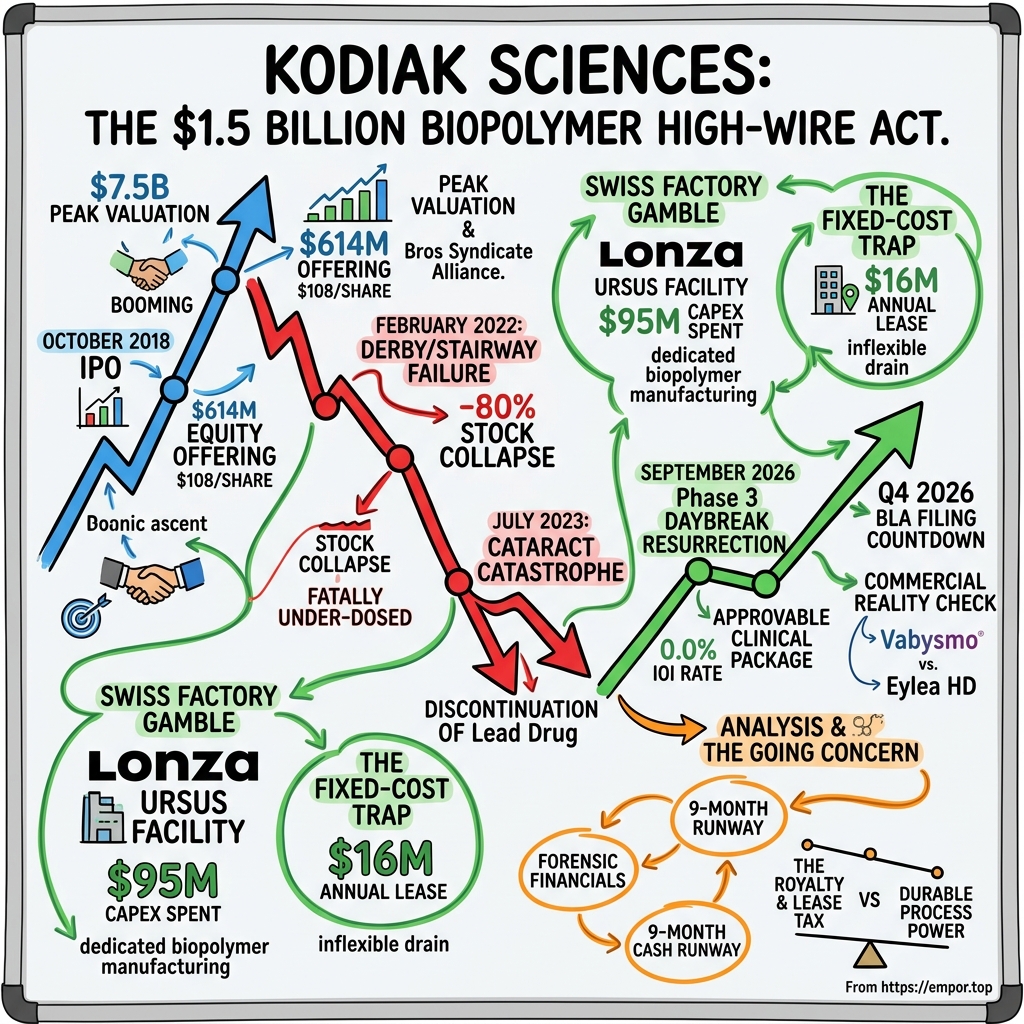
Kodiak Sciences: The $1.5 Billion Biopolymer High-Wire Act
The Central Questions of the Story
- The Durability Gamble: Can Kodiak's antibody biopolymer conjugate, now branded Zenkuda, overcome a four-year clinical detour and the memory of failed pivotal trials, then win prescriptions from blockbusters such as Eylea HD and Vabysmo?
- The Ursus Anchor: Is the dedicated Lonza manufacturing suite in Visp, Switzerland a cornered resource or a fixed-cost weight on a company with no revenue?
- The Runway and the Royalty: How will Kodiak handle a cash runway of roughly three quarters, a going-concern warning, and a 4.5% top-line royalty owed to its largest shareholder without crushing what is left for common equity?
I. Introduction & Episode Roadmap (00:00 – 00:12)
In late November 2020, while most of the world was still learning the vocabulary of lockdowns, a Palo Alto biotech with no approved drugs and no revenue sold just under six million new shares at $108 apiece and walked away with $614.3 million in net proceeds10. The buyers were not paying for sales. Kodiak Sciences had never booked a dollar of product or collaboration revenue, and it still has not13. They were paying for an idea: that a cleverly engineered molecule could let an 80-year-old with wet macular degeneration get an injection in the eye twice a year instead of every month or two.
At the top of that wave, the market valued Kodiak at more than $7.5 billion1. Within roughly three years, the stock fell below $3 and the company was worth less than the cash on its balance sheet1. Then, on September 28, 2026, Kodiak announced that Zenkuda had met its primary endpoint in a Phase 3 trial called DAYBREAK, with more than half of patients going six months between injections4.
So this is a story about a single piece of chemistry that took investors all the way up, all the way down, and part of the way back. It is also a story about money. From 2016 through 2025, Kodiak lost about $1.53 billion, and by the end of 2025 its accumulated deficit stood at about $1.56 billion1. That is the "$1.5 billion" in the title: the price, so far, of finding out whether the idea works.
The Hook: A Gold Mine Guarded by a Needle
Drugs injected into the eye to block VEGF, a protein that drives leaky blood vessel growth, are among the most lucrative products the pharmaceutical industry has ever made. In 2023, Regeneron's Eylea franchise alone produced about $5.8 billion of US net sales, and Roche's newer Vabysmo crossed $2.6 billion globally1. But the friction in this market is human, not commercial. Every dose means a needle through the white of the eye, a trip to a specialist, and often a family member taking the day off to drive. The best drug in the world does nothing for a patient who stops showing up.
The Promise of the ABC Platform
Dr. Victor Perlroth, a physician turned biotech investor, founded Kodiak in 2009 around an engineering answer to that human problem16. His team built what it calls an Antibody Biopolymer Conjugate, or ABC: an anti-VEGF antibody chemically bolted to a very large, branched, water-loving polymer. The analogy is a sea anchor. A small boat drifts away quickly in a current; tie it to a big drag chute and it stays put far longer. The polymer was meant to keep the drug inside the gel of the eye for months instead of weeks.
The Episode Arc
The story runs in six movements. First, the origins and the biopolymer insight. Second, the manic ascent: the Baker Bros. syndicate, the 2018 IPO and the pandemic fundraising boom. Third, the twin collapses of February 2022 and July 2023. Fourth, the Swiss factory, built while the drug was failing. Fifth, the 2026 resurrection and the countdown to a fourth-quarter Biologics License Application. Finally, the analysis: competitive power, management credibility, and the algebra that separates the bull case from the bear case.
The verdict up front is simple. Kodiak is single-platform biotech risk in its purest form. It built commercial-scale infrastructure before it had clinical proof, it nearly died when the proof failed to arrive, and it has now produced data that at least gives it a credible shot at approval. Whether that shot turns into a business depends on a market that changed a great deal while Kodiak was away. To see why the prize was worth all this, it helps to start inside a retina clinic.
 Subscribe on LinkedIn
II. The Intravitreal Gold Mine: Why Big Pharma Loves the Eye (00:12 – 00:25)
Picture a retina clinic waiting room on a weekday morning in the mid-2010s. Most of the chairs are filled by people in their late seventies and eighties. Some carry large-print appointment cards; many hold the arm of an adult child. They are here for the same reason they were here last month: a shot of anti-VEGF medicine into the eye. The procedure takes minutes. The anxiety, the numbing drops, the iodine sting and the blurred drive home take most of the day. Miss enough of these visits and the central vision that lets someone read a menu or recognize a grandchild's face can be lost for good.
The Biology, in Plain English
Wet age-related macular degeneration, diabetic macular edema and retinal vein occlusion share a common villain. In each disease, the eye overproduces VEGF, a signaling protein that tells the body to grow new blood vessels. In the retina, those new vessels are fragile and leaky, like cheap garden hoses laid under a carpet. Fluid and blood seep into the layers that hold light-sensing cells, and those cells die. Anti-VEGF drugs mop up the excess signal, which stops the leaking. The problem is that the mop wears out. The eye clears the drug, VEGF comes back, and the leak returns.
Buy-and-Bill: Why the Economics Are So Good
In the United States, these drugs travel an unusual commercial route. Retina specialists buy vials up front, inject them in the office and bill Medicare Part B or a commercial insurer afterward, typically at the drug's average sales price plus a markup1. This "buy-and-bill" system turns the physician into both a prescriber and a purchaser. It rewards products that doctors trust and that insurers reimburse reliably, and it punishes anything that adds clinical risk, because a bad outcome lands on the doctor who chose and bought the vial.
For a drug developer, the attraction is that every injection is a sale. The catch, for a newcomer, is that a doctor who has done thousands of uneventful Eylea injections needs a very good reason to change.
The Durability Wall
The first generation of these drugs, Genentech's ranibizumab and Regeneron's 2mg aflibercept, generally needed dosing every four to eight weeks1. That rhythm worked well in trials, where nurses chase every patient. It worked far less well in real life, where older patients miss appointments, lose rides and drop out. The industry's holy grail became durability: the same vision gains with fewer needles. Whoever could stretch the interval furthest without losing efficacy would capture both the patients and the doctors' gratitude.
Kodiak's Engineering Thesis
Most rivals attacked durability by changing the drug's dose or its target. Others chased implants, slow-release pellets or gene therapy, each of which brought its own surgical or safety baggage. Kodiak's bet was different. It kept a familiar mechanism, VEGF blockade, and changed the chassis. The polymer it chose, built from phosphorylcholine, mimics a component of cell membranes, so the body should treat it as unremarkable rather than as a foreign invader. The resulting conjugate is soluble and optically clear, which matters when the drug sits in the path of light on its way to the retina.
The elegance was that, if it worked, Kodiak would offer doctors a drug that behaved like the ones they knew, just for much longer. The risk was that the chassis was entirely new to the eye, and nobody knew what a large polymer would do over years of repeated injections. Investors needed a capital structure willing to wait for that answer, and Kodiak found one in a pair of brothers in New York.
III. The Architect and the Syndicate: Baker Bros Backs the Biopolymer (00:25 – 00:38)
On December 1, 2019, with early-stage data suggesting that tarcocimab tedromer, then known as KSI-301, could hold patients for four to six months, Kodiak signed a Funding Agreement with Baker Bros. Advisors111. Baker Bros. is one of the most concentrated and patient life-sciences investors in the market, and one of its founders, Felix J. Baker, sits on Kodiak's board6. The deal was not a typical stock purchase. It was a bet on future sales of a drug that had not yet started a pivotal trial.
The Founder
Victor Perlroth trained as a physician before moving into venture investing and company building, and he has run Kodiak since its founding as a Delaware limited liability company in June 2009; it converted into a corporation in September 201516. His style, visible across a decade of filings and presentations, is that of a builder who thinks in platforms rather than single products: one chassis, many cargoes, many diseases. That ambition shaped every major decision that follows, for better and for worse.
The 2018 IPO
Kodiak went public on October 5, 2018, selling 9 million shares at $10 for about $78.5 million in net proceeds and a market value of roughly $370 million91. It was a modest debut. The step change came only once clinical data began circulating. By December 2019, Kodiak could sell 6.9 million shares at $46, raising about $297.8 million net1. In just over a year, the market had put a value of roughly five times the IPO price on the same pre-revenue company.
The Baker Bros. Architecture
The royalty deal's mechanics deserve a close look because they still bind the company today111:
- Baker Bros. committed up to $225 million in exchange for a 4.5% royalty on future worldwide net sales of tarcocimab. Kodiak drew the first $100 million on February 4, 2020, and in July 2021 the parties amended the deal so the remaining $125 million would never be funded.
- Payments stop once Baker Bros. has received 4.5 times what it funded, or $450 million.
- Kodiak can buy the royalty back at any time for $450 million, less whatever it has already paid.
The accounting tells the more interesting story. Because Baker Bros. is a major shareholder with a board seat, Kodiak books the $100 million as a long-term liability, not as revenue or equity1. No interest has been accreted on it so far, because the company has not judged commercial sales probable and estimable2. In plain terms, Kodiak's largest shareholder also holds a senior claim on the first dollar of every Zenkuda sale. A 4.5% cut of revenue does not sound like much until one remembers it comes off the top line, before any of the launch costs that will dominate the early years.
Why take such a deal? In 2019 and 2020 it let Kodiak keep 100% of worldwide rights instead of handing half of the drug to a big pharmaceutical partner. That independence was the whole point of the strategy, and it was paid for partly with a future revenue stream.
Historical Falsification: Governance
The claim that Kodiak runs with strong, independent governance is worth testing against the company's own record.
The evidence points the other way. Dr. Perlroth serves as both Chairman and CEO, and the company has no designated lead independent director6. At the end of March 2026, Baker Bros. owned about 32.2% of the stock, and all directors and officers together controlled about 44.4%6. At the June 2, 2026 annual meeting, director Charles A. Bancroft received roughly 10.6 million withheld votes against 38.9 million in favor, a withhold rate above 21%7. That level of dissent is unusual for an uncontested board seat, yet say-on-pay passed with almost no opposition, which suggests the insider bloc carries the vote7.
Then there is the founder's own balance sheet. About 2.1 million of Dr. Perlroth's directly held shares, roughly 88% of them, are pledged as collateral for a personal credit facility6. Pledging is not wrongdoing, but it creates a specific risk: a sharp fall in the share price can force a sale that has nothing to do with the company's prospects, and it ties the CEO's personal finances closely to the stock in the short term.
The conclusion is that the record narrows the governance claim to a smaller, honest version. Kodiak is an insider-controlled company with aligned but concentrated owners. That arrangement kept it alive through two collapses, as later sections show, but it also means outside shareholders have little leverage if management makes a bad call. The next test of that structure came with the largest pile of money Kodiak ever raised.
IV. Manic Expansion: The $7.5 Billion Paper Empire (00:38 – 00:50)
Autumn 2020 was a strange season for biotech. Interest rates were near zero, generalist funds were pouring money into anything with a credible molecule, and investment banks were working through the night. In November, Kodiak priced 5,966,436 shares at $108 and raised about $614.3 million net in a single offering101. Together with what remained from the 2019 raise and the Baker Bros. royalty cash, the company now had a war chest that many commercial-stage drug makers would envy.
Five Pivotal Trials at Once
What Kodiak did with the money defines the rest of this story. A conventional developer runs one large confirmatory trial, reads it out, then expands. Kodiak ran its program in parallel across several of the most valuable indications in ophthalmology at the same time114:
- Wet age-related macular degeneration: DERBY and STAIRWAY.
- Diabetic macular edema: GLEAM and GLIMMER.
- Retinal vein occlusion: BEACON.
- Non-proliferative diabetic retinopathy: GLOW.
The logic was speed. If the molecule worked, Kodiak would arrive at the FDA with a broad label and leapfrog rivals still running one indication at a time. The flaw was correlation. Every trial tested the same molecule, from the same manufacturing process, often with similar dosing assumptions. If something was wrong with the drug or the regimen, it would show up everywhere at once. Kodiak had not diversified its risk; it had replicated it.
The spending followed the ambition. Research and development rose from about $38 million in 2019 to a peak of about $268 million in 2022, while net losses peaked at roughly $334 million the same year1. Headcount roughly tripled from 31 employees in 2019 to more than 110 by 20221.
The "Zero-to-One" Capex Bet: Lonza Ursus
The second big decision was about manufacturing. Making an antibody is a solved problem. Making an antibody, a very large custom polymer, and then reliably fusing them together at commercial scale is not. Management concluded that contract manufacturers would not have the capacity or the know-how for a global launch, so Kodiak partnered with Lonza, the Swiss contract manufacturer, to build a dedicated suite known as Ursus in Visp1.
Capital spending, which had been well under $1 million a year through 2019, jumped to about $17 million in 2021, $37 million in 2022 and $41 million in 2023, about $95 million in total over three years1. In effect, Kodiak was building a factory for a drug whose pivotal trials had not yet read out.
The Bull Thesis at the Top
At the peak, the bull case wrote itself: a twice-yearly anti-VEGF drug in a market worth well over $10 billion a year, a platform that could carry other cargoes into other diseases, and a balance sheet large enough to launch alone. The valuation, above $7.5 billion, priced in something close to success across most of those trials1.
The verdict on this period is double-edged. Raising at the top of the market was a genuinely good decision; later sections show it kept the company alive. Spending that money on un-staggered trials and a factory before proof was the opposite of risk management. The bill arrived on a winter morning in 2022.
V. The Implosion: DERBY, STAIRWAY, and the Cataract Catastrophe (00:50 – 01:05)
On February 23, 2022, Kodiak published the topline results of DERBY and STAIRWAY, the trials meant to prove that tarcocimab could match monthly-style aflibercept in wet AMD while dosing far less often12. It could not. Tarcocimab failed to show non-inferior vision gains against aflibercept 2mg12. Over the following months the share price collapsed, and by 2023 the company that had been worth more than $7.5 billion traded below $3 a share, a market value of roughly $100 million to $150 million1.
Anatomy of the Failure
The core problem, as later redesigns made clear, was the regimen rather than simply the molecule. Kodiak tried to prove durability and efficacy at the same time, pushing patients out to long intervals early, before the disease had been brought fully under control124. Think of a wildfire. The standard approach is to put it out thoroughly first and only then move to occasional patrols. DERBY started patrolling while the embers were still hot, and in too many patients the fire came back.
On the February 2022 call, analysts pushed management on whether the biopolymer itself might be limiting how well the drug reached the retina. Management's answer was that the problem lay in trial design and regimen, not in the molecule12. That was a claim, not yet a fact. It would take four more years and a new trial to test it.
The July 2023 Blow: GLEAM and GLIMMER
Then came diabetic macular edema. In July 2023, Kodiak reported that GLEAM and GLIMMER, its twin Phase 3 trials in DME, had not met their goals, and announced it would discontinue development of tarcocimab in that program13. The DME readouts also surfaced a safety issue: a higher rate of cataracts and inflammation in the front of the eye than doctors would accept for a chronic, repeatedly injected drug134. A molecule designed to stay in the eye a long time had produced side effects that also stayed.
Not everything failed. BEACON, in retinal vein occlusion, met its primary endpoint13. But a drug that works in one smaller indication while failing in the two largest is not a franchise, and the market treated it accordingly. In August 2023, Dr. Jason S. Ehrlich, the chief medical and development officer, left the company; Dr. J. Pablo Velazquez-Martin succeeded him6.
Historical Falsification: "The Platform Is De-Risked"
At the peak, the claim implicit in the valuation and the factory build was that the ABC platform had been effectively de-risked by early data. The record rejects that claim in the form it was made.
From 2020 through 2023, Kodiak spent roughly $800 million on research and development, most of it on trial designs that failed their primary tests or exposed a safety signal1. Management then cut deeply. R&D fell from about $268 million in 2022 to about $126 million in 2024, and net losses fell to about $176 million1. The company liquidated its marketable securities, letting $340 million mature during 2023, and moved everything into money market funds1. These were the actions of a company preparing for a long wait, not a launch.
What the record does not reject is the narrower claim that the polymer extends the drug's life in the eye. Even the failed trials showed long intervals in many patients; the trouble was efficacy at those intervals and safety in DME. That distinction, between "durable" and "durable enough to win," is the hinge on which the rest of the story turns.
What the Calls Revealed
The tone shift between the two crises is telling. In February 2022, management defended the molecule and blamed the regimen. By July 2023, the language had moved to containment: preserving cash, reviewing the portfolio and narrowing focus1314. Neither stance included much accounting for why five trials had been launched in parallel with shared assumptions. That silence matters because the same leadership is now asking investors to trust a second attempt. And while all of this was happening, a factory was being finished in the Swiss Alps.
VI. The Swiss White Elephant: Lonza Ursus and the Fixed-Cost Trap (01:05 – 01:18)
Visp is a small industrial town in the Upper Rhône valley, ringed by mountains and dominated by Lonza's sprawling chemical and biologics campus. On January 31, 2023, Kodiak's Ursus suite there was commissioned as a cGMP facility, and about $81.7 million of equipment and leasehold improvements went into service1. Less than six months later, the company announced the GLEAM and GLIMMER results and stopped development of the very drug the suite had been built to make13.
It is hard to think of a cleaner illustration of timing risk. The plant's reactors were ready. The product was not.
Single-Source Dependency
Kodiak does not own its own commercial manufacturing plant in the United States. Its conjugate manufacturing runs through Lonza at Ursus, managed via its Swiss subsidiary, Kodiak Sciences GmbH1. Manufacturing purchases under third-party agreements were about $60 million in 2023, $26 million in 2024 and $35 million in 20251. At the end of 2025, Kodiak still owed about $23.9 million in minimum commitments subject to cancellation fees, plus potential clinical and commercial supply obligations of roughly 86.5 million Swiss francs1.
One plant, one partner, one process. If a batch fails, or the suite goes down, there is no second source waiting in the wings. For a company with a single lead product, that is an operational risk that sits directly on top of the commercial risk.
The Accounting Reality of the Lease Drag
The Ursus arrangement and the Palo Alto headquarters show up on the balance sheet as operating leases. At June 30, 2026, Kodiak carried about $52.8 million of lease liabilities on a present-value basis2. On an undiscounted basis, the year-end 2025 schedule ran to about $73.3 million through the early 2030s1. Cash lease payments have run at roughly $16 million a year, about $15.8 million in 2024 and $16.1 million in 20251.
Depreciation, mostly from the Ursus equipment, runs at about $18 million a year1. In 2025 the company also recorded a $1.9 million lease impairment1. None of this changes whether the drug works. It changes how much a slow launch would hurt.
Currency Risk
Kodiak reports in US dollars and keeps its reserves in dollar money market funds, but a large share of its manufacturing spending is in Swiss francs1. It has used forward contracts before, but had none outstanding at the end of 2024, 2025 or mid-202612. Currency losses were small, about $1 million in 20251. The real exposure is the franc-denominated supply commitments: if the franc keeps strengthening against the dollar, every vial costs more in the currency in which Kodiak keeps its cash.
Operating Leverage, Both Ways
Here is the plain economics. A dedicated plant is a fixed cost. When volumes are high, fixed costs are spread across many doses and the cost per vial falls, which is the bull case for Ursus. When volumes are low, the same fixed costs land on a handful of doses and crush gross margins, which is the bear case. Right now Ursus is producing clinical and validation material for a company with no revenue, so it is all cost and no leverage.
The verdict is that Ursus is a real asset with a real price. It gives Kodiak control over a hard-to-make product, which matters if launch demand materializes. It also ensures that every quarter of delay costs money. The question of whether it was a white elephant or a far-sighted bet was always going to be settled in the clinic, and in 2026 the clinic finally produced an answer.
VII. The Resurrection: DAYBREAK and the BLA Re-Assembly (01:18 – 01:32)
On September 28, 2026, Kodiak filed a press release with the headline it had waited four and a half years to write: Zenkuda and tabirafusp-ted met their primary endpoints in the pivotal DAYBREAK trial in wet AMD45. Zenkuda, the commercial name for tarcocimab tedromer, met the primary visual acuity endpoint with a p-value of 0.00074. About 54% of patients were maintained on six-month dosing under strict "treat-to-dry" criteria4. The intraocular inflammation rate was 0.0%, and the cataract rate was 0.5%4.
The molecule that had been declared finished in 2023 was back.
Fixing the Flaws
Two changes made the difference, according to the company's own description of the program41:
- Regimen. Patients received monthly loading doses at the start, and their intervals were extended only once imaging showed the retina was dry. Put out the fire first, then patrol. This is exactly the step DERBY had skimped on.
- Formulation and process. Kodiak tightened manufacturing and release specifications at Ursus to address impurities associated with the earlier safety findings14. The low cataract and inflammation rates in DAYBREAK are the first large-scale evidence that this worked.
Spending ramped back up to fund the new program. R&D rose to about $182 million in 2025, and to about $105 million in the first half of 2026, up about 21% year on year12.
The Pivotal Package
Kodiak now says it has five positive Phase 3 trials supporting Zenkuda: DAYBREAK and DAYLIGHT in wet AMD, GLOW and GLOW2 in diabetic retinopathy, and BEACON in retinal vein occlusion41. It plans to submit a Biologics License Application in the fourth quarter of 20264. The second drug in DAYBREAK, tabirafusp-ted (KSI-501), a bispecific that blocks both VEGF and IL-6, also met its primary endpoint, which gives the platform a second validated product4.
Certification Is Not Commercialization
Here the analysis has to slow down. A positive Phase 3 trial is an approvability signal, not a sales forecast, and Kodiak's own history is a reminder of that gap. Its earlier positive readout in BEACON in 2023 produced no revenue at all, because the company could not build a franchise on one smaller indication13. The market Zenkuda will enter in 2027 also differs sharply from the one it was designed for in 2019:
- Roche's Vabysmo, which blocks both Ang-2 and VEGF-A, was already generating more than $2.6 billion a year by 2023, with dosing up to every 16 weeks and Roche's large sales force behind it1.
- Regeneron's Eylea HD, high-dose aflibercept, has taken a large share of the existing Eylea base with longer intervals than the original 2mg product1.
- Aflibercept biosimilars are entering the US market, pushing down prices and encouraging payers to require cheaper drugs first1.
The question that matters is how much better six months is than four in a real clinic. For a patient, two fewer injections a year is meaningful. For a retina practice, it means fewer billable injections, which cuts against a doctor's incentive in a buy-and-bill world. For a payer, it depends on price. DAYBREAK proved that Zenkuda can work. It did not prove that doctors will switch, and that is the next test. Before any of that, though, Kodiak has to pay its bills.
VIII. Forensic Financials: Profit into Cash, Pay, and the Going Concern (01:32 – 01:45)
On March 31, 2026, PricewaterhouseCoopers signed its audit report on Kodiak's 2025 financial statements1. The opinion was clean, but it carried an explanatory paragraph that every biotech investor learns to look for: substantial doubt about the company's ability to continue as a going concern, because of recurring losses and negative operating cash flow since inception1. The same warning appeared again in the June 2026 quarterly filing2. Six months before its most important trial readout, Kodiak's auditor was saying, in formal language, that the company did not have enough money to finish the job on its own.
Where Did $1.5 Billion Go?
Start with the big picture. From 2016 through 2025, Kodiak recorded about $1.53 billion of net losses but burned only about $982 million of operating cash1. The gap of roughly $553 million is not a hidden profit. About three quarters of it is stock-based compensation, which totalled about $415 million over the decade; most of the rest is depreciation and lease amortization on the Ursus plant1.
That matters for two reasons. First, the cash burn is real but smaller than the headline losses. Second, the stock compensation is also real: it is paid in shares, not dollars, which means existing holders bore that cost through dilution instead of through the cash balance. Stock compensation peaked at about $106 million in 2022, the same year the pivotal trials failed1.
Working Capital: Nothing to Collect
Kodiak has no customers, so it has no receivables. Its only current assets beyond cash are about $5.5 million of prepaid expenses, made up of advance payments to clinical sites and contract research organizations, prepaid insurance and Swiss VAT refunds21. There are no collection risks here, because there is nothing to collect yet.
Pay Against Results
In 2025, Dr. Perlroth's total compensation was about $2.5 million, including a base salary that rose to roughly $810,000 in July 2025, about $923,000 in option awards and about $773,000 in cash bonus6. Chief Financial Officer John A. Borgeson received about $1.6 million6. Named executives earned 150% of their target bonuses in 2025, based on operational milestones, in a year when the company lost about $230 million61.
The fair defense is that a pre-revenue biotech cannot pay on profits, so it pays on milestones such as trial enrollment and data. The fair criticism is that a 150% payout is a maximum-style result in a year that ended with a going-concern warning. Given that say-on-pay passed easily on the insider bloc's votes, outside shareholders effectively had no say7.
What the Auditor Watched
PwC's single critical audit matter was research and development expense: specifically, the judgment involved in estimating accrued costs across global contract research and manufacturing vendors, on about $182 million of 2025 R&D spending1. That is a standard area of focus for a clinical-stage biotech. Management reported effective internal controls and no material weaknesses, and there are no pending material lawsuits1.
The Runway Math
Now the arithmetic that frames everything. At June 30, 2026, Kodiak had about $125.9 million in cash and equivalents, plus about $6.2 million of restricted cash securing its Palo Alto leases2. In the first half of 2026, it burned about $86 million in operating cash, or about $43 million a quarter2.
Divide the first number by the second and the answer is just under three quarters. Without new money, the cash would run out around the first quarter of 2027, well before an FDA decision on a BLA filed in late 2026 could arrive2. The December 2025 equity raise, 8 million shares at $23 for about $172.7 million net, bought time but did not end the problem81. The share count has risen from about 52.7 million at the end of 2024 to about 62.8 million by mid-202612.
The conclusion is not a forecast; it is arithmetic. Kodiak must raise capital or sign a partnership with upfront cash before the end of 2026 or early 2027. The only open questions are on what terms and at whose expense, which brings the story to the investment committee room.
IX. Analysis & Bear vs. Bull Case (01:45 – 02:00)
Imagine an investment committee in early October 2026. On the screen: a positive Phase 3 trial, a BLA due within weeks, about three quarters of cash, and a near-certain financing ahead. The question on the table is not whether DAYBREAK was good news. It was. The question is whether Kodiak has a durable advantage strong enough to turn good data into a profitable business, and how much of that future belongs to the shareholders who buy in now.
Hamilton Helmer's 7 Powers
- Process Power (moderate). Making an antibody-polymer conjugate reliably at scale is hard, and Kodiak spent years and hundreds of millions learning how, including tightening its process after the 2023 safety problems14. That know-how, embedded with Lonza at Ursus, is not easy to copy quickly. But it is shared with a contract manufacturer, which limits how exclusive it truly is.
- Cornered Resource (moderate). Patents on the conjugate platform and on Zenkuda provide exclusivity, which the company expects to run well into the next decade1. Patents protect the molecule, not the market: they do not stop Roche or Regeneron from offering longer-acting drugs of their own.
- Scale Economies (latent). Ursus could make each vial cheap at high volume. Today it produces losses, not leverage.
- Switching Costs (very low). A retina specialist can move a patient from Eylea HD to Vabysmo to Zenkuda at the next visit. There is no lock-in.
- Network Effects and Branding (none, or negative). Doctors remember the 2022 and 2023 failures. Kodiak will have to rebuild trust visit by visit.
The 7 Powers verdict is that Kodiak has a technical edge, not yet a commercial moat. Its powers sit in making the drug, not in selling it.
Porter's Five Forces
- Threat of new entrants (high). Gene therapies and long-acting implants and inserts from companies such as 4D Molecular Therapeutics, EyePoint Pharmaceuticals and Ocular Therapeutix aim at durability of a year or more1. If they succeed, six months stops being the frontier.
- Buyer power (high). Retina practices, group purchasing organizations, specialty distributors and payers all sit between Kodiak and the patient. Payers can require a cheaper drug first, and biosimilars make that easier.
- Supplier power (very high). One manufacturing partner, one dedicated suite, and franc-denominated commitments1.
- Threat of substitutes (high). Off-label bevacizumab, biosimilar aflibercept and the established branded drugs are all proven alternatives.
- Rivalry (fierce). Kodiak faces Regeneron and Roche, two of the deepest-pocketed and most experienced commercial organizations in ophthalmology.
The structural picture is a hard one for a single-product independent. Good science enters a market where nearly every force pushes margins down.
The Skeptic's Case
- The dilution squeeze. With less than a year of cash, Kodiak must raise money before approval. Even after a strong readout, a large offering dilutes holders, and the insider bloc's control means outside holders have little say in the terms26.
- Commercial failure. Doctors satisfied with Vabysmo and Eylea HD may see two fewer injections a year as a modest gain, especially from a company with a history of trial failures and a buy-and-bill model that rewards injection volume.
- The royalty and lease tax. A 4.5% top-line royalty and about $16 million a year in lease payments, plus heavy depreciation, mean early revenue is taxed before it reaches operating profit1.
- Governance. Combined chair and CEO, a pledged founder stake, generous bonuses in loss years and significant director dissent are the kind of facts an activist would put in a letter67.
The Contrarian Case
- Real durability. More than half of wet AMD patients going six months between injections, with a clean safety profile in DAYBREAK, is a meaningful clinical result4.
- A broad label. Five positive Phase 3s could support a launch across wet AMD, diabetic retinopathy and retinal vein occlusion at once41. Diabetic retinopathy, in particular, is a large population where frequent injections have been a barrier to treatment.
- Partnership optionality. Positive data make ex-US licensing far more plausible, and an upfront payment could reduce the need for equity. Management has not announced any such deal.
- A second wave. Tabirafusp-ted's DAYBREAK result, plus later programs such as KSI-101 in inflammatory eye disease, give the platform more than one shot41.
Weighing It
The history narrows the bull case without rejecting it. It shows that the chassis can deliver durability and, with a better regimen and cleaner process, efficacy and safety. It also shows that Kodiak's past technical milestones, including the BEACON success, did not convert into revenue, and that management's capital decisions, though bold, came at a high cost to shareholders. The claim that survives is a modest one: Kodiak now has an approvable drug with a real durability edge, entering a crowded market with a weak balance sheet.
Three KPIs to Watch
- Cash runway. The latest reading is about $126 million of cash against about $43 million of quarterly operating burn, and the burn has been rising with Phase 3 and pre-launch work2.
- BLA acceptance and label. The BLA is planned for the fourth quarter of 20264. FDA acceptance without a refusal-to-file letter, and later whether the label supports six-month dosing, are the binary events to watch.
- The financing structure. Whether the next dollar comes from a partner's upfront payment or from discounted equity will decide how much of any success belongs to today's shareholders.
The analysis comes down to a few lessons about building a company like this, and they apply well beyond Kodiak.
X. Playbook: Business & Investing Lessons (02:00 – 02:15)
Lesson 1: Don't Build the Cathedral Before Confirming the Faith
The moment: about $95 million of capital spending between 2021 and 2023 on a dedicated Swiss suite, commissioned at the end of January 2023, for a drug whose DME program was halted that July113. The pivotal results were still pending when the steel went in.
The takeaway: building a factory before proof turns a scientific risk into a financial one. When the trials failed, Kodiak did not just lose time; it kept paying for a plant it could not use. The line to remember: a factory built before proof is a promise that charges rent.
Lesson 2: Raise Capital When You Can, Not When You Need It
The moment: the $614 million raise at $108 a share in November 2020, at peak biotech optimism10.
The takeaway: that cash is the only reason Kodiak was still standing for DAYBREAK. Without it, the 2022 and 2023 failures would likely have meant a fire sale or worse. The same company that misjudged its trial strategy made exactly the right call on timing its raise. The line to remember: dilution at the top is the cheapest insurance a biotech will ever buy.
Lesson 3: Dosing Regimens Can Kill Good Molecules
The moment: DERBY in February 2022, when an aggressive attempt to prove long intervals before the disease was controlled produced a failed trial, and DAYBREAK in 2026, when loading doses and treat-to-dry rules produced a success with essentially the same active ingredient124.
The takeaway: in drug development, trial design is part of the product. Overreaching for a marketing claim, here "longest interval," can turn a working drug into a failed trial and cost years. The line to remember: at Kodiak, the molecule did not die; the regimen did.
Lesson 4: Insider Syndicates Are Both Lifelines and Governance Traps
The moment: Baker Bros.' $100 million royalty in February 2020, from a holder that now owns about a third of the company and sits on its board, with a claim of up to $450 million on future sales16.
The takeaway: concentrated, patient insiders kept Kodiak funded and stable when public investors fled. The same concentration means management is rarely challenged on pay, board composition or capital allocation. The line to remember: the owner who saves you also gets to grade you.
XI. Epilogue (02:15 – 02:25)
Where Kodiak Stands Tonight
In early October 2026, Kodiak is in an unusual position: it has its best clinical news in years and one of its tightest balance sheets. The DAYBREAK result has lifted the company out of the pricing range of a failed biotech, and the September readout gives it something to sell to partners and investors4. But at mid-year it had about $126 million in cash and was burning about $43 million a quarter2. The company cannot reach an FDA decision on its current resources.
The Next Decisive Moments
- The BLA. Kodiak plans to file in the fourth quarter of 2026 across wet AMD, diabetic retinopathy and retinal vein occlusion4. A clean acceptance would turn "approvable" into a scheduled decision. A refusal to file, or a narrow label, would reopen every old doubt about this program.
- The financing. Either a partner pays for regional rights, or public investors fund the gap. A partnership would answer the going-concern question with less dilution. A large discounted offering would answer it at existing shareholders' expense. The choice will also show how much leverage Kodiak really has with big pharmaceutical companies.
- Commercial readiness. Locking down commercial supply from Ursus, setting a price against Eylea HD, Vabysmo and biosimilars, and building or renting a sales force are each large decisions that the current cash balance cannot support on its own.
The Ultimate Tension
All three central questions meet here. The durability gamble paid off in the trial, but the market it is entering got tougher. The Swiss suite may turn out to be an advantage, but only if volumes arrive before the cash runs out. And the Baker Bros. royalty and insider control mean that even a successful launch will be shared out in ways common shareholders do not decide. The open question is whether Kodiak launches Zenkuda as an independent company, or whether this story ends the way so many single-product biotech stories do: with a larger company buying the drug, the plant and the platform at a price set by Kodiak's need for cash.
XII. Outro (02:25 – 02:30)
Go back to Visp on that last day of January 2023. The Ursus suite was commissioned and the cleanrooms were ready, with stainless steel waiting for a product that, within six months, the company itself would stop developing in diabetic macular edema113. For three years, that suite looked like a monument to premature confidence.
Today the same reactors stand ready to make the same molecule, rescued by a better regimen and a cleaner process. That is what makes Kodiak unlike almost any other company in its industry. It made nearly every classic mistake of premature scale, survived only because it raised money at exactly the right moment, and then showed that in drug development, a dead molecule is sometimes just an under-dosed one. Whether that resurrection becomes a business will be decided not in the lab, but in retina clinics and in the terms of a financing round that is now only months away.
References
-
Form 10-K for Fiscal Year Ended December 31, 2025 — Kodiak Sciences Inc., 2026-03-31 ↩↩↩↩↩↩↩↩↩↩↩↩↩↩↩↩↩↩↩↩↩↩↩↩↩↩↩↩↩↩↩↩↩↩↩↩↩↩↩↩↩↩↩↩↩↩↩↩↩↩↩↩↩↩↩↩↩↩↩↩↩↩↩↩
-
Form 10-Q for Quarterly Period Ended June 30, 2026 — Kodiak Sciences Inc., 2026-08-13 ↩↩↩↩↩↩↩↩↩↩↩↩↩
-
SEC EDGAR XBRL Company Facts for CIK 0001468748 — SEC, 2026-10-03 ↩
-
Form 8-K Exhibit 99.1 Press Release: DAYBREAK Phase 3 Results — Kodiak Sciences Inc., 2026-09-28 ↩↩↩↩↩↩↩↩↩↩↩↩↩↩↩↩↩↩↩↩
-
Form 8-K: Zenkuda and Tabirafusp-ted Meet Primary Endpoints in Pivotal DAYBREAK Trial — Kodiak Sciences Inc., 2026-09-28 ↩
-
Definitive Proxy Statement on Schedule 14A — Kodiak Sciences Inc., 2026-04-22 ↩↩↩↩↩↩↩↩↩↩↩↩↩
-
Form 8-K: Voting Results of 2026 Annual Meeting of Stockholders — Kodiak Sciences Inc., 2026-06-04 ↩↩↩↩
-
Form 8-K: Underwriting Agreement for $172.66M Public Offering — Kodiak Sciences Inc., 2025-12-18 ↩
-
Form 424B4 Prospectus for Initial Public Offering — Kodiak Sciences Inc., 2018-10-05 ↩
-
Form 424B4 Prospectus for Follow-On Public Offering Raising $614.3M — Kodiak Sciences Inc., 2020-11-20 ↩↩↩
-
Form 8-K: Royalty Funding Agreement with Baker Bros. Advisors — Kodiak Sciences Inc., 2019-12-02 ↩↩
-
Form 8-K: Phase 2b/3 DERBY and STAIRWAY Topline Results — Kodiak Sciences Inc., 2022-02-23 ↩↩↩↩↩
-
Form 8-K: Discontinuation of Tarcocimab Development Following Phase 3 GLEAM/GLIMMER Trials — Kodiak Sciences Inc., 2023-07-24 ↩↩↩↩↩↩↩↩
-
Form 10-K for Fiscal Year Ended December 31, 2023 — Kodiak Sciences Inc., 2024-03-28 ↩↩
 LinkedIn
 WhatsApp
 Reddit
 Hacker News
 Email
Email Kindle
 RSS Feed
 Spotify
 Apple Podcasts
 Amazon Music
 Audible
 YouTube