MSA Safety: The Company That Keeps the World Safe
I. Introduction & Episode Roadmap
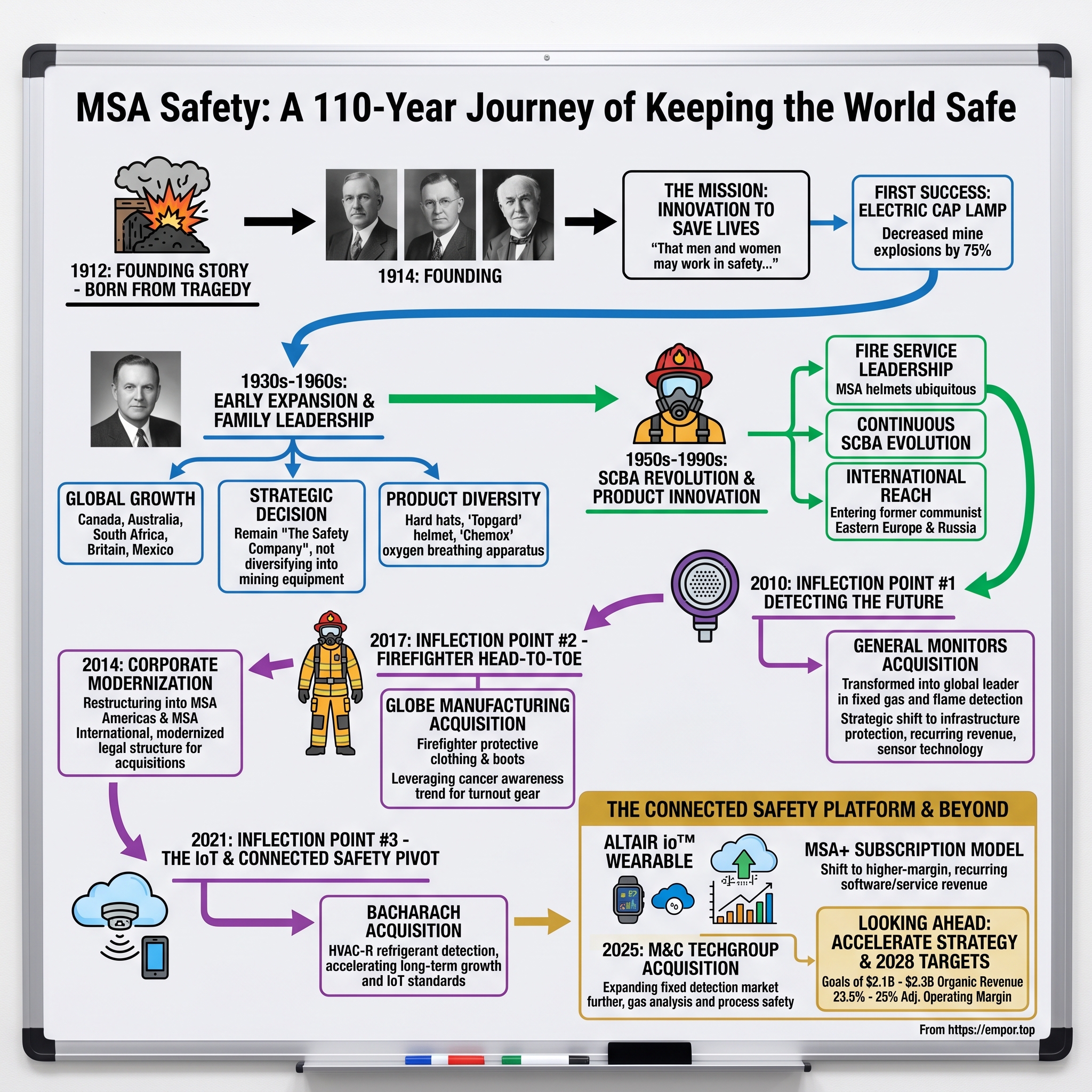
March 26, 1912. Just before 7:30 in the morning in the hills of West Virginia, ninety-one men descended into the Jed Mine to begin what should have been another ordinary day of extracting coal from the earth. Within seconds, everything changed. A single open flame—the very light source miners depended on to see—ignited pocket of accumulated methane gas. The Jed Mine exploded. In a flash, methane gas ignited and more than 80 miners lost their lives.
That disaster, one of hundreds that had plagued America's coal mines in the early twentieth century, planted a seed that would germinate into something extraordinary. A young mining engineer named John T. Ryan Sr., working for the U.S. Bureau of Mines, found himself forever changed. From this tragedy, mine engineer John T. Ryan Sr. had an epiphany: "If I could spend my life doing what I can to lessen the likelihood of the occurrence of such terrible disasters, I shall feel in the end that my life had been well spent."
From that conviction arose MSA Safety—a company that has spent 110 years transforming the way humans protect themselves in hazardous environments. Driven by its singular mission of safety, the Company has been at the forefront of safety innovation since 1914, protecting workers and facility infrastructure around the world across a broad range of diverse end markets while creating sustainable value for shareholders. Today, with 2024 revenues of $1.8 billion, MSA Safety is headquartered in Cranberry Township, Pennsylvania and employs a team of over 5,000 associates across its more than 40 international locations.
The central question this analysis seeks to answer: How did a company born from a coal mine tragedy become the global leader in safety technology? The answer involves multi-generational family leadership spanning three generations of Ryans, a strategic pivot from mining-centric equipment to broad industrial and fire service applications, a series of acquisitions that fundamentally reshaped the company's technological capabilities and market position, and most recently, a bold bet on connected safety and IoT technology that positions MSA for the next century of protecting workers.
The story of MSA Safety is ultimately a story of mission-driven capitalism at its best—a business model where profitability and purpose have remained intertwined for over a century, where the company's fundamental reason for existing has never wavered: "That men and women may work in safety and that they, their families, and their communities may live in health throughout the world."
 Subscribe on LinkedIn
II. The Founding Story: Born from Tragedy
The American coal mining industry in the early 1900s was an abattoir. Mine disasters—accidents in which five or more were killed—became shockingly common in the early 20th century. Between 1876 and 1900, there were 101 disasters, and that climbed to 305 between 1901 and 1925. In 1909, the year with the most coal mine disasters, there were 20 accidents. In 1910 there were 19, plus six disasters in other kinds of mines.
The Jed Mine disaster was not even the deadliest. That distinction belongs to the Monogah Coal mine disaster in 1907, which claimed 362 lives. But the Jed explosion proved to be a turning point—not because of the scale of death, but because of who witnessed it and what they chose to do about it.
The Jed disaster can be thought of as a kind of turning point because of what it inspired. John T. Ryan Sr., a mining engineer who worked for the U.S. Bureau of Mines, was shocked by the loss of life that day in 1912. Ryan and George H. Deike formed what was then called Mine Safety Appliances.
Ryan recruited colleague George H. Deike to help realize his vision for a new company. Recognizing the critical importance of dependable, safe mining equipment, they went straight to one of the country's great thinkers: Thomas Edison. The brilliant inventor helped Ryan and Deike create the electric cap lamp which, over the next 25 years, reduced mine explosions by an astounding 75 percent.
The collaboration with Edison was no mere endorsement deal. The problem that had killed tens of thousands of miners was fundamentally one of illumination. The first safety lamps, designed to offer some illumination that wouldn't ignite an explosion while also serving as a warning for the presence of methane, appeared about 100 years before the Edison cap lamp. English chemist Sir Humphry Davy found that wrapping a metal screen around a flame kept the heat low enough to not ignite flammable gasses. But safety lamps were even dimmer than other lighting methods available at the time and they couldn't be mounted on a cap.
What Edison, Ryan, and Deike created was revolutionary: a battery-powered headlamp that eliminated the open flame entirely. From day one, Mine Safety Appliances has been a leader in keeping workers safe. Its mission started with founders John Ryan and George Deike on June 14, 1914 when MSA set up a workplace in downtown Pittsburgh, Pa. Their first order of business was to enlist Thomas Edison to scale down his alkaline battery to power a flameless cap lamp.
The U.S. Bureau of Mines approved the lamp in 1915, and adoption was quick. It can be hard to grasp exactly how much this invention changed mining safety, but the effect was enormous. In fact, Edison, who has more U.S. patents—1,093—than anyone else, said the cap lamp might have been the invention of his that did the most for humanity.
Founded in response to a devastating mine explosion, the initial impetus was less about venture capital and more about addressing an urgent safety need, financed by the founders themselves.
This origin story established the cultural DNA that would persist through eleven decades: innovation driven not by profit-seeking but by the imperative to save lives. The company's founding mission statement remains unchanged: "That men and women may work in safety and that they, their families, and their communities may live in health throughout the world."
For investors, this founding story matters because it explains MSA's unusual corporate character—a publicly traded company that has never wavered from its purpose, even when diversification might have offered easier paths to growth. The mission isn't marketing—it's the company's operating system.
III. Early Expansion & Family Leadership (1914–1960s)
Mine Safety Appliances was founded in 1914 by the Deike Family in Pittsburgh, Pennsylvania, to provide helmets and other safety devices to the men who worked in the coal mines of Pennsylvania and beyond. The company remained quite small for nearly 20 years, and was built from nothing into a solid concern within a generation of the firm's first day of business. As with most company histories, however, it is the person who takes the initial product or business idea and develops it into a worldwide success story that deserves the focus of attention. The person at Mine Safety who fits this description is John T. Ryan, Jr.
The younger Ryan's path to leadership was anything but accidental. His father, John T. Ryan, attended the School of Mines at Pennsylvania State University. When he was old enough, John, Jr., was sent to the same school where he studied the same subjects. After he graduated in 1934 with a degree in mining engineering, John, Jr., saved his money and then applied to and was accepted in the M.B.A. program at Harvard University. After Ryan graduated from Harvard in 1936 with an M.B.A., he began to work as an employee at Mine Safety Appliances Company.
The timing proved fortuitous. The Great Depression had devastated most American businesses, but the imperative for worker safety remained constant—indeed, economic hardship only intensified the pressure to prevent costly accidents. Luckily, the Ryan family was not hard hit by the economic hardships of the Great Depression, which drove numerous individuals into bankruptcy, and signaled the collapse of what many people regarded as stable businesses.
As Ryan's leadership ability grew more evident to everyone associated with MSA, it was a foregone conclusion that when the position of president became available he would be the only man to fill the job. In 1953, Ryan was named president of the company, and continued his aggressive worldwide expansion program. The next destination on his travel itinerary included Mexico; by the mid-1950s MSA was operating a profitable enterprise just south of the Mexico-American border. With sales offices and manufacturing facilities established throughout North America, Ryan decided to use the remainder of the decade to consolidate the company's gains.
But Ryan Jr. had larger ambitions. While other American manufacturers remained focused on domestic markets, he envisioned a global safety company. MSA expands into Canada, Australia, and South Africa in 1939—remarkably, just as World War II was beginning to reshape the global order.
The expansion accelerated after the war. Mine Safety Appliance Company (Britain) is established, creating a manufacturing beachhead in Europe that would prove critical to MSA's international strategy.
The impressive scope of Ryan's international vision, and his personal commitment to forging international business ventures for the company cannot be underestimated. Throughout the second half of his career, from about 1960 onward, approximately one-third of the firm's total sales came from overseas markets, a remarkable achievement made years before what most companies aspire to today. Although Ryan's international vision was to provide personal safety equipment for people on the job throughout the world, the effect of his efforts was extremely practical, namely, that MSA's international diversity protected it from unexpected swings in the economies and markets of specific geographical markets around the world. This resulted in a strong and stable company, one that was readily able to weather the vicissitudes of a changing global economy.
The period also saw a critical strategic decision that would shape MSA for decades. With coal mining booming, some insiders wanted MSA to abandon, or at least de-emphasize, its safety business and focus on the production of mining equipment. Ryan, whose father was CEO at the time, recalls that the discussion wasn't always cordial. "My father thought we'd be little fish and would have trouble competing (in mining equipment)," Ryan recalls. "But in safety, we were the big fish, so we thought we should focus on that and go around the world and use our know-how to sell safety products. It was quite a fracas; some people left over that decision, but it was the right decision." Those who departed did indeed enter the mining equipment business, forming National Mine Service, which succeeded and ultimately was purchased by a bigger player. MSA survived the splintering, regrouped and became "The Safety Company."
This decision to remain "The Safety Company" rather than diversifying into adjacent markets proved prescient. While mining equipment became increasingly commoditized, safety technology evolved into an ever-more-sophisticated field where premium pricing and brand reputation could sustain margins. The choice to stay focused established a strategic discipline that has characterized MSA ever since.
For investors, the early history demonstrates something unusual: three generations of family leadership that maintained strategic consistency while adapting to changing markets. That cultural continuity—rare in publicly traded companies—has been a source of competitive advantage.
IV. The SCBA Revolution & Product Innovation (1950s–1990s)
By the mid-twentieth century, MSA had evolved from a single-product company into a diversified manufacturer of safety equipment. But its most significant innovations were yet to come.
Mine Safety Appliances Co. has been manufacturing oxygen breathing apparatus for decades. Their "Chemox" chemical rebreather, primarily designed for use in mines, has been modified for use on Mount Everest in 1952 and 1986. They are stated to be simple in construction and operation. It is essentially a canister of potassium superoxide connected to one-way flow valves to an air bag and thence to the user. There are no controls or operable valves of any kind. Breathing rate controls oxygen production. The main disadvantage is the 4-lbs canisters are good for only about 45-minutes of rapid climbing before another canister must be switched in. The canisters supply about 6 hours of sleeping oxygen.
The leap from mining safety to mountaineering represented something philosophically important: MSA's technology was now protecting humans at the absolute extremes of physical endurance, not merely in industrial settings. This positioned the company at the premium end of respiratory protection.
MSA also produces protective hard hats. MSA went on to produce a lighter and more streamlined helmet known as the "Topgard" in the 1960s. The hard hat innovations demonstrated MSA's ability to iterate on established product categories, applying new materials and manufacturing techniques to create differentiated products.
The fire service emerged as an increasingly important market. MSA's self-contained breathing apparatus (SCBA) technology evolved continuously, and the company's helmets became ubiquitous in American firefighting. The brand equity built during this period—firefighters literally entrusting their lives to MSA equipment—created switching costs that persist to this day.
MSA's long-standing commitment to the fire service industry began nearly 100 years ago. Our goal is to provide dependable, high-quality products, instruments and service that will help to ensure a safe return home. MSA's extensive knowledge and expertise has helped to harness new technologies to produce exceptional protective equipment.
Meanwhile, the international expansion that John T. Ryan Jr. had championed continued. MSA expands into former communist Eastern Europe and Russia. The elder Ryan personally led negotiations to establish operations in these emerging markets, demonstrating the hands-on leadership style that characterized his tenure.
When John T. Ryan, Jr., died in 1996, he was widely mourned throughout the world by people from many diverse cultures and backgrounds. His death marked the end of an era—but the company he had built was strong enough to continue without him.
He was replaced by one of his own grandsons, John Ryan III. Although Ryan III was a relatively young man when he assumed control of the company, he had been well trained by his grandfather and senior executives in the company for a number of years. Wisely, Ryan III continued his grandfather's policy of international development.
The SCBA platform that MSA developed during this period became the foundation for the company's modern fire service business. Today, the technology that powers the G1 SCBA is developed on the campus of the MSA Safety global headquarters in Cranberry Township, and the G1 units are manufactured and assembled at the company's Murrysville facility. With more than 15 patents, the G1 SCBA is the centerpiece of the MSA Connected Firefighter platform—a suite of advanced safety technologies that work in concert to significantly improve firefighter monitoring, accountability and communication. The G1 SCBA utilizes embedded Bluetooth technology to transmit important data, including cylinder air pressure, battery status and various alarm indicators, to incident commanders via MSA's FireGrid System.
The decades of incremental innovation built layers of intellectual property and brand equity that competitors found difficult to replicate. For investors evaluating MSA today, this heritage matters: the company's market positions were not achieved through aggressive acquisition alone, but through generations of patient product development.
V. International Expansion & The Ryan Legacy (1990s–2000s)
From its beginnings in the early part of the 20th century to the turn of the new millennium, MSA has expanded from a small local firm into an organization that markets its products in over 140 countries around the world.
John T. Ryan III's tenure as CEO (1991-2008) represented both continuity and evolution. Ryan has been with the company since 1969 and is the third generation of Ryans to lead the company. He has held the position of chairman and chief executive officer since October 1991.
His path to the CEO role was unconventional for a family member. Upon graduating magna cum laude from the University of Notre Dame, Mr. Ryan served as an officer in the U.S. Army in Military Intelligence. After earning an M.B.A. degree from Harvard University, Mr. Ryan joined MSA in 1969. From 1974 to 1986, he served in the company's International segment, responsible for operations in the Middle East. He held the role of Executive Vice President from 1986 to 1990, responsible for all of MSA's U.S. operations.
His grandfather, John Ryan, was elected the first president of ISEA when it was formed back in 1933. Later, his father, John Ryan Jr., was the chairman of the association, and then John the III was chairman of the association. So that's remarkable history.
The Cairns acquisition in 2000 marked an important milestone, adding a prestigious firefighter helmet brand to MSA's portfolio. The deal exemplified the company's strategy of acquiring complementary brands with strong customer loyalty rather than attempting to build such positions organically.
When Ryan III announced his retirement in 2007, he made clear his intention to remain involved as a director and shareholder—maintaining the family connection while allowing professional management to take operational control. Ryan noted, "My father gave me a great role model of how to be in the position that I'm about to go in. My father was non-executive chairman of MSA for about 15 years, and he really was there to advise. Beyond doing the tasks of a shareholder and a director, my father let the CEO do his job, and that's the way things will work. There can only be one boss, and Bill Lambert will be the boss."
Mr. Ryan III served as Chairman and CEO of MSA until his retirement from the company in 2008. Following his retirement, he remained the Non-Executive Chairman of the Board until May 2015, after which he continued service as a Director. Mr. Ryan has served as a Director of MSA since 1981.
John T. Ryan III's retirement from the board in 2024 finally ended the Ryan family's direct involvement in MSA governance after 110 years. Nish Vartanian, MSA Chairman and CEO, commented, "When I think of MSA, I think of John and the legacy he has helped to build and preserve over a remarkable 55-years of continuous service to the company. His dedication to our mission, his commitment to managing with integrity, and his care for all MSA associates—past, present, and future—were all tremendous influences on my own career. Through the years, he has served as an important mentor to me, and I know he has to many other past and present leaders of MSA."
The transition from family to professional leadership was handled with unusual care. Rather than an abrupt handoff, the Ryans maintained board representation for decades after ceding operational control, ensuring cultural continuity while allowing new leadership to emerge.
VI. Inflection Point #1: The General Monitors Acquisition (2010) — Becoming the Detection Leader
The 2010 acquisition of General Monitors represented MSA's most significant strategic move since its founding. For $280 million, MSA transformed itself from a personal protective equipment company into the global leader in fixed gas and flame detection.
MSA today announced it has signed an agreement to acquire General Monitors, headquartered in Lake Forest, Calif., a leading innovator and developer of advanced flame and gas detection systems. The transaction is valued at $280 million and will be financed with a combination of existing cash balances and incremental borrowing. General Monitors, which employs approximately 225 people globally and has annual revenues of approximately $80 million, will continue to operate from its California headquarters. MSA believes this acquisition will be immediately accretive, exclusive of one-time transaction costs, and will significantly strengthen MSA's market position in one of the most attractive segments of the safety industry. It will further enhance MSA's line of fixed gas-detection products and strategically position MSA as the industry leader in the estimated $850 million market.
"This acquisition clearly accelerates a key element of our long-term corporate strategy to provide a broad line of fixed flame and gas detection systems and solutions to customers in the many markets our two companies serve—particularly in the oil, gas and petrochemical industry," said William M. Lambert, MSA President and CEO. "It also fits our goal of market and brand leadership in the markets where we compete and is immediately accretive."
Since 1961, General Monitors has been dedicated to benefiting society through leading-edge combustible gas, toxic gas, and flame detection monitoring products of the highest quality that protect life and property.
The strategic logic was compelling. General Monitors brought several critical capabilities:
While MSA is a market leader in multiple safety product categories, General Monitors focuses exclusively on fixed gas and flame detection. And although MSA has an established presence in the fixed gas detection market as well, very little overlap exists between the two companies' respective areas of strength in products and geographic markets. And that fact underscores why both MSA and General Monitors saw an acquisition as such a perfect fit. For example, General Monitors brings significant strength in the areas of flame detection and hydrogen sulfide detection, areas not historically strong for MSA.
On October 13, 2010, MSA acquired General Monitors. With the combined strength of General Monitors' and MSA's Permanent Instruments product groups, MSA is now the market leader, representing approximately $200 million of a one billion dollar market, with one third higher market share than the closest competitor. The acquisition of General Monitors is the largest MSA has ever made.
With the acquisition of General Monitors in September 2010, the MSA FGFD product portfolio expanded even further. As two unmatched experts in gas and flame detection joined forces, we are proving that the right mix of durable products and innovative technology can increase safety while driving operational efficiency. Together MSA and General Monitors have the widest range of sensing technologies for fixed gas and flame detection (FGFD). We can create solutions that will not only provide worker safety and protect facilities, but will also decrease overall cost of ownership.
This acquisition fundamentally shifted MSA's business mix. Previously, the company had been primarily focused on personal protective equipment—products worn or carried by individual workers. General Monitors added facility infrastructure protection—systems installed throughout industrial plants to detect hazardous conditions before they could harm anyone.
The implications were profound:
- End market diversification: Oil and gas, petrochemical, and other process industries became much larger customers
- Recurring revenue: Fixed detection systems require ongoing monitoring, calibration, and replacement
- Technology platform: General Monitors' sensor expertise became the foundation for MSA's connected safety strategy
For investors, the General Monitors acquisition marked MSA's transition from a specialized equipment manufacturer to an integrated safety solutions provider. The premium paid—roughly 3.5x revenue—reflected the strategic value of market leadership in an attractive, growing segment.
VII. Corporate Modernization: The 2014 Restructuring
As MSA approached its centennial, management recognized that the company's legal and organizational structure had calcified over decades. The 2014 restructuring modernized MSA's corporate architecture to support its evolving global operations.
With 2016 revenues of $1.15 billion, MSA employs approximately 4,300 people worldwide. The company is headquartered north of Pittsburgh in Cranberry Township, Pa., and has manufacturing operations in the United States, Europe, Asia and Latin America. With more than 40 international locations, MSA realizes approximately half of its revenue from outside North America.
The restructuring organized MSA's operations into two primary business segments: MSA Americas and MSA International. This segmentation clarified accountability and enabled more focused strategic planning for each major geographic region.
Perhaps more importantly, the corporate refresh positioned MSA for the acquisitive growth strategy that would accelerate in subsequent years. A modernized legal structure made integration of acquired businesses more straightforward and enabled more efficient capital deployment.
The changes were less visible than major acquisitions but equally important. Clean corporate governance, clear segment reporting, and rationalized legal entities all contribute to the kind of institutional quality that long-term investors value.
VIII. Inflection Point #2: Globe Manufacturing Acquisition (2017) — Firefighter Head-to-Toe
MSA Safety Incorporated today announced it has completed its acquisition of Globe Holding Company, LLC of Pittsfield, New Hampshire, in an all-cash transaction valued at $215 million, or approximately 2 times revenue and 9 times EBITDA on a trailing 12 month basis. Globe is a leading innovator and manufacturer of firefighter protective clothing and boots, with approximately 420 employees across four U.S. locations.
Globe invented turnout gear over 130 years ago. Today we still deliver the most advanced, best-fitting, and longest-lasting protection by listening to our customers, creating breakthrough designs, and applying the engineering skills of the nation's most trusted manufacturer.
The strategic rationale was elegantly simple: "With virtually no product overlap, the acquisition aligns well with our corporate strategy in that it expands our core product portfolio in a key customer segment. More simply, it means we can now help protect firefighters from head to toe, with Cairns Helmets, our industry leading G1 self-contained breathing apparatus, and Globe turnout gear and boots."
"Helping to keep firefighters safe has been a constant of MSA's mission since the 1920s," said William M. Lambert, MSA Chairman and CEO. "With virtually no product overlap, this acquisition aligns extremely well with our corporate strategy in that it strengthens our leading position in the North American fire service market and it expands our Core Product portfolio in a key customer segment."
Mr. Lambert concluded: "The brands of MSA, Cairns Helmets (owned by MSA) and Globe represent more than 400 combined years of serving the fire service industry, with one common goal: protecting the health and safety of firefighters. Our combined organization will leverage both companies' deep knowledge of firefighter needs, as well as our intense dedication to the individual firefighter, to create a dynamic new entity in the North American fire service market focused on advancing innovation in firefighter safety."
The timing was fortuitous. "The acquisition of Globe comes at a time when the fire service industry is undergoing a significant mindset shift regarding firefighter health and wellness," Mr. Lambert noted. "Given this trend, which is driving a need for multiple sets of turnout gear for individual firefighters, as well as a heightened awareness concerning the importance of routine laundering and care, this acquisition nicely positions MSA and Globe to meet those needs."
The cancer awareness movement in firefighting created a structural tailwind for turnout gear demand. As departments recognized that contaminated gear posed long-term health risks, they began purchasing multiple sets per firefighter and instituting regular cleaning protocols—dramatically increasing consumption of Globe's products.
Blanco joined MSA in 2012 as vice president of global operational excellence, a role in which he led the implementation of best-in-class practices that helped advance the effectiveness and efficiency of MSA's global manufacturing operations. As vice president and general manager for MSA's U.S. and Canada business, Blanco oversaw a number of strategic initiatives that helped the region achieve key goals, highlighted by operating margin expansion, the successful delivery ramp-up for MSA's market-leading G1 self-contained breathing apparatus, and helping the company's Americas segment achieve more than 20 percent growth in fall protection revenue in the first six months of 2017. Prior to joining MSA, Blanco worked for Eaton Corporation, a global and diversified power management company, as vice president of manufacturing for the company's $7 billion electrical sector.
The Globe acquisition exemplified MSA's M&A playbook: acquire market-leading brands with strong customer relationships, minimal product overlap, and clear synergy potential. The 2x revenue / 9x EBITDA valuation reflected both Globe's premium market position and the strategic value of creating a comprehensive fire service offering.
IX. Inflection Point #3: Bacharach Acquisition (2021) — The IoT & Connected Safety Pivot
Global safety equipment manufacturer MSA Safety Incorporated today announced it has completed its acquisition of Bacharach, Inc. in a transaction valued at $337 million.
The company employs 200 people across four locations in the United States, Canada and Ireland. Founded in 1909, Bacharach's advanced instrumentation technologies help protect lives and the environment, while also increasing operational efficiency for its diversified customer base.
"The acquisition of Bacharach accelerates our long-term growth strategy to expand our addressable market in applications that align with MSA's mission and core technologies," said Nish Vartanian, MSA Chairman, President and CEO. "With a leading detection portfolio and strong brand, Bacharach provides access to attractive end markets while aligning exceptionally well with MSA's product and manufacturing expertise." Mr. Vartanian added that MSA's gas detection manufacturing Center of Excellence and Bacharach's headquarters are both located in the greater Pittsburgh area.
The Bacharach deal opened an entirely new end market: heating, ventilation, air conditioning, and refrigeration (HVAC-R). Headquartered near Pittsburgh in New Kensington, Pa., Bacharach is a leader in gas detection technologies used in the heating, ventilation, air conditioning and refrigeration (HVAC-R) markets with annual revenue of approximately $70 million.
"Bacharach's end markets align with regulatory tailwinds that support growth through various economic cycles. The company's complementary technology and manufacturing processes also provide an opportunity to enhance productivity across a number of areas."
The integration demonstrated MSA's institutional learning from prior acquisitions. In conjunction with the closing, MSA announced that Aaron Tufts will serve as the Integration Leader for the acquisition. Mr. Tufts most recently served as MSA's General Manager of Fixed Gas and Flame Detection (FGFD) products. He joined MSA as part of the company's 2010 acquisition of General Monitors. Over his career, Mr. Tufts has held various roles of increasing responsibility in both sales and marketing.
The assignment of a General Monitors alumnus to lead the Bacharach integration exemplified how acquired talent becomes integrated into MSA's leadership pipeline—and how acquisition experience compounds over time.
MSA's leading gas detection technologies, combined with Bacharach's expertise in HVAC-R, are creating a new portfolio of connected refrigerant detection technologies that are entirely new to the market. "As we look broadly at the HVAC-R industry, we see a market that is fully on board and ready to adopt IoT technologies that create new standards for remote connectivity," said Aaron Tufts, Chief Operating Officer of MSA Bacharach.
The HVAC-R market represents a significant growth opportunity driven by regulatory pressures around refrigerant leak detection and environmental compliance. As governments tighten regulations on hydrofluorocarbons (HFCs) and other refrigerants, demand for sophisticated detection and monitoring systems increases.
The detection brands of MSA, which include General Monitors, Senscient, Sierra Monitor, and now Bacharach, represent more than 325 combined years of gas detection innovation, with one common mission: protecting the health and safety of people and facility infrastructures around the world.
X. The Connected Safety Platform & ALTAIR io Launch
The acquisitions of General Monitors, Bacharach, and related detection businesses were not merely about expanding product portfolios—they were building blocks for MSA's connected safety vision.
Adopting new technology that helps to simplify safety procedures and connect managers to their employees in hazardous environments has never been more easy. Today, MSA Safety announced that its latest industry game-changer—the ALTAIR io™ 4 Gas Detection Wearable device—is now available for order. Designed to work in concert with the company's new MSA+ safety subscription service, the ALTAIR io 4 device represents the hardware portion of a cloud-ready suite of technology that MSA calls the Connected Work Platform. When connected together, the ALTAIR io 4 and MSA+ create a versatile and powerful hardware/software combination that enhances worker safety while simplifying safety program management.
With fully integrated cellular connectivity right out-of-the-box, the ALTAIR io 4 delivers real-time visibility to help drive safety and productivity across workers, worksites, and workflows. The ALTAIR io 4 is a secure, smart gas detector with out-of-the-box connectivity packed into an ultra-rugged design. It features our XCell sensor platform which continues to lead the industry in lifetime and durability. The ALTAIR io 4 was designed from the ground up to work seamlessly with the MSA Grid and the ALTAIR io Dock, providing hassle-free compliance, effortless fleet management and incredible visibility into your worker safety that you've never had before.
The ALTAIR io platform represents MSA's most significant product innovation in years. Key features include:
CAT-M LTE cellular connectivity and integration with the MSA Grid. Deploys in seconds, right out of the box - No IT required. Rugged, durable design and industry-leading XCell® Sensors. Survives a 25-foot drop test and breakthrough sensor design enables faster response and shorter span calibrations. 1 to 4 gas options available.
Built-in cutting-edge, CAT-M LTE cellular connectivity and integration with the MSA Grid. Deploys in seconds, right out of the box. No IT required. The best just keeps getting better. Rich, new safety and detection features are delivered safely and securely from our cloud to your fleet.
MSA will feature the ALTAIR io 4 at the summit, highlighting how it was designed from the ground-up, making it MSA's first direct-to-cloud gas detector to feature: Out-of-the box global cellular connectivity and GPS location to transmit real-time data, like critical gas detection readings and location information, directly to supervisors via the MSA Grid software platform; Access to MSA software services that enable fleet management, as well as real-time monitoring, incident reporting and datalogging services.
The MSA+ subscription model represents a fundamental shift in the company's business model. Rather than one-time equipment sales, MSA now offers comprehensive safety-as-a-service packages that include hardware, software, connectivity, and ongoing support.
With MSA+, safety managers can bundle hardware and software needs for long-term safety advancements and a convenient way to stay ahead of safety innovation and with minimal capital expense. The MSA Grid and accompanying MSA+ safety subscription has various price points and subscription levels to accommodate individual customer needs and budgets. MSA+ also extends warranty coverage and provides automatic and ongoing software upgrades. "Having the ALTAIR io 4 connected with MSA+ means it will only get better with time. It means getting the latest software updates automatically, ultimately bringing the most recent safety technology immediately to the worksite. Additionally, with safety data automatically logged in the MSA Grid, it helps make compliance easier by streamlining the data gathering and creating reports to inform safety decisions."
This connected safety strategy addresses a fundamental challenge in industrial safety: ensuring that workers actually use protective equipment correctly and consistently. Real-time monitoring creates accountability, while fleet management capabilities help safety managers ensure compliance across large workforces.
For investors, the connected platform represents an important evolution in MSA's business model—from episodic equipment sales toward recurring software and service revenue. The transition is still in early stages, but the strategic direction is clear.
XI. M&C TechGroup Acquisition (2025) — Expanding Detection Further
MSA Safety Incorporated today announced it has acquired M&C TechGroup in a transaction valued at approximately $200 million. Acquisition expands MSA's Detection solutions and adds new capabilities in the gas analysis and process safety markets. With annual revenue of approximately $55 million, M&C TechGroup is highly complementary to MSA's technology, customer base and distribution network.
Founded in 1985, M&C TechGroup is based in Ratingen, Germany and has approximately 220 employees. The company is a global full-scale provider of gas analysis solutions to detect, measure and monitor various parameters in a range of critical industrial processes across a broad range of industrial markets.
"We are excited to welcome M&C to the MSA Safety family," said Steve Blanco, MSA Safety President and CEO. "By bringing aboard M&C, we expand our addressable market in detection, with complementary technologies across diverse markets. The acquisition of M&C aligns well with our Accelerate strategy, which includes a focus on growing our detection business and enhancing our portfolio through strategic acquisitions."
The acquisition of M&C TechGroup, a leading manufacturer of gas analysis and process safety technologies, was valued at $188 million, net of cash acquired.
The most significant strategic development in the quarter was MSA's acquisition of M&C TechGroup, a German-based company specializing in gas analysis solutions. The $188 million transaction (net of cash acquired) expands MSA's fixed detection total addressable market by approximately $500 million and aligns with the company's ACCELERATE strategy focused on growing its detection business. M&C TechGroup, founded in 1985, employs approximately 220 people and generates annual revenue of around $55 million. The acquisition was financed through a combination of cash and revolving credit facility at a mid-teens EBITDA multiple.
Steve Blanco, President and CEO, noted: "We continued our broad-based momentum in fixed and portable detection and delivered double-digit growth in fall protection. The success of these growth areas offset timing headwinds in the fire service due to the later-than-normal announcement of the annual Assistance to Firefighter Grants program in the U.S. Additionally, I am pleased to report that our recent acquisition of M&C TechGroup is performing well, and the integration remains on track."
M&C products and systems are used in a wide range of industries and applications, including energy, chemicals, utilities, manufacturing, food and beverage, and other industrial applications. Founded in 1985, M&C TechGroup employs approximately 220 associates globally.
The M&C acquisition continues MSA's pattern of acquiring specialized detection companies with strong technical capabilities and established customer relationships. The deal expands MSA's presence in continuous emissions monitoring and industrial process control—markets driven by environmental regulations and operational efficiency imperatives.
XII. The MSA Business System & Leadership Transition
The Board of Directors of MSA Safety, Inc. has elected Steve Blanco Chief Executive Officer, to be effective May 10, 2024, which follows the company's annual meeting of shareholders. The Board has also elected Mr. Blanco as a director of the company, effective immediately. Mr. Blanco, 57, currently serves as MSA's President and Chief Operating Officer. His election is part of a planned management succession and coincides with a decision by MSA Chairman and CEO Nish Vartanian to inform the Board of Directors that he intends to retire as CEO in May of this year.
Blanco also helped oversee the acquisitions and integrations of Globe Manufacturing, Sierra Monitor and Bacharach. Most recently, he has served as the architect behind the MSA Business System, which is designed to make the company a best-in-class organization by driving a culture of continuous improvement across MSA—to innovate, improve and transform the company.
Steve Blanco serves as President and Chief Executive Officer where he is responsible for overseeing MSA Safety's global portfolio and the implementation of the company's strategic initiatives. He most recently served as President of the company's Americas business segment from 2017 to 2022. As President of MSA Americas, revenue in the segment grew by more than 40%. During his tenure with the company, Steve also helped oversee the acquisitions and integrations of Bacharach, Globe Manufacturing and Sierra Monitor. Prior to joining MSA Safety, Steve worked for Eaton Corporation, serving as Vice President of Manufacturing for the company's Electrical Sector, and worked for Ford Motor Company and Visteon. He joined MSA Safety in 2012.
Mr. Blanco becomes the 10th CEO in MSA's 110-year history.
The transition from Vartanian to Blanco represents an important moment in MSA's history. Prior to his retirement, Mr. Vartanian was employed with MSA for over 39 years and served in a variety of sales, operational and executive roles.
Mr. Vartanian joined MSA in 1985 as a sales intern and shortly thereafter moved into a sales position working in the Atlanta, Ga., area. Over his 35-year career with the company, Mr. Vartanian served in a variety of capacities.
"The Board is grateful to Nish for his strong leadership over the past six years, guiding MSA through years of growth and expansion, and navigating the company through unprecedented challenges brought by the COVID-19 pandemic, all while earning record sales and profitability."
The MSA Business System that Blanco architected represents a systematic approach to operational excellence. Blanco created and launched the MSA Business System, which is designed to make MSA Safety a best-in-class organization by creating a continuous improvement culture throughout the organization. Over the past 12 years, Mr. Blanco has held roles of increasing responsibility, including President and Chief Operating Officer. In this capacity, Mr. Blanco created and launched the MSA Business System, which is designed to make MSA Safety a best-in-class organization by creating a continuous improvement culture throughout the organization.
Blanco's background is notably different from his predecessors. Rather than rising through sales or family connections, he came to MSA from large industrial companies with extensive manufacturing operations experience. His focus on operational systems reflects this background.
For investors, the leadership transition merits attention. Blanco inherits a company in strong competitive position but facing challenging market conditions. His operational background and acquisition integration experience position him well for MSA's next chapter, but executing the Accelerate strategy while managing near-term headwinds will test his leadership.
XIII. Current Financial Performance & Business Model
"We closed 2024 with solid performance against the backdrop of a dynamic operating environment," said Steve Blanco, MSA Safety President and Chief Executive Officer. "Our team delivered resilient full year results with double-digit EPS growth and solid operating margin expansion, supported by effective SG&A management, despite lower-than-expected sales growth. This year, our sales growth headwinds included pockets of industrial end market weakness, softer U.S. fire service demand and FX. As we enter 2025, we continue to navigate a dynamic operating environment, and we maintain our commitment to achieving our 2028 targets through the execution of our Accelerate corporate strategy, enabled by the MSA Business System."
MSA Safety has reported its financial results for the fourth quarter and full-year 2024, highlighting net sales growth, operating income, and shareholder returns. The company recorded net sales of $500 million in the fourth quarter, reflecting a 1% increase under Generally Accepted Accounting Principles (GAAP) and a 2% organic increase. Full-year net sales reached $1.8 billion, with a similar growth pattern. GAAP operating income for the quarter stood at $118 million, representing 23.5% of sales, while adjusted operating income reached $120 million or 24.0% of sales. For the full year, MSA Safety generated $389 million in GAAP operating income, equivalent to 21.5% of sales, and adjusted operating income of $414 million, or 22.9% of sales.
MSA Safety Incorporporated annual revenue for 2024 was $1.808B, a 1.15% increase from 2023. MSA Safety Incorporporated annual revenue for 2023 was $1.788B, a 17% increase from 2022. MSA Safety Incorporporated annual revenue for 2022 was $1.528B, a 9.13% increase from 2021.
Msa Safety's annual revenue for 2020 was $1.35 billion, a 3.83% decrease from 2019. Msa Safety's annual revenue for 2019 was $1.40 billion, a 3.23% increase from 2018.
Revenue Progression (2019-2024): | Year | Revenue | Growth | |------|---------|--------| | 2019 | $1.40B | +3.2% | | 2020 | $1.35B | -3.8% | | 2021 | $1.40B | +3.9% | | 2022 | $1.53B | +9.1% | | 2023 | $1.79B | +17.0% | | 2024 | $1.81B | +1.2% |
MSA Safety ended 2024 with a net leverage ratio of 0.7x and net debt of $343 million.
The company balanced capital allocation priorities in 2024 by returning $79 million of capital to shareholders via dividends, executing $30 million of share repurchases and repaying $94 million in debt.
The company expects low-single-digit organic sales growth in 2025, supported by strong demand for safety products, infrastructure investment, and connected worker technology.
Favourable conditions include sustained demand for safety products and solutions, stable fire service funding, and growing infrastructure investments. Additionally, the company expects positive market dynamics in gas detection and connected worker technology. Challenges include the non-recurrence of a US Air Force order, a standard change from the National Fire Protection Association (NFPA) in North America, and foreign exchange headwinds.
XIV. The Accelerate Strategy & 2028 Targets
MSA Safety announced its 2028 financial targets, projecting organic revenue in the range of $2.1 billion to $2.3 billion, with an adjusted operating margin between 23.5% and 25.0%, and an adjusted earnings per share (EPS) of $10.00 to $11.00.
Next Phase of Long-Term Strategy for Profitable Growth: MSA Safety utilized its investor day to introduce the next phase of its strategy to drive continued growth and outperformance. Building on the company's strong market positions and proven innovation engine that helps solve its customers' most significant safety challenges, the company's next phase of its strategy includes the following key strategic pillars: Above-Market Profitable Growth. Continue to be the leader in premium safety solutions, leveraging scale, market leadership and customer-centric innovation to drive above-market profitable growth. Growth Accelerators. Implement targeted growth accelerators, in areas such as connected solutions, higher-growth end markets and safety megatrends around connectivity and productivity.
Targets to be complemented by more than $1.5 billion of disciplined capital deployment optionality enabled by a healthy balance sheet and robust free cash flow generation.
MSA Safety (NYSE: MSA), a global leader in advanced safety products, held its Investor Day on May 22, 2024, where it unveiled its long-term strategy and 2028 financial targets. Key financial goals include organic revenue ranging from $2.1B to $2.3B, an adjusted operating margin of 23.5% to 25.0%, and adjusted EPS between $10.00 and $11.00. The strategy focuses on above-market profitable growth, targeted growth accelerators, applying the MSA Business System for continuous improvement, and effective capital deployment.
Steve Blanco stated: "I'd step up and say our Accelerate strategy initiatives are on pace. The macro trends are still very, very good and we've got a great diverse portfolio. In our view and what we look at in our business, we're fully committed to those 28 targets. That growth, the margin expansion over time and of course compounding that EPS number."
XV. Competitive Landscape & Strategic Position
MSA operates in a competitive but rational market where the major players have established distinct positions.
The gas detection market exhibits a competitive landscape with several key players holding a substantial market presence across various sectors, including manufacturing & industrial, oil & gas, mining, chemical & petrochemical, power generation, building & construction, and others. Leading companies in the market include Honeywell International Inc. (US), MSA (US), Drägerwerk AG & Co. KGaA (Germany), Industrial Scientific (US), and Halma Plc (UK). These companies provide advanced gas detection solutions for a wide range of mission-critical and hazardous environments, primarily spanning the Oil & Gas, Chemical and Petrochemical, Mining, and Industrial Manufacturing sectors.
Honeywell International Inc. is recognized as the market leader, holding a significant share due to its comprehensive offerings in both fixed and portable gas detection systems, complemented by its extensive industrial presence. MSA is another top-tier player, distinguished by its focus on worker safety and protection.
The gas detection market is projected to reach USD 5.18 billion by 2030 from USD 3.84 billion in 2025, growing at a CAGR of 6.1% during the forecast period. The gas detection market is undergoing a significant technological shift, offering substantial opportunities driven by stringent safety regulations and the integration of Industry 4.0/5.0. The technological landscape is evolving rapidly, moving beyond traditional catalytic and electrochemical sensors to advanced infrared (IR) and semiconductor-based sensors, which offer higher accuracy, durability, and faster response times. The opportunistic environment is fueled by the integration of IoT, wireless connectivity, and AI for real-time monitoring, predictive maintenance, and remote management across critical industries.
North America is the largest market for gas detectors, holding approximately 40% of the global share. The region's growth is driven by stringent safety regulations, increasing industrial activities, and a rising focus on workplace safety. The demand for advanced gas detection technologies is further fueled by the oil and gas, manufacturing, and chemical sectors, which are heavily regulated to ensure safety compliance. The United States and Canada are the leading countries in this market, with major players like Honeywell, MSA Safety, and Emerson dominating the landscape. The competitive environment is characterized by continuous innovation and technological advancements, as companies strive to meet the evolving safety standards.
MSA Safety - Large specialist in personal and fixed gas detectors with sizable company revenues (MSA total net sales reported as about ~$1.8B for 2024), making it one of the top pure-play safety/gas-detection vendors.
Porter's Five Forces Analysis:
Supplier Power (Moderate): MSA sources specialized sensors, electronics, and materials from a range of suppliers. While certain sensor technologies require specialized capabilities, the company's scale provides negotiating leverage.
Buyer Power (Low-Moderate): End customers include large industrial companies, fire departments, and government agencies. While these are sophisticated buyers, safety equipment purchasing decisions are driven primarily by regulatory requirements, brand reputation, and performance rather than price alone.
Threat of New Entrants (Low): The safety equipment market requires substantial technical expertise, regulatory approvals, and brand credibility developed over decades. MSA's century of market presence and installed base create significant barriers.
Threat of Substitutes (Very Low): Workers cannot substitute inferior safety equipment when regulations mandate specific protection standards. In many applications, there is no viable substitute for proper gas detection or respiratory protection.
Competitive Rivalry (Moderate): Competition is primarily between established players (Honeywell, Dräger, MSA, Industrial Scientific). Price competition is disciplined given the mission-critical nature of the products.
Hamilton Helmer's 7 Powers Analysis:
Brand (Strong): MSA's brand carries exceptional weight in fire service and industrial markets. The Edison connection and century of market presence create trust that competitors cannot replicate.
Scale Economies (Moderate): MSA benefits from manufacturing scale, but not to the same degree as commodity products. Premium positioning limits the relevance of scale-based cost advantages.
Switching Costs (Strong): Training, spare parts inventories, maintenance procedures, and institutional familiarity create meaningful switching costs, particularly for large fleet customers.
Network Effects (Emerging): The connected safety platform creates potential network effects as more devices contribute to safety intelligence and fleet management capabilities.
Counter-Positioning (Moderate): MSA's premium positioning and mission focus distinguish it from broader industrial conglomerates like Honeywell. The company's narrow safety focus enables deeper specialization.
Process Power (Strong): Decades of manufacturing know-how and acquired integration capabilities represent accumulated process advantages that are difficult to replicate.
Cornered Resource (Moderate): Key intellectual property, particularly in sensor technologies and connected platforms, provides some protection, though the safety equipment space is not characterized by single-patent moats.
XVI. Key Metrics for Investors
For investors tracking MSA Safety's ongoing performance, three metrics deserve primary attention:
1. Organic Revenue Growth Rate This measures underlying business momentum excluding acquisitions and currency effects. MSA targets mid-single-digit organic growth through 2028. Performance above or below this range signals whether the Accelerate strategy is working.
2. Adjusted Operating Margin Currently around 22-24%, with a target of 23.5-25% by 2028. Margin expansion reflects pricing power, operational efficiency improvements from the MSA Business System, and favorable product mix shift toward higher-margin detection products.
3. Detection Business Growth Detection (fixed gas and flame detection, portable gas detection, HVAC-R monitoring) represents MSA's highest-growth opportunity. Tracking detection segment growth versus overall company growth reveals whether the strategic pivot toward connected safety is succeeding.
XVII. Bull Case & Bear Case
Bull Case
Regulatory Tailwinds: Workplace safety regulations continue tightening globally. Environmental monitoring requirements, particularly for refrigerant leak detection, create structural growth drivers for MSA's detection business.
Connected Safety Adoption: The ALTAIR io platform and MSA+ subscription service represent a fundamental business model evolution. If industrial customers embrace connected safety at scale, MSA could transition toward higher-margin, recurring revenue streams.
Market Leadership Durability: MSA's #1 or #2 positions in key categories (SCBA, firefighter helmets, fixed gas detection) reflect brand equity and customer relationships developed over generations. These positions are defensible.
Balance Sheet Optionality: Net leverage of 0.7x and strong free cash flow generation provide ample capacity for continued acquisitions and shareholder returns.
2028 Target Achievement: If MSA achieves its targets ($2.1-2.3B revenue, 23.5-25% margins, $10-11 EPS), the stock offers attractive return potential from current levels.
Bear Case
Cyclical Exposure: Industrial end markets (oil & gas, manufacturing, mining) are inherently cyclical. Extended economic weakness could pressure demand for capital equipment and replacement cycles.
Fire Service Budget Dependency: A significant portion of revenue depends on fire department capital budgets, which are sensitive to municipal fiscal conditions. Softer U.S. fire service demand noted in 2024 highlights this risk.
Acquisition Integration Risk: MSA's growth strategy relies heavily on acquisitions. Integration challenges or overpayment for targets could destroy value.
Technology Disruption: While MSA invests in connected safety, faster-moving competitors or new entrants with superior technology platforms could erode market position.
Tariff and FX Headwinds: As a global manufacturer, MSA faces ongoing exposure to trade policy uncertainty and currency fluctuations.
XVIII. Myth vs. Reality
| Consensus View | Reality |
|---|---|
| "MSA is a boring industrial company" | MSA is actually at the forefront of IoT adoption in safety equipment, with cloud-connected devices and subscription business models |
| "Safety equipment is commoditized" | MSA maintains premium pricing and strong margins through brand reputation, regulatory requirements, and continuous innovation |
| "The fire service business is in decline" | Cancer awareness driving demand for multiple turnout gear sets per firefighter; NFPA standards updates create replacement cycles |
| "Detection is a niche business" | Detection is MSA's fastest-growing segment with structural tailwinds from environmental regulations and industrial digitalization |
| "Family-controlled companies underperform" | MSA successfully transitioned from family to professional management while preserving mission-focused culture |
XIX. Investment Considerations
Regulatory and Legal Overhang: As a safety equipment manufacturer, MSA faces ongoing product liability exposure. The company maintains appropriate insurance and reserves, but catastrophic claims remain a tail risk inherent to the industry.
NFPA Standard Timing: Timing headwinds in the fire service due to the later-than-normal announcement of the annual Assistance to Firefighter Grants program and the timing of the National Fire Protection Association (NFPA) approval for our next-generation self-contained breathing apparatus create near-term uncertainty in fire service revenue.
Dividend Reliability: The company has demonstrated strong dividend reliability, maintaining payments for 53 consecutive years and raising them for the past 11 years. This track record appeals to income-oriented investors but constrains capital deployment flexibility.
Management Execution: Steve Blanco assumed CEO responsibilities in May 2024. While his operational background and acquisition integration experience are well-suited to MSA's strategy, investors should monitor execution in his first full years of leadership.
XX. Conclusion: The Company That Keeps the World Safe
From a West Virginia mine explosion in 1912 to a $1.8 billion global safety technology company in 2025, MSA Safety's journey illustrates the power of mission-driven capitalism. For 110 years, every strategic decision—from the original collaboration with Thomas Edison to the recent acquisition of M&C TechGroup—has been filtered through a singular question: Does this help protect workers?
That consistency is MSA's greatest competitive advantage. While conglomerates have entered and exited the safety equipment space, while startups have attempted to disrupt established players, and while economic cycles have tested the industry's durability, MSA has endured because its purpose has never wavered.
The company now faces its next strategic test: transitioning from a product-centric equipment manufacturer to a technology-enabled safety solutions provider. The ALTAIR io platform, MSA+ subscriptions, and connected safety vision represent a fundamental reimagining of how industrial safety works. Success would cement MSA's leadership position for another century. Failure could leave it vulnerable to faster-moving competitors.
As we enter 2025, we continue to navigate a dynamic operating environment, and we maintain our commitment to achieving our 2028 targets through the execution of our Accelerate corporate strategy, enabled by the MSA Business System.
For investors, MSA Safety offers something increasingly rare in public markets: a company where doing well and doing good are genuinely aligned. The markets MSA serves—fire service, oil and gas, manufacturing, construction, utilities—will continue requiring sophisticated safety solutions. The regulatory environment grows more demanding, not less. And the workforce increasingly expects employers to prioritize their safety.
In a world where corporate purpose statements often ring hollow, MSA Safety's mission statement has guided actual business decisions for over a century. That authenticity, combined with market leadership positions, a clean balance sheet, and proven acquisition capabilities, creates a compelling foundation for long-term value creation.
The Jed Mine disaster of 1912 created a burning question in the mind of a young mining engineer: Could technology prevent such tragedies? One hundred and thirteen years later, more than 5,000 MSA associates in over 40 countries continue answering that question—every day, in hazardous environments around the world, helping to ensure that men and women may work in safety and return home to their families.
 LinkedIn
 WhatsApp
 Reddit
 Hacker News
 Email
Email Kindle
 RSS Feed
 Spotify
 Apple Podcasts
 Amazon Music
 Audible
 YouTube