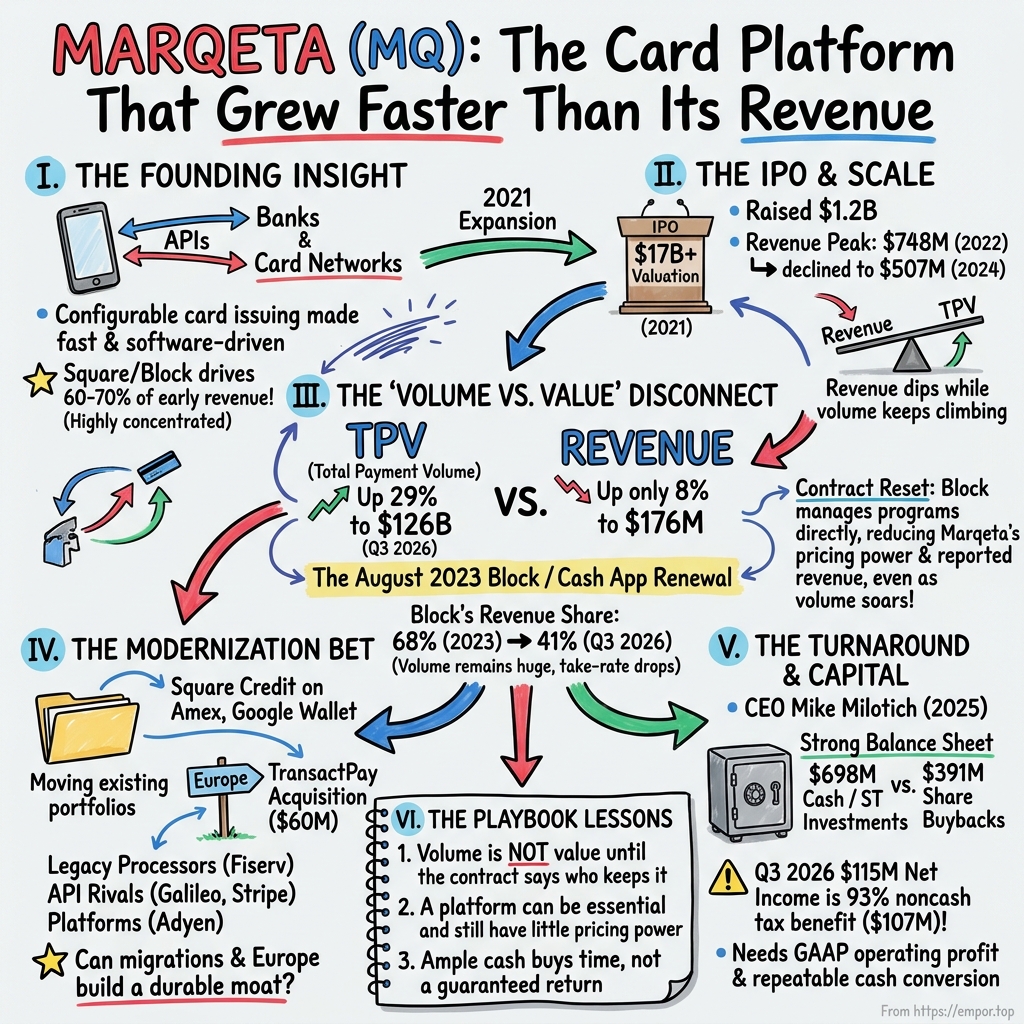
Marqeta: The Card Platform That Grew Faster Than Its Revenue
I. A $500 Billion Run Rate, and a Slower Top Line
Somewhere in the United States on an ordinary afternoon, a delivery driver taps a company card to pay for a customer's groceries, a teenager buys a sandwich with a debit card that lives inside a payments app, and a small business owner swipes a credit card that was issued, approved and controlled by software most of them have never heard of. None of these people sees the name Marqeta. They see Cash App, Square, a delivery app, a buy-now-pay-later brand, a wallet on a phone. Marqeta lives one layer below the logo, in the split second between a card being tapped and a terminal flashing "approved."
On November 3, 2026, that invisible layer reported what had flowed through it over the previous three months. Total processing volume, the dollar value of every purchase made on cards running on Marqeta's platform, came to about $126 billion, up 29% from a year earlier.[^1] Multiply one quarter by four and the platform is handling money at a pace of more than $500 billion a year. That is a river of commerce larger than the annual economic output of most countries.
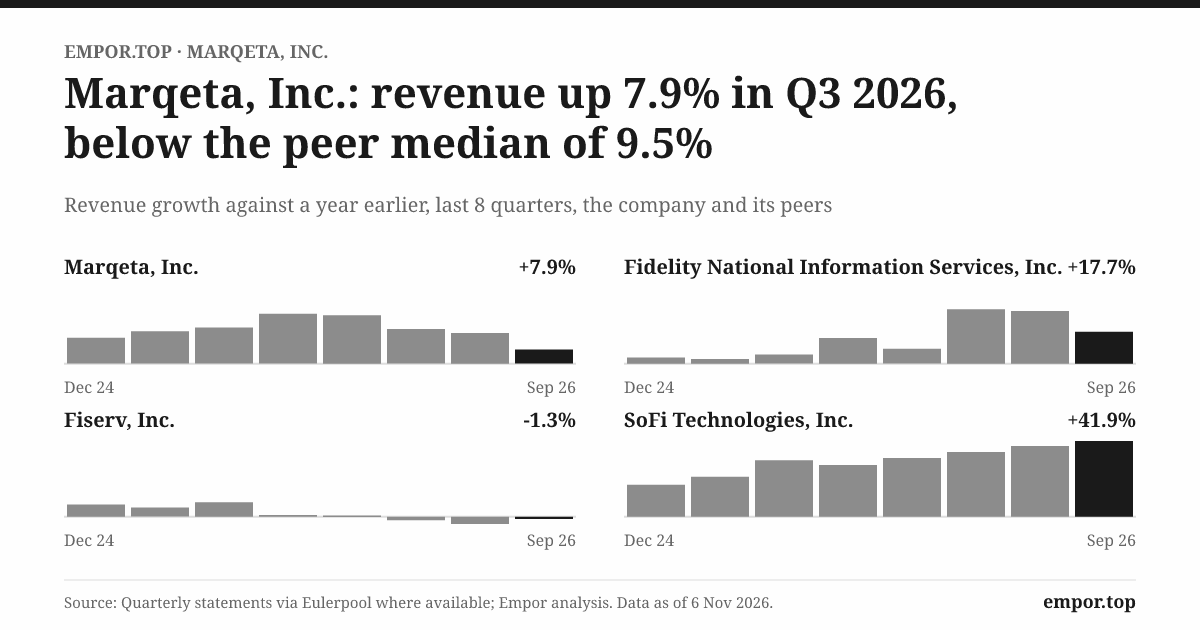
Then came the line that matters to a shareholder. Revenue for the quarter was about $176 million, up just 8%.[^1] Volume grew more than three times as fast as the money Marqeta recorded for handling it. Put the two numbers side by side and the puzzle of the whole company appears in one ratio: for every $100 that passed through the platform, Marqeta booked roughly 14 cents of revenue. Two years earlier, in 2024, it had booked about 17 cents.1 The river was getting wider. The toll Marqeta collected on it was getting thinner.
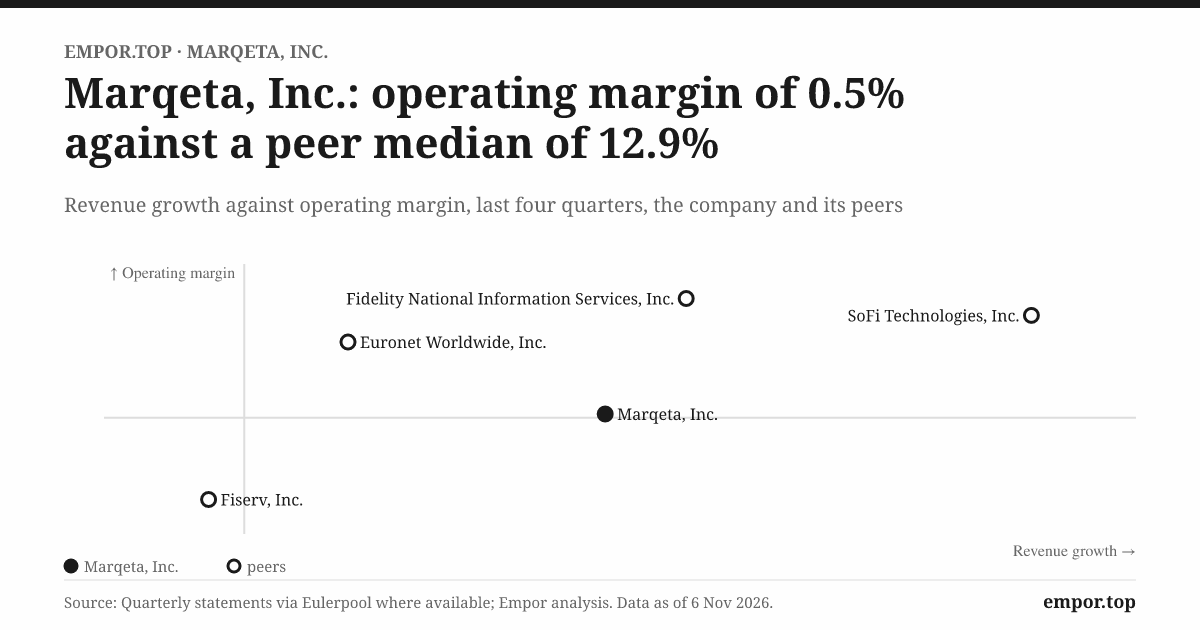
The quarter's bottom line seemed to tell a happier story. Marqeta reported net income of about $115 million, a figure that would look, at first glance, like the arrival of a profit machine. But roughly $107 million of that came from a noncash tax benefit, the release of an accounting reserve against tax assets the company had built up over years of losses.2 Strip it out and the quarter's operating profit was about $6 million on $176 million of revenue, a margin of under 4%.2 Over the first nine months of 2026, Marqeta's operations produced about $86 million of cash, against reported net income of about $131 million.2 The headline profit overstates the quarter. What the quarter actually showed was a business that had crawled, for three quarters in a row, to a small operating profit after years of large losses.
That gap between volume and value is not a footnote to the Marqeta story. It is the story. Marqeta was built on a simple and powerful idea: that issuing a payment card should be as programmable as sending a text message from an app. The idea worked. Some of the most ambitious consumer finance companies of the last decade built on it, and the volume proves it. Yet the economics of that success have never belonged to Marqeta alone. They have been negotiated, quarter after quarter, with a short list of very large customers, the banks that legally issue the cards, and the networks that carry the transactions.
Three questions drive what follows. The first is whether Marqeta can hold its place between the brands that own the customer, the banks that hold the licenses and the networks that run the rails, or whether each of those parties can squeeze the middle. The second is whether new customers can make up for the shrinking role of Block, the company behind Square and Cash App, which for most of Marqeta's life supplied the majority of its revenue. The third is whether profitability is finally becoming repeatable, or whether it is still being assembled from tax benefits, accounting credits and the timing of payments.
The answers begin in a much smaller room, more than a decade before anyone measured Marqeta in hundreds of billions. They begin with a product team that wanted to put a card inside an app, and with a founder who noticed that the people who controlled the plumbing had no interest in making that easy. The irony that runs through everything afterward was present from the start: a platform designed to give companies freedom over payments ended up depending on a handful of companies choosing to use it.
 Subscribe on LinkedIn
II. The Interface Between an App and a Bank
Picture a product team at a fast-growing technology company in the early 2010s. They have an app that millions of people open every week. They have a clever idea for a card: one that only works at certain merchants, or that funds itself at the moment of purchase, or that lets a gig worker get paid instantly and spend the money on the same day. The design takes an afternoon on a whiteboard. Building it takes months, sometimes years.
The reason was the plumbing. To put a card in someone's hand in the United States, a company needed a licensed bank to issue it, a card network such as Visa or Mastercard to carry its transactions, and a processor to sit between them, approving or declining each purchase in milliseconds and keeping the books. The processors of that era were built for banks, not apps. Their systems were configured through long implementation projects, change requests and batch files, and they treated a card program as something to set up once and leave alone. A product team that wanted to change a rule on a Tuesday afternoon was asking for something the system had never been designed to do.
Jason Gardner, an entrepreneur who founded Marqeta in 2010 and ran it as chief executive for more than a decade, built the company around removing that friction.3 His insight was that card issuing could be turned into software infrastructure: a set of application programming interfaces, or APIs, that a developer could call the way they called a mapping service or a messaging service. Instead of filling in forms with a processor, a company would write code. It could create cards instantly, set spending controls in real time, decide at the moment of a transaction whether to approve it based on its own data, and change the rules whenever the business changed. Marqeta called the concept modern card issuing.3
It helps to be clear about who does what, because the whole economic argument depends on it. Marqeta supplies the issuing and processing technology. It does not lend money and is not the legal issuer of most cards on its platform. Partner banks, such as Sutton Bank, issue the cards and settle the money. Networks such as Visa, Mastercard and, later, American Express carry the transaction from the merchant's terminal to the issuer and back. And the customer, the company whose brand is on the card, owns the relationship with the person holding it.4 Think of Marqeta as the switchboard and rulebook between an app and a bank. The app decides what the card should do; the bank lends its license and balance sheet; the network runs the roads; Marqeta makes all of it work in the fraction of a second a purchase allows.
The customer who proved the concept was Square. Its Cash Card, a debit card connected to the Cash App balance, ran on Marqeta's platform and became one of the defining fintech products of its era.3 It showed why programmable issuing mattered. Cash App could design the card, change features, and launch to an audience of millions without rebuilding a bank processor from scratch. Other ambitious companies followed, including on-demand delivery and buy-now-pay-later businesses that needed virtual cards created instantly, spending locked to a single merchant, or funds released at the moment of purchase.3 By the end of 2020, Marqeta said about 275 million cards had been issued on its platform; by March 2021 the count had passed 320 million.3
One feature captured the difference better than any slogan. Marqeta called it Just-in-Time Funding.3 A traditional prepaid card holds a balance, which means money sits idle on it and can be stolen or misspent. A Just-in-Time card can hold nothing at all until the instant a purchase is attempted. At that moment the authorization request arrives, the customer's own software decides whether this particular purchase, at this merchant, for this amount, should happen, and only then is the card funded for exactly that sum.3 For a delivery company sending a shopper into a supermarket with a company card, that is the difference between hoping the shopper buys the right order and knowing the card will only pay for it. It was the kind of control a legacy processor could not offer without a custom project, and it explains why so many of Marqeta's early customers were on-demand businesses.
That was proof that the product worked at scale. The same pages that described this success also carried the first warning. In 2019, Square accounted for about 60% of Marqeta's revenue. In 2020, the share rose to about 70%.3 As Cash App boomed during the pandemic, Marqeta's revenue roughly doubled, from about $143 million in 2019 to about $290 million in 2020, and most of that growth came from one customer.3
Concentration like that changes the balance of power in a relationship. To Square, Marqeta was a critical supplier, but its fees were a modest line in a much larger business. To Marqeta, Square was most of the company. A supplier in that position can be essential to a customer's product and still have very little leverage over the customer's economics, because the customer knows exactly how much the supplier needs it. Square also had the engineering talent and scale to consider alternatives, including building more of the stack itself or dealing more directly with banks and networks.
The early losses tell the same story from another angle. Marqeta lost about $58 million in 2019 and about $48 million in 2020, even as revenue doubled.3 The company was investing ahead of growth, as young platforms do, but it was also learning that the economics of the card business are shared. Interchange, the fee a merchant pays on each card purchase, flowed to the issuing bank, which passed a portion to Marqeta, which in turn shared a large part with its customers as an incentive to grow volume. The more a customer like Square processed, the more of that revenue it could demand back.4
So Marqeta entered its next chapter having answered one question convincingly. Yes, a programmable card platform could be built, and serious companies would trust it with serious volume. The harder question remained open. When a customer scales on top of your API, does the platform capture more value from that growth, or does the customer negotiate the economics back? Public investors were about to be asked to put a price on the answer.
III. The IPO Priced a Future That Had One Very Large Customer
June 2021 was a giddy moment for financial technology. Interest rates sat near zero, digital payments had surged through the pandemic, and investors were paying rich multiples for any company that could plausibly claim to be infrastructure for the future of money. Into that market walked Marqeta.
On June 8, 2021, the company priced its initial public offering at $27 a share, above the range it had marketed to investors.5 The next morning, the stock opened on the Nasdaq at $32.50, giving Marqeta a market value of more than $17 billion.5 The offering raised about $1.2 billion for the company; including additional shares, Marqeta ended up with about $1.3 billion of net proceeds after costs.51 For a business that had booked about $290 million of revenue the previous year, the valuation implied enormous confidence: well over fifty times trailing sales at the opening price.
What exactly were investors buying? The prospectus offered a sweeping vision. Marqeta described itself as the platform that would modernize card issuing, a market where most volume still ran on decades-old processors, and pointed to a growing roster of high-profile customers in delivery, lending, expense management and digital banking.3 Its total processing volume had grown at a dazzling rate. Its product was genuinely differentiated. And its founder kept control: Gardner held Class B shares carrying superior voting rights, a structure that preserved his influence after he stepped back from day-to-day leadership.36
But the prospectus confirmed the concentration risk.3 That single number falsifies any reading of the IPO as the listing of an already diversified platform. Investors were buying a broad opportunity attached to one dominant relationship. The prospectus was candid about the risk; the price suggested the market believed diversification would arrive quickly enough not to matter.
For a while, the numbers cooperated. Revenue rose from about $517 million in 2021 to about $748 million in 2022.[^8] Then the line turned. Revenue fell to about $676 million in 2023 and to about $507 million in 2024.1 Three years after the IPO, Marqeta's revenue was a third below its peak, and the company was still losing money: about $223 million in 2023 alone.[^8] The stock suffered accordingly.
The environment around the company was also turning. In 2022 the Federal Reserve began raising interest rates at the fastest pace in decades, and the fintech valuations that had framed the IPO collapsed with them. Many of Marqeta's customers were themselves young companies that had been funded on cheap capital, and they now had to slow spending, cut costs or renegotiate their supplier contracts. Marqeta's own share price fell with the sector, which mattered less for its operations than for its options: with a market value far below its debut, every future use of capital, from acquisitions to buybacks, would be measured against a stock that the market no longer priced as a high-growth platform.
The easy reading of that slide is that card activity collapsed. It did not. In 2024, the year revenue fell by a quarter, total processing volume rose about 31% to roughly $291 billion.1 More money than ever was moving through the platform. What changed was how much of that money appeared on Marqeta's income statement, and the reason was a contract.
In 2023, Marqeta and Block amended their agreements for Cash App. The new terms shifted responsibilities in the Cash App program and changed how Marqeta presented the revenue from it.[^8] Under the old arrangement, Marqeta's reported revenue included fees that it collected and then paid out to the networks and banks; under the new one, Block took on more of that responsibility directly, so those pass-through amounts no longer ran through Marqeta's books. The amendment also lowered Marqeta's pricing.[^8] Two different effects arrived together. One was cosmetic for profit but brutal for the revenue line: revenue and costs fell together, leaving gross profit far less affected. The other was real: Marqeta accepted less money per transaction to keep its biggest customer.
From that point on, volume and revenue stopped telling the same story. A shareholder who watched only processing volume would think Marqeta was thriving. A shareholder who watched only revenue would think it was shrinking. Both would be wrong, and the right measure, gross profit, sat between them. The IPO had given Marqeta a fortress of cash and a growth-stock valuation. It had not given the company bargaining power over its largest customer, and the Cash App renewal was the moment that limit became visible on the income statement.
IV. The Cash App Renewal Changed What "Growth" Meant
The August 2023 amendment read like legal housekeeping. Block would become responsible for managing the primary card network program for Cash App, taking over arrangements that Marqeta had previously handled.[^8] In a press release it would barely warrant a sentence. On Marqeta's income statement, it rewrote the meaning of growth.
To see why, it helps to separate three numbers that are easy to confuse. Total processing volume is the value of purchases on Marqeta-powered cards; it is a measure of activity, not money Marqeta keeps. Net revenue is what Marqeta records as income after paying revenue share to customers; in some programs, it also includes network and bank fees that Marqeta collects and then passes on, which inflates revenue without adding profit. Gross profit is what is left after those pass-through costs; it is the closest measure of what the platform actually earns.4 Imagine a travel agent who sometimes books a hotel and collects the full room rate before paying the hotel, and sometimes simply takes a commission while the guest pays the hotel directly. The agent's revenue swings enormously between the two models, while the commission it keeps may barely change. When Block began contracting more directly, Marqeta moved from the first model toward the second for a large slice of its business.
That is why 2024 was a turning point: revenue fell as processing volume grew.1 Part of the drop was presentation. Part was the lower pricing Marqeta had agreed to. The combination meant that, for the first time, the platform could grow quickly in usage and shrink in reported revenue in the same year, a pattern that would make every subsequent quarter harder to read.
Block's grip loosened slowly. Its share of revenue fell from about 68% in 2023 to about 41% in the third quarter of 2026.[^8]142 That decline is real progress, and it happened while Marqeta's revenue base was recovering, which means other customers were growing. But 41% is still extraordinary concentration. No other customer exceeded a tenth of revenue in the latest quarter, and the company does not disclose what its top five or top ten customers contribute.2 The current Cash App and Square Debit Card terms run to June 2028 and renew annually after that unless ended earlier, so the relationship is anchored for now, with the next negotiation already on the horizon.4
There is a second dependency, on the supply side. Sutton Bank, a small Ohio bank that issues a large share of fintech cards in the United States, settled about 55% of Marqeta's processing volume in the third quarter of 2026, down from about 63% a year earlier.2 Marqeta works with a broader set of issuing banks than it once did, and the trend is toward diversification. Yet a single bank's regulatory standing, risk appetite or commercial terms can still affect more than half of what flows through the platform. Banks that sponsor fintech programs have faced increasing regulatory scrutiny across the industry, which is why this concentration matters more than a supplier list usually would.
Why would so much fintech volume sit with one small bank? The answer lies in a quirk of American payments regulation. Since 2011, the Durbin Amendment has capped the interchange fees that large banks, those with more than $10 billion of assets, can earn on debit card purchases, while smaller banks are exempt.4 A debit card issued through a smaller bank therefore earns materially more on each swipe than the same card issued through a giant one, and that richer interchange is what funds the revenue share flowing to fintechs and the fees flowing to processors such as Marqeta. The economics of much of the fintech debit industry rest on that exemption, which is why changes to bank sponsorship, regulation of sponsor banks or a bank outgrowing the threshold all reach Marqeta's income statement.
By 2026, the gap between volume and revenue had a new explanation, one management offered directly. On the third-quarter call, executives said that the fastest-growing programs on the platform were those with minimal or no program management, meaning customers that used Marqeta for processing but handled more of the surrounding services, bank relationships and network arrangements themselves.7 Those programs bring volume but less revenue per dollar processed. So third-quarter processing volume rose 29%, revenue 8% and gross profit only 7%.[^1] The last number is the one that should catch an investor's eye. Gross profit was not supposed to be distorted by presentation changes. If it grew more slowly than volume, then the value per transaction was falling on its own terms, not just being moved off the income statement.
The analyst questions on that call went straight at this. The company lowered its revenue outlook for the fourth quarter while leaving its gross-profit expectation unchanged.7 Management's explanation was that one customer was moving its bank and network fees outside Marqeta's income statement, the same mechanism as the Block amendment on a smaller scale: revenue falls, costs fall with it, gross profit is untouched.78 That is a coherent explanation, and it is consistent with what happened in 2023. It also means investors should increasingly ignore Marqeta's revenue growth rate and watch gross profit instead, because the company's top line is now subject to the contracting choices of its customers.
Executives also described the next stage of the Block relationship. Management expected new issuance of Cash App cards on Marqeta to slow to little or none by the end of 2026, while most of the existing base of traditional Cash App cards stayed on the platform.78 That is a striking admission. The largest customer, still supplying around two-fifths of revenue, is not expected to add many new cards through Marqeta. The installed base will keep generating volume, but its natural growth engine is slowing. Management declined to give 2027 guidance until February, so the size of that effect remains open.7
The contract terms add other moving parts. Price steps embedded in renewals, including temporary ones, change revenue per transaction from year to year. A September 2026 renewal with another customer came with a warrant to buy up to 550,000 Marqeta shares for a penny each over five years, vesting as the customer hits transaction-volume milestones; because the warrant is treated as consideration paid to the customer, its value reduces revenue as it is earned.2 In plain terms, Marqeta was paying a large customer in its own stock to bring more volume. That is a legitimate commercial tool. It is also a sign of who held the stronger hand in that negotiation.
The bullish counterpoint is real. Management said non-Block processing volume was growing more than twice as fast as Block volume.7 If that pace holds while Cash App issuance fades, the mix shifts quickly toward a broader customer base. But volume is precisely the measure that has misled before. A listener should want to see non-Block growth show up as gross profit, and as revenue concentration that keeps falling for reasons other than one customer moving fees off the books.
The Cash App renewal taught a lesson that the rest of this story keeps returning to: Marqeta's economics are not set by how much money flows through it. They are set by contracts, and the contracts are written by parties with alternatives. That raises the obvious question about the platform itself. If customers can renegotiate, move fees off the books or take services in-house, how hard is Marqeta to replace?
V. The Modernization Bet: Can a Migration Become a Moat?
Moving a live card portfolio is one of the most nerve-racking jobs in payments. Millions of people carry the cards. They expect them to work at the supermarket on the morning of the switch exactly as they did the night before. Card numbers, expiry dates and the tokens stored inside phones and online stores all need to keep working, or customers get declined at checkout and call support in a fury. Banks and fintechs postpone these projects for years because the downside of a botched migration is so visible.
In 2026, Square went through one. Its credit card program moved onto Marqeta's platform and onto the American Express network, joining Square's debit card program, which already ran on Marqeta.[^1]7 For Marqeta, it was a showcase. The company could move existing accounts and card credentials, run debit and credit programs for the same customer on a single platform, and do so across different banks and different networks. Management said it had completed four portfolio migrations in roughly 24 months, and argued that more than 90% of card transaction volume still runs on legacy platforms.7 That second figure is the heart of the bull case: if most of the world's card volume still runs on old processors, a modern platform that can safely move it has a very long runway.
Marqeta connects card programs to issuing banks and networks, then applies customers' rules to transactions and handles settlement and reporting.4 Its selling point has always been control: customers write the rules for their cards and change them in software, without filing change requests with a processor. Credit capabilities were strengthened in 2023 when Marqeta agreed to acquire Power Finance, a credit card program management platform, which helped bring lending products such as Square's credit card into reach.[^11]
A second piece of technology makes migrations like Square's possible and is worth a plain explanation. When a person adds a card to a phone wallet or saves it with an online store, the merchant usually never holds the real card number. It holds a token, a stand-in number issued through the network that only works in that wallet or with that merchant. Moving a portfolio means keeping all of those tokens alive, so that the card saved on a ride-hailing app or a streaming service keeps working the morning after the switch. Doing that for millions of cards at once, without a wave of declined payments, is precisely the kind of unglamorous execution that separates a capable processor from a promising one.
The competition is best understood by the job each rival does, because these companies disclose different measures and none publishes a clean issuer-processing market share. The incumbents are the large legacy processors, such as Fiserv and Visa's own issuer-processing business, which run enormous bank portfolios and offer stability, scale and long relationships. Then come the API-oriented issuer processors, such as Galileo, owned by SoFi, and i2c, which sell a similar promise of modern, configurable issuing to fintechs and banks. Integrated payments platforms such as Adyen offer card issuing as part of a broader package that includes merchant acceptance; Adyen processed about €1.39 trillion of volume in 2025 and earned about €2.36 billion of net revenue, but that volume is mostly merchant payments acceptance, so it is context for scale rather than a like-for-like comparison.9 Stripe offers issuing tools to the businesses already on its platform. And finally there is the option every large customer always has: build more of it in-house, or take more of it directly from a bank that offers its own processing.4
A war game across those competitors begins with the strongest evidence for Marqeta. Migrations like Square's credit portfolio show capability. Launches across multiple banks and networks show flexibility. The company added notable programs in 2026, including a card for Google Wallet aimed at children and teens and a European program with Satispay, an Italian mobile payments company.[^1]7 These are proof of product breadth. None of them, on the disclosed evidence, has yet been shown to be material to revenue.
Now test the claim against what would actually break it. A moat in infrastructure shows up as customers who cannot easily leave, cannot easily split their business across suppliers, and keep paying more over time. Marqeta's own record pulls against each of those. Customers can and do use more than one bank, and the shift toward programs with little or no program management shows that large customers prefer to own more of the stack themselves.7 The Block amendment showed how the largest customer could take over services and renegotiate pricing.[^8] A 2026 renewal required warrants to secure volume.2 Volume continued to outpace revenue and gross-profit growth, which is what pricing pressure looks like in the numbers. The company does not disclose customer retention rates, net revenue expansion, migration win rates or gross profit per dollar of volume, the figures that would show whether its flexibility is turning into pricing power.
The five forces bring the pressures into focus once. Buyer power is the dominant force: the Block renewal showed how a large customer could reset the economics. Supplier power is real because Marqeta depends on issuing banks for licenses and settlement and on networks for the rails, with processing volume still concentrated at one bank.2 Rivalry runs on three fronts, against legacy processors that already hold the bank portfolios, API competitors that sell similar flexibility, and integrated platforms that bundle issuing with other services. Substitution is always available to the biggest customers, who can build or source capabilities elsewhere. The barriers to new entry are the genuinely encouraging part: bank and network integrations, compliance obligations, security certifications, the trust needed to carry millions of cards, and above all the execution record that migrations require. Those barriers protect Marqeta from new startups more than they protect it from existing giants and its own customers.
That distinction matters for the 90% figure. "Legacy volume is available" is a statement about the market. "Marqeta will win it" is a separate claim, and the evidence for it is so far a handful of migrations, several of them involving an existing customer. The large banks that own most legacy volume have long relationships with incumbent processors, and the incumbents are modernizing too. The measurable path for Marqeta is visible: signed migrations, completed conversions, customers who stay, customers who expand, and above all gross profit that grows with them. Until those numbers are disclosed, the modernization opportunity is a plausible strength, not a proven moat.
The newer bets deserve their honest weight. Marqeta announced work with stablecoin companies that let card programs be funded by or settle in digital dollars, and pitched its controls and tokenization as natural tools for agentic commerce, where AI software agents make purchases on a person's behalf.7 The logic is sensible: if a software agent is going to spend money, someone needs to issue it a card with narrow, programmable limits, and that is exactly what Marqeta's controls do. But on the third-quarter call management itself described the rules for agent payments as still unsettled, and there is no disclosed revenue base from either initiative.7 More automation could raise transaction counts on cards; it could also make card features easier to commoditize. These are options, not earnings.
The verdict from the competitive war game is narrower than the bull case and stronger than the bear case. Marqeta has demonstrated that it can do difficult things, and the migration capability is real. What it has not demonstrated is that this capability lets it hold or raise its price when customers grow. Running that business through a period of falling take rates, a fading Cash App issuance pipeline and investor skepticism fell to a chief executive who began his Marqeta career counting the money rather than selling the platform.
VI. Mike Milotich Inherits a Turnaround With a Moving Scoreboard
In February 2025, Marqeta lost its second chief executive in about two years. Simon Khalaf, a veteran technology operator who had succeeded founder Jason Gardner as CEO, departed, and the board handed the job on an interim basis to Mike Milotich, the company's chief financial officer.106 In September 2025, the board removed the word "interim."11 The proxy statement's three-year compensation table captures the turbulence in a single line: Gardner, Khalaf and Milotich each served as principal executive officer during the period.6
Milotich is a different kind of leader from the founder he followed. Gardner was a product evangelist who sold a vision of programmable money. Khalaf came from building consumer technology platforms. Milotich came to Marqeta as CFO after a long finance career at Visa, where he had worked in corporate finance and dealt with investors from inside the world's largest card network.11 He knew the card economics from the network's side of the table, and he knew how Wall Street reads a payments income statement. That background suited the job he inherited, which was less about inventing a new product than about making the existing one predictable: restoring steady growth after the Block reset, a revenue trough and a carousel of executives.
The founder's own path had been a gradual step back. Gardner moved from chief executive to executive chair when Khalaf took over, and later left executive duties for a non-executive seat on the board.6 The transition had an accounting echo that would confuse readers of the income statement for years: a large performance award granted to Gardner as executive chair was later cancelled, and the reversal of expense already recorded under it produced the one-time credit that flattered 2024's results.4 Gardner remains a director, and through his Class B shares he retains the most powerful single voice in the company's governance, so every chief executive since him has run the business with its founder still holding nearly half of the votes.6
The improvement since then is visible, though mixed. Revenue in 2025 rose about 23% to roughly $625 million.4 That recovery still left the company below the $748 million it reported in 2022, but because the 2023 Block amendment removed pass-through fees from the top line, the comparison overstates how far the business had really fallen.[^8] The operating line tells a more interesting story than it first appears to. Marqeta's operating loss was about $46 million in 2025, compared with about $25 million in 2024, which looks like a deterioration.4 It was not. The 2024 figure had been flattered by a one-time noncash credit of about $145 million, the reversal of expense previously recognized for a performance award granted to Gardner as executive chair.4 That credit is why the quarter ending June 2024 showed an operating profit of more than $100 million1 in a year when the business was still losing money. Strip it out, and the 2024 operating loss was around $170 million, so 2025's $46 million loss represented a genuine and large improvement.
Then came 2026, and a run of small positive results. Operating profit was about $2 million in the first quarter, about $4 million in the second and about $6 million in the third.212 Adjusted EBITDA, management's preferred measure, which excludes stock compensation and other items, reached about $39 million in the third quarter, up 28%.[^1] Three consecutive quarters of GAAP operating profit are a milestone for a company that had never produced one without an accounting credit. They are also a very short record, and the margins are thin enough that a modest change in a single customer contract could erase them.
That is why the third quarter's net income is the wrong scorecard. The roughly $107 million tax benefit came from releasing a valuation allowance, an accounting judgment that Marqeta is now likely enough to earn future taxable profits to use its accumulated tax losses.2 The judgment says something about management's confidence. It does not produce cash. For the first nine months, operating cash flow of about $86 million compared with net income of about $131 million.2 The cleaner measure of progress is the operating line, and on that measure Marqeta is just above break-even.
Is the margin gain coming from productivity or from slower investment? The evidence leans toward productivity, with caveats. Research and development spending held broadly flat, about $141 million in 2024 and about $145 million in 2025, while revenue recovered, so R&D fell from about 28% of revenue to about 23%.41 The company did not starve the product. It capitalized more software development, about $28 million in 2025, which moves some engineering cost from the income statement onto the balance sheet to be amortized later.4 Headcount rose from 854 to 938, although 58 of the additions came with TransactPay.41 A skeptical investor should note that capitalizing more development flatters current operating profit modestly. It is not a large enough effect to change the direction of the story.
Incentives sit alongside the results. Milotich's 2025 compensation totaled about $11 million, including an option award valued at about $8.7 million and a $1 million bonus, with discretionary one-time payments tied to the February 2025 leadership transition.6 That is a standard structure for a new CEO, heavily weighted toward equity that only pays if the stock rises. It also has to be read beside Marqeta's equity dilution: stock compensation across the company ran at about $105 million in 2025, a sizable figure for a company of this revenue.4 And it sits inside a governance structure where Gardner, no longer an executive, still holds about 95% of the Class B shares and about 47% of total voting power.6 Whatever the board decides, the founder's vote weighs heavily.
The credibility stress test has several parts. The company has had three principal executive officers in three years. Its chief accounting officer, Sarah Barkema, gave notice in August 2025 of a resignation effective a year later, adding a finance-leadership change to the CEO transition.136 Shareholder support for executive pay fell from about 98% at the 2025 annual meeting to about 78% in June 2026, when roughly 107 million votes went against the compensation package.146 In the investor universe, a drop of that size is a clear message of dissatisfaction, especially when the founder's votes are counted on the other side. And a securities class action alleging that Marqeta misled investors about its performance and revenue expectations was preliminarily approved for a $13 million settlement in September 2026; the company funded it during the quarter.2 A related derivative suit reached a term sheet in October 2026 for governance reforms that still require court approval.2 The settlement is a bounded cost. The lawsuit's subject, whether management's revenue expectations could be trusted, is the same question investors still ask.
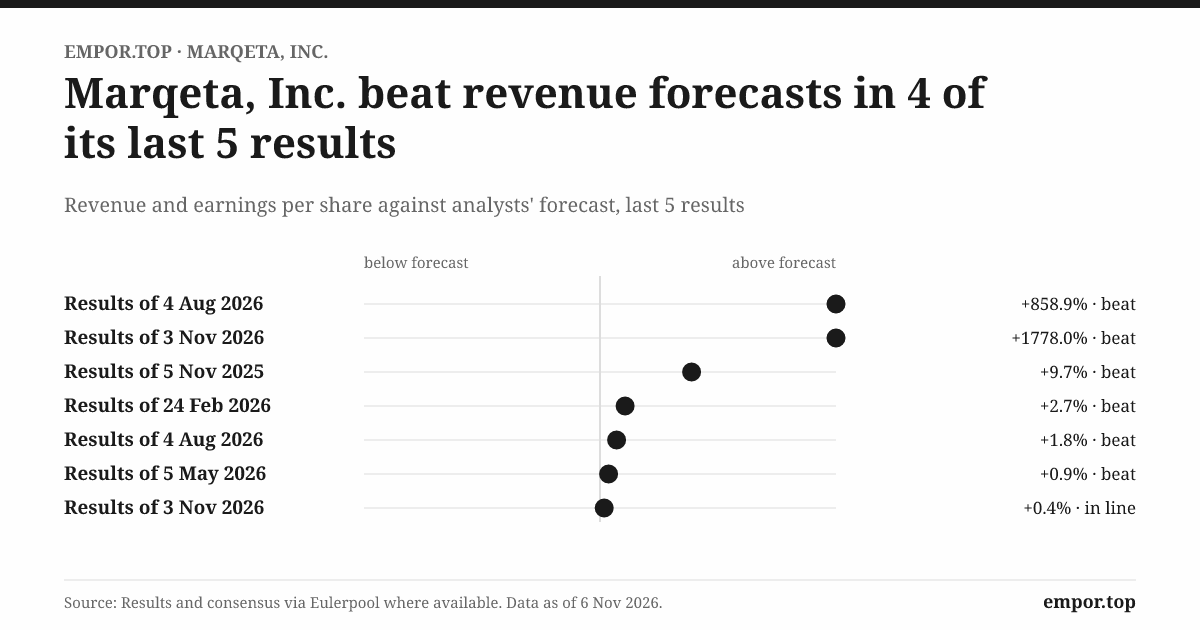
How does the current team handle that question? On the third-quarter call, management gave unusually concrete explanations: why revenue and gross profit diverged, which customer was moving fees off the income statement, how Cash App issuance would fade, and why non-Block volume was growing faster.7 It also declined to give 2027 guidance until February.7 That is discipline, or at least caution. The Q2 results had shown revenue growth of 17% and the third quarter showed 8%, so the deceleration was a known part of the story by the time analysts asked about it.12[^1] The real test of Milotich's credibility will be the February outlook: whether it bridges volume, mix and Block's slowing issuance in a way that later quarters confirm. While that verdict is pending, the company has been making a different kind of bet with its cash, one aimed across the Atlantic and one aimed at its own share count.
VII. A $60 Million European Bet Beside a $391 Million Buyback
In July 2025, Marqeta closed the acquisition of TransactPay, a UK and EU card program manager and issuing business.[^18]10 It was a modest deal by the standards of the company's balance sheet: a purchase price of about $60 million, plus earnouts that could pay the sellers more if the business hit targets.4 Over the same year, Marqeta spent about $391 million buying back its own shares.4 The comparison is the clearest picture of how the company allocated capital: a small strategic purchase to extend the platform, beside a share repurchase more than six times larger.
What did TransactPay add? In Europe, the role played by sponsor banks in the United States is often filled by electronic money institutions, licensed firms that can hold customer funds and issue cards. TransactPay brought those licenses along with program-management and issuing infrastructure.[^18]4 The strategic logic is easy to follow. Marqeta's customers want to launch cards in more countries, and the company had relied on partners to do it outside North America. Owning licensed infrastructure in Europe lets Marqeta offer a more complete package to customers expanding there, and to European companies such as Satispay that want modern issuing.
Benchmarking the price is harder than it looks. About $60 million was roughly one-twentieth of Marqeta's cash and short-term investments at the end of 2025.4 TransactPay contributed only about 1% of consolidated revenue in 2025, and only for the months after the deal closed.4 Marqeta does not publish TransactPay's standalone annual revenue or profit, so there is no reliable basis for calling the price a cheap or an expensive multiple of sales, nor for a peer comparison. What can be said is that the deal was small relative to the company's resources, and that its success will be measured by whether Europe becomes a meaningful source of gross profit rather than a strategic rationale attached to a small acquired business.
There is an accounting wrinkle that changes how the balance sheet should be read. TransactPay holds customer funds, money that belongs to cardholders and program customers, which appears on Marqeta's balance sheet as restricted cash, about $268 million at the end of September 2026, matched by obligations to the customers who own it.2 That cash is not corporate liquidity. Treating it as part of Marqeta's war chest would overstate the company's financial strength by more than a third. TransactPay also represented about a quarter of consolidated assets at the end of 2025 for this reason, even though it supplied about 1% of revenue.4 Its earnouts, and the work of integrating a regulated European business, are further reasons to watch execution.
The prior record on acquisitions is short and mixed in evidence. Power Finance helped enable the Square credit migration.[^11]7 The company does not disclose standalone revenue or returns from it either. Two acquisitions, both bolt-ons, both strategically legible, neither yet measurable as a financial return: that is the honest summary.
The buyback deserves the harder look, because it is where most of the capital went. Marqeta repurchased about $391 million of shares in 2025, when revenue remained below its 2022 peak and the company still had an operating loss.4 Through September 2026, it spent another $92 million to buy about 5.7 million shares under an authorization approved in December 2025, and in August 2026 the board approved a further $150 million program.2 Marqeta also carried out a one-for-four reverse stock split effective June 30, 2026, which reduced the share count and raised the per-share price without changing anyone's ownership.214
The case for buying back stock is straightforward. Marqeta had far more cash than it needed, had no conventional debt, and its shares had fallen sharply from their IPO price. If management believed the market undervalued the business, repurchases were a way to return excess capital while concentrating the remaining shareholders' claim. Cash was clearly ample: the IPO had supplied about $1.3 billion of net proceeds, and the balance sheet at the end of September 2026 showed no conventional funded borrowing.12
The case against is about what the buybacks actually achieved. The company's substantial stock compensation in 2025 meant that a large part of each year's repurchases offset shares issued to employees rather than shrinking the count.4 A buyback that mostly absorbs dilution is effectively another form of employee pay, funded with the IPO money. Executives' incentives, including the CEO's option grant, are tied to the share price, so a repurchase program also supports the measure by which management is rewarded. That is not improper, and it is common. It does mean that shareholders should measure the program net of equity issuance and by the change in diluted share count over time, not by the dollars spent.
There is also a cost in income. Interest on cash had been a meaningful part of Marqeta's results: other income, mostly interest, was about $33 million in 2025, down from about $53 million in 2024, partly because repurchases had lowered average balances.4 In a year when Marqeta lost about $13 million before tax, that interest was material.4 Every dollar spent buying shares was a dollar no longer earning yield, which made the reported results a little worse in exchange for a smaller share count.
So the capital-allocation verdict is mixed and specific. The European acquisition is small, strategically sensible, and unproven. The buybacks were large, returned cash that the business did not need, and were partly consumed by stock compensation. Neither yet shows a measurable return. Which brings the story back to the quarter that seemed, for a moment, to transform the earnings picture, and to a more careful question: how strong is this company's financial position once the accounting is stripped away?
VIII. The Balance Sheet Is Stronger Than the Earnings Record
The third-quarter report of 2026 contained two numbers that seem to belong to different companies. One was net income; the other, the noncash tax benefit that accounted for most of it.2 Read together, they explain why Marqeta's financial position has to be judged on its balance sheet and its cash flows, not on its reported earnings. The earnings record is short, thin and repeatedly shaped by accounting events. The balance sheet is sturdy.
Start with the long view. Across the seven years from 2019 to 2025, Marqeta reported cumulative net losses of about $664 million. Over the same period, its operations generated about $321 million of cash.3[^8]4 A company that loses money on paper while producing cash looks paradoxical until the mechanics are clear. A large part of the gap is stock-based compensation, which is a real cost to shareholders because it dilutes them, but which does not consume cash: it ran at about $128 million in 2023, $137 million in 2024 and $105 million in 2025.4 Depreciation and amortization add more noncash expense. The rest is working capital, the timing of when money comes in and goes out.
Working capital is unusually important in Marqeta's model, and it explains why its cash flow can look better than its business. When a cardholder spends, interchange income flows to Marqeta, which owes a share of it to its customers as revenue share and settles it later. That means Marqeta often holds money for a while before paying it out. Its days payable, a measure of how long it takes to pay its bills, stretched to more than 400 days of cost of revenue in 2024 and 2025, against well under 200 earlier in its history.4 In plain terms, the company is sitting on large sums it owes to others. In 2025, operating cash flow of about $163 million and free cash flow of about $161 million both benefited from increases in revenue-share payables and accrued liabilities, partly offset by higher receivables.4 That is a genuine source of cash, but it is not a sustainable rate of earnings. If the timing reverses, or if a large customer renegotiates payment terms, the cash flow can fall sharply even with no change in the underlying business.
So the free cash flow figure should be read as an upper bound rather than a run rate. The nine-month 2026 figure of about $86 million of operating cash flow is lower than 2025's pace, which is consistent with that timing benefit fading.2 Over the last twelve months, operating profit was only about $3.7 million while net income was about $129 million.2 Any valuation that capitalizes the reported net income as if it were recurring is capitalizing a tax judgment.
The balance sheet itself is clean, with one important distinction. At the end of September 2026, Marqeta held about $698 million of cash and short-term investments available for corporate use.2 Its restricted cash, mostly customer funds held by TransactPay, was about $268 million and offset by matching obligations.2 The company's main obligations beyond customer settlements are modest office leases of a few million dollars.2 There are no covenants to breach and no refinancing wall to climb. This is not a company that can be forced into a corner by its lenders.
Receivables are the second place to look closely, and here the honest conclusion is "worth watching," not "a warning." Receivables measured as days of revenue rose from about 59 in 2023 to 85 in 2024, then eased to 74 in 2025.4 Part of that rise reflects the shrinking revenue line after the Block amendment, which makes the same receivable balance look larger relative to sales. At the end of September 2026, two customers accounted for about 16% and 14% of accounts receivable, up from 12% each at the end of 2025, a modest rise in concentration.2 The allowance for credit losses was small, about $3 million at the end of 2025.4 Marqeta does not publish receivables ageing, write-offs or overdue balances, so the collection timeline cannot be assessed from outside. Nothing disclosed suggests a problem. The concentration simply makes the next disclosures matter more.
The auditor's signal is reassuring with a caveat. KPMG issued an unqualified opinion on the 2025 financial statements and concluded that internal controls over financial reporting were effective.4 As is permitted in the first year after an acquisition, the controls assessment excluded TransactPay, which represented about a quarter of consolidated assets at year-end, largely because of its customer funds.4 Combined with the chief accounting officer's 2026 departure, that makes integration of controls over the European business a reasonable item for investors to track in the next annual report.13
The accounting judgments worth flagging are three: the tax-asset valuation, revenue presentation, and the treatment of customer warrants and revenue share as reductions of revenue.24 None of these is aggressive in itself. Together they mean that Marqeta's reported numbers require more interpretation than most.
The conclusion is the one that carries into valuation. Marqeta is liquid, debt-free and in no danger of a financing squeeze. Ample cash buys time. It cannot, by itself, establish that the platform earns an attractive return on the capital and people invested in it. That question is now being answered in the share price.
IX. What Would Make the Platform Worth More?
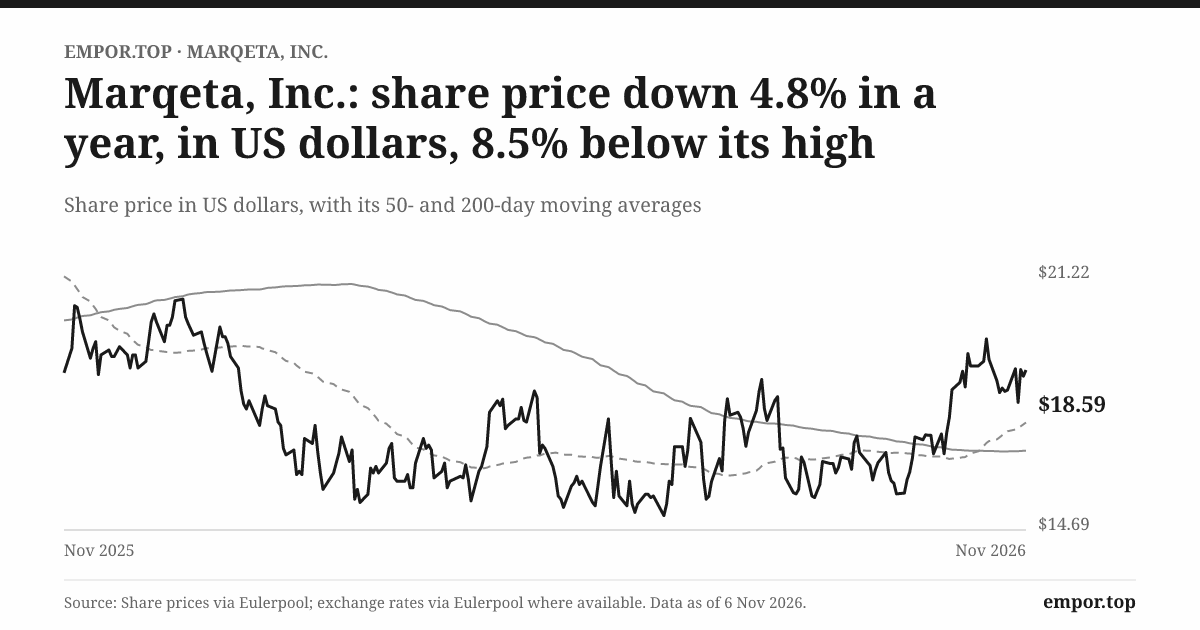
On November 6, 2026, Marqeta's shares closed at $18.59, a little below their 52-week high of about $20.[^19] Because of the one-for-four reverse split, that price is not directly comparable with the $27 IPO price; adjusted for the split, the offering price was equivalent to $108 a share, so the stock trades more than 80% below where public investors first bought it.514 The company's market value is about $1.8 billion, roughly a tenth of the $17 billion it was worth on its first morning of trading.5 Subtract its corporate cash and the enterprise value, the price of the operating business itself, is about $1.1 billion.
Against that price, the conventional multiples tell contradictory stories. The stock trades at about 15 times last-twelve-months earnings, a modest-looking multiple that is almost entirely an artifact of the third-quarter tax benefit. Enterprise value is about 20 times EBITDA, which looks reasonable until one notices how thin the EBITDA base is. Enterprise value against operating profit is close to 300 times, because operating profit over the past year was only about $3.7 million.2 On sales, the business trades at about 1.6 times enterprise value to revenue, and about 2.6 times market value to revenue. There is no five-year median P/E to compare against, because the company has rarely had positive earnings to measure. The honest reading is that the market is valuing Marqeta on its future gross profit, not on any current earnings figure.
Management's preferred measure offers another lens, and a cautionary one. Adjusted EBITDA reached about $39 million in the third quarter.[^1] Annualize it and an enterprise value of about $1.1 billion looks like roughly seven times adjusted EBITDA, a price that would seem undemanding for a payments platform. But adjusted EBITDA excludes stock-based compensation, which cost about $105 million in 2025.4 That expense is real to shareholders, because it is paid in newly issued shares, which the company then spends cash to buy back. Put stock compensation back in and most of the adjusted profit disappears, which is why the GAAP operating line and the enterprise-value-to-sales ratio are better anchors than the company's adjusted figure. The gap between the two measures is itself a useful KPI: as stock compensation shrinks relative to gross profit, adjusted and reported earnings converge, and the valuation debate becomes simpler.
Peer multiples can only be context. Global Payments traded at about 4.3 times enterprise value to sales in early November 2026, Fiserv at an estimated 2.6 times 2026 sales, and Adyen at about 7 times enterprise value to revenue in late October.151617 Those businesses differ in mix, scale and revenue presentation; Marqeta's own revenue line has shifted with gross-versus-net accounting, so a revenue multiple understates or overstates it depending on which contracts dominate. Adyen's volume, about €1.39 trillion, dwarfs Marqeta's, but most of it is merchant acceptance rather than issuing. What the comparison does suggest is that the market prices Marqeta below larger, profitable processors, consistent with its concentration, its thin margins and its short profit record.
The bull case is clear enough to state in a paragraph. Card volume is moving away from old processors as companies embed financial products in their apps, and Marqeta's migration record and expansion across networks, banks and countries give it a path to win that business. The company says non-Block volume is growing more than twice as fast as Block volume.7 As the mix diversifies, the company's dependence on one customer falls, and a platform with largely fixed engineering costs should convert each additional dollar of gross profit into operating profit at a high rate. The enterprise value of about $1.1 billion, in this view, is a low price for a profitable infrastructure business at the start of its operating leverage.
The bear case is equally concrete. Block remains Marqeta's largest customer, and new Cash App issuance through Marqeta is expected to slow by year-end.27 Pricing remains under pressure as volume growth outpaces revenue and gross profit. The alternatives are many: legacy processors with bank relationships, API competitors offering similar flexibility, integrated platforms that bundle issuing with acceptance, and in-house builds by the largest customers. In this view, Marqeta is a useful supplier whose customers capture the value it creates, and its thin operating margin is not a temporary phase but the natural result of its position.
Hamilton Helmer's seven powers framework helps decide between those cases, because it asks which durable advantages are actually present. Scale economies exist in principle, since a processing platform carries large fixed costs, but they have not yet shown up as high margins. Network economies are weak: one more customer on Marqeta does not make the platform more valuable to another, the way one more merchant makes a network more useful to cardholders. Counter-positioning was Marqeta's founding advantage, a modern architecture that legacy processors could not easily copy without disrupting their own systems, but it erodes as incumbents modernize and API rivals copy the model. Switching costs are real but double-edged: migrations are hard, which protects Marqeta's installed base, yet the same difficulty is what keeps most legacy volume where it is, and customers can still split programs across processors and banks. Branding counts for little, because the end user never sees Marqeta. Marqeta holds no cornered resource; if anything, its dependence on Sutton Bank runs the other way. Process power, the accumulated skill of executing complex migrations and running card programs reliably, is the most promising candidate, and it is still forming. On the evidence, Marqeta has a strong product and an emerging process advantage, not yet a power that secures its pricing.
The skeptical-investor test follows from that. A company with real pricing power can usually show it: customer retention above industry norms, net revenue expansion from existing customers, a migration win rate against incumbents, and gross profit per dollar of volume that holds or rises. Marqeta does not disclose those measures. Until it does, or until its reported gross profit makes the argument for it, API flexibility and the modernization opportunity remain plausible strengths rather than established advantages.
That leaves a short list of numbers that will settle the question. The first is whether gross-profit growth begins to catch up with volume growth.[^1] The second is whether Block's share keeps falling for the right reason, alongside non-Block gross-profit growth.2 The third is whether GAAP operating profit and operating cash flow remain positive, with working-capital timing kept in view: the latest quarter brought about $6 million of operating profit, and the first nine months brought about $86 million of operating cash flow.2
The risks run through mechanisms already visible in the record. Large customers can renegotiate economics or slow new issuance. Dependence on banks and networks means a regulatory problem at a sponsor bank, or a change in network terms, could disrupt programs. A mix shift toward customers that use fewer services can lower revenue yield. European expansion brings execution and controls risk in a regulated business. And payment infrastructure carries constant exposure to fraud, cyberattacks and regulatory demands, where a single serious incident could damage the trust that the whole business depends on. AI-driven and stablecoin payments sit on the other side of the ledger as possible extensions of card controls and rails, still without a commercial record.
What would make the platform worth more is not a new narrative. It is several consecutive quarters of growing gross profit and positive operating cash flow, achieved without a large tax benefit or a favorable swing in working capital. That evidence would answer the question the IPO price once took for granted, and the lessons of the story so far explain why it has been so hard to supply.
X. Playbook: Business & Investing Lessons
Go back to the Cash App amendment, when Marqeta's reported revenue fell even as processing volume climbed. Marqeta lived that gap, and the lessons belong to it alone.
The first lesson is that a platform can be essential to a product and still be a small line in the customer's budget. Marqeta was indispensable to the Cash Card's daily operation, while Square supplied most of Marqeta's revenue.3 That imbalance is the hidden geometry of many infrastructure companies. The supplier sees a dependency; the customer sees a vendor. Founders building infrastructure for a few giant customers should ask not how much they matter to the customer's product, but how much they matter to the customer's profit and loss, because that is where the renegotiation will start.
The second lesson is that volume is not value until the contract says who keeps it. The gap between volume and revenue in 2024, and between volume and gross profit in the third quarter of 2026, made the point plainly.1[^1] For years, investors were tempted to value the company on the river of money running through it. The river turned out to belong to whoever wrote the terms. For any intermediary, a metric of activity is a promise of revenue, and the promise is only as good as the pricing power behind it.
The third lesson is that a migration win is proof of execution, and a moat is proof that customers stay and pay. Moving Square's credit portfolio onto Marqeta and the American Express network was a genuine technical achievement.[^1] It shows Marqeta can do what it says. It does not yet show that customers who migrate will pay Marqeta more over time, or that the vast pool of legacy volume will choose it over rivals. Capability opens the door. Only retention and price realization prove the room is yours.
The fourth lesson is that cash gives a company time to learn what it is good at, and the clock keeps running. The IPO supplied about $1.3 billion of net proceeds.1 Since then, Marqeta has used that money to fund years of losses, buy TransactPay and Power Finance, and repurchase hundreds of millions of dollars of stock, partly offsetting employee stock awards.4[^11] Each deployment can be defended. None has yet produced a measurable return a shareholder can point to. A fortress balance sheet is a gift to a company still finding its economics, but it can disguise for years whether the business would be self-funding without it.
XI. Epilogue
Tonight, Marqeta is a company in an in-between state. It is profitable at the operating line, barely, for the first time without an accounting credit. It has a strong balance sheet, a broader customer base than at any point in its history and a platform that has proved it can migrate large portfolios. It also has a largest customer that still supplies about two-fifths of revenue, for which management expects new card issuance through Marqeta to slow to little or none by year-end, a key bank that settles more than half its volume, and a revenue line that moves with its customers' contracting choices.27
The next decisive moment arrives in February 2027, when Marqeta reports full-year 2026 results and gives its first outlook for 2027.7 That outlook will have to explain the bridge from this year to next: how much Cash App's slowing issuance will cost, which pricing steps in the Block and other contracts take effect, which large renewals are due, and how many customers are moving bank and network fees outside Marqeta's income statement. If the guidance shows gross profit growing at a healthy pace despite those headwinds, it will be the first strong evidence that the non-Block business can carry the company. If it shows gross-profit growth stalling while volume keeps climbing, the bear case will have its proof.
Through 2027, the question will be whether new customers and migrations offset Block's lower issuance in gross profit, not merely in volume. A string of signed and completed migrations from large banks or fintechs, beyond existing customers, would begin to answer whether the legacy market is truly available to Marqeta. A falling Block share driven by others' growth would mean diversification; a falling share driven by Block simply paying less would mean the opposite.
Shareholders will also be watching whether management delivers GAAP operating profit and operating cash flow once the tax benefit and the working-capital tailwind are set aside. Each quarter of that evidence makes the current profitability more credible; each quarter that relies on one-time items makes it less so. On the governance side, the court's decision on the derivative settlement's reforms, the next say-on-pay vote at the 2027 annual meeting and the pace of buybacks measured net of stock compensation will show whether the board has absorbed the dissent of 2026.214 Further out, the current Block terms run to June 2028, which means the next big negotiation with the company that made Marqeta is not far away.4
None of that is settled, and the reason is specific. The platform is growing; cards are being embedded in more apps, wallets and, perhaps one day, software agents. But Marqeta has not yet shown that this growth reliably turns into pricing power and durable operating profit. Its infrastructure may become more valuable as money becomes more programmable. Its customers still decide how much of that value Marqeta gets to keep.
XII. Outro
Think again of that afternoon: the delivery driver's card, the teenager's debit card inside a phone, the small business owner's credit card, all approved in a blink by software none of them can see. That quarter's figures captured the scale of the gap.[^1]
That is what makes Marqeta unlike a conventional processor. It was never a question of whether the technology worked. The technology works, at a scale its founder could only sketch on a whiteboard in 2010. The question has always been the distance between the payments it enables and the economics it captures. Marqeta helps other companies make money move. Its future depends on making a little more of that movement stick.
References
-
Marqeta Form 10-Q for the quarter ended September 30, 2026 — SEC, 2026-11-03 ↩↩↩↩↩↩↩↩↩↩↩↩↩↩↩↩↩↩↩↩↩↩↩↩↩↩↩↩↩↩↩↩
-
Marqeta Form S-1/A Registration Statement — SEC, 2021-06-01 ↩↩↩↩↩↩↩↩↩↩↩↩↩↩↩
-
Marqeta FY2025 Form 10-K — SEC, 2026-02-24 ↩↩↩↩↩↩↩↩↩↩↩↩↩↩↩↩↩↩↩↩↩↩↩↩↩↩↩↩↩↩↩↩↩↩↩↩↩↩
-
Marqeta valued at over $17 billion in Nasdaq debut — Reuters via Yahoo Finance, 2021-06-09 ↩↩↩↩↩
-
Marqeta Q3 2026 Earnings Call Transcript — Stock Analysis, 2026-11-03 ↩↩↩↩↩↩↩↩↩↩↩↩↩↩↩↩↩↩↩
-
Adyen publishes H2 2025 financial results — Adyen, 2026-02-12 ↩
-
Marqeta replaces CEO, makes TransactPay acquisition — Payments Dive, 2025 ↩↩
-
Marqeta CEO appointment, Form 8-K Exhibit 99.1 — SEC, 2025-09-08 ↩↩
-
Marqeta Form 10-Q for the quarter ended June 30, 2026 — SEC, 2026-08-05 ↩↩
-
Marqeta 2026 Annual Meeting Vote Results, Form 8-K — SEC, 2026-06-11 ↩↩↩↩
 LinkedIn
 WhatsApp
 Reddit
 Hacker News
 Email
 Kindle
 RSS Feed
 Spotify
 Apple Podcasts
 Amazon Music
 Audible
 YouTube