MannKind: The Inhaled-Insulin Bet That Had to Become a Different Company
I. The Quarter the Story Changed
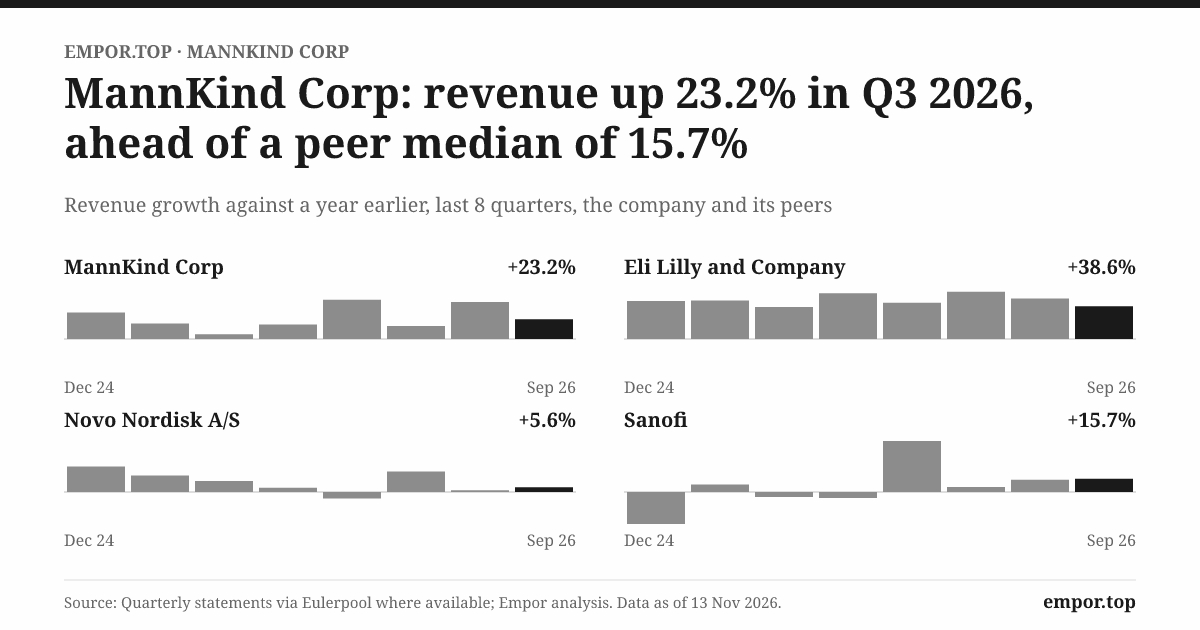
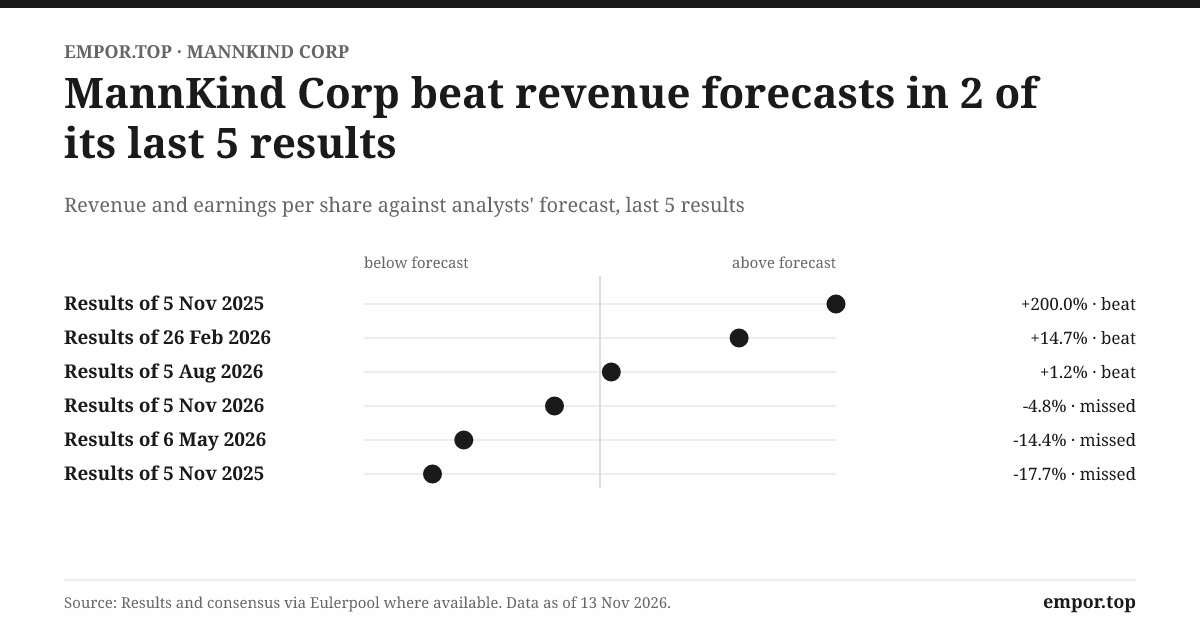
On November 5, 2026, MannKind Corporation released a quarter that could be read as two completely different stories, depending on which line a reader looked at first. The top line looked like a company that had finally arrived. Revenue for the three months to September came to $101.9 million, up 24% from a year earlier, and sales of the company's own commercial products had more than doubled, rising 102%.[^1] For a business that spent most of its public life reporting revenue measured in single-digit millions, a hundred-million-dollar quarter was a milestone in its own right.
The bottom line told the other story. MannKind lost $23.2 million in the same quarter.[^1] It was the fourth consecutive quarter in which the company reported a net loss, after a stretch in 2024 and most of 2025 in which it had looked, at last, like a profitable company.12 So the question hanging over the results was not whether MannKind was growing. It plainly was. The question was what kind of growth this was, and who it was really for.
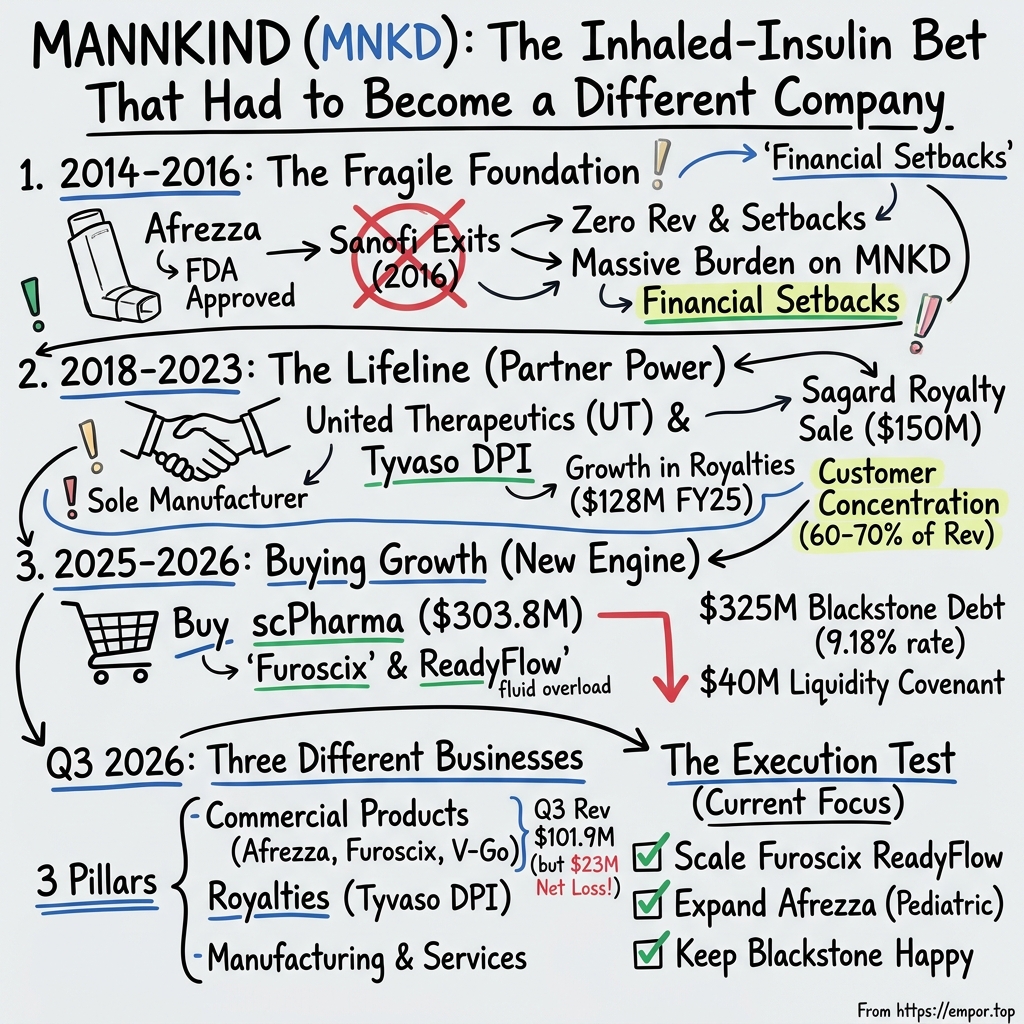
Inside that $101.9 million sat three very different businesses. About $45 million came from selling medicines MannKind itself markets: Afrezza, the inhaled insulin on which the company was built; V-Go, a small wearable insulin delivery device; and Furoscix, a treatment for fluid overload that MannKind had owned for barely a year.[^1] Another $37.5 million came as royalties on Tyvaso DPI, an inhaled pulmonary hypertension drug that United Therapeutics sells and MannKind manufactures.[^1] The remainder, roughly $19 million, came from the manufacturing and development work MannKind performs for that same partner. One way to hold the quarter in mind is as a three-legged stool, with one leg the company built, one it bought, and one it rents out to someone else's sales force.
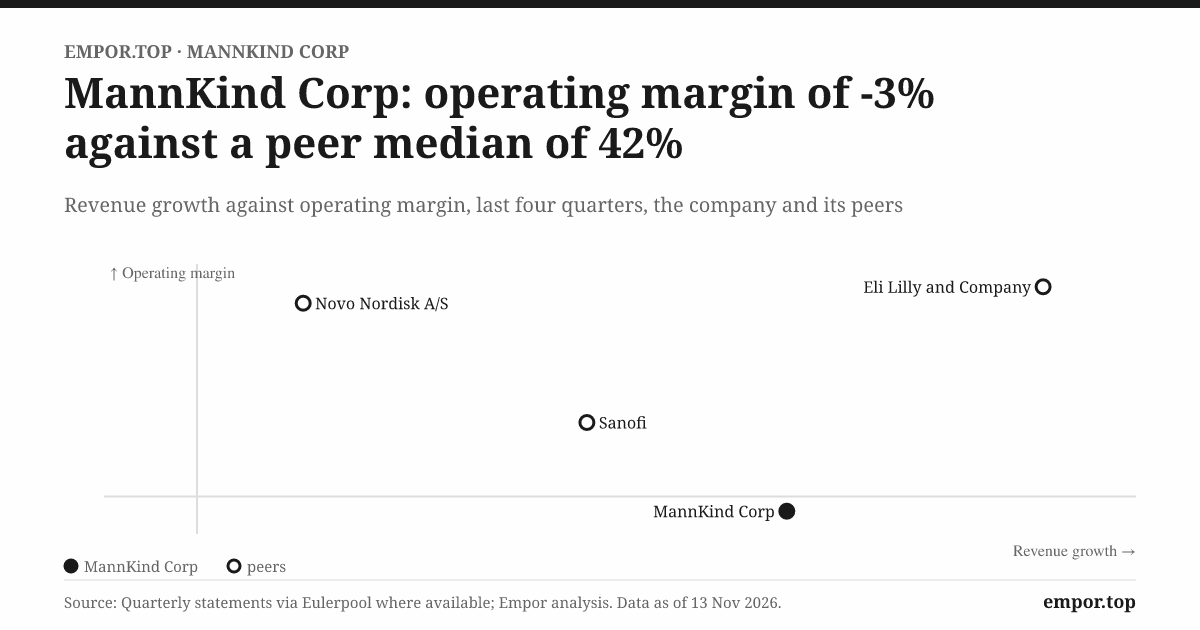
The size of the whole enterprise matters for what follows. In 2025, MannKind recorded about $349 million of revenue, up 22% from the year before.1 That is small by pharmaceutical standards and large by the standards of MannKind's own past. Yet over the last four reported quarters, the company lost money at both the operating line and the net line.2 The growth was arriving, but it was arriving bundled with the costs of launching products, the accounting that follows an acquisition, and the interest on a large new loan.
That is the puzzle at the heart of this story. Is MannKind's growth becoming a durable business, or is it still a collection of promising launches propped up by partner economics? The quarter offered clues pointing both ways. Commercial product sales more than doubling sounds like a turning point, but most of that doubling came from Furoscix, a product MannKind did not own a year earlier. Royalties look like a steady engine, but they depend entirely on how well United Therapeutics sells its drug, a decision MannKind does not control. And the loss is not a rounding error; it is roughly a quarter of revenue.
Three questions follow, and they run through the rest of this episode. Can Afrezza, the product that has defined MannKind for two decades, grow beyond a niche? Can Furoscix justify the price and debt MannKind took on to acquire it? And can the royalty stream from United Therapeutics fund the next stage of the company without leaving MannKind permanently dependent on a single partner?
Chief Executive Michael Castagna framed the moment as a shift in the company's posture, from delivering catalysts to executing against them.[^2] It was a revealing phrase. For most of its history MannKind was a company of catalysts: an approval, a partnership, a financing, a rescue. Catalysts are events. Execution is a run-rate. The market has spent years rewarding MannKind for the former, and the 2026 results are the first real test of the latter.
The verdict from this one quarter is narrow but clear. The product portfolio and revenue base have broadened substantially, and the company is no longer the single-product inhaled-insulin story it was a decade ago. But growth has not yet become consistent operating profit or cash earnings, and the gap between the headline growth rate and the bottom line is the part of the story most worth understanding.
To understand why that gap exists, and why MannKind made the choices that created it, the story has to go back to its biggest strategic wager. The company spent the better part of two decades and well over a billion dollars building an inhaled insulin. Then, having proved it could make the product, it went out and bought a second commercial medicine to change what MannKind is. The reason it had to do that begins with a partner who walked away.
 Subscribe on LinkedIn
II. The Technology That Outlived Its First Commercial Plan
In the first week of January 2016, MannKind disclosed that Sanofi, one of the three companies that dominated the world's insulin market, had given notice that it would terminate their collaboration on Afrezza.[^5] The product had been approved by the U.S. Food and Drug Administration in 2014, and Sanofi had launched it in 2015 with the weight of a global diabetes franchise behind it.3 One year in, Sanofi had sold only about $7.5 million worth.3 For a drug that was supposed to change how people with diabetes took insulin, that was not a slow start. It was a verdict.
By April 2016, the marketing rights had returned to MannKind.[^7] The company that had invented the product now had to sell it, with no global partner, no established diabetes sales force, and a balance sheet that had been carrying losses for years. Its revenue line in 2015 was zero.1
A founder's dream and a market of giants
The ambition behind Afrezza belonged to Alfred Mann, a physicist-turned-entrepreneur who had already built medical device businesses, including insulin pump maker MiniMed, before pouring much of his own fortune into MannKind.3 His idea was simple to describe and fiendishly hard to execute. Insulin injections are a daily burden for millions of people. If insulin could be breathed in, absorbed through the lungs and into the bloodstream quickly, then mealtime insulin could become something a patient took with a puff instead of a needle.
The enabling technology was called Technosphere. In plain terms, it is a way of making extremely fine, dry particles that carry a drug deep into the lungs, where the vast surface area of the air sacs lets the medicine dissolve and pass into the blood within minutes. Think of it as a delivery truck sized precisely to fit the smallest roads in the body. The particles are loaded into a small cartridge and inhaled through a palm-sized device. The point was not just convenience; inhaled insulin acts quickly, which in theory matched the body's own spike of insulin after a meal more closely than injected insulin did.
The development and approval journey took years and enormous sums, and by the time the FDA approved Afrezza, Mann was in the final stretch of his life. He died in early 2016, within weeks of Sanofi's exit.3 The dream had outlived its first commercial plan, and very nearly its founder's patience and money.
The industry was always the headwind. Insulin was, and is, controlled by giants: Eli Lilly, Novo Nordisk and Sanofi itself. They own the relationships with endocrinologists, the formulary positions with insurers, and the sales forces that call on primary-care doctors. Worse, inhaled insulin had already failed once in spectacular fashion. Pfizer's Exubera, approved in 2006, was withdrawn a short time later after weak sales, leaving a multibillion-dollar write-off and a deep skepticism among doctors and payers about the whole category.3 Afrezza was a smaller, more elegant device and a different formulation, but it had to sell into the memory of that failure.
Product proof is not business proof
This is the first lesson MannKind's history teaches, and it recurs throughout the story. Approval proved that Afrezza worked and was safe enough to sell, with conditions. It did not prove that doctors would prescribe it, that insurers would pay for it, or that patients would stick with it. Afrezza carried a boxed warning about the risk of acute bronchospasm in patients with chronic lung disease, and patients needed lung-function testing before starting therapy.3 Every one of those steps is friction for a busy physician who already has well-understood injectable options. Sanofi, with all its scale, could not overcome that friction quickly enough to justify continuing.
The cost of surviving the setback showed up everywhere in MannKind's financial statements. The company lost about $368 million in 2015.1 Shareholders' equity was negative, meaning the company's liabilities exceeded its assets, and it has remained negative in every year since.1 From 2014 through 2025, MannKind's cumulative net losses came to almost $900 million, and over that span its operating cash outflows totaled roughly $400 million, gaps that had to be filled with stock sales, loans and asset deals.1 That is the backdrop against which a new leader arrived.
Michael Castagna joined MannKind in March 2016 as chief commercial officer, weeks before the company took Afrezza back, and became chief executive in May 2017, succeeding Matthew Pfeffer.7 He was not a scientist-founder in Mann's mold. He was a commercial operator, trained as a pharmacist, with a Wharton MBA and a career spent in the business of selling medicines: roughly a decade at Bristol-Myers Squibb, including running its immunoscience division, then senior roles at Sandoz and Amgen, where he led global commercial work on biosimilars and lifecycle management.78 Biosimilars are a useful clue to his temperament. They are a business of fighting entrenched incumbents with a cheaper, compatible alternative, winning one formulary and one prescriber at a time. Castagna inherited something similar: a product the incumbents had abandoned, and a mandate to prove they were wrong.
The early record was sobering. MannKind's revenue was $11 million in 2017 and $27 million in 2018, and the company lost more than $100 million and then more than $80 million in those two years.1 Management talked about relaunching Afrezza with a focused sales force targeting endocrinologists, simplifying access and educating prescribers. Sales did grow, but slowly, and they remained a fraction of what the company needed to cover its costs. Even the healthy-looking 2016 accounts were an illusion of sorts: that year's revenue of about $174 million largely reflected the unwinding of the Sanofi collaboration, not customers buying Afrezza, and revenue then fell by more than 90% the following year.1
So by the late 2010s, MannKind faced a choice that every single-asset company eventually meets. It could keep funding a product it understood better than anyone in the world, betting that persistence would eventually unlock demand. Or it could find another source of cash to fund that persistence. Castagna's MannKind did not choose one or the other. It found a way to turn its factory, and its inhalation know-how, into someone else's growth engine. That turned out to be the deal that saved the company.
III. The Partner Deal That Turned a Factory into a Royalty Stream
In 2018, MannKind signed a license and collaboration agreement with United Therapeutics, a company built around treatments for pulmonary arterial hypertension, a rare and deadly form of high blood pressure in the arteries of the lungs.4 United Therapeutics already sold Tyvaso, a drug patients inhaled through a nebulizer, a bulky machine that turns liquid medicine into mist over several minutes, several times a day. What it wanted was a dry-powder version that patients could inhale from a small device in a breath or two. MannKind had exactly the technology to make that happen.
The deal was structured as an economic chain with three links. United Therapeutics would commercialize the product, which became Tyvaso DPI. MannKind would manufacture it and supply it, and perform development services along the way. And MannKind would earn royalties on United Therapeutics' sales.1 In other words, MannKind would be paid to make the product, paid to help develop it, and paid again every time someone sold it.
From royalty trickle to royalty river
The product won approval in 2022 and changed MannKind's financial shape almost immediately.4 Royalties rose from about $72 million in 2023 to about $128 million in 2025.41 Collaboration and service revenue, most of it tied to the same partner, reached about $107 million in 2025.1 Put together, the United Therapeutics relationship turned MannKind's revenue line from a trickle into something that could support a real company. Revenue roughly doubled in 2023 and grew another 44% in 2024; in 2023 MannKind reported a positive operating profit that, unlike the one-off 2016 figure, came from customers rather than an accounting unwind, and in 2024 it posted net income of about $27 million.14
It is important to separate two very different numbers here. In the third quarter of 2026, United Therapeutics sold about $379 million of Tyvaso DPI.[^2] That is not MannKind revenue. It drives MannKind's royalties and its manufacturing activity, but the vast majority of that money stays with the company that owns the product and the patients. MannKind's royalty on those sales was $37.5 million in the quarter.[^1] The headline sales figure is the size of the river; the royalty is the bucket MannKind gets to dip in it.
The concentration that comes with this arrangement is concrete. United Therapeutics accounted for about 72% of MannKind's revenue in the first nine months of 2025 and about 60% in the first nine months of 2026.2 The annual report presents the concentration on a different basis, putting United Therapeutics at about 30% of 2025 revenue and 35% of 2024 revenue, and the company does not reconcile the two presentations; the nine-month comparison is the like-for-like one.12 Either way, the direction is right and the level is still high. The share fell mainly because MannKind bought Furoscix, not because United Therapeutics' contribution shrank, which matters: dilution of a concentration is not the same as diversification of demand.
United Therapeutics is also almost the entire collaboration receivable. At the end of September 2026, it accounted for 97% of the money owed to MannKind for collaboration and services.2 There is no sign of payment trouble, and United Therapeutics is a large, profitable company. But a business whose biggest customer controls both the demand for the product and the timing of the payments is a business whose fortunes follow someone else's strategy.
Selling a slice of tomorrow
At the end of 2023, MannKind did something that told investors how management weighed that dependence. It agreed to sell one percentage point of its Tyvaso DPI royalty to Sagard Healthcare for $150 million upfront, with up to $50 million more available if certain sales thresholds were met.[^9] MannKind kept the remaining 9% royalty.[^9] The deal covered royalties through 2042, so MannKind effectively swapped roughly a tenth of a long income stream for a lump of cash now.
The temptation is to read that as a windfall. It was financing. The accounting treats it as a liability, which grows as interest is imputed on it and shrinks as royalty payments flow to Sagard.1 In 2025, MannKind recorded about $14 million of non-cash interest on that liability and passed about $13 million of royalty revenue through to Sagard.1 In practical terms, the company traded future royalty cash for today's flexibility, at an implied cost that depends entirely on how fast Tyvaso DPI grows. The better United Therapeutics does, the more expensive the deal looks in hindsight.
When it announced the Sagard deal, management presented the proceeds as fuel for pipeline investment and business development rather than as a rescue.[^9] That framing was consistent with a company whose operating cash flow had just turned positive. It also set up what came next. The Sagard proceeds, along with the operating cash that the United Therapeutics relationship generated, cleared the decks for a bigger move. Cash on hand was useful, but the company's leadership believed MannKind needed something more durable than a partner's royalty: a second commercial product that it owned outright.
That ambition reflects the strategic tension of this whole era. The partner cash flow funded growth, kept the factory busy, and gave MannKind its first profitable years. But the company was still, in an important sense, renting its future from United Therapeutics. If the partner's product slowed, faced new competition, or chose another supplier for a future version, MannKind had little to fall back on except Afrezza. So MannKind went shopping, and in 2025 it found what it wanted in a small company with a product designed to keep heart-failure patients out of the hospital.
IV. Buying Furoscix: A New Growth Engine with a Price Tag
On October 7, 2025, MannKind closed its acquisition of scPharmaceuticals, which the filings call scPharma.1 The prize was Furoscix, a version of the diuretic furosemide that patients could take at home through the skin rather than through an intravenous line in a hospital or clinic. Furosemide is one of the oldest and most widely used drugs in cardiology. It helps the body flush out excess fluid, and fluid overload is one of the most common reasons heart-failure patients end up in emergency rooms. The pitch for Furoscix was not a new molecule. It was a new place to give an old one: the patient's living room instead of a hospital bed.
The price was meaningful for a company of MannKind's size. MannKind paid about $303.8 million in cash for the equity, and the total deal value could reach about $363.5 million once contingent value rights, payable if certain milestones were met, were included.1[^11] The acquisition accounts recorded about $194 million for developed technology, meaning the existing product, and about $130 million for in-process research and development, meaning the pipeline work that had not yet reached the market.1 Most of what MannKind bought, in other words, was intangible: rights, regulatory work and future products.
A change of scale, paid for with debt
The deal changed MannKind's scale and its capital structure at the same time. To fund it, MannKind borrowed $325 million under a secured term loan from Blackstone.1 Borrowings on the balance sheet rose from about $48 million at the end of 2024 to about $473 million at the end of 2025, a figure that includes the Blackstone loan, the remaining convertible notes and other financing obligations.1 Total assets roughly doubled in the same year.1 This was a deliberate change of identity, from a company that relied on a partner's royalty toward a company that owned two commercial medicines and a much heavier balance sheet.
Was the price reasonable? A rough scale check helps. In August 2026, on the second-quarter call, management guided to Furoscix sales of $110 million to $120 million for 2026.5 The cash equity price of $303.8 million equaled roughly two and a half to two and three-quarters times that sales range. That ratio is not a peer valuation multiple; it ignores the debt MannKind assumed, the launch spending required, and the contingent payments. But it shows that MannKind paid for a product with real revenue, not just a story. Whether it overpaid depends on what Furoscix earns after the cost of selling it, and that number does not yet exist in public form. The honest verdict is that the purchase price looks proportionate to the guided sales, and that proportion will only be validated or refuted by contribution margins over the next several years.
In the 2025 results, Furoscix contributed about $23 million of revenue from the closing date to year-end, under three months of ownership.1 That number was enough to show that the product existed as a business. It was not enough to show it was a good one.
The milestone test arrives quickly
Acquisitions with contingent payments set their own exam schedule, and Furoscix's first tests arrived inside a year. The first was regulatory. In July 2026, the FDA approved ReadyFlow, a new version of the Furoscix delivery system.2 The original product used an on-body infusor, a small wearable pump stuck to the abdomen that delivered the dose over several hours. ReadyFlow was designed to be simpler and cheaper to make. Its approval triggered a contingent value right payment of approximately $44.8 million, which MannKind paid in the third quarter.2
The second test was commercial, and it went the other way. The deal also included a separate contingent payment tied to Furoscix reaching a sales threshold, and by September management said it no longer expected that $110 million sales milestone to be paid.2[^2] From a cash perspective, not paying a milestone is good news for MannKind's shareholders. From an evidence perspective, it is a signal: the product's sales were tracking below the level the deal had contemplated as a success case.
The third-quarter numbers show both sides of the launch. Furoscix revenue was $22.4 million in the quarter.[^2] That made it about half of MannKind's total commercial product sales, which also means Afrezza and V-Go together contributed only about $23 million. On the call, management said about 75% of shipments had moved to ReadyFlow by late October.[^2] Conversion from the old device to the new one is a necessary step, but it is a supply-side event. What it does not yet show is whether new prescribers keep writing prescriptions, whether patients refill, and whether insurers and specialty pharmacies keep the product easy to obtain.
The margin bill for a new product
The economic trade-off is concrete. The company expects ReadyFlow to cost less to produce than the on-body infusor, which should help margins over time.[^2] But in the third quarter, MannKind's commercial product gross margin fell from about 80% to about 73% year over year as Furoscix entered the mix.[^2] For every $100 of product sales, MannKind now kept roughly $7 less after the cost of making it. A lower-margin product can still be worth owning if it grows fast and carries its share of the sales force. The question is whether Furoscix's margin rises toward Afrezza's as ReadyFlow becomes the standard, or stays lower because of the costs of distribution, patient support and the device itself.
There is also a difference in tone between the two calls. In August, management was emphatic about the size of the opportunity, describing the number of heart-failure patients who might benefit from at-home diuretic treatment and guiding to triple-digit millions of sales for the year.5 By November, the emphasis had shifted to execution: the ReadyFlow transition, new prescriber counts, and channel access.[^2] Analysts on the third-quarter call pressed on demand and on how to interpret a quarter in which conversion and inventory movements could distort reported sales. Management's answers leaned on the transition and on long-term addressable patient estimates more than on hard data about repeat use and net revenue per patient.[^2] That does not mean the launch is failing. It means the company has not yet published the evidence that would prove it is working.
What Furoscix must prove is simple to state and hard to deliver. It needs sustained product revenue that grows quarter after quarter, and it needs improving contribution after the cost of the sales force and launch spending, not merely approval or a wave of early prescriptions. The deal turned MannKind into a company with two owned commercial products. It also turned MannKind into a company whose success depends on how three very different businesses fit together, and whether they reinforce one another or compete for the same scarce dollars and attention.
V. One Portfolio, Three Different Businesses
Picture MannKind's third-quarter income statement as a single room with three doors. Through the first door walk the commercial products, together about $45 million in the quarter.[^1] Through the second come the collaboration and service revenues, the money United Therapeutics pays MannKind to make and develop Tyvaso DPI. Through the third come the royalties, $37.5 million.[^1] Each door leads to a different business, with different customers, costs, risks and growth drivers. Adding them together produces a single revenue number that is easy to report and easy to misread.
The full-year 2025 numbers make the shape visible. Commercial product sales were about $114 million, collaboration and services about $107 million, and royalties about $128 million.1 Within the product line, Afrezza contributed about $75 million, V-Go about $16 million and Furoscix about $23 million, the last only for the period after the acquisition closed.1 That is a far more diversified company than the one Castagna inherited. But revenue is not interchangeable. A dollar of royalty costs MannKind almost nothing to earn and depends on a partner's sales. A dollar of Afrezza costs a sales force, marketing and manufacturing. A dollar of collaboration revenue carries manufacturing costs and the overhead of a factory.
Disaggregating the growth
That is why the headline growth rates need to be broken apart. Revenue grew 22% in 2025 and 24% in the third quarter of 2026.1[^1] Neither figure is a clean measure of Afrezza demand. In 2025, the growth came partly from rising Tyvaso-related revenue and partly from three months of Furoscix. In 2026, most of the commercial product growth came from Furoscix, which was not in the year-ago numbers at all. A listener should hear "24% growth" and think "mostly acquisition and partner," not "the inhaled insulin has taken off."
MannKind's manufacturing capability deserves its own moment, because it is the least visible and most distinctive part of the company. MannKind operates a plant in Danbury, Connecticut, where it makes the dry-powder formulations and the inhalers for both Afrezza and Tyvaso DPI.1 At the end of 2025, about 254 of its 592 employees worked in manufacturing.1 Making inhaled powders is genuinely hard. The particles must be precisely sized, stable, and delivered reliably from a cheap plastic device, batch after batch, at pharmaceutical quality standards. That capability is why United Therapeutics chose MannKind. But a factory is only an advantage if customers buy what it makes and the contracts produce returns. MannKind's capacity is valuable precisely to the extent that partners need it, and today the main partner is one company.
Afrezza, in both directions
The evidence on Afrezza points two ways. In one direction, sales rose from about $64 million in 2024 to about $75 million in 2025, a 17% gain for a product that critics had written off a decade earlier.1 And Afrezza won approval for use in children, opening a new indication with a patient population whose families often find injections especially burdensome.[^2] For a product that has struggled to break out, a pediatric label is a real door.
In the other direction, on the third-quarter call, management said adult promotional share of voice for Afrezza had fallen by about 65% as resources shifted to the pediatric launch and to Furoscix.[^2] Share of voice is a measure of how much of the sales and marketing conversation a product commands with doctors relative to competitors. Cutting it by roughly two-thirds in the core adult market is not a small change. It means MannKind chose to prioritize new indications and a new product over continuing to push its legacy one into its largest market. Management has said it intends to restore adult promotion over time.[^2] Until it does, Afrezza's growth in adults has to come from existing prescribers and word of mouth, not from new effort.
V-Go is the smallest and clearest piece. Sales fell from about $19 million in 2023 to about $16 million in 2025.41 It is a declining product in a market where newer wearable delivery devices have more momentum. Its role in the portfolio is modest, and its trend is a reminder that not every acquired or legacy asset becomes a growth engine.
Working capital is part of the business model
The final piece of the operating model is the one most likely to be overlooked. MannKind's inventory days, the number of days of cost of goods held on its shelves, reached 211 in 2025, up from 133 in 2024.1 The cash conversion cycle, which measures how long money is tied up between paying for inputs and collecting from customers, reached 197 days.1 In plain terms, MannKind ties up roughly six and a half months of cash in the gap between producing medicine and getting paid for it. Part of that reflects Furoscix inventory acquired with the company, and part reflects euro-denominated insulin purchase commitments that MannKind must honor regardless of Afrezza's sales.1 The company also recorded about $10 million of inventory write-offs in 2025.1 Inventory is not dead money in pharmaceuticals; launches require it. But inventory that does not sell becomes a cost, and a working-capital cycle that lengthens as revenue grows is a quiet drag on cash.
The way MannKind gets paid for its products adds another layer of judgment. Afrezza, V-Go and Furoscix move through wholesale distributors, and the price on the invoice is not the price MannKind keeps. Rebates to insurers and Medicaid, chargebacks, prompt-payment discounts and returns are all estimated and deducted. At the end of 2025, gross commercial receivables of about $44 million were reduced by a returns reserve of about $10 million and distributor and prompt-pay discounts of about $3 million.1 By September 2026, the three largest commercial receivable balances made up about 68% of commercial receivables, and one commercial customer alone accounted for about 15% of nine-month revenue.2 None of this signals a problem; the company reported no credit-loss allowance at that date.2 It does mean that the quality of MannKind's product revenue rests on a handful of distributors and on management's estimates of how much of each sale will be clawed back, which is why a sudden change in those reserves would be worth more attention than a headline sales beat.
The cost side explains why the 2025 profit faded even as revenue rose. Operating profit fell from about $73 million in 2024 to about $39 million in 2025.1 The single biggest driver was research and development, which more than doubled in two years, from about $31 million in 2023 to about $66 million in 2025, as the company pushed its pulmonary pipeline forward.1 Selling and administrative costs climbed too, ahead of and then after the scPharma closing. MannKind chose to reinvest its first real profits rather than bank them. That is a legitimate choice, but it means that the profitable years of 2023 and 2024 were a window, not a new baseline, and the company has not yet shown what its earnings look like once the spending stops rising.
This is where it would be easy to claim a moat. The strongest current proof of advantage is MannKind's status as the sole manufacturer of Tyvaso DPI, and the repeat demand for its own products. But durability and pricing power remain unproven. Sole-manufacturer status is a function of a contract and a qualified plant, not a law of nature. Repeat demand for Afrezza has been real but modest. The technology is distinctive, but distinctive technology did not save Afrezza under Sanofi.
So the central operating question for MannKind's portfolio is not whether each piece can grow. It is whether manufacturing scale, commercial teams and product launches can improve margins without making working capital and selling costs outrun sales. That question falls squarely on the people running the company, and on whether their decisions over the last decade have earned them the benefit of the doubt.
VI. Castagna's Expansion Test: From Rescue CEO to Portfolio Builder
On the November 2026 earnings call, Michael Castagna described the company as having moved from delivering catalysts to executing against them.[^2] It was the language of a leader who wanted to change the scoreboard. For most of his tenure, MannKind's wins had been events: a partnership signed, an approval received, a deal closed. Now he was asking to be judged on something harder to fake, which is the quarter-by-quarter performance of a business.
Castagna's team has a clear set of jobs. With Chief Financial Officer Chris Prentiss, who took the role in 2024, and a board chaired by James Shannon, the company has to integrate scPharma, allocate field teams between Afrezza and Furoscix, keep promoting Afrezza in adults while building the pediatric launch, and stay within the liquidity terms of the Blackstone loan.[^12]2 That is a lot of plates for a company with fewer than 600 employees at the end of 2025.1
The record, by outcome
The best way to judge management is to trace strategy by outcomes rather than slogans. The first decision was to keep Afrezza alive after Sanofi left. The outcome was a product that survived and grew, but slowly; nearly a decade after MannKind took it back, Afrezza's annual sales were around $75 million.1 That is a meaningful business for a company of MannKind's size, but not the scale of a product that changes diabetes care.
The second decision was the United Therapeutics partnership. The outcome was transformational: royalties and collaboration revenue turned MannKind into a company with real revenue and, for a while, real profits. This was the single best strategic decision of the era, and it is fair to credit it to the team that negotiated it.
The third decision was the Sagard royalty sale. The outcome was $150 million of cash in exchange for a slice of future royalties, a reasonable trade if the cash was deployed well.[^9] The fourth was the scPharma acquisition, funded with debt, whose outcome is still being written.
The counterevidence belongs in the same ledger. V-Go, a product MannKind acquired in 2022, has shrunk since 2023.41 In 2025, MannKind recorded a $6.4 million impairment on an available-for-sale investment, a write-down of money the company had put into a security that lost value.1 And the company has repeatedly turned to equity, asset transactions and debt to fund itself: a 2021 sale-leaseback of its facility, the 2023 royalty sale, the 2024 convertible note exchange, and the 2025 Blackstone loan.1 None of these are failures on their own. Together they show a management team that has been creative about funding, which is a strength, and that has rarely been in a position to fund ambitions from internal cash alone.
Promises against outcomes
When MannKind announced the Sagard sale, management framed the proceeds as giving the company flexibility to invest in its pipeline and in business development.[^9] That is broadly what happened: the cash supported the balance sheet that made the scPharma deal possible. But the acquisition was ultimately funded mostly with debt, which means MannKind both sold a piece of its royalty and borrowed against substantially all its assets within two years. A skeptical shareholder can reasonably ask whether those two moves together represent discipline or appetite.
The 2026 calls offer a test of forecast discipline. On the second-quarter call, management guided to $110 million to $120 million of Furoscix sales for 2026.5 By the third-quarter call, it was emphasizing the ReadyFlow transition and execution, and it had told investors that the separate $110 million sales milestone was not expected to be paid.[^2]2 That is not the same as missing guidance, since the milestone and the guidance are measured differently. But it signals that Furoscix sales were tracking below at least one bar that the deal itself had set.
One governance detail from the 2025 audit is worth a sentence. The independent auditor gave clean opinions on both the financial statements and internal controls, but excluded scPharma from its internal-control assessment because the business had only just been acquired; scPharma then represented about 7% of consolidated assets, excluding goodwill and intangibles, and about 7% of revenue.1 That exclusion is routine for a fresh acquisition. It also means the 2026 audit will be the first to test the controls of the business on which MannKind's growth now most depends.
Current milestones deserve proportionate treatment. Pediatric approval for Afrezza and the ReadyFlow launch are real accomplishments. Neither proves long-run adoption. MannKind's own history teaches that an approval is the start of a commercial test, not the end of one.
Pay and alignment
Compensation offers its own view of alignment. Castagna's reported total compensation was about $9.3 million in 2025, including about $7.7 million of stock awards valued at the date they were granted.[^12] That was roughly flat with 2024, while net income fell from about $27.6 million to about $5.9 million.[^12]1 On the other hand, the proxy's "compensation actually paid" figure for 2025, which adjusts equity awards for changes in the share price, was only about $0.75 million.[^12] That gap is the clearest evidence that a large part of the CEO's pay rides on the stock: when the share price falls, the realized value of his awards falls with it. Castagna owned about 1.1% of the company according to the 2026 proxy.[^12]
Shareholders mostly approved. The 2026 say-on-pay vote drew about 137 million votes in favor and about 16 million against, or about 10.6% opposition among votes cast for or against.6 That is not a protest vote, but it is not unanimity either. The next proxy will show which performance targets drove 2026 awards, and whether they rewarded revenue growth that came from an acquisition or profit and cash that came from execution.
Castagna has overseen a genuine shift, from one product toward royalties and multiple commercial products. The record is mixed: revenue has grown impressively, but it has not yet become consistent profits, and the scPharma deal raises the stakes on execution. Credibility is now a live test. MannKind has more products and more debt than at any point in its history, and the debt has its own rules.
VII. The Debt Behind the Diversification
In March 2026, a small but symbolic piece of MannKind's financial history quietly ended. The company settled the last $36.3 million of its convertible notes due that year, paying about $35.5 million in cash and the rest in shares.2 For more than a decade, convertible notes had been one of MannKind's lifelines: debt that lenders could swap for stock if the share price rose, which let a cash-hungry company borrow at lower interest in exchange for future dilution. Most of that legacy had already been dealt with in 2024, when MannKind exchanged the bulk of its convertible notes for about 26.7 million new shares and about $89.2 million of cash.42 By the spring of 2026, the convertible era was over.
What replaced it was a very different kind of lender. At the end of September 2026, MannKind owed $325 million in principal to Blackstone, at an effective interest rate of about 9.18%.2 The loan matures in 2030, pays a floating rate set at a margin of 4.75 percentage points over SOFR, the benchmark short-term interest rate, and is secured by substantially all of MannKind's assets, including its intellectual property.2 The company must keep at least $40 million of unrestricted liquidity at all times.2 Cash plus short-term investments stood at about $97 million at the end of the quarter.2
How the expansion was funded
Laying out the sequence makes the financial engineering clear. MannKind spent years funding itself with stock sales. In 2021, it sold its manufacturing facility and leased it back, raising cash while keeping the plant.1 At the end of 2023, it sold a slice of its Tyvaso DPI royalty to Sagard.[^9] In 2024, it cleaned up most of its convertible debt. In 2025, it borrowed from Blackstone to buy scPharma.1 Each step solved one problem and created a new kind of claim on the company's future cash.
Those claims are not the same, and they are worth separating. The Blackstone loan is classic secured debt: interest is paid in cash every quarter and principal is due in 2030. The Sagard royalty liability is not debt in the usual sense; it is repaid out of Tyvaso DPI royalties that flow directly to Sagard, and its accounting interest is largely non-cash.1 The sale-leaseback created a financing liability of about $103 million at the end of 2025, reflecting rent MannKind must pay to use the plant it sold.1 All three reduce the cash available to shareholders. Only the Blackstone loan carries a covenant that can trigger a default if the company runs short.
The cash pattern
The recent cash record is mixed. In 2025, MannKind generated about $18 million of operating cash flow and about $14 million of free cash flow, after capital spending.1 Those were real positive numbers, though thin. In the first nine months of 2026, the company lost about $58.9 million on a net basis, and its cash balance fell from about $74.9 million to about $41.3 million, even as it continued to hold short-term investments.2 Part of that decline reflected the roughly $44.8 million ReadyFlow milestone payment and the convertible settlement, both one-time items.2 Part reflected interest on the Blackstone loan, which at an effective rate above 9% on $325 million implies roughly $30 million a year of interest expense on that facility alone. And part reflected the cost of launching Furoscix and supporting Afrezza.
The covenant mechanism is what turns this from an accounting question into a strategic one. The $40 million liquidity floor is not a target; it is a tripwire. If unrestricted liquidity falls below it, the lender can declare a default. And the loan's terms restrict asset sales, further royalty sales, additional acquisitions and other actions without Blackstone's consent.2 Those are precisely the tools MannKind has historically used to fund itself. The company reported that it was in compliance with its covenants at September 30, 2026.2 But a company whose survival has depended on creative financing now has a lender with veto rights over the next creative financing.
Reported profit and cash have rarely moved together at MannKind, and the gap is worth understanding before trusting either. In 2025, the company earned about $5.9 million of net income but generated about $18 million of operating cash.1 The difference came mostly from charges that cost no cash: about $24 million of stock-based compensation, about $14 million of imputed interest on the Sagard royalty liability, about $12 million of depreciation and amortization, and about $10 million of inventory write-offs, partly offset by about $13 million of royalty revenue that MannKind booked but passed straight through to Sagard.1 The stock compensation deserves a second look. It does not drain cash, but it is a real cost to shareholders, paid in dilution rather than dollars, and it was roughly four times the year's net income.
Currency adds noise on top. MannKind has committed to buy insulin from Amphastar in euros, so every move in the euro against the dollar changes the value of that obligation. In 2025 the company recorded a non-cash foreign-exchange loss of about $7.7 million; in the first nine months of 2026, the euro's move produced a gain of about $2.2 million.12 The company does not disclose a hedging program.1 These swings do not change the business, but they can swing a small quarterly profit into a loss, or the reverse, and investors reading headline earnings should strip them out.
Dilution deserves perspective too. MannKind had about 321.6 million shares outstanding in October 2026.2 The 2024 convertible exchange alone added about 26.7 million shares, and years of equity raises before that compounded the count. Shareholders have been diluted repeatedly; the Blackstone loan is, in part, an attempt to grow without diluting them further. That is a defensible choice. It simply swaps one cost, dilution, for another, interest and covenants.
A skeptical investor would stress-test this structure by asking what happens if things go wrong. If Furoscix sales stall or Tyvaso DPI royalties slow, MannKind's cash generation would weaken while interest payments continued. Management could cut spending, but the obvious candidates, sales and marketing for Afrezza and Furoscix, are precisely the investments the growth story depends on. Research and development, which reached about $66 million in 2025, or about 19% of revenue, is another lever, but cutting it would push back the pipeline options that justify the platform narrative.1 There is room to manoeuvre, but not much room for a long stretch of disappointment.
The watch item here is concrete. It is not total cash plus investments, which can include balances that are not counted the same way under the loan. It is unrestricted liquidity measured against the $40 million covenant, and operating cash flow after interest. Those two numbers determine how much freedom MannKind has to pursue the future its management describes. And that future rests on a claim about competitive position that deserves a hard look.
VIII. What Has to Be True for MannKind to Win
Three products and programs sit in MannKind's portfolio at very different stages of proof. Afrezza's pediatric launch is underway, with a new label and an established product. Furoscix ReadyFlow is in its first months on the market. And an inhaled version of nintedanib, a drug used to treat idiopathic pulmonary fibrosis, a scarring disease of the lungs, is in a Phase 2 clinical trial.[^2] Investors who hear "platform" are being asked to treat Afrezza and nintedanib as related bets on the same underlying capability. They are related. Furoscix is a separate commercial bet.
The scorecard for the quarter ties them together: Afrezza remains an established product,1 Furoscix is in launch,[^2] and Tyvaso royalties coexist with a quarterly loss.[^1] Those numbers describe a company with real assets and a cost structure that has not yet caught up with them.
The war game
Start with the competitive arena, because this is where the investment case is either won or lost. In insulin, MannKind faces a market shaped by Eli Lilly, Novo Nordisk and Sanofi, whose scale and relationships with prescribers and payers dwarf MannKind's. They control formulary positions with large insurers, negotiate rebates across portfolios of products, and fund sales forces many times larger than MannKind's entire employee base. Afrezza's selling point, a rapid-acting insulin breathed in at mealtimes, is distinctive, but distinctive is not the same as preferred. Doctors are comfortable with injectable rapid-acting insulin, insulin pumps and, increasingly, automated delivery systems linked to continuous glucose monitors.
In pulmonary hypertension, the arena looks completely different. There, MannKind is not competing with United Therapeutics; it is United Therapeutics' supplier. The partner owns the customer relationship, the pricing decisions and the commercial strategy. MannKind's manufacturing position is valuable but partner-dependent. If United Therapeutics' product faces competition from other inhaled treatments for pulmonary hypertension, MannKind's royalties feel it. If United Therapeutics decides to build or qualify a second manufacturing source, MannKind's bargaining power shrinks.
Porter's five forces sharpen the picture. Buyer power is high: in the royalty and manufacturing business, the buyer is a single partner that represented about 60% of revenue in the first nine months of 2026, and in commercial products, three wholesale distributors each represent a large share of sales.21 Supplier power is meaningful too, since MannKind has euro-denominated commitments to buy insulin from Amphastar, which it must honor whether or not Afrezza sales grow; a 10% move in the euro would shift pre-tax income by roughly $6.6 million.1 The threat of substitutes is high in insulin, where established delivery methods dominate. Rivalry is intense with giant incumbents. The barrier to new entrants is the one force that works in MannKind's favor: making inhaled powders at commercial scale is technically demanding and requires regulatory approval, so a new competitor cannot simply copy the factory.
Hamilton Helmer's seven powers ask a narrower question: what lets a company earn returns above its cost of capital for a long time? MannKind's strongest candidate is a form of cornered resource, its manufacturing know-how and status as sole manufacturer of Tyvaso DPI. That is real but contractual, held at the partner's pleasure as much as by right. Switching costs exist for United Therapeutics, because qualifying a new manufacturer for an approved inhaled drug takes years and regulatory work, but they are not permanent. MannKind does not have scale economies relative to the insulin giants, network effects, or a brand that commands pricing power. Its patents and process expertise provide some protection, but the history of Afrezza shows that technical protection does not create demand.
Testing the platform claim against history
The strongest version of the bull case is that MannKind's inhalation platform can produce a stream of products, each benefiting from the same manufacturing capability and know-how. MannKind's own record is the most relevant test. Afrezza won approval in 2014 and, more than a decade later, generates about $75 million a year.31 Tyvaso DPI succeeded spectacularly, but it succeeded because United Therapeutics already owned a franchise and a sales force in the disease; MannKind's contribution was the delivery technology. The platform's track record, therefore, is one clear success that depended on a partner's commercial machine, and one long struggle when MannKind owned the product.
That history does not reject the platform claim. It narrows it. The evidence supports a smaller version: MannKind is good at making inhaled versions of drugs and can create real value when a partner with an established franchise sells them. It does not yet support the claim that MannKind can turn its own inhaled products into large businesses on its own. The KPI that would confirm the larger claim is sustained growth in Afrezza sales and a second partnered or owned inhaled product reaching commercial scale.
Nintedanib sizes this correctly. The inhaled version completed Phase 1b work and is now in a Phase 2 trial, with management pointing to a readout in the first half of 2028.[^2] That readout is the next meaningful proof point. It is a future option, not current value, and the history of Afrezza argues for discounting even a positive clinical result until it becomes repeat revenue.
The near-term risks all work through the same economics. United Therapeutics' demand and concentration determine royalties and manufacturing revenue. Furoscix adoption and gross margin determine whether the acquisition pays. Afrezza's promotional coverage and competition determine whether the legacy product grows. Euro-denominated insulin commitments create non-cash swings and real purchase obligations. And costly secured financing absorbs cash that could otherwise fund growth.
Three numbers to watch
Out of all the possible measures, three matter most for the next four quarters. The first is United Therapeutics' share of MannKind revenue, which stood at about 60% for the first nine months of 2026, down from about 72% a year earlier.2 The direction is right, but only if royalties keep rising while the share falls. The second is product-level sales and gross margin for Afrezza and Furoscix; commercial product gross margin was about 73% in the third quarter, down from about 80% a year earlier.[^2] The third is operating cash flow measured against debt interest and the liquidity covenant; after a positive 2025, the first nine months of 2026 brought a net loss and a fall in cash from about $75 million to about $41 million.12
The decision rule follows. A winning case needs declining United Therapeutics concentration without a fall in royalties, growing product sales with improving margin, and positive cash after launch investment. If all three appear together, the diversification thesis has its proof. If they diverge, the company is still dependent on its partner, still investing ahead of returns, or still borrowing the time it needs. MannKind has been here before, and the lessons of that earlier history are worth stating plainly.
IX. Lessons from the Inhaler and the Royalty Check
Two moments bookend MannKind's modern history. In early 2016, Sanofi handed back Afrezza after selling only about $7.5 million of it in a year.3 A decade later, a royalty on someone else's inhaled lung drug, worth about $128 million to MannKind in 2025, was part of the financial foundation that let the company buy a second commercial product.1 Between those moments, MannKind learned more about the economics of invention than most companies ever have to.
The first lesson is the one Afrezza taught at Sanofi's expense: an approval opens a door; it does not bring customers through it. The FDA's yes in 2014 was a scientific and regulatory triumph. It did not change the habits of prescribers, the formulary decisions of insurers or the preferences of patients who already managed their insulin with needles and pens. Every founder who believes a breakthrough will sell itself should study what happened when one of the world's largest insulin companies tried to sell Afrezza and gave up within a year. The product was real. The market for it was not yet built, and it could not be built quickly.
The second lesson came from the United Therapeutics deal: a partner can turn an invention into cash flow, and make your fortunes follow someone else's sales force. MannKind's technology found its greatest commercial success not in the disease it was designed for, but in a partner's franchise, where the partner already owned the doctors, the patients and the distribution. That is a powerful model. It is also a dependent one. Tyvaso DPI's growth lifted MannKind into profitability, but every quarter since, the company's results have risen and fallen with decisions taken in another company's boardroom.
The third lesson is the one the Sagard sale wrote in ink: when you sell tomorrow's royalty to pay for today's plan, the plan has to earn its keep. MannKind took $150 million for a tenth of its Tyvaso DPI royalty, then borrowed $325 million to buy scPharma.[^9]1 Each step was sensible on its own. Together, they mean the company now receives less of its best income stream and owes more to a secured lender, which raises the bar for every product it sells. The royalty that once funded the company's survival is now partly committed to Sagard until 2042, and its value is now being reinvested in a bet that has to work.
The fourth lesson is the one Furoscix is writing right now: a second product is diversification only when it carries its own economics. Owning two commercial medicines instead of one sounds like reduced risk. But if the second product carries lower margins, requires an expensive launch and is financed with debt, it can increase the company's risk even as it reduces its concentration. Diversification in the income statement is not the same as diversification in the cash flow statement. The early conversion to ReadyFlow and the wave of new prescribers are evidence of motion, not of returns.
The company-specific lesson binds the others together. MannKind's survival has depended on repeatedly finding a new way to monetize its technology: a global partner, a commercial relaunch, a royalty deal, a royalty sale, a loan, an acquisition. Each funding bridge carried the company to the next shore. The next chapter must show that MannKind can keep the economics as well as create the products, because each bridge has made the next execution test more consequential than the last.
X. Analysis & Bear vs. Bull Case
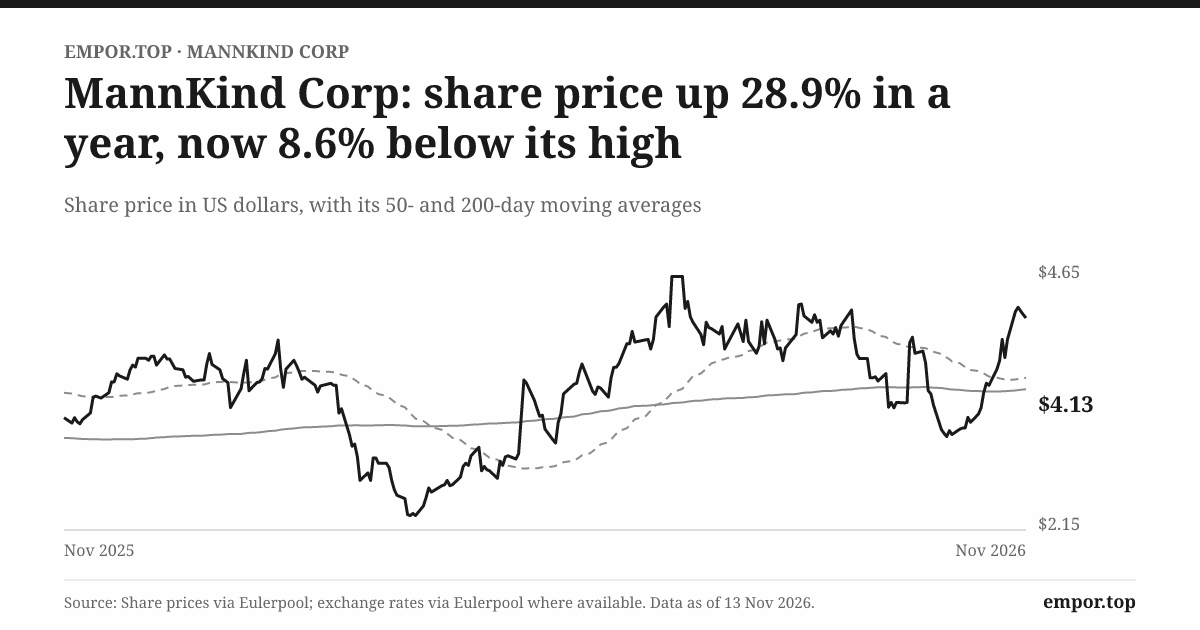
On November 13, 2026, MannKind's stock closed at $4.13, within about 9% of its 52-week high of $4.52 and well above its 52-week low of $2.28.[^16] The market valued the equity at about $1.3 billion and the enterprise, including debt and net of cash, at about $1.6 billion.[^16] The rally came in a year in which the company reported four consecutive quarterly losses. Somebody in the market was paying for a future that the income statement had not yet delivered.
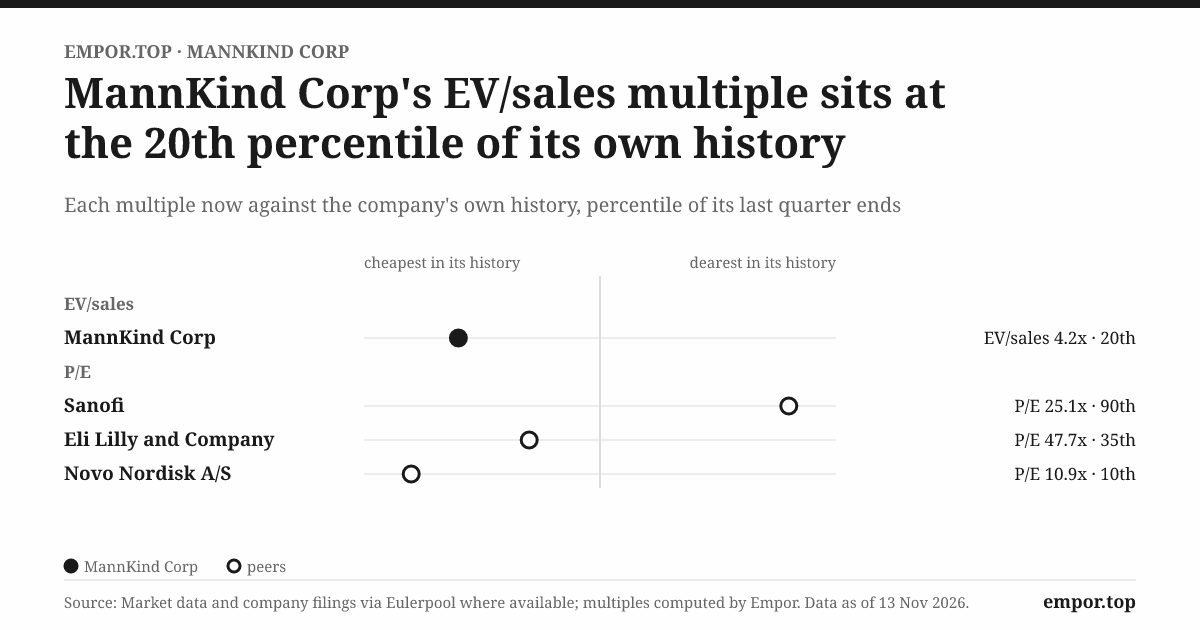
The valuation numbers show how much. Measured on 2025 earnings, MannKind traded at about 356 times earnings, against its own five-year median of about 88 times.[^16]1 Enterprise value was about 4.2 times sales and about 237 times EBITDA, and the free-cash-flow yield on the last twelve months was negative, at about minus 6%.[^16] Those multiples are distorted, because the earnings base is tiny and in the latest twelve months negative. A P/E of 356 is not really a valuation; it is the arithmetic consequence of dividing a $1.3 billion market value by about $5.9 million of net income.1 The more meaningful comparison is enterprise value against sales and against cash generation. At about four times sales, the market is valuing MannKind as a company whose revenue will eventually turn into substantial profit, not as one that is barely breaking even.
The bull case
The bull case has real assets behind it. Tyvaso DPI royalties and manufacturing revenue continue to grow as United Therapeutics expands the franchise. Afrezza gains a new growth leg in children and, once adult promotion is restored, reaccelerates in its core market. ReadyFlow lowers Furoscix's cost of goods and makes home treatment easier to prescribe, so that the product's margin rises and its sales compound. The manufacturing platform, proven by Tyvaso DPI, attracts further partnered products, and the nintedanib program adds a clinical option in a serious lung disease. In this version of the story, the 2026 losses are the trough of an investment cycle, and the company emerges with three growing revenue streams and operating leverage as sales outrun a now-built cost base.
The bear case
The bear case is stronger on current earnings quality. United Therapeutics remains the largest customer and controls the demand that drives most of MannKind's profit. Afrezza remains small against the insulin giants after more than a decade on the market, and its adult promotion has just been cut by about two-thirds.[^2] Furoscix needs expensive launch investment, carries lower margins than the products it joined, and is no longer expected to reach the sales milestone the acquisition contemplated.2 Recent quarterly operating losses, combined with interest costs on a loan with an effective rate above 9%, may absorb the growth for longer than the market's current price assumes.2
The manufacturing advantage remains narrow and partner-dependent. The bull case requires that advantage to broaden. The bear case requires only that it stay as it is while costs remain high.
The management and capital-allocation tests
The management test is about reconciling narrative with numbers. Castagna's strategy has diversified the revenue base, which is a genuine achievement. But the acquired product's sales milestone was not expected to pay as of the third quarter, and the company must reconcile its growth narrative with realized sales, margins and liquidity.[^2]2 The next few quarters will show whether guidance becomes more conservative and more precise, or stays anchored to addressable-market estimates.
The capital-allocation test centers on scPharma. The cash purchase price was substantial relative to MannKind's historical revenue base. The available evidence does not establish that MannKind overpaid against comparable transactions in the industry; the decisive benchmark is whether Furoscix sales and contribution margin justify the price and the debt that financed it. If Furoscix reaches and sustains guided revenue with improving margins, the deal will look sensible. If it stalls at the third-quarter run-rate, the combination of debt, launch costs and lower margins will look like an expensive way to reduce customer concentration.
A skeptical long-term holder would push further. Was selling part of the future Tyvaso DPI royalty, borrowing against substantially all assets, and adding a commercial launch force the best available use of capital? Or would a slower growth plan, keeping the royalty, avoiding secured debt and building Afrezza organically, have protected more of the franchise's value? The question is not rhetorical. An activist might ask the board to explain, with numbers, why the expected return on scPharma exceeds the return MannKind gave up on the royalty slice it sold, and how the board will judge the acquisition if Furoscix falls short of guidance.
The plain verdict is that the transformation is underway, not complete. The market price assumes that MannKind's launches succeed and that growth converts into cash before that record exists. That may happen. But the investment case today depends on proof of product-level economics and cash generation that the company has not yet published, and the next year of results will decide whether the price was foresight or hope.
XI. Epilogue
Tonight, MannKind is a different company from the one Sanofi walked away from. ReadyFlow entered the market and took over most of Furoscix's shipments. Afrezza's pediatric launch is underway. The convertible notes are gone, the Blackstone loan runs to 2030, and the company says it is in compliance with its covenants.2 Management says execution is now the test.[^2] For once, the company and its skeptics agree on what matters.
The next four quarters will write the story's most important chapter, and each of the decisive moments can be named. The first comes with the fourth-quarter results in early 2027, when MannKind reports its first full year of Furoscix ownership. That report will show whether Furoscix met management's August sales guidance and whether ReadyFlow began to lift commercial product gross margin.5[^2] A product that hits its guide with improving margin would be a strong signal that the acquisition carries its own economics. A product that misses, with margins stuck, would push the burden back onto the royalty.
The second moment is quieter but just as important: the first quarters in which Furoscix is in both the current and year-earlier figures. From the fourth quarter of 2026 onward, MannKind's growth rate can no longer be flattered by an acquisition. If revenue still grows at double digits once Furoscix is in the base, the company's organic engines are working. If growth collapses toward single digits, the 2025 and 2026 growth rates were mostly purchase, not performance.
The third is Afrezza's adult business. Pediatric uptake is a genuine opportunity, but if adult promotion is not restored, the core market could stagnate while the company celebrates a new indication. The evidence to watch is net sales growth, not prescription anecdotes. The fourth is United Therapeutics' share of revenue and the royalty line itself, as Tyvaso DPI faces competition and its commercial execution evolves. Concentration should fall because other revenue grows, not because royalties shrink.
Further out, the nintedanib program heads toward a clinical readout in the first half of 2028.[^2] A positive result would be welcome, but it would be a clinical milestone, not commercial value, and MannKind's own history makes that distinction unusually important.
And through all of it, the lender will be watching the same number investors should: unrestricted liquidity against the $40 million covenant, and operating cash flow after interest, acquisition payments and launch investment.2 That is the quiet clock behind every product decision.
The question that cannot yet be answered is the one the company has been chasing for two decades: whether MannKind can turn its platform into a repeatable commercial company, rather than a sequence of rescued products and monetized royalties. The tools are on the table. The proof is not.
XII. Outro
Somewhere in Danbury, Connecticut, a production line is filling small plastic cartridges with a powder so fine it behaves almost like a gas. Some of those cartridges will become Afrezza, the insulin Alfred Mann dreamed of. Others will become Tyvaso DPI, a partner's medicine that earns MannKind a royalty with every breath a patient takes. The factory does not care which is which. The balance sheet does.
That is what makes MannKind unlike any other company in this story. It has spent decades proving it can make the technology work. What it has not yet proved is the oldest question in the business of invention, the one that the inhaler, the factory and the royalty statement all keep asking in different words: who captures the value? For most of its history, the honest answer has been someone else. The next chapter will show whether MannKind can finally keep enough of what it makes to stand on its own.
References
-
Form 10-K for year ended December 31, 2025 — SEC, 2026-02-26 ↩↩↩↩↩↩↩↩↩↩↩↩↩↩↩↩↩↩↩↩↩↩↩↩↩↩↩↩↩↩↩↩↩↩↩↩↩↩↩↩↩↩↩↩↩↩↩↩↩↩↩↩↩↩↩↩↩↩↩↩↩↩
-
Form 10-Q for quarter ended September 30, 2026 — SEC, 2026-11-05 ↩↩↩↩↩↩↩↩↩↩↩↩↩↩↩↩↩↩↩↩↩↩↩↩↩↩↩↩↩↩↩↩
-
Sanofi Drops MannKind's Inhaled Insulin — Nature Biotechnology, 2016-03 ↩↩↩↩↩↩↩↩
-
Form 10-K for year ended December 31, 2024 — SEC, 2025 ↩↩↩↩↩↩↩
-
Second Quarter 2026 Earnings Call Transcript — Stock Analysis, 2026-08-05 ↩↩↩↩
-
Castagna takes reins as CEO at MannKind — The Signal, 2017-06 ↩↩
 LinkedIn
 WhatsApp
 Reddit
 Hacker News
 Email
 Kindle
 RSS Feed
 Spotify
 Apple Podcasts
 Amazon Music
 Audible
 YouTube