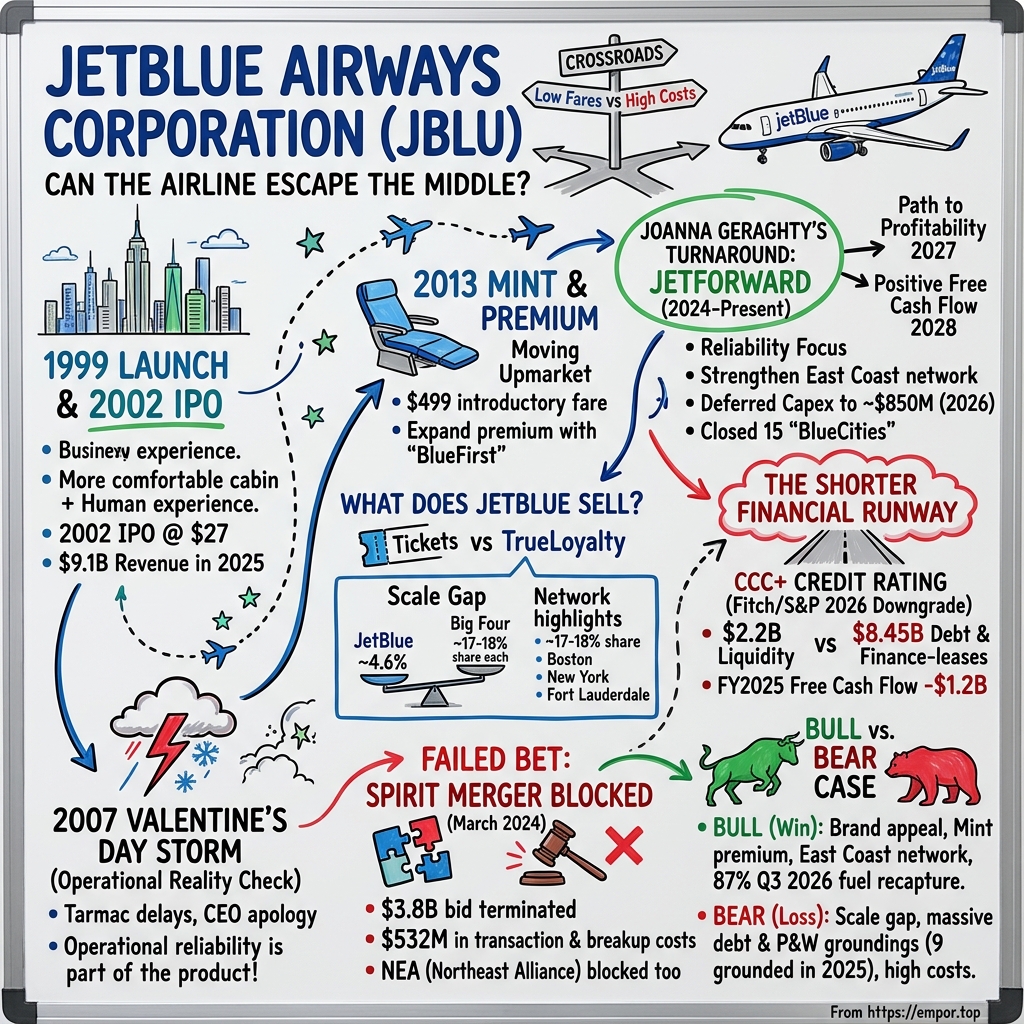
JetBlue Airways Corporation: Can the Airline Escape the Middle?
I. The Airline at the Crossroads
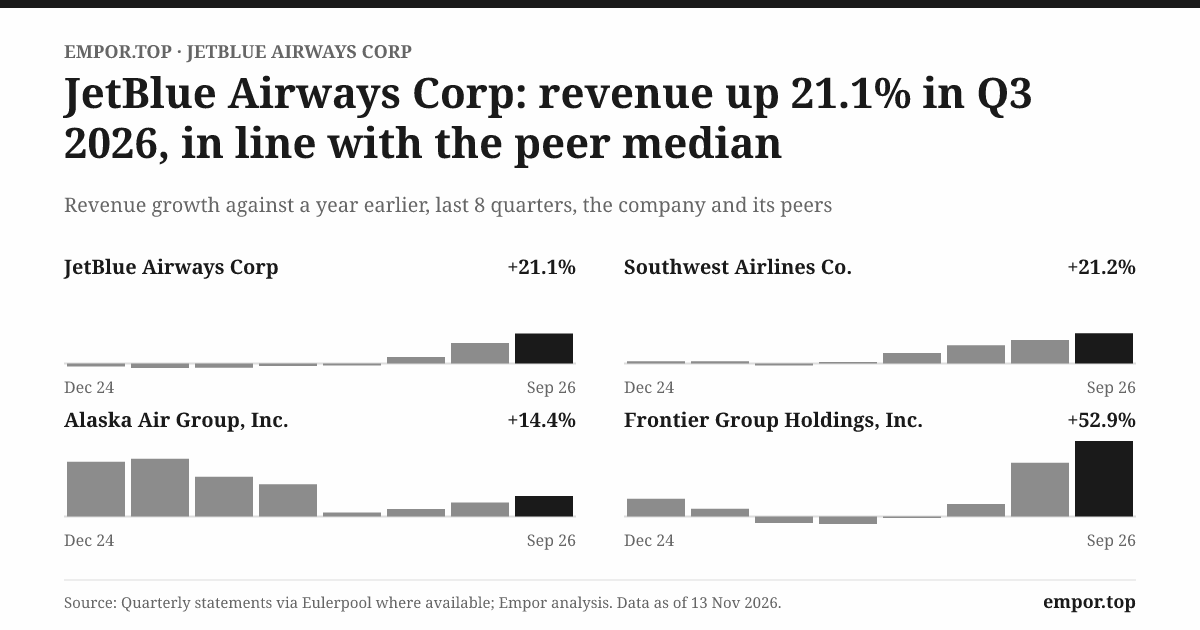
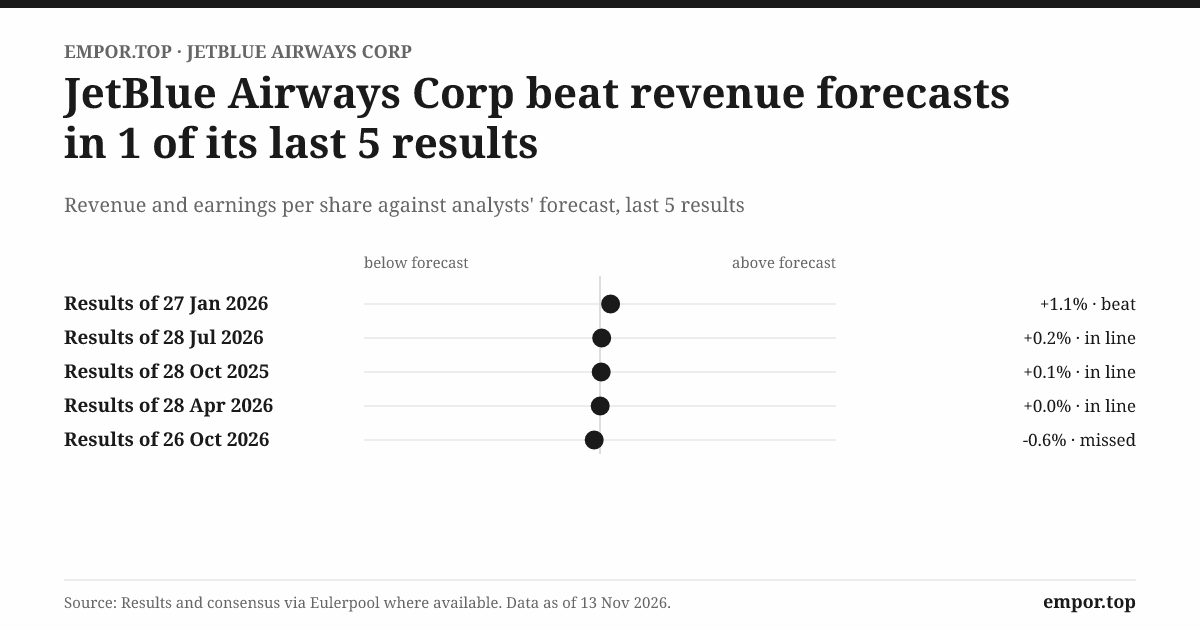
On October 26, 2026, JetBlue Airways told investors something it had not been able to say with conviction for years: people wanted its seats again, and they were paying more for them. Revenue for the third quarter came in at about $2.8 billion, up 21.1% from the same quarter a year earlier.1
For an airline whose sales had shrunk in almost every quarter of 2024 and 2025, that was not a rounding error. It was the strongest top-line quarter in the company's recent history, and it arrived in the middle of a year in which jet fuel had turned expensive and Northeast summer skies had been clogged by weather and air-traffic-control limits.
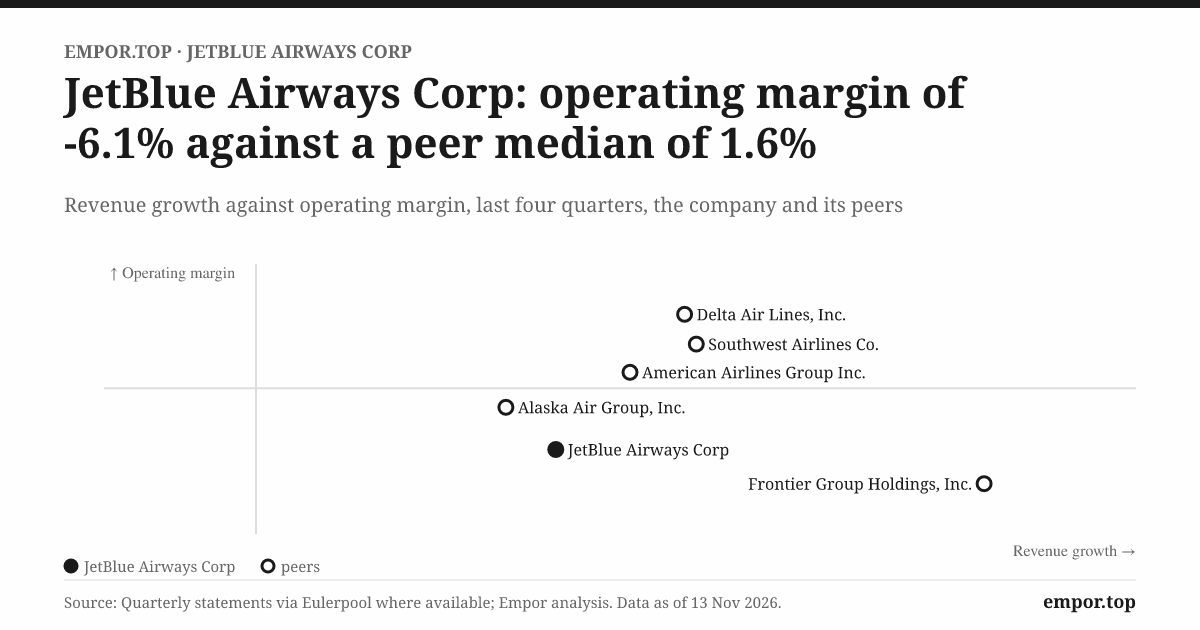
Then came the line that mattered more. After paying for fuel, crews, aircraft, maintenance, airports and everything else it takes to fly a plane from Boston to San Juan, JetBlue still reported a GAAP operating loss of $144 million.1 Its operating margin was roughly minus 5%.
In other words, for every $100 a customer handed over, the airline spent about $105 before it paid a cent of interest on its debt. Revenue was up by a fifth, and the business still lost money on the act of flying.
That gap is the story. JetBlue spent a quarter of a century trying to occupy a place in American aviation that is notoriously hard to hold: better than the bare-bones discounters, cheaper and friendlier than the giant network carriers. Airline analysts call this "the middle," and it has a long record of swallowing companies whole.
The middle is where an airline carries some of the cost of a premium product without the scale, the global network and the corporate contracts that let Delta, United and American charge for it. It is also where an airline cannot quite match the stripped-down unit costs of the ultra-low-cost operators that compete on price alone.
So this episode turns on three questions. The first is whether a differentiated airline can be made to pay: whether JetBlue's cabin, its loyalty program and its premium Mint product earn enough to cover the cost of providing them.
The second is whether it can do that without buying scale, because three times in the past decade JetBlue tried to solve its size problem by acquisition or alliance, and each time a rival bidder or a federal court stopped it. The third is about time. Does JetBlue have enough liquidity to prove the first point before its creditors lose patience?
The clock is real. At September 30, 2026, JetBlue reported about $2.2 billion of liquidity, including roughly $1.6 billion of unrestricted cash and securities and a $600 million revolving credit line it had not drawn.2 Against that cushion sat about $8.45 billion of debt and finance-lease obligations.2
Both Fitch and S&P Global had cut the company's credit rating to CCC+ earlier in 2026, deep in speculative territory, citing cash burn, leverage and a free-cash-flow recovery that kept slipping further into the future.34 In 2025 the airline's operating cash flow had turned negative, and after capital spending it burned roughly $1.2 billion of free cash.5
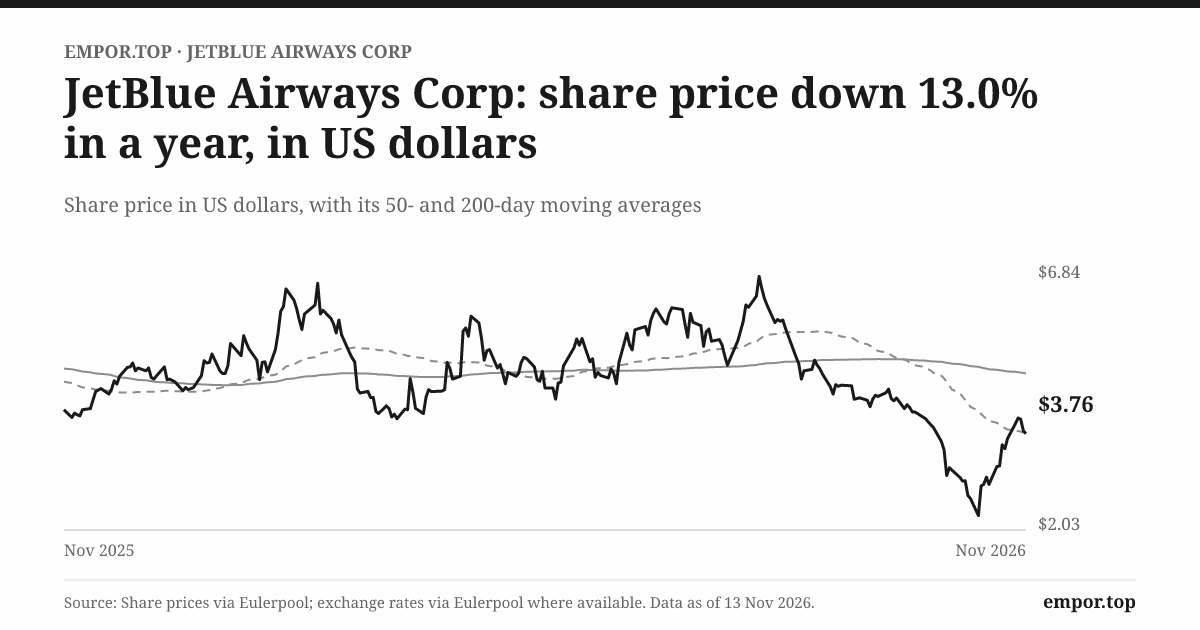
The stock market has priced that tension bluntly. On November 13, 2026, JetBlue's shares closed at $3.76, giving the whole company an equity value of about $1.4 billion. That is roughly one-seventh of a year's revenue and a fraction of the company's debt, which means that roughly six of every seven dollars in JetBlue's enterprise value belong to lenders and lessors, not shareholders.
The shares had traded as high as $6.59 and as low as $2.29 over the prior year, and from their peak over five years they had fallen by more than 85%. A market that volatile is not making a calm judgment about a stable business. It is betting on an outcome.
The boundary of this story is simple. This is JetBlue Airways Corporation, the NASDAQ-listed airline, together with its consolidated subsidiaries such as the travel-products business Paisly and the TrueBlue loyalty program.5 There is no parent group whose economics need to be separated out and no controlling shareholder whose interests sit above the public's. What happens to JetBlue happens to its shareholders, its crewmembers and its creditors directly.
The revenue rebound is genuine evidence that something in the product and the network is working. It does not yet prove that JetBlue can earn its way out of the middle. The turnaround plan management calls JetForward has to turn demand into operating profit, and operating profit into cash, before debt service and fuel bills tighten the runway further.
To understand why that conversion has been so hard, the story has to go back to the promise JetBlue made at birth, and to the idea that a cheap flight did not have to feel cheap.
 Subscribe on LinkedIn
II. A Different Kind of New York Airline
David Neeleman was not supposed to be starting an airline in New York. By the late 1990s he had already built one airline and sold it. Morris Air, the Utah carrier he helped run, had been acquired by Southwest Airlines in 1993, and Neeleman spent a short and unhappy stint inside Southwest before leaving under a non-compete agreement.
He used the waiting period to help found Canada's WestJet and to build an airline reservations-technology business.6 When the non-compete expired, he went looking for the place where an upstart could do the most damage to complacent incumbents, and he chose the most crowded, most expensive, most unforgiving air market in the United States.
The pitch was audacious in its simplicity. JetBlue would base itself at John F. Kennedy International Airport, which the big domestic carriers largely treated as an international gateway rather than a domestic hub, and it would fly brand-new Airbus A320s with leather seats, assigned seating and free live satellite television at every seat.6 It would offer low fares, but it would not treat customers as cargo.
The company's founders raised a large war chest for a startup carrier, and the first JetBlue flight took off in February 2000.6 The name itself was a statement: blue was the sky, the jet was new, and nothing about the brand looked like the beige, rumpled experience that many Americans associated with flying coach in that era.
The timing turned out to be a gift and a test at the same time. The September 2001 terrorist attacks devastated the airline industry, and JetBlue's home city was ground zero. Yet the young carrier reported a profit for 2001, a year in which most of the industry bled heavily, because its costs were low, its planes were new and fuel-efficient, and its crews were not tied to the legacy work rules of the older carriers.6
That record made JetBlue a darling of Wall Street. In April 2002 it went public on NASDAQ, offering about 5.9 million shares at $27 apiece.6 An airline less than three years old, flying out of a city still recovering from catastrophe, had convinced public investors that it was something new.
What exactly was new? The founding wager was that a basic flight could feel better without charging legacy-carrier prices. That meant two things. On the customer side, JetBlue built a product that stood apart from the bare-bones low-cost service exemplified by Southwest's open seating and peanut bags: more legroom than many rivals in coach, entertainment at every seat, a brand voice that sounded human.
On the cost side, it borrowed Southwest's discipline. JetBlue flew a single type of single-aisle aircraft, which simplified training and maintenance, kept its planes in the air for long stretches each day, and built dense flying on the East Coast, especially north-south routes between New York and Florida.6
New York shaped more than the route map. It shaped the identity. JetBlue was the hometown airline for a city whose residents fly constantly, complain loudly and love an underdog that treats them well. Its focus cities grew to include Boston, where it eventually became one of the largest carriers at Logan Airport, and Fort Lauderdale, a gateway to Florida, the Caribbean and Latin America.5
These three places, all in the most congested part of American airspace, remain the backbone of the network today, and that geography is both an asset and a burden. Being big in Boston and New York means owning scarce slots and gates in markets with affluent travelers. It also means flying through the weather and air-traffic bottlenecks that make the Northeast the hardest place in the country to run an on-time operation.
Fast-forward a quarter of a century and the business has grown roughly a hundredfold from its early days. JetBlue reported about $9.1 billion of revenue in 2025.5 Yet the competitive world around it has changed even more. Southwest, the original low-cost model, has added assigned seating and premium options.
Spirit and Frontier built their businesses on ultra-low base fares and fees for everything else. And the big network carriers, after a decade of mergers and bankruptcy restructurings, learned to segment their cabins so precisely that their cheapest basic-economy fares now compete directly with JetBlue's while their premium cabins and global networks capture the business traveler that JetBlue cannot fully serve.
That is the crux. JetBlue's original advantage was a product and a brand that stood out from bare-bones low-cost service. It was real, and in the airline's best years it showed up in the numbers: operating margins of around 19% in 2015 and 2016, among the best in the industry at the time.5
But a good product does not by itself establish durable pricing power. Seat-back screens can be copied. Legroom can be matched. A friendlier tone of voice is valuable until a competitor with lower costs or a larger network decides to match the fare.
The promise JetBlue made in 2000 still sits at the heart of what it sells. The question that keeps returning through every chapter of this story is whether a better flight experience can earn enough to cover an airline's costs. The first time the company had to answer it under pressure was not in a boardroom or an earnings call. It was on a frozen runway in Queens.
III. Valentine's Day Revealed the Cost of the Promise
On February 14, 2007, an ice storm settled over the New York area. Many airlines canceled flights early, parked their planes and sent their crews to hotels. JetBlue did something different. Hoping the weather would break, it kept passengers boarded and aircraft lined up at JFK, waiting for a window to depart. The window never came.
Planes sat on the frozen tarmac for hours with passengers aboard, unable to take off and unable to return to gates that were themselves jammed with other stranded aircraft.7 Toilets filled. Food ran out. And then the problem spread. Because crews and airplanes were out of position, cancellations rippled through the network for days, far beyond the storm itself.7
For most airlines, a bad day in winter is a bad day. For JetBlue it was an existential embarrassment, because the entire brand rested on the idea that it treated people better. When Neeleman testified before the House Committee on Transportation and Infrastructure that spring, he did not hide behind the weather.
He called the episode the worst operational day in the company's seven-year history and apologized for leaving passengers trapped on its aircraft.7 A company that had sold humane treatment at low prices had, in full view of the national media, shown customers the opposite.
What had actually broken was revealing. JetBlue's systems for tracking crews, rebooking customers and communicating with reservations agents had been built for a smaller, simpler airline. Years of rapid growth had added aircraft and routes faster than the operational plumbing had matured.7
When everything went wrong at once, the company could not locate its own pilots and flight attendants, so it could not restart. The very traits that made JetBlue efficient in good times, including tight aircraft utilization and lean staffing, left little slack in bad times.
The response was swift and public. Within days JetBlue published a Customer Bill of Rights, which promised defined compensation to passengers for delays, cancellations and ground holds caused by the airline, and it described to Congress the investments it was making in crew-tracking, staffing and procedures for deplaning aircraft.7
The gesture was smart branding, but it was also a costly commitment, because compensation tied to delays meant the company would pay in cash for future operational failures. In effect, JetBlue was pricing its own reliability risk and putting the bill in writing.
The storm also changed who ran the company. In May 2007, less than three months after the meltdown, the board named president Dave Barger chief executive, with Neeleman stepping back to non-executive chairman.8 Barger, an operations-minded executive who had been with JetBlue since before its first flight, was a very different leader from the founder-salesman who had willed the airline into existence.
The founder's departure was the first of several transitions that divide JetBlue's history into distinct management eras: Barger's operations-first decade, Robin Hayes's push toward premium products and margins from 2015, and Joanna Geraghty's turnaround since 2024.5
How much did Valentine's Day really change JetBlue's growth and operating choices? The honest answer is that it shifted the company's priorities more than its structure. JetBlue slowed its expansion for a period, invested in systems and leaned harder on the idea of operational integrity. But it remained a dense, highly utilized airline concentrated in the Northeast. That underlying exposure never went away; it was simply managed with better tools.
That exposure showed up again in 2026. On its third-quarter call, management cited summer weather and air-traffic-control constraints as pressures on completed capacity, meaning flights that were scheduled but not flown, and on crew costs, because disrupted operations require more overtime, more reserve staff and more hotel nights.9
The 2025 annual report lists weather, air-traffic-control limits and congestion at its focus cities as operating risks that can materially affect results.5 The headline in 2007 was passengers stuck on a runway. The headline in 2026 was a cost line that rose because the operation could not fly the schedule it had planned. Different symptoms, same underlying condition.
It would be too neat to claim that a single disruption two decades ago explains JetBlue's economics today. It does not. The airline that followed Valentine's Day was profitable for most of the next twelve years.
What the episode exposed was an enduring airline truth that applies with special force to JetBlue: a differentiated customer promise depends on operational reliability. A passenger does not buy a seat-back screen or a friendly greeting. A passenger buys an arrival. If the plane does not leave, the rest of the product is decoration.
So reliability belongs beside fare and service as a core part of what customers actually purchase. For an investor, that has a precise consequence. Every operational disruption is a double hit: it raises costs immediately, through crew overtime, rebooking and compensation, and it erodes the very brand premium that is supposed to justify JetBlue's existence.
Once the company had repaired its operation after 2007, the obvious next question was whether it could go beyond being reliably pleasant and start charging some customers a great deal more. In 2013, it tried.
IV. Mint Found a Higher-Fare Customer
In September 2013, JetBlue announced a product that seemed to contradict everything a low-fare airline was supposed to be. It was called Mint, and it put fully lie-flat seats on JetBlue's transcontinental flights between New York and Los Angeles and San Francisco, the most lucrative domestic routes in the country.10
A handful of those seats sat inside private suites with sliding doors, something no U.S. airline offered on a domestic flight at the time. The press release's headline promised premium service at an "unbelievably unpremium price," and the introductory one-way fares started at $499, far below what the legacy carriers charged for their transcontinental business cabins.10
The strategic logic was elegant. Coast-to-coast flights out of JFK are dominated by bankers, entertainment executives, consultants and affluent leisure travelers, many of whom had been paying thousands of dollars for round-trip business-class tickets on American, United and Delta. JetBlue could not win those passengers with a bigger legroom pitch in coach.
It could win some of them with a premium cabin priced well below the incumbents, while the rest of the aircraft kept the approachable main-cabin product the brand was built on. Fill a few rows with high-fare travelers, and the economics of the whole flight could change, because a lie-flat seat occupies the floor space of several coach seats but can sell for many times the fare.
Mint launched in 2014 and became one of the most praised airline products in America.10 It also became JetBlue's most important tool for moving upmarket. Over the following years the airline extended Mint well beyond the original New York–Los Angeles and San Francisco routes to other transcontinental, Caribbean and Florida markets, and eventually across the Atlantic to London, Paris and other European cities on long-range Airbus A321 aircraft.5
Mint proved that customers would try, and return to, a premium product from an airline best known for low fares. That is not a trivial finding. Many carriers have launched premium cabins that faded quietly because the brand could not support the price.
The competitive context, however, is daunting. Delta, American and United compete for exactly the same premium traveler with far larger networks, many more premium seats and loyalty programs that are among the most valuable consumer franchises in America. A Delta frequent flyer flying from New York to Los Angeles is not just buying a seat.
They are accumulating status that gets them upgraded on a flight to Atlanta, a lounge in Tokyo and a credit-card relationship that may be worth more to Delta than the ticket itself. Mint can beat a legacy business cabin on price and design, and still lose the customer because the customer's employer, credit card and status tier all point elsewhere. That is the scale gap that will recur throughout this story.
The idea Mint established now has a domestic sibling. JetBlue's plan includes BlueFirst, a premium cabin intended for domestic routes that do not have Mint, alongside new lounges at JFK and Boston.9
The logic is the same as in 2013: premium demand has been one of the most resilient parts of the airline industry since the pandemic, and JetBlue wants to capture more of it rather than surrender it entirely to the network carriers. Management tied the premium push directly to its unit-revenue gains in 2026, describing improved optimization of Mint and connecting itineraries through an upgraded revenue-management system.1
Here the analysis has to stay disciplined. Mint is concrete evidence that JetBlue can build a premium product customers want. It is not evidence that premium seats have fixed the company's economics. JetBlue does not disclose the revenue or profit contribution of Mint, nor what share of its revenue comes from premium cabins and upsells.5
The company-wide record is unforgiving on this point. Mint has existed for twelve years. In the first six of them, JetBlue was solidly profitable. In the last six, it lost money every year, even as Mint expanded to new routes and continents.5 Whatever Mint contributes, it has not been large enough to offset the forces that turned the whole airline unprofitable after 2020.
That narrows the claim rather than rejecting it. The fair version is this: Mint shows JetBlue can win a higher-fare customer on selected routes, and the premium cabin is a credible growth vector. Whether it improves margins at meaningful scale is unproven.
The metric that would confirm it is a sustained rise in unit revenue relative to unit cost on the routes where premium seats are added, alongside a company-wide return to operating profit. Until those show up together, Mint is a strong product sitting inside a weak income statement. To understand why that combination is possible, it helps to look closely at what JetBlue actually sells, and how the money flows.
V. What Does JetBlue Actually Sell?
Picture a family in Boston booking a February trip to Fort Lauderdale in October. They click through a fare, choose seats, perhaps add a checked bag, and pay with a JetBlue co-branded credit card. At that moment JetBlue receives their cash. It has not yet flown them anywhere.
It has not yet paid for the fuel, the crew, the landing fees or the aircraft time that the trip will consume. What it has done is make a promise to deliver a seat, a service and a schedule four months later, and to hand the money back in some form if it cannot.
That small transaction contains most of JetBlue's economics. The airline overwhelmingly sells transportation, priced one trip at a time. In 2025, passenger revenue was about $8.34 billion of total revenue of roughly $9.06 billion, which means more than nine of every ten dollars came from tickets and the fees attached to them.5
There are no long-term passenger contracts and no minimum purchase commitments. Fares vary by route, by how far ahead a customer books, by fare class and by add-ons such as bags, extra legroom or Mint.5
Five levers determine how much JetBlue collects. Demand sets the ceiling. Yield, the average fare per mile flown, measures what customers actually pay. Capacity, the number of seats the airline chooses to fly, sets supply. Load factor measures how many of those seats are filled. And route mix determines whether the airline is flying the right planes to the right places at the right times.
Airline managers spend most of their working lives moving those levers against one another: adding capacity on a route can raise volume but depress yield; cutting capacity can lift fares but leave fixed costs spread over fewer passengers. Because every competitor is pulling the same levers on overlapping routes, revenue is cyclical and highly sensitive to rivals' decisions, to fuel costs that cannot always be passed on, and to disruptions that erase planned flights.5
The cash timing is unusual, and it is worth dwelling on because it confuses many first-time readers of airline accounts. When the Boston family pays in October, JetBlue records the money as an air traffic liability, a debt to the customer that is paid off by flying them. At September 30, 2026, those advance ticket sales and related liabilities totaled about $1.9 billion due within a year and another $0.8 billion longer term, largely tied to loyalty points.2
This float is why standard retail metrics such as inventory days and cash conversion cycles say little about an airline. JetBlue's "inventory" is mostly spare parts and fuel, and its working capital is structurally negative because customers fund flights before they happen. That is a strength in a growing airline, because cash arrives early. It becomes a vulnerability if bookings slow, because the float shrinks and the cash goes the other way.
The second revenue stream is loyalty. TrueBlue, JetBlue's frequent-flyer program, earns money not only when members fly but when partners buy points to give to their own customers. The most significant points buyer is Barclays, the issuer of JetBlue's co-branded credit cards.5 Every time a cardholder swipes for groceries and earns TrueBlue points, Barclays pays JetBlue for those points, and JetBlue allocates that consideration across air travel, use of the JetBlue brand and customer list, advertising and other benefits.5
Loyalty and related revenue was about $148 million in the third quarter of 2026, up about 20% from a year earlier, and roughly $436 million over the first nine months.21 That is useful, high-margin money. It is also small against a cost base of more than $10 billion a year, and JetBlue does not disclose what share of revenue the Barclays relationship represents, nor the contract's duration.5 The loyalty program is valuable enough that JetBlue borrowed against it in 2024, pledging TrueBlue as collateral for a major financing, which tells you lenders see real cash flows there, and also that those cash flows are now partly spoken for.5
Two newer initiatives extend the loyalty idea. Paisly, JetBlue's travel-products business, sells hotels, rental cars, cruises and vacation packages, including to customers of other travel brands. Management projected Paisly operating income of around $100 million in 2026 and set a goal to double it by 2028.11
And in 2025 JetBlue struck its Blue Sky partnership with United Airlines, which lets members of each program earn and redeem on the other and is designed to give TrueBlue members access to a much larger network.5 Both make sense. Neither should displace the airline in the story. A $100 million profit stream matters at the margin for a company whose equity is worth about $1.4 billion, but it cannot rescue an airline that lost more than $600 million in 2025.5
There is a quieter lever worth watching: technology. JetBlue says its upgraded revenue-management system, the software that decides how many seats to sell at each price on each flight, improved forecast accuracy and optimization of Mint and connecting itineraries in 2026.1 This is where artificial intelligence actually touches the airline business. AI does not threaten to replace air travel.
It does threaten to widen the gap between airlines that price well and those that price poorly, because a few dollars of extra yield per passenger, multiplied across tens of millions of passengers, is the difference between profit and loss. The test is simple: better pricing should show up as unit revenue rising faster than unit cost, and ultimately in operating profit.
So what kind of edge does JetBlue have? The fair inventory is short. It has a recognizable consumer brand that still stands for a better coach experience. It holds valuable positions in constrained East Coast airports, especially Boston, New York and Fort Lauderdale, where slots and gates are scarce and cannot be easily replicated by a newcomer.
It has a loyalty program with a credit-card partner willing to pay for points. What the record does not establish is strong switching costs, a structural unit-cost advantage or an airline-wide pricing premium. A family choosing between JetBlue and a rival on a Boston–Fort Lauderdale route can compare fares on a phone in seconds and switch at the next booking.
Scale makes the challenge plain. Recent Bureau of Transportation Statistics data on domestic revenue passenger miles, a measure of how many paying passengers an airline carries and how far, put JetBlue at roughly 4.6% of the U.S. market.12 Delta, American, United and Southwest each held roughly 17% to 18%.12
Each of the big four is therefore close to four times JetBlue's size in domestic flying alone, before counting their international networks, corporate sales teams and loyalty ecosystems. Locally, the picture is better. In Boston, JetBlue is a leading carrier, and in New York and Fort Lauderdale it has meaningful share. That local strength is real, but it is concentrated in exactly the geography where weather and air-traffic limits bite hardest.
The weak points of the moat follow directly. Airlines compete route by route and schedule by schedule, so any advantage is only as durable as the next competitor's capacity decision. Passengers can compare prices instantly. The critical inputs, aircraft, engines, fuel and airport access, come from a small number of suppliers or are allocated by authorities, which gives those suppliers leverage.
Barclays is an important counterparty on the loyalty side. Put together, JetBlue sells a differentiated product in a commoditized market. That is a respectable position, but it means every dollar of margin has to be earned through execution rather than collected as an economic rent. And the single largest test of execution is the machinery that delivers the product: the fleet.
VI. The Network and Fleet Became the Cost of Competing
An Airbus A321 parked at a JetBlue gate at Logan is two things at once. It is the product: the seats, the screens, the Mint suites, the Wi-Fi that JetBlue sells to customers.
It is also a balance-sheet burden: an asset worth tens of millions of dollars that has to be bought or leased, financed, maintained, insured and depreciated whether or not it flies full. That dual nature is why airline economics are so brutal. The aircraft that make growth possible also create long-lived fixed commitments that do not shrink when demand does.
For most of its history, JetBlue managed that tension well. Before 2020, the airline produced positive operating margins every year from 2014 through 2019, ranging from a thin 3.5% in a difficult 2018 to about 19% in its best years.5 Revenue grew steadily, the fleet grew with it, and borrowing remained moderate: total debt was about $3.2 billion at the end of 2019.5
Then the pandemic erased almost two-thirds of the company's revenue in a single year, and the comparison changed permanently. Revenue recovered, reaching more than $9 billion by 2022. Annual net profit did not recover.5
The debt tells the rest. Borrowings rose from about $3.2 billion in 2019 to about $10.3 billion at the end of 2025, more than tripling while shareholders' equity fell from roughly $4.8 billion to about $2.1 billion.5 Some of that borrowing was pandemic survival financing. Some was aircraft financing, as JetBlue continued to take delivery of new Airbus A220s and A321neos to replace older aircraft and expand Mint.
Some was the 2024 TrueBlue loyalty financing and new equipment notes. The result is that interest expense in 2025 reached about $588 million, up about 61% from the year before, an amount larger than the airline's entire 2025 operating loss.5 JetBlue is now paying interest on a debt load built during years when the business was not earning back its cost of capital.
Capital spending kept flowing throughout. In 2025, JetBlue spent about $1.08 billion on capital expenditures, plus about $44 million of pre-delivery deposits on future aircraft; in 2024, capex was about $1.48 billion.5 That spending bought aircraft, spare engines, interiors, parts, ground equipment and facilities. It kept the fleet modern and the product competitive. It did not produce acceptable returns. Return on invested capital, positive and in the mid-teens in the strong years of the mid-2010s, has been negative in every year since 2020.5
The engines made it worse. Pratt & Whitney's geared turbofan engines, which power JetBlue's A220s and many of its A321neos, required accelerated inspections after a manufacturing defect in powder-metal parts, and durability problems kept engines in shops longer than planned. JetBlue reported an average of nine aircraft grounded in 2025 for lack of serviceable engines, with four still grounded at year end, and said it expected mid-single-digit groundings through 2026.5 A grounded aircraft is the worst of both worlds: the company keeps paying for it but cannot fly it.
That is a capacity constraint, a maintenance-cost problem and a reminder of how concentrated the airline's supply base is. JetBlue flies Airbus planes and depends on a narrow group of engine makers, and when one of them stumbles, the airline cannot simply shop elsewhere.2 Management has said it is past the peak of the groundings, but it has also, in effect, absorbed a supplier's quality failure into its own cost base.5
Workforce is the other large fixed commitment. JetBlue averaged about 19,000 active full-time-equivalent crewmembers in 2025, down about 3% from 2024, plus about 3,100 active part-time crewmembers.5 Lower headcount alongside lower capex suggests the company is moving from an "invest for growth" posture toward a "harvest what you have" posture, though continued losses mean the shift is defensive rather than triumphant.
The discipline test is now explicit. Under JetForward, management deferred roughly $3 billion of planned capital expenditure over several years, largely by pushing back aircraft deliveries, and guided to capital spending of about $850 million in 2026.131 Lower spending is the right instinct for a company burning cash with a CCC+ rating.
The risk is that underinvestment eventually shows up somewhere else: older aircraft flying longer, more maintenance events, a less competitive product, or a network that cannot grow into the most profitable opportunities when they appear. The measure that would show discipline working is free cash flow improving while completed capacity, on-time performance and aircraft availability hold steady or rise.
One claim needs to be kept in proportion. JetBlue describes meaningful technology investment, including AI tools for pricing and operations, but it does not disclose a separate research-and-development expense or any comparable R&D series.5 Technology spending is real, but it sits within operating costs and capital spending, and it cannot be benchmarked against peers the way a manufacturer's R&D could be.
Put together, the fleet story explains why the turnaround is so hard. Aircraft enabled JetBlue's routes and Mint's expansion, and they absorbed the cash that might otherwise have cushioned the balance sheet. By 2022, the company's leaders had concluded that organic reinvestment alone would not close the scale gap with the big four quickly enough. So they reached for the oldest shortcut in the airline business: buying another airline.
VII. The $3.8 Billion Bet That Did Not Close
In the spring of 2022, Spirit Airlines had a deal to merge with Frontier, another ultra-low-cost carrier. JetBlue crashed the party. It made an unsolicited offer, raised it, and kept raising it until Spirit's board walked away from Frontier.
In July 2022 JetBlue and Spirit agreed to a merger valued at about $3.8 billion in cash, a price that included a sweetener to be paid to Spirit shareholders while regulators deliberated and a reverse breakup fee if the deal was blocked on antitrust grounds.14 For a company whose own market value was only a few billion dollars, it was the largest bet in its history.
The case for the deal was about scale. Spirit had a fleet of Airbus aircraft that JetBlue could refit with its own cabins, pilots JetBlue badly needed, and a network concentrated in Florida, the Caribbean and Latin America that overlapped with JetBlue's Fort Lauderdale strength.
Combined, the two would have become the fifth-largest airline in the country, big enough, JetBlue argued, to mount a genuine national challenge to the four dominant carriers.14 Management framed it as a pro-consumer move: a larger JetBlue would discipline the big four's fares across more of the country.
The Justice Department saw it differently. In its lawsuit and at trial, the government argued that Spirit was itself a uniquely aggressive price competitor, and that converting its dense, low-fare seats into JetBlue's roomier, higher-priced cabins would remove capacity and raise fares for the most price-sensitive travelers.14
On January 16, 2024, Judge William Young of the federal court in Boston agreed and blocked the deal, writing that eliminating Spirit would harm the cost-conscious travelers who rely on its low fares.15 In March 2024, JetBlue and Spirit terminated their agreement, and the Justice Department declared the outcome a victory for travelers.16
The bill arrived in JetBlue's 2024 accounts. The company recorded about $532 million of Spirit-related costs that year, including a $69 million termination payment to Spirit, alongside the legal, advisory and other expenses of a two-year fight.5 That one charge was larger than JetBlue's entire operating loss in 2025.
Was $3.8 billion a fair price? It is tempting to compare it with industry acquisition multiples and declare that JetBlue overpaid. That comparison does not work. Because the deal never closed, there is no acquired business to evaluate, no realized synergies and no integration record against which to test the price. What can be measured is the cost of the pursuit: more than half a billion dollars of charges, management attention diverted for nearly two years, and a strategic plan that had to be rebuilt from scratch in 2024.
The deeper risk was that, had the deal closed, JetBlue would have had to finance it with debt on top of an already stretched balance sheet while integrating two very different airlines. In hindsight, the decision exposed a company whose leadership believed scale was so essential that it was worth a large legal risk and a heavy financing burden to buy it.
Spirit was not the first such attempt. In 2016, JetBlue bid for Virgin America, the design-forward West Coast carrier, and lost to Alaska Air Group, which paid about $2.6 billion; JetBlue said its organic growth plan offered a better path.17 In 2020, JetBlue entered the Northeast Alliance with American Airlines, a code-sharing and schedule-coordination arrangement in Boston and New York that gave JetBlue access to American's network and loyalty base.
The Justice Department sued, and in May 2023 a federal judge ruled that the alliance violated antitrust law and ordered it unwound.18 Antitrust litigation tied to the alliance continues, with plaintiffs seeking injunctive relief and monetary damages, and the company does not quantify a probable loss.5 Three times in seven years, JetBlue reached for scale through combination. Once it was outbid. Twice it was stopped in court.
The pattern matters for investors because it closes off the easiest exit from the middle. If JetBlue cannot buy scale, at least not on terms regulators accept, then it has to earn its way to profitability at roughly its current size. That is a much harder task, and it is the one now in front of management.
The consequence for the company's leaders was immediate. When Joanna Geraghty took over as chief executive in February 2024, a month after Judge Young's ruling, she inherited a strategic plan that had just been invalidated. She later described the merger's uncertainty as a distraction from the work of returning to profitability, and JetForward became the post-Spirit strategy.19
The governance stress test arrived at the same moment. In February 2024 an investor group led by Carl Icahn disclosed a significant stake in JetBlue and signed an agreement giving it two seats on the board while it held the required ownership.20 Activists rarely buy into airlines for the scenery. Icahn's presence signaled that at least one sophisticated investor saw value in the wreckage, and also that the board would face pressure to cut costs and show results.
In August 2026, after the group's ownership fell below the threshold in that agreement, the two Icahn-designated directors, Jesse Lynn and Steven Miller, left the board.21 The activist arrived when the stock was depressed and left before the turnaround was proven, which is not a verdict in itself, but it removed one of the louder voices for accountability at a critical moment. With Spirit gone and the activists off the board, the story narrows to one person and one plan.
VIII. Joanna Geraghty's Turnaround Has to Clear the Cash Test
Joanna Geraghty did not arrive at the top of JetBlue as an outsider sent to clean house. She joined the company in 2005 as a lawyer, two years before the Valentine's Day storm, and spent nearly two decades moving through its legal, customer-experience and operations functions before becoming president and chief operating officer in 2018 and chief executive in February 2024.20
That background cuts both ways. She knows the airline's operation, culture and unions intimately, and she was inside the leadership team through the years when JetBlue chased the Northeast Alliance and Spirit. A new CEO with no history can blame the past. Geraghty cannot entirely, and to her credit she has largely not tried.
In July 2024, alongside second-quarter results, she unveiled JetForward.19 The plan had four priorities, and they read like a diagnosis of everything that had gone wrong. First, run a reliable operation, a lesson the company learned on Valentine's Day.
Second, strengthen the network around the East Coast leisure markets where JetBlue is strongest, rather than spreading aircraft across marginal routes. Third, sell products customers value and will pay for, including premium seating, Mint expansion and loyalty. Fourth, secure the balance sheet. JetForward set out a target of $800 million to $900 million of incremental earnings before interest and taxes by 2027.19
The early returns were encouraging on the plan's own terms. For 2024, JetBlue reported $395 million of revenue initiatives delivered against a $300 million target.13 It cut unprofitable flying, exited a set of cities, and redeployed capacity toward Fort Lauderdale and other leisure markets.
Over 2024 and 2025 it closed 15 BlueCities, the company's term for the places it serves, and redeployed about one-fifth of its prior network capacity.9 It also deferred capital spending and raised strategic financing, including the loyalty-backed loans, to bolster liquidity.13
Yet the profit and cash outcomes did not follow. JetBlue's operating margin in 2025 was about minus 4%, its free cash flow was about minus $1.2 billion, and its 2026 outlook still included a negative adjusted operating margin.51 A plan that delivers its revenue initiatives but leaves the company burning cash is a plan whose initiatives have been overwhelmed by something else: fuel, labor costs, engine groundings, disruption, or simply an industry where competitors are making the same moves.
That brings us to the targets themselves, which have moved. JetForward began with the $800 million to $900 million incremental EBIT target for 2027. Later, management discussed about $1.2 billion of annual incremental EBIT in 2028 and earnings of at least $1 per share that year.11 On the third-quarter 2026 call, it still described a path to operating profit in 2027, even as the 2026 outlook remained loss-making.9
There is nothing inherently suspicious about extending a plan and raising its ambition. But an investor should notice the shape of the change: the goalposts grew larger and moved a year further out while the actual results remained negative. A plan that keeps promising more, later, has to be judged by whether the near-term milestones are hit, not by the size of the eventual number.
The two most recent calls help separate firm answers from soft ones. In prepared remarks on the second-quarter call, management emphasized strong premium and Fort Lauderdale performance and the early benefits of revenue management.11 In analyst questioning, the sharpest challenges concerned fuel, capacity and the credibility of the 2028 target. On fuel, management gave a concrete figure on the third-quarter call: it said JetBlue had recaptured about 87% of higher fuel costs through fares in the quarter.9 That is a measurable answer, and a meaningful one, because it implies JetBlue had at least some pricing power when every airline faced the same cost shock.
On capacity, management was also specific, describing how it was trimming weak flying and holding growth in check.9 On liquidity and the 2028 target, the answers leaned more on assumptions: a recovery in unit revenue, continued cost discipline, moderating fuel and the successful execution of new products, without a full bridge from today's losses to the promised earnings.9 Management also pointed to about $7 billion of unencumbered assets that could support further financing if needed, which is reassuring as a backstop and a reminder that more borrowing remains on the table.9
Separate the controllable from the external, and the picture sharpens. The decision to close cities, redeploy aircraft, defer capex and reprice the network was management's. Fuel prices, summer weather, air-traffic-control limits and Pratt & Whitney's engine problems were not. The fair reading is that JetBlue has made the right strategic moves within its control and been hit hard by forces outside it.
The unfair reading, which a skeptical activist would press, is that every airline faces fuel, weather and supplier problems, and the ones with better economics still make money. Larger carriers face the same weather, the same fuel market and the same engine makers. External headwinds explain some of JetBlue's losses. They do not explain why JetBlue, specifically, remains among the weakest performers.
The third quarter of 2026 contains the strongest evidence for the plan. Revenue per available seat mile, the amount JetBlue collects for each seat it flies one mile, rose 18.4% year over year.1 That is an extraordinary jump for an airline, the kind of number that suggests real demand, real pricing and real network improvement. It is also the strongest evidence that the problem now sits mainly on the cost side and in the balance sheet.
The quarter still produced a GAAP operating loss, and interest on elevated debt pushed the pretax loss to about $270 million.1 If an 18% unit-revenue gain cannot produce an operating profit, the question is how much more revenue improvement, or how much cost reduction, would be needed. That gap is what the 2027 target has to close.
Incentives are the next lens. The 2026 proxy statement reports that Geraghty received total compensation of about $5.19 million in 2025, down from about $6.76 million in 2024, including roughly $1.1 million of non-equity incentive pay and about $3.25 million of stock awards.20 JetBlue lost about $602 million that year.5 Reducing a judgment about management to one pay figure would be lazy: CEO pay at large U.S. airlines runs well above this level, and much of Geraghty's pay comes as stock whose value has collapsed alongside the shareholders'.
The more useful question is whether the incentive plan's performance measures, including operating margin, free cash flow and reliability, line up with what investors need. An incentive payout in a year of large losses deserves scrutiny, and the test for future years is whether payouts track operating profit, free cash flow and leverage rather than initiative milestones alone.
Shareholders sent a mixed signal. At the 2026 annual meeting, the advisory vote on executive compensation passed comfortably, with about 181 million votes for and 20 million against.22 All thirteen director nominees were elected, but some drew meaningful opposition, including director Ellen Jewett, who received about 31 million votes against.22 That is not a revolt. It is a measurable reservation, the kind that tells a board shareholders are watching.
One last piece of the plan deserves a small place, not a large one. Paisly's projected operating income is genuine optionality.11 It is also exactly the kind of side business that management teams tend to celebrate when the core is struggling.
JetBlue's history with projected initiative value is mixed: revenue initiatives were delivered, but the company still lost money. Until Paisly's results are reported clearly enough to test against the target, it is a footnote to the airline, not a growth engine.
The verdict on JetForward is that it is plausible but unproven. Early initiative delivery is evidence of execution. The decisive measure is sustained operating improvement that survives fuel, disruption and lower capital spending. And the company has to survive long enough to show it, which turns the story from strategy to money.
IX. The Turnaround Runs on a Shorter Financial Runway
At September 30, 2026, JetBlue reported about $2.2 billion of liquidity,2 against about $8.45 billion of debt and finance-lease obligations.2 Liquidity is the bridge the turnaround has to cross. The question is whether the bridge reaches the other side.
Start with a number that looks reassuring and is not. Over the twelve years from 2014 through 2025, JetBlue generated about $10 billion of cumulative operating cash flow against cumulative net profit of only about $98 million.5 At first glance that looks like an extraordinary cash machine hiding behind modest earnings. It is not. Airlines collect ticket cash before they fly, which inflates operating cash flow in growing years.
They also carry large depreciation charges for aircraft, which reduce reported profit without consuming cash in the year they are recorded. Neither effect means profits are turning into distributable cash. The proof is in free cash flow, which subtracts capital spending: over the same twelve years, JetBlue's cumulative free cash flow was roughly minus $3 billion.5 The airline has spent more on aircraft and equipment than its operations generated, and filled the gap with borrowing.
The current pressure is sharper still. In 2025 JetBlue recorded about $688 million of depreciation and amortization, a non-cash charge that should have widened the gap between its $602 million net loss and its operating cash flow.5 Even so, operating cash flow came in at about minus $94 million.5
The advance-ticket liability supplied some cash, rising by about $116 million, but not enough to offset everything else. Then $1.08 billion of capex pushed free cash flow to about minus $1.2 billion.5 When an airline cannot generate positive operating cash flow even with its depreciation added back and its customers prepaying, it is losing money on the cash basis, not just on the accounting basis.
It helps to separate the different kinds of obligations on JetBlue's balance sheet, because they carry different risks. Debt is debt: about $8.4 billion excluding finance leases, much of it secured. About $8 billion of net book value in aircraft, engines, equipment and facilities was pledged under financing arrangements at the end of the third quarter.2
Air traffic liabilities, by contrast, are customer advances, not borrowings: they are repaid by flying people, not by writing checks to lenders, though they would become a cash drain if bookings fell sharply. Operating leases, about $950 million of liabilities, are a third category, contractual rent on aircraft and facilities.2 For creditors, the distinction matters because pledged assets reduce what is left for unsecured lenders, and customer advances depend on continued trust in the airline.
The covenants add another layer. JetBlue said it was in compliance with its material debt and lease covenants at September 30, 2026.2 But the TrueBlue financing carries debt-service coverage and minimum-liquidity requirements and cross-default provisions, and credit-card processors can demand cash reserves against advance ticket sales if liquidity thresholds are breached.2 That last point is easy to miss and important.
If JetBlue's liquidity falls far enough, the processors that hand over cash from ticket sales can start holding some of it back, precisely when the airline needs it most. The receivables on the balance sheet, about $403 million at the end of the third quarter, are mainly amounts due from those card companies and from co-brand partners; JetBlue does not disclose their aging, so the timing risk cannot be resolved from the small reported allowance alone.25
Financing has also become expensive. Interest expense in 2025 was about $588 million, while interest income on JetBlue's cash was only about $127 million.5 Net interest added a substantial burden on top of the company's operating loss. That is the arithmetic of a leveraged company: even if operations break even, the interest bill keeps the bottom line in the red.
The credit-rating agencies have spelled out the stakes. In April 2026 Fitch downgraded JetBlue's issuer rating from B- to CCC+, citing continued operating losses, negative free cash flow, elevated leverage and cash burn likely to exceed $500 million in 2026.3 Fitch expected cash burn to moderate in 2027 and free cash flow to approach breakeven in 2028 if unit revenue outpaced unit-cost growth. It named its downside triggers precisely: liquidity falling below $1 billion, failure to lift EBIT margins above breakeven, and fixed-charge coverage below 1.0 times.3
In June 2026 S&P Global followed, cutting to CCC+ and citing fuel-cost pressure, positive free cash flow delayed until 2028 and leverage projected near 10 times by the end of 2027.4 S&P's stable outlook assumed JetBlue's liquidity could cover its deficits through 2027.4 Two independent credit committees thus reached the same view: the bridge exists, but it is narrower than it looks, and the margin of safety depends on the turnaround arriving on schedule.
Valuation multiples need care in this setting. On November 13, 2026, JetBlue's enterprise value of about $9.3 billion stood at roughly 42 times its trailing EBITDA. That looks expensive, but the multiple is inflated by a very thin EBITDA base, and with free cash flow negative it says almost nothing on its own. The price-to-earnings ratio is no help either: JetBlue has not had positive trailing earnings for years, so any P/E figure dates from a period that no longer describes the business.
Price-to-book of about 1.1 times reflects equity that has been shrinking under losses. Price-to-sales of about 0.1 times looks strikingly low, and it is low because the market assigns most of the company's value to creditors. The multiples are not a valuation conclusion. They are a description of a business priced for distress, where the outcome depends on whether the cash path improves.
Liquidity provides a bridge, not a cure. The open question is how much headroom remains after planned spending, continued cash burn and upcoming maturities. If JetForward delivers on time, the bridge is long enough. If it slips again, the next stop is more secured borrowing against a dwindling pool of unencumbered assets. That is where the bull and bear cases meet.
X. Analysis & Bear vs. Bull Case
Imagine the network-planning meeting at JetBlue's headquarters in Long Island City in the autumn of 2026. On the table are two options for a handful of aircraft. One is to add seats to Fort Lauderdale, where unit revenue has been strong and the airline has been building its Florida position.
The other is to trim weak flying elsewhere and keep the planes on the ground or in reserve, protecting cash. Fuel prices are elevated. A new domestic premium product needs to be sold. Every choice trades growth against liquidity. That meeting, in miniature, is the whole investment case.
The bull case starts with the evidence of the most recent quarter. Unit revenue jumped about 18%, and JetBlue said it recaptured most of a fuel-cost increase through fares, which is exactly what an airline with some pricing power should be able to do.19 Its premium products have a track record of customer acceptance, from Mint since 2014 to the coming BlueFirst cabin.
It has a recognizable consumer brand, a loyalty program valuable enough to borrow billions against, a credit-card partner paying for points, a network partnership with United that broadens loyalty utility, and strong local positions in Boston and New York. Fort Lauderdale has become a source of improving performance. If those assets, combined with better revenue management, allow JetBlue to capture more valuable demand, the company's small size could even be a virtue: a few hundred million dollars of margin improvement would transform an equity value of about $1.4 billion.
The bear case starts with what has actually happened. JetBlue's operating margin was about minus 4% in 2025, and the company has not earned an annual net profit since 2019.5 It holds roughly 4.6% of U.S. domestic revenue passenger miles, while each of its four largest competitors holds about 17% to 18%.12 Its passengers can switch at the next booking.
Its competitors have broader networks, larger loyalty ecosystems and dedicated corporate-sales operations. Its suppliers are concentrated, as the Pratt & Whitney groundings showed. Its cost structure and balance sheet leave little room for operational misses, and its home airports are among the most disruption-prone in the country. The bear case does not require anything new to go wrong. It only requires the last six years to continue.
Michael Porter's five forces frame the industry pressures. Rivalry is intense and route-level: every JetBlue market faces at least one large competitor, and airline capacity can be redeployed quickly. Buyer power is high, not because any single customer is large, but because millions of travelers compare fares on the same screens and face almost no switching costs. Supplier power is meaningful: two aircraft makers, a handful of engine makers, and unionized labor groups all hold leverage, and engine shortages demonstrated how a single supplier's problem becomes the airline's cost.
The threat of new entrants is moderated by airport access and capital requirements, especially in slot-controlled New York, which is one of JetBlue's genuine protections. Substitutes are limited on long routes but real on short ones, where trains and cars compete. The net picture is an industry structurally designed to compete away excess returns, in which JetBlue holds some protected airport positions but no evidence of a durable company-wide cost advantage.
Hamilton Helmer's 7 Powers framework asks a narrower question: what, if anything, lets JetBlue earn persistently superior returns? Scale economies belong to the big four, not JetBlue. Network economies, in the loyalty sense, also favor the larger carriers, whose programs offer more destinations and more ways to redeem. Switching costs are low for most passengers; the co-brand credit card raises them modestly for some. Counter-positioning was JetBlue's original power in 2000, when legacy carriers could not match its product without disrupting their own cost structures, but the big network airlines have since segmented their cabins and largely neutralized it.
Cornered resources exist in the form of slots and gates at JFK and Boston. Brand is real but has not translated into an airline-wide fare premium. Process power, the ability to run an operation more efficiently than peers, is not visible in the record. The honest conclusion is that JetBlue has advantages, in brand and local network presence, that have not yet been shown to create persistent superior returns. The evidence supports a differentiated offer, not a proven moat.
The latest quarter must be weighed in both directions. Strong unit-revenue growth and fuel recapture are positive operating clues, suggesting that demand and pricing are moving the right way. GAAP losses, negative-margin guidance for 2026 and expensive financing remain the counterevidence. The decisive question is whether unit revenue can keep outrunning unit cost for long enough to produce sustained profit.
Three measures will keep the story honest. The first is operating margin, which stood at about minus 5% in the third quarter of 2026 and minus 4% for 2025, slightly worse than a year earlier.15 The second is free cash flow after capital spending, about minus $1.2 billion in 2025, with Fitch expecting more than $500 million of burn in 2026.53
The third is net debt against liquidity headroom, with liquidity at about $2.2 billion and Fitch's warning line at $1 billion.23 Behind those headline measures sit the operating explanations: unit revenue against unit cost, and aircraft availability, which captures whether the fleet the company is paying for can actually fly.
The risks that matter are specific. Fuel-price pass-through is the first: JetBlue had no fuel hedges outstanding at the end of 2025, so it is fully exposed to spot prices and must recapture increases through fares.5 Northeast weather and air-traffic-control disruptions are the second, because they hit costs and brand at once. Pratt & Whitney groundings are the third.
Demand softness, especially in leisure travel if the economy weakens, is the fourth. Financing and covenant pressure, including credit-card processor reserves, is the fifth. And execution risk in JetForward itself, especially in new premium products and network changes, is the sixth. Artificial intelligence belongs on this list only as revenue-management technology, a tool that can widen or narrow pricing gaps between airlines, not as a threat to the existence of air travel.
Valuation is context, not conclusion. A low sales multiple may reflect real distress rather than opportunity, and the equity is a thin slice on top of a large debt stack. Any suggestion that the shares are cheap has to resolve the cash and debt path first.
Weighing the evidence, the bull case has real product, loyalty and local-network assets plus recent revenue momentum. The bear case is stronger on demonstrated economics. The question is which story the next four quarters will tell, and the company's own history offers a few lessons about how to read them.
XI. Playbook: Business & Investing Lessons
Go back to that frozen runway at JFK in February 2007, passengers staring out of windows at ice that would not melt, an airline that had promised to be different discovering that it was not different enough when it mattered. Then jump forward nineteen years to a conference call in October 2026, where management described record unit revenue and fuel recapture while reporting another quarterly loss. Between those two moments lies almost everything worth learning from JetBlue.
The first lesson comes from Valentine's Day. A service promise is only as strong as the operation delivering it. The storm showed that comfort, entertainment and respect mattered little to a customer stuck on a tarmac.
The lesson for founders is that operational reliability is not a back-office function; it is the product. The lesson for investors is that a brand-led airline faces a double penalty for disruption, paying once in cost and again in lost premium. In an airline, reliability is part of the product.
The second lesson comes from Mint. A better cabin can open a higher-yield segment, and JetBlue proved that customers would pay real money for lie-flat seats from a low-fare brand.
But Mint has not made the airline profitable, which means product success has to be measured by profit contribution, not passenger enthusiasm. Applause from travel reviewers is a leading indicator. Margin is the only one that pays the interest. A beloved product inside an unprofitable company is a feature, not a business.
The third lesson comes from Spirit. Scale bought under legal and financial pressure is not automatically value creation. JetBlue pursued Spirit for nearly two years, spent more than half a billion dollars and emerged with nothing but a bill and a strategy to rebuild.
The broader lesson is that in a concentrated, heavily regulated industry, the path to scale through acquisition is narrow and expensive, and a company that bets its strategy on it must account for the possibility of losing. The price of a deal includes the years spent trying to close it.
The fourth lesson comes from JetForward. Targets matter when they become cash. JetBlue's management delivered revenue initiatives and cut weak flying, but the plan's success will be judged by operating profit and free cash flow, not by incremental EBIT estimates. The best evidence will come in a quarter where fuel rises and the company still earns money. A turnaround is real when it survives the fuel bill.
XII. Epilogue
As of mid-November 2026, JetBlue stands at the edge of the period that will decide its next decade. Its revenue has returned to growth. Its unit revenue is rising faster than at almost any point in its history. Its premium products are expanding, and its network has been reshaped around the markets where it is strongest. And it is still losing money, still burning cash and still rated CCC+ by two credit agencies that have spelled out exactly what would make them cut further.34
The next moment arrives early in 2027, when JetBlue reports its fourth quarter of 2026 and refreshes its outlook. Management's stated targets are the reference point.9 The first test is whether the 2027 operating-profit goal still stands, and whether it depends on favorable fuel prices or unusually strong demand. A profit target that holds only if jet fuel falls is a hope, not a plan.
The second test is cash. Investors should watch free cash flow after capital spending and financing costs, not just adjusted earnings or the incremental EBIT that JetForward initiatives are said to produce. If capex stays near the guided level and operating cash flow turns positive, the burn will narrow. If not, liquidity will fall toward Fitch's warning line.3
The third test is the operation itself. Fort Lauderdale's performance, the contribution of premium seating and loyalty, aircraft availability as Pratt & Whitney groundings ease, and completed capacity against plan will reveal whether the improvements are structural or seasonal.
The fourth test is the balance sheet. Liquidity after cash burn, collateral demands from card processors and debt maturities will determine how much room management has to maneuver. Any change in ratings or covenant headroom will be an early warning, in either direction.
And the final test is consistency. Management's outlook deserves scrutiny.119 When it speaks again, the right question is not whether the numbers are optimistic but whether they have changed, and how clearly the reasons are explained. Credibility in a turnaround is built by hitting near-term milestones and explaining misses specifically, not by announcing ever-larger targets for ever-later years.
If JetBlue reaches operating profit in 2027 with fuel near current levels and free cash flow approaching breakeven, the bridge will have held, and the company will have proved that a differentiated airline of its size can make money. If it misses again, the conversation will shift from strategy to financing, and from what JetBlue sells to who owns its assets. The story remains open because revenue momentum has not yet produced sustained operating profit or cash, and the next evidence must connect those dots.
XIII. Outro
Somewhere tonight a passenger is settling into a Mint suite on a JetBlue flight out of JFK, sliding the door closed, reclining the seat into a bed and looking out at the lights of Queens. For that passenger, JetBlue is exactly what David Neeleman promised a quarter of a century ago: proof that flying can feel better without becoming a luxury. Behind that seat sits the airline's 2025 cash burn of about $1.2 billion.5
That contrast captures JetBlue's central tension. The product has always been easier to love than the economics. The recent revenue rebound offers a sign of progress. Now the airline has to do the harder thing, which it has not managed since 2019: make that growth stick as operating profit and cash. Whether the idea that built JetBlue can support a durable airline is the question the next few years will answer.
References
-
JetBlue Announces Third Quarter 2026 Results — JetBlue Airways, 2026-10-26 ↩↩↩↩↩↩↩↩↩↩↩
-
Q3 2026 Form 10-Q — JetBlue Airways Corporation (SEC), 2026-10-26 ↩↩↩↩↩↩↩↩↩↩↩↩↩
-
Fitch Downgrades JetBlue to 'CCC+' from 'B-' — Fitch Ratings, 2026-04-03 ↩↩↩↩↩↩↩
-
S&P downgrades JetBlue deeper into junk as high fuel costs dent recovery — Reuters via Investing.com, 2026-06-08 ↩↩↩↩
-
2025 Form 10-K — JetBlue Airways Corporation (SEC), 2026-02-12 ↩↩↩↩↩↩↩↩↩↩↩↩↩↩↩↩↩↩↩↩↩↩↩↩↩↩↩↩↩↩↩↩↩↩↩↩↩↩↩↩↩↩↩↩↩↩
-
Final IPO Prospectus — JetBlue Airways Corporation, 2002-04-11 ↩↩↩↩↩↩
-
JetBlue Valentine's Day 2007 hearing and testimony — U.S. House Committee on Transportation and Infrastructure, 2007-04-20 ↩↩↩↩↩
-
Form 8-K: David Barger named Chief Executive Officer — JetBlue Airways Corporation (SEC), 2007-05-10 ↩
-
JetBlue (JBLU) Q3 2026 Earnings Call Transcript — The Motley Fool, 2026-10-27 ↩↩↩↩↩↩↩↩↩↩↩
-
JetBlue (JBLU) Q2 2026 Earnings Call Transcript — The Motley Fool, 2026-07-29 ↩↩↩↩↩
-
Airline Domestic Market Share — Bureau of Transportation Statistics ↩↩↩
-
2024 Year in Review and Earnings Presentation — JetBlue Airways Corporation (SEC), 2025-01-28 ↩↩↩
-
Findings of Fact and Conclusions of Law, United States v. JetBlue Airways Corp. and Spirit Airlines — U.S. Department of Justice, 2024-01-16 ↩↩↩
-
Federal Judge Blocks JetBlue, Spirit Airlines Merger Following DOJ Lawsuit — TravelPulse, 2024-01-16 ↩
-
Justice Department Statement on JetBlue Terminating Its Acquisition of Spirit Airlines — U.S. Department of Justice, 2024-03-04 ↩
-
Alaska Air confirms purchase of Virgin America for $2.6B after hard-fought duel — GeekWire, 2016-04-04 ↩
-
US judge rules against American Airlines, JetBlue partnership — Al Jazeera, 2023-05-19 ↩
-
JetBlue Announces Second Quarter 2024 Results — JetBlue Airways, 2024-07-30 ↩↩↩
-
2026 Definitive Proxy Statement — JetBlue Airways Corporation (SEC), 2026-04-02 ↩↩↩
-
Form 8-K: Icahn Group Director Appointments End — JetBlue Airways Corporation (SEC), 2026-08-24 ↩
-
2026 Annual Meeting Voting Results, Form 8-K — JetBlue Airways Corporation (SEC), 2026-05-14 ↩↩
 LinkedIn
 WhatsApp
 Reddit
 Hacker News
 Email
 Kindle
 RSS Feed
 Spotify
 Apple Podcasts
 Amazon Music
 Audible
 YouTube