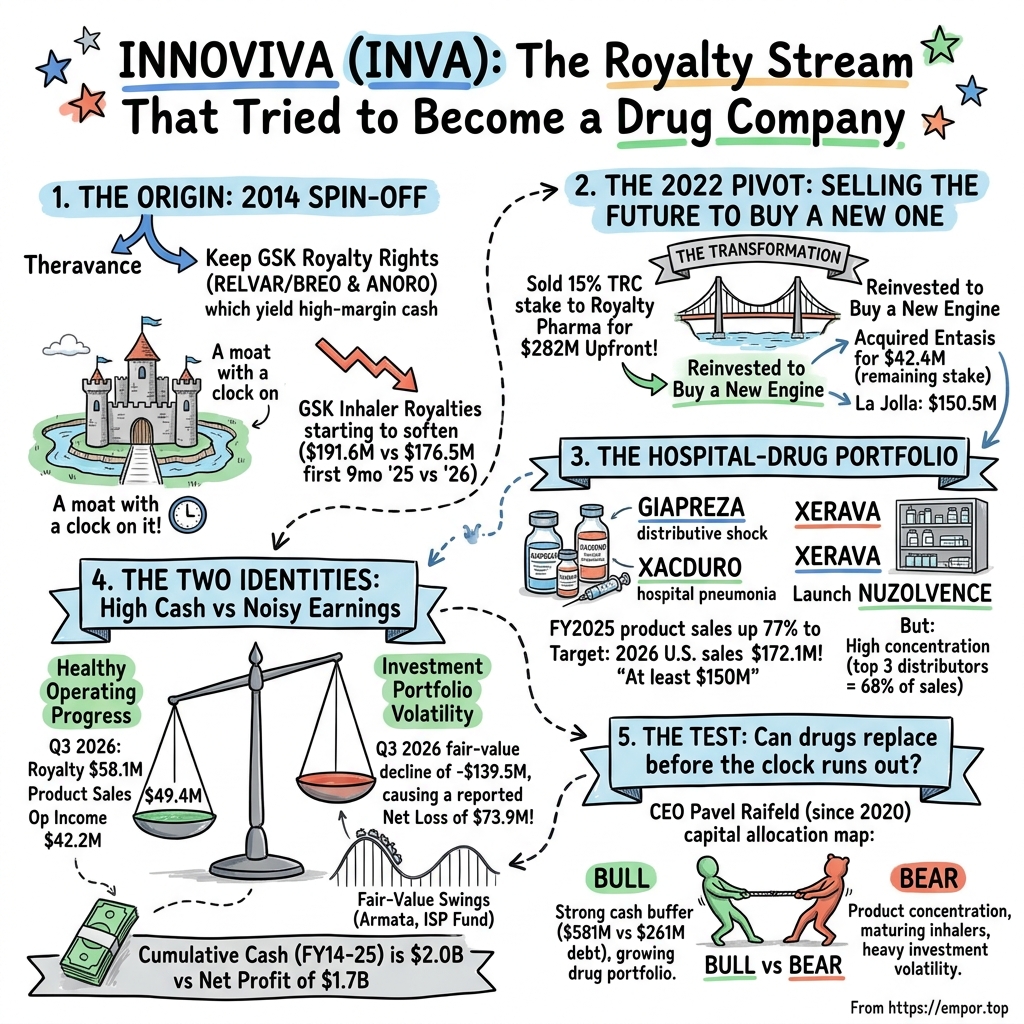
Innoviva: The Royalty Stream That Tried to Become a Drug Company
I. A profitable quarter, a reported loss
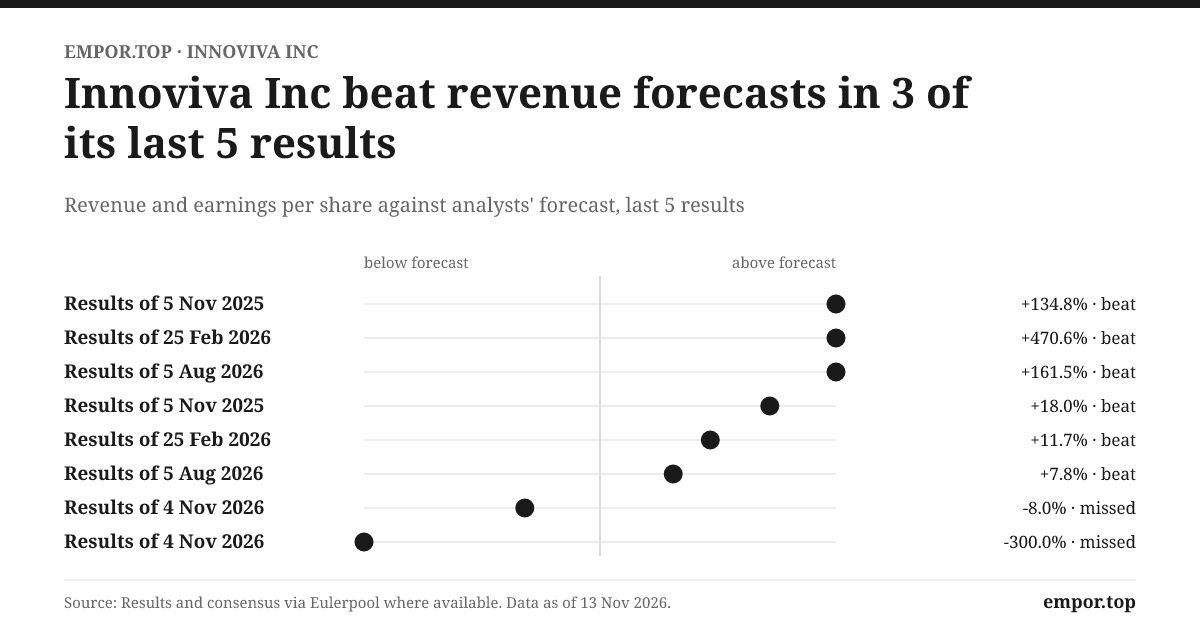
On November 4, 2026, Innoviva put out a quarterly report that read like two companies sharing one press release.
The first company had a good quarter. Its sales team had pushed U.S. product sales up 45% from a year earlier, to about $43 million.[^1] Two hospital drugs did most of that work. GIAPREZA treats patients in shock. XACDURO treats a hard-to-kill hospital pneumonia. A new oral antibiotic called NUZOLVENCE had just reached American pharmacies. Operating income rose about 22%, to $42.2 million.[^1]
The second company had a bad quarter. The value of its investment portfolio fell by $139.5 million, mostly because shares of Armata Pharmaceuticals, a phage-therapy biotech in which Innoviva holds a large stake, had dropped.[^2] Nobody wrote a check for that $139.5 million.
It was an accounting mark, the difference between what the shares were worth at the end of June and at the end of September. But it flowed straight through the income statement, and it turned the quarter into a net loss of $73.9 million.[^1]
So which company is Innoviva? The one that earned $42 million running its business, or the one that lost $74 million on paper?
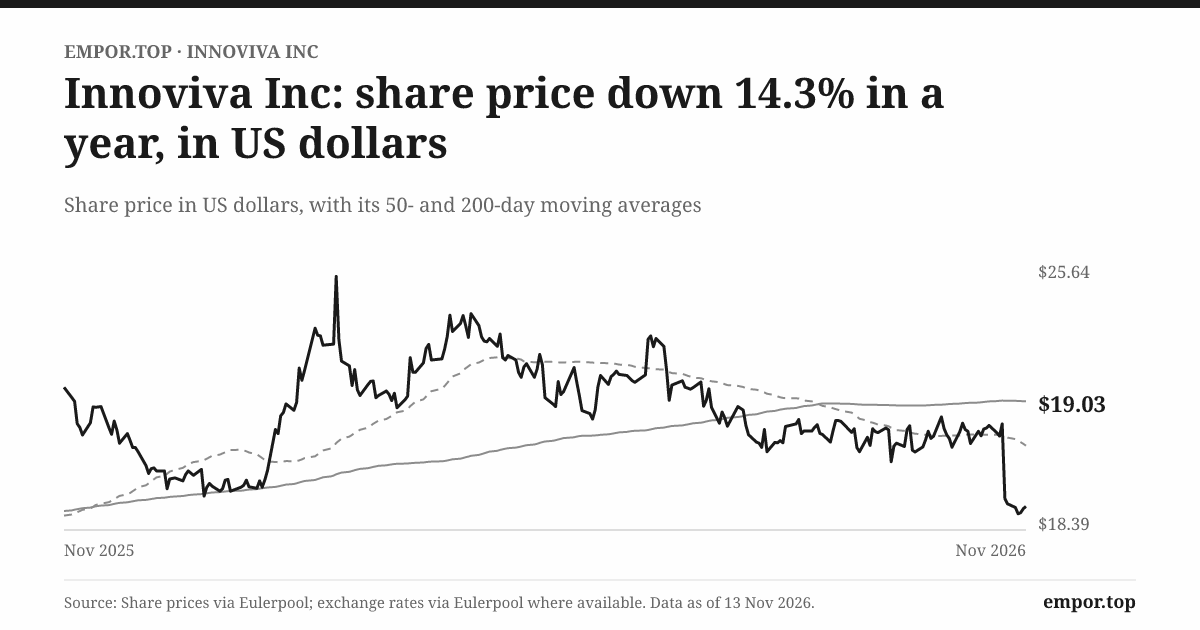
The honest answer is both, and that is what makes this story worth telling. Innoviva is a small public company, worth about $1.4 billion at a share price near $19 in mid-November 2026. It sits on three very different engines at once.
The oldest is a royalty stream on two inhalers that GSK sells around the world. The newest is a portfolio of hospital and infectious-disease drugs that Innoviva sells itself. And alongside both sits a book of strategic stakes in other healthcare companies, whose prices move every day the market is open.
Look at the quarter's revenue and the first engine still carries most of the load. Total revenue was $106.1 million, of which $58.1 million came from net royalties and $49.4 million from product sales.[^1]
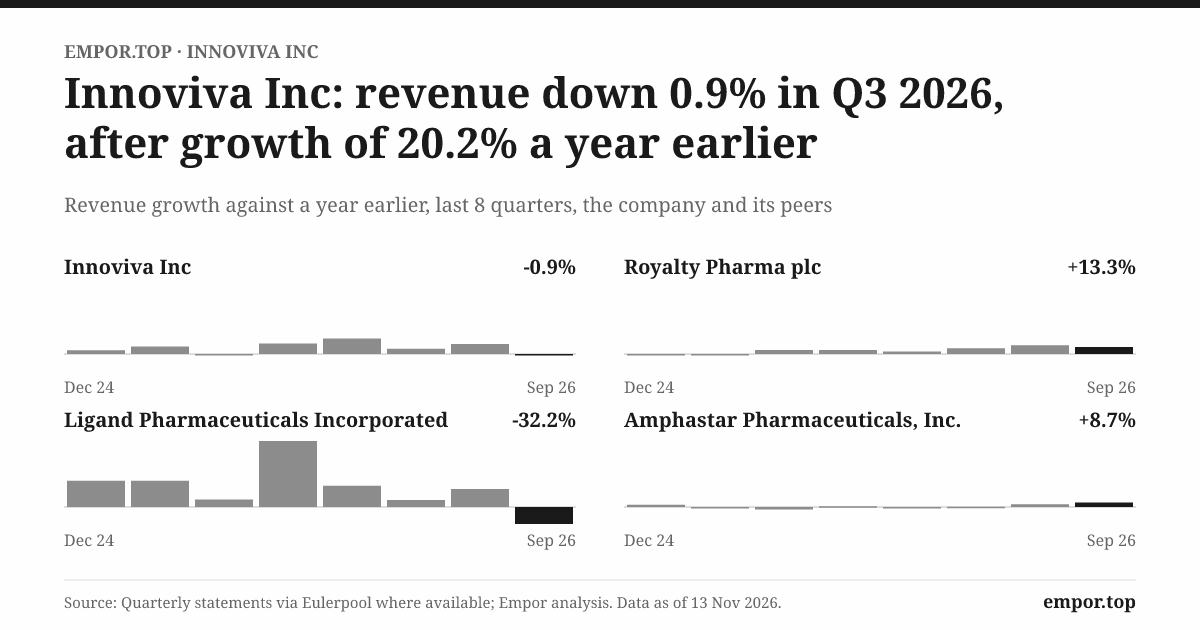
Revenue actually fell about 1.6% from a year earlier, because royalties declined and because international shipments of XACDURO happened to land in a different quarter.1 The headline growth number, in other words, belonged entirely to the products. The royalties were drifting the other way.
Pull back to the full year and the shape is the same, only bigger. In 2025 Innoviva reported about $411 million of revenue.2 GSK paid it $250.3 million in gross royalties, and the company sold $172.1 million of its own drugs, up 77% in a single year.2 Four years earlier, product sales had been zero. Today they are about two-fifths of the business.
That is the central bet, and it raises three questions this story keeps circling back to.
The first is whether the owned products can grow into a durable second engine, one that does not need an approval or an acquisition every year to keep moving. The second is whether the royalty stream is as durable as its reputation. Royalties have the image of bond coupons, steady and boring.
But these coupons are attached to inhalers that are getting older, sold by a partner whose own fastest-growing respiratory product sits outside Innoviva's royalty contract. The third question is the one the November quarter put on the front page: how much should anyone trust the earnings number when investment marks can swing it by more than the whole operating business earns?
One more wrinkle makes the puzzle harder. Innoviva reports as a single operating segment.2 Investors can see revenue by product and royalty by product, but they cannot see a separate profit line for the drug business versus the royalty business. They can see that operating income is healthy. They cannot see how much of it the products would earn on their own once sales, marketing, manufacturing and amortization of the acquired drugs are charged against them.
So the quarter that opens this story is a fair summary of the company. The operating business is profitable and the product line is growing. The reported bottom line can move in the opposite direction from both. Understanding why requires going back to the moment Innoviva was born, as the half of a split company that kept the cash and gave away the laboratory.
 Subscribe on LinkedIn
II. The spin-off left Innoviva with a royalty stream
Most drug companies begin with a scientist and a molecule. Innoviva began with a contract.
The company that became Innoviva was called Theravance. It was a South San Francisco drug-discovery shop that filed to go public in June 2004, with the classic biotech pitch of clever chemistry and a long pipeline.3 Its most important relationship was with GSK.
Starting in 2002, the two companies worked together on a new generation of long-acting inhaled medicines for asthma and chronic obstructive pulmonary disease, the lung condition better known as COPD.4 GSK would run the late-stage trials and do the selling. Theravance would collect royalties if the drugs made it.
They made it. In 2013 U.S. regulators approved BREO ELLIPTA, a once-daily inhaler that pairs a steroid with a long-acting bronchodilator, and ANORO ELLIPTA, a once-daily inhaler that combines two bronchodilators.4 Outside the U.S., BREO is sold as RELVAR. For the first time, the Theravance-GSK collaboration was producing real drugs with real global sales.
That created an awkward situation. Theravance now owned two very different things. One was a royalty stream from GSK, a contractual right that needed lawyers and accountants more than scientists. The other was a research operation that burned cash in pursuit of new medicines. Investors who wanted a steady income stream had to fund the laboratory, and investors who wanted biotech upside had to own a royalty vehicle.
In June 2014, management split the two. Theravance distributed a new company, Theravance Biopharma, to its shareholders. The research programs and most of the scientists went with Theravance Biopharma. The listed company that remained kept the core GSK royalty rights on RELVAR/BREO and ANORO, plus an economic interest in a separate entity tied to GSK's later triple-therapy inhaler.4 In January 2016, that remaining company changed its name to Innoviva.4
The financial record shows how sharply the identity changed. In 2014, as the royalties were barely starting, the company reported $8 million of revenue and a loss.2 By 2019 revenue was about $261 million, and operating margin was above 90%.2 Very few businesses on Earth earn 90 cents of operating profit on every dollar of revenue. A royalty owner with almost no employees can, because someone else pays for the factories, the sales reps and the advertising.
Here is how the machine works. GSK manufactures the inhalers, ships them to pharmacies and hospitals in dozens of countries, negotiates with insurers and governments, and books the product sales on its own income statement. Innoviva does none of that. It receives a percentage of GSK's net sales. On RELVAR/BREO, the rate is 15% on the first $3 billion of annual global net sales and 5% on anything above that.2 On ANORO, the royalty tiers between 6.5% and 10%.2
Think of it as owning a piece of the cash register in someone else's shop. The register rings every time a patient fills a prescription. Innoviva never has to stock the shelves. But it also cannot decide what goes in the window, how much to charge, or whether the shopkeeper decides to push a newer product instead.
That trade-off is the whole story of the royalty business. It is high-margin, contractual cash that requires very little capital. It is also completely dependent on GSK's sales, GSK's pricing, GSK's product priorities and GSK's reporting. Innoviva says that dependence remains.2
GSK was not just Innoviva's customer for most of this period. It was also a large shareholder, a legacy of the old Theravance alliance. That stake ended in 2021, when Innoviva repurchased GSK's shares.2 It was a clean break. GSK remained the company that sold the inhalers and paid the royalties, but it no longer owned a piece of the company that received them. From then on, GSK's business and Innoviva's business were linked only by contract.
The cash that contract produced was large. Across the dozen years from 2014 to 2025, Innoviva generated about $2.0 billion of operating cash flow and about $1.8 billion of free cash flow.2 In the early years much of it went to servicing the debt that came with the old Theravance structure.
Borrowings were above $700 million in 2014 and below $270 million by the end of 2025.2 Shareholders' equity, which was negative for years after the spin-off, turned positive in 2018 and exceeded $1 billion by 2025.2
Those early years were not comfortable. The split had left the royalty company carrying the heavy debt load of the old Theravance, and for several years the royalties were essentially a machine for paying bondholders. Dividends, paid in 2014 and 2015, stopped almost entirely after 2016.2
Shareholders were told, in effect, to wait while the cash cleaned up the balance sheet. Across the dozen years, dividends absorbed only about 8% of free cash flow; the rest went overwhelmingly to creditors first and, later, to buybacks and investments.2
By around 2020 the debt problem was mostly solved, and the question became harder. What should a company with a growing pile of cash and a royalty on two aging inhalers do with itself?
There were two obvious paths. One was to behave like a trust: collect the royalties, pay down the rest of the debt, return the cash, and quietly shrink as the products aged. The other was to use the royalty as a funding engine and build something Innoviva controlled. The second path meant selling part of the future for cash today, and then betting that cash on a business far harder to run than a royalty.
Innoviva chose the second path. To understand whether that was wise, it helps first to understand exactly what kind of moat the royalty stream really was.
III. A royalty right is a moat with a clock on it
Open GSK's 2025 annual report and turn to the respiratory pages. The biggest line there is not one of Innoviva's inhalers.
It is TRELEGY, GSK's once-daily triple-therapy inhaler, which combines a steroid and two bronchodilators in one device. In 2025 TRELEGY sold about £3.0 billion and grew 11%.5 RELVAR/BREO sold about £1.0 billion, down 5%.5 ANORO sold £542 million.5 In GSK's own portfolio, the product that grew was the one Innoviva does not collect on.
That is the most important competitive fact about Innoviva's royalties, and it comes from inside the partner's house. TRELEGY is not an outside rival trying to steal patients. It is the next step in the same family, sold by the same company, often to the same doctors.
For some COPD patients who are not controlled on two medicines, a doctor can move them to three in one inhaler. Every time GSK's sales force wins one of those switches, it may be moving a patient away from a product that pays Innoviva 15% to one that pays Innoviva nothing.
Not every TRELEGY prescription is a lost BREO prescription. Some are new patients, and some come from rival companies. But the direction matters, and GSK's numbers show it plainly. The partner is growing in respiratory. Innoviva's piece of that growth is shrinking.
A simple piece of arithmetic shows how directly Innoviva's income tracks GSK's sales. At roughly £1.0 billion, RELVAR/BREO sales are well under the $3 billion threshold where the royalty steps down to 5%. So the whole brand pays at 15%. Converted at roughly $1.30 to the pound, 15% of those sales is a little under $200 million.
ANORO, at a royalty rate in the high single digits, adds something like $50 million. Those two estimates together land close to the $250.3 million of gross royalties Innoviva actually reported for 2025.2 The 5% tier above $3 billion, designed for a blockbuster future, is now a historical curiosity.
That math also explains why the royalty line is starting to sag. In the first nine months of 2026, Innoviva's net royalty revenue fell from $191.6 million to $176.5 million, down about 8%.1 RELVAR/BREO royalties declined year over year while ANORO royalties rose slightly.1 The larger product is shrinking. The smaller one is holding. Because Innoviva earns more on every dollar of BREO than on every dollar of ANORO, the mix is moving the wrong way.
To see why TRELEGY is such a natural successor, it helps to know how doctors treat COPD. Think of it as a ladder. Patients with milder disease start on a single long-acting bronchodilator, a drug that relaxes the airways for a full day. If symptoms persist, doctors add a second bronchodilator, which is what ANORO provides in one device.
Patients who keep having flare-ups may need an inhaled steroid on top, and the step that combines all three in one daily puff is exactly TRELEGY's territory. BREO, a steroid plus one bronchodilator, sits on a side rung that has historically served many asthma patients and some COPD patients. Every move up the ladder toward three-in-one therapy is a move toward the product Innoviva no longer has a piece of.
A brief technical aside helps here. Innoviva reports royalties two ways. Gross royalties are what GSK owes on its sales. Net royalty revenue subtracts an annual amortization charge for fees Innoviva paid years ago to secure parts of the arrangement.2 The amortization is a non-cash, slowly shrinking accounting charge. It does not change the trend, but it explains why the net figure always runs below the gross one.
The wider market makes the picture more crowded still. GSK is not alone in respiratory. AstraZeneca and Boehringer Ingelheim are both major sellers of inhaled COPD and asthma medicines, including their own combination products.2 Insurers and pharmacy benefit managers negotiate hard over which inhalers sit on preferred lists. And each of these products eventually faces generic or alternative versions as patents and other protections expire.2
So what kind of moat is this?
It is not a moat in the sense investors usually mean. Innoviva has no customer lock-in, because it has no patients or doctors as customers. It has no network effect. It has no brand that a pharmacist recognises. Its moat is a legal one.
It is a contract that obliges GSK to pay a percentage of sales for as long as the royalty terms run.2 That contract is valuable precisely because Innoviva cannot be competed out of it. No rival can bid a lower royalty rate and take the stream away.
But a contractual moat protects the right to be paid, not the size of the payment. Innoviva earns only when the underlying products sell. The contract cannot force a doctor to choose BREO over TRELEGY, cannot stop an insurer from preferring a rival inhaler, and cannot stop GSK from deciding where its sales force spends its time.
Michael Porter's competitive forces help clarify who holds the power. GSK is the single buyer of Innoviva's only royalty product, and it controls everything about how the inhalers are made, priced and sold. That gives GSK enormous practical leverage, even though the royalty rate is fixed.
Substitutes are everywhere: TRELEGY within GSK, rival combination inhalers outside it, and eventually cheaper alternatives. Innoviva has no disclosed ability to switch its royalty to another seller. It is a one-customer business with the terms written in stone, which is a strength in a dispute and a weakness in a market.
Long-term patent and license protections remain part of what the asset is worth. They define how long the coupons keep arriving at anything like today's rates. But a legal right is not a guarantee of stable sales. Every year that passes is a year closer to the point where protection fades and sales compress further. That is why it makes sense to describe this asset as a moat with a clock on it.
For an investor, the clock is the right frame. The royalty stream still produced about a quarter of a billion dollars of gross payments in 2025, and it requires almost no investment from Innoviva.2 That is real money. The question is not whether the stream is valuable, but whether it is growing or melting, and at what rate. The first nine months of 2026 say it is melting slowly, at a high single-digit pace.
That creates a strategic dilemma with no clean answer. A high-margin royalty stream is a wonderful source of funding for diversification. But any royalty the company sells to raise funds is future upside traded for cash today. In 2022 Innoviva faced that exact choice with the one royalty tied to GSK's fastest-growing inhaler. It sold.
IV. Innoviva sold a piece of the future to buy a new one
In July 2022, Innoviva made a sequence of decisions that defined the company it is today.
The first was a sale. Innoviva held a 15% economic interest in Theravance Respiratory Company, the entity that collected royalties on TRELEGY.6 It sold that interest to Royalty Pharma, the largest dedicated buyer of drug royalties, for about $282 million in cash upfront and up to $50 million more if a sales milestone was hit.6
With the benefit of hindsight, it is striking which royalty went out the door. GSK's own 2025 numbers show TRELEGY as the respiratory product that kept growing, while the inhalers Innoviva kept were the ones that started to decline.5
Was that a mistake? Not necessarily. A royalty buyer such as Royalty Pharma pays for expected future growth upfront, so part of TRELEGY's later success was already in the price. A $282 million check in 2022 was certain. TRELEGY's growth was not. But the sale did change the shape of Innoviva's royalty book. From then on, it owned two maturing products and none of the growth product.
The second and third decisions were purchases. Innoviva had already built a position of about 60% in Entasis Therapeutics, a small company developing antibiotics against drug-resistant bacteria.[^9] In 2022 it bought the shares it did not already own, paying about $42.4 million.[^9]
That figure is the price of the remaining minority, not the full cost of the company. Innoviva had paid for its earlier stake in separate investments. What it got was full control of Entasis's lead program, sulbactam-durlobactam, which would later be approved and sold as XACDURO.
Then came La Jolla Pharmaceutical, a commercial-stage company that sold GIAPREZA, a drug for patients in shock, and XERAVA, an antibiotic for complicated abdominal infections. On July 24, 2022, Innoviva agreed to buy it through a tender offer at $6.23 per share in cash.7 That price was about 70% above La Jolla's 30-day volume-weighted average share price, a substantial premium.7 Net of La Jolla's own cash, Innoviva paid about $150.5 million.2
The La Jolla sale was not a one-bidder affair. The company ran a process that drew proposals from other parties before Innoviva's offer was agreed.7 That matters as context. It suggests the price was tested against rival interest rather than set in a private negotiation.
But it does not prove that the price was right. A 70% premium to a struggling small-cap's share price can be cheap or expensive depending on what the products go on to earn, and there is no close, recent public comparable that settles the question either way.
Put the three moves together and the logic is clear. Innoviva sold a stake in a royalty it did not control for about $282 million. It then spent roughly $190 million in net cash to take full control of two companies with drugs it could sell itself. It traded a passive, growing income stream for an active, operational business, and it pocketed a margin of cash in the process.
The trade moved Innoviva from a business where GSK did the work to one where Innoviva had to hire salespeople, manage drug supply, win hospital formularies and negotiate with distributors. It changed the risk, not just the asset mix. A royalty can disappoint only through the partner's sales. A commercial drug business can disappoint through manufacturing, pricing, access, launch execution and competition, all at once.
So what did the 2022 deals actually buy? Four years on, the operating record is the best available test.
The La Jolla products became the backbone of the new business. In 2025 GIAPREZA generated $73.6 million of sales, up 34% from the year before.2 XERAVA generated $23.5 million.2 Together that is close to $100 million of annual revenue from a company acquired for about $150 million in net cash. On a crude revenue multiple, that looks like a reasonable price, before accounting for the costs of selling the drugs.
Entasis delivered something arguably bigger. XACDURO won U.S. approval in 2023 and, in 2025, produced about $74.4 million across U.S. and international sales.2 From a standing start, it became Innoviva's second-largest product in roughly two years. For a hospital antibiotic aimed at a narrow, drug-resistant infection, that is a fast commercial ramp.
The record is not uniformly strong, though, and the weak spots are instructive. XERAVA's U.S. sales grew only 4% in 2025, and they fell 4% in the first nine months of 2026.21 Some XACDURO sales outside the U.S. reflected inventory timing and supply arrangements with partners, rather than patient-level demand in a given quarter.1 That is why a quarter can look strong one period and soft the next, as the third quarter of 2026 showed.
So did the 2022 deals turn royalty wealth into a commercially useful platform? On the evidence, yes, in the narrow sense that the platform now exists and sells real drugs. Product sales went from nothing to $172 million in three years.2
What the disclosures do not show is the deal-level return. Innoviva does not publish product-level profit, so nobody outside the company can calculate the cash return on La Jolla or Entasis after sales costs, manufacturing, research and amortization.
The deal-making did not stop in 2022. In 2025 Innoviva bought the assets of the Lynx platform, booking $9.4 million of acquired in-process research and development and agreeing to pay up to $20 million more in development, regulatory and sales milestones plus future royalties.2 That small transaction is revealing in its structure. Innoviva, a company built on receiving royalties, now pays them on some of what it buys. The roles have reversed.
Research spending tells a similar story of selective rather than sweeping reinvestment. R&D expense was $33.9 million in 2023, fell to $13.7 million in 2024 and rose back to $30.6 million in 2025, including the Lynx charge and continued work on NUZOLVENCE.2
That was somewhere between 4% and 11% of revenue in those years, a fraction of what a conventional drug developer spends. Capital spending on property and equipment was barely a rounding error, around $1 million in 2025.2 Innoviva is not trying to become a discovery company again. It is trying to be a buyer and seller of drugs that other people discovered.
That gap matters, because the correct way to judge an acquisition is not by approvals or press releases. It is by the cash it eventually returns compared with the cash it consumed. The approval of XACDURO was a milestone. The $74 million of sales was proof of demand.
The question of whether those sales earn a good return on everything Innoviva spent to get there is still open. That makes the next chapter, the business of actually selling these drugs, the one that decides whether the 2022 trade was a pivot or a detour.
V. The hospital-drug portfolio is growing; the hard part is making growth durable
Picture an intensive-care unit at three in the morning. A patient's blood pressure is collapsing despite fluids and the standard drugs. Doctors call this distributive shock: the blood vessels have relaxed so much that the heart cannot keep blood flowing to the organs. This is the moment GIAPREZA was built for. It is a synthetic version of angiotensin II, a hormone the body uses to tighten blood vessels, given intravenously when other vasopressors are not enough.2
Down the hall, another patient on a ventilator has developed pneumonia caused by Acinetobacter baumannii, a bacterium notorious for shrugging off antibiotics. Hospital-acquired and ventilator-associated pneumonia from this bug can be lethal, and the options have historically been poor. This is XACDURO's patient.2 It pairs an older antibiotic, sulbactam, with durlobactam, a newer molecule that blocks the enzymes the bacteria use to destroy it.
These are not the drugs of mass-market pharma. Nobody sees a television ad for GIAPREZA. They are sold to a few thousand hospitals, prescribed by critical-care and infectious-disease specialists, and stocked by hospital pharmacies that answer to committees.
That is the business Innoviva bought itself into, and in the quarter to September 2026 it worked. GIAPREZA and XACDURO each generated about $23 million of net product sales.[^1] In the same quarter, NUZOLVENCE became commercially available in the U.S.[^1]
Walk the portfolio in order of what it actually earns, and the concentration becomes obvious. GIAPREZA is the anchor, still growing about a third a year.2 XACDURO is the fast riser. XERAVA, the abdominal-infection antibiotic that came with La Jolla, is a steady but slow contributor.
ZEVTERA, an antibiotic for serious bacterial infections that Innoviva licensed for the U.S., adds only a small amount so far.2 Then there is NUZOLVENCE, a single-dose oral treatment for uncomplicated gonorrhea, which has only just begun to sell.[^1]
Two drugs did almost all the growing: GIAPREZA and XACDURO accounted for nearly all product-sales growth in 2025.2 A company that looks diversified across five brands is, in economic terms, mostly a two-product business with three options attached.
That growth continued into 2026. U.S. product sales were up 45% year over year in the third quarter.[^1] Management set a target of at least $150 million in U.S. product sales for the full year 2026, a goal it carried through its second-quarter results and investor presentation and reaffirmed in November.[^11][^12][^1]
Simple arithmetic shows what the target asks for. Three quarters of roughly $43 million would already add up to well over $100 million, so the remaining test is whether the fourth quarter holds the pace rather than whether it accelerates.
The target is specific, which is to the company's credit. It is also limited to U.S. sales. International sales, which depend on partners ordering stock for their own markets, are deliberately left out. That is a sensible choice, because ex-U.S. XACDURO sales can be lumpy due to inventory timing and supply arrangements.1 But it also means investors should judge the platform by U.S. demand first and treat international revenue as lumpy.
An approval is not a market
The arrival of NUZOLVENCE deserves careful framing. A U.S. launch is a real milestone. A new oral antibiotic for gonorrhea, a disease whose bacteria have grown steadily more resistant to existing treatments, has genuine medical value.
But availability is the first step, not the business. For NUZOLVENCE to matter financially, it has to win placement with payers, earn a place in treatment guidelines and prescribing habits, reach clinics where patients are treated, and generate repeat orders quarter after quarter.
Innoviva's own history argues for patience in judging launches. XERAVA was an approved, commercially available antibiotic long before Innoviva owned it, and it is still a small and slow-growing brand. XACDURO, by contrast, ramped quickly.
The difference was not the approval. Both had one. The difference was how much each drug changed the choice a doctor faced. XACDURO addressed a specific, deadly pathogen with few good alternatives. XERAVA entered a crowded field of broad-spectrum antibiotics.
That is the general competitive lesson for hospital antibiotics. Hospitals run antimicrobial stewardship programs that deliberately restrict the use of new antibiotics, to slow the growth of resistance. Established, cheaper generics remain the first choice for most infections. Pharmacy and therapeutics committees decide what goes on the hospital formulary. A clinical advantage only becomes revenue if it survives that gauntlet.
GIAPREZA faces a different kind of clock. In 2025 Innoviva settled patent litigation with generic drugmakers that had filed to copy GIAPREZA, granting them a royalty-free U.S. license that begins in the early 2030s, subject to antitrust review.2
The settlement gives the brand a defined runway. It also puts an end date on the product that currently generates the most product revenue. GIAPREZA's growth years are therefore finite, and the company needs other products to take over before generic entry arrives.
It is worth pausing on how small the organization behind all this is. At the end of 2025, Innoviva had 159 full-time employees.2 That headcount covers the royalty administration, the investment portfolio, finance, regulatory work, medical affairs and the commercial team selling five hospital and infectious-disease drugs.
A large pharmaceutical company might deploy more people than that to cover a single region. The lean structure is part of why the operating margin stays high. It is also a constraint, because a narrow commercial footprint can only reach so many hospitals with so many conversations.
Inventory tells the story of a company learning to be a manufacturer's customer. Right after the 2022 acquisitions, inventory looked enormous relative to the cost of goods sold, because Innoviva inherited stock that had been revalued upward at the acquisition date and was selling it slowly.2
As sales grew, that ratio fell sharply, from well over a thousand days of cost in 2022 to about 122 days in 2025.2 In plain terms, the products moved from sitting in warehouses to moving through hospitals. That is one of the quieter, more convincing signs that demand is real.
The distributors in the middle
There is another concentration hiding in the product business, and it sits in the supply chain. Innoviva does not sell its drugs directly to every hospital. It sells most of them to a small number of large wholesalers and distributors, who then supply the hospitals. In 2025, Innoviva's three largest product customers accounted for 24%, 22% and 22% of net product sales, or about 68% combined.2 At year-end those same three accounted for about 73% of product receivables.2
The concentration is easing, slowly. The top three product customers accounted for 85% of product sales in 2023, compared with about 68% in 2025.2 That is progress, but it is the kind of concentration that is normal for U.S. specialty pharmaceuticals, where three national wholesalers dominate distribution.
The risk is less that a distributor walks away than that the distributors' ordering patterns create quarter-to-quarter noise, and that their bargaining power shows up in fees and terms.
All of this sits on top of the GSK concentration. GSK remains the source of most of Innoviva's revenue.2 So the company is diversifying away from one large counterparty by building a business that leans on three others. The difference is that the distributors are conduits for demand from thousands of hospitals, while GSK is the demand.
Receivables tell a consistent story. Product receivables were $35.0 million at the end of 2025 and $44.0 million at the end of September 2026, which roughly tracks the growth in product sales.21
Innoviva says it estimates credit losses using payment terms, customers' actual payment patterns and individual circumstances.2 It does not publish an ageing table showing how much is overdue. So the filings support a conclusion that receivables have grown in line with sales, but not a detailed view of collection quality.
At the company level, collection looks dramatically better than a decade ago. Debtor days, the number of days of revenue sitting in receivables, fell from 481 in 2014 to 30 in 2025.2 That decline mostly reflects the move from a tiny, lumpy early revenue base to a large, regular royalty stream. It is a reassuring backdrop, but it is a company-wide measure dominated by GSK. It does not substitute for a product-customer ageing analysis that Innoviva does not provide.
Weigh it all, and the verdict is clear but bounded. The hospital-drug portfolio has real commercial traction. GIAPREZA and XACDURO are selling meaningful volumes to hospitals that do not buy drugs lightly. That is more than most small companies that acquire approved products ever achieve.
But the platform is not yet a proven, broad-based growth engine. It depends on two drugs, three distributors, unpredictable international ordering and a newly launched product whose value is still an option. The test of durability is whether growth spreads beyond GIAPREZA and XACDURO before GIAPREZA's patent runway runs short.
Proving that will take years of operating results. And those results arrive every quarter wrapped in a much louder number, one that has nothing to do with selling drugs.
VI. The investment portfolio made earnings look like a different company
Imagine opening Innoviva's 2025 annual report without knowing anything about the company. The headline is excellent. Net income was $271.2 million, up more than tenfold from 2024.2[^13] Earnings per share were above $3.2
Now look one line up. Operating income, the profit from royalties and products after running costs, was $163.7 million, slightly lower than the $166.9 million of 2024.2 The business did not suddenly become far more profitable in 2025. Something else did the lifting.
That something was $161.6 million of favorable changes in the fair value of Innoviva's investments.2 Under U.S. accounting rules, the company marks many of its strategic stakes to market each quarter, and the change runs through the income statement. When the investee shares rise, Innoviva records a gain. When they fall, it records a loss. No cash moves either way until something is sold or distributed.
Then came 2026, and the marks reversed. In the first quarter, Innoviva reported net income of about $186 million; in the second, a net loss of about $83 million.[^11] During the year the company also released a $38.9 million reserve for potential foreign tax liabilities once the relevant statute of limitations expired, another gain with nothing to do with selling drugs.1
In the third quarter, investment marks again drove a net loss.[^1][^2] Across those nine months, net income was just $29.3 million.1
Operating cash flow in the same nine months was $129.0 million.1 Read those two figures side by side. The business threw off more than four times as much cash as it reported in profit. The gap is mostly the $109.3 million of net non-cash fair-value adjustments, plus about $20 million of amortization on acquired drug assets, partly offset by about $31 million of cash tied up in working capital as product sales grew.1
Over a long enough span, these swings largely wash out, and the underlying cash generation shows through. From 2014 to 2025, Innoviva reported cumulative net profit of about $1.7 billion and operating cash flow of about $2.0 billion.2
Cash exceeded reported profit by about 18% over twelve years. That is healthy. But it is an average across years that included enormous accounting gains and losses, so it says more about the royalty stream's reliability than about the reliability of the earnings line.
The bridge from profit to cash has several moving parts beyond the investment marks, and they matter for understanding any single year. In 2025, operating cash flow of $196.9 million was supported by $43.8 million of deferred taxes, $26.3 million of amortization on acquired intangibles and $9.5 million of stock compensation, while growing receivables and inventory consumed cash.2
Amortization of the acquired drugs is a real cost in economic terms, because it reflects money already spent to buy them. But it is a cost paid in 2022, not today.
The single biggest source of recent volatility has a name: Armata Pharmaceuticals. Armata is a clinical-stage company developing bacteriophage therapies, viruses engineered to kill specific bacteria. Innoviva holds a large position in it, including equity and other instruments, and Armata's share price movements have been large enough to swing Innoviva's quarterly results.2[^2] The third-quarter 2026 loss was primarily Armata.[^2]
Armata is not part of Innoviva's operating business. It contributes no product sales and no royalties. Its value to Innoviva lies entirely in what the stake might eventually be worth or sold for.
So a sophisticated reader should treat Armata as a separate line item in a mental sum-of-the-parts, not as a driver of Innoviva's earning power. The same applies to the wider book of strategic investments, which fell from $614.0 million at the end of 2025 to $535.5 million by September 2026.1
The treasury side adds a smaller, steadier contribution. In 2025 Innoviva earned $21.1 million of interest and dividend income on its cash and holdings, a little more than the $16.7 million of interest it paid on its convertible notes.2
Its cash equivalents sit largely in money-market funds.2 In effect, the cash pile now pays for the debt. That is a comfortable position, and a far cry from the years after the spin-off when interest was a heavy charge against the royalties.
There is a further reason for caution with the marks. A meaningful part of the investment book consists of private holdings and convertible instruments whose values rely on what accountants call Level 3 inputs: estimates and models rather than quoted market prices.2
Those valuations involve judgment, and judgment can be wrong in either direction. A quoted share price at least tells you what someone would pay today. A model tells you what someone believes the asset should be worth.
The fund that unwound
Before Armata dominated the headlines, there was a larger experiment. Innoviva invested $300 million in ISP Fund LP, a vehicle whose general partner and investment adviser were affiliates of Sarissa Capital, the activist investment firm that had become closely involved with Innoviva.2
The arrangement carried a 1% management fee on Innoviva's capital account and a 10% annual performance allocation.2 Those terms were lighter than the classic hedge-fund structure, but they were not free.
In October 2024, Innoviva elected to unwind the fund.2 It received $121 million of distributions in 2025 and had expected further distributions through April 2026.2 At the end of 2025 the fund still held $79.7 million of assets, and Innoviva consolidated it on its balance sheet as a variable interest entity, the accounting term for a vehicle it effectively controls even without traditional majority ownership.2
The related-party dimension should be weighed without exaggeration. Sarissa's strategic advisory services to Innoviva were described as provided free.2 The fund was not a royalty or operating revenue stream flowing between related companies. Sarissa stopped being treated as a related party after its board representatives left following the May 2025 annual meeting.2
But it was a meaningful governance fact. A public company placed $300 million, a sum larger than any of its 2022 acquisitions, into a fund managed by affiliates of an investor with board representation. That is the kind of arrangement that demands a clear accounting of what came back.
The right test for the fund, and for the investment book as a whole, is not a quarterly mark. It is realized cash returned compared with capital deployed. The $121 million of 2025 distributions is a piece of that tally, and the remaining distributions through 2026 will complete it. Investors who want to judge Innoviva's capital allocation need that full scorecard. The marks, in either direction, are only an estimate of what the scorecard might eventually say.
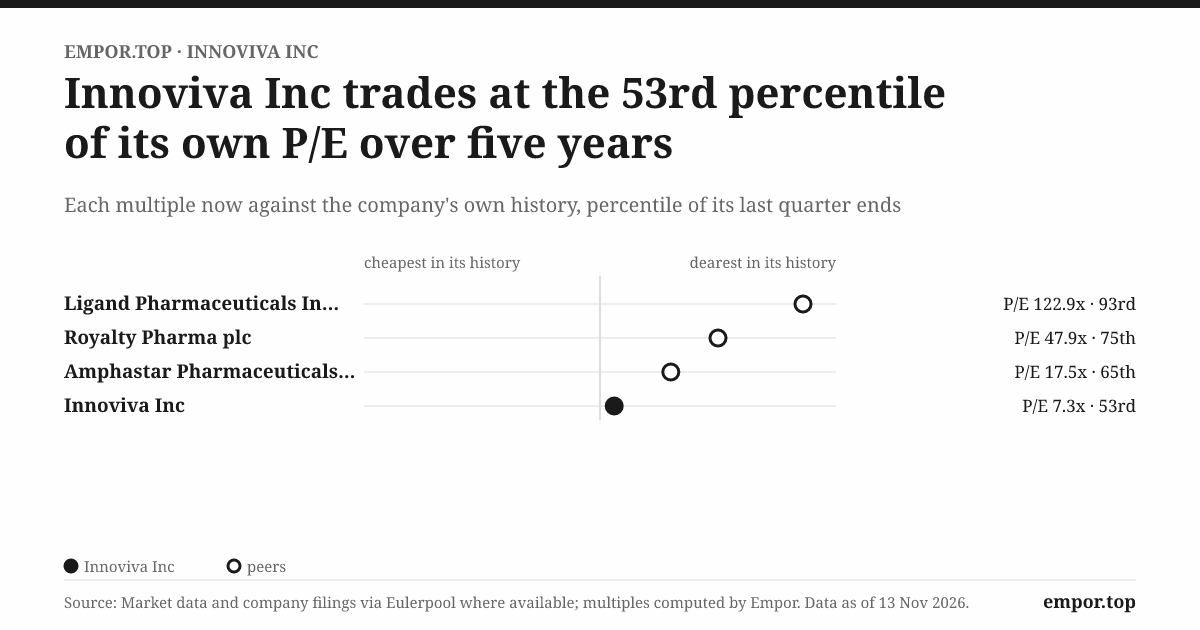
That is why the low headline valuation needs to be read with care. At the November 2026 share price, Innoviva traded at about 7.3 times trailing earnings, an earnings yield of about 13.6%. But trailing earnings include the gains of late 2025 and the losses of 2026. A multiple of a number that can swing by $150 million in a quarter is not a precise instrument. A more useful lens is operating income and operating cash flow, stripped of investment marks, over several years.
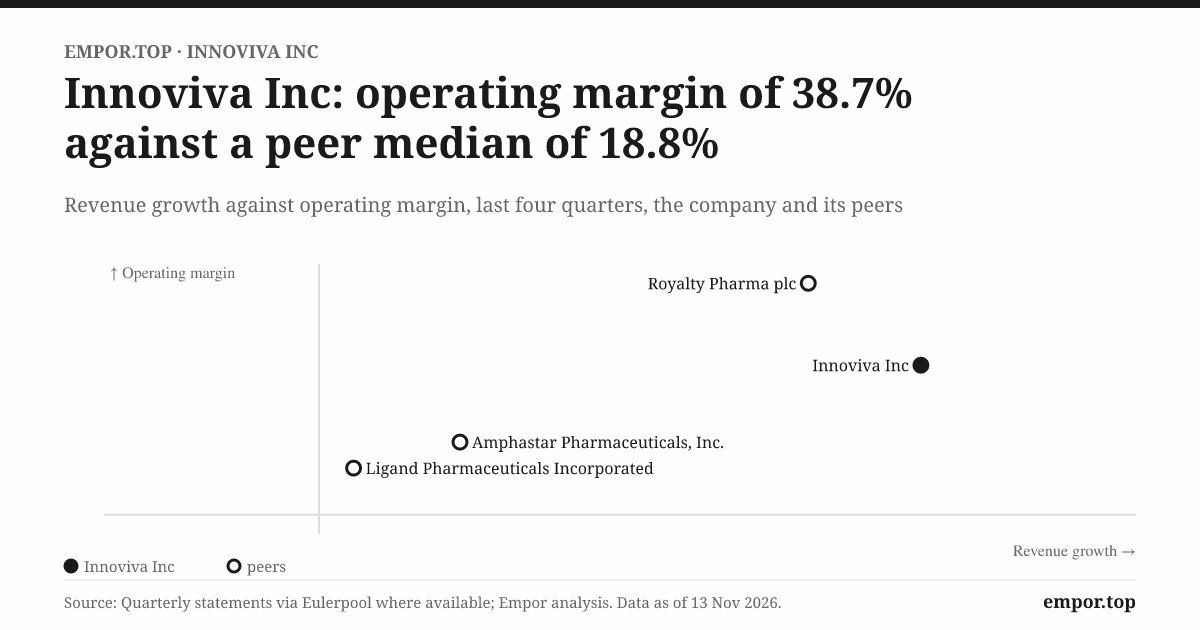
On that view, the royalty and product operations are steady and cash-generative, with operating income in the range of $160 million to $170 million a year recently, and operating cash flow not far behind.2 The investment portfolio is a separate, volatile asset worth hundreds of millions of dollars. Putting the two together into a single earnings figure produces a number that describes neither.
The people who chose to build that portfolio, and the people who now run the company, deserve their own scrutiny.
VII. Raifeld's capital-allocation record is the test of the new strategy
Pavel Raifeld did not come to Innoviva from a drug company. He came from an investment firm.
Before becoming chief executive in 2020, Raifeld had been part of Sarissa Capital's investment team.8 Sarissa, the activist firm founded by Alex Denner, had built a large position in Innoviva and won representation on its board.9 Raifeld's appointment put a capital allocator, rather than a commercial pharma executive, in charge of a royalty company that was about to decide what to do with its cash. Stephen Basso joined as chief financial officer in August 2023.8
That background shaped the strategy. The 2022 sequence of selling a royalty and buying commercial assets is an investor's move, an exercise in swapping one asset for another at a price judged attractive. So is the decision to keep a large book of strategic stakes in other healthcare companies. Management described its approach in 2022 as disciplined capital allocation.6 Four years later, there is enough of a record to test that word.
The record has several chapters, and they point in different directions.
The acquisitions produced a working commercial business, as the hospital-drug results show. That is a genuine achievement. The ISP Fund was unwound after about four years, and the final return on the $300 million will only be clear once all the distributions are in.
The Armata stake has made Innoviva's earnings swing violently, and its ultimate value depends on a clinical-stage biotech's success. Strategic investments as a whole fell by about $80 million in the first nine months of 2026.1
Then there are the buybacks, which have a longer history than the current program. After buying out GSK's stake in 2021, Innoviva repurchased about 6.2 million shares in 2023 and roughly another million in early 2024, spending $91.4 million in total, and it retired its remaining treasury shares in April 2024.2 The pattern is consistent: when the company has no better use for the royalty cash, it shrinks the share count.
But the pattern has a counterweight. In 2025 Innoviva's financing cash flow included proceeds from warrant exercises and stock issuance, partly offset by repurchases.2 Shares go out as well as in. That is why the share count, rather than the dollars spent on buybacks, is the figure that tells shareholders whether their slice of the company is actually growing.
The current program began in November 2025, when Innoviva's board authorized up to $125 million of share repurchases.1 By the end of September 2026 the company had spent $82.7 million, including about 1.2 million shares bought in the third quarter, and it spent another $9.6 million in October.1
That is a substantial return of capital for a company worth $1.4 billion. With the shares down about a quarter from their 52-week high, the buybacks were executed at lower prices than earlier in the year.
Against the buybacks stands a large new equity plan. In 2026 shareholders approved an equity incentive plan reserving 9 million shares.[^16]8 With about 74 million shares outstanding, that reserve is equivalent to roughly 12% of the share count.8 It is capacity, not a commitment, and there is no assumption that all of it will be issued. But it competes directly with the buyback. Shares repurchased with one hand can be reissued as compensation with the other.
The chief executive's own pay moved sharply. Raifeld's reported total compensation was $5.4 million in 2025, up from $2.2 million in 2024.8 Most of the increase came through stock and option awards, worth $2.7 million and $1.8 million respectively, with a cash bonus of $378,000.8
In the same year, operating income was roughly flat and net income soared on investment marks.2 The equity-heavy structure aligns Raifeld's wealth with the share price. It also means his reported pay jumped in a year when the operating business did not.
His own stake is meaningful. As of March 2026, Raifeld beneficially owned 734,885 shares, about 1% of the company.8 At a share price near $19, that is a stake worth roughly $14 million, which gives him a material personal interest in how the capital is deployed.
What the shareholders said
The May 2026 annual meeting offered a modest governance signal. Say-on-pay passed comfortably, with 56.2 million votes in favor and 2.8 million against or abstaining.[^16] Raifeld himself was re-elected with almost no opposition.[^16] Chair Mark DiPaolo was a different story. He received 50.1 million votes for and 9.2 million against or abstaining, roughly 15% of votes cast.[^16] That is not a revolt, but it is a noticeable protest against a board chair.
The ownership base explains why such votes rarely become revolts. Innoviva has no controlling shareholder. Its largest holders as of March 2026 were index and quantitative investors: BlackRock at about 14%, Vanguard at about 11%, Dimensional and Renaissance Technologies at about 6% each.8
A year earlier, Putnam had also been above the 5% threshold, and Sarissa held about 11.6% as of December 2024.98 Sarissa's departure from the board removed the most engaged, concentrated investor from the governance picture.
Two smaller items complete the governance record. The 2026 proxy reported that the chief executive, chief financial officer and chief accounting officer each filed one Form 4 late in 2025, for one transaction each.8 That is an administrative lapse, not an accounting issue, but it is the sort of detail a careful board should not allow.
And the auditor gave an unqualified opinion on the financial statements and internal controls, highlighting as its critical audit matter the judgments over whether Innoviva was the primary beneficiary of various variable interest entities.2 In a company whose balance sheet includes funds and partnerships it may or may not consolidate, that judgment is exactly where scrutiny belongs.
Taken together, the record is mixed and still developing. Management has built a growing commercial platform and is returning capital at a meaningful pace. It has also presided over a large, volatile investment book, a fund arrangement with an affiliated firm that has been unwound, and a step-up in reported pay. The fairest summary is that the strategy is credible in its operating results and unproven in its capital returns.
The real test is how management explains itself when the numbers turn. On calls and in presentations, the questions that matter are concrete ones. Why are BREO royalties falling, and how fast? Which products drive U.S. growth, and how much is repeat demand? What realized proceeds will the investment portfolio deliver, and when? A company that answers those questions with specifics earns confidence. A company that answers them with adjectives does not.
The bull and bear cases are, in the end, arguments about those answers.
VIII. Analysis & Bear vs. Bull Case
Lay three pictures side by side. The first is a contract, signed years ago, under which GSK pays Innoviva a slice of every RELVAR/BREO and ANORO inhaler it sells. The second is a chart of product sales, rising from zero in 2021 to $172 million in 2025 and still climbing in the U.S.2
The third is a jagged line of quarterly investment marks, swinging from large gains to large losses within months. Innoviva is all three pictures at once. The bull and bear cases are arguments about which picture matters most.
Start with scale. In 2025 the royalty contract produced $250.3 million of gross payments, while the product business continued to grow.2 In the first nine months of 2026, net royalties fell while product sales rose.1
At the end of September 2026, Innoviva held $581.4 million of cash against $261 million of principal on convertible notes due in 2028.12 The market valued the whole company at about $1.4 billion, and its enterprise value, after netting cash against debt, at about $1.1 billion.
Why the business could win from here
The bull case begins with cash. The royalty contract still generates about $230 million a year of net royalty revenue, with almost no costs attached on Innoviva's side.2 Even as that stream declines, it funds the product business, buybacks and debt service with room to spare. Operating income rose 21.9% in the third quarter of 2026, to $42.2 million.[^1] The operating business is not shrinking.
The second leg is commercial proof. GIAPREZA and XACDURO have real, growing hospital sales, supporting a product line that grew 77% in 2025.2 Innoviva has shown it can take acquired assets and sell more of them than their previous owners did, which is the hardest skill in specialty pharma.
The third leg is the balance sheet. Cash covers the disclosed note principal more than twice over.12 There is no near-term maturity. The company is buying back its own stock at prices about a quarter below the 52-week high.
On the market's own numbers, an investor paying about $1.1 billion of enterprise value gets operating profit of roughly $170 million over the past year, an enterprise-value-to-operating-profit multiple of about 6.5 times. That is a low multiple for a business with this much cash generation.
What could break the case
The bear case begins where the bull case does: with GSK. Innoviva still gets most of its revenue from a single partner whose growth product, TRELEGY, sits outside its royalty contract.25 RELVAR/BREO is declining, and BREO is the higher-royalty product.
If the royalty decline accelerates, the product business has to grow faster just to keep total revenue flat. That is what happened in the third quarter, when total revenue fell slightly despite 45% U.S. product growth.[^1]
The second bear argument is concentration in the new engine. Two drugs drive most product revenue, three distributors take most product sales, and international XACDURO sales move with partner inventory rather than patients.21 GIAPREZA, the largest product, has a generic license date in the early 2030s.2 The platform is younger and narrower than its five brand names suggest.
The third argument is the earnings line itself. Investment marks can overwhelm the operating story in either direction. The P/E of about 7.3 times looks cheap, and it sits a little above the five-year median of 6.7 times. But a multiple of volatile earnings is not proof of undervaluation.
Run the industry forces through this business and the picture sharpens. Buyer power is dominant on both engines: GSK controls price, promotion and product priority on the royalty side, while distributors and hospital committees decide what gets stocked and used on the product side. Supplier power is moderate: Innoviva relies on third-party manufacturers for its active ingredients and finished drugs, without disclosing how concentrated those suppliers are.2
Substitutes are the sharpest threat. TRELEGY and rival inhalers from AstraZeneca and Boehringer Ingelheim substitute for the royalty products, and generics and established antibiotics substitute for the hospital drugs. New entrants are held back mainly by regulation and patents, which is why GIAPREZA's settlement date matters. Rivalry in hospital antibiotics is fierce, but it is fought over narrow indications, which can protect a well-positioned drug for years.
Hamilton Helmer's seven powers give a cleaner verdict on whether any of this adds up to a durable advantage. Innoviva has no meaningful scale economies or network effects. It has no switching costs on the royalty side and only modest ones in hospitals, where protocols and formulary listings create some inertia.
It has no brand in the consumer sense. Its strongest power is the cornered resource: a royalty contract no competitor can take, and product patents and regulatory exclusivities that keep copies out for a time.
That is a real power, but it has an expiry date on every element. Process power, the ability to repeatedly acquire and commercialise hospital drugs better than others, would be the most valuable power Innoviva could build. GIAPREZA and XACDURO are evidence for it. XERAVA is evidence against it. Two successes in one deal cycle do not yet prove a repeatable process.
So the moat question resolves this way. The royalty is a contractual asset whose value is set by GSK's sales trajectory. The product business has to earn its position through clinical evidence, hospital access, reliable supply and commercial execution.
The claim that Innoviva is becoming a durable specialty-pharma company survives, but in a narrower form: it has shown it can commercialise two acquired hospital drugs well, not yet that it can do so repeatedly.
Two second-order risks round out the picture without changing it. Currency is one. GSK sells the partnered inhalers around the world, so a stronger dollar shrinks the dollar value of royalties earned in pounds, euros and yen. The company says it does not believe currency poses a substantial risk to operating income, and it does not disclose a material hedging program.2
Credit is the other. The company has no disclosed agency rating, and with cash well above debt, the question of creditworthiness is mostly academic for now.2 The risks that matter are the ones that sit inside the business: GSK's mix, hospital adoption and the investment book.
The balance sheet deserves the same stress test. Cash of $581 million covers $261 million of 2028 notes on the reported figures.12 But several claims compete for that cash. Convertible notes can dilute shareholders if the share price rises enough to make conversion attractive. Buybacks consume cash. Strategic investments may require further commitments.
The 9-million-share equity plan can add shares even as buybacks remove them.[^16] Its past shows that leverage and dilution can both be managed, but also that the capital structure was once a heavy burden.2
Three measures can keep the thesis honest. The first is gross GSK royalties by product, especially RELVAR/BREO, which fell in the first nine months of 2026 while ANORO edged up.1 The second is U.S. product sales by brand, with attention to whether NUZOLVENCE and XERAVA add to growth or whether it stays concentrated in GIAPREZA and XACDURO; U.S. sales grew 45% in the third quarter.[^1]
The third is operating cash flow compared with operating income, after setting aside investment marks; in the first nine months of 2026, operating cash flow was $129.0 million.1 If royalties stabilise, product growth broadens and cash keeps pace with operating income, the case strengthens. If royalties fall faster and product growth narrows, it weakens.
Valuation context completes the picture without settling it. The 7.3 times P/E compares with roughly 14 times for ANI Pharmaceuticals, a specialty-drug company with a different mix and no royalty book.10
The gap says the market discounts Innoviva's earnings heavily, which is reasonable for a company whose biggest revenue line is declining and whose net income swings with investment marks. Whether the discount is too large depends on how the three measures evolve, not on the multiple itself.
That leaves the most useful question: what can founders and investors learn from what Innoviva has done?
IX. Playbook: Business & Investing Lessons
Go back to July 2022 one more time. A company that had done nothing but collect royalties for eight years sold a royalty and bought two drug companies in the same month. Every lesson Innoviva teaches flows from that summer.
The first lesson is the most basic. A royalty can buy time, but it cannot buy product-market fit. The TRELEGY-linked interest Innoviva sold helped fund its acquisitions of La Jolla and Entasis.62 What the cash could not buy was hospitals willing to use the drugs.
GIAPREZA and XACDURO found that demand. XERAVA largely did not. The money was the same in each case. The market was not. For any company tempted to turn passive income into an operating business, the lesson is that the capital is the easy part. The customer is the hard part.
The second lesson follows directly. An approval is a beginning, not a business. XACDURO's commercial ramp showed that approval was only the first threshold.2 NUZOLVENCE has crossed the same first threshold, and it now faces the same second test.
Investors who price a launch as if it were a business make the mistake that biotech has made for decades: treating the regulator's permission as the customer's demand. Innoviva's own portfolio shows that an approved drug can grow fast or sit still. The difference is decided in hospitals and clinics, not in Washington.
The third lesson is about accounting. The profit line can tell you what an asset is worth today; cash tells you what it paid. Armata has also made the earnings line swing sharply without changing hospital orders.[^2]
The royalty-backed business has been steadier than its earnings line.2 An investor who reads only net income will see a company lurching between boom and bust. An investor who reads cash will see a royalty-backed business slowly reshaping itself.
The fourth lesson belongs to management, and to any investor judging management. Capital allocation earns credibility one realized return at a time. Innoviva has made bold moves: the acquisitions, the $300 million fund with Sarissa affiliates, the Armata stake, the buybacks.21
Some have produced visible results, such as the product business. Others are still marks on a balance sheet, waiting for a sale or a distribution to turn into cash. The word "disciplined" only means something when the money comes back. For Innoviva, some of it has, and some of it has not yet.
Together these lessons describe the power and the burden of redeploying a cash stream. A new business can become real, as Innoviva's product platform has. But the return on the capital used to build it remains unproven until the cash flows prove it. The next year will supply much of that evidence.
X. Epilogue
Tonight, Innoviva is a company in transition, and it knows the dates of its next tests.
The first will come when Innoviva reports full-year 2026 results, early in 2027. That report will show whether U.S. product sales cleared the target of at least $150 million.[^1] The aggregate figure matters less than its makeup. If GIAPREZA and XACDURO alone carried the year, the platform remains a two-drug business.
If XERAVA steadied and NUZOLVENCE began generating repeat orders, the platform starts to look like something broader. NUZOLVENCE's first full year of sales will test whether Innoviva can launch a drug, not just buy one.
The same report will show whether the recent royalty decline continues. If RELVAR/BREO royalties keep falling while ANORO holds, the royalty engine is melting slowly but predictably, and the product business has to outrun it.
If the decline accelerates, the arithmetic becomes harder. If royalties stabilise, the case for Innoviva as a cash-generating holding company with a growth arm becomes much stronger.
The third test runs through the investment portfolio. The ISP Fund's final distributions should reveal what the $300 million arrangement ultimately returned. The Armata stake will continue to swing quarterly results until it is resolved one way or another. Investors will want the realized-return scorecard.
The fourth test is the share count. The buyback authorization had about $33 million left at the end of October 2026.1 The equity plan has 9 million shares in reserve.[^16] The 2028 convertible notes sit in the background. The share count over the next two years will show whether buybacks are genuinely returning capital or merely offsetting compensation.
Beyond the next annual report, two dates frame the longer horizon. In March 2028 the convertible notes mature, and holders will either take cash or, if the share price has risen far enough, take shares.2 Either outcome is manageable on today's cash balance, but the second would add to the share count just as the buyback is trying to shrink it.
And in the early 2030s, generic versions of GIAPREZA can enter the U.S. under the 2025 settlement.2 Between now and then, Innoviva needs its newer products to grow into the space GIAPREZA will eventually vacate. The calendar is generous, but it is not open-ended.
Each outcome tells a different story. Steady royalties plus broadening product growth would mean the second act is working. Faster royalty decline with product growth still concentrated would mean Innoviva is running hard to stay in place. Realized investment returns above capital deployed would vindicate the capital-allocation strategy. Large realized losses would undercut it.
The central tension remains. Can product growth persist as royalties soften, and can the capital Innoviva has deployed produce cash returns rather than just valuation marks? The company has given itself the resources to answer that question. It has not yet answered it.
XI. Outro
Go back to Innoviva's November 2026 report. It put the contradiction in one place: operating gains alongside a net loss driven by investment marks.[^1]
Its second act is a commercial business built on hospital drugs rather than drug discovery.
The royalty still pays for the story. Whether Innoviva's products can eventually carry more of it than its royalties and its marks is the measurable question that will define the company's next decade.
References
-
Form 10-Q — Innoviva, Inc., 2026-11-04 ↩↩↩↩↩↩↩↩↩↩↩↩↩↩↩↩↩↩↩↩↩↩↩↩
-
Form 10-K — Innoviva, Inc., 2026-02-25 ↩↩↩↩↩↩↩↩↩↩↩↩↩↩↩↩↩↩↩↩↩↩↩↩↩↩↩↩↩↩↩↩↩↩↩↩↩↩↩↩↩↩↩↩↩↩↩↩↩↩↩↩↩↩↩↩↩↩↩↩↩↩↩↩↩↩↩↩↩↩↩↩↩↩↩↩↩↩↩↩↩↩↩↩↩↩↩
-
Order Granting Confidential Treatment, referencing 2004 Form S-1 — U.S. Securities and Exchange Commission, 2017-04-06 ↩
-
Form 8-K: Sale of 15% Interest in Theravance Respiratory Company to Royalty Pharma — Innoviva, Inc., 2022-07-13 ↩↩↩↩
-
La Jolla Pharmaceutical Merger Agreement and Offer to Purchase — U.S. Securities and Exchange Commission, 2022-07-24 ↩↩↩
-
2026 Proxy Statement — Innoviva, Inc., 2026-03-24 ↩↩↩↩↩↩↩↩↩↩
 LinkedIn
 WhatsApp
 Reddit
 Hacker News
 Email
 Kindle
 RSS Feed
 Spotify
 Apple Podcasts
 Amazon Music
 Audible
 YouTube