Hope Bancorp: The Relationship Bank at the Edge of Its Next Scale
I. The Quarter Before the Next Bank Arrived
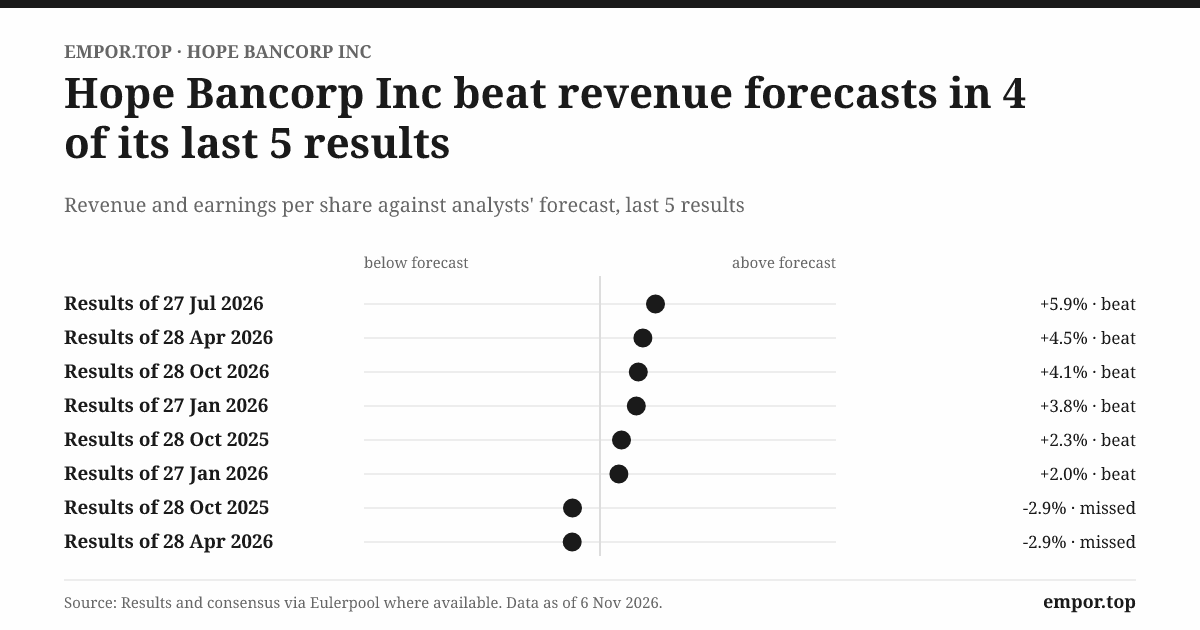
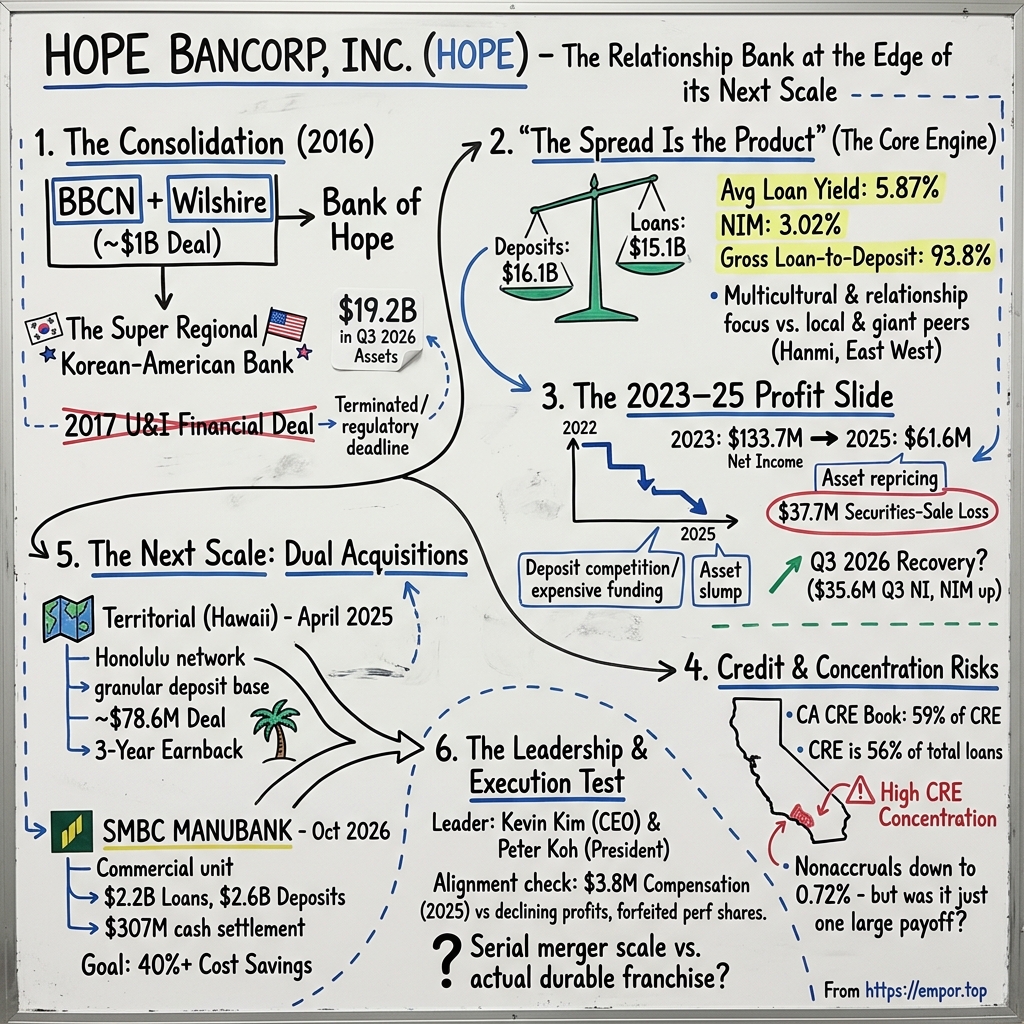
On the morning of October 28, 2026, Hope Bancorp reported a quarter that its shareholders had been waiting several years to see. Net income for the three months to September came in at $35.6 million, about 16% more than in the same quarter a year earlier, and the bank's net interest margin, the single number that best describes how much a lender earns on the money it puts to work, rose to 3.02% from 2.89%.1 The holding company ended the quarter with about $19.2 billion of assets.2 Measured against the bank's own recent past, it was a good day.
The calendar made it stranger than that. When Kevin Kim and his chief financial officer, Julianna Balicka, walked analysts through those numbers, the quarter they were describing had already ended, and so had the version of the bank that produced it. On October 1, Bank of Hope had taken over selected loans, deposits and seven Southern California locations from the commercial banking unit of SMBC MANUBANK, the American subsidiary of Japan's 三井住友銀行, Sumitomo Mitsui Banking Corporation.2 Roughly $2.2 billion of loans and $2.6 billion of deposits had moved onto Hope's books before purchase accounting, and the seller had paid Hope an estimated $307.4 million in net cash to settle the difference between what it handed over and what it owed.2 The analysts on the call were therefore being asked to judge a recovery in one bank while trying to model the arrival of another.
That timing turns out to be the most useful thing about the quarter. The improvement in earnings was achieved before MANUBANK contributed a dollar, which means it stands as independent evidence about the bank Hope already was: a Los Angeles lender built around Korean-American businesses, extended across the mainland and, since 2025, into Hawaii. Whether that evidence is strong enough to carry the next phase is the question this story sets out to answer.
The stakes come in three layers. The first is whether relationship banking, the old-fashioned business of knowing borrowers, lending to them across many years and holding their operating cash, can earn returns that justify the effort in an era when depositors can move money with a thumb. The second is whether Hope's long habit of buying other banks has built value for its owners or mainly built size. The third is whether a lender with most of its loans tied to commercial property, much of it in California, can grow without letting credit or funding risk grow faster.
It helps to be precise about who is who. Hope Bancorp is the company whose shares trade on the NASDAQ under the ticker HOPE; Bank of Hope is the California-chartered bank it owns, and almost everything that matters economically happens inside the bank.3 MANUBANK is not a sister company or a joint venture. Hope bought a set of assets and liabilities from a Japanese banking group that had decided to sell them, paid in cash rather than stock, and agreed to a collaboration under which Bank of Hope will serve SMBC's Japanese commercial and retail customers who need banking in the United States.2 None of that showed up in the September quarter.
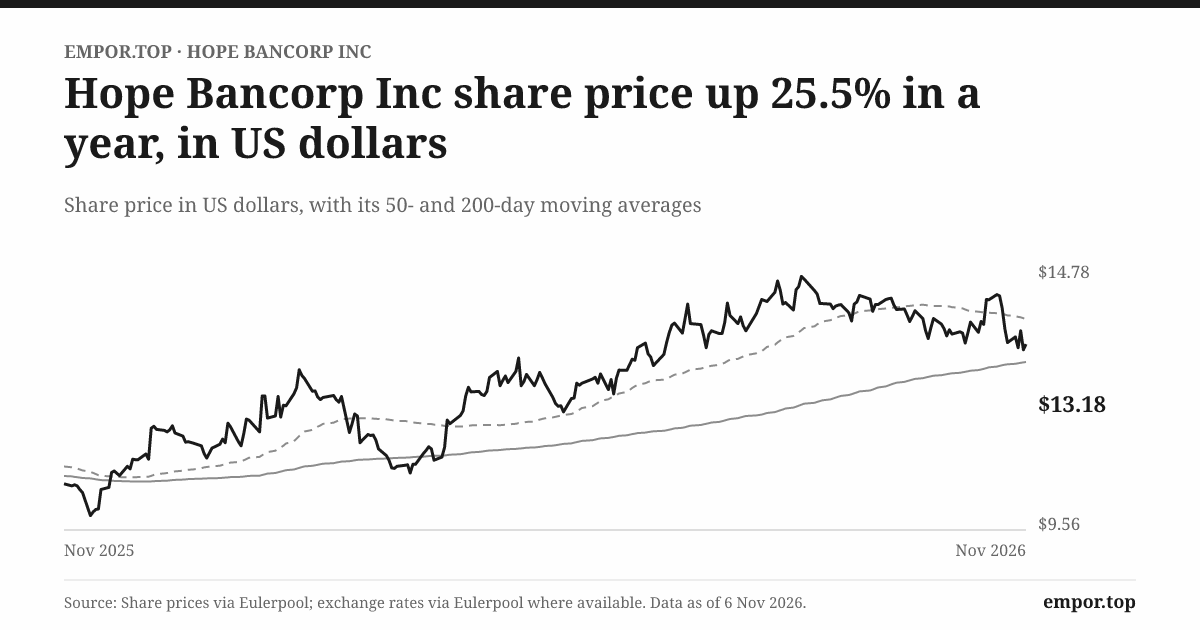
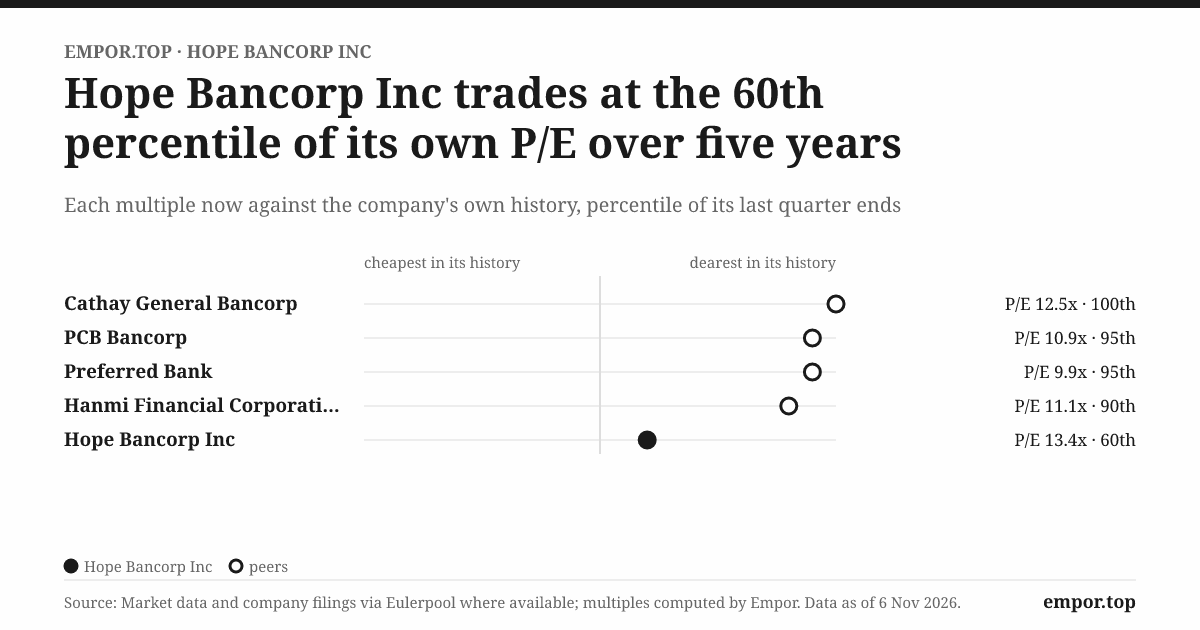
The market's view going into the deal was cautious rather than hostile. On November 6, HOPE closed at $13.18, which valued the whole company at about $1.7 billion, roughly 0.8 times the book value of its equity and about 13.4 times its last twelve months of earnings.4 That earnings multiple sat slightly above the stock's own five-year median of about 12.7 times.4 Put those two readings side by side and they tell a single story. Investors were paying less than the accounting value of the bank's equity, which is what a market does when it doubts that equity will earn its keep, but they were paying a slightly richer price for current earnings than usual, which is what a market does when it expects those earnings to improve. The price assumes recovery and refuses to pay for it twice.
There is a reason for that hesitation. The September quarter was good relative to 2025, but 2025 was a weak base. Hope earned far more in 2022 than it does today, and the path down from that peak ran through higher deposit costs, a deliberate loss on securities, credit charges and merger expenses. One rising quarter does not reverse four years. A bank's true earning power is what it makes across an interest-rate cycle and a credit cycle, and Hope's current management has not yet shown a full cycle in which the bigger bank earns more per dollar of equity than the smaller one did.
So the four days between the earnings report and the MANUBANK close, or more exactly the strange overlap in which a closed deal sat beside unconsolidated results, frame everything that follows. To understand whether Hope's recovery can hold, it is worth going back to the moment when this company first decided that the way to win was to get bigger.
 Subscribe on LinkedIn
II. The Consolidation That Made Bank of Hope
Walk down Wilshire Boulevard through Los Angeles' Koreatown and the history of Korean-American banking is written on the buildings. For a generation, the community's banks were small and competed hard with one another for the same customers, a rivalry Hope's own filings still describe;5 they were the lenders who financed the liquor stores, garment wholesalers, restaurants and strip malls that immigrant families built in the 1980s and 1990s. Hope Bancorp's corporate address, 3200 Wilshire Boulevard, sits in the middle of that story.6 So does its family tree.
The trunk of that tree was BBCN Bancorp, itself the product of a 2011 combination of two Los Angeles Korean-American lenders, Nara Bancorp and Center Financial; years later Hope's filings still carried the trust-preferred securities those predecessors had issued in the early 2000s, a kind of genealogical record in the footnotes.5 BBCN then pushed outward. In February 2013 it bought Pacific International Bancorp, gaining four branches around Seattle, and in August 2013 it bought Foster Bankshares, adding nine branches, eight of them in Illinois.5 Each deal followed Korean-American communities to a new metro area. None of them changed the scale of the bank.
The deal that did came in 2016. On July 29 of that year, BBCN completed its all-stock merger with Wilshire Bancorp, the other large Korean-American lender in Los Angeles, renamed the holding company Hope Bancorp and renamed the bank Bank of Hope.5 Wilshire shareholders received 0.7034 of a share for each of theirs, and the combined company issued about 55.5 million new shares, valued at $15.37 each, for a total of roughly $853 million.5 Hope booked about $4.6 billion in acquired assets, including roughly $3.8 billion of loans, and assumed about $3.8 billion of deposits, along with 35 branches spread across California, New York, New Jersey, Texas, Georgia and Alabama.7 Total assets went from about $7.9 billion to about $13.4 billion in a single year.5
Management described the result in grand terms. The merger, the 2016 annual report said, created "the only super regional Korean-American Bank" in the United States.5 It is a phrase worth treating as a claim to test rather than a fact to repeat. "Super regional" describes geography and size. What a shareholder wants to know is whether the merger brought something that earns better returns: customer relationships the bank could not otherwise have won, cheaper deposits, or cost savings large enough to lift profitability.
The first answer arrived quickly, and it was not flattering. In the same 2016 annual report, management disclosed that it had identified material weaknesses in internal control over financial reporting "resulting from our merger of Wilshire Bancorp."5 A material weakness is an auditor-grade warning that a company's processes could let a significant error into its financial statements. The bank said it had begun remediation, and the weaknesses did not prove fatal, but they are a reminder that combining two banks is not a press release. It is thousands of loan files, two systems, two credit cultures and two sets of habits that have to become one.
The balance sheet also told a quieter story. Goodwill, the accounting residue of paying more than the book value of what you acquire, rose from about $105 million to about $463 million because of the deal.5 That is not inherently bad; goodwill records what the buyer believed the franchise was worth beyond its assets. But goodwill earns nothing on its own. It has to be justified by future profits, and it means a bank's tangible equity grows more slowly than its headline equity.
And then there is the long verdict of the share price. The Wilshire shares were priced at $15.37 in 2016.5 Ten years later, HOPE's share price was still below that level.4 Dividends have been paid throughout, so long-term holders have not lost the way the price alone suggests, but the comparison is still uncomfortable. A merger that doubled the size of the bank did not, a decade later, produce a share worth more than the currency used to buy it. Hope's own proxy offers a related measure: $100 invested at the end of 2020 was worth about $127 at the end of 2025 including dividends, against about $153 for its chosen peer group.6
The next deal showed that ambition had limits beyond the company's control. Hope agreed to buy U&I Financial, the Washington-state holding company of UniBank, a deal in which UniBank would have merged into Bank of Hope. On September 15, 2017, the two sides announced a mutual termination because Hope had not obtained the required regulatory approval before the September 23 deadline.7 Each party bore its own costs, with no penalties or termination fees.7 Hope did not say why the approval failed to arrive. The episode was small in money, and it was not a failed investment, since nothing was bought. It was, however, a real execution limit: a serial acquirer depends on regulators' willingness to approve the next deal, and in 2017 that willingness did not come in time.
What does the consolidation era add up to? It clearly built a larger franchise with a national footprint among Korean-American businesses and households, and it created the platform from which every later decision was made. It does not, on the evidence, prove that scale and a shared customer identity translated into superior pricing or returns. The share price, the peer-relative total return, the control weaknesses after Wilshire and the halted U&I deal narrow the "super regional" claim to a smaller, still respectable one: Hope became the biggest bank serving its core community, and that is a distribution position, not yet a proven economic advantage.
That leaves the most basic question unanswered. Once all these banks were stitched together, what exactly was Bank of Hope selling, and why would a borrower or depositor choose it over the many other places they could go?
III. The Spread Is the Product
Picture a garment importer in downtown Los Angeles with a couple of hundred employees, a warehouse lease and suppliers in Asia. Once a year, a relationship manager from Bank of Hope sits down with the company's owner to review its revolving credit line, the facility it draws on to pay for inventory before customers pay for finished goods. The same banker has arranged a term loan on the warehouse, issues the letters of credit that reassure overseas suppliers, wires payments abroad and converts dollars into won or yuan. The owner may switch to Korean mid-sentence when the conversation gets technical. That relationship is what Hope means when it talks about relationship banking.
Strip away the warmth, though, and the economics are simple. Hope lends money at one rate and borrows it from depositors at a lower rate, and the difference, after credit losses and operating costs, is the business. Many of its commercial loans float, repricing off the prime rate, the Secured Overnight Financing Rate or other benchmarks, while lines are typically reviewed annually and term loans usually run five to seven years.3 In 2025 the average yield on Hope's loans was 5.87%.3 The cost of the money that funds those loans is the other half of the equation, and in the September 2026 quarter the bank's weighted average cost of deposits was 2.58%, down 30 basis points from a year earlier.2
The best way to understand the September quarter is to look at those two halves separately. Hope's interest income was almost exactly flat year on year, about $245 million in both periods. Its interest expense, however, fell from about $118 million to about $110 million.2 Net interest income rose by roughly 7%, and nearly all of that came from paying depositors and lenders less, not from charging borrowers more.2 That is the cleanest piece of evidence in the whole recovery: it says Hope's improvement was a funding story first.
Management described the margin gain in exactly those terms, attributing it to higher yields on earning assets and "a favorable shift in our funding mix."8 The mix shift is visible in the deposit book. On the Q3 call, management said non-maturity deposits, the checking, savings and money-market balances that have no fixed end date, rose 6% from the previous quarter while time deposits fell 5%; time deposits had shrunk to 37% of the total from 40% a year earlier.8 At September 30, deposits were about $16.1 billion: 22% in non-interest-bearing demand accounts, 41% in money-market, interest-bearing checking and savings, and 37% in certificates of deposit.32 Loans were about $15.1 billion, so the bank lent out about 94 cents of every deposit dollar.1
Think of it like a restaurant that cannot raise menu prices but can renegotiate its supplier contracts. Every time a certificate of deposit matures, Hope gets to decide whether to match the rate the customer is offered elsewhere or let the money go and replace it with cheaper funding. This choice is happening constantly. About a third of Hope's time deposits were due to mature within three months of September 30, and about 70% within six months.2 That is an opportunity when rates are falling, because expensive money rolls off. It is a vulnerability when rates rise, because the same money reprices against the bank. On the call, management noted that the market then expected rate increases in 2027, a reversal from the cuts expected at the start of the year, which is a reminder of how quickly the tailwind can turn.8
Fees add a second, smaller stream. Hope earns income from deposit service charges, international trade financing, wire transfers and foreign exchange, interest-rate swaps sold to commercial borrowers, and gains from selling the guaranteed portions of Small Business Administration loans.3 In 2025, deposit service fees and SBA loan-sale gains were each about $12.5 million, swap fees about $5.9 million and wire and currency fees about $4.5 million.3 These are real products that deepen a relationship, but they are not a second business on the scale of lending. Hope reports a single operating segment, and the fees supplement the spread rather than balancing it.3
The September quarter shows both the usefulness and the lumpiness of that stream. Noninterest income rose to about $22.1 million, but that included a $4.7 million gain on SBA loan sales and a $3.1 million gain on sales of other loans.2 Gains on sale are earned when a bank decides to sell, which makes them partly a choice about timing rather than a recurring charge on a customer. They are welcome. They are also the kind of income an investor should discount when judging what the franchise earns in a normal quarter.
Scale matters in banking because technology, compliance and regulatory costs are partly fixed, and because larger banks can serve larger borrowers. Hope, with about $19.2 billion of assets at the end of September, sits in an interesting middle position among the banks that compete for Asian-American customers.2 Hanmi Financial, the closest Korean-American competitor, was about $8 billion.9 Cathay General Bancorp, the long-established Chinese-American lender, was about $25.6 billion.10 East West Bancorp, the giant of the category, was about $86 billion.11 Hope is more than twice Hanmi's size but a fraction of East West's, and it competes against all of them as well as against national banks, which have no cultural specialty but far deeper technology budgets and cheaper funding.
What, then, is the edge? The honest answer is that it is plausible but not proven. Banks compete on four things: the cost of their funding, the quality of their underwriting, the service they provide, and the local knowledge that lets them lend to businesses a stranger would misread. Hope's cultural fluency, its trade-finance and currency services, its Seoul representative office and now its Hawaii and Japanese-business channels are all credible distribution advantages.2 What the filings do not show is the evidence that would turn plausibility into a moat. Hope does not publish customer retention rates, the share of customers who use several products, how its loan pricing compares with competitors, or market-share gains within its core communities. There is no customer concentration measure of the kind an industrial company would report, because a bank's exposures are its borrowers and depositors, and the largest single borrower relationship, at about $108 million at the end of 2025, was performing.3
That leaves a practical test. If relationship banking is a real advantage, it should show up in three places: a deposit cost that stays below what pure rate-shoppers would demand, loans that grow organically rather than only through acquisitions, and a net interest margin that holds up when the rate environment changes. The September quarter passed the first test for a single quarter. It was during the preceding three years that all three were tested hard, and the results were less kind.
IV. The 2023–25 Profit Slide
In 2022, Hope earned about $218 million.3 It was the best year in the company's history, and it came at the end of a decade in which deposits had been cheap and plentiful for every bank in America. Then the Federal Reserve raised rates at the fastest pace in a generation, and the economics that had made 2022 so comfortable began to unwind from the funding side.
The numbers form a steep staircase down. Net income fell from $133.7 million in 2023 to $61.6 million in 2025.3 On a per-share basis, diluted earnings fell from $1.82 in 2022 to $0.45 in 2025.3 The longer record is equally sobering. Over the decade to 2025, the revenue line grew about 10.5% a year, much of it from acquisitions and higher gross interest income, while net profit declined about 4.5% a year.3 More business did not mean more profit. It meant a bigger bank earning less.
One clarification belongs here. Some market-data series put Hope's 2025 profit nearer $58 million; the audited figure is $61.6 million, and that is the number that counts.3
The slide had three distinct causes, and lumping them together as "the cycle" misses what each says about the bank.
The first was funding. When rates rose, depositors who had tolerated near-zero interest moved money into certificates and money-market funds, and banks had to pay up to keep it. Hope's cost of deposits rose sharply; by the first nine months of 2025 its weighted average deposit cost was about 3.00%.2 At the end of 2023, Hope's own merger deck showed its cost of total deposits at about 2.82% for the year, against 1.23% for Territorial Bancorp, the Hawaiian thrift it was about to buy.12 That comparison is worth pausing on. A bank that sells itself on relationships was paying more than twice as much for its deposits as a community savings bank whose depositors were mostly households. Relationships with businesses, it turns out, are not the same as cheap money. Business owners watch their cash.
Management's response to the squeeze was to make the bank smaller before making it bigger again. Total assets fell from about $19.1 billion at the end of 2023 to about $17.1 billion a year later, and borrowings dropped from roughly $2.0 billion to about $0.4 billion as Hope paid down expensive wholesale funding.3 By the 2026 proxy, Kim was telling shareholders that the bank had "significantly lowered our cost of deposits" and "reduced our reliance on brokered funding," although brokered deposits still stood at about $902 million at the end of 2025.63 Shrinking the balance sheet protected liquidity and capital at a dangerous moment for regional banks. It also meant fewer earning assets, which is part of why profits fell so far: a bank that deliberately carries less carries less to earn on.
The second was a deliberate decision about the securities portfolio. Like most banks, Hope held bonds bought when yields were low. Those bonds paid little, and their market value had fallen below their book value as rates rose. In the second quarter of 2025, Hope sold a block of these available-for-sale securities, recognized a $37.7 million loss, and reinvested the proceeds at higher yields.3 Accounting-minded investors call this a repositioning, and the logic is sound: the loss had already happened economically, and selling simply moved it from the balance sheet's other comprehensive income into reported earnings in exchange for better future income. But it took a large bite out of 2025. Noninterest income for the year fell to $26.5 million from $47.1 million because of it.3
The third was credit and merger costs. Net charge-offs, the loans written off net of recoveries, rose to $29.0 million in 2025 from $26.6 million in 2024, with the increase driven by commercial and industrial loans.3 Merger-related costs tied to the Territorial deal also passed through earnings; in the first nine months of 2025 they totaled about $20.8 million.2
How much of the decline was temporary? Hope's own non-GAAP measures give a partial answer. Excluding what it calls notable items, mainly the securities loss and merger costs, earnings per share were about $0.85 in 2024 and $0.89 in 2025.6 Even on that kinder basis, the bank was earning less than half what it had made in 2022, when the same measure was about $1.81.6 The securities loss and merger expenses explain why 2025 looked terrible. They do not explain why the underlying business was so much smaller than its peak.
The 2026 numbers are where the story turns. In the nine months to September, Hope earned $98.1 million, against $27.1 million in the same period of 2025.2 That comparison overstates the improvement, because the 2025 period carried the securities loss, heavy merger costs and a $4.9 million tax charge from a change in California's tax apportionment rules.2 The fairer comparison uses Hope's adjusted figures: about $101.6 million for the first nine months of 2026, against about $79.0 million a year earlier, an improvement of nearly 30%.2 In the third quarter alone, adjusted net income was about $37.5 million, against $31.5 million, and the annualized return on assets excluding notable items was about 0.79%.2
On the Q3 call, management made two points that bear on sustainability. First, it pointed to the funding mix and a deposit beta on recent rate moves of "a little under 24 percent," meaning the bank had passed through less than a quarter of rate changes to non-maturity depositors, a figure Balicka described as unusually good; she also said she expected betas to rise with each additional rate hike.8 Second, it guided that, excluding notable items, 2026 revenue would grow about 16% to 18% and pre-provision net revenue, the profit before credit costs and taxes, about 23% to 25%.8 Those are management's forecasts, not results, and part of the growth comes from a full year of Territorial and a quarter of MANUBANK. Detailed 2027 guidance, Balicka said, would come with fourth-quarter results.8
One word of caution belongs to the cash-flow statement. Hope's reported operating cash flow over 2023 to 2025 added up to roughly $755 million, about two and a half times its net income over the same years.3 For an industrial company, that would be a sign of exceptional earnings quality. For a bank, it means very little. Operating cash flow includes changes in accrued interest, loan-sale activity and noncash accounting adjustments; in 2025, for example, it absorbed about $70.2 million of discount accretion and the add-back of the securities loss.3 A bank's earnings quality shows up instead in its credit costs, its capital and its funding stability.
The verdict on the slide, then, is that it was substantial and had identifiable rate, securities and credit components, and that 2026 has recovered some of the ground, mostly through cheaper funding. What 2026 has not done is restore the prior earnings base. And the most dangerous part of the past three years is the one that has not yet fully played out: the loan book, and particularly the commercial property inside it.
V. Credit Improves, but the Book Is Still Concentrated
Sometime in the first quarter of 2026, a large commercial real estate loan that Hope had stopped accruing interest on was paid off.2 For a bank's credit statistics, this kind of event is like a single heavy patient leaving the intensive care ward: the ward suddenly looks much healthier, even though no one else's condition has changed. By September 30, Hope's nonperforming assets had fallen to about $108.5 million, or 0.57% of assets, from about $136.1 million, or 0.73%, at the end of 2025.2 Nonaccrual loans fell to 0.72% of loans from 0.90%, and management attributed much of the year-to-date improvement to that payoff and to fewer accruing loans more than 90 days past due.2
The best way to read a bank's loan book is as its receivables ledger. Each loan is a customer that owes money, and the questions are the same ones a careful creditor asks of any customer: who is paying late, who has stopped paying, how much has been written off, and how large a reserve has been set aside for what might still go wrong. For Hope, the main tests are criticized loans, which are loans the bank itself has flagged as showing weakness; nonaccrual loans, where the bank no longer expects to collect interest; net charge-offs; and the allowance for credit losses, the reserve against future losses.
On most of those measures, 2026 looks better. Criticized loans were about $335 million at the end of September, flat with June and down about 10% from a year earlier, which management said equated to about 2.22% of loans.8 Net charge-offs in the third quarter were about $7 million, or 19 basis points annualized, down from 24 basis points in the second quarter.8 The allowance stood at about $154 million, or 1.03% of loans, enough to cover nonaccrual loans about 1.4 times over.82
The longer record tempers the celebration. In 2025, criticized loans fell to about $351 million from about $450 million, a large improvement, but in the same year Hope sold about $50.8 million of loans it judged to carry elevated credit risk.3 Selling troubled loans is a legitimate tool; banks often prefer a known discount today to an uncertain workout tomorrow. But a decline in problem loans achieved partly through sales and payoffs is not the same as a portfolio whose borrowers are getting healthier. It shows that management is actively cleaning the book, which is useful, and it means the statistics flatter the underlying trend somewhat.
The concentration is the thing that will not move quickly. At September 30, commercial real estate made up about 56% of Hope's loans, and about 59% of that CRE exposure was in California.2 That is a bank heavily exposed to one asset class in one state. Commercial property loans are typically repaid from the rent a building generates and, at maturity, by refinancing. When interest rates rise, refinancing costs more, property values fall because investors demand higher yields, and borrowers who bought at the top find their equity cushion shrinking. A loan that was comfortable at origination can become difficult to refinance even if the building is fully let.
The mechanism, in other words, runs through five channels: the income the property produces, the rate at which it can be refinanced, when the loan matures, how much equity the borrower has left, and what is happening to the local property market. If California property conditions weaken, or if rates rise again as the market began expecting on the Q3 call, a concentrated CRE book can turn into higher provisions much faster than improving ratios might suggest.8 On the positive side, about 48% of Hope's loans were straight variable-rate and another 27% hybrid, which means rising rates lift loan income, but also means borrowers feel those increases directly.8
Hope's auditor has drawn attention to the same area. In its report on the 2025 financial statements, Crowe LLP identified two critical audit matters: the modeled allowance for commercial real estate loans and the fair value of acquired seasoned loans.3 A critical audit matter is not a criticism. It is the auditor's statement that a particular judgment was complex, subjective and material, and that the auditor had to work especially hard to test it. Crowe's opinion on the financial statements and on internal control was unqualified, with no material weakness reported.3 Still, the two areas it chose are the two that matter most to this story. The CRE allowance depends on models of property values and unemployment that can be wrong in either direction; the acquired-loan valuations depend on assumptions about deals Hope has just done.
Put the evidence together and the verdict is clear but provisional. Credit quality improved through 2026, and the improvement is broader than one payoff: criticized loans and charge-off rates both moved in the right direction. But the most visible drop in problem assets came from a single large loan leaving, and the concentration that makes Hope vulnerable is unchanged. The forward tests are the same ones that have always mattered for this bank: criticized loans, delinquencies, charge-offs and reserve coverage, read quarter after quarter, particularly in California CRE.
That concentration also explains why Hope's next strategic move headed west, across the Pacific. If the mainland book was heavy in California commercial property, a granular, household-funded bank in Hawaii offered something different: cheap deposits and home loans. The question was what Hope would have to pay for it.
VI. Territorial: A Hawaiian Franchise for a Three-Year Earnback
Territorial Savings Bank had been taking deposits in Hawaii since 1921, which made it older than statehood and, by the time Hope came calling, the fifth-largest holder of deposits in the islands.12 It was a classic savings institution: about 55,000 deposit accounts, an average balance around $30,000 and a median of roughly $4,100, with 93% of non-CD balances coming from consumers.12 These were teachers, retirees and small families on Oahu, Maui and Kauai, not commercial treasurers. Their money was cheap and loyal, and in 2023 Territorial paid about 1.23% on its total deposits, less than half Hope's cost.12
The deal was announced in the spring of 2024. Hope offered 0.8048 of its shares for each Territorial share, an all-stock transaction valued at about $78.6 million, or $8.82 per Territorial share, based on Hope's price at the time.12 At the end of 2023, Territorial had about $2.24 billion of assets, $1.31 billion of loans and $1.64 billion of deposits.12 Hope said the combination would create the largest regional bank serving multi-ethnic customers across the continental United States and Hawaii, more than double its residential mortgage balances, and be "immediately accretive after the close with double-digit percentage EPS growth."12 It targeted a close by the end of 2024.12
The headline price looks almost like a steal. Hope's deck showed that it was paying about 31% of Territorial's tangible book value, meaning roughly 31 cents for each dollar of the target's tangible equity.12 So why did Hope still project that its own tangible book value per share would be diluted by about 6%, with an earnback of about three years?12 The answer lies in what Territorial owned. Like many thrifts, it held long-dated, low-rate home loans and securities whose market value had fallen sharply as rates rose. Under acquisition accounting, Hope had to mark those assets to fair value at closing, which wiped out much of the apparent equity. The book value on Territorial's balance sheet was, in economic terms, partly an illusion created by historical cost accounting. Hope was not buying a dollar of equity for 31 cents. It was buying low-yielding assets at their true value, plus a deposit franchise and branch network, for a modest premium.
That accounting has a second effect that matters for reading Hope's earnings. The discount created by marking loans down does not disappear. It is accreted back into interest income over the remaining life of the loans, which lifts reported yields and margins for several years. Purchase-accounting accretion is real cash eventually, because the loans pay off at par, but it is not evidence of better lending. Some of the improvement in Hope's reported margin since April 2025 reflects this mechanical effect, and the cleanest way to judge the acquisition is to separate it out.
The closing took longer than promised. Rather than the end of 2024, the merger completed on April 2, 2025.13 Hope issued about 6.98 million shares, valued at about $73.3 million at the close.3 Territorial continued to operate under its own name, as Territorial Savings, a division of Bank of Hope, a decision the company framed as preserving "the 100-plus year legacy" of the brand.13 At the time, the division ran 29 branches in Hawaii; by September 2026 that number was 25, reflecting consolidation after the deal.132
Was the price measured or excessive? On the disclosed numbers, it looks measured. A projected 6% dilution with a three-year earnback is within the range that bank investors usually tolerate, and the fact that Hope paid in its own undervalued shares means it was using a cheap currency to buy a cheap target. The more important question is what Hope got for that dilution. Territorial's cheap deposits lowered Hope's overall funding cost. Its mortgages diversified a loan book otherwise dominated by commercial property. Its Hawaii franchise gave Hope a second, distinct community.
The deal also tests management's promise-keeping, and here the record is mixed. The "double-digit EPS growth" promise was framed against a world in which the deal closed by year-end 2024 and rates followed a particular path. In the event, Hope's adjusted earnings per share rose only from about $0.85 in 2024 to about $0.89 in 2025, a gain of roughly 5%.6 Partial-year ownership, a later close and the cost of the securities repositioning all muddy the comparison, and 2026 may yet show the promised step-up. But a shareholder who read the deck in 2024 and then read the 2025 results would have seen a deal that closed late and delivered a smaller first-year improvement than the headline suggested.
The broader acquirer record also bears on the claim. Hope's Territorial deck described the company as "a seasoned acquiror & integrator of diverse business models."12 That is partly earned. BBCN and Hope completed a series of combinations, and the Wilshire integration, despite the control weaknesses, produced a functioning national franchise. But the U&I deal failed to clear regulatory approval, and Territorial itself has not yet compiled a post-close return record long enough to judge. A seasoned acquirer is one whose deals earn more than they cost, and the evidence for that is still being written.
The tests from here are specific. Investors need to track how much of Territorial's low-cost deposits remain as rates move, what the Hawaii division earns once purchase-accounting accretion fades, and how organic loan and deposit growth looks when acquired balances are stripped out. Hope does not publish a separate Territorial profit-and-loss statement, which makes that last test harder than it should be.
Within a year of closing the Hawaiian deal, Hope had found another one, this time on its home turf, with an entirely different shape.
VII. MANUBANK: More Deposits, More Integration Work
SMBC MANUBANK sat inside the American arm of one of Japan's largest banking groups, a subsidiary of SMBC Americas Holdings.2 Its commercial unit gave Hope something it had never had: a business banking operation whose parent already served Japanese companies and their people, and which would keep sending them to whoever ran the unit next. On March 31, 2026, Bank of Hope signed the agreement.2
It is important to keep the seller's motives separate from the buyer's economics. SMBC chose to divest. Whatever its reasons, the value of this transaction to Hope's shareholders lies entirely in what Hope can keep: the deposits, the loans, the customer relationships, the referral pipeline from SMBC and the cost savings available when two operations become one.
The deal closed effective October 1, 2026.2 At closing, Hope acquired the unit's loans and deposits before purchase accounting, along with seven locations in Southern California, one of which will close in the fourth quarter.2 The seller paid a net cash settlement, subject to final adjustment, and Hope issued no shares.2 Management said on the call that it paid no deposit premium.8
That cash settlement is easy to misread. It is not a gift. When a bank takes on deposits, it takes on an obligation to repay them, and the settlement is the cash needed to fund the part of those deposits not matched by loans. What makes it valuable is that the deposits came cheap. On the call, management put their weighted average cost at about 2.22%, below Hope's own 2.58%, with about $0.6 billion in non-interest-bearing accounts, about $1.8 billion in interest-bearing non-maturity accounts and only about $0.2 billion in certificates.8 Management estimated that the acquired deposits would lower Hope's overall cost of deposits by about 5 basis points on a pro forma basis, and that pro forma time deposits would fall to about 33% of the total.8
The loan side is less attractive. The acquired loans included about $1.3 billion of real estate and $0.9 billion of commercial loans, and excluding SBA loans their weighted average coupon was about 5.69%, below Hope's own loan yield.8 Shortly after closing, on October 21, Hope sold about $0.2 billion of acquired SBA 7(a) guaranteed loans for about $191.3 million, with no gain or loss recognized.28 That sale is one reason the loan balance Hope ultimately holds is smaller than earlier estimates; management also said total loans at closing were below the levels announced in March, while customer deposits were "largely stable."8
The accounting will shape reported results for years. Management described a total purchase-accounting discount of roughly $90 million, combining rate and credit marks, of which about $30 million is the non-accretable credit component still being finalized.8 The accretable portion will flow into interest income over about five years, but front-weighted, with much of it in the first two.8 That means Hope's reported margin and earnings in 2027 will receive a mechanical boost from MANUBANK that has nothing to do with lending skill, just as Territorial's accretion did after 2025. Investors who want to judge the deal on its merits will need to look through that boost.
The real prize is cost savings, and it is also the real risk. Management said it expects fully phased-in cost savings of more than 40% of MANUBANK's starting expense run rate of about $136 million, and that savings were tracking "better than originally estimated."8 Forty percent of $136 million is more than $54 million a year, against an acquired loan book of about $2 billion, which explains why the deal can be economically attractive even with lower-yielding loans. It also invites an obvious question, which StoneX analyst Andrew Leach asked on the call: why was MANUBANK's expense base so high relative to its assets? Management attributed it to its history as an SMBC subsidiary and said Hope could absorb the operations without duplicating functions.8 That is plausible. It is also a claim whose proof lies in the next two years.
The Q&A also showed where management's numbers ran out. When Piper Sandler's Matthew Clark asked what share of the loan book would benefit from higher rates, Balicka did not have the figure to hand and promised to follow up.8 DA Davidson's Gary Tenner pressed on deposit betas and on how early the cost savings would arrive.8 Neither exchange revealed a problem. Together they marked the edges of what the bank had modeled publicly four weeks into an integration whose largest steps were still ahead.
The timing has already moved. Management said the core system conversion, the moment when MANUBANK's customers move onto Hope's technology platform, is scheduled for the fourth quarter of 2027, which pushes the full phase-in of savings later than originally expected, partly to avoid paying heavy breakage fees on existing technology contracts.8 Some savings will come early; others must wait for the conversion. An integration that runs more than a year from close to conversion is a long period in which customers deal with two systems, relationship managers wonder about their futures and competitors call MANUBANK's clients.
Capital also takes a hit. Hope's common equity tier 1 ratio, the main measure of a bank's loss-absorbing capital, was 12.25% at September 30; management expected it to fall to about 10.2% after the acquisition, down about 200 basis points, as roughly $2 billion of acquired loans joined the balance sheet without any new equity behind them.82 That would still be comfortably above regulatory minimums, but would use up much of the cushion that would otherwise support buybacks or absorb credit losses.
The falsifiable claim is simple. MANUBANK creates value for Hope's shareholders only if the savings and the lower funding cost exceed the integration expenses, the dilution to capital and any loss of customers or bankers. The early signs, stable deposits and savings tracking ahead of plan, are encouraging. The delayed conversion and lower loan balances are the first reminders that integration rarely follows the deck. The next four quarters will show which version prevails, and they will do so under a management team that has now spent more than a decade asking investors to trust its deal-making.
VIII. Kevin Kim's Long Tenure, and the Scorecard
Kevin S. Kim did not come up through a bank. He started his career as a certified public accountant at two of the largest accounting firms, then practiced law for 18 years, focusing on corporate transactions, business acquisitions, tax planning and real estate deals.6 He studied English and international trade at 한국외국어대학교 Hankuk University of Foreign Studies in Seoul, then earned an MBA from UCLA's Anderson School and a law degree from Loyola Law School in Los Angeles.6 In 2014 he became president and chief executive of BBCN Bank, and in 2019 he added the chairmanship.6 At 68, he has led the institution for its entire life as Hope Bancorp: the Wilshire merger, the failed U&I deal, the profit slide, Territorial and now MANUBANK.6
That background shapes how he runs the company. A deal lawyer and accountant naturally sees a bank as a set of transactions to be structured, valued and closed, and Hope's history reflects that: the proxy describes Kim as having "spearheaded the series of mergers" that created the company.6 The same instinct explains the strengths and limits of the record. Hope has been good at getting deals done and structuring them sensibly. Whether it has been as good at running the larger bank afterwards is the open question.
Around Kim is a team with more operating and capital-markets depth than the founding era. Julianna Balicka, 47, became CFO in 2023 after a career on the other side of the table: she covered West Coast regional banks as an equity analyst at Keefe, Bruyette & Woods from 2005 to 2016, rising to managing director, then ran investor relations and corporate finance at East West Bank.6 She knows how investors read banks like Hope because she used to be one of them. Peter Koh, 49, represents continuity from the Wilshire side of the family. He joined the bank's predecessors in 2001, served as senior loan officer and chief credit officer at Wilshire Bank, became Bank of Hope's chief credit officer in 2016 and chief operating officer in 2022.6 On April 1, 2026, he became president of the bank, while Kim remained chairman and CEO.6 The same proxy introduced new guidelines on CEO succession planning.6 Hope has not named a successor, but the board has made Koh the most visible candidate.
The pay record is where the scorecard gets uncomfortable. Kim's reported total compensation was about $3.0 million in 2023, $3.3 million in 2024 and $3.8 million in 2025, while net income fell from $133.7 million to $61.6 million.63 His 2025 pay was above the roughly $3.6 million he earned in 2022, when the bank made more than three times as much.6 The CEO-to-median-employee pay ratio was 47 to 1.6
There are offsetting facts, and they matter. The performance share units granted under the 2023 long-term incentive plan were completely forfeited because the bank missed its performance thresholds for the 2023 to 2025 cycle.6 Kim's 2025 cash bonus paid out at 83% of target.6 He owned about 998,000 shares, almost twice the roughly 527,000 required by the company's guideline of five times base salary.6 At recent prices, that stake is worth more than $13 million, far more than his annual pay. A CEO with that much stock has every reason to care about the share price.
Still, the overall pattern is one where the reported value of pay rose as profits fell. Some of that reflects how equity grants are valued at issue, and the "compensation actually paid" measure, which adjusts for the real fate of those awards, was lower at about $2.9 million in 2025.6 Shareholders largely accepted the arrangement: at the May 2026 annual meeting, about 95.9 million votes were cast in favor of executive pay and about 10.8 million against, roughly 90% support.14 That is a pass, not an endorsement of every element, and a meaningful minority dissented.
Capital allocation belongs on the same scorecard. In 2025, Hope paid about $70.7 million in dividends, more than its $61.6 million of reported net income.3 The quarterly dividend of 14 cents per share has been held steady.8 Paying out more than reported earnings in a single bad year is defensible when the shortfall is driven by a one-time securities loss and the bank has strong capital; on adjusted earnings of about $0.89 per share, the $0.56 annual dividend represented a payout of roughly 63%.63 But the dividend has not grown in years, buybacks were absent in the third quarter, with about $26.6 million still authorized, and capital is now being used for acquisitions.2 The choice has been to keep the dividend steady and spend capital on deals rather than on buybacks at a discount to book value. That is a coherent strategy if the deals earn more than buybacks would have. It is a costly one if they do not.
Governance follows the common American model with a twist. Kim combines the roles of chairman and CEO, and all other directors are independent.6 Dale Zuehls has served as lead independent director since May 2024, and the board strengthened that role, adopted a majority voting standard for uncontested director elections and reduced its size to nine members.6 Those changes move in the right direction. They do not change the fact that the person whose deals are being judged also chairs the board judging them.
On consistency, management's story has been relatively stable. Across recent calls and the 2026 proxy letter, the message has emphasized lower deposit costs, less brokered funding, better credit and the addition of relationship managers.68 That consistency is a credit. But the record of promises against outcomes is mixed, as the Territorial and MANUBANK deals show. Management has explained each shift, and none is a scandal. Together they suggest a team that is reliable on direction and optimistic on timing.
The register behind the board is also worth knowing, because it determines who could challenge management. No shareholder controls Hope. The largest disclosed holders were index and institutional managers: BlackRock at about 13.7%, Vanguard at about 10.7%, Wellington Management at about 8.6% and Dimensional Fund Advisors at about 5.3%, although the BlackRock and Vanguard figures came from schedules filed in 2024.6 A register dominated by large, diversified holders tends to vote with management on routine matters and rarely mounts campaigns. That helps explain the comfortable say-on-pay margin, and it means pressure for better returns, if it comes, is more likely to arrive through the share price than through a proxy fight.
The verdict is that Kim's ownership and the forfeited share awards offer genuine alignment evidence, while the profit record, rising pay and the stock's underperformance against peers weigh against an unqualified management-quality claim. The next proof is execution: two integrations, clear reporting of what each acquired business earns, and earnings that grow faster than the balance sheet. Whether that proof arrives will decide how investors resolve the bull and bear cases now competing for the stock.
IX. Analysis & Bear vs. Bull Case
Imagine two analysts looking at the same bank on the same afternoon. The first sees a lender trading at about 0.75 times book value while its peer median sits near 0.98 times, with a margin rising, problem loans falling, a cheap Hawaiian deposit franchise and a fresh $2.6 billion of low-cost deposits.48 The second sees a bank earning a trailing return on equity of about 5.8%, well below what equity investors require, with more than half its loans in commercial real estate, 42% of its deposits uninsured and two integrations still to finish.32 Both are looking at accurate numbers. The investment case depends on which numbers move next.
Start with the forces that shape any bank's profits, framed through Michael Porter's five forces. The most powerful force on Hope is its suppliers, which in banking means depositors. They provide the raw material, money, and in an era of online banks and money-market funds they can move it quickly. Hope's estimated uninsured deposits rose to about $6.77 billion, or 42% of the total, at September 30, from 38% at the end of 2025.2 Uninsured depositors are the most rate-sensitive and the most likely to leave in a panic, so that rising share is a meaningful source of supplier power. Buyers, meaning borrowers, have moderate power: commercial borrowers compare terms and can refinance elsewhere, though the cost of moving a full operating relationship is real. Rivalry is intense, with Hanmi, Cathay, East West, national banks and Korean bank branches all competing for the same customers. Substitutes are growing: private credit funds now lend against commercial property, and money-market funds compete for deposits. The barrier to entry is high, because bank charters and capital rules are hard to obtain, but that barrier protects all incumbents, not Hope in particular.
Hamilton Helmer's seven powers framework asks a sharper question: what lets a company earn persistently higher returns than its rivals? Hope's evidence for each is thin. Scale economies are the MANUBANK thesis, since the deal's value depends on spreading fixed costs over a bigger base, but Hope is still far smaller than East West, so scale is a relative disadvantage against the category leader. Network economies do not apply. Counter-positioning is weak: national banks could serve Korean-American customers if they chose, and many do. Switching costs exist for full-relationship commercial clients with lines, treasury services and trade finance, but deposit behavior in 2023 to 2025 showed that business customers move their cash when rates move. Brand matters within communities, and Hope's choice to keep the Territorial name in Hawaii shows it values local identity, but brand has not translated into deposit costs below peers on the mainland. Cornered resources, perhaps bilingual bankers and community networks, are not truly cornered, since competitors hire from the same pool. Process power, superior underwriting, would show in credit losses below peers through a cycle; the CRE concentration and the auditor's focus on CRE loss modeling mean that power is unproven.3
So why might Hope win from here? The bull case has three real pieces of evidence. First, funding is improving: deposit costs fell to 2.58% in the third quarter from 2.88% a year earlier, and MANUBANK should lower them further.28 Second, credit has moved in the right direction, with criticized loans down about 10% from a year earlier and charge-offs falling.8 Third, Hope has assembled a distinctive set of channels: the Korean-American mainland franchise, Hawaii households, specialty commercial services and now a Japanese-business referral partnership with SMBC.2 If those channels bring in low-cost deposits and good loans organically, the bank's returns can rise even without more deals.
Why might it not? The bear case is equally concrete. Returns are weak: a 5.8% return on equity, or adjusted return on assets around 0.79%, is far below what a bank needs to justify trading at book value.32 The CRE concentration and California exposure leave little room for a property downturn. Uninsured deposits and short-dated certificates mean funding costs could rise quickly if rates rise again, as the market began expecting on the Q3 call.8 Two integrations are running simultaneously, with MANUBANK's core conversion more than a year away. And capital, after the deal, will be thinner than it was.
Peer valuations add context but should not be read as a league table. On the same data page, Hanmi traded at about 1.19 times book, Preferred Bank at about 1.54 times, Cathay at about 1.39 times and East West at about 1.95 times.4 East West is more than four times Hope's size, has a more diversified loan book and has earned much higher returns; Preferred and Hanmi are smaller and run different business mixes. Provider definitions of book value also differ. The spread is striking, but it mostly reflects the market's judgment that Hope's returns are lower and its risks less well rewarded, not a simple mispricing.
An activist looking at Hope would ask pointed questions. Why has a bank trading below book value spent capital on acquisitions rather than repurchasing its own shares at a discount? Why did executive pay rise while earnings fell by more than half? Why does Hope not report the standalone profitability of Territorial so shareholders can judge whether it is earning its cost? Why should one person chair the board that evaluates his own deals? These are fair challenges, and management's answers, that acquisitions build durable funding and franchise value that buybacks cannot, will only be convincing if returns rise.
The dividend deserves its own stress test. With a yield of about 5.3%, the dividend is a large part of the investment case for many holders.4 After its payout exceeded reported earnings in 2025, the dividend faces the expected 2-percentage-point fall in the bank's CET1 ratio after MANUBANK.38 The dividend is sustainable only if normalized earnings and regulatory capital support it through the integration period. On 2026's run-rate earnings, the payout is manageable; on 2025's, it was not.
Three numbers will decide the case. The first is the net interest margin, together with the cost of deposits: the margin was 3.02% in the third quarter and rising, while deposit costs were 2.58% and falling.12 The second is credit quality, best read through criticized loans and nonperforming assets: criticized loans were about 2.22% of loans and NPAs 0.57% of assets, both improving.82 The third is organic growth, meaning loan and deposit growth after stripping out acquired balances; deposits grew about 3.3% in the first nine months of 2026 before MANUBANK.2
On valuation, the market price appears to assume that Hope's recovery is real but incomplete. A discount to book reflects doubts about credit, returns and integration. A move toward a recovery multiple would require sustained profitability, a return on equity closer to the cost of equity, and capital generation strong enough to fund both the dividend and growth. None of those is impossible. None is yet proven.
X. Business & Investing Lessons
Go back to the summer of 2016, when BBCN and Wilshire became one bank and the press release celebrated a new super-regional franchise. Then follow the balance sheet forward: the Wilshire deposits arriving, the Hawaiian savers joining in 2025, MANUBANK's commercial clients in 2026. Each step made the bank bigger. The lessons lie in what each step did, and did not, do for the people who own it.
The first lesson comes from the funding squeeze of 2023 to 2025: in banking, a deposit is a relationship only until the customer finds a better rate. Hope's experience showed that cultural fluency and long-standing business ties did not keep deposits cheap when rates rose.12 For founders and investors in any relationship business, the lesson is to measure loyalty in price, not in tenure. A customer who stays but demands market rates has a relationship with the price, not with the firm.
The second comes from the Wilshire merger and its long aftermath: a merger can add reach overnight; it takes years to prove the acquired book earns its cost. Hope's 2016 merger brought control weaknesses, and a decade later the share price remained below the level used to buy Wilshire.54 Territorial's low headline price still diluted Hope's tangible book after the target's assets were marked to fair value.12 Purchase accounting can make an acquisition look cheaper or more profitable than it is, through bargain prices on one side and accretion income on the other. The test of an acquisition is not the announcement multiple but the return on the capital it consumed, measured years later.
The third comes from the large CRE payoff in early 2026: when credit improves after one large payoff, the portfolio has not yet passed the cycle. Hope's recent credit improvement also reflected risky loans leaving the book.23 Those are sensible actions, and they make the statistics look better than the underlying borrowers may be. The broader lesson for anyone reading a lender's credit statistics is to ask whether improvement came from borrowers getting healthier or from problem loans leaving the book. The first is a trend; the second is a cleanup.
The fourth lesson is the one that ties the others together: a bigger franchise is not a better one until it earns more per dollar of equity. Hope's profits fell even as revenue grew, while executive pay rose as returns declined.36 Scale gives a bank more customers, more data and more ways to spread costs. It also gives it more loans to underwrite, more systems to integrate and more depositors who can leave. Hope's defining skill is combining relationship-bank franchises. Whether that skill creates durable value depends on deposit economics, credit discipline and integration returns, not on how many deals it completes.
XI. Epilogue
Tonight, Hope Bancorp is a bank with two integrations in motion. In Hawaii, Territorial Savings has been part of the bank for a year and a half, its branch count trimmed and its deposits folded into Hope's funding base.2 In Southern California, MANUBANK's former customers are five weeks into life as Bank of Hope clients, still on the old systems, with a core conversion more than a year away.8 The quarter that ended in September was the last clean look at the bank before the next one arrived.
The next moments are already on the calendar. In the coming weeks, Hope will close one of the seven MANUBANK locations it acquired.2 With its fourth-quarter results, management has promised detailed 2027 guidance, and that guidance will be the first full statement of what the combined bank expects to earn.8 Then come the quarters that will test each claim made on the October call: whether the acquired deposits stay, whether savings arrive on schedule, and whether the bank's margin holds as rates move.
Each outcome would mean something different. If MANUBANK's deposits stay and its costs fall as promised, Hope will have bought cheap funding and a new commercial channel, and its margin could rise further even if rates rise. If deposits leak or the savings slip, the bank will have absorbed lower-yielding loans and a thinner capital cushion for little gain. If California commercial property weakens, all of this could be overshadowed by credit costs. If it holds, the credit improvement of 2026 will look less like a lucky payoff and more like a turn.
The questions this story opened with remain open. Can relationship banking earn better returns? The September quarter suggests funding is improving, but returns are still low. Can acquisitions build value? Territorial's earnback and MANUBANK's savings will answer that over the next two years. Can Hope manage credit and funding risk as it grows? The CRE concentration and rising uninsured deposits are the places to watch.
The decisive test is whether return on equity rises while capital remains adequate and the dividend is funded by earnings rather than by capital. Hope has bought the scale. It has not yet shown that scale pays.
XII. Outro
Go back once more to October, when Hope opened its doors to a new set of customers it had just paid to acquire and, four weeks later, reported its best quarter in years. The results described a bank that had learned, slowly, to fund itself more cheaply and to clean its loan book. The new deal described a bank that still believes it can grow its way to better returns.
That is the image that captures Hope. Every acquisition hands it a ledger of relationships: garment importers in Los Angeles, savers in Honolulu, Japanese-owned companies across Southern California. And every one of those relationships must be earned again, through service, through the rate paid on a deposit, through the decision to renew a loan or call it. Hope's story is the wager that relationships can become a scalable franchise. The unresolved measure of that wager is not how many deposits Hope acquires. It is what they earn after credit costs and integration.
References
-
Hope Bancorp Reports Financial Results for the Third Quarter and Nine Months Ended September 30, 2026 — Hope Bancorp, Inc., 2026-10-28 ↩↩↩
-
Form 10-Q for the quarter ended September 30, 2026 — Hope Bancorp, Inc., 2026-11-06 ↩↩↩↩↩↩↩↩↩↩↩↩↩↩↩↩↩↩↩↩↩↩↩↩↩↩↩↩↩↩↩↩↩↩↩↩↩↩↩↩↩↩↩
-
Form 10-K for the year ended December 31, 2025 — Hope Bancorp, Inc., 2026-02-25 ↩↩↩↩↩↩↩↩↩↩↩↩↩↩↩↩↩↩↩↩↩↩↩↩↩↩↩↩↩↩↩↩↩
-
Hope Bancorp peer comparison, data as of November 6, 2026 — 2026-11-06 ↩↩↩↩↩↩↩
-
Form 10-K for the year ended December 31, 2016 — Hope Bancorp, Inc., 2017-02-27 ↩↩↩↩↩↩↩↩↩↩↩
-
2026 Proxy Statement — Hope Bancorp, Inc., 2026-04-10 ↩↩↩↩↩↩↩↩↩↩↩↩↩↩↩↩↩↩↩↩↩↩↩↩↩↩↩↩
-
Form 10-Q for the quarter ended September 30, 2017 — Hope Bancorp, Inc., 2017 ↩↩↩
-
Q3 2026 Earnings Call Transcript — Hope Bancorp, Inc., 2026-10-28 ↩↩↩↩↩↩↩↩↩↩↩↩↩↩↩↩↩↩↩↩↩↩↩↩↩↩↩↩↩↩↩↩↩↩↩
-
Hanmi Reports 2026 Third Quarter Results — Hanmi Financial Corporation, 2026-10 ↩
-
Form 10-Q for the quarter ended September 30, 2026 — Cathay General Bancorp, 2026-10 ↩
-
Form 10-Q for the quarter ended September 30, 2026 — East West Bancorp, Inc., 2026-10 ↩
-
Territorial Acquisition Presentation — Hope Bancorp, Inc., 2024 ↩↩↩↩↩↩↩↩↩↩↩↩↩
-
Hope Bancorp Completes Merger with Territorial Bancorp — Hope Bancorp, Inc., 2025-04-02 ↩↩↩
-
Form 8-K: 2026 Annual Meeting Voting Results — Hope Bancorp, Inc., 2026-05-22 ↩
 LinkedIn
 WhatsApp
 Reddit
 Hacker News
 Email
 Kindle
 RSS Feed
 Spotify
 Apple Podcasts
 Amazon Music
 Audible
 YouTube