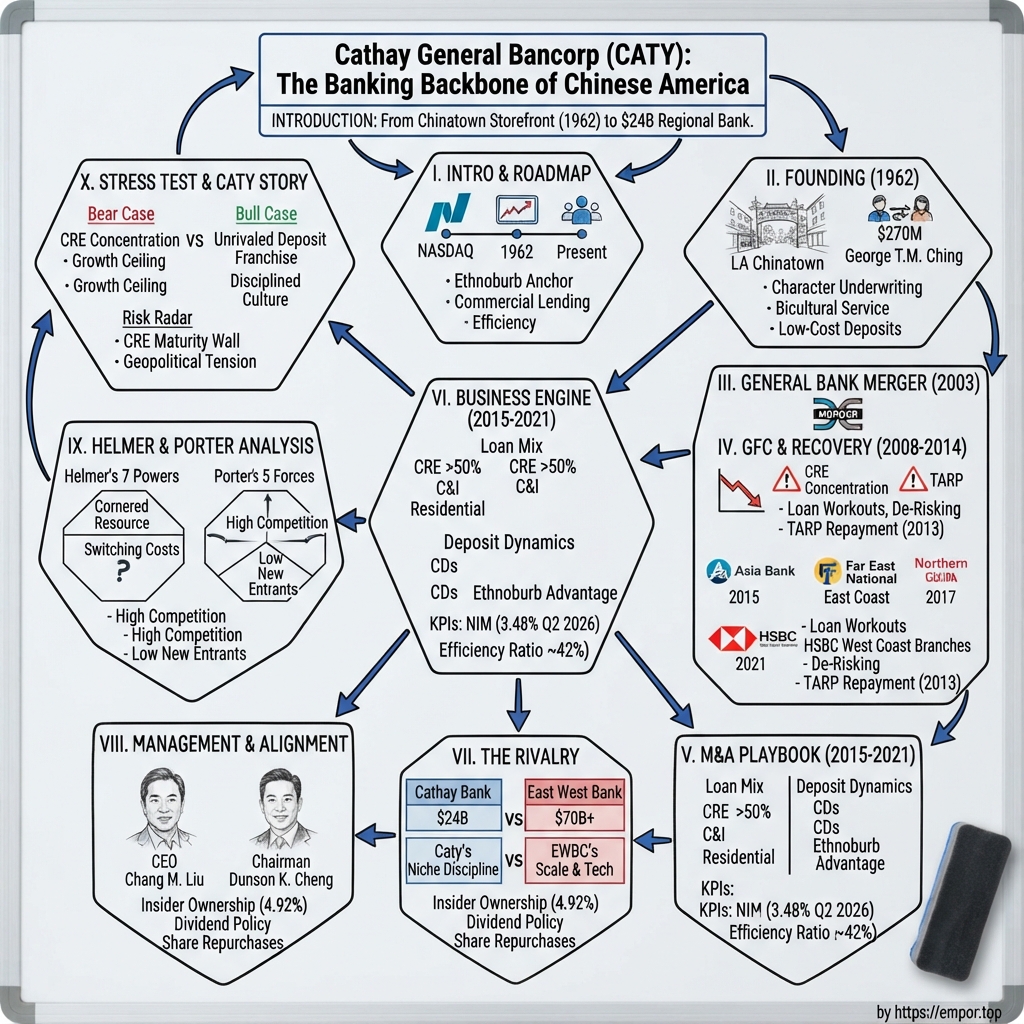
Cathay General Bancorp: The Banking Backbone of Chinese America
I. Introduction & Episode Roadmap
Walk north on Broadway in Los Angeles until the signage flips from English to Chinese and the storefronts start selling roast duck and herbal medicine, and you arrive at 777 North Broadway. It is an unremarkable building by the standards of American finance — no glass tower, no atrium, no wall of trading screens. It is the head office of a bank with roughly $24.65 billion in assets, and it has never moved out of Chinatown.1
That address is the whole thesis in a single detail. Cathay General Bancorp, the Nasdaq-listed holding company for 國泰銀行 Cathay Bank, is a $24.65 billion institution that still runs its holding company out of the neighborhood where it opened its doors on April 19, 1962.12 As of June 30, 2026, it held $21.06 billion of deposits and $20.62 billion of gross loans, earned $92.2 million in the quarter, and produced a 1.52% return on average assets — respectable numbers for a regional bank in a year when most of the sector was still fighting to rebuild margin.2
The hook is the improbability of the arc. In 1962, a Stanford-trained economist named George T.M. Ching opened a bank because Chinese Americans in Southern California could not reliably get a loan from anyone else.3 Sixty-four years later, that bank operates over 60 branches across nine states, a branch in Hong Kong, and representative offices in Beijing, Shanghai and Taipei.12 It has survived a near-death experience in the Great Financial Crisis, absorbed a competitor larger than itself, bought a bank from a Taiwanese financial group, and picked up a retail network from HSBC. Along the way it became one of the two institutions that effectively define Chinese-American banking in the United States — and it is unambiguously the smaller of the two.
The structural question this story asks is simple and unsentimental: does ethnic-community banking actually produce a durable economic advantage, or does it just produce a durable identity?
The bull version of the answer says that deep, generational relationships inside a specific immigrant business community generate deposits that are stickier and cheaper than what a generic regional bank can raise, and loan losses that are lower than the collateral type would suggest, because the bank knows who it is lending to in a way a credit model cannot replicate. The bear version says that "relationship banking" is what every bank calls its deposit base right up until rates move, that Cathay's funding is in fact heavily weighted toward time deposits that reprice fast and shop hard, and that a balance sheet with more than half its loans in commercial real estate is a leveraged bet on West Coast property values wearing a cultural costume.
Both versions have evidence. The job of this piece is to weigh it.
Here is the route. We start in 1962, with the specific and documented problem that made a Chinatown bank necessary, and the post-1965 immigration wave that turned a Chinatown bank into a suburban commercial lender. We move to the watershed: the October 2003 merger with 萬通銀行 General Bank, which nearly doubled the company overnight and put a former rival's chairman inside Cathay's own boardroom, where he still sits. We then spend real time in the crisis years — 2008 to 2013 — because that is where the franchise was actually tested, where the U.S. Treasury put $258 million into the company, where regulators imposed memoranda of understanding, and where the equity holders took losses. We examine the post-crisis acquisition record with the purchase-accounting tables open, which produces some surprises. We take apart the loan book and the deposit book. We put Cathay head-to-head with 華美銀行 East West Bank, which has grown to more than three times its size. We evaluate current management through what they have actually said on earnings calls across eight quarters, including the parts where analysts pushed back. Then we run the frameworks — Helmer's 7 Powers, Porter's Five Forces — and finish with the bull case, the bear case, and the two or three numbers that will tell you whether either is coming true.
One framing note before we start. Cathay's story is unusually long, and most of it is not where the money is decided today. The 1960s and 1970s matter because they explain the deposit franchise and the credit culture; they do not explain the 2026 income statement. So the early history is told compactly and always tied forward. The weight sits where the risk sits: the balance sheet, the competitive position, and the credibility of the people running it.
We begin with a capital deficit.
 Subscribe on LinkedIn
II. The Ethnoburb Blueprint: Founding Cathay Bank in 1962
Picture a department store back office in Los Angeles in 1951. A man in his late thirties is reconciling cash registers at night — one of three jobs he is working simultaneously. He has a master's degree in economics with a banking emphasis from Stanford, earned between 1937 and 1939, and he spent the years after the Second World War working in Hong Kong's banking sector before China's political upheaval sent him to California. He is overqualified for the register job, and he handles it the way a systems person handles tedium: he designs a faster reconciliation method and finishes four hours of work in one.3
That man was George T.M. Ching, born in the United States in 1914, and eleven years later he founded a bank.3
The credit gap was specific, not abstract
The word "redlining" gets used loosely. In the Chinese-American Los Angeles of the early 1960s, the exclusion was more mundane and more total than a map with red lines on it. A first-generation immigrant running a laundry, a restaurant, a garment shop or an import business typically had no U.S. credit file, no audited financial statements, limited English, and a business whose cash flows lived in a ledger book and a coffee can. To a mainstream bank's underwriting desk, that customer was not a bad risk — the customer was unreadable. There was nothing to score.
Ching's insight was that unreadable is not the same as uncreditworthy. What he recognized in the 1960s was that Chinese Americans were being systematically turned away when they sought credit from local banks, and that the gap was an opportunity as well as an injustice.3 Cathay Bank was incorporated under California law on August 22, 1961 and commenced operations as a California state-chartered bank on April 19, 1962, opening in Los Angeles Chinatown as the first bank in Southern California founded by a Chinese American.13 Ching did not do it alone; the bank was established by a group of seven community members, drawn from Chinatown's merchant and professional class.2
The founding act was demand creation, not just credit supply
Here is the part of the origin story that actually matters commercially, and it is easy to miss. Ching's first problem was not finding borrowers. It was finding depositors who understood what a bank was for. According to the bank's own account of its founding, he functioned as a financial-literacy ambassador, personally explaining to community members what banking services could do for them — because, as his daughter Deborah put it, "people didn't know how to use (local banks') services."3
That is a different founding act than most bank origin stories. Cathay did not compete for a share of an existing deposit market; it converted a population that was largely operating outside the formal banking system into first-time depositors. The economics of that conversion are worth dwelling on, because they still show up on the balance sheet six decades later. A depositor who opens their first-ever checking account at your branch, in their own language, with a manager who knows their cousin, does not shop that relationship the way a rate-sensitive saver shops a certificate of deposit. The primary operating account — payroll, receivables, the money that sits there because it has to sit somewhere — is the cheapest and stickiest liability in banking. Cathay's founding generation of customers gave it that base essentially by default.
Three operating practices defined the early bank, and each has a modern descendant:
Character-based underwriting. When the paperwork does not exist, reputation substitutes for it. In a dense community where the borrower's family, suppliers, landlord and customers are all within a few blocks, defaulting has social consequences that no credit bureau can impose. This is not folklore — it is a real information advantage, and it is the ancestor of a practice management still describes today: Cathay's commercial real estate loans carry full personal guarantees in nearly all cases, a structure that puts the borrower's own balance sheet behind the property.4
Bicultural relationship banking. Bilingual staff, trade letters of credit, and remittance channels to East Asia were not diversity initiatives; they were the product. The modern version is documented in the 10-K: many of the bank's employees speak English plus one or more Chinese dialects or Vietnamese, and 78% of the workforce is of Asian descent as of December 31, 2025.1 That is not decoration. It is the operating system.
Trade finance as a bridge. From early on, the bank stood between customers on two sides of the Pacific. Today that shows up as a Hong Kong branch and representative offices in Beijing, Shanghai and Taipei, though the 10-K is candid that those representative offices now do limited work — coordinating document transport and performing liaison services, not originating business.1
The demographic engine: from Chinatown to the ethnoburb
The event that turned Cathay from a neighborhood institution into a commercial bank was not a strategic decision. It was the Immigration and Nationality Act of 1965, and what followed it.
Waves of immigrants from Taiwan, Hong Kong and later mainland China arrived with capital, professional credentials and business ambition, and — critically — they did not settle in Chinatown. They went east, into the San Gabriel Valley. Monterey Park became known as the first suburban Chinatown, and by the 1980s the San Gabriel Valley had transformed from predominantly white suburbs into an Asian-majority commercial ecosystem with its own banks, grocery stores, restaurants and malls.5 The geographer Wei Li later coined a term for this pattern — the "ethnoburb," a hybrid of the ethnic enclave and the middle-class suburb.5
For a bank, an ethnoburb is a very particular kind of market. Unlike a traditional urban enclave, it is property-intensive. Its residents buy houses. Its businesses occupy strip centers, small industrial buildings, and mixed-use retail. Its wealth accumulates in real estate rather than in securities. The demand that flowed to Cathay from the 1970s onward was therefore not primarily consumer credit — it was mortgages and small commercial real estate, extended to people the bank could read and secured by property the bank could see.
That is the origin of the balance sheet Cathay carries today, and it is also the origin of its central vulnerability. A bank that grows up serving a property-buying community becomes a property lender whether it intends to or not.
The founding generation solved the trust problem. The next generation would have to solve the scale problem — and the first attempt at that would come from an unexpected direction: buying the competitor across the street.
III. Scaling the Niche: Branch Expansion & The 2003 General Bank Merger
By the late 1990s, Cathay had a good problem and a bad one. The good problem was that its customers had scattered across the country and kept banking with it. The bad problem was that its customers had scattered across the country and it did not have branches where they landed.
The follow-the-diaspora expansion
The build-out reads like a map of Chinese-American settlement in America. Cathay became a public company on Nasdaq in 1990.2 Then it followed its customers: New York and Texas in 1999, Washington State in 2000, Massachusetts in 2003, Illinois in 2006, New Jersey in 2007, Nevada in 2013, Maryland in 2015.2 Overseas, it established a Hong Kong branch and representative offices in the Pacific Rim capitals where its trade-finance customers had counterparties.2
This was cheap growth of a particular kind. A conventional regional bank entering Flushing, Queens, or Bellevue, Washington, has to buy market share — advertising, teaser rates, hiring away local lenders. Cathay entering Flushing was entering a market where a meaningful share of the target customers already knew the name, had family who banked there in Los Angeles, or wanted a lender who would look at their business the way Cathay looked at businesses. The acquisition cost of a customer in a diaspora network is lower than the acquisition cost of a customer in an open market. That is the real economic content of the phrase "community bank," and it is worth stating precisely because the phrase is otherwise mush.
But branch-by-branch expansion is slow, and by 2003 Cathay's management wanted to be something other than a fast-growing niche bank. They wanted to be the consolidator.
October 2003: buying the rival
The target was GBC Bancorp, the holding company for 萬通銀行 General Bank — the other major Chinese-American bank in Los Angeles, a direct competitor for the same depositors, the same trade-finance customers, and the same commercial real estate loans.
The deal closed at the close of business on October 20, 2003, under an agreement signed May 6, 2003. Cathay issued 6,750,000 shares of common stock and paid $162.4 million in cash for all the outstanding GBC shares — a transaction valued at approximately $478 million based on Cathay's closing price on October 17, 2003.67 Shareholders who did not make a timely election received roughly $35.552 in cash and 0.093 Cathay shares per GBC share.7 The cash portion was funded from existing balances plus $40 million of newly issued trust preferred securities, and the holding company changed its name from Cathay Bancorp to Cathay General Bancorp.6
The combined institution had approximately $5.8 billion in total assets and $4.4 billion in deposits, 45 branches across five states, and three overseas offices.7 The 6.75 million shares issued to GBC holders represented roughly 27% of the combined company.7
What the deal actually bought
Three things, in descending order of importance.
It removed the most dangerous competitor. In a niche defined by relationships rather than price, the marginal threat is not Bank of America — it is the other bank that speaks the same language and understands the same customer. Eliminating General Bank as an independent competitor meaningfully changed the pricing dynamic for deposits and loans in the San Gabriel Valley. This is the least glamorous and most valuable thing a consolidating acquisition can do.
It bought density, not just presence. Branch economics in retail banking are brutally nonlinear. Two branches in the same trade area, each half-utilized, are worth considerably less than one branch at full utilization, because the fixed costs — manager, vault, compliance, lease — are the same either way. Overlapping networks are the classic source of merger synergy, and Cathay's overlap with General Bank in Southern California was extensive.
It bought a person. Peter Wu, GBC Bancorp's chairman, president and chief executive, became Cathay General Bancorp's executive vice chairman and chief operating officer and joined a newly created Office of the President/CEO; three GBC directors joined the board.6 That is a striking structural choice — you do not normally hand your acquired rival's CEO a seat in your own executive suite. The signal it sent to General Bank's customers and lenders was that this was a combination rather than a conquest. It worked well enough that Peter Wu remained a Cathay director as of March 2026, more than twenty-two years later, holding 694,066 shares, or 1.04% of the company.8
Dunson K. Cheng, then Cathay's chairman, president and CEO, framed it in exactly those terms at closing, noting that both organizations "were founded and are managed to serve the community."7 That is the language of a merger of equals rather than a takeover, which is a useful thing to say when the asset you are buying is trust.
The strategic pivot underneath the deal
The General Bank merger did something else that was less advertised and more consequential: it accelerated Cathay's shift from consumer mortgage lending toward commercial real estate. General Bank was a commercial lender, and the combined loan book tilted accordingly. Over the following two decades, non-owner-occupied CRE — retail strip centers, light industrial warehousing, mixed-use property, multifamily — became the engine of the company. By the end of 2025, commercial real estate accounted for 52.4% of gross loans.9
For an investor, this is the moment the risk profile of the company changed permanently. Consumer mortgages to homeowners in the San Gabriel Valley are diversified, small-ticket, and slow to default. Commercial real estate is lumpy, cyclical, and revalues violently when cap rates move. Cathay traded a lower-return, lower-volatility book for a higher-return, higher-volatility one. In an expansion, that trade looks brilliant.
The expansion had five years left to run.
IV. Battle-Testing the Franchise: The Great Financial Crisis & Real Estate Scars (2008–2014)
On December 5, 2008, the United States Treasury purchased 258,000 shares of Cathay General Bancorp's Series B preferred stock for $258.0 million, and received warrants to buy 1,846,374 common shares at $20.96.10
Strip away the euphemisms of the era — the program was designed, in the official framing, to inject capital into "eligible healthy institutions" — and the number tells you what you need to know. A bank with roughly $11 billion of assets took $258 million of federal capital. That is not a liquidity accommodation. That is a solvency cushion.
What went wrong
Cathay entered 2008 with exactly the concentration profile that the previous fifteen years had rewarded: heavy exposure to California commercial real estate, land acquisition, and construction lending. When Southern California property values collapsed, the collateral stopped covering the loans and the borrowers' businesses stopped covering the debt service at the same time — the specific correlation that makes CRE downturns so destructive.
The damage arrived in the income statement with a delay and then all at once. Cathay reported a net loss attributable to common stockholders of $83.7 million, or $1.59 per share, in 2009.11 Non-performing assets reached 5.05% of gross loans plus other real estate owned at December 31, 2009 — roughly one dollar in twenty of the loan book not paying.11 Reserve coverage of non-performing loans fell to 77.36%, meaning the allowance did not even cover the loans already known to be broken.11
For context on how far that is outside the normal operating range of this company: at June 30, 2026, non-performing assets were 0.59% of total assets and the allowance covered 195.97% of non-performing loans.2 The crisis peak was not a bad quarter. It was an order-of-magnitude event.
The regulatory reality behind the numbers
The part of this history that rarely makes it into the corporate timeline is that Cathay operated under formal regulatory constraint. The company entered into memoranda of understanding with the Federal Reserve Bank of San Francisco, and the bank with the California Department of Financial Institutions and the FDIC. Under those memoranda, the bank was restricted from paying dividends up to the holding company; required to maintain an adequate allowance; barred from opening new branches or business lines without prior approval; required to notify the FDIC before changing senior executives or directors; and required to retain management and directors acceptable to the regulators.11 The bank paid no dividend to the holding company in 2010 or 2011.11
In January and February 2010, the bank's board appointed a Compliance Committee to review the company's management and governance and assigned the Audit Committee to oversee implementation of the two memoranda.11 Cathay's own filing acknowledged it was in compliance "except that the Company will make certain process improvements to its Capital Plan based on input from the FRB SF."11
That is as close as a 10-K gets to saying the regulators were unhappy with the capital planning process. Investors evaluating any bank's crisis narrative should note the distinction: surviving a crisis and surviving it on your own terms are different achievements. Cathay did the first.
The response
Management's playbook had three moves, and they were executed in a logical order.
First, raise equity from the market, not just the government. On February 1, 2010, Cathay raised $124.9 million net of costs through a public offering of common stock.11 Existing shareholders were diluted at a depressed price — a real, permanent cost — but the alternative was worse.
Second, work the loans rather than dump them. Dunson Cheng, then chairman, president and CEO, guided a strategy of charge-offs, workouts and orderly disposition of foreclosed property rather than a fire sale. The mechanics of that patience were described plainly on a much later earnings call by CFO Heng Chen, and they are worth quoting because they explain the whole credit culture: non-accrual loans "stay in nonaccrual for 2 or 3 quarters," and if borrowers still cannot pay, the property becomes other real estate owned — "then, we normally are able to sell OREO close to our book."4 Low loan-to-value at origination is what buys you the option to be patient. A lender at 80% LTV must sell immediately; a lender at 50% can wait for the market.
Third, protect the deposit franchise above everything. This is the least visible and most important decision of the period. A bank in credit distress can shrink its way to safety by letting deposits run off — and destroy the very thing that makes it worth more than its loan book. Cathay did not. The core deposit base survived the crisis substantially intact, which is why the franchise was still worth recapitalizing.
By 2010, the loss narrowed to $4.8 million attributable to common shareholders, a 94.2% improvement.11 In 2013, the company redeemed all $258 million of Series B preferred stock, and on December 9, 2013 the Treasury sold all of its warrants for $13.1 million, or $7.20 per warrant, in a secondary offering.12 The taxpayer, for the record, made money on Cathay.
The lesson that still governs the balance sheet
The durable investor takeaway from 2008–2013 is not "Cathay survived." Most banks survived. The takeaway is about where the survival came from.
It did not come from diversification — Cathay was and remains concentrated in California CRE. It did not come from superior macro forecasting. It came from two structural choices made years earlier: low loan-to-value ratios at origination, and personal guarantees on commercial real estate loans. Both reduce yield at the margin. Both look like leaving money on the table during a boom. Both are the reason the bank had time.
That is the trade this company has made ever since, and it is the trade you are evaluating when you evaluate the stock: Cathay systematically accepts a lower loan yield in exchange for a thicker collateral cushion. Whether that trade is worth it depends entirely on how often the cushion gets used.
Coming out of the crisis with restored capital and no acquisitions on the board for nearly a decade, Cathay faced a new question: what to do with the money.
V. The M&A Playbook: Asia Bank, Far East National, and HSBC Branch Deals (2015–2021)
There is a specific kind of quiet that follows a bank crisis. Capital rebuilds. Loan demand returns. The regulatory memoranda lift. And then a management team that spent five years playing defense has to decide what kind of company it wants to be.
Cathay's answer, between 2015 and 2022, was to buy three things: a bank, a bank holding company, and a branch network. The three deals are usually described as a single "M&A strategy." Read the purchase-accounting tables and they are three genuinely different transactions, executed at three genuinely different prices, and only one of them looks like the strategy the outline of the story would suggest.
Transaction one: Asia Bancshares (2015) — paying up for density
On July 31, 2015, Cathay completed the acquisition of New York-based Asia Bancshares, Inc., the parent of Asia Bank, which operated three branches in New York City and one in Maryland.13
The consideration was $139.9 million — 55% in stock and 45% in cash, comprising 2,580,359 Cathay shares valued at $82.9 million at the acquisition date plus $57.0 million in cash.13 What Cathay received: $419.2 million of loans, $63.6 million of cash, $13.3 million of premises, and $420.6 million of assumed deposits. What Cathay recorded on top: $55.8 million of goodwill and $1.3 million of core deposit intangible.13
That goodwill number is the whole story of this deal. Cathay paid roughly $140 million for net tangible assets of approximately $84 million — a premium of about 1.7x tangible book. That is a full price, and it tells you what management thought it was buying: not assets, but position. Flushing and the surrounding Chinese-American neighborhoods of Queens are the densest concentration of Cathay's target customer outside Southern California, and branch density there is scarce and hard to build organically. Entry into Maryland came along with it.13
The honest assessment is that this was a strategic price, not a bargain, and it should be judged on whether the deposits proved cheap and sticky over the following decade rather than on the multiple paid. Goodwill has not been impaired; total goodwill stood at $375.7 million at the end of 2025 and management's annual testing has consistently concluded no impairment.914 That is a passing grade, not a distinction.
Transaction two: Far East National Bank (2017) — the deal that was not a premium
Now for the transaction that most summaries of Cathay get backwards.
In July 2017, Cathay purchased from 永豐銀行 Bank SinoPac all of the outstanding share capital of SinoPac Bancorp, the U.S. holding company for Far East National Bank, for an aggregate purchase price of approximately $351.6 million plus post-closing payments contingent on the realization of certain FENB assets.1516 The holding company merger completed on July 17, 2017 and the bank merger followed on October 27, 2017.15 The structure was unusually protective of the buyer: $100 million of consideration was deferred and released within a year based on the timing of the bank merger, and 10% was held back for release over three years.16 Cathay funded part of it with a $75.0 million term loan from U.S. Bank signed October 12, 2017, at one-month LIBOR plus 175 basis points.15
Here is what the purchase accounting actually showed. Total assets acquired were $1.21 billion, including $705.8 million of gross loans, $19.9 million of FHLB and FRB stock, $46.1 million of cash surrender value of life insurance, $40.7 million of net deferred tax assets, and $6.1 million of core deposit intangible. Liabilities assumed were $852.4 million, including $813.9 million of deposits. Net assets acquired: $360.1 million. Total consideration: $354.5 million. The difference produced a gain from acquisition of $5.6 million.15
A bargain purchase gain, not goodwill. Cathay paid slightly less than the fair value of what it received.
That reframes the deal entirely. The common characterization — that Cathay overpaid at roughly 1.6x tangible book and then struggled with integration — does not survive contact with the filing. What the filing supports is a different and more interesting reading: a motivated seller. Bank SinoPac was exiting a U.S. subsidiary, and the deal structure Cathay negotiated (large deferred payment, three-year holdback, contingent post-closing payments tied to asset realization) is the structure a buyer builds when it is not fully confident in the acquired book. Cathay also booked $4.1 million of one-time acquisition and integration expenses in 2017 and saw professional service and data processing costs rise as a direct result.15
The analytical conclusion: bargain purchase gains in bank M&A are a signal, not a windfall. Accounting gains that arrive on day one are frequently the market's way of pricing risks that show up in years two through five. Cathay bought $705.8 million of loans and 9 California branches plus a Beijing representative office at a discount, and it added meaningful commercial lending capacity in Northern California.16 Whether the discount was adequate compensation for what came with it is not something the filings resolve cleanly — but investors should stop describing this as an overpayment. It was the opposite, and the reason it was the opposite is itself worth noting.
Transaction three: the HSBC branches (2022) — a deal that cost almost nothing
The third transaction is routinely dated to 2021 and described as a $1 billion deposit purchase spanning California and Washington. Neither is right.
Cathay Bank completed the purchase of HSBC Bank USA's West Coast mass market consumer banking business and retail business banking business on February 7, 2022 — announced in 2021, closed in 2022 — acquiring 10 retail branches in California for total consideration of approximately $5.0 million.1417
What came with it: loans with a principal balance of $646.1 million and deposits of $575.2 million.14 Cathay added $3.5 million of goodwill and $3.1 million of core deposit intangible.14 The acquired loans were overwhelmingly residential — total residential mortgage loans jumped 25.6% in 2022 to $5.3 billion, and $550.5 million of that increase came directly from the HSBC branches.14
Read that again: total consideration of roughly $5.0 million for a book that brought over half a billion dollars of residential mortgages and nearly six hundred million of deposits. This was not a deposit-premium transaction in the conventional sense; HSBC was exiting a retail business it no longer wanted, and Cathay was the natural buyer for branches whose customer base overlapped almost exactly with its own.
Two honest caveats. First, the deal brought more loans than deposits, so it was not the pure low-cost-funding capture it is often described as — Cathay took on $646.1 million of assets against $575.2 million of liabilities. Second, mortgages originated by HSBC in 2020–2021 were written at the lowest rates in modern American history, which means Cathay inherited a slug of long-duration, low-yielding assets right before the Federal Reserve began the fastest tightening cycle in forty years. The consideration was tiny; the economic cost was the duration.
What the three deals say about capital allocation
Put the three together and a pattern emerges that is more disciplined than the standard "serial acquirer" narrative.
Cathay paid a full price exactly once, for the asset it could not build — East Coast branch density in the densest Chinese-American market outside California. It paid a discount for a subsidiary a foreign parent wanted out of, and protected itself structurally while doing so. It paid a nominal amount for a branch network another bank had decided to abandon. In none of the three did it pursue a transformational deal, a hostile approach, or an out-of-niche diversification.
The counter-argument an activist would make: this is not capital allocation, it is opportunism dressed as strategy. Three deals in seven years, none of them large enough to change the trajectory of a $24 billion bank, and no deals at all since February 2022. Cathay's own CEO has effectively confirmed the passivity. Asked in April 2026 about the M&A landscape, Chang Liu said the company would "think about looking at things more opportunistically just based on what's presented to us," that the focus remains "more on just our organic growth and executing the business plan," and — plainly — that M&A "is not the top priority at this point."18 Nearly two years earlier, in July 2024, he had said essentially the same thing: "until there's a viable candidate out there or a company out there that makes sense for us that's within our niche space, we don't have anything on the boards right now."4
Consistency across two years is a credibility marker, and it should be counted as one. But consistency about waiting is not the same as a plan. With CET1 at 13.27% at the end of 2025 — well above what a bank of this risk profile needs to run — the capital is going out through dividends and buybacks rather than into franchise expansion.9 That is a defensible choice. It is also an admission that management does not currently see a way to compound at higher returns by deploying it.
Which brings us to the machine that actually generates the money.
VI. Inside the Engine: Business Segments, Loan Economics & Deposit Mechanics
Strip away the history and Cathay Bank is a straightforward machine with three moving parts: it borrows short from a specific community, it lends long against West Coast property, and it keeps its own operating costs unusually low. Everything else is commentary.
Let us take the parts one at a time, in plain language.
The loan book: a property lender with a business-banking wrapper
At June 30, 2026, gross loans stood at $20.62 billion, composed of $10.78 billion of commercial real estate, $5.83 billion of residential mortgages, $3.52 billion of commercial loans, $248 million of construction, and $234 million of equity lines.2
Commercial real estate is the business. It represented 52.4% of gross loans at the end of 2025, and it is the single largest determinant of what happens to this company.9 The composition is deliberately unglamorous: commercial retail properties, shopping centers, owner-occupied industrial facilities, office buildings, multiple-unit apartments, hotels, and multi-tenanted industrial properties, essentially all secured by first deeds of trust.9
The number that matters most in that book is not the balance — it is the loan-to-value. Cathay reported an average LTV on its CRE portfolio of 49% at December 31, 2025, essentially unchanged from 50% eighteen months earlier.194 In layman's terms: for every dollar the bank has lent against a commercial property, there is roughly two dollars of appraised property value standing behind it. Property values would have to fall by more than half before the collateral stopped covering the debt.
That is the mechanism, and it is worth being precise about why it matters. A CRE lender at 49% LTV and a CRE lender at 70% LTV are not running the same business with different risk appetites. They are running structurally different businesses. The 49% lender earns a lower spread, because low-leverage borrowers can shop their loans. But the 49% lender also has the ability to wait through a downturn, restructure rather than foreclose, and — as management described — sell foreclosed property "close to our book."4 The high-LTV lender has none of those options. Cathay's entire credit history, including 2009, is an argument that the lower spread is worth it.
The office question, answered with actual numbers. Every regional bank in America has spent three years being asked about office exposure, and most answers are evasive. Cathay's is specific. As of Q4 2025, office property loans represented 13% of the total CRE portfolio and 7% of total loans — about $1.4 billion. Of that, only 30% is secured by pure office buildings, and only 3% sits in central business districts. Another 42% is collateralized by office retail stores, office mixed-use and medical office properties, and the remaining 28% by office condos.19
Translated: the frightening category — big, empty, single-tenant downtown towers — is roughly 3% of a book that is itself 7% of loans. Cathay's "office" exposure is mostly small professional suites, dental and medical practices, and mixed-use buildings with retail on the ground floor. That is a materially different risk than the one the word "office" triggers in an investor's head. The exposure has also been shrinking; it was 15% of CRE and 8% of loans in mid-2024.4
Retail property is the larger sub-category, at 24% of CRE and 12% of total loans, or about $2.5 billion. Of that, 90% is secured by retail stores, neighborhood centers, mixed-use or strip centers, and only 9% by shopping centers.19 Again, this is neighborhood commerce, not enclosed malls.
Commercial and industrial lending — $3.52 billion — is the trade-finance and working-capital business: short-term loans, lines of credit, trade-finance loans, cash-secured commercial loans, and SBA loans.9 It is the smallest of the three main books and, on management's own account, the most competitively pressured. Chang Liu told analysts in January 2026 that C&I was where Cathay saw "the most amount of competition," with rates on the existing portfolio declining "steeper than the other 2 segments."19
Residential mortgage at $5.83 billion is the quiet workhorse: low-LTV lending, much of it to Asian-American borrowers, with historically low default rates. Its strategic value showed up in an unexpected place in 2026, when CFO Al Wang noted that under the Federal Reserve's proposed capital rules, Cathay's "decently sized mortgage portfolio with very low LTVs" could deliver a low-double-digit percentage reduction in risk-weighted assets, worth roughly $150 million to $175 million of capital ratio benefit.18 That is an unearned option sitting inside the balance sheet — real, but contingent on a rule that has not been finalized.
The deposit book: the part of the story that is oversold
Here is where the romantic version of Cathay's franchise meets the ledger.
The narrative says: deep community ties produce a cheap, sticky, low-beta deposit base. The balance sheet says something more nuanced. At June 30, 2026, Cathay's $21.06 billion of deposits broke down as $3.57 billion non-interest-bearing demand, $2.61 billion NOW, $3.89 billion money market, $1.42 billion savings, and $9.57 billion of time deposits.2
Time deposits — certificates of deposit — were 45% of the total. Non-interest-bearing demand deposits were 17%.
That is not a low-beta funding base. It is the opposite: nearly half the funding is in the single most rate-sensitive, most shoppable liability a bank can have. And Cathay's own management has been explicit about the beta. Asked directly in January 2026 what deposit beta was embedded in the 2026 margin outlook, Heng Chen answered "in the 60% range or so" on interest-bearing deposits.19 A 60% beta means that for every 100 basis points the Fed moves, roughly 60 basis points flow through to what Cathay pays its savers.
The CD franchise also runs on a distinctly cultural rhythm. Cathay runs a Lunar New Year promotional campaign each January to defend and gather deposits — in 2026, at roughly 3.65% for six months and 3.50% for twelve months — timed to the season when Chinese-American households traditionally move money.1819 It is a genuine, differentiated marketing channel. It is also, unmistakably, rate-led deposit gathering.
So what is the real advantage? Two things, and they are narrower than the story usually claims.
First, the non-interest-bearing base is real but not exceptional. At 17% of deposits, Cathay's NIB share is respectable for a commercial bank of this type but not a standout. The operating accounts of San Gabriel Valley businesses are genuinely sticky; there just are not enough of them to fund a $21 billion balance sheet.
Second, and more importantly, the CD base is sticky at a competitive rather than a leading price. This is the subtler advantage and the one supported by evidence. Chang Liu described the strategy candidly in January 2026: with nearly $4 billion of CDs maturing in the first quarter at an average yield of about 3.8%, the plan was to "price somewhat below that" while "sensitive about defending that base."19 By April, management reported that first-quarter maturities had been replaced at around the mid-3.50s — a genuine reduction, achieved without losing the money.18 A depositor who will renew 25 basis points below the market rate because the branch manager speaks their language and has known them for fifteen years is worth something. It is just worth 25 basis points, not 200.
The uninsured deposit ratio has held steady at 45%, which is high in absolute terms but backstopped: at December 31, 2025 the bank had $7.5 billion of unused Federal Home Loan Bank capacity, $1.3 billion from the Federal Reserve, and $1.6 billion of unpledged securities — together covering more than 100% of uninsured and uncollateralized deposits.19
Margin and efficiency: where the last two years were actually won
The clearest evidence that this machine works sits in the margin trajectory.
Net interest margin bottomed at 3.01% in the second quarter of 2024.4 It reached 3.36% in the fourth quarter of 2025, 3.43% in the first quarter of 2026, and 3.48% in the second quarter of 2026 — the eighth consecutive quarter of expansion.19182 Net interest income rose 10.1% in 2025 to $742.5 million, driven, in the 10-K's own words, primarily by the decrease in interest expense from time deposits.9 Quarterly earnings per diluted share went from $0.92 in Q2 2024 to $1.37 in Q2 2026 — a 49% increase over two years with essentially no balance sheet growth.42
That is the single most important operating fact about Cathay right now, and it deserves a plain-English conclusion: almost all of the recent earnings improvement came from the liability side of the balance sheet, not from growing the business. Average loans grew just 1.5% in 2025.9 The earnings recovery was a repricing story — expensive CDs written in 2023 and 2024 rolling off and being replaced more cheaply — not a franchise-expansion story. That distinction matters enormously for what happens next, because repricing tailwinds are finite by construction.
The cost side is genuinely strong. The reported efficiency ratio was 43.41% for 2025, improved from 51.35% in 2024, and 41.53% in the second quarter of 2026.92 On an adjusted basis — which strips out the amortization of low-income housing and alternative energy tax credit investments that Cathay, unusually, books in non-interest expense while most peers record it in income tax expense — the ratio was 37.0%.1820 That accounting difference is worth flagging: Cathay's headline efficiency ratio is understated relative to peers who use the proportional amortization method, which means the real cost advantage is larger than the reported number suggests.18
The source of that advantage is not mysterious. Cathay ran a $24 billion bank with approximately 1,268 full-time-equivalent employees at the end of 2025 and just over 60 branches.1 That is extraordinary deposit density per location, and it is a direct consequence of serving a geographically concentrated community that walks into the branch.
The machine, then, is real. The question is what happens when a much larger machine parks next door.
VII. The Rivalry: Cathay Bank vs. East West Bank
Twelve miles separate 777 North Broadway in Los Angeles Chinatown from 135 North Los Robles Avenue in Pasadena. One is the head office of Cathay Bank. The other is the headquarters of East West Bancorp. They serve overlapping communities, compete for the same commercial borrowers, and were founded from the same premise — that Chinese Americans needed a bank of their own.
One of them is now more than three times the size of the other.
The scoreboard
At June 30, 2026, East West Bancorp held $84.8 billion of total assets against Cathay's $24.65 billion. East West's loans were $59.0 billion and deposits $70.1 billion, versus $20.62 billion and $21.06 billion at Cathay.212
The performance gap is wider than the size gap would predict. In the second quarter of 2026, East West earned $364 million, a return on average assets of 1.75% and a return on average common equity of 16.0%. Cathay earned $92.2 million, a 1.52% return on average assets and 12.21% on average equity.212 For the full year 2025, the divergence was starker still: Cathay's return on average assets was 1.33% and return on average equity 10.87%.9
The market has priced the gap accordingly. East West's tangible book value per share was $64.06 at June 30, 2026; Cathay's was $39.93.2120 Against recent share prices of roughly $129 for EWBC and $62 for CATY, that is approximately 2.0x tangible book for East West and roughly 1.55x for Cathay.22
Why the divergence happened
This is not a story about one management team being better at banking than the other. It is a story about two genuinely different strategic choices, made decades ago, compounding.
East West chose to outgrow the niche. Under Dominic Ng, who has led it as chairman and CEO for three decades, East West used its Chinese-American foundation as a launchpad rather than a boundary. It built a nationwide commercial bank: large corporate lending and syndications, technology and venture banking, cross-border private equity and entertainment finance, and a genuine institutional treasury-management platform. Ng's framing of the second quarter of 2026 — "record levels of net interest income, revenue, loans, and deposits" and "above-peer returns" reflecting "the growth opportunities we have captured across our markets" — is the language of a bank that measures itself against the national peer group, not against the other Chinese-American bank in Los Angeles.21
Cathay chose to defend the niche. Middle-market CRE, trade finance, residential mortgage, and ethnoburb retail banking. No venture lending, no syndication desk of scale, no entertainment finance. Chang Liu's language in April 2026 is the exact mirror of Ng's: the focus is on "supporting our loyal customers and deepening long-standing relationships rather than pursuing volume that will require taking on additional credit risk in this unpredictable economic environment."18
Both statements are true descriptions of what each bank has done. Only one of them describes a business that has been compounding book value at a mid-teens rate.
Where Cathay actually wins
It would be lazy to conclude from the scoreboard that Cathay is simply a worse East West. On three specific dimensions it has a defensible position.
Cost structure. Cathay's adjusted efficiency ratio of 37.0% is genuinely excellent, and the tax-credit amortization accounting means the reported 41.53% understates it further.182 Running a bank cheaply is a permanent advantage, not a cyclical one, and Cathay's branch density in the San Gabriel Valley and Flushing gives it a structurally low cost of deposit gathering per dollar.
Credit conservatism. A 49% average CRE loan-to-value with near-universal personal guarantees is a materially more defensive book than most commercial banks carry.194 In a benign credit environment this looks like underperformance. In a severe one it looks like the reason the company still exists — which is precisely what 2009 demonstrated.
Simplicity. Cathay has minimal exposure to the areas where regional banks have recently been surprised. Management disclosed in April 2026 that loans to non-depository financial institutions — the private-credit channel that has drawn increasing regulatory attention across the sector — make up less than 2% of total loans.18 There is no meaningful venture book, no crypto adjacency, no large syndicated exposure.
Where Cathay loses ground, structurally
The disadvantages are the mirror image and they are not easily fixed.
Scale in technology and product. Treasury management, cash management, payments, and digital onboarding are increasingly the products that determine which bank a growing commercial customer keeps. These are fixed-cost businesses. A bank with $84.8 billion of assets can amortize a platform investment across three and a half times the base that a $24.65 billion bank can. Cathay's response has been to emphasize digital modernization, but it is competing against a rival that can outspend it by construction.
Lending limit and product scope. Cathay's own 10-K states plainly that when a proposed loan exceeds internal lending limits, the bank "has, in the past, and may in the future, arrange the loan on a participation or syndication basis with correspondent banks," and refers clients requiring services it does not offer to correspondents.1 That is an honest disclosure of a real ceiling. When a Cathay customer's business outgrows Cathay, the natural next call is East West.
Talent flow. The direction of senior movement is telling. Cathay's Chief Credit Officer, Albert Sun, was Chief Credit Officer at East West Bank from 2015 to 2017 before later stints at Grasshopper Bank and Piermont Bank. Chief Administrative Officer Thomas M. Lo spent 2010 to 2018 at East West in international and commercial banking before joining Cathay in 2018.1 Cathay has recruited experienced executives out of its larger rival — a reasonable way to import capability, and also a reminder of which institution has been the training ground.
The honest verdict on the rivalry
Cathay is not losing to East West in the sense of losing customers. It is losing in the sense of not compounding as fast, and the market has capitalized that difference into a persistent valuation discount that is unlikely to close on the strength of a good margin quarter.
The investment question is therefore not "will Cathay catch East West" — it will not, and management is not trying to. The question is whether a smaller, cheaper, more conservative bank in the same niche can generate returns adequate to its cost of equity through a full cycle. On 2025's 10.87% return on average equity, the answer was marginal.9 On the first half of 2026's 12.05%, it improved.2 Whether the improvement persists depends almost entirely on decisions being made by the people we turn to next.
VIII. Current Management, Capital Allocation & Transcripts Analysis
On January 23, 2026, Cathay announced that Heng W. Chen would retire as chief financial officer effective March 1, 2026, ending a nearly 42-year career in auditing and finance that included 23 years at Cathay.23
Reading that press release alongside the earnings transcripts from the quarters on either side of it is one of the more instructive exercises available to a Cathay investor, because it captures a real handoff in real time — and because the two CFOs sound noticeably different.
The people
Dunson K. Cheng, Executive Chairman. Cheng, 81, has a Ph.D. in physics. He has been a director of Cathay Bank since 1982 and of the holding company since its formation in 1990. He was president of the bank from 1985 to 2015 and chairman, president and CEO of the holding company from 1994 to 2016, becoming executive chairman in October 2016.124 He led the company through the General Bank merger and through the crisis. He holds 850,768 shares, or 1.27% of the company.8
A physicist running a bank for two decades is not a novelty detail — it is a reasonable explanation for a credit culture built around structural margins of safety rather than around growth targets. His stated individual goals for 2025 compensation purposes were management of the bank's credit culture, overseas development, CEO mentoring, and digital transformation, and his base salary was decreased by 17% that year.24 A declining salary for an 81-year-old executive chairman whose defined role includes mentoring his successor is what an orderly wind-down of an outsized founder-era role looks like. Governance-minded investors will still note that the board is chaired by the former CEO, which limits the independence of the oversight function; the board's own defense is that separating the chairman and CEO roles "provides clarity of leadership."24
Chang M. Liu, President and CEO. Liu, 59, has run the company since October 2020. His path was through the credit function: he joined Cathay in 2014 as SVP and Assistant Chief Lending Officer, became Chief Lending Officer in 2016, Chief Operating Officer in 2019, president of the bank in 2019, and CEO in 2020. Before Cathay he was EVP and Chief Lending Officer at Banc of California from 2011 to 2014.124 He holds 157,701 shares.8
A CEO who came up through lending rather than through finance or retail tends to have a specific bias: he protects credit quality first and grows second. Liu's public statements are consistent with that to the point of monotony — which, for once, is a compliment.
Albert J. Wang, CFO since March 1, 2026. Wang brings over 28 years of finance and accounting experience: EVP and Chief Accounting Officer at Webster Bank from 2017 to 2025, Chief Accounting Officer and acting CFO at Banc of California, Chief Accounting Officer at Santander Bank, and a senior manager at PricewaterhouseCoopers covering banking and capital markets. He is a CPA.23 He served as Deputy CFO before stepping up, and he held zero shares of Cathay stock as of March 26, 2026 — the natural consequence of a recent external hire, but worth watching as an alignment matter.8
The Banc of California overlap between Liu and Wang is not accidental; it is a known-quantity hire. The stylistic change on the calls is immediate. Chen's answers were terse and operational. Wang's are structured around slides, adjusted metrics, earn-back periods, and explicit walk-forwards of reserve builds — the vocabulary of someone who has spent a career explaining bank financials to analysts. When he decomposed a $10 million allowance increase in July 2026 into "$5.5 million for growth, $3 million for specific reserves and another $1.5 million for kind of key factors," that was a level of granularity Cathay had not previously offered.2
Ownership and alignment
All nominees, directors and executive officers as a group — 19 people — beneficially owned 3,031,095 shares, or 4.53% of the 66,972,039 shares outstanding as of March 26, 2026.8 The largest individual holders are legacies: Anthony M. Tang at 1.44%, Dunson Cheng at 1.27%, and Peter Wu at 1.04%.8
Institutional ownership is index-dominated: BlackRock at 15.91%, Vanguard at 12.33%, Dimensional Fund Advisors at 5.75%, and State Street at 5.51%.8 That concentration of passive ownership has a practical implication worth naming: roughly four in every ten shares are held by owners who will not sell on a strategy disagreement and will not run an activist campaign. It stabilizes the register and it also removes a source of pressure.
The Employee Stock Ownership Plan is a vestige rather than a live alignment mechanism. It owned 614,028 shares, or 0.91% of the company, at December 31, 2025 — and the company has made no contributions to the trust since 2004 and does not expect to make any in the future.25
Capital allocation: the actual record
Cathay's capital return has been steady and, recently, accelerating.
The dividend went from $0.24 per share in the fourth quarter of 2017 to $0.31 in the fourth quarter of 2018 to $0.34 in the fourth quarter of 2021, and then to $0.38 declared on February 13, 2026 — an 11.8% increase.918 Against 2025 diluted earnings of $4.54, an annualized $1.52 dividend is roughly a third of earnings, leaving substantial room.9
Buybacks have been programmatic. Cathay repurchased 1.1 million shares for $51.9 million at an average of $47.15 in the fourth quarter of 2025 under a June 2025 $150 million authorization; completed that program in the first quarter of 2026 with 244,000 shares at $51.31; and in the second quarter bought 242,000 shares at an average of $58.19182 In July 2026 the board raised the authorization from $150 million to $200 million, subject to pending regulatory approval.2
Two things about that pattern deserve comment.
The first is that the average purchase price has risen with the stock, from $47.15 to $51.31 to $58.00 across three consecutive quarters. That is the arithmetic of a fixed-dollar program, not of opportunism. Wang was refreshingly direct about the constraint on the July call: the prior structure allocated most of the authorization to the current year with only a small carryover, which meant "we didn't really have much dry powder when we got into the first quarter" — precisely when bank stocks were weak — and the upsizing to $200 million was designed to fix that.2 Recognizing that your buyback machinery prevented you from buying at the low is an unusually candid admission, and the fix is the right one. But the record to date is dollar-cost-averaging, not value-driven repurchase.
The second is the trust preferred redemption. Cathay announced plans to redeem approximately $54.1 million of its $119.1 million of outstanding trust preferred securities — roughly 45% of the total, representing its highest-cost issuances.2 This is unglamorous liability management and exactly the right use of surplus capital for a bank with no compelling growth investment: retire your most expensive funding.
Reading the transcripts: what management says, and what analysts do not believe
Prepared remarks tell you what management wants emphasized. The Q&A tells you what the market doubts. Across the last four quarters, the friction points have been consistent.
Friction point one: is the margin expansion real, or is it noise? Cathay's reported NIM has been flattered every quarter by interest recoveries and prepayment penalties. Analysts have pushed on this repeatedly, and management has consistently disclosed it. In Q4 2025 those items added 5 basis points; in Q1 2026, about 6 basis points; in Q2 2026, about 4 basis points.19182 When David Chiaverini of Jefferies pressed in July 2026 on whether the underlying trend was as good as reported, Wang gave the core number without hedging: "on a core basis, we would have been at 3.44% this past quarter."2
That is the right way to answer, and the disclosure is a credibility positive. But note what it means: roughly 4 basis points of the reported 3.48% margin is recurring-but-lumpy income, and management itself has cautioned that the room for further expansion "is going to become smaller and smaller."2
Friction point two: the rate outlook has flipped twice, and the NIM guide has not moved. This is the most analytically interesting sequence of the past year, and it cuts both ways.
In January 2026, Heng Chen told analysts the 2026 outlook assumed two Fed rate cuts — one in June, one in September — and guided NIM to 3.40%–3.50%.19 By April, Wang said the outlook "no longer assumes any rate cuts in 2026" — and reaffirmed the same 3.40%–3.50% range.18 By July, the assumption had inverted again: the NIM and NII outlook "now assumes a 25-basis-point rate increase in September" — and the guide was reaffirmed a third time.2
Two rate cuts, then zero, then a hike, and the same margin guidance throughout. There are two readings. The charitable one is that the guide was set with genuine conservatism and Cathay's balance sheet — 60% fixed-rate and hybrid loans, with a large fixed-rate mortgage book repricing upward from 2020-era coupons — is more rate-neutral than a simple liability-sensitivity model would suggest.19 The skeptical one is that a range wide enough to survive a 50-basis-point swing in policy rates in either direction is not a forecast; it is a band. Both readings are defensible. What is not in dispute is that the actual results have landed inside the range, and that in mid-2024, when Heng Chen said the margin "has begun to bottom out," it did.4 That call was correct and it was made at the trough.
Friction point three: loan growth, and whether discipline is a choice or a constraint. This is the softest spot in the story. Cathay guided to 3.5%–4.5% loan growth for 2026 and reiterated it three times.19182 But first-quarter loans grew just 0.2% linked quarter, which Liu attributed to construction borrowers refinancing away to life insurance companies and agency lenders "that have much better competitive longer-term rates than we had."18 That is not a discipline story. That is a competitiveness story: Cathay lost those loans on price and duration.
The second quarter recovered strongly — loans up 2.2% linked quarter, with $200 million of bookings in the first three weeks of July, mostly CRE including multifamily and retail refinancings.2 Gary Tenner of D.A. Davidson asked the obvious question: was Q2 simply pent-up demand from a slow Q1? Liu's answer conceded most of the point — "I think, honestly, it's just kind of pulling all of that stuff through in the second quarter."2
Management also acknowledged a familiar seasonal pattern: "similar to last year, we saw a slower start to the first quarter."18 Investors should hold the loan-growth guide to a full-year test rather than a quarterly one, and note that the same 3.5%–4.5% aspiration follows a 2024 in which guidance had to be cut mid-year to 0%–2%.4
Friction point four: deposit costs are turning against them. The most important forward-looking disclosure in the July 2026 call was not about margin — it was about funding. Wang flagged roughly $3.3 to $3.4 billion of CDs rolling off at 3.54%, which he expected to replace at "probably a slightly higher yield than that," and noted that brokered large-CD rates had moved from 3.60%–3.70% at the start of the year to 4.00%–4.05%.2 That is the repricing tailwind ending and beginning to reverse.
Set against management's incentive structure, the picture is coherent. The 2025 bonus plan was built on earnings per share and return on average assets targets of $4.30 and 1.26%; actual results were $4.54 and 1.33%, producing payouts of about 111% on both metrics.24 Modest targets, modestly beaten, modestly paid. Nobody at Cathay is being compensated to swing for the fences — which is the correct design for this bank and also a fair summary of why it does not grow faster.
IX. Helmer's 7 Powers & Porter's 5 Forces Analysis
Frameworks are only useful if you are willing to score them honestly, including the zeros. Applied to Cathay, most of the boxes are empty. The two that are not are worth the whole exercise.
Hamilton Helmer's 7 Powers
Cornered Resource — the strongest power, and the only one that is clearly durable. Helmer's test for a cornered resource is preferential access to a coveted asset on attractive terms. Cathay's version is a network of generational relationships inside the Chinese-American business community — the ability to underwrite a San Gabriel Valley importer's business on the basis of a twenty-year relationship, a bilingual lender who understands the customer's supply chain, and a family that has banked at the branch across three generations. The evidence that this is a real asset rather than a marketing claim: 78% of employees are of Asian descent, the workforce is multilingual by design, and the bank's own competitive-strategy disclosure names "our long established relationships with the Chinese-American communities" as a principal competitive tool alongside extended weekday hours and Saturday banking.1 A mainstream bank cannot buy this in a year, or five.
The limit is equally clear. A cornered resource confers power only over the market it corners. Cathay's is bounded by the size and growth of Chinese-American commercial banking demand in a handful of metropolitan areas — and the same resource is partly shared with East West, Royal Business Bank, and the Pacific Rim banks that continue to open Los Angeles branches.1
Switching Costs — moderate, and concentrated in the commercial book. A retail depositor chasing 25 basis points on a CD faces essentially no switching cost, which is why 45% of Cathay's funding is genuinely contestable.2 The commercial borrower is a different matter: a trade-finance customer whose letters of credit, foreign exchange, deposit accounts and CRE mortgage all sit at one bank, and whose underwriting is built on a relationship history that would have to be re-established elsewhere, faces real friction. That is where Cathay's pricing power lives, and it is why the bank's fee income leans on wealth management, letters of credit, foreign exchange and treasury management rather than on consumer fees.18
Counter-Positioning — moderate, and eroding slowly. The classic form of this power is a business model the incumbent cannot copy without damaging itself. Character-based underwriting of first-generation immigrant entrepreneurs qualifies: a money-center bank's centralized credit model cannot economically originate a $2 million loan that requires a lender who speaks Cantonese, understands the borrower's family guarantee structure, and can visit the property. But counter-positioning weakens as the target market assimilates into standard credit scoring. A second- or third-generation Chinese-American business owner with fifteen years of tax returns and a clean credit file is bankable by anyone.
Scale Economies — a weak power, and arguably negative. This is the clearest deficit. Against East West's $84.8 billion balance sheet, and against national banks with vastly larger technology budgets, Cathay is subscale in exactly the places where scale increasingly matters — digital platforms, treasury management technology, and lending capacity.211
Network Economies, Branding, Process Power — not present in any meaningful form. Cathay has a respected name in its community, but a bank brand is not a pricing mechanism, and there is no credible claim to a proprietary process advantage.
Net assessment: one strong power, two moderate ones, and a scale disadvantage. That is a defensible niche business, not a compounding machine — which is more or less what the returns show.
Porter's Five Forces
Threat of new entrants — low. De novo bank formation in the United States requires regulatory capital, an FDIC charter, and a compliance apparatus that costs money before it earns any. Cathay itself carries a dedicated Chief Information Security Officer, a Chief Risk Officer hired in January 2025 from Bank of the West, board-level risk committees, and Bank Secrecy Act obligations — an overhead structure that is essentially fixed regardless of size.1 Nobody is chartering a new Chinese-American community bank in Monterey Park.
Bargaining power of suppliers — deposit holders — moderate to high, and rising. This is the force that actually constrains Cathay's economics. Nearly half of funding sits in time deposits; management assumes a 60% interest-bearing deposit beta; brokered CD rates rose roughly 40 basis points in the first half of 2026; and Wang described "a lot of competition for deposits" in the July call.192 Depositors in this market have Treasuries, money market funds, and at least four other banks courting the same relationships. They know it.
Bargaining power of buyers — borrowers — moderate. Prime CRE borrowers with 50% LTV requests can shop across every regional bank in California, and increasingly across life insurance companies and agency lenders — which is exactly what cost Cathay construction balances in the first quarter of 2026.18 Cathay's answer is service and speed rather than price, which works for relationship customers and does not work for the marginal deal.
Threat of substitutes — low to moderate. Non-bank private credit has expanded aggressively into middle-market lending, but it is structurally disadvantaged in low-LTV, long-duration real estate lending where bank funding costs win. Cathay's own exposure to that channel is minimal — non-depository financial institution loans are under 2% of the book.18 The more real substitute is the agency and life-company channel for stabilized multifamily and commercial property, which competes directly on rate and term.
Competitive rivalry — high, and explicitly acknowledged. The 10-K's framing is unusually blunt for a regulatory document: "In California, one larger Chinese-American bank competes for loans and deposits with the Bank and at least two super-regional banks compete with the Bank for deposits. In addition, there are many other banks that target the Chinese-American communities in New York and in both Southern and Northern California. Banks from the Pacific Rim countries, such as Taiwan, Hong Kong, and China, also continue to open branches in the Los Angeles area."1
The named-and-unnamed field includes East West, Hope Bancorp, 한미은행 Hanmi Bank, and RBB Bancorp — the last three all considerably smaller than Cathay, with market capitalizations of roughly $1.8 billion, $0.9 billion and $0.4 billion respectively against Cathay's approximately $4.2 billion.22 Cathay is therefore the clear number two in a market with one much larger leader and a long tail of subscale competitors. That is a workable position. It is not a comfortable one.
X. Skeptical Stress Test, Risk Radar & Bear vs. Bull Case
Now the adversarial pass. What would a short seller say, and how much of it survives contact with the filings?
The bear thesis, stated properly
"Cathay is a $24 billion bank with more than half its loans in West Coast commercial real estate, facing a wall of maturities that were underwritten at 2019–2021 cap rates and must be refinanced at today's coupons. Its funding is 45% time deposits with a 60% beta, meaning the recent margin expansion — which is essentially the entire earnings story of the past two years — reverses the moment CD pricing turns, which management has already told you is happening. It grows loans at low single digits, earns a return on equity in the low teens at best, trades at a persistent discount to its direct peer for good reason, and is returning capital because it cannot find anything better to do with it."
That is the case at full strength, and parts of it are simply correct. Let us test the parts that are testable.
On CRE quality, the counter-evidence is strong. The average loan-to-value across the CRE portfolio was 49% at the end of 2025, essentially all loans are secured by first deeds of trust, and management states that almost all CRE loans carry full personal guarantees.1994 Total CRE loans represented 287% of the bank's total risk-based capital and construction and land loans 14%, both inside the 300% and 100% supervisory criteria that trigger heightened examination scrutiny — and CRE concentration has been falling, from 289% at the end of 2024 to 277% on an average basis by mid-2026.92 Non-performing assets were 0.59% of total assets at June 30, 2026, with allowance coverage of non-performing loans at 195.97%.2 Net charge-offs in the second quarter of 2026 were $1.8 million on a $20.6 billion book — a rounding error.2
One caution on debt service coverage: the widely cited claim that Cathay maintains portfolio DSCR above 1.35x is not disclosed in the company's filings or earnings materials. Investors should not rely on it.
On funding, the bear is right and management agrees. There is no counter-evidence here, only sequencing. The CD repricing tailwind has largely been harvested. Management said so plainly: further NIM expansion is "probably more months than quarters at this point."2
On capital, the bear case is weakest. Common Equity Tier 1 was 13.27% at the holding company and 13.73% at the bank at December 31, 2025, with total risk-based capital of 14.93% and a Tier 1 leverage ratio of 10.91%.25 By June 30, 2026 the Tier 1 risk-based ratio had reached 13.70% and total risk-based capital 15.47%.2 A bank carrying that much capital against a 49%-LTV real estate book has a very large loss-absorption buffer.
The current risk radar
The CRE refinancing wall. Loans written in 2019–2021 at low coupons against then-prevailing cap rates must refinance into a higher-rate environment, and higher rates mean lower property values and tighter debt service coverage. Cathay's 49% LTV means most borrowers can still refinance — but "most" is doing work in that sentence, and the borrowers who cannot are the ones that become the next cycle's charge-offs.
Geopolitics and trade. This is a risk that is genuinely specific to Cathay rather than generic. Its C&I book is built on import/export businesses trading between North America and Asia. Tariffs, trade restrictions, or cross-border capital controls hit those borrowers' revenues directly. The company's own forward-looking-statement language now names "the potential for new or increased tariffs, trade restrictions or geopolitical tensions" as a distinct risk factor, and management referenced an active conflict as a driver of deposit-rate pressure on the April 2026 call.2018 Chang Liu has repeatedly framed the environment as "unpredictable" and cited "geopolitical tensions" as a reason for conservative underwriting.18
Deposit beta lag in reverse. If policy rates rise from here — which is what Cathay's own July 2026 guidance now assumes — the bank's asset yields reprice more slowly than its deposit costs, because 60% of the loan book is fixed or in a hybrid fixed-rate period.192 Liability sensitivity that was a gift on the way down becomes a headwind on the way up.
Regulatory and accounting judgment. Two items deserve flagging. First, Cathay disclosed in July 2026 that it "completed a review of certain regulatory capital reporting treatments, resulting in an increase of approximately 20 basis points to our risk-based capital ratios."2 A retrospective correction that improves reported capital is benign in direction but is, by definition, a prior-period reporting error. Second, the allowance model itself has required repeated adjustment: in the first quarter of 2026, Cathay raised reserves partly through a recalibration of a model input and by changing weightings on specific portfolios — because, as Wang explained, the model uses national economic forecasts while "we're very coastal," and the national forecast may not have been "doing those portfolios justice" on office exposure.18 That is a sensible correction and an honest explanation. It is also a reminder that CECL reserve levels are a management judgment, not a measurement.
Concentration in an equity fund. A smaller item worth noting: the 2025 10-K disclosed that Cathay's equity securities include an equity-method investment in a private investment fund holding "concentrated positions in certain private entities," and warned that a liquidity event or third-party valuation adjustment "could have a significant impact on our future financial condition or results of operations."9 Equity securities were $51.9 million at year-end 2025.9 The mark-to-market swings have already been visible in quarterly results — a $17.3 million valuation gain in Q1 2026 and an $11.7 million gain in Q2.182 This is a small, volatile, non-core position that flatters or depresses reported earnings without telling you anything about the bank.
The bull case: why Cathay wins from here
-
The funding franchise is defensible at a small but real discount. The evidence is not that Cathay pays nothing for deposits — it pays plenty. The evidence is that it repriced roughly $4 billion of maturing CDs down from 3.80% to the mid-3.50s in a single quarter without losing the balances, and grew deposits $240 million in the first three weeks of July.182 That is a franchise doing exactly what a franchise should.
-
The cost structure is genuinely top-decile and structurally so. A 37.0% adjusted efficiency ratio, understated further by an accounting convention that pushes tax-credit amortization into operating expense, on a bank run with roughly 1,268 employees and just over 60 branches.181 Low cost is the most durable advantage in commoditized banking.
-
The credit book is built for a downturn, not for a boom. Forty-nine percent average LTV, personal guarantees, minimal central-business-district office, minimal private-credit exposure, and CRE concentration inside supervisory guidelines and declining.194182
-
Capital is abundant and the uses are improving. Double-digit CET1, a dividend at roughly a third of earnings, an enlarged buyback authorization, retirement of the highest-cost trust preferred securities, and a potential unearned windfall of $150–175 million of capital relief if the Federal Reserve's proposed rules land as drafted.25218
-
The valuation gap versus East West is wide. Roughly 1.55x tangible book against roughly 2.0x, for a bank earning a return on assets within about 23 basis points of its rival's in the most recent quarter.2220212
The bear case: why Cathay may underperform
-
The growth ceiling is structural. Loan growth of 3.5%–4.5% against a niche whose geographic and demographic boundaries are fixed. The margin engine that produced 49% EPS growth over two years is a repricing engine, and it is close to spent.2
-
Credit is early-cycle-benign, not proven. Non-accrual loans rose 25.5% in the second quarter of 2026 to $111.7 million, and other real estate owned was $33.7 million and rising.2 Special mention loans jumped $80 million in the fourth quarter of 2025 as the bank downgraded five relationships totaling $92 million for covenant breaches.19 These are small numbers on a $20 billion book — but the direction in a benign environment is upward, and the company's own history says CRE losses arrive suddenly rather than gradually.
-
The scale disadvantage compounds. Every year East West outspends Cathay on technology and outgrows it on balance sheet, the gap in product capability and corporate lending capacity widens. Cathay's disclosed practice of syndicating loans that exceed its lending limits and referring clients to correspondents for services it does not offer is a permanent tax on its growth ceiling.1
-
Governance is legacy-shaped. An executive chairman who is the former CEO, a board with long-tenured directors including the acquired rival's former chief executive, insider ownership of 4.53% dominated by that legacy cohort, and a new CFO holding no stock.8 None of this is improper. All of it means change, if it is needed, will have to come from inside a group that has run this company for decades.
XI. Playbook & Epilogue
The transferable lessons
Niche dominance is a real moat, and it has a hard ceiling. Cathay's advantage in Chinese-American commercial banking is genuine, documented, and not replicable by a national bank. It is also confined to a market of finite size. Investors who buy niche leaders should be clear-eyed that they are buying a defensible margin, not a growth runway. The premium goes to the company that uses the niche as a base and expands outward — which is the entire difference between Cathay's story and East West's.
Underwriting discipline is a purchase, not a virtue. Every basis point of yield Cathay gives up by lending at 49% loan-to-value instead of 65% is a premium paid on an insurance policy. Most years, the policy does not pay out and the discipline looks like underperformance. In 2009, it was the reason the bank still existed to be recapitalized. The mistake investors make is judging the policy in the years it does not pay.
Read the purchase accounting, not the press release. The most useful discovery in this entire history was that Far East National Bank produced a $5.6 million bargain purchase gain rather than a goodwill charge — the exact opposite of how the deal is usually described.15 Bank M&A narratives calcify quickly and are frequently wrong. The acquisition footnote in the 10-K is where the truth lives.
Consistency in management language is evidence; consistency in guidance ranges is not. Cathay's leadership has said the same thing about M&A, credit discipline and organic growth for two straight years, and delivered results inside its own margin range through a policy-rate outlook that inverted twice.4182 The first is a genuine credibility marker. The second is at least partly a function of a range wide enough to accommodate almost anything.
The three KPIs that matter
Everything above compresses into three numbers. Track these and you will know whether the bull or bear case is winning, without needing anyone's opinion.
1. Net interest margin, on a core basis. Not the headline figure — the figure excluding interest recoveries and prepayment penalties, which management now discloses each quarter and which was 3.44% in the second quarter of 2026 against a reported 3.48%.2 The entire earnings recovery of 2024–2026 lives in this line. When it stops expanding, the repricing story is over, and growth has to come from somewhere else.
2. Total cost of deposits, and specifically the rate on maturing CDs versus their replacement rate. Cathay discloses this with unusual specificity: roughly $3.3–3.4 billion of CDs rolling off at 3.54% as of the July 2026 call, expected to be replaced slightly higher.2 This single spread is the cleanest available measure of whether the community franchise actually confers pricing power. If Cathay can keep replacing maturing CDs at or below the rolling-off rate while holding balances, the moat is real. If it has to pay up to keep the money, it is a rate-taker with good branches.
3. Non-performing assets as a percentage of total assets. At 0.59% at June 30, 2026, this ratio is near cycle lows and has recently been drifting upward.2 It is the earliest reliable signal that the CRE refinancing wall is producing casualties. The historical reference point is not subtle: it was 5.05% of loans plus OREO at the end of 2009.11
Epilogue
There is a temptation, writing about a company like this, to end on the arc — a Chinatown storefront in 1962 becoming a $24.65 billion institution — as though the size were the point.
It is not the point. Plenty of banks got to $24 billion. What is genuinely rare about Cathay is that it got there without ever leaving the business it was founded to do, and without ever quite deciding whether that was a limitation or a strategy.
George Ching's original insight was that a population no one else could underwrite was not a bad credit — it was an unread one, and reading it was worth money. Sixty-four years later, the descendants of that insight are still visible in the numbers: the multilingual branch network, the Lunar New Year deposit campaign, the personal guarantees on nearly every commercial mortgage, the 49% loan-to-value that has now survived two real estate cycles. Those are not sentimental artifacts. They are the operating system, and they explain both why the bank earns a top-decile efficiency ratio and why it grows loans at four percent.
The unresolved question is the one the company has been circling since 2003, when it bought its largest competitor and had to decide what to become. East West answered it by using the community as a launchpad. Cathay answered it by using the community as a home. Twenty-three years of compounding have made clear which answer produced the larger bank and the higher multiple.
Whether it produced the better one depends on a variable no one can forecast: when the next real estate cycle turns, and how far. Cathay has built its entire balance sheet around the assumption that it will. That is either extraordinary discipline or a permanent tax on returns, and the honest answer is that it is both — you simply do not get to choose which, in advance.
References
-
Cathay General Bancorp — Form 10-K for fiscal year 2025, Item 1 Business — SEC EDGAR, 2026-03-02 ↩↩↩↩↩↩↩↩↩↩↩↩↩↩↩↩↩↩
-
Cathay General Bancorp Announces Second Quarter 2026 Results — Form 8-K Exhibit 99.1, SEC EDGAR, 2026-07-22 ↩↩↩↩↩↩↩↩↩↩↩↩↩↩↩↩↩↩↩↩↩↩↩↩↩↩↩↩↩↩↩↩↩↩↩↩↩↩↩↩↩↩↩↩↩↩↩↩↩↩
-
When Community Calls: Why George Ching Founded Cathay Bank — Cathay Bank ↩↩↩↩↩↩
-
Cathay General Bancorp Second Quarter 2024 Earnings Conference Call — Cathay General Bancorp, 2024-07-23 ↩↩↩↩↩↩↩↩↩↩↩↩↩↩
-
How Asian immigrants to the U.S. resisted pressures to assimilate, creating a vibrant American suburbia — The Conversation, 2025-02-13 ↩↩
-
Cathay General Bancorp — Form 8-K reporting completion of GBC Bancorp merger, SEC EDGAR, 2003-10-21 ↩↩↩
-
Cathay Bancorp, Inc. and GBC Bancorp Complete Merger — Form 8-K Exhibit 99.2, SEC EDGAR, 2003-10-21 ↩↩↩↩↩
-
Cathay General Bancorp — Definitive Proxy Statement (DEF 14A), Beneficial Ownership — SEC EDGAR, 2026-04-16 ↩↩↩↩↩↩↩↩
-
Cathay General Bancorp — Form 10-K for fiscal year 2025, Item 7 Management's Discussion and Analysis — SEC EDGAR, 2026-03-02 ↩↩↩↩↩↩↩↩↩↩↩↩↩↩↩↩↩
-
Cathay General Bancorp — Form 10-K for fiscal year 2012, TARP Capital Purchase Program disclosure — SEC EDGAR, 2013-03-01 ↩
-
Cathay General Bancorp — Form 10-K for fiscal year 2010 — SEC EDGAR, 2011-02-28 ↩↩↩↩↩↩↩↩↩↩
-
Cathay General Bancorp — Form 10-K for fiscal year 2013 — SEC EDGAR, 2014-03-03 ↩
-
Cathay General Bancorp — Form 10-K for fiscal year 2015, Asia Bancshares acquisition note — SEC EDGAR, 2016-02-29 ↩↩↩↩
-
Cathay General Bancorp — Form 10-K for fiscal year 2022, HSBC branch acquisition disclosure — SEC EDGAR, 2023-02-28 ↩↩↩↩↩
-
Cathay General Bancorp — Form 10-K for fiscal year 2017, SinoPac Bancorp acquisition note — SEC EDGAR, 2018-03-01 ↩↩↩↩↩↩
-
Cathay General Bancorp Completes SinoPac Bancorp Acquisition — PR Newswire, 2017-07-14 ↩↩↩
-
Cathay General Bancorp — Form 10-K for fiscal year 2021, subsequent events — SEC EDGAR, 2022-03-01 ↩
-
Cathay General Bancorp First Quarter 2026 Earnings Conference Call — Cathay General Bancorp, 2026-04-22 ↩↩↩↩↩↩↩↩↩↩↩↩↩↩↩↩↩↩↩↩↩↩↩↩↩↩↩↩↩
-
Cathay General Bancorp Fourth Quarter and Full Year 2025 Earnings Conference Call — Cathay General Bancorp, 2026-01-22 ↩↩↩↩↩↩↩↩↩↩↩↩↩↩↩↩↩↩↩↩
-
Cathay General Bancorp Announces Second Quarter 2026 Results — non-GAAP reconciliations and forward-looking statements, Form 8-K Exhibit 99.1, SEC EDGAR, 2026-07-22 ↩↩↩↩
-
East West Bancorp Reports Second Quarter 2026 Results — Form 8-K Exhibit 99.1, SEC EDGAR, 2026-07-21 ↩↩↩↩↩↩
-
Cathay General Bancorp Stock Quote & Company Overview — Nasdaq ↩↩↩
-
Cathay General Bancorp Announces Retirement of Chief Financial Officer and Appointment of Successor — Form 8-K Exhibit 99.1, SEC EDGAR, 2026-01-23 ↩↩
-
Cathay General Bancorp — Definitive Proxy Statement (DEF 14A), director biographies and Compensation Discussion and Analysis — SEC EDGAR, 2026-04-16 ↩↩↩↩↩
-
Cathay General Bancorp — Form 10-K for fiscal year 2025, Notes to Consolidated Financial Statements — SEC EDGAR, 2026-03-02 ↩↩↩
 LinkedIn
 WhatsApp
 Reddit
 Hacker News
 Email
Email Kindle
 RSS Feed
 Spotify
 Apple Podcasts
 Amazon Music
 Audible
 YouTube