Herbalife Nutrition Ltd.: The Business That Has to Prove Its Sales
I. Five Quarters of Growth, and a CEO Gone
On the afternoon of November 2, 2026, Herbalife's quarterly earnings call opened with a voice investors knew well, though not in the role he now held. John DeSimone had spent most of his career as the company's chief financial officer, the person who explained the numbers after someone else had told the story. Now he was introducing himself as interim chief executive. Stephan Gratziani, the former top distributor who had been elevated to CEO only eighteen months earlier, had left effective November 1.1 The board had made the decision on October 29, and at the same moment it pulled forward the start date of the incoming CFO, Scott Schaefer, so that he arrived the same day DeSimone moved into the corner office.1
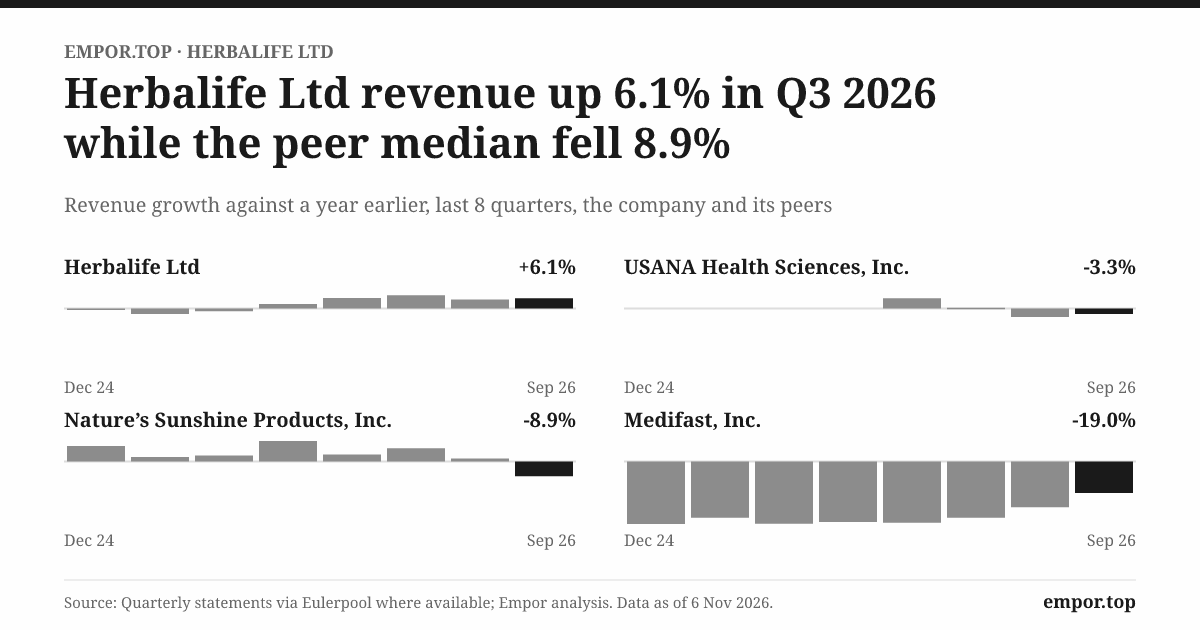
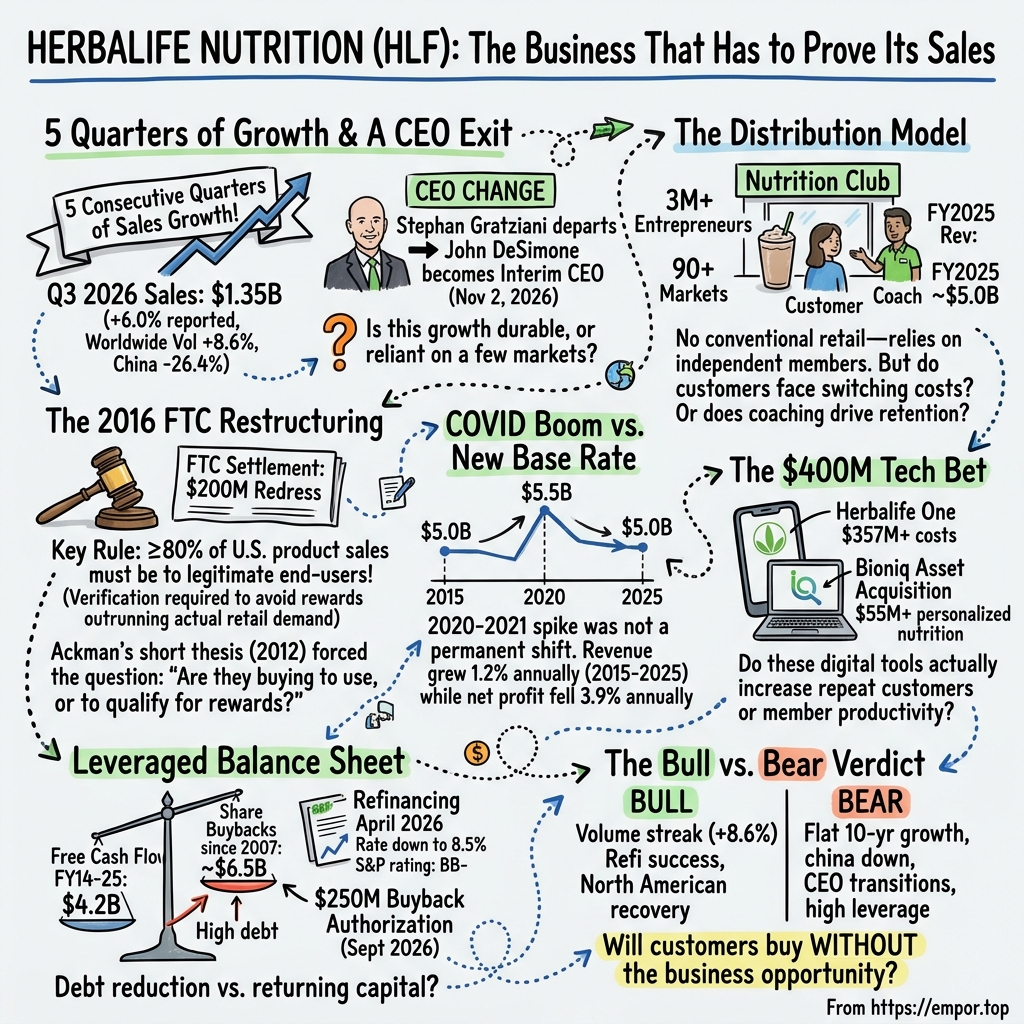
The awkward part was that the numbers DeSimone had to present were the best Herbalife had shown in years. Third-quarter net sales came to about $1.35 billion, up 6.0% on a reported basis and 7.6% once currency swings were stripped out.2 It was the fifth consecutive quarter in which sales had grown against the year before.2 Worldwide volume, the measure Herbalife uses to count how much product actually moved through its network rather than what it was priced at, rose 8.6%.2 Operating profit climbed about 13% from a year earlier, and the operating margin moved back above 10%.1 Usually a CEO leaves a company when the numbers stop working. Here the numbers had started working, and the CEO left anyway.
That contradiction is the right place to start, because the five-quarter streak sits on top of a decade in which Herbalife barely grew at all. Revenue rose about 1.2% a year from 2015 to 2025, and net profit fell about 3.9% a year over the same stretch.34 A company with operations in more than 90 markets and a global sales force numbering in the millions finished 2025 with sales of roughly $5.0 billion, about where it stood in 2014.3 So the question on the call was not whether the latest quarter was good. It plainly was. The question was whether a fifteen-month run is long enough, and broad enough, to change a ten-year story.
There were reasons to be careful. The same quarter that delivered 8.6% volume growth also showed China, once one of the company's great growth engines, with sales down 26.4% in local currency.2 When a company's consolidated number improves while one of its biggest historical markets shrinks by a quarter, the growth is coming from somewhere specific, and specific growth can reverse. The leadership change added a second layer of doubt. Investors could reasonably ask whether a recovery that began under one CEO would survive the transition to an interim one, with a brand-new CFO at his side.
It helps to be precise about what Herbalife is. The listed company is Herbalife Ltd., incorporated in the Cayman Islands and traded on the New York Stock Exchange under the ticker HLF; the "Herbalife Nutrition" name is the brand the company has long used.3 It owns the operating subsidiaries that make, buy, warehouse and ship the shakes, teas, supplements and skin-care products. It does not employ the people who sell them. Those sellers are independent Members, who buy product from the company, use it, sell it to others, and in some cases recruit other Members and earn compensation under the company's Marketing Plan.3 Herbalife employed about 8,500 people at the end of 2025.3 The Member network is many hundreds of times larger, and it is not on the payroll.
That distinction is the hinge on which the whole company swings. A conventional consumer brand sells to a retailer, and the retailer sells to a shopper. Herbalife sells to Members, and the Members sell to themselves, to their customers, and in some cases to the people they bring into the business. Every dollar of reported revenue is therefore a claim that somebody, somewhere, wanted the product. For most of its history, the market has argued about how true that claim is.
The stakes for an investor follow directly. If the Member network is converting into repeat consumer demand, Herbalife is a global nutrition brand with an unusual and hard-to-copy route to market, generating large amounts of cash. That cash could finally shrink a debt load built up over years of share buybacks. If the network is instead a machine that needs constant recruiting to keep its volume up, the recent growth is a cyclical upswing in a business that has repeatedly failed to hold its gains, and the cash it throws off is better used to pay lenders than to repurchase stock.
Every product line, every market and every technology bet in the story that follows has to clear the same bar. People have to keep buying the products, whether or not they are also chasing the promise of a business opportunity. To see why that bar is both Herbalife's foundation and its hardest test, the place to start is not a boardroom or a trading floor. It is a small room with a blender in it.
 Subscribe on LinkedIn
II. A Shake, a Coach, and a Distribution Network
Picture a storefront on a side street, a converted shop with a few tables and a counter. Inside, a Herbalife Member mixes a protein shake, pours a cup of aloe drink and tea, and hands them to a customer who came in on a friend's recommendation. There is no checkout aisle and no shelf of competing brands. There is a conversation about weight, energy, breakfast habits and goals, and a weigh-in for those who want one. Herbalife calls these places nutrition clubs, and in the company's telling they are the modern form of a sales channel that began in 1980, when founder Mark Hughes started selling a weight-management shake in Los Angeles.5
The club is a good way to see what Herbalife actually sells. On the shelf, so to speak, are products in weight management, targeted nutrition, energy, sports and fitness, and what the company calls outer nutrition, meaning skin and personal care.3 Its signature item remains the Formula 1 meal-replacement shake, the direct descendant of Hughes's original product. Behind the counter is the thing a supermarket cannot easily replicate: a person who knows the customer's name, checks in on their progress and offers what the company describes as coaching. In 2025, the company says more than 3 million entrepreneurs used its platform.32
The transaction underneath is simple, and its simplicity matters. The unit of sale is an order: a canister of shake mix, a box of tea, a bottle of supplements. There is no subscription term, no seat licence, no contracted minimum purchase, and the company reports no figure for contracted recurring revenue.3 A customer who stops coming to the club simply stops buying. Nothing in the filings binds them to return.
That arrangement folds two propositions into one company: nutrition products supported by personal coaching, and a business opportunity built around Member sales and recruitment.3 The two can reinforce each other. A satisfied customer becomes a Member to get a discount, then opens a club, then recruits others. They can also pull against each other. A Member chasing a higher rank may buy more product than their customers consume, and a network whose energy depends on recruitment can grow quickly and shrink just as quickly.
The 3 million figure deserves respect and scrutiny in equal measure. It is a measure of reach that few consumer companies can match without owning a single store. It is not, however, a count of active repeat customers, and Herbalife does not publish one.3 Millions of people with access to a platform is a statement about the size of the sales force. It says nothing about how many people drink a shake every morning for a year, which is the number that would actually tell an investor whether the business has a loyal customer base.
What moves the reported top line, then, is a set of interacting forces rather than a contract book. Recruitment adds Members; productivity determines how much each one sells; repeat purchases determine whether those sales recur; pricing and the mix of products and countries change the value of each unit; and currency translation changes what those local-currency sales are worth in dollars.3 In 2025, for example, the company's sales growth came more from pricing than from volume, while volume overall was nearly flat and China volume fell about 10.6%.3 The improvement since then has a different texture, with volume leading. That distinction, between growth from selling more and growth from charging more, will come up again, because it is the single most useful clue to whether the network is healthy.
The competition reaches well beyond other direct sellers. Among publicly listed companies, Nu Skin and USANA are the closest comparisons: both sell nutrition and personal-care products through independent distributors, and both are considerably smaller than Herbalife. But the bigger contest is for the same consumer's breakfast and gym bag. Mass-market protein and meal-replacement brands sit on supermarket shelves, direct-to-consumer supplement companies sell online with subscription discounts, and e-commerce platforms put dozens of alternatives one click away. Herbalife itself lists competition from these channels, and from e-commerce in particular, as a risk to its business.3 It does not publish a market share for its categories, and none should be implied.
So what does the network actually give Herbalife that a shopper cannot get elsewhere? The strongest honest answer is personal attention and local access. A club in a neighborhood without a well-stocked health store, or a coach who keeps a customer accountable, offers something a search result does not. That can be a genuine reason to buy. The weaker point is proof. Herbalife discloses no customer-retention rate, no repeat-purchase rate and no evidence that coached customers stay longer than customers of rival brands. Members can also sell competing products, and consumers can switch at the next order.3 The network is a real distribution asset. Whether it is a moat, something that keeps competitors out and customers in, is a separate claim, and the company's own disclosure does not yet establish it.
There is a reason Herbalife's business has been examined so closely, and it has to do with that second proposition, the business opportunity. For years, critics argued that the opportunity was the real product and the shakes were the excuse. In 2016 a federal regulator forced the question into a legal document.
III. The FTC Order Changed What a Sale Had to Mean
On July 15, 2016, the Federal Trade Commission announced that Herbalife had agreed to restructure its U.S. business and pay $200 million to compensate consumers.6 The announcement was unusual in both tone and content. The agency did not simply impose a fine and move on. It rewrote, in effect, how a Herbalife distributor in the United States could earn money, and it put an independent compliance auditor in place to check the work.6 For a company whose survival had been publicly questioned for three and a half years, the settlement was both a relief and a constraint that would last far longer than the headlines.
The fight had begun in December 2012, when Bill Ackman, the activist investor who runs Pershing Square, unveiled a short position in Herbalife of more than 20 million shares and presented a marathon case arguing that the company was a pyramid scheme.7 His thesis was that distributors earned their money primarily from recruiting other distributors rather than from selling products to real consumers, and that most participants lost money. It was a dramatic public bet, and it turned the stock into a battlefield. Other well-known investors took the opposite side, Herbalife's management fought back, and the share price swung violently as each side released research. The underlying dispute, however, was never really about personalities. It was about a definition: who is a customer, who is a recruit, and how much of Herbalife's sales were reaching people who actually consumed the products.
The FTC's complaint gave that dispute legal form. The agency alleged that Herbalife had deceived consumers into believing they could earn substantial income, and that its compensation structure was unfair because it rewarded distributors for recruiting and for buying product rather than for retail sales to real customers.6 Those were allegations. The outcome was a settlement, not a court ruling, and it is important to keep the two apart. The order required changes and redress; it did not include a judicial finding that Herbalife was a pyramid scheme.6 Both sides could therefore claim something. The FTC got structural reform and $200 million for consumers. Herbalife kept operating in the U.S. without the label its fiercest critic had tried to attach.
The mechanism of the order is worth explaining in plain terms, because it is the closest thing the company has to an external test of demand. Think of the old system as paying a salesperson on how much stock their team ordered. The new system pays them, in large part, on how much their team sold to people outside the business. Under the order, at least two-thirds of the rewards paid to U.S. distributors must be based on retail sales that are tracked and verified, and at least 80% of Herbalife's U.S. product sales must be to legitimate end users for the company to keep paying compensation at its existing levels.6 Sales have to be documented, customers have to be identifiable, and an independent auditor checks compliance.6 In effect, the order converts the abstract question of whether demand is real into a recurring paperwork requirement.
That requirement did not fade with the news cycle. Herbalife continues to operate its U.S. business under the order and reported that it met its annual 2025 requirement.3 Compliance is not free. Tracking and verifying sales costs money, and it changes how Members behave: a distributor who cannot be rewarded for inventory loading has less incentive to load inventory. Seen from an investor's chair, the settlement removed the most extreme tail risk, a regulator shutting the U.S. business down, and replaced it with an ongoing operating discipline in the company's home market.
There was a second regulatory chapter that shows the scrutiny was not limited to the United States. In 2019 the Securities and Exchange Commission found that Herbalife had made misleading disclosures to investors about its business model in China, where direct selling is tightly regulated and the company operated under a different structure, and Herbalife agreed to pay a penalty of $20 million.8 China was then a market Herbalife pointed to as a source of growth. Its later decline, which the recent numbers still show, makes that history more than a footnote: it is a reminder that the company's description of how a market works and how that market actually works have, at least once, diverged in a way a regulator found material.
What the FTC order did not do is just as important as what it did. It addressed the risk that rewards could outrun retail demand in the United States, and Herbalife says it complies. But meeting the order's thresholds does not by itself prove that demand is independent of Member incentives. A Member who buys product for personal consumption counts, under the order's framework, as a legitimate end user; that is reasonable, since many people join to get a discount on products they use. It also means that some portion of what counts as end-user demand comes from people who are, or were, inside the network. And the order governs only the U.S., which is a minority of the company's sales. The rest of the world operates under local laws and Herbalife's own policies.3
The episode sharpens the central proof question rather than settling it. What evidence would show that Members and their customers buy the products to use them, not to qualify for a higher position or earn rewards? The best evidence would be published rates of customer retention and repeat purchase, a breakdown of sales between Members and outside customers, and volume that holds up when recruiting slows. Herbalife publishes volume. It does not publish the rest. So the investor is left reading volume trends for signs of durable demand, and the most dramatic reading of those trends came four years after the FTC settlement, when a pandemic sent the whole world looking for ways to eat better at home.
IV. The 2020 Boom Did Not Become a New Base Rate
In 2020 Herbalife had the kind of year a direct seller dreams of. People were stuck at home, worried about their health, short of income and eager for something to do. A business that combined nutrition products with a home-based earning opportunity, delivered through social networks and increasingly through phones, fitted the moment. Sales rose about 14% to roughly $5.5 billion, and they grew again in 2021 to about $5.8 billion, the highest level in the company's history.3 Operating profit reached about $734 million in 2021, and the operating margin stood near 12.7%.3
Then the tide went out. In 2022 sales fell about 10%, back to roughly $5.2 billion, and they kept slipping in 2023 and 2024.3 By 2025 revenue was about $5.0 billion, below the 2020 level and well below the 2021 peak.3 The pandemic did not reset the company's growth rate. It borrowed demand from the future, or, more precisely, it brought in a wave of Members and customers who did not all stay once normal life resumed.
The longer view makes the point even more clearly. In 2015 Herbalife's sales had fallen sharply, which the company attributed mainly to a strong U.S. dollar shrinking the value of foreign sales and to lower volume.4 Sales were only modestly higher by 2025.34 The profit picture is worse. Operating profit was about $584 million in 2015 and about $442 million in 2025.34 The company sold a little more and kept noticeably less of it.
Why did the profit fall faster than the sales? Part of the answer is mix. Sales in markets and products with lower margins grew relative to those with higher margins, and China, historically among the more profitable regions, shrank. Part is cost: a company that invests in new technology, pays to comply with regulatory requirements in many countries and absorbs inflation in ingredients, freight and labor needs volume growth to cover those costs, and Herbalife did not get it. And part is currency. Herbalife earns in dozens of local currencies but buys most of its products and ingredients in U.S. dollars, so a strong dollar squeezes both the reported sales line and the gross margin at the same time.3 Operating margin fell from about 13% in 2015 to about 8.8% in 2025.3
Against that history, the recent streak looks different in kind, not just in degree. Through 2025, pricing did more of the work; the 2026 quarters are better evidence because volume led.32 That is the right kind of growth. It is also only a few quarters old.
The geography of the recovery is where an investor should look hardest. In the third quarter, management credited strength in several regions, including improved North American sales and strong momentum in India and Latin America, while China sales fell sharply again.2 That pattern describes a recovery that is real but concentrated. Herbalife's history is full of markets that boomed and then cooled: in the 2010s China was the growth story; during the pandemic several regions surged together; now India is often the market management highlights. A company with a broad-based recovery would show volume growth across most of its regions at once. A company riding a few hot markets would show what Herbalife's latest quarter shows, which is strong aggregate growth with a large region in steep decline.
Management has described the period since 2023 as a transformation, with programs aimed at modernizing the Member experience, sharpening the product range and rebuilding the company's technology. Transformation language is cheap, and every company that has had a bad few years uses it. The way to hold it accountable is to ask what a successful transformation would look like in the numbers. It would show sales growth led by volume rather than price, in more regions than not; an operating margin climbing back toward the 12% to 13% range the company earned in its better years; and free cash flow that repeats from one year to the next without depending on favorable working-capital swings. The latest quarter shows the first sign, partially shows the second, and does not yet settle the third.
What the record does not yet establish is just as clear. It does not show a return to growth in China, where sales continued to fall steeply in the third quarter of 2026.32 And it does not show a broad-based, volume-led expansion that has survived a full year of comparisons against an improving base. Five quarters is a promising sequence. Herbalife had a promising sequence in 2020 and 2021 as well, and that one did not become the new normal.
If the past decade proved anything, it is that the network alone does not deliver steady growth. Management's answer has been to rebuild the tools the network uses, and that rebuild turned into one of the biggest bets in the company's recent history.
V. The Member Platform Became a $400 Million Technology Bet
Every direct-selling company eventually discovers that its distributors are running a small business on whatever tools the company gives them. For decades at Herbalife those tools were order forms, phone calls, spreadsheets and a patchwork of regional websites and back-office systems built for different countries at different times. A Member in one market might place orders, track their team's volume and check their compensation through systems that looked and worked nothing like those used by a Member a border away. In 2022 Herbalife set out to replace that patchwork with a single platform it called Herbalife One, a multi-year rebuild of the technology Members use to manage customers, place orders, run their businesses and present the brand online.3
The size of the bet is easiest to grasp in round numbers. By the end of 2025 Herbalife had incurred roughly $357 million of implementation costs on the program, and about $43 million of Herbalife One costs ran through its 2025 accounts alone.3 Much of the spending was capitalized, which means it was recorded as an asset on the balance sheet rather than charged against profit as it happened, and is then expensed gradually through amortization once the systems go live.3 That accounting matters for anyone reading the income statement. During the build, a large share of the cost stayed off the profit line. As the platform moves from implementation into use, those costs start arriving as non-cash amortization charges, a drag on reported earnings that has nothing to do with how many shakes are sold this quarter. Spending on the program continued into 2026: in the first nine months, Herbalife capitalized or prepaid another $32.5 million of software-implementation costs, on top of about $40 million of conventional capital expenditure.1
To put the bet in proportion, consider that Herbalife reports its research and development spending as not material and does not disclose a figure.3 Ordinary capital expenditure in 2025 was about $80 million, roughly 1.6% of sales.3 Against those small numbers, a program that cost several hundred million dollars over four years is the largest single strategic investment the company has made in a long time. It is a statement that management believes the network's future depends on software.
The logic is reasonable. A Member with better tools should be able to serve more customers, follow up more consistently, place orders more easily and spend less time on administration. Customers who can reorder from a phone, see a personalized plan or chat with their coach are, in principle, more likely to come back. The problem is that a technology rollout is not revenue. The proof that matters is whether the tools increase the number of active customers, raise each Member's productivity, improve retention or lift order frequency. Herbalife reports none of those metrics directly. The best available evidence is indirect: volume has been growing since the platform began rolling out more widely, and management attributes part of that improvement to better Member tools.2 That is plausible. It is not yet proof, because a dozen other factors, from pricing to promotional events to the recovery of specific countries, also moved volume in the same period.
The second half of the technology bet is personalization, and it arrived through acquisitions. In 2025 Herbalife bought the assets of three small companies, Pruvit, Pro2col and Link BioSciences, for an aggregate consideration of about $25.5 million.3 These are capability additions rather than a new business line, a mix of personalization know-how, software and, in Pruvit's case, a ketone-based product range. None is large enough to change the shape of the company's segment results.
The bigger move came in 2026. In March, Herbalife announced it would acquire the core assets of Bioniq, a London-founded personalized-supplement company that formulates daily nutrient blends based on a customer's blood tests and health data.9 The deal closed in April.10 The structure was cautious. Herbalife agreed to pay base consideration of $55 million spread over five years, plus up to $95 million in additional contingent payments if sales milestones are met.1011 Bloomberg Law reported the transaction as a purchase of assets rather than of the whole company, a structure that let Herbalife choose what it took on and pay over time.11
That structure deserves a fair reading. Paying most of the potential price only if sales materialize limits the downside: if Bioniq's products do not sell through Herbalife's network, the company will not owe the full $150 million. It is a sensible way to buy an option. But the contingent payments are a measure of what the deal could cost, not evidence of what it will earn. On the third-quarter call, management said that fewer than 50,000 units of the Bioniq-based product had been sold since its launch.2 For a company that sells billions of dollars of product a year, that is a test batch. It may become something bigger. For now it is optionality, and it should be valued as such.
Herbalife's own history offers a useful benchmark for how to judge these bets. The company has launched many new product lines, digital programs and country expansions over the years, and the ones that mattered were the ones that eventually showed up in volume and in segment sales. The rest faded quietly. The right way to judge Herbalife One and the personalization acquisitions is the same: compare what was spent and what milestones were promised with the revenue and volume that actually followed, and revisit the comparison over several reporting periods rather than one. If, two years from now, Bioniq is still a footnote and Member productivity has not visibly improved beyond the pre-platform trend, the program will have been a costly rebuild of the existing channel. If volume per Member and repeat ordering rise in the markets where the platform is fully live, it will have been the investment that made the network fit for a digital age.
The platform matters most in the place where Herbalife's selling actually happens. That place, increasingly, is the nutrition club, and the club is also the best test of whether the network is a moat or simply a storefront.
VI. A Network Can Be the Storefront, but Is It the Moat?
Walk back into the club on the side street, but this time look at it as a competitor would. In the United States, nutrition clubs generated 42% of Herbalife's sales volume in the third quarter of 2026, and management said club productivity rose more than 10% from a year earlier.2 The club is no longer a quirky add-on to the business; in the company's home market it is close to half of U.S. sales volume. A rival brand that wanted to reach the same customer would need to persuade the club operator to stock its products, or build its own network of clubs, or win the customer through a supermarket shelf, a gym, a subscription website or an online marketplace. Each of those routes exists. The question is how much the club protects Herbalife against them.
Michael Porter's framework for industry forces is a useful way to locate the pressure. Start with buyers. Herbalife has no dominant customer; no single buyer accounts for a material share of consolidated sales, and receivables are spread mostly across credit-card companies and a limited number of importers.3 That means no Walmart can squeeze its terms. But the real buyer is the end consumer, and that consumer can switch brands and channels at the next purchase with almost no cost. Buyer power in the conventional sense is low; consumer choice is high. The threat of substitutes is the strongest force in the industry. A protein shake from a grocery store, a meal-replacement subscription, a weight-loss drug or simply a change of diet all compete for the same goal, and Herbalife itself identifies competition from other channels, and e-commerce in particular, as a risk.3
The supply side is more manageable. Herbalife manufactures a substantial share of its products in its own facilities and buys ingredients from multiple suppliers, but most supplier purchases are priced in U.S. dollars, so input costs and currency together can squeeze gross margins.3 Supplier power is moderate. Rivalry among existing competitors is intense but fragmented: Nu Skin and USANA are the closest listed direct sellers, while the bigger fight is with branded consumer-goods companies and online nutrition sellers. The threat of new entrants is real for the product, since a new protein brand can launch online in months, and much lower for the distribution system, since building a global network of millions of independent sellers would take decades. Overlaying everything is regulation, which in this industry functions almost as a sixth force: the FTC order in the United States, direct-selling rules in China and consumer-protection laws elsewhere can reshape the incentives that hold the network together.
Hamilton Helmer's "7 Powers" framework asks a sharper question: what, if anything, lets Herbalife earn better returns than rivals over long periods? Several of the powers can be ruled out or set aside quickly. There is no disclosed evidence of a cornered resource, such as a proprietary ingredient or exclusive licence that rivals cannot obtain. Switching costs appear low: consumers can stop buying at the next order, and Members are free to sell competing products.3 Counter-positioning, where an incumbent cannot copy a newcomer's model without damaging its own business, has arguably worked against Herbalife as often as for it, since online sellers built direct relationships with consumers without carrying the cost of a distributor compensation plan.
Two powers are worth taking seriously. The first is scale economies. Herbalife's size gives it buying power, its own manufacturing, and a global infrastructure of warehouses, regulatory registrations and compliance systems in more than 90 markets that a small rival would struggle to fund.3 The second is a form of network effect. A Member with a team, a club and loyal customers has built something that is tied to the Herbalife brand and compensation plan; leaving means starting over. More Members in a city can mean more clubs, more visibility and more referrals. This is not a network effect in the strict sense, where each new user makes the product better for every other user, but it is a real form of local density.
The strongest case for the network is that clubs create a social reason to keep coming back that a website cannot replicate. The club in a neighborhood is a storefront, a community center and a sales force at once, and Herbalife pays for it mostly through variable compensation linked to sales rather than rent and salaries. That is a genuinely different cost structure from a retail brand's.
The stress test is the same disclosure gap, extended to price sensitivity and comparable sales productivity across the network.3 The 42% club share and the 10% productivity increase are encouraging, but they cover one market and come from the company's own call rather than its audited statements.2 The company's margins also tell a cautionary tale. A business with durable pricing power and a cost advantage would expect its operating margin to hold up through a full cycle. Herbalife's fell from about 13% in its better years to 8.8% in 2025.3 That is not what a powerful moat usually looks like.
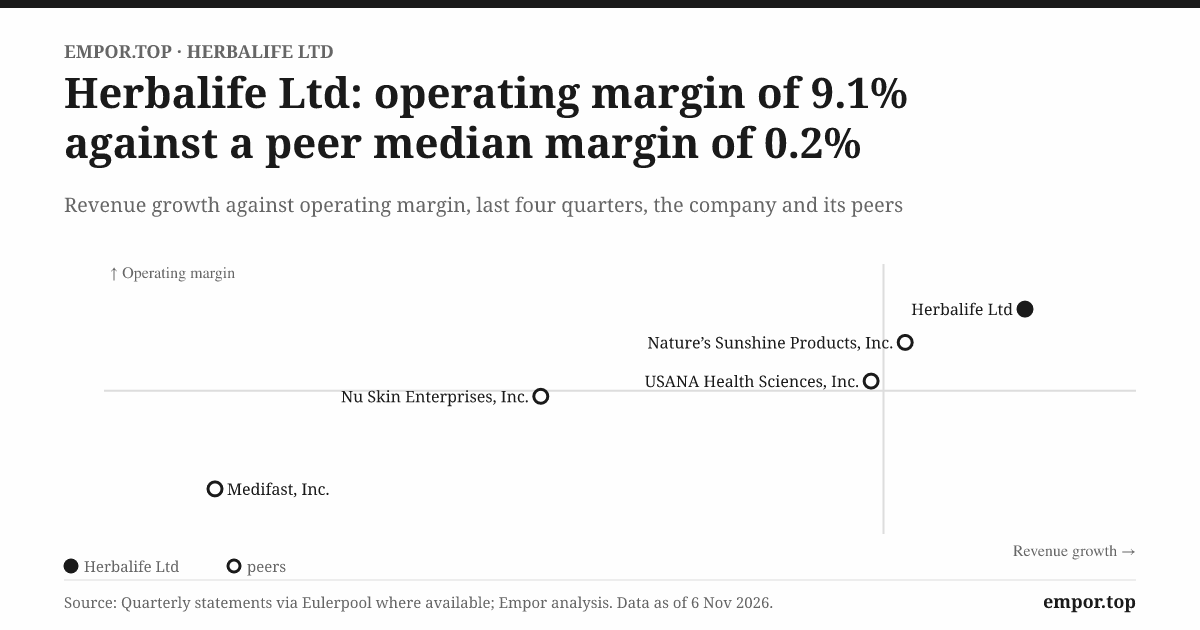
The peer comparison is consistent with that verdict. Nu Skin and USANA, the closest listed analogues, have also struggled with slowing growth in recent years, which suggests the pressure on the direct-selling model is industry-wide rather than unique to Herbalife. Herbalife's advantage over those peers is scale: it is the largest of the three by a wide margin. Its advantage over the broader nutrition market is less certain. There is no disclosed market share, and broad category estimates for the global nutrition market say little about whether Herbalife is winning or losing customers within it.
Weighing all this, the history narrows the moat claim to a smaller version. Herbalife's network is a real route to market, with clubs, Member relationships and global infrastructure as concrete assets that would be expensive to replicate. The available evidence does not establish customer loyalty, pricing power or a durable cost advantage. The moat is plausible but unproven. The indicator that would confirm or reject it is the one management is now emphasizing: if club productivity and regional volume keep rising for several more quarters, especially while prices are not being pushed higher, the network is showing the kind of resilience a moat implies. If volume fades as soon as the pricing and promotional tailwinds do, the network is a channel, and channels can be competed away.
A business with a real but unproven advantage needs a balance sheet that can withstand the bad years. Herbalife's balance sheet was shaped by a different priority.
VII. The Buyback Machine Left a Debt-Shaped Balance Sheet
In September 2026 Herbalife's board approved a new $250 million share-repurchase program, to run for three years.1 On the surface it was an ordinary announcement. Companies that generate cash routinely return some of it to shareholders. But this one arrived only a few months after Herbalife had refinanced its debt at considerable cost, and it came from a company with negative shareholders' equity, a credit rating below investment grade and a long history of borrowing to buy back stock. For anyone who knew that history, the authorization was less a routine signal than a test.
Start with what the business has produced. From 2014 through 2025, Herbalife generated about $5.6 billion of cash from operations, comfortably more than the roughly $3.5 billion of net profit it reported over the same period.3 After capital expenditure, free cash flow totalled about $4.2 billion.3 That is a lot of cash for a company that today has a market value of around $1.6 billion. Yet at the end of 2025 Herbalife held only about $353 million of cash, down by roughly $620 million from where it had been at the end of 2013.3 Over the same span it paid only $30 million of cash dividends, all of them in 2014.3 So where did more than $4 billion of free cash flow go?
Most of it went into the company's own shares. Herbalife says it has repurchased about $6.5 billion of stock since 2007, and it says its debt arose primarily from those repurchase programs rather than from funding normal operations.3 That is a candid admission, and it explains the shape of the balance sheet. When a company spends more on buybacks than it earns, the difference has to be borrowed, and when cumulative buybacks exceed the equity investors originally contributed plus retained profit, shareholders' equity turns negative. Herbalife's equity has been negative in most years since 2014, reaching about minus $1.4 billion in 2021 before improving to around minus $515 million in 2025.3 Borrowings peaked around $3.0 billion in 2021.3
Negative equity is not in itself a sign of distress. Some highly profitable companies, from restaurant franchisors to software firms, run with negative book value because they have returned more capital than they retained. The risk lies in pairing that structure with a business whose earnings are volatile. When Herbalife's operating profit fell from more than $700 million in 2021 to about $356 million in 2023, the debt did not fall with it.3 Leverage, measured as debt relative to earnings, rose sharply, and the cost of borrowing followed.
The company responded by stopping the buybacks. It made no open-market repurchases in 2024 or 2025, and cash went instead to paying down debt.3 Borrowings fell from about $3.0 billion at the end of 2021 to about $2.3 billion at the end of 2025.3 That progress was recognized by the credit agencies. Moody's revised its outlook to stable in March 2025, citing improved free cash flow and deleveraging while still flagging the risks of direct selling, recruitment and competition.12 In February 2026 S&P upgraded Herbalife's credit rating to BB- from B+, citing better operating trends and debt reduction, and noting the company's target of reducing gross debt to $1.4 billion by 2028.13 S&P still regarded leverage and business-model volatility as material risks.13
The April 2026 refinancing was the next step. Herbalife replaced high-cost secured debt with $800 million of new secured notes due 2033 and a new credit facility.101 The transactions lowered borrowing costs: the reported weighted-average interest rate on the company's credit facility fell from about 11.6% at the end of 2025 to 8.5% by September 2026.13 The refinancing also had a price. Retiring the old debt early produced a loss on extinguishment of about $94.6 million in the second quarter, which pushed that quarter to a net loss.10
By September 30, 2026, Herbalife's debt stack looked like this in plain terms. There were $277.5 million of convertible notes due in 2028, $600 million of unsecured notes due in 2029, $800 million of the new secured notes due in 2033, and $272.2 million drawn under the new credit facility, made up of a $222.2 million term loan and a $50 million revolving credit balance.1 That adds up to roughly $1.95 billion of gross debt, meaningfully below where it had been. The covenants require total leverage of no more than four times earnings, first-lien net leverage of no more than 2.5 times, and fixed-charge coverage of at least two times; Herbalife reported compliance.1 About $330 million of the facility remained available.1
This is where the distinction between cash generation and cash availability matters. Herbalife's free cash flow, roughly $250 million in 2025, is real.3 But it has many claims on it before it can be called excess. Interest payments come first, and on nearly $2 billion of debt they are substantial even at lower rates. Capital spending and the Herbalife One program require cash. Acquisitions such as Bioniq require cash over several years, plus potential contingent payments. Required debt amortization requires cash. And working capital can swing in either direction from quarter to quarter.
On the third-quarter call, management reported net leverage of about 2.0 times.2 That figure needs to be reconciled with the gross-debt picture and with S&P's own forecast of about 2.9 times adjusted leverage for 2026.13 The difference is largely definitional: net leverage subtracts cash, and management's earnings measure adds back items that S&P may treat differently. Neither number is wrong, but an investor should read them as answers to different questions. The more useful test is simpler. Over the next year, how much debt principal does Herbalife actually repay, how much stock does it actually buy back, and does the first number stay larger than the second?
A skeptical long-short investor would frame the challenge bluntly. A company that has spent $6.5 billion on buybacks, ended up with negative equity and only recently earned its way back to a BB- rating should not be authorizing new repurchases until it has hit the debt target it gave the rating agencies. The counterargument is that at a share price of around $15, well below its 52-week high, repurchases may be a better use of cash than paying down debt that now carries a lower rate. Both arguments are defensible. What the history rules out is the assumption that management will automatically prioritize the balance sheet. In past cycles, when cash was abundant, buybacks won.
Whether that pattern repeats will be decided by the people now running the company, and the leadership roster changed abruptly just as the refinancing settled in.
VIII. The Recovery Has a New CEO Before It Has a New Base Rate
Stephan Gratziani's rise to the top of Herbalife was the kind of story the company liked to tell about itself. He had been a Herbalife distributor for decades, building a large network before joining management, becoming president in 2023 and then chief executive in May 2025.14 He was the first Herbalife chief executive to have come up through the distributor ranks. To Members, his appointment was a signal that the company understood the people who actually sold its products. To investors, it was a bet that a leader who had lived the Marketing Plan could revive the network's energy. Eighteen months later, he was gone.1
The handoff happened quickly. On October 29, 2026, the board appointed John DeSimone interim CEO effective November 1, and moved Scott Schaefer's start date as CFO forward to the same day.1 The company has not appointed a permanent CEO. In the space of a few weeks, Herbalife's top two financial and operating roles had changed hands, while the executive chairman, Michael Johnson, remained in place.
Johnson is the constant in this story. A former senior Walt Disney executive, he joined Herbalife as CEO in 2003, the year after private-equity firms had bought the company following Mark Hughes's death, and led it through its return to public markets in 2004.145 He stepped back to executive chairman in 2017, returned to run the company again in 2022 after the CEOs who followed him had come and gone, and then handed the job to Gratziani.14 DeSimone has his own long history with the company. He served for years as CFO and in other senior roles, left, and returned as CFO in March 2024.14 His 2025 salary was only about $2,400, under an arrangement intended mainly to provide health benefits, which suggests that his return was driven less by cash compensation than by equity and commitment to the company.14 Few interim CEOs know the business's finances in as much detail.
His interim package is substantial. DeSimone will receive a salary of $1.1 million, a target bonus of 160% of salary and equity awards valued at about $9.04 million, part of which is tied to performance.1 The performance-based portion vests only if conditions set by the board are met, so a meaningful slice of the award depends on results delivered during his tenure rather than on simply occupying the chair.1 As of March 9, 2026, the proxy showed DeSimone with 1.21% beneficial ownership of the company.14 That figure deserves a caveat. Beneficial ownership in SEC filings includes shares underlying options or awards that are exercisable or will vest within 60 days, so it overstates the stake actually held outright. Even so, it is a meaningful position, and it aligns his interests with shareholders'. Gratziani was reported at 306,604 shares on the same basis.14
The broader pay picture is more contentious. In 2025 Johnson received total compensation of about $8.66 million and Gratziani about $7.38 million.14 Johnson's 2024 total was even higher, about $13.21 million.14 Over the same three years, net income was $142 million, $254 million and $228 million, and the ten-year trend in profit was downward.143 Pay at Herbalife has not moved in lockstep with earnings, and equity awards make up much of it.
Shareholders noticed. At the 2025 annual meeting, the advisory vote on executive pay received only about 51.5% support, a near-rejection by the standards of large U.S. companies, where most say-on-pay votes pass with more than 90%.15 In 2026 support recovered sharply: about 70.2 million votes for and 7.1 million against, roughly 90% of votes cast.16 Several things changed between the two votes. The board used its 2026 proxy to respond to the weak result, and the handover of the CEO role from Johnson to Gratziani meant the 2026 vote judged a different leadership structure.14 The shareholder base also shifted, with active holders such as Nantahala Capital steadily increasing their stakes through 2025.17 The recovery in support is a real improvement in governance. It does not erase the message of 2025, which was that a large share of investors considered pay out of line with performance.
Two related-party details are worth mentioning, because in a company built on distributor relationships, how the board handles them tells you something about trust. In 2025 Gratziani received $753,994 for suspending his distributorship when he became an executive, and relatives of a director earned about $1.26 million under the Marketing Plan.14 These amounts are tiny against $5 billion of revenue. The company's policy requires Audit Committee review of covered related-party transactions over $120,000, but treats payments like Gratziani's and certain director distributor earnings as pre-approved categories.14 That is not improper, but it means the most relevant transactions for a direct-selling company are approved as a class rather than examined case by case.
The earnings calls provide a credibility record of a different kind. Through 2026, management's prepared remarks kept returning to the same themes: growth led by volume rather than price, a recovering North America, momentum in India and Latin America, nutrition clubs, the new technology platform, and a falling debt burden.210 That consistency counts for something, because a narrative that changes every quarter is usually a sign that the previous one failed. China is where the story has been least satisfying. Management has acknowledged the decline in that market without offering a dated plan to reverse it, and by the third quarter sales there were still falling by about a quarter in local currency.2 The other weak point is the very thing an interim CEO cannot easily supply: a commitment that outlasts him. Strategy statements made by a leadership team in transition are only as durable as the next appointment.
The verdict on management is mixed rather than negative. DeSimone's knowledge of the company and his reported ownership give him a meaningful stake in the outcome, and the board moved quickly to avoid a leadership vacuum. But the rapid turnover in the CEO and CFO roles weakens the case for continuity. Herbalife has cycled through a succession of chief executives, permanent and interim, since 2017. A recovery that depends on consistency of execution now depends on a team that has not yet been assembled.
Leadership questions matter most when they affect how the numbers are reported and interpreted, and Herbalife's recent earnings have plenty of moving parts.
IX. When One Quarter's Profit Is Not the Whole Story
The second quarter of 2026 looked, on its face, like a disaster. Herbalife reported a pretax loss of about $3 million and a net loss of about $26 million, after a string of profitable quarters.10 A reader skimming the headline might have concluded that the recovery had stalled. In fact operating profit that quarter was about $128 million, close to the levels of the quarters around it.10 The loss came from below the operating line: the roughly $94.6 million charge for retiring old, expensive debt early as part of the April refinancing.10 Three months later, the September quarter showed operating profit up about 13% from a year earlier and net profit of about $57 million.1 The business had not swung from collapse to boom. The accounting had.
That episode is a small lesson in how to read Herbalife's results, and it applies across the whole recent record. Start with the operating line, because it is closest to the core business. Revenue recovered from its 2023 low, but operating profit in 2025, about $442 million, remained well below the roughly $734 million of 2021, and the operating margin of 8.8% was about four points below 2021's level.3 In the third quarter of 2026 the margin was back around 10.3%, which is real progress.1 It is still below where the company operated for most of the previous decade.
Reported net income is noisier still, for reasons that have little to do with how many shakes Herbalife sold. In 2024 the company recognized about $230 million of deferred-tax benefits, which flattered net income that year to roughly $254 million even though pretax profit was only about $169 million.3 The resulting tax rate, around minus 50%, is the kind of figure that tells you a one-time accounting item is at work rather than a change in the business.3 In 2025 net income of about $228 million was lower than 2024's despite higher pretax profit, simply because the tax benefit did not repeat.3 In 2026, the nine-month figures included the debt-extinguishment loss, restructuring charges and their own set of tax effects.1 Anyone comparing net income across these years without adjusting for those items will draw the wrong conclusion about the trend.
Cash flow tells a more flattering long-run story, with its own caveats. Over the twelve years from 2014 through 2025, cash from operations came to about 161% of net profit.3 Part of the gap is structural and healthy: depreciation and amortization, share-based compensation, non-cash interest and inventory write-downs are all expenses that reduce profit without consuming cash in the period. In 2025 those four items alone added back roughly $207 million.3 Part of it reflects the tax accounting swings just described, which inflate net income in some years without producing cash. And part of it is working capital, which can move either way. In 2025 rising receivables used about $20 million of cash; in the first nine months of 2026, favorable changes in operating assets and liabilities contributed about $27 million.31 The cumulative cash surplus is real cash generation. It is not proof that each year's earnings convert to cash at a steady rate, and the recent improvement in cash flow has had some help from timing.
Treasury and currency income are small enough to keep in proportion. Interest income in 2025 was about $8.5 million, against pretax profit of about $275 million, so Herbalife is not a company whose earnings depend on investment returns.3 Other operating income consisted mainly of small Chinese government grants, a few million dollars a year, which are not a recurring source of profit.3 Foreign-exchange transaction losses, about $14.5 million in 2025, were larger than interest income and reflect the company's structural mismatch between local-currency sales and dollar-denominated purchases.3 Herbalife hedges part of that exposure with short-term contracts, but the hedges smooth the swings rather than remove them.3
There is one category of risk that sits largely outside the income statement and deserves to be named. Herbalife is contesting a series of tax assessments in several countries. In Mexico, the tax authority has assessed about $24.3 million of value-added tax for 2019. In Brazil, there are assessments related to payments to Members and to state sales taxes, several of them tens of millions of dollars each. In India, there are value-added and service-tax assessments, plus income-tax assessments for several audit years that together run to more than $100 million.3 The company contests most of them and has not accrued them, because management judges that a loss is not probable.3 That is an accounting judgment, not a certainty. Brazil-related proceedings are supported by letters of credit, surety bonds and restricted cash.3 Outcomes may take years, and an adverse ruling in any of them would mean a cash cost the reported earnings do not currently reflect. PwC, the auditor, gave an unqualified opinion on the 2025 financial statements and on internal controls, with no material weakness reported.3
One small but useful indicator rounds out the picture. Debtor days, a measure of how long it takes to collect receivables, rose from about five in 2024 to about seven in 2025, and receivables climbed from about $92 million at year-end to about $117 million by September 2026.31 In absolute terms these numbers are tiny for a $5 billion business, because most sales are paid by credit card at the point of order and substantially all card receivables were current.3 Bad-debt expense was essentially zero in 2025.3 The rise is worth watching mainly because a growing share of receivables comes from importers in a limited number of countries, whose credit quality the company reviews on an ongoing basis.3
Put together, the evidence supports a measured conclusion. The improvement in operating performance during 2026 is visible and is not an accounting illusion. But annual net income remains heavily affected by tax and refinancing items, and recent cash flow has had some help from working capital. Several more quarters of margin and cash improvement, on a basis that strips out those items, are needed before the trend can be called established. That conclusion leads directly to the question every investor eventually asks: given all this, what is the market paying for?
X. Analysis & Bear vs. Bull Case
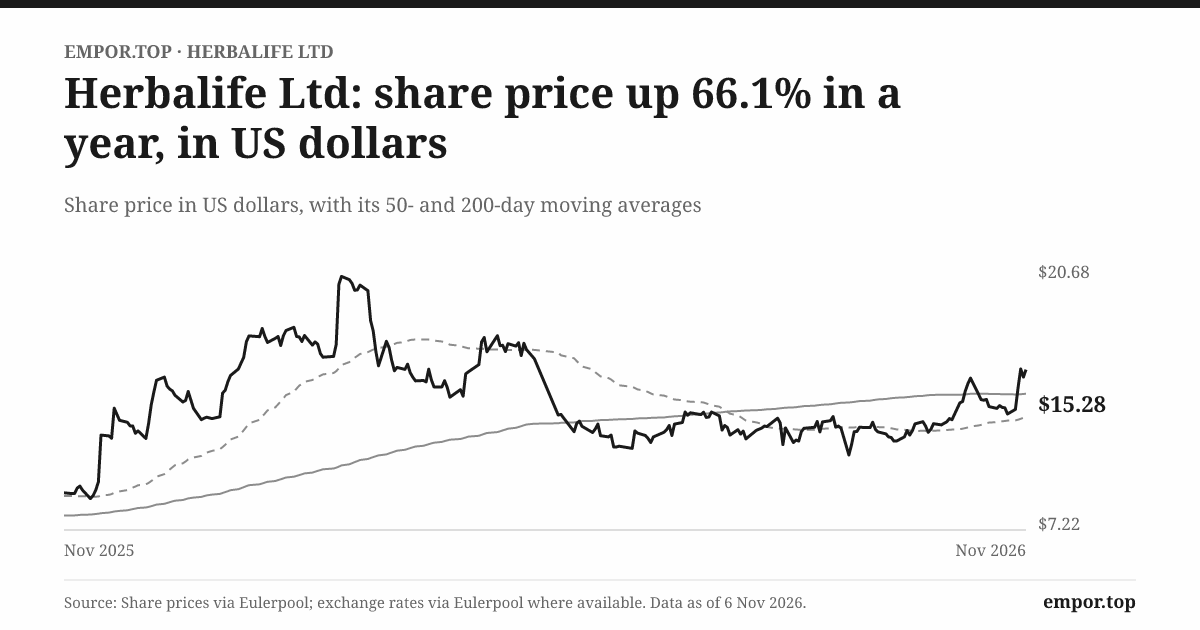
On November 6, 2026, Herbalife's shares closed at about $15.28.18 That price was roughly 23% below the stock's 52-week high of about $20 and well above its 52-week low of about $8.80.18 In other words, the market had already rewarded a good part of the recovery, then pulled back. At that price the company had a market value of about $1.6 billion and an enterprise value, including its debt net of cash, of about $3.3 billion.18 More than half of what an acquirer would pay for the whole business, in effect, belongs to lenders. That alone tells you how much the capital structure shapes the equity story.
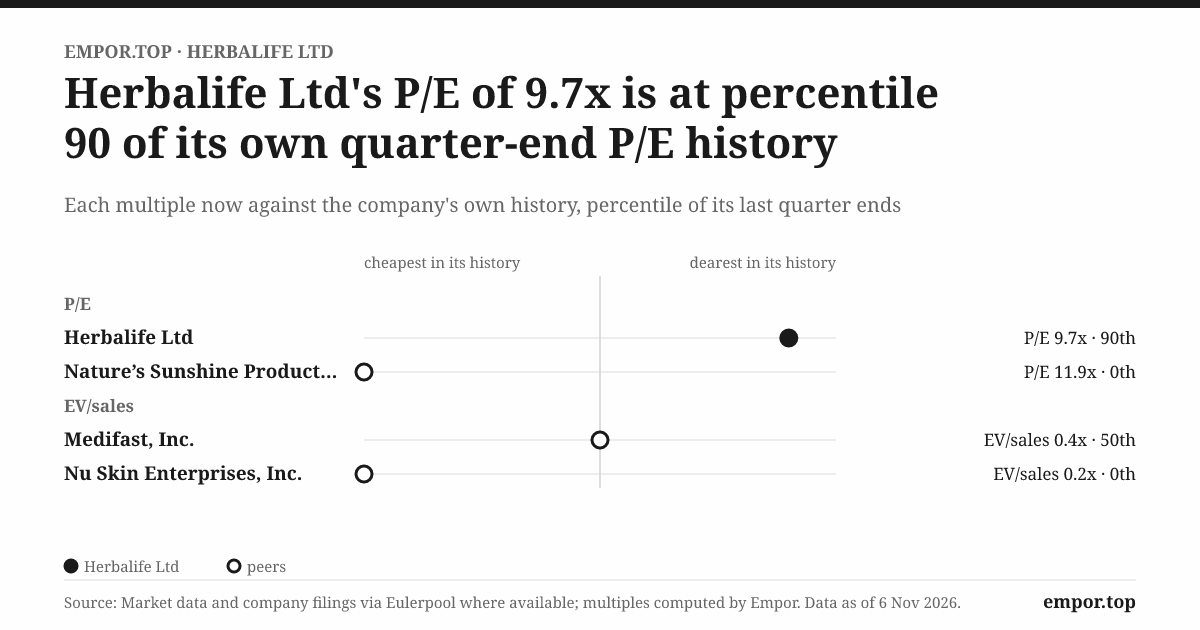
The headline multiples look modest. The shares traded at about 9.7 times trailing earnings, an earnings yield of roughly 10%, and about 6.1 times EBITDA.18 The free-cash-flow yield, at around 27%, looks extraordinary at first glance.18 But the most important comparison is with Herbalife's own history, and there the stock is not obviously cheap. Its five-year median price-to-earnings ratio is about 6.7 times, so at 9.7 times the market is valuing current earnings more generously than it has on average over that period.18 The reason is that trailing earnings were depressed by the second-quarter refinancing loss, so the multiple is inflated by a one-time item, and investors are partly looking through to a higher normalized level. Still, current earnings are below the company's earlier peaks, and the stock is priced as if the recovery will continue rather than as if the business is broken.
Comparisons with peers need care. A February 2026 comparison of public consumer companies showed Herbalife at about 6.0 times forward earnings, against about 7.0 times for Nu Skin and about 10.9 times for USANA, with Herbalife's enterprise value at about 0.55 times forward revenue against roughly 0.4 times for both peers.[^19] Those figures were measured at a different date, on forward estimates and in some cases on peer earnings that were negative or not meaningful, so they should not be compared directly with the November trailing multiple. What they do suggest is that the whole listed direct-selling group trades at low multiples, which is the market's verdict on the model's volatility, and that Herbalife does not stand out as unusually cheap within it.
The bull case is straightforward and has real evidence behind it. Five consecutive quarters of sales growth, led most recently by 8.6% volume growth, suggest the network has regained momentum.2 North American sales have improved, and nutrition clubs are becoming more productive.2 The April refinancing lowered borrowing costs, and the company's cash generation, sustained over more than a decade, gives it the means to keep reducing debt.13 Management's guidance for 2026, reported sales growth of about 4.9% to 5.9% and adjusted EBITDA of about $670 million to $690 million, implies that the recovery continues through the fourth quarter.2 If those trends hold, falling interest costs and rising operating profit would compound, and the equity, sitting on top of a shrinking debt pile, would capture most of the gain. That is the leverage effect working in shareholders' favor.
The bear case is equally coherent. A decade of low sales growth and declining profit is not erased by five good quarters. The business depends on Member productivity and recruitment, which have proven cyclical, and the 2020–2021 boom showed how quickly gains can reverse. China, once a major growth market, is shrinking fast. The CEO left after eighteen months, and the CFO role changed at the same time. The balance sheet still carries nearly $2 billion of debt and negative equity, and the board has just authorized a new buyback program. Contested tax assessments in several countries remain unaccrued. And none of the disclosures establish the customer loyalty or pricing power that would protect margins through the next downturn. In this reading, the stock's move off its lows already prices in more of the recovery than the evidence supports.
The question that separates the two cases is not whether the latest quarter was good. It is what kind of growth it was. If growth depends mainly on price increases, on a few strong countries or on temporarily favorable costs, the volume and margin trends will show it: volume will flatten as pricing slows, margin will compress as costs normalize, and the regional breakdown will narrow. If Member productivity is genuinely improving across the network, regional volume and club productivity should keep rising together, and the operating margin should keep moving toward the levels of the company's better years.
The risks worth tracking are tied to specific mechanisms rather than generic macro worries. Consumer demand and direct-selling regulation determine sales; a change in how regulators view distributor compensation in any major market could reshape incentives. The dollar affects both reported revenue and the cost of goods. Debt and covenants limit how much cash can go to shareholders. Tax disputes can create sudden cash costs. And the technology platform and acquisitions need commercial results to justify what has been spent on them.
Out of all the figures Herbalife reports, three are the ones that matter most. The first is year-over-year Member sales volume by region, which rose 8.6% worldwide in the third quarter while China declined sharply.2 The second is operating margin excluding identifiable one-off items, which stood at about 10.3% in the third quarter and 8.8% for 2025.13 The third is free cash flow after interest and capital spending, set alongside the amount of debt principal actually repaid; free cash flow was about $253 million in 2025, while gross debt has fallen to roughly $1.95 billion.31 If all three move in the right direction for another year, the recovery will have become a trend. If the first stalls while the second and third are propped up by cost cuts and working capital, the recovery will have been a cycle.
The central judgment is balanced, and should be. Herbalife's network is large, and its cash engine is real. Neither makes durable growth or a customer moat self-proving. The market, at current prices, is giving the company some benefit of the doubt, and the next few quarters will show whether that benefit was earned.
XI. Business & Investing Lessons
The story of Herbalife has been told for years as a morality tale, with heroes and villains depending on who was telling it. Stripped of the drama, it offers lessons that apply well beyond direct selling, and each of them is rooted in a specific moment.
The first lesson comes from the 2016 FTC order. Regulators did not ban Herbalife's model; they made it count its customers. The order required sales to legitimate end users and distributor rewards tied to verified retail sales.6 A decade later, the company still lives inside that requirement, and the numbers investors care about most, volume and club productivity, are still a way of asking the same question. A distributor network is an advantage only when customers keep showing up. Founders who build on a channel of independent sellers should expect to prove that, and investors should insist on seeing it, because a network that recruits faster than it retains is building its own reversal.
The second lesson comes from the buyback ledger. Herbalife's history of funding repurchases partly with debt left it with less cash and more leverage when profits fell.3 The lesson is that cash is not excess cash until the debt schedule says so. A buyback looks like discipline when the business is growing. When the business stalls, the same buyback shows up as leverage that constrains every choice that follows, and the new $250 million authorization is the next test of whether that lesson has been learned.1
The third lesson comes from the Herbalife One rollout and the Bioniq launch. After substantial investment in the platform and the personalized-nutrition acquisition, fewer than 50,000 Bioniq-based units had sold by the third quarter.3102 That is not a failure; it is early. But it illustrates a principle every operator knows and many forget in their investor presentations: a technology platform is a cost until it changes the customer's behavior. The measure of a digital transformation is not the go-live date. It is the repeat order.
The fourth lesson comes from the contrast between a five-quarter streak and a ten-year record. Herbalife's pandemic-era growth proved temporary.3 The latest recovery has stronger volume behind it and a different leadership team. It may well be different this time. But a recovery is a series, not a quarter, and the most dangerous moment for a cyclical business is the point at which it starts to believe its best year is its new base rate.
Those lessons are only useful if they help an investor judge what comes next, and the coming year is unusually full of moments that will provide answers.
XII. Epilogue
Tonight Herbalife stands at an unusual juncture. Its interim CEO has been in the job for a week. Its new CFO has been in his for the same week. The company has five consecutive quarters of sales growth behind it, management's 2026 guidance, which implies one more, a recently refinanced debt stack and a fresh $250 million buyback authorization, all of it still unused at the end of September.21 Each of those facts is a beginning rather than an ending, and the next twelve months will turn several of them into verdicts.
The first verdict will come on the leadership question. The board has to decide whether DeSimone becomes the permanent CEO or whether it looks elsewhere, inside or outside the distributor community. Either choice sends a signal. A permanent appointment of DeSimone would signal continuity and financial discipline from a leader who has seen the company through several cycles. An outside hire would signal that the board wants a new operating vision. A long search would signal uncertainty, at the very moment when the recovery needs consistency. Whatever the choice, the measure of the leadership team will be whether it keeps a consistent, measurable operating plan, one that names the volume, margin and debt targets and then reports against them.
The second verdict will come from the regional numbers. If China stabilizes, Herbalife's growth will have broadened, and the case for a durable recovery will strengthen considerably. If China keeps shrinking while India and Latin America carry the group, the recovery will remain concentrated, and concentrated recoveries are fragile. The fourth-quarter results, and then the first two quarters of 2027, will show whether volume growth extends across more regions or narrows to the strongest few.
The third verdict concerns Bioniq and the technology platform. Bioniq's sales, and whether it hits the milestones that trigger contingent payments, will be the most visible test of whether Herbalife can convert a personalization capability into revenue through its network. A milestone payment, oddly, would be good news, because it would mean the product was selling. The platform's success will show up more slowly, in Member productivity and repeat orders, if it shows up at all.
The fourth verdict concerns capital. Every quarter, Herbalife reports free cash flow, debt principal repaid and share repurchases. Read side by side, those three numbers will reveal whether management has internalized the lesson of the last cycle. If debt keeps falling toward the $1.4 billion target the company described to S&P while buybacks stay modest, the balance sheet will be on a path to resilience.13 If buybacks accelerate before the debt target is met, investors will be watching a familiar pattern replay.
Finally, the annual report for 2026, the next earnings calls and the 2027 say-on-pay vote will update the credibility score. Shareholders who nearly rejected the pay program in 2025 and endorsed it in 2026 will vote again under new leadership.1516 Their verdict will reflect not just the pay package but the board's handling of the transition.
The tension that remains is simple to state and hard to resolve. Herbalife has shown that its network can grow again. It has not yet shown that the growth will outlast the conditions that produced it, or that the cash it generates will go first to the lenders who are owed it.
XIII. Outro
Go back one last time to the club on the side street. The blender is running. A Member hands a shake across the counter to a customer who came in because a neighbor said it helped. The Member offers a check-in next week and maybe, if the customer seems interested, a conversation about becoming a Member too. That room is a storefront, a community and a recruiting office all at once, and it is a major sales channel for Herbalife.
It is also the place where the company's whole bargain with the market gets settled, one order at a time. The FTC order made that proof a legal requirement in the United States.6 The market makes Herbalife prove the same thing every quarter, in volume. Its network remains both the company's greatest asset and its hardest proof. The test that runs through its history is not how many people join. It is how many customers come back next week, and the week after that.
References
-
Q3 2026 Form 10-Q — Herbalife Ltd., 2026-11-02 ↩↩↩↩↩↩↩↩↩↩↩↩↩↩↩↩↩↩↩↩↩↩↩↩
-
Q3 2026 Earnings Call Transcript — Herbalife Ltd., 2026-11-02 ↩↩↩↩↩↩↩↩↩↩↩↩↩↩↩↩↩↩↩↩↩
-
2025 Form 10-K — Herbalife Ltd., 2026-02-18 ↩↩↩↩↩↩↩↩↩↩↩↩↩↩↩↩↩↩↩↩↩↩↩↩↩↩↩↩↩↩↩↩↩↩↩↩↩↩↩↩↩↩↩↩↩↩↩↩↩↩↩↩↩↩↩↩↩↩↩↩↩↩↩↩↩↩↩↩↩↩↩↩↩↩↩↩↩
-
Herbalife Will Restructure Its Multi-level Marketing Operations and Pay $200 Million for Consumer Redress — Federal Trade Commission, 2016-07-15 ↩↩↩↩↩↩↩↩
-
Herbalife Bulls Take On Short Ackman After Pyramid Claim — Bloomberg, 2012-12-21 ↩
-
SEC Order on Herbalife's China Disclosures — U.S. Securities and Exchange Commission, 2019-08-28 ↩
-
Herbalife to Expand Personalized Nutrition Through Planned Bioniq Acquisition — Herbalife Ltd., 2026-03-26 ↩
-
Herbalife to Buy Assets from Supplements Firm Bioniq for $55 Million — Bloomberg Law, 2026 ↩↩
-
Herbalife Outlook Upgraded to Stable, Ratings Affirmed by Moody's — Investing.com, 2025-03-06 ↩
-
S&P Upgrades Herbalife Rating on Stronger Operations — Investing.com, 2026-02-24 ↩↩↩↩
-
2026 Proxy Statement — Herbalife Ltd., 2026-03-17 ↩↩↩↩↩↩↩↩↩↩↩↩↩
-
2025 Annual Meeting Results, Form 8-K — Herbalife Ltd., 2025-04-25 ↩↩
-
2026 Annual Meeting Results, Form 8-K — Herbalife Ltd., 2026-05-06 ↩↩
-
Schedule 13G, Nantahala Capital Management — Herbalife Ltd., 2025-08-14 ↩
 LinkedIn
 WhatsApp
 Reddit
 Hacker News
 Email
 Kindle
 RSS Feed
 Spotify
 Apple Podcasts
 Amazon Music
 Audible
 YouTube