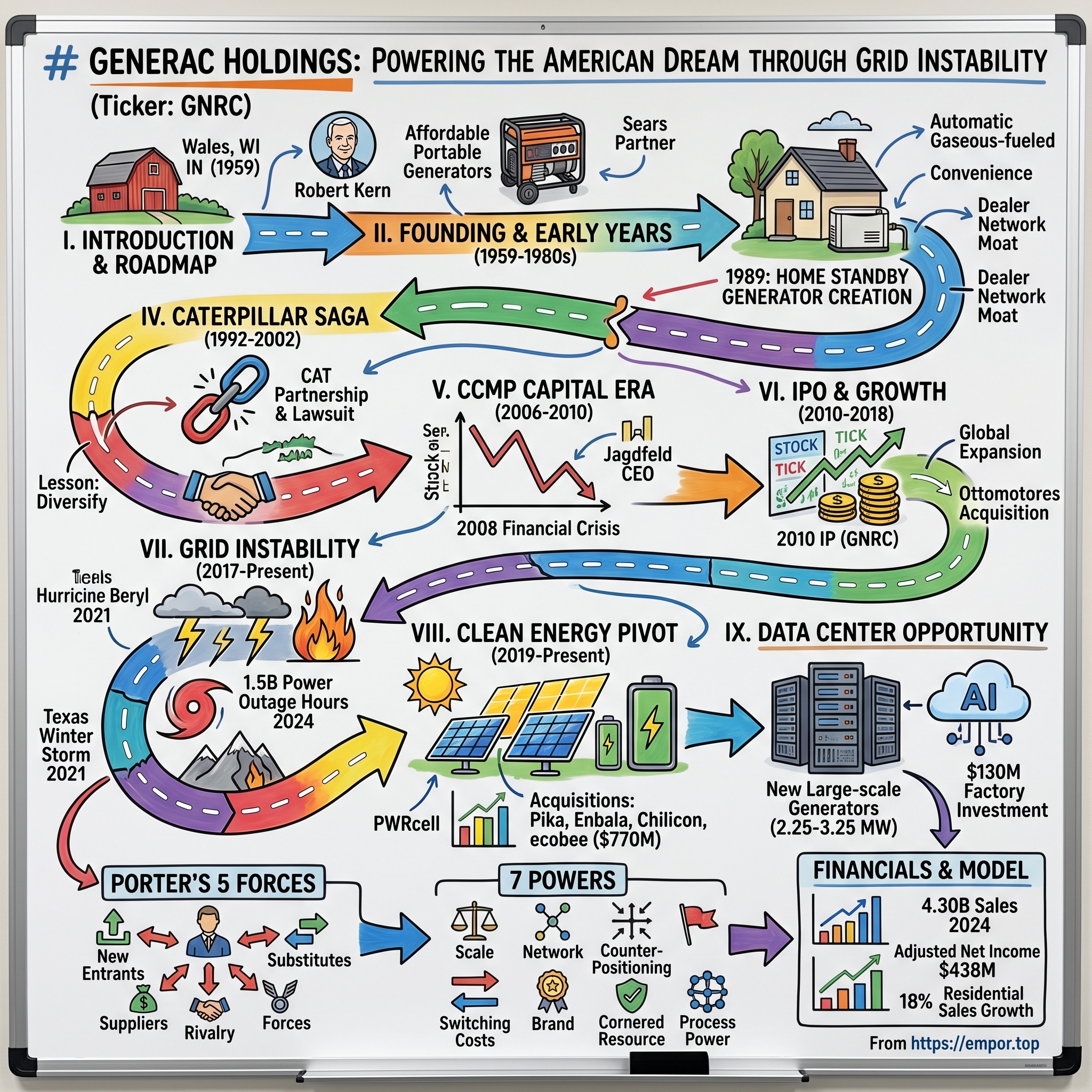
Generac Holdings: Powering the American Dream Through Grid Instability
I. Introduction & Episode Roadmap
Picture a Wisconsin winter night in 2021. The power grid buckles under record-breaking cold, and millions of Texans shiver in darkness as the ERCOT system collapses. Across the country, in wealthier neighborhoods and critical facilities, a familiar humming sound fills the air—the reassuring drone of Generac generators roaring to life. In that moment, a modest company founded sixty-six years earlier in a barn in rural Wisconsin transformed from a niche appliance maker into an essential pillar of American infrastructure resilience.
Generac Holdings Inc., commonly referred to as Generac (derived from a combination of "generating" and "AC"), is a Fortune 1000 American manufacturer of backup power generation products for residential, light commercial and industrial markets. Generac's power systems range in output from 800 watts to 9 megawatts, and are available through independent dealers, retailers and wholesalers.
The numbers tell a compelling story. For the full year 2024, net sales increased by 7% to $4.30 billion, with residential product sales up 18%. The residential dealer network grew to over 9,200, an increase of more than 400 dealers year-over-year. The company's market dominance is staggering: Nearly eight of ten home standby generators sold is a Generac.
The central question that captivates students of business history is deceptively simple: How did a $7,500 startup in Wisconsin become the dominant force in backup power—and is it now transforming into something far bigger?
This story touches on several recurring themes that make for great business analysis: category creation, private equity transformation, climate volatility as a secular growth driver, and a bold pivot toward "total energy solutions." It's a tale of an engineer's vision that took three decades to commercialize fully, a CEO who rose from the finance department to reshape the company's destiny, and a business model that profits when the lights go out.
But make no mistake—this isn't simply a weather-dependent commodity business. Generac introduced its "Powering A Smarter World" enterprise strategy in 2021, continuing the evolution of its business model that pairs traditional and emerging power generation, conversion, and storage technologies with new monitoring, management and grid services capabilities. The company that defined an industry is now attempting to redefine itself for an era of grid decentralization and renewable energy disruption.
For investors trying to understand whether Generac represents a mature cash cow or a reinvigorating growth story, the journey from Wales, Wisconsin to Wall Street offers critical lessons about category creation, capital allocation, and the strange intersection of climate anxiety and consumer demand.
 Subscribe on LinkedIn
II. Founding & Early Years: The Robert Kern Story (1959–1980s)
The year was 1959. Eisenhower was president, Alaska had just become a state, and in a modest barn in Wales, Wisconsin, an engineer named Robert D. Kern had an idea that would take decades to fully realize. In 1959, Kern started Generac with just five employees in a garage in Wales, Wisconsin. An engineer by training, he spent the next several decades growing Generac into an industry leader.
What distinguished Kern from the countless other small manufacturers of the post-war American industrial boom? A relentless focus on making power generation accessible to ordinary people and businesses who couldn't afford—or didn't need—the massive industrial generators that dominated the market. Back in 1959, our founder was committed to designing, engineering and manufacturing the first affordable backup generator.
Kern's early strategy was elegant in its simplicity. Rather than compete head-to-head with industrial giants, he found a partner who could deliver volume and distribution: Sears, Roebuck and Co. Founded by Robert Kern in 1959, the company soon began producing portable generators for Sears, Roebuck and Co. under the Craftsman brand. This relationship gave the fledgling company access to the most powerful retail distribution network in America and validated its core proposition—that reliable power generation could be democratized.
The company's early innovation went beyond marketing. Generac was the first company to commercialize portable, engine-driven generator sets. This wasn't simply assembling components—it required developing engines specifically designed for the punishing duty cycle of generator operation, where engines run for extended periods under varying loads rather than the stop-and-go patterns of automotive use.
During the 1970s, Generac expanded its offerings in the portable and recreational vehicle markets, and in the 1980s the company entered the commercial and industrial markets with its backup power generation systems. This expansion followed the classic "bowling pin" strategy—using momentum in one adjacent market to knock down the next.
What's remarkable about this period is Kern's discipline. For nearly five decades, he ran Generac as a private company, reinvesting profits into R&D and manufacturing capacity rather than extracting value. After nearly five decades of incredible growth and leadership, Kern sold his company in 2006 to focus on philanthropy.
Kern's values shaped the company's culture in ways that persisted long after his departure. Kern established the Kern Family Foundation with his late wife, Patricia, in 1998, with an eye toward promoting the value of work, developing the formation of good characters, increasing educational achievement and instilling entrepreneurial mindset. When he finally sold the company, when Kern sold the company in 2006, he and his late wife Patricia shared the proceeds of the sale with employees. Workers received gifts based on their years of service, some receiving as much as $40,000.
That generosity signaled something important about the culture Kern built—a sense that Generac was a community, not just a business. It also set expectations for how the next generation of leadership should treat the company's stakeholders.
Robert Kern passed away on November 8, 2022, at age 96. Aaron Jagdfeld, the current CEO, remarked that "Bob's passing is a tremendous loss for the Generac family and the larger community. His forward-thinking vision laid the solid foundation for what Generac is today."
For investors, the Kern era established several durable advantages: vertical integration in engine manufacturing, a culture of engineering-first innovation, and the foundation of what would become the industry's most extensive dealer network. These advantages would prove essential when the next chapter of Generac's story began to unfold.
III. The Category Creation Moment: Home Standby Generators (1989)
Every great company has an inflection point—a moment when a product or strategy transforms from interesting experiment to market-defining category. For Generac, that moment arrived in 1989.
Generac continued to innovate its portable generators, and in 1989, launched the first ever automatic home standby generator. It was a move that created a market segment — of which Generac remains the clear leader.
To understand why this mattered, consider what "backup power" meant before 1989. For commercial and industrial facilities, it meant expensive diesel generators that required specialized installation, dedicated fuel storage, and trained operators. For homeowners, it meant hauling a portable generator out of the garage, running extension cords through windows, and manually managing which circuits received power. Neither option was practical for the average American household.
The first big shift was creating the automatic home standby generator market. Before the late 1980s, backup power was mostly portable and manual. By introducing the first gaseous-fueled, automatic home standby system in 1989, Generac tapped into a massive, underserved residential market.
The brilliance of the automatic home standby generator lay in its convenience. Connected to the home's natural gas or propane supply, it could detect a power outage and switch on automatically—even when the homeowner was away or asleep. No manual intervention required. No gasoline cans to store. No extension cords to trip over. For aging homeowners, families with medical equipment, or anyone with a home-based business, this was transformational.
The business model innovation was equally significant. Rather than selling through big-box retailers (the portable generator strategy), Generac built relationships with electrical contractors and HVAC dealers who could handle the installation. This created a service relationship, not just a product transaction.
Generac is renowned as a market leader in residential standby generators, with a wide range of sizes and configurations to suit various needs. Generac boasts an extensive service network, ensuring prompt support and maintenance whenever needed.
The dealer network became a formidable competitive moat. Every dealer who invested in Generac training, inventory, and marketing became a de facto sales force. The switching costs worked both ways—dealers who built their businesses around Generac products had strong incentives to stay loyal, while homeowners with existing Generac installations naturally turned to authorized dealers for maintenance and upgrades.
"Generac created the market for home standby generators," CEO Jagdfeld said, "and today seven out of every 10 home standby generators sold is a Generac. It's an incredible legacy, and one we celebrate every day — not just during anniversary years. In fact, a few years ago, our one millionth home standby unit rolled off the assembly line."
The market creation strategy followed a pattern familiar to students of Clayton Christensen's disruption theory. Generac didn't try to beat industrial generator manufacturers at their own game. Instead, it created a new market segment that incumbents dismissed as too small or too low-margin to pursue. By the time competitors recognized the opportunity, Generac had established brand recognition, dealer relationships, and manufacturing scale that proved nearly impossible to replicate.
For investors evaluating companies today, the 1989 innovation offers a template: sometimes the most valuable strategy isn't winning a market, but creating one. The home standby generator category barely existed before Generac invented it—now it generates billions in annual revenue and shows no signs of saturation.
IV. The Caterpillar Saga & Near-Acquisition (1992–2002)
Every company faces moments that test its independence and strategic clarity. For Generac, that test came in the form of an alliance with—and near-acquisition by—one of America's industrial giants.
In 1992, Generac began private labeling generator sets for Caterpillar, Inc. As the partnership grew between the two companies, they discussed a potential acquisition of Generac by Caterpillar, although a deal was never finalized.
On paper, the relationship made perfect sense. Caterpillar possessed global distribution, brand recognition, and financial resources that dwarfed Generac's capabilities. Generac had specialized engineering expertise and manufacturing efficiency in smaller generator categories that Caterpillar lacked. The partnership allowed Caterpillar to offer a broader product line while providing Generac with access to markets it couldn't reach independently.
But partnerships with industrial giants are perilous for smaller companies. The power imbalance creates dependency, and when strategic priorities shift, the consequences can be devastating.
In June 1996, Caterpillar decided to terminate the private labeling agreement. Generac then sued Caterpillar under the Wisconsin Fair Dealership Law, the Sherman Antitrust Act, the Wisconsin common law concerning restrictive covenants, and the Illinois Consumer Fraud and Deceptive Business Practices Act.
The lawsuit represented existential stakes for Generac. Years of building around the Caterpillar relationship meant significant revenue was at risk. The legal battle dragged through the courts with ultimate disappointment for Generac: The federal district court, in two separate orders, disposed of the action in Caterpillar's favor. Generac then challenged the lower court's rulings in the U.S. 7th Circuit Court of Appeals, which ruled that Generac's claims were properly dismissed.
Generac continued to supply some transfer switches to Caterpillar until 2002, when Caterpillar changed suppliers.
The Caterpillar experience taught Generac several lessons that would shape its subsequent strategy. First, customer concentration creates vulnerability—no matter how prestigious the customer. Second, vertical integration and proprietary technology are more valuable than partnership dependencies. Third, the residential market that Generac was building offered something the industrial market couldn't: millions of individual customers rather than a handful of large accounts.
The period also saw Generac make a strategic decision that would later prove consequential. In 1998, Generac sold its portable products division to the Beacon group, a private equity firm, who later sold it to Briggs & Stratton. This divestiture allowed Generac to focus resources on the higher-margin home standby category, but it also created a future competitor—and, eventually, an opportunity to rebuild the portable business on stronger foundations.
The Caterpillar saga illustrates a recurring theme in industrial history: the danger and opportunity of large customer relationships. Companies that grow dependent on a single massive customer often find themselves hostage to that customer's strategic whims. Generac survived the Caterpillar breakup, but the experience informed a diversification strategy that would eventually make the company more resilient.
V. The Private Equity Transformation: CCMP Capital Era (2006–2010)
By 2006, Robert Kern was 82 years old. He had built Generac from a five-person operation into an industry leader, but he lacked a succession plan that could preserve both his financial legacy and his company's culture. The solution came from an unexpected quarter: private equity.
Generac Power Systems, after 47 years of private ownership by its founder and Chairman Robert D. Kern, has signed an agreement that will result in a change of control. The company is a manufacturer of standby power products and is solely focused on that business. Its four manufacturing facilities are located in Waukesha, Eagle and Whitewater, Wisconsin and Maquoketa, Iowa.
In November 2006, affiliates of CCMP Capital Advisors, LLC, together with affiliates of Unitas Capital Ltd. and members of management, formed Generac and acquired all of the capital stock of Generac Power Systems. CCMP was formed in August 2006 when the buyout and growth equity investment professionals of J.P. Morgan Partners, LLC separated from JPMorgan Chase & Co. to commence operations as an independent firm.
The transaction structure reflected careful attention to continuity. It was important to Generac's management and to CCMP Capital that the company maintains its successful business model and protects its corporate culture. To that end, the current Generac management team — William Treffert (CEO), Dawn Tabat (COO) and Aaron Jagdfeld (CFO) — would continue in their leadership roles.
"This transition has been long anticipated and I am confident that we have selected the best partner for Generac," said Robert Kern. "The success we have enjoyed over the past decades has been a result of the excellent work of our employees and the strong relationships that we have built with our business partners."
The private equity era began with ambition but quickly encountered the worst economic conditions since the Great Depression. The 2008 financial crisis hammered consumer spending on discretionary items like generators, and the housing market collapse reduced new home construction—a key driver of standby generator installations.
In late 2006, Generac was purchased by CCMP Capital of New York. In 2009 CCMP took a write-off, described as a non-cash goodwill and trade name impairment charge, of $583.5 million against their purchase of Generac.
That write-down represented a remarkable admission: CCMP had effectively acknowledged that the value they paid for Generac couldn't be justified by the company's near-term prospects. But write-offs are accounting entries, not operating realities. The underlying business remained intact, and management was already plotting a transformation.
The most consequential decision of the CCMP era was a leadership change. Aaron Jagdfeld was appointed president and chief executive officer in September, 2008 and is the current CEO. Jagdfeld's promotion represented an unusual bet—elevating the CFO to the top job during a financial crisis, at a company that had always been led by engineers.
Jagdfeld started at the company in 1994 in the finance department and was appointed chief financial officer in 2002. Before joining Generac, Jagdfeld worked in the audit practice of the Milwaukee office of Deloitte & Touche. Aaron Jagdfeld earned a Bachelor of Business Administration in Accounting from the University of Wisconsin-Whitewater, graduating in 1993.
Jagdfeld brought a different perspective to Generac's challenges. Where engineers focused on product capabilities, he focused on customer needs. Where manufacturing executives optimized for efficiency, he optimized for market development. His accounting background gave him the chops to run the business, and the self-proclaimed "gear head" understood how the products worked. Jagdfeld, who comes from humble roots on Milwaukee's northwest side, has built a reputation as one of the hardest workers at Generac.
One critical decision during this period: Upon expiration of a non-compete agreement related to the sale in 2007, Generac re-entered the portable generator market in 2008. This allowed the company to recapture a market segment it had abandoned a decade earlier, providing balance against the higher-margin but more cyclical standby business.
As the company's third CEO since its inception in 1959, Mr. Jagdfeld has led Generac's transformation from a manufacturer of backup generators and engine powered products into a global energy technology company.
The private equity chapter of Generac's story offers important lessons. CCMP provided capital for growth, professional governance, and—crucially—the discipline to prepare for an eventual public offering. The 2008-2009 crisis, while devastating for the balance sheet, forced operational improvements that would prove valuable when growth returned. And the elevation of Jagdfeld positioned the company for the next phase of expansion.
VI. The IPO & Public Market Growth (2010–2018)
The story of Generac's IPO begins with impeccable timing—though not in the way most investors expect. Rather than waiting for perfect market conditions, the company went public in early 2010, when memories of the financial crisis were still fresh and investor appetite for industrial stocks remained muted.
On February 11, 2010, Generac Holdings Inc. (NYSE: GNRC), parent company of Generac Power Systems, Inc., began trading on the New York Stock Exchange under the ticker symbol GNRC. The initial public offering provided $224 million in net proceeds, which were used to pay down debt.
Generac became a publicly traded company 51 years after it was founded by longtime owner, Robert Kern. The IPO ushered in an era of global expansion, starting with the Company's acquisition of Ottomotores, an industrial generator manufacturer with operations in Mexico and Brazil.
The second was the transition to public ownership with the 2010 IPO. This move, following the private equity acquisition, unlocked the capital needed for the aggressive acquisition strategy that followed, allowing the company to diversify beyond its core product.
The IPO was less about cashing out than about building a platform. With public market access, Generac could pursue acquisitions using stock as currency, attract talent with equity compensation, and invest in growth initiatives that might take years to generate returns. The debt paydown improved financial flexibility just as the company was ready to accelerate its strategy.
The international expansion began with Latin America, for good strategic reasons. Generac announced an agreement to acquire Ottomotores UK Limited and its affiliates, including the operations of Ottomotores Mexico and Ottomotores Brazil, for $46.5 million in cash. Founded in 1950 and headquartered in Mexico City, Ottomotores Mexico is a leading manufacturer of power generation equipment in Mexico and other parts of Latin America.
Failing electrical grids affect more than homes and businesses. Technology that depends on electricity is becoming a critical element of the nation's infrastructure and a part of Generac's future. "Fifth generation cellular technology is required for everything from the self-driving cars of the near future to business data requirements. As 5G becomes a reality, the cellular towers that transmit data become indispensable and cannot be subject to electrical failure. Generac is the leading provider of backup power to cell towers in the United States."
The rationale for Latin American expansion was straightforward: in developing markets, unreliable grid infrastructure created immediate demand for backup power solutions. Rather than waiting for customers to come to them, Generac positioned itself where the need was most acute.
The post-IPO period also saw several high-profile storms that turbocharged awareness of backup power. In October 2012, Generac raised its 2012 guidance to about 30 percent sales growth over 2011, which would push it past $1 billion in annual sales. Generac said it will hire more than 100 production workers and start manufacturing operations in a Jefferson facility driven by superstorm Sandy's impact.
Superstorm Sandy in 2012 became a watershed moment for the home standby category. Millions of Americans in the densely populated Northeast corridor experienced extended power outages, and the images of darkened neighborhoods contrasted with generator-powered homes created powerful marketing that no advertising campaign could match.
Generac's 38 percent compound annual growth rate since 2010 is "impressive amid the slow growth environment in the U.S." and is driven in part by "strong management execution to capitalize on recent major power outage events" and Jagdfeld-led efforts to improve the company's marketing and distributor penetration.
The company's transformation wasn't solely about external events. Jagdfeld systematically professionalized the sales and marketing functions. Aaron Jagdfeld noted: "We've been kind of this quiet little company out here in western Waukesha County for a long time. And I think that changed overnight. Now with all the outages and the categories of product being top of mind for people and our brand being so strong in the marketplace, we're really capitalizing on that today in a way that we just couldn't before."
For investors, the 2010-2018 period established Generac's formula: maintain dominant market share in the core residential standby business while expanding internationally and into adjacent commercial/industrial markets. Each major storm event created a demand spike, but the underlying growth came from steady market development and brand building.
VII. The Hurricanes, Wildfires & Grid Instability Catalyst (2017–Present)
If climate change is the crisis of our era, Generac has become one of its accidental beneficiaries. The calculus is uncomfortable but undeniable: every major weather disaster that damages electrical infrastructure creates a surge in demand for backup power.
CEO Aaron Jagdfeld stated: "The mega-trends that support our long-term expectations were on full display in 2024 as power quality continued to deteriorate and power prices continued to increase."
The U.S. experienced nearly 1.5 billion hours of power outages in 2024, the highest since Generac first started tracking the figure in 2010. That statistic deserves emphasis: Americans lost more collective hours of electricity last year than at any point in the past fifteen years. This isn't a temporary aberration—it's a secular trend driven by multiple reinforcing factors.
The litany of disasters is familiar to anyone who follows the news. Hurricane Harvey, Irma, and Maria devastated the Gulf Coast and Puerto Rico in 2017. California wildfires have created both direct power outages and preventive shutoffs as utilities try to reduce fire risk. The 2021 winter storm is a prime example of how extreme weather can devastate the grid. The storm caused temperatures to drop significantly, leading to frozen power plants and natural gas pipelines. It resulted in widespread power outages affecting millions of residents and businesses.
Most recently, Hurricane Beryl in July 2024 caused significant disruptions to the Texas power grid. The storm's high winds and heavy rainfall led to widespread outages, particularly in coastal areas. Many Texans are still struggling from the impact of Hurricane Beryl.
But the grid instability story extends beyond dramatic weather events. Our modern lives are placing an ever-higher demand on an outdated grid. As average temperatures continue to rise, more people are using more climate control in their homes. And while there's an increasing emphasis on sourcing electricity from renewable sources that will help make the grid more resilient, that new infrastructure support will take years to catch up.
In addition to lower power quality, higher power prices are expected as investment is needed to upgrade infrastructure and build towards cleaner energy solutions. Even today, cost per kilowatt hour is up by approximately 30% since 2020, according to data from the U.S. Bureau of Labor Statistics.
This creates a perfect storm for Generac's core business. Rising electricity costs make the payback period for backup power investments shorter. Declining grid reliability makes the need more urgent. And the integration of intermittent renewable energy sources creates new opportunities for storage and grid services.
Jagdfeld noted that Q4 2024 results "highlight our ability to rapidly increase production and execute on the strong demand for home standby and portable generators resulting from elevated outage activity in the second half of the year."
The telecommunications infrastructure angle adds another dimension. As 5G networks proliferate and data becomes critical infrastructure, the consequences of power outages multiply. Backup power isn't just about comfort anymore—it's about maintaining connectivity for work, healthcare, and emergency services.
Generac Holdings Inc. reported a strong financial performance for the fourth quarter and full-year 2024, highlighted by a 16% increase in net sales to $1.23 billion in Q4, driven primarily by a 28% surge in residential product sales.
For investors, the grid instability thesis represents both opportunity and risk. The opportunity is obvious: sustained demand growth driven by factors largely outside Generac's control. The risk is equally clear: demand spikes following major events create inventory management challenges and can lead to disappointing quarters when disaster activity normalizes.
The key insight is that Generac's management has learned to treat weather-driven volatility as a feature, not a bug. The manufacturing system is designed to scale up quickly when demand spikes and scale down efficiently when it normalizes. The dealer network maintains enough inventory to respond to emergencies while avoiding the carrying costs of excessive stock.
VIII. The Clean Energy Pivot: From Generator Company to Energy Technology (2019–Present)
The most consequential strategic decision in Generac's recent history came not from crisis but from anticipation. In 2019, the company began systematically repositioning itself from a generator manufacturer to a comprehensive energy technology company.
Generac Power Systems, the market leader in residential backup power systems, announced its move into Clean Energy in September 2019. The company that single-handedly created the billion-dollar home standby generator market would now draw on its best-in-class technology and extensive engineering expertise to offer a complete ecosystem of new energy storage and management products.
"The Clean Energy business represents a significant investment in the future of our company," said Aaron Jagdfeld. "Emergency backup power is our core business, but we believe storage and energy management represent the next step for Generac."
The acquisition strategy was methodical. The April 2019 acquisition of Pika Energy Inc. brought a designer and manufacturer of battery storage technologies that capture and store solar or other power sources for homeowners and businesses. In October 2020, the Company acquired Enbala Power Networks Inc., one of the leading providers of distributed energy optimization and control software that helps support the operational stability of the world's power grids.
In July 2021, Generac added to its residential clean energy portfolio with the acquisition of Chilicon Power LLC, a designer and provider of grid-interactive rooftop power inversion devices and monitoring solutions for the solar market.
The crown jewel of the acquisition spree came in late 2021. Generac announced the acquisition of ecobee Inc., a leader in sustainable smart home solutions, in a transaction valued up to $770 million USD contingent on the achievement of certain performance targets. Generac's largest acquisition to date was in 2021, when it acquired ecobee for $770M.
"ecobee's solutions are an important addition to Generac's extensive residential energy technology portfolio," said Jagdfeld. "Residential HVAC systems represent the largest energy-consuming device in the home today and ecobee's smart thermostats and sensors offer the most intelligent way to balance comfort with conservation."
The strategic logic connected multiple dots. Solar panels generate electricity during the day; batteries store it for evening use; smart thermostats optimize consumption; generators provide backup when other sources fail. Together, these products create an ecosystem where Generac can offer a complete home energy solution rather than a single product.
In 2019, Generac acquired battery manufacturer Pika Energy, and has since integrated their technology into the launch of their own Generac-branded home storage solution: the Generac PWRcell. Having long been a leader in the backup power space, Generac is now moving into clean energy and energy storage.
The integration efforts continue today. In May 2025, Generac announced the launch of ecobee by Generac Smart Thermostat Enhanced with Home Energy Management, integrating with Generac Home Standby Generators and Generac PWRcell 2 Solar Battery Storage Solutions. At a time when Americans are seeing both rising energy costs and more frequent power outages – with 1.5 billion hours of outages taking place in 2024 alone – this is the latest in Generac's suite of residential energy technology solutions.
In 2021, Generac unveiled its "Powering A Smarter World" strategic plan, which serves as the framework for the significant investments the company has made and will continue to make to capitalize on the long-term growth prospects. The enterprise strategy is based on the combination of several key mega-trends that are expected to drive significant strategic growth themes.
The mega-trends and strategic growth themes support the enterprise strategy, "Powering A Smarter World," and the purpose statement, "To lead the evolution to more resilient, efficient, and sustainable energy solutions."
Recent acquisitions have expanded the commercial and industrial footprint. In June 2024, Generac announced the acquisition of PowerPlay Battery Energy Storage Systems, a division of SunGrid Solutions Inc. PowerPlay specializes in providing turnkey Battery Energy Storage Systems (BESS) solutions tailored for commercial and industrial (C&I) projects up to 7 MWh.
In August 2024, Generac announced the acquisition of Ageto, a leading provider of microgrid controllers that seamlessly integrate, optimize and manage distributed conventional resources, renewable energy resources and electric vehicle chargers in the commercial & industrial market.
For investors evaluating this transformation, the key question is whether Generac can successfully execute a "both/and" strategy—maintaining dominance in traditional generators while building a significant clean energy business. The acquisitions have assembled the technological building blocks; now execution must deliver on the promise.
IX. The Data Center Opportunity
The intersection of artificial intelligence and energy infrastructure has created a new frontier for Generac—one that could rival the residential generator market in long-term significance.
"We're seeing rapid growth in the construction of new data centers by hyperscalers and cloud service providers, which is fueled by the explosion of AI and an unprecedented surge in energy demand," said Brad Meissner, Director of Product Management. Generac strengthened its portfolio with new generators designed for the data center market, including diesel and natural gas generators and multi-asset energy systems designed to connect and scale flexibly with the diverse needs of hyperscale, colocation, enterprise and edge data centers.
The company is investing about $130 million in equipment and a factory to build larger backup generators for massive computing facilities running artificial intelligence applications, said Chief Executive Officer Aaron Jagdfeld.
Central to the company's data center offering is the introduction of a full lineup of five new generators, ranging from 2.25 MW to 3.25 MW. These generators expand the company's ability to support high-capacity applications while integrating into energy ecosystems.
The data center opportunity differs fundamentally from the residential market in several ways. Data centers operate 24/7 with zero tolerance for downtime. A few seconds of power loss can corrupt data, crash applications, and cost millions in lost revenue. This creates demand for the most reliable—and most expensive—backup power solutions available.
When Generac formally debuted its new line of large-scale generators for data centers at Data Center World in 2025, the company wasn't just testing the waters. It was announcing itself as a new contender in one of the most demanding corners of mission-critical infrastructure.
"The biggest demand that we've got from customers has been about lead times," noted Ricardo Navarro, SVP at Generac. "We are delivering open sets in less than 30 to 35 weeks, and packaged units in less than 50 weeks. If you compare that with the current supply of existing OEMs, it's one-third of that lead time."
Navarro highlighted that "Generac is the largest supplier to the telecom industry"—a credential that provides entrée to data center conversations and demonstrates capability in mission-critical applications.
"We're seeing rapid growth in the construction of new data centers by hyperscalers and cloud service providers, which is fueled by the explosion of AI and an unprecedented surge in energy demand," said Brad Meissner. In a market where AI is accelerating the pace of construction and expanding power densities, procurement speed can make or break a project timeline. Generac is positioning its 50–60 week lead time as a key differentiator—shorter than many industry norms that now stretch into 70–90 weeks.
The market opportunity is substantial. The Data Center Generators Market was valued at USD 8.24 Billion in 2024, and is expected to reach USD 12.69 Billion by 2030, rising at a CAGR of 7.46%.
Navarro pointed to Generac's $130 million Beaver Dam, Wisconsin facility as proof of its commitment to scale. "It's a really exciting time for us. The opportunity for growth is significant, and we are determined to be in the driver's seat. We are going to become a main player in this space."
For investors, the data center opportunity represents both potential and execution risk. Generac must compete against entrenched players like Caterpillar and Cummins who have decades of experience in large-scale industrial applications. The company's advantages—lead times, integration with energy storage, software capabilities—must prove compelling to hyperscaler procurement teams accustomed to working with established industrial suppliers.
X. Competitive Landscape & Industry Analysis
Understanding Generac requires understanding its position relative to competitors who approach the market from different directions with different strengths.
Four major generator brands dominate the market: Generac, Cummins, Kohler, and Briggs & Stratton. Which is best to power your home during an outage?
Generac holds the lion's share of the residential standby generator market, with approximately 40% market penetration. The company pioneered affordable home standby generators in the 1980s and has maintained its leadership through innovation, broad availability, and an extensive dealer network.
Briggs & Stratton holds approximately 20% of the market and leverages over a century of small engine manufacturing expertise. They offer a value-oriented alternative with competitive features at lower price points.
The competitive dynamics vary significantly by segment. In residential standby generators—Generac's core market—the company enjoys dominant share and brand recognition that competitors have struggled to match. As one industry observer noted: "Generac has a huge lead in terms of market share, so it's only natural that they also get a lion's share of complaints. If you start browsing the Kohler tech message boards, you'll see a lot of Kohler complaints, too."
Industry participants often note that "Generac [is] much better at marketing." This reflects a deliberate strategic choice—Generac invested heavily in consumer brand building while competitors focused on commercial channels.
The competitive positioning differs by customer need. Cummins generators are renowned for their robust construction and reliability, making them a preferred choice for commercial and industrial applications. Cummins generators are designed for optimal fuel efficiency, helping reduce operating costs over the long term.
Generac generators are often the most affordable option, making them ideal for homeowners on a budget who still want reliable power backup. Generac's pricing is competitive without sacrificing quality, providing excellent value for smaller residential setups.
The dealer network represents Generac's most durable competitive advantage. "Generac holds about a 75% market share in the air cooled home backup generator market. So it is very easy to find reviews (Good and bad) on Generac because they sell a ton of them!"
As one installer explained: "After doing a lot of research, I concluded Generac was the correct choice for me because: There are a lot more Generac repair techs in my region than Kohler. (25x more). Generac has a huge lead in terms of market share, so it's only natural that they also get a lion's share of complaints."
The clean energy pivot creates a new competitive dynamic. Generac now competes not just with traditional generator manufacturers but with solar installers, battery storage companies like Tesla, and smart home providers. This expansion of the competitive set brings both opportunity and complexity.
XI. Porter's 5 Forces Analysis
Threat of New Entrants: LOW-MEDIUM
Barriers to entry in Generac's core business are substantial. The company's 65+ year history and brand recognition can't be replicated quickly. The residential dealer network grew to over 9,200 dealers—a distribution asset that would take years and billions of dollars to build from scratch.
Manufacturing generator engines requires specialized expertise and significant capital investment. Regulatory certifications and safety standards create additional barriers. However, the energy storage and solar market has lower barriers, with new entrants proliferating.
Bargaining Power of Suppliers: LOW-MEDIUM
"Unlike others, our differentiated supply chain and our ability to adjust production to market demand, allows us to provide shorter lead times."
Generac manufactures its own engines—a unique position in the industry that reduces supplier dependency. Multiple Wisconsin manufacturing facilities provide operational control. The clean energy expansion creates some dependency on battery cell suppliers, but this is manageable given the commodity nature of these inputs.
Approximately 70-80% of Generac's Cost of Goods Sold are materials. Roughly 50% of these materials are sourced in North America, with the remaining 50% sourced globally. China exposure is less than 10% of total material purchases and has been halved over the past five years.
Bargaining Power of Buyers: LOW
Generac's customer base is highly fragmented—millions of individual homeowners rather than concentrated industrial purchasers. The emergency nature of the product reduces price sensitivity; when the power goes out, customers aren't shopping for bargains. The dealer network creates service relationships that increase stickiness.
Threat of Substitutes: MEDIUM (and Rising)
The most significant long-term threat comes from alternative energy solutions. As solar and battery storage costs decline, some customers may choose to invest in renewables rather than traditional generators. Grid improvements could theoretically reduce demand—though current trends suggest the opposite.
Generac's clean energy pivot addresses this threat proactively by positioning the company to benefit regardless of which technology customers choose.
Industry Rivalry: MEDIUM
The market is consolidated because it consists of major players, such as Caterpillar Inc., Cummins Inc., Generac Power Systems Inc., Kohler Co., ABB Ltd., Atlas Copco AB, Yanmar, and GE Vernova.
Generac dominates the residential segment; competition is more intense in commercial and industrial markets where Caterpillar and Cummins have strong positions. The clean energy space brings new competitors from outside traditional generator manufacturing.
XII. Hamilton's 7 Powers Framework Analysis
1. Scale Economies: STRONG
Generac's manufacturing concentration in Wisconsin provides significant cost advantages. Generac's power systems range in output from 800 watts to 9 megawatts—a massive product range that amortizes R&D and manufacturing overhead across millions of units. The largest dealer network enables superior distribution economics.
2. Network Economies: MODERATE-STRONG
Generac's business model pairs traditional and emerging power generation, conversion, and storage technologies with new monitoring, management and grid services capabilities.
The growing software/connectivity ecosystem creates network effects—more connected devices generate more data, improving algorithms and customer experiences. The dealer network itself exhibits network characteristics: the more dealers in a region, the better service coverage and faster installation times.
3. Counter-Positioning: STRONG
When Generac created the automatic home standby category, industrial generator manufacturers like Caterpillar and Cummins dismissed it as too small to pursue. By the time the market achieved significant scale, Generac had established advantages that proved difficult to replicate. The current clean energy pivot represents another counter-positioning bet—traditional generator competitors are slow to embrace technologies that could cannibalize their core businesses.
4. Switching Costs: MODERATE
Installation costs create customer lock-in—a homeowner who has invested in a Generac installation faces significant expense to switch brands. The new home standby designs seamlessly integrate with other Generac products - including ecobee smart thermostats and PWRcell battery systems. Using the same brand ensures optimal performance and simplified warranty service. The energy ecosystem increases switching costs as customers integrate more Generac products.
5. Branding: STRONG
Generac has been a major player in the generator market since 1959. Known for their focus on innovation and affordable pricing, Generac has become a popular choice for both residential and commercial applications.
The Generac brand has become near-synonymous with home generators—a powerful position that competitors have struggled to erode despite decades of effort.
6. Cornered Resource: MODERATE
Proprietary engine designs developed specifically for generator use represent a cornered resource. Technology from acquisitions (Pika Energy, Enbala, Chilicon) provides capabilities that aren't available to competitors who lack similar intellectual property. The dealer network relationships constitute another form of cornered resource.
7. Process Power: STRONG
"Our fourth quarter results highlight our ability to rapidly increase production and execute on the strong demand for home standby and portable generators resulting from elevated outage activity."
The ability to scale production rapidly for hurricane season demand spikes, then scale down efficiently when demand normalizes, represents genuine process power. This capability was developed over decades of experience managing weather-driven volatility and cannot be easily replicated by competitors.
XIII. Financial Analysis & Business Model Deep Dive
Understanding Generac's financial model requires appreciating both its strengths and its peculiarities. This is a company whose quarterly results can swing dramatically based on factors entirely outside management's control—yet the long-term economics are compelling.
The Company initiated full-year 2025 net sales growth guidance to be approximately 3 to 7% as compared to the prior year. Adjusted EBITDA margin, before deducting for non-controlling interests, is expected to be approximately 18.0 to 19.0%.
This is expected to be driven primarily by residential product sales growth in the mid-to-high single digit range, primarily led by shipments of home standby generators and residential energy technology solutions.
The segment dynamics reveal the business's evolution. For full-year 2024, net sales increased 7% to $4.30 billion, with residential sales up 18% to $2.43 billion. Residential remains the core, but the company is actively expanding its commercial and industrial footprint.
Generac's adjusted net income for 2024 was $438 million, or $7.27 per share, compared to $335 million or $5.40 per share in 2023.
Q4 2024 highlights include record adjusted net income of $168 million ($2.80 per share), record adjusted EBITDA of $265 million (21.5% of net sales), and all-time record free cash flow of $286 million.
Cash flow generation has improved significantly. The company repurchased 1.05 million shares for $153 million and repaid $278 million in debt. This reflects management's confidence in the business and commitment to returning capital to shareholders.
A significant achievement for Generac in Q1 2025 was the gross margin expansion of nearly 400 basis points year-over-year, reaching 39.5%. This improvement, the highest for a first quarter since 2021, was attributed to a favorable sales mix driven by the higher proportion of residential product sales and the realization of lower input costs.
The demand volatility challenge deserves careful attention. Weather-dependent revenue creates planning difficulties and can lead to significant inventory swings. A quiet hurricane season can result in excess inventory and margin pressure; an active season can strain manufacturing capacity and lead to backlog buildup.
Generac allocated a substantial portion of its revenue, approximately $148.2 million, to research and development activities in 2024—evidence of ongoing investment in product development and new categories.
Capital allocation reflects the company's strategic priorities: acquisitions to expand capabilities, R&D to maintain technological leadership, and share buybacks to return capital when organic opportunities are insufficient to absorb cash generation.
XIV. Investment Considerations & KPIs to Watch
The Generac thesis hinges on several key questions that investors must evaluate.
The Bull Case:
The secular drivers supporting Generac's business appear durable. Grid instability isn't improving—it's getting worse. Climate volatility shows no sign of abating. Electrification of transportation and heating creates new failure points in the power system. Data center demand for reliable power is exploding. And the clean energy transition creates opportunities for storage and grid services that didn't exist a decade ago.
Generac's market position in residential generators approaches monopoly strength. The dealer network, brand recognition, and manufacturing scale create advantages that competitors have failed to erode over decades of trying. The clean energy pivot positions the company to benefit from secular trends while hedging against potential disruption of the core business.
Management has demonstrated discipline in capital allocation—acquiring strategically, investing in R&D, and returning capital to shareholders when appropriate. The balance sheet is manageable and provides flexibility for opportunistic moves.
The Bear Case:
Weather-dependent revenue creates inherent volatility that some investors will find uncomfortable. A multi-year period without major hurricanes or grid failures could result in disappointing growth and inventory challenges.
The clean energy pivot requires execution in markets where Generac lacks the dominant position it enjoys in generators. Competition from Tesla, established solar installers, and well-funded startups creates uncertainty about whether Generac can replicate its residential generator success in adjacent categories.
The data center opportunity brings Generac into competition with Caterpillar and Cummins—companies with decades of experience in large industrial applications and deep relationships with the largest customers. Success is not guaranteed.
Valuation assumes continued growth and margin improvement; any disappointment could result in significant multiple compression.
Key KPIs to Monitor:
For investors tracking Generac's ongoing performance, two metrics deserve particular attention:
-
Residential Product Sales Growth Rate — This measures the health of the core business. Watch for year-over-year comparisons that adjust for major storm activity in prior periods. Sustainable high-single-digit growth would validate the secular thesis; prolonged low-single-digit growth would suggest market saturation.
-
Home Standby Penetration Rate — Generac estimates current penetration of addressable U.S. homes at approximately 5-6%. This metric measures the long-term runway for the core business. Rising penetration validates the secular growth story; stagnant penetration suggests the market may be more mature than bulls believe.
XV. Conclusion: The Generator Company That Refused to Stop Evolving
Robert Kern couldn't have imagined, when he started manufacturing generators in a Wisconsin barn sixty-six years ago, that his company would one day trade on the New York Stock Exchange, acquire smart thermostat makers, and compete for data center contracts worth millions of dollars. Yet that improbable journey captures something essential about American capitalism: the ability of determined entrepreneurs and their successors to build enduring institutions from modest beginnings.
Generac's story offers several lessons for students of business and investing. First, category creation can be more valuable than market share capture. Generac didn't beat incumbents in their existing markets—it invented new markets that incumbents dismissed. Second, distribution and service networks create durable competitive advantages. The dealer relationships that Generac built over decades represent an asset that no competitor has successfully replicated. Third, private equity ownership can add value when aligned with good management—but public markets provide the capital and currency needed for truly transformational growth.
The company now faces a strategic challenge familiar to many mature category leaders: how to grow beyond the core business without abandoning the strengths that made success possible. The clean energy pivot and data center expansion represent bets on Generac's ability to extend its competencies into adjacent markets. Success would cement the company's position as a comprehensive energy technology provider; failure would leave investors with a mature, weather-dependent generator business trading at a premium multiple.
For now, the mega-trends support continued growth. Americans experienced more power outage hours in 2024 than at any point in the past fifteen years. Climate volatility shows no signs of abating. The electrical grid requires trillions of dollars in investment that will take decades to deploy. And the data center boom has only begun.
In that uncertain world, Generac has built a business on a simple but enduring proposition: when the power goes out, people will pay for the peace of mind that backup generation provides. That proposition was true in 1959, when Robert Kern started his company. It remains true today. And it seems likely to remain true for decades to come.
The lights will go out again. When they do, Generac will be there.
 LinkedIn
 WhatsApp
 Reddit
 Hacker News
 Email
Email Kindle
 RSS Feed
 Spotify
 Apple Podcasts
 Amazon Music
 Audible
 YouTube