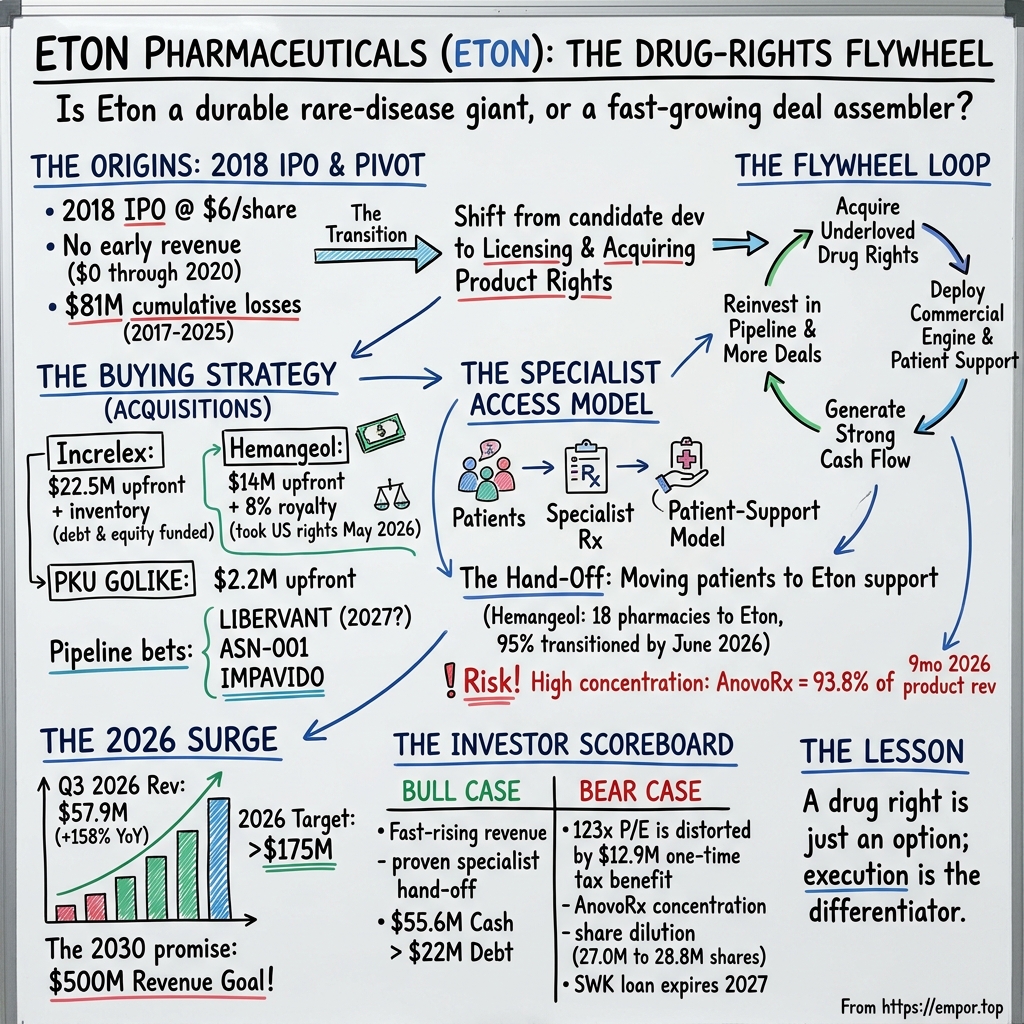
Eton Pharmaceuticals: The Drug-Rights Flywheel
I. The $6 IPO and the $500 Million Promise
On the first Friday of November 2026, Sean Brynjelsen had the kind of number most small-company chief executives only get to put on a slide. A few years earlier, Eton Pharmaceuticals had told investors it would reach $200 million of annualized revenue. On the third-quarter call Brynjelsen said the company had blown past that mark and had done it "an impressive 5 quarters ahead of schedule."1 Then the CEO reached for the bigger goal. Eton had promised $500 million of revenue by 2030, and based on the third-quarter run rate, Brynjelsen said, the company was already "nearly halfway" there.1
That run rate was not a rounding trick. Eton reported $57.9 million of revenue for the quarter ended September 30, 2026, up about 158% from a year earlier, and it raised its full-year guidance to more than $175 million.3 Multiply the quarter by four and you get roughly $230 million, which is indeed a little under half of $500 million. For a company that sold its first shares to the public in 2018 at $6 apiece, with no commercial revenue to its name, it was a remarkable place to be standing.2
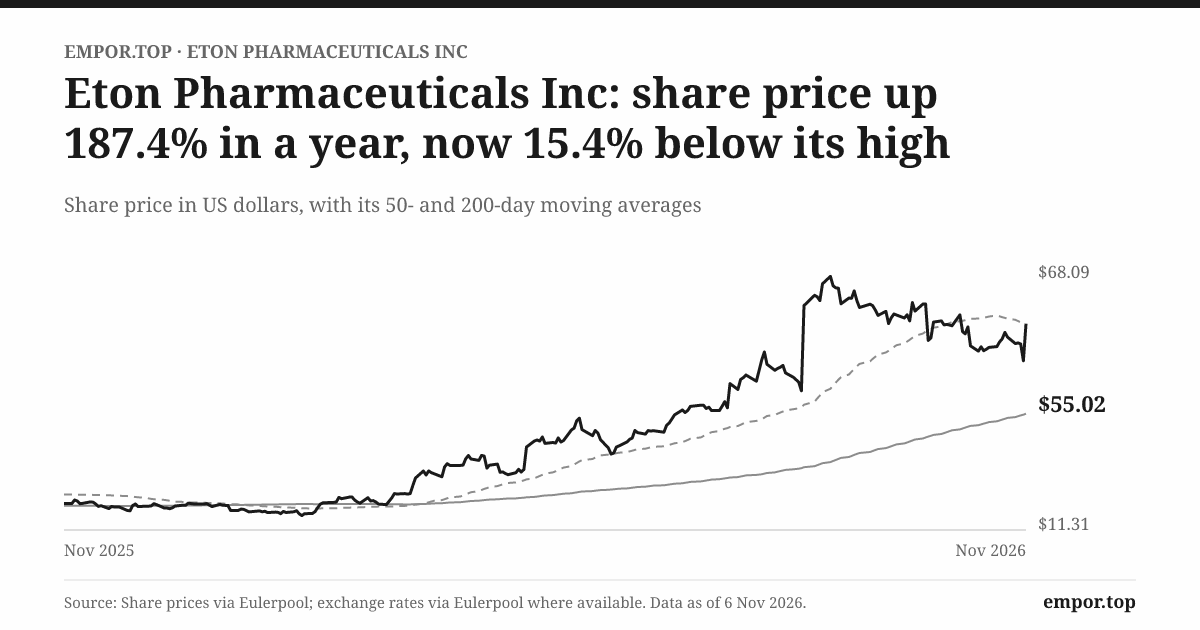
The stock had noticed. On November 6, 2026, Eton closed at about $55, almost four times its low of the previous twelve months, and the company was valued at roughly $1.5 billion.4 The same chart that delights a shareholder is the one that should make a careful investor lean forward, because the business behind it does not look like the drug companies most people picture. Eton does not have a blockbuster molecule discovered in its own laboratory. It has a growing shelf of medicines for small groups of patients, most of which it licensed, bought or reformulated, and a small commercial team that tries to get each of them into the right hands.
That is the collision at the heart of this story. On one side sits a revenue line that has more than doubled in a year. On the other sits a set of mechanics that are unfamiliar to many investors: buying the American rights to a medicine another company no longer prioritizes, moving its patients onto a new pharmacy and support system, and then trying to sell more of it than the previous owner did. Why would anyone sell such products in the first place? Because, for a large drug maker, a medicine with ten or twenty million dollars of U.S. sales is a rounding error that still demands a regulatory team, a supply chain, a pharmacovigilance desk and someone to answer the phone when a family's insurance claim is denied. For a company of Eton's size, the same product can be a meaningful share of revenue and a reason for its sales force to visit a clinic. The opportunity lives in that difference in attention. So does the risk, because a product that a large owner found too small to bother with can also prove too small to carry the price a smaller buyer paid for it.
The question is whether those mechanics add up to a durable rare-disease company, or to a fast-growing revenue stream that has to be rebuilt one product right at a time.
Three narrower questions follow from that. The first is how much of the growth is organic, meaning more patients on the products Eton already owned, rather than revenue that simply changed hands when Eton bought a product. The second is whether Eton's focused commercial model, a small specialist sales force paired with intensive patient support, gives it a real edge over the many other companies that could bid for the same product rights. The third is whether the acquisitions earn their price without the kind of dilution, debt or channel risk that quietly eats the gains.
The market's answer, for now, is generous. At November 6 prices, Eton's enterprise value was about 11.2 times its sales over the previous twelve months, and its share price was about 123 times trailing earnings.4 The second figure needs an asterisk the size of a billboard, because third-quarter earnings included a large one-time tax benefit that has nothing to do with selling medicine. Even with that caveat, investors were paying a premium price for a company whose commercial record is only about five years long.
The growth is real. Whether it is durable depends on whether Eton can keep finding, buying and commercializing products while the portfolio it already owns keeps growing underneath. To see why that is the right test, it helps to go back to what Eton was when it first asked the public for money, and how far it has travelled from that plan.
 Subscribe on LinkedIn
II. A Public Company Built to Find Products
The prospectus Eton filed in September 2018 described a company that was barely a year and a half old. It had been incorporated in Delaware in April 2017 and kept its offices in Deer Park, a suburb north-west of Chicago.2 It had started life as a wholly owned subsidiary of Imprimis Pharmaceuticals, the compounding company now known as Harrow, which had paid $3,500 for its first 3.5 million shares; by the time of the offering Imprimis owned about a quarter of the stock and Eton was, in its own words, "no longer a subsidiary."2
The offering itself was modest. Eton sold 3 million shares at $6 each through National Securities Corporation, raising $18 million before fees and listing on the Nasdaq Capital Market under the ticker ETON.2 There was no product revenue to show investors, only a plan.
The plan came from the person at the top. Brynjelsen had joined as president and chief executive in June 2017, after senior business-development roles at two generic and specialty drug makers: Brynjelsen had been executive vice president of business development at Sagent Pharmaceuticals and senior vice president of global business development at Akorn, and held an MBA from the University of Notre Dame.2 That background matters more than it might seem. A business-development executive spends a career not inventing drugs but finding them, valuing them, negotiating for them and working out how to sell them. Eton was built in that image.
The 2018 strategy was explicit about the route. Eton would develop "low-risk" products using the FDA's 505(b)(2) pathway, focusing on liquid products such as injectables, oral liquids and eye drops.2 The 505(b)(2) pathway is the regulatory equivalent of renovating a house rather than building one from the foundations. The active ingredient already has a long safety record, so the company can rely partly on existing data and prove only what is new: a different form, a different concentration, a version a child can swallow. It is cheaper and faster than discovering a molecule. It also means the moat is thinner, because the underlying chemistry is well known.
The early slate reflected that. It included an injectable for pain, injectables for nutritional deficiencies, a preservative-free allergy eye drop and early oral liquids.2 It also contained an arrangement that would echo years later. The prospectus disclosed that Brynjelsen had "a material ownership interest" in several companies from which Eton had licensed product rights, including a 50% stake in Selenix, the source of the DS-200 injectable candidate, and stakes of 27% and 33% in two others; Eton said the terms approximated an arm's-length deal.2 Investors were told about it on the first page of the relationship. Whether they weighed it is another matter.
Then came the long, expensive middle. Eton reported essentially no revenue through 2020 and lost money every year from 2017 onward, with operating losses widening to about $27 million in 2020 as development spending climbed.5 Equity markets paid for the gap: the company raised cash from financing in almost every early year, raising about $31 million in 2020 alone.5 Add up the nine years from 2017 through 2025 and Eton's net losses totaled about $81 million.5 That is the price of building a pharmaceutical company before it has anything to sell, and the shareholders who funded it carried the risk.
Revenue arrived in 2021, at about $21 million, and then stalled at the same level in 2022, when the operating loss widened again to roughly $8 million.5 Those were the years in which Eton's identity changed. The hospital injectables gave way to something narrower and, as it turned out, more promising: medicines for rare pediatric and endocrine conditions. In 2020 Eton licensed ALKINDI SPRINKLE, a hydrocortisone formulation for children with adrenal insufficiency, from Diurnal, issuing shares to Diurnal as part of the deal.5 DS-200, the Selenix candidate, was eventually sold rather than commercialized.5 The company kept developing its own reformulations, but the growth model shifted toward licensing and acquiring products that already had patients.
The shift shows up in the numbers. Revenue rose from about $21 million in 2021 to about $79 million in 2025, and the 2025 jump alone was more than 100%.5 Operating losses narrowed until, in 2025, the company roughly broke even at the operating line.5 Eton now reports a single operating segment, but that one segment holds products with very different histories: some licensed, some bought outright, some reformulated in-house, each with its own royalty, supply contract and regulatory file.5
That is the tension this history leaves behind. A focused rare-disease portfolio can become more valuable as each new product rides on the same sales team, the same pharmacy partners and the same patient-support system. Or every new product can turn out to require another deal, another negotiation and another execution test, which makes the company less a flywheel than a treadmill. With a commercial record of about five years, the history alone cannot tell you which. What it can tell you is that Eton's growth now depends on what happens after a prescription is written, which is where the business actually lives.
III. The Rights Business: Small Markets, Specialist Access
Picture a family whose baby has a growth on her face that keeps getting bigger. A pediatric dermatologist diagnoses infantile hemangioma, a benign tumor of blood vessels that usually fades with time but can, in severe cases, threaten a child's sight or breathing, or leave lasting scars. The specialist writes a prescription for HEMANGEOL, an oral solution of propranolol designed for infants.6 At that moment, in most people's mental model of the drug business, the hard part is over. In Eton's business it is just beginning.
Before the medicine reaches the baby, someone has to verify the family's insurance, chase a prior authorization, route the prescription to a pharmacy that stocks the product, work out what the family will pay and make sure the bottles arrive on time, every month, for the length of treatment. Until 2026 HEMANGEOL patients were scattered across 18 different pharmacies, and families paid about $55 a bottle, which could exceed $100 a month.6 Eton says that when it took over U.S. commercialization in May, it moved those patients into a single program called Eton Cares, with 24-hour support and a $0 copay program.6
This is the business in miniature. Eton recognizes revenue when it ships a medicine to a customer, typically a specialty pharmacy or wholesaler, not when a patient signs up for anything.5 There is no subscription and no minimum purchase. Repeat demand comes from the fact that a child with adrenal insufficiency needs hydrocortisone every day and a patient with Wilson disease needs zinc for life; it continues only as long as the prescriber keeps prescribing, the insurer keeps paying, the supplier keeps making the product and the pharmacy keeps dispensing it.5 Licensing agreements add royalties, milestones and occasional upfront payments, but the core is product sales.5 So the high growth rate investors see is not contracted recurring revenue. It is the sum of thousands of individual treatment decisions that have to keep happening.
The company that makes those decisions happen is very small. Eton had 44 full-time employees at the end of 2025, of whom 24 worked in sales and marketing, twelve in research and development and eight in corporate and strategy roles.5 On 2025 revenue, that was close to $1.8 million per employee, and Brynjelsen told analysts on the third-quarter call that Eton has "one of the highest revenues per employee probably in the industry."1 The logic of the model follows from the size. In a rare disease, the prescribers are a few hundred specialists, not tens of thousands of family doctors, so a sales force of a couple of dozen people can call on almost everyone who matters. Each additional product aimed at the same pediatric endocrinologists or neurologists costs very little to add.
It helps to see the shelf that strategy has assembled, because the products share more than a logo. ALKINDI SPRINKLE and KHINDIVI are both hydrocortisone for children whose adrenal glands do not make enough cortisol, one as granules sprinkled on food, the other as an oral liquid.5 INCRELEX treats children whose bodies do not respond to growth hormone in the usual way. GALZIN is zinc for Wilson disease. Carglumic acid treats a rare metabolic disorder that lets ammonia build up in the blood, and PKU GOLIKE is a medical food for patients who cannot process an amino acid found in protein.5 Several of these land on the desk of the same pediatric endocrinologist or metabolic specialist. That overlap is the quiet engine of the model: when a sales representative visits a clinic about one product, the visit already pays for the conversation about the next one, and the patient-support staff already know the insurers and the paperwork.
Now look at who actually pays Eton. The end patients are spread across many products and conditions. The customer is not. AnovoRx, a specialty pharmacy, accounted for about 85% of Eton's revenue in 2025, and in the first nine months of 2026 its share rose to 93.8% of net product revenue; at September 30, 2026 it represented 95.0% of Eton's net receivables.45 Eton names Optime Care and Pentec Health as other channels, but it does not publish a full customer-by-customer breakdown of revenue or an ageing table for its receivables.45
That concentration is worth sitting with, because it cuts both ways. A single, high-touch pharmacy partner is part of what makes the Eton Cares model work: one pharmacy, one hub, one set of benefit-verification staff who learn the products. The HEMANGEOL transition is the strongest evidence for it. Management said it originally expected moving patients from 18 pharmacies to take three to four months, and that about 95% had transitioned by the end of June, "well ahead of our expectations."6 That is a genuine execution win on a difficult operational task. It is also one transition, completed once, under favorable conditions. It shows that Eton can move a patient population; it does not prove that those patients are locked in, or that a rival could not move them again.
The same concentration gives AnovoRx substantial leverage. If almost every dollar Eton earns passes through one pharmacy, then that pharmacy's service quality, financial health and contract terms are effectively Eton's own. A dispute, a disruption, a change of ownership or a renegotiation would land directly on Eton's revenue line, and Eton would have limited room to walk away. A wise investor treats that not as a reason to dismiss the model, but as the price of running it this way.
Michael Porter's five forces help sort out the economics. Buyer power is high, for the reason just described, and it is reinforced by the insurers and Medicaid programs that ultimately pay for the medicine and negotiate rebates; the auditor flagged Medicaid rebate estimates as a critical matter in the 2025 audit.5 Supplier power is also real. Eton relies on single- or sole-source suppliers and contract manufacturers for its products, and while it does not quantify that dependence, a single plant problem could leave patients without medicine.5 The threat of substitutes is moderated by the rarity of the indications and by product-specific regulation: a pediatric oral formulation approved for a narrow condition is hard to swap for something else. But that protection is narrower than it looks, because nothing prevents another company from licensing or developing a competing formulation of the same well-known molecule, which is precisely what Eton itself did to build its pipeline.
Rivalry and new entry depend on who else wants the same assets. Among public companies, Xeris Biopharma and Zevra Therapeutics are often grouped with Eton as rare-disease commercial companies, though their product mixes differ a great deal. On November 6, 2026, Xeris traded at about 7.8 times enterprise value to sales and Zevra at about 3.8 times, against Eton's 11.2 times.78 Those are valuation comparisons, not measures of who wins prescriptions; the three companies mostly do not sell competing drugs.
So the moat question can be stated once and plainly. Eton has shown that it can point a small, focused team at specialist markets, wrap a product in patient support and grow sales. The public evidence does not establish customer diversification, pricing power, patient retention over many years, market share or a lasting cost advantage. What Eton has is an operating approach. Whether it becomes a moat depends on how the company feeds that approach with new products, and that brings the story to the deals.
IV. The Portfolio Turned into a Buying Strategy
In December 2024 Eton made the biggest bet in its history. It agreed to buy the rights to Increlex, a treatment for children with severe primary insulin-like growth factor deficiency, a rare cause of short stature, from the French drug maker Ipsen. To pay for it, Eton arranged a new loan facility with SWK, a specialty-pharma lender that had backed it before, and sold new shares in a private placement.9 The purchase price was $22.5 million upfront, plus about $8.7 million for inventory.9
For a company that had never earned a full-year operating profit, it was a serious commitment. Eton's investing outflow in 2024 was about $40 million, and its borrowings jumped from about $5 million to about $30 million.9 Its debt-to-equity ratio went from roughly a third to more than one.5 The company was, in effect, borrowing against its belief that its commercial team could sell more of Increlex than Ipsen had bothered to.
Increlex also showed that an acquired product arrives with baggage. Some of its sales are outside the United States, and on the second-quarter 2026 call management said those ex-U.S. sales carried negative margins, which pulled adjusted gross margin down to about 73% from 75%.6 Eton later started a study to harmonize Increlex's label, a further cost of owning a product designed and documented by someone else.1 None of this undermines the deal. It does show that buying a product means inheriting its supply chain, its international contracts and its regulatory housekeeping along with its patients, and each of those carries a cost that never appears in the upfront price.
It helps to see Increlex against a smaller deal earlier that year. In March 2024 Eton bought PKU GOLIKE, a medical food for patients with phenylketonuria, for $2.2 million upfront, with up to $2 million more in sales-based milestones.11 The structure capped Eton's initial exposure and tied the rest of the price to actual sales, a sensible shape for a product of uncertain size. It did not guarantee a return; it simply limited the cost of being wrong.
Then came HEMANGEOL. In February 2026 Eton agreed to acquire the U.S. rights for $14 million upfront plus an 8% royalty on sales, and it bought roughly $2.2 million of inventory.10 The product had about $11.7 million of U.S. sales in 2025, under its previous owner.10 That gives investors something rare in this kind of deal: a clean benchmark. The upfront price was about 1.2 times the prior year's sales, before the royalty and inventory. It is a more useful yardstick than any sweeping comparison with pharma acquisitions, because the comparison is with the product's own history.
What did that price buy? It bought a product used, historically, by about 8,000 patients a year, with a net price that management put at $8,000 to $10,000 per treatment.6 It also bought a product with a clock on it. Asked about the patent position on the second-quarter call, management gave October 2028 as the expiry and said it was pursuing formulation work and additional intellectual property.6 A buyer paying 1.2 times sales for a product with a little over two years of patent life left is making a very different bet from one paying the same multiple for a decade of protection. The deal made sense only if Eton could grow HEMANGEOL quickly, and earn its money back early.
The 2026 deal flow did not stop there. Eton licensed ASN-001, a topical treatment for moderate infantile hemangioma, paying $3 million upfront.4 It took on U.S. distribution of IMPAVIDO, the only FDA-approved oral therapy for severe leishmaniasis, a parasitic infection, starting in late September; management called it a lower-margin product worth "multiple millions of dollars annually."6 And it added LIBERVANT, a buccal film for seizure clusters, which it expects to launch in 2027.1 In the first nine months of 2026 Eton spent about $18.2 million on product-rights purchases, alongside the ASN-001 payment.4 These are tests of whether Eton can keep adding without losing focus, and they deserve different weights. HEMANGEOL and IMPAVIDO already sell. LIBERVANT and ASN-001 are promises with regulatory steps still to clear.
There is a natural temptation, in a story like this, to call a deal cheap because management says a product's peak sales could be large. That is backward. The fair question is whether the sales, margins and cash a product actually produces catch up with everything Eton paid for it: the upfront money, the royalties, the inventory, the development costs and the interest on the debt that funded it. No reliable set of comparable transactions exists in Eton's disclosures to say whether its prices were low or high relative to the market. What exists is each product's own record, and only for HEMANGEOL is that record clear enough to calculate a starting multiple.
Capital is the other half of the ledger. Eton paid for the expansion partly with debt and partly with shares. The December 2024 private placement added stock, SWK received warrants in 2019, 2020 and 2024, and option and restricted-stock grants continue.5 The share count rose from about 27.0 million at the end of 2025 to about 28.8 million at September 2026, an increase of nearly 7% in nine months, mostly from equity awards.4 That is not alarming for a company whose revenue doubled. It is, however, a reminder that shareholders own a slice of the business, not the business, and that a growing company can quietly hand part of its growth to employees and lenders.
The evidence so far supports a strategic-fit story. The Increlex, HEMANGEOL and smaller deals all point the same commercial team at the same kinds of specialists, and the products are selling. What the evidence does not yet prove is that the acquired assets earn a return above their full cost of capital. HEMANGEOL, the cleanest test, is also the newest one. What happened after Eton took it over is where the growth story either confirms itself or starts to look like revenue changing hands.
V. HEMANGEOL Becomes the Growth Test
On May 1, 2026, HEMANGEOL relaunched under Eton's name.6 The patient handoff went faster than management expected.6 By the third quarter, the first full quarter of Eton-owned HEMANGEOL sales, management said the number of patients on the product was above its historical level, and that net pricing was "closer to the top end of the range, maybe just a little bit over."1
That sequence is the backdrop for the headline numbers. Third-quarter revenue was $57.9 million, about 158% higher than a year earlier, and nine-month revenue was about $119.8 million, more than double the $58.7 million of the same period in 2025.34 It is the most dramatic growth in Eton's history, and it is worth being honest about what it contains.
The acceleration is easier to grasp as a curve than as a percentage. Brynjelsen said Eton exited 2025 at an annualized revenue rate of about $85 million.1 The second quarter of 2026 brought about $37.6 million of revenue, up 99% from a year earlier, with adjusted EBITDA of about $16.2 million, a margin of roughly 43%.6 The third quarter took the annualized rate to roughly $230 million. In three quarters, in other words, the run rate nearly tripled. Very few companies of any kind manage that without either a transformational acquisition or a breakthrough launch, and Eton had a bit of both, which is exactly why the composition of the growth matters so much.
HEMANGEOL was not in Eton's revenue a year earlier. It was acquired in February and relaunched in May, so year-over-year growth includes a product that, in the comparison period, belonged to someone else.410 On the third-quarter call, Eton's chief business officer, David Krempa, described HEMANGEOL as the biggest driver of the sequential jump, because the third quarter included three full months of sales against a partial May in the second.1 On a product with about $11.7 million of sales under its previous owner, a strong Eton launch could plausibly add something like $4 million to $5 million a quarter, and possibly more if pricing and patient counts rose as management described. That alone is a large share of the year-over-year increase, though Eton does not publish the precise figure.
The other side of the evidence is just as real. Management attributed the growth to more than one product. Eton's new chief financial officer, Judith Matthews, cited higher sales of INCRELEX, ALKINDI SPRINKLE, KHINDIVI, GALZIN, DESMODA and carglumic acid.1 Brynjelsen said the company had reached record active patient counts on INCRELEX, HEMANGEOL, ALKINDI SPRINKLE, KHINDIVI, GALZIN and DESMODA.1 On the second-quarter call, management said KHINDIVI and ALKINDI SPRINKLE had more than 600 active patients with a goal of 1,000, that fewer than half of zinc-treated Wilson disease patients had moved to GALZIN, and that DESMODA was running at 115% of internal patient-add targets.6 These are the kinds of signals a portfolio is genuinely broadening.
There is also a cost-side tell that supports the bull reading. Operating profit rose from about $2.5 million in the fourth quarter of 2025 to about $23 million in the third quarter of 2026, while revenue less than tripled.4 A company that simply bought revenue at a full price would see costs rise in step. Instead, because Eton's sales force and overhead stayed roughly the same size, most of the extra gross profit fell to the operating line. That is operating leverage, and it is the clearest evidence that the shared platform actually lowers the cost of carrying each additional product.
The limit is equally clear. Eton does not publish revenue by product, and it does not publish an acquisition-adjusted organic growth rate.4 Asked on the second-quarter call for product-specific numbers, management declined.6 So "broad-based growth" is management's account, backed by patient counts and sales commentary, but not something an outside investor can quantify product by product. The most a careful reader can say is that growth is a mix of acquired HEMANGEOL sales and expansion across the existing portfolio. That is stronger than a single acquisition alone. It is weaker than a disclosed organic growth rate.
Guidance offers a second lens on management's credibility. Earlier in 2026, Eton guided to full-year revenue of more than $120 million. With the second-quarter results it raised that to more than $145 million, and with the third quarter to more than $175 million.61 The direction is plainly good. The shape is worth noticing, too. On the third-quarter call an analyst pointed out that a flat fourth quarter would already deliver about $178 million, and pressed for why the guide was not higher. Brynjelsen's reply was pointed: "we didn't give you a range. We said more than $175 million." Brynjelsen said the company prefers guidance it believes it can meet.1
That is a defensible philosophy. Repeatedly beating a conservative number is better than missing an ambitious one, and the 2026 record shows management under-promising rather than overreaching. But conservative guidance has its own cost: it tells investors very little about the underlying trajectory, because each raise mostly confirms what the last quarter already showed. The useful test is not whether Eton beats its guide, but whether the next quarters reveal the product-level detail needed to judge it.
Over the next four quarters, that detail is concrete. Investors will want to see whether HEMANGEOL patients stay on therapy once the excitement of the transition fades, whether patient counts on the older products keep setting records, whether AnovoRx's share of revenue and receivables starts to fall, and whether operating cash keeps pace with operating profit. The products already on the shelf are doing the heavy lifting today. The ones still in development are where the company has asked investors to believe the most.
VI. The Pipeline Has to Cross the Commercialization Gap
The ET-700 result arrived with the third-quarter numbers, and it was the kind of finding that rarely makes a headline. ET-700 is Eton's attempt at a better zinc therapy for Wilson disease, a rare genetic condition in which the body cannot get rid of copper, which builds up in the liver and brain. Zinc works by blocking copper absorption in the gut. In a small proof-of-concept study, ET-700 did block copper absorption better than placebo, but, as Brynjelsen put it, "not as well as our existing GALZIN product": copper uptake fell by about 12% on ET-700 against about 46% on GALZIN.1 The new formulation was far gentler, with one treatment-related adverse event among twelve patients against eight of twelve on GALZIN.1 The problem was speed. The drug released its zinc too slowly to do its job, so Eton identified faster-release versions and planned follow-up study arms for 2027.1
That is a useful moment to sit in, because it shows what a pipeline actually is. Two quarters earlier, management had said ET-700 could exceed $100 million of peak U.S. sales and talked of a pivotal study in early 2027.6 Then the data came back mixed. The tolerability advantage was real; the efficacy was not yet there. A pipeline is a set of bets, and the honest way to read one is to give each bet its own odds.
Eton reported five late-stage candidates in September 2026, and its research spending is modest: about $7.8 million in 2025, roughly a tenth of revenue, including a $2.2 million FDA filing fee for its ET-600 application.45 Management guided 2026 research spending to $10 million to $14 million, including the ASN-001 payment.6 This is a lean development engine, built around reformulations and licensed late-stage assets rather than discovery.
The candidates sort into three tiers. Closest to market is LIBERVANT, a buccal film of diazepam for seizure clusters, a film that dissolves against the inside of the cheek. Its FDA decision date for children aged six to eleven is late March 2027, and Eton expects to launch in April 2027, subject to approval and the resolution of an exclusivity question.1 Brynjelsen said the U.S. market for this kind of rescue therapy exceeds $450 million a year, and that Eton plans a sales force of fewer than 20 people aimed at pediatric neurologists.1 Brynjelsen's estimate is for the whole market, not Eton's. LIBERVANT has to win against established nasal and rectal rescue treatments, and both the label and the approval come before any sales opportunity.
Also near the front is glyburide oral suspension for neonatal diabetes, a rare form of diabetes in newborns. The drug is approved and used in Europe, and no approved oral liquid treatment exists in the United States.6 Eton received Fast Track designation, completed its bioavailability study and said on the third-quarter call it was "finalizing the last few submission materials," with a possible launch in 2027.1 The regulatory path looks concrete. The patient population is very small, which makes it a fit for Eton's model and a limit on how much it can matter.
ASN-001 sits a tier further back but carries the biggest claims. It is a topical treatment for moderate infantile hemangioma, the less severe cousin of the condition HEMANGEOL treats, and it has already completed a Phase III study against placebo.6 Management estimated that it could address 20,000 to 30,000 patients a year, two to three times HEMANGEOL's severe segment, and said it expects ASN-001 to become "the largest revenue-generating product in our portfolio."61 Before that, Eton needs a 28-day bioavailability study, with dosing expected to begin in January 2027, an application around mid-2027 and a possible launch in 2028.1 The fit with HEMANGEOL's sales team is obvious. The patient estimate is a management projection, not a sales record.
Further back still are ET-800 and ET-900. Eton says it can take ET-900, a candidate for infantile spasms, a severe epilepsy of infancy, through a proof-of-concept Phase II study for less than $1 million, with enrollment starting in early 2027.1 That is a cheap option, and it should be valued like one.
Eton's own history argues for this tiered view. ET-400, the hydrocortisone oral solution later sold as KHINDIVI, saw its FDA decision date pushed back three months in February 2025 after the agency asked to review supplemental information.12 KHINDIVI was ultimately approved in May 2025, and the third-quarter call showed it among the products with record patient counts.51 The episode supports neither blanket confidence nor blanket doubt. Regulatory timelines slip, and approved products can still grow. The same product is now back in front of the FDA: Eton has applied to extend KHINDIVI's label to a broader range of young children, with a target action date of May 28, 2027.1 Label expansions of this kind are the cheapest form of pipeline a company like Eton can have, because the product, the sales force and the supply chain already exist. If it succeeds, it is growth that cannot be mistaken for an acquisition.
For each pipeline claim, the right sequence to track is the same: completed study, filed application, approval, launch, patient uptake and repeat sales. LIBERVANT and glyburide are nearest the end of that chain. ASN-001 is in the middle. ET-700, ET-800 and ET-900 are near the start. Until a product crosses those stages, it deserves only passing weight in any assessment of Eton's earnings power. Which brings the story back to what Eton is earning now, and how much of it is real cash.
VII. The Margin Surge Meets the Cash and Tax Statements
Eton's third-quarter income statement looked almost too good. Revenue of $57.9 million turned into net income of $35.2 million, or $1.06 per diluted share, a net margin above 60%.3 For a company that had lost money in most of its history, that is the kind of quarter that makes valuation screens light up. It is also the kind of quarter that needs to be taken apart before anyone leans on it.
The first piece to remove is tax. In the third quarter, Matthews explained, Eton "released the valuation allowance associated with our federal and a portion of our state deferred tax assets."1 Translated, that means this. A company that has lost money for years accumulates tax losses that it can use to shelter future profits, but accounting rules require it to keep those losses off its balance sheet until it is confident it will actually earn enough to use them. Once Eton became consistently profitable, it judged that it would, and it recognized the value of those past losses in one go, booking a tax benefit of roughly $13 million in the quarter.4 That benefit is real in the sense that it lowers future tax bills. It is not income from selling medicine, and it will not recur. Eton's own non-GAAP figures, which exclude it, put third-quarter net income at about $16.5 million, or $0.50 a share.1
The one-off tax benefit distorts trailing net income of about $48 million; trailing operating profit, about $41 million, is the cleaner measure of what the business earned.4 On that basis, Eton's enterprise value was about 35 times operating profit, still a rich multiple, but one that describes the business rather than an accounting event.4
The operating improvement is unmistakable. Operating margin went from a loss of about 6% in the third quarter of 2025 to a profit of about 40% a year later.4 Gross margin is high, management expects adjusted gross margin to approach 75% for the year, and it raised adjusted EBITDA margin guidance to more than 40%.1 Matthews also cautioned that the EBITDA margin "may fluctuate quarter-to-quarter," and noted higher FDA fees after Eton lost an orphan-drug fee exemption, a small but telling cost of having grown.1
The next test is cash. Over Eton's nine years as a public-company-in-the-making, from 2017 through 2025, cumulative net losses of about $81 million compare with operating cash outflows of only about $35.5 million.5 The gap is not mysterious. Large noncash charges, chiefly stock compensation, amortization of acquired product rights and the accounting step-up of acquired inventory, made reported losses look worse than the cash flows. In 2025, for example, Eton lost about $4.6 million on paper but generated about $10.5 million of operating cash, helped by $5.5 million of stock compensation, about $4 million of depreciation and amortization and about $5.1 million of inventory step-up.5 The inventory step-up is the least intuitive of those items, so it is worth a moment. When Eton buys a product along with the previous owner's stock of finished medicine, accounting rules require it to record that stock at roughly what it could be sold for, not at what it cost to make. As those bottles are sold, the inflated value flows through cost of goods, depressing reported profit even though the cash was spent, in effect, as part of the purchase price. It is a bit like buying a shop with its shelves already full: the first months of sales look less profitable on paper because the acquisition paid for the stock upfront. Once that inherited inventory is gone, gross margin rises, which is part of why Eton's margins improved through 2025 and 2026.
Investors should read those add-backs with a little skepticism: stock compensation is a real cost to shareholders even if it uses no cash, and it is part of why the share count keeps rising.
In 2026 the cash finally showed up in force. Operating cash flow reached about $49.9 million in the first nine months, and Brynjelsen said the company generated $35 million of operating cash in the third quarter alone.41 Nine-month operating profit was about $38 million, so the cash ran ahead of profit, helped partly by higher collections.4 Free cash flow is still a small yield on the current valuation, about 1% on the trailing figure, because the market capitalization has run so far ahead.4
Receivables deserve a closer look, because they are where cash conversion usually cracks first. Net receivables rose from about $11.8 million at the end of 2025 to about $26.4 million at September 2026, and 95% of that balance was owed by AnovoRx.4 Doubling receivables sounds alarming until you set them against sales: third-quarter revenue more than doubled too, and $26.4 million is equivalent to roughly six weeks of third-quarter sales, a shorter collection period than at the end of 2025.45 Eton recorded no allowance for credit losses at the end of 2025, and it says it considers past-due duration, customer health and prior losses.5 It does not publish an ageing table. With nearly all receivables owed by one pharmacy, the absence of losses so far is reassuring, but it is not diversification.
The balance sheet is in better shape than it was a year ago. Eton held $55.6 million of cash at September 30, 2026, against $22 million of SWK debt, which it had cut by $8 million in nine months, including a $5 million prepayment in the third quarter.41 The loan is secured on the company's assets, carries a floating rate of SOFR plus 6.55%, matures in December 2027, requires quarterly principal payments and carries a 5% exit fee.4 That is expensive money. The cash covers it comfortably today, but a 2027 maturity is not far away, and the same cash will be wanted for the next acquisition.
The investor's scoreboard here is short. Product growth or, absent product revenue, patient trends. Operating cash flow measured against operating profit and receivables. And the diluted share count. If all three move the right way for a few more quarters, the margin surge is a business. If cash slows as receivables climb, it is a timing gift. That judgment depends heavily on the people allocating the capital, and on how they are paid.
VIII. The CEO's Bets, Incentives and Disclosure Tests
On the third-quarter call, Brynjelsen sounded like a chief executive running ahead of the company's own promises, saying Eton was "optimistic" that the $500 million goal would be achieved "much earlier than what we stated previously," while defending a revenue guide set at a level the company could meet.1 Optimism about the long-term target, conservatism about the near-term number: it is a combination that can reflect real confidence, or a careful management of expectations. The record so far suggests the first more than the second, but a record five years long is a short one.
The team around the CEO changed this year. James Gruber, Eton's long-serving chief financial officer, handed the job to Judith Matthews effective June 1, 2026, in what the company described as a planned transition, with Gruber staying on as a consultant for six months.14 Data providers still list Gruber in the role; the filings do not. The handover came in the middle of Eton's fastest growth and its most complex accounting quarter, including the tax-allowance release, which makes the continuity of financial controls worth watching, though nothing in the filings suggests a problem.
It helps to remember how Brynjelsen's company began. Eton was incubated inside Imprimis, and Mark Baum, a director affiliated with Imprimis, received a 730,000-share restricted stock award under a consulting agreement at the time of the IPO.2 The early structure, a parent company, a deal-making chief executive and a set of product rights sourced partly from entities the CEO co-owned, made Eton look less like a laboratory and more like a vehicle for assembling products. Over the following eight years, the vehicle became a company: Imprimis stepped back, the injectable slate gave way to rare-disease medicines and the related-party product sources shrank to a handful of residual payments. That evolution is a point in management's favor. It also explains why the governance questions that remain have such a long tail.
Brynjelsen's own stake is meaningful. In April 2026 Brynjelsen owned about 3.1 million shares, or about 10.6% of the company, making the CEO the largest holder, just ahead of the healthcare investor Opaleye Management at about 10.5%, with EcoR1 Capital at about 7.3% and BlackRock at about 5.7%.13 There is no controlling shareholder.13 A founder-CEO with a tenth of the company has a strong reason to care about the share price, and two specialist biotech funds on the register are likely to scrutinize capital allocation closely.
Pay is the other lens. Brynjelsen's total compensation rose from about $2.41 million in 2024 to about $2.91 million in 2025, including a performance bonus of $354,792, paid at 83% of target.13 The bonus metrics were stock performance, revenue and profitability, FDA approvals, and licensing or acquisition activity.13 That last category is worth a second look. Rewarding the chief executive for doing deals encourages deals; it does not by itself reward deals that earn their cost of capital. Revenue and profitability metrics partly balance it. What is missing from the disclosed list is a metric tied to cash returns on the capital spent on product rights, which is the single measure that would tell shareholders whether the flywheel is working.
Shareholder voting offered a quieter signal. At the June 2026 annual meeting, director Charles Casamento received about 5.6 million withheld votes, against about 2.1 million for director Jenn Adams.15 Directors still win in uncontested elections, but a withhold count more than twice as high as a fellow board member's usually reflects a specific objection, whether to committee responsibilities, tenure, attendance or another board seat. The filings do not explain it, and the cause is worth checking in the meeting materials rather than assuming.
Then there are the related-party payments, which trace straight back to the prospectus. Under an amended agreement, Selenix was entitled to 45% of the proceeds Eton received from selling the DS-200 product candidate.25 Eton paid Selenix $220,000 in October 2024 and $675,000 in June 2025.5 The 2025 payment was less than 1% of that year's revenue.5 Eton also disclosed about $238,180 of compensation to the chief executive's daughter, an employee, and noted that Brynjelsen holds a partial interest in a partner for the EM-100 eye-drop product.135
These are disclosed, small relative to the business and rooted in arrangements that predate the IPO. They are also the sort of facts a careful governance committee would want explained in full: how the payments were calculated, who approved them and on what benchmark. The filings describe the agreements and the amounts but do not set out a pricing benchmark.5 Nothing in them suggests an undisclosed payment or a hidden motive. The right reading is not suspicion; it is a request for more transparency from a company whose valuation now depends on trust in management's judgment.
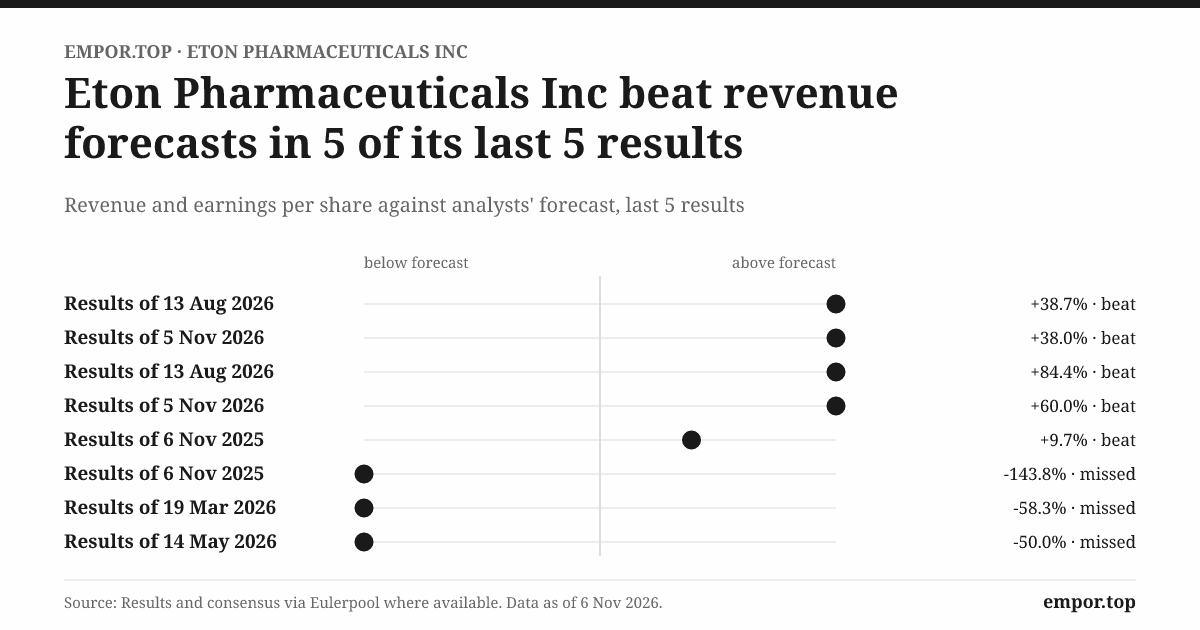
The scorecard of promises and outcomes is mostly positive. Eton set a revenue target and beat it early. It guided conservatively in 2026 and raised the number twice. It said the HEMANGEOL transition would take three to four months and finished most of it in two. Against that, ET-700's first result fell short of the efficacy management had hoped for, and the 2030 goal depends on approvals, acquisitions and organic growth that have not yet happened. The next test is whether guidance stays disciplined as the deal pace and the pipeline expand, because that is when a confident management team most needs a board willing to say no. Whether investors should pay for that confidence is the question the valuation forces.
IX. Analysis & Bear vs. Bull Case
Put Eton's numbers next to its peers and the premium jumps off the page. At November 6, 2026 prices, investors paid about 11.2 times sales for Eton's enterprise, against about 7.8 times for Xeris and about 3.8 times for Zevra.478 They also paid about 18.6 times book value.4 The stock had swung almost fourfold in a year, and its one-year volatility was close to 70%; in the past five years it had suffered a fall of about 64% from peak to trough.4 This is a market pricing a fast-growing small company, and pricing in a good deal of future success.
What does that price assume? At 11 times sales, and roughly 35 times operating profit, the market is not paying for the business Eton has; it is paying for something close to the business management describes. If Eton were simply to hold its third-quarter run rate of roughly $230 million and its current margins, the multiple would fall quickly toward the peer range. The premium is therefore a bet that revenue keeps compounding toward the $500 million ambition without the margin, the cash or the share count giving way. That is a claim about the future, and the fair way to test it is through the mechanisms that would break it.
The bull case begins with the commercial platform. Eton's small specialist team, its single-pharmacy access model and its patient-support program can, in principle, make each new product cheaper to sell than the last. The evidence is not only the HEMANGEOL transition but the operating leverage that followed: operating profit rose almost tenfold over three quarters while overhead barely moved.4 Growth was accompanied by record patient counts across six products, not just one.1 If that pattern holds, launches and acquisitions really do reinforce each other.
The bear case begins with the channel. Almost 94% of nine-month product revenue and 95% of receivables came through AnovoRx, a share that rose rather than fell as Eton grew.45 The company does not publish product-level sales or customer ageing, so outsiders cannot see how quickly that dependence is changing or how much of the growth is organic. A single pharmacy partner with that much of the revenue line has bargaining power that Eton's management cannot simply wish away.
The second bull argument is the balance sheet. Eton ended September with $55.6 million of cash, more than twice its $22 million of funded debt, and operating cash flow had strengthened sharply.4 For the first time in its history, the company is funding itself.
The second bear argument is that the same cash has too many claims on it. The SWK loan is secured, floating-rate and due in December 2027.4 Royalties on HEMANGEOL and other licensed products take a slice of every sale, and the amended Diurnal license alone carries up to $44 million of future sales milestones.5 Acquisitions, milestones, debt service and equity awards all compete for the same future dollars. A company that needs to keep buying products to grow has a structural appetite for capital, and it will be tested most when the next attractive deal arrives at a high price.
Hamilton Helmer's seven powers offer a stricter test of the moat, and Eton passes only some of them. Scale economies exist in a narrow form: the cost of a shared sales force and support hub is spread over more products, which is the operating leverage visible this year. But those economies are small in absolute terms; a larger rare-disease company with more products could achieve the same thing. Switching costs are modest. Families and specialists do not like to change a working therapy, and the HEMANGEOL transition shows that moving patients takes effort, but Eton itself has shown it can be done in a couple of months. There are no meaningful network effects. Brand matters among a few hundred specialists, but it is a reputation for service rather than a consumer brand that commands a price premium.
The most interesting power is cornered resource. A license or acquired product right, especially one with orphan exclusivity or a patent, is a resource only one company can hold. That is real, but it is temporary: HEMANGEOL's patent expiry is October 2028, according to management, and the underlying molecules are well known.6 Process power, the hardest power to copy, would require evidence that Eton's commercialization machine works systematically better than its rivals'. One fast transition and a year of record patient counts are encouraging, but not yet enough. Counter-positioning applies in a narrow sense: large pharmaceutical companies often find small rare-disease products not worth their attention, which is exactly what creates Eton's supply of assets. That same fact means competition for those assets comes from other small companies with the same idea.
Two further risks sit outside the moat analysis but bear on it. The first is the payer. Rare-disease medicines command high prices because few patients use them, but Medicaid rebates and commercial insurers' gross-to-net deductions already shape what Eton actually collects; management flagged rebate dynamics as a drag on HEMANGEOL's net price on the second-quarter call, and the auditor singled out Medicaid rebate estimates as the most judgment-heavy number in the 2025 accounts.65 Any tightening of U.S. drug-pricing policy would land on a company like Eton directly, because it has no diversified hospital or international business to cushion it. The second is the mix of what Eton is adding. IMPAVIDO is a lower-margin distribution product, and each new license brings its own royalty.6 A portfolio can grow in revenue while its average margin drifts down, which is why operating profit per product, not total revenue, is the honest test of the platform.
The comparison with Xeris and Zevra should be read carefully. Neither is a direct substitute; their portfolios and growth paths differ, and a lower multiple elsewhere does not prove Eton is mispriced. It does mean the premium is something Eton has to keep earning through growth, rather than something the sector grants automatically.
A skeptical long-short investor or activist would ask a short, pointed list of questions. What is acquisition-adjusted organic growth? What are product-level sales or, at least, product-level patient trends? How is the AnovoRx relationship contracted, and how quickly is concentration falling? What is operating cash flow per diluted share, and how fast is the share count growing? And what return has each product-rights purchase earned against its full cost? These are not hostile questions. They are the minimum disclosure a company with this valuation and this model should be expected to provide.
Three measures will tell investors the most. The first is AnovoRx's share of revenue and receivables, which rose from about 85% of revenue in 2025 to about 94% of product revenue in the first nine months of 2026, the wrong direction for diversification.54 The second is operating cash flow relative to operating profit, which reached about $50 million against roughly $38 million of operating profit in the first nine months, a strong but young reading.4 The third is the diluted share count, which rose from about 27.0 million to about 28.8 million between December and September.4
Land the thesis where the evidence supports it. Eton has a credible commercial playbook, real operating leverage and strong momentum. It does not yet have a demonstrated moat, a long enough record to establish the durability of its returns, or the disclosure needed to separate bought growth from built growth. The premium valuation is a wager that those gaps close in Eton's favor. The story so far offers a few lessons regardless of how that wager pays off.
X. Lessons from a Business Built on Rights
When Eton paid $14 million upfront for HEMANGEOL, it was buying something more slippery than a molecule: a product with a short patent clock and a patient relationship to rebuild.106 It moved about 95% of patients across by the end of June.6
The first lesson comes from that handoff. A drug right is an option on a relationship; the handoff is where the company earns it. The purchase multiple was only the opening calculation.10 What made the deal look smart in the third quarter was what followed: the patient-support program and the swift transition.6 For founders, the lesson is that buying an asset is a negotiation, but keeping its customers is an operating skill. For investors, it means the multiple paid tells you less than the retention that follows.
The second lesson comes from the guidance. Eton raised its 2026 revenue target twice, each time close to what it had already earned.61 When an analyst pushed for a higher figure, the chief executive defended the conservatism.1 A target is useful only when the next quarter tells you what changed. A conservative guide that is always beaten builds credibility, but it can also become a ritual that hides more than it reveals. The questions that matter are the ones guidance does not answer: which products grew, by how much and why.
The third lesson comes from the tax release that lifted Eton's reported net income in the third quarter.34 The benefit was real. It was also not the business. A profit number can be real and still be the wrong measure of the business. Investors who understood Eton's quarter looked past the bottom line to operating profit, cash flow and the share count, and asked what would recur.
The fourth lesson is the one that ties the others together. A company built on rights is only as good as its next allocation decision. The discipline that would make the model durable is the one this story keeps returning to: measure each product by patient adoption, cash returned and diluted shares, not by pipeline headlines or the number of deals signed. That discipline will be tested immediately, because Eton's next year is crowded with exactly the kinds of events that tempt companies to forget it.
XI. Epilogue
Tonight, Eton stands at the highest point of its short commercial life, with record patient counts, a roughly $230 million quarterly revenue run rate, more cash than debt and a share price near four times its year-ago low.41 The risks are just as familiar: pharmacy concentration, a patent clock and a valuation that assumes the next few years go well.46
The next moments that will decide the story are already on the calendar. Fourth-quarter results, due early in 2027, will show whether HEMANGEOL patients continue therapy after the transition. In January, Eton expects to begin dosing in ASN-001's bioavailability study, with an application planned around mid-2027.1 The FDA is due to rule on LIBERVANT for children aged six to eleven in late March, with a launch planned for April if approval comes and the exclusivity question is resolved.1 Glyburide is nearing filing, and the company says ET-700 will return to the clinic with faster-release formulations.1 The SWK loan comes due in December 2027.4
Each outcome carries a different meaning. If HEMANGEOL keeps growing and the older products keep adding patients, the organic engine is real, and Eton's premium has a foundation. If LIBERVANT is approved and wins share in a crowded rescue-therapy market, the platform has proved it can launch, not only acquire. If ASN-001 reaches the market in 2028 on schedule, the HEMANGEOL deal will look less like a two-year patent bet and more like the first step in owning infantile hemangioma treatment. And if AnovoRx's share starts to fall, while operating cash keeps pace with profit and the share count grows slowly, the flywheel will look like a flywheel.
Underneath those events runs a slower clock. HEMANGEOL's patent protection, by management's account, ends in October 2028, the same year ASN-001 could reach the market.61 If the timing works, Eton hands its hemangioma specialists a new topical product just as the old oral one becomes exposed to competition, and the relationship it bought in 2026 carries over to a product it licensed. If the timing slips, the company could face the erosion of a key product before its successor arrives. Few things in Eton's story will test the flywheel idea as directly as that handoff from one product to the next.
The bear's version of the same calendar is just as specific. A LIBERVANT delay, a stall in HEMANGEOL patients, receivables growing faster than sales or another large acquisition paid for with shares would each tell investors that growth is being bought rather than built. Management may continue to meet its conservative guidance, but the real test is whether it supplies the product-level data that would let outsiders separate acquisition growth from organic performance.
The decisive evidence is not another large target. It is whether the commercial portfolio grows without concentration, working capital or dilution absorbing the gains. That is a quieter story than $500 million by 2030, and it will be told over the next four quarters, one product at a time.
XII. Outro
Go back to the family with the baby and the prescription. Eton's business is everything around that decades-old molecule: the work of getting medicine to the child.
Eton still has to earn the right to keep each patient. Whether it can repeat that work across the portfolio is the question Eton is answering in public, one quarter and one family at a time.
References
-
Eton Pharmaceuticals (ETON) Q3 2026 Earnings Call Transcript — The Motley Fool, 2026-11-06 ↩↩↩↩↩↩↩↩↩↩↩↩↩↩↩↩↩↩↩↩↩↩↩↩↩↩↩↩↩↩↩↩↩↩↩↩↩↩
-
Form S-1/A — Eton Pharmaceuticals, Inc., 2018-09-25 ↩↩↩↩↩↩↩↩↩↩
-
Third Quarter 2026 Financial Results — Eton Pharmaceuticals, Inc., 2026-11-05 ↩↩↩↩
-
Form 10-Q — Eton Pharmaceuticals, Inc., quarter ended September 30, 2026 — SEC, 2026-11-05 ↩↩↩↩↩↩↩↩↩↩↩↩↩↩↩↩↩↩↩↩↩↩↩↩↩↩↩↩↩↩↩↩↩↩↩↩↩
-
Form 10-K — Eton Pharmaceuticals, Inc., FY2025 — SEC, 2026-03-19 ↩↩↩↩↩↩↩↩↩↩↩↩↩↩↩↩↩↩↩↩↩↩↩↩↩↩↩↩↩↩↩↩↩↩↩↩
-
Eton Pharmaceuticals (ETON) Q2 2026 Earnings Call Transcript — The Motley Fool, 2026-08-20 ↩↩↩↩↩↩↩↩↩↩↩↩↩↩↩↩↩↩↩↩↩↩↩↩↩↩↩↩
-
Form 10-K — Eton Pharmaceuticals, Inc., FY2024 — SEC, 2025 ↩↩↩
-
Form 8-K — HEMANGEOL acquisition terms — Eton Pharmaceuticals, Inc., 2026-02 ↩↩↩↩↩
-
Form 8-K — PKU GOLIKE acquisition terms — Eton Pharmaceuticals, Inc., 2024-03 ↩
-
Form 8-K — ET-400 PDUFA extension — Eton Pharmaceuticals, Inc., 2025-02 ↩
-
Definitive Proxy Statement — Eton Pharmaceuticals, Inc., 2026-04-24 ↩↩↩↩↩
-
Form 8-K: CFO Succession — Eton Pharmaceuticals, Inc., 2026-04-16 ↩
-
Form 8-K: Annual Meeting Results — Eton Pharmaceuticals, Inc., 2026-06-09 ↩
 LinkedIn
 WhatsApp
 Reddit
 Hacker News
 Email
 Kindle
 RSS Feed
 Spotify
 Apple Podcasts
 Amazon Music
 Audible
 YouTube