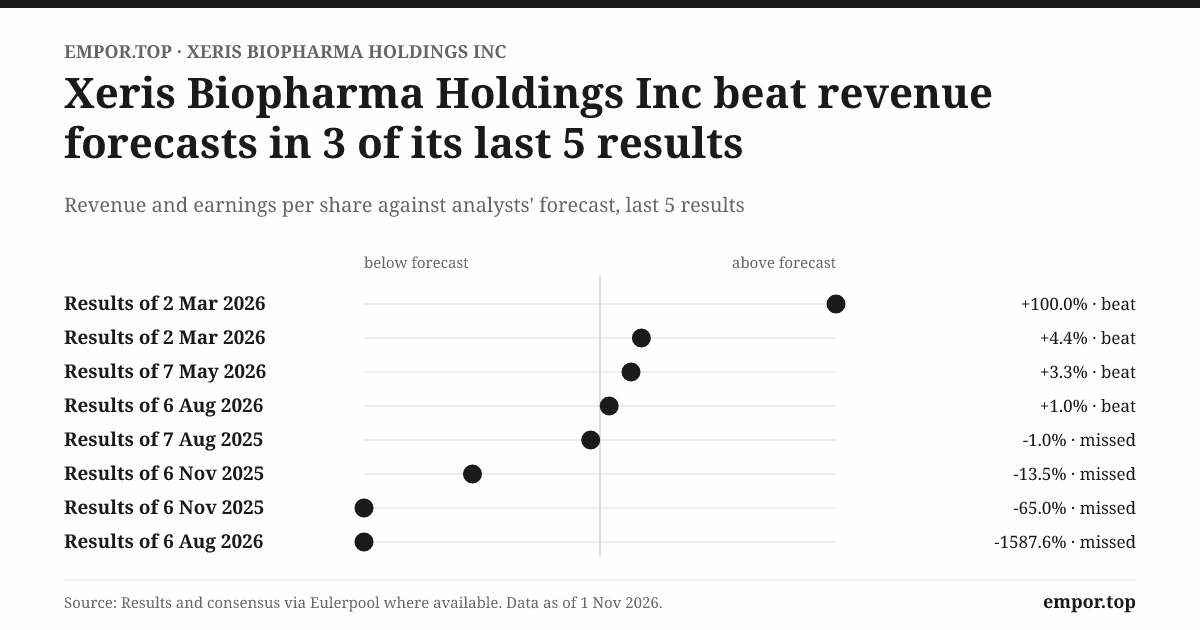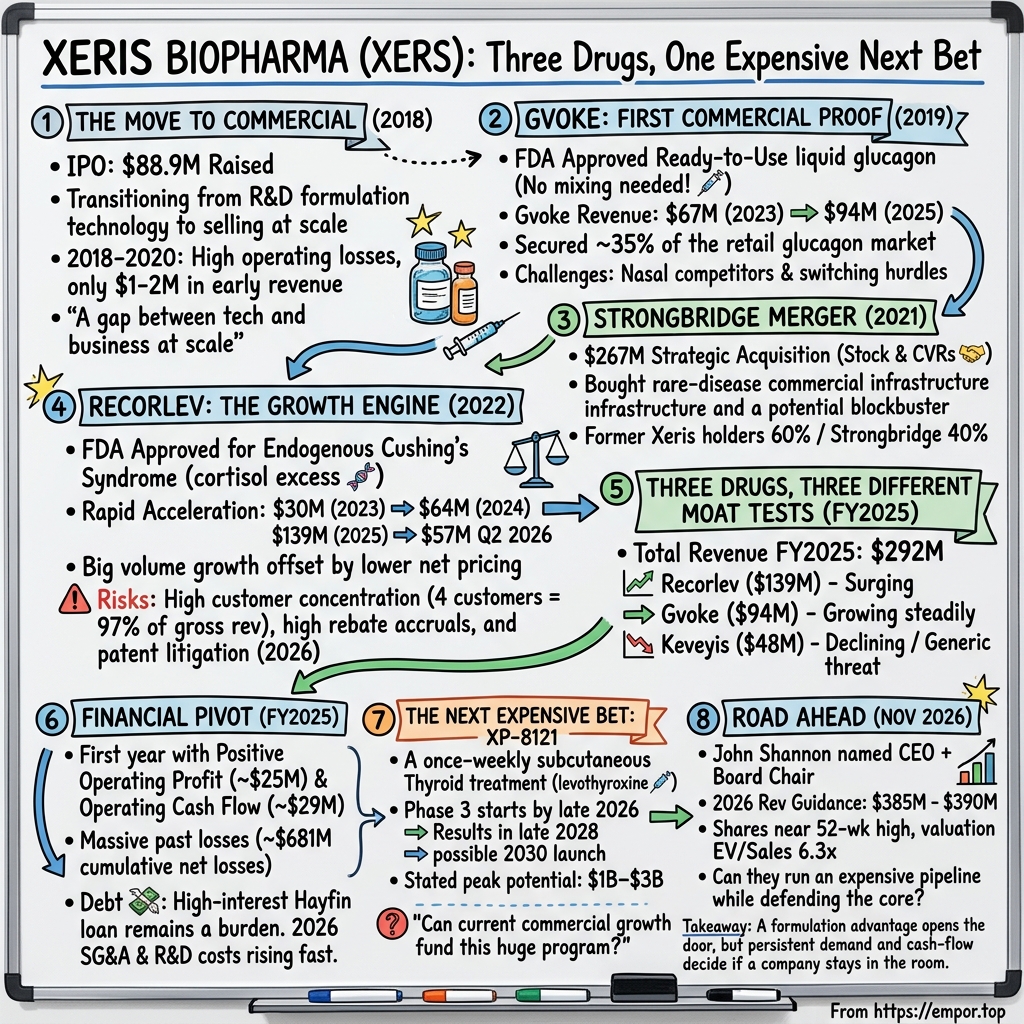
Xeris Biopharma: Three Drugs, One Expensive Next Bet
I. The company that had to become commercial
In June 2018, a small Chicago drug company stood in front of public investors with a technology, a pipeline and almost no sales. Xeris Pharmaceuticals sold its shares at $15 each and walked away with about $88.9 million after fees.1 The pitch was elegant. Many injectable drugs are fragile. They have to be refrigerated, freeze-dried into powder, or mixed by hand before anyone can use them. Xeris said it had found a way to dissolve some of those molecules in non-aqueous solvents, so they could sit at room temperature as ready-to-use liquids. It called its platforms XeriSol and XeriJect.1
The first medicine built on that idea was a liquid glucagon, the hormone that pulls a person with diabetes out of a dangerous low blood sugar. It was not yet approved. The company had never sold a medicine at scale. In both 2016 and 2017 its revenue was about $1 million, mostly grant and collaboration income, while operating losses kept widening as trials grew larger.1 In other words, the IPO was not a reward for a business. It was the money to try to build one.
The people around the table explain the pitch. Steven Prestrelski, the formulation scientist whose work underpinned the platforms, had spent his career on the unglamorous problem of keeping proteins and peptides stable, the kind of work that rarely makes headlines but decides whether a drug can survive a summer in a glove compartment.1 Paul Edick, the chief executive, was a commercial veteran brought in to turn the science into a company that could sell things.1 That pairing, a scientist's platform and a seller's ambition, defined the IPO story. Investors were being asked to believe that a lab advantage could be converted, one product at a time, into a portfolio.
The bet also had a clear logic about the market. Glucagon was a sensible first target precisely because the existing rescue kits were so awkward. If Xeris could show that its chemistry made an old hormone dramatically easier to use, it would prove the platform on a product with obvious patient benefit and a large, familiar market of people with insulin-treated diabetes. The idea was to win a beachhead, then reuse the same chemistry across other molecules, either alone or through partners who would pay to license it.1
That distinction is the spine of this story. A formulation technology is a capability, a bit like a clever engine design. A pharmaceutical business is the whole car, the dealers, the financing and a driver who wants to buy it again next year. Xeris spent the next eight years learning how expensive the rest of the car is.
Four questions run through everything that follows. The first is whether Recorlev, a Cushing's syndrome drug Xeris bought rather than invented, can keep growing at the pace that has transformed the company. The second is whether the portfolio as a whole can produce durable cash after Xeris pays for its sales force, its research and its interest. The third is whether the debt and the steady dilution that financed the journey can finally come down. The fourth is whether the next big pipeline bet, a once-weekly thyroid injection called XP-8121, can earn its place without starving the businesses that pay the bills.
The early years can be told quickly, because they rhyme. Revenue stayed around $1 million to $2 million a year through 2020, while operating losses climbed from about $13 million in 2016 to more than $120 million in 2019 as the company built a commercial team in anticipation of approval.21 Every year the gap had to be filled by someone else's money.
The IPO was only the first fill. In February 2019, eight months later, Xeris went back to the market and priced nearly 6 million new shares at $10 each, a third below the IPO price, raising about $55.5 million net.[^3] Investors who had bought at $15 were now watching the company sell stock at $10 to keep the lights on and the launch funded. That is not unusual for a development-stage biotech, but it set a pattern that would recur: when the business needed capital, it issued paper, and existing shareholders absorbed the cost.
Then came the largest piece of financial engineering in the company's history. In May 2021, Xeris agreed to combine with Strongbridge Biopharma, paying mostly in its own shares plus contingent value rights, small IOUs that would pay out only if certain milestones for Strongbridge's lead drug were met.[^4] That deal eventually reshaped the company into the holding company that trades today.
The shape of the plan, from the IPO onward, was simple to say and hard to do. Get a product approved. Build a sales force. Win patients. Use the revenue to fund the next product. The first step would prove that the Xeris formulation could reach the market. It would not prove that Xeris could win enough patients to pay for itself. The first test of that difference arrived in September 2019.
 Subscribe on LinkedIn
II. Gvoke proved the formulation could reach patients
Picture the old way of rescuing someone from a severe hypoglycemic episode. A person with type 1 diabetes collapses, confused or unconscious, because their blood sugar has crashed. A parent, a teacher or a stranger reaches for the red emergency kit. Inside is a vial of powder and a syringe of liquid. Under stress, with shaking hands, the rescuer has to inject the liquid into the vial, swirl it until the powder dissolves, draw the mixture back up and then inject it. Every step is a chance to fumble.
On September 10, 2019, the FDA approved Gvoke, Xeris' answer to that scene: the first ready-to-use, room-temperature-stable liquid glucagon for severe hypoglycemia, approved for patients aged two and older.[^5] It came in a prefilled syringe and in the HypoPen, an autoinjector that works more like an EpiPen than a chemistry set. The approval rested on three Phase 3 trials comparing Gvoke with the conventional mix-it-yourself kits.[^5] For a platform company, this was the proof of concept made flesh. A molecule that normally had to be stored as a powder had been turned into a stable liquid, and the regulator had agreed it worked.
There was a catch in the timing. Two months earlier, the FDA had approved Baqsimi, Eli Lilly's nasal glucagon, which a rescuer simply puffs into the nose.[^5] So Gvoke did not arrive as the only modern alternative to the red kit. It arrived as the second, and it arrived from a tiny company facing a giant. A ready-to-use injection is far easier than a mixing kit. A nasal spray avoids the needle altogether. Which of those conveniences matters more depends on the patient, the prescriber and the insurance formulary, not on the chemistry.
The launch itself was staged. The prefilled syringe was meant to reach pharmacies in October 2019, with the HypoPen autoinjector following in 2020.[^5] That sequencing was practical, since the autoinjector is a more complex device to manufacture, but it meant the most consumer-friendly version arrived after Baqsimi had already started building prescriber habits. In a category where a doctor writes a rescue prescription perhaps once a year for each patient, habits formed in the first months of a new product's life are sticky.
The launch also forced Xeris to become something it had never been: a company with sales representatives in doctors' offices, contracts with insurers, distribution agreements with wholesalers and patient-support programs. All of that costs money before the first prescription is written. Operating losses roughly doubled from 2018 to 2019, peaking at more than $120 million, as Xeris paid for that infrastructure ahead of revenue.2 This is the hidden price of commercialization that a formulation advantage does not cover. Every small company that decides to sell its own drug, rather than license it to a larger partner, must build this machine, and it must build it at a scale large enough to matter to prescribers but small enough to survive.
The commercial climb that followed was real but gradual. Gvoke's prescriptions grew year after year, and by 2024 the product brought in about $83 million, up roughly 24%, on about 265,000 prescriptions.3 By the fourth quarter of 2024, Xeris said Gvoke's share of retail glucagon prescriptions averaged about 35%.3 In 2025 Gvoke revenue rose to about $94 million, roughly 14% growth, up from about $67 million two years earlier.2
Those numbers deserve a careful reading, because they say two things at once. They say Gvoke became a genuine franchise: a product that started from zero in a market dominated by legacy kits and a Lilly-launched nasal spray, and grew into almost a third of Xeris' total sales. They also say that being first to a ready-to-use liquid did not make Gvoke the category leader. If roughly a third of retail prescriptions were Gvoke, then about two-thirds went to something else, whether nasal glucagon, older kits or newer rivals.34
It is worth being precise about what that share figure measures. It is Xeris' own count of retail glucagon prescriptions. It does not capture every unit of glucagon used in hospitals or institutions, and it does not tell anyone how often a Gvoke patient stays on Gvoke when the prescription comes up for renewal. A rescue drug is also an odd product. Many patients fill it, keep it in a bag or a drawer, and hope never to use it. Demand therefore depends heavily on whether doctors remember to prescribe it and whether pharmacies and insurers make it easy, rather than on how often patients consume it. Gvoke's sales also show some seasonality, which Xeris itself flags.2
So what kind of proof was Gvoke? It was clinical and regulatory proof that the platform worked, and it was commercial proof that Xeris could build a sales force, win formulary access and grow a product for years. It was not proof that formulation convenience creates a lasting moat. A competitor with a different kind of convenience held its ground, and the share Gvoke has won is the kind that has to be defended prescription by prescription.
That lesson matters for everything that came later. A convenient formulation can open the door. Prescriber habits, insurer access and patients' willingness to refill decide whether a product stays in the room. And in the years right after approval, Gvoke alone was nowhere near enough to cover the company's costs. Xeris was still burning roughly $80 million to $100 million of operating cash a year in 2019 through 2021.2 It needed something bigger, faster. In May 2021, it went shopping.
III. Strongbridge brought the drug that changed the company
On May 24, 2021, Xeris announced it would acquire Strongbridge Biopharma, an Irish-domiciled rare-disease company with a U.S. commercial base in Pennsylvania.[^4] On the surface it looked like a merger of two cash-hungry small caps. Underneath, it was a bet on one molecule that had not yet been approved.
Strongbridge brought two assets. One was Keveyis, an approved drug for primary periodic paralysis, a rare inherited condition in which patients suffer sudden episodes of muscle weakness or paralysis.[^4] It was a modest, steady earner with a specialist sales force behind it. The other was Recorlev, levoketoconazole, a cortisol synthesis inhibitor for endogenous Cushing's syndrome that was then under FDA review.[^4] Recorlev was the prize.
The logic, as management framed it, was a marriage of complementary halves. Xeris had a formulation platform and a primary-care and endocrinology sales organization built for Gvoke. Strongbridge had rare-disease expertise, endocrinology relationships and a potential launch. Put them together and the combined company could spread its overhead across three products instead of one, while Recorlev's launch gave the whole thing a growth engine.[^4]
The economics were simple to describe and harder to judge. Xeris offered Strongbridge holders a fraction of a Xeris share and one contingent value right worth up to $1 in cash or stock, tied to Recorlev milestones, for each of their shares. Including the maximum CVR value, the deal was valued at about $267 million, and the upfront consideration represented about a 37% premium to Strongbridge's prior closing price.[^4] Because it was paid mostly in shares, the deal transferred ownership as well as assets: former Xeris holders ended up with about 60% of the combined company and Strongbridge holders about 40%.[^4]5
Think about what that 60/40 split meant. Xeris shareholders gave away two-fifths of their company, and of all its future products and pipeline, in exchange for Keveyis, a Cushing's candidate and a sales team. If Recorlev failed, they had diluted themselves heavily for a slowly declining specialty drug. If Recorlev worked, the price could look cheap in hindsight. At signing, nobody could know which.
The case for Recorlev rested on forecasts. Strongbridge had pitched a potential peak-sales range of roughly $250 million to $350 million for the drug.5 The merger documents included the usual fairness opinions and comparisons of precedent deals.5 Those materials are useful as a record of what the parties believed, but they are not independent proof that Xeris paid a fair price. A seller's peak-sales estimate is, by construction, an optimistic case. A 37% premium for a pre-approval rare-disease asset is not outlandish by small-cap biotech standards, but it is not a bargain on its face either.
There was also a corporate rebuilding embedded in the transaction. To combine a U.S. company with an Irish one, the parties created a new holding company, Xeris Biopharma Holdings, which became the listed parent of both Xeris Pharmaceuticals and the Strongbridge entities.52 That is why the company that trades today has a different name and a different SEC filing history from the one that went public in 2018. The structure was plumbing, but it carried a message: Xeris was no longer presenting itself as a formulation-technology company that happened to sell glucagon. It was presenting itself as a biopharmaceutical company with a portfolio.
Why did Strongbridge's own holders agree? Because they faced the same arithmetic in reverse. Launching a rare-disease drug alone is expensive, and a small company with one approved product and one under review needs either a lot of cash or a partner to share overhead. By taking Xeris shares, Strongbridge holders kept a stake in Recorlev's upside while gaining Gvoke's revenue and a larger sales footprint. The CVR sweetened the bet for them if the launch went well. Both sides were, in effect, pooling risk to give one drug a better chance.
The deal closed in October 2021, and the bet got its first answer quickly.[^9] On December 30, 2021, the FDA approved Recorlev for adults with endogenous hypercortisolemia in Cushing's syndrome for whom surgery is not an option or has not been curative.[^9] The approval was based on two Phase 3 trials, SONICS and LOGICS, and came with a boxed warning for liver toxicity and heart-rhythm (QT) prolongation.[^9] That warning matters commercially. It means doctors must monitor patients, which adds friction, and it gives competitors a talking point.
What has happened since is the most important fact in Xeris' recent history. Recorlev generated about $139 million in 2025, more than doubling from the prior year, and became the company's largest product.2 That has not yet reached the $250 million to $350 million peak range that Strongbridge once advertised, but the growth curve is steep enough that the question has shifted from whether Recorlev works commercially to how high and how long.
The rest of the acquired portfolio tells a less flattering story. Keveyis revenue fell from about $57 million in 2023 to about $48 million in 2025.2 That is a slow erosion rather than a collapse, but it means one of the two products Xeris bought in 2021 is shrinking. Any honest scorecard on Strongbridge has to count both.
The CVRs add one more nuance. They were designed so that Strongbridge holders would be paid extra only if Recorlev hit specific regulatory and sales thresholds by certain dates.[^4]5 The deal's headline value of $267 million included the maximum CVR payout; a buyer who did not ultimately pay every CVR dollar paid less than the headline. The structure shifted some of the risk of a slow launch back onto the sellers, which was sensible engineering for a buyer without much cash.
So was Strongbridge a good deal? The evidence supports a narrower verdict than either cheerleaders or skeptics would like. It was strategically consequential: it gave Xeris the product that turned it into a growing commercial company. It was not a proven bargain at signing, because the premium was real and the forecast was only a forecast. Five years later, Recorlev's growth has made the deal look productive, but the case rests almost entirely on one drug. The acquisition worked most clearly through a single product, which makes Recorlev's growth rate and competitive life unusually important to everyone who owns the stock.
IV. Recorlev became the growth engine
Cushing's syndrome is a disease of too much cortisol, the body's main stress hormone. Most often the cause is a small tumor, frequently in the pituitary gland, that drives the adrenal glands into overproduction. The symptoms read like a list of things that go wrong slowly: weight gain around the middle, a rounded face, high blood pressure, high blood sugar, thinning bones, easy bruising, depression. Because each symptom is common on its own, the disease can take years to diagnose. Surgery to remove the tumor is the first choice, but it does not always work, and some patients cannot have it. For them, a drug that brings cortisol down becomes the treatment.
Recorlev is one of those drugs. It works by blocking enzymes the adrenal glands use to make cortisol, a bit like turning down the valve on an overflowing tank.[^9] Xeris launched it in 2022, shortly after approval, and the company's endocrinology sales force took it to the relatively small number of specialists who manage these patients.[^9]2
The early launch was not explosive. Recorlev brought in about $30 million in 2023.2 Then it accelerated sharply, reaching about $64 million in 2024 and about $139 million in 2025.2 In the second quarter of 2026, Recorlev revenue was about $57 million, up 81% on the year-earlier quarter.[^10] Put that in perspective: Recorlev alone now earns in one quarter roughly what the entire company earned in a year as recently as 2021, and in the second quarter of 2026 it supplied more than 60% of total revenue of about $92 million.[^10]
Why did a drug that grew modestly in its first two years suddenly double, and then double again? The shape of the curve is common in rare diseases, and it is worth explaining. A rare-disease launch is a slow education campaign. The specialists who treat Cushing's syndrome need to learn the drug's profile and its monitoring requirements. Insurers need to put it on their coverage lists, often after demanding prior authorizations. Patients who are stable on another therapy rarely switch without a reason. So the early years accumulate small numbers of patients one at a time. Because the patients who start a chronic cortisol-lowering drug tend to stay on it for months or years, each new cohort stacks on top of the last. Once prescriber familiarity and coverage reach a tipping point, the stacked base can make revenue look like it is accelerating even if the rate of new starts is only rising steadily.
That mechanism cuts both ways. It means past growth carries forward, because patients already on therapy keep generating revenue. It also means growth rates naturally slow as the base gets larger, even if Xeris is adding as many new patients each quarter as before. The 81% second-quarter growth rate is impressive; a lower rate in later quarters would not necessarily signal a problem. What would signal a problem is a fall in the absolute number of patients added each quarter, or a rise in discontinuations.
Xeris has also been spending to push that mechanism harder. The company expanded its Recorlev sales effort in 2026, part of the roughly $50 million planned increase in commercial and administrative spending.6 On the second-quarter call, analysts asked directly about the return on that investment, which is the right question: a larger sales force is worth it only if each additional representative brings in more profit than they cost.6
What is driving the acceleration? Xeris has been specific about one point. It said Recorlev's 2025 growth came from volume, more patients on therapy, partly offset by lower pricing.2 That is an important admission. It means the company is not simply raising prices on a captive population; it is adding patients, and realized price per patient has drifted down, likely because of rebates, payer mix and discounts. Growth through volume is healthier than growth through price, but falling net price also signals that payers have leverage.
On the second-quarter 2026 call, management emphasized strong patient demand and expanding prescriber and referral activity, and said more than 60% of Recorlev patients were new to therapy rather than switching from another Cushing's medicine.6 If that holds, it supports the company's most ambitious claim: that Recorlev is expanding the market, finding undiagnosed or untreated patients, rather than just carving up an existing one. It is a company-reported figure, not an audited one, and no outside data source verifies it. The way to test it is to watch patient additions alongside net revenue per patient over several quarters. A market-expansion story should show patient counts rising faster than price falls.
The competitive backdrop explains why that matters. The incumbent in medically treated Cushing's syndrome is Corcept Therapeutics, whose drug Korlym, mifepristone, blocks the cortisol receptor rather than cortisol production. Korlym generated about $761 million of revenue in 2025.7 That is more than five times Recorlev's 2025 sales. The comparison is not a clean market-share calculation: Korlym and Recorlev work through different mechanisms, are used in somewhat different patients and are often discussed for different clinical situations, and Corcept itself faces generic mifepristone competition and other rivals such as osilodrostat.7 But it shows how large a nearby Cushing's business can become, and how established the alternative is. Xeris is not building in an empty field. It is growing next to a much larger, more profitable specialist with deep relationships among the same endocrinologists.
Now follow the money from the pharmacy back to Xeris. Like most specialty drug companies in the United States, Xeris does not sell directly to patients. It sells to a handful of wholesalers and specialty distributors, which then supply the pharmacies. Four customers accounted for 97% of gross product revenue in each of 2023, 2024 and 2025, and those same customers made up 92% of receivables at the end of 2025.2 The company does not name them. That level of concentration is normal for the industry, but it means a few counterparties stand between Xeris and nearly all of its cash.
The bigger accounting judgment sits further down the chain. When a Recorlev prescription is dispensed, Xeris books revenue at an estimated net price. The real net price depends on which insurer or government program ultimately pays, what rebate that payer is owed, and how many months later that rebate is settled. At the end of 2025, Xeris carried $43.3 million of accrued trade discounts and rebates, and its auditor flagged that accrual as a critical audit matter because the estimate depends on payer mix and the lag between dispensing and settlement.2 For scale, that accrual was almost as large as the company's entire year-end receivables of about $51 million.2 A critical audit matter is not a warning of an error; the opinion was unqualified. It is the auditor telling readers where the hardest judgment lives. If payer mix shifts toward programs with steeper rebates, today's revenue could prove to have been estimated too high.
Then there is protection. A small-molecule drug's economics depend on how long it stays free of generic copies. In February 2026, Xeris sued Torrent and Somerset over alleged infringement of Recorlev patents that run to 2040, after generic makers sought approval to copy the drug.2 Litigation like this is how branded drugmakers defend exclusivity in the United States, and a filing can trigger a statutory stay on generic approval while the case proceeds. But the outcome and timing are uncertain, the cases are expensive, and a loss would compress the period in which Recorlev can earn branded returns.
Weigh it all, and Recorlev is the clearest evidence in the company's history that Xeris can turn an acquired, approved therapy into fast-growing sales. The growth is real and audited. The broader claim, that this growth is durable and that Recorlev will keep expanding the Cushing's market for years, is narrower than management's framing. It depends on patient additions continuing to outrun price erosion, on rebate estimates holding up, on a much larger competitor not changing the game, and on patent litigation going Xeris' way. The single most useful number for an outsider is Recorlev's quarterly net revenue read together with patient growth. When both rise, the story holds. When revenue rises only because of patients while price keeps sliding, or when patient growth slows, the story is changing.
And that raises the question the next part of the story has to answer: if Recorlev is this strong, does Xeris own a repeatable advantage across its products, or does each product have to win on its own?
V. Three products, three different tests of the moat
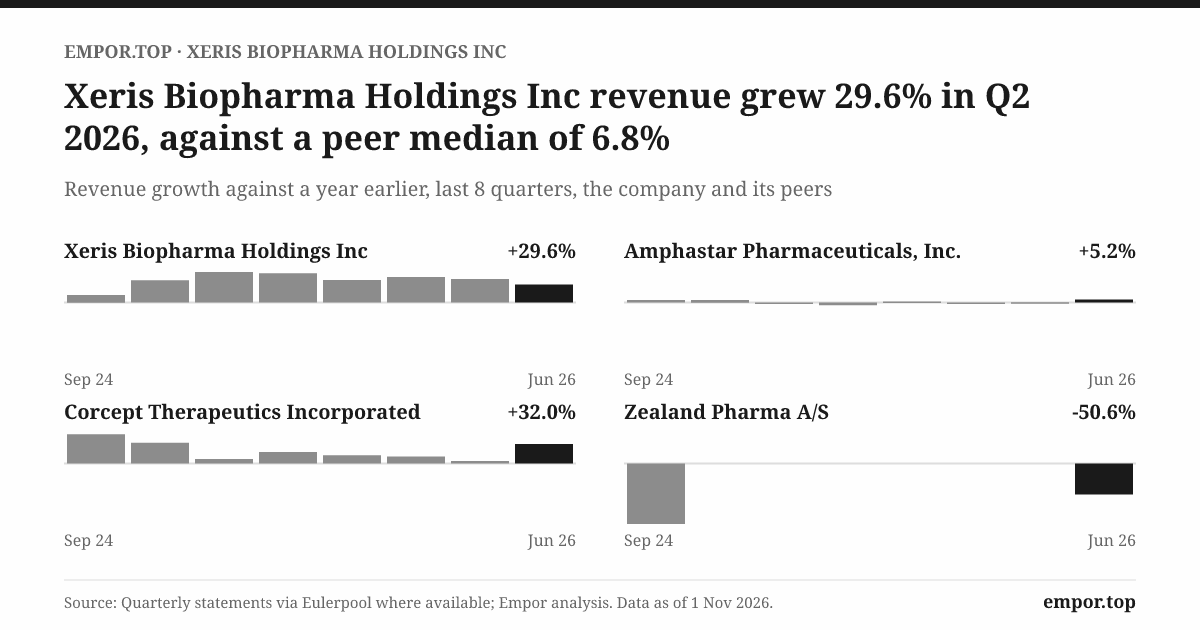
Line up Xeris' 2025 revenue and it tells three stories at once. Total revenue was about $292 million.2 Recorlev contributed about $139 million, almost half. Gvoke contributed about $94 million, about one-third. Keveyis contributed about $48 million, about one-sixth, and royalties and collaboration income made up the remainder.2 One product surging, one growing steadily at about 14%, and one slipping by about 4%.2
Averages hide that divergence. Company-wide revenue grew about 43% in 2025, which sounds like a portfolio firing on all cylinders.2 In reality, most of that growth came from one engine, a second engine contributed moderately, and a third was a slow drag. Listeners who own the stock are really owning three separate bets that happen to share a sales force and a balance sheet.
This is where a classic competitive-strategy lens helps, applied to each product rather than to the company as a slogan. Michael Porter's five forces asks who holds bargaining power over a business's profits. Hamilton Helmer's seven powers asks whether a company has a durable structural advantage, things like switching costs, scale economies or a cornered resource, that lets it earn more than rivals for a long time. Applied to Xeris, both frameworks point in the same direction.
Start with the buyers. The immediate buyers are those four wholesalers, and behind them stand the real economic buyers: insurers, pharmacy benefit managers and government programs that decide which drugs patients can get and at what net price. Their power shows up in two places in Xeris' own disclosures: the concentration of revenue in a few distributors, and the large, judgment-heavy rebate accrual.2 When Recorlev's pricing drifted down even as volume soared, that was buyer power in action.2
Next, substitutes and rivals. Gvoke competes against nasal glucagon and older kits; Xeris' own figure of about 35% retail share at the end of 2024 means it is a strong challenger, not the leader.3 Recorlev competes for Cushing's patients alongside a much larger incumbent in Korlym and other cortisol-lowering drugs.7 Keveyis faces the threat of generic dichlorphenamide, which is why Xeris filed a new patent action in October 2026.8 In every case, prescribers and payers have alternatives.
Suppliers matter less but are not trivial. Xeris buys Keveyis supply from Taro under an agreement that requires minimum marketing spend and minimum purchase quantities tied to the prior year, and that agreement was amended to run through March 2027.2 A declining product with a minimum-purchase commitment is a small but real squeeze on cash and on inventory.
Barriers to entry are mostly regulatory and legal rather than economic. A new competitor needs FDA approval, which takes years, and generic makers must clear patents. Those are real barriers, but they are time-limited and contestable, which is precisely why Xeris is in court over both Recorlev and Keveyis.
Now Helmer's question. Does Xeris have switching costs? Nothing in its filings establishes high switching costs for any product; a doctor can write a different glucagon prescription tomorrow, and Cushing's patients can move between therapies when clinically sensible.2 Does it have scale economies? Its sales force is now spread across three products, which helps margins, but it is small compared with Corcept's in Cushing's or Lilly's and Amphastar's in diabetes. Does it own a cornered resource? Its patents and its formulation know-how are the closest candidates. The patents are real but contested; the formulation capability is real but has produced uneven commercial results. Counter-positioning, network effects and brand do not obviously apply.
The fairest conclusion is that Xeris has a commercial platform and product-specific strengths, but the evidence does not establish a portfolio-wide moat. Its advantage is better described as a capability: the ability to take a niche specialty drug, get it reimbursed and sell it to a defined group of specialists. That capability is valuable, and Recorlev's growth proves it can be executed. But Keveyis' decline shows the same sales organization cannot stop erosion on its own, and Gvoke's contested share shows the formulation technology does not guarantee leadership.
The formulation platform deserves its own honest accounting. Xeris has long described XeriSol and XeriJect as technologies that partners can license to make their own drugs more stable or more concentrated.1 That has produced some royalty and collaboration revenue, but the amount remains small relative to product sales.2 Gvoke is the platform's flagship commercial success, and XP-8121 is its next big test. Until the platform produces a second commercial winner, or partners pay meaningful sums to use it, it is better treated as a capability than as a standalone moat.
The October 2026 Keveyis patent action belongs in proportion. Xeris disclosed that it had filed suit over a generic version of dichlorphenamide, Keveyis' active ingredient.8 That is a defense of a still-material product that brings in tens of millions a year. It is not proof that a new patent has already kept generics off the market, and Keveyis revenue was already declining before the case was filed.2
Which leaves the central moat test for the whole company. Can Xeris keep adding and retaining patients while sustaining net price, even though competitors, payers and generic makers all have alternatives? So far, Recorlev says yes on patients and "not quite" on price; Gvoke says yes on growth and "not first" on share; Keveyis says the default trajectory without new protection is down. Those are three different answers, and the company's economics depend on how they combine. That combination finally started producing profits in 2025, which is where the story turns from strategy to money.
VI. Profit arrived, but so did the investment bill
For most of its life, Xeris' income statement looked like a fundraising schedule. From 2016 through 2024, the company never once posted a full-year operating profit. Then, in 2025, it did.
The turn was not subtle on a quarterly chart. Operating losses had narrowed through 2024, with the company briefly in the black in the fourth quarter of that year. Through 2025 the operating line stayed positive in three of four quarters and ended the year with about $17 million of operating profit in the fourth quarter alone.2 For the full year, revenue of about $292 million produced operating profit of about $25 million and operating cash flow of about $29 million.2 Year-end cash and short-term investments were about $111 million, and cash stood at about $122 million in June 2026.29
Set that against the decade that came before. From 2016 through 2025, Xeris accumulated roughly $681 million of net losses and about $532 million of operating cash outflow.21 Shareholders and lenders paid for every one of those dollars. The first positive operating year is therefore a genuine milestone. It is the moment when a company that existed on outside capital started generating some of its own.
One nuance first. Data providers that round to the nearest million show Xeris' 2025 net income as zero. The annual report records a small net income of about $0.6 million.2 The difference is trivial in dollars but not in symbolism: Xeris did, narrowly, make money in 2025 at the bottom line.
How did operating profit of $25 million become net income of under $1 million? Mostly through interest. Xeris paid about $29 million of interest expense in 2025, far more than the roughly $5 million of interest and other income it earned on its cash.2 The company had become profitable as an operating business while remaining, financially, a borrower whose lenders took nearly all of the operating profit. The main loan, a secured term facility from Hayfin, carries a floating rate, so the cost of that debt moves with interest rates rather than being locked in.2
Now look at the quality of the cash. Operating cash flow of about $29 million was nearly fifty times the net income figure, which sounds like spectacular cash conversion until one opens the bridge. Two large non-cash charges were added back. Share-based compensation was about $22 million, and amortization of acquired intangible assets, mostly the cost of Strongbridge's drugs being written off over time, was about $11 million.2 Those add-backs are legitimate accounting, but share-based compensation is not free. It is paid in new shares rather than cash, which means it shows up later as dilution. An investor who wants to know what the business really earns for each existing share has to treat a large part of that $22 million as a real cost.
Working capital pulled in the other direction. Receivables used about $11 million of cash and inventory about $19 million, so together the business tied up roughly $30 million more in unpaid bills and stock on shelves.2 Some of that is the natural cost of growth: when sales rise 43%, more money is owed by wholesalers at any moment. The inventory build is more notable. Xeris carries a lot of inventory relative to the cost of what it sells, measured at well over a year of supply, partly because drug manufacturing runs in long, lumpy batches.2 Rising accrued rebates partly offset those uses, since Xeris owed payers more and had not yet paid them.2 That offset is itself temporary: a rebate accrued today is cash out the door when it settles.
Put plainly, Xeris' 2025 cash generation is real, but it is not the same as recurring earnings that shareholders could pocket. It is cash flow before paying employees partly in stock, and it was flattered by the timing of rebate settlements.
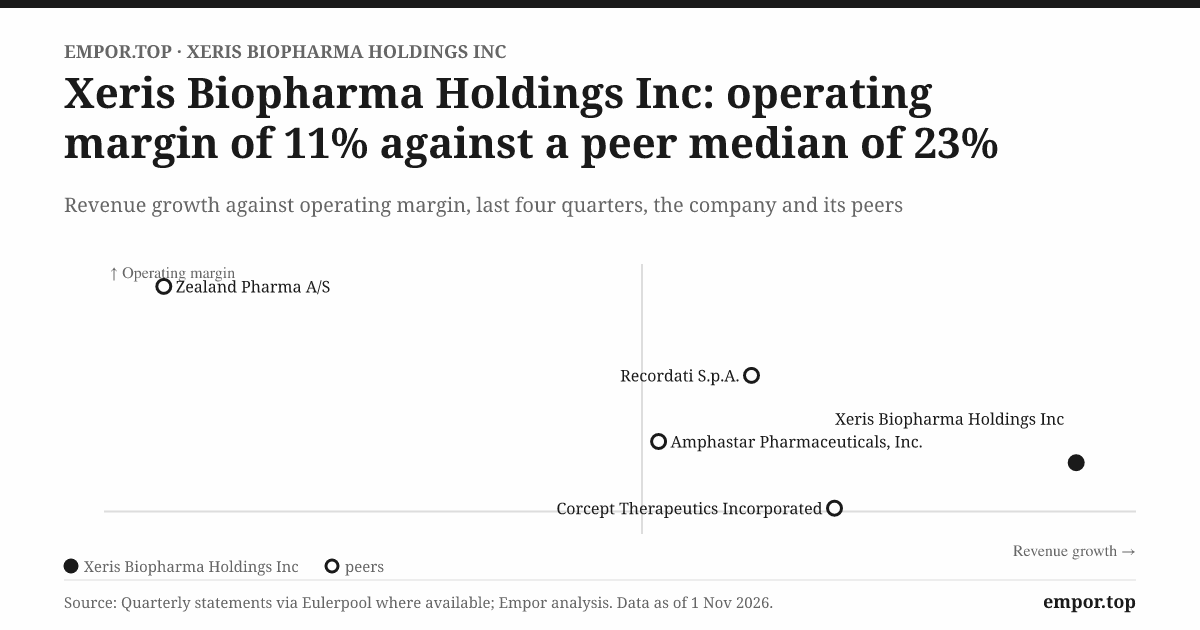
Where did the margin improvement come from? The cost lines answer it. Between 2024 and 2025, revenue rose by about $89 million while operating results swung from a loss of about $34 million to a profit of about $25 million, an improvement of nearly $60 million.2 Research spending rose only about $6 million. That means roughly two-thirds of each new revenue dollar flowed through to operating income, after the cost of making the drugs and the modest growth in sales and administrative expense. That is the classic operating leverage of a specialty pharmaceutical company: once the sales force and the back office exist, additional prescriptions are cheap to serve. It is also why the company's choice to step up spending in 2026 matters so much. Operating leverage works in reverse when costs grow faster than sales.
The balance sheet tells the longer story of how expensive the journey was. Shareholders' equity was negative at the end of 2023 and 2024, meaning accumulated losses had exceeded all the capital ever paid in, and it turned only slightly positive, about $14 million, at the end of 2025.2 That is why some return-on-equity figures for Xeris look absurd, such as triple-digit percentages: dividing by an equity base near zero produces meaningless ratios. The more useful measure is simpler. At the end of 2025, Xeris had roughly $111 million of cash against about $220 million of reported long-term debt, so lenders, not shareholders, financed much of the remaining asset base.2
The investment bill arrived at the same moment the profits did. In 2025, R&D spending was about $31 million, about 11% of revenue.2 Capital expenditure was under $1 million, because Xeris uses contract manufacturers and invests mostly in people rather than plants.2 At the end of 2025 it employed 435 people, about half of them in sales and marketing.2 Then, on the second-quarter 2026 call, management described planned 2026 increases of roughly $25 million in R&D and $50 million in sales, general and administrative spending, to prepare XP-8121's Phase 3 trial and to expand the commercial organization behind Recorlev.6 That is about $75 million of additional annual cost, more than twice 2025's operating cash flow.
Revenue growth can pay for a lot of that; 2026 guidance of $385 million to $390 million implies roughly $95 million more revenue than in 2025, and most of each new dollar of drug sales falls through after the cost of goods.[^10] But the arithmetic is tight, and it explains why operating margin in the first half of 2026 slipped from the fourth-quarter 2025 peak of nearly 20% to single digits.[^10][^15]
The second-quarter 2026 headline looked worse still: a net loss of about $31 million on revenue of about $92 million.[^10] That loss was not an operating collapse. It mostly reflected a one-time, non-cash fair-value charge tied to agreements to exchange the company's convertible notes.[^10]9 In plain terms, Xeris agreed to retire its convertible bonds partly by giving holders shares, and the accounting required it to record a loss for the value handed over in that exchange. The operating business was still profitable that quarter, with about $5 million of operating income.[^10]
The verdict on this chapter is clear, and it needs one hedge. Commercial scale has changed Xeris' economics, from a company that consumed cash every year to one whose operations can, in a good year, fund themselves. The hedge is that the cushion is thin relative to what is now being asked of it: a planned step-up in spending, interest on secured debt, the working capital that growth consumes, and equity pay that dilutes. The durability test is not adjusted EBITDA, which excludes many of those costs. It is operating cash flow after working capital and after counting share compensation as a cost, and whether that number can cover the investment plan. And the largest single item in that plan is a bet on the thyroid.
VII. The next bet is a weekly thyroid injection
On September 9, 2026, Xeris hosted a webinar for investors and analysts that was, in effect, a pitch for the company's second act.[^16] The subject was XP-8121, a once-weekly subcutaneous injection of levothyroxine for hypothyroidism.[^16] Management laid out the Phase 3 program, trial design and timeline, and took questions from analysts.
To see why this matters, start with the patient. Hypothyroidism, an underactive thyroid, is one of the most common chronic conditions in America. The standard treatment is levothyroxine, a cheap generic pill taken every day, usually first thing in the morning on an empty stomach and apart from food, coffee and certain other medicines that can interfere with its absorption. Many patients do perfectly well. But some struggle to keep their thyroid levels in range, whether because of absorption problems, other medications, or the simple difficulty of perfect daily routines over decades. Each time levels drift, the doctor adjusts the dose and tests again.
XP-8121's proposition is to replace that daily ritual with a weekly injection under the skin, using Xeris' formulation technology to make levothyroxine stable as an injectable liquid.[^16] The idea is the same one that animated Gvoke: take a treatment that works but is awkward, and remove the friction.
The timeline management presented is long. Xeris said it expects to start Phase 3 by the end of 2026, aims for topline results in late 2028 and could see a launch in 2030.[^16]6 Management estimates peak net revenue potential of $1 billion to $3 billion a year.[^16] To put that in context, the top of that range is more than ten times Xeris' entire 2025 revenue.
The size of that opportunity is precisely why it deserves skepticism. A peak-sales estimate is management's scenario, not demonstrated demand. The challenge is not whether a weekly injection could work biologically; earlier-stage data persuaded Xeris to move into Phase 3. The challenge is commercial. XP-8121 will compete against one of the cheapest drugs in medicine. Insurers will ask why they should pay a branded price for an injectable version of a pill that costs pennies. Doctors will ask which patients need it. Patients will weigh a weekly needle against a daily pill. A $1 billion product needs a large population for whom the convenience or consistency is worth the cost to whoever pays, and Phase 3 must show clinical performance strong enough to justify that price.
The economics of a trial like this are different from anything Xeris has run before. Gvoke's Phase 3 work compared a rescue drug against an existing kit in a controlled setting. Recorlev's trials were run by Strongbridge before Xeris owned it. A thyroid program in a common chronic disease has to show that a weekly dose keeps thyroid hormone levels in range over many months, in enough patients to satisfy regulators, while monitoring the safety of repeated injections. Long trials in common diseases are slower to enroll than people expect, and the cost of each month of delay is borne entirely by the sponsor.
There is also a strategic choice embedded in the program. Xeris could, in principle, develop XP-8121 alone and sell it through its own sales force, or bring in a partner with a larger primary-care presence to share the cost and the reward. Hypothyroidism is mostly managed by primary-care doctors as well as endocrinologists, a far broader audience than the specialists who prescribe Recorlev. Management has emphasized its existing commercial platform as an advantage.[^16]6 Whether that platform is large enough for a primary-care launch of this scale, without a partner, is an open question that the company will have to answer before 2030.
There is a meaningful gap between technical progress and commercialization. A Phase 3-ready program and patent protection are milestones. They do not establish efficacy, approval, reimbursement or demand. Xeris' own record sharpens the point: in two decades, Gvoke has been the platform's one meaningful commercial success. The platform's commercial conversion rate so far is one meaningful product, Gvoke, in two decades.
The funding question sits right next to the scientific one. Phase 3 trials in a large chronic condition are expensive and long, and the planned R&D increase is only the start of the spending.6 Xeris must also fund its commercial expansion, debt service and working capital needs.26 If the core business keeps growing, it can carry this program. If Recorlev slows, the company would face a choice between cutting the trial, adding debt, issuing shares or finding a partner.
It is revealing to compare the two moments when management talked about XP-8121 in 2026. On the second-quarter call in August, the program appeared as part of a broader growth narrative, with analysts asking about timing.6 The September webinar went further, with detailed trial design and a specific long-range commercial thesis.[^16] The timing was consistent between the two. What changed was the amount of conviction on display. That is normal for a company preparing to commit significant money, and it is exactly why outsiders should hold management to the milestones it has set.
Those milestones form a sequence, and each must be passed in order. First, Phase 3 starts on time. Second, enrollment proceeds without major delay or redesign. Third, results arrive and show that the weekly injection keeps patients in range as well as or better than daily pills. Fourth, Xeris finances the run-up to launch without crippling dilution. Fifth, payers agree to cover it at a price that makes the economics work. XP-8121 is plausibly material to the future of the company. It is also, today, a plan rather than a product. Which brings the story to the people making that plan, and the balance sheet they have to make it with.
VIII. Shannon's expanded role meets the balance sheet
On July 1, 2026, John Shannon added a second title. Already Xeris' chief executive, he also became chair of the board, and Marla Persky was designated lead independent director to balance the combined role.10
Shannon is not a founder. He had served as Xeris' president and chief operating officer, running the company's day-to-day operations, before succeeding Paul Edick as CEO in August 2024.11 Edick had led the company since before its IPO and through the Strongbridge deal.111 So the Xeris of today is, in a sense, an operator's company: the executive who ran operations through the Recorlev ramp is now in charge of the whole thing, including the board that oversees him.
That matters because the job has changed. Edick's era was about getting products approved, raising money and making a transformational deal. Shannon's era is about running a profitable specialty business without letting costs run ahead of revenue, while funding the largest development program the company has attempted. The first job rewards boldness. The second rewards discipline, and one of its main tools is a board willing to say no. Combining the chair and CEO roles is common in American companies, and the lead independent director role exists precisely to provide a counterweight. Whether that counterweight is real is something outsiders can judge only by its results: how the board handles pay, guidance and any future acquisition.
His pay reflects that. Shannon's total reported compensation was about $5.0 million in 2025, up from about $3.8 million in 2024, the year he became CEO.11 Of the 2025 figure, about $2.8 million was stock awards and about $608,000 was a cash incentive tied to corporate objectives.11 Equity is the largest part of his package, which aligns him with shareholders in direction but also contributes to the share-based compensation that dilutes them. Directors and executive officers as a group held about 4.35% of the company at the 2026 proxy date.11 That is a meaningful but not controlling stake, and it covers the whole group, not Shannon alone. The largest outside holders were index giants Vanguard and BlackRock, each holding around 6%.11
The governance counterweight came at the 2026 annual meeting. Shareholders re-elected the board, but two nominees, John Johnson and Dawn Halkuff, received substantial withhold votes.12 Johnson is a familiar name in this story: he had led Strongbridge and joined the combined board after the merger.5 Say-on-pay passed comfortably, with about 82.2 million votes for and 4.7 million against.12 The 2025 say-on-pay had won about 89% support.13 Taken together, this is a board structure functioning normally, with notable dissent on two directors that deserves tracking, not evidence of a control failure.
The capital-allocation record is mixed in the way of most small biotechs that survived. The Strongbridge combination expanded the portfolio and delivered the growth engine, though it came with substantial dilution. Through 2025, shares outstanding rose from about 149 million to about 166 million, partly because of convertible-note conversions and warrant settlements.2 In January 2026, Armistice Capital exercised warrants for about 2.3 million shares, paying about $7.3 million.[^10] Then in July 2026, Xeris retired its remaining convertible notes due 2028 through a mix of cash repayment and share exchanges or conversions.[^10] Management said the transaction would cut interest expense.[^10]6 It also removed the overhang of bonds that could convert into stock at any time. But it used cash and issued shares, so existing holders paid for the simplification through dilution.
What remains is the secured Hayfin term loan, about $189 million at the end of 2025, maturing in March 2029 with a floating rate.2 It holds a first-priority claim on substantially all of Xeris' assets, including its intellectual property, and its covenants restrict additional debt, liens, acquisitions, dividends and asset sales.29 The filings disclose no covenant default.9 But in practice the lender sits ahead of shareholders on everything Xeris owns, and it has a say in any big strategic move, including the further acquisitions analysts have asked about.
One piece of governance history should be stated only in proportion. In 2023, Xeris dismissed KPMG as its auditor and appointed Ernst & Young.14 The company reported no disagreements and no reportable events in connection with the change, and KPMG's letter did not dispute that.14 EY's opinion on the 2025 financial statements and internal controls was unqualified.2 Auditor changes sometimes signal trouble; this one, on the record available, did not.
Management's credibility is best judged by its guidance. On the first-quarter 2026 call and again on the second-quarter call, Xeris raised the bottom of its full-year revenue guidance while holding the top at $390 million, leaving a range of $385 million to $390 million.[^15][^10] Raising floors while holding ceilings is a conservative pattern: it signals confidence in the base without promising upside. Analysts on the second-quarter call pressed on three topics: the return on the expanded Recorlev sales force, the timing of XP-8121 and the appetite for further M&A.6 Management's prepared remarks emphasized demand and execution; the Q&A showed where investors are nervous, which is whether the new spending will pay back and whether the company might buy its way into the next chapter.
So management has delivered the commercial transition, and the acquisition it made produced a fast-growing lead asset. That is a real record. The next credibility test is whether guidance, investment and dilution stay aligned with results now that the CEO also chairs the board. The scorecard is forward-looking and specific: revenue against guidance, share count, cash interest after the note retirement, and evidence that the independent directors are exercising real oversight. All of that is what the market is now pricing.
IX. What is priced into the next chapter?
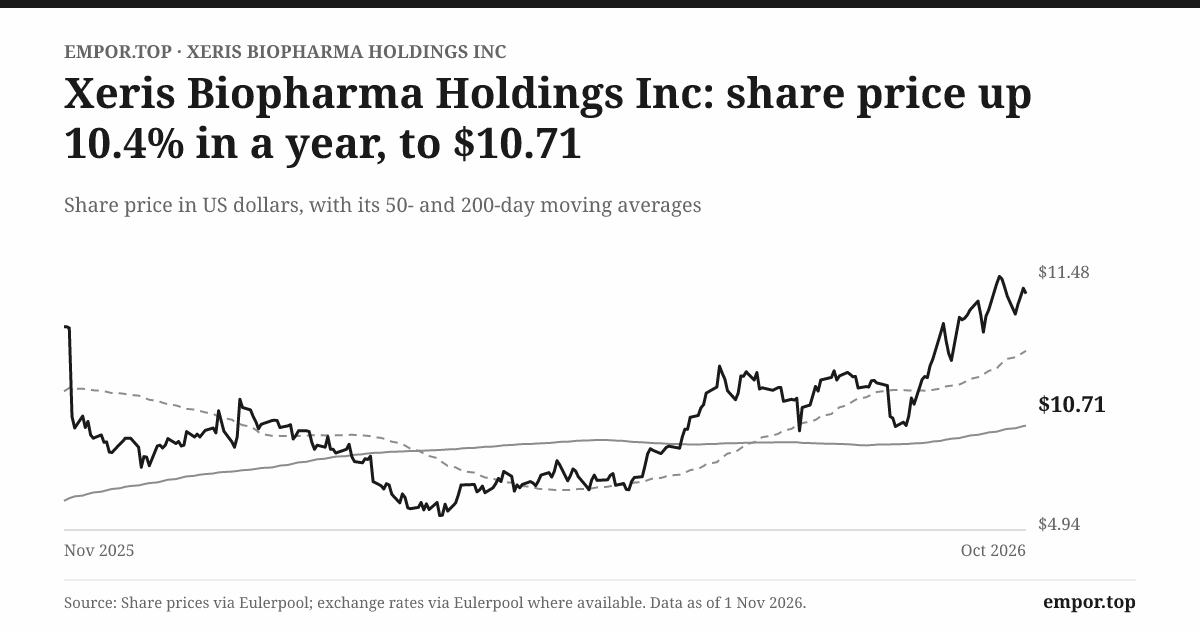
On November 1, 2026, Xeris' stock closed at about $10.71, within 4% of its 52-week high and roughly double its 52-week low of about $5.29.15 The company was worth about $1.9 billion in the market and about $2.0 billion including its debt net of cash.15 Four days later, on November 5, it was scheduled to report third-quarter results.[^23] The price was set by investors who had watched Recorlev's acceleration and wanted to own the next leg.
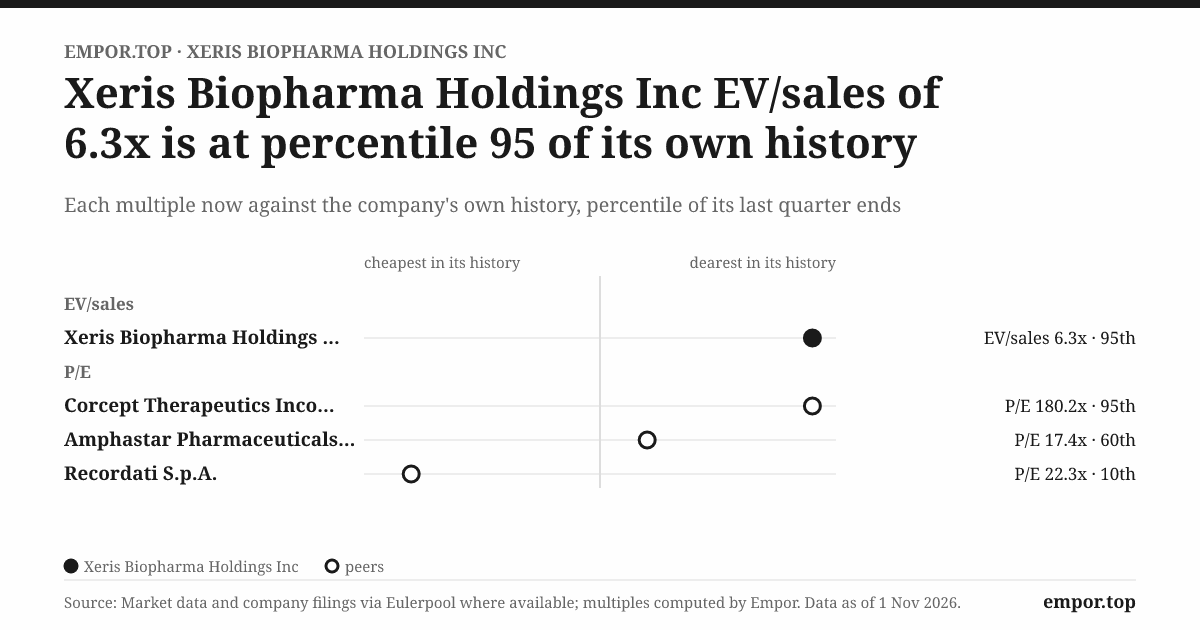
The clearest way to read the valuation is enterprise value against sales. At the November 1 snapshot, Xeris traded at about 6.3 times trailing revenue.15 Its own history over the past four years ran from about 1.6 times in 2022 to about 4.6 times in 2025.15 So the market is paying far more for each dollar of Xeris' sales than it did even a year ago. Against 2026 guidance, the multiple falls to a little over five times, because revenue is still growing fast. That is the market's way of saying it expects revenue growth to keep compounding well beyond today's scale.
Other headline multiples are less useful. A price-to-earnings ratio of about 84 times and an EV-to-EBITDA multiple of more than 120 times look alarming, but they mostly reflect how thin and volatile Xeris' earnings are.15 When profit is close to zero, small changes in the denominator swing the ratio wildly. Sales multiples are steadier, but they say nothing by themselves about future margins, which is the real question.
Peers give context, not a benchmark. At the end of October, Corcept traded at roughly 9.9 times sales, Amphastar at about 2.2 times and Harmony Biosciences at about 1.8 times.161718 Corcept is the closest competitor in Cushing's syndrome and carries a much higher margin structure. Amphastar, a diversified injectables maker, and Harmony, a rare-disease company, have different product mixes, scale and growth. Xeris sits between the high-growth Cushing's specialist and the slower specialty-pharma group, which is roughly where its business mix would place it. None of these multiples is directly comparable.
Here is the bull case, laid out on its own terms. Recorlev keeps adding patients, and the company says more than half are new to therapy, and grows toward and past its original peak estimate. Gvoke keeps growing in the low to mid teens. The commercial organization, now built, supports additional launches at lower incremental cost, so margins expand. The retired convertible notes reduce interest. XP-8121 advances through Phase 3 on schedule, and the market gradually assigns value to a multibillion-dollar opportunity. In this telling, today's 6.3 times sales is the price of admission to a company whose earnings are only beginning.
The bear case is equally specific. Recorlev's growth slows as the most accessible patients are treated, while net price keeps slipping as payers push back. Four distributors and a judgment-heavy rebate accrual magnify any shift in demand or payer mix. Keveyis faces generic competition that erodes a still-material revenue stream faster than the October patent suit can stop. Patent litigation on Recorlev produces an earlier generic date than 2040. Spending growth, floating-rate interest and working capital outrun operating cash generation, and the company returns to the equity market. XP-8121 meets delays or ambiguous results, or wins approval but struggles against cheap oral generics. In this telling, 6.3 times sales prices in success that may not arrive.
The competitive framework applied to the product portfolio still matters here: Xeris' valuation depends on execution, since its sales capability and defended patents do not shield it from price erosion or competition.
Two risks deserve a place on the radar because they act through specific mechanisms. The first is refinancing. The Hayfin loan matures in March 2029, a few months after XP-8121's targeted topline results.2[^16] If the trial reads out well and Recorlev is still growing, refinancing should be straightforward. If either disappoints, Xeris could face a lender negotiation at precisely the moment its equity is weakest. The floating rate adds a second sensitivity: higher benchmark rates raise the interest bill before any of this happens.2
The second is drug pricing and reimbursement. Xeris already reports that realized prices are falling for its fastest-growing product as volume rises.2 Its revenue depends on commercial insurers, pharmacy benefit managers and government programs, each of which can tighten coverage or increase rebate demands. A rare-disease product like Recorlev is usually more protected from such pressure than a drug with many substitutes, because the patient population is small and the clinical need is acute, but the steady drift in Recorlev's net price shows that protection is partial. For XP-8121, which would enter a market dominated by inexpensive generics, payer resistance is likely to be the central commercial battle rather than a side issue.
A skeptical investor would also stress-test M&A. Xeris' biggest value creation came from buying Strongbridge, and management has fielded questions about doing more.6 But the Strongbridge deal created value only to the extent Recorlev keeps growing; the other acquired product is shrinking. Another acquisition would have to clear a higher bar: secured-loan covenants that restrict deals, the dilution required to pay with stock, and the opportunity cost of not using the existing commercial infrastructure more productively. An activist would ask management to prove that each new dollar of sales-force spending on Recorlev produces more profit than a new deal would, before reaching for the next one.
Three numbers matter more than all the rest. First, Recorlev quarterly revenue and patient growth, last reported at about $57 million in the second quarter of 2026, up 81%, with management saying patient demand remained strong.[^10]6 Second, product-level net pricing and customer concentration, where the latest evidence is mixed: Recorlev's 2025 growth came from volume partly offset by lower pricing, and four customers still accounted for 97% of gross product revenue.2 Third, operating cash flow after working capital, read alongside diluted share count and debt: about $29 million in 2025, with shares rising from about 149 million to about 166 million during that year and more issued in 2026.2[^10]
The November 5 report will update those numbers, but it cannot resolve the long-term question. It will test whether Xeris is tracking toward its $385 million to $390 million guidance. It will not prove whether Recorlev has a decade of growth ahead or whether XP-8121 will ever sell. The timeline here stops at the November 1 snapshot. What the story has already shown, however, is a sequence of lessons about how this company became a business.
X. Lessons from a commercial pivot
Go back to three moments. September 2019, when the FDA approved Gvoke and a formulation idea finally became a medicine. May 2021, when Xeris handed over 40% of itself for a Cushing's drug that had not yet been approved. And 2025, when, after a decade of losses, the company's operations finally produced more cash than they consumed. Each looked like a turning point. Each taught something different.
The first lesson comes from Gvoke: a formulation advantage opens the door; prescribers and patients decide whether the product stays in the room. Gvoke's roughly one-third share years after launch shows that convenience alone does not guarantee leadership.3 For founders building on a platform technology, the lesson is that "first" and "easier" are invitations to compete, not guarantees of winning. For investors, it means discounting any product thesis that rests on convenience alone.
The second lesson comes from Strongbridge: an acquisition earns its premium in the years after the vote. The 37% premium Xeris paid was a bet on a forecast.[^4] Recorlev's later growth made the bet look sensible, while Keveyis kept shrinking.2 Deals do not create value on announcement day; they create it, or destroy it, quarter by quarter afterward. The question to ask of any acquisition is not whether the premium was reasonable at signing but whether the acquirer can do something with the asset that the seller could not.
The third lesson comes from 2025's first positive year: profit on paper is a beginning; cash after rebates, inventory and equity pay is the test. Xeris' operating profit was real, but cash conversion still reflected stock-based pay and working capital.2 A company can report its best year ever while its shareholders are still being diluted to pay employees. Investors in any newly profitable growth company should do the same arithmetic: subtract the share compensation, look at working capital, and ask what is left for owners.
The fourth lesson comes from XP-8121: a pipeline forecast is a promise to prove the next step. Management's $1 billion to $3 billion peak estimate remains a forecast, with a timetable that runs to 2030.[^16] Each step remains a hurdle, and the company's own record shows how much harder the later ones are than the earlier ones. A pipeline forecast is not an asset to be capitalized; it is a list of things that still have to happen.
Taken together, these lessons describe a company that has, so far, passed each test in a qualified way. Approval: passed, but without category leadership. Acquisition: passed, but through one product. Profitability: passed, but narrowly and with dilution. The next test is whether those qualified passes can add up to a company that funds its own future.
XI. The next reports decide what kind of company this is
Tonight, Xeris stands four days from its third-quarter report. Full-year guidance remains unchanged.[^10] Recorlev continues to grow.[^10] Management says it expects to start the XP-8121 Phase 3 trial before the end of the year.[^16]
The first thing to watch is whether the third and fourth quarters land inside that guidance range, and what Recorlev contributes. A strong quarter driven by patient additions with stable net price would support the market-expansion story. A strong quarter driven by inventory stocking at wholesalers, or one where price erosion accelerates, would be a weaker kind of growth. A miss against guidance would directly test the credibility management built by raising its floor while holding its ceiling.
The second thing to watch is cash. The step-up in research and commercial spending is happening now. The question is whether operating cash flow, after paying rebates that come due, funding receivables and building inventory, keeps pace. If it does, the investment plan is self-funding. If it does not, the company will lean on its cash balance, and eventually on the capital markets again.
The third is the balance sheet after the July note retirement. The post-transaction share count, the remaining Hayfin balance and the cash interest bill will show how much the company has actually de-risked. A falling interest burden with a stable share count would be the first time in Xeris' history that its capital structure was simplifying without new dilution.
The fourth is XP-8121. Starting Phase 3 would be a milestone, and Xeris has told investors to expect it by year-end. But a trial start is the beginning of a multiyear process. Results, approval and adoption are separate hurdles, each one with its own odds.
Each of these outcomes points toward a different kind of company. If Recorlev keeps growing, cash keeps building and the trial starts on time, Xeris begins to look like a self-funding specialty pharma with a credible second act. If Recorlev slows and cash tightens while the trial spending ramps, it looks more like one strong product propping up an expensive option. The next year will turn on execution, not on the size of anyone's market estimate. The stock price, sitting near its high, has already chosen a side of that question. The reports that follow will say whether the business agrees.
XII. The difference between a product and a company
Eight years ago, Xeris went public before it had sold a single approved medicine, on the strength of a chemistry idea. Tonight it has three marketed products, one of which supplies nearly half its annual sales, and a development program that management believes could someday be bigger than everything else combined.2[^16]
What makes Xeris unusual is the path. It did not succeed as a platform company in the way it first imagined. Its biggest success was a drug it bought, not one it formulated. Its own invention reached patients but not leadership. And the profit it finally earned arrived at the very moment it decided to spend heavily on its next bet. One product is carrying the growth story; the next is still a trial plan.
Think back to that June 2018 IPO, and the bet investors were asked to make: that a clever way of dissolving fragile molecules could become a company. The answer, eight years on, is yes, but not in the way anyone drew it on a slide. The chemistry produced Gvoke. The company was made by a merger, a launch and the patient, expensive work of selling a rare-disease drug one endocrinologist at a time. Now the chemistry is being asked to carry the story again, this time in one of the most crowded and price-sensitive corners of medicine.
Xeris has shown it can get a drug to market; now it has to show the market can keep paying for the next one.
References
-
Form S-1/A Registration Statement — Xeris Pharmaceuticals, Inc., 2018-06-11 ↩↩↩↩↩↩↩↩↩↩
-
2025 Form 10-K — Xeris Biopharma Holdings, Inc., 2026-03-02 ↩↩↩↩↩↩↩↩↩↩↩↩↩↩↩↩↩↩↩↩↩↩↩↩↩↩↩↩↩↩↩↩↩↩↩↩↩↩↩↩↩↩↩↩↩↩↩↩↩↩↩↩↩↩↩↩
-
Xeris Biopharma Delivers Record Fourth Quarter and Full Year 2024 Results — Business Wire, 2025-03-06 ↩↩↩↩↩
-
Merger Proxy Statement and Prospectus — Xeris Biopharma Holdings, Inc., 2021 ↩↩↩↩↩↩
-
Xeris (XERS) Q2 2026 Earnings Call Transcript — The Motley Fool, 2026-08-13 ↩↩↩↩↩↩↩↩↩↩↩↩↩
-
Form 8-K on Keveyis Patent Litigation — Xeris Biopharma Holdings, Inc., 2026-10-14 ↩↩
-
Q2 2026 Form 10-Q — Xeris Biopharma Holdings, Inc., 2026-08-06 ↩↩↩↩
-
Form 8-K on Board and Officer Changes — Xeris Biopharma Holdings, Inc., 2026-06-29 ↩
-
2026 Definitive Proxy Statement — Xeris Biopharma Holdings, Inc., 2026-04-23 ↩↩↩↩↩↩
-
2026 Annual Meeting Voting Results — Xeris Biopharma Holdings, Inc., 2026-06-04 ↩↩
-
2025 Definitive Proxy Statement — Xeris Biopharma Holdings, Inc., 2025-04-23 ↩
-
KPMG Letter on Change in Auditor — Xeris Biopharma Holdings, Inc., 2023-03-17 ↩↩
 LinkedIn
 WhatsApp
 Reddit
 Hacker News
 Email
 Kindle
 RSS Feed
 Spotify
 Apple Podcasts
 Amazon Music
 Audible
 YouTube