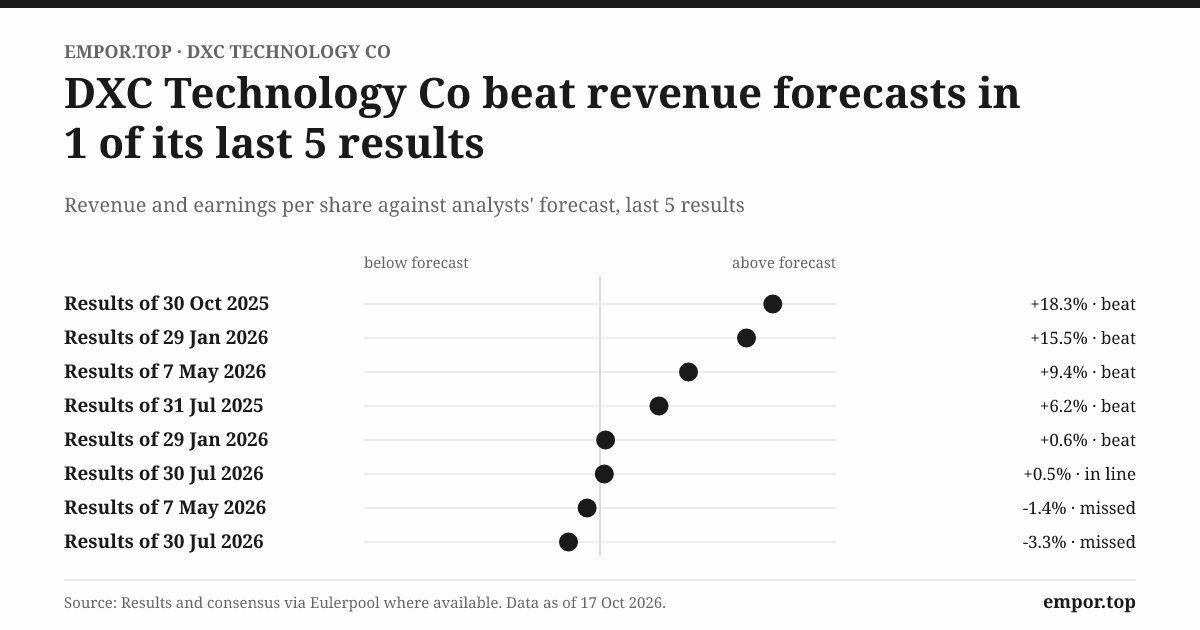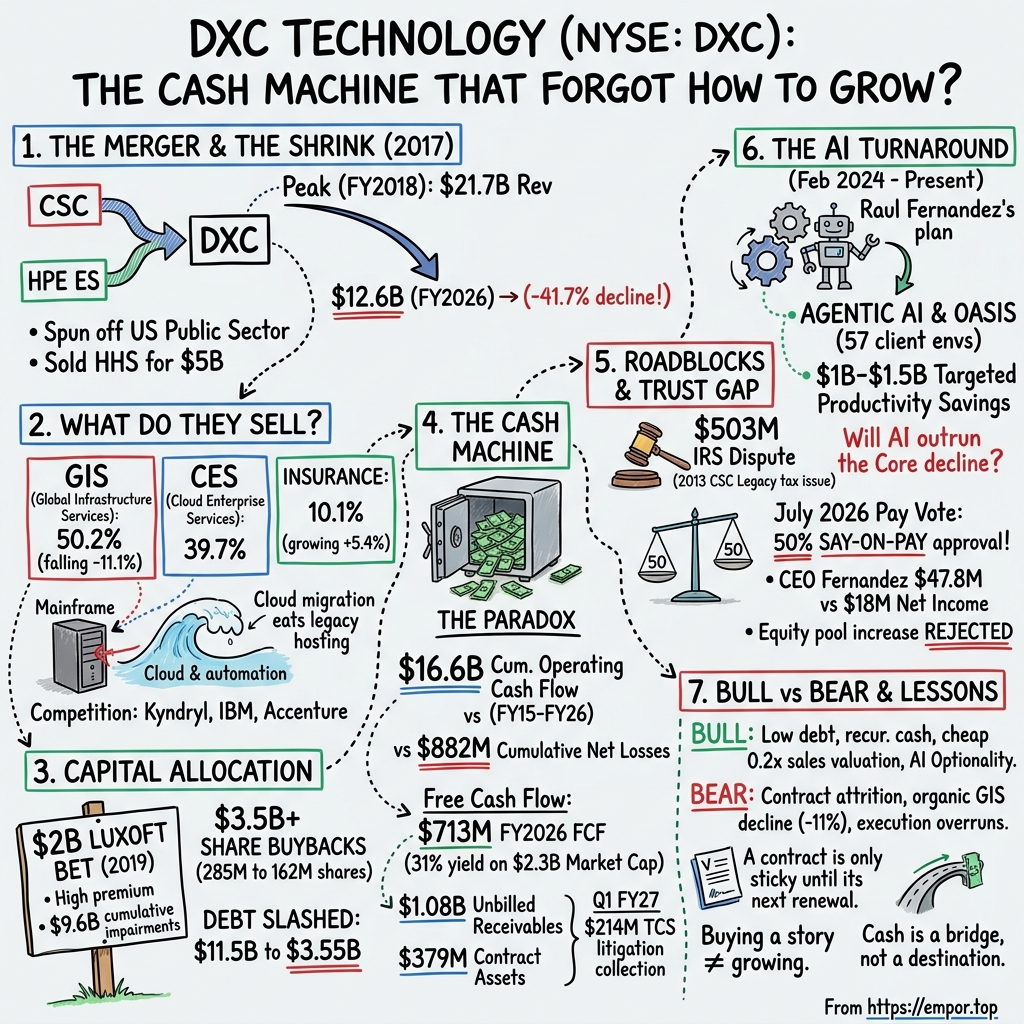
DXC Technology Company: The Cash Machine That Forgot How to Grow
I. The $2.3 Billion Company With a $4.5 Billion Enterprise Value
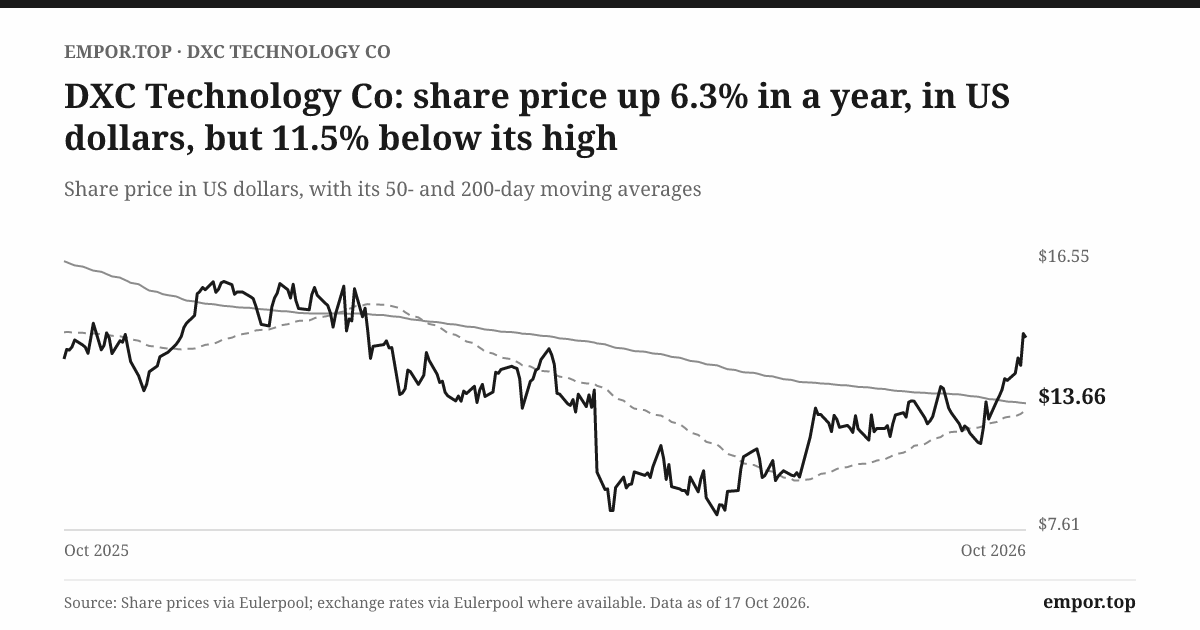
On Friday, October 17, 2026, a share of DXC Technology closed at $13.66.1 At that price the whole company, which keeps airline reservation systems, bank mainframes, hospital networks and insurance policy engines running across some 60 countries, was valued by the stock market at about $2.3 billion. Add the debt and leases and take away the cash, and the enterprise value comes to roughly $4.5 billion. That is less than half of one year's revenue, for a company that still books more than $12 billion of sales.
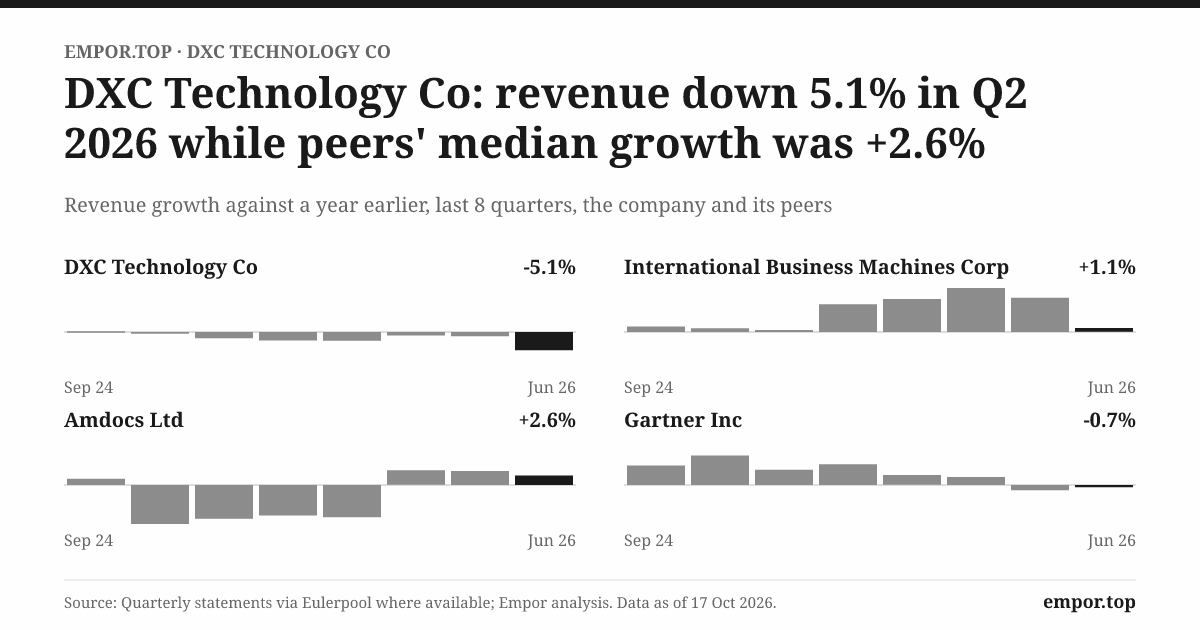
Most investors would see that as either a mistake or a warning, and DXC has been both at different times. The company was born in April 2017 from one of the largest mergers in IT services history and reached $21.7 billion of revenue in its first full fiscal year.12 Nine years later, in the fiscal year that ended in March 2026, revenue was $12.6 billion.1 In the quarter that ended in June 2026 it was $3.0 billion, down 6.7% on an organic basis from a year earlier, meaning after stripping out currency moves and portfolio changes.3 The company employs about 115,000 people, organised into three segments: Global Infrastructure Services, which runs clients' data centres, networks, mainframes and cloud estates; Consulting & Engineering Services, which builds and modernises applications; and Insurance Software & Services, which sells and operates policy and claims platforms for insurers.1
Four questions hang over the stock, and the rest of this story tries to answer them. Can DXC stop the decline in its core, especially in the infrastructure business that still brings in half its revenue? How much of the cash it produces each year can be repeated, and how much is the harvest of assets already paid for? Could a long-running dispute with the Internal Revenue Service, in which the government seeks about $503 million over a deduction claimed by a predecessor company, drain liquidity at the worst possible moment?1 And has management, now on its third chief executive since the merger, earned the trust of the shareholders who pay it?
The headline valuation numbers need some cleaning before they tell the truth. Commonly quoted screens show DXC with a free cash flow yield of about 54%, built on roughly $1.0 billion of free cash flow in fiscal 2026. DXC's own definition is stricter. It deducts not just spending on equipment but also capitalised software and the transition-and-transformation costs it incurs when it takes over a new client's systems, and on that basis fiscal 2026 free cash flow was $713 million.1 Against a $2.3 billion market value that is still a yield of roughly 31%, which is extraordinary for a company with an investment-grade credit rating. It is not 54%, and the gap between the two figures is itself a clue: a meaningful part of what looks like spare cash is money DXC has to keep spending just to stay in the contracts it has.
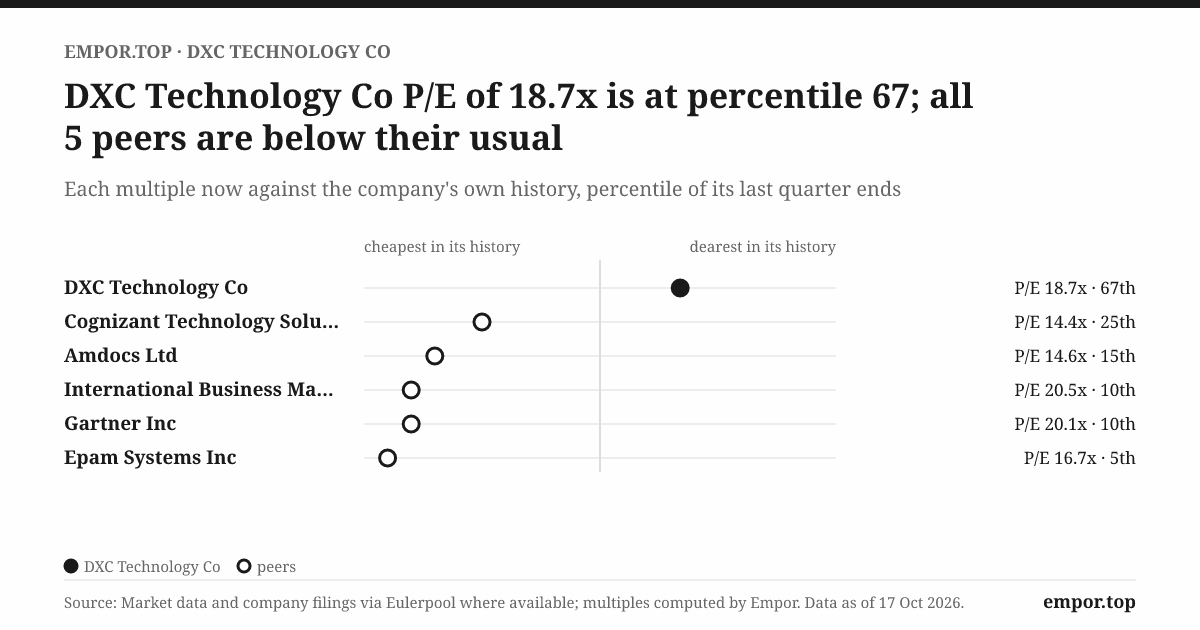
The price-to-earnings ratio is even less useful. At about 18.7 times trailing earnings, DXC looks expensive next to its own five-year median of 9.5 times. But fiscal 2026 net income attributable to common shareholders was only $18 million, because the company paid tax at an effective rate of 91.2%.1 When the tax bill takes almost all of pre-tax profit, the P/E describes a tax problem more than the business. A turnaround investor would point to a company that turns more than $1 billion of operating cash a year into a market value only a few times larger. A skeptic would point to revenue that has shrunk in almost every year of DXC's existence and to GAAP profits so thin that one accounting judgment can wipe them out.
Both views start from the same fact. The cash is real, and so is the shrinkage. The low valuation is the market's bet that the shrinkage wins, and the burden of proof sits with management. To see why the market is so doubtful, start with the deal that created the company and the promise it made about scale.
 Subscribe on LinkedIn
II. The Merger That Promised Scale—and Started Shedding It
On April 3, 2017, the NYSE ticker DXC started trading for the first time. Behind it were two old giants of corporate computing. Computer Sciences Corporation, founded in 1959, had spent decades writing and running software for governments and large companies. Hewlett Packard Enterprise's Enterprise Services unit was the descendant of Ross Perot's EDS, the company that more or less invented IT outsourcing. The combined company told investors it would start life with roughly $25 billion of revenue and about 6,000 clients, which would make it one of the largest independent IT services companies in the world.4
The deal was structured as a Reverse Morris Trust: HPE spun off the Enterprise Services business into a new company, Everett SpinCo, which then merged with CSC, so HPE shareholders could receive their stake without a large tax bill.5 The logic was that two companies facing the same pressure, from clients moving to cheaper offshore providers and to the public cloud, could survive it better together. A bigger base would spread fixed costs, a cost-cutting programme would lift margins, and the combined client list would be a market for new digital services.
Some of that logic held for a while. In fiscal 2018, the first year of the merged company, DXC reported $21.7 billion of revenue and about $2.6 billion of operating profit, a margin of around 12%, far above anything CSC had managed on its own.1 The cost cuts were real. So was the habit of reshaping the company by selling or spinning off parts of it. CSC had already split off its North American public-sector business as CSRA in 2015, which is why CSC's revenue in the years before the merger looks so much smaller. In May 2018, barely a year after it was formed, DXC separated its U.S. public sector business and merged it with Vencore and KeyPoint to create Perspecta.5 That matters for anyone reading the long revenue chart: not every dollar that has disappeared since fiscal 2018 was lost to a competitor. Some of it was handed over in deals that DXC chose to make.
The trouble showed up in 2019. Revenue slipped to $20.8 billion in fiscal 2019, and over the year management cut its guidance more than once.1 In November 2019, on the call for the second quarter of fiscal 2020, the company explained what had gone wrong in unusually candid terms: deals had been delayed or lost, there were execution problems at existing customers, transformation programmes had cost more than planned, and DXC needed to reinvest in its operations and its people.67 In other words, the cost cuts that lifted margins in the first year had also cut into the delivery capacity that clients were paying for. In outsourcing, a client that feels neglected does not complain loudly. It quietly takes the next contract renewal to a competitor.
The bill came due in fiscal 2020. DXC recorded goodwill impairments of about $6.8 billion that year, which helped push the net loss to roughly $5.4 billion.15 Goodwill is the premium a buyer pays above the value of a business's identifiable assets, and writing it down is an admission that the business will earn less than the price assumed. Mike Lawrie, who had run CSC since 2012 and engineered the merger, stepped down in September 2019 and was replaced by Mike Salvino, a former Accenture executive.5 The change in leaders matters less here than what it said about the merger: the scale it created had not protected the business from the forces it was meant to resist.
Salvino's most important move was a sale. In March 2020 DXC agreed to sell its U.S. State and Local Health and Human Services business, which runs Medicaid and other benefits systems for state governments, to Veritas Capital for $5 billion, or about 3.5 times that unit's trailing sales.8 The proceeds were meant to pay down debt, which had swollen to about $11.5 billion by the end of fiscal 2020.15 It was a good price for a business that steady, and the deal closed in October 2020. But it is evidence of what DXC could sell, not of how its remaining business was doing. Revenue fell to $16.3 billion in fiscal 2021 partly because the HHS business left, and then kept falling in the years after, when there were no big disposals left to explain it.1
Put those years together and the paradox is plain. From fiscal 2018 to fiscal 2026 revenue fell about 41.7%, from $21.7 billion to $12.6 billion.1 Some of that was Perspecta and HHS. But the continuing business has also shrunk, year after year, under three different chief executives. DXC kept redrawing the boundary of the company and the core inside the boundary kept getting smaller. That raises the question every investor in a services business eventually has to ask: what exactly is the client buying, and why would they keep buying it from DXC?
III. What Does DXC Sell When the Work It Runs Can Move to the Cloud?
Picture a mid-sized European insurer. It has a mainframe in a data centre that has run its policy administration since the 1990s, a claims system built on DXC's own insurance software, and a project in progress to move customer-facing applications onto Microsoft Azure. Nobody at the insurer wants to touch the mainframe, because if it goes down, policies stop renewing and claims stop paying. DXC can keep that mainframe running, keep the insurance platform patched and compliant, and send engineers to help with the cloud migration. That is the company's pitch in one scene: it operates the old estate while helping clients build the new one.
The pitch makes money in four different ways. The largest are multi-year infrastructure contracts, usually three to seven years long, in which DXC runs a client's servers, networks and help desks for a fee that often includes equipment the client effectively leases from DXC.1 Then there is fixed-price project work, where DXC agrees to deliver a system for a set fee and books revenue as it spends its estimated costs, so a project that runs over budget squeezes DXC's margin rather than the client's. Time-and-materials work is billed by the hour or day of each engineer, which is simple but exposes DXC to every pause in a client's discretionary spending. And in Insurance and business-process services, DXC is often paid per transaction, such as per policy or per claim processed.1 Consulting and engineering engagements usually run one to three years.1 Together these contracts left DXC with $16.4 billion of remaining performance obligations at the end of March 2026, which is the contracted revenue it has yet to deliver, and the company expects to recognise about 41% of that within twelve months.1 That backlog is about 1.3 years of revenue. It is a cushion, not a guarantee of growth.
The three segments behave very differently. Global Infrastructure Services, or GIS, is the giant, with $6.34 billion of revenue in fiscal 2026, about half the company.1 Yet its segment profit of $432 million was lower than the $518 million earned by Consulting & Engineering Services, which brought in only $5.02 billion.1 Insurance, at $1.28 billion, is the smallest segment and the only one that grew, with reported revenue up 5.4%.1 So the biggest business is also the least profitable per dollar, and it is the one most exposed to clients moving work to Amazon Web Services, Microsoft Azure and Google Cloud, which can do some kinds of hosting more cheaply than any outsourcer.
The quarter ended June 2026 showed the fault line sharply. GIS organic revenue fell 11.1% from a year earlier, while CES fell 3.0% and Insurance grew 1.4%.3 There was one encouraging number inside GIS: bookings, the value of new contracts signed, rose 34.7%, and the segment's book-to-bill ratio was 1.11, meaning it signed slightly more new business than it recognised as revenue during the quarter.39 A book-to-bill above one is how a shrinking services business begins to stabilise. But bookings in outsourcing are lumpy, they are recognised over years, and they include renewals that may come back at a smaller scope than the contracts they replace. One quarter's bookings is a hint, not yet a recovery.
DXC is also not alone at this table. Kyndryl, the infrastructure business IBM spun off in 2021, reported fiscal 2026 revenue of about $15.1 billion, roughly DXC's scale and facing much the same pressure.[^10] Cognizant reported about $21.1 billion of revenue in 2025, and Accenture is several times larger than either.1011 IBM competes in consulting and managed infrastructure, the Indian firms compete hard on price for application work, and the hyperscalers compete for the hosting itself. DXC does not publish a market-share figure, and with this many overlapping rivals any such figure would be loose anyway.
Does the moat hold?
The strongest case for DXC's advantage is that its clients find it hard to leave. No single customer accounted for 10% or more of revenue in fiscal 2024, 2025 or 2026, so DXC is not hostage to any one buyer.1 Mainframes, insurance platforms and decades-old custom code are risky and costly to move, which gives an incumbent real switching-cost protection. But the record of the past nine years tests that claim through the mechanism that would break it, which is renewals, and the result is not kind. Large corporate buyers rebid outsourcing contracts, split them among several vendors, and use cloud migration to shrink what is left. DXC's U.S. revenue alone fell from about $3.9 billion in fiscal 2024 to about $3.2 billion in fiscal 2026.1 If switching costs were strong enough to give DXC pricing power, revenue and margins would not both be this weak. The evidence narrows the moat to something smaller: DXC is hard to remove from the systems it already runs, but it struggles to grow the value of that work, and some of it leaves at every renewal. Clients' testimonials about long relationships prove loyalty to a service, not that DXC can charge more for it.
Against that background, DXC's newer tools are options rather than a business. Xponential is its framework for applying AI and automation inside client engagements. OASIS is an agentic AI platform, software that can take actions across systems rather than just answer questions, and DXC has also built agentic security tools.9 In the June quarter, management said OASIS was running in 57 customer environments and that DXC had signed one multimillion-dollar agentic security contract.9 Neither is a disclosed revenue line. That is early customer proof. It shows clients will try the tools inside relationships DXC already has, which is exactly where an incumbent should have an edge. It does not yet show that clients will pay enough to offset the infrastructure work that is leaving. Before judging whether that can happen, it helps to look at the last time DXC tried to buy a new growth story.
IV. The $2 Billion Luxoft Bet—and the Price of Buying a New Story
On January 7, 2019, DXC announced it would buy Luxoft, a Swiss-headquartered, NYSE-listed digital engineering firm with deep roots in Eastern Europe, for about $2 billion in cash.12 Luxoft built software for banks and carmakers: trading platforms, in-car infotainment, digital customer experiences. To DXC, still running the old estates of the world's biggest companies, Luxoft was a way to move up into the work that clients actually wanted to spend more on. The pitch to investors was that DXC's client list combined with Luxoft's engineers would accelerate the shift of its revenue mix toward digital.12
It was not a cheap way to buy that story. The price worked out to roughly 2.2 times Luxoft's revenue and around 20 times its earnings before interest, tax, depreciation and amortisation, at a time when broad IT services deals typically priced closer to 11 times EBITDA.12 A digital engineering firm growing faster than legacy outsourcing deserved some premium. But almost doubling the typical multiple meant DXC needed Luxoft's growth to continue, and to rub off on the rest of the company, for the deal to pay back.
The accounting tells part of the story. DXC allocated about $1.2 billion of the purchase price to goodwill, well over half the consideration.13 That means more than half of what DXC paid was for future earnings power that did not show up as identifiable assets like contracts, technology or customer relationships. In the years that followed, DXC wrote off roughly $9.6 billion of goodwill across the whole company, including the giant charge in fiscal 2020 and another of about $611 million in fiscal 2023.1 It would be wrong to pin that total on Luxoft, since most of it reflected the value of the merged businesses that formed DXC in 2017. But the pattern is the point. DXC repeatedly paid for future growth and then had to admit, through write-downs, that the growth would be smaller.
The outcome at the company level is clearer than at the deal level. DXC does not report Luxoft's standalone revenue or returns, so it is impossible to say whether Luxoft itself created or destroyed value. What can be said is that the acquisition did not change DXC's trajectory. Revenue was $20.8 billion in the fiscal year Luxoft was announced and has fallen in most years since.1 The digital-growth thesis may have softened the decline in consulting and engineering. It did not reverse the overall decline.
The rest of DXC's portfolio history pulled in a different direction. The Perspecta separation and the HHS sale shrank the company and paid down debt, which made the listed company smaller and more focused on commercial clients and less on U.S. government work.58 Those were sensible ways to reduce risk, and the HHS price in particular was strong. But they also took away some of the steadiest revenue DXC had, leaving a company more exposed to the commercial outsourcing work that cloud migration was eroding.
Then there is what DXC did with the cash it kept. From fiscal 2018 through fiscal 2026 it spent more than $3.5 billion on share buybacks, including about $898 million in fiscal 2024 alone.1 Shares outstanding fell from about 285 million at the merger to about 162 million by May 2026.114 The dividend, about $0.21 a share per quarter, was suspended in the first quarter of fiscal 2021, and management has said it does not plan to bring it back.1 There was another route out at one point: private equity firms showed takeover interest in late 2022, and DXC hired advisers, but no deal followed.15
Shrinking the share count by more than 40% is a large bet. If each share now owns a bigger slice of a business that keeps generating cash, buybacks at low prices can be a good use of money. But each slice is of a smaller pie: earnings per share was $6.28 in fiscal 2018 and $0.11 in fiscal 2026, and even allowing for the tax distortion, the earning power each share represents has fallen.1 A skeptic would ask whether the same billions spent on buybacks could have funded a stronger transition, or whether no amount of reinvestment would have saved the legacy contracts anyway. The record does not settle that. It does show that neither the Luxoft bet nor the buybacks stopped the decline. That left the next chief executive with a familiar task and a new set of tools.
V. Raul Fernandez's AI Turnaround Has to Outrun the Core Decline
On June 11, 2026, DXC held an Investor Day, its first big set-piece presentation to the market under Raul Fernandez. On stage the company demonstrated its agentic AI tools working on the kind of client systems DXC runs every day: software agents triaging infrastructure incidents, writing and testing code, hunting security threats.16 Six weeks later, on the July call for the first quarter of fiscal 2027, Fernandez described the opportunity as changing how DXC builds and delivers technology, not just adding a new product line.9
Fernandez is an unusual choice for the job. He is an entrepreneur rather than a lifelong services executive: he founded the internet consultancy Proxicom in the 1990s and later built and sold other technology companies, and he joined DXC's board soon after the merger before stepping in as interim chief executive in December 2023, when Salvino left.14 The board made him president and CEO in February 2024.14 His style, judged from calls and the Investor Day, is less about financial engineering and more about product: he talks about DXC as a builder of technology rather than a renter of engineers.16 His plan has three parts. First, stabilise the services core. Second, build AI-enabled products and automation into that core. Third, move clients toward contracts that pay for outcomes, such as resolved tickets or processed claims, rather than for hours of labour.16
That third part is the heart of the bet, and it cuts both ways. If DXC can automate work it is paid for by the hour, revenue falls unless it can convince clients to pay for the result instead. If it can make that switch, automation becomes margin. If it cannot, automation becomes a faster way to shrink.
The record so far
The results under Fernandez test the plan. In May 2026, on the fourth-quarter fiscal 2026 call, management acknowledged that results had missed expectations because discretionary short-term spending weakened, particularly in GIS in the U.S. and Europe.17 That was a straightforward admission, which counts for something. The real test was what came next. In the June quarter, organic revenue was still down 6.7%, GIS down 11.1%, and the full-year guidance still called for organic revenue to fall by 3% to 5%.39 So the explanation held, in the sense that the weakness did not get worse than guided, but the recovery it implied had not arrived.
The Investor Day's biggest number needs careful reading. DXC said agentic productivity could produce $1 billion to $1.5 billion of savings.16 Savings are not growth. They show up as lower delivery costs, which might protect margins, but they might also be passed to clients in cheaper renewals, consumed by the cost of building and deploying the tools, or offset by restructuring charges that DXC has incurred almost every year. The questions an investor should hold management to are whether those savings are net of implementation and restructuring costs, how much of them DXC keeps, and whether cutting delivery cost again risks the same client damage the 2018 cost programme caused.
The early proof is real but small. Management reported OASIS in 57 customer environments, the multimillion-dollar agentic security contract, and 86 trained forward-deployed engineers, specialists who sit with clients to put the tools into production.9 None of that comes with a disclosed revenue figure. DXC's record of turning new offerings into revenue is the right yardstick here, and that record, from the post-merger digital push to Luxoft, is one of announcements running ahead of results. That history does not doom OASIS, but it means deployments and trained headcount should be read as inputs, not outputs.
Insurance is a firmer foothold. The segment grew reported revenue 5.4% in fiscal 2026, and at the Investor Day management described a shift toward recurring software and software-as-a-service revenue.116 Insurance software is sticky in the way the moat argument needs: carriers run their books on it for decades. The catch is size. At about 10% of revenue, even fast growth in Insurance cannot outweigh a 10% decline in a GIS business five times its size.
The analysts' questions at the Investor Day and on the July call went straight to those gaps: when would AI products report revenue, when would GIS stop shrinking, what margin targets the company would commit to, and whether demand was really there or only interest.169 Management's answers gave measurable milestones on cash flow and bookings, and on the June quarter the strong GIS bookings gave it something concrete to point to. On product revenue and the timing of GIS stabilisation, answers leaned on the longer-term roadmap rather than dated targets.9 That is not evasion so much as an honest reflection of where the strategy stands: a plan with early evidence, not a turnaround with results.
Management credibility is a behaviour record. Fernandez's team has explained a miss plainly, kept guidance unchanged rather than chasing it, and kept the strategy consistent from the Investor Day to the July call. The proof it has not yet delivered is the one that matters: GIS organic revenue that stops falling, bookings that turn into recognised revenue, product revenue that DXC is willing to disclose, and recurring Insurance software growth. Until those show up, the AI plan is testable rather than proven. And while it is being tested, the business has to keep paying for itself, which is where DXC's strongest argument lies.
VI. One Billion Dollars of Operating Cash, but How Much Is Repeatable?
Here is the strangest pair of numbers in DXC's history. Add up the net income of the company and its predecessor CSC over the twelve fiscal years from 2015 through 2026, and the total is a loss of about $882 million. Add up the cash generated by operations over the same twelve years, and the total is about $16.6 billion.1 A business that lost money on paper for a decade generated enough cash to pay down most of its debt and buy back nearly half its shares. How?
The answer is mostly accounting, and it is not a scandal. Net income is reduced by charges that do not cost cash in the year they are taken. The biggest were the goodwill impairments, roughly $9.6 billion over the period, which recorded that earlier acquisitions were worth less than their price.1 That money left long before, when the businesses were bought. Depreciation and amortisation, the slow expensing of servers, data centres and capitalised software, ran above $1 billion a year.1 Lease charges on offices and data centres and mark-to-market charges on pension plans add more non-cash noise.1 In fiscal 2026, net income of about $28 million in total became $1.248 billion of operating cash flow after adding back about $1.18 billion of depreciation and amortisation, about $305 million of lease expense and about $169 million of pension actuarial charges.1
That bridge explains the gap, but it does not make every dollar recurring. Depreciation adds back cash only because DXC spent it earlier. To keep running clients' estates, it has to keep buying equipment, building software and paying the upfront costs of taking over new contracts. That is why DXC's own free cash flow definition deducts all three, and why fiscal 2026 free cash flow on that basis was $713 million rather than the roughly $1.0 billion that a simple "operating cash minus equipment spending" calculation produces.1 The company-defined number is the one to use when testing management's guidance and comparing years, because it is the one management itself promises.
The debt story is the clearest success. Borrowings fell from about $11.5 billion at the end of fiscal 2020 to about $3.55 billion of contractual debt on the balance sheet at the end of fiscal 2026.1 DXC ended fiscal 2026 with about $1.74 billion of cash and a $3 billion revolving credit facility it had not drawn.1 That is a company that cannot easily be pushed into distress. But liquidity does not answer the business question. A smaller company with a strong balance sheet is still a smaller company.
The latest quarter needs adjusting too. In the June quarter, operating cash flow was $418 million and company-defined free cash flow was $314 million, both far above the year before.2 But they included $214 million collected from Tata Consultancy Services after DXC won a long legal fight over stolen insurance software code.23 In July management raised its fiscal 2027 free cash flow guidance from about $600 million to about $685 million, partly because of that litigation cash.9 Strip it out, and the underlying guidance looks closer to the lower number, which is below fiscal 2026's $713 million.
Follow the cash over twelve years and the competing claims on it become clear. Free cash flow on the simple definition added up to about $8.5 billion. Dividends, before they were suspended, took about $1.3 billion. Cash on hand fell by about $706 million, from about $2.4 billion at the end of fiscal 2014 to about $1.7 billion at the end of fiscal 2026.1 The rest, and more, went to buying back shares and paying down debt, with help from asset sales such as HHS. DXC has been a reliable machine for turning old contracts into cash and sending that cash to lenders and shareholders.
Is it repeatable? The honest answer is that a version of it is. Operating cash has stayed above $1.2 billion in each of fiscal 2024, 2025 and 2026.1 But it has drifted down along with revenue, and the guidance for fiscal 2027, once the litigation receipt is removed, implies further drift. The test is normalised operating cash flow and company-defined free cash flow after excluding litigation receipts, restructuring costs and the effect of selling receivables. That last item hides inside the balance sheet, in money DXC has earned but not yet collected.
VII. The Receivable That Has Not Yet Become Cash
Imagine a fixed-price modernisation project for a bank. DXC has agreed to move a set of applications to the cloud for a fixed fee, paid in instalments at milestones. Halfway through, DXC's engineers have done half the work and incurred half the estimated costs, so under accounting rules DXC books roughly half the revenue. But the bank has not reached the next payment milestone, so it has not been billed. That revenue sits on DXC's balance sheet as an unbilled receivable or a contract asset: money DXC believes it has earned, based on its own estimates of how far along the project is.
At the end of March 2026, DXC's receivables broke down into four pieces. Billed trade receivables, invoices sent and awaiting payment, were about $1.24 billion. Unbilled receivables were about $1.08 billion. Contract assets, a similar category for performance not yet unconditionally billable, were about $379 million. Other receivables, which include tax and miscellaneous amounts, were about $654 million.1 Unbilled receivables and contract assets together came to about $1.46 billion, or about 49% of the roughly $3.0 billion gross receivables total. Put simply, nearly half the money DXC is owed has not yet been invoiced.
That is not unusual for a company that does long, complex contracts, and the collection record looks orderly. The allowance for doubtful accounts was only $27 million, under 1% of gross receivables, and bad-debt provisions were small in each of the last two years.1 Days sales outstanding, the average time it takes to collect, was 71 days at the end of June 2026, up slightly from 69 a year earlier.3 Broader debtor-days measures that count all receivables against revenue come out higher, around 86 days in fiscal 2026, because they use a wider definition. The two do not contradict each other; they measure different things, and both have been fairly stable for years.1
What makes cash conversion harder to compare is a facility DXC uses to sell receivables. Under an arrangement with banks of up to $400 million, DXC sells some of its invoices before they are due and removes them from its balance sheet. At the end of fiscal 2026, $367 million of receivables had been sold this way, the same as a year earlier.1 That supports liquidity and is a common tool. But it means DXC collects cash earlier than an unfactored business would, so its operating cash flow is flattered in the year the facility grows and penalised in any year it shrinks or is not renewed. Because the balance was flat between the last two year-ends, it did not distort the change in cash between them. It does mean the "true" receivables balance is bigger than it looks.
The real risk in these balances is estimation, not deadbeat clients. Deloitte, DXC's auditor, flagged revenue recognition on complex contracts as a critical audit matter: contracts with several distinct promises bundled together, contracts that get modified midway, and contracts that hide equipment leases inside service fees.1 Each requires judgments about how much revenue to book and when. Deloitte gave an unqualified opinion and reported no material weaknesses in internal controls.1 And no customer accounted for 10% of revenue in fiscal 2024 through 2026, so there is no single slow-paying giant to worry about.1
The conclusion is undramatic, which is good news. DXC's receivables look like those of a large, careful services firm, with estimates that deserve watching rather than alarm. The bigger balance-sheet question is not money clients owe DXC. It is money the government says DXC owes.
VIII. The $503 Million Tax Dispute Is Still in the Courtroom
In April 2026, lawyers for DXC and the IRS filed their last post-trial briefs in the U.S. Tax Court.1 The trial, held in August and October 2025, was about a decision made years before DXC existed. On its tax return for fiscal 2013, CSC claimed a capital loss of about $651 million. The IRS disallowed it and, with penalties and interest that keep accruing, seeks roughly $503 million.1 Now the judge has everything needed to decide, and the ruling could land in any quarter.
How big is $503 million for DXC? It is about 29% of the $1.74 billion of cash DXC held at the end of March 2026 and more than a fifth of its market value.1 That sounds alarming. But by the end of June, cash had risen to about $1.96 billion, partly because of the TCS collection, and the $3 billion revolving credit facility, which runs to November 2030, was untouched.31 Debt has fallen sharply since 2020. An adverse ruling would hurt, and it would use money that could otherwise fund buybacks or investment, but it is a question of capacity, not survival. DXC could pay it.
The credit agencies agree, with caveats. DXC's ratings remain investment grade: BBB- from both Fitch and S&P with stable outlooks, and Baa2 from Moody's, but with a negative outlook.1 Fitch had downgraded the company from BBB in August 2025, citing multi-year revenue attrition.1 The agencies credit the debt reduction, steady cash generation and liquidity, and worry about the same thing equity investors worry about: the slow erosion of legacy infrastructure outsourcing and the execution risk of the turnaround.1
The TCS case is a reminder of why the latest quarter's earnings are not a clean run rate. DXC sued Tata Consultancy Services in 2019, alleging it misappropriated code from DXC's Vantage-One and CyberLife insurance platforms. A Texas jury found for DXC, the court entered a judgment of about $194 million plus interest and fees, the Fifth Circuit affirmed it in November 2025, and in June 2026 the Supreme Court declined to hear TCS's appeal.13 DXC collected $214 million and recorded a $168 million litigation gain plus about $46 million of interest income in the June quarter.3 Those items made up most of the quarter's other income, and they will not repeat. The case is also a modest proof point for the moat argument in Insurance: DXC's insurance code was valuable enough that a giant rival was found to have taken it.
Two other exposures belong in this picture. The first is currency. About 74.6% of DXC's fiscal 2026 revenue came from outside the United States, mostly Europe, the UK and Australia, while much of its delivery work is done by engineers paid in Indian rupees.1 DXC hedges part of its forecast rupee spending with forward contracts, which smooths costs but cannot stop a strong dollar from shrinking reported revenue and equity.1 The second is related parties, where the disclosures turn out to be small. The ties to HPE are legacy tax indemnities from the 2017 merger, including an $86 million payable to HPE.1 And the board's independent special committee reviewed a services contract with RemoteRetail, a company majority-owned by Fernandez, and found it on arm's-length terms and immaterial to DXC's results.14 Neither looks like a channel for moving value.
So the tax case is a real overhang, sized correctly as a hit to the cash DXC could otherwise use, not as a threat to its solvency. The next hard event is the Tax Court ruling and the net cash bill that follows, which may differ from the headline once DXC's existing reserves for uncertain tax positions and any appeals are counted. The company's cash pile answers whether DXC can pay. It does not answer whether shareholders will like what is left. And shareholders have recently said quite clearly what they think of the people managing that cash.
IX. The Pay Vote That Nearly Split in Half
At DXC's annual meeting on July 21, 2026, shareholders voted on the advisory say-on-pay resolution, the yearly chance to approve or reject how executives are paid.18 When the votes were counted, about 58.93 million shares had voted for it and about 58.85 million against.18 The resolution passed by a margin of roughly 80,000 votes, about 50% support. A year earlier the same resolution had won around 95%.14 In the world of large-company proxy votes, where pay packages routinely pass with 90% or more, a coin-flip result is a loud message.
The package that drew it was large. Fernandez's total compensation for fiscal 2026 in the Summary Compensation Table was about $47.8 million, including about $42.4 million of stock and option awards.14 Under the SEC's "compensation actually paid" measure, which marks equity awards to their changing value, the figure was about $36.4 million.14 Neither number is cash in his pocket. Most of it is equity whose eventual value depends on the share price and performance conditions. But set against the $18 million DXC earned for common shareholders in the same year, the contrast was hard to miss: the chief executive's reported pay was more than twice the company's net income.114 That comparison is partly unfair, since the tax rate crushed net income and equity awards are forward-looking, but it is the kind of image shareholders remember.
Shareholders sent a second, sharper signal on the same day. They rejected a proposal to increase and extend the 2017 Omnibus Incentive Plan, the pool of shares DXC uses for equity pay, with about 67.9 million votes against and 49.8 million for.18 Turning down a share reserve is rarer and more concrete than a narrow say-on-pay vote, because it limits what the board can actually grant. It is not an activist campaign. No outside investor has publicly run one. It is a large group of ordinary institutional holders saying they want more evidence before handing out more stock.
Alignment is the board's main defence. Fernandez's incentive design for fiscal 2026 included equity awards tied to measures such as free cash flow and total shareholder return relative to peers.14 The board is formally independent: David Herzog serves as independent chair, and eight of the nine director nominees were independent.14 Those are the right forms. But ownership is thin. Fernandez held about 0.27% of DXC's shares, and all directors and executive officers together held about 1.13%.14 Most of the economic stake in DXC belongs to index funds and institutions such as BlackRock, Vanguard and Dimensional, along with Glenview Capital, a concentrated hedge fund that held about 5.5%.14 Management's own fortunes are tied to the stock mainly through new awards, not through shares it already owns.
The RemoteRetail review fits here in proportion. The board found the contract immaterial.14 It is a small item, and it does not explain the vote. The vote is better explained by the arc of the whole story: shareholders who have watched revenue fall for years, a pay package that jumped from about $16.7 million in fiscal 2025, and a turnaround that had not yet shown up in revenue.14
Governance form does not settle whether pay and buybacks have created value. The July vote says that roughly half the voting shareholders do not think it has yet. Fernandez's team can close that trust gap only one way, with results. Which raises the question underneath every other one in this story: what exactly would those results have to be?
X. Analysis & Bear vs. Bull Case
Take the market's price as a statement. At about 0.2 times sales and below book value, the stock market is saying that DXC's revenue will keep shrinking long enough that today's cash flow is worth only a few years of itself. The largest segment, GIS, still makes up half of revenue and is still losing it.13 For DXC to be valued as a turnaround rather than a melting ice cube, it has to show that the decline is ending, not merely that it can survive it. The best way to judge whether that is plausible is to put the bull case and the bear case side by side, then test the moat properly.
The bull case starts with the balance sheet. Debt has fallen by about two-thirds since fiscal 2020, the revolver is untouched, and the ratings are investment grade.1 Operating cash flow has stayed above $1.2 billion in each of the last three fiscal years, and company-defined free cash flow of $713 million in fiscal 2026 equals about 31% of the market value.1 There are early signs on the growth side too: GIS bookings up sharply in the June quarter, OASIS deployed in dozens of client environments, a first meaningful agentic security contract, and an Insurance business that is growing and shifting toward recurring software.391 If GIS stabilises, a company this cheap does not need to grow fast to re-rate. It only needs to stop shrinking.
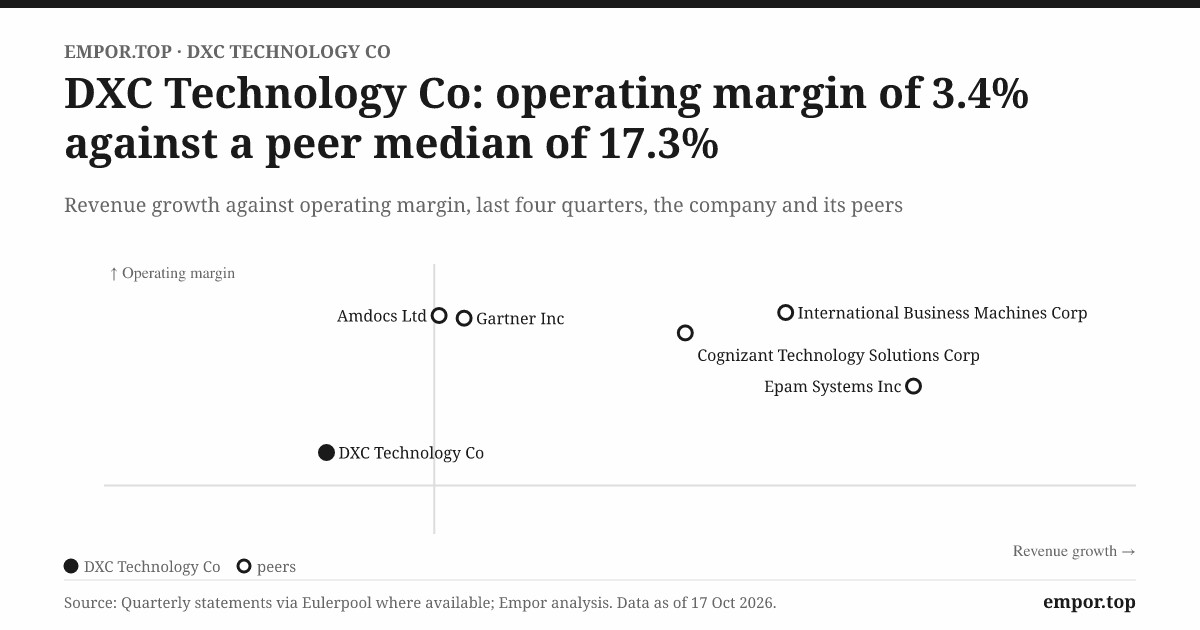
The bear case is the long record. Revenue is down about 41.7% from the fiscal 2018 peak.1 Organic revenue fell 6.7% in the latest quarter and 11.1% in GIS.3 The GAAP operating margin was only about 2.0% in fiscal 2026, a level at which one bad project or restructuring charge can erase a year's profit.1 Every previous growth story, from the post-merger digital pitch to Luxoft, failed to stop the decline. And the free cash flow the bulls count is partly the harvest of past investment, which will shrink as the installed base does.
The valuation needs reconciling, not just quoting. The commonly cited 54% free cash flow yield uses a definition that leaves out costs DXC itself treats as capital spending. On DXC's definition, the yield is about 31%. And neither number is a normalised forward return: guidance for fiscal 2027, once the TCS cash is removed, points to lower free cash flow, and the IRS case could take a large one-time bite. Peers frame the discount. Kyndryl, the closest pure infrastructure comparison, trades on similarly low sales multiples, while Cognizant and Accenture, which grow, trade at many times DXC's.[^10]1011 The market is not singling DXC out. It prices legacy infrastructure outsourcing as a declining business, and DXC has not yet given it a reason to price DXC differently.
The moat, tested once
Michael Porter's five forces explain why margins are thin. Buyers are powerful: they are large companies with procurement teams, they rebid contracts and spread work across several vendors, and the absence of any 10% customer means DXC has no single relationship it controls.1 Substitutes are the biggest threat, because the hyperscale clouds can replace hosting and data centre work, and AI can automate parts of the help desks and testing DXC charges for. Rivalry is intense among DXC, Kyndryl, IBM, Accenture, Cognizant and the Indian firms. Supplier power is moderate: DXC depends on Microsoft, the clouds and hardware makers, and has about $2.4 billion of minimum purchase commitments with software, telecom and hardware providers.1 New entrants are not the issue; the scale needed to run global estates is a barrier, but the existing rivals are more than enough.
Hamilton Helmer's seven powers, the durable sources of advantage, narrow it further. DXC has no network effects, no brand that lets it charge more, and no process power visible in its margins. Its scale has not produced cost leadership, as its operating margin trails the Indian firms by a wide margin. What it does have is switching costs, in the form of embedded systems, mission-critical mainframes and insurance platforms, plus something close to a cornered resource in decades of knowledge of particular clients' estates. The record says those switching costs are real but leaky: they slow the loss of a client but have not stopped scope from shrinking at renewal. Insurance software, protected by code good enough that a court found a rival had taken it, is where the switching-cost power looks strongest. The calibrated verdict is that DXC has a narrow, weakening moat in infrastructure and a narrow but more durable one in Insurance. Pricing power is not proven anywhere.
Three numbers will show whether that verdict should change. The first is constant-currency organic GIS revenue, most recently down 11.1%.3 The second is trailing book-to-bill by segment, most recently 1.11 in GIS, and whether bookings turn into recognised revenue a few quarters later.3 The third is normalised company-defined free cash flow, excluding litigation receipts and changes in the receivables facility, which was $713 million in fiscal 2026 and is guided lower for fiscal 2027 on that basis.19
The risks are best understood as mechanisms. Cloud migration and AI automation reduce the scope of legacy contracts at each renewal. Weak discretionary spending hits project work first, as the March quarter showed. A cyber or privacy failure inside a client's estate would damage the trust that is DXC's main asset. Tax and currency exposures can consume cash and reported revenue. And restructuring, which DXC has done almost every year, can disrupt delivery if pushed too hard, as the 2018 programme did.
A skeptical outside owner would ask three hard questions. Should DXC keep buying back shares at these prices, which is attractive if the decline slows and a trap if it does not? Should it invest more in growth, which the record says it has struggled to convert? Or should it separate the Insurance software business, which looks like a better business than the company it sits inside, from the legacy infrastructure work? DXC has not proposed the third option, and the evidence that Insurance could stand alone is limited to one segment's growth. But it is the question an activist would ask first, and it leads naturally to what DXC's history teaches.
XI. Lessons: A Services Giant Is Only as Sticky as Its Next Renewal
DXC was born with a promise of $25 billion of revenue and 6,000 clients.4 It has spent the years since selling pieces of itself, writing down what it bought, and trying to build a new growth story on top of a shrinking one. A few lessons from that journey belong to DXC and no other company.
The first is that a contract can be sticky right up to the renewal. Nobody rips out a bank's mainframe on a whim, and DXC's clients have mostly stayed. But staying is not the same as spending. The money in outsourcing is in the scope of each renewal, and that scope has shrunk at DXC year after year as clients move workloads to the cloud, automate the routine work, and rebid the rest. Switching costs protect the relationship, not the revenue. For investors in any services company, the right question is not how long clients stay but how much they pay when they come back to the table.
The second is that buying a growth story is not the same as growing. Luxoft cost about 20 times EBITDA, nearly twice what ordinary IT services deals fetched, and more than half the price became goodwill.1213 DXC's revenue kept falling anyway. The point is not that Luxoft was a bad business; DXC never reported enough to say. It is that an acquisition cannot change the direction of a company far larger than itself, and that the cheapest-looking deals are often the ones that assume the most.
The third is that cash is a bridge, not a destination. DXC turned a decade of paper losses into more than $16 billion of operating cash and used it to cut debt by about two-thirds and its share count by more than 40%.1 That bought time and safety. But cash generated by an installed base shrinks with the base, and every dollar sent to lenders and shareholders was a dollar not spent building what comes next. The bridge is real. It only leads somewhere if the company builds the other side before it gets there.
The fourth is that a demo becomes strategy only when it reaches the income statement. OASIS running in 57 client environments and 86 forward-deployed engineers are signs that clients are willing to try.9 They are not yet revenue, and DXC's history of announcing new directions faster than they paid off is reason to wait for the number. For founders and investors alike, the rule is simple: count the customers who pay, not the ones who watch.
XII. Epilogue: The Next Renewal Is the Real Verdict
Tonight DXC is a company in the middle of an experiment. It has the balance sheet to survive almost any single shock, a cash flow that would make most companies of its market value envious, and a leadership team with a coherent plan and a shareholder base that has, by the narrowest of margins, given it the benefit of the doubt. What it does not have is proof. Over the next year, a handful of moments will supply it, or not.
The first is a ruling from a courtroom in Washington. When the Tax Court decides the CSC capital-loss case, DXC will know whether it owes something close to $503 million or much less.1 A loss would take a large slice of the cash cushion built up after the TCS collection and the debt paydown, and investors will want to see the net bill against cash and revolver capacity, not the headline. A win would remove the single biggest overhang on the balance sheet.
The second is a pattern in the quarterly results. If GIS organic revenue stops falling for two consecutive quarters without the help of disposals, and the strong bookings of the June quarter show up as recognised revenue, the story changes from managed decline to stabilisation. If GIS keeps falling at double digits, the June bookings will look like a one-off and the guidance for a 3% to 5% decline will start to look optimistic.
The third is a disclosure DXC has not yet made. When OASIS and agentic security report paid revenue or material renewals, rather than deployment counts and demonstrations, the AI strategy becomes a business that can be valued. Until then it is an option that the market, reasonably, prices near zero.
The fourth is cash on DXC's own terms. Future free cash flow should be checked against the company's definition and stripped of litigation proceeds and swings in the receivables facility. If normalised cash holds near the levels of the past three years while revenue stabilises, the 31% yield is real. If it keeps drifting down with revenue, the yield is a mirage that shrinks as investors approach it.
The last is a test of behaviour. Compare guidance with results each quarter. Watch whether the board responds to the July vote by reshaping pay or the share reserve request, and whether buybacks slow or accelerate as the IRS ruling approaches. Picture the scene that will decide all of this: a GIS contract up for renewal, a client's procurement team on one side of the table, and DXC on the other trying to sell both the continued operation of the old estate and a new AI layer that makes it cheaper to run. If the client signs for both at a price that holds DXC's revenue, the turnaround is real. If the client takes the savings and shrinks the contract, the decline continues, only more efficiently.
XIII. Outro: The Company That Runs the Systems—and Its Own Runway
Go back to the insurer's mainframe, humming in a data centre somewhere in Europe. DXC's people know how to keep it running; they have done it for decades. About 115,000 of them, across a business that still brings in $12.6 billion a year, keep thousands of systems like it alive every night.1 That skill is real, and it is why the cash keeps coming.
But the cash is the proceeds of yesterday's work, and the next renewal decides whether it is a foundation or the slow harvest of a shrinking estate. DXC is neither just a cheap cash yield nor just a dying legacy business. It is a race between how fast it can make the next version of its clients' work worth paying for and how fast the old work disappears. The operator of yesterday's systems now has to prove it can be a paid partner in tomorrow's automation, and it has to do so before the runway ends.
References
-
DXC Technology Co. Form 10-K for Fiscal Year Ended March 31, 2026 — SEC EDGAR, 2026-05-08 ↩↩↩↩↩↩↩↩↩↩↩↩↩↩↩↩↩↩↩↩↩↩↩↩↩↩↩↩↩↩↩↩↩↩↩↩↩↩↩↩↩↩↩↩↩↩↩↩↩↩↩↩↩↩↩↩↩↩↩↩↩↩↩↩↩↩↩↩↩↩
-
DXC Technology Co. Form 10-Q for Period Ended June 30, 2026 — SEC EDGAR, 2026-07-31 ↩↩↩↩↩↩↩↩↩↩↩↩↩↩
-
DXC Technology Annual Report 2017 — SEC EDGAR, 2017-06-15 ↩↩
-
DXC Technology Co. Form 10-K for Fiscal Year Ended March 31, 2020 — SEC EDGAR, 2020-06-01 ↩↩↩↩↩↩
-
Q2 FY2020 Earnings Call Transcript — SEC EDGAR, 2019-11-11 ↩
-
DXC Technology to Sell U.S. State and Local Health and Human Services Business to Veritas Capital for $5.0 Billion — DXC Technology, 2020-03-10 ↩↩
-
Q1 FY2027 Earnings Call Transcript — DXC Technology, 2026-07-30 ↩↩↩↩↩↩↩↩↩↩↩↩
-
Cognizant Reports Fourth Quarter and Full Year 2025 Results — Cognizant, 2026-02-04 ↩↩
-
DXC Technology Co. Form 10-Q for Period Ended September 30, 2019 (Luxoft acquisition accounting) — SEC EDGAR, 2019-10-31 ↩↩
-
DXC Technology Co. 2026 Definitive Proxy Statement — SEC EDGAR, 2026-06-04 ↩↩↩↩↩↩↩↩↩↩↩↩↩↩
-
DXC Technology Said to Tap Advisers After Takeover Interest — Bloomberg Law, 2022-09-21 ↩
-
Q4 FY2026 Earnings Call Transcript — DXC Technology, 2026-05-07 ↩
-
2026 Annual Meeting Voting Results, Form 8-K — SEC EDGAR, 2026-07-22 ↩↩↩
 LinkedIn
 WhatsApp
 Reddit
 Hacker News
 Email
 Kindle
 RSS Feed
 Spotify
 Apple Podcasts
 Amazon Music
 Audible
 YouTube