DoubleVerify: The Company That Measured the Ads—and Then Put Itself Up for Sale
I. The $13.60 Question
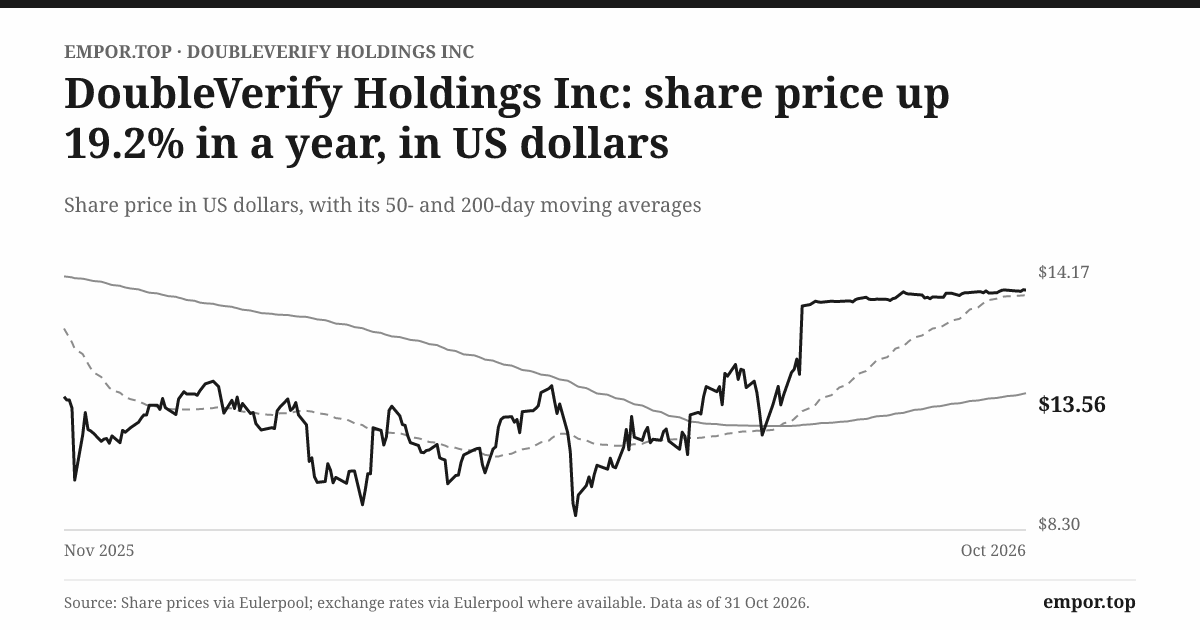
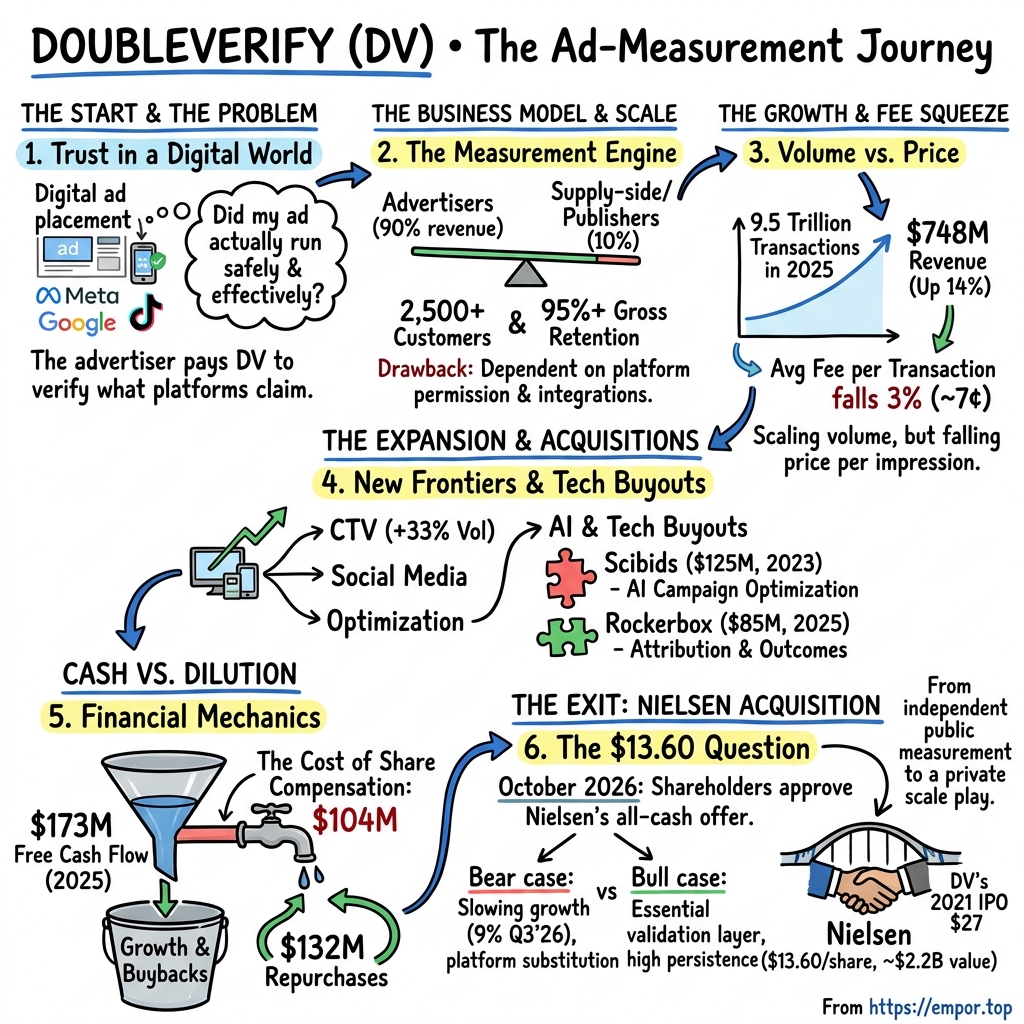
On Thursday, October 29, 2026, DoubleVerify's shareholders held the vote that decided whether they would remain owners of a public company. The count was not close. About 119.9 million shares voted for Nielsen's all-cash offer and about 5.7 million voted against, roughly 96% of the votes cast and more than three-quarters of all shares outstanding.1 The day after the vote, DV published its third-quarter results. Two days after the vote, on Saturday, October 31, the stock's last closing price was $13.56, Friday's close.2
That was four cents below the $13.60 a share that Nielsen had agreed to pay.3 Four cents is the sound of a market that has mostly stopped arguing. When a stock trades that close to a cash offer, investors are no longer debating what the business is worth. They are pricing the odds that the deal closes, and the time value of waiting for it. At $13.56, the market valued DoubleVerify's equity at about $2.2 billion, close to the roughly $2.15 billion headline value that press coverage attached to the deal in August.4
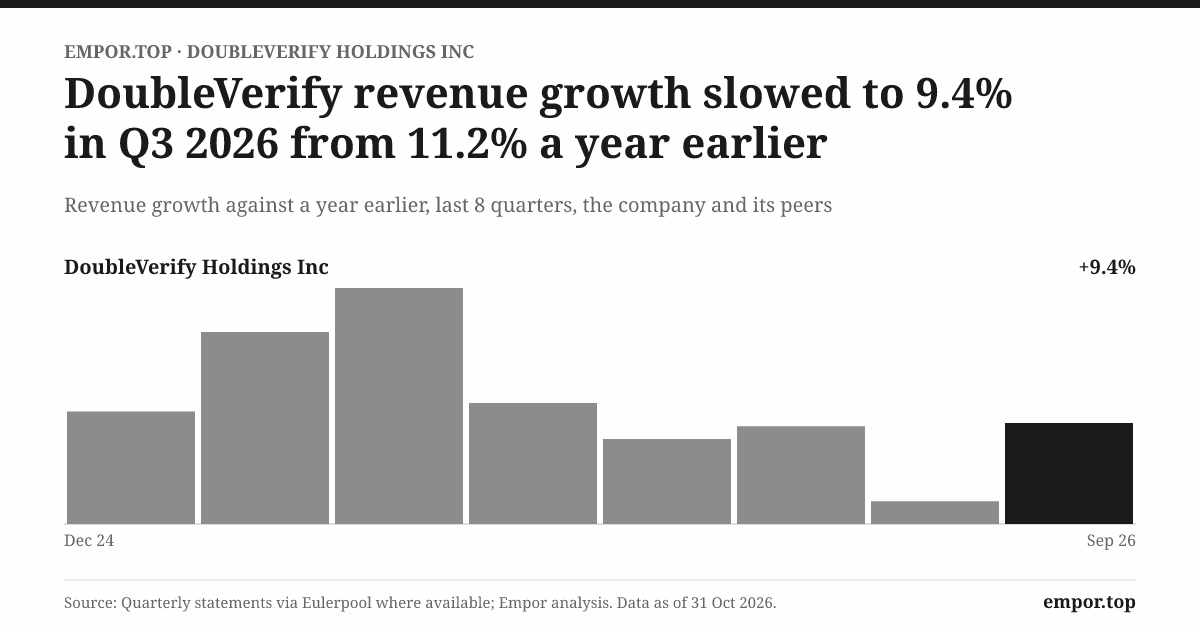
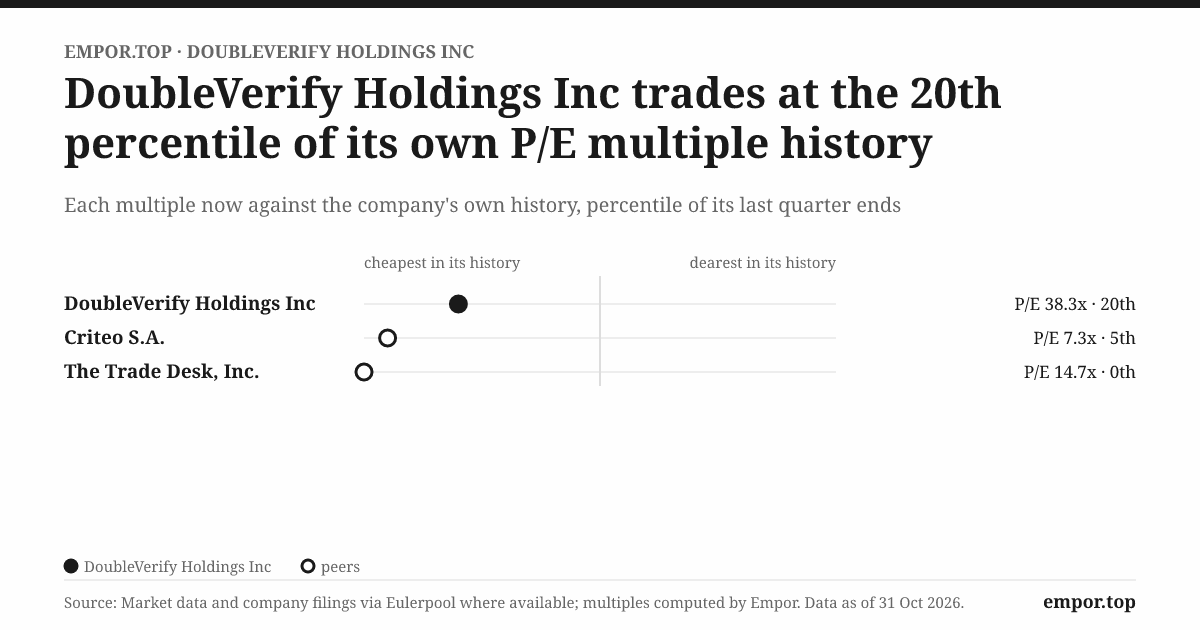
But what the market was pricing and what the company was are different questions. In the quarter that ended in September 2026, DV booked about $206 million of revenue, up 9% from a year earlier.5 That was a respectable number for most software companies and a modest one for this one. Over the five years to 2025, DV had grown revenue at about a quarter a year, compounding from roughly $243 million in 2020 to $748 million in 2025.6 A company that once grew by a third a year was now growing by less than a tenth in some quarters, and the earnings multiple told the same story. At the October price, the stock traded at about 38 times its trailing earnings, against a five-year median of roughly 65 times. Investors had already marked the company down long before Nielsen arrived.
Nielsen's offer, in the language of the merger proxy, was a 30% premium to DV's volume-weighted average share price over the 60 trading days before the deal was announced.3 That sounds generous, and for a shareholder who bought in the summer of 2026 it was. For a shareholder who bought at the 2021 IPO, it was a loss of roughly half. A cash offer is a transaction price. It tells you what one buyer, with its own financing, synergies and strategic needs, was willing to pay, and what a majority of holders were willing to accept. It does not, on its own, tell you what DoubleVerify would have been worth had it kept going alone.
Nor had the vote finished the deal. Shareholder approval removed one condition. Others remained. By the time of the special meeting, the U.S. waiting period under the Hart-Scott-Rodino antitrust law had expired, and Australia's competition regulator had cleared the transaction in a Phase 1 determination on October 13.78 The merger agreement still carried further regulatory and closing conditions, and two stockholder complaints and 14 demand letters had challenged the adequacy of the proxy disclosures.7 Approval was not closing. The four-cent gap was the price of that remaining uncertainty.
So this is a story that arrives at its ending before it has answered its most interesting questions. DoubleVerify built a business by standing between advertisers and the giant platforms that sell them attention, checking whether the ads they paid for were seen by humans, in safe places, and in the formats promised. The first question is whether that position is defensible when the platforms being measured also offer their own measurement. The second is whether new products in social media, streaming television and artificial intelligence can reverse a slowdown that began in 2024. The third is how much of DV's impressive cash generation actually reaches owners after stock compensation, software spending and acquisitions. And the fourth is what the sale itself says: whether $13.60 was a fair exit for a slowing but cash-rich company, or a verdict delivered at the bottom of a cycle.
The uncomfortable possibility running through all of it is that the deal may close before DV ever has to answer those questions in public again. After signing with Nielsen, the company stopped hosting earnings calls and withdrew its guidance.5 The referee, in other words, has stopped taking questions. To understand what Nielsen is buying, it helps to start with the job DoubleVerify does, and with the odd fact that anyone pays for it at all.
 Subscribe on LinkedIn
II. A Business Built Between the Buyer and the Platform
Picture an ad for a running shoe. It appears in a social feed between a friend's holiday photos and a news clip, or it plays during a break in a streaming drama on a living-room television. The brand that paid for it has a handful of questions it cannot answer by itself. Was the ad actually on screen long enough to be seen? Did it run beside content the brand would never want its name next to? Was the "viewer" a person, or a bot farm generating fake traffic to harvest ad dollars? And did anyone who saw it go on to buy shoes?
The platform that sold the space has answers to all of those questions. That is precisely the problem. The platform controls the inventory, the data about who saw what, and much of the reporting the advertiser receives. Asking the seller to grade its own homework is not crazy, and many advertisers do exactly that, but for a large brand spending across dozens of websites, apps, social networks and streaming services, it creates two difficulties. Each platform measures in its own way, which makes comparisons hard, and each has an obvious interest in the result. DoubleVerify exists in that gap. It sells independent verification and measurement across channels, a common yardstick that is not owned by the party being measured.
The company was founded in 2008, in the early years of programmatic advertising, when automated exchanges began buying and selling ad slots in milliseconds and nobody could quite see where the ads landed.9 Its first job was simple to describe and hard to do: confirm that ads ran where advertisers thought they did. Over time the work broadened from checking placements to blocking bad ones in advance, measuring attention and, later, trying to measure business outcomes.
Today DV describes its advertiser offering in two halves. Activation is the part that acts before or around the purchase of an ad. When an advertiser's buying software is about to bid for a slot, DV's tools can assess whether the page or app is safe, whether the traffic looks fraudulent and whether the content is suitable, and steer spend away if not. Measurement is the after-the-fact report card: once the ad has run, DV assesses whether it was viewable, whether fraud was involved and where it appeared.6 A third, smaller line serves the other side of the market. Supply-side customers, the publishers and platforms selling ad space, use DV's tools to understand and manage the quality of their own inventory, often because advertisers ask them to.
The economics follow from that split. In 2025, DV generated about $748 million of revenue, and about 90% of it came from advertiser customers, with roughly 10% from the supply side.6 Advertisers mostly pay a measured-transaction fee: a small charge linked to the volume of ad impressions DV checks on their behalf. Supply-side customers usually sign one- to two-year contracts with minimum guarantees that reset monthly, plus overage charges when usage runs higher.6 DV served more than 2,500 customers in 2025, and no single customer accounted for more than 10% of revenue.6
The result is a business that is recurring without being fixed. DV has ongoing contracts with a large share of its customers and calls its revenue highly recurring, but it recognizes advertiser revenue as the service is delivered, which means the bill rises and falls with the number of ads its customers buy.6 When brands pull back spending, DV's revenue pulls back with them. The fourth quarter, when holiday advertising peaks, is usually its strongest. A useful analogy is a toll road whose operator is paid per car. It does not need to sign a new contract every time a car passes, but it is exposed to how many people decide to drive.
There is also a less obvious dependency. To measure ads inside Meta's apps, Google's YouTube, TikTok or a streaming service, DV needs the platform's cooperation: technical integrations, data access and permission to run its classification inside what are, in effect, walled gardens. The same platforms offer advertisers their own measurement tools, and DV's annual report names Meta, Google and The Trade Desk among its competitors.6 An independent measurer that relies on the cooperation of the companies it measures is in a delicate position. Its analysis may be independent. Its access is not.
DV's strongest counterargument is persistence. The company says its top 25, 50 and 75 customers have been with it for about nine years on average.6 Brands do not keep a vendor for nearly a decade by accident. Yet persistence and power are not the same thing. A long relationship shows that customers find the service useful enough to keep. It does not show that they pay more each year, that they could not easily add a second vendor, or that they would resist if a platform offered a free alternative that was good enough. The rest of this story is, in part, an attempt to separate those things, beginning with the meter that runs every time an ad is checked.
III. The $748 Million Business—and the Price of Every Impression
Nicola Allais has the job, as DV's chief financial officer, of explaining a business that runs on numbers too large to picture. On the company's February 2026 call to discuss full-year 2025 results, the mechanics he and chief executive Mark Zagorski described came down to two levers pulling against each other.10 One lever was volume: the number of ad transactions DV measured for advertisers. The other was price: the average fee DV collected on each of them. In 2025, the first lever pulled hard and the second pulled the other way.
Start with the headline. DV's 2025 revenue rose about 14%.6 Inside that number, activation revenue grew 15%, measurement 10% and supply-side revenue 25%.10 Activation is by far the largest line; supply-side is the smallest, and its faster growth comes from a low base. These are revenue categories, not separately managed businesses: DV reports one operating segment, so there is no separate profit figure for any of them.6
Now the meter. Advertiser measured-transaction volume grew about 15% in 2025, to around 9.5 trillion transactions.10 That is an almost unimaginable count of ad impressions, more than a thousand for every person on Earth. But the average measured-transaction fee fell about 3%, to roughly seven cents per thousand transactions.10 Put those together and the arithmetic is unforgiving. A company that checks 15% more ads but earns 3% less on each one does not grow advertiser revenue by 15%. It grows by something closer to 11 or 12%, before any other effects.
The fourth quarter made the tension sharper. In Q4 2025, advertiser revenue grew about 7% while volume grew about 8%, with the fee again down about 3%, once a single large customer's introductory fixed-fee arrangement was excluded from the comparison.10 That customer exclusion matters for honest arithmetic. A fixed-fee deal breaks the link between volume and revenue for that customer, so management stripped it out to show the underlying trend. With it stripped out, the underlying trend was still a fee in gentle decline.
Why would the price of each check fall? Management's explanation was mostly about mix. Advertising dollars had been moving from the open web, the vast long tail of websites where DV's pre-bid activation products are well established, toward social platforms. DV's premium pre-bid tools were not yet fully deployed in social, so a dollar of spend moving from a news site to a social feed could become a cheaper DV transaction.10 International growth and large-customer volume discounts can work the same way. The mix explanation is plausible, and it is consistent with the reported numbers. It is also, for a shareholder, a double-edged one. If the cheaper channels are where the growth is, then volume growth will keep outrunning revenue growth until DV can sell its higher-priced products into those channels.
There is a deeper reading as well. Falling unit prices in a growing market can signal three different things. They can mean a company is passing scale efficiencies to customers to win share, which is healthy. They can mean customers are negotiating harder because alternatives exist, which is a warning sign. Or they can mean mix is shifting toward lower-value formats, which is neutral until it becomes permanent. DV's disclosures support the third explanation most directly. They do not rule out the second, because the company does not publish price changes by customer cohort.
The 2026 results showed a business that had slowed and then partly steadied. In the third quarter, activation revenue was about $118 million, up 10% from a year earlier; measurement was about $69 million, up 8%; and supply-side revenue was about $19 million, up 5%.5 Over the first nine months, the growth rates were 5%, 10% and 10% respectively.5 Read together, those figures say that activation, the engine, had a weak first half of 2026 and recovered in the third quarter, while supply-side growth cooled sharply from 2025's pace. A second-quarter revenue increase of only about 2% had been the low point.11 The third quarter was better. It was not a return to 2025, let alone to the years when DV grew by a third.
The company's growth story rests on three newer routes into the same market: social media, connected television (streaming video watched on internet-connected TVs, usually shortened to CTV), and retail media, the ad networks run by retailers such as grocery and big-box chains. It is tempting to treat these as new businesses. They are better understood as new roads to the old destination. Each adds coverage of ad spend that DV could not previously measure well, and each must eventually prove that it carries the same price per check as the open web, or better.
So the investigation of DV's growth lands on a clear verdict. Volume carried the core advertiser business, and the price of each impression drifted down. That is not a crisis. A business can grow for a long time on rising volume. But it means growth in the number of ads checked does not automatically become equivalent revenue growth, and it means the case for DV's long-term value depends on whether new products can lift price as well as volume. Before asking whether they can, it is worth asking what, exactly, protects the volume DV already has.
IV. A Moat Made of Integrations, Retention—and Trust
Consider a single campaign for a consumer brand. It runs on news websites, in a mobile game, across two social networks and inside ad breaks on three streaming services. The brand wants one rule applied everywhere: no ads next to violent content, hate speech or misinformation, and no paying for bots. Each of those channels has different rules about what an outside vendor may see, different technical standards, and different definitions of what counts as an impression. Somebody has to translate one brand-safety policy into dozens of local dialects and then report back in a single language. That translation work, built up integration by integration over nearly two decades, is the heart of DoubleVerify's claim to an advantage.
The question this section must answer is whether that claim describes a durable moat or a useful service with competitors close behind. The cleanest way in is to look at who holds power in DV's market, and then at what the company's own record says about its ability to keep customers and charge them.
Who holds the leverage
Start with the buyers. DV's customers are advertisers and their agencies, and they have real bargaining power. Most of them can use the free or bundled measurement tools offered by the platforms they buy from. Many large advertisers can and do use more than one verification vendor, or split vendors across channels. Agencies, which manage spending for many brands, can steer volume between vendors in bulk. DV's low customer concentration limits the damage any one buyer can do, but it does not stop buyers as a group from pressing on price.6
Then the suppliers, which in DV's case are not providers of raw materials but providers of access. The platforms control the inventory, the data and the interfaces through which outside measurement works. This is the force that makes DV's position structurally unusual. A platform does not have to compete with DV head-on to weaken it. It can simply decide how much data to share, how deep an integration to allow, or which measurement partners to certify. DV's annual report lists the same platforms among its competitors, alongside specialist firms.6 The companies that open the gate are also, in some products, rivals inside the field.
The threat of substitutes comes mostly from those same platforms. For a campaign that runs entirely within one walled garden, the platform's own reporting may be good enough, especially if the advertiser trusts it and the price is zero. Third-party verification is most valuable when spending is spread across many channels and a common standard matters. It is least valuable when spending concentrates on a few giant platforms. That is a meaningful observation about where the digital ad market has been heading.
Rivalry among specialists is real. The closest comparable public company is Integral Ad Science, which reported about $530 million of revenue in 2024.12 DV's 2025 revenue of about $748 million is larger, but the periods differ and neither company's filings establish a reliable market-share figure.6 DV's annual report lists a broader set of competitors that includes Nielsen itself, Scope3, Zefr, Comscore and Protected Media, in addition to the platforms.6 That Nielsen appears on the list of competitors is a detail worth remembering when we reach the sale. New entrants face the challenge of building integrations and earning accreditation from industry bodies, which takes time, but the list shows that the field is not empty.
What the retention record proves, and what it does not
Now the evidence for stickiness, which is genuinely strong. DV reported gross revenue retention above 95% for five consecutive years through 2025.6 Gross retention measures how much of last year's revenue from existing customers the company kept, before counting any expansion; above 95% means very few customers left or shrank meaningfully. DV also said it retained all of its top 75 customers through 2024, and those largest relationships average about nine years.136 Customers do not stay that long with a vendor whose product they consider a commodity. The switching cost is partly technical, since integrations into buying software and reporting systems take effort to unwind, and partly reputational: a brand-safety manager who switches vendors and then suffers an embarrassing placement has to explain why.
But the same record contains the strongest piece of disconfirming evidence. Net revenue retention, which adds expansion to retention and therefore shows whether existing customers spend more each year, has been falling. It was about 127% in 2022, about 112% in 2024 and about 109% in 2025.136 In plain terms, a dollar of revenue from existing customers in 2022 became about $1.27 the following year; by 2025 it became about $1.09. Customers were still staying. They were no longer expanding as quickly. The decline coincides with the falling fee per transaction, and the two point in the same direction: DV's hold on its customers is firm, but its ability to extract more from each of them has weakened. DV does not publish customer-cohort expansion rates or the share of revenue from its five or ten largest customers, so outsiders cannot see whether the slowdown is broad or driven by a few large accounts.6
When trust is the product
There is one more test, and for a verification company it is the most important. DoubleVerify sells judgment. If advertisers come to believe that its judgment is unreliable, every other advantage weakens at once. That test arrived in 2025, when the independent research firm Adalytics published reports criticizing the outcomes of ad-verification services, including claims that ads had been served to bots and to declared crawlers despite verification tools being in place. DV publicly disputed the methodology and conclusions, arguing in a March 2025 statement that the analysis misunderstood how its tools and industry-standard filtering work.14
Around the same period, a securities class action was filed against the company. It was voluntarily dismissed without prejudice on December 22, 2025.6 The allegations in the research reports remain contested, not established findings, and the dismissal of the lawsuit removed a legal overhang without settling the underlying argument about measurement accuracy. Still, the episode mattered precisely because of what DV sells. A tire maker can survive a critical review of one tire. A referee whose calls are publicly questioned has a different kind of problem, because the value of the call depends on everyone believing it.
Weighing all of this, the history narrows the moat claim rather than rejecting it. DV's advantage is real and consists of accumulated integrations across channels, years of classification and fraud-detection data and models, and long relationships with large advertisers. That advantage is strong enough to keep customers. The record does not support a stronger version: there is no exclusive access to platform data, no evidence of a pricing umbrella over competitors, and the trend in net retention says that expanding within the customer base has become harder. The tests that would confirm or falsify the narrower claim are visible ones: whether gross retention stays above 95%, whether the fee per transaction stabilizes, and whether net retention stops falling. DV's answer to all three was a wave of new products, and those products had to earn their place.
V. The New Products Had to Earn Their Place
The streaming television screen is a strange place for a verification company. On the open web, DV can see the page an ad appears on and classify its content. On a connected TV, the ad might be served into a program through a chain of intermediaries, and the "page" is a show that may be identified only by a code or a vague label. Advertisers discovered that some CTV inventory sold as premium was not what it claimed to be: ads labeled as running in well-known programs, for example, that actually ran elsewhere, or devices that were not televisions at all. Program-level transparency, knowing which show an ad actually ran in, became one of DV's pitches for the channel.
That is the scene of DV's expansion: a company built on checking web pages pushing its tools into places where pages do not exist, while the platforms that run those places build their own ad and measurement systems. The question is whether the new products create a new growth curve or remain promising capabilities whose economics nobody outside the company can see.
The expansion followed format coverage. DV added verification across social platforms, then extended it into streaming inventory, then pushed into program-level measurement and pre-bid controls for CTV, so that advertisers could avoid unwanted programs before buying rather than discovering problems afterward.6 Each step widened the share of ad spend DV could touch. The usage figures were encouraging. CTV measurement volume grew about 33% in 2025, and CTV measured transactions grew about 22% in the third quarter of 2026.105 Social measurement revenue grew about 20% in that quarter.5 By the fourth quarter of 2025, social activation and measurement together represented about 19% of DV's revenue.10
Those numbers deserve to be taken seriously and read carefully. They show that advertisers were using DV in the newer channels and that usage was growing faster than the company as a whole. They do not show the price of a CTV or social check compared with an open-web check, or whether those products are as profitable. DV does not disclose CTV revenue or profit separately, and its social figure is a share of revenue, not a margin.6 Recall the mix problem from the fourth quarter of 2025: management said the shift toward social was one reason the average fee fell, because premium pre-bid tools were not yet fully penetrated there.10 Growth in a lower-priced channel can raise volume and dilute price simultaneously. Usage is proof of demand. It is not yet proof of the economics.
The artificial-intelligence strategy gives a more concrete test, because DV bought a business to pursue it. In 2023 it agreed to acquire Scibids, a French company whose software uses machine learning to optimize campaign bidding, adjusting where and how much an advertiser bids for each impression based on the outcomes the advertiser wants.15 The logic was to move DV from telling advertisers where not to spend toward helping them decide where to spend. Management later told investors that it had sold the Scibids solution to 19 customers and cited a return of about $4 for every $1 customers invested.16 Those are early proof points reported by the company. They are not a disclosed revenue stream, and the return figure is not independently validated. Nineteen customers, against a base of more than 2,500, is a beginning.
AI cuts both ways for DV, and both mechanisms deserve attention. On one side, the explosion of AI-generated content and AI-driven traffic creates more need for checking: more low-quality sites assembled by machines to harvest ad revenue, more synthetic content of uncertain suitability, and more sophisticated bots. DV already uses AI models for classification and fraud detection, and better models could make its tools cheaper to run and more accurate.6 On the other side, the platforms have their own AI and vastly more data about their own inventory. If Meta's or Google's systems become good enough at keeping ads away from unsafe content and filtering invalid traffic inside their own walls, the case for paying a third party to check weakens, at least for spending concentrated on those platforms. DV's annual report lists AI as both an opportunity and a competitive risk.6 Neither side of that ledger has yet produced disclosed figures that settle it.
The fair verdict is that social and CTV are credible extensions of the core business, supported by real usage and growth, and that AI is, so far, a capability rather than a disclosed engine. Product launches and industry accreditations are worth something; they show that DV can build and that it is trusted to measure in new places. But they are not revenue, and the measure that would prove their value is the same one that troubled the core business: whether these products lift revenue per customer and the fee per transaction, or mainly add complexity and development cost. Some of those capabilities DV built itself. Others it bought, and the price of buying them is the next part of the story.
VI. The Buyouts Behind the Product Roadmap
In July 2023, DoubleVerify signed its agreement to buy Scibids for $125 million.15 The consideration was not all cash: part was paid in DV stock, and part was tied to future performance.15 Nineteen months later, in February 2025, DV announced a second significant purchase, agreeing to pay $85 million for Rockerbox, a New York company that helps marketers work out which of their ads actually caused sales.17 Final purchase accounting put the Rockerbox price at about $82.3 million net of acquired cash.6
Neither deal was a bolt from the blue. DV had been building through acquisition for years. In 2018 and 2019 it bought Leiki, a semantic-classification company; Zentrick, a video-ad technology firm; and Ad-Juster, which reconciled ad-delivery data for publishers.6 In 2021 it added OpenSlate, which brought brand-safety and suitability analysis for YouTube and other social video, and Meetrics, a European verification company.6 Read in sequence, the purchases tell a coherent story. Each extended either DV's coverage, into video, social, Europe or the supply side, or its capability, into classification, optimization and outcomes. This was not a roll-up of unrelated revenue streams bought to manufacture growth. It was a product roadmap assembled partly from other people's code.
Scibids and Rockerbox represent the two newest chapters of that roadmap. Scibids added AI-driven campaign optimization. Rockerbox added three tools that marketers increasingly want. Multi-touch attribution tries to assign credit for a sale across the many ads a customer saw before buying. Marketing-mix modeling uses statistics to estimate how spending in each channel contributed to sales. Incrementality testing compares groups who saw ads with groups who did not, to measure the sales the advertising genuinely caused.17 The common thread is a shift in the question DV answers. The old question was "did my ad run properly?" The new one is "did my ad work?" Advertisers increasingly judge spending by business outcomes rather than by media-quality checks, so the move is strategic to the core rather than a diversification.
How expensive were these deals? Measured against DV's own scale, the Scibids price was about 17% of DV's 2023 revenue, and the Rockerbox price about 11% of its 2024 revenue.613 Those are scale comparisons, not valuation multiples. DV did not disclose comparable revenue or earnings for either acquired business, so outsiders cannot compute what multiple DV paid or benchmark the prices against similar deals. The only operating comment on Rockerbox's performance came from management, which said on the February 2026 call that Rockerbox's 2025 revenue had come in slightly ahead of expectations.10 Since the expectations themselves were never published, the comment tells the listener that management was satisfied, and little more.
A skeptical shareholder would want to set the strategic logic against the record of prior deals. Here the evidence is limited in both directions. DV's filings warn, as most acquirers' do, that integration, retention of acquired staff and customers, and expected benefits can disappoint.6 The company's reports over 2023 to 2025 do not show an impairment or write-off of these acquisitions, which would have been the clearest public sign of a failed purchase. But the absence of a write-off is not proof of success, particularly when the acquired products are folded into DV's broader revenue lines and never reported separately. DV's return on invested capital, around 5 to 7% in recent years on its reported operating profit, is modest for a software company. It is weighed down by a large equity base built partly from IPO proceeds and acquired goodwill, so it cannot be read as a verdict on the recent deals alone, but it is a reminder that DV's acquired and built capabilities have not yet produced high returns on the capital they absorbed.6
For context on affordability, DV generated about $173 million of free cash flow in 2025.6 Paying $85 million for Rockerbox in that year consumed roughly half of it. These were not reckless sums for a company of DV's size and cash generation. Whether they were wise sums is a different question that the public record cannot yet answer.
The verdict on the acquisitions is that their strategic fit is clear and their returns are not. Scibids and Rockerbox fit a credible move from verification toward optimization and outcome measurement. There is no disclosed evidence that DV overpaid, and no disclosed evidence that it did not. The test that would settle the question is the one any owner should apply: what the acquired products add to revenue per customer, to retention, and ultimately to free cash flow per diluted share. That last measure brings us to the part of DV's story that looks best on a cash-flow statement and is hardest to translate into an owner's return.
VII. Cash Was Strong; the Per-Share Claim Was Harder
Open DoubleVerify's 2025 cash-flow statement and the first number that jumps out is the gap. Net income for the year was about $50.7 million. Cash generated from operations was about $211.2 million, more than four times as much.6 For a company whose earnings had fallen two years running, that looks like a hidden strength: profits understated, cash pouring in. It is partly that. It is also a puzzle with a specific answer, and the answer sits on the line directly beneath net income, where the company added back about $104.2 million of stock-based compensation.6
Here is how the bridge works. Accounting profit is reduced by some costs that do not involve cash leaving the company in the year. Depreciation and amortization, about $56.6 million in 2025, is one: it spreads the cost of past investments, including acquired technology and capitalized software, over time.6 Stock compensation is another. When DV pays engineers and executives partly in shares and options, the value of that pay is recorded as an expense, but no cash leaves the bank. So the cash-flow statement adds it back. Working capital moved the other way in 2025, using about $17 million of cash.6
Over a longer span the pattern is consistent. Between 2018 and 2025, DV's cumulative net profit was about $295 million while cumulative operating cash flow was about $727 million, roughly two and a half times as much.6 Some of that gap is genuinely good news. DV has been collecting faster from customers: receivables, measured in days of revenue, fell from a peak of about 142 days in 2020 to about 108 days in 2025, and recent bad-debt write-offs shrank.6 A software business with little physical capital and improving collections should convert profit into cash well.
But stock compensation is not free just because it is non-cash. It is paid in ownership. Every share or option granted to an employee either dilutes existing shareholders or has to be bought back with real cash to keep the share count stable. In 2025, the stock-compensation add-back was roughly half of DV's operating cash flow before working-capital changes. An owner who treats the full $211 million as available cash is, in effect, counting the employees' pay twice: once as a cost that does appear in earnings, and again as cash that seems free.
The company did not spend all its cash on buybacks. It invested heavily in product. Product-development expense reached about $178 million in 2025, roughly 24% of revenue, up from about 22% in 2023.6 On top of that, DV spent about $39 million on equipment and capitalized software in 2025, up from about $27 million in 2024.6 Capitalized software is worth a sentence of explanation. Under accounting rules, some of the cost of building internal-use software can be recorded as an asset and expensed gradually rather than all at once. That moves part of development spending out of operating expense and into investing cash flow, which flatters operating cash flow while leaving free cash flow, which subtracts capital spending, a more honest figure. DV's free cash flow, after those outlays, was about $173 million in 2025.6 Headcount, meanwhile, rose more than 11% from the start of 2024 to about 1,231 employees by the end of 2025, while revenue grew about 31% over 2023 to 2025.6 This was a company still building, not one harvesting.
Then the buybacks. DV repurchased about 8.4 million shares for roughly $132 million in 2025, and management said on the February 2026 call that this cut the share count by about 3%.610 In the first half of 2026, under a newly authorized $300 million program, it bought back another 9.8 million shares for about $100 million.11 That was a significant acceleration: a half-year of buybacks equal to more than half of 2025's free cash flow, executed at an average price of a little over $10 a share. Cash fell from about $259 million at the end of 2025 to about $210 million by June.11
Were those good purchases? Measured against the $13.60 Nielsen later offered, the first-half 2026 buybacks look well timed, since DV paid roughly $10 for shares that a buyer soon valued at $13.60. Measured against earlier repurchases at higher prices, and against the dilution they offset, the picture is less flattering. Buybacks that merely absorb the shares issued to employees do not raise each remaining owner's stake; they convert stock compensation into a cash cost. Only repurchases beyond that offset, at prices below intrinsic value, create per-share value. DV's share count reduction of about 3% in 2025 is evidence that the buybacks did more than offset dilution in that year, but they used cash that might otherwise have funded product development or acquisitions.
One misconception is worth correcting. Data services sometimes show DV carrying around $100 million of "borrowings," which can suggest debt. In fact, that figure largely reflects lease obligations on offices and equipment: at June 2026, DV showed about $83 million of operating lease liabilities and about $29 million of finance lease obligations.11 DV had a $200 million revolving credit facility, but reported no amount drawn at the end of 2025 and said it was in compliance with the facility's covenant, which caps net leverage at 4.5 times.6 The revolver is a liquidity backstop, not a refinancing wall. DV's balance sheet is not where its risk lies.
So the cash story lands on a narrower claim than the raw numbers suggest. DV's cash conversion is real and strong, and it has funded investment and buybacks without a large funded-debt burden. But a meaningful share of that cash exists because employees were paid in stock, and the buybacks that followed were partly the cost of keeping their pay from diluting everyone else. The measure that matters for an owner is free cash flow per diluted share after stock compensation, capitalized software and repurchases. On that measure DV was good, not spectacular, and the people responsible for the allocation choices were, by early 2026, explaining a miss.
VIII. The CEO's Growth Story Met a Harder Tape
Mark Zagorski came to DoubleVerify in 2019 with a résumé that read like a tour of advertising technology's consolidation years. He had run eXelate, a data company that Nielsen acquired, and later led Telaria, a video advertising platform, before taking the chief executive's job at DV under Providence Equity Partners' ownership.9 By the time DV went public, he was its public face: an evangelist for independent measurement who spoke in the language of "trust" and "transparency" and framed DV as the neutral layer of a fragmented ad world. The detail that gives his career a strange symmetry is that the buyer of DV in 2026 was the same company that had once bought his previous business.
On the February 26, 2026 call, Zagorski and Allais had a harder story to tell. The fourth quarter of 2025 had come in below expectations, and the explanation they gave was specific: late in the quarter, several customers pulled back campaigns, and management linked the pullback to changes at advertising agencies, where account moves and consolidation shifted spending, and to weakness in retail advertising.10 It is worth noting what kind of explanation that is. It is concrete, it names a mechanism, and it is external. It also implicitly concedes a vulnerability already visible in the price data: DV's revenue is exposed to decisions made by agencies managing many brands at once, which is the buyer-power problem in miniature.
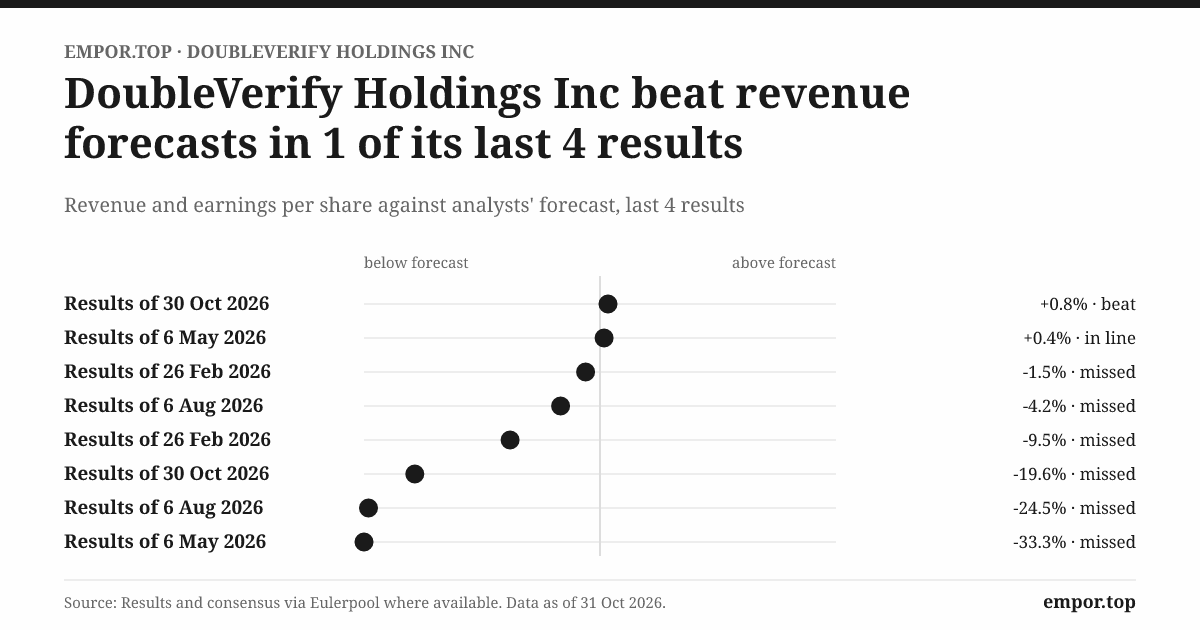
The better way to judge management is to compare promises with outcomes over time. A year earlier, in February 2025, management had described 2025 as a transition year and excluded a large customer from its revenue guidance, an unusual step that lowered the bar.16 Revenue ultimately grew about 14% for the year, a reasonable outcome against cautious guidance, before the fourth quarter weakened.6 Then 2026 began with growth in single digits. Measured over the longer run, the deceleration was steady: revenue grew about 25% a year from 2020 to 2025, about 18% a year from 2022 to 2025, 14% in 2025 and 9% in the third quarter of 2026.65 Management did not overpromise wildly. But its strategy of expanding into new channels and products had not, by the time of the sale, reversed the slowdown, and the two operating signals that would show it working, net retention and transaction pricing, had both moved the wrong way.
The responses management announced were tangible. It said it would reduce the annual value of executive equity grants by more than 40% compared with 2025, use AI to improve internal productivity, and execute the new $300 million repurchase authorization.10 The equity-grant cut addressed the dilution issue directly, and the acceleration in buybacks showed up quickly in the first-half numbers. Whether these choices improved per-share returns or simply offset dilution is a question the deal arrived before anyone could answer.
Pay deserves context rather than outrage. Zagorski's reported 2025 compensation was about $11.8 million, up from about $1.1 million in 2024, against a year in which net income fell.18 The swing is mostly an artifact of the timing of large equity awards: the proxy's separate measure of "compensation actually paid," which adjusts for changes in the value of equity, was about $6.9 million for 2025.18 Neither figure is cash received. Both are the kind of numbers a skeptical shareholder would want explained alongside falling profits. Zagorski's beneficial ownership was reported at about 2.25% in the merger proxy, a figure that includes shares he could acquire through exercisable or vesting equity.3
The merger adds a separate alignment question. The proxy estimated the value of Zagorski's outstanding equity interests at about $20.97 million under its transaction assumptions.3 Executives with meaningful equity and accelerated or transaction-related benefits have an interest in a deal closing, and the advisory vote on merger-related executive compensation passed.1 That is not evidence of misconduct. It is a standard feature of public-company sales that shareholders are entitled to weigh. The board's protection against conflicts was a special committee composed solely of independent and disinterested directors, which negotiated the transaction.3 Providence, which had once controlled DV, still held about 11.72% and signed a voting agreement to support the deal.3
The shareholder support was strong, and it answers a narrow question: holders of most of the stock preferred $13.60 in cash now to an uncertain standalone future. It does not answer whether the offer captured DV's long-term value, because those holders were choosing between a bird in the hand and a business that had decelerated for three years. With the deal signed, DV had suspended future earnings calls and withdrawn its guidance, leaving the executives who had spent years explaining its growth story without analysts' questions to answer.5 That silence frames the central question of the sale itself.
IX. The Sale Price and the Standalone Counterfactual
On April 21, 2021, DoubleVerify's shares began trading on the New York Stock Exchange. The IPO had priced at $27 a share, and the stock opened around $35, a jump of roughly 30% on the first day.199 The market of 2021 was hungry for digital advertising exposure: pandemic lockdowns had accelerated the shift of spending online, and a profitable, fast-growing measurement company backed by a well-known private-equity owner fit the moment. Providence Equity Partners, which had acquired control of DV in 2017, remained the controlling shareholder after the offering, and DV expected to remain a "controlled company" under NYSE rules.9 The offering included about 8.6 million new shares, whose proceeds went to DV, and about 4.7 million shares sold by existing holders.9
The IPO price was a valuation promise. It said that investors believed DV's growth would continue for years and that its position between advertisers and platforms was worth a premium multiple. Five and a half years later, Nielsen offered $13.60, roughly half that price.3
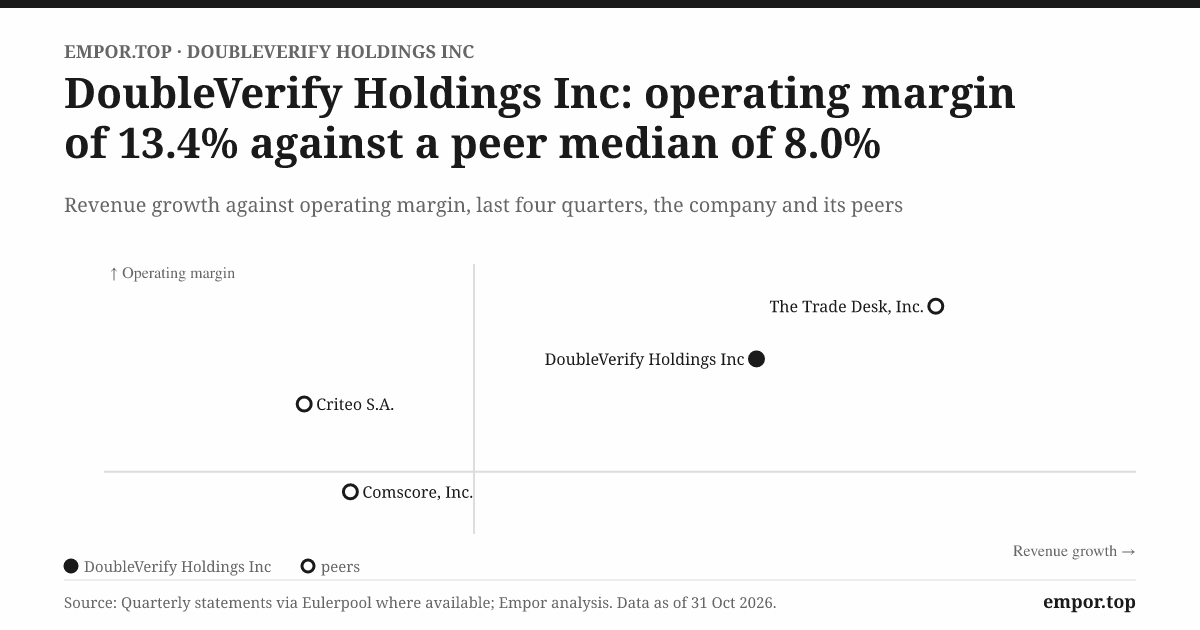
Put the long-run operating record beside that share price and the contrast is stark. Revenue roughly tripled over the period.6 Few companies that went public in 2021 can say as much. But profits did not keep pace. Net income rose from about $20 million in 2020 to about $50 million in 2025, peaking in 2023 at about $71 million.6 Operating margin fell from about 15% in 2023 to about 10.6% in 2025, as product-development spending, headcount and stock compensation grew faster than revenue in the slower years.6 The company grew enormously and its earnings power grew much less, so the multiple the market paid for those earnings contracted. A business can triple in size and still disappoint investors who paid for something even bigger.
How should the offer be judged? Three comparisons help, and each has limits. Against DV's own trading history, the 30% premium to the 60-day volume-weighted price was a real premium.3 Against its five-year history of valuation multiples, a price around 38 times trailing earnings sat well below the median of about 65 times, but historical multiples from a high-growth era are not a fair-value benchmark for a slower company. Against its closest peer, the market priced DV at about 12 times enterprise value to EBITDA, close to the roughly 12 times recorded for Integral Ad Science in July 2026, though the dates and businesses are not perfectly matched.20 On those last numbers, the market was valuing the two specialists similarly, as mature cash-generative businesses rather than growth stories. The free-cash-flow yield at the offer price was about 7%, which is what the market demanded for a company it believed would grow slowly.
Nielsen's rationale was strategic. It described the deal as combining Nielsen's audience measurement, the long-established business of counting who watches what, with DV's ad verification and effectiveness tools, to create a broader "media intelligence" company.21 Nielsen is the buyer and the expected parent after closing; DV would become a wholly owned subsidiary of Neptune BidCo, Nielsen's parent.3 Nielsen's own group economics, its financing and its other businesses sit outside DV's story. What matters for DV shareholders is that they would receive cash and step out.
There are two paths from here. If the merger closes, DV becomes private. Integration, any synergies, and future returns on the products described in this story move outside public reporting, and DV's public shareholders do not participate in them. If the merger terminates, DV must resume standalone guidance and earnings calls, facing slower growth and the same platform competition, and with a buyback program that had already consumed a large part of its cash cushion. The first resumed call would carry the burden of explaining the withdrawn outlook.
So the price carries a double meaning. For a shareholder, $13.60 is a certain cash exit, subject to closing. For the public company, it is a market verdict on what DV could no longer convince investors to pay. The comparison with the IPO does not prove that DV was undervalued, because lower growth, margin pressure, dilution and execution uncertainty all justify a lower multiple than 2021's. But it frames the real argument, which is whether DV's advantages were durable enough to warrant more. That argument is best tested head-on.
X. Analysis & Bear vs. Bull Case
Put two documents side by side. In one, DV's management describes a company expanding into more channels, launching more products and keeping most of its revenue from existing customers each year. In the other, the numbers show the fee DV earns per measured transaction falling and the platforms DV measures building ever more capable tools of their own. Both are accurate. The work of judging DV is deciding which document describes the future.
The bull case starts with position. DV sits in a part of the advertising market that grows more complex every year. Spending fragments across the open web, social networks, streaming services, retail media networks and gaming, each with its own rules. An advertiser that wants one standard of safety and one measure of effectiveness across all of them needs a referee that works everywhere. DV's integrations, built over many years, and its long relationships with large advertisers support its claim to fill that role. Volume growth in 2025 showed that demand for checking was still expanding.10 And because the business needs little physical capital, more measured volume can, in principle, become more cash without much extra investment.
The bear case starts with the meter. Measured volume can grow while fees fall, as they did in 2025.10 Platform-native tools can be good enough for campaigns concentrated on one platform, and the digital ad market's largest dollars concentrate on a handful of platforms. Customers can multi-source, splitting work between DV and Integral Ad Science or a platform's own tools, which caps pricing. And the platforms hold the most important lever of all: they decide how much access an outside verifier gets. A reduction in integration access, or a platform decision to favor its own measurement, could challenge the moat without any competitor winning a deal.
The moat, tested once
Frameworks help organize this. Michael Porter's five forces, applied to DV, show two strong forces against it. Buyer power is meaningful because advertisers and agencies can choose among vendors or use free platform tools, even though no single customer is large. Supplier power, in the form of platform control over access and data, is structurally high, because DV cannot measure what it cannot see. The threat of substitution, from platform-native measurement, is the most important competitive force. Rivalry among specialists is moderate: DV and IAS are the two scaled independents, with smaller firms around them. The threat of new entrants is lower, because building integrations and earning industry accreditation takes years, and that is one of DV's genuine protections.
Hamilton Helmer's seven powers offer a second lens, asking which durable sources of advantage a company has. DV's clearest power is switching costs. Integrations into buying platforms and reporting systems, years of historical data and the reputational risk of changing vendors all make customers reluctant to leave, which the retention figures confirm. A modest form of scale economies exists too: the fixed cost of building classification models and integrations is spread over trillions of transactions, which a smaller rival cannot match. DV has some claim to the cornered-resource power through its accumulated data and accreditations, but nothing exclusive: it does not own the platforms' data, and IAS holds similar accreditations. Network effects are weak, since one advertiser's use does not make DV much more valuable to another, beyond improving its models. Branding as a power, the ability to charge more for the same product because of reputation, is precisely what the falling fee and the Adalytics controversy call into question. There is no evidence of counter-positioning, in which an incumbent cannot copy a newcomer's model without hurting itself; if anything, the platforms are the ones with a model DV cannot copy.
The verdict from the frameworks matches the verdict from the record. DV has a real switching-cost advantage and some scale benefits. It does not have a proven pricing power, and its position depends on the cooperation of suppliers that are also substitutes.
The commercial evidence makes the same point. Customers stayed, but their expansion slowed.136 DV does not publish cohort retention, top-five concentration or product-level profitability. Product launches, AI capabilities and industry certifications are signs of activity, not revenue, and the disclosed early economics of the AI strategy remain preliminary.16
Capital allocation is a mixed picture. Scibids and Rockerbox fit the strategy, but their standalone economics are not disclosed. Buybacks reduced the share count, yet much of their cost was the price of absorbing stock compensation. An activist examining DV in early 2026 would have asked three pointed questions: why stock compensation remained so large relative to cash flow, why product-development spending kept rising as a share of revenue while growth slowed, and whether the acquisition program had earned its returns. Management's equity-grant cut and buyback acceleration were partial answers; the sale became the final one.
The risks attach to specific mechanisms. Weakness in ad spending reduces measured volume directly, as the agency-driven pullbacks of late 2025 showed. Platform competition and access can erode pricing. AI can improve DV's optimization and classification tools, or make platform-native verification capable enough to replace them. And the pending merger brings its own risk: delay, added cost from the proxy-disclosure litigation, or a termination that would leave DV to resume public life without guidance.
Three numbers would settle the case, and they are the ones to watch. The first is the pairing of advertiser transaction volume and fee per transaction: in 2025, volume rose about 15% and the fee fell about 3%. The second is net revenue retention, which was falling, alongside gross retention above 95%. The third is free cash flow per diluted share after stock compensation and capitalized software, the owner's measure of whether cash generation translates into value.
The core verdict is that DoubleVerify is a useful, established independent layer in digital advertising, and its retention record supports that. The evidence for pricing power and renewed expansion is weaker than the evidence for retention. That gap, between keeping customers and growing what they pay, is the heart of what the story teaches.
XI. Business & Investing Lessons
Go back to the advertiser at the start of this story, the one asking a platform to prove that its own ad ran safely and effectively. DoubleVerify built a business answering that advertiser's question on the platform's behalf. The lessons from how that business grew, slowed and sold itself belong to DV more than to any generic software company, because they come from the odd place it occupied: between a customer who pays and a platform that controls everything the customer wants to know.
The first lesson is that a useful independent referee still needs the field's permission to enter. DV's independence was real in its analysis and conditional in its access. Its expansion into social media and streaming television depended on integrations with the companies whose ads it would grade, and those companies also sold advertisers their own measurement. Founders who build a business on another company's platform often talk about the platform as a distribution channel. DV shows that it can also be a landlord, a competitor and a regulator at once. The durable version of such a business is the one that makes itself valuable enough to the platforms, through the advertiser dollars it helps unlock, that cutting it off would cost them more than tolerating it. DV achieved that for nearly two decades. It never achieved it so completely that its pricing was safe.
The second lesson is that customers can stay while the economics soften. DV's retention remained strong as net retention and the average fee per transaction fell. An investor who saw only the retention figure would have concluded that DV's moat was intact, and in one sense it was. Customers were not leaving. They were simply paying less for each check and expanding more slowly, partly because spending shifted to cheaper channels and partly because alternatives existed. Retention measures whether customers need a product. Pricing measures whether they need it from you. At DoubleVerify, loyalty was never the same thing as leverage.
The third lesson is that a cash-flow add-back is not free. DV's stock-compensation add-back and the buybacks that partly offset it show why headline cash generation overstated what owners received. For investors, the practical rule is to read the cash-flow statement from the bottom up: start with free cash flow, subtract the stock compensation that buybacks must offset, and divide by the diluted share count. What is left is the cash that belongs to owners. At DV it was a healthy number. It was also much smaller than the headline.
The fourth lesson is that an acquisition is a thesis until the acquired product earns its place. Scibids and Rockerbox fitted DV's strategy of moving from checking ads toward optimizing and proving their results. Yet the public record never showed what either earned, because their revenue disappeared into DV's broader lines. Management's assurance that Rockerbox had come in slightly ahead of expectations, against expectations that were never published, is the kind of evidence that should make investors patient rather than confident. The wider point is that strategic fit is the beginning of the case for a deal, not the end. The end is whether customers pay more because of it.
There is a final, quieter lesson in how the story concluded. DV's shareholders chose a known price over an uncertain standalone future. That was not a judgment that the business was broken. It was a judgment that the slower, cash-generative, platform-dependent company DV had become was worth a known number now more than an uncertain one later. Sometimes the most honest valuation of a business comes not from an analyst's model but from its owners' willingness to leave.
XII. Epilogue
Tonight, on October 31, 2026, DoubleVerify is still a listed company, and it is quiet in a way it has not been since 2021. There was no earnings call to accompany the third-quarter release, no updated outlook for the year and no analyst questions about the recovery in activation revenue.5 Its shares sit four cents beneath the price at which they are expected to disappear. Its employees keep checking trillions of ads, and the meter keeps running.
The next moments that decide the story are mostly procedural, but they matter. The remaining regulatory and closing conditions in the merger agreement still have to be satisfied.3 The U.S. waiting period has expired and Australia's regulator has cleared the deal, but neither clearance closes it on its own.78 The proxy-disclosure complaints and demand letters filed by stockholders could add cost or delay, even though DV has said it believes they lack merit.7 If those conditions are met, the merger closes, $13.60 a share arrives in shareholders' accounts and DoubleVerify becomes a subsidiary of Nielsen's parent.
If the deal closes, the most interesting question moves inside a private company. Nielsen will have to decide how to combine audience measurement with DV's verification without damaging the independent credibility that made advertisers pay for DV in the first place. An independent referee owned by a larger measurement company is still independent of the platforms, but it will have to persuade advertisers that its calls are not shaped by the commercial interests of its new parent. Nielsen once appeared on DV's own list of competitors. Advertisers will be watching whether the combined company sells them one standard or two.
If the deal terminates, the drama becomes public again, and quickly. DV would have to restart guidance and earnings calls, explain the outlook it withdrew, and show whether the third-quarter improvement was the start of a recovery or a pause in a longer slowdown. The first resumed call would be the hardest in the company's public history, because management would need to persuade investors to value a standalone business that its own board had agreed to sell.
Either outcome leaves the commercial test exactly where it was. The questions that ran through this story, whether DV can defend independent measurement against the platforms it measures, whether new products can lift price as well as volume, and whether cash generation reaches owners after stock compensation, will be answered by the same few numbers: transaction volume, the fee per transaction, the expansion of existing customers and free cash flow per diluted share. In 2025, those numbers said that DV's customers stayed, its volume grew, its prices drifted down and its cash was strong but partly paid in stock. Nobody knows yet what they will say under Nielsen, and if the deal closes, outsiders may never find out.
That is the tension that remains tonight. The story is about to change hands before its central business questions can be answered in public. The company built to provide transparency is about to become a little less transparent itself.
XIII. Outro
Somewhere tonight, an ad for a running shoe appears in a social feed, in a mobile game or in the break of a streaming drama. Before it ran, a piece of DoubleVerify software probably checked whether the place was safe, whether the viewer was human and whether the price was worth paying. After it ran, another piece reported back. The advertiser will never think about it, which is the point. Trust that works is invisible.
DoubleVerify became a business by selling independent judgment in a digital market where the largest platforms control the inventory and much of the measurement. It proved that advertisers would pay for a second opinion, year after year, for nearly a decade at a time. It never fully proved that they would pay more for it each year. And so its public life will end, if the deal closes, with a four-cent gap between a share price and a cash offer: a company that spent eighteen years measuring the platforms, set to be sold to a company whose future depends on measuring media at scale, at the price its owners decided was enough.
References
-
Special-Meeting Voting Results, Form 8-K — DoubleVerify Holdings / SEC, 2026-10-29 ↩↩
-
Definitive Merger Proxy Statement (DEFM14A) — DoubleVerify Holdings / SEC, 2026-09-29 ↩↩↩↩↩↩↩↩↩↩
-
Nielsen buying DoubleVerify for $2.15 billion — Axios, 2026-08-07 ↩
-
DoubleVerify Reports Third Quarter 2026 Financial Results, Exhibit 99.1 — DoubleVerify Holdings / SEC, 2026-10-30 ↩↩↩↩↩↩↩↩↩
-
2025 Form 10-K — DoubleVerify Holdings / SEC, 2026-02-26 ↩↩↩↩↩↩↩↩↩↩↩↩↩↩↩↩↩↩↩↩↩↩↩↩↩↩↩↩↩↩↩↩↩↩↩↩↩↩↩↩↩↩↩↩↩↩↩↩
-
Merger Proxy Supplement (DEFA14A) — DoubleVerify Holdings / SEC, 2026-10-20 ↩↩↩↩
-
Nielsen–DoubleVerify Phase 1 Determination — Australian Competition & Consumer Commission, 2026-10-13 ↩↩
-
Form S-1/A Registration Statement — DoubleVerify Holdings / SEC, 2021-04-12 ↩↩↩↩↩
-
Q4 and Full-Year 2025 Earnings Call Transcript — DoubleVerify, 2026-02-26 ↩↩↩↩↩↩↩↩↩↩↩↩↩↩↩
-
Q2 2026 Form 10-Q — DoubleVerify Holdings / SEC, 2026-08-07 ↩↩↩↩
-
2024 Form 10-K — DoubleVerify Holdings / SEC, 2025-02-27 ↩↩↩↩
-
Statement on Adalytics' GIVT Report — DoubleVerify, 2025-03-28 ↩
-
DoubleVerify Extends Leadership in Independent AI-Powered Campaign Optimization Solutions with Agreement to Acquire Scibids — DoubleVerify, 2023-07-31 ↩↩↩
-
Q4 and FY2024 Earnings Call Prepared Remarks — DoubleVerify, 2025-02-27 ↩↩↩
-
DoubleVerify to Acquire Rockerbox, Adding Outcome Measurement and Attribution Capabilities — DoubleVerify, 2025-02-26 ↩↩
-
2026 Definitive Proxy Statement — DoubleVerify, 2026-04-07 ↩↩
-
Providence-backed DoubleVerify's shares jump 30% in NYSE debut — Reuters via Investing.com, 2021-04-21 ↩
-
Nielsen to Acquire DoubleVerify, Creating a Leading Independent Media Intelligence Company — Nielsen, 2026-08-06 ↩
 LinkedIn
 WhatsApp
 Reddit
 Hacker News
 Email
 Kindle
 RSS Feed
 Spotify
 Apple Podcasts
 Amazon Music
 Audible
 YouTube