Deluxe Corporation: The Check Printer Borrowing Against Its Future
I. The Check Printer’s $625 Million Bet
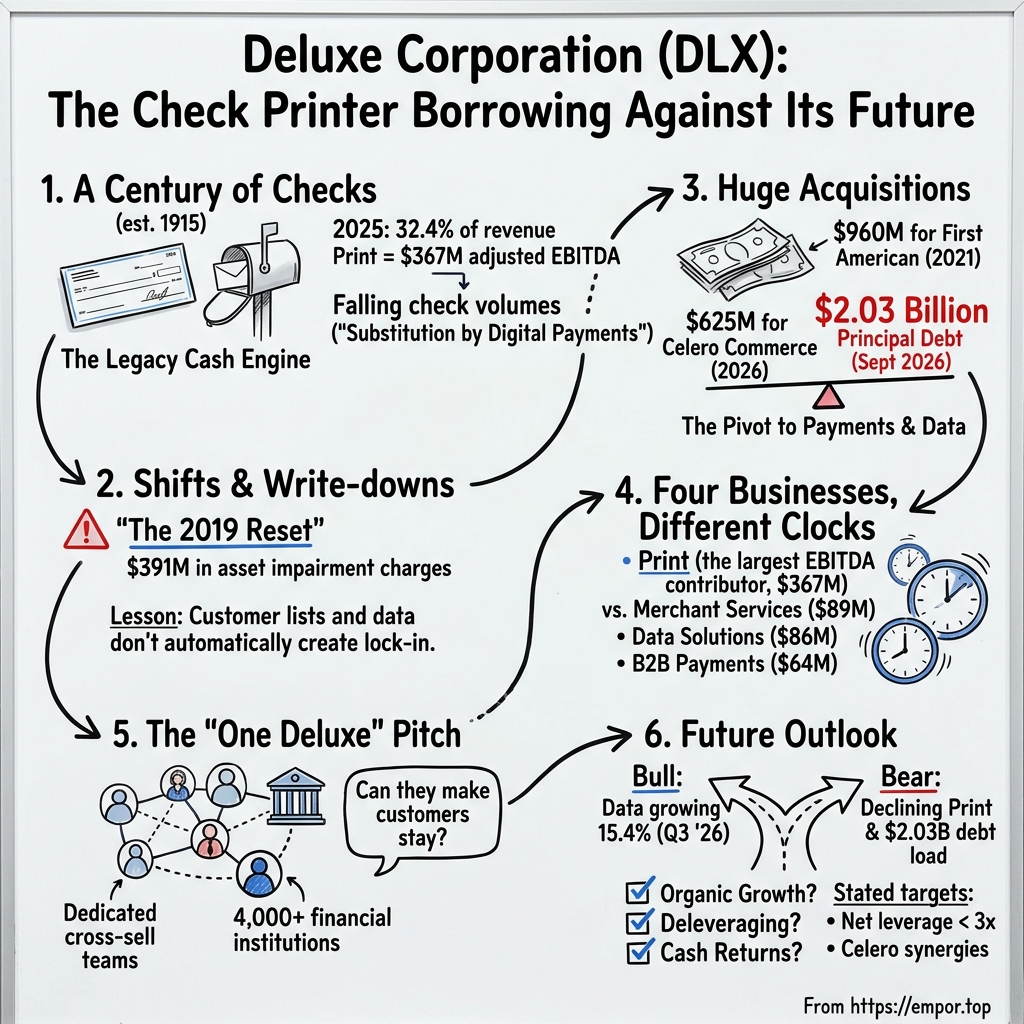
On July 31, 2026, a company best known for the paper rectangles tucked into the back of a checkbook finished buying a payments processor. Deluxe Corporation paid about $625 million in cash for Celero Commerce, a firm that helps small and medium-sized merchants accept card payments, and it paid for the deal the way it had paid for its last big bet: with borrowed money. Deluxe amended its credit agreement, drew new term debt and leaned on its revolving credit line to close the transaction.1 There was no new equity, no partner and no seller financing worth the name. A 111-year-old printer had once again pledged a share of its future cash to buy a faster-growing business.
The last time it did this, the number was bigger. In 2021 Deluxe agreed to pay about $960 million in cash for First American Payment Systems, a merchant-acquiring business that management said would double the size of its payments operation.2 Five years and one more acquisition later, the two deals together represent more than $1.5 billion of purchase price aimed at a single idea: that a company built on checks can turn itself into a company built on payments and data before the checks run out.
The new deal arrived with a confident headline. Deluxe described Celero as accelerating its transformation "toward payments and data solutions scale."3 And on the third-quarter call in early November, management could point to a portfolio that already looked different from the one investors had known. Payments and Data businesses had grown to about 57% of quarterly revenue, a milestone helped along by two months of Celero.4 For a company whose name is still printed on millions of checks, that is a striking sentence. More than half the sales now come from something other than print.
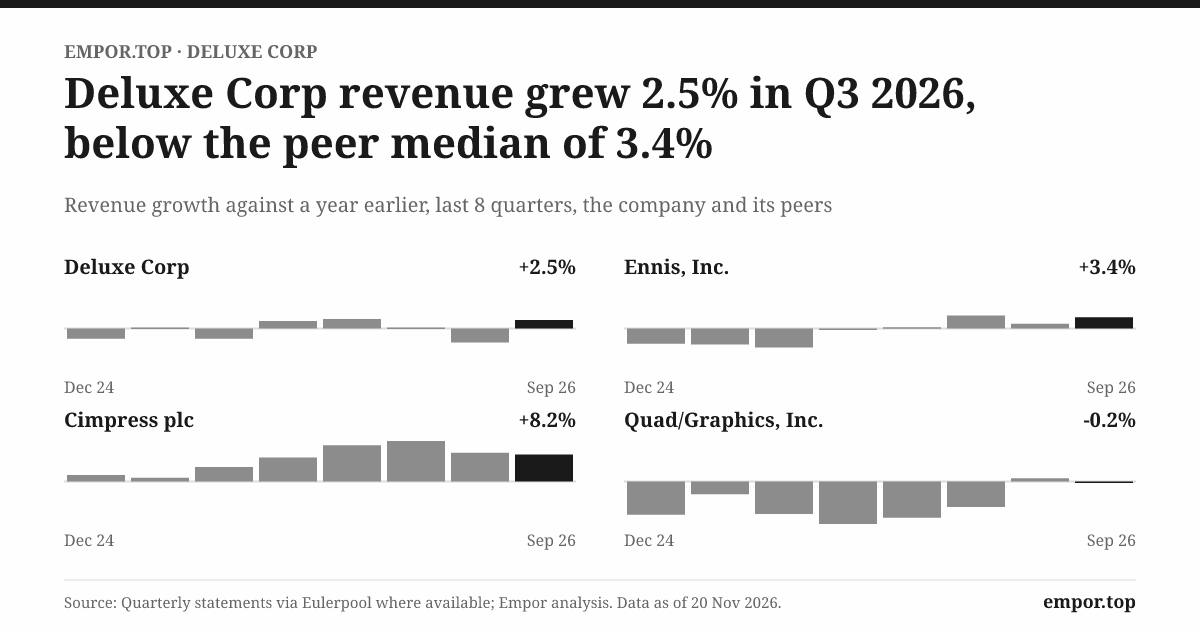
Look one line lower in the same quarter, though, and the picture gets more complicated. Revenue in the three months to September 2026 was about $554 million, up 2.5% from a year earlier. Net income was $13 million, down roughly 61% from the $34 million earned in the same quarter of 2025.5 A bigger business made much less money. Part of that collapse was the cost of buying and integrating Celero; part was interest on the money borrowed to do it. By September 30, Deluxe owed about $2.03 billion in principal, spread across a term loan, two sets of bonds, its revolver and a receivables facility.5 Against that, the entire company was valued by the stock market at roughly $1.1 billion.
That gap, between a debt load approaching twice the equity market value and a quarter of shrinking profit, is the tension at the heart of this story. Deluxe is not a company in crisis. It generates real cash, pays a dividend, and has been reducing leverage for several years. But it is a company that keeps choosing to borrow against the cash its oldest business produces, in order to buy the businesses it hopes will replace it.
Four questions decide whether that choice is wise. The first is whether the mix shift can grow on its own, organically, once the acquired revenue is stripped out. The second is whether Deluxe actually has a durable edge in merchant processing, business-to-business payments and data-driven marketing, or whether it is simply one more competitor in crowded markets. The third is whether its acquisitions have earned their price, a question with a long and uncomfortable paper trail. The fourth is whether the company can pay down debt while still producing the cash the strategy depends on.
None of those questions can be answered by the Celero headline. Two months of ownership tells investors almost nothing about whether a payments platform will retain its merchants, deliver promised savings and throw off enough cash to retire the debt that bought it. What the story can do is put the new bet in context: beside the century-old franchise that funds it, beside the write-downs that followed the last attempt to grow beyond paper, and beside the First American deal that first reshaped the balance sheet.
The useful way to picture Deluxe today is as two companies living under one roof. One is a mature, shrinking, cash-rich check and print business that still produces most of the profit. The other is a set of growth businesses that produce most of the momentum and most of the strategic narrative. The first company is paying the second company's bills. The question for long-term investors is whether the second can grow up before the first one grows old. To see why that question is even possible to ask, the story has to start with the checkbook.
 Subscribe on LinkedIn
II. A Century of Checks Becomes a Cash Engine
For most of the twentieth century, a checkbook arrived the same way. A bank customer opened an account, and a few days later a slim box came in the mail: a vinyl cover, a register for writing down balances, and a stack of numbered checks with the bank's name, the customer's name and a string of magnetic-ink numbers along the bottom edge. Very often the company that printed it was Deluxe, a business founded in 1915.6 The customer usually never thought about the printer. The bank did, because the printer was the one that had to get every account number exactly right.
That invisibility was the business model. Deluxe rarely needed to win the household; it needed to win the bank. Financial institutions sent their customers' reorders through Deluxe, and the company built the plants, the security processes and the fulfillment systems to produce millions of personalized documents with almost no tolerance for error. A misprinted check is not a cosmetic flaw. It is a payment that bounces, a fraud risk, or a customer-service call the bank would rather not take. Over decades, that reliability became a relationship, and the relationship became a channel.
The modern Print segment still runs on the same mechanics, with additions. Deluxe sells checks through financial institutions and directly to consumers and small businesses, and it sells business forms, deposit tickets and related supplies.6 It also uses its printing plants for print-on-demand work and promotional products, which lets equipment built for a declining product earn money on adjacent ones.6 The company describes itself as a leading check printer in the United States, though it does not give a market share.6
What makes this old business matter so much today is the size of what it still produces. In 2025, checks alone accounted for about a third of Deluxe's revenue, roughly 32%.6 The broader Print segment brought in about $1.14 billion, a little more than half of the company's $2.13 billion of revenue. And it generated about $367 million of segment adjusted EBITDA, the company's preferred measure of operating cash earnings before corporate costs, out of about $604 million across all four segments.6 Put simply, the business everyone describes as the past produced about six of every ten dollars of segment earnings.
There is a reason the margins are so high. A check plant that has been running for decades is largely paid for. The bank relationships are already in place. The product barely changes from year to year, so there is little to spend on reinvention. When an old business no longer needs to grow, almost every dollar of its operating profit can be redirected elsewhere. Print's segment margin, above 32%, is the margin of a harvest.
But a harvest has a season. Checks and business forms have faced decades of substitution: debit cards replaced checks at the grocery store, online bill-pay replaced checks in the mail, and electronic signatures and digital invoices replaced many paper forms. Deluxe acknowledges these pressures directly, warning that check and forms volumes continue to decline as payment habits and record-keeping shift to digital alternatives.6 Falling volume does more than shrink revenue. It changes bargaining power. A bank that orders fewer checks every year has more reason to push for lower prices at contract renewal, and a printer with plants to fill has more reason to accept them.
Deluxe has so far met that decline with price increases, cost cuts and plant consolidation, which is why its Print margin has held up even as sales fell. In 2023 Print revenue was about $1.26 billion; by 2025 it was about $1.14 billion, a decline of roughly a tenth in two years.6 Yet the segment's earnings stayed large enough to underwrite everything else the company wanted to do.
The company that does all this is smaller than its history might suggest. At the end of 2025 Deluxe employed about 4,600 people, nearly all of them in the United States, with small teams in Canada and India.6 That is a modest workforce for a business with more than $2 billion of revenue, and it reflects years of plant consolidation and automation in Print. It also means much of the remaining cost-cutting has already been done. A harvest business can only be pruned so many times before the pruning starts to cut into the trunk.
The danger is not that Print disappears next year. It is that the rate of decline accelerates while the company is still relying on it, or that price increases stop sticking with banks that are themselves trying to cut costs.
The question has never been whether Deluxe could afford to try to become something else. It has always been whether the something else would work. And the company's first serious attempt to answer that question, in the years just before the pandemic, ended in one of the largest write-downs in its history.
III. The Growth Story That Was Written Down
The 2019 annual report is the document in Deluxe's history that reads most like a confession. That year the company recorded about $391 million of asset impairment charges, most of it, about $358 million, against goodwill: the premium it had paid in earlier acquisitions over the value of the assets it bought.7 The reasons were unusually specific. Some businesses had underperformed the expectations set when they were acquired. Deluxe had exited certain customer contracts. And, most tellingly, large clients had decided to bring marketing work in-house rather than keep paying Deluxe to do it.7
The arithmetic of that year was brutal. A company that had earned operating profit of more than $300 million a year through the middle of the decade reported an operating loss of about $188 million in 2019, and a net loss of about $223 million.7 Profit had already slipped in 2018. Now it fell through the floor.
To understand how Deluxe got there, it helps to know who was running it. Barry McCarthy became chief executive in late 2018.8 He was not a printing lifer. He came to Deluxe from the payments industry, where he had held senior roles at First Data, one of the giants of card processing.8 That background shaped what came next. A First Data veteran sees a bank relationship not as a channel for selling paper but as a doorway into the bank's merchants and corporate clients, the businesses whose transactions generate fees every day rather than once per checkbook reorder. His appointment was itself a statement about where the board thought the company had to go. A check printer hiring a payments executive was a check printer telling the market it did not intend to remain one.
McCarthy inherited a strategy already in motion. In the years before he arrived, Deluxe had bought a string of businesses in small-business services, marketing and data, hoping to use its bank relationships and small-business customer lists as a springboard into more modern services. The pitch was intuitive. Deluxe knew thousands of banks and millions of small businesses. If it could sell those customers marketing campaigns, websites, logos, payroll and payment tools, it could replace shrinking check revenue with growing service revenue from the same relationships.
The 2019 write-down showed where that logic broke. A customer list is not the same thing as a customer who cannot leave. When a large bank decided it could run its own marketing campaigns, Deluxe's relationship with that bank did not stop it from doing so. When acquired businesses grew more slowly than planned, the premium paid for them had to be written off. The impairment was an accounting entry, but the cause behind it was commercial: customers had choices, and some of them chose not to keep buying.
That history matters for the present because the newest growth claims rest on similar foundations. Data Solutions, today one of Deluxe's fastest-growing segments, still sells data-driven marketing to financial institutions. Merchant Services and B2B Payments still rely on cross-selling to bank and small-business relationships. The 2019 episode does not prove those businesses will fail. It does prove that relationships and data capabilities, by themselves, do not guarantee lock-in. The burden of proof falls on retained customers, sustained pricing and returns on the capital spent to acquire them.
A smaller echo came five years later. In 2024 Deluxe exited its payroll and human-resources services business and wrote off the roughly $7.7 million of goodwill associated with it.6 The amount was minor next to 2019. The pattern was not. Payroll had been one of the services meant to deepen relationships with small businesses, and it, too, did not earn its place. Deluxe has also exited web-hosting and logo-design businesses that had been part of the earlier small-business-services push.6 Each exit tidied the portfolio, and each one was a reminder that not every adjacent service actually fit.
The fairest reading of this record is that it narrows rather than rejects the idea that Deluxe can grow beyond paper. Management did act: it stopped pretending that every acquired service would compound, wrote down what had failed and sold or closed what did not fit. But it also means that the company's claims about customer relationships deserve the same test that 2019 applied. Do the customers stay, and do they pay more over time?
By the start of the new decade, the lesson McCarthy seemed to draw was not that the pivot was wrong, but that it had been spread too thin. Instead of assembling many small adjacencies, Deluxe would make one large bet on the part of the strategy that looked most like its new chief executive's own background: payments. That bet had a name, and a price tag that would reshape the balance sheet for years.
IV. The First American Deal Changed the Balance Sheet
In the spring of 2021, with the pandemic still distorting nearly every company's numbers, Deluxe announced that it would buy First American Payment Systems for about $960 million in cash.2 First American was a merchant acquirer: the kind of company that signs up shops, restaurants and service businesses to accept card payments, provides the terminals and software, and earns a slice of every transaction that flows through. Deluxe told investors the deal would double its Payments revenue and create a platform for faster growth.2
The size of the bet becomes clearer against Deluxe itself. At the end of 2020 the whole company had about $880 million of borrowings and about $513 million of shareholder equity.6 In a single transaction it was preparing to spend more than its entire debt load at the time. First American had generated about $290 million of revenue in 2020, so Deluxe was paying roughly 3.3 times sales.2 When the deal closed and the accounting was done, about $736 million of the price was recorded as goodwill, the intangible premium that has to be justified by future earnings.9 And management expected pro forma net leverage, debt relative to annual EBITDA, to rise to around four times.2
That last number explains why First American mattered more to the balance sheet than to the income statement. By the end of 2021 Deluxe's borrowings had roughly doubled to about $1.8 billion, and its debt was now about three times its equity.6 A company that had spent most of its history with modest leverage was now a heavily indebted one, and every strategic choice afterward would be made under that weight.
The pitch had three parts. First American would bring a payments platform with its own technology. It would bring distribution, through partners such as independent sales organizations and software firms that refer merchants. And it would make cross-selling possible, so that Deluxe's bank relationships could send merchants to First American and First American's merchants could buy Deluxe's other services.2 Faster organic growth, the argument went, would generate the cash to pay the debt back down.
The record since then gives that argument a mixed grade. Payments did grow, and First American became the core of what is now the Merchant Services segment, which produced about $399 million of revenue in 2025.6 But the company as a whole did not accelerate. Revenue jumped in 2021 and 2022 as the acquisition was folded in, then drifted lower. From 2022 to 2025, Deluxe's total revenue shrank by about 1.6% a year.6 The new engine was running, but the old one was slowing down at nearly the same pace.
It is tempting to call the deal overpaid on the basis of the sales multiple alone. That would be too quick. Payments businesses are often valued on earnings rather than revenue, and the disclosed acquisition materials do not provide a clean, comparable EBITDA multiple for First American at the time of purchase. What the numbers do show is how much future value the price assumed. When nearly four of every five dollars paid is goodwill and the buyer's leverage rises to four times earnings, the acquirer is betting heavily that growth and synergies will materialize on schedule. If they come slowly, the cost does not disappear. It sits on the balance sheet as debt and interest.
And the debt did come down, slowly. Borrowings fell from about $1.8 billion at the end of 2021 to about $1.5 billion by the end of 2025, while equity crept higher.6 S&P Global Ratings, which had watched leverage climb, upgraded Deluxe in April 2025 after its measure of adjusted leverage fell to about 5.4 times from 6.6 times in 2023.10 That was real progress. It was also progress from a level that rating agencies regard as highly leveraged, which is why the rating, even after the upgrade, sat firmly in speculative grade.
Meanwhile the portfolio kept changing at the edges. The payroll exit, the sales of web hosting and logo design, and other pruning moves shrank the businesses that did not fit, while capital kept flowing toward payments and data.6 In capital-allocation terms, these were the write-offs and exits that belong in the same ledger as First American: some acquired businesses compounded; others were quietly let go.
Which raises the question that hangs over the next chapter. Between 2021 and 2026, Deluxe told investors that the priority was debt reduction. Then, with leverage finally falling, it borrowed again to buy Celero. Was that the act of a management team that had become more selective, waiting for the right asset? Or did debt repayment simply pause until the next strategic opportunity appeared? The answer depends partly on what the four businesses inside Deluxe actually look like today, and they are running on very different clocks.
V. Four Businesses, Four Different Clocks
In the third quarter of 2026, Data Solutions passed $100 million of quarterly revenue for the first time.4 It was a small milestone in absolute terms, but it captured something investors had been waiting for: a part of Deluxe that was not just surviving but growing quickly. In the same quarter, Print kept doing what Print does, shrinking by about 3.6% on a comparable adjusted basis.4 Two segments, two directions, one company.
Deluxe reports four segments, and the easiest way to understand them is to ask what each one is paid for.
Merchant Services is paid for moving money. When a customer taps a card at a small restaurant that uses Deluxe's processing, the restaurant pays a fee on that transaction, and Deluxe keeps a portion after paying the card networks, the issuing bank and, often, the partner who signed the merchant up. Revenue is recognized as transactions happen.6 That makes the business sensitive to how much its merchants sell, to pricing, and to the "residuals" it pays independent sales organizations, the third-party sales forces that bring in merchants in exchange for a share of the ongoing income.6 A good analogy is a toll road whose operator splits each toll with the people who directed traffic onto it. In 2025, Merchant Services brought in about $399 million of revenue and about $86 million of segment adjusted EBITDA, a margin a little above 21%.6
B2B Payments is paid for helping businesses and banks collect and manage money. It includes receivables management, lockbox services, in which payments are mailed to a processing center that opens them, deposits them and reports them back, and treasury-management tools that banks offer their corporate clients.6 It is less glamorous than card processing but closer to Deluxe's roots, because many of the payments it handles are still checks. Growth depends on new client implementations and transaction volumes, and it can be constrained when a client leaves or a bank decides to build the capability itself.6 B2B Payments produced about $291 million of revenue and $64 million of segment adjusted EBITDA in 2025.6
Data Solutions is paid for helping clients find customers. It runs data-driven marketing campaigns, most notably for financial institutions trying to attract deposits or loan customers, and recognizes revenue when a campaign is completed.6 Its growth has been the most visible part of the turnaround story: the company's small 2025 revenue increase came from data-driven marketing demand, particularly from financial institutions, which added about $73.5 million, along with price increases elsewhere.6 Without that one source of demand, Deluxe's revenue would have fallen. The segment generated about $307 million of revenue and $86 million of segment adjusted EBITDA in 2025, a margin of about 28%.6
And Print is paid for producing checks and their cousins.6
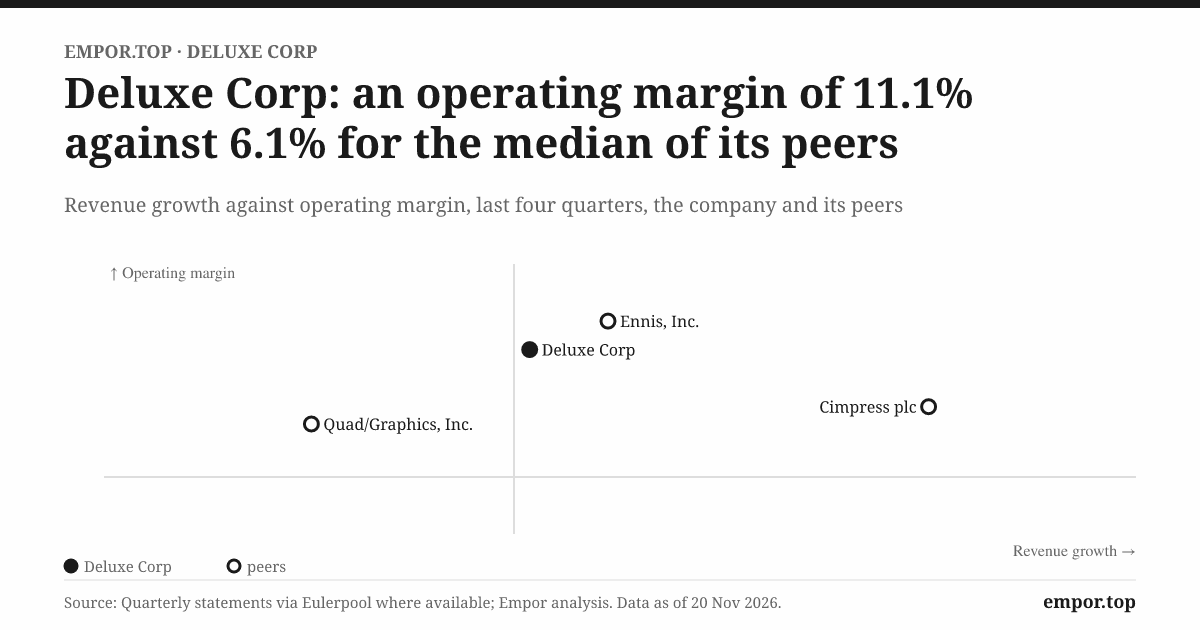
Put those four together and the imbalance is obvious. The three growth segments combined produced roughly the same revenue as Print, about $1 billion, but only about $236 million of segment adjusted EBITDA, well under Print's $367 million.6 The new Deluxe is bigger in narrative but still smaller in earnings. That is not a criticism of the growth businesses; payments and marketing services typically carry lower margins than a fully depreciated printing franchise. But it means a shift in mix does not automatically raise total-company returns. If Deluxe replaces a dollar of Print revenue at a 32% margin with a dollar of Merchant revenue at a 21% margin, revenue holds steady while earnings fall.
That is why the growth rate in the new businesses matters so much. In the third quarter, Data grew 15.4% year over year, its eighth consecutive quarter of double-digit growth.4 Excluding Celero, the Payments and Data businesses together grew about 8.3%.4 Those are healthy numbers for a company whose total revenue has barely moved in years. They suggest genuine demand, particularly from banks competing for deposits in a period when attracting customers has been expensive.
They also come with caveats management itself supplied. On the call, executives said they expected some seasonal moderation in Data in the fourth quarter.4 Campaign revenue is lumpy by nature; a bank can run a large campaign one quarter and pause the next. Deluxe does not disclose what share of Data revenue recurs, or how many clients renew year after year.6 And while the company describes its marketing offerings as using AI-supported analytics, it also warns that generative AI and agentic search could change how consumers find financial products, potentially reducing the reach of the very campaigns it sells.6 AI is a feature in the product today. It is not yet evidence of a moat, and it is explicitly listed as a threat.
Print, meanwhile, is behaving like a well-managed decline, the best case for a harvest business.6 The risk is the obvious one. Cost cuts eventually run out of room, and price increases eventually push customers toward the substitutes that are already eroding volume.
For anyone trying to follow this company, the scorecard is simpler than the four-segment structure suggests. Watch organic revenue growth in each segment, excluding acquisitions and divestitures. Watch segment adjusted EBITDA margins, to see whether growth is profitable. And watch free cash flow after interest and capital spending, because that is the money actually available to repay debt and pay shareholders. If the newer segments grow while their margins hold and the company's free cash flow rises, the mix shift is working. If revenue grows only through acquisition, or margins compress as Deluxe chases volume, the shift is cosmetic.
Every one of those tests eventually leads back to the same question about customers. Growth businesses are worth more than declining ones only if their customers stay. And Deluxe's argument that they will rests on a single phrase.
VI. Does “One Deluxe” Make Customers Stay?
The phrase is "One Deluxe." In management's telling, it describes dedicated teams that use a relationship in one part of the company to sell something from another part: a bank that buys checks might also buy treasury-management tools, data-driven marketing campaigns or merchant processing for its small-business customers.6 It is the strategic glue meant to turn four businesses into one platform. If it works, the whole is worth more than the parts, because each customer buys more and has more reasons not to leave.
The raw material for that strategy is real. Deluxe has relationships with thousands of financial institutions; a 2021 company overview put the number at around 4,000.2 It serves millions of small businesses and consumers. And because no single customer accounted for more than 10% of consolidated revenue in any year from 2023 to 2025, the company is not hostage to one buyer.6 Management even argues that its focus on small and medium-sized businesses reduces concentration risk.6
But breadth is not the same as lock-in. The evidence for "One Deluxe" as a competitive advantage would be numbers the company does not publish: segment-level customer retention, the share of customers that buy from more than one segment, revenue per customer over time, and the concentration of its top bank clients below the 10% threshold.6 Without them, the claim stays at the level of plausibility. Deluxe may well cross-sell successfully, but outsiders cannot see the conversion rate.
The best way to test the claim is to ask who has power in each of Deluxe's markets. In check printing, buyers have considerable power. Banks are sophisticated, they negotiate contracts, and they face their own pressure to cut costs as check volumes fall. Deluxe acknowledges competitive pricing with financial-institution clients and names a large rival along with online sellers, software vendors and retailers that sell checks directly.6 The threat of substitutes is not hypothetical; it is the entire trend of the past three decades. What Deluxe has on its side is scale, security processes and long-standing relationships, which make it a hard incumbent to displace in a market where few new entrants would bother to compete. That is a genuine advantage, but it is the advantage of the last strong player in a shrinking room.
In Merchant Services and B2B Payments, the picture changes. Deluxe competes with independent processors, the payment arms of the largest card processors, treasury-management specialists and, importantly, banks' own in-house capabilities.6 After Celero, the company says it ranks among the top ten U.S. merchant acquirers, but that ranking is based on annual gross transaction volume, not on a disclosed share of industry profits.3 Volume rankings matter for bargaining with card networks and for spreading technology costs, but they do not on their own prove pricing power. Small merchants are notoriously willing to switch processors for a better rate, and the independent sales organizations that bring them in can steer them elsewhere.
In Data Solutions, the most concrete evidence is the growth already noted.4 That shows demand. It does not show that clients cannot leave. The 2019 impairments were caused in part by clients insourcing marketing work, and the same option remains open to banks today.7 A campaign that performs well brings the client back. A campaign that performs poorly, or a bank that hires its own analytics team, sends the revenue away.
There is one more place where customer relationships show up in the numbers, and it deserves a careful look. At the end of September 2026, Deluxe had about $68.5 million of unbilled trade receivables, money for work already performed but not yet invoiced, up from about $53.5 million at the end of 2025.5 Revenue recognized in excess of billings, a related contract asset, had risen to about $46.3 million from about $30.8 million.5 Neither figure is alarming on its own; it is normal for a services business to recognize revenue before billing, and Celero's consolidation could account for part of the rise. Bad-debt reserves rose only modestly over the nine months, and the company reported no material past-due balances on its longer-term distributor receivables.5 But Deluxe does not publish an aging schedule for its trade receivables, so investors cannot see how long these amounts have been outstanding.5 The test is simple: in coming quarters, these balances should convert to billings and then to cash without a jump in write-offs.
Weighed together, the evidence leaves a narrower claim than "One Deluxe" implies. Deluxe has established distribution and scale in check printing, real processing capability in payments, and service relationships across thousands of financial institutions and small businesses. Those assets may help it compete. They do not yet amount to strong switching costs or a proven cross-selling advantage, because the company has not published the retention and overlap numbers that would prove it. The forward test is whether customers keep choosing Deluxe, and whether they buy more each year.
That test is also, in effect, a test of management. A strategy built on relationships is only as credible as the people who promise its results. And in December 2023, Deluxe's leadership made a set of very specific promises.
VII. North Star: A Target Met, a Transformation Still Under Test
On December 5, 2023, Deluxe held an Investor Day and gave its strategy a name: North Star. The targets were concrete and dated. By 2026, management said, the program would deliver about $100 million of incremental run-rate free cash flow and about $80 million of improvement in comparable adjusted EBITDA.11 Those numbers were meant to fund the four priorities that linked the whole plan: growing EBITDA, generating more free cash flow, paying down debt and lowering leverage.11
Measured against its own scorecard, North Star has delivered. Management said Deluxe reached the free-cash-flow target a year early, in 2025.8 The financial statements support the direction of travel. Operating profit rose to about $259 million in 2025 from about $161 million in 2023, and free cash flow, cash from operations less capital spending, climbed to about $175 million from just under $100 million.6 Debt fell, and the rating upgrade followed.10
What makes the result worth examining is how it was achieved. Revenue in 2025 grew just 0.5%.6 The earnings recovery came almost entirely from the cost side. Selling, general and administrative expenses fell by about $36 million, helped by tighter expense control, lower amortization of acquired intangibles, lower bad-debt expense and lower Print commissions.6 Restructuring charges dropped to about $19 million from about $49 million the year before.6 And the comparison was complicated by the prior year: 2024 had included a gain of about $31 million from selling assets, a one-off that flattered that year and was absent from the next.6 Strip it all down and North Star looks like what it was designed to be: a cost and cash program, not a growth program.
That distinction matters because cost programs and growth programs age differently. Lower amortization happens automatically as old acquisitions roll off the books; it is real, but it says nothing about operations. Lower bad-debt expense can reflect better underwriting, or simply a kinder credit environment. Restructuring that ends is good news, unless the next restructuring is already being planned. Each of these sources of improvement is legitimate. None of them can be repeated indefinitely.
The first nine months of 2026 showed how quickly the picture can blur. GAAP net income for the period was about $68 million, down from about $70 million a year earlier, even before the full weight of Celero's interest and integration costs had landed.5 The comparison is muddied in several directions at once: the sale of the Safeguard distributor channel in March removed about $79 million of revenue from the nine-month comparison, Celero contributed only part of a quarter, acquisition costs ran through the income statement, and interest expense changed as new debt arrived.5 Management's answer is to point investors toward comparable adjusted measures that strip out divestitures and acquisition effects. That is a reasonable way to see the underlying operations. It is not a substitute for GAAP earnings and cash, which are what shareholders actually receive.
The people making these promises are paid in a way that rewards some of them more than others. McCarthy's total compensation was about $7.5 million in 2025, essentially unchanged from 2023 even as profits roughly tripled from a weak base.8 He beneficially owned about 1.15 million shares, about 2.5% of the company, as of February 2026, which gives him a meaningful personal stake in the stock price.8 Annual incentives were weighted toward revenue, EBITDA, earnings per share and strategic initiatives, while long-term awards were tied to revenue, free cash flow and relative shareholder returns.8 Free cash flow sits in the long-term plan, which is encouraging for a leveraged company. Explicit debt reduction does not appear as a standalone metric.
McCarthy does not run the numbers alone. William Zint has been chief financial officer since 2022, and his pay rose from about $1.7 million in 2023 to about $2.3 million in 2025 as he took on a larger share of the North Star work.8 Neither he nor McCarthy received a discretionary cash bonus for 2025; the bulk of their pay came through stock awards and formula-driven incentive plans.8 That structure is the conventional one for an American mid-cap, and it has one notable feature for a company in Deluxe's position. Because revenue appears in both the annual and long-term plans, executives are paid in part for growing the top line, and acquisitions grow the top line immediately. Nothing in the disclosed design is improper. It simply means that investors, not the compensation committee, have to do the work of separating revenue that was built from revenue that was bought.
Shareholders have been broadly supportive. At the 2026 annual meeting, the advisory vote on executive pay drew about 32.7 million votes in favor and about 1.1 million against.12 The board also changed hands at the top: Cheryl Mayberry McKissack retired as independent chair after the meeting, and director Paul Garcia was expected to succeed her, continuing a separation of the chair and chief executive roles that dates to 2005.8 Strong say-on-pay support signaled that the largest holders, dominated by index funds such as BlackRock and Vanguard, were comfortable with the plan.8 It does not prove operating credibility, because passive holders rarely vote against management on pay without a crisis.
The fairest verdict on McCarthy's tenure is that he has run a more disciplined company than the one that wrote off hundreds of millions of goodwill in his first full year. He set dated targets, met the most important one early, and pruned businesses that did not work. But the same record includes the 2019 write-down, the payroll exit and a set of smaller divestitures, and the earnings recovery relied heavily on costs rather than revenue. A course correction that narrows the portfolio is valuable; it is not the same as proving that the new bets will earn their cost of capital.
North Star reached its cash target. The next test is far less forgiving, because it involves borrowing again. And this time, Deluxe chose to spend the cash North Star produced on a new acquisition rather than on finishing the job of paying down the last one.
VIII. Celero: Bigger Payments, Bigger Debt
Celero Commerce became part of Deluxe on July 31, 2026, about six weeks after the deal was announced.1 To finance it, Deluxe amended its credit agreement, added term debt and drew on its revolver, and in the process extended the maturity of both the revolver and the term loan to July 2031.1 It was the kind of financial housekeeping that rarely makes headlines, but it shaped the deal as much as the price did. Deluxe did not just buy a business. It reset the timetable on which much of its debt comes due.
The industrial logic is straightforward. Celero serves small and medium-sized merchants and reaches them through four channels: banks, software companies, independent sales partners and its own direct sales force.3 That overlaps neatly with what First American built and with Deluxe's long-standing bank relationships. Together, Deluxe and Celero processed about $70 billion of gross transaction volume in 2025, which management says places the combined business among the top ten U.S. merchant acquirers by that measure.13 More volume means more leverage in negotiations with card networks and processors, and more transactions over which to spread the fixed cost of technology, compliance and risk management.
The price is where the story gets interesting. Celero generated more than $200 million of revenue in 2025 at an adjusted EBITDA margin of about 28%.3 That implies roughly $56 million of adjusted EBITDA. Divide the $625 million price by that figure and Deluxe paid about 11 times Celero's 2025 adjusted EBITDA. Deluxe's own presentation, however, described the multiple as about 7.4 times last-twelve-months adjusted EBITDA.13 The difference is not an error. Deluxe's figure counts anticipated tax assets, which reduce the effective cost of the deal, and run-rate cost synergies, savings that have not happened yet.13
Both numbers are legitimate ways to describe the deal, but they answer different questions. The 7.4 times figure describes what the deal costs if everything goes to plan. The 11 times figure describes what Deluxe paid for the business as it existed when it bought it. A buyer that quotes the first number is telling investors it expects to deliver the synergies; an investor who wants to judge the risk should start from the second. Against the broad universe of payment companies, neither multiple looks extravagant. But the lower one is a promise, not a bargain already secured.
It is natural to set this deal beside First American. The comparison is instructive, but imperfect: Celero's purchase price is about two-thirds of First American's, and Deluxe disclosed far more about Celero's margins, which makes its multiple easier to calculate. First American's materials did not provide a directly comparable EBITDA multiple.2 What the two deals share is a structure. Both were paid for in cash, both were financed with debt, both were justified by growth and distribution, and both pushed leverage up at a moment when Deluxe had been promising to bring it down.
Management attached dated commitments this time, which makes the deal easier to grade. It expects at least $15 million of cost synergies over 24 months, and it targets net leverage below three times within about two years of closing.3 Those are the numbers that will decide whether the 7.4 times multiple becomes real. The synergies are modest relative to the price, around a quarter of Celero's 2025 EBITDA, which makes them plausible but also means the deal depends heavily on Celero's own growth to earn its keep.
The early evidence is, by definition, thin. The third quarter included only two months of Celero, which contributed about $33.5 million of revenue.4 Management said Merchant Services margins expanded in the quarter.4 That is encouraging, but two months is not enough to see the patterns that matter in merchant acquiring: how many merchants leave after the change in ownership, whether partners keep sending new business, whether pricing holds, and how quickly the technology platforms can be combined. Integration problems in this industry tend to show up after the first year, not in the first quarter.
That is why the most useful part of each coming earnings call is likely to be the analyst questions rather than the prepared remarks. Prepared remarks are where a company tells its story; the question-and-answer session is where the story gets tested. On the November call, management kept its synergy and leverage commitments in place and described the integration as on track, but it did not yet publish merchant attrition, partner productivity or a quarter-by-quarter synergy count.4 That is understandable two months in. It also means investors are being asked to trust a timetable before the evidence arrives, and the questions worth listening for over the next year are specific ones: how many Celero merchants have left since closing, whether bank and software partners are sending more referrals or fewer, whether pricing has held as processing moves onto combined systems, and how much of the $15 million has actually shown up in the cost base rather than in a plan.
There is a further wrinkle that makes those answers matter more than usual. Merchant acquiring is a business in which the customer, the small merchant, often never deals directly with the processor at all. It deals with the sales partner or the software vendor that embedded the payments. When ownership of the processor changes, the merchant may not notice, but the partner certainly does, and partners can move their portfolios of merchants to rivals offering better economics. Celero's value therefore lives partly in relationships Deluxe does not fully control. The bank channel, where Deluxe's own history gives it credibility, is the part of the combined business where its long relationships should help most; the independent-partner channel is where they help least.
Then there is the cost of integration itself, which is the quiet tax on every acquisition. Systems have to be merged, risk and compliance functions combined, and overlapping teams reduced, and each of those steps generates charges before it generates savings. Deluxe has been through this before with First American, and the restructuring line in its income statement has rarely been empty in the years since. The danger is not that integration costs exist. It is that they become permanent, so that "one-time" charges recur year after year and adjusted earnings drift steadily further from GAAP earnings.
Celero, then, is a reasonable deal at a price that is not obviously excessive, wrapped in a financing structure that leaves little margin for disappointment. Whether it works will be visible not in the next quarterly revenue figure but in the balance sheet. And the balance sheet, after July 31, carries more weight than it has in years.
IX. The Debt and the Cash That Have to Carry It
The September 2026 balance sheet tells the story of the summer in a few lines. Principal debt stood at about $2.03 billion, made up of an $800 million term loan, $475 million of unsecured notes, $450 million of secured notes, about $200 million drawn on the revolver and $100 million from a receivables securitization.5 Unrestricted cash was about $75 million.5 Interest expense for the quarter was about $35 million.5 Net income remained at $13 million. In the most recent quarter, Deluxe paid its lenders nearly three times as much as it earned for its shareholders.
That is the uncomfortable snapshot. The longer record is more reassuring, and it explains why lenders have been willing to keep financing the company. From 2014 through 2025, Deluxe generated about $3.2 billion of cash from operations against about $1.1 billion of cumulative net profit.6 That is a striking gap, and it has a straightforward explanation. Much of Deluxe's reported profit is reduced by non-cash charges, especially the amortization of intangible assets acquired in its deals; in 2025 alone, depreciation and amortization totaled about $138 million and share-based compensation another $25 million.6 Working-capital timing also played a role, as receivables swelled after First American and later normalized. In plain terms, Deluxe's accounting profit understates the cash its businesses produce, because the cost of past acquisitions keeps flowing through the income statement long after the cash was spent.
That caveat cuts both ways. The amortization is non-cash today, but it reflects cash that was spent, often borrowed, to buy those businesses. Treating it as costless flatters the economics of the acquisition strategy. The right question is not whether Deluxe generates more cash than profit, but whether the cash it generates after capital spending, interest and dividends is enough to reduce the debt that funded the acquisitions in the first place.
Over the same twelve years, free cash flow totaled about $2.3 billion, and dividends consumed about $654 million of it.6 The dividend has been remarkably steady in dollars, at roughly $50 million to $60 million a year. That steadiness is exactly why the payout ratio has swung so wildly: in years when earnings collapsed, the same dividend consumed far more than the year's profit. In 2025 it took about two-thirds of net income.6 At the current share price, the dividend yields about 3.6%.14 It is a commitment that competes directly with debt repayment for every spare dollar.
There is an important trap in reading Deluxe's cash position. The company's balance sheet carries large settlement-processing assets: money that flows through its payments businesses on behalf of merchants and customers.5 That money is not Deluxe's to spend. At the end of 2025, the broader cash and short-term investments line was about $310 million, but unrestricted cash was only about $37 million.6 By September 2026, unrestricted cash was about $75 million.5 The real liquidity cushion is that cash plus the undrawn revolver, which had about $190 million of capacity remaining out of $400 million.5
The credit agreement imposes tests on total leverage, secured leverage and interest coverage, and Deluxe reported no default.5 About three-quarters of its borrowings are fixed through interest-rate swaps entered into with the Celero financing, which protects the income statement from rising rates.4 The 2026 refinancing pushed the revolver and term loan out to 2031, but a large wall remains earlier: about $985 million of principal matures in 2029.5 That is little more than two years away and close to the company's entire equity market value. Refinancing it will depend on what lenders think of Deluxe in 2028, which means the Celero integration and Print's rate of decline will be judged not just by shareholders but by the credit markets, and the price of the next loan will reflect the verdict.
It is worth pausing on what that maturity schedule implies for the order of priorities. A company in Deluxe's position has four claims on its free cash: capital spending, which management raised to about $110 million for 2026 as it invests in the growth businesses; interest; the dividend; and debt repayment.4 The first three are, in practice, close to fixed. Capital spending cannot be cut far without starving the newer segments; interest is contractual; and a dividend cut would be read by the market as a signal of distress. That leaves debt repayment as the residual, the line that absorbs any shortfall. In a good year, Deluxe can do all four. In a bad one, the debt simply stops falling, and the leverage target slips with it.
Rating agencies have been cautiously constructive. S&P's April 2025 upgrade cited cost savings, cash generation and deleveraging potential, while warning about the structural decline in Print, the risk that it could accelerate, and competitive and economic pressure on transaction volumes.10 Moody's affirmed its B1 rating in April 2026 and moved the outlook to positive, citing progress on leverage and free cash flow.[^15] After the Celero announcement, S&P affirmed its B+ rating with a stable outlook and projected adjusted gross leverage around 5.5 times in 2026, easing toward about 4.9 times by the end of 2027, contingent on integration, synergies and the economy.[^16] In other words, the agencies expect leverage to fall, but from a level that remains firmly in high-yield territory.
Each of the risks on the radar connects to this balance sheet through a specific mechanism. If check volumes fall faster, Print's cash generation weakens just as debt service rises. If merchant volumes soften in a slower economy, payments growth slows and Celero's contribution falls short. If paper, ink and postage costs rise faster than Deluxe can pass them through, Print margins compress. If banks pull back on marketing spend, or AI-driven search changes how consumers find financial products, Data's growth could stall. And if integration absorbs management attention, the debt-reduction timetable slips. None of these is a prediction. Each is a way the cash that has to carry the debt could come up short.
The overall verdict is that Deluxe's cash generation has been resilient over a long and difficult period, and that resilience is the strongest part of the bull case. But leverage leaves limited room for a weak operating year or a slower integration. The proof will be free cash flow after capex, interest and dividends, not operating cash flow alone. Which brings the story to the question the market is trying to price.
X. Analysis & Bear vs. Bull Case
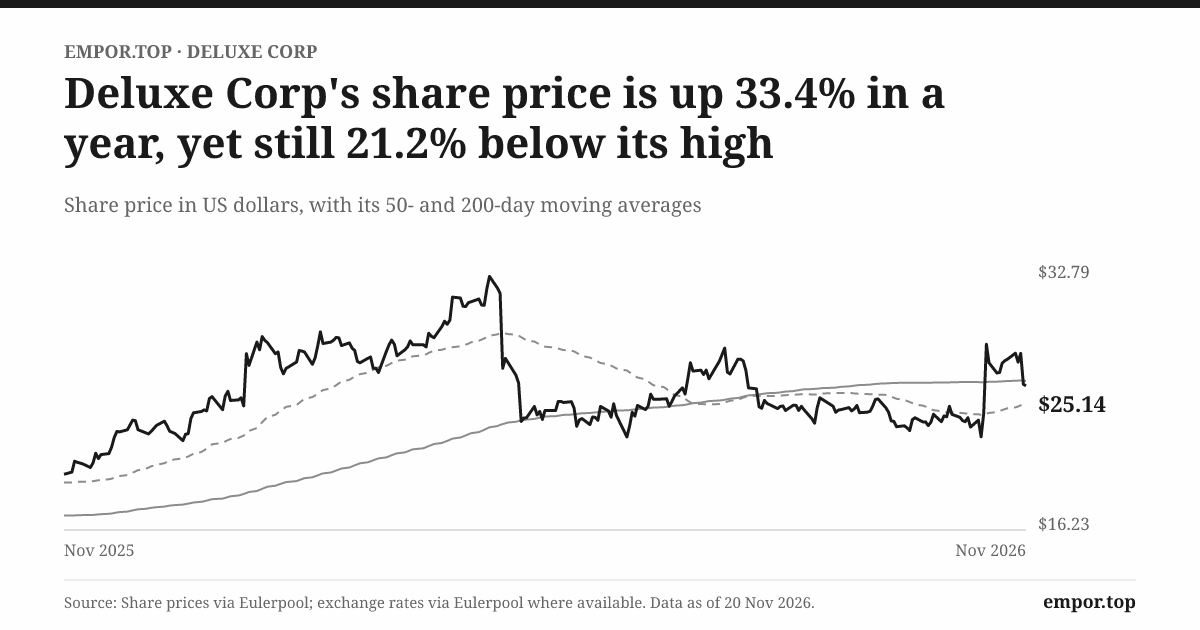
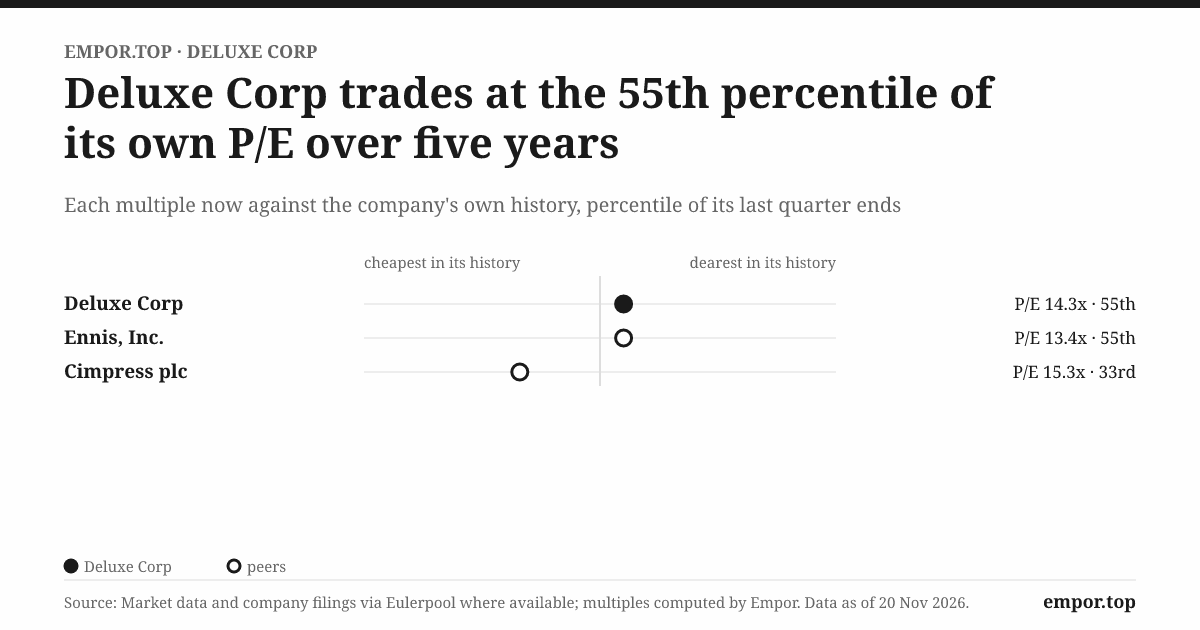
On November 20, 2026, Deluxe shares closed at $25.14.14 Over the prior year they had traded as low as $18.85 and as high as $31.90, a range that captures the market's uncertainty about which Deluxe it owns.14 At that price, the company's equity was worth about $1.1 billion, and its enterprise value, equity plus net debt, was about $3.2 billion.14 The stock traded at about 14.3 times trailing earnings, slightly above its own five-year median of about 13.4 times, and at about 8.2 times EV to EBITDA.14
Those multiples say something specific. The market is not pricing Deluxe as a dying check printer, which would typically trade at a deep discount on earnings. Nor is it pricing it as a payments growth company, which would command far higher multiples. It is pricing it roughly where it has been for five years: as a leveraged, slow-growing cash generator with some optionality on the new businesses. A useful outside reference, though a dated one, comes from an SEC-filed comparable-company analysis using May 2026 market data, before Celero closed. It showed Deluxe at about 6.8 times trailing EV to EBITDA against a 6.7 times median for a selected peer group.15 The peer set was not a pure match, and the valuation date predates both the acquisition and the current share price, so it is best read as a sign that Deluxe was priced in line with a group of mixed payments and services companies, not at a premium.
The bull case starts with momentum in the businesses that matter for the future. Data Solutions has posted eight consecutive quarters of double-digit growth.4 Payments and Data together grew about 8.3% in the third quarter excluding Celero.4 Celero adds scale and a broader distribution network, and its stated synergy and leverage targets are modest enough to be achievable. North Star met its free-cash-flow goal early, leverage was falling before the deal, and cash generation has been durable for more than a decade. A bull would argue that the market is still valuing Deluxe on its past as a check printer, and that as the mix shifts and the debt falls, the multiple should rise toward that of a payments company.
The bear case starts with the same company viewed over a longer span. Revenue fell about 1.6% a year from 2022 to 2025.6 Print remained more than half of 2025 revenue, and checks alone were about a third.6 The earnings recovery came mostly from cost cuts. And just as debt reduction was gaining traction, Deluxe borrowed hundreds of millions more to buy Celero before a single full year of combined results was available. A bear would argue that the company is using the cash of a declining business to buy growth, then pointing to the bought growth as proof that the strategy works.
Michael Porter's five forces help sort the two views. Buyer power is significant: banks negotiate check pricing hard and can insource marketing, while small merchants switch processors readily. The threat of substitutes is the dominant force in Print, where digital payments keep advancing. Supplier power is moderate, with card networks setting much of the economics in merchant processing. Rivalry is intense in payments, where Deluxe competes with far larger processors and specialists. The threat of new entrants is low in check printing, a shrinking market few would enter, but higher in payments and marketing, where software companies and fintechs keep arriving.
Hamilton Helmer's seven powers ask a sharper question: which durable advantage, if any, lets Deluxe earn returns above its cost of capital? Scale economies are real in check printing, where Deluxe's volume spreads fixed plant and security costs, but they protect a declining market. Counter-positioning does not apply; Deluxe is the incumbent being counter-positioned against. Switching costs exist in B2B Payments and treasury services, where implementations take time, but their strength is unmeasured because retention is not disclosed. Network effects are weak; merchant processing does not grow more valuable to each merchant as others join. Brand matters to banks as a mark of reliability, not as a reason consumers choose a check. Cornered resources and process power are hard to identify. The honest conclusion is that Deluxe has one clear power, scale in a shrinking market, and a plausible but unproven claim to switching costs in its service businesses.
That frame clarifies why Deluxe could win. Its check infrastructure and bank relationships give it a funded, stable base. Its payment processing capability, now larger with Celero, gives it a real position in small-business acquiring. And its distribution across thousands of banks may support cross-selling, if "One Deluxe" turns out to be more than a slogan. The evidence for retention and customer-level economics is incomplete, which is precisely why the bull case remains a bet rather than a conclusion.
It also clarifies why it may not. Substitutes keep advancing in Print. Banks can build or buy services elsewhere. Customer insourcing caused large impairments once before. And the new businesses, however fast they grow, carry lower margins than the old one they are meant to replace, which means growth must be strong to keep total earnings rising.
The management test is concrete. Investors can weigh delivery against the North Star targets, which were met on cash, and against the Celero synergy and leverage timetable, which has just begun. They can separate operational gains from acquisition contributions and divestiture-adjusted comparisons. And they can ask whether the next spare dollar goes to debt reduction or to another deal.
Three numbers capture most of what matters. The first is organic growth in Payments and Data, which grew about 8.3% in the third quarter excluding Celero, and which will show whether the mix shift can stand without acquisitions.4 The second is Print's revenue decline and segment EBITDA, with revenue down about 3.6% on a comparable basis in the third quarter, which will show whether the cash engine is aging gracefully.4 The third is free cash flow after capex, interest and dividends, alongside net leverage, which will show whether the company can actually pay for its transformation.
The market price suggests investors are waiting to see those numbers. The lessons of Deluxe's history suggest they are right to.
XI. Business & Investing Lessons
Put the 2019 annual report beside the June 2026 Celero announcement.73 The first records what happened when Deluxe's assumptions about its customers failed. The second asks investors to believe a new set will hold. Between them sit most of the lessons this company has to teach.
The first lesson is about time. Deluxe's check business has funded pivots before, but its decline leaves less cash and less room for mistakes. The old business can buy time; it cannot buy the future twice.
The second lesson is about relationships. Deluxe's own history shows that a bank relationship does not prevent insourcing or departure when a contract ends. A relationship becomes a moat only when the customer keeps choosing it.
The third lesson is about price. As Celero shows, a plausible multiple can still leave the rest of a leveraged company with little room for disappointment.
The fourth lesson is about targets. North Star's early cash target deserves credit, but hitting an adjusted target is a milestone, not yet a return.
The fifth lesson ties the others together. Deluxe's mix shift is impressive, but it matters only if the cash follows.
XII. Epilogue
Tonight, Deluxe sits at a hinge. It has a new payments business bolted onto an old print franchise, a debt load at its highest in years and a stock market that has priced it as neither a winner nor a loser. The next few quarters will start to show which way the hinge swings.
The first test arrives with the fourth-quarter results, which will include a full quarter of Celero for the first time. Investors will be able to see how much revenue Celero contributes, whether Merchant Services margins keep expanding, and, critically, whether Payments and Data growth holds when Celero is reported separately from the base business.4 If organic growth stays near that pace, the mix shift will look increasingly self-sustaining. If it fades, the story will depend more heavily on the acquisition than management has suggested.
The second test is the synergy clock. Management has promised at least $15 million of cost savings within 24 months of closing.3 Each quarter between now and mid-2028 is a checkpoint. Investors should watch whether savings arrive on schedule and whether integration costs stop rising. A deal that delivers synergies late, or delivers them alongside rising restructuring charges, would be telling a different story from the one in the presentation.
The third test is Print. Its revenue has been declining at a mid-single-digit pace while its margins held. If that pattern continues, Print will keep paying for the transformation. If volume declines accelerate, or price increases stop sticking with banks, the cash engine will weaken while the debt load remains high. Few things would change Deluxe's story faster.
The fourth test is the balance sheet itself. Management has said it expects to bring net leverage below three times within about two years of closing.3 The path there runs through unrestricted cash, free cash flow after dividends and capex, and steady debt repayment, all with the 2029 maturity wall approaching. Deluxe has also said it plans to update its multiyear outlook at an upcoming Investor Day, giving management a chance to reset expectations in light of Celero.4 How it frames those targets, and whether it explains any shortfalls in the old ones, will say a great deal about the next phase.
Each of these tests bears on the four questions that opened this story. The unresolved question underneath all of them is a race against time. Can Deluxe reach a higher-growth mix before its legacy cash engine weakens materially?
XIII. Outro
That box still matters: checks were about a third of 2025 revenue.6
Now follow the money a little further. The same small business that writes a check to its supplier swipes a customer's card at the counter, and that payment runs through a merchant terminal into a processing network that, increasingly, Deluxe owns. Celero helped push Payments and Data past half of third-quarter revenue.4 The check and the card transaction sit side by side in the company's accounts, one fading and one growing, one paying for the other.
That is what makes Deluxe unusual. It is trying to make the money behind yesterday's payment method finance the infrastructure of tomorrow's. The checkbook is both relic and resource: a declining product that still bankrolls the company's attempt to outgrow it. Whether the attempt succeeds will not be decided by the size of the new businesses, but by what they keep after the debt is paid.
References
-
Celero Acquisition Completion and Financing, Form 8-K — Deluxe Corporation, 2026-07-31 ↩↩↩
-
First American Acquisition Presentation — Deluxe Corporation, 2021-04-22 ↩↩↩↩↩↩↩↩
-
Deluxe to Acquire Celero Commerce, Accelerating Transformation Toward Payments and Data Solutions Scale — Deluxe Corporation, 2026-06-18 ↩↩↩↩↩↩↩↩
-
Q3 2026 Earnings Call Transcript — Deluxe Corporation, 2026-11-04 ↩↩↩↩↩↩↩↩↩↩↩↩↩↩↩↩↩↩↩
-
Q3 2026 Form 10-Q — Deluxe Corporation, 2026-11-05 ↩↩↩↩↩↩↩↩↩↩↩↩↩↩↩↩
-
2025 Form 10-K — Deluxe Corporation, 2026-02-13 ↩↩↩↩↩↩↩↩↩↩↩↩↩↩↩↩↩↩↩↩↩↩↩↩↩↩↩↩↩↩↩↩↩↩↩↩↩↩↩↩↩↩↩↩↩↩↩↩↩↩
-
2026 Proxy Statement — Deluxe Corporation, 2026-03-09 ↩↩↩↩↩↩↩↩↩↩
-
First American Acquisition and Pro Forma Results — Deluxe Corporation, 2021-08-10 ↩
-
Credit Rating Rationale — S&P Global Ratings, 2025-04-03 ↩↩↩
-
2023 Investor Day Presentation — Deluxe Corporation, 2023-12-05 ↩↩
-
2026 Annual Meeting Voting Results, Form 8-K — Deluxe Corporation, 2026-04-24 ↩
-
Celero Acquisition Presentation — Deluxe Corporation, 2026-06-18 ↩↩↩
-
Comparable Public Companies Table, market data as of 2026-05-01 — SEC-filed document ↩
 LinkedIn
 WhatsApp
 Reddit
 Hacker News
 Email
 Kindle
 RSS Feed
 Spotify
 Apple Podcasts
 Amazon Music
 Audible
 YouTube