Douglas Emmett: The Long Lease and the Empty Floor
I. The Million Square Feet That Hadn’t Moved In
Picture an office floor in Westwood or Brentwood on a weekday in November 2026. The lights are on a timer, the carpet has been replaced, and a fresh lease sits in a filing system somewhere with a tenant's signature on the last page. Nobody is working there yet. The architects are still drawing the build-out, the contractor has not finished the conference rooms, and the first rent check is weeks or months away. On paper the floor is spoken for. In the landlord's bank account it is still empty.
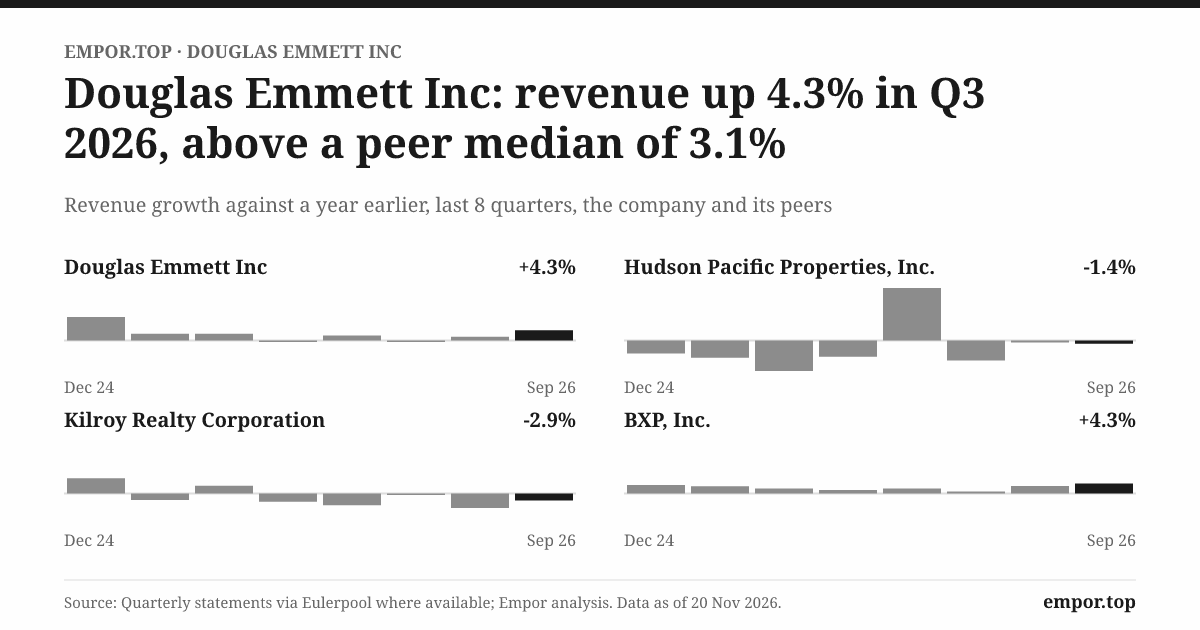
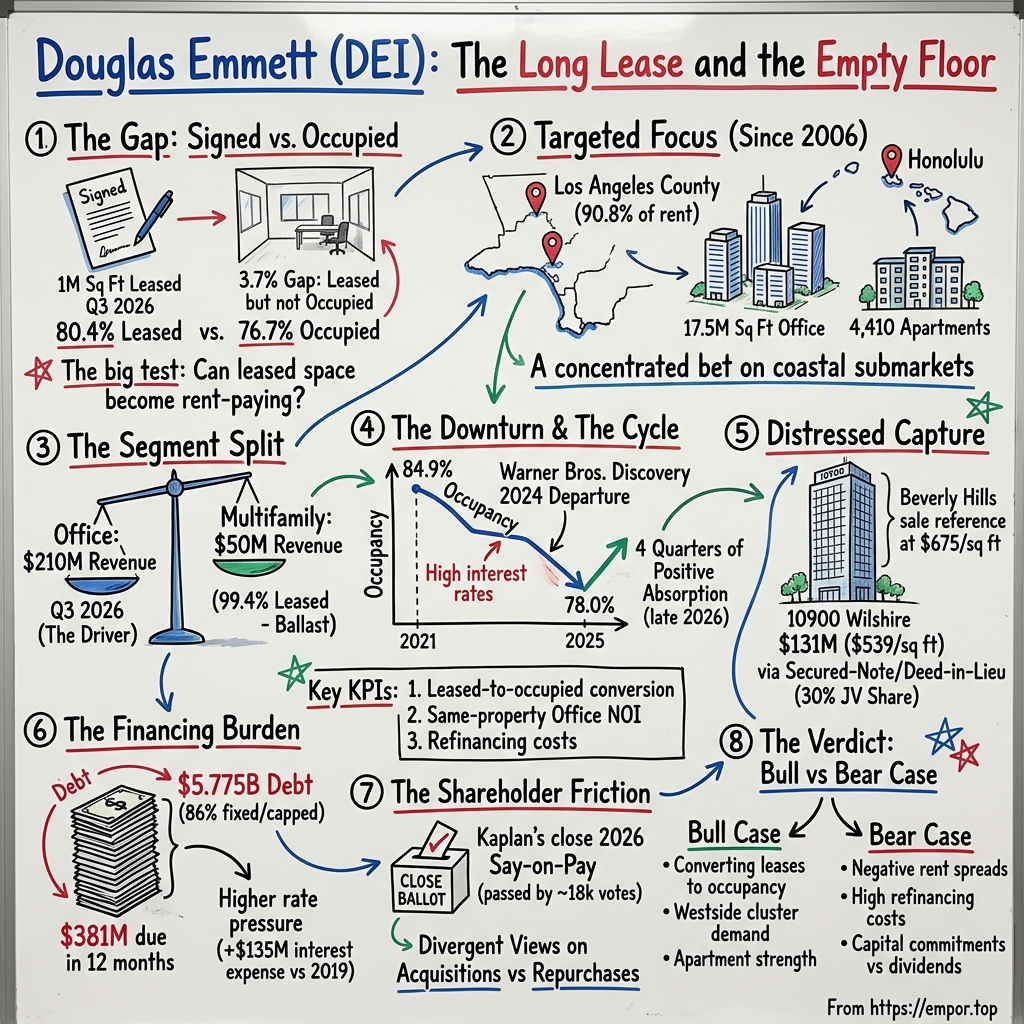
That floor is the clearest picture of Douglas Emmett in late 2026. On November 4, Chairman and CEO Jordan Kaplan and his team got on their third-quarter earnings call with the best leasing story they had told in years.1 The company had signed 224 office leases in the quarter, 142 of them renewals and 82 of them new tenants, adding up to almost a million square feet.1 The precise figure, 996,533 square feet, is the kind of number a leasing department frames and hangs on the wall.2 Office occupancy had climbed by more than a full percentage point in three months, which Kaplan described as the largest quarterly gain since 2012.1 It was, he said, the fourth consecutive quarter of positive absorption, meaning more space was being filled than vacated.1
Then there was the gap. At quarter-end, 80.4% of Douglas Emmett's office space was leased, but only 76.7% was occupied.2 That difference of 3.7 percentage points is space with a signed lease but no tenant yet paying full rent from a working floor. Kaplan said a normal spread for the company runs around 100 to 150 basis points, so a gap of roughly 350 or more was, in his words, a very good sign.1 He has a point. A wide leased-to-occupied gap is a queue of future rent. But a queue is not revenue, and investors have learned to be wary of the moment when an operating story is told mostly in the future tense.
The rent itself tells a more complicated story. On the new and renewed leases signed in the quarter, starting cash rents were 9.2% below the rents on the expiring leases they replaced.2 Measured on a straight-line basis, which spreads the whole lease's rent, including its annual bumps, evenly across the term, the new leases were worth 1.8% more than the old ones.2 Management's explanation was that the company's typical 3% to 5% annual escalators more than offset the lower starting rent over the life of the lease.1 That is arithmetically true and economically important, but it also means the landlord is accepting less cash today in exchange for more cash later. In a business carrying billions of dollars of secured debt, the timing of cash is not a detail.
Douglas Emmett, which trades on the New York Stock Exchange under the ticker DEI, is a real estate investment trust that owns office towers and apartment buildings concentrated in a handful of neighborhoods in western Los Angeles County and in Honolulu.3 At the end of September 2026 it had about 17.5 million square feet of in-service office space and 4,410 apartments.2 Office is the engine. In the third quarter it generated roughly $210 million of revenue against about $50 million from apartments.2 The apartments are nearly full and growing; the offices are the place where the investment case is won or lost.
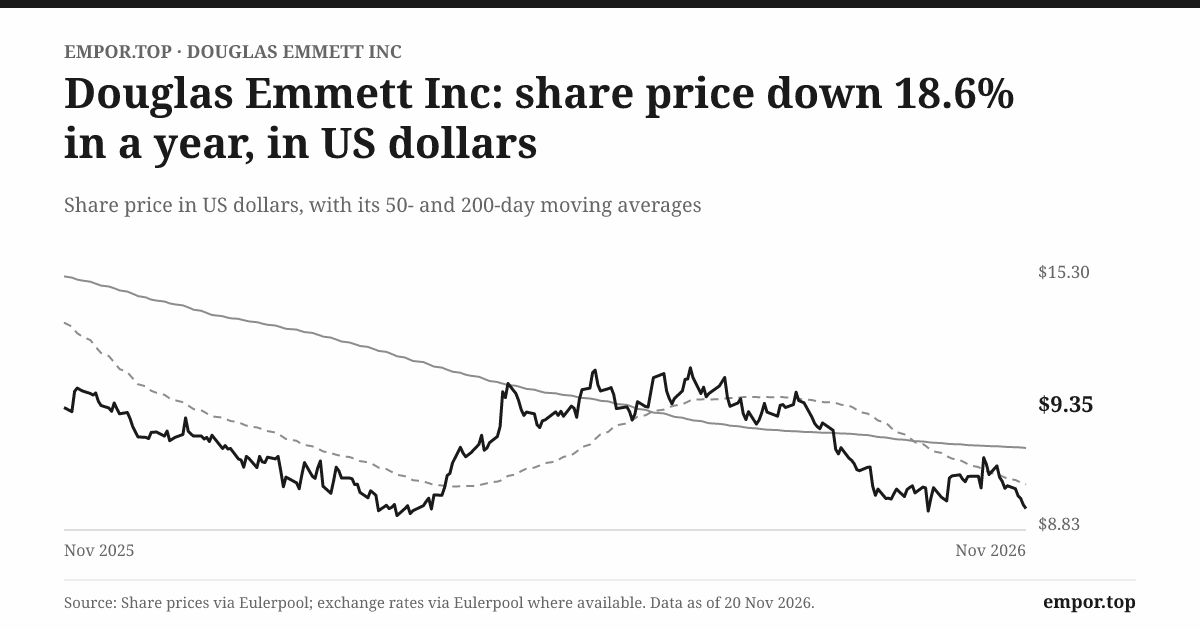
The stakes are easy to state and hard to resolve. Since 2019, the company's interest bill has risen by more than $135 million a year as its average cost of debt climbed from roughly 3% to roughly 5%, which Kaplan said accounts for nearly all of the decline in funds from operations since that peak.1 The stock closed at $9.35 on November 20, 2026, near its 52-week low and below its high of $12.75, giving the equity a market value of about $1.7 billion against an enterprise value of about $7.2 billion once debt is included.4 The dividend yields about 8.1% at that price.4 So the question is not whether Douglas Emmett owns good real estate. It is whether occupancy can recover fast enough, and at rents good enough, to outrun the cost of financing that real estate and the capital needed to keep its buildings competitive.
Three further tests sit inside that question. The first is whether the company's strategy of clustering buildings in a few sought-after submarkets actually gives it an edge in winning tenants, or just concentrates its exposure. The second is whether the money it has lately been putting into acquisitions, redevelopment and apartment conversions will earn more than it costs. The third is whether the people running the company, who have been running it since before it was public, are paid and governed in a way that lines up with the common shareholders who have watched earnings shrink. Each of those tests begins with what investors actually bought twenty years ago.
 Subscribe on LinkedIn
II. The Public Company Built Around a Few Markets
In October 2006, Wall Street was in the middle of a real estate boom. Office towers were trading at record prices, credit was cheap, and private landlords were lining up to turn their portfolios into public stock. Into that market came a Santa Monica operator with an unusually narrow map. Douglas Emmett's prospectus offered 55 million shares at a price range of $19 to $21, with Lehman Brothers leading the underwriting syndicate and an option for another 8.25 million shares.5 The registration became effective on October 23, 2006.6
What were buyers getting? Not a national REIT with towers in every gateway city. As of June 30, 2006, the portfolio consisted of 46 office properties with about 11.6 million rentable square feet and nine apartment properties with 2,868 units.5 About 90.8% of annualized rent came from Los Angeles County and the remaining 9.2% from Honolulu.5 Within Los Angeles, the company named nine submarkets: Brentwood, the Olympic Corridor, Century City, Santa Monica, Beverly Hills, Westwood, Sherman Oaks and Encino, Warner Center and Woodland Hills, and Burbank.5 The buildings were not trophies scattered across America. They were a dense pattern of mid-size and large office properties along a few corridors on the Westside and in the San Fernando Valley, plus apartments in some of the most supply-constrained residential neighborhoods in the country.
The listing was the last step in a long private history. The predecessor operating companies had been building and managing this portfolio for decades, and by the time of the IPO they had managed nine institutional funds that together raised more than $1.5 billion of equity.5 The formation transactions rolled those funds and the operating companies into a single Maryland corporation, with Dan Emmett, Christopher Anderson, Jordan Kaplan and Kenneth Panzer named as the predecessor's principals.5 The IPO, in other words, did not create a new business. It converted an established private platform, with its own institutional investors, into a public company that ordinary shareholders could buy.
That origin matters for understanding the structure today. Like many REITs, Douglas Emmett owns its properties through an operating partnership, a vehicle that holds the real estate and in which the public company is the controlling partner.3 Some insiders and former fund investors hold units in that partnership instead of common shares; those units can generally be exchanged for stock.3 On top of that, the company runs consolidated joint ventures in which outside institutional investors own part of a property or portfolio.3 The accounting consequence is simple but easy to forget. The consolidated revenue, assets and debt in Douglas Emmett's statements include the outside partners' shares, so the company's economic interest is smaller than the gross totals. When the story later turns to a building the company owns only 30% of, that distinction becomes concrete.
The man who has run the business through every chapter since is Jordan Kaplan. He joined the predecessor operating companies in 1986, the same year he finished an MBA at UCLA after an undergraduate degree at UC Santa Barbara.7 In 1991 he co-founded the immediate predecessor and served as chief financial officer of the predecessor operating companies until the IPO, when he became chief executive and a director.7 Kenneth Panzer, who joined in 1984 after Penn State, followed a parallel path as chief operating officer.7 Kaplan, now 64, is a finance-trained operator who spent his formative years as the numbers person for a private landlord; Panzer, 65, spent his on the buildings and leasing side.7 For two decades, the public company has effectively been their partnership.
Some data providers list Kaplan as CEO "since 2025," which is wrong in a way worth correcting. What changed in 2025 was his title on the board: he was named chairman that year, as co-founder Dan Emmett left the board.78 The operating regime, the leasing philosophy and the capital-allocation instincts were already his. That continuity is a strength in one sense, because the people who built the portfolio know every building and every submarket. It also means there is no new management team to blame or credit for the last five years. The record belongs to the same people.
At the IPO, the strategy was described in terms that have barely changed: own a concentrated portfolio in submarkets with high barriers to new supply, keep the tenant base small and diverse, and run the buildings with an in-house team rather than outsourcing leasing and management.5 The shape of the tenant base was already distinctive. The office portfolio held 1,778 commercial leases averaging only about 5,800 square feet each.5 That is the footprint of a dental practice, a boutique law firm or a family office, not a corporate headquarters. Office supplied about 84.7% of annualized rent and apartments the remaining 15.3%, and the apartments were 99.6% leased.5 The business model, in short, was to be the landlord of choice for thousands of small professional tenants in neighborhoods where they wanted to work and their partners wanted to live, and to hold a residential portfolio on the side in places where building new apartments was nearly impossible.
There was one tenant worth noticing in 2006. Time Warner was the largest, at about 6.6% of office annualized rent.5 Remember that name. Its successor company's departure eighteen years later would mark one of the hardest moments in the company's public life.
The prospectus also gives a useful starting line for occupancy. In mid-2006 the office portfolio was 93.1% leased, and 96.1% leased outside the Warner Center and Woodland Hills submarket, which was then the soft spot.5 At the end of 2025, in-service office occupancy was 78.0%.3 The two numbers measure slightly different things, leased versus occupied, and the portfolio has changed in the intervening years. But the gap of roughly fifteen percentage points is not a rounding error. It signals that the operating environment for Westside office space has changed profoundly since the company went public, and that the question facing investors now is less about expansion and more about refilling.
So the defining choice of the public company was focus. Investors were not buying a diversified bet on American office demand. They were buying a claim on a few square miles of Los Angeles and a slice of Honolulu, run by people who knew those streets intimately. Focus can support deep local knowledge and pricing intelligence. It can also mean that when demand in those few square miles weakens, there is nowhere else for the portfolio to hide. The answer has to be found one lease at a time.
III. The Westside Bet Has to Win One Lease at a Time
Imagine a managing partner at a twenty-lawyer firm in Century City whose lease expires in eighteen months. A broker brings three options. The firm can renew in place, perhaps giving back a floor because half the associates work from home two days a week. It can move across the street to a competitor's newly renovated building that is offering a year of free rent. Or it can relocate to a smaller suite in Santa Monica, closer to where the partners live. Every one of those choices is a negotiation with a landlord who has empty space, and Douglas Emmett is often on more than one side of that table.
This is the daily reality of the business. Douglas Emmett earns money primarily by renting square feet of office space and apartment units.3 Office tenants generally sign non-cancelable leases that pay base rent plus reimbursements for some building operating costs, and the company also collects parking and other property income.3 Apartment leases are typically one year or less, which lets apartment rents reset quickly when the market moves.3 Office leases are longer and generally contain the 3% to 5% annual increases management highlighted on its latest call.1 At the end of September 2026, the contracted minimum base rent on the company's office and ground leases totaled about $3.46 billion over their remaining terms, a backlog that excludes apartment rent and reimbursements.4 That backlog is the business's ballast, but escalators only compound if a tenant stays and space is filled. A 4% bump on an empty floor is worth nothing.
Office is the weight that matters, generating roughly four times the apartment revenue in the third quarter of 2026.2 The apartments are the good news in the portfolio: they were 99.4% leased at quarter-end, and same-property cash net operating income from them grew 4.4% from a year earlier.21 In a world of half-empty office towers, a residential portfolio that is effectively full is valuable. But it is useful ballast, not a second growth engine. Even rapid apartment income growth could not offset a prolonged decline in office income. Management's own caution reinforced the point on the August call, when Kaplan described recent apartment rent growth as unsustainable and said he expected a return to the long-term trend.9
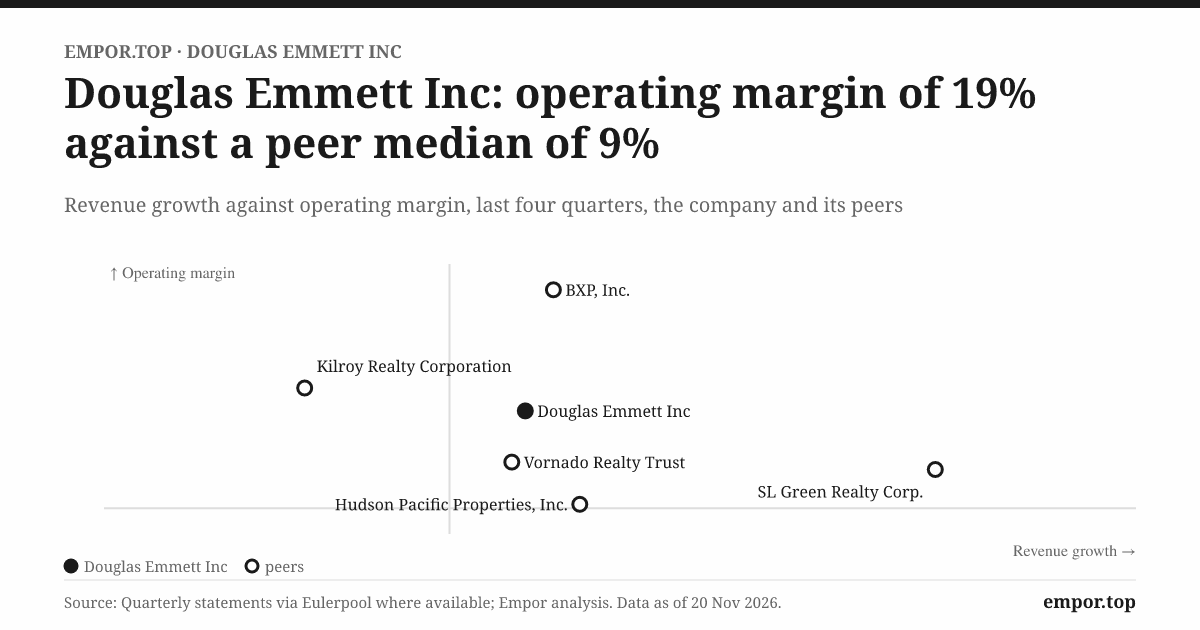
Who are the rivals across the street? Boston Properties, now BXP, is the largest publicly traded office landlord in the United States, with a portfolio spanning Boston, New York, San Francisco, Seattle, Washington and Los Angeles.10 It competes with Douglas Emmett only in a slice of its business. The closer public comparisons are Kilroy Realty, which owns office and life-science space along the West Coast including Los Angeles, and Hudson Pacific Properties, which owns West Coast office buildings and film studios.1112 Then there are private landlords, including the Irvine Company and many smaller owners, which compete directly in Douglas Emmett's submarkets and do not report occupancy at all.3 Comparing these companies is tricky. They define in-service portfolios, occupancy and leased rates differently, they own different mixes of buildings, and none has Douglas Emmett's density in the same neighborhoods. The sensible conclusion is that DEI is a local specialist competing against both national giants and private owners, not a market-maker.
Apply the classic competitive forces once, and the picture sharpens. Tenants have real bargaining power when there is spare space, and in western Los Angeles there has been plenty: West Los Angeles office vacancy was about 24% in late 2024.13 Hybrid work gives tenants a further option, which is to shrink. No single tenant, however, has leverage over Douglas Emmett, because the base is fragmented. No tenant accounted for more than 10% of revenue in recent years, and at the end of 2025 more than half of office leases were for 2,500 square feet or less.3 Switching costs are limited: moving is expensive and disruptive, but at lease expiry a tenant can leave. Competing landlords constrain pricing directly, and the long-run substitute is not another office building but no office at all, or far less of one. New supply is not the main threat, because few new towers are being built on the Westside. The threat is the already-built space sitting empty and the tenants who decide they need less of it.
Where does that leave the company's claimed advantages? The clustering is real. Owning several buildings in the same submarket lets the company offer a tenant who is growing or shrinking a different suite next door, share leasing and engineering staff across buildings, and see more of the local deal flow than an owner with one tower. Kaplan said on the November call that the company renews about 70% of its tenants "year in and year out," and the company reported lease transaction costs of $5.26 per square foot per year, which management described as below the benchmark for office REITs.1 Those are meaningful operating facts. Low leasing costs suggest the company does not have to buy its tenants with lavish improvement allowances, and steady retention suggests the small-tenant model holds up.
The disconfirming evidence, though, sits in the company's own record. Office occupancy fell for several years after 2021, from 84.9% to 78.0% at the end of 2025.3 A landlord with a durable edge in its markets would be expected to show either a rising share of occupied space or a sustained rent premium during a downturn. Douglas Emmett has shown neither consistently. Its starting cash rents remained below expiring rents in the latest quarter.2 That is not what pricing power looks like. The fairer verdict is that location and local operating scale are plausible advantages that help the company compete for tenants, and its leasing costs and retention support that narrower claim, but the evidence does not establish a moat in the sense of an ability to charge more than rivals or keep occupancy higher through a cycle.
The tenant mix deserves the same evidence-first reading. At the end of 2025, legal firms made up about 20% of office annualized rent, financial services about 17% and real estate about 13%.3 These are classic Westside professional-services tenants: law practices, wealth managers, brokers, entertainment-adjacent firms. The diversity protects the company from any single bankruptcy, and the company holds security deposits and letters of credit as a buffer, with about $67 million of security deposits at the end of 2025.3 The company also acknowledges that smaller tenants may be more vulnerable in a downturn.3 Diversification spreads credit risk; it does not eliminate exposure to a broad slowdown among small professional firms in one metropolitan area.
There is one more layer to the rent picture that a listener should hold onto. When a landlord gives a tenant free rent up front and then charges escalating rent later, accounting rules require it to book the average rent evenly over the lease. The difference between the rent booked and the cash billed accumulates on the balance sheet as a deferred rent receivable, which stood at about $134 million at the end of September 2026.4 Bad-debt write-offs have been small in recent years, which is reassuring.3 But a growing gap between booked rent and collected rent is precisely what makes cash flow, rather than reported revenue, the true scoreboard for this company.
That leads to the single most useful operating test for the next year. The first number is conversion: how quickly the space that is leased but not occupied turns into occupied, rent-paying floors. The second is same-property office net operating income, which strips out acquisitions and new developments and shows whether the existing buildings are earning more. The early signs are mixed. The leased-to-occupied spread narrowed from more than 470 basis points at the end of June to 370 basis points at the end of September as tenants moved in, and occupancy rose, which is exactly what the bull case requires.91 Yet same-property cash net operating income across the portfolio still fell 3.1% in the third quarter from a year earlier.1 Leasing activity is moving. The economics have not yet caught up, and the reason they have not becomes clearer when one looks back at how the slide began.
IV. When the Office Cycle Turned Against the Portfolio
On the last day of 2024, a lease ran out in Burbank. Warner Bros. Discovery, the descendant of the Time Warner that had been Douglas Emmett's largest tenant at the IPO, did not renew its space at the company's Studio Plaza property.14 The building had housed one of the most recognizable names in entertainment for years. Now it was a very large block of empty office space in a market where tenants were still deciding how much office they needed.
The company's own 2024 annual report did not dress the year up. Management described it as a difficult one, shaped by high interest rates, occupancy headwinds and the departure of the largest tenant.14 That candor is worth noting, because it sets a baseline for judging later optimism. In the moment the largest tenant left, management did not pretend the loss was trivial.
The consensus story about Douglas Emmett's slump tends to go like this: a great portfolio was hit by a pandemic shock and one large move-out, and once those passed, the buildings would refill. The record is less tidy. Occupancy had already been declining before Warner Bros. Discovery's lease expired.3 Revenue growth slowed along the way: the company grew revenue at about 4.7% a year over the decade to 2025, but only about 0.3% a year from 2022 to 2025.3 Revenue rose 1.7% in 2025 to about $1.0 billion, but that year's growth included an office property the company acquired and a joint venture it newly consolidated, so the reported number overstates what the existing buildings achieved on their own.3 When a company adds buildings to its income statement, revenue goes up even if every old building is flat.
Profit tells a harsher story than revenue. Net income attributable to common shareholders went from a loss of about $43 million in 2023 to a profit of about $24 million in 2024 and about $16 million in 2025, on a revenue base of roughly a billion dollars.7 Over the last twelve months to September 2026 the company reported a net loss.4 Some of that is accounting: depreciation on a large property portfolio is a big non-cash charge. But the direction is unmistakable. Higher interest costs and lower occupancy squeezed the space between rent collected and money owed.
So was this a temporary shock or a lasting weakness? The fairest reading is that it was both. One tenant's departure in Burbank does not explain a multi-year decline across a portfolio concentrated on the Westside. The longer slide reflects a broader reset in how much office space professional firms want, and it is central to the investment case. At the same time, the latest quarters show that demand has not disappeared. Kaplan pointed to the fourth straight quarter of positive absorption in November, and the second-quarter call had already reported about 60,000 square feet of positive absorption and some 960,000 square feet of leases signed.19
Here the story needs to separate two very different things. One is a market recovery, in which office demand across western Los Angeles improves and every landlord, including Douglas Emmett, fills more space. The other is a company-specific win, in which Douglas Emmett takes tenants from competitors because its buildings, locations or service are better. The bull case is much stronger if the second is happening. On the November call, when analysts pressed on whether the company was winning share, Kaplan acknowledged that it was difficult to tell whether Douglas Emmett was taking tenants from competitors or benefiting from broader demand.1 That candor is admirable, and it is also a limit. If management cannot say it is gaining share, investors should not assume it.
Kaplan has been careful about this kind of claim before. On the August call, asked about the momentum behind larger leasing deals, he said the proof would come over one, two and three quarters.9 By November the momentum had continued, but the proof he described, sustained gains in occupied space, was still only partly delivered. Occupancy guidance tells the same story. In August the company narrowed its full-year office occupancy expectation to 75% to 77%, explaining that the change reflected the inclusion of Studio Plaza for the full year rather than a deterioration in demand.9 The third-quarter reading of 76.7% landed in the upper half of that range.2 That is execution in line with guidance, not a breakout.
The texture of the leasing has also changed, and that change cuts both ways. Kaplan said in November that the company was seeing more large deals than it used to.1 For a landlord built on 5,000-square-foot suites, bigger tenants are welcome: one signature fills a whole floor. But large deals bring larger tenant-improvement packages and slower move-ins, because a firm taking 50,000 square feet needs months of construction before it can occupy the space.1 Crummy made the same point about Studio Plaza in August, noting that first-generation leases in a repositioned building take longer to build out, which keeps the gap between leased and occupied space wide for several quarters.9 So part of what makes the leased-to-occupied spread look so promising is also what makes the cash arrive later. The pipeline is real; its timing is elastic.
The renewals tell their own story. In the third quarter, 142 of the 224 office leases were renewals, covering more than 724,000 square feet, against 82 new leases covering about 272,000.1 Renewals are the bread and butter of a small-tenant landlord, and keeping tenants in place avoids the downtime and build-out cost of finding new ones. But renewals do not add occupancy. They protect it. The new-lease number, roughly a quarter of the quarter's volume, is the part that actually grows occupied space, and it is the figure that will tell investors whether Douglas Emmett is refilling its towers or merely holding the line.
Where does technology fit? It is tempting to tell a dramatic story about artificial intelligence emptying office towers. The honest version is more modest. AI is not a substitute for Douglas Emmett's product in the way streaming replaced video rental stores. Tenants still need somewhere to meet clients, train juniors and do the work that benefits from being in the same room. But AI could change how many people a law firm or wealth manager employs, and therefore how many square feet it needs at renewal. Douglas Emmett's concentration in legal and financial-services tenants makes that a relevant, if slow-moving, risk. The near-term test, however, is not a speculative AI narrative. It is whether leases convert to occupancy and whether occupancy turns into rising net operating income.
The verdict on this period is clear enough to state plainly. The slump was not only one tenant's departure: occupancy had been falling for several years, and the portfolio-wide weakness that followed makes the longer office-demand reset the central fact of the investment case. The latest leasing improvement is encouraging, and four quarters of positive absorption is a real change in direction. But a few good quarters do not yet establish a full recovery, especially when the starting rents on new leases are still below the rents they replace. While its existing towers were still refilling, Douglas Emmett did something that tells investors a great deal about how its managers see the cycle. It went shopping.
V. A Distressed Tower at $539 a Foot
In January 2025, a seventeen-story office tower at the corner of Wilshire and Westwood boulevards, across from the Hammer Museum and just south of the UCLA campus, changed hands in the way buildings often change hands in a downturn: not through a bidding war, but through a lender.13 The previous owner, Tishman Speyer, had bought 10900 Wilshire in 2014 for $125 million and later borrowed about $122.7 million against it from Blackstone Mortgage Trust.13 By late 2024 the loan was in special servicing, with maturity approaching and concern that the owner would default.13
A joint venture managed by Douglas Emmett stepped into that situation. Rather than buy the building from Tishman Speyer in a conventional sale, the venture acquired the secured note tied to the property and then took title through a deed in lieu of foreclosure, a process in which the borrower hands the property to the holder of the debt rather than going through a court-supervised foreclosure.313 The reported price was about $131 million, or about $539 per square foot, and Blackstone provided about $61.8 million of financing for the acquisition.13 Douglas Emmett owns 30% of the acquisition joint venture.34
That 30% is the first thing to understand about the deal. Because the company controls and consolidates the venture, the full building appears in its consolidated revenue, assets and debt. But Douglas Emmett's shareholders own less than a third of its economics. The outside partners own the rest. When investors read that consolidated revenue grew in 2025, part of the growth belonged to someone else.
Was it a bargain? The tempting benchmark is a nearby sale. In the fourth quarter of 2024, Tishman Speyer sold a Beverly Hills office building to Faring for about $90 million, or about $675 per square foot.13 On that comparison, 10900 Wilshire changed hands at roughly a fifth less per foot. But a single local sale is context, not a controlled comparison. The buildings differ in location, occupancy, physical condition, debt and, crucially, development potential. A price per square foot says nothing about how much rent the building produces or how much capital it will need. Without a property-level yield, a cap rate or an underwritten return, the deal cannot be called cheap. It can only be called distressed and lower-priced than one neighbor.
What the tower does add is clear from the company's own description. It is a Westwood office building in a submarket where Douglas Emmett already owned several properties, and it comes with a residential development site that the company can build on by right, meaning without a discretionary zoning approval.3 This is not a new business line. It is a doubling down on the same streets, combining the office playbook with the apartment conversion strategy the company has been pursuing elsewhere. On the August call, Kaplan said the company had purposely slowed the project to test interest from large office tenants, adding that one way or another, the property would have residential.9 By November, management was describing the planned residential component as up to several hundred units and said funding was on target with a construction loan.1
10900 Wilshire was not the only purchase. In April 2026, another Douglas Emmett-managed joint venture acquired the Bedford Collection, five medical-office buildings in Beverly Hills totaling about 246,000 square feet, for about $260 million.9 Douglas Emmett owns 13.3% of that venture, which was capitalized with about $150 million of equity and $130 million of debt.9 Kaplan told analysts he targets unlevered ten-year returns of 10% or better on such deals, and on the November call he said the company was looking for top-quality office buildings at discounts not seen in decades.91 His reading of the market on the August call was blunt: he said he had seen a seller part with a building for less than they paid only twice, and he argued that apartments were trading at very low cap rates, making office the more attractive purchase.9 A cap rate is simply a property's annual net operating income divided by its price, the real estate equivalent of an earnings yield, so a low cap rate means an expensive asset. Kaplan's argument, then, is that the market is overpaying for apartment income and underpaying for office income. That is a contrarian view, and contrarian views are where the best real estate returns are made. They are also where the worst ones are made, which is why the 10% return target matters more than the narrative around it. The company has not yet published the realized return on either joint-venture purchase, and it is too early for one to exist.
Using joint-venture partners lets the company buy more buildings than its own balance sheet could fund and collect management fees along the way. It also means the company's share of each win, and each mistake, is small relative to the headlines.
The larger capital commitments are closer to home. Studio Plaza, the Burbank property that Warner Bros. Discovery vacated, became a 456,000-square-foot office repositioning, in which the company is renovating the building to re-lease it to new tenants.3 By August, management said it was well over half leased and had moved back into the in-service portfolio, though first-generation build-outs take longer and temporarily widen the gap between leased and occupied space.9 In Brentwood, the Landmark Residences project is converting an office property into apartments.3 Kaplan said in November that the company had more than 1,000 apartment units under construction and would not start new residential projects until current ones were closer to completion.1 These are serious execution bets. They are not yet evidence of realized returns.
Landmark also carries a legal overhang. The company is appealing a trial-court ruling that the Ellis Act, a California law allowing owners to withdraw rental units from the market, was not a proper route to remove tenants for fire and life-safety retrofits, and it is separately litigating with insurers over recovery of reconstruction costs dating to 2020.4 Management said it did not expect the ruling to materially affect the project's timing, cost or plans.4 An older building also brings older problems: the company identifies asbestos in 33 of its buildings, with obligations for properties not under major work that cannot be reasonably estimated.3
The company's capital-allocation record deserves the same scrutiny the deal does. The company's operating-profit spike in 2019 was not evidence of a golden operating year. That year's results included a gain of about $308 million from consolidating a joint venture, an accounting event rather than a recurring improvement.15 More recently, disclosed capitalized development costs rose from about $43 million in 2024 to about $104 million in 2025, including about $11 million of capitalized interest.3 That is development spending only, not total capital expenditure, and it says nothing by itself about whether the projects will earn their cost.
The skeptic's question is simple: why buy more office buildings when your own are a quarter empty? The bullish answer is that the best time to buy real estate is when sellers are forced, and that adding a Westwood tower with a residential site at a distressed price is a different bet from filling an older Valley building. Both arguments have merit. What the record cannot yet show is whether these deals earn more than the company's cost of capital. That cost, as the next part of the story shows, has risen sharply.
VI. More Leases, More Interest
On August 5, 2026, CFO Peter Seymour delivered a sentence on the second-quarter call that captured the company's predicament better than any slide.9 Douglas Emmett's operating income expectations had improved from its prior projections, he said, but that improvement was more than offset by the impact of higher market interest rates.9 The company kept its full-year guidance for funds from operations at $1.39 to $1.43 per share.9 Kaplan added that rates were clouding the company's performance.9 Better leasing, in other words, was running up a down escalator.
Three months later the leasing had strengthened further, and Kaplan named interest rates as the biggest challenge.1 He said higher rates still accounted for nearly all of the decline in FFO since 2019.1 In the third quarter of 2026 alone, consolidated interest expense was about $72.8 million.4 Run that rate for a year and it comes to roughly $290 million, more than a quarter of the company's annual revenue. FFO, or funds from operations, is the REIT industry's standard earnings measure; it adds back real estate depreciation to net income and removes gains and losses on property sales, so it approximates the cash a portfolio generates before capital spending.7
The debt itself has a particular shape. At the end of September 2026, consolidated secured-note principal was about $5.8 billion.4 Almost all of it is borrowed against individual properties, and most loans are non-recourse, which means a lender's claim is generally limited to the building that secures it rather than the whole company.4 Think of it as a portfolio of separate mortgages rather than one corporate credit card. That separation protects shareholders from one bad building dragging down the rest. It does not make the debt harmless. Loan agreements contain covenants that can require excess cash to be deposited with lenders or the borrower to add collateral, provide a guarantee or pay down debt.3 The company also guaranteed part of a $175 million joint-venture loan to satisfy a minimum debt-yield requirement.3 The company discloses no corporate credit rating in its filings, because it borrows building by building.4
The company has hedged much of its exposure. About 86% of its debt was fixed, swap-fixed or capped at the end of September, and the fixed or swap-fixed portion carried a weighted-average rate of about 5.04% with about 3.8 years of remaining life.4 An interest-rate swap works like an insurance contract: the company pays a fixed rate to a bank and receives a floating rate in return, which converts a variable-rate loan into a predictable payment. The protection is real but temporary. When swaps and loans expire, the company refinances at whatever the market charges then.
That is exactly what has been happening. In May 2026 the company refinanced a $400 million loan for four years at an effective fixed rate of about 6.15%, and in June a $415 million loan at about 6.18%.9 In August it refinanced a $366 million office loan on a four-year, non-recourse basis at an effective fixed rate of about 6.24% through September 2029.1 Kevin Crummy, the chief investment officer, said refinancings during the year totaled more than $1.2 billion.1 Each of those deals is a success in one sense: the company found lenders willing to extend credit to Los Angeles office buildings, and Kaplan noted the company has never had a debt default or a short pay in its forty-year history.1 Each is also more expensive than the debt it replaced. A loan refinanced from the 3% era into the 6% era doubles the interest on that building.
There is a quieter detail in how the company manages liquidity. Asked on the August call about a corporate credit line, Kaplan explained that borrowing and holding cash was cheaper for Douglas Emmett than paying the fees on an undrawn facility, so if the company wanted more capital, it would rather simply borrow it.9 At the end of September it held about $311 million of cash and equivalents, parked in money-market funds and bank accounts.4 That is a deliberate choice to run without a traditional revolving backstop and lean on a cash cushion plus property-level lenders instead. It has worked through a very difficult cycle. It also means the company's flexibility depends on secured lenders continuing to want Los Angeles office collateral, and on that cash balance staying healthy as projects draw on it.
The hedging book has also become an accounting swing factor. In the first nine months of 2026, the company's cash-flow hedges recorded about $68 million of gains in other comprehensive income and reclassified about $16 million into interest expense.4 Translated into plain language: the swaps that locked in cheaper rates are still saving the company money, but those savings roll off as each swap matures. Part of the rising interest bill ahead is simply the end of old protection.
The maturity schedule shows how much refinancing is still ahead. The company reported about $381 million due within twelve months of September 30, 2026, followed by about $964 million and $961 million in the two following twelve-month periods.4 Management expects to refinance its short-term maturities.4 The near-term pile is manageable. The two years after that are larger, and they will reprice another slice of the debt stack. Investors should track not just whether those loans are refinanced, but at what rate, for how long and with what covenants.
Now the puzzle at the center of the cash story. From 2014 through 2025 the company reported cumulative net profit of about $969 million but generated about $4.7 billion of cash from operations, almost five times as much.3 The main reason is depreciation. A landlord's buildings wear out on paper over decades, so the accounting charge is large, around $400 million in 2025 alone, but no cash leaves the building when it is booked.3 That is why REITs report FFO, and why low GAAP earnings are not by themselves a sign of a failing business.
But operating cash is not free cash. The same twelve years show free cash flow after capital expenditure of about negative $1.0 billion, against roughly $1.8 billion of dividends paid.3 That negative figure includes heavy acquisition and development years, notably around 2016 and 2017 when the company expanded significantly, so it overstates the drain from routine operations. Still, the money had to come from somewhere, and borrowings grew from about $3.4 billion to about $5.6 billion over the period while the ratio of debt to equity rose from roughly 1.8 to roughly 2.9.3 Tenant improvements, leasing commissions, building upgrades, redevelopment and debt service all compete for the same operating cash before a dividend is paid.
The dividend therefore needs the right yardstick. Measured against GAAP net income, the 2025 payout was about 794%, which looks alarming but mostly reflects depreciation depressing reported profit.3 A better measure is adjusted funds from operations, or AFFO, which subtracts recurring capital spending and leasing costs and removes non-cash rent. In the third quarter of 2026, Douglas Emmett's AFFO payout ratio was 84.5%.2 That is covered, but not by a wide margin, and AFFO itself declined from about $52 million a year earlier to about $47 million.1 The company has already shown it will cut when the math demands it: dividends paid fell by about a third, from roughly $196 million in 2022 to roughly $129 million in 2023.14
The unresolved part of the cash bridge is the recurring capital required to keep buildings competitive. The company discloses recurring capital spending for its in-service portfolio of only about $3 million for office and $3 million for apartments in 2025, but that excludes properties undergoing major work and is not a full measure of what it costs to keep a tower leasable.3 It also reported about $277 million of remaining commitments for development, repositioning, capital expenditure and tenant improvements at the end of 2025.3 Lobby and elevator upgrades, such as the one Kaplan described at 100 Wilshire, are part of what it takes to compete for tenants in this market.9 Until the company publishes a clean bridge separating maintenance, leasing costs, redevelopment, dividends and refinancing, the durability of the payout remains partly a judgment call. That judgment rests on the people making it, and in 2026 shareholders made clear they were watching those people closely.
VII. Kaplan’s Near-Tie Vote
The annual meeting of a mid-cap REIT is usually a non-event. Proposals pass with comfortable margins, directors are re-elected, and the votes are filed in a short 8-K that almost nobody reads. Douglas Emmett's 2026 meeting in late May was different. When the advisory vote on executive pay was counted, about 68.21 million shares had been cast in favor and about 68.20 million against.16 The margin was 18,472 votes.16 In a company with roughly 167 million shares outstanding, the pay plan survived by a sliver smaller than a single mid-sized fund's position.7
The board votes sent a sharper message. Shareholders withheld about 95.4 million votes from director Shirley Wang and about 60.7 million from William Simon.16 Withholding is the only way most investors can register disapproval of a director in an uncontested election. Numbers that large are not random dissent; they are coordinated displeasure, usually guided by proxy-advisory recommendations and big institutional holders.
What were shareholders reacting to? The headline compensation numbers are part of it. Kaplan's reported total compensation was about $9 million in 2025, $9 million in 2024 and $8 million in 2023; Panzer's was almost identical.7 Over those same three years, net income attributable to common shareholders swung from a loss of about $43 million to a profit of about $24 million and then about $16 million.7 Put plainly, the chief executive's reported pay in 2025 was more than half the profit attributable to every common shareholder combined.
That comparison is vivid but incomplete, and the incomplete parts matter. Most of the reported pay was not cash. Kaplan and Panzer each received a one-million-unit award of long-term incentive plan units, known as LTIP units, with a reported grant-date value of about $8.17 million.7 LTIP units are a REIT-specific form of equity that becomes economically equivalent to operating-partnership units, and these awards carried performance conditions and transfer restrictions.7 The grant-date value is an accounting estimate of what the award was worth on the day it was granted, not money paid. If the stock stays depressed, the realized value will be far lower. That design aligns pay with share price, at least in theory.
Ownership points the same way. As of March 31, 2026, directors and officers as a group held about 13.0% of common stock, and about 17.1% on a share-equivalent basis that includes operating-partnership and LTIP units.7 Kaplan alone held about 12.6 million shares and share equivalents, and Panzer about 9.9 million.7 At $9.35 a share, Kaplan's stake is worth well over $100 million. Few REIT chief executives have that much of their personal wealth tied to their company's stock. When the share price falls, Kaplan loses real money.
The largest outside holders are index funds and a value manager. Vanguard reported about 15.6%, BlackRock about 14.4%, First Eagle about 8.2% and State Street about 6.5%, based on Schedule 13G filings dated in early 2024.7 Because the proxy repeats those older filings, the figures do not show whether those managers have recently bought or sold. There is no controlling shareholder.7
Governance also includes the small matters that a skeptic notices. The company disclosed that in 2025 it employed relatives of directors and executives, including Kaplan's and Panzer's daughters and director William Simon's son, with compensation in each case below a stated threshold, and it paid about $2.0 million to the architecture firm Gensler for development work on terms it described as no less favorable than those from unaffiliated parties.7 None of these is large relative to a billion-dollar revenue base. They are the kind of details that do not break a thesis but do color how an investor reads a close pay vote.
Capital allocation is where alignment becomes concrete. In 2023 the company repurchased about 9.1 million shares for about $109 million, at an average price of about $12.03.3 With the stock now around $9.35, those repurchases are underwater by more than a fifth. That does not make them a mistake in hindsight, because the company was buying below its estimate of asset value, but it does test the idea that buybacks are an obviously superior use of cash. Since then the company has favored joint-venture acquisitions over repurchases, explaining that JV partners remain an important source of capital for larger deals.1 The activist's question writes itself: with the stock trading at roughly book value and the company itself saying office buildings are cheap, why buy a fraction of someone else's distressed building instead of a larger fraction of your own? Management's answer is that joint ventures let it control more assets with less of its own money. The answer an investor should demand is a disclosed return on those investments compared with what a buyback would have earned.
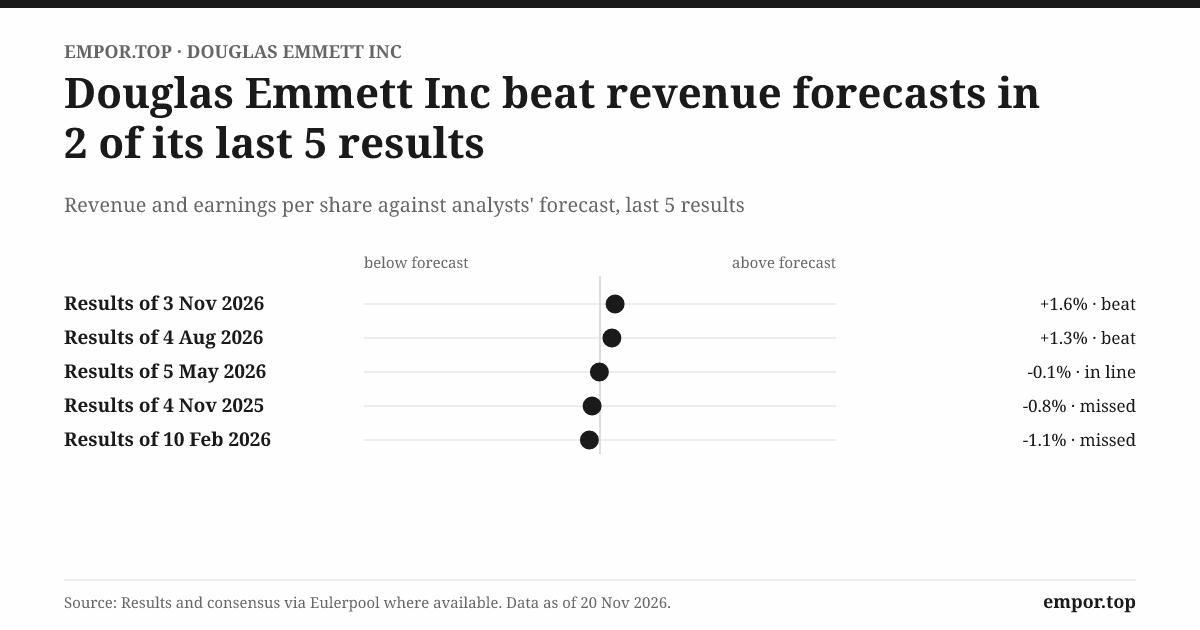
Guidance discipline is a better sign. Across the two most recent calls, management's tone has been consistent and specific. In August, Seymour attributed the absence of a guidance raise to rates, not to vague market conditions.9 In November, guidance was reaffirmed rather than stretched, and Kaplan conceded he could not tell how much of the leasing came from taking share versus market growth.1 Kaplan also said that FFO could return to 2019 levels and beyond, even at current interest rates.1 That is a claim to remember. It is a specific, testable promise, and the company's ability to keep it will say more about management's credibility than any pay vote.
The record supports neither a blanket endorsement nor a charge of failed stewardship. Management has meaningful skin in the game, explains itself clearly and has not overpromised on the latest calls. But common earnings are weak, pay has remained near $9 million while profits shrank, and nearly half the votes cast were against the pay plan. The next say-on-pay vote, and whether the board changes the plan's design in response, will reveal whether that message was heard. For now the market has delivered its own verdict, and it is written in the share price.
VIII. Analysis & Bear vs. Bull Case
On November 20, 2026, Douglas Emmett's stock remained near its 52-week low.4 Its equity was valued at about $1.7 billion against an enterprise value of about $7.2 billion.4 The company's net loss over the last twelve months means trailing earnings per share are negative.4 The quoted price-to-earnings ratio of about 102 is based on 2025's small profit and is nearly useless for a REIT, because depreciation crushes GAAP earnings.4
Better measures paint a more nuanced picture. The stock trades at about 1.0 times book value, around $9.78 per share.4 Book value for a landlord is the depreciated historical cost of its buildings, so it can sit far below or above what the buildings would sell for today. Enterprise value is about 11.9 times EBITDA.4 Market-data providers put Kilroy at about 14.4 times, BXP at about 16.1 times and Hudson Pacific at about 12.4 times on a comparable basis.171819 Douglas Emmett is priced near the bottom of that peer group. The market appears to be assuming that its occupancy recovery will be slow, its interest costs will stay high and its dividend is less safe than the yield implies. The price is not saying that the buildings are worthless; it is saying that the equity sits behind a lot of debt in a business with uncertain cash flows.
The bull case starts with the assets. Douglas Emmett owns dense clusters of office buildings in some of the most supply-constrained neighborhoods in the country, plus an apartment portfolio that is effectively full and growing. Its tenant base is diversified, its leasing costs are low relative to peers, and its retention has been steady. The leased-to-occupied pipeline is unusually large, and if those leases commence as management expects, occupied space and cash rent will rise over the next year. Add to that refinancing done without defaults, joint-venture capital to buy distressed buildings, and a land bank for apartment conversions, and the bull sees a company at the bottom of the office cycle with operating leverage ahead.
The bear case starts with the same facts read differently. Office occupancy remains well below its 2021 level, and the latest leases had negative starting cash rent spreads. Financing costs have roughly doubled on refinanced loans, more than $1.9 billion of debt matures in the two years after the next twelve months, and refinancing has brought higher rates. Redevelopment at Studio Plaza, Landmark and 10900 Wilshire, plus joint-venture acquisitions, competes for cash with debt repayment and the dividend. The AFFO payout ratio remains in the mid-80s, and AFFO has fallen from a year earlier.
To weigh those cases, the competitive framework has to be applied once, carefully. Tenants have meaningful bargaining power when space is available, switching costs are limited at lease expiry, and the main substitute is less office altogether. Hamilton Helmer's framework of seven sources of durable power asks a different question: does the company have scale economies, network effects, counter-positioning, switching costs, a brand, a cornered resource or a process advantage that lets it earn more than rivals for long periods? The most plausible candidates for Douglas Emmett are a form of cornered resource, in owning hard-to-replicate locations in clusters, and a modest process advantage in its in-house leasing and management. Its low leasing costs and steady renewal rate are consistent with both. Network effects and counter-positioning do not apply, and its brand matters to brokers more than to tenants.
One cost advantage does show up in the numbers. Seymour reported general and administrative expense of about 4.6% of revenue in the third quarter, which he described as the lowest in the company's benchmark group, and the company runs its entire portfolio with roughly 778 employees.13 A lean corporate overhead is a genuine, if modest, process advantage: less of each rent dollar is consumed by headquarters before it reaches lenders and shareholders. It is not the kind of power that wins tenants, but it is the kind that helps a landlord survive a long downturn without cutting the services tenants notice.
The historical test is the decisive one. The company's occupancy and rent spreads have not demonstrated pricing power. That narrows the claim rather than rejecting it. Location and local operating capability help the company compete; they have not demonstrated pricing power. The revised claim is that Douglas Emmett can fill its space faster and more cheaply than a typical landlord in the same markets, and that claim can be checked through occupancy, renewal retention, cash rent spreads and same-property net operating income in each coming quarter.
Three numbers can settle most of this debate. The first is the occupied office rate measured against the leased rate: the spread narrowed as occupancy rose.29 The second is same-property office net operating income, the cleanest measure of whether existing buildings are earning more; portfolio same-property cash NOI remained negative in the third quarter.1 The third is the cost of refinancing set against net maturities, with recent refinancings priced above the average on fixed or swap-fixed debt.14 Alongside those, AFFO after recurring capital and leasing spend is the measure to watch when judging the dividend.
The falsifiers are concrete. If the space that is leased but not occupied fails to convert into occupancy over the next three quarters, or if same-property NOI stays negative while refinancing costs rise, the recovery case should be narrowed sharply or rejected. If conversion lifts occupancy and NOI without renewed dilution or a dividend cut, the case strengthens materially. The market's discount implies that the first outcome is more likely. The next year will show whether that discount was a fair price for risk or an overreaction to a cycle the company is already climbing out of. Either way, the story offers lessons that reach beyond one landlord in Los Angeles.
IX. Business & Investing Lessons
Go back to the empty floor in Westwood, the one with the signed lease and the unfinished build-out. Everything Douglas Emmett has taught investors over the last five years is visible in that room.
The first lesson is about timing. In real estate, the signature is the beginning of the return, not the return. A leased rate of 80.4% sounds like recovery until it sits next to an occupied rate of 76.7%, and the difference is months of construction, free rent and patience before cash arrives.2 Founders who sell long contracts and investors who buy contracted backlogs face the same truth. A promise of future revenue has to survive its own start date, and every month between signing and paying is a month the company carries the cost. The companies that look best on bookings often look worst on cash.
The second lesson is about price. A distressed asset is only cheap if the rent and the capital plan work. 10900 Wilshire changed hands at about $539 a square foot, well below one nearby sale, and it came through a lender rather than a bidding war.13 Those are the conditions under which bargains are made. But price per square foot is a physical measure, not an economic one. The real question is what the building will earn after residential construction, leasing costs and higher-rate debt, and that answer depends on execution that has not happened yet. The lesson for any acquirer, in any industry, is that a forced seller tells you the price is low, not that the return will be high.
The third lesson is about the queue. Douglas Emmett generated far more operating cash than net profit over twelve years, which sounds like abundance until lenders, contractors, tenants demanding improvements and the redevelopment pipeline take their share.3 Then the dividend gets what is left, and its high AFFO payout ratio shows how little room remains.2 The temptation for investors is to treat a REIT's operating cash as its dividend capacity. The better habit is to count every claim ahead of the shareholder before declaring the payout safe.
The fourth lesson belongs to this company more than any other: concentration is a strategy only as long as the place you concentrated in keeps its promise. For two decades, owning a few square miles of Los Angeles was a source of local knowledge, operating efficiency and pricing intelligence. When office demand on those same streets weakened, there was no other market to soften the blow. A focused business does not get to diversify its way out of a downturn. It has to win its way out, one lease and one refinancing at a time. That is exactly where Douglas Emmett stands tonight.
X. Epilogue
The next three quarters are when the leasing of 2026 will either become income or remain a promise. Management said that basically all of the space leased but not yet occupied at the end of September would commence over the next four quarters, with the majority in the next one or two.1 That gives investors an unusually clear calendar. If the spread between leased and occupied space, 3.7 percentage points at the end of September, narrows because tenants arrive rather than because new leases dry up, occupied office space will rise toward 80%.2 If it narrows because leasing slows while move-ins stall, the recovery narrative will have run ahead of the facts.
The first moment to watch is the fourth-quarter results in early 2027, when the company will report full-year occupancy against its guidance range and, as Kaplan promised in November, provide guidance on all-in refinancing rates.1 That guidance will tell investors how much of the coming maturity wall will reprice and at what cost. The near-term pile of about $381 million due within twelve months is manageable.4 The two larger tranches behind it, close to $2 billion together, are where the interest bill will be decided.4 Each refinancing completed at a rate close to the current average is a win; each one closer to 6.5% or higher is a headwind the leasing has to overcome.
The second set of moments is physical. Studio Plaza has to finish leasing and move its tenants in. Landmark Residences has to clear its legal fight and deliver apartments. 10900 Wilshire has to decide between large-tenant office use and a residential component, and then build whatever it chooses. Together these projects account for much of the roughly $277 million of disclosed remaining commitments for development, repositioning and tenant improvements.3 Development capacity is not earnings. Until the units are leased and the floors are occupied, they are costs with a story attached.
The third moment is the next annual meeting. Shareholders who split almost evenly on pay in 2026 will be watching whether the board redesigns compensation, whether FFO moves toward the 2019 level Kaplan says it can regain, and whether the company's choice between joint-venture acquisitions, buybacks, dividends and debt repayment looks better with a year more of evidence.116
There is one thing the next year probably will not provide: a single clean figure for the recurring capital it takes to keep these buildings competitive. The company does not disclose one, so the question of whether the dividend is fully earned after that spending will stay partly open. The tension that remains is the tension of the whole story. The company has found the tenants. Now it has to collect their rent faster than its lenders collect theirs.
XI. Outro
Somewhere on the Westside tonight, a leased floor is still waiting for its tenant.
Douglas Emmett is a bet that valuable neighborhoods and patient property operations can turn signed leases into durable cash, even as the cost of debt and the purpose of the office keep changing beneath it. The financial story changes only when tenants show up and pay.
References
-
Douglas Emmett (DEI) Q3 2026 Earnings Call Transcript — The Motley Fool, 2026-11-05 ↩↩↩↩↩↩↩↩↩↩↩↩↩↩↩↩↩↩↩↩↩↩↩↩↩↩↩↩↩↩↩↩↩↩↩
-
Q3 2026 Earnings Results and Operating Information — Douglas Emmett, 2026-11 ↩↩↩↩↩↩↩↩↩↩↩↩↩↩↩
-
Form 10-K for fiscal year 2025 — Douglas Emmett / SEC, 2026-02-20 ↩↩↩↩↩↩↩↩↩↩↩↩↩↩↩↩↩↩↩↩↩↩↩↩↩↩↩↩↩↩↩↩↩↩↩↩↩↩
-
Form 10-Q for the quarter ended September 30, 2026 — Douglas Emmett / SEC, 2026-11-06 ↩↩↩↩↩↩↩↩↩↩↩↩↩↩↩↩↩↩↩↩↩↩↩↩↩↩
-
Form S-11 Amendment No. 4 — Douglas Emmett / SEC, 2006-10-06 ↩↩↩↩↩↩↩↩↩↩↩
-
2026 Proxy Statement — Douglas Emmett / SEC, 2026-04-17 ↩↩↩↩↩↩↩↩↩↩↩↩↩↩↩↩↩
-
Douglas Emmett (DEI) Q2 2026 Earnings Call Transcript — The Motley Fool, 2026-08-11 ↩↩↩↩↩↩↩↩↩↩↩↩↩↩↩↩↩↩↩↩↩
-
Form 10-Q for the quarter ended June 30, 2026 — Hudson Pacific Properties / SEC, 2026 ↩
-
Douglas Emmett Buys Westwood Office Building From Tishman Speyer For $131M — Bisnow, 2025-01-28 ↩↩↩↩↩↩↩↩
-
Form 10-K for fiscal year 2019 — Douglas Emmett / SEC, 2020 ↩
-
Annual Meeting Voting Results, Form 8-K — Douglas Emmett / SEC, 2026-06-03 ↩↩↩↩
 LinkedIn
 WhatsApp
 Reddit
 Hacker News
 Email
 Kindle
 RSS Feed
 Spotify
 Apple Podcasts
 Amazon Music
 Audible
 YouTube