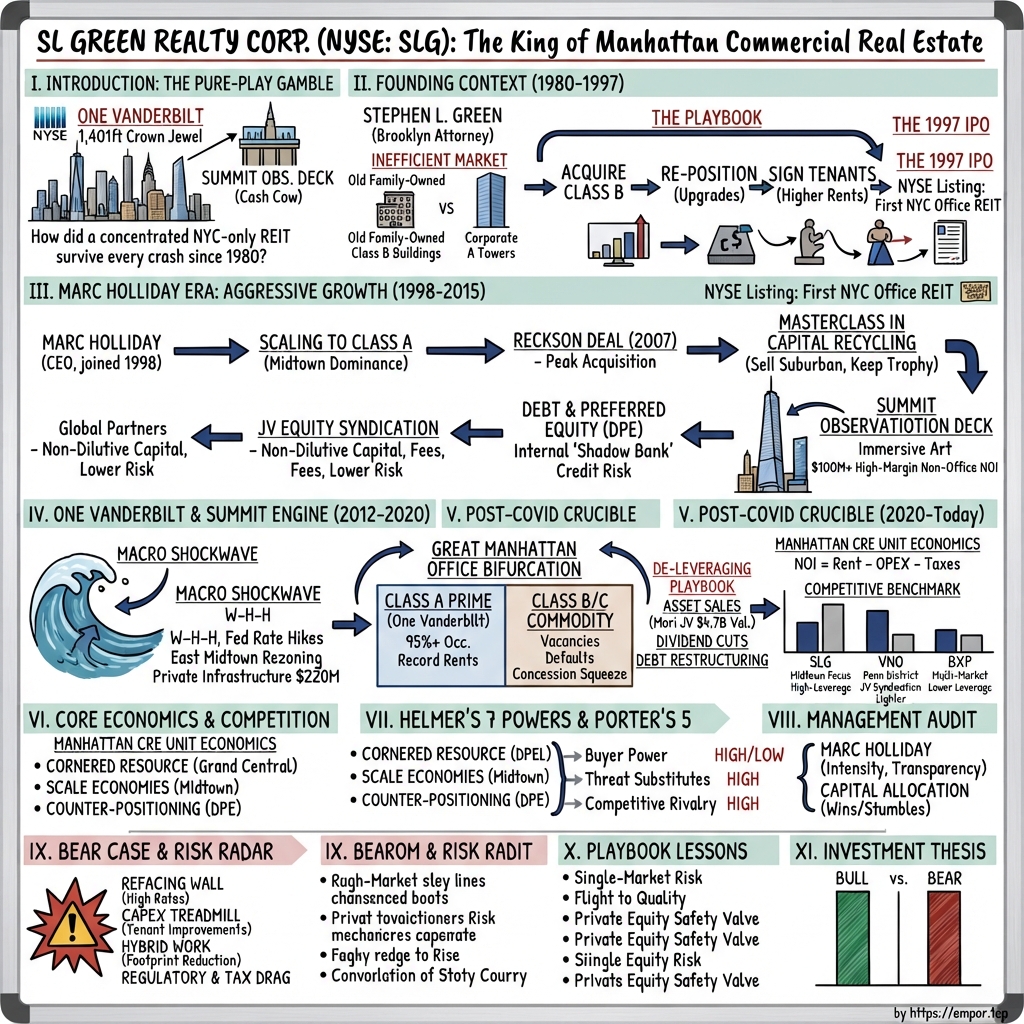
SL Green Realty Corp.: The King of Manhattan Commercial Real Estate
I. Introduction & Episode Roadmap
On the afternoon of July 23, 2026, a conference call operator opened the line for SL Green Realty Corp.'s second-quarter results, and Marc Holliday began with a line about summer. "It may be the dead of summer, our team is of course, hard at work," he told analysts. "This is truly when we shine the brightest."3
He had reason for theatre. Minutes earlier the company had raised its full-year funds-from-operations guidance by $1.20 per share at the midpoint — from a range of $4.40 to $4.70 all the way to $5.60 to $5.90, a lift of more than 26% delivered in a single quarter.1 For an office REIT in 2026, six years after the world decided that office buildings might be obsolete, that is not a normal thing to do.
But read the fine print and the story gets more interesting. Of that $1.20, only $0.40 came from the actual business — better leasing, faster space turnover, tighter expense control, more fee income. The other $0.80 came from an accounting recognition change at a single building, One Vanderbilt, whose cash distributions had so thoroughly exceeded its book value that the carrying value on SL Green's balance sheet had gone negative and hit the maximum negative basis GAAP permits.13 Real cash, yes — but cash that had already been earned and repatriated years earlier, now flowing through the income statement on a delay.
That single paragraph is the whole company in miniature: an operating business that is genuinely inflecting, wrapped inside a capital structure and an accounting presentation complex enough that the headline number and the underlying number are rarely the same thing.
The high concept. SL Green is Manhattan's largest office landlord. As of June 30, 2026 it held interests in 54 buildings totalling 30.6 million square feet, including ownership interests in 29.2 million square feet.1 Its crown jewel is One Vanderbilt Avenue — 1,401 feet, 1.7 million square feet, sitting directly on top of Grand Central Terminal — and atop that tower sits SUMMIT One Vanderbilt, a mirrored-glass observation experience that has become one of the most-visited paid attractions in New York.92
What it is not is a $20 billion company by equity value. As of late August 2026 the common equity was worth roughly $4.2 billion, against approximately $4.0 billion of consolidated debt and a further $5.9 billion representing SL Green's share of joint-venture mortgage debt as of December 31, 2025.24 The gross asset base is enormous; the slice of it that belongs to common shareholders is comparatively thin, and levered. That leverage is the engine and the hazard, and everything in this story runs through it.
The core paradox. Nearly every lesson in modern portfolio construction says: diversify. SL Green did the opposite. It went public in 1997 as the first REIT devoted exclusively to New York City commercial property, and it has never meaningfully hedged that bet.5 It rode out the dot-com bust, September 11, the 2008 credit collapse, and then the one crisis genuinely designed to kill it — a pandemic that emptied Midtown and normalised working from a kitchen table. In March 2023, as regional banks failed and the market priced office towers as impaired collateral, SL Green's shares closed as low as $19.96. By August 2026 they traded near $59.4
Was that a vindication of strategy, or a violent mean reversion in a heavily shorted, heavily levered security? Both readings are defensible. The job of this piece is to separate them.
The arc. Five movements:
The pure-play gamble — Stephen L. Green's discovery in the 1980s that Manhattan's unglamorous Class B office stock was mispriced, and the 1997 listing that turned a private repositioning shop into a public vehicle.
The financial engineering era — Marc Holliday's arrival from the mezzanine-lending world in 1998, and the construction of a machine that recycled capital through joint-venture equity syndication and an in-house debt and preferred equity platform that functioned as a private credit shop long before that phrase was fashionable.
The transit-oriented masterpiece — the decade-long fight to rezone the blocks around Grand Central, build a supertall on top of a railway terminal, and then discover that the most profitable square footage in the building might be the observation deck on floors 91 to 93.
The post-COVID crucible — 500-plus basis points of Fed tightening, a wall of maturing mortgages, a short-seller siege, and the great bifurcation of Manhattan office space into scarce trophy product and unwanted commodity stock.
The investor playbook — where the moat is real, where it is rhetoric, what management has and has not delivered against its own targets, and the two or three numbers that actually settle the argument from here.
The story begins forty-six years ago, with a young lawyer's son who noticed that nobody else wanted the buildings he wanted.
 Subscribe on LinkedIn
II. Founding Context & The Early NYC Office Playbook (1980–1997)
Picture Midtown Manhattan in 1980. The city had barely survived its near-bankruptcy of 1975. Whole blocks of the Garment District and the far West Side were tenanted by small businesses in buildings that had not been touched since the Eisenhower administration. Elevator cabs rattled. Lobbies were dim. The good addresses — Park Avenue, Sixth Avenue, the Seagram Building — belonged to insurance companies, banks and a handful of dynastic families. Everything else was, in the polite language of the brokerage community, "Class B."
Stephen L. Green looked at that inventory and saw a spread trade.
Green, the son of a real estate attorney, founded S.L. Green Properties in 1980.5 The insight was not architectural, it was structural. Class A trophy towers were efficiently priced: everyone knew what they were worth, sophisticated institutional buyers competed for them, and the returns were correspondingly ordinary. Class B buildings — defined in the Manhattan market as properties more than twenty-five years old but in good physical condition, in desirable locations, at materially lower rents — were owned by families and small partnerships with no access to institutional capital, no professional leasing operation, and no incentive to reinvest.5
The playbook that followed was almost boringly mechanical, and that was the point.
Buy at a discount to replacement cost. Fix the things tenants actually notice — the lobby, the elevator cabs, the HVAC, the security desk, the bathrooms. Then lease it aggressively to credit-worthy mid-market tenants who wanted a decent address without paying Park Avenue rents. SL Green did not just own; it managed and leased in-house, which meant it captured the fee economics and, more importantly, saw the flow of tenant demand across dozens of buildings before anyone else did.
By the time the firm considered a public listing, its 1997 annual report could describe a track record of having been "involved in the acquisition of 31 Class B office properties in Manhattan containing approximately four million square feet and the management of 50 Class B office properties in Manhattan containing approximately 10.5 million square feet."5 The corporate staff numbered 64 people, of whom 40 were real estate professionals, working out of offices at 70 West 36th Street — an address that tells you everything about the firm's positioning at the time.5
Why go public, and why then. Wall Street had historically been sceptical of single-market REITs, for the obvious reason: a REIT that owns buildings in one city is a leveraged bet on one city's economy, one city's tax policy, and one city's politics. Diversified REITs argued they were safer. SL Green's counter-argument was that in a market as deep, opaque and relationship-driven as Manhattan, local knowledge was the edge, and that spreading capital across Dallas and Denver would dilute the only thing the firm was actually good at.
The listing came on August 20, 1997, when the company issued 11.615 million shares to the public, including the underwriters' over-allotment of 1.52 million shares. Net cash proceeds after underwriting discounts were $228.7 million.5 The uses of proceeds are a small masterclass in what a value-add landlord does with fresh equity: roughly $42.6 million retired mortgage debt on the seeded properties, about $95.5 million went straight back out the door to acquire more buildings, $35.6 million repaid a Lehman Brothers loan, and $41.7 million was earmarked for capital expenditure and working capital.5 By December 31, 1997 the company owned interests in twelve commercial properties totalling about 3.3 million rentable square feet, at a weighted average occupancy of 94%.5
Two details from that first annual report deserve to survive into the present. First, the firm disclosed that it and its predecessor had renewed roughly 75% of expiring leases across their owned and managed portfolio between 1994 and 1997.5 Retention is the quiet compounding engine of office real estate — every lease you renew is a lease on which you do not spend eighteen months of free rent and a hundred dollars a foot of tenant improvements. Twenty-nine years later, Holliday would tell an analyst that his ambition was still "as high a renewal probability as possible, 75% plus."3 The target has not moved.
Second, and less flattering: the 1997 document reads like a company that expected to keep buying Class B buildings forever. It did not. Within a decade the firm would abandon the value-add niche that made it, and go hunting for exactly the trophy assets it had once been priced out of. Whether that was strategic evolution or style drift is one of the honest arguments about SL Green, and it starts with the man who arrived in July 1998.
For investors, the founding era leaves one durable inheritance: an operating platform — leasing, management, construction — that generates fee income and market intelligence independent of the buildings SL Green happens to own at any moment. That platform is why the company still earns money managing other people's assets, and it is the least discussed part of the business.
III. The Marc Holliday Era: Aggressive Expansion, M&A, & Shadow Banking (1998–2015)
Marc Holliday did not come up through property management. He came up through debt.
Before joining SL Green as Chief Investment Officer in July 1998, Holliday was Managing Director and Head of Direct Originations at Capital Trust Inc., a New York mezzanine finance company, where he originated principal investments consisting of mezzanine debt, preferred equity and first mortgages — and before that he spent 1991 to 1997 at Capital Trust's predecessor, Victor Capital Group.6 He holds a business and finance degree from Lehigh and a master's in real estate development from Columbia.6
That biography explains almost everything about the company SL Green became. A landlord thinks in terms of buildings, tenants and rent rolls. A mezzanine lender thinks in terms of capital stacks — who sits senior, who sits junior, where the yield is, and what happens to each layer when values move. Holliday brought the second mental model into a business that mostly ran on the first.
He became Chief Executive Officer in January 2004, and Chairman in January 2019.6 For most of the intervening period his partner was Andrew Mathias, who joined as a Vice President in 1999 and was promoted to President in April 2007, when Holliday stepped down from that title to concentrate on the chief executive role.6 Holliday also served as President and CEO of Gramercy Capital Corp., SL Green's externally managed commercial finance affiliate, from August 2004 to October 2008 — a detail worth holding onto, because it shows how early and how deliberately the firm pushed into lending as a business line rather than a sideline.6
Trading up. The first strategic move of the Holliday era was to walk away from the Class B niche. Through the 2000s SL Green migrated toward premier Midtown assets — 1515 Broadway, the Times Square tower anchored by Viacom and later Paramount; 280 Park Avenue; 11 Madison Avenue; and 420 Lexington Avenue, the Graybar Building wrapped around the flank of Grand Central. The logic was not snobbery. It was margin arithmetic that Holliday would later articulate with unusual candour on the first-quarter 2026 call, when an analyst asked whether the firm would buy Class B buildings again given how much cheaper they were. His answer: the leasing costs — free rent, tenant improvements, construction — are broadly similar per square foot whether the face rent is $60 or $150. "We think there is a lot more margin in dealing in the $90-and-up, $100-and-up rents," he said.12 Concession costs are largely fixed per foot; rent is not. So the higher the rent, the more of every incremental dollar survives to the bottom line. That is the single most important economic idea in the company, and it was formed in this period.
The Reckson deal. On January 25, 2007 — with hindsight, almost exactly at the peak of the commercial real estate cycle — SL Green completed the acquisition of Reckson Associates Realty Corp. in a transaction valued at approximately $6.0 billion.7 Reckson shareholders received about $31.68 in cash plus 0.10387 of an SL Green share, and SL Green assumed roughly $238.6 million of mortgage debt, $287.5 million of convertible debt and $967.8 million of unsecured notes.7 Before the deal, SL Green owned 28 office properties totalling about 18.9 million square feet.7
The critique at the time — that SL Green had paid top-of-market for a suburban-heavy portfolio months before the credit markets seized — was reasonable. The defence is in the same press release, and it is the part worth studying. Simultaneously with closing, SL Green sold certain Reckson assets to an investment group led by Reckson's own executive management for approximately $2.0 billion.7 What SL Green kept was six premier New York City office buildings totalling roughly 5.6 million square feet; what it sold, immediately and at pre-crisis pricing, was a large slice of the Westchester and Connecticut suburban exposure it never wanted.7
This is the template that recurs for the next two decades: acquire the whole, sell the parts you do not want at the same moment, and finance the retained trophy assets with the proceeds. It is a merchant-banking approach to real estate, and it depends entirely on the seller's market staying open long enough to execute the disposals. In January 2007 it did. Eighteen months later it would not have. The honest verdict on Reckson is that the structure was excellent and the timing was lucky, and management has never seriously been asked to distinguish between the two.
Capital innovation one: joint-venture equity syndication. The mechanism that defines SL Green's balance sheet is deceptively simple. Rather than own a trophy tower outright and finance it with corporate debt, the firm sells a minority interest — typically anywhere from a fifth to just under half — to a large institutional investor, usually foreign, at a full private-market valuation. SL Green retains control, retains the property management and leasing contracts, and books recurring fee income from the venture. The partner gets access to Manhattan assets it could never assemble on its own.
The partner list reads like a directory of global institutional capital: 森ビル Mori Building Co., Ltd. and 森トラスト Mori Trust from Japan, the 국민연금공단 National Pension Service of Korea, and Hines from Houston.82 The effect on the balance sheet is that a very large share of SL Green's economic interest sits in unconsolidated joint ventures — roughly 13.9 million square feet of Manhattan office space at the end of 2025, versus about 9.5 million consolidated.2
The benefits are real: capital raised without issuing equity at a discount, risk shared, fee streams created. The cost is equally real and less discussed. A joint-venture-heavy REIT is genuinely harder to analyse. Debt sits off the consolidated balance sheet even though the economic exposure is not off the company. Same-store metrics require "including the Company's share of" caveats. And when things go wrong at a JV, the workaround options are constrained by a partner's consent rights. Complexity is not fraud, but it is a discount factor, and SL Green has traded at one for most of the last decade.
Capital innovation two: the debt and preferred equity platform. Holliday's mezzanine instincts produced the second engine. SL Green built an in-house lending arm making well-collateralised debt and preferred equity investments across New York City real estate — junior mortgages, mezzanine loans, preferred equity positions sitting above the common but below the senior lender.
The 2025 annual report is unusually direct about why the company does this. Beyond the yield, the filing lists three benefits: the investments can become a source of property acquisitions when borrowers stumble; owners who have borrowed from SL Green tend to offer it off-market looks at other deals; and the lending activity itself generates market intelligence and relationships that feed the leasing and acquisition business.2 In other words, the loan book is partly a yield product and partly a sonar array pointed at the Manhattan market.
The structure has evolved. Where the platform once sat directly on the balance sheet, SL Green now runs it substantially through a fund: it is general partner and investment manager of the SLG Opportunistic Debt Fund, which closed on over $1.3 billion of capital commitments, of which $213.6 million had been funded as of December 31, 2025.2 By the second quarter of 2026 total deployment had reached $590.5 million, with $517.5 million funded.1 Migrating from balance-sheet lending to third-party fund management is a meaningful shift: it converts credit risk into fee income, and it is the kind of capital-light pivot that public REIT investors generally reward — provided the fund actually performs.
The risk is unchanged and should be stated plainly. Subordinated positions are the first to absorb losses when property values fall. SL Green recorded $14.5 million of investment reserves in 2025.11 When Manhattan values were sliding in 2023 and 2024, the loan book was a source of anxiety, not comfort. It works beautifully in a rising market and it is precisely wrong in a falling one — which is the same thing you would say about the equity portfolio, and that correlation is the point.
By 2012, with the platform built and the balance sheet levered, Holliday turned to the project that would define his tenure: building a skyscraper on top of a train station.
IV. The One Vanderbilt Megadevelopment & SUMMIT Cash Engine (2012–2020)
There is a specific kind of arrogance required to look at the block immediately west of Grand Central Terminal — a jumble of undistinguished mid-rise buildings, sitting on the busiest transit node in North America — and conclude that the correct use of the site is a 1,401-foot tower. The site was not zoned for it. The neighbours did not want it. The landmark preservation community regarded the area as sacred. And the city had spent years failing to pass a rezoning of East Midtown.
SL Green did it anyway, and the mechanism it used is more interesting than the building.
Buying density with infrastructure. New York's zoning code allows the city, in certain districts, to grant additional floor area in exchange for public benefits. SL Green's proposition was blunt: let us build far more square footage than the site permits, and we will pay for the transit improvements the Metropolitan Transportation Authority cannot afford. The company committed $220 million to public improvements — two new subway entrances serving the 4, 5 and 6 trains, new staircases connecting mezzanine and platform levels, a transit hall linking through to the Long Island Rail Road concourse, and Vanderbilt Plaza, a 14,000-square-foot pedestrian plaza carved out of a street.9
Read that as a business transaction rather than civic generosity and it becomes remarkable. SL Green effectively purchased buildable density with capital expenditure, at a moment when nobody else was bidding. The company then supplemented the rezoning bonus with air rights acquired from neighbouring landmarked properties — the transferable development rights that Manhattan's preservation regime creates and that only a handful of firms know how to assemble.
Capitalising the tower. Megadevelopment is where REITs go to die, because construction consumes equity for years before producing a dollar of rent. SL Green solved that with the syndication playbook. On January 26, 2017 the company announced a joint venture in which the National Pension Service of Korea took a 27.6% interest and Hines took 1.4%, with the two partners committing aggregate equity of no less than $525 million.8 The tower was designed by Kohn Pedersen Fox, and at that point was expected to contain 1.7 million square feet across 58 floors.8
The construction period ran through the peak of the "urban office is finished" discourse in reverse — it began in a boom and ended in a catastrophe. One Vanderbilt officially opened on September 14, 2020, in a city where Midtown was still functionally deserted, restaurants were serving on sidewalks, and every commercial real estate strategist in America was writing notes titled some variation of "the death of the office."9 It opened 70% leased.9
That timing is the single luckiest and unluckiest fact in the company's history. Unlucky, because a building delivered in September 2020 faced two years of the worst leasing conditions in living memory. Lucky, because by the time demand returned, One Vanderbilt was the newest large trophy tower in Midtown and there was almost nothing else being built.
The financing outcome tells you how the market ultimately judged the asset. As of December 31, 2025, One Vanderbilt carried a $3.0 billion mortgage at a stated rate of 2.95%, maturing in July 2031.2 A three-billion-dollar loan at under 3% locked until 2031 is, in a world of 5% and 6% office debt, an extraordinarily valuable liability. It is arguably worth more to shareholders than several of SL Green's smaller buildings, and it is the reason the company can afford to be patient about the rest of its maturity schedule.
The accident that became a business. Observation decks are a standard amenity in supertall buildings — a way to monetise the top floors, which are expensive to build and awkward to lease. SL Green's version, SUMMIT One Vanderbilt, opened in October 2021 and was engineered as something else entirely: an immersive mirrored-glass art environment developed with the artist Kenzo Digital, complete with glass-floored skyboxes cantilevered off the building, an outdoor terrace, a transparent elevator ride called Ascent, and cocktail service.23 It welcomed approximately 2.2 million visitors in 2025.2
Here the analytical discipline matters, because SUMMIT is routinely described — including in the framing of this very outline — as generating "$100 million-plus of high-margin non-office revenue." The filings tell a more textured story, and it is worth walking through slowly because the structure is genuinely confusing.
SUMMIT is operated by a consolidated SL Green subsidiary that leases the space from the One Vanderbilt joint venture, which SL Green does not consolidate. So the economics land in three different places. In 2025 the SUMMIT operator recorded revenue of $122.3 million against operator expenses of $116.4 million.2 That leaves under $6 million of margin at the operator level — but the operator's expenses include $40.9 million of rent, including percentage rent, paid to the One Vanderbilt venture, of which $22.4 million flowed back to SL Green through its equity pickup in that venture.2 So the honest description is that SUMMIT generated something in the region of $28 million of economic contribution to SL Green in 2025, not $100 million.
That is still a meaningful, differentiated, non-office cash flow. It is not a hidden hundred-million-dollar profit centre, and investors who model it as one are modelling the gross revenue line as though it were profit.
Two further caveats. First, SUMMIT operator revenue actually declined 8.2% in 2025, from $133.2 million the prior year.2 Holliday attributed the softness to weak inbound foreign tourism and a difficult first quarter, noting on the second-quarter 2026 call that year-over-year attendance was "down a few points" but that daily ticket sales had recovered to levels "exceeding $400 thousand-plus a day."3 Second, for comparison, Empire State Realty Trust's observatory — the reference asset in this category — produced $90.1 million of net operating income in 2025 and guided to $87 million to $92 million for 2026, with the observatory representing a substantially larger share of that company's overall economics.17
Where SUMMIT does look genuinely strategic is as intellectual property. Management has confirmed plans to open a Paris location in summer 2027 and Tokyo in 2030.3 If SL Green can export the format and earn development and management economics on other people's buildings, that converts a single-asset amenity into a branded attractions platform — a capital-light annuity attached to a very capital-heavy company. That is an attractive idea. As of August 2026, it remains an idea with one operating location and a Paris opening still a year away, and management has not disclosed the economics of either international project.
The tower was finished, the deck was open, and then the world changed the terms of the argument.
V. The Post-COVID Crucible: Work-From-Home, Interest Rate Shocks, & Survival (2020–Today)
On March 23, 2023, SL Green's shares closed at $19.96.4
To understand what that number meant, consider what else was happening that week. Silicon Valley Bank had failed nine days earlier. Signature Bank, a lender deeply embedded in New York commercial real estate, had been seized. The entire market had decided, in the space of a fortnight, that regional bank balance sheets were stuffed with office loans that would never be repaid, and that the equity beneath those loans was worthless. SL Green — Manhattan's largest office landlord, carrying billions of dollars of property-level mortgage debt and a subordinated loan book — was the purest available expression of that fear.
The two shocks. The first was behavioural. Hybrid work did not eliminate office demand, but it changed the arithmetic a tenant runs when a lease expires. If a firm's people are in the building three days a week instead of five, the honest answer to "how much space do we need?" is less, and that answer arrives not gradually but in a lump, once, on the day a ten-year lease rolls.
The second shock was financial, and for a levered REIT it was worse.
The Federal Reserve took its policy rate from near zero to above 5.25%, and the effect on a company like SL Green ran through three channels simultaneously. Floating-rate interest expense rose immediately. Maturing fixed-rate mortgages had to be refinanced at rates that could be double the expiring coupon. And capitalisation rates — the yield buyers demand on property income, which functions as the discount rate for the whole asset class — expanded, which mechanically reduced asset values even where cash flow was stable. A levered equity stub sitting beneath a repricing asset is a brutal place to be, which is precisely why the stock behaved the way it did.
The bifurcation. What actually happened next was not a uniform recovery. It was a split.
Manhattan's office market is roughly 417.1 million square feet, of which about 261.0 million sits in Midtown.2 Within that vast inventory, a small band of new, heavily amenitised, transit-connected towers became genuinely scarce while the wider market stayed soft. By the first quarter of 2026, Holliday told analysts, the vacancy rate for trophy buildings had fallen to 3.4% — "essentially saying there is no space at all in that segment of the market."12 One Vanderbilt reached full occupancy, and by April 2026 a sublease in the tower was being marketed at an asking rent of $350 per square foot.19
Meanwhile, at the other end of the quality spectrum, older commodity buildings lost tenants, lost value, and in many cases lost their owners' equity entirely. Some of that stock is now being permanently removed. Holliday has repeatedly flagged office-to-residential conversion as the most underappreciated force in the market — inventory leaving the office pool for good, tightening the middle and bottom of the market rather than just the top.3 On the second-quarter 2026 call he argued conversion economics still favour residential, citing the roughly 5.0% cap rate SL Green achieved selling the residential and retail components of 7 Dey Street, though he conceded the gap was narrowing.3
Aggregate market data supports the recovery narrative, with a caveat. Manhattan leasing volume grew to 31.0 million square feet in 2025 from 23.4 million in 2024 — a striking jump.2 But overall average asking rents rose only 0.6% over the year, to $73.19 per square foot, with Class A asking rents up 1.8% to $82.72.2 Enormous volume; barely any market-wide pricing power. The pricing power is concentrated in the top slice, which is exactly where SL Green has spent twenty years repositioning itself — but it also means the "Manhattan is booming" story is really a "the best 10% of Manhattan is booming" story.
The concession squeeze. Here is the part that does not show up in headline leasing statistics, and it is where the bear case lives.
When a landlord signs a tenant, it typically pays for the fit-out — the tenant improvement allowance — and grants months of free rent. Those are real cash costs, paid upfront, against rent collected over a decade. In 2025 SL Green signed 199 Manhattan office leases covering 2,568,551 square feet at an average rent of $91.77 per square foot, with average concessions of 8.6 months of free rent and a tenant improvement allowance of $93.62 per square foot.11 Read that again: the tenant improvement allowance was roughly equal to one full year of rent, on top of nearly nine months of free rent.
So a headline mark-to-market of "1.2% higher than previous fully escalated rents" for full-year 2025 — which is what SL Green actually achieved — is a very thin result once you net out what it cost to achieve it.11 That is the honest characterisation of 2025: heavy leasing volume, minimal rent growth, enormous capital outlay.
What changed in 2026 was the spread, not just the volume. The first quarter produced the biggest first quarter of leasing in the company's 28-year history — 51 leases, 930,000 square feet, at a mark-to-market of 16%.12 The second quarter added 53 leases totalling 445,161 square feet at 18.0% above prior escalated rents, and for the first half, 104 leases covering 1,374,425 square feet at 16.6%.1 Same-store occupancy, inclusive of leases signed but not yet commenced, rose from 93.0% at the end of 2025 to 94.7% at June 30, 2026.111
Crucially, concessions began to compress. Second-quarter deals carried an average of 4.5 months of free rent and a $58.77 tenant improvement allowance — dramatically lighter than the full-year 2025 averages, though skewed by a higher mix of renewals, which are always cheaper than new leases.1 Leasing head Steven Durels told analysts on the July call that on a typical five-year renewal, free rent had come down to roughly three months.3 That is the metric that decides whether the recovery is real, and it moved in the right direction.
The de-levering playbook. Through all of this, management ran the same play it had run since Reckson: sell partial interests in trophy assets to institutional buyers, at prices that implicitly rebut the public market's valuation.
The signature transaction was with 森ビル Mori Building. In late 2024 SL Green sold an 11.0% interest in One Vanderbilt at a gross asset valuation of $4.7 billion, generating net proceeds of $189.5 million.1020 In October 2025 Mori bought a further 5.0% interest at the same $4.7 billion valuation, producing another $86.6 million.2 The strategic logic — establishing a private-market mark on the company's best asset at a moment when the public equity implied something far lower — is genuinely sound, and the willingness of a sophisticated Japanese developer to double down a year later is a real data point rather than a press release.
The relationship then deepened into development. In May 2026 SL Green sold a 49.0% joint venture interest in its next ground-up tower, 346 Madison Avenue, to Mori Building at a gross valuation of $175.0 million, receiving net cash proceeds of $94.9 million while retaining 51.0% and the development and leasing management roles.1 Mori announced it as its first U.S. development project: a 46-storey, 962-foot, roughly 850,000-square-foot Kohn Pedersen Fox tower near Grand Central, expected to complete in 2031.16 Fully capitalising a development on day one, before a shovel moves, is the risk-management lesson SL Green learned the hard way on One Vanderbilt.
The disposition programme has been wide-ranging: a 49.0% interest in 100 Park Avenue at a $425.0 million valuation; the residential and retail components of 7 Dey Street for $222.6 million; a contract to sell 10 East 53rd Street for $312.2 million at roughly a 5.7% cap rate, which management characterised as about a 3.5x multiple on its 2024 purchase of a partner's interest.1113 The 2026 business plan calls for $2.5 billion of dispositions and $7.0 billion of refinancings; by late July, four of eleven planned transactions were complete or in contract.133
The dividend, and what it says. On March 23, 2026 — in the middle of the best leasing environment the company had ever reported — SL Green cut its annual common dividend to $2.47 per share, from $3.09 in 2025.13 The company had also shifted from monthly to quarterly payment beginning in 2026.11
This is the most revealing capital allocation decision of the era, and it deserves to be read carefully rather than defended. Management's explanation was consistent across the announcement and the subsequent call: REIT dividends are ultimately driven by taxable income, the new level retains roughly $50 million of incremental annual capital, and that capital would go toward discounted debt payoffs, share repurchases, or development.1312 CFO Matthew DiLiberto added the number that actually matters: funds available for distribution — FFO after the real cash cost of tenant improvements, leasing commissions and recurring capital expenditure — would not cover the dividend until 2028.12 Holliday reiterated the point when pressed: "by 2028 we expect our FAD to be in line with our dividend that we recently recalibrated to."12
Translated: the company is not currently generating enough cash after the cost of leasing to pay its own dividend, and does not expect to for two more years. Management is candid about this, which counts for something. But investors should not be confused about the direction of causality. The company cut the dividend because the cash was not there, and it is funding the shortfall with asset sales.
The counterpoint is that the shortfall is investment, not decay. Holliday put it directly on the April call: "we are leasing the hell out of this portfolio. With that comes leasing capital that we will muscle through in 2025, 2026, and 2027."12 If occupancy really does reach 96–98% and the portfolio settles into a renewal-dominated steady state, capital spending falls sharply and cash flow inflects hard. That is the bet. It is a coherent bet. It is also, at this moment, unproven, and 2028 is a long way from an August 2026 share price near $59.
Two accountability items. In September 2025 the community advisory committee reviewing SL Green's proposed Caesars Palace Times Square casino at 1515 Broadway — a project pursued with Caesars Entertainment and Roc Nation — voted 4–2 against advancing it, with only the governor's and mayor's appointees in support.14 The company had capitalised the pursuit heavily: full-year 2025 FFO absorbed $13.9 million, or $0.18 per share, of transaction costs "primarily attributable to the Company's pursuit of a casino license."11 That is a real, unrecovered expenditure on a speculative regulatory outcome, and it belongs on the ledger.
And the headline earnings comparison for 2025 deserves a translation. Reported FFO fell from $8.11 per share in 2024 to $5.72 in 2025 — an alarming-looking decline.11 But 2024 included $3.08 per share of gains on discounted debt extinguishments, and 2025 included $0.75.11 Strip both out and underlying FFO was roughly $5.03 in 2024 and $4.97 in 2025 — essentially flat. Neither the crash nor the boom was as dramatic as the headline. Those debt extinguishment gains, incidentally, arise when SL Green or a venture buys back its own mortgage debt below par; they are genuine economics but they are lumpy, opportunistic, and not a business.
Which raises the question the next section has to answer: underneath the financial engineering, what does this business actually earn?
VI. Core Business Economics, Industry Structure, & Competitive Landscape
Strip away the joint ventures, the debt fund, the observation deck and the special servicing contracts, and SL Green is doing something a Venetian merchant would recognise. It collects rent from a building and pays the costs of running that building. Everything else is superstructure.
How the money actually works. Net operating income — NOI — is the base rent a tenant pays, plus escalations (contractual pass-throughs of increases in property taxes and operating expenses), minus property taxes and the direct costs of running the building: cleaning, security, elevators, heating and cooling, union labour. In New York, property taxes are the single largest line item, and they are set by a municipal government with its own fiscal needs. That is the first structural vulnerability of a New York-only landlord, and it has nothing to do with tenants.
The number that actually determines whether a lease created value is not the headline rent. It is the net effective rent. Take a ten-year lease at $100 per square foot. Grant twelve months free — that is 10% gone. Spend $100 per square foot on tenant improvements, amortised over ten years — another $10 per year, so 10% more. Pay leasing commissions to brokers on both sides. What began as $100 becomes something closer to $75, before the landlord has paid a dollar of interest or property tax.
This is why the exchange between Truist analyst Michael Lewis and Holliday on the July 2026 call was the most substantive moment of the quarter.
Lewis pushed hard: the 18% cash mark-to-market is great, but he had pulled up supplemental packages from 2016 and 2021 and calculated that net effective rents seemed to rise only about 2.5% to 3% a year. Where, he asked, was the improvement actually showing up?3
Holliday's answer was partly a dodge and partly the most illuminating thing he said all year. He argued that net effective rent is not a clean metric because it depends on assumptions nobody agrees on — whether tenant improvements should be fully amortised over the lease or credited with salvage value, given that a good installation retains value for the next tenant. Then he made the real point: the biggest driver of net effective rent is not concessions on new leases but the renewal mix. On a renewal with three to six months of free rent and "TIs of paint and carpet," he said, "even if rents are flat, replacement rents, your net effectives will be up by almost 100%."3 And he conceded the offsetting cost that landlords rarely volunteer: driving nominal rents requires continuous reinvestment in lobbies, amenities and roofs, which never appears in the per-lease concession statistics at all.3
The company does not disclose a net effective rent growth figure. Holliday said plainly: "we do not have that number."3 For a REIT whose entire investment case rests on rent growth exceeding concession inflation, that disclosure gap is a legitimate criticism, and an activist would lead with it.
Cap rates versus the cost of debt. The other economic engine is the spread between what buildings yield and what money costs. In the zero-rate era, Manhattan trophy assets traded at capitalisation rates in the low-to-mid 4% range against debt costing 3%. That spread was the profit. By 2023 debt cost 6% and cap rates had expanded, and the spread inverted.
Holliday's framing on the July call was that the relationship is more subtle than a simple spread: cap rates are driven by expected NOI growth and a view on rates, so if income growth is expected to outrun rates, cap rates can compress even below financing cost — "it is not uncommon to have, you know, cap rates drift lower than your financing costs when you have embedded growth."3 He put his own portfolio "decidedly between 5% and 6%," with certain assets below 5% and very few above 6%.3
That is management's mark on its own net asset value, and it should be treated as an interested estimate rather than a fact. But there are third-party anchors: 10 East 53rd Street contracted at approximately 5.7%, a side-street office building; 7 Dey's residential and retail components traded near 5.0%.3 Those are actual transactions, and they broadly support the low-to-mid range for better assets.
The credit market has corroborated the trend. Chief Investment Officer turned President Harrison Sitomer told analysts that roughly $11 billion of CMBS originations had priced year-to-date in 2026 against about $8.5 billion in the comparable prior period, that AAA spreads on single-borrower deals had tightened inside 100 basis points, and — the striking claim — that spreads on trophy office AAAs were now trading in line with or inside industrial, multifamily and self-storage.3 If accurate, that is a genuine regime change in how the bond market prices Manhattan office collateral, and it directly lowers SL Green's refinancing risk.
The competitive war-game. SL Green's rivals fall into three tiers, and each one competes on a different axis.
Vornado Realty Trust is the closest analogue: a New York-concentrated REIT, similarly levered, with roughly $7.4 billion of equity market value as of late August 2026.4 Its strategic bet was different — an enormous, decade-long redevelopment of the Penn District around Penn Station, plus far greater street retail exposure. Vornado's New York office occupancy reached 92.2% in 2026 with management forecasting above 93% by year-end, meaningfully behind SL Green's 94.7%.1 Steven Roth's firm has been considerably less aggressive than SL Green in syndicating joint-venture equity, which means less complexity but also fewer levers when capital is needed.
BXP — formerly Boston Properties — is the scale player, at roughly $11.3 billion of equity value, spread across Boston, New York, Washington, San Francisco and Seattle.4 Diversification has been a genuine advantage in this cycle in one respect and a liability in another: Boston and Washington held up better than expected, San Francisco did not. What BXP does not have is SL Green's density in one submarket, and density is what generates the broker relationships and the constant flow of tenant intelligence that lets SL Green move faster on a given deal.
Empire State Realty Trust is the instructive comparison, because it is the other pure-play New York landlord with a major observatory. At roughly $0.8 billion of equity value, ESRT is a fraction of SL Green's size, with a substantially lower-levered balance sheet, an older and smaller-floorplate office portfolio, and total commercial occupancy of 90.3% at the end of 2025.417 Its core FFO declined from $0.95 per share in 2024 to $0.87 in 2025.17 ESRT is the counterfactual: a conservatively financed New York office REIT that avoided the leverage risk and, so far in this cycle, has captured much less of the recovery. Whether that is prudence or missed opportunity depends entirely on which part of the cycle you measure.
Then there are the private giants — Brookfield at Manhattan West, Related at Hudson Yards, Tishman Speyer, Rudin, Fisher Brothers. They compete for the same tenants with the same amenity packages, and they are not constrained by quarterly earnings optics.
Where SL Green wins, and where it does not. It wins on leasing velocity and market coverage: 199 leases in 2025, 104 in the first half of 2026 alone.111 That is not one big anchor tenant carrying the year; that is a machine processing a very large number of medium-sized transactions, which requires a leasing organisation of real depth. It wins on capital access — the Mori relationships, the Korean pension money, the CMBS execution. And it wins on transit-adjacent positioning around Grand Central, which is scarce and cannot be manufactured.
It loses on diversification, full stop. Every risk this company carries is correlated to one city's economy, one city's tax base and one city's politics. Tenant concentration compounds it: the five largest tenants accounted for 15.2% of SL Green's share of portfolio annualised cash rent at the end of 2025, with Paramount Global alone at 5.3%.2 Paramount's own situation is in flux — Holliday spent time on the July call discussing the Skydance combination and a pending Warner Bros. transaction, and what it might mean for 1515 Broadway when the Paramount lease expires.3 A single tenant at 5.3% of rent, in a building whose alternative use plan was rejected by a casino committee, is a concentrated exposure that deserves more attention than it usually gets.
The next question is whether any of this constitutes a durable competitive advantage, or merely a good position in a good cycle.
VII. Strategic Analysis: Helmer's 7 Powers & Porter's 5 Forces
Real estate is the graveyard of moat analysis. Buildings are commodities in the sense that a square foot of Class A office space in Midtown is broadly substitutable for another square foot of Class A office space in Midtown. There is no switching cost in the software sense, no network effect in the marketplace sense, no proprietary technology. And yet the returns to skill in this industry are enormous and persistent, which means something is protecting them. Hamilton Helmer's framework is a useful scalpel for figuring out what.
Cornered resource. This is the strongest claim SL Green can make, and it is genuinely strong. There is exactly one Grand Central Terminal. The parcels physically adjacent to it, with direct sub-surface connections into the concourse and the subway mezzanines, are a finite and fully allocated set. SL Green controls a remarkable share of them: One Vanderbilt sits directly across from the terminal with a purpose-built transit hall beneath it; 245 Park Avenue and 420 Lexington are on the same rail spine; and 346 Madison will rise a block away.216
This is a real cornered resource, but it needs a caveat that bulls skip. Owning irreplaceable land does not by itself generate excess returns — it generates a high entry price. The excess return comes from having assembled it cheaply, which SL Green did by acquiring the One Vanderbilt site and buying density with infrastructure spending at a time when no one else would. That was a one-time act of positioning. Whether it can be repeated at 346 Madison is the open question, and the answer will not be known until 2031.
Scale economies. SL Green employed 1,289 people at the end of 2025, of whom 337 worked in corporate offices — meaning roughly 950 were deployed in buildings.2 Concentrating 30 million square feet inside a few Midtown submarkets allows shared engineering staff, bulk procurement of energy and cleaning services, and genuine bargaining leverage with contractors and unions. There is also a subtler scale effect on the leasing side: when a tenant outgrows its space, SL Green can usually offer it another building nearby, which converts a potential loss into a retained relationship. Holliday described exactly this dynamic in July, saying the challenge was "giving tenants confidence that once they lease space, we will have more growth options for them either within those buildings or surrounding buildings."3
The evidence supports modest rather than dramatic scale advantage. Property operating expenses at same-store properties rose 13.7% in 2025 while same-store rental revenue rose 6.8%.2 Management has said expenses are running around 2% annual growth in the current period.12 Scale in this business dampens cost inflation; it does not eliminate it.
Counter-positioning. The debt and preferred equity platform is the closest thing SL Green has to counter-positioning, though it fits imperfectly. Traditional banks face capital charges and regulatory scrutiny on commercial real estate exposure, particularly office. SL Green faces neither, and it has an underwriting advantage banks structurally cannot replicate: it knows what the collateral is worth because it leases and manages comparable buildings every day. Sitomer described the current approach as originating the entire capital stack and syndicating out the senior and subordinate pieces to reach the fund's target yield.3
The reason this is imperfect counter-positioning is that it is not proprietary. Blackstone, Starwood, Apollo and a hundred private credit funds do the same thing at far greater scale. SL Green's edge is local information, not structural immunity.
Process power. This is underrated and probably the most durable of the four. Navigating New York City land use — the ULURP public review process, air rights transfers, landmarks approvals, Buildings Department sign-offs, and the union labour environment — is a craft accumulated over decades and embodied in specific people. The tell came on the July 2026 call, when Holliday handed the microphone to a construction executive to walk analysts through the structural inspection protocols at the 750 Third Avenue conversion, following a widely reported structural incident at an unrelated 42nd Street project.3 That was reputational risk management, but it was also a display of institutional depth that a newly arrived out-of-town competitor simply cannot buy.
Notably, SL Green has no meaningful brand power with tenants (companies lease space, not landlords), no network economies, and no switching costs beyond the practical cost of moving an office. Four of seven powers, two of them strong. That is a real but bounded moat.
Porter's five forces, honestly scored.
Threat of new entrants: very low. This is the most robust conclusion in the whole analysis. Building a new tower in Midtown requires land that does not exist, entitlements that take years, and construction spending measured in billions. Holliday's claim on the April 2026 call was blunt: "It is simply physically impossible for any other new construction to be delivered between now and 2029 in Midtown Manhattan."12 Supply is effectively frozen for the medium term, and that is the single most important fact in the bull case.
Bargaining power of buyers: split. For commodity space, tenants hold the whip — hence the 2025 concession packages. For trophy space with a 3.4% vacancy rate, the landlord holds it, which is what produced the 18% second-quarter mark-to-market.121 SL Green has spent twenty years migrating from the first category to the second, which is the strategically correct response to this force.
Threat of substitutes: high, but decaying more slowly than feared. Hybrid work is the substitute, and it is permanent. But the substitution appears to have found a level rather than continuing to deepen. Holliday cited approximately 50 million square feet of Manhattan office space leased over the trailing four quarters and 12,000 office-using jobs added in the city in the first half of 2026 per the city's budget office.3 Coworking is a minor factor for SL Green's tenant profile. The genuine long-tail substitute risk is not remote work but artificial intelligence reducing headcount growth in exactly the industries that fill Midtown towers — a risk analysts have begun raising and to which management has offered no quantified answer.
Bargaining power of suppliers: high. Lenders, contractors and construction unions all hold pricing power in New York. The mitigant is the improving CMBS bid, and SL Green's hedging discipline: management reported running roughly 90/10 fixed-to-floating, up from a target of 70/30, and hedging forward on financings before launch.3
Rivalry: high but currently muted by scarcity. When trophy vacancy is 3.4%, rivalry expresses itself in rent levels rather than concession wars. That flips instantly if new supply or a demand shock arrives.
The net read: SL Green's protection comes overwhelmingly from supply constraint and local process expertise, not from anything intrinsic to the company that a well-capitalised rival could not eventually replicate. That is a cyclical-structural hybrid moat. It is real right now. It would erode fast in a market where Midtown vacancy rose and capital flowed back into ground-up development.
Which puts the weight of the investment case squarely on the people making the capital allocation decisions.
VIII. Management Credibility, Capital Allocation, & Governance Audit
The best way to judge a management team is not to read what it says it will do. It is to line up what it said three years ago against what actually happened.
The people. Marc Holliday has run SL Green since January 2004 — twenty-two years, through four distinct market regimes.6 His style on calls is discursive, confident to the edge of salesmanship, and unusually willing to reason out loud about mechanisms rather than retreat into talking points. He is also the industry's most visible public advocate for New York City, which is both authentic and self-interested. He does not hedge his own view of the stock: "I think the stock is terribly mispriced," he told analysts in April 2026.12
Matthew DiLiberto, the Chief Financial Officer, is the counterweight, and the more useful voice for investors. He is the one who explained, without being asked twice, that $0.80 of the $1.20 guidance raise was a non-cash recognition artefact of One Vanderbilt's negative carrying value, and who volunteered the specific mechanics: an amortisation component of roughly $21 million a year running through early 2031, plus the difference between cash distributions and GAAP equity pickup, with the variable piece fluctuating quarter to quarter depending on how much cash the venture chooses to distribute.3 That is genuinely high-quality disclosure. A less scrupulous CFO would have banked the raise and let analysts figure it out.
DiLiberto also drew a line that is worth noting. When a Citi analyst suggested SL Green introduce a "core FFO" or "real estate FFO" metric to isolate underlying earnings, Holliday refused: "I do not believe in violating what NAREIT says is FFO and creating your own."3 Refusing to invent a flattering adjusted metric is a mark in management's favour — though it sits awkwardly beside the company's unwillingness to disclose net effective rent growth, which would be less flattering.
The leadership transition is the live governance question. Andrew Mathias departed as President effective December 31, 2023, at the end of his employment agreement, after roughly twenty-five years with the firm; no specific reason was disclosed beyond the contract expiry.11 Holliday held the President title on an interim basis for more than two years before promoting Harrison Sitomer on March 2, 2026 — a 36-year-old who joined as an intern and analyst in 2012 and became Chief Investment Officer in January 2022, retaining that role alongside the presidency.156 Sitomer launched the $1.3 billion debt fund and drove the international capital relationships.15 The company simultaneously extended contracts for DiLiberto and Chief Operating Officer Edward Piccinich through 2028.15
The generous reading is patient, deliberate succession planning that ultimately promoted from within. The sceptical reading is that a two-year vacancy in the second-most-senior role at a company this complex, following an unexplained departure, is a long time for a board to leave a key-person risk unaddressed. Both are true.
Compensation and alignment. SL Green's incentive structure is tied to operating outcomes rather than asset accumulation, which is the right general design for a REIT. The formulaic bonus criteria are set each January and are explicitly aligned with the guidance given at the December investor conference.6 For 2025, the disclosed scorecard included FFO of $5.72, funds available for distribution of $237 million, more than 2.5 million square feet of signed leases against a 2.0 million target, a 1.2% mark-to-market against a target of the same, year-end occupancy of 93.0% in line with the stated goal, $57.2 million of discounted debt extinguishment gains against a $50 million goal, and special servicing assets under management of $20.9 billion against a $17.5 billion goal.6
Two observations. First, the goals are specific, published in advance, and measurable — that is genuinely better governance than most REITs offer. Second, Holliday's 2025 total direct compensation was $19,724,530, comprising $1.4 million of salary, a $3.28 million formulaic bonus, $10 million of performance-based equity and $5 million of time-based equity, with roughly 85% of named-executive total direct compensation delivered in equity.6 That is a very large number for a company with roughly $4.2 billion of equity market capitalisation, and the proxy notes it represented a year-over-year decrease for each named executive.64 A shareholder can reasonably conclude both that the structure is well-designed and that the quantum is rich.
The related-party item. In December 2016, entities owned and controlled by Holliday and Mathias were permitted to invest personally in the One Vanderbilt project at appraised fair market value — paying $1.4 million and $1.0 million respectively — in exchange for a share of profits realised above SL Green's capital contributions: approximately 1.27% and 0.85% on the property, and 1.92% and 1.28% on SUMMIT.2 The interests carried no right of return of capital and had no value unless the project cleared the company's full investment, and the pricing rested on an independent third-party appraisal.2 Stabilisation of the property was achieved in 2022 and of SUMMIT in 2023, and both executives have tendered portions of their interests.2
This is disclosed, appraised, and structurally subordinated to shareholders getting their money back first — the defensible end of the related-party spectrum. It is nonetheless a personal, direct, leveraged stake by executives in the company's single most important asset, and it is fair to ask whether it influenced how aggressively One Vanderbilt was prioritised for capital and leasing attention relative to other buildings. There is no evidence that it did. There is also no way for an outsider to test it.
Scoring the track record. The wins are concrete: the Reckson structure, the One Vanderbilt entitlement and the syndication that funded it, establishing a repeatable private-market valuation mark through the Mori transactions, and — on the evidence of the first half of 2026 — hitting or exceeding the occupancy and mark-to-market targets set at the December 2025 investor conference. DiLiberto raised the year-end occupancy target from 94.8% to 95% in April, and the company was tracking ahead by July.121
The stumbles are equally concrete. The $13.9 million written off pursuing a casino licence that a community board killed 4–2 was a discretionary bet on a political outcome. Reported 2025 same-store cash NOI declined 2.0% for the year, which is a poor result in a market management was simultaneously describing as historically strong.11 The company's "alternative strategy portfolio" — five joint-venture assets including 2 Herald Square, 650 Fifth Avenue and Worldwide Plaza — stood at 59.3% leased at the end of 2025, a portfolio of impaired situations that Holliday himself described as contributing "little in the way of earnings and really nothing in the way of NAV."23 To management's credit, it also disclosed there is "no recourse to speak of" on those assets and it is not committing significant capital to them.3
And there is the buyback question the outline flags. SL Green repurchased stock aggressively in the years before the rate shock, and cash spent then was cash unavailable for de-levering later. In the second quarter of 2026 the company returned to the market, buying $14.1 million of stock at an average price of $49.67.1 Holliday framed it as investing in a "structural disconnect" between price and underlying value.3 The uncomfortable pattern is that the company buys its own shares when it feels flush and confident — which historically has meant late in an up-cycle — rather than when the stock was at $20 and it could not afford to. That is not unique to SL Green; it is close to universal in corporate America. It is still a real criticism.
The call-quality verdict. Across the 2025 and 2026 calls, the analyst questions cluster on three things: the true cash drag of tenant improvements, refinancing rates on maturing debt, and whether occupancy gains translate into net effective rent growth. Management answers the first two with specifics — hedging ratios, cap rates on completed sales, the state of the CMBS bid. It answers the third with reasoning rather than data, because the data does not exist in the disclosure. That asymmetry is the single most useful thing an investor can take from listening to these calls.
IX. Activist / Skeptical Investor Stress Test & Current Risk Radar
In September 2023, Bloomberg reported that SL Green had become the most-shorted office REIT in the United States, even as its shares rose 11% in a year when the office REIT complex fell more than 19%.18 By June 2024 short interest still ran near 19.7% of the float.18 The short case was never that Manhattan was finished. It was narrower and more surgical: that a company with this much property-level and joint-venture debt, this much subordinated credit exposure, and this much cash going out the door in tenant improvements could not simultaneously grow into its capital structure and pay its dividend.
Three years later, that thesis has been substantially — but not entirely — refuted.
Here is what a serious sceptic would still press.
The refinancing wall is real and near-term. As of December 31, 2025, SL Green faced $655.1 million of consolidated principal maturities in 2026 and $2.57 billion in 2027, against $1.08 billion and $1.75 billion respectively of its share of joint-venture debt in those years.2 The 2027 stack is the pressure point: it includes $640 million of unsecured term loans and $1.05 billion of revolving credit facility exposure.2 Management's answer is the $7.0 billion 2026 refinancing programme and a large hedging book, and the largest single item — the 245 Park Avenue financing — was in advanced stages as of July 2026.133
The refinancing math is unforgiving in one direction. Every maturing low-coupon mortgage that reprices to a market rate is a permanent reduction in cash flow, regardless of how well the building leases. One Vanderbilt's 2.95% coupon runs to 2031 and is safe; much of the rest is not. When an analyst asked directly about the 2027 maturities and expiring swaps, Holliday deferred the answer to the December investor conference.3 That is a defensible scheduling choice and also an unanswered question.
The capital expenditure treadmill. This is the strongest remaining short argument. To hold occupancy above 94% in Manhattan, a landlord must keep spending — on tenant fit-outs, on lobby and amenity renovations, on the constant modernisation that lets an older building compete with a new one. Management's own funds-available-for-distribution math concedes that this spending consumes the dividend until 2028.12 If leasing volumes stay elevated for longer than expected — which, perversely, would be a sign of strength in demand — the capital outflow persists longer too. The bull and bear cases here point in the same direction on the income statement and opposite directions on the cash flow statement, which is exactly why the stock is contentious.
Subordinated credit risk. The debt fund is deploying capital into a market that has recovered, which is the good news and also the concern: SL Green is originating junior positions at 2026 valuations. If Manhattan values retrace, those positions absorb losses first. The company took $14.5 million of investment reserves in 2025, a modest number, but the exposure scales with deployment, which reached $590.5 million by mid-2026.111
Complexity and disclosure. An activist's cleanest attack would not be on the assets. It would be on the presentation: an FFO figure that in a single quarter includes a $0.35 per share non-cash recognition benefit from a negative-basis joint venture, alongside fair-value derivative adjustments and deferred financing write-offs, at a company where more than half the square footage sits in unconsolidated ventures.1 Nothing here is improper — the treatment was vetted through auditors and NAREIT before adoption, per DiLiberto.3 But an investor cannot get to underlying cash earnings from the headline without doing meaningful work, and complexity of that kind reliably compresses multiples.
The current risk radar.
Cost of capital. The dominant risk. Sitomer noted in July that the benchmark rate environment "is not cooperating," even as credit spreads tightened.3 Spread compression is within the company's influence; the ten-year Treasury is not.
Structural demand. Hybrid work has stabilised, but the next iteration of the same risk is artificial intelligence altering headcount growth in financial and professional services. Durels disclosed that SL Green has deliberately capped AI-industry exposure at 1% to 2% of the portfolio, and drew a distinction between today's well-capitalised, revenue-generating AI tenants and the revenue-free dot-coms of 1999 — while conceding "there will be winners and losers."3 Capping the exposure is prudent underwriting. It does not address the second-order risk, which is that AI shrinks the office footprints of the banks and law firms that are SL Green's actual tenant base.
Municipal and regulatory drag. Local Law 97, enacted in 2019, imposes carbon caps on large New York buildings with targets of a 40% emissions reduction by 2030 and 80% by 2050. SL Green states it expects to be compliant through the first period ending 2029 "with no material financial impact," and in 2026 shifted away from its previously validated science-based targets toward a locally tailored decarbonisation strategy aligned to a 2050 net-zero operations goal.2 That shift in framework is worth watching; changing the yardstick mid-race is not automatically a red flag, but it makes progress harder to benchmark. The more immediate municipal risk is fiscal: Holliday spent substantial call time in April 2026 discussing a city budget projected at roughly $127 billion against about $115 billion the prior year, a proposed pied-à-terre tax, and possible modifications to the pass-through entity tax and unincorporated business tax.12 A New York-only landlord is a leveraged position on New York's fiscal politics.
Tenant credit. Beyond Paramount's 5.3% concentration, SL Green's rent roll skews to financial services, legal and professional services — the sectors that led Manhattan leasing at 33.6% and 10.3% of 2025 volume respectively.2 Those are cyclically sensitive industries, currently at a cyclical high. Holliday cited $65 billion of record Wall Street securities industry profits in 2025 and big-bank second-quarter 2026 profits up roughly 50% year over year as evidence of demand strength.123 He is right that it is evidence. It is also, definitionally, peak-cycle evidence.
X. Playbook: Key Business & Investing Lessons
1. Single-market focus is a leverage multiplier, not a strategy. Concentration does not create returns; it amplifies whatever your underlying skill and cycle produce. SL Green's Manhattan focus gave it broker relationships, political access and land-use expertise that a national REIT could not match — and it gave shareholders a security that fell to $19.96 in March 2023 and traded near $59 in August 2026 on essentially the same asset base.4 The lesson is not that focus is wrong. It is that focus must be paired with a balance sheet that can survive the drawdown that focus guarantees, and investors should size positions accordingly.
2. In a structurally challenged asset class, the top decile behaves like a different industry. The great insight of the post-2020 period was that "office" stopped being one market. Trophy vacancy at 3.4% and market-wide asking rents up 0.6% in the same year are not two facts about one market; they are facts about two markets that happen to share a zoning category.122 The generalisable lesson — applicable to shopping malls, hotels, and eventually to a great deal of legacy software — is that when demand for a category shrinks, quality does not decline proportionally. It concentrates. Positioning inside the top slice before the split becomes consensus is where the return lives.
3. Private-market equity is a public REIT's most valuable pressure-release valve. When the public market prices your assets at a discount you consider absurd, you have three options: argue, buy back stock, or sell a piece to someone who disagrees with the public market. SL Green chose the third repeatedly, and the discipline it imposes is real — a sale to 森ビル Mori Building at a $4.7 billion valuation, repeated a year later at the same mark, is a harder fact than any management NAV estimate.102 The caveat is that this valve only works while institutional buyers want the asset class, and it works best on exactly the assets you least want to sell.
4. Ancillary revenue is worth pursuing, and worth measuring honestly. SUMMIT is a genuinely creative piece of value engineering: floors that would have leased at a discount became a differentiated consumer product. But the gap between its $122.3 million of gross operator revenue and its roughly $28 million of economic contribution to SL Green is the whole lesson.2 Ancillary businesses attached to a core asset are frequently reported at the revenue line and modelled by investors at the profit line. The discipline is to trace the money through the actual legal structure before assigning it value — and to note that this particular business shrank 8.2% in 2025 while the core business was accelerating.2
5. Buy back stock when it is cheap, not when you feel rich. Repurchases funded late in a cycle, when liquidity feels abundant, consume capital that becomes precious when the regime changes. SL Green's history illustrates the pattern without being an outlier in it. The related lesson concerns the dividend: cutting it in March 2026, in the middle of the best leasing environment in company history, was almost certainly the right decision and it was still a cut.13 A REIT dividend is a claim on cash the business actually generates after the cost of keeping buildings full — and management's own admission that coverage arrives in 2028 is the most important sentence it has uttered in two years.12
6. Fee businesses are the quiet compounder inside an asset-heavy company. Special servicing assignments, third-party management, development fees, and debt fund management fees require little capital and are worth a higher multiple than rent. SL Green's special servicing book stood at $8.4 billion of active assignments plus $9.9 billion of designated-but-inactive appointments at the end of 2025.11 Counter-cyclically, that business grows when the property market is in trouble — a natural hedge inside a portfolio that has none.
XI. Investment Thesis: The "Why Win / Why Not" Case & Key KPIs
Why win. The bull case rests on four legs, and each can be tested against evidence rather than assertion.
First, supply. No meaningful new office space will be delivered in Midtown Manhattan before roughly 2029, because the projects that would have delivered in that window were shelved between 2020 and 2024 and cannot be restarted quickly.12 This is the most verifiable element of the case: it is a fact about construction timelines, not a forecast about demand. If demand merely holds, occupancy and rents in the trophy segment tighten mechanically.
Second, the portfolio is positioned in the segment that captures that tightening. Occupancy of 94.7% at mid-2026 with a stated year-end target of 95%, a 16.6% first-half mark-to-market, and concessions compressing on renewals are all consistent with a landlord that has genuine pricing power in its own submarket.1
Third, the balance sheet has a self-help mechanism the public market keeps underpricing. The company has demonstrated repeatedly that it can sell minority stakes in its best assets at valuations far above the implied public mark, and that international institutional capital — Japanese, Korean, and increasingly domestic — remains willing to underwrite Manhattan trophy product.3
Fourth, the operating leverage from here is unusually steep. If the leasing capital cycle truly rolls off, DiLiberto's projection of more than 10% same-store cash net operating income growth in 2027 and funds-available-for-distribution breakeven against the dividend by 2028 implies a cash flow inflection that is not obviously in the price.12
Why not. The bear case does not require Manhattan to fail.
It requires only that the inflection be later, smaller, or more expensive than projected.
The company's dividend is not currently covered by cash flow after the true cost of leasing, and will not be for two more years on management's own numbers.12 Roughly $2.57 billion of consolidated principal and $1.75 billion of the company's share of joint-venture debt mature in 2027, much of it carrying below-market legacy coupons that will reprice higher.2 Reported earnings quality is muddied by non-cash recognition items and lumpy discounted-debt gains that flatter comparisons in some years and depress them in others. And the whole structure is a levered, single-city bet on financial and professional services employment at what is, by management's own recitation of record Wall Street profits, a cyclical high.12
There is also a valuation observation worth stating without any recommendation attached: the shares roughly tripled from the March 2023 low and traded near the upper end of their 52-week range in August 2026, with a 52-week span of $34.77 to $66.29.4 A great deal of the recovery thesis has already been expressed in the price. The question is no longer whether Manhattan office survives. It is whether the cash flow arrives on schedule.
The falsification test. What would prove the bull case wrong? Three things, in order of importance: mark-to-market spreads rolling back toward the low single digits of 2025 while concession packages re-widen; the 2027 refinancings clearing at rates that visibly consume the same-store NOI growth; or a stall in Manhattan office-using employment, which would show up in leasing pipelines within two quarters.
The three KPIs that matter.
One: Manhattan same-store occupancy together with the mark-to-market on replacement leases. These two must be read as a pair, because either one alone can be gamed — occupancy can be bought with concessions, and spreads can be flattered by leasing only the best space. Together they answer the only question that matters operationally: is SL Green filling its buildings and getting paid more for the same square footage? The reference points are 94.7% occupancy and a 16.6% first-half spread, against a stated 95% year-end occupancy goal.1 Investors should watch whether the spread holds as the easy vacancy is absorbed, and should keep tracking the disclosed free rent months and tenant improvement allowance per square foot alongside it, since that is the closest available proxy for the net effective rent figure the company declines to publish.
Two: funds available for distribution relative to the dividend. This is the honesty metric. FFO can be lifted by accounting recognition and one-time gains; FAD cannot, because it subtracts the cash actually spent on tenant improvements, leasing commissions and recurring capital expenditure. Management has staked its credibility on FAD covering the $2.47 dividend by 2028.12 Whether the trajectory tracks toward that — and it can be observed quarterly, against the $237 million of FAD reported for 2025 — is the single cleanest test of whether the recovery is generating cash or merely accounting earnings.6
Three: SUMMIT operator revenue. Not visitor count, revenue — because attendance can be held up with discounting, and management's stated competitive advantage is that SUMMIT does not discount or participate in city pass programmes while competitors do.3 The 2025 figure of $122.3 million, down 8.2%, is the base.2 If SUMMIT revenue grows in 2026 and the Paris opening in 2027 arrives with disclosed economics, the platform thesis gains its first real evidence. If revenue keeps drifting down, SUMMIT is a single good asset with a tourism beta, not a business line.
XII. Outro
Forty-six years separate the young man who bought his first Midtown loft building in 1980 from the company that raised its earnings guidance by 26% in a single July afternoon in 2026.51 The through-line is not a building or a strategy. It is a refusal to diversify.
SL Green has been, from the beginning, a wager that knowing one market better than anyone else is worth more than owning many markets adequately.
That wager has been tested in ways its founder could not have imagined — a terrorist attack that emptied Lower Manhattan, a credit crisis that closed the capital markets, and a pandemic that made the entire product category temporarily optional. It has survived all three, and by mid-2026 it was reporting its strongest leasing in twenty-eight years into a Midtown market where the best space had almost run out.
But survival is not the same as vindication, and a recovering cycle is not the same as a durable advantage. The company's genuine edges — irreplaceable positions around Grand Central, decades of accumulated skill in New York's land-use machinery, and relationships with global capital deep enough that a Japanese developer will underwrite a tower before the demolition starts — are real and hard to replicate. Its genuine vulnerabilities — a levered structure spread across dozens of joint ventures, a dividend that its own cash flow will not cover until 2028, a maturity wall in 2027, and an economy concentrated in one city's financial sector at a cyclical peak — are equally real and considerably easier to underestimate when the leasing news is good.
The interesting thing about SL Green in August 2026 is that both sets of facts are true at once, and that the resolution is knowable. It will be settled not by the New York skyline or by any narrative about the return to office, but by three numbers arriving on schedule over the next eight quarters: whether the rent spreads hold, whether the cash finally shows up after the cost of filling the buildings, and whether the observation deck on floors 91 to 93 turns out to be a business or a view.
References
-
SL Green Realty Corp. Reports Second Quarter 2026 EPS of ($0.38) per Share; and FFO of $1.43 per Share (Form 8-K, Exhibit 99.1) — SEC EDGAR, 2026-07-22 ↩↩↩↩↩↩↩↩↩↩↩↩↩↩↩↩↩↩↩
-
SL Green Realty Corp. 2025 Form 10-K Annual Report — SEC EDGAR, 2026-02-17 ↩↩↩↩↩↩↩↩↩↩↩↩↩↩↩↩↩↩↩↩↩↩↩↩↩↩↩↩↩↩↩↩↩↩
-
Earnings call transcript: SL Green tops Q2 2026 EPS view, lifts outlook — Investing.com, 2026-07-23 ↩↩↩↩↩↩↩↩↩↩↩↩↩↩↩↩↩↩↩↩↩↩↩↩↩↩↩↩↩↩↩↩↩↩↩↩↩↩
-
SL Green Realty Corp. Stock Financial Overview — Reuters ↩↩↩↩↩↩↩↩↩
-
SL Green Realty Corp. Form 10-K405 for Fiscal Year 1997 — SEC EDGAR, 1998 ↩↩↩↩↩↩↩↩↩↩
-
SL Green Realty Corp. 2026 Definitive Proxy Statement (DEF 14A) — SEC EDGAR, 2026-04-22 ↩↩↩↩↩↩↩↩↩↩↩↩
-
SL Green Realty Corp Completes Reckson Associates Realty Corp. Acquisition (Form 8-K, Exhibit 99.1) — SEC EDGAR, 2007-01-25 ↩↩↩↩↩
-
SL Green, National Pension Service of Korea and Hines Form Joint Venture for Ownership of One Vanderbilt — SL Green Realty Corp., 2017-01-26 ↩↩↩
-
In Midtown, 1,401-foot One Vanderbilt is officially open — 6sqft, 2020-09-14 ↩↩↩↩
-
SL Green Realty Corp. 2024 Form 10-K Annual Report — SEC EDGAR, 2025-02-18 ↩↩
-
SL Green Realty Corp. Reports Fourth Quarter 2025 EPS of ($1.49) per Share; and FFO of $1.13 per Share (Form 8-K, Exhibit 99.1) — SEC EDGAR, 2026-01-28 ↩↩↩↩↩↩↩↩↩↩↩↩↩↩
-
SL Green (SLG) Q1 2026 Earnings Call Transcript — The Motley Fool, 2026-04-16 ↩↩↩↩↩↩↩↩↩↩↩↩↩↩↩↩↩↩↩↩↩↩
-
SL Green Realty Corp. Announces Annual Ordinary Dividend of $2.47 per Share — SL Green Realty Corp., 2026-03-23 ↩↩↩↩↩
-
Advisory committee votes kill two Manhattan casino proposals — NY1, 2025-09-17 ↩
-
Harrison Sitomer Moves Up to President at SL Green — Commercial Observer, 2026-03-02 ↩↩↩
-
Mori Building Announces First U.S. Development Project, Partners with SL Green on 346 Madison Avenue in New York City — Mori Building Co., Ltd., 2026-05-28 ↩↩
-
Empire State Realty Trust Announces Fourth Quarter and Full Year 2025 Results — Empire State Realty Trust, 2026-02-17 ↩↩↩
-
SL Green Stock (SLG) Is Most Shorted Office REIT in US Despite Rally — Bloomberg, 2023-09-21 ↩↩
-
One Vanderbilt Sublease Asks Record $350 Per Square Foot — The Real Deal, 2026-04-14 ↩
-
SL Green Sells 11% Stake in One Vanderbilt to Mori Building at $4.7B Valuation — The Real Deal, 2024-10-21 ↩
 LinkedIn
 WhatsApp
 Reddit
 Hacker News
 Email
Email Kindle
 RSS Feed
 Spotify
 Apple Podcasts
 Amazon Music
 Audible
 YouTube