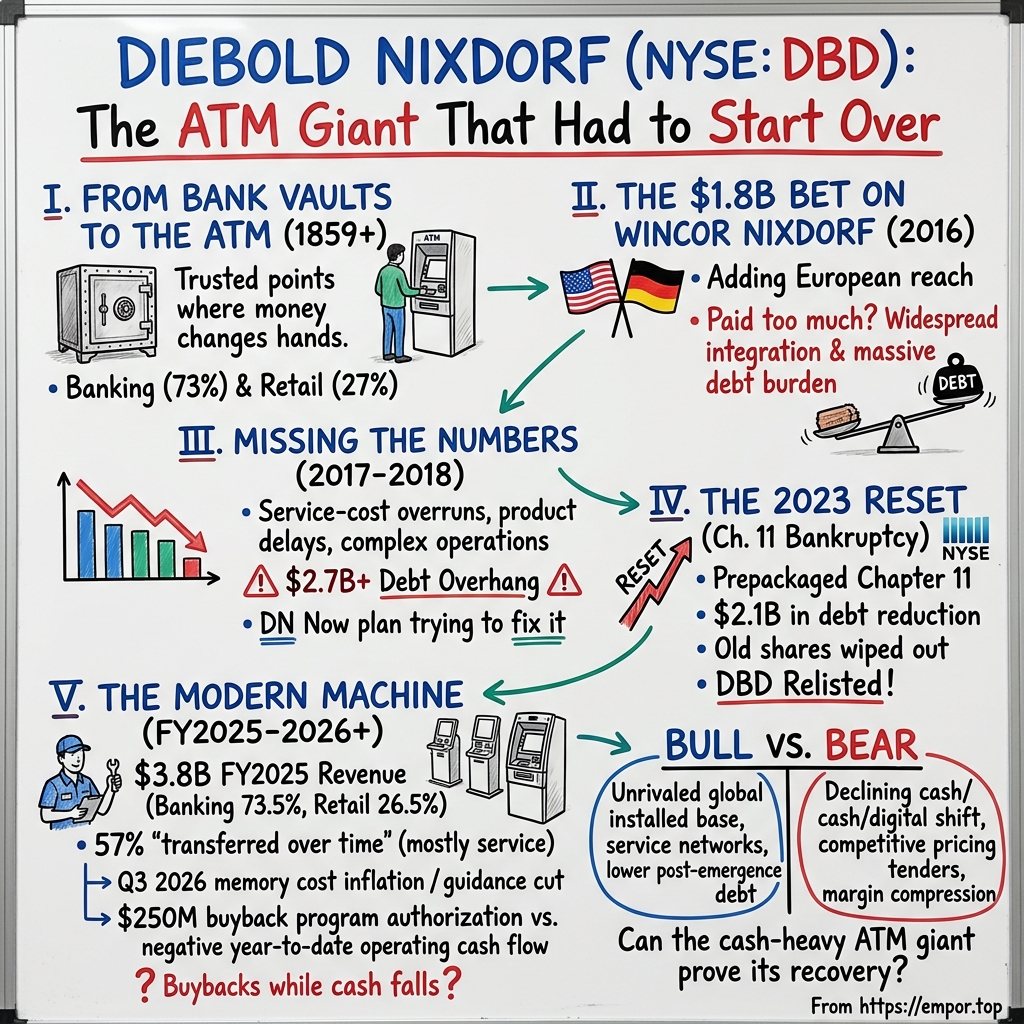
Diebold Nixdorf: The ATM Giant That Had to Start Over
I. The machine that came back from bankruptcy
Somewhere right now, a bank customer is standing in front of a machine set into a wall. They tap a card, type four digits and wait for about two seconds while a server checks the balance. Then comes the sound everyone knows: the whir and riffle of notes being counted, and a slot opening with cash in it.
The customer does not think about who built the machine, and they have no reason to. Behind that moment sit a cassette of notes that someone loaded under armed guard, a sensor array that checks each bill, software that talks to the bank's core systems, encryption that stops thieves from intercepting the card data, and a field engineer who will turn up when the dispenser jams. Very often the name on that machine's service contract is Diebold Nixdorf.
The company works in more than 100 countries and employs roughly 20,000 people.1 In 2025 it booked about $3.8 billion of revenue from banks and retailers who still need machines to take, give, count, check and protect money.1 That is a large, real business. It is also one whose old shareholders lost everything.
In the summer of 2023, Diebold Nixdorf went through a prepackaged Chapter 11 restructuring that removed about $2.1 billion of debt.4 The old common shares were canceled. On Monday, August 14, 2023, new shares in the reorganized company began trading on the New York Stock Exchange under the same ticker, DBD.4 Same brand, same machines, same customers, and an entirely different set of owners.
That is the contradiction at the heart of this story. Commentators have spent a decade predicting a cashless world, and in some rich countries cash use really has fallen. Yet banks still open branches, retailers still install self-checkouts, and somebody still has to build, install, upgrade and repair the equipment where physical money changes hands. Diebold Nixdorf is one of the few companies on earth that does all of that at global scale.
Scale, though, has not protected its shareholders. Twice in a decade the company bet that being bigger would make it stronger. The first bet was the 2016 acquisition of its German rival, Wincor Nixdorf. The second bet, made by creditors rather than by management, was that cutting the debt in half would let the underlying business finally show what it could earn.
So this episode carries three questions. Did the Wincor Nixdorf deal build a stronger company, or did it load the business with more debt than it could carry? Does the installed base of machines in bank lobbies and supermarket aisles create a durable advantage, or do customers treat the vendors as interchangeable at tender time? And can the company that emerged in 2023 turn its recent growth into dependable cash while also buying back stock?
The present-day hook makes those questions urgent. On October 28, 2026, Diebold Nixdorf reported third-quarter revenue up 5% from a year earlier, led by a 16% jump in its Retail business.2 On the same day it cut its full-year outlook, disclosed that operating cash flow for the first nine months of the year was negative, and announced that its board had authorized another $250 million share repurchase program.2
Growth, a guidance cut, cash going out, and a bigger buyback, all in one press release. Each of those facts can be read generously or skeptically, and the only way to choose between the readings is to understand where this company came from.
So the story follows the same machine through three lives. First, a family security business from the American Midwest that learned to build things banks could trust. Second, a leveraged global merger that was supposed to create the champion of self-service banking and retail. Third, a post-bankruptcy public company trying to prove that the champion's economics are finally as solid as its steel.
The first life begins long before anyone imagined a cash machine, with a German immigrant in Ohio building boxes that would not burn.
 Subscribe on LinkedIn
II. From bank vaults to the self-service branch
In 1859, Charles Diebold began making safes and vaults in Cincinnati.5 It was a sensible trade for the age: banks, merchants and railroads held their wealth as paper and coin, and the main threats to it were fire and thieves.
The story that made the company's name came twelve years later. When the Great Chicago Fire tore through the city in 1871, word spread that all 878 Diebold safes in the burned area had survived with their contents intact.5 Whether every one of those claims would hold up to a modern auditor is beside the point. The legend did what marketing still tries to do today: it turned a product into a promise. Orders poured in, and by 1872 the company had outgrown Cincinnati and moved its plant and headquarters to Canton, Ohio.5
For the next century, Diebold was a vault company. In 1874 Wells Fargo chose it to build what was billed as the world's largest vault, shipped west in 1875 on a 47-car train.5 In 1921 it sold the largest commercial bank vault yet made, to Detroit National Bank, and in 1968 First National Bank of Chicago bought double vault doors weighing a combined 87 and a half tons.5 The company listed on the New York Stock Exchange in April 1964 under the ticker it still carries, DBD.5
Then, in the early 1970s, demand for security equipment slowed, and Diebold took a chance on a strange new machine: the automated teller.5 It introduced its first ATM model in 1973, and within five years it had captured an estimated 45% of the American market.5 In 1990 it formed a joint venture with IBM, called InterBold, in which Diebold held 70%, combining its own banking hardware with IBM's reach into bank computer rooms.5
That leap is easy to tell as a pivot from safes to computers. It is better understood as continuity. A vault and an ATM both sit at the exact point where money changes hands, and both must earn a bank's trust that they will not fail, will not be broken into, and will be fixed fast if something goes wrong.
That is why customers buy more than a box. An ATM has to do all that reliably, while also resisting skimmers and explosive attacks and reporting its own faults. When it breaks in a rural branch on a Saturday, a technician needs to be there. A self-checkout in a supermarket has to read barcodes, weigh produce, take cards and cash, link to the store's inventory system and keep the queue moving.
Over the decades, that operational burden became the real business. Hardware is episodic: a bank refreshes an ATM fleet every several years, and a retailer replaces checkouts when its technology or store format changes. Installation, software, maintenance and managed services are the way a vendor stays attached to the customer between those refresh cycles. The machine is the entry ticket; the service route is the relationship.
Today the business still reflects that inheritance. Roughly three-quarters of revenue comes from Banking, mainly ATMs, branch automation and the services around them, and about a quarter from Retail, mainly checkout and self-service systems for stores.1 The historical through-line, then, is not simply that cash lasts. It is that Diebold's enduring role has been to build and maintain trusted equipment at the places where money moves.
By the 2010s, though, that role was under pressure from every direction. Banks were closing branches as customers moved to mobile apps. Hardware was getting cheaper and more commoditized. Software was where the industry's thinking had moved, and the American market Diebold knew best was mature. If the company wanted to grow, it would need a bigger footprint outside the United States and a broader portfolio of services and software.
Across the Atlantic, in the German city of Paderborn, there was a company facing almost exactly the same problem from the other side.7 Wincor Nixdorf was strong in Europe, strong in retail checkout systems, and just as aware that selling machines was no longer enough. Put the two together, the thinking went, and you would have a global champion of self-service banking and retail, big enough to spread its research budget and service network across the world.
That was the ambition. The price of it would shape the next decade.
III. The $1.8 billion bet on Wincor Nixdorf
In November 2015, Diebold announced that it had agreed to buy Wincor Nixdorf, its German rival, in a deal with a headline value of about $1.8 billion.7 The two companies were among the largest ATM makers in the world. For the industry, it was the equivalent of two old rival families deciding that the outside world had become so threatening that they would be safer as one household.
The man who struck the deal was Andreas Mattes, Diebold's chief executive, a former Hewlett-Packard executive who had arrived in 2013 to modernize an old Ohio manufacturer.7 His pitch was simple. Banks and retailers wanted fewer, bigger vendors who could deliver hardware, software and services everywhere they operated. Neither Diebold nor Wincor could do that alone.
The strategic case, in its strongest form, was genuinely compelling: the merger promised broader scale and a shift toward steadier software and services revenue.7
Combine them, and the merged company could spread research costs across a much larger revenue base, consolidate factories and product lines, and offer one service network to global customers. Management told shareholders it expected substantial cost savings from combining the businesses, and the registration statement laid out the synergy and growth case in detail.7
Then there was the price. The initial offer was €52.50 per Wincor share, a mix of €38.98 in cash and 0.434 Diebold shares, which represented a 32% premium to Wincor's closing price before the approach became public.7 Because part of the payment was in Diebold stock, the value moved as Diebold's share price moved. By the time the transaction completed in 2016, it valued Wincor at about €1.6 billion.7
A 32% premium is not outrageous by the standards of public-company takeovers, where a control premium of between a quarter and a half of the unaffected price is common. The more useful question is what that premium obliged the combined company to deliver. A buyer that pays a third more than the market's price for a business is betting that it can create at least that much extra value through savings and growth. If the synergies arrive late, or the combined business shrinks, the premium becomes a pure transfer from Diebold's shareholders to Wincor's.
There is no clean set of comparable ATM-industry acquisitions against which to judge the multiple Diebold paid, so the claim that it overpaid by a precise amount cannot be made. What can be judged is the structure. To pay the cash portion, Diebold borrowed heavily. The company's total borrowings went from about $640 million at the end of 2015 to about $1.8 billion a year later.9 In a single year, the debt load nearly tripled.
That changed the nature of the bet. A company with modest debt can afford a messy integration, because time is on its side. A company with three times as much debt needs the integration to work quickly, because interest is due every quarter whether the factories have been consolidated or not.
There was a further complication. Under German law, acquiring a majority of a listed company did not automatically give Diebold full control of Wincor's cash and operations. The remaining minority holders kept rights, and Diebold had to work through German corporate procedures to integrate the business fully.9 It was a slower, more legalistic path to unity than the deal's champions might have hoped.
The deal closed in August 2016, and the company took the name Diebold Nixdorf.9 The early results showed exactly why acquisition accounting can flatter a company. Reported revenue rose from about $2.4 billion in 2015 to about $4.6 billion in 2017, as Wincor's sales were added to the accounts.9 On the surface, the company had nearly doubled.
Underneath, the picture was worse. Operating margin, which had been around 6% before the deal, fell to under 2% in 2016 and about 3% in 2017.9 The company reported net losses in both years.9 Free cash flow, the cash left after running the business and buying equipment, turned negative.9 The bigger company was making less money per dollar of sales than the smaller one had.
Some of that was the predictable cost of integration: severance, consultants, factory moves and the accounting write-up of acquired inventory. But the scale of the deterioration hinted at something more troubling. Two complex organizations, with different product lines, different IT systems and overlapping sales teams, were not combining cleanly. Later filings recorded large impairments and wave after wave of restructuring.9
So the merger bought real geographic and product scale. It also came with a premium, a mountain of debt and an integration that proved far harder than the synergy slides suggested. The evidence supports calling Wincor an expensive strategic bet whose promised benefits did not protect the combined company from distress.
The real problem, it turned out, was not whether two product catalogs fit together. It was whether a heavily indebted company could make the combined operation work before customers and costs moved against it.
IV. When the bigger company started missing its numbers
In 2017, barely a year after the merger closed, Diebold Nixdorf told investors that its year was going to look worse than promised. Management cut its full-year revenue outlook from about $5.0 billion to between $4.7 billion and $4.8 billion, and lowered adjusted EBITDA guidance, a measure of operating earnings before interest, taxes and noncash charges, from $440–$470 million to $360–$380 million.8
Think about what that meant. A company that had just borrowed more than a billion dollars on the strength of a plan was telling the market, within its first full year, that it would earn roughly a fifth less than planned. Lenders and shareholders had underwritten the debt on the old numbers.
The explanations in that first revision pointed to weaker demand in some regions and the costs of combining the companies.8 Investors hoped it would be a one-time reset. It was not. In 2018 the company revised guidance again, and this time the reasons read like an inventory of everything that can go wrong inside an industrial company.
Management itself described a complicated operating model with too much product customization, higher costs to deliver service, delays in shipping products, lower banking volumes in some regions, an unfavorable mix of what it sold, and the expense of combining two organizations.9 That list matters because of where it came from. This was not an outsider's critique; it was the company's own diagnosis. And it described a broad execution failure, not simply a weak ATM cycle.
Consider what each of those words meant on the ground. Customization meant that a bank in one country might get a machine configured differently from a bank next door, multiplying parts, testing and spare inventory. Service-cost overruns meant field engineers were taking longer or flying further to fix machines than the contracts had assumed. Shipping delays meant revenue the company expected in one quarter slipped into the next, while the costs of building and storing the machines arrived on time.
By 2018 the company recorded an operating loss of about $360 million and a net loss of more than half a billion dollars, much of it from impairments and restructuring.9 Shareholders' equity turned negative.9 In accounting terms, the company now owed more than its assets were worth on the books.
The balance sheet had to be patched. In 2018, Diebold Nixdorf negotiated with its lenders to raise up to $650 million of new debt financing and amend its credit terms.9 The new money kept the company liquid. But it was expensive, and it added to a pile of borrowings that would reach about $2.2 billion by the end of that year.9
The management team changed as well. In early 2019, Gerrard Schmid, a former banking-software executive, became chief executive, and the company launched a program called DN Now.10 The name was meant to signal urgency, and the target was big: roughly $400 million of gross annual cost savings by 2021.10
DN Now attacked the problems management had already diagnosed. It aimed to simplify the product line, reduce the number of factories and variants, consolidate back-office functions, standardize how services were delivered, and cut layers of management left over from two companies.10 It was less a strategic reinvention than a large-scale cleaning operation.
And, for a while, it worked. On the fourth-quarter 2019 call, management reported higher adjusted EBITDA for the year, a large year-over-year improvement in free cash flow, and lower leverage.10 Operating margin climbed back above 5% in 2019 after the 2018 loss.9 For investors who had held on, it was the first good news since the deal.
The turnaround deserves its due. Simplifying a global manufacturer while customers keep buying, and service technicians keep driving, is hard work. A team that delivers meaningful savings and turns cash flow positive has done something real.
But the record also offers a sharp test of what DN Now proved, and the test cuts the other way. Savings and a strong rebound did not fix the capital structure. Revenue kept falling, from about $4.4 billion in 2019 to about $3.9 billion in 2020 as the pandemic shut branches and stores, and then to about $3.5 billion in 2022.1 Borrowings rose to about $2.7 billion by the end of 2022.1
So DN Now is evidence of operational repair, not proof that the acquisition earned its cost. A company can fix its factories and still be crushed by its balance sheet if sales shrink and debt grows. The same organization that celebrated lower leverage in early 2020 was in Chapter 11 three and a half years later.
The operating plan had done what it could. What remained was a balance sheet that still had to survive.
V. The 2023 reset: old shares out, new company in
By the spring of 2023, Diebold Nixdorf had run out of easy options. The pandemic had hurt orders. Global supply chains had snarled, raising the cost of components and delaying shipments. Inflation lifted labor and freight costs. And rising interest rates made the company's floating-rate debt more expensive just as its cash flow weakened.11
The numbers told the story without drama. In 2022, revenue fell about 11% and the company lost about $580 million.1 Operating cash flow was deeply negative: the business consumed close to $390 million of cash running its operations that year.1 Total debt stood above $2.7 billion.11 The company faced large near-term obligations and a business with flat or falling sales.
On May 30, 2023, Diebold Nixdorf announced that it had reached a restructuring support agreement with key financial stakeholders.12 Holders of most of its debt had agreed in advance to a plan that would convert much of what they were owed into ownership of the company. The day after, it filed for Chapter 11 protection in the United States, running a parallel process for one of its Dutch subsidiaries under Dutch restructuring law.1112
A prepackaged Chapter 11 is a peculiar kind of bankruptcy. The deal is negotiated before the filing. The court's job is to confirm it quickly and bind everyone to it, rather than to supervise a long fight among creditors. The machines kept running, customers kept being served, and employees kept being paid. The drama was all in the capital structure.
The plan cut about $2.1 billion of debt.4 It gave the company new financing to replace the financing used to tide it through the process. And it handed most of the equity in the reorganized company to the creditors who had agreed to the swap.12 The old common shares were canceled.4 Those shareholders received nothing for them.
On August 11, 2023, the company announced that it had emerged from the restructuring, and its new shares began trading on the NYSE on August 14.4 After emergence, gross debt was approximately $1.25 billion and net debt, after cash, about $700 million.4 In November, it filed a registration statement covering about 19.5 million shares in the reorganized company so that creditors who had received stock could sell it freely.13 It was not an initial public offering. No new money came in; the paper simply changed hands.
The ownership boundary is the most important thing to keep straight. Anyone who held Diebold Nixdorf shares before mid-2023 was wiped out. The shares trading today are claims on a successor company. When someone points to the long-run chart of DBD stock, they are splicing two different securities together.
The accounting is just as discontinuous. The company's financial statements now divide 2023 into a "Predecessor" period before emergence and a "Successor" period after it, and the company itself warns that the two are not comparable.1 In the predecessor period, extinguishing the old debt produced a large accounting gain, which is why 2023 shows a profit of about $1.4 billion.1 That number has nothing to do with selling ATMs. It is the bookkeeping image of creditors forgiving debt in exchange for equity.
That also explains a startling-looking figure in the quarterly record: in the quarter that ended in September 2023, earnings per share appear as almost $57.1 Again, it is a reorganization gain, not a business result. Anyone screening historical profitability for Diebold Nixdorf needs to drop 2023 entirely.
The new balance sheet was far healthier. Total borrowings fell from about $2.7 billion at the end of 2022 to about $1.4 billion at the end of 2023 and about $1.0 billion at the end of 2024.1 During 2024, the company refinanced its exit loan, taking a small loss on the refinancing.1 By the end of 2025, its main debt was $950 million of 7.75% senior secured notes due in 2030, with nothing drawn on its revolving credit facility.1
But healthier is not the same as healthy. The company remained a borrower with speculative-grade credit ratings. In December 2025, Moody's upgraded it to B1, citing improved leverage, stronger liquidity and positive free cash flow, as well as its position in the ATM market.17 In April 2026, Fitch assigned a BB- rating with a stable outlook.18 Those are respectable steps up the ladder, but both sit in the high-yield tier, where lenders still demand a significant premium for the risk.
The restructuring removed the debt overhang that had constrained the company since the Wincor deal. It did so by transferring ownership from shareholders to creditors. It repaired solvency. What it could not do was prove that the business underneath was capable of durable growth and cash generation.
It is worth pausing on who won and who lost. Old shareholders lost everything. Creditors who swapped debt for equity took on the risk of the business in exchange for the chance to share in its recovery. Customers barely noticed, which is itself telling: banks and retailers kept buying service from a company in bankruptcy because their machines needed it. That is a quiet piece of evidence for the stickiness of the installed base, even if it says little about the price customers were willing to pay.
That was the question the new owners inherited: with a smaller debt load, could management invest in the core and still generate cash through a cycle? To answer it, it helps to look at how the company actually makes its money.
VI. The machine is now a service route, a software layer, and a box
Picture two scenes on the same morning. In a bank branch, a Diebold Nixdorf technician kneels in front of an open ATM, swapping a worn note-transport belt and running diagnostics before the branch opens. Across town, a supermarket chain is replacing a row of staffed tills with self-checkout kiosks, and a project team is installing hardware, loading software and training staff before the weekend rush.
Those two scenes are why the company reports two businesses, Banking and Retail. They share factories, components and much of the service network. But they have different customers, different buying cycles and, increasingly, different growth rates.
In 2025, total revenue was about $3.8 billion, up 1.5% from the year before.1 Banking made up about 73.5% of sales and Retail about 26.5%.1 Banking grew 1.2% and Retail 2.1%.1 In other words, the core of the company remains the bank customer, and in 2025 neither business was growing quickly.
Follow a typical sale from factory to field. A bank orders a fleet of new ATMs, perhaps because the old ones run outdated operating systems, perhaps because it wants machines that can accept deposits as well as dispense cash. Diebold Nixdorf builds the machines, ships them, installs them and connects them to the bank's network. It may supply the software that runs the fleet and monitors it. Then, for years afterward, it may service the machines under contract, or even operate the whole fleet for the bank as a managed service.
Each of those layers is recognized differently in the accounts. Hardware delivered and accepted is recognized at a point in time. Service and some software and project work are recognized over time as the work is done. In 2025, about 43% of revenue was recognized at a point in time and about 57% over time.1
That 57% figure is the one bulls like to quote, so it is worth being careful about what it does and does not say. "Recognized over time" is an accounting category, not a promise of future revenue. It includes service contracts, but it also includes products and project work that happen to be delivered over a period.1 It is not the same as contracted recurring revenue. The company does not disclose typical contract length, minimum commitments, or recurring revenue as a share of sales.1
That matters because recurring revenue is the heart of the moat argument. If a bank signs a five-year service agreement with automatic renewals and price escalators, the vendor has something close to an annuity. If a bank buys service year to year, and can switch to a third-party maintainer or rival manufacturer whenever its contract lapses, the vendor has a habit, not an annuity. From the outside, investors cannot tell which describes more of Diebold Nixdorf's book.
What is clear is that the hardware side is cyclical and exposed to the cost of parts. In the third quarter of 2026, product margin fell by 510 basis points, or about five percentage points, from a year earlier.2 Management attributed the drop to elevated memory-chip costs and product mix, partly offset by recoveries related to tariffs.2
Memory chips are an unusual headache for an ATM maker. Every ATM and checkout terminal contains a computer, and that computer needs memory. When the semiconductor industry redirects capacity to the data centers training artificial intelligence models, prices for ordinary memory chips can spike. A company that has agreed fixed prices with customers months earlier absorbs the difference until it can pass it on. Management estimated a net memory-cost headwind of about $25 million for 2026.3
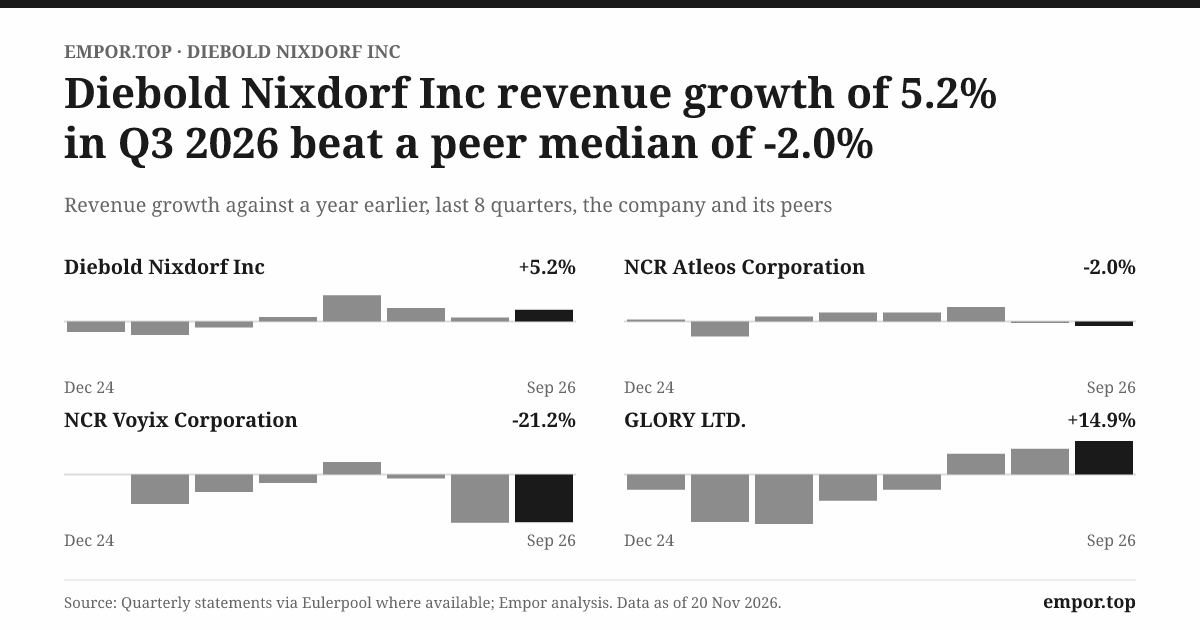
Now look at the segments in motion. In the third quarter of 2026, total revenue rose 5% from a year earlier, but Retail rose 16%.2 Retailers were buying self-checkout and store-automation systems, and Diebold Nixdorf highlighted deployments of its SmartVision AI technology, which uses cameras and software to help detect errors and theft at checkout.2 Banking grew far more slowly.
It is tempting to read that as a handoff, with Retail taking over as the engine. But proportion matters. Banking is still nearly three times the size of Retail. A 16% jump in the smaller segment adds less in absolute dollars than a modest move in the larger one. Retail growth has not displaced Banking as the core; it has made the company less dependent on Banking's cycle, at least for now.
Which segment carries the profit? With nearly three-quarters of sales and the deeper service base, Banking is the larger pool of profit dollars in the segment figures.1 What the company does not report is a clean split between hardware margins and service margins within each segment, which would show how much of the profit comes from the field engineers and how much from the factory.
There is one more clue about where the company is heading: how much it spends on the future. Research, development and engineering expense fell from $93.6 million in 2024 to $86.7 million in 2025, even as revenue edged up.1 That is a drop from about 2.5% of sales to about 2.3%.1 For a company that describes itself as a technology and services provider, that is a modest research budget, and it is moving down, not up.
There may be good reasons. A merged company with too many product lines can spend less by maintaining fewer of them. Software development can be focused. But the trend is a cost-discipline signal, not evidence of a rising innovation push. It should temper any story that frames Diebold Nixdorf as a software company in the making.
So the company's hard-to-measure promise is this: service and software make the machine more valuable over time, binding customers to the vendor between hardware cycles. If that is true, it should show up in retention rates, renewal economics and customer lifetime profit. Diebold Nixdorf does not publish those numbers. The promise might be true. It is simply not yet proved, which leads directly to the question of whether the installed base is a moat at all.
VII. Is the installed base a moat—or a customer's next tender?
Picture the meeting. A large bank's procurement team gathers around a table with a spreadsheet of its ATM fleet. Some machines are a decade old. The incumbent vendor wants to replace them and extend the service contract. The procurement head asks the question every vendor dreads: should we put this out to tender?
That moment is the moat test in miniature. If the bank renews with the incumbent at a decent price, the installed base is working as a competitive advantage. If the bank invites rivals, plays them against each other and switches vendors when someone undercuts the price, the installed base is just a list of machines that happen to have one logo on them.
The forces at work are not friendly to suppliers. Large banks and retailers are sophisticated buyers with professional procurement teams, and many run formal competitive tenders. Diebold Nixdorf does not disclose customer concentration, its largest customers' share of revenue, or whether any customer exceeds 10% of sales, so the extent to which any one buyer dominates is unclear.1 But a business of thousands of large institutions can still face a buyer base that negotiates hard.
On the other side, suppliers of chips, sensors and specialized components can squeeze margins when prices spike, as the memory crunch showed. Substitutes are real: mobile banking, card payments and instant payment systems reduce the number of cash transactions in many countries. And rivals can bundle equipment, software and field service just as Diebold Nixdorf does.
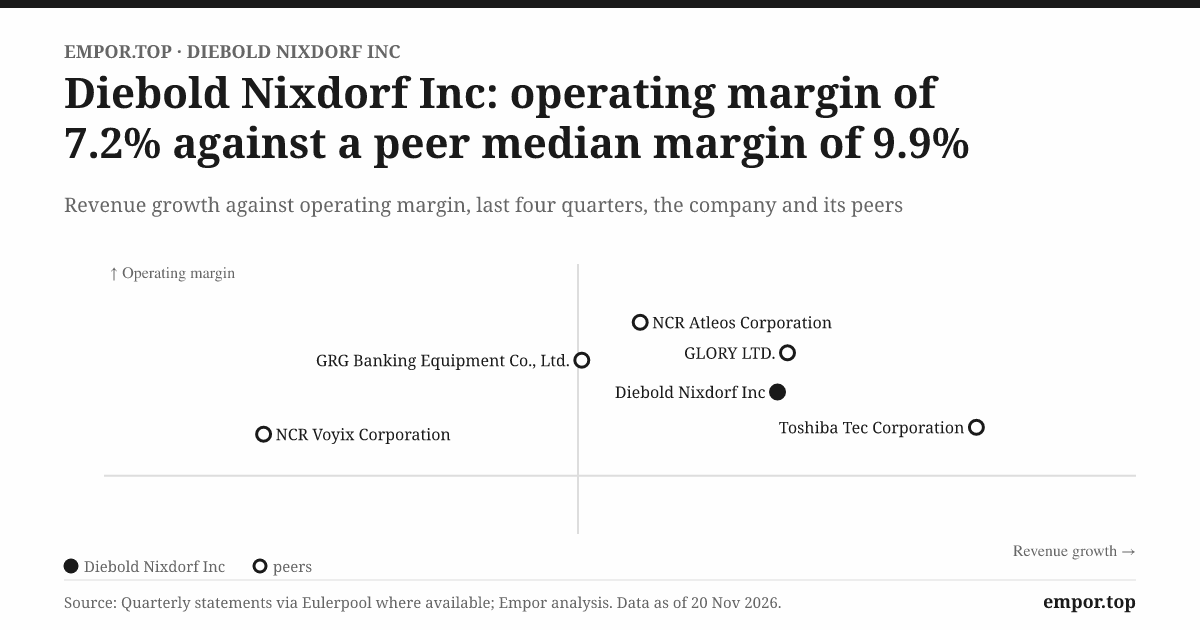
The most direct rival is NCR Atleos, the ATM and ATM-services business that now trades separately from the old NCR.6 In equipment, Diebold Nixdorf competes with 효성 Hyosung, the Korean manufacturer, and グローリー Glory, the Japanese cash-handling specialist.6 In retail checkout, it faces NCR Voyix, the other half of the old NCR, and 東芝 Toshiba, whose retail systems business sits in many large supermarket chains.6
China is a special case that shows how the company adapts where it cannot dominate alone. There, Diebold Nixdorf works partly through two equity-accounted alliances: a 48.1% stake in a financial-technology venture with 浪潮 Inspur in Suzhou, and a 49% stake in Aisino-Wincor, a retail and banking systems venture with 航天信息 Aisino in Shanghai.1 It reports modest balances owed to and from these affiliates, about $11 million receivable and $22 million payable at the end of 2025, described as ordinary-course dealings.1 It does not disclose how much revenue or purchasing flows through them, so their economic weight cannot be judged precisely. What they do signal is that in some markets the company competes by partnering with local champions rather than by selling its own fleet against them.
So where would an edge come from? The plausible mechanism is switching cost. A bank with several thousand Diebold Nixdorf ATMs has trained staff on them, integrated them with its software, stocked spare parts for them and signed service contracts built around them. Replacing the fleet with another vendor's machines means new integration work, new training and new risks of downtime, all to save money on hardware that may be only a fraction of the total cost of running the network.
Service density adds to that. A vendor with technicians in every region can respond faster and more cheaply than a rival with sparse coverage. In theory, the more machines a vendor services in an area, the lower its cost per call, which is the classic logic of route density in industrial services.
That logic supports retention potential, not proof of superior economics. Diebold Nixdorf does not publish retention rates, renewal rates, win-loss ratios on tenders or price realization. Without those numbers, the switching-cost moat is a hypothesis.
What can be measured suggests a close contest rather than a cornered market. In Switzerland, an installed-base sample compiled from RBR Data Services showed Diebold Nixdorf with 51% of ATMs in 2024 and NCR Atleos with 43%, after Atleos gained three points.16 That is a two-player market in which the incumbent's lead shrank. If the installed base were a fortress, a rival gaining three points in a single mature market would be unusual.
It is one country, and it must not be stretched into a global share figure. Globally, the company describes itself as a leading ATM supplier but does not publish a comparable share series.6 What the Swiss sample does show is the mechanism that would break the moat claim: a credible competitor taking share in a market where switching costs are supposed to protect the incumbent.
Then there is the technology threat. ATMs remain useful, and in many emerging markets cash is still central. But in some developed markets cash use has declined for years, and that can reduce how many machines a bank needs and how often it replaces them. The counter-trend is branch transformation and cash automation: banks that close branches sometimes put more capable machines in the remaining ones, and retailers automate cash handling to cut labor.
Those trends may offset each other. The company's filings do not quantify how much. That leaves investors with a conclusion that is less exciting than either the bull or the bear would like.
The installed base, the service footprint and the integration with customers' systems create a credible but unproven switching-cost advantage. The record narrows the moat claim to a smaller version: incumbency helps, especially in renewals and upgrades, but customers can and do invite alternatives, and the company does not disclose the evidence that would show it wins those contests on terms better than its rivals.
The next proof points should be retention, service-renewal economics, segment margins and bid wins or losses, not product launches alone. Until then, the moat is a reasonable bet rather than a demonstrated fact. And the bet was being tested by a much more immediate pressure: the cost of the chips inside the machines.
VIII. The rebound meets the memory bill
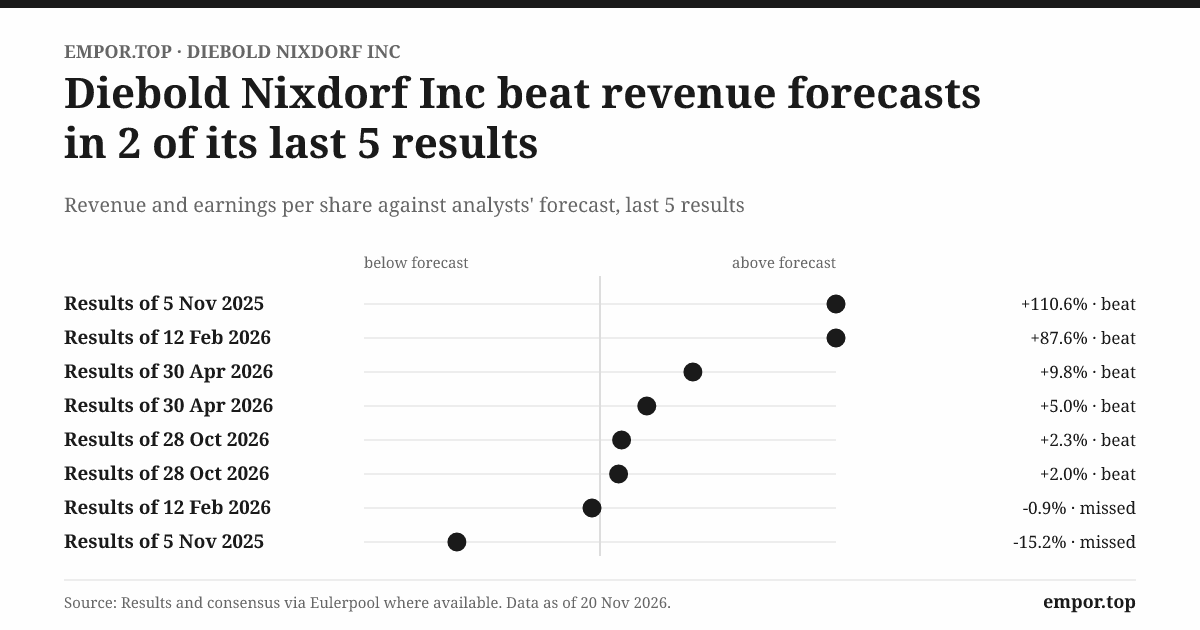
In late July 2026, Diebold Nixdorf's management sounded confident. On the second-quarter call, executives pointed to strong order entry in the first half of the year and a healthy backlog.15 They discussed an inventory build to support expected deliveries, and a large Brazilian tender that had been delayed.15 And they reaffirmed the full-year outlook.15
Three months later, on October 28, the tone was different. Revenue in the third quarter rose 5% from a year earlier, but operating profit fell by almost half, from about $74 million to about $39 million.12 Net profit fell from about $41 million to under $7 million.14 And management cut its full-year forecast.2
To understand why, start with the year before. In 2025, the company's post-emergence recovery looked real. It generated $300.7 million of cash from operations and about $263 million of free cash flow.1 For a business that had consumed hundreds of millions of dollars of cash in 2022 and 2023, that was a dramatic swing.
Some of that swing came from working capital, the cash tied up in inventory and customer receivables, minus what the company owes its own suppliers. In 2025, the company collected receivables faster, received income tax refunds and drew down inventory, offset partly by paying suppliers and lower deferred revenue.1 That is good management, but it is not fully repeatable. You can only collect a backlog of receivables once.
The longer record shows why the market treats cash generation with suspicion. Over the twelve years from 2014 to 2025, the company's reported net results added up to a loss of more than $600 million, and its free cash flow was negative in total.1 That span crosses the reorganization, so it is not a clean operating comparison. But it is a reminder that strong cash years have been the exception.
One genuinely encouraging clue sits in the receivables. At the worst of the merger hangover in 2016, customers were taking about 101 days on average to pay their bills, a sign of a sprawling, poorly integrated billing machine.9 By 2025 that figure was down to about 58 days.1 Trade receivables stood at about $609 million at the end of 2025 against an allowance for bad debts of just $6 million, and the company describes revenue recognized for work done in earlier periods as de minimis.1 It does not publish an aging table or overdue balances, so collection quality cannot be fully tested from the outside. But the direction is plainly better than it was a decade ago.
There is also a quieter drain between operating profit and the bottom line, and it explains why net earnings look so thin next to the company's revenue. In 2025, other expense, net, came to about $117 million: roughly $86 million of interest, a $44 million foreign-exchange loss, offset slightly by interest and other income.1 Pretax profit that year was only about $121 million.1 In plain terms, financing costs and currency swings consumed almost as much as the company earned before tax.
Currency is not a side issue here. About three-quarters of 2025 revenue came from outside the United States, and the company estimates that a 10% move in exchange rates would have shifted operating income by roughly $38 million to $46 million, depending on direction.1 It hedges certain exposures, including euro and Brazilian real net-investment hedges, and says it does not trade derivatives speculatively.1 A swing from a $14 million currency gain in 2024 to a $44 million loss in 2025 shows how much noise remains.1 Add an indirect-tax contingency, which the company estimates could cost up to $52.5 million more than it has accrued, and the gap between a good operating year and a good shareholder year becomes easy to see.1
The auditor's view offers some comfort. KPMG issued a clean opinion on the 2025 statements and found internal controls effective, while flagging revenue recognition as a critical audit matter because sales are generated across so many countries.1 That is a reasonable thing for an auditor to worry about in a business with operations in more than 100 jurisdictions, and it is a reminder that geographic sprawl is a control risk as well as a growth opportunity.
Then came 2026. At the end of September, cash and restricted cash stood at $184.9 million, down from more than $400 million of cash and short-term investments at the end of 2025.14 Operating cash flow was negative $29.3 million for the first nine months of the year.2 The company cited cash taxes and working-capital needs, including inventory built to serve projects whose timing had moved.14
On the third-quarter call, management laid out several distinct mechanisms, and it helps to separate them rather than blur them into "macro."3
The first is memory inflation. Prices for memory chips rose sharply, and Diebold Nixdorf had committed to customer prices before those costs arrived. Management estimated the net headwind at about $25 million for 2026, after the effect of actions it had taken.3 It told analysts that it was implementing price escalators and negotiating recovery with customers, but that the benefit would lag the cost.3
The second is product mix. Some of the hardware shipped in the quarter carried lower margins than the company had expected, compounding the memory hit to product margin.2
The third is timing. Large banking projects, including the Brazilian tender management had mentioned in July, can slip by months. When they do, revenue moves out of the year, but the inventory built for them stays on the balance sheet.315
The fourth is the cash cycle itself. Receivables, inventory and tax payments do not move in step with profit. A company can report a profitable quarter and still consume cash if it ships late in the period, builds inventory or pays taxes.
Management responded by lowering its 2026 outlook. The revised forecast called for adjusted EBITDA of $490–$510 million and free cash flow of $190–$210 million.2 Notice the arithmetic behind that free-cash-flow range. With operating cash negative through September, hitting the target requires a very large fourth quarter. The company's fourth quarters have historically been its strongest, as customers spend year-end budgets; revenue in the December 2025 quarter was about $1.1 billion, the highest of any quarter in the recent record.1 But the forecast now leans heavily on one quarter going right.
The sequence of calls is itself evidence. In July, management reaffirmed guidance despite knowing about the delayed tender and the inventory build. In October, the cut came with concrete explanations: memory costs, product mix, project timing and working capital. Those explanations are specific, and specificity counts in management's favor. But the Q2 reaffirmation makes guidance discipline a live test. Either the risks were not visible in July, or management chose not to adjust then.
The verdict for this chapter is measured. Cash recovery in 2025 was real. But the latest evidence does not yet establish a stable through-cycle rate at which this company converts profit into cash. Over the next four quarters, the tests are segment revenue and operating margin, free cash flow after working capital and taxes, and whether price escalators really do offset memory costs as management expects.
There is one more test, and it has nothing to do with chips. While cash was falling, the company was spending heavily on its own stock.
IX. A buyback while cash is falling
On the same day it cut its forecast, Diebold Nixdorf's board authorized a new $250 million share repurchase program.2 It was a striking juxtaposition. A company that had just reported nine months of negative operating cash flow was telling the market it might spend roughly an eighth of its own market value buying back shares.
The decision only makes sense in the context of where the company has been. A decade ago, it paid dividends. Then it borrowed heavily to buy Wincor, cut the dividend, and stopped paying it altogether after 2018.1 It has paid no dividends since 2019.1 Then came the leverage crisis and the restructuring that wiped out the old shares. Capital allocation at this company has a painful history: the largest deployment of capital in its modern era was followed by distress.
After emergence, management shifted toward debt reduction and cash generation. By 2025, with free cash flow strong, the company began buying back stock, repurchasing about $128 million of shares that year.1
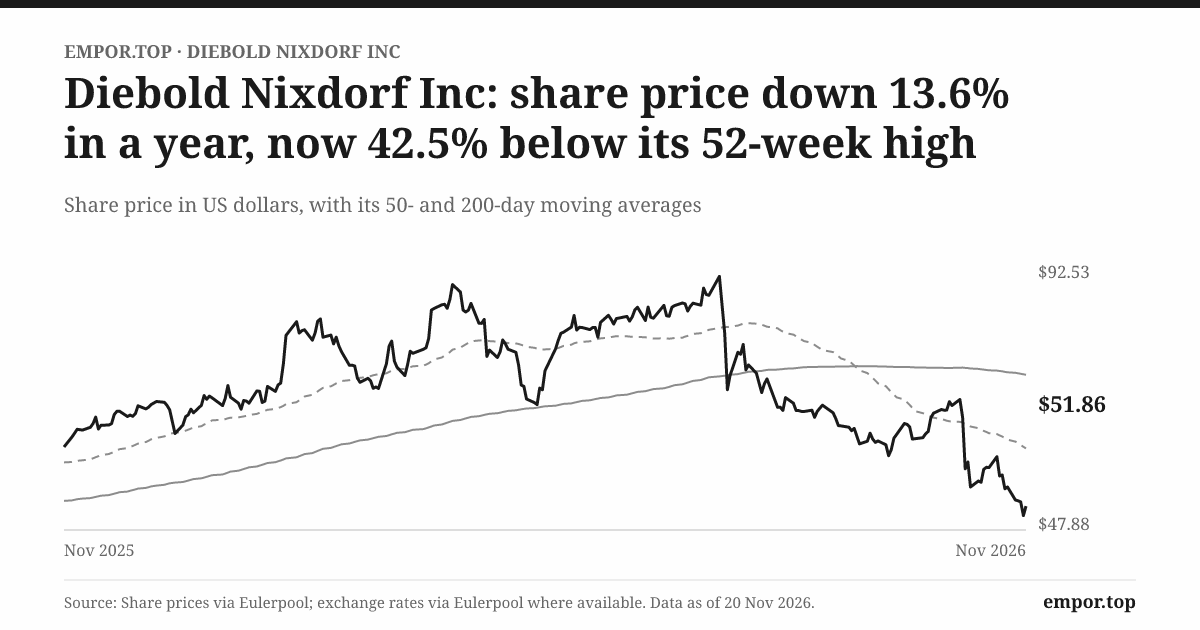
In the first nine months of 2026, it bought another 1.93 million shares for $148.6 million.2 That works out to an average price of about $77 a share. On November 20, 2026, the stock closed at $51.86.22 So far, the company has bought back stock at prices well above where it now trades.
That alone does not make the buyback wrong; any purchase looks expensive after a fall. But it does show that repurchases have been competing with liquidity. Cash fell from more than $400 million at the end of 2025 to $184.9 million at the end of September.14 Nearly $150 million of that drop went into buybacks, while operations used cash.
The company's reply is that it has ample liquidity. At September 30, beyond its cash, it had $285.8 million available under its $310 million revolving credit facility after letters of credit.14 The revolver matures in December 2029, and the company's 7.75% senior secured notes are due in 2030.1 In its quarterly filing, the company said its liquidity and available borrowing capacity would support its needs for at least the next 12 months.14
The credit agencies have rewarded the direction of travel, including Moody's December 2025 upgrade.17 Those are exactly the three things a large buyback, funded while operating cash runs negative, puts at risk. Rating agencies tend to tolerate shareholder returns from companies whose cash generation is proven. They tend to be less forgiving when returns coincide with a weaker year. The company's rating trajectory in 2027 will therefore be a useful outside verdict on whether the buyback was surplus capital or stretched capital.
There is also the question of covenants. The indenture for the 2030 notes and the credit agreement contain restrictive covenants, which typically limit how much a borrower can pay out to shareholders and how much more debt it can take on.1 The company has not suggested it is close to any limit. But for a speculative-grade borrower, the room to buy back stock is not unlimited, and every dollar spent on shares is a dollar not available to cushion a weak quarter.
That statement about liquidity is credible on its own terms. Nobody is suggesting the company is about to run out of money. The real question is what kind of company it wants to be. A business that funds buybacks from free cash flow generated after investment, taxes and working capital is returning surplus capital. A business that funds buybacks while drawing down cash and relying on a credit line is making a leveraged bet on its own stock.
A skeptical investor, or an activist, would ask that question bluntly. Why authorize another $250 million when the first nine months used cash and the 2026 outlook was just cut? The answer will not come from the authorization; boards authorize programs all the time without completing them. It will come from what the company actually spends, and what happens to its cash and debt, in the fourth quarter and into 2027.
There is a reasonable case for the buyback. If management believes the shares are cheap relative to the cash the business will generate in a normal year, buying them reduces the share count and concentrates future returns on the remaining holders. The stock was trading about 42.5% below its 52-week high in late November.22
There is also a reasonable case against. Speculative-grade companies with cyclical hardware exposure benefit from cash cushions, because the cycle can turn against them faster than their lenders can be persuaded to help. This particular company has been through that once already, and its old shareholders did not survive it.
The fair conclusion is that buybacks can be sensible after deleveraging, and the company still reports adequate liquidity. But the timing deserves scrutiny, and the size of the authorization relative to cash on hand makes it the single most important capital-allocation decision to watch. Track actual purchases and net debt, not the headline number.
Those decisions, of course, belong to the people running the company, and the man at the top has an unusual relationship to its history.
X. The CEO's second company
Octavio Marquez did not come to Diebold Nixdorf from outside to fix it. He grew up professionally in the technology industry, with more than a decade at Hewlett-Packard, including running its business in Mexico, followed by a stint at Dell EMC.13 He joined Diebold in 2014, before the Wincor deal, and spent years running its Latin American and then Americas regions, before becoming head of global banking in November 2020.13
In March 2022, he became president and chief executive.13 He inherited a company whose debt was crushing it, whose supply chain was in disarray, and whose shareholders had watched the stock fall for years. Within about fifteen months, he led it into Chapter 11. Within three months of that, he led it out.
So in a sense, he runs his second company: the same brand, the same products and many of the same people, but a different balance sheet, a different set of owners and a different board. The current chair is Patrick Byrne, an independent director, and the board is majority independent, with Marquez as the only non-independent member.19
It is important to keep the accountability period straight. The Wincor acquisition, its financing and the 2017–2019 integration failures belong to earlier management teams. They are evidence about the company's capital-allocation history, not personal failings of the current CEO. Marquez did, however, have senior roles during those years, so he cannot claim to be a complete outsider to what went wrong.
His post-emergence record has real achievements. The company returned to profit in 2025, earning about $94 million after a small loss in 2024.1 Cash flow turned strongly positive. Debt was refinanced and ratings were upgraded.117 In early 2026, on the fourth-quarter 2025 call, management presented those results as proof that the restructured company could deliver.21
How is he paid? Marquez's total compensation for 2025 was $8.69 million, down from $9.53 million in 2024.19 It included $4.74 million in stock awards and about $3.08 million in non-equity incentive compensation, the annual bonus tied to performance targets.19 Most of his pay, in other words, depends on the stock price and on hitting operating goals.
He also owns stock. The proxy listed 73,770 shares beneficially owned by Marquez.19 At the late-November share price, that stake is worth roughly $3.8 million. It is meaningful money, but well below his annual pay, so his exposure comes more from future stock awards than from his existing holdings.
Comparing pay to profit is tricky here. A CEO earning $8.69 million while the company earns $94 million looks expensive at first glance. But restructuring years produce distorted accounting, and the 2024 loss included unusual items. Simple pay-versus-profit ratios mislead in a turnaround. The fairer test is whether the incentive targets reward durable cash generation or merely adjusted earnings.
Shareholders seem broadly comfortable. At the May 2026 annual meeting, they elected all eight director nominees, ratified the auditor and approved executive compensation on an advisory basis.20 The company's filing of the results does not set out the vote margins in the section that reports them, so the level of dissent cannot be measured from it.
The ownership base is concentrated, which gives a few holders a lot of influence. As of March 2026, Capital World Investors reported about 34% of the shares and Millstreet Capital Management and its affiliates about 15%.19 Neither is described as a controlling shareholder. But between them they own nearly half the company, and both arrived largely through the restructuring.19 What they do with their stakes in the coming years will matter for the stock.
That brings the story back to guidance behavior. On the second-quarter call, management reaffirmed its outlook. On the third-quarter call, it cut it, with specific numbers and specific mechanisms.315 Executives gave concrete figures for the memory headwind and described the price-recovery plan.3 But the forecast still depends on customer timing and on costs being recovered, both of which are outside management's full control.
There is a fair argument in Marquez's favor on style. Executives who have run regional sales organizations, as he did across Latin America and the Americas, tend to think in terms of customers and field operations rather than financial engineering. The post-emergence emphasis on service quality, Retail wins and cost discipline fits that profile. The risk of the same profile is that forecasts lean on customer timing, which a sales-minded leader may see as more controllable than it is.
So the CEO's record is real but short. The credibility test for Marquez is straightforward to state, even if it will take years to pass. Several comparable post-emergence years of earnings and cash flow, timely explanation of misses before they become surprises, and visible restraint in buybacks when cash is tight would strengthen the case. Until then, investors have one good year and one complicated one.
The question is what the market is paying for that record.
XI. Analysis & Bear vs. Bull Case
On November 20, 2026, Diebold Nixdorf's shares closed at $51.86, giving the company a market value of about $1.9 billion.22 Including debt and subtracting cash, its enterprise value was about $2.8 billion.22 The stock sat about 42.5% below its 52-week high of roughly $90.22 Growth in the third quarter, and a fresh buyback authorization, had collided with a cut to the full-year forecast.
At that price, the stock traded at about 24.6 times trailing earnings, close to its own five-year median of about 25.4 times.22 Its enterprise value was about 8.3 times EBITDA, and the free-cash-flow yield on trailing results was about 7.4%.22 If the company met the midpoint of its revised 2026 free-cash-flow guidance of about $200 million, the yield on today's market value would be a little over 10%.2
The investment spine can be stated neutrally. Diebold Nixdorf wins if it keeps critical machines reliable and makes each customer relationship broader and more service-heavy, so that the installed base generates steady, profitable revenue between hardware cycles. It loses if tenders commoditize equipment, if cash usage declines faster than branch automation offsets it, or if cost increases keep outrunning its ability to reprice.
The bull case has real evidence behind it. About 57% of 2025 revenue was recognized over time, reflecting a large service and project business.1 The company has a global service network.1 Cash generation in 2025 was strong.1 Retail grew 16% in the third quarter of 2026.2 The balance sheet, while still leveraged, is a fraction of its former weight, and credit ratings have improved.1718
The bear case has evidence too. Contract terms and recurring revenue are not quantified.1 Research spending fell in 2025.1 Reported earnings are distorted by the 2023 reset, and the long-run growth record is modest: revenue fell slightly per year over five years.1 Guidance was cut in 2026, operating cash turned negative year to date, and the company spent heavily on buybacks as cash fell.214 The debt is still speculative grade.17
Where the power really sits
To decide between those cases, it helps to run the business through two classic frameworks once, carefully.
Start with Michael Porter's five forces. Buyer power is high: large banks and retailers are sophisticated, run tenders and can multi-source. Supplier power is moderate and rising in tight markets, as the memory-chip squeeze showed. The threat of substitutes is real and structural, because digital payments and mobile banking reduce cash transactions in many countries. Rivalry is intense among the established banking and retail vendors.6 The threat of new entrants is low, because building a global service network and certified secure hardware is expensive. On balance, it is an industry where scale is necessary to compete but does not guarantee high returns.
Now Hamilton Helmer's seven powers, which ask what lets a company earn returns above its cost of capital for a long time. Scale economies exist in manufacturing and service density, but the company has had scale for a decade without earning consistently strong returns. Switching costs are the most plausible power, though published retention and pricing evidence is lacking. Network economies are absent. Counter-positioning is absent. Brand is moderate; the Diebold name carries trust, but banks buy on specifications and price. Cornered resources are absent; there is no exclusive technology or license. Process power, the hard-to-copy operating know-how built over years, is possible in service delivery, but the 2018 service-cost overruns cut against it.
So the moat remains plausible, but unproved.
Run the activist's playbook over the same evidence and a short list of challenges emerges. An activist would ask why a company with a 2.3% research budget and falling R&D describes itself as a technology leader. They would ask why recurring revenue, retention and contract length remain undisclosed three years after emergence, when those numbers are precisely what would justify a higher multiple if they are good. They would ask why buybacks accelerated into a year in which the forecast was cut. And they would ask whether the Retail business, growing quickly but much smaller, earns its keep, or whether it is being grown at margins that dilute the whole. None of those questions implies wrongdoing. They are simply the questions the company's disclosure leaves open.
Valuation should be read with that conclusion in mind. A P/E near the company's own five-year median sounds unremarkable. But historical earnings are noisy, because 2023's reorganization gain and the losses that preceded it make the median hard to interpret. There is no clean set of peer multiples to anchor the comparison. What today's price appears to assume is that the post-emergence company can sustain something like its 2025 cash generation, not that it will grow rapidly.
That makes three numbers especially important to watch. The first is segment revenue and operating margin, which shows whether Retail growth and Banking stability are producing profit; the latest reading saw consolidated operating margin fall to about 3.9% in the third quarter from about 7.8% a year earlier.1 The second is free cash flow after working capital and taxes; the latest reading was negative operating cash through September against a full-year target of $190–$210 million.2 The third is any evidence on service and software growth or renewal rates, which the company does not yet publish.
The decision point is close. The next results must show Retail growth and Banking stability converting into margins and cash, not just sales and adjusted EBITDA.
XII. Lessons from the reset
Go back to three moments: the Wincor deal, the 2018 lender rescue9 and the 2023 restructuring, which erased about $2.1 billion of debt and wiped out shareholders.4 Each was a test of the same belief: that being bigger makes a hardware-and-service company safer.
The first lesson belongs to the Wincor deal. Scale could not compensate for the time and debt required to integrate two global manufacturers. Scale is only an advantage when the balance sheet can wait for the integration to work. For founders and acquirers, the wider point is that strategic logic and financial structure are not separate decisions; a good idea financed badly becomes a bad idea.
The second lesson belongs to the service model. A machine in the field is not a moat until the customer renews, and the renewal earns a margin. Diebold Nixdorf does not disclose how many customers renew or at what price. Investors in any installed-base business should ask for the renewal economics, not the installed-base count.
The third lesson belongs to the restructuring. Debt can outlive the strategy that justified it. That is why leverage on a cyclical business is a bet on the cycle, whatever the acquisition memo says.
The fourth lesson belongs to the present. The company authorized $250 million of buybacks as it cut its forecast.2 A recovery is proved by cash through the cycle, not by an authorization in a press release. The test for management is whether the money it returns is truly surplus.
Put those lessons together and the company's unusual position comes into focus. Diebold Nixdorf sells equipment designed to make cash move: out of bank vaults into customers' hands, from shoppers' wallets into store tills. Its own history turns on a different question: whether that equipment can make cash stay with the people who own the company.
XIII. Epilogue
Tonight, Diebold Nixdorf heads into the last weeks of 2026 with a reduced outlook, a fresh $250 million buyback authorization and a set of customer programs whose timing can swing revenue and cash in either direction.2 Its revised forecast leaves a steep target.2 The fourth quarter will do most of the work.
The first moment to watch is the memory bill. Management has said that escalators and contract repricing will recover much of the cost of more expensive memory chips over time.3 If those recoveries arrive and product margins rebound, the third quarter will look like a temporary squeeze. If customers resist, and margins stay low, it will look like evidence that buyers hold the pricing power in this industry.
The second is project timing. The delayed Brazilian banking tender and other large projects must convert into revenue.15 Retail must keep growing without sacrificing margin to win deals. If both happen, the company will have shown that its two businesses can grow together; if Banking stalls while Retail grows at thin margins, the growth will have come at a cost.
The third is cash. When the company reports full-year results in early 2027, investors will compare free cash flow with guidance after working capital, cash taxes and repurchases. A result inside the range would rebuild credibility after the October cut. A miss would raise harder questions about both forecasting and the buyback.
The fourth is the balance sheet and the owners. Cash, revolver use and net debt need to be tracked alongside buybacks. And the next proxy and ownership filings will show whether the large holders who arrived through the restructuring are staying or selling.
All of those moments point back to the central test. The debt was reset in 2023. Did the business underneath it become stronger? Three years after emergence, the answer is not yet in. The company has produced one strong cash year and one year in which cash has moved the wrong way. The story stays open until the company produces several comparable post-emergence years in a row.
XIV. Outro
Somewhere tonight, the same customer steps up to the same machine. Card in, four digits, a short wait, the whir of counted notes. The slot opens, the cash comes out, and the customer walks away without a second thought.
That machine has outlasted a lot, including the bankruptcy that erased its old owners. Its brand still works quietly, as it was designed to, in more than 100 countries.
Diebold Nixdorf's machines remain embedded in the physical economy. Its investors are still waiting to see whether the economics are embedded too. The company that keeps money moving through banks and stores has one question left to answer: can it finally make enough of that money for its own shareholders?
References
-
2025 Annual Report — Diebold Nixdorf, 2026 ↩↩↩↩↩↩↩↩↩↩↩↩↩↩↩↩↩↩↩↩↩↩↩↩↩↩↩↩↩↩↩↩↩↩↩↩↩↩↩↩↩↩↩↩↩↩↩↩↩↩↩↩↩
-
Q3 2026 Earnings Release — SEC, 2026-10-28 ↩↩↩↩↩↩↩↩↩↩↩↩↩↩↩↩↩↩↩↩
-
Q3 2026 Earnings Call Transcript — Stock Analysis, 2026-10-28 ↩↩↩↩↩↩↩↩
-
Diebold Nixdorf Officially Emerges from Financial Restructuring; Shares Relisting on NYSE — Diebold Nixdorf, 2023-08-11 ↩↩↩↩↩↩↩
-
Diebold, Incorporated — International Directory of Company Histories, Encyclopedia.com ↩↩↩↩↩↩↩↩↩
-
Wincor Nixdorf Acquisition Registration Statement (Form S-4) — SEC, 2016 ↩↩↩↩↩↩↩
-
Diebold Nixdorf Adjusts 2017 Financial Outlook — Diebold Nixdorf, 2017 ↩↩
-
Q4 2019 Earnings Call Transcript — The Motley Fool, 2020-02-11 ↩↩↩↩
-
ATM Maker Diebold Nixdorf Files for Bankruptcy to Cut $2 Billion in Debt — Reuters via MarketScreener, 2023-06-01 ↩↩↩
-
Diebold Nixdorf Enters into Global Debt Restructuring Support Agreement with Key Financial Stakeholders — Diebold Nixdorf, 2023-05-30 ↩↩↩
-
Form 10-Q for the quarter ended September 30, 2026 — SEC, 2026-10-28 ↩↩↩↩↩↩↩
-
Q2 2026 Earnings Call Transcript — The Motley Fool, 2026-07-29 ↩↩↩↩↩↩
-
Global ATM Intelligence Service Brochure, Switzerland market sample sourced to RBR Data Services — Datos Insights, 2026 ↩
-
Moody's Ratings Upgrades Diebold Nixdorf's Credit Rating to B1 — Diebold Nixdorf, 2025-12-17 ↩↩↩↩↩
-
Diebold Nixdorf Achieves Stable BB- Rating from Fitch — Diebold Nixdorf, 2026-04-23 ↩↩
-
Annual Meeting Voting Results (Form 8-K) — SEC, 2026-05-22 ↩
-
Q4 2025 Earnings Call Transcript — MarketScreener, 2026-02-12 ↩
 LinkedIn
 WhatsApp
 Reddit
 Hacker News
 Email
 Kindle
 RSS Feed
 Spotify
 Apple Podcasts
 Amazon Music
 Audible
 YouTube