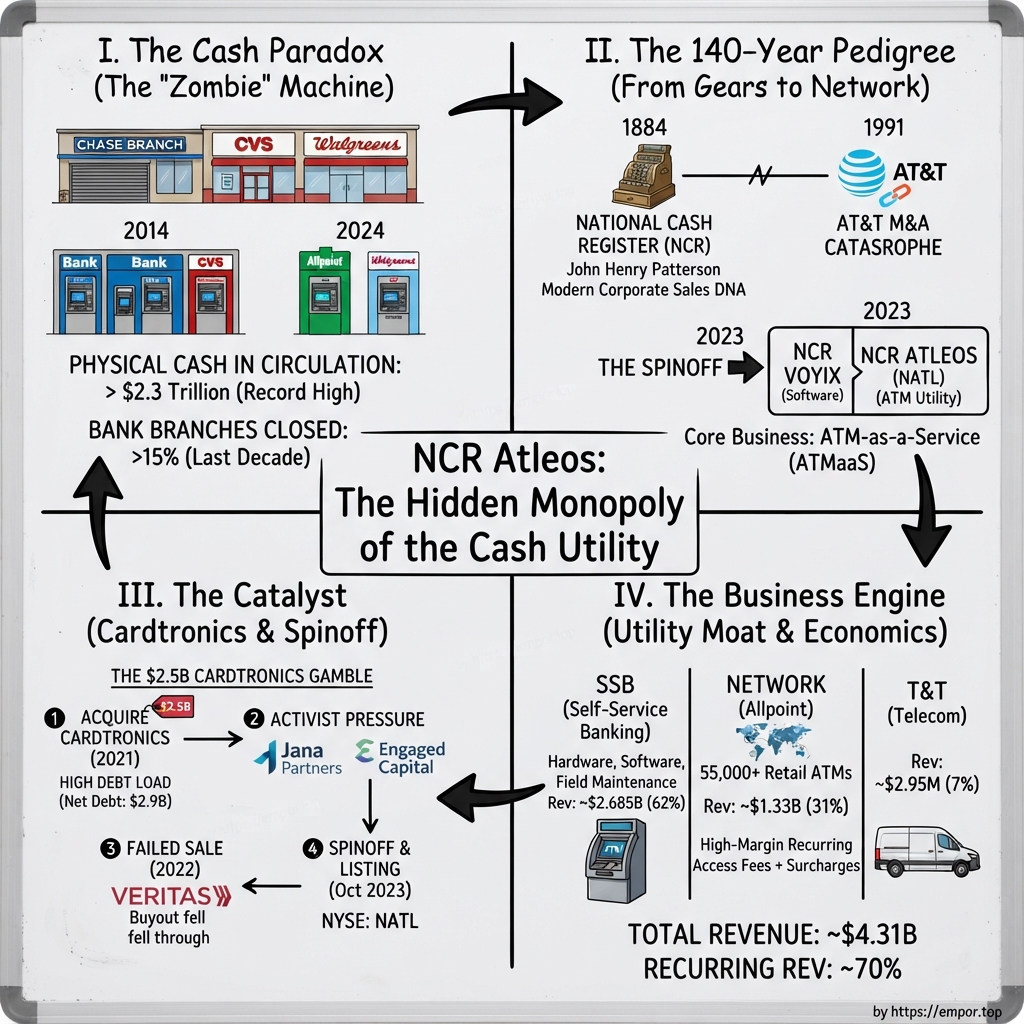
NCR Atleos: The Hidden Monopoly of the Cash Utility
I. Cold Open & The Cash Paradox: The "Zombie" Machine Printing Free Cash Flow
Drive past the Cleveland suburbs to any strip mall built in the 1990s, and a decade of American banking history is visible in the storefronts. In 2014, the anchor tenants were a Chase branch, a CVS, and a Walgreens. All three housed automated teller machines, each displaying a bank logo like a flag planted on claimed territory. By 2024, the bank branch sat dark, its drive-through lanes blocked with cones. Inside the CVS and the Walgreens, however, the terminals were still humming. They no longer belonged to a bank. They belonged to an independent network that leased access to any institution willing to pay: a credit union three counties over, a digital neobank with no physical branches, and a regional lender that preferred renting an ATM footprint to owning one.
That parking lot encapsulates the story of NCR Atleos. The branch closed, the cash remained, and an intermediary had to operate the infrastructure.
The prevailing Silicon Valley consensus of the 2010s predicted that physical cash would be obsolete by 2020, displaced by Venmo, Apple Pay, and contactless cards. That forecast proved only partially correct. While cash's share of consumer transactions has declined, usage remains substantial. The Federal Reserve's 2026 Diary of Consumer Payment Choice found that consumers made roughly 6 of their 47 monthly payments in cash — about 13% of total volume, trailing credit cards at 34% and debit at 32%.1 Yet the same survey revealed that four out of five consumers still used cash in the prior 30 days, 90% planned to continue using it, and cash maintained the number-three payment position for six consecutive years.1 Meanwhile, the total volume of physical currency reached record levels: U.S. currency in circulation stood at roughly $2.4 trillion as of late 2025,2 and the Federal Reserve's 2026 print order called for 3.8 to 5.1 billion new notes worth $108.9 billion to $139.6 billion.3
Two curves have moved in opposite directions: cash represents a declining share of transaction volume, but a rising pool of nominal value. Beneath both trends lies a third structural shift: commercial banks are dismantling their own physical distribution channels. U.S. bank branch counts dropped roughly 19% between 2014 and 2024, ending 2024 near 68,600 FDIC-insured commercial bank branches.4
Who bridges digital bank accounts and physical currency when retail banks no longer wish to operate brick-and-mortar buildings, vaults, armored transport, and technician fleets? Across a large and growing share of the developed world, the answer is a single entity that many equity investors overlooked.
NCR Atleos Corporation trades on the New York Stock Exchange under the ticker NATL. It represents the ATM and cash-services business spun out from the 140-year-old National Cash Register Company in the October 2023 breakup that also produced NCR Voyix. Atleos inherited the automated teller hardware, a global field-service technician network, the Allpoint retail network acquired from Cardtronics for roughly $2.5 billion, and most of the parent company's debt burden. In 2025, Atleos generated $4.354 billion of revenue and $830 million of adjusted EBITDA, with 71% of revenue recurring.5
The corporate trajectory shifted from an ongoing public investment case to an acquisition workout on February 26, 2026, when Atleos agreed to a sale. The Brink's Company — the armored-transport operator established in 1859 — agreed to acquire NCR Atleos in a cash-and-stock transaction valued at approximately $6.6 billion including assumed debt, paying $30.00 in cash plus 0.1574 Brink's shares for each Atleos share, an implied $50.40 per share and a 24% premium to the prior close.6 Shareholders of both Atleos and Brink's approved the merger on June 30, 2026; U.S. antitrust clearance came the same month; management now expects to close early in the first quarter of 2027.78
This transaction reframes the core analytical question. Rather than asking whether public market investors should purchase shares in a cash utility, the more revealing inquiry is what the equity market misunderstood, how long that disconnect persisted, and what an armored-car operator's willingness to commit $6.6 billion reveals about the true value of physical cash infrastructure.
The answers trace back to Dayton, Ohio, in 1884; through the costly technology acquisitions of the early 1990s; across a hardware duopoly that drove one of its two members into bankruptcy court; through a $2.5 billion counter-bid made at an unfavorable inflection point in interest rates; through a failed leveraged buyout that collapsed when the loan market froze; and into a corporate spinoff engineered specifically to load one half of a company with debt so the other half could breathe. Along the way, this analysis tests the company's competitive moat against the operating record — including the boundaries management itself has quietly set — deconstructs the segments and the unit economics of the ATM-as-a-Service conversion that management staked the company on, and identifies the small number of metrics that actually decide whether this business operated as a durable utility or a melting iceberg.
Start where the sales profession itself started.
 Subscribe on LinkedIn
II. The 140-Year Pedigree: Patterson, Dayton, and the DNA of B2B Hardware
The founding artifact was not a computer. It was a brass box designed to stop theft.
In the late 1870s, James Ritty, a Dayton saloonkeeper, patented a mechanical device to keep bartenders from pocketing receipts, calling it the Incorruptible Cashier. John Henry Patterson bought the patent and the business, renamed it the National Cash Register Company in 1884, and proceeded to build something far more consequential than cash drawers: the modern B2B sales playbook. Patterson introduced guaranteed sales territories, formal quotas, scripted sales pitches like the NCR Primer, customer testimonial booklets, and a dedicated residential sales training school at Sugar Camp outside Dayton. Patterson was autocratic and eccentric—firing executives abruptly and championing rigid personal regimens—but he established the operating template that American enterprise sales organizations followed for decades.
His most prominent protégé was Thomas J. Watson Sr. Fired by Patterson in 1914, Watson carried the Patterson doctrine to the Computing-Tabulating-Recording Company and built IBM. The culture of twentieth-century American enterprise hardware sales originated in Dayton and spread across the corporate world.
For long-term investors, however, the critical inheritance was not the sales lore; it was the field service network. Selling a physical machine that a merchant relies on daily requires that the machine function continuously. That demand necessitated technicians, service vans, spare parts depots, and local route density. NCR built that maintenance network for mechanical registers, expanded it through the mainframe era with systems like the NCR 304 and NCR 315, and preserved it through subsequent technological shifts. Across decades, thousands of company technicians serviced banks, supermarkets, and department stores worldwide. When evaluating what Atleos controls that competitors cannot easily duplicate, a substantial portion of the answer remains this accumulated density of service routes.
The company's second inheritance was an enduring corporate scar. In 1991, after a hostile takeover fight, AT&T agreed to acquire NCR for approximately $7.48 billion—a premium of roughly 132% over NCR's market value.9 The strategic thesis assumed that telecommunications and computing were converging and that a single conglomerate should own both. The integration faltered, destroying billions of dollars in value before AT&T unraveled the combination. In the 1996 restructuring that also created Lucent Technologies, AT&T separated NCR, and NCR re-emerged as a standalone public company on January 1, 1997.10 The acquisition became a case study in M&A value destruction, leaving NCR with an institutional memory of being bought, broken, and spun back out.
The third inheritance proved most decisive in shaping Atleos: the structural volatility of the hardware refresh cycle.
Consider the mechanics of an equipment sale during the 2010s. When a compliance mandate or software transition—such as the EMV chip migration or the forced retirements of Windows XP and Windows 7—compelled a major bank to upgrade its fleet, the lender ran a competitive procurement process. It selected either NCR or its rival Diebold, placing an order for several thousand terminals delivered over 18 to 30 months. While fulfilling the order, NCR's factories ran at full capacity, revenue spiked, incremental margins expanded, and market observers extrapolated the growth.
Once installation wrapped up, however, the bank had little reason to buy replacement units for another seven to ten years. Factory utilization dropped, fixed manufacturing overhead weighed on operating profits, and management executed restructuring programs while waiting for the next regulatory mandate to revive demand. Expanding into retail point-of-sale terminals and self-checkout kiosks appeared to offer product diversification, but it ultimately compounded the volatility: retail point-of-sale and banking ATM cycles both depended on lump-sum, customer-controlled replacement schedules that gave vendors minimal forward visibility.
Experiencing that recurring boom-and-bust dynamic solidified an internal operating principle: manufacturing hardware is a commoditized trap, while durable enterprise value resides in network density, embedded software, and long-term recurring service contracts.
Every subsequent strategic initiative at Atleos—acquiring a surcharge-free retail ATM network, shifting hardware transactions into subscription pricing, and packaging terminals into managed service contracts—represented an effort to escape this cycle. The transition toward ATM-as-a-Service was not an aesthetic repositioning; it was an operational response to four decades of hardware volatility.
Before it could escape that cycle, however, NCR had to survive the corporate war that defined it.
III. The ATM Battlefield: Commoditization & The Diebold Duopoly
For most of the modern era, the global market for bank-grade self-service terminals came down to two names, headquartered about 200 miles apart in Ohio.
NCR operated out of Dayton and later Atlanta; Diebold was based in Canton. Two companies, each with more than a century of history, sold to the same conservative institutional buyers, competing on products where the technical differences were real but narrow: cash dispensers, deposit modules, note-recycling units, encryption mechanisms, and the fleet-management software stack. Around them operated a secondary tier: South Korea's Hyosung, whose Nautilus Hyosung unit dominated merchant and entry-level terminals, and China's GRGBanking, which captured Asian volume and exerted persistent downward price pressure.
To understand why this duopoly proved far less comfortable than it appeared, consider the dynamics of a typical bank ATM tender. A prospective buyer issued detailed specifications covering dispense speeds, deposit validation, note recycling, encryption standards, remote monitoring, compliance certifications, and strict service-level agreements. Both vendors routinely met the criteria. Neither could establish enough product differentiation to command a pricing premium that a procurement committee would accept. Competition inevitably resolved into price concessions and bundled maintenance or software to secure the hardware order. A duopoly implies pricing power; in practice, two heavily capitalized rivals fighting over a shrinking pool of scheduled replacement orders created one of the least attractive economic structures in enterprise hardware.
The legacy economics were straightforward and, in hindsight, precarious. A commercial bank purchased an ATM the way it bought a vault—as a capital expenditure costing tens of thousands of dollars per deposit-capable unit, depreciated over seven to ten years, with a software license and a modestly profitable annual maintenance contract attached. The manufacturer booked a large upfront hardware sale followed by a thin recurring annuity.
Two structural forces undermined that model simultaneously. The first was the post-2008 interest-rate environment: years of near-zero interest rates compressed net interest margins, turning every bank expense line into an immediate target, and hardware refreshes were among the easiest capital outlays to defer by a year or more. The second was branch rationalization. A shrinking branch network required fewer automated tellers, and every shuttered branch removed a machine from the replacement pipeline permanently.
Diebold attempted to solve the problem through scale. In 2016, it acquired German peer Wincor Nixdorf to create Diebold Nixdorf, taking on a debt burden designed for an expanding market that never arrived. European banking consolidation, integration hurdles, and post-pandemic supply chain disruptions eroded the combined company's margins. The collapse unfolded rapidly. On June 1, 2023, Diebold Nixdorf and key subsidiaries filed voluntary Chapter 11 petitions in the Southern District of Texas under a prepackaged reorganization plan agreed upon with creditors, alongside a parallel Dutch restructuring proceeding; the bankruptcy court approved a $1.25 billion debtor-in-possession financing package the following day, confirmed the plan on July 13, 2023, and the company emerged that August after roughly ten weeks.11 Existing equity was completely wiped out.
The lesson of that bankruptcy is often misunderstood. Diebold did not fail because automated teller machines became irrelevant; it failed because it financed a mature, cyclical manufacturing operation with the balance sheet of a growth company right before interest rates spiked. The underlying market remained intact. Diebold Nixdorf reported approximately $3.81 billion in revenue for 2025 with adjusted EBITDA between $470 million and $490 million, more than doubled its free cash flow, earned credit rating upgrades from S&P and Moody's, and introduced a three-year plan targeting $3.98 billion to $4.08 billion in revenue and $550 million to $600 million in adjusted EBITDA by 2027.12 The reorganized rival was not an incapacitated competitor, but a leaner operator with a substantially repaired capital structure.
That outcome carried two distinct implications for the competitive moat around Atleos. On the positive side, the restructuring imposed long-overdue pricing discipline across the industry, eliminating a distressed seller willing to underbid contracts simply to maintain manufacturing absorption. On the negative side—a reality often glossed over in bullish commentary—Diebold emerged from Chapter 11 deleveraged, whereas Atleos emerged from its corporate separation heavily leveraged. For a period following 2023, the operationally weaker competitor possessed the stronger balance sheet.
That disparity set the stage for the pivotal strategic shift that defined both the moat and the debt burden: the moment NCR abandoned purely selling hardware to banks and chose instead to buy the customer network directly.
IV. The $2.5B Gamble: Buying Cardtronics & The Allpoint Network
In December 2020, the buyout appeared settled. Cardtronics plc — the world's largest non-bank ATM operator — signed a definitive agreement to be taken private by Catalyst Holdings, an affiliate of Apollo Global Management, alongside Hudson Executive Capital, at $35.00 per share in cash.13 It was a textbook late-cycle private equity transaction: a cash-generative, overlooked infrastructure asset acquired at a modest multiple with low-cost debt.
Then, on January 7, 2021, Cardtronics disclosed an unsolicited third-party proposal of $39.00 per share. On January 25, it signed a definitive merger agreement with NCR Corporation at that $39.00 cash price — an enterprise value of roughly $2.5 billion including debt. NCR paid the $32.6 million break fee owed to Apollo on Cardtronics' behalf.13 The transaction closed on June 21, 2021, making Cardtronics a wholly owned NCR subsidiary; the UK Competition and Markets Authority issued an initial enforcement order the same day and reviewed the combination through the summer.1415
The strategic rationale lay in what Cardtronics controlled. The company operated more than 285,000 ATMs across ten countries in North America, Europe, Asia-Pacific, and Africa, anchored by its crown jewel: the Allpoint Network, the world's largest retail-based surcharge-free ATM network with over 55,000 locations.14 Allpoint was not a manufacturing asset. It was an ecosystem of long-term commercial relationships: placement and revenue-sharing agreements with retailers possessing prime foot-traffic real estate, paired with reciprocal access agreements with financial institutions eager to provide cardholders surcharge-free cash access without building their own branches.
Before acquiring Cardtronics, NCR's relationship with bank clients was transactional and episodic: sell a fleet, service it under contract, wait seven to ten years, and compete for the next hardware replacement cycle. Cardtronics supplied the operational elements NCR could not easily assemble internally: premier retail real estate agreements, cash-in-transit orchestration, transaction switching, and surcharge-free network membership that transformed an ATM in a pharmacy or grocery store into an off-premise branch for any participating lender.
Combining those capabilities created an entirely new commercial pitch for regional bank executives: Stop buying ATMs. Outsource the fleet. NCR will own the hardware, manage the software, transport the cash, maintain network uptime, and grant cardholders surcharge-free access to tens of thousands of retail locations at a predictable monthly fee per machine. That model became the foundation of ATM-as-a-Service, a turnkey solution made possible only because NCR controlled both hardware manufacturing and network infrastructure.
Yet the strategic logic carried immediate financial exposure.
The purchase multiple was defensible under the capital market conditions of January 2021 — a mid-single-digit-growth infrastructure provider acquired at a high-single-digit to low-double-digit forward EBITDA multiple during an era of near-zero interest rates. The vulnerability was not the valuation in isolation, but three compounding financial realities.
First, the acquisition relied on floating-rate debt just before credit conditions reversed. NCR funded the purchase with new term loans and senior notes. Within fifteen months, the Federal Reserve initiated the fastest monetary tightening cycle in four decades, materially increasing debt service costs on obligations underwritten during the zero-interest-rate era.
Second, Cardtronics exhibited structurally thinner free cash flow conversion than its headline EBITDA suggested. Operating a retail ATM network requires substantial ongoing expenditures: merchant commissions, armored transport, maintenance logistics, and, crucially, financing for vault cash. In public filings, Atleos highlighted the "maintenance of a significant amount of vault cash, which involves risk of loss and is subject to cost fluctuations based on interest rate movements."16
Vault cash represents one of the most critical yet least understood mechanisms in ATM economics. A terminal functions only if its cassettes are stocked with currency. That money does not sit as idle corporate capital; operators typically borrow or lease it from commercial banks under liquidity facilities, paying financing fees tied to short-term benchmark rates. It functions much like retail inventory, except the merchandise is legal tender and the carrying cost floats directly with interest rates. Multiplying several thousand dollars per machine across tens of thousands of locations creates a large, permanently financed working-capital obligation. When benchmark rates climbed from near zero to more than 5%, the expense of stocking the ATM fleet surged in tandem — an operational cost increase dictated by monetary policy rather than foot traffic. This dynamic explains why Network segment margins tracked the interest rate cycle rather than underlying cash transaction volumes.
Third, the acquisition mathematically constrained NCR's balance sheet for the remainder of its corporate life. The leverage absorbed from Cardtronics curtailed capital allocation flexibility and triggered a sequence of financial pressures that dictated the company's next structural moves.
The strategic outcome of the Cardtronics transaction was therefore two-sided. The acquisition secured the retail network density and recurring revenue base that formed the core of NCR's competitive moat. At the same time, the debt load and floating-rate sensitivity incurred in the purchase eroded corporate flexibility for years. That tension between operating advantage and financial leverage defined the business inherited by NCR Atleos after the spin-off.
The bill arrived in 2022.
V. The Activist Squeeze, The Failed Sale, & The Spinoff of Atleos
By early 2022, NCR Corporation was a company arguing with itself in public. On one side sat an aspiring software business — restaurant and retail point-of-sale software, digital banking platforms, and merchant payment processing — that sought the premium multiples awarded to recurring tech revenues. On the other sat automated tellers, legacy hardware manufacturing, an expansive field-service network, and a retail cash utility that equity markets viewed as a cyclical, capital-intensive industrial asset. Layered across both was the debt incurred to buy Cardtronics. The result was a persistent conglomerate discount that satisfied neither management nor public shareholders, whose frustration mounted as the equity lagged its peer benchmarks.
On February 8, 2022, the board unanimously approved a comprehensive strategic review with outside financial advisors, formally considering every restructuring path: the sale of material businesses or assets, a tax-free corporate spinoff, a merger, a sale of the entire enterprise, or alternative structural transactions.17 The board also reconstituted its governance, appointing three new independent directors during 2022 while initiating a wide-ranging shareholder engagement effort.18
The activist dynamics surrounding the review warrant precise distinction. While company disclosures and regulatory filings verify the strategic review, the board refreshment, and extensive shareholder outreach, specific public assertions regarding which hedge funds secured board representation during this window remain unconfirmed by primary filings. What regulatory and public records do document is that activist interest in the separated assets continued long after the split: Engaged Capital publicly presented both NCR Voyix and NCR Atleos as standalone investment ideas at an investor conference in December 2024, more than a year after the separation.19 The core activist thesis — that the market value of the individual businesses exceeded the conglomerate whole — remained active after the parts began trading independently.
Through mid-2022, the strategic review converged toward a whole-company leveraged buyout. The Wall Street Journal reported in July 2022 that Veritas Capital was in advanced negotiations to acquire NCR.20 Then macroeconomic reality intervened. Inflation accelerated, the Federal Reserve initiated aggressive interest rate increases, and the syndicated loan and high-yield bond markets froze. By August, financial reporting indicated that Veritas was struggling to assemble a viable debt financing package.21 A leveraged buyout of a heavily indebted, hardware-centric company valued near $10 billion required extensive debt syndication, and by late 2022 syndication was effectively unavailable. The auction stalled not over valuation disagreements, but because credit markets seized.
In September 2022, the board adopted the structural fallback it had deferred: separating the enterprise into two independent, publicly traded companies through a tax-free distribution.22 The digital commerce, retail point-of-sale, and restaurant business became NCR Voyix. The automated teller, retail cash network, and hardware maintenance operation became NCR Atleos.
The financing structure of that separation remains the single most important factor in understanding NATL as an equity security, because it dictated the company's capital allocation for the subsequent three years. The spinoff was not an equal division of balance-sheet liabilities. NCR allocated the preponderance of the debt burden directly to Atleos, reasoning that the ATM and network business possessed the larger, more predictable cash flows required to service heavy fixed obligations, which would have crippled Voyix. In September 2023, immediately prior to the split, NCR Atleos Escrow Corporation priced $1.35 billion of 9.500% senior secured notes due 2029 at 98.750% of par — an offering upsized from an initial $1.05 billion, with the maturity trimmed from seven years to five and a half.23 To credit investors, the terms told the story: to place that volume of paper, the issuer accepted a compressed maturity, a steep 9.5% coupon, and an original-issue discount. That was the price debt markets demanded in the autumn of 2023 to fund an ATM operator. Alongside those notes, Atleos established $2.085 billion in senior secured credit facilities, comprising a $500 million revolving credit line, a $750 million term loan A, and an $835 million term loan B.24
The separation finalized on October 16, 2023, and Atleos debuted on the New York Stock Exchange as an independent entity.25 It launched with an imposing debt burden, an operating profile that conventional wisdom viewed as structurally obsolete, and a compressed valuation multiple reflecting those skepticism-heavy assumptions. Credit rating agencies underscored that vulnerability: Moody's initially placed the company deep within speculative-grade territory. It was not until August 21, 2024, that Moody's upgraded the corporate family rating from B2 to B1, pointing to an improving leverage ratio, stable category cash flows, and management's explicit pledge to direct surplus cash flow toward debt paydown.26
From its inception, the post-spin equity functioned as a high-delta call option on operational execution and balance-sheet repair. The subsequent trajectory of the sister company reinforced why Atleos was saddled with the leverage. In 2024, NCR Voyix — the supposed digital growth vehicle — agreed to divest its digital banking software division to Veritas Capital for $2.45 billion in cash.27 The private equity sponsor that could not syndicate a levered buyout of the unified conglomerate in the frozen credit landscape of 2022 readily funded a clean, unencumbered software transaction two years later. Credit availability, rather than pure corporate architecture, had dictated the contours of the split.
For Atleos shareholders, the equation was straightforward: if operating income held steady and management directed free cash flow toward paying down high-cost notes, equity value would expand through the transfer of enterprise value from debt to equity. If transaction volumes deteriorated rapidly under digital payment competition, the leverage would consume the equity. The subsequent operating chapters determined which outcome prevailed.
VI. Inside the Machine: Segments, Economics, & The ATMaaS Engine
Behind the corporate restructuring, Atleos operates three reporting segments of unequal scale and strategic importance, with the revenue mix shifting noticeably since the 2023 separation.
Self-Service Banking forms the core. In 2025, the segment generated $2.881 billion in revenue, up 7%, producing adjusted EBITDA of $751 million at a 26.1% margin—a 19% increase from $629 million and a 23.4% margin in 2024.5 That performance stood out for a division often categorized by public markets as legacy hardware. The underlying composition explained the divergence: hardware revenue within the segment expanded 14%, while ATM-as-a-Service revenue grew 33%.5 Growth occurred simultaneously in legacy equipment deliveries and in the subscription model designed to replace them.
Network encompasses the Allpoint franchise and its underlying transaction-processing switches. It delivered $1.265 billion in revenue in 2025, down 1%, while adjusted EBITDA dropped 11% to $359 million from $403 million, as operating margins compressed from 31.4% to 28.4%.5 For a segment central to the bullish thesis on Atleos as a cash platform, the 2025 contraction represented a notable operational headwind.
Telecommunications & Technology remains a minor legacy operation: revenue fell 13% in 2025 to $168 million, generating $31 million in adjusted EBITDA.5 It provides modest cash flow without strategic integration into the broader cash infrastructure.
Across the consolidated enterprise, 2025 revenue rose 1% to $4.354 billion, with recurring contracts generating $3.075 billion, or 71% of the total.5 Adjusted EBITDA reached $830 million, up 6%, representing a 19.1% margin. Net income of $162 million more than doubled from $80 million, lifting diluted earnings per share to $2.14 from $1.08, while adjusted diluted EPS climbed to $4.13 from $3.34.5
Examining the underlying operational mechanics clarifies how these numbers translate into cash generation.
What a modern ATM actually is. In practice, a bank-grade terminal functions less like a mechanical dispenser and more like an unstaffed micro-branch. Encased within the cabinet are a safe, dispensing mechanisms, and increasingly a recycler—a module that accepts deposited currency, validates the bills, and re-dispenses them to subsequent users rather than idling them for pickup. Note recycling alters terminal unit economics substantially, because armored-carrier transport represents the single largest ongoing operating expense of an ATM fleet. By cycling deposited cash directly back into circulation, recyclers reduce armored-carrier dispatch frequencies. Management highlighted the accelerating adoption of recycling technology as a primary catalyst for hardware orders in the first quarter of 2026.28 Overlaid on the mechanical chassis is a software stack that integrates the terminal into the client bank's core processor, manages cryptographic keys and data encryption, diagnoses hardware faults remotely, and supports two-way video banking via Interactive Teller Machines.
Why banks are willing to outsource it. Maintaining a proprietary ATM fleet obligates a financial institution to manage eight non-core operational disciplines: hardware procurement, cash forecasting, cash-in-transit carrier logistics, cryptographic key management, PCI compliance, field-service dispatch, terminal security patching, and transaction switching. None of these functions generate net interest margin. They operate purely as cost centers, with unfavorable unit costs for regional lenders operating fleets below several thousand terminals.
The unit economics of the conversion. Under the traditional equipment model, the vendor sold a terminal for an upfront five-figure sum and subsequently earned an incremental annual maintenance fee over a seven-to-ten-year lifecycle. Upfront capital expenditure dominated lifetime revenue per endpoint. Under ATM-as-a-Service, the transaction model inverts: the vendor books negligible upfront hardware revenue, capitalizes the terminal onto its own balance sheet, and bills a comprehensive monthly fee bundling hardware, software, cash replenishment, telecommunications, regulatory compliance, and field maintenance. Over an average seven-year service agreement, cumulative revenue per endpoint expands to several times the legacy baseline, as the provider absorbs operational responsibilities the bank previously managed in-house.
That structural shift brings two distinct financial consequences. The favorable outcome is that revenue shifts into multi-year, recurring contractual streams with high forward visibility. The countervailing burden is that the initial conversion cycle requires significant upfront cash. The vendor forfeits immediate hardware receipts while financing terminal manufacture and deployment on its own balance sheet, recouping that outlay gradually through monthly subscriptions. An operator executing an aggressive conversion cycle therefore registers depressed near-term revenue and elevated capital intensity relative to a competitor selling equipment outright. This capital drag explains why Atleos cautioned in its annual report that the transition toward a software- and services-led model "poses risks related to capital expenditures and the ability to generate expected returns."16 In regulatory risk disclosures, the company explicitly acknowledged that the recurring-revenue transformation requires substantial capital commitments.
Is it working? Operating results through 2025 and mid-2026 demonstrated sustained execution. ATM-as-a-Service closed 2025 with $288 million in annualized recurring revenue, while fourth-quarter bookings surpassed $200 million in total contract value for the first time in company history.5 That expansion continued into 2026: ATMaaS revenue reached $77 million in the second quarter of 2026, up roughly 24% from $62 million in the prior-year period, following year-over-year growth of approximately 30% in the first quarter, as the company expanded deployments across Europe and Latin America alongside established footprints in North America and Asia.2928
And what the Network segment tells us. Evaluating the Network segment requires dissecting its four underlying revenue streams, which react differently to macroeconomic and behavioral shifts.
Financial institution access fees. Banks, credit unions, and fintech issuers pay subscription-style fees granting cardholders surcharge-free access to Allpoint terminals—in effect leasing physical branch reach. This represents the segment's highest-margin, most stable revenue stream.
Convenience surcharges. Non-affiliated cardholders pay an out-of-network fee at the point of withdrawal, which Atleos splits with the host retailer. Because this revenue depends strictly on per-transaction foot traffic, it carries the most direct exposure to secular declines in cash usage.
Interchange. Card networks remit fixed processing fees to the ATM operator on completed transactions, established by payment scheme schedules outside Atleos's control.
Allpoint+ deposits. Deposit-enabled terminals across major metropolitan centers permit customers of branchless banks to deposit cash directly into digital accounts—addressing a critical structural hurdle for direct banks and neobanks.30 By enabling bi-directional cash flow, deposit capability upgrades Allpoint from a passive cash-dispensing network into an active branch alternative, offering the company's highest strategic upside.
Revenue mix governs resilience: as access fees and deposit volume expand relative to transactional surcharges, the segment behaves less like a declining transactional asset and more like an enterprise utility. However, Atleos does not break out that internal revenue distribution in public filings, leaving investors without precise visibility into its terminal value dynamics.
Globally, Atleos operates proprietary ATM networks in 13 countries and provides maintenance across 65, generating 55% of 2025 consolidated revenue outside the United States through retail host partnerships with Circle K, Costco, CVS, Kroger, Target, and Walgreens.16 Network managed units totaled 78,400 at the end of 2025 and 77,000 at the end of the second quarter of 2026, with trailing-twelve-month average revenue per unit of $16,200 and $16,000, respectively.529 Across both metrics, performance was flat to slightly down. In the second quarter of 2026, Network revenue slipped 1% year over year while segment adjusted EBITDA jumped 23% to $106 million—an earnings expansion management attributed partly to lower vault cash costs.29
That distinction carries significant analytical weight. Much of the recent margin expansion in the Network segment stemmed from declining vault cash financing expenses as interest rates moderated—a macroeconomic relief valve rather than an indicator of structural pricing power. The liquidity mechanism that compressed segment margins during the Federal Reserve's tightening cycle provided an automatic tailwind as benchmark rates eased. Sustainable operational leverage depends on terminal additions and real ARPU expansion, neither of which has meaningfully inflected.
The operational reality reflected in the segment disclosures is measured: the services transition continues to generate contracted growth, while the network footprint is defending its existing base rather than expanding organically. For an enterprise carrying substantial debt, a stable cash generator providing downside protection represents a constructive holding, even if it falls short of the compounding two-sided platform portrayed in bullish narratives. Testing that platform thesis requires examining the competitive moat against the actual operating record.
VII. Moat & Strategy: 7 Powers & Porter's Five Forces
Consider a well-capitalized competitor attempting to enter the U.S. cash infrastructure market with $3 billion in capital. Hardware manufacturing can be outsourced or acquired on price from Asian suppliers such as GRGBanking. Building the software stack presents complex engineering challenges, but remains technically tractable. The insurmountable barrier appears at the retail door. A finite group of national retail chains controls tens of thousands of high-footfall locations across North America, and their lobby space is already bound by long-term exclusive contracts. That physical placement footprint forms the true competitive moat, and assessing its durability requires examining the business through formal strategic frameworks rather than generic assumptions.
Applying Hamilton Helmer's Seven Powers framework clarifies where structural advantages exist and where they fall short.
Network effects (Allpoint). The Allpoint retail network operates as a genuine two-sided platform—the only one in the company's portfolio. Expanding premium retail endpoints makes the network increasingly attractive to card issuers seeking cash access for their customers. In turn, signing more financial institutions and cardholders drives terminal transaction volume, reinforcing Atleos's economic value to host retailers and helping it secure and retain multi-year placement agreements. The relationship with Chime illustrates the dynamic: Allpoint has provided fee-free ATM access to Chime members since 2021, Chime offers members more than 50,000 fee-free ATMs through the network, and in an expansion of the relationship Atleos began branding ATMs at more than 4,000 Walgreens stores with Chime's brand.31 In practice, a branchless digital bank rents a physical retail presence it could never justify constructing, paying for the privilege of mounting its brand on third-party infrastructure. A new entrant cannot replicate that geographic scale on day one.
Switching costs (Self-Service Banking and ATMaaS). Operational switching costs for banking institutions are substantial, though they should not be overstated. Replacing an incumbent terminal provider requires re-integrating with a bank's core transaction processing software, re-provisioning cryptographic keys, renegotiating cash-in-transit carrier logistics, and re-certifying compliance and security workflows. Bank technology executives rarely undertake such complex migrations without compelling economic justification, particularly during the term of a five- to seven-year contract. Notably, Atleos does not disclose specific contract renewal or annual churn rates for its ATM-as-a-Service portfolio; any retention figures cited across the market remain external estimates rather than verified company metrics.
Scale and route density (field engineering). Field service represents an unglamorous yet highly defensible competitive barrier. Atleos maintains a global service organization spanning an installed and serviced fleet of roughly 600,000 ATMs and reported delivering 5.8 million hours of ATM availability through service improvements.3233 Service efficiency is a mathematical function of route density: when a technician's daily route already encompasses eleven terminals within a twenty-mile radius, the marginal cost of servicing a twelfth unit is minimal. That unit cost remains consistently lower than what a financial institution's internal maintenance team or a fragmented regional vendor can achieve. Route density makes the ATM-as-a-Service value proposition compelling on both cost and reliability, enabling Atleos to operate a client's fleet at lower total expenditure than the bank could manage directly.
Counter-positioning. The outsourced network model enables regional banks, credit unions, and digital neobanks to offer a physical cash footprint rivaling or exceeding the proprietary branch networks of JPMorgan Chase or Bank of America, at a fraction of the capital commitment. National mega-banks cannot replicate this shared-utility model without cannibalizing the proprietary branch networks they invested decades and tens of billions of dollars to construct. This constitutes classic counter-positioning—though it represents an advantage held over the competitors of Atleos's bank clients, rather than direct leverage over the clients themselves.
Equally revealing are the structural powers Atleos lacks, because a competitive framework used solely to document strengths becomes an exercise in advocacy.
No cornered resource. The company possesses no proprietary patent thicket, exclusive component supply agreements, or irreplaceable engineering talent. Every hardware terminal and module Atleos produces can be manufactured by alternative vendors.
No process power. While the company's field service logistics are refined and difficult to assemble rapidly, they do not constitute proprietary process advantages comparable to specialized manufacturing systems. A capitalized competitor with sufficient time could build an equivalent network, and Diebold Nixdorf already operates one of comparable scale.
No brand power. End-market consumers do not select an automated teller machine based on the hardware manufacturer. They choose terminals based on physical convenience and whether their financial institution provides surcharge-free access. The consumer brand equity of Atleos is negligible, which is why the company regularly leases its terminal screens and wraps to third-party institutions such as Chime.
No pricing power over large clients. The primary area where Atleos exercises unilateral pricing discretion is the out-of-network convenience surcharge paid by non-affiliated cardholders—a fee paid by consumers with few immediate alternatives. While this represents a high-margin revenue stream, it draws scrutiny from consumer advocates and operates within a declining overall volume pool.
Across Helmer's Seven Powers, Atleos commands three (network effects, switching costs, and scale economies), partially benefits from counter-positioning, and lacks three (cornered resources, process power, and brand power). That balanced scorecard reflects an infrastructure utility generating adjusted EBITDA margins near 19%, rather than the 35% to 45% margins earned by businesses possessing cornered enterprise assets.
A distinct operational risk further complicates the competitive profile. An ATM network represents a globally distributed estate of internet-connected computing terminals that physically store and dispense currency, making it an attractive target for commercial cybercrime—exposed simultaneously to physical tampering, card skimming, automated jackpotting attacks, and core network intrusion. Atleos discloses that it manages cybersecurity risk within an enterprise risk management program, and treats the assessment and identification of material cyber threats as a board-level concern.16 For investors, the risk profile is acutely asymmetrical: flawless security execution generates no incremental revenue, whereas a single coordinated breach or network cash-out could disrupt operations, incur substantial remediation expenses, erode client confidence, and jeopardize the institutional banking certifications that form a prerequisite for market participation.
Examining the competitive environment through Michael Porter's Five Forces framework clarifies the broader industry dynamics acting on the business.
Threat of substitutes: high, and the dominant force. Digital wallets, debit and credit card penetration, real-time account-to-account payment networks such as FedNow, and cash-free retail merchants exert persistent downward pressure on physical currency transactions. Competitive advantages within the ATM sector do not reverse this behavioral shift; they merely dictate how efficiently an operator extracts cash flow while the transition unfolds.
Buyer power: bifurcated. Mid-sized regional lenders, community institutions, and fintech platforms lack the operational scale to maintain proprietary fleets cost-effectively, making them natural buyers for comprehensive ATM-as-a-Service contracts. Conversely, top-tier national banks operate extensive proprietary networks, purchase hardware in substantial volumes, and negotiate aggressively on pricing. Disclosed commercial results reflect that division: adoption of ATM-as-a-Service has remained concentrated among mid-tier and regional institutions, with no public evidence of a Tier-1 U.S. commercial bank outsourcing its primary fleet to Atleos. Retail host partners also exercise significant bargaining power, as national chains command premium terms for their retail square footage.
Supplier power: low, with emerging input-cost exposure. Standardized computing components, structural steel, and a competitive market for armored transport limit supplier leverage. However, input-cost volatility surfaced in early 2026: Atleos absorbed roughly $11 million of net tariff and higher memory costs in the first quarter of 2026 alone, up significantly from the prior year.28 Semiconductor pricing trends and trade policy adjustments have become direct variables in terminal manufacturing margins.
Threat of new entrants: very low. Upfront capital intensity, field-service route density, exclusive national retail placement agreements, and rigorous bank-grade security certifications present formidable hurdles to prospective new competitors.
Rivalry: concentrated, and no longer weakening. Following its 2023 financial restructuring, Diebold Nixdorf is growing revenue and adjusted EBITDA, generating record free cash flow, buying back stock, and guiding to further growth through 2027.12 While commercial pricing discipline across the sector improved relative to the pre-bankruptcy period, operating results demonstrate that Atleos contends with a revitalized peer rather than an incapacitated rival.
The synthesis reveals an enterprise supported by an authentic but asymmetric moat. Strategic advantages are concentrated in retail site access and field-service density, moderate in equipment manufacturing, and ineffective against digital payment substitution. It operates as a durability moat rather than a growth engine—determining the stability with which the business extracts cash from an evolving payment system, rather than its ability to expand transaction volume. That balance between defensive stability and secular headwinds defines the fundamental valuation equation.
VIII. Historical Falsification Layer: Testing the Core Claims Against Reality
Four central claims underpin the investment case for Atleos. Testing each against the strongest disconfirming evidence separates durable structural advantages from promotional narratives, providing clear verdicts on where the business model holds and where it breaks down.
Claim 1: "ATM-as-a-Service is an inevitable, rapid secular conversion wave."
The institutional mechanism that constrains this shift is organizational inertia: conservative bank procurement cycles, layered security reviews, board reluctance to outsource a critical customer touchpoint, and the hesitation of bank executives to transfer fleet operations to an external vendor.
The disconfirming evidence lies in the growth arithmetic. Atleos reported ATM-as-a-Service annualized recurring revenue of $288 million at the end of 2025 against consolidated revenue of $4.354 billion.5 More than four years after acquiring the foundational capability through Cardtronics in 2021, ATM-as-a-Service represented roughly 7% of total revenue. While expanding steadily, it has not swept the global banking sector. The customer profile reinforces that boundary: commercial wins remain concentrated among regional banks, credit unions, and digital fintechs, with no public evidence of a Tier-1 U.S. commercial bank outsourcing its core fleet to Atleos.
Verdict: narrow the claim, do not reject it. Outsourcing economics remain compelling for mid-tier lenders facing rising operating costs and branch closures. Furthermore, the commercial trajectory—fourth-quarter 2025 bookings exceeding $200 million in total contract value, alongside 24% to 30% revenue growth through the first half of 2026—demonstrates tangible contractual demand rather than speculative pipeline.52928 However, this represents an addressable conversion cycle with an institutional ceiling, not an industry-wide inevitability. Falsification KPI: ATMaaS annualized recurring revenue and quarterly booked total contract value. If annualized recurring revenue growth slows below the mid-teens or bookings drop materially below the recent run rate for two or more consecutive quarters, the conversion thesis breaks down.
Claim 2: "The $2.5 billion Cardtronics acquisition created durable shareholder value."
The mechanism that would invalidate this acquisition thesis is overpayment ahead of an interest-rate shock, where escalating financing costs overwhelm the cash generated by the underlying network.
The disconfirming evidence is documented across the corporate record. NCR outbid a private equity consortium by $4.00 per share and absorbed the rival's termination fee, closing the transaction weeks before the Federal Reserve initiated the sharpest monetary tightening cycle in forty years. The resulting balance-sheet leverage set off a chain reaction: a planned sale of the whole company stalled when syndicated credit markets froze, forcing a corporate breakup that saddled the spun-off Atleos with 9.500% secured notes issued below par to establish its capital structure.23 For its initial two years as an independent public entity, Atleos had to subordinate corporate capital allocation almost entirely to debt reduction. Concurrently, the acquired network faced operating headwinds: Network segment revenue declined 1% in 2025 with adjusted EBITDA falling 11%, while primary retail hosts contracted their footprints—CVS shuttering approximately 900 stores between 2022 and 2024, and Walgreens announcing plans in October 2024 to close roughly 1,200 underperforming locations over three years.534
A subsequent development materially altered that retail-attrition headwind. Following the acquisition of Walgreens by Sycamore Partners in August 2025, the chain's closure program was curtailed substantially, with expected 2026 closures reduced to fewer than 100 stores against prior projections of roughly 700.35 The risk of rapid retail-network contraction, while legitimate, materialized well below worst-case assumptions.
Verdict: the claim survives in a heavily qualified form. Cardtronics provided Atleos with the only asset in its portfolio that competitors cannot readily replicate, anchoring both the ATM-as-a-Service commercial offering and the strategic rationale for the $6.6 billion acquisition by Brink's. Yet the purchase price and floating-rate debt structure constrained corporate flexibility for roughly four years, and the acquired network has functioned as a mature, flat-to-contracting profit pool rather than an organic compounding platform. Describing the acquisition as well-timed remains indefensible; viewing it as strategically indispensable is grounded in the operational record.
Claim 3: "The cashless society is imminently destroying the terminal value."
The operational mechanism that would dismantle the enterprise is a rapid decline in cash withdrawal volumes that triggers negative operating leverage across a fixed-cost service and field-technician network.
The empirical data directly contradicts this imminent-collapse thesis. Physical cash usage has declined gradually rather than collapsed: cash accounted for approximately 14% of consumer payments by volume in 2024 and roughly 13% in the 2026 Diary of Consumer Payment Choice, while average monthly cash transactions held steady and consumer cash-holding behavior remained resilient—76% of consumers carried cash in 2025 with an average of $69 on hand, and 45% stored an average of $364 for emergency reserves.361 Nominal currency in circulation continued to expand, even as annual growth moderated below pre-pandemic rates.3 Meanwhile, the proprietary banking distribution network has dismantled its own capacity faster than transaction demand has eroded, with U.S. branch counts falling roughly 19% over a decade as net closures persist.4 As physical branches shutter, remaining retail and off-premise automated terminals absorb the displaced transaction volume.
Verdict: reject the imminent-destruction hypothesis; retain the slow-decay framework. The countervailing forces will not remain in indefinite balance, and transaction data does not support long-term volume expansion. Nevertheless, Atleos has increased its operational share of a slowly declining activity because brick-and-mortar bank branches are disappearing faster than consumer cash transactions. Falsification KPI: Network segment managed units and trailing-twelve-month average revenue per unit. Operating results have tracked flat to slightly down—78,400 units and $16,200 in ARPU at the end of 2025, adjusting to 77,000 units and $16,000 by mid-2026—a trajectory consistent with controlled, gradual maturation rather than an accelerating commercial platform.529 A concurrent, sustained decline across both metrics would confirm the melting-iceberg scenario.
Claim 4: "Post-spin management executed and deleveraged as promised."
The mechanism that would undermine this operational thesis is persistent stranded corporate overhead, margin erosion, and missed balance-sheet deleveraging targets—the typical failure mode of a levered corporate spinoff during its initial operating years.
On operational execution, the historical record is consistent and measurable. Adjusted EBITDA expanded from $785 million in 2024 to $830 million in 2025.5 Adjusted free cash flow climbed 35% to $326 million, lifting free cash flow conversion from 31% to 39%.5 Adjusted net debt decreased from $2.521 billion to $2.302 billion, driving net leverage down from 3.21x to 2.77x by year-end 2025, and further improving to 2.69x with adjusted net debt of $2.366 billion as of June 30, 2026.529 Moody's confirmed that operating progress with an August 2024 credit rating upgrade to B1, citing the improving leverage profile and management's adherence to debt paydown.26 Demonstrating capital discipline after approaching its target leverage range, management initiated shareholder returns by repurchasing 1.2 million shares for $44 million, subsequently pausing buybacks and suspending annual guidance upon executing the merger agreement with Brink's.5
An important analytical caveat tempers this operating record: a meaningful component of the earnings expansion reflected external monetary conditions rather than pure managerial efficiency. Net income growth in 2025 and the second quarter of 2026 benefited from declining interest expense—$62 million in the quarter compared to $69 million a year earlier—while Network segment margins expanded on lower vault cash carrying costs.29 Lower benchmark interest rates provided an operational tailwind to a levered, cash-carrying infrastructure utility just as aggressive rate hikes had penalized it. Management executed effectively on balance-sheet deleveraging and service expansion, but macroeconomic easing drove a significant share of the financial recovery.
Verdict: the claim holds, with the qualification that earnings expansion was substantially aided by macroeconomic tailwinds. That interplay between managerial discipline and corporate leadership points directly to the executive governance that steered the post-separation strategy.
IX. Management Credibility, Incentives, & Capital Allocation
Atleos was never entrusted to an industry visionary. It was handed to a corporate finance operator, by design.
Tim Oliver assumed the role of President and CEO in 2023, having previously served as Chief Financial Officer of NCR Corporation, where he directed financial stewardship, compliance, balance-sheet strategy, and investor relations throughout the Cardtronics integration, the strategic review, the aborted buyout, and the subsequent spinoff.37 His career reflected an extensive background in industrial and technology finance rather than product development, spanning senior finance roles at Raytheon, Rockwell Automation, Metavante Technologies, and MEMC; executive positions as President and CFO of the Goldstein Group and CFO of Springs Window Fashions; operational finance roles at AlliedSignal; and, early in his career, bond trading at Bear Stearns, following an undergraduate degree in economics from Williams College and an MBA from NYU Stern.37
That executive background aligned directly with the company's operating mandate. An enterprise confronting a heavy debt stack, an industrial cost structure, and a multi-year business-model transition did not require an engineering pioneer; it required a manager experienced in structuring debt, preserving covenants, and rationalizing manufacturing capacity. The early foundation in credit markets was central to the thesis: an executive trained in pricing debt understood that equity value in a levered corporate spinoff is driven primarily by the velocity of debt paydown.
Andy Wamser became Chief Financial Officer on January 27, 2025, succeeding Paul Campbell, who had stepped into the CFO role at the October 2023 separation following a 35-year tenure across NCR and Atleos and remained with the company through April 1, 2025, to oversee the leadership handover.38 Wamser joined from BlueLinx, where he served as Senior Vice President and CFO, having earlier worked as Executive Vice President and CFO of Mativ Holdings, led finance, treasury, and investor relations at AutoNation, and spent years in investment banking at Barclays Capital and UBS.38
That leadership transition marked a distinct shift in corporate phases. Replacing a 35-year institutional veteran with an external capital-markets specialist fifteen months after the spinoff reflected changing corporate priorities. Campbell understood the legacy cost allocations and commercial contracts necessary to establish an independent operating entity. Wamser brought expertise in capital structure optimization, corporate treasury, and Wall Street communication—capabilities tailored for refinancing debt and evaluating strategic transactions. While board records do not indicate whether that exact sequence was premeditated, the appointment preceded the definitive sale agreement with Brink's by thirteen months.
Incentives. Atleos structured short-term incentive compensation around three financial metrics—Adjusted EBITDA, Free Cash Flow, and Revenue—intended to reinforce operational execution.39 Long-term equity compensation combines time-vested restricted stock units with performance stock units tied to relative total shareholder return against the S&P SmallCap 600 Index over a three-year performance cycle running from January 2024 through December 2026, cliff-vesting in 2027, with a secondary evaluation against the S&P MidCap 400 Value Index if absolute total shareholder return finishes below 7.5% and the primary metric yields a payout under 50%.40 Named executive officers are required to hold settled performance shares for twelve months following vesting.40
Two aspects of this compensation framework warrant scrutiny. First, the incentive architecture is conventional and aligned with the operational requirements of a levered spinoff: cash flow generation and EBITDA expansion are the exact metrics required to service debt, while the small-cap relative total shareholder return benchmark provides an appropriate peer baseline. Second, the absolute-return fallback represents a notable governance concession. By preserving a payout mechanism based on relative ranking even when absolute shareholder gains remain below 7.5%, the board softened downside exposure—a common executive compensation design, but one that diverges from strict pay-for-absolute-performance standards.
Capital allocation in practice. Debt reduction took clear precedence: the reduction in net leverage from 3.21x to 2.69x over eighteen months was funded through operational cash flow rather than asset sales.529 Growth capital ranked second, directed into ATM-as-a-Service hardware that Atleos capitalized onto its own balance sheet—reinforcing why capital expenditures and free cash flow conversion serve as more informative health indicators than headline EBITDA. Shareholder returns ranked last, initiated only after leverage fell within management's target band: a $44 million share repurchase program, which was promptly suspended once the merger agreement with Brink's was signed.5
Assessed against its initial commitments, executive leadership delivered on its primary operational priorities: paring down debt, expanding recurring services revenue, and avoiding speculative acquisitions or aggressive distributions while levered. That execution contrasted with the strategic volatility of the predecessor conglomerate. Yet the outcome also highlights the boundaries of that discipline. Rather than continuing to compound cash flows and capture the potential upside of further balance-sheet deleveraging as an independent public utility, the board opted for an immediate exit at a 24% takeover premium—a rational, risk-mitigated decision that nonetheless capped the long-term re-rating potential for standalone equity holders.
X. Playbook & Durable Business Lessons
Strip away the corporate specifics, and four transferable lessons remain.
1. The riches are in the remnant. When a high-multiple growth business and a low-multiple cash cow live under one roof, the market prices neither correctly. The growth business is dragged down by the cyclical hardware attached to it; the cash cow is denied the utility multiple it would earn standing alone, because investors cannot separate its cash flows from the parent company's narrative. NCR's separation provided a clean natural experiment: the same assets, differently packaged, produced a business that grew adjusted EBITDA, cut leverage by half a turn a year, and drew a $6.6 billion strategic bid within twenty-eight months of listing.6 The corollary matters more than the initial observation: the reason the remnant trades cheaply is usually that it carries the debt. Utility-like cash flows paired with a levered balance sheet are where equity returns live—and where equity risk concentrates.
2. Stop selling the box; sell the outcome. The generic version of this principle is a corporate cliché. The Atleos version is specific and testable. Converting a hardware sale into a managed service works when three conditions hold: the customer performs adjacent operational tasks poorly and would rather not handle them; the vendor possesses route-density and scale advantages the customer cannot match; and the vendor can fund the working-capital drag of the transition. Atleos met all three criteria—banks struggle with cash logistics, Atleos commands technician density, and its balance sheet managed to absorb the conversion costs. Remove any single pillar, and the model breaks down. The accounting realities are equally demanding: the conversion temporarily depresses near-term revenue and raises capital intensity before generating returns, explaining why public markets often penalize the transition before recognizing its value.
3. Own the last mile when the last mile is disappearing. As the physical footprint of retail banking contracts, remaining physical nodes gain scarcity value. Atleos's most valuable asset is not a factory or a patent; it is a portfolio of long-term placement contracts for lobby space in retail chains that are themselves rationalizing their store footprints. The principle applies across industries where digital substitution eliminates physical touchpoints faster than it reduces consumer demand for the underlying transaction: surviving endpoints become more valuable even as the aggregate category shrinks. The caveat is structural: the strategy works only as long as host merchants keep their doors open. When Walgreens and CVS announced mass closures, Atleos's moat contracted with them, and it re-expanded when Walgreens's new private-equity owner reversed course.3435 A moat rented from someone else's real-estate strategy is ultimately a moat with a landlord.
4. In a mature hardware duopoly, the balance sheet is the strategy. Diebold Nixdorf and NCR sold competing versions of the same machine to the same customers for decades. One financed a mega-merger with debt sized for growth that never arrived, wiping out its equity in bankruptcy court in 2023. The other absorbed a levered acquisition, was forced into a corporate separation, and then spent more than two years methodically directing cash flow toward debt reduction until it was acquired at a premium. Neither outcome turned on product superiority; both were determined by debt maturity schedules and credit market conditions when refinancing came due. In cyclical, capital-intensive industries, balance-sheet survival is the strategy, and everything else is secondary.
An overarching corollary across these dynamics concerns narrative. For most of the decade after 2014, capital markets treated "cash is dying" as a settled conclusion rather than a testable hypothesis, discounting the multiples of businesses tied to physical currency accordingly. The proposition was always verifiable: the Federal Reserve published payment diary data each year showing gradual volume erosion against a much faster decline in bank branches. Investors who tracked the underlying arithmetic had an analytical edge that persisted for years, precisely because the prevailing consensus was a slogan rather than an empirical model. That dynamic defines value opportunities in mature industries: the market is often correct about long-term direction, but frequently mistaken about the rate of change—and the rate is where mispricings occur.
Those lessons frame the final question: what, exactly, was an investor underwriting in 2026—and what could have broken the thesis?
XI. The Investment Spine: Bull vs. Bear Case & The 3 Critical KPIs
A single corporate event reshapes the entire analytical framework: since February 26, 2026, an investment in NATL has ceased to be primarily an underwriting of automated teller economics. It has become an evaluation of a pending corporate merger.
The transaction. Under the definitive merger agreement, The Brink's Company agreed to acquire NCR Atleos for $30.00 in cash plus 0.1574 Brink's shares per Atleos share. The transaction consideration equates to approximately 13.3 million newly issued Brink's shares and $2.2 billion in cash, alongside the assumption of roughly $2.6 billion in Atleos debt, representing an enterprise valuation of approximately $6.6 billion. Upon completion, existing Brink's shareholders will own approximately 78% of the combined company, while Atleos shareholders will hold roughly 22%.6 To backstop the transaction, Brink's secured $4.5 billion of committed bridge financing from Morgan Stanley Senior Funding.6 Management outlined financial targets for the combined entity that include approximately $10 billion in annual revenue, $200 million in run-rate cost synergies achieved within three years primarily across corporate overhead and administrative functions, at least 35% earnings-per-share accretion relative to 2027 consensus estimates, more than $1 billion in annual free cash flow within two years, and a net leverage ratio between 2.0x and 3.0x by year-end 2027.641 Mark Eubanks will serve as chief executive officer, Kurt McMaken as chief financial officer, and one independent director from Atleos will join the Brink's board.6 The agreement includes reciprocal termination provisions, with a breakup fee of $145 million payable by Atleos and $175 million payable by Brink's under specified circumstances.42
Process status as of early September 2026. Shareholders of both companies approved the transaction on June 30, 2026, and the acquisition cleared U.S. antitrust review under the Hart-Scott-Rodino Act that same month.742 In March 2026, Atleos completed a consent solicitation amending the indenture governing its 9.500% senior secured notes due 2029 so that closing the transaction would not trigger a change-of-control redemption, executing a supplemental indenture with Citibank on March 11 that becomes operative immediately before the merger takes effect and lapses if the transaction terminates.43 Following two shareholder lawsuits filed in New York state court on June 10 and 11 alleging disclosure omissions in the joint proxy, both companies denied wrongdoing but filed supplemental disclosures detailing transaction background, financial analyses prepared by Morgan Stanley and J.P. Morgan, and financial advisor fee structures.44 On the second-quarter earnings call on August 5, 2026, executive leadership noted that it anticipated an accelerated closing timeline early in the first quarter of 2027.29 The remaining closing conditions consist of foreign regulatory approvals and state money-transmitter licensing clearances.42
The bull case. The positive investment thesis rests on three core pillars, ordered by their empirical support.
Deleveraging as a mechanical transfer of value. This driver produced measurable results throughout the standalone period. Net leverage decreased from 3.21x at year-end 2024 to 2.69x by mid-2026 as adjusted EBITDA expanded, transferring enterprise value from bondholders to equity holders each quarter.529 For an infrastructure company whose enterprise valuation substantially exceeds its equity capitalization, disciplined debt reduction serves as the primary engine of equity value creation.
Branch rationalization accelerating outsourcing demand. Every commercial branch closure removes physical cash infrastructure that a retail bank must replace through external partnerships. Contract booking volume supports this outsourcing dynamic, while international expansion into European and Latin American markets broadens the addressable pipeline beyond domestic banking.528
A shared cash utility for digital neobanks. Branchless financial technology platforms lack the economic justification to construct proprietary retail networks, yet their cardholders require cash access and deposit capabilities. Chime leasing branding rights across more than 4,000 Walgreens terminals illustrates how branchless platforms utilize the Allpoint network as surrogate physical branches.31
The bear case. The downside scenario likewise centers on three operational and structural vulnerabilities.
Closing and arbitrage exposure. With shareholder approvals and domestic antitrust clearance secured, remaining transaction risk centers on international regulatory and money-transmitter approvals across 13 operating jurisdictions—a procedural process where regional delays could push back the closing schedule. With the stock trading near the implied purchase consideration, the shares reflect the asymmetric profile of merger arbitrage: modest upside to the gross transaction spread against substantial downside re-rating toward standalone valuation multiples if the deal fails to close.45 Furthermore, because roughly 22% of the merger consideration consists of Brink's common equity, Atleos investors remain directly exposed to Brink's stock price fluctuations and post-merger integration risks rather than receiving an insulated all-cash settlement.
Accelerated cash substitution. While current unit economics accommodate a gradual mid-single-digit decline in physical currency usage, an abrupt behavioral shift or policy-driven acceleration toward digital payments would exert severe negative operating leverage across a fixed-cost service and technician network. Network segment managed units and average revenue per unit have remained essentially flat, indicating that operating buffers against accelerated volume declines remain thin.
Vulnerability to interest rate and supply chain reversals. Operating margin expansion in early 2026 benefited from declining vault cash financing costs as benchmark interest rates eased; higher policy rates would increase both floating debt service and the carrying costs of currency loaded into terminals.29 Concurrently, manufacturing input costs remain volatile, with semiconductor pricing and net tariffs creating an $11 million headwind during the first quarter of 2026 alone.28
The activist stress test. A skeptical institutional investor examining the corporate record would focus on three specific weaknesses:
First, limited disclosure granularity. Atleos reports aggregate ATM-as-a-Service revenue and annualized recurring revenue, but omits contracted endpoint counts, fleet churn rates, and renewal pricing trends—limiting an external analyst's ability to verify the long-term stability of the subscription transition.
Second, the decision to sell. The board accepted a 24% premium less than three years after the corporate spinoff, before the multi-year deleveraging program had run its course. Investors who viewed Atleos as an undervalued, cash-generative utility can reasonably argue that the full re-rating upside was transferred to Brink's shareholders before the standalone thesis fully matured.
Third, the underlying quality of earnings. Because recent operating gains were bolstered by macroeconomic relief—lower benchmark rates reducing vault cash carrying costs and corporate interest expense—core operational earnings power remains lower than headline financial improvements suggest.
The three KPIs that decide this business. Three operational metrics determine whether the business operates as a durable utility or a melting asset:
- ATM-as-a-Service annualized recurring revenue and quarterly booked total contract value. This represents the most direct measure of the subscription transition. Contract bookings serve as the primary leading indicator, with booked contract value translating into recognized recurring revenue over subsequent quarters.
- Net debt to adjusted EBITDA. In a levered infrastructure enterprise, this ratio governs the velocity at which debt paydown accrues to equity value. Following completion of the merger, it will dictate whether the combined Brink's-Atleos balance sheet achieves an investment-grade credit profile or requires years of cash flow to digest transaction leverage.
- Network managed units and trailing-twelve-month average revenue per unit. This paired metric serves as the definitive test of the secular cash-decline debate. Managed unit count tracks geographic retail footprint, while average revenue per unit measures terminal monetization. Flat performance across both indicators reflects a mature, cash-generative asset managing gradual secular decline; concurrent contraction in both would indicate that the cash utility is eroding faster than forecast. Conversely, sustained expansion in unit revenue against a stable terminal fleet would provide the first empirical evidence of pricing power across the shared retail network—an outcome that disclosed financial results have yet to demonstrate.
XII. Epilogue: The Cash Machine in the Digital Age
There is a distinct irony reserved for observers who have watched a technology be declared dead for two decades.
Silicon Valley spent twenty years trying to eliminate physical cash, and it made meaningful progress: cash ranks as the third payment instrument in America, used for roughly one transaction in eight. Yet during crises of confidence, the underlying consumer reflex remains unchanged. In March 2023, when Silicon Valley Bank collapsed and depositors were reminded that a digital balance is an institutional claim rather than a physical object, the reaction was as old as banking itself: secure the currency in hand. Four in five Americans still used cash in the prior month, three-quarters carry it, and nearly half maintain a cash reserve at home averaging several hundred dollars for the moment a payment app fails to load.1
That resilience does not make cash a growth business; it plainly is not. Rather, it defines an argument about terminal value — the economic difference between an asset that decays gradually toward a structural floor and one that drops to zero. The analytical debate surrounding NCR Atleos, from the compressed multiple it was assigned at its corporate separation to the premium Brink's agreed to pay, centered entirely on which of those two trajectories it was following.
The public equity market's initial assessment was punitive: an enterprise burdened by a 9.5% coupon, tagged with a sunset-industry label, and saddled with the debt stack its corporate parent offloaded on the way out the door. An automated teller on a convenience-store wall is not a growth engine and will never become one. Yet a terminal mounted in a retail storefront under a multi-year contract, in a community where the final bank branch closed years earlier, providing cardholders of a branchless neobank their only physical access to currency, represents an infrastructure asset with a defensible position and an extended cash tail. The difference between an absence of growth and an absence of value was the crux of the market's mispricing. The resolution arrived less than three years later: a $6.6 billion acquisition offer from a buyer that has spent 167 years moving physical currency, and consequently understood what the machines were worth. When an armored-transport operator commits billions of dollars to acquire an automated teller network, it is not wagering on an expansion in cash usage. It is securing the consolidated pipes that distribute it.
The outcome carries a fitting corporate symmetry. John Henry Patterson's original 1884 venture was designed to ensure that whenever money changed hands, a mechanism recorded the exchange and collected a toll. One hundred and forty-two years later, the enterprise that grew out of that brass register operates roughly 77,000 retail network terminals and services hundreds of thousands more, performing fundamentally the same function: standing at the intersection where digital claims convert into physical currency, and capturing a fee. The corporate plate has cycled through National Cash Register, AT&T Global Information Solutions, NCR, and NCR Atleos — and by early 2027, regulatory clearances permitting, it will carry the name of Brink's.
The name on the machine keeps changing. The toll remains.
References
-
2026 Diary of Consumer Payment Choice — Federal Reserve Financial Services, 2026 ↩↩↩↩
-
Monetary Base: Currency in Circulation (MBCURRCIR) — FRED, Federal Reserve Bank of St. Louis ↩
-
Currency Print Orders, Calendar Year 2026 — Board of Governors of the Federal Reserve System ↩↩
-
Findings from the 2024 FDIC and NCUA Deposit Statistics — American Bankers Association ↩↩
-
NCR Atleos Corporation Reports Strong Results in 2025 — NCR Atleos Investor Relations, 2026-02-26 ↩↩↩↩↩↩↩↩↩↩↩↩↩↩↩↩↩↩↩↩↩
-
Brink's to Acquire NCR Atleos for $6.6 Billion, Creating Leading Financial Technology Infrastructure Company — NCR Atleos Investor Relations, 2026-02-26 ↩↩↩↩↩↩
-
Shareholders Overwhelmingly Vote to Approve Brink's Acquisition of NCR Atleos — NCR Atleos Newsroom, 2026-06-30 ↩↩
-
NCR Atleos Corp Form 8-K, Q2 2026 Earnings Release Exhibit 99.1 — U.S. Securities and Exchange Commission, 2026-08-05 ↩
-
Deals from Hell, Chapter 8 — September 1991: The Acquisition of NCR Corporation by AT&T Corporation — Robert F. Bruner / Wiley ↩
-
AT&T spins off NCR after years of frustration; the breakup is completed — The Baltimore Sun, 1997-01-01 ↩
-
Diebold Nixdorf, Inc. Form 10-Q for the quarter ended June 30, 2023 — U.S. Securities and Exchange Commission ↩
-
Diebold Nixdorf Reports 2025 Fourth Quarter and Full-Year Financial Results — PR Newswire, 2026-02-12 ↩↩
-
Cardtronics plc Annual Report on Form 10-K for fiscal year 2020 — U.S. Securities and Exchange Commission ↩↩
-
NCR Completes Transaction with Cardtronics — NCR Atleos Newsroom, 2021-06-21 ↩↩
-
Completed acquisition by NCR Corporation of Cardtronics plc — UK Competition and Markets Authority, 2021-09-10 ↩
-
NCR Atleos Corp Annual Report on Form 10-K for fiscal year ended December 31, 2025 — U.S. Securities and Exchange Commission, 2026-02-27 ↩↩↩↩
-
NCR Corp To Explore Strategic Alternatives For Its Business Units — Forbes, 2022-02-22 ↩
-
NCR Corporation Annual Report to Shareholders (Form ARS), FY2022 — U.S. Securities and Exchange Commission ↩
-
Activist Engaged Capital pitches NCR Voyix, NCR Atleos at conference — Seeking Alpha, 2024-12 ↩
-
NCR Scraps Sale Process, Plans to Split Into Two Public Companies — The Wall Street Journal, 2022-09-15 ↩
-
NCR said to have 'pulled the plug' on selling — ATM Marketplace, 2022 ↩
-
NCR board announces it will split into two separate entities — Payments Cards & Mobile, 2022-09 ↩
-
NCR Corporation and NCR Atleos, LLC Announce Upsize and Pricing of Senior Secured Notes Offering — NCR Atleos Newsroom, 2023-09-22 ↩↩
-
NCR Atleos Corporation's $2.085 Billion Credit Facilities and $1.35 Billion High-Yield Senior Secured Notes Offering — Cravath, Swaine & Moore LLP ↩
-
NCR Corporation Completes Separation into Two Independent Companies: NCR Voyix and NCR Atleos — Business Wire, 2023-10-16 ↩
-
Moody's Ratings upgrades NCR Atleos' CFR to B1 — Moody's Ratings, 2024-08-21 ↩↩
-
NCR Voyix agrees to sell digital banking unit to Veritas Capital for $2.45bn — FinTech Futures, 2024 ↩
-
NCR Atleos Corporation Reports Strong First Quarter 2026 Results with 7% Revenue Growth — NCR Atleos Investor Relations, 2026-05 ↩↩↩↩↩↩
-
NCR Atleos Corporation Reports Strong Second Quarter Results — NCR Atleos Investor Relations, 2026-08-05 ↩↩↩↩↩↩↩↩↩↩↩
-
Chime Partners with NCR Atleos to Expand Brand Reach Across the United States — NCR Atleos Newsroom ↩↩
-
NCR Atleos Corp Annual Report on Form 10-K for fiscal year ended December 31, 2024 — U.S. Securities and Exchange Commission, 2025-03-03 ↩
-
NCR Atleos Delivers 5.8 Million Hours of ATM Availability to Customers Through Advanced Service Innovation and Continuous Improvement — Business Wire, 2026-03-10 ↩
-
CVS and Walgreens are closing nearly 770 stores in 2025 — Yahoo News, 2025 ↩↩
-
Walgreens store closures continue across the U.S. in 2026 — Fox Business, 2026 ↩↩
-
2025 Findings from the Diary of Consumer Payment Choice — Federal Reserve Financial Services, 2025-05-13 ↩
-
Tim Oliver, President and Chief Executive Officer — NCR Atleos Leadership ↩↩
-
NCR Atleos Announces Chief Financial Officer Transition — NCR Atleos Investor Relations, 2025-01-14 ↩↩
-
NCR Atleos Corporation Definitive Proxy Statement (Form DEF 14A), 2026 — U.S. Securities and Exchange Commission, 2026-04-03 ↩
-
NCR Atleos Corporation Definitive Proxy Statement (Form DEF 14A), 2025 — U.S. Securities and Exchange Commission, 2025-04-04 ↩↩
-
Q4 2025 Brink's Co Earnings Call and Acquisition of NCR Atleos Transcript — GuruFocus, 2026-02-26 ↩
-
The Brink's Company Form 424B3 (Joint Proxy Statement/Prospectus for the NCR Atleos merger) — U.S. Securities and Exchange Commission, 2026 ↩↩↩
-
NCR Atleos Advances Brink's Merger with Noteholder Consent — The Globe and Mail, 2026-03 ↩
-
NCR Atleos, Brink's reaffirm merger amid shareholder suits — The Globe and Mail, 2026-06 ↩
-
NCR stock holds close to deal terms as Brink's acquisition moves forward — ad-hoc-news.de, 2026-08-31 ↩
 LinkedIn
 WhatsApp
 Reddit
 Hacker News
 Email
Email Kindle
 RSS Feed
 Spotify
 Apple Podcasts
 Amazon Music
 Audible
 YouTube